

In early 2015, Indiana was poised to pass Senate Bill 101, also known as the Religious Freedom Restoration Act. The bill would explicitly allow a business to deny services to customers if doing so conflicted with the owner's religious beliefs, thereby enabling discrimination against the Lesbian, Gay, Bisexual, and Transgender (LGBT) community. Mark Benioff, the CEO of Salesforce.com, spoke out against this law. When asked what motivated him to take a stand in favor of LGBT rights, Benioff said “I had no choice, as the largest tech employer inside Indiana. My employees were … so rattled by what was going on.”Footnote 1
Benioff also noted that in business school he was taught that “there is one and only one social responsibility of business—to … increase its profits,” a view popularized by Milton Friedman.Footnote 2 However, Benioff believes that today, “the business of business is improving the state of the world, and that includes the social issues that we're discussing.”Footnote 3 In sum, the Salesforce.com CEO was motivated to speak out in favor of LGBT rights because of pressure from his employees, not as a part of a strategic move to court customers. (Although, these two motivations are by no means mutually exclusive.)
When corporations speak out on LGBT issues, they can be instrumental in blocking or repealing anti-LGBT state laws. For example, outrage from the business community was reportedly the cause of the partial-repeal of the Indiana Religious Freedom Restoration Act,Footnote 4 the repeal of the North Carolina antitransgender “bathroom bill,”Footnote 5 and the failure of a similar bathroom bill to pass the Texas legislature.Footnote 6 Furthermore, experimental evidence suggests that CEO activism against anti-LGBT state laws decreases public support for such laws.Footnote 7 Historically, businesses have also been linked to the enactment of sexual orientation nondiscrimination policies.Footnote 8 Explaining the forces that give rise to business engagement on moral issues is needed to fully understand the political role played by corporations in the policy process.
While traditional corporate political activity (CPA) and corporate social responsibility (CSR) have been studied extensively, corporate activism on social issues has not. Social scientists know very little about why corporations take stands on social issues, activism that places companies in the middle of the nation's most contentious debates and influences policy outcomes. Most CPA literature takes for granted that corporations engage in politics to advance their market position. Hillman and Hitt, for example, assume that “In many industries the success of business in the public policy arena is no less important than business success in the marketplace; as a result, it is critical for firms to develop political strategies as a part of their overall strategy.”Footnote 9 They argue that corporations must engage in the political process or lose out to rival firms and interest groups. But recent examples of corporate activism on social issues suggest that something more than appealing to consumers and cutting costs might motivate corporate social activism.
In this paper, we focus on corporate engagement with the salient issue of LGBT rights. We argue that a theory of companies responding to their external environment is insufficient to explain corporate activism. Instead, we highlight the role of internal employee organizations in highly-educated workforces that pressure management to take public stands advocating for policies that advance LGBT rights. Previous research has demonstrated that creating an environment supportive of LGBT employees is good for business, since it makes LGBT employees more satisfied and improves retention.Footnote 10 In recent years, public LGBT rights activism has become a part of corporations’ strategies to court LGBT customers and employees; and LGBT employee groups are one important mechanism by which corporations come to realize the strategic economic benefits of LGBT rights activism. While pressuring their employers to engage in activism, LGBT employee groups have to delicately navigate multiple identities—being an LGBT person and an employee at their place of work. Employee groups often engage in activism that requires them to be mildly confrontational with their employer, and they must do their best not to irritate others within their organization.
To test our theory, we collected all instances of LGBT rights activism by the largest five hundred publicly-traded US corporations between 2011 and 2017, including Supreme Court amicus briefs, congressional lobbying disclosures, PAC contributions, tweets, press releases, open letters, and media appearances. In this paper, we make a distinction between marketing (whose target is consumers) and corporate activism (whose target is lawmakers); we are interested in explaining trends in the latter, not the former. In an exploratory analysis using time series cross-sectional methods and controlling for pro-LGBT corporate attitudes, we find evidence that employee pressure gives rise to LGBT rights activism. Since the analysis is descriptive in nature, we are unable to make a strong causal claim; however, our results are suggestive of a considerable and robust association between LGBT employee groups and corporate activism at high levels of workforce education.
We make two contributions to the study of corporate political behavior in this study. First, previous research has demonstrated that CSR practices are related to a firm's desire to attract and retain employees.Footnote 11 And more specifically, research has demonstrated that organizations within firms can influence a corporation's internal practices, such as the adoption of human resources (HR) policies.Footnote 12 However, an empirical link between corporate activism—taking public stands on controversial social issues—and employee stakeholder management has yet to be demonstrated. Since corporate social issue engagement can harm shareholder value,Footnote 13 it is not clear why and by what mechanism corporations would engage in such a costly behavior for the sake of LGBT employee retention. To our knowledge, our study is the first to demonstrate the impact of internal organizations that represent rank-and-file employees on a firm's external political behavior. Second, departing from the extant literature on employee activism, we demonstrate that the effectiveness of LGBT employee groups is conditional upon high levels of employee education. Employees in less-educated workforces are unable or unwilling to use their employee groups to advocate for policy change.
Corporations respond to their environment
Although there is certainly overlap between them, we identify three categories of explanations for CPA on social issues from the extant literature: market forces, political strategy, and social context. Each of these frameworks casts corporations as utility maximizers, responding to stimuli in their external environment in an attempt to maintain profits.
Market forces
A prominent explanation for CPA on LGBT rights—and social issues in general—suggests that corporations engage as a response to market forces. As Milton Friedman put it bluntly: “The social responsibility of business is to increase its profits.”Footnote 14 If so, we would expect that corporations are motivated to court the LGBT community and its allies, associating their brands with social inclusivity. Experimental evidence suggests that, in economic interactions, in-partisans are rewarded for their shared political beliefs more than out-partisans are punished for their dissimilar beliefs.Footnote 15 Meanwhile, research on political consumerism has shown that liberals and Democrats are more likely than conservatives and Republicans to boycott or “buycott” companies for political or social reasons.Footnote 16 Previous research into the social orientation of companies finds preliminary evidence in support of the notion that activism on LGBT issues can win over LGBT and liberal allied consumers. In particular, Chatterji and Toffel find that supporters of same-sex marriage are more likely to purchase the products of corporations whose CEOs speak out in favor of LGBT rights.Footnote 17
Political strategy
An alternative perspective suggests that existing political commitments motivate corporations to take stances (or not) on LGBT rights. Because they want to support politicians that will advocate for a favorable regulatory environment, corporations’ activism on LGBT issues may be related to their existing political orientations. We would not, for example, expect a corporation with a history of only supporting conservative politics to be active on LGBT issues.
One way of determining a corporation's political strategy is by examining the activity of its Political Action Committee (PAC). Bonica finds that corporate PACs are less ideological (and more strategic) than individual contributors.Footnote 18 Corporate PACs behave as if they are trying to seek access to politicians, supporting powerful incumbents that they can later lobby in Congress. Yet there do appear to be ideological differences across industries.Footnote 19 This variation in PAC ideology might explain variation in corporate activism.
Political context could also affect the likelihood of corporate activism through a company's reliance upon government contracts and regulation. Previous research suggests that industry-specific rationales for political activity can be shaped by the regulatory environment. Corporations benefiting from regulation and those dependent upon government contracts are least likely to engage in partisan political activity, while those facing hostile regulation support economically conservative political parties.Footnote 20 Heavily-regulated corporations should be less likely to make (liberal) activist statements on LGBT rights because they will not want to challenge established government policies and a status quo from which they benefit.
Social context
A third potential explanation for corporate activism on LGBT rights is that corporations do not want to be seen as out-of-sync with the public mood in order to maintain legitimacy among American consumers. Corporations may also be more active on LGBT rights when those issues are more salient in the national news. Previous research demonstrates an effect of social context on corporations’ support for LGBT rights. One study of the determinants of HR policy adoption suggests that public opinion drives firms’ decisions to grant domestic partner benefits to employees in same-sex relationships and to forbid employment discrimination on the basis of sexual orientation.Footnote 21
Similarly, the political leanings of the neighborhood or locale where a company is headquartered might also affect political activity. It is plausible that managers and rank-and-file employees are socialized into the political norms of their community.Footnote 22 In the interest of maintaining positive relationships with their local community and with their employees who are a subset of that community, companies may seek to align their political activities on cultural issues with the community's established preferences. Furthermore, a company headquartered in a conservative area should be less likely to make pro-LGBT public statements in fear that residents and politicians might retaliate against them.
Finally, corporations may be engaging in corporate activism on LGBT rights because they do not want to be out-of-step with firms in their organizational field. Learning from their peers, corporations often mirror the behavior of similar firms, in a process of mimetic isomorphism.Footnote 23 In the face of uncertainty over whether to publicly support LGBT rights, many corporations may calculate that it is best to follow the lead of others within their organizational field.
Internal organizations encourage corporate activism
Viewed collectively, extant explanations highlight how external stimuli can shape corporate self-interest and motivate businesses to engage with social issues. Our rival approach instead looks inside corporations to understand why and how employees can pressure management to engage politically on issues of importance to a company's workers. We draw from the stakeholder theory of the firm, which emphasizes the influence that stakeholders—including employees—can have on firm behavior.Footnote 24 Contributing to the extant literature, we focus specifically on the role of LGBT employee resource groups (ERGs) as a formal mechanism through which employees pressure management to publicly advocate for LGBT rights, affecting the external political orientation of the firm. In an era in which company policies are becoming more LGBT-friendly, employees are now trying to convince their employers to show support for pro-LGBT public policies. Before detailing our argument for how employee groups pressure management to be politically active, we first provide an overview of LGBT ERGs in corporate America.
ERGs are sometimes called “affinity groups” or “employee networks.” As defined by Welbourne et al.,Footnote 25
ERGs are sponsored by the organization, but they are staffed by volunteers. Employees who are already working paid jobs take it upon themselves to spend additional unpaid time to help improve the organization by being members of one or more ERGs in their firms.
Many LGBT ERGs initially developed as unofficial groups and later gained official recognition from their employers. But in recent years, it is common for HR or diversity managers to be the impetus for the creation of ERGs.Footnote 26 In other words, LGBT employee groups are likely, in recent years, to have been created in companies where management is already trying to promote inclusiveness within their workforce. We are aware of no evidence that outside organizations—such as the Human Rights Campaign (HRC), a prominent LGBT advocacy organization—directly cultivate these employee groups. All literature suggests that these organizations form organically within a firm, frequently in a “bottom-up” process.Footnote 27
According to the HRC's Corporate Equality Index reports (which we discuss below), almost all LGBT ERGs have an executive sponsor, a corporate executive who serves as an advocate for the group. There is also frequently an organizational hierarchy. Many companies have a diversity council, where their various ERGs (for women, ethnic minorities, and LGBT individuals, etc.) convene and have direct contact with the CEO, head of HR, and/or the chief diversity officer.Footnote 28
Employee groups as internal pressure groups
Employees are often better-positioned than external pressure groups to effect organizational change on social issues.Footnote 29 They have easy access to management and ample knowledge about the inner-workings of an organization, which make them more persuasive than external stakeholders. Previous research demonstrates the effectiveness of LGBT ERGs in working with management to change corporate culture and implement pro-LGBT HR policies.
By increasing the visibility of the LGBT community and LGBT issues within the workplace, LGBT ERGs can promote a culture of activism among their members.Footnote 30 LGBT employee groups work within the norms of their corporation to effect incremental change, but LGBT employees can also effect change by simply embracing their identity and being “out-of-the-closet” at work.Footnote 31 Since they navigate multiple identities (being LGBT and an employee of the firm), ERGs rarely engage in aggressive lobbying tactics like protesting, which would risk alienating other employees outside of their group and could backfire, making management resistant to the ERG's demands.Footnote 32 Members often have aspirations of broad social change and LGBT ERGs are often active in the larger LGBT rights movement outside of the workplace.Footnote 33 Especially for LGBT ERGs, members of employee groups are advocates for change both within—and outside—their organizations.
Using interviews and case studies, Raeburn argues that LGBT ERGs are the primary drivers of pro-LGBT institutional change and specifically the adoption of pro-LGBT human resources policies like the extension of domestic partner benefits.Footnote 34 Raeburn argues that LGBT ERGs do this by working with elites and convincing them that pro-LGBT policies benefit the firm's bottom line:Footnote 35
Gay employee activists attempt to influence the subjective judgments of elites by helping them interpret their murky environments in ways that favor change. What this usually boils down to is an emphasis on the competitive advantages that equitable policies can bring vis-à-vis other players in the industry and wider business world.
There is also quantitative evidence of the effectiveness of LGBT ERGs in cultivating internal change. In particular, scholars have documented that the presence of an LGBT ERG can predict the adoption of pro-LGBT HR policies like domestic partner benefits.Footnote 36
In addition to more narrow workplace victories, there is anecdotal evidence that ERGs encourage their employers to advocate for broader social change, although this notion has not yet been tested empirically. As reported by the Bay Area Reporter, a San Francisco LGBT news website,Footnote 37
LGBT ERGs have succeeded not only in improving workforce conditions for their members and co-workers but are increasingly addressing issues beyond the office walls. Their leaders were instrumental in pushing their companies to support the legislative and legal fights of the last two decades for marriage equality… [and to take] a stand against transphobic state and federal laws.
Examples abound. Raeburn describes a West Coast utility company, where “employee activists had requested that the company endorse a gay rights bill that was pending in the state legislature.”Footnote 38 Microsoft's LGBT employee group persuaded the corporation to support state sexual orientation nondiscrimination laws in 2006.Footnote 39 A coalition of various Wall Street ERGs lobbied their employers to sign Supreme Court briefs supporting same-sex marriage in the US v. Windsor and Obergefell v. Hodges cases.Footnote 40 Gap worked with its employee group to launch a Twitter campaign against Indiana's 2015 Religious Freedom Restoration Act.Footnote 41
As described by Out and Equal, an organization that works closely with LGBT ERGs: at times, employee groups are the impetus for their corporation's activism on LGBT issues. Since these groups are most aware of issues affecting the LGBT community, ERGs bring LGBT issues to the attention of corporate executives. Even when ERGs are not the impetus for corporate activism, they may be part of the decision-making process and consulted for the best way of publicly supporting LGBT rights.Footnote 42
In sum, at least two features of LGBT ERGs position them to convince their employers to take pro-LGBT public stances. First, although arising independently, ERGs frequently become connected with the broader LGBT rights movement and promote an activist culture among a company's LGBT employees. Second, once fully established and working relationships have been formed, ERGs provide LGBT employees with access to management and make management aware of LGBT issues, using economic arguments to convince them of the benefits of corporate activism. Companies can have nondiscrimination protections, offer equal benefits to same-sex couples, and have mandatory diversity training—and have a genuinely pro-LGBT internal culture—but it takes a critical mass of LGBT employees to form an ERG. Therefore, ERGs are unique when compared with other indicators of a pro-LGBT internal culture because having an ERG requires interest from activism-oriented employees.
Other ERGs—such as those for women, African Americans, and Hispanics—should theoretically have the same effect on corporate activism as LGBT ERGs do. Anecdotal examples in the areas of racial justice and immigration suggest as much. For instance, developed during the civil rights movement, the first ERGs were Black employee groups that had a major role in working to build cohesion and solidarity within the workplace, especially in pioneering companies such as Xerox and Pepsi.Footnote 43 More recently, in Silicon Valley, there was substantial employee activism over the Trump Administration's Muslim travel ban executive order.Footnote 44 However, we cannot be certain that the same bottom-up process motivates CPA on issues other than LGBT rights given the unique history of the LGBT workplace movement, which developed in the absence of the federal protections enjoyed by other minority groups. Without such protections, LGBT citizens had to turn to their employers to receive nondiscrimination protections and domestic partner benefits.Footnote 45
Employee group effectiveness is conditional upon high levels of employee education
Departing with the extant literature on the effectiveness of employee groups, we expect that the association between ERGs and activism will be limited to firms in a particular organizational context, specifically highly-educated workforces. We argue that the effect of employee groups on activism should be conditional upon high levels of employee education since education correlates with: (1) employee bargaining power, (2) moral policy preferences, and (3) politically-relevant skills and the ability to make convincing arguments.
First, employees in low-skilled positions—without specialized skills—have lower bargaining power with employers as they are easily replaceable. When employees are more difficult to replace, their employers will give greater weight to their concerns. Therefore, employee education should improve the likelihood that ERGs can convince their employers to take public stances on LGBT rights. This argument is the inverse of the process of employer mobilization that Hertel-Fernandez describes.Footnote 46 While we argue that LGBT employee activism is most likely in high-skilled (high bargaining power) occupations where employees urge their employers to take liberal stances on a cultural issue, Hertel-Fernandez describes employer mobilization as most prominent in low-skilled (low bargaining power) occupations where employers urge their employees to take mostly conservative stances on economic issues. In both instances, bargaining power is an important prerequisite for CPA.
Second, education—but not other measures of socioeconomic status—correlate with liberal policy preferences on moral issues like LGBT rights.Footnote 47 In educated workforces, other employees are likely to share the pro-LGBT policy preferences of LGBT employee groups. When the rest of the workforce is educated (and socially-liberal), LGBT ERG political activity should be less likely to receive push-back from other workers at the firm. Management will be more likely to accede to the demands of LGBT employee groups when other employees within the firm share the policy preferences of the ERGs. Management would not want to take a political stand that was too controversial with their workers, because it could risk harming employee recruitment, retention, and productivity.
Third, education confers important politically-relevant skills. Political science research has long established that education and the civic skills that stem from that education lead to higher levels of political participation.Footnote 48 Therefore, higher-educated individuals are typically more politically-active and have civic skills that make them more effective political participants. Perhaps more importantly, political persuasion on morally-framed issues like LGBT rights is most successful when social networks are homogeneous.Footnote 49 Generalizing to the context of the workplace, ERGs can make more-convincing arguments to presumably highly-educated managers when ERGs themselves are also highly-educated (i.e., in a homogeneous workplace without educational inequality). In such a context, there is minimal social distance between managers and their employees.
Identifying LGBT rights activism
To capture the universe of major business involvement in LGBT issues, we narrow our focus to publicly-traded corporations headquartered in the United States. Using S&P's Compustat database, we identify the largest five hundred corporations (by revenue) that meet this criteria in any year between 2012 and 2016.Footnote 50 From this list of the five hundred largest companies in each year, there are 553 unique corporations. The companies in our sample represent a wide range of firms across the business community employing over twenty-five million people. As table A.1 in Online Appendix A.5 shows, corporate activism varies by economic sector.
To build our dataset, we searched for both hard activism and soft activism. We define hard activism as Supreme Court briefs, congressional lobbying disclosures, and PAC contributions, while we define soft activism as tweets, press releases, open letters from national or state coalitions of businesses, interviews with CEOs, op-eds, and speeches. Hard activism sends a strong signal of support and engages in higher-stakes, direct lobbying of policymakers. Alternatively, soft activism sends a comparably weaker signal of support and engages in lower-stakes, mostly indirect lobbying, announcing policy positions through the media or another third party without specifically targeting policymakers.Footnote 51 This set of activism includes LGBT rights struggles at the national and state levels. (Business coalitions in particular tend to be especially state-focused.) We noted any time that a company within our sample engaged in one of these forms of activism on an LGBT rights issue between 2011 and 2017. Of the 769 instances of activism we identified, about 30 percent were hard activism, while the remaining 70 percent were soft activism.
To locate instances of soft activism, we began with a preliminary search of the Fortune 100's Twitter accounts and mentions of their name within the news media. We used this preliminary search to compile a list of all LGBT-related advocacy to generate a set of keywords. To begin our official data collection, we searched Twitter accounts and news sources using the corporation's name plus those keywords.Footnote 52
For both hard and soft activism, the search yielded activism on same-sex marriage, LGBT nondiscrimination protections, state religious freedom laws, and transgender facilities access. Of the 769 instances of activism, 40 percent were related to same-sex marriage, while the remainder addressed one of the other LGBT rights issues. The variety of forms, issues, and contexts included in our data collection enable us to make claims about the broader population of LGBT rights activism—as opposed to being more narrowly focused on one form, issue, or context. Just over a third of the publicly-traded corporations in our sample made at least one public statement in support of an LGBT rights issue. Further information on the data collection effort is located in Online Appendix A.
Strikingly, we found no instances of public conservative activism on LGBT issues. Even well-publicized opposition to same-sex marriage by Chick-fil-A CEO Dan Cathy does not appear to have sparked other conservative activity. Notably, following Cathy's comments, the corporation released a statement saying that the company had no desire to enter the public policy debate surrounding same-sex marriage.Footnote 53 Therefore, the CEO was speaking on his own behalf, not as the leader of his corporation, and Chick-fil-A was not engaging in anti-LGBT corporate activism through its CEO. Regardless, Chick-fil-A is a privately-held corporation, so it falls outside of our sample.
Method and independent variables
To determine the relationship between employee groups and activism, we use time series cross-sectional regression models. The primary dependent variable is the quarterly number of public statements a corporation made in support of LGBT rights normalized so that a one-unit change represents one standard deviation, ranging from -0.18 (0 statements) to 22.70 (6 statements). Therefore, the unit of analysis is the company-quarter dyad. Company-year dyads would leave us with too few time periods to test theories of social context (discussed further below).
Given our dataset, a random intercept (random effects) model is preferable to a fixed effects model. Seventy-nine percent of companies either had an ERG the entire time or did not have an ERG the entire time from 2011 to 2017. In other words, for only 21 percent of companies in our sample is an ERG created (or dissolved) during the time series, so there is limited within-company variation on the ERG variable. Because of this minimal time series variation in our key independent variable, we include firm random intercepts instead of firm fixed effects.
To explain corporate activism, we include many industry-level independent variables; therefore, we cannot include industry fixed effects because they would be collinear with those independent variables. However, we do include Global Industry Classification System (GICS) economic sector fixed effects to account for unobserved heterogeneity between eleven economic sectors. Although we control for many different variables and do include economic sector fixed effects, some firm-level unobserved heterogeneity may remain without a stronger causal identification strategy. Thus, we caution the reader that this analysis should be understood as a preliminary and exploratory test of our hypothesis that LGBT ERGs in a well-educated workforce cause corporations to engage in more activism.
We now describe each of the independent variables included in our main analyses.
LGBT employee groups. To identify LGBT ERGs, we utilize the HRC's Corporate Equality Index reports.Footnote 54 Since 2002, the HRC, the preeminent LGBT rights interest group, annually releases the Corporate Equality Index (CEI), ranking employers by how inclusive their internal human resources policies are of the LGBT community. Each year, the largest 1,000 public corporations and 200 law firms are sent a survey from the HRC asking them about their policies with respect to LGBT employees. At the end of each year, a CEI report is issued for the upcoming year; for example, the 2018 CEI was released at the end of 2017. Companies are sent surveys in the middle of the year; therefore, the 2018 CEI is based upon data from the middle of 2017. In the CEI survey, companies are asked if they have a firm-wide diversity council and/or LGBT employee resource group. We use these data to construct a variable for whether (1) or not (0) a company had an LGBT ERG in a given quarter-year. Each year between 2011 and 2017, more and more companies had LGBT ERGs. In the beginning of 2011, 51 percent of companies had an LGBT ERG. By the end of 2017, 67 percent of companies had one.
Beginning with the 2011 CEI, the HRC began giving “unofficial” ratings to companies that did not respond to their survey. They construct these unofficial ratings using publicly-available information and information submitted to them by employees. We include these unofficial ratings in our main analysis but our results are robust to the exclusion of unofficial ratings (see Online Appendix B.2, table B.5). Four hundred and seventy-eight companies (86 percent of the sample) were rated by the CEI officially or unofficially at least once between the 2011 and 2018 CEI. In Online Appendix B.3, we show that our results still hold even after accounting for this potential survey response and selection bias. Further details about the CEI data are located in Online Appendix C.
Employee education. We measure our second independent variable—employee education—using IPUMS US Census Current Population Survey microdata.Footnote 55 Using this IPUMS data with survey weights, we estimate the percent of nonmanagement employees with bachelor's degrees at the sub-industry level.Footnote 56 Since companies within the same narrow sub-industry hire from the same pool of labor, our analysis is capturing the company's latent workforce and will determine how the sub-industry labor market conditions the effectiveness of a firm's employee group. This variable ranges from 6 to 80 percent of nonmanagement employees with a bachelor's degree. The 10th percentile is 12 percent and the 90th percentile is 60 percent, while the mean is 34 percent. We interact this variable with the LGBT ERG variable, making it a cross-level interaction term, since the LGBT ERG variable varies within and between companies but the employee education variable only varies between companies.Footnote 57
For the sake of brevity, we only provide a brief description of each of the remaining independent variables. For a more detailed description of independent variables, including data sources, readers are referred to Online Appendix A.6.
Diversity climate. To account for the fact that companies with ERGs are also those that engage in more efforts to promote diversity inside and outside of the company, we control for firm inclination toward promoting diversity. Using factor analysis, we combine four indicators of CSR from the KLD database, capturing the gender and racial diversity of the firm's management and hiring practices.
LGBT HR policies. We create a modified HRC Corporate Equality Index score to account for differences in companies’ institutional support for their LGBT employees. We expect to find an association between LGBT ERGs and activism at high levels of education above and beyond what can be attributed to pro-LGBT human resources policies. Using the same CEI data we used to determine which companies had ERGs, we gathered data on whether the company had diversity training, LGBT-inclusive fringe benefits, and non-discrimination protections. We standardize this variable by year, since CEI question wording varies each year and it is most prudent that we account for the relative pro-LGBT orientation of the firm among its peers. In our primary analyses, we use a two-quarter lag of the HRC variables (LGBT ERG and HR policies).Footnote 58 For example, this means that we use the 2017 CEI data (which is measured in Q3 2016) from Q1 2017 through Q4 2017.
The remaining variables are associated with one of the other frameworks—market forces, political strategy, or social context. However, we do acknowledge the imprecision in categorizing variables with one framework when multiple could explain a given result. For example, market forces and social context may overlap. Companies need to keep up with their competitors or else they may lose customers to rival firms, but they may also be following competitors because they are simply faced with uncertainty over the best course of action. Nonetheless, we categorize each variable with one framework that we believe fits it best for the sake of analytical simplicity.
We include four variables to capture the market forces influencing a corporation.
Market dominance. Are companies more likely to be active when they occupy a dominant position within their industry? To capture market dominance, we divide the firm's annual revenue by the cumulative revenue in their GICS sub-industry, using the full sample of firms available in the Compustat database. Higher values on this variable indicate that the company is more dominant within their sub-industry, i.e., they control a larger share of the market.Footnote 59
Recognizable company. In order to receive free advertising from the media, are companies that are more recognizable to the public more likely to be active? More-recognizable companies should also be more likely to face boycotts or benefit from buycotts. Using the Harris Poll, we generate a dichotomous measure for whether the company was in the top 100 most recognizable companies within a given year.
Assets. Since larger companies should be more prone to boycotts, in part due to the greater media attention their actions receive, we also include a measure of company size in our analysis. Specifically, we include the total sum of corporate assets (measured quarterly, log transformed).
Pride parade sponsor. Are companies engaging in activism in an effort to advertise themselves to the LGBT community? If so, we would expect companies that target the LGBT community for advertising (aimed at consumers) to be more likely to engage in LGBT activism (aimed at lawmakers), all else equal. One method of advertising to the LGBT community is through sponsoring pride parades, large events that take place during LGBT pride month. Sponsoring a pride parade is not necessarily a statement in support of LGBT rights; we argue that it is better understood as a way to position the company's brand as inclusive. We generate a dummy variable that takes the value of one if the company ever sponsored one of the largest five pride parades between 2011 and 2017.
We use two variables to capture a corporation's political strategy.
Corporate PAC liberalism. Are companies active on LGBT rights to further their existing political strategy? To capture a company's existing political orientation, we include a measure of corporate PAC ideology based upon Bonica's DIME database.Footnote 60 We generate an ordinal measure, where companies with a conservative PAC (N=130) receive a value of -1, companies with no active PAC (N=292) receive a value of 0, and companies with a moderate PAC (N=131) receive a value of 1.Footnote 61
Industry-specific regulation index. Are companies that are heavily-regulated by the federal government less likely to make activist public statements for fear of harming their relationship with the government? To test this hypothesis, we include a variable for the annual number of federal regulations faced by the corporation. We use sub-industry-level data from QuantGov's RegData and the variable is log-transformed.
We measure social context at the industry level (with a time-varying covariate), local level (with a time-invariant covariate), and national level (with time-varying covariates). Because the social context around LGBT rights changes so drastically throughout our time series, we use a company-quarter dataset as opposed to a company-year dataset. We would not be able to test for whether corporations were engaging in mimetic isomorphism or responding to changing news and public opinion contexts with any validity if these variables were measured annually.
Industry-level activism. Are companies following the lead of their peers in a mimetic process? If so, when more corporations within a firm's sub-industry are active on LGBT rights, then a given firm should respond by being more active themselves. To account for this possibility, we generate a variable for the percent of other corporations within the firm's GICS sub-industry that supported LGBT rights in the previous quarter.
Local LGBT rights attitudes. Are companies headquartered in conservative areas less likely to speak out on LGBT issues in fear of protests from their local community? Using public opinion data from the Public Religion Research Institute, we create a composite index of LGBT rights attitudes in the metro area where the company is headquartered.Footnote 62 The index is composed of one question on same-sex marriage and two different questions relating to LGBT nondiscrimination. The index theoretically ranges from 0 to 1, where 1 means that 100 percent of the population fully support LGBT rights.
National opinion. Are companies more likely to be active on LGBT issues when the public becomes more supportive of LGBT rights? We measure public opinion in each quarter of the year using a Gallup question that asks respondents whether they support same-sex marriage. We standardize this poll data and operationalize this variable two ways: the first difference and a one-quarter lag.
News coverage. Are companies more likely to make pro-LGBT activist statements when LGBT issues are more salient in the news media? We conduct a LexisNexis search of major newspapers to determine the number of articles covering LGBT issues in each quarter of the year. We standardize this count and operationalize this variable using the first difference and a one-quarter lag.
Results
Online Appendix A.8 presents summary statistics and a correlation matrix. The appendix also presents two scatter plots of activism vs. employee education—for those with and without an LGBT ERG—which shows initial evidence in favor of our hypothesis that LGBT ERGs promote activism in highly-educated workforces.
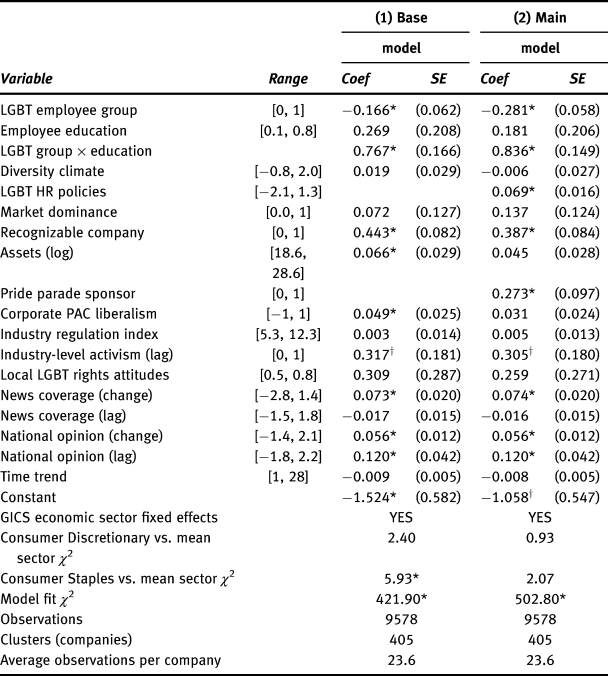
Table 1 presents the results of two different models. Model 2 includes all independent variables, while model 1 excludes variables that could be considered post-treatment. Because LGBT ERGs can influence LGBT HR policies and the likelihood of pride parade sponsorship, these two variables are excluded from model 2. Including these variables could absorb some of the effect of ERGs on activism. For the ERG × education interaction term, as well as the rest of the variables, the results are substantively similar between models 1 and 2. Adding in the LGBT HR policies and pride parade variables—both of which can arguably be affected by ERGs—does not significantly mitigate the association between ERGs and activism.
Multilevel regression models: Determinants of corporate LGBT rights activism

Each model is a multilevel linear regression, with random intercepts for each company. Robust standard errors are clustered by Census industry—the level at which employee education is estimated. Consumer Discretionary and Consumer Staples χ 2 are Wald-type tests to determine whether activism in these two consumer-oriented industries is statistically different from the average industry. Note:  $^\dagger p \lt 0.10$, *p < 0.05.
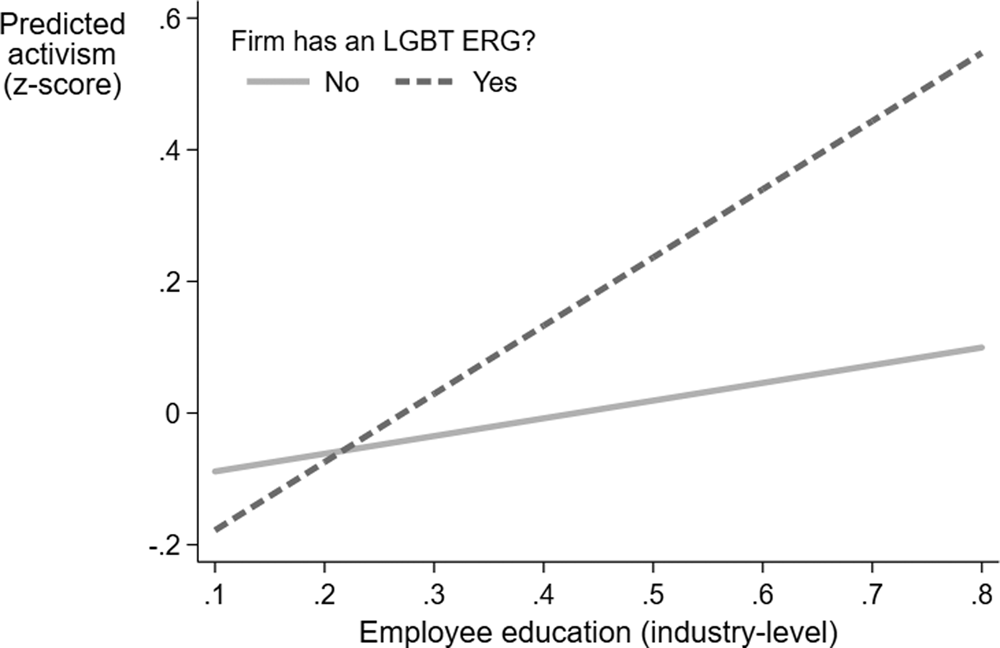
Figure 1 presents the marginal effects of the interaction between LGBT ERGs and employee education, as derived from model 1. Predicted activism is presented for companies with an LGBT ERG (dashed line) and without an LGBT ERG (solid line) at different levels of employee education. On average, companies without an LGBT ERG are around the mean level of activism (z-score of 0), regardless of employee education. Companies with an LGBT ERG are also near the mean level of activism if they have a low-skilled workforce. Only companies with LGBT ERGs in high-skilled workforces engage in any meaningful amount of LGBT rights activism, ceteris paribus.
Marginal effects of LGBT employee groups
Marginal effects are derived from the results of model 1. The predicted number of activist statements made in a given quarter (standardized) is estimated at different levels of employee education and whether the company has an LGBT employee group.

Companies with an LGBT ERG are predicted to have levels of corporate activism that are 0.55 standard deviations above the mean when they have highly-educated employees (where 80 percent of the workforce has a bachelor's degree). With 95 percent confidence, the estimated activism for companies with ERGs and a highly-educated workforce ranges between 0.32 and 0.77. This translates into one-tenth of a pro-LGBT public statement in any given quarter-year. When this number is multiplied by the twenty-eight quarters in the analysis, the model predicts that a company with an LGBT ERG and a highly-educated workforce will make roughly three pro-LGBT statements over the course of the time series, 2011 to 2017. Alternatively, companies without an LGBT ERG or those that do have an LGBT ERG but have a less-educated workforce are predicted to make between zero and one public statements between 2011 and 2017. As predicted, the association between ERGs and activism is entirely confined to companies with a high-skilled workforce.
Instead of employee education, we additionally conducted analyses using alternative economic contextual factors, each also obtained using IPUMS CPS data: unionization, employee wages, and the industry unemployment rate. None of these variables were statistically significant and substantively meaningful moderators of LGBT employee group effectiveness. We also interacted the ERGs variable with GICS economic sectors. The association between ERGs and activism is not statistically significant in the consumer-oriented economic sectors (discretionary and staples). The fact that only employee education is a moderator of ERG effectiveness lends credence to our theory. This evidence suggests that other market factors do not condition the association between ERGs and activism, but education—because it captures bargaining power, moral policy preferences, and sophisticated political participation—does. However, our methods prevent us from nailing down the specific mechanisms behind the statistical association between highly-educated employee groups and corporate activism that we identify.
We find mixed support for other explanations of CPA on social issues that give greater weight to market forces, political strategy, or social context; although we do acknowledge the imprecision in categorizing variables with one framework over another when some variables could be categorized with multiple frameworks.
With respect to market forces, only the recognizable company and pride parade sponsor variables are statistically significant and have a substantively meaningful coefficient. Recognizable companies are 0.3 to 0.4 standard deviations more active. Companies that sponsor pride parades are 0.3 standard deviations more active. Surprisingly, the market dominance and assets variables have small coefficients and large standard errors. Larger companies and companies that command a large share of their industry are no more likely to make public statements in support of LGBT rights.
Another way to test for the market forces explanation is to compare the marginal effects of the Consumer Discretionary and Consumer Staples economic sectors to the average industry—in other words, test for whether economic sectors with an incentive to court liberal customers are more active on LGBT issues than average. These χ 2 tests are included at the bottom of table 1. Contrary to the expectations of the market forces explanation, consumer-oriented economic sectors do not engage in higher levels of LGBT rights activism than average. The exception is in model 1, where the Consumer Staples economic sector is more activist than the average economic sector—as the statistically significant but weak χ 2 value indicates.
The results of the political strategy variables are also striking; political context does not seem to have any correlation with LGBT rights activism, ceteris paribus. Since the coefficient on the corporate PAC liberalism variable is not meaningfully large relative to its range, it appears to be the case that companies’ existing relationships with political parties are orthogonal to their propensity for activism on LGBT rights. Also insignificant is the association between government regulation and activism.
Finally, there is minimal support for the notion that corporations take activist stances in response to social context. First, results indicate that when all companies within a firm's industry are active on LGBT rights (industry activism = 1), firms increase their activism by roughly 0.3 standard deviations when compared with when no companies are active (industry activism = 0). This relationship is only statistically significant at the 0.10 level. However, since it is very rare for every company within a firm's industry to be active on LGBT rights, the substantive association is quite minimal. Second, the coefficient on local LGBT rights attitudes where the corporation is headquartered is indistinguishable from zero. Third, neither LGBT news coverage nor approval for same-sex marriage have a statistically significant and strong association with activism.
Since the analysis is at the company-quarter level, the coefficients are small. In any given quarter, the likelihood of activism is minimal. Therefore, the roughly 0.3 standard deviation increase in activism that is attributed to LGBT ERGs in high-skilled workforces is substantial. The only other variables that consistently have a meaningful association with activism are the recognizable company and pride parade sponsorship variables. To summarize our results, we find that companies that have LGBT employee groups in highly-skilled workforces, companies with a recognizable brand, and companies that sponsor LGBT pride parades engage in the most LGBT rights activism.
Robustness checks and threats to casual inference
In examining the conditions that foster corporate activism on LGBT issues, we lack a natural experiment or as-if-random variation that would strengthen claims of causality. Since our ability to draw a causal conclusion is limited by our descriptive methods, the analysis presented in the previous section is only exploratory by nature. The results leave open the possibility of a causal interpretation but we cannot definitively infer causation given our methods. One limitation of our methodology is that we are not explicitly able to model the data generating process behind employee groups due to their limited time series variation. Theoretically, many of the external forces discussed in the literature review (especially market forces and social context) might be able to explain the creation of ERGs. Our analysis is also not able to determine which of the three plausible mechanisms explain why the association between ERGs and activism is conditional upon education. Although, the three mechanisms—employee bargaining power, moral policy preferences, and political participation with convincing arguments—are not necessarily mutually exclusive.
In Online Appendix B.1, we attempt to address various threats to causal inference to the extent possible with observational data and little time series variation in ERG presence. The first set of analyses is a placebo test, comparing LGBT rights activism to immigration activism. LGBT ERGs have no association with immigration activism and the results of model 2 still hold even after controlling for immigration activism. In the second set of analyses, we use alternative ways of measuring ERG presence to (1) try to rule out reverse causation and (2) compare companies that want ERGs but don't have them to companies that do have them—in a design that very loosely approximates a regression discontinuity.
In the third set of analyses within Online Appendix B.1, we attempt to deal with other potential sources of endogeneity in the form of omitted variable bias. There are at least three ways that the presence of LGBT employee groups might be endogenous to corporate LGBT rights activism. First, corporations in industries with a larger LGBT population are more likely to have ERGs and engage in activism. Second, corporations in industries with greater support for LGBT rights are more likely to have ERGs and engage in activism. Third, companies with a history of supporting diversity—and LGBT employees specifically—are more likely to have ERGs and engage in activism.
Online Appendix B.2 describes a number of further robustness checks. In the appendix, we demonstrate that the association between employee groups and activism at high levels of education exists for both soft and hard forms of activism. We also employ alternate specifications of the CEI variables (ERGs and HR policies), the employee education variable, and the corporate ideology variable. Additionally, we add variables to our model capturing a firm's consumer-orientation and show that our results are robust to the exclusion of business-to-consumer companies. Finally, we show that our results hold if we instead analyze corporate activism using a logit, negative binomial, or Cox event history model. For every model, marginal effects of LGBT ERGs at various levels of employee education are presented in Online Appendix B.4.
Discussion and conclusion
Why would corporations leverage their “privileged position”Footnote 63 in the policymaking process in order to support the liberal side of controversial moral policy issues? Do they do so in response to external forces, or do they do so in response to the desires of internal organizations? Although only preliminary, our analysis suggests the latter: Pressure from well-organized and educated employees is a more powerful motive of corporate activity on LGBT rights. We identify ERGs as an important mechanism through which LGBT employees gain access to management and can convince them of the strategic economic benefits of taking a stand in support of LGBT rights. Neither the market forces, political strategy, nor social context explanations are sufficient to fully explain corporate activism. Although each does play an important role, since employee groups will use political, social, and especially market-based arguments to convince their managers to engage in activism.
Our theory development and analysis have implications for both the study of organizations and the study of American politics. Research by Meyerson and Scully and Negro and Olzak suggests that there is a trade-off between outward displays of LGBT identity and being able to accomplish social change.Footnote 64 As we've argued, many LGBT ERGs are able to navigate these multiple identities and audiences to successfully persuade their managers to publicly advocate for LGBT rights. But importantly, their success is conditional upon high levels of education among the workforce. Employee groups in educated workforces have more bargaining power, are situated in a context where others outside of the group are more receptive to LGBT rights, and are more likely to make credible arguments that are persuasive to management.
This study also expands our broader understanding of the role of business in American society. Since we find evidence in support of the notion that LGBT ERGs can explain variation in LGBT rights activism, this means that corporations are often taking pro-LGBT public stances in a genuine effort to change public policy. Corporations are multidimensional entities; “business” is not a conservative monolith.Footnote 65 Looking within corporations broadens our ability to understand the motives of their political activity.
Future research should investigate the forces that give rise to corporate activism on other social issues. However, the theory and results from this study suggest that activism will be limited to issues that affect a corporation's employees. Employees—and employee groups more specifically—are a primary medium through which managers become aware of the importance of different political struggles affecting marginalized people. Employee groups pressure their employers to advance the rights of marginalized people by using economic arguments that suggest that activism can help firms recruit customers and employees. Therefore, we should expect corporations to only engage with social issues when doing so can benefit their employees—because employees are a key mechanism through which corporations become aware of different social issues. In line with this notion, a working paper has found that corporate activism on moral policy is limited to identity-based social issues like LGBT rights, racial justice, and immigration—and not on issues like abortion and gun control.Footnote 66 Issues such as abortion and gun control have not historically been discussed regularly in the workplace so employees may be less likely to pressure managers to speak out on them.
To be sure, market-based explanations are necessary—although not sufficient—to explain patterns in corporate activism. Companies with a brand name that is recognizable to consumers are more active on LGBT rights. Since the American public will pay greater attention to the actions of recognizable companies, these companies have a greater economic incentive to be active on LGBT rights, seen as LGBT-friendly, and keep their brand name in the minds of consumers.Footnote 67 Companies that sponsor pride parades are also more active on LGBT rights, which is consistent with what we would expect if companies are active as a part of their overall effort to advertise themselves to the LGBT community. Interestingly, we do not find consistent evidence that companies in consumer-oriented economic sectors are more likely than those in non-consumer-oriented economic sectors to be active on LGBT rights. However, this is less surprising after examining the list of companies active on LGBT issues, which includes defense contractors and pharmaceutical companies.
We find little evidence that corporations engage in political activity on social issues to curry favor with political leaders. In other words, corporate activism on LGBT rights seems orthogonal to a corporation's existing orientation toward politics. Neither the ideology of a corporation's PAC nor the intensity of a corporation's regulatory environment meaningfully correlates with levels of corporate activism. We also find only minimal support for the notion that corporations are responding to social context—as measured by industry-level activism, local and national public opinion, and national news coverage.
More broadly, our results point to the limits of the conventional wisdom that external factors, such as the desires of consumers, wholly motivate corporate political behavior. Undoubtedly, keeping and expanding a company's consumer base is one important explanation for CPA on moral policy. But the publicly-owned corporations that we study also appear to view moral policy engagement as necessary to their efforts to recruit and maintain a diverse workforce. Companies are acceding to the demands of educated and organized LGBT employees; recognizable companies want to attract and maintain a diverse set of employees and their activism is likely effective at attracting consumers; and companies sponsor LGBT pride parades to attract a diverse set of employees as well as customers.
Supplementary material
To view supplementary material for this article, please visit https://doi.org/10.1017/bap.2020.5.