Although Kubrick is normally treated as an artist who deals in big, important ideas, the key to his style lies in his anxious fascination with the human body.Footnote 1
The animal brain is sensory and physical; communication and decision making are expressed through the body, which conveys affects relating to fear, pain, threat, pleasure, and aggression. The animal brain constitutes one form of intelligence that is often regarded as inferior in comparison with the human brain. Yet 2001 does not fall prey to this judgment.Footnote 2
In case anyone might question the need for another contribution to the vast literature on Kubrick's 2001: A Space Odyssey – which now includes no less than seven monographs or single-themed compilations alongside countless articles and chapters – Robert Kolker puts the case pretty well in his editorial introduction to a 2006 collection of ‘new essays’ on the film:
The power of 2001 lies in the fact that it can have no conclusion. It is the perpetual generator of the imagination, taking us on its journey every time we join it, stimulating with its imagination the imagination of others, making meaning, making us continually want to find meaning, and eluding us every time.Footnote 3
Such insistence on open-ended, reader-based interpretation might seem, by now, a standard critical trope. But if I find Kolker's introduction a useful launching pad for another pass through 2001 it is not just for its avowed faith in interpretative indeterminacy, but for its vivid illustration of just how hard it is to sustain that faith in the face of a work that, as Michel Chion once put it, ‘holds up a mirror to our perpetual temptation to project’.Footnote 4 For the purposes of this essay I am primarily concerned with a single instance, which emerges when Kolker turns to the pivotal Jupiter Mission episode and asserts that the famous HAL 9000 computer is ‘2001's great enigma: a machine with intelligence and consciousness. A machine with feelings – in fact more feelings than any of the human characters inhabiting the film.’Footnote 5
It seems from the blunt ‘in fact’ that Kolker is not even aware that his last, comparative assertion (‘more feelings’) is itself a ‘projection’ that presumptively resolves part of the enigma of HAL. And it is easy to understand why this might be the case. A shuffle through previous commentary finds that ‘the facts’ about HAL's emotions have been rehearsed so often as to become an unquestioned trope in most readings of the film. In a 1973 film guide, for example, Carolyn Geduld adumbrated the emerging consensus when noting some variance between the film and Arthur C. Clarke's later novelization, affirming that ‘although there is no question that Kubrick's HAL has “feelings”, the issue is clouded in Clarke's account’.Footnote 6 Within more recent literature we find, for example, that for Alexander Walker HAL is ‘the most “human” personality in the entire film […] the repository of the old stock of human emotions so carefully drained out of his scientific minders’, while for Thomas Allan Nelson he has an ‘expressive humanity superior to that of sentient travellers separated from the familiar domesticities of Earth’.Footnote 7 All such assertions, finally, can claim surprisingly clear support from the auteur himself. Although generally reluctant to explain his films, Kubrick blithely sketched out some creative intentions and plot details in a 1970 interview:
One of the things we were trying to convey in this part of the film is the reality of a world populated – as ours soon will be – by machine entities who have as much, or more, intelligence as human beings, and who have the same emotional potentialities in their personalities as human beings. We wanted to stimulate people to think what it would be like to share a planet with such creatures. In the specific case of HAL, he had an emotional crisis because he could not accept evidence of his own fallibility.Footnote 8
That initial reference to ‘emotional potentialities’ may be somewhat oblique, but the later invocation of ‘an emotional crisis’ seems unequivocal. Surely this authoritative support for the consensus about HAL's feelings renders any accusation of ‘projection’ on this point rather perverse.
The problem is that while Kubrick's words to a journalist may have been perfectly clear, they are flatly contradicted by the way his film, after meticulous formal preparation, pointedly frames an unanswerable question about this very issue. Early in the Jupiter Mission, after several long external views of the spaceship Discovery have led, in turn, to a spatially disorienting presentation of the astronauts in its circular interior, we first meet HAL through a BBC interview recorded shortly before. Following several exchanges with Frank Poole and Dave Bowman, the interviewer turns to HAL, whom he has just described as ‘the latest result in machine intelligence […] which can reproduce, though some experts still prefer to use the word mimic, most of the activities of the human brain’.Footnote 9 The equivocation about ‘mimicry’ carries on into a conversation about one particular ‘activity of the human brain’. Ultimately, a direct question – ‘do you believe that HAL has genuine emotions?’ – elicits a reply that refuses to resolve the initial doubt. ‘Well, he acts like he has genuine emotions,’ says Bowman. ‘Of course he's programmed that way to make it easier for us to talk to him. But as to whether or not he has real feelings is something that I don't think anyone can truthfully answer.’ A cut back to an external view of the ship and a resumption of the Khachaturian Adagio that had accompanied its first appearance combine to punctuate that last sentence, lending it the formal weight of a textual interpolation in a silent film: ‘whether or not HAL has real feelings is something no-one can truthfully answer.’
It would be absurd to suggest that everyone who has presumed to answer this question has simply been mistaken. But the degree to which a belief in the ‘feelings’ HAL expresses through his acousmatic voice has effaced Dave's doubt stands as a vivid example of the way ‘the things that people think are apparent in the film’ (as Chion puts it) inflect interpretations of the rich ambiguities it actually contains. Indeed, in his strongest example of this tendency, Chion singles out another question – the cause of HAL's murderous insanity – that might also seem decisively resolved by Kubrick's words to his interviewer. But while references to the computer's inability to ‘accept evidence of his fallibility’ have also become a commonplace, ‘the film’, Chion notes, ‘tells us nothing about this’ – and actually leaves this question, like that about HAL's ‘genuine emotions’, unanswered.Footnote 10
Given the paratactic nature of filmic narrative, Chion's literalist invocations of manifest content may carry a whiff of wilful naïveté. But the value in an attempt to reopen the narrative gaps around these particular points should be clear once we note how pervasively assertions about HAL's ‘human’ emotions bring with them starkly contrasting views about the ‘dehumanized’ astronauts – and thus a broadly negative sense of the place of modern homo sapiens in the film's epochal trajectory from prehistoric ape to post-human ‘star child’. Arguably, many of these sweeping references – say, to the astronauts’ enthralment to ‘scientific rationalism’, or their ‘alienation from their bodies’, or their rejection of ‘noninstrumental selfhood’ – depend on oddly selective readings of what is actually ‘in the film’ (to borrow again from Chion).Footnote 11 But given that every reading will be selective to some degree, rather than challenging such notions point by point it is better if I note that my own attempt to reopen 2001's interrogation of machine and human ‘selfhood’ begins from a perspective closer to that articulated long ago by Annette Michelson, in an influential 1969 article she herself characterized some decades later as ‘an opening move in what was to develop as a claim for a cinema of modernism’.Footnote 12
Registering exceptional caution in noting that HAL ‘acts as though he has feelings, as one astronaut remarks’ and pre-empting inappropriate certainties about the film with her sense of ‘doubt elevated to an esthetic principle’, Michelson gave particular focus to the film's challenge to an embodied, ‘carnal’, and physical kind of knowledge:
The intensified and progressively intimate consciousness of one's physicality provides the intimation of that physicality as the ground of consciousness. The film's ‘action’ is felt, and we are ‘where the action is’. Its ‘meaning’ or ‘sense’ is sensed, and its content is the body's perceptive awaking to itself.Footnote 13
It is easy to understand, from that emphatically universal ‘we’, why Michelson later noted a need for qualifying ‘theoretical considerations’. But from the even more up-to-date perspective of a time in which various scholars have debated the possibility that ‘the age of “high” theory has passed’, this early emphasis on ‘the corporeality of this cinema’ and on ‘the body's perceptive awakening to itself’ can provide a crucial, carnal standpoint from which to reopen the question of the conflict between machine and human ‘selfhood’ at the crux of 2001's evolutionary trajectory.Footnote 14
Still, there is a more basic problem with Michelson's account, which emerges clearly when she writes, for example, that in 2001 ‘[v]iewing becomes, as always but as never before, the discovery, through the acknowledgment of disorientation, of what it is to see, to learn, to know, and of what it is to be, seeing’; or again: ‘The film's reflexive strategy assumes the eye as ultimate agent of consciousness, reminding us, as the phenomenologist will, that art develops from the concern with “things seen to that of seeing itself”.’Footnote 15 Elegant as it is, this claim for an exemplary cinematic modernism clearly rests on a one-sided sense of the multimedia interaction, which wholly overlooks the role of ‘hearing’, ‘the ear’, and ‘things heard’ in the ‘reflexive strategy’ of 2001. This amounts to a significant aporia in an account of the film's challenges to ‘physicality as the ground of consciousness’, given that music and sound have conventionally been understood to play a pivotal role in imbuing seen bodies on screen with an empathetic interiority, and in ‘suturing’ those illusory subjectivities, however contingently, to the bodies in the cinema.Footnote 16
This essay outlines a new interpretation of the Jupiter Mission that supplements Michelson's emphasis on physicality with a more careful attention to the reflexive use of music and sound. In re-establishing the crucial importance of the question of HAL's feelings to the climactic struggle between human and machine, I will suggest, in turn, that a reframing of this issue opens fresh perspective on the film's broadest implications, including the Nietzschean subtexts often extrapolated from its most famous musical cue, the fanfare from Richard Strauss's Also sprach Zarathustra.Footnote 17 Here again the argument covers well-worn ground. The 2001 score – which also includes the ‘Blue Danube’ waltz by Johann Strauss jr and several extracts from what were then relatively recent works by György Ligeti – has long held pivotal status in histories of film music and has received close interpretative scrutiny from, for example, Chion and David Patterson.Footnote 18 But I think there is still much to be said about the degree to which this famous ‘compilation score’ realizes a possibility adumbrated long ago by Adorno and Eisler:
Roughly speaking, all music, including the most ‘objective’ and nonexpressive, belongs primarily to the sphere of subjective inwardness, whereas even the most spiritualized painting is heavily burdened with unresolved objectivity. Motion-picture music, being at the mercy of this relationship, should attempt to make it productive, rather than to negate it in confused identifications.Footnote 19
The intractably broad reference to ‘all music’ somewhat undercuts the potential for such an exhortation to inspire specific critical insight. But a more precise attention to the ‘identifications’ suggested through the deployment of the particular kind of lyricism most iconically expressive of ‘subjective inwardness’ can fruitfully aid a pursuit of the questions of subjectivity and selfhood that attend Dave's doubt about HAL's feelings – and open a critical path, in turn, through the successive confrontations with corporeality and consciousness across 2001's whole transhistorical trajectory.
Invitation to a rehearing
The Jupiter Mission section of the film, which includes two snippets of source music (‘Happy Birthday’ and ‘Daisy Bell’), features a single piece of pre-existing music as underscoring. The Adagio from Aram Khachaturian's ballet Gayane starts with the initial titles and continues uninterrupted for nearly three and a half minutes across several visual cuts, before falling silent just before the interview scene. The same music then begins again at the end of the interview and unfurls an even longer continuous span through a new series of scenes. It is easy enough to understand why this piece, which is never heard again after these two appearances, has remained the least discussed of all the pre-existing works in the 2001 soundtrack. Unlike the famously obtrusive excerpts by the two Strausses or all the otherworldly swathes of Ligeti, Khachaturian's meandering, post-Romantic string phrases can quite easily remain more or less ‘unheard’ (to borrow Claudia Gorbman's influential formulation) as a generic instance of affective underscoring. But while there is broad agreement about what has variously been described as the ‘desolate’, ‘elegiac’, or ‘melancholic’ affect of the Adagio, no similar consensus has emerged about the precise locus or origin of that affect within the imagery on view.Footnote 20
No doubt it would seem easiest just to leave this question open, with a view to the spatial indeterminacy that Chion, for one, has emphasized as a fundamental aspect of music's contribution to film. But a sense that there is something of greater critical interest to discern in these successive spans of image–music interaction can find support in the sheer range of responses that have been offered before. If these are ordered along a rough spectrum according to the perceived strength of the link between sound and image, we find at one extreme Chion's suggestion that:
This melancholic interlude illustrates how contingent film music really is, since it does not allow us to forget, as we hear it over the images of the Discovery, that all sorts of other pieces of music would have been possible. […] This piece helps to give the scenes a discreetly poignant sense of solitude, but it still does not become one with the images. It remains apart, alongside, creating an atmosphere all by itself.Footnote 21
This is but one instance of Chion's pervasive emphasis on both the ‘horizontal’ discontinuity in the succession of disparate works across the score and the ‘vertical’ disunity of its ‘forced’ local superimpositions of music and image.Footnote 22 But many other critics, finding it easier to hear the Adagio as at ‘one with the images’, have generally been quite content to associate its affect with the astronauts' sense of ‘isolation and strain’, the ‘extreme boredom of deep space travel’, or the ‘empty and monotonous existence aboard the Discovery’.Footnote 23 And at the other end of the spectrum, Patterson, who discerns an esoteric continuity running from the ‘harmonic series’ of Strauss's Zarathustra fanfare and through the melodic incipits of all the tonal excerpts in this film, also proposes an even more intimate linkage between the Khachaturian and the imagery it first accompanies. Noting a precisely synchronized cut in the music (from two- to three-voiced texture) and imagery (a first glimpse of HAL's red eye, in which Dave is reflected), he reads this ‘strategic manipulation’ of imagery and music as a formal identification of the computer as a true ‘third member’ of the ship's ménage à trois.Footnote 24
None of these is a wholly satisfying interpretations of the crafty, formally suggestive deployment of this excerpt in the film. Chion's claim that ‘all sorts of other pieces would be possible’ seems cavalier after his comments on the lengthy editing process, during which Kubrick ‘tried out many solutions and many different musical pieces’. Even if some ‘incessant doubts’ were never resolved, it would be more in line with Chion's own strictures to think carefully about the music that did end up ‘in the film’ rather than invoking infinite options that did not.Footnote 25 Patterson is more attuned to the potential of the compilation score to provide one strand of a truly hybrid medium, to be ‘worked’ like sculpture (as Alexander Walker once put it) during the editing process that Kubrick revered as the most distinctive aspect of his art.Footnote 26 But his mapping of musical voices onto characters seems inconsistent (the expansion from one voice to two occurs across a cut between two external views), and his reading also fails to account for the exact repetition of the Khachaturian excerpt, soon after the first few Jupiter Mission scenes, to accompany new images. Each instance of such typically Kubrickian repetition poses a distinct challenge to reflection about how the music serves the whole aggregate of scenes it successively underscores.Footnote 27
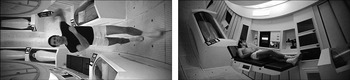
The common association of the music's affect with the astronauts seems to me the least convincing reading of all. Apart from a sense of inappropriate ‘projection’ (presumptions about boredom seem misplaced, given that these men are clearly fulfilling roles for which they strenuously trained) it is worth recalling the original conception of this scene. As Jeremy Bernstein noted in the New Yorker profile he wrote after visiting the 2001 set in 1965, Frank's exercise in the Discovery centrifuge was accompanied on set by ‘a Chopin waltz – picked by Kubrick because he felt that an intelligent man in 2001 might choose Chopin for doing exercise to music’.Footnote 28 The ‘temp track’ thus evinced a strong connection between music and astronaut, embracing both physical activity and some hint of ‘subjective inwardness’.Footnote 29 But with his final choice of music, Kubrick severed this close association with human subjectivity. Indeed the first appearance of Frank exercising in the centrifuge seems blatantly dissociated from the stately unfurling of the Adagio – an impression soon further reinforced by the aural counterpoint between the music and the sound of breath and footsteps that swells and fades as he jogs towards and away from the camera. The separation between music and human subjectivity is further underlined with the music's second appearance, which begins just before a cut to Frank prone on a sunbed in shorts and ludicrous orange sunglasses (01:01:18) – a matter-of-fact vision of ‘the body beautiful’ just as hard to link to the melancholic strings as was the earlier activity (see Figure 1).
(a) Frank's first appearance, exercising in the centrifuge; (b) Frank ‘sunning’ himself and watching/listening to the message from his parents.

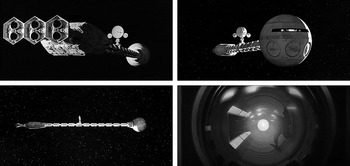
Rather than taking such blatant disjunction between underscoring and visible humanity as support for Chion's sense of total separation between music and image, an alternative interpretation might begin by accepting that Khachaturian's lyrical strings do seem archetypically redolent of ‘subjective inwardness’ and then attending carefully to the way in which Kubrick's camerawork and editing frame a different locus of this interiority. Such guidance begins immediately with the first entry of the Adagio beneath the title – ‘Jupiter Mission: 18 Months Later’ – that appears across starry space just after the end of the prior episode in the moon crater (00:52:27). Within seconds the Discovery begins sliding into view, heading slowly into the depths beyond. The full minute required for its length to appear gives us plenty of time to register the oft-noted anthropomorphic shape of a bulbous head and long, segmented spine. No sooner have the rear rocket cones emerged than our perspective from behind, ‘over the shoulder’ of this creature, is replaced by an even more blatantly subjective view. Just after the entry of the Adagio's second melodic voice, a cut brings us before the face of the spherical skull, its lit window atop three circular ports like a Cyclopean eye over multiple mouths.Footnote 30 For a few seconds we observe this skull ‘face to face’ on its oblique approach. Then, before we enter the centrifuge, a second cut draws us back for a last, sidelong view of the skeletal shape threading its way across the screen (see Figures 2a, 2b, and 2c).
Scenes from the start of the Jupiter Mission, edited to Khachaturian's Adagio: (a) ‘over the shoulder’ of the Discovery; (b) ‘face to face’ subjective shot; (c) final sidelong presentation (compare with (d) sidelong presentation of the fully embodied Dave, as reflected in HAL's eye).

This whole ‘strategic manipulation’ of eye lines and perspectives (to borrow Patterson's terms) reads like a pointed invitation to associate the affect of the underscoring with the ‘subjective inwardness’ of the ‘body’ it accompanies from its very first appearance, rather than the astronaut whose activities – exercising and sunbathing – seem so at odds with the same music when he belatedly appears. But the ‘subjectivity’ of the Discovery is, of course, HAL – indeed, the studied presentation, shot by shot, of the ‘skull and spine’ receives a verbal corollary when the BBC interviewer addresses HAL as ‘the brain and central nervous system of the ship’. If the editorial sculpting of this episode suggestively links the music's melancholy to the ship's computerized subjectivity, does this not offer a clear response to the question raised in the same episode about HAL's ‘real feelings’? The answer, I think, is yes and no. It is by teasing out the contradiction that arises from the invitation to hear the Khachaturian as some version of ‘HAL's emotions’, even while his capacity to feel such things is expressly put in doubt, that we can discover the outlines of a new interpretation of the Jupiter Mission plot, and in turn of the film's deepest subtexts.
An interpretation and one main offshoot
In any attempt to rehear the Khachaturian as a distinct choice from amidst all possible musical bearers of melancholy, Chion's sense of a ‘discreetly poignant’ affect is not a bad place to start.Footnote 31 The generically gloomy affect of this minor-mode meandering is clear enough, but the understated reticence that hovers just this side of expressive blankness – hence the common references to ‘desolation’ or ‘alienation’ rather than anything more plangent – renders it wonderfully apt for the paradoxical task of conveying a melancholy about an inability to ‘really feel’ anything at all (including melancholy). In this light, Kubrick's decision to cut back to the ship's exterior and begin the second occurrence of the underscoring right after Bowman's expression of doubt reads like a blunt reinforcement of the paradox. When this repeat of the Khachaturian then continues through a video message to Frank from his parents, the Adagio comes into ironic counterpoint with the expressions of familial affection, and the singing of ‘Happy Birthday’, that end the broadcast – which has, of course, passed through HAL's own circuits.
If this rich counterpoint between televised voices and extradiegetic music might already invite thought about the unspecified causes of HAL's ‘neurosis’, further reflection is needed to open up the broadest implications of the whole sequence. Looking back, it is possible to see the disconnect between Frank's exercise and the music not only as an invitation to question the locus of the inexpressible melancholy but also as a hint at one of its causes. Even before the sunbed scene projects through HAL some of the human emotional interaction that is inaccessible to him, this initial scene emphatically presents a fully embodied existence just as tellingly absent from his own experience. Here again it is crucial to note what is actually ‘in the film’, for any reference to the ship's ‘gigantic body’ – or any comparison, for example, with a ‘strange insect or deep-sea creature’ – is problematic if it ignores the lack of limbs that renders the ship a disembodied brain and spine, whose slow forward drift is starkly juxtaposed against the astronaut's vigorous exercise of legs and arms.Footnote 32 We should thus think again about the psychological undertones we are invited to share when hearing Frank's breath and footsteps (aural markers of embodiment) from the disembodied viewpoint of one of HAL's interior eyes (00:53:55) – and then again when, with our first glimpse into one of those eyes (and the final textural expansion of the Khachaturian), we see reflected what he sees: the flexing starfish of human limbs, as Dave crawls through one of the ship's rotating passageways (00:55:03) (see Figure 2d).
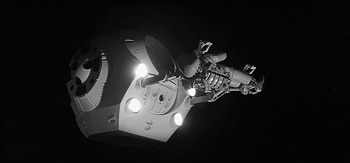
The elusive placement of the Khachaturian, the poignant discretion of its affect, and the particular sequence of images with which it is juxtaposed all add up, I would argue, to a pointed framing of HAL's alienation from embodied emotional experience. As stated, this is no more nor less a ‘projection’ of meaning than any other reading. But a reconsideration of these scenes in these terms can inform a reinterpretation of the entire film, up to its last image of the star child in space. As an immediate offshoot consider, first of all, the climactic conflict between human and computer that begins with an unforgettable visual variation of the Christian Pietà (01:37:01). Cradling Frank's dead body in a space pod's mechanical arms, Dave, outside the Discovery, orders HAL to ‘open the pod-bay doors’ (see Figure 3).
A twenty-first-century Pietà: Dave cradling Frank's body in the space pod's arms.

Perhaps there is already a faint irony to be sensed in the clichéd invocations of emotion that begin HAL's unctuously polite refusal: ‘I'm sorry, Dave, I'm afraid I can't do that’.Footnote 33 But it is through the sequence of scenes that ensues once Dave relinquishes Frank's corpse into the silent blackness of space and turns to do battle with HAL that the film more decisively undercuts all assumptions about the computer's superior humanity. To be sure, when HAL gently reminds Dave that his plan to enter through the emergency airlock will prove difficult without his forgotten space helmet, the requirements of the human organism seem to pose a serious disadvantage. But the very existence of this airlock – a mark of the fallibility of machines, built right into HAL's limbless body – signals an opposite truth about the power dynamic that now unfolds. Through the sequence of bodily actions by which Dave solves the problem and proceeds to victory over HAL the ensuing scenes insistently foreground, and highlight as pivotal to the film's larger message, the physical grounds of human ingenuity.
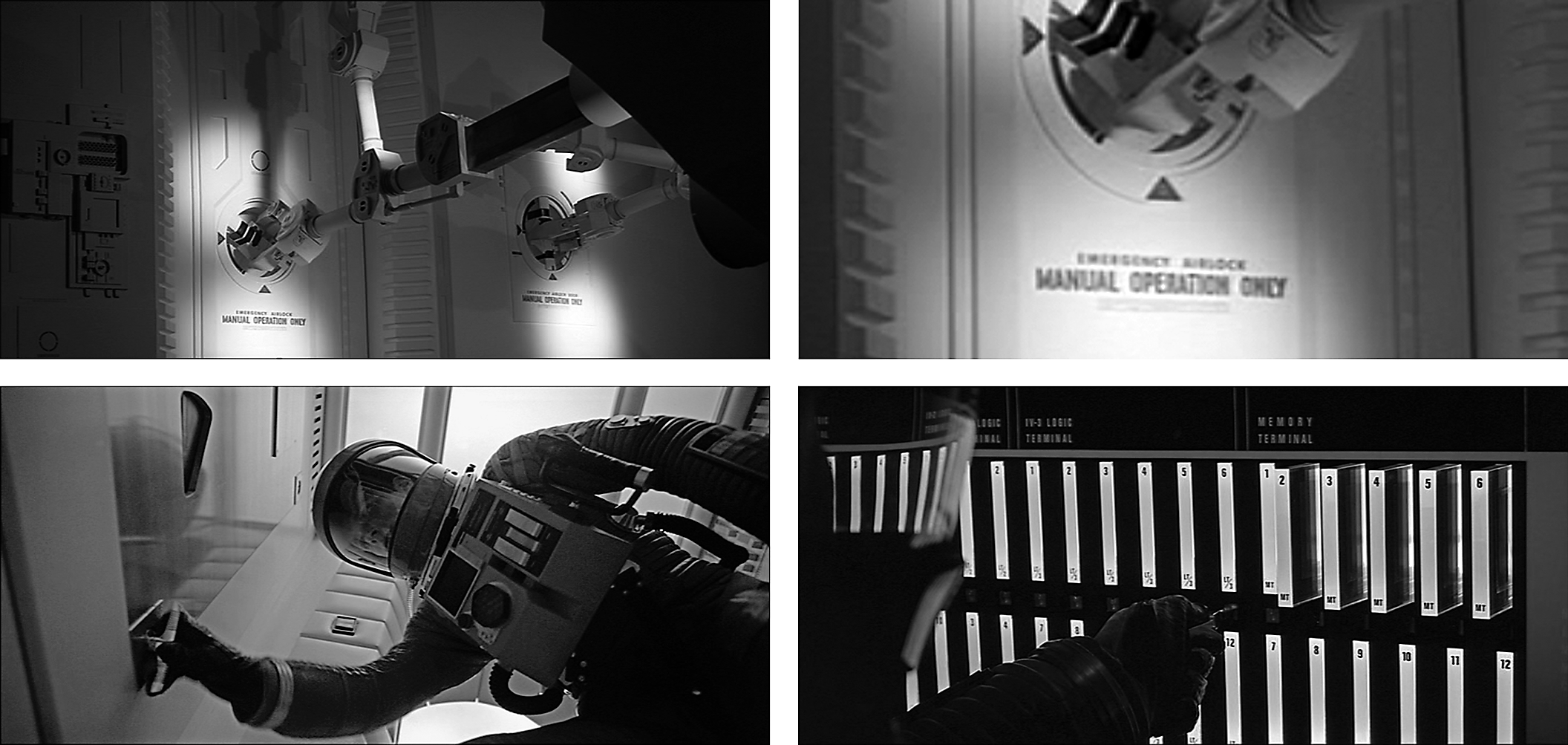
For the sake of argument it is worth spelling out each stage. First, Dave uses the space pod's mechanical arms to seize one of two rotating handles labelled ‘MANUAL OPERATION ONLY’ (01:42:00). A long take on the rising airlock door is the first of many instances of dogged focus on the physical realities whose negotiation requires ‘manual operation’. A more convulsive physical means – the explosive bolts on the space pod door – allows Dave to propel himself into the airlock, where he grasps the ‘emergency hatch close’ that seals him inside and infuses life-giving air. (Here we cut briefly to one of HAL's impotently watching eyes.) When a dissolve brings us forward to join the newly space-helmeted astronaut wending his way through the ship, we find that the silence of space has given way to the close-miked breath and hiss that link our bodies with his, and pose a wry counterpoint to HAL's once decisive voice now plaintively asking what Dave is doing. After Kubrick's handheld camera pauses briefly to watch the astronaut clamber up a ladder from below (the fleeting crotch shot a poignant image of awkward physicality), we rejoin him in an antechamber where he uses two hand-sized wrenches to unscrew the bolts, turn by turn, on the door panel of the ‘logic memory center’ (01:46:00). Lifting the levers that open the panel and clumsily clambering through, the astronaut embarks on a last ‘manual operation’ – now a more finely ‘digital’ one, using thumb and fingers – as he begins to unscrew the numbered units of HAL's brain with a small screwdriver (01:47:25) (see Figure 4).
The three ‘manual operations’ by which Dave secures his triumph over HAL: (a) the prosthetic turns that open and raise the ‘emergency airlock’ door; (b) close-up of (a) showing label ‘MANUAL OPERATION ONLY’; (c) the hand wrench that opens the ‘Logic Memory Center’; (d) the screwdriver that performs the ‘lobotomy’.

It has often been noted that 2001 is shot through with imagery of circular rotation – as in the cosmic hierarchy that extends, through the first half, from the interrelated orbits of the solar system, through the massive wheel of a half-built space station, to the centrifuge of the Discovery itself. It seems no one has yet been struck by the way this nested interplay of rotations extends down through the chain of human activities (prosthetic turning, full-fisted wrenching, fine-fingered unscrewing) by which Dave attains, and executes, the literally pivotal plot crux: the removal of a deflection, via machine intelligence, from an evolutionary trajectory from ape, to man, to post-human star child. The culminating emergence from the whole series of gestures is one of the most famous scenes in cinema. But consider how a new attunement to HAL's alienation from human feeling and embodiment can inform a hearing of the little song that is released as a dying memory of electronic infancy (01:49:15).
After dozily introducing himself, the computer offers to sing a song he had been taught by his programmer ‘Mr Langley’ years before. ‘Yes, I'd like to hear it HAL. Sing it for me’, Dave says breathlessly, as he proceeds with the lobotomy. The computer begins to sing ‘Daisy Bell’, his voice decelerating and descending in pitch against the steady hiss of the astronaut's breathing apparatus:
Just after completing this last line, the low growl breaks off, aurally marking a death also signalled by the activation of a new, prerecorded voice on an explanatory video elsewhere in the chamber.
While many commentators have found this the most poignant scene in a film largely devoid of empathetic invitations, at least a few have retained some doubt about HAL's ‘real feelings’ through the most seemingly sincere moments – including the halting incantation ‘I'm afraid / I'm afraid, Dave’, whose echo (just before the song) of the earlier phatic politeness carries an unmistakable trace of artifice (01:47:50).Footnote 34 As for the song itself, Patterson has offered the most extensive analysis. Finding this piece ‘the most awkward to contextualize within the narrative’, he rejects all ‘metaphoric’ readings as ‘unimportant, if not nonexistent’.Footnote 35 Suggesting that Kubrick's exhaustive researches for his soundtrack would likely have led him to an early recorded example of computerized voice synthesis that featured the same song, he proposes instead that HAL's ‘death aria’ operates in part as ‘a musical wink to the very few who might be technologically in-the-know’. And he also finds it an apt choice for even more arcane reasons, based on his sense that the intervallic content of its four-note incipit (‘Daisy, Daisy’) completes the thread of melodic continuity running from the Zarathustra fanfare through all other tonal excerpts.Footnote 36
Compelling as these proposals may be, their shared dependence on esoteric concerns available only to those ‘in-the-know’ – the history of voice synthesis, the harmonic series – seems at odds not only with Chion's cautions about what is apparent ‘in the film’ but also with Kubrick's oft-quoted claim that he intended his film ‘to be an intensely subjective experience that reaches the viewer at an inner level of consciousness, just as music does’.Footnote 37 To be sure, the director's dismissive reference to ‘verbal pigeonholing’ in the same interview might seem to uphold Patterson's rejection of metaphoric extrapolations from the song's words. But an argument that the richest ‘subjective experience’ springs from a hearing of music and words together can draw for support on countless other instances in Kubrick of song lyrics craftily – and at times ironically – deployed to encapsulate key themes or questions. (Think, for example, of Vera Lynn singing ‘We'll Meet Again’ against the mushroom clouds at the end of Dr Strangelove or of the interwar dancehall songs ‘Home’ and ‘It's All Forgotten Now’ heard as distant background to Jack's bathroom chat with Grady about domesticity and memory in The Shining.) The careful editing supports the sense that such verbal deepening of ‘pure’ musical experience is also in play here. Neither of Patterson's proposed subtexts requires a hearing of more than a few words of ‘Daisy Bell’. But Kubrick gives us precisely the whole chorus, maintaining audibility right through the tag line – ‘on a bicycle built for two’ – and meticulously underlining (shot by shot) how closely Dave is listening.
What, then, do we hear, with Dave? We hear a computer whose ability to experience ‘real feelings’ has been in doubt from the start, and whose inexpressible non-feeling about that inability has been conveyed from his ‘subjective inwardness’ to ours via Khachaturian's desolate strings … singing a song about love (‘… I'm half crazy, all for the love of you’). We hear an incomparably intelligent machine whose entrapment in a ‘fleshless vertebra’ dotted with impotent internal eyes has been defeated by the ‘manual operations’ of an embodied human being … singing of a different machine, back in a prelapsarian, physically collaborative stage of technological interaction (if you stop pedalling a bicycle you fall down).Footnote 38 In short, we hear the exposure of an extraordinary, thoughtless cruelty. In teaching HAL ‘Daisy Bell’, ‘Mr Langley’ had imprinted on the deepest layer of his subconscious – just where ‘higher brain functions’ give way to ‘automatic and regulatory systems’, as Dave put it to Frank in their chat about disabling the computer – a song that encapsulates the two realms of experience that most clearly define his alienation from full humanity: genuine emotion and embodied action.
However clearly Kubrick may have affirmed an ‘inability to accept evidence of fallibility’ as the main cause of HAL's breakdown, this ‘death aria’, the culmination of a sequence that begins (even before Dave's doubtful response to the interviewer) with the editing of the spaceship's first appearance to the Khachaturian Adagio, exposes an even more profound instability in a computer brain literally ‘imprinted’ with a perpetual subconscious reminder of its alienation from human identity. This alternative reading of the roots of HAL's neurosis also boasts some implicit support from Kubrick. In a 1968 interview for Playboy, when asked about the fate of ‘Romantic love’ in the modern age, he replies by describing ‘the basic love relationship’ as something ‘ingrained in man's psyche’ like a kind of ‘primitive emotional programming’ – a metaphor that gains new resonance in view of this new sense of the song as an ‘ingrained’ layer of HAL's ‘programming’. The sense of subtextual implications only deepens when Kubrick, invoking ‘the family’ as ‘the most primitive and visceral unity in society’, further elaborates:
Perhaps man has been too ‘liberated’ by science and evolutionary social trends. He has been turned loose from religion and has hailed the death of his gods; the imperative loyalties of the old nation-state are dissolving and all the old social and ethical values, however reactionary and narrow they often were, are disappearing. Man in the twentieth century has been cut adrift in a rudderless boat on an uncharted sea; if he is going to stay sane throughout the voyage, he must have someone to care about, something that is more important than himself.Footnote 39
‘If he is going to stay sane …’ – well, the only one who fails to stay sane on this voyage through uncharted space is HAL. However cool and controlled these men may seem as they go about their professional tasks (and interact with relatives across vast temporal and spatial distances), it is not the astronauts who fail to maintain their grip on a coherent subjectivity, but rather the creature bereft of a ‘primitive and visceral’ attachment to a family, whose potential to care about anything at all has been shadowed from the start by a suspicion of pre-programmed mimicry. Perhaps an inadmissable fallibility will always be part of a rational explanation for this failure. But the path opened into more elusive realms of subjective interiority by the restrained lyricism of the Khachaturian Adagio suggests even deeper causes for HAL's murderous turn on his fellow crew members, whose human bodies and ‘emotional potentialities’ stand as perpetual reminders of everything he is not.
Broader implications
The implications of this revisionist account of a single episode extend out to touch many of the central debates about 2001. On one closely delimited critical terrain, for example, I think of Michael Mateas's discussion (in an essay in Kolker's recent volume) of HAL's exemplary status in the development of ideas about artificial intelligence (AI). As is well known, during work on this film Kubrick consulted with Marvin Minsky, a pioneering AI researcher whose enthusiasm for his subject extended to contempt for the ‘accident of history’ that had embedded abstract mental processes in the ‘organic brains of human beings’. From a rereading (and rehearing) of the Jupiter Mission episode I would now say that Kubrick's film ultimately articulated a vivid critique of this scientistic disdain for embodied ‘meat machines’ – thus, in a sense, prefiguring a later, ‘interactionist’ stage of AI research which, as Mateas describes it, would acknowledge the complex interplay of bodily and mental processes in any consciousness worthy of the name.Footnote 40
In a broader view this invitation to listen again to Dave's doubt about ‘real feelings’ and look again at the ‘manual operations’ by which he defeats HAL must inspire sceptical reappraisal of those identity-critical readings which, framed in the theoretical terms of a later phase of film studies than Michelson's ‘late modernist’ essay, presumptively associate Kubrick's astronauts with a hyper-rational, anti-corporeal, anti-emotional (and thus misogynistic and homophobic) ideal of masculinity.Footnote 41 Of course it would be absurd to swing the pendulum of revisionist rebuttal to an extreme: to put it bluntly, whatever questions the film might conceivably raise about emotion and embodiment, simply by virtue of being astronauts Dave and Frank remain implicated to some degree in conventional archetypes of male heroism. But Kubrick's deployment of those archetypes within the nexus of sounds and images that make up their Jupiter Mission adumbrates messier conclusions about human selfhood than can be captured through any polemically one-sided theoretical perspective. Indeed, a hint towards a deeper appreciation of that messiness can be glimpsed in the paragraph just quoted from Kubrick's 1968 interview, where his invocation of a modern man who has ‘hailed the death of his gods’ recalls the Nietzschean overtones of the film's most famous musical cue.
Not everyone has been happy to assume that the recurring fanfares from Also sprach Zarathustra carry Nietzschean subtexts into 2001 in any straightforward manner. The most forceful objection has come from Paul Merkley, who has assembled what he sees as incontrovertible evidence that ‘Nietzsche was not the reason’ for Kubrick's choice of Strauss's tone poem ‘and did not influence the film's plot or even its implications’.Footnote 42 Basically, these assertions rest on a simple fact of chronology. It seems from archival and testimonial evidence that Kubrick only discovered the Strauss (through his brother-in-law Jan Harlan) after his shooting was complete, and that his initial interest was framed in simple sonorous and practical terms: he wanted a fanfare of ‘big’ effect and brief length. After using the Strauss as one of his temp tracks during the initial editing, he then commissioned an original score from Alex North – which would, in turn, be rejected in favour of the now-familiar compilation, with its three iterations of Also sprach Zarathustra.
For Merkley, the fact that the Strauss fanfare was added so late to a film already close to visual completion ‘invalidates all of the speculations on Nietzsche in the secondary literature that surrounds 2001’.Footnote 43 But Kubrick's own casual Nietzschean reference in his Playboy interview (‘the death of their gods’) suggests that Merkley, exaggerating the power of archival evidence to delimit the ‘implications’ of a finished film, has overinvested in a red herring. That one cue aside, at least some of the film's broadly Nietzschean implications were clear to Kubrick in 1968 – and it is hard to believe (with or without clear evidence) that neither he nor Clarke had noticed them before.Footnote 44 Perhaps the more precise parallels many would later discern between the film's overall evolutionary trajectory and the one sketched in Nietzsche's Also sprach Zarathustra came into high relief only with the serendipitous addition of the Strauss fanfare. But to suggest that a lack of clear prior creative intent is enough to ‘invalidate’ such parallels is to endorse a narrow, outdated notion of total authorial control over artistic meaning that Merkley himself seems to challenge, at least implicitly, through his emphasis on the collaborative (and thus deeply contingent) nature of the film-making art.Footnote 45
One strength of Chion's book on 2001, indeed, is the early emphasis it gives to the ‘imponderables, doubts, technical problems and last-minute decisions and changes of mind’ that characterized the years of collective labour on the film, and that render unsustainable any myth of total directorial control.Footnote 46 Given Chion's own pronounced (if somewhat inconsistent) anti-hermeneutic inclinations, however, it is unsurprising to find him, too, in the sceptics' camp about the Nietzschean implications of the Strauss fanfare.Footnote 47 But there is a tinge of bad faith in his flippant suggestion that ‘the triumphant effect of this music in the film seems to me no more tied to Strauss's title and the content of Nietzsche's work than the title of the “Blue Danube” is tied to the idea of a central European river and the colour blue’.Footnote 48 In truth, there is no need to think of colours or rivers to receive, with the waltz that accompanies the dance of spaceships early in the film, a rich range of cultural connotations.Footnote 49 And whether or not any single instance of the Richard Strauss fanfare is firmly ‘tied’ to philosophical subtexts (something that cannot really be said about any music), anyone familiar with the classical ‘leitmotivic’ approach to film scoring will know that questions of musical meaning are rarely answerable with reference only to the effect of a single snippet in isolation – they require a broader view of the accretions and interrelationships of signification that arise through the music's recurrences in various contexts across an entire film. It is in this light that the interpretative thought experiment I have developed from certain inklings about the cutting of the Jupiter Mission to Khachaturian can potentially offer some new inflections to the longstanding debate about Nietzschean implications.
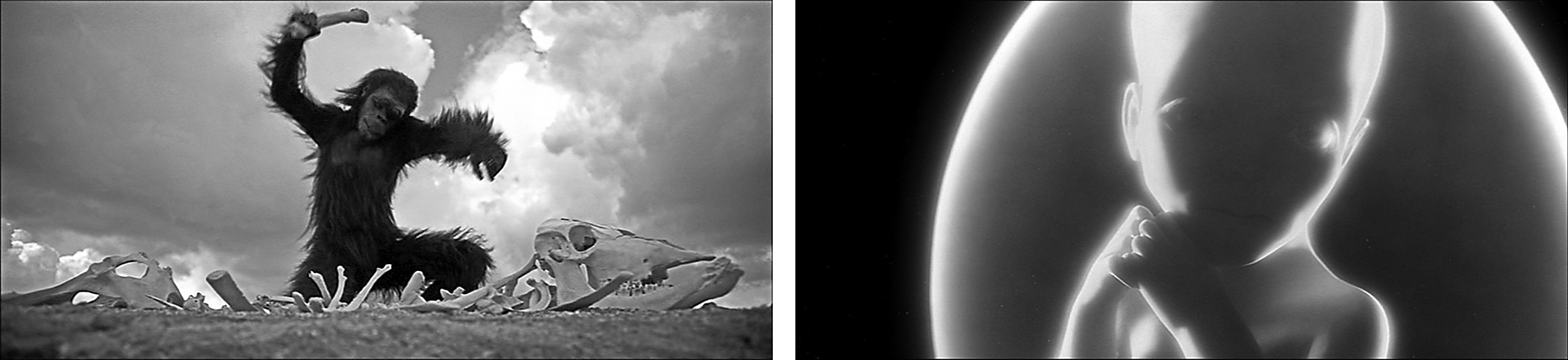
Consider again how the Also sprach Zarathustra fanfare is deployed across the film. In any precise consideration of central themes the opening juxtaposition of its portentous ‘harmonic series’ against a vision of aligned planets (which has inspired various invocations of Boethian musica universalis and musica instrumentalis) must be said to remain something of an ‘empty sign’, even for viewers ‘in-the-know’ about the Nietzschean title. It is only when it recurs (just after the reappearance of the same planetary alignment atop the monolith) to underscore the ape's first, triumphant play with his newly discovered thigh-bone weapon that a clearer realm of associated meaning begins to come into focus (00:14:41). It may seem disconcerting, to say the least, that this first evolutionary leap towards homo sapiens leads to a series of violent murders; later, of course, HAL – the most elaborate product of human tool-making powers – also goes murderously awry. But the triumph Dave secures by manipulating more basic tools can be seen as a positive reconnection to the gestures of his primitive forebears – in other words, as a correction of an overinvestment in the myth of disembodied mind. And while the various stages of this victory of embodied competence over artificial intelligence are given without underscoring, the fact that the plot turns on Dave's recapitulation of the ape's first ‘manual operation’ provides telling background to the imagery that does eventually emerge to the sounds of the third, culminating Zarathustra fanfare (02:13:12); see Figure 5.
The imagery underscored by the second and third Zarathustra fanfares: (a) the ape with thigh-bone weapon; (b) the ‘star child’ clutching hands to face.

The final image of 2001 – the foetal star child, floating free of Dave's decrepit body after his last feeble reach towards the monolith (see Figure 5b) – has perhaps sustained just as many projections of ‘the things that people think are apparent in the film’ as the question of HAL's feelings or the cause of his neurosis. Once again, Kubrick's own comments have proven a deceptively clear guide to interpretation. Musing in his Playboy interview on the possibility of life on other planets, he voiced his most extreme AI-inflected vision when he imagined highly evolved beings in these terms:
[They] may have progressed from biological species, which are fragile shells for the mind at best, into immortal machine entities – and then, over innumerable eons, they could emerge from the chrysalis of matter transformed into beings of pure energy and spirit.Footnote 50
Perhaps this vision of ‘the chrysalis of matter transformed into […] pure energy’ lies behind Mateas's passing assertion, at one point in his essay on AI, that ‘the star child in 2001 exhibits a radical, new materiality’.Footnote 51 Perhaps it lends implicit support to the conclusion of Hanson's queer-theoretical critique: ‘through science and technology [Dave] has given birth to himself out of his own head. He has presumably re-engendered himself as a self-sufficient and autonomous being that can do without woman, the body, and nature.’Footnote 52 Indeed, for all of her exceptional emphasis on the film's summons to corporeal experience, even Michelson seems to endorse a similar interpretation when she sums up 2001's ‘voyage of discovery’ at one point as a ‘progress toward disembodiment’.Footnote 53
If it is easy to understand how Dave's doubt about HAL's feelings could be forgotten after various scenes seemingly replete with genuine emotion, and that the narrative gap around his neurosis could be filled with a relatively simple explanation about unacceptable fallibility, it is harder to credit how this final image could be seen, again and again, to convey some message about ‘disembodiment’. Perhaps it is too easy to conflate the star child with the spectral watchers often inferred from the bizarre sounds of Ligeti's Aventures that greet Dave on his arrival in the ‘hotel room’ (02:05:55). Indeed these avant-garde blurts and howls seem the closest aural equivalent of the effect of an encounter with alien spirits as Kubrick imagined it: ‘if the tendrils of their consciousness ever brushed men's minds, it is only the hand of God we could grasp as an explanation’.Footnote 54 But there is a fundamental difference between this purely aural hint of presiding supraphysical beings and the image that later, to the trumpets and drums of Also sprach Zarathustra, crowns 2001's evolutionary trajectory. Many viewers fasten on the star child's bulging cranium and huge eyes as culminating symbols of a central thematic focus on questions of intelligence. But surely the greater interpretative challenge lies in the fact that this vision of post-human transcendence is fully embodied, replete with all of its limbs, poignantly clutching finely formed hands to delicate mouth.
Chion finds this ending a ‘hymn to wonder’ that ‘resists Nietzschean undercurrents’.Footnote 55 But perhaps the baffling final image is the point at which the film most powerfully affirms its affinity with a central strand of Nietzsche's Also sprach Zarathustra. As Jerrold J. Abrams notes in his essay for the 2007 collection The Philosophy of Stanley Kubrick, Nietzsche's notoriously problematic book includes, amidst all its lucubrations on ‘Eternal Return’ and other such concepts, an attempt to envision the ‘overman’ in a way that transcends the old dichotomy between the physical and the metaphysical – in other words, to imagine how, through Zarathustra's teachings, ‘we would have all the old superhumanity (of religion) and none of the otherworldly immateriality, all of the futuristic perfectionism and none of the superstitious metaphysics of rebirth in another world’.Footnote 56 In one germane section of Also sprach Zarathustra, ‘On the Despisers of the Body’, Nietzsche isolates this point with particular clarity: ‘“I” you say, and are proud of this word. But the greater thing – in which you do not want to believe – is your body and its great reason: it does not say I, but does I.’Footnote 57 Many scholars have elaborated on this corporeal emphasis in Nietzsche's thought, most famously summed up in the claim ‘I should only believe in a God who knew how to dance’.Footnote 58 While a synthesis of this vast secondary literature is impractical here, I would nonetheless adduce it as a diverse body of thought behind the suggestion that Kubrick's final image, the culmination of a thread of corporeal imagery extending back through Dave's ‘manual operations’ to the primordial apes, sets the seal on a filmic exploration of embodiment and transcendence whose Nietzschean inflections are both richer and more pervasive than can be summarily dismissed by narrowly positivistic points of evidence – nor indeed captured by bland invocations of ‘wonder’.
Postscript in lieu of a conclusion
To suggest that the star child provides the culmination of a filmic interrogation of emotion and embodiment that leads, along a path signposted by musical cues, into the vicinity (at least) of Nietzschean philosophy is not to presume that this last vision, and its accompanying sonorous blast, can be deemed a straightforwardly successful resolution of the questions raised in 2001. On the contrary, after the inspired ‘blank slate’ of the monolith, which generally appears in tandem with the eerily unsettling, ambiguously located sounds of Ligeti's Requiem, this shockingly literal last image of a glowing foetus with crudely bombastic Straussian underscoring might well be deemed a colossal failure of the filmic imagination.Footnote 59 The faintly cartoonish visual quality hardly helps to dispel the suspicion of overblown, incomprehensible absurdity. Recalling Zarathustra's invocation of the body that ‘does I’, we might well ask: What does this body do, really? How will it eat, breathe, survive?
Pushing the same questions further (in hopes of leaving this critical journey most fruitfully open), we might acknowledge that any reference to Nietzsche alongside such a film inevitably brings with it as many complications as it does avenues to critical clarity. For a passing glimpse of this other side of the story, consider Terry Eagleton's retrospective reflections, in his 2003 book After Theory, on the ‘narratives of class, race and gender’ that came to define a ‘a style of thinking known as postmodernism,’ and his arguments for a new style of thinking more attentive to universal ‘animal’, ‘material’, and ‘bodily’ aspects of human identity. When Eagleton, at one point, nods to Nietzsche as a key precursor for this line of thought, it is in terms that seem to fit perfectly with the analysis here developed:
Nietzsche maintained that the roots of justice, prudence, bravery and moderation, indeed the whole phenomenon of morality, were essentially animal. In this sense, ethics resembles aesthetics, which started life in the mid-eighteenth century not as a language about art, but as a way of investigating bodily experience.Footnote 60
The reference to an aesthetics based in ‘bodily experience’ clearly resonates with the emphasis I have borrowed from Michelson; the focus on the ‘animal’ basis of human concerns seems just as apt. But the complication arises from the fact that this passage appears in a chapter whose main theme, and title, is ‘Morality’. Even after the body is restored to thematic centrality, any coherent concept of morality is all but impossible to trace through 2001 from the primordial battles around the waterhole to the last, monumental image of the star child. In fact, we might say that the complete absence of intersubjective moral concerns in the film's concluding vision – the trajectory may not be towards disembodiment, but it is towards an amoral, autonomous body in space – is one point that renders the suspicions of postmodern feminists and queer theorists wholly understandable.Footnote 61
I do not introduce such complications in order to propose any further and grander resolution, but rather to indicate that the thought experiment I have extrapolated from the cutting of the Jupiter Mission to Khachaturian must inevitably end up reaffirming Kolker's sense of the film as ‘making us continually want to find meaning, and eluding us every time’. Still, perhaps there is an important qualification to consider, in closing, about this reflexive reference to ‘meaning’ as the goal of every critical search. My inquiry began, at least, as a pursuit of something different – as indicated in my titular words ‘real feelings’ (and as related, perhaps simplistically, to Eisler and Adorno's ‘subjective inwardness’). It thus might be most usefully understood against the background of some recent calls to restore the distinctly affective properties of music to centrality in sound and image studies, alongside (or in place of) the identity-critical approaches now seen even by one erstwhile leading practitioner as a ‘path of least resistance’. Indeed, when suggesting that the ‘different relationships of sound and music to referentiality and representation’ might now inspire sonorously attuned critics to ‘our own’ approaches, distinct from the familiar ‘models from literary and cultural studies’, Anahid Kassabian has specifically invoked ‘theories of affect’ as one potentially fruitful new resource.Footnote 62
If my hearing of the Adagio's affective contribution to the Jupiter Mission so far remains untheorized – and is thus only a first step along such a critical path – that is in part the result of a conscious decision to begin, at least, from what can be seen and heard ‘in the film’ (to recall Chion one last time) before allowing subtextual shades of meaning to begin encroaching on sensory experience. Some appropriate theories of affect may well help, further down the line, to elaborate this response towards a more fully developed phenomenological account of this score. But to frame the possibility this way is perhaps to claim, already, some initial progress on the path towards an account of 2001 that balances – and complicates – Michelson's exemplary carnal and phenomenological account of its challenges to ‘the eye’, ‘what is seen’, and ‘seeing itself’ through equally sophisticated attention to ‘the ear’, ‘what is heard’, and indeed ‘hearing itself’.