

The present study compared the development of insight into the structure of several types of compound word between native Chinese speakers and native English speakers. Morphological awareness, the ability to reflect upon and manipulate morphemes and employ word formation rules, has been extensively investigated during the past two decades. Previous studies of morphological awareness of English-speaking children have focused on derivational or inflectional morphology (e.g., Carlisle, Reference Carlisle1988, Reference Carlisle and Feldman1995, Reference Carlisle2000; Mahony, Sinhgson, & Mann, Reference Mahony, Singson and Mann2000; Tyler & Nagy, Reference Tyler and Nagy1989, Reference Tyler and Nagy1990), and few have addressed compound morphology, probably because compound words are less productive than derivational words in English. Chinese, however, contrasts strongly with English in terms of which categories of word formation rules are most productive. Unlike English, Chinese is highly productive in compounding (Packard, Reference Packard2000), whereas relatively few inflectional and derivational words exist in Chinese.
In previous research on morphological awareness, only basic compound structures have been examined. The acquisition of noun + noun (NN) compounds among preschool children has been most thoroughly investigated (e.g., Clark, Reference Clark and Deutsch1981; Clark & Berman, Reference Clark and Berman1984, Reference Clark and Berman1987; Clark, Gelman, & Lane, Reference Clark, Gelman and Lane1985; McBride-Chang, Shu, Zhou, Wat, & Wagner, Reference McBride-Chang, Shu, Zhou, Wat and Wagner2003). Because child language development is generally characterized in terms of increasing ability to deal with complexity, especially morphological complexity (Clark, Reference Clark1993), the present study addressed the need for research on a greater variety of compound types. Because of the differences between Chinese and English, a study of the development of awareness of compound structures in these two languages across a range of ages could provide valuable insights into both universal and language-specific processes that are important for learning to read (Anderson & Li, Reference Anderson, Li, McKeough, Lupart, Phillips and Timmons2005).
STRUCTURE OF COMPOUNDS IN ENGLISH AND CHINESE
Basic compound words consist of two stem morphemes (e.g., classroom, cran-berry). The stem morphemes can be free roots (e.g., class in classroom) or bound roots (e.g., cran- in cranberry). Unlike English, which is rich in inflectional affixes (e.g., -s, -ed) and derivational affixes (e.g., -ly, -tion), Chinese has abundant free roots (e.g., 花, hua1, flower; 茶, cha2, tea) and bound roots (e.g., 园, yuan2, garden; 叶 ye4, leaf). The primary way of forming complex words in Chinese is by combining free or bound roots (e.g., 花 茶, hua1cha2, jasmine tea;花 园, hua1yuan2, flower garden: 茶 叶, cha2ye4, tea leaves).
Chinese morphology is more transparent than English morphology for several reasons. First, virtually all Chinese morphemes consist of one syllable. In contrast, morphemes in English may consist of more than one syllable, morpheme boundaries are not reliably marked by any phonological feature, and morphemes do not have a simple one to one correspondence with syllables (e.g., sign and signature). Second, with rare exceptions, morphemes in Chinese are in one to one correspondence with the basic writing unit: the character. Third, in comparison to English, which involves frequent shifts in pronunciation and spelling when morphemes are put together to form complex words, (e.g., pronounce and pronunciation), the formation of complex words in Chinese almost never involves phonological change to component morphemes, and never involves orthographic change. For these reasons, identifying individual morphemes in Chinese is straightforward, especially when compared to a language such as English in which morphemes come in different sizes and shapes and constantly change their phonological and orthographic identity.
Selkirk (Reference Selkirk1982) offered a comprehensive analysis of the structure of English compounds and proposed that compound nouns can be NN (e.g., housewife, spaceship) or verb + noun (e.g., playground, pickpocket). Compound verbs can be noun + verb (NV; e.g., browbeat, window shop), adjective + verb (e.g., direct dial, dry clean), or verb + particle (VP; e.g., pick up, sit down). Generally, compounds follow the right-hand head rule (i.e., the head of the compound—the constituent of the compound that matches the compound's form class—is located on the right), with the exception of VP compounds, where the verb on the left is clearly the head (Bauer & Renouf, Reference Bauer and Renouf2001; Selkirk, Reference Selkirk1982).
In terms of the productivity of each compound structure, Bauer (Reference Bauer1987) concluded that NN compounds comprise the largest and most productive class of compound words in English. Verb + particle compounds are also highly productive, whereas NV compounds have limited productivity but are more productive than verb + noun (VN) compounds. Bauer and Renouf (Reference Bauer and Renouf2001) analyzed compounds in a large British newspaper corpus containing 360 million words and concluded that VN (e.g., pickpocket, turnpike) compounds are no longer productive in modern English.
Packard (Reference Packard2000) proposed an analysis of Chinese compounds based on the form class of the component morphemes. Chinese compound nouns can be NN (e.g., 电 脑, dian4nao3, electricity-brain, “computer”), NV (e.g., 壁 挂, bi4gua4, wall-hang, “wall hanging”), VN (e.g., 睡 袋, shui4dai4, sleep-bag, “sleeping bag”), and verb + verb (VV; e.g., 买 卖, mai3mai4, buy-sell, “business”). Chinese compound verbs can be VN (e.g., 出 版, chu1ban3, emit-edition, “to publish”), NV (e.g., 瓜 分, gua1fen1, melon-divide, “to partition”), and VV (e.g., 学 习, xue2xi2, study-practice, “to study”). Yuan and Huang (Reference Yuan and Huang1998) analyzed a corpus of 40,958 two-character Chinese words and reported that the proportions of NN, VN, and NV compounds were 0.308, 0.195, and 0.022, respectively. Analysis of the data in Huang (Reference Huang and Packard1997, p. 264) obtained from the dictionary Guoyu Ribao Cidian yielded comparable figures of 0.293, 0.203, and 0.034, respectively.
Psycholinguistic evidence on the processing of compound words suggests that in both English and Chinese, familiar lexicalized compounds tend to be accessed as whole units or, at least, that constituents are slower to be accessed than whole units, whereas low frequency or novel compounds are decomposed into constituent morphemes (Sandra, Reference Sandra1990; Taft & Zhu, Reference Taft, Zhu and Feldman1995; van Jaarsveld & Rattink, Reference van Jaarsveld and Rattink1988; Zhang & Peng, Reference Zhang, Peng, Chen and Tzeng1992). In an eye-tracking experiment with Dutch native speakers, Kuperman, Schreuder, Bertran, and Baayen (Reference Kuperman, Schreuder, Bertran and Baayen2009) investigated the temporal order of activation of whole words (e.g., dishwasher) and of their morphological constituents (e.g., dish, wash, er) in a lexical decision task with visual presentations of polymorphemic Dutch compounds. Simultaneous effects of full-form compound frequency and left constituent frequency were observed early whereas the effects of the right constituent frequency emerged later, indicating a time-locked, parallel, and interactive use of all morphological cues in compound processing. Hsu, Tzeng, Huang, and Tai (Reference Hsu, Tzeng, Hung and Tai1998) found that the productivity of compound structures influenced the lexical decision times of Taiwanese adults. When the targets were compound nouns, the most frequent type, NN words (e.g., 茶 壶, cha2hu2, tea-pot, “teapot”), had the shortest reaction times, followed by VN nouns (e.g., 贴 纸, tie1zhi3, stick-paper, “sticker”), which in turn, had faster reaction times than NV nouns (e.g., 牙 刷, ya2shua1, tooth-brush, “toothbrush”). When the targets were compound verbs, the most frequent compound verb type, namely, VV verbs (e.g., 打 听,da3ting1, hit-listen, “inquire”) had the fastest reaction times, followed by VN verbs (e.g., 掉 包, diao4bao1, drop-package, “to substitute secretly”) and NV verbs (e.g., 瓜 分, gua1fen1, melon-divide, “to partition”). These results suggest that the productivity of different types of compounds influences lexical processing.
The current study addresses whether productivity affects acquisition of various compound structures. Four compound structures that are approximately equivalent in Chinese and English were investigated. Three of these structures were compounds realized as NN, VN, and NV. The fourth structure consisted of left-headed compound verbs realized as VV in Chinese and VP in English. Most of the Chinese VV words were directional resultative verbs, such as 走 进 (zou3jin4, walk-enter, “to walk in”) and 穿 过 (chuan1guo4, penetrate-pass, “to run though”), a subtype of Chinese VV words selected to be comparable to English VP words.
Based on the relative productivity of each compound structure in the two languages, we expected better performance on VV/VP and NN than on VN and NV in both languages. Chinese speakers were expected to perform better on VN than on NV due to the higher productivity of VN in Chinese. Conversely, VN is less productive than NV in English, so we hypothesized that the English-speaking group would perform better on NV than on VN. Because novel compounds are more likely to be decomposed into constituent morphemes, as explained earlier, we expected better performance on novel compounds than on familiar compounds for both language groups.
ACQUISITION OF COMPOUND MORPHOLOGY
In studies of the acquisition of compound morphology, researchers have addressed such questions as: What do compounds mean to children? How do children discover word formation rules? Does the acquisition of compound morphology contribute to children's oral vocabulary and listening comprehension and, later, reading vocabulary and reading comprehension? It appears that even preschoolers have some, and perhaps considerable, knowledge of the simpler compounding rules of English. Berko (Reference Berko1958) examined children's ability to produce complex words given a nonsense base, and found that 4- to 7-year-olds mainly produced compounds. For example, when asked what they would call a tiny wug, 52% of the children produced compounds such as baby wug or little wug, correctly stressing the first word in the compound as adults do (e.g., bláckbird instead of black bírd).
Clark and her colleagues extensively investigated word-formation processes, especially compounding, among young children (e.g., Clark, Reference Clark and Deutsch1981; Clark & Berman, Reference Clark and Berman1987; Clark et al., Reference Clark, Gelman and Lane1985). Children as young as 3 years old often coined novel compounds to fill lexical gaps, such as car-smoke (exhaust) and fix-man (car mechanic) (Clark, Reference Clark and Deutsch1981). In an elicitation task, children who were 3 years old and above could create simple compounds such as pumpkin-house and horse-truck appropriately (Clark et al., Reference Clark, Gelman and Lane1985). Among the types of compounds, NN compounds are most common in children's spontaneous and elicited speech.
Cross-language evidence reveals that children can identify the head of a compound at an early age. The ability to understand the modifier-head relation in compounds emerges between age 2 and 3 (Clark et al., Reference Clark, Gelman and Lane1985, Clark & Berman, Reference Clark and Berman1987). Clark and Berman's (Reference Clark and Berman1987) study with Hebrew-speaking children assessed children's comprehension of novel compounds, which were composed of familiar morphemes with fairly transparent compounding relations. Results showed that from age 4, children could identify the head of a compound noun (e.g., they knew that a housedog is a dog and a doghouse is a house).
Other studies suggest that children's knowledge of compound nouns is still developing between age 3 and 5 (Gottfried, Reference Gottfried1997; Nicoladis, Reference Nicoladis2003). Nicoladis (Reference Nicoladis2003) showed English-speaking children an array of four pictures and asked them to identify the picture of the novel target rabbit car. The pictures were of a rabbit, a car, a car next to rabbit, and a car with rabbit ears and tails. The results indicated that 3-year-old children were less likely than 4-year-old children to understand the meaning of novel compounds. Using the same paradigm, Hao (Reference Hao2003) found that Chinese preschoolers as young as 3 years old could decompose novel compounds into morpheme constituents and correctly infer word meanings by combining the two morphemes. The children's ability to infer the meanings of novel compounds was significantly correlated with their oral vocabulary and listening comprehension.
The foregoing studies of compound production and comprehension suggest that preschool-age English- and Chinese-speaking children have considerable knowledge of compound morphology. However, to date, the evidence has been mainly restricted to knowledge of simple NN compounds. The task involving novel compounds composed of familiar nouns (e.g., Which is a better name for a bee that lives in the grass: a grass bee or a bee grass?) has been most widely used (e.g., Nagy, Berninger, Abbott, Vaughan, & Vermeulen, Reference Nagy, Berninger, Abbott, Vaughan and Vermeulen2003; Wang, Cheng, & Chen, Reference Wang, Cheng and Chen2006). When and how children develop knowledge of compound structures other than NN and knowledge of morphologically complex compounds (e.g., paper shredder, machine washable, stand-by passenger) remain open questions. In addition, school-age children who lag behind in reading may still be struggling with even simple compound structures. For example, Nagy et al. (Reference Nagy, Berninger, Abbott, Vaughan and Vermeulen2003) found that at-risk second-grade readers performed only slightly above chance when judging novel but simple compound nouns.
Very few studies have investigated the development of compound morphology during the elementary school years. An exception is Ku and Anderson (Reference Ku and Anderson2003), who investigated knowledge of derived and compound words in a cross-language study of Chinese- and English-speaking children in second, fourth, and sixth grades. The tasks included novel word interpretation, novel word judgment, and homograph discrimination. Children from both language groups showed large improvements in performance between second and sixth grade and overall there was no difference between language groups. However, Chinese-speaking children from all grades performed somewhat better than their English-speaking counterparts on compound words, whereas the English-speaking children performed better on derived words. This pattern of results was attributed to the fact that compounding is a more productive and transparent word formation process in Chinese, whereas derivation is more productive and transparent in English. However, it should be noted that the comparison of compounds versus derived words came from a post hoc analysis of performance on a limited range of word types. Ku and Anderson (Reference Ku and Anderson2003) speculated that the Chinese-speaking children would have outperformed the English-speaking children if the full range of complex words in Chinese and English had been examined. The present study attempts to test this hypothesis by examining four compound types represented in both languages.
Zhang (Reference Zhang2004) was among the first to investigate the development of knowledge of a range of compound word structures. Eight measures of morphological awareness including assessments of semantic knowledge, relational knowledge, syntactic knowledge, as well as a measure of reading comprehension, were administered to 184 Chinese-speaking second, fourth, and sixth graders from Beijing. Results showed that children's awareness of the structure of compounds improved rapidly over the elementary school years. Zhang (Reference Zhang2004) extended the investigation of compound morphology to more complex compound types, including subordinate compounds, verb–object compounds, and subject–predicate compounds. However, conclusions about differences among compound types could not be drawn because of the small number of items representing each structure. Furthermore, the compounds were defined in terms of traditional Chinese grammar that describes word components in syntactic terms rather than by their internal morphological structure (Packard, Reference Packard2000). The current study improves upon Zhang's (Reference Zhang2004) study by adopting Selkirk's (Reference Selkirk1982) and Packard's (Reference Packard2000) classification of compound word types in English and Chinese, and by including a sufficient number of items of each type.
AWARENESS OF COMPOUND MORPHOLOGY AND READING DEVELOPMENT
It has long been recognized that morphological awareness is associated with children's vocabulary growth and reading development (Fowler, Feldman, Andjelkovic, & Oney, Reference Fowler, Feldman, Andjelkovic, Oney, Assink and Sandra2003; Nagy & Anderson, Reference Nagy and Anderson1984; Tyler & Nagy, Reference Tyler and Nagy1990; White, Power, & White, Reference White, Power and White1989; for a review, see Kuo & Anderson, Reference Kuo and Anderson2006). Morphological awareness provides a “more general index of metalinguistic capacity” than phonological or syntactic awareness alone (Carlisle, Reference Carlisle and Feldman1995, p. 192). Research in English has demonstrated that morphological awareness significantly predicts children's word recognition and reading comprehension, after controlling for phonological awareness, vocabulary knowledge, IQ, or prior level of reading ability (e.g., Carlisle, Reference Carlisle and Feldman1995, Reference Carlisle2000; Carlisle & Nomannbhoy, Reference Carlisle and Nomanbhoy1993; Nagy, Berninger, & Abbott, Reference Nagy, Berninger and Abbott2006). Research shows that morphological awareness becomes increasingly important in English word reading during the upper primary grades and is associated with reading comprehension across the primary and middle grades (Carlisle, Reference Carlisle and Feldman1995; Nagy et al., Reference Nagy, Berninger and Abbott2006).
The importance of morphological awareness in Chinese literacy development has also been amply demonstrated (e.g., Ku & Anderson, Reference Ku and Anderson2003; Li, Anderson, Nagy, & Zhang, Reference Li, Anderson, Nagy, Zhang, Li, Gaffney and Packard2002; McBride-Chang et al., Reference McBride-Chang, Shu, Zhou, Wat and Wagner2003, Reference McBride-Chang, Liu, Wagner, Shu, Zhou and Cheuk2005; Packard et al., Reference Packard, Chen, Li, Wu, Gaffney and Li2006; Shu, McBride-Chang, Wu, & Liu, Reference Shu, McBride-Chang, Wu and Liu2006; Wu et al., Reference Wu, Anderson, Li, Wu, Li and Zhang2009). In the McBride-Chang et al. (Reference McBride-Chang, Shu, Zhou, Wat and Wagner2003) study with kindergarten and second-grade children from Hong Kong, morphological awareness accounted for unique variance in Chinese character recognition after controlling for phonological awareness and vocabulary measures. Based on a battery of nine tasks that included metalinguistic awareness, visual skills, vocabulary, and other cognitive measures, Shu et al. (Reference Shu, McBride-Chang, Wu and Liu2006) identified a deficit in morphological awareness as a core reason for developmental dyslexia among fifth and sixth grade Chinese children.
As previously discussed, Chinese has a more productive and transparent compound morphology than English. Furthermore, due to the large number of homophones in Chinese—many thousands of morphemes are represented by only about 1200 syllables—reading Chinese requires readers to distinguish different meanings of words that sound identical. Because of these characteristics of Chinese and English, it has been hypothesized that morphological awareness makes a larger contribution to reading for Chinese-speaking children than for English-speaking children (Anderson & Li, Reference Anderson, Li, McKeough, Lupart, Phillips and Timmons2005; Nagy & Anderson, Reference Nagy, Anderson, Wagner, Venezky and Street1998). Ku and Anderson's (Reference Ku and Anderson2003) cross-language study only weakly supported such a hypothesis, but the hypothesis was clearly supported in a cross-language study by McBride-Chang et al. (Reference McBride-Chang, Liu, Wagner, Shu, Zhou and Cheuk2005) that compared the contributions of phonological awareness and morphological awareness to word recognition in second graders from Beijing, Hong Kong, Korea, and the United States. Morphological awareness was found to be more important for reading Chinese, phonological awareness was more important for reading English, and both phonological and morphological awareness contributed to reading Korean.
To recapitulate, the hypotheses that guided this study were (a) because of the greater productivity and transparency of the compound morphology of Chinese, Chinese-speakers ranging from elementary school children to young adults are expected to have more advanced knowledge of compound structures than their English-speaking counterparts; (b) knowledge of different types of compound is affected by the relative productivity of each compound structure within the language; and (c) knowledge of compound morphology continues to develop over the elementary school years, especially knowledge of less frequent and less obvious compound structures.
METHOD
Participants
The participants were 357 Chinese-speaking children from an elementary school in Ordos, a city in Inner Mongolia in northwest China, and 196 English-speaking children from three elementary schools and two middle schools in Tulsa, Oklahoma, in the midwest of the United States. Children from both countries were from public schools serving working-class families. There were 120, 108, and 129 Chinese-speakers from second, fourth, and sixth grades, and 59, 65, and 72 English-speakers from second, fourth, and sixth grades, respectively. The mean ages of the Chinese-speaking second, fourth, and sixth graders were 8.7, 10.7, and 12.8 years old. The mean ages of the English-speaking second, fourth, and sixth graders were 8.2, 10.3, and 12.8 years old. Of the Chinese-speaking children, 91% were Han, the largest ethnic group in China, and 9% were Mongolian. The Mongolian children speak Mongolian at home and learn Mandarin Chinese as a second language in school, whereas the Han children speak Mandarin both at home and in school. The English-speaking children were from several ethnic backgrounds: 58% European Americans, 18% African Americans, and 15% other minorities (Hispanic American, Native American, and Asian American); in 9% of the cases ethnicity was not declared or home surveys were not returned.
The young adult participants were 78 Chinese-speaking undergraduates at Beijing Normal University and 62 English-speaking undergraduates at Oklahoma State University. Seventy-six (97%) Chinese undergraduates were Han, 1 was Mongolian, and 1 was Uyghur. Forty-five (58%) Chinese undergraduates were female and 33 (42%) were male. All the American undergraduates were female and White. The American undergraduates participated in the study to fulfill a course requirement. The mean ages of the undergraduates from China and the United States were 20.9 and 21.9 years old, respectively.
Procedures
Raven's IQ. To determine whether the nonverbal intelligence of the Chinese and Americans was equivalent, the Raven's Standardized Progressive Matrices test was administered to all the child participants. The raw scores were converted to percentile ranks based on the norms from the standardizations in the two countries.
Word structure analogy task. This task is a refined version of the one created by Zhang (Reference Zhang2004). The similar word structure analogy task in both Chinese and English versions has been successfully used with fifth-grade Chinese children learning English as a second language (Zhang et al., Reference Zhang, Anderson, Li, Dong, Wu and Zhang2010). It assesses the ability to make compound structure analogies involving four types of compounds found in both Chinese and English: NN, VV/VP, VN, and NV. Each item consisted of a target compound word containing a given constituent followed by three compound-word choices that also contained the given constituent. The task was to circle the compound-word choice that was most similar to the target compound word. An example is the target compound word handbag containing the constituent hand with the choices a. handout, b. handover, and c. handcar. The answer is handcar because it has the same NN structure as handbag. For each structure, 10 arrays of familiar compounds (e.g., sunroof, a. sunset, b. sunrise, c. sunhat) and 10 arrays of novel compounds (e.g., candy-door, a. candy-wash, b. candy-road, c. candy-blow) were developed. Altogether there were 40 familiar word items and 40 novel items in both the Chinese and English versions of the task. See Appendix A for instructions and stimuli.
Items were designed to require a decision based on the structure of the compound rather than semantic overlap. Items were constructed, judged, and revised in an iterative process. The Chinese and English tasks were constructed to be as close to parallel as possible, based on the judgments of three of the authors who are fluent bilinguals: two native Chinese speakers and one native English speaker. The semantic overlap between target and choice across the three choices was carefully matched to avoid being used as a judgment cue. All of the familiar compounds were transparent, in the sense that the constituent morphemes contribute in an obvious way to the meaning of the compound. Note that familiar compounds usually contain elements of meaning beyond those directly predictable from the constituents. For instance, although the constituent morphemes of the transparent compound greenhouse contribute in a straightforward way to the meaning of the compound, there is nothing in the constituent morphemes that indicates that a greenhouse is a place where plants are grown.
The 40 Chinese and 40 English real-word items were rated for frequency on a 7-point Likert scale by undergraduate raters. There were no significant differences in ratings among the four compound structures in either language (all p > .05). All the real-word items were judged by classroom teachers to be known to second graders from oral language. Both familiar compounds and novel compounds were made up of two morphemes familiar to second graders. Novel compounds were plausible but nonoccurring or very low in frequency.
We determined the frequency of real-word items in large databases. The frequency of Chinese words was obtained using the Modern Chinese Corpus Online Search System developed by the Center for the Studies of Chinese as a Second Language at Beijing Language and Culture University (www.dwhyyjzx.com/cgi-bin/yuliao/). As recommended by Blair, Urland, and Ma (Reference Blair, Urland and Ma2002), the frequency of English words was estimated using a comprehensive Internet search engine, AltaVista (www.altavista.com). Word frequency was operationalized as the number of hits returned for the exact form of each real-word item. Blair and colleagues (Reference Blair, Urland and Ma2002) found that the frequency estimates produced by internet search engines were very consistent with those calculated from linguistic corpuses (e.g., CELEX lexical database; Baayen, Piepenbrock, & Gulikers, Reference Baayen, Piepenbrock and Gulikers1995; Kučera & Francis, Reference Kučera and Francis1967) and stable over a 6-month period.
An advantage of Internet search is that frequency estimates of all the real words used in the current study could be determined, whereas not all are available in databases such as CELEX. A possible disadvantage is that the estimates represent the frequency in adult usage, and may not reflect children's experience with language. This is unlikely to be a problem because, as Carroll (Reference Carroll, Davies and Richman1971) has noted, for words with moderate to high frequency there is virtually no difference in frequency in a corpus of child language, such as Carroll, Davies, and Richman (Reference Carroll, Davies and Richman1971), and a corpus of adult language, such as Kučera and Francis (Reference Kučera and Francis1967).
Participants of all ages were given the same word structure analogy test in groups. Two practice items were presented. The experimenter read aloud the words to the second graders as they followed on their own copies. Children were encouraged to ask for help if they had difficulty in decoding the words. The order of the familiar word task and novel word task was counterbalanced within each age group. Within tasks, items representing the different types of compounds were intermixed.
RESULTS
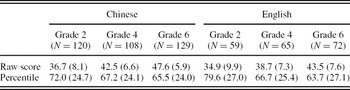
Raven's IQ raw score and percentile rank are shown in Table 1. The children from the two countries were approximately equivalent in terms of nonverbal intelligence. For fourth and sixth graders, nonparametric tests showed no significant difference in IQ percentile ranks between the English-speaking and Chinese-speaking children. For second-graders, English-speaking children ranked higher than their Chinese-speaking counterparts, p < .05.
Mean (SD) Raven's IQ raw scores and percentile ranks

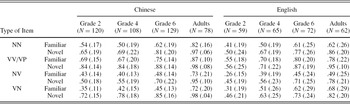
Proportions correct on the word structure analogy task are displayed in Table 2. Older age groups, especially Chinese adults, were at ceiling on some types of compound structures and the score distributions were negatively skewed. An arcsine transformation with correction for extreme scores (Bartlett, Reference Bartlett1936) was applied to make the distributions more nearly normal. A four-way repeated-measure analysis of variance (ANOVA; Language × Age × Structure × Word Type) was then performed, in which language and age were between-subject factors, and compound structure and word type (familiar/novel) were within-subject factors. The ANOVA confirmed significant main effects for language, age, compound structure, and word type, and several significant interactions appeared.
Mean (SD) proportions correct on word structure analogy task

Note: NN, noun + noun; VV/VP, verb + verb/verb + particle; NV, noun + verb; VN, verb + noun.
As anticipated, Chinese speakers performed better than English speakers, F (1, 685) = 48.79, p < .01, η2 = 0.06. Simple effects analyses established that second grade and adult Chinese speakers performed better than their English-speaking counterparts on most compound structures (except for familiar VN) (ps < .05). No significant language group difference was found for fourth and sixth graders.
Type of compound structure had a large and significant effect, F (3, 2055) = 562.68, p < .01, η2 = 0.45. No interaction between structure and language was found. Significant differences were found between most structure pairs in both language groups (ps < .05). Both language groups performed better on the compound structures that are more productive in their respective languages. The performance of the two language groups followed the same order: VP/VV > NN > VN > NV. The pattern of results was similar in terms of relatively better performance on VV/VP and NN words, which are productive in both Chinese and English, than on the other two structures. Both language groups performed better on VN than on NV, which is not fully consistent with the relative productivity hypothesis, as a reverse pattern (NV > VN) was expected for the English-speaking group.
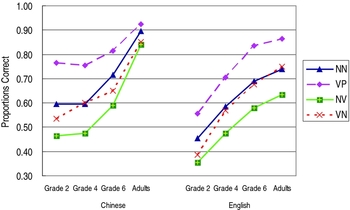
Figure 1 shows the developmental trend for each language across the four ages and four compound structures. Knowledge of compound structures improved rapidly with age, F (3, 685) = 132.36, p < .01, η2 = 0.36. Pairwise comparisons showed that for Chinese speakers, the difference between each age pair was significant (ps < .05) except for the difference between second graders and fourth graders. For English speakers, significant differences between age pairs were found (ps < .05) except for the difference between sixth graders and adults.
The performance on the word structure analogy task by language, age, and type of compound. [A color version of this figure can be viewed online at journals.cambridge.org/aps]

There was a significant difference in performance on familiar words and novel items, F (1, 685) = 1111.76, p < .01, η2 = 0.61. Both Chinese and English speakers performed significantly better on novel items than on familiar words (ps < .05).
The four-way interaction, three of the three-way interactions, and some additional two-way interactions were significant. These interactions will not be discussed in detail, because they appear to be attributable in large part to the compression of scores caused by the performance ceiling for Chinese adults and so are not theoretically interesting.
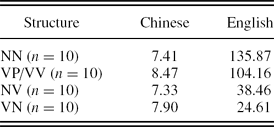
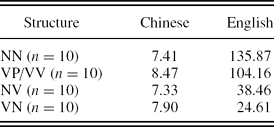
Additional analyses were conducted to determine whether productivity has effects above and beyond word frequency. Table 3 displays average frequency estimates for each type of real-word compound in Chinese and English. For Chinese items, no significant difference in frequency was found across the four structures (p > .05). For English items, however, significant frequency differences were found among the four structures, F (3, 36) = 3.07, p < .05. English NN and VP items were significantly more frequent than NV and VN items.
Average frequency estimates for Chinese and English real-word items
Note: NN, noun + noun; VP/VV, verb + particle/verb + verb; NV, noun + verb; VN, verb + noun.
To minimize the influence of frequency differences across the four structures in English, additional analyses were done excluding four English real-word items with extremely high frequency (NN: hometown, headline; VP: come back, make up). Two English real-word items with very high adult error rates (headstart, water fall) were also excluded on the grounds that children could not be expected to see the structure in items that were opaque to adults. With these items excluded, there was no frequency difference among the English real-word items across the four structures (p > .05).
Further analyses were then performed, excluding the aforementioned six items and taking the word frequency of the remaining items into account. Item was the unit of analysis, age was the within-item factor, type of compound structure was the between-item factor, and word frequency was the covariate. For the Chinese real words, there was a significant structure effect, F (3, 35) = 2.43, p = .08, η2 = 0.17, and age effect, F (3, 105) = 17.26, p = .00, η2 = 0.33, after controlling for word frequency. The pattern followed the order VP = NN > NV = VN. For the English real words, there was also a significant structure effect, F (3, 29) = 4.53, p = 0.01, η2 = 0.32, and age effect, F (3, 87) = 56.01, p = .00, η2 = 0.66, after controlling for word frequency. The pattern followed the order VP = NN > VN = NV. Word frequency was not significant in either the Chinese or the English analysis. We also reran the four-way repeated-measure ANOVA with subject as the unit of analysis (Language × Age × Structure × Word Type), excluding the aforementioned six English items, with essentially the same results as before. These analyses show that there is an effect of the productivity of compound word structures beyond any effect of word frequency.
DISCUSSION
A major finding of this study is that, as predicted, Chinese speakers generally have better developed knowledge of the structure of compound words than English speakers. This finding held true especially for second graders and adults, and for all of the compound structures common to the two languages except for the familiar VN compounds. The performance of Chinese second graders was well above chance level on most types of compounds, and was comparable to that of fourth graders. In contrast, American second graders performed at or below chance level on most types of compounds but made rapid progress during elementary school years. Chinese children showed good knowledge of compounding as early as second grade and made significant progress beyond fourth grade, reaching a ceiling at adulthood. American adults, on the other hand, did not perform significantly better than sixth graders and still had much room for improvement.
The theory that we propose to explain these findings is that Chinese has a more productive compound morphology than English, and so Chinese speakers have a better-developed sense of compounding. For this reason, we propose, Chinese children develop insight into compounding at an earlier age. This would explain both our finding of an advantage for compounding morphology for Chinese speakers in general, as well as the earlier development of compounding among the Chinese second graders. Compound words are relatively scarce in English. Moreover, while English-speaking children undoubtedly are exposed to transparent compound words such as underwear, toothpaste, and washcloth, they also frequently encounter opaque compounds such as breakfast, hot dog, and Thanksgiving whose structure may be difficult to discern.
The most discriminating evidence for an explanation of performance that is based on productivity was the ordering of performance on different types of compound over the two language groups. Both groups performed better on the compounding patterns that are more productive in their respective languages and more poorly on the patterns that are less productive. Both the Chinese and English groups showed better performance on VV/VP and NN compounds, which are productive in both Chinese and English, and both groups performed less well on NV and VN compounds, which are less productive in both languages. In addition, the Chinese group performed better on VN than NV compounds, which is as expected because the VN structure is more productive in Chinese than the NV structure. The American group did not show the reverse pattern (better performance on NV than VN) that was expected because the NV structure is more productive in English than the VN structure (Bauer & Renouf, Reference Bauer and Renouf2001). In a preliminary study, findings supported the productivity hypothesis with regard to the relative difficulty of the VN and NV structures in Chinese and English (Zhang, Anderson, Packard, Wu, & Tang, Reference Zhang, Anderson, Packard, Wu and Tang2007). Because of the inconsistent results, whether the hypothesis holds true needs further investigation.
According to our interpretation, participants of every age in both languages performed better on novel compounds than on familiar ones because the latter have been lexicalized and do not invite decomposition into constituents. Psycholinguistic evidence suggests that in both English and Chinese familiar lexicalized compounds tend to be processed as whole units, whereas low-frequency or novel compounds are more likely to be decomposed into constituent morphemes (Sandra, Reference Sandra1990; Taft & Zhu, Reference Taft, Zhu and Feldman1995; van Jaarsveld & Rattink, Reference van Jaarsveld and Rattink1988; Zhang & Peng, Reference Zhang, Peng, Chen and Tzeng1992). Morpheme decomposition is essential in order to make compound structure analogies. If many familiar compounds are processed as a whole, this would explain the better performance on novel compounds than on familiar compounds in the current study. This explanation matches well with research showing that compound word production in Chinese and in English is determined by a compound's whole word frequency, and not by constituent morpheme frequency (Janssen, Bi, & Caramazza, Reference Janssen, Bi and Caramazza2008).
The results of the present study add to knowledge about the role of morphological analogy in the acquisition and processing of compound words. In a NN compound explanation task, Krott and Nicoladis (Reference Krott and Nicholadis2005) found that family size of the constituent morphemes (the number of compounds sharing the constituents) affects English-speaking children's segmentation of compounds. Children were more likely to mention a constituent when it came from a large family (e.g., cake in coffee cake, cupcake, pound cake, rice cake, wedding cake, etc.) than a small family (e.g., napkin in paper napkin), suggesting that children's segmentation of compounds is facilitated by analogy with existing compounds. Although the current study did not manipulate the family size of constituent morphemes, morphological structure might be recognized more readily in the word structure analogy task when the shared constituent is from a family of related words (Krott & Nicoladis, Reference Krott and Nicholadis2005). It will be interesting to examine how the family size of the shared constituent morpheme affects the performance on the compound structure analogy task in future research.
To summarize, the results of the present study indicate that native Chinese speakers have more advanced insight into compound structures than native English speakers. Speakers of both languages showed more insight into the structure of the productive compounds, NN and VP, than the less productive compounds, NV and VN. A theory that gives a good account of the results is that awareness of compound structures is affected by the relative productivity of compound structures within and across languages.
APPENDIX A: INSTRUCTIONS FOR WORD STRUCTURE ANALOGY TEST
English instructions
This is a word-reading activity. In this activity, you will see 40 lines of familiar words and 40 lines of new words that you might have never seen or heard before. In each line, there is one target word followed by three choices. Your task is to circle the choice that is most similar to the target word. Let's do some practices.

The correct answer for practice question 1 is (a) because both the target “paper box” and (a) “pencil box” talk about “some kind of box that has something to do with paper or pencil,” whereas (b) “call box” and (c) “black box” do not.
The correct answer for practice question 2 is (b) because both the target “eat-book” and (b) “cut-book” can be understood as being “an action happens to the book, to eat or to cut”, but (a) “horse-book” and (c) “flower-book” cannot.
Do you understand the task now? If yes, turn to the next page and get started. Thank you very much for your participation!
Chinese instructions

APPENDIX B
Experimental stimuli