State and local governments have historically provided generous retirement benefits to career employees. Most full-time public sector employees are eligible for employer-provided health insurance in retirement, given that they have achieved some minimum years of service. This benefit can represent a significant fraction of the total compensation that an employee receives. Retiree health insurance (RHI) plans in the public sector generally allow retired employees to remain in the same health plan as active workers. From the public employer's perspective, RHI is an important benefit that helps to attract, retain, motivate, and ultimately retire quality workers. However, the cost of these plans represents a large and increasing percentage of total compensation in many states and localities.
The future of public sector RHI will depend on the ability of governments to continue to provide this benefit in the face of rising costs and aging populations. At the same time, determining how public sector employees view and value this benefit is essential to understanding how public sector labor markets may respond to changes in retirement benefits. Despite its significance, much is still unknown about the responses to the economic incentives inherent in RHI plans in the public sector and the impact of providing RHI on the financial status of state and local governments.
This paper examines the landscape of public sector retiree health plans in the USA. Much of this discussion is based on the state-level actuarial reports produced in accordance with the Governmental Accounting Standards Board Statement No. 45 (GASB 45). In addition to providing a review of the current state of research regarding public sector RHI, this paper highlights several important issues that require further study.
1 Reported liabilities associated with retiree health plans in the public sector
While RHI coverage in the USA is declining in the private sector, all states and many local governments provide some type of health insurance for their retired employees.Footnote 1 State and local governments began extending health insurance to their retirees in the 1960s and 1970s, which coincides with the adoption of these plans by large, unionized firms in the private sector following the establishment of Medicare in 1966. While Medicare provides public health insurance to individuals aged 65 and older, there is no stop loss feature, and so there is demand for supplementary coverage for retirees who are Medicare eligible. At the same time, earlier retirements led to demand for health insurance coverage for retirees younger than age 65. In part due to adverse selection, individual supplemental plans and general health insurance plans for individuals under age 65 tend to have high premiums. Thus, RHI has become a valuable benefit for many workers.Footnote 2Clark and Morrill (Reference Clark and Morrill2010) describe the basic structure of retiree health plans for state employees and the cost to the retiree of continued participation in the plan (also see US GAO, 2007, 2009).
The GASB 45, which was approved in 2004, requires public employers to produce an actuarial statement assessing the financial status of retiree health programs using generally accepted accounting standards as set forth by GASB (2004). States must report the present discounted value of the future liability of health insurance promises to current and future retirees. Prior to this rule, the long-term obligations of these promises were not widely recognized.
GASB 45 statements include the actuarial accrued liabilities (AAL), the assets contained in any dedicated trust fund, the unfunded actuarial accrued liabilities (UAAL), the annual required contributions (ARC), and the current method of financing for these RHI plans. The UAAL is the difference between AAL and any assets that the employer has set aside in an irrevocable trust. If the plan is completely pay-as-you-go, the UAAL is equal to the AAL. The ARC is the normal cost of the retiree health plan plus the amount needed to amortize the existing unfunded liability over a 30-year period. It is important to remember that public employers are not required, in any legal sense, to contribute the ARC. Instead, the ARC indicates the annual contribution by the employer that is needed to move the plan toward full funding. States can continue to use pay-as-you-go funding for these plans if they choose. ARCs and UAALs have been growing over time in most states and are now a major public policy issue.
The actuarial calculations conducted in accordance with GASB 45 are based on the parameters of the RHI plan, the number of workers and retirees covered by the plan, and the economic and demographic assumptions used by the actuaries regarding medical cost growth, discount rates, enrollment rates, etc. Over the past few years, a series of papers and reports have called attention to the large and growing unfunded liabilities associated with public retiree health plans (Goldman Sachs, 2007; Pew Center on the States, 2007, 2010; Standard & Poor's, 2007; Zion and Varshney, Reference Zion and Varshney2007). Using data from state Comprehensive Annual Financial Reports (CAFR), these studies provided the public the first assessment of the hidden liabilities associated with retiree health plans provided by state and local governments. Estimates of the total unfunded liabilities ranged from $500 billion to $1.5 trillion.
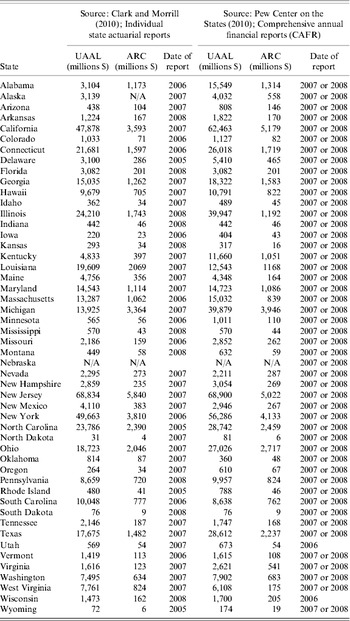
Clark and Morrill (Reference Clark and Morrill2010) report figures taken directly from the actuarial statements prepared by the states in compliance with GASB 45. By examining the actuarial statements, one can note the assumptions imbedded in the projections, such as the discount rates and the assumed inflation rates. They find that the total unfunded liabilities for the states as reported in the GASB 45 actuarial statements is over $400 billion. Table 1 shows the estimated UAALs and the ARCs for state plans as reported by the Pew Center on the States (2010) and in Clark and Morrill (Reference Clark and Morrill2010). These data reveal that the magnitude of the unfunded liabilities associated with these programs varies substantially across the states ranging from less than $50 million to over $60 billion.
State liabilities for RHI, summary information

Differences between the values reported for the individual states in Pew Center on the States (2010), which uses the CAFRs data, and in Clark and Morrill (Reference Clark and Morrill2010), which uses the individual state actuarial reports, are due to the authors using different years of data and/or to the inclusion of additional RHI plans besides those for general state employees. The largest differences between the two sources of data arise because in some states teachers are included in one of the reports but not the other. Clark and Morrill report that Alabama has an unfunded liability of $3.1 billion in the plan covering general state employees, while Pew reports an UAAL of $15.6 billion. However, Clark and Morrill also report the unfunded liability of the retiree health plan for teachers in Alabama as $12.5 billion. Adding this estimate to the number they report in Table 1 yields approximately the same value shown by Pew.Footnote 3 In addition, the differences in UAALs from the two sources are sometimes due to the year of the data reported. For example, in North Carolina, the difference in the UAAL report by Pew and by Clark and Morrill is entirely due to the fact that the Pew study used a 2007 report and the Clark and Morrill study used a 2005 actuarial report. Note that the data in most studies of retiree health liabilities do not include the additional liabilities associated with retiree health plans at the local level and many state plans also do not cover public school teachers.Footnote 4 A major limitation in determining the total unfunded liability of public sector RHI plans is the lack of a national data base that includes all state, local, and teacher plans.
2 Differences across states in RHI plans
To produce a report in accordance with the GASB 45 rule, public employers must calculate the present value of their promise to pay RHI to all current and future retirees. The present value of benefits based on current programs is determined by projecting the life expectancy of all workers, both retired and active, and the retirement behavior of active employees. These projections also incorporate the rising cost of health insurance provision. A discount rate is used to convert the stream of payments over the subsequent 30 years to a present value of the liabilities associated with the state retiree health plans. GASB 45 requires that the actuarial statements assume that the current provisions of the retiree health plan will remain in effect.
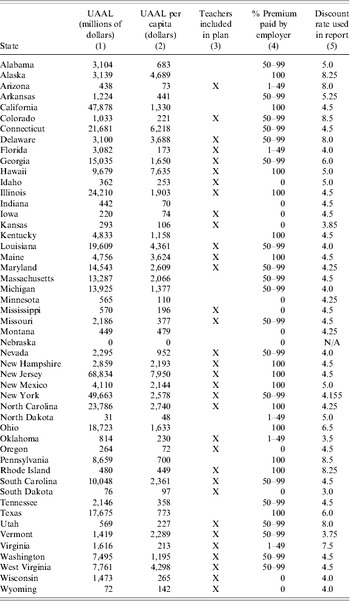
The following discussion focuses on the state-level actuarial reports. To explore the origins of the differences across states in liabilities, we combine the information gathered from the actuarial reports, as reported in Table 1 and in Clark and Morrill (Reference Clark and Morrill2010), with some secondary sources to help better frame the relative liabilities. Table 2 reports the UAAL again for reference and then includes a measure of UAAL per capita for each of the states.Footnote 5 Comparing these two values clearly shows that even after adjusting for population size, there are substantial differences across the states in their retiree health liabilities. For example, states with the lowest UAAL per capita include North Dakota ($48), Indiana ($70), Arizona ($73), Iowa ($74), and South Dakota ($97). In comparison, states with the highest UAAL per capita are New Jersey ($7,950), Hawaii ($7,635), Alaska ($4,689), Louisiana ($4,361), and West Virginia ($4,298). Thus, the UAAL per capita of the two highest states is more than 100 times the UAAL per capita of the three lowest states.
Information acquired from state actuarial reports

Sources: UAAL calculations are from data gathered from state actuarial reports. The population figures are from 2005 Census population estimates. The percent of the premium paid is from the 2007 GAO report with the exception of Washington and West Virginia, which we modified to be 50–99 . The discount rate is for the state plan covering general state employees.
Table 2 also presents several other important aspects of the retiree health plans of the various states that influence the accrued liabilities of the states. These factors are whether teachers are included in the same plan that covers general state employees, the percent of the premium paid by the employer, and the discount rate used to calculate the present value of future insurance costs. Because many states report the sensitivity of the liability levels to the assumptions used in the actuarial calculations, one can explore how significant these assumptions are to the unfunded liability levels of individual states.
2.1 RHI plan coverage
An important component of RHI plans is the extent of coverage. Our discussion here focuses on plans that cover general state employees. In many states, these same plans also cover public school teachers. Column 3 of Table 2 indicates that 33 state plans include public school teachers. Some large states such as New York, New Jersey, North Carolina, and Louisiana include teachers, whereas others such as California, Michigan, Texas, and Ohio do not. Broader coverage should be associated with larger liabilities, all else equal. For example, the New Jersey amount includes teachers and local employees in addition to state employees, whereas the California UAAL is based on a plan that does not cover these types of workers.
In addition to variation in the state policies regarding the inclusion of teachers and local workers in the state plan, as described further below, state plans also differ in their years of service requirements, eligibility ages, and integration with federal health insurance plans. For example, some public sector employers terminate the participation of retirees in the health plan at the age of 65 when individuals become eligible for Medicare. In addition, all plans require that the retiree enroll in Medicare as soon as they become eligible to do so (US GAO, 2007, 2009; Clark and Morrill, Reference Clark and Morrill2010).
2.2 Generosity of RHI across the states
The generosity of RHI plans can differ along several dimensions. For example, some state plans require fewer years of service before an employee would be eligible for fully subsidized health insurance.Footnote 6 Plans also differ in the extent of subsidization (percent of the premium paid by the state), as well as other forms of cost sharing such as the deductible and co-payment requirements. At a minimum, though, all states allow retirees to buy into the state health insurance plan. While there is a tremendous amount of variation in the characteristics of any health plan offered by public employers, the percent of the premium that the state subsidizes is a key characteristic determining the generosity of the plans due to the nature of how the present value of benefits are calculated. The difference in the lifetime present value of health insurance coverage at retirement with the retiree paying no premium compared to the retiree paying the entire premium could be over $200,000 per participant (Fidelity Investments, 2009).
GASB 45 identifies two types of subsidies, explicit and implicit. An explicit subsidy occurs when the state pays some (or all) of the premium for the health insurance. An implicit subsidy occurs when the risk pool used to determine the monthly premium for health insurance for retirees includes both active and retired employees. Including active and retired employees in one risk pool means that the premium charged to retirees is lower than the premium that would be assessed if the plan included only retirees (while the cost for active workers is therefore higher than it would otherwise be). The difference in cost between the blended premium and the retiree-only premium is an implicit subsidy. Under GASB 45, this type of implicit subsidy must be reported as a liability of the retiree health plan. Thus, even those employers that require the retiree to pay 100% of the premium will have some liability associated with allowing retirees to purchase health insurance as part of their general health insurance plan.
In addition to higher per person costs, employers with more generous RHI benefits must assume a higher ‘take-up’ rate when making calculations of future costs. More generous plans will be more attractive relative to those in the private health insurance market or insurance plans offered through a spouse's employer. Therefore, a generous health plan not only costs states more per retiree that claims the benefit, but the AAL will also reflect the higher number of retirees expected to utilize the plan. GAO (2007) divides the states into four categories: states that pay the entire insurance premium, states that pay 50–99% of the premium, states that pay 1–49% of the premium, and states that require the retiree to pay the entire premium. This assessment ignores the implicit subsidy associated with these plans. This measure of the generosity of each state plan is presented in column 4 of Table 2.Footnote 7
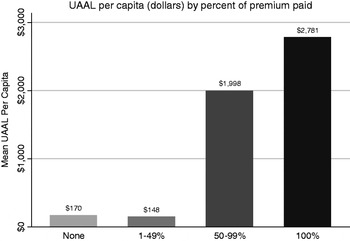
The impact of state paid premiums is clearly shown in Figure 1, which illustrates the mean UAAL per capita for states in the each of four generosity categories shown in Table 2. States that require retirees to pay the entire premium only have liabilities associated with the implicit subsidy. The mean UAAL per capita for these states is only $170 million. States that pay a small proportion of the premium (1–49%) have a mean UAAL per capita that is very similar to those states requiring the retiree to pay the entire premium. In stark comparison, the mean UAAL per capita is $1,998 for those states paying 50–99% of the premium and $2,781 for the states that pay 100% of the premium. Figure 1 illustrates the importance of this generosity parameter in determining the liabilities associated with state retiree health plans. These data present an interesting puzzle for researchers to explain: why have some states chosen to pay the entire RHI premium, while other states simply allow retirees access to their health plans?
Average UAAL per capita (measured in dollars) by the percent of premium paid by the state

2.3 Assumed trends in medical cost increase
In the actuarial statements, the health-care cost trend rate is typically defined as the rate of change in per capita health claims costs over time as a result of factors such as medical inflation, utilization of health care services, plan design, and technological developments. The rate of assumed increase in the per capita cost of medical care is another determinant of the projected future cost of providing RHI. Over the past few years, the total cost for employer-provided health care has been increasing at annual rates in excess of 10%.Footnote 8 Virtually all of the actuarial reports for state RHI plans assume that the medical cost rate will decline from its current level of 10–14% per year to a rate of around 5%. Of course, lower assumed rates of inflation result in lower liabilities and ARC, thus making the state's financial position look rosier.
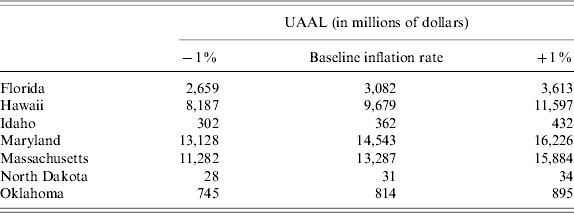
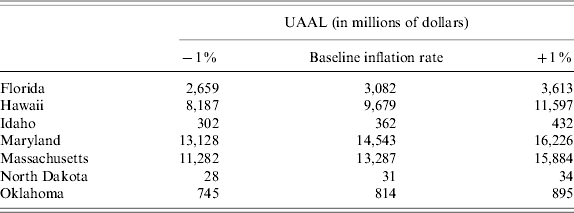
Several of the actuarial statements illustrate the impact of variations in the rate of increase in per capita medical costs. These figures are presented in Table 3. For example, Hawaii reports a UAAL of 9.7 billion dollars using an assumption that the current rate of medical care cost increase falls from the current 11% to only 5% in 2113. Then, the report states that an increase of 1% point in the medical care cost increase would raise the UAAL to $11.6 billion, an increase of almost 20%. The other states that report the results of such an exercise have similar patterns. Therefore, we must conclude that if the rate of medical care cost increase were to continue at its current rate, all projections of state UAALs and ARCs would be significantly higher. Since all the reports have adopted similar assumptions on medical care cost increases, this assumption does not affect the relative values of UAAL across the states.
Sensitivity of UAAL to inflation rate
Source: Actuarial reports of various states.
2.4 Assumed discount rates
GASB 45 allows public employers to use a discount rate that is consistent with the return on the ‘investments that are expected to be used to finance the payment of benefits’. For states that do not prefund their retiree health plans, the assumed discount rate should approximate the yield on the portfolio of the state's general assets from which funds are drawn to pay for the health benefits for retirees. However, if the state establishes an irrevocable trust to partially or wholly finance its RHI, a rate consistent with the return on these investments can be used in the actuarial reports. The GASB standards allow partially funded plans to adopt a blended rate between 4% and 7% to 9% to calculate their accrued liabilities. The final column of Table 2 indicates the discount rate used by each state in calculating their UAAL. In comparison with public pension plans, most states are currently using lower discount rates for determining the liabilities associated with their RHI plans, and this follows from the funding strategy chosen by the state. The actuarial reports of 17 states are based on a discount rate of 4.5%, another 11 states use 4.0–4.25%, and four states adopted discount rates of 3.0–3.85%.
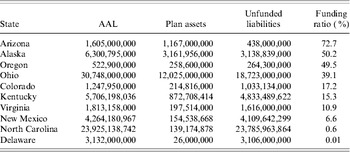
Table 4 indicates the states that have existing funds and the funding ratio for these plans. Based on their actuarial statements all other states do not have any assets set aside for the payment of RHI. Thus, most of these plans are funded on a pay-as-you-go basis using current revenues to pay current premiums for health insurance for retired workers. This is a substantially different funding strategy compared to that used by the states to fund their pension plans.
Assets and funding ratios of state retiree health plans

Source: Actuarial reports of various states and author calculations.
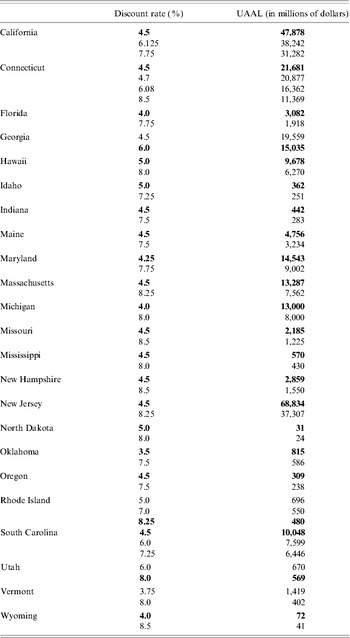
Many of the state actuarial statements show the impact of assuming a higher discount rate. This sensitivity analysis is most often included in the reports of states considering the establishment of a trust fund or where there are specific proposals concerning prefunding. The reduction in UAAL and ARC associated with using a higher rate is discussed in the reports as being an advantage of establishing a trust for these plans. These calculations are shown in Table 5 for all of the states that reported the sensitivity of the UAAL to changes in the discount rate. Typically, the statements report the UAAL using a discount rate of 4–5%, which is consistent with the current pay-as-you-go status of these plans. The consultants often illustrate the impact of a movement toward full funding by incorporating a discount rate of approximately 8% into the calculations. The impression is clearly given that if only the state were to move toward funding, their health liabilities would be dramatically reduced.
UAAL by discount rate

Source: Actuarial reports of various states. Values in bold are the values used in the report.
Since most public employers do not have dedicated trust funds for these health plans, they tend to use discount rates of between 3.5 and 5.0%. Thus, in general, estimated liabilities for RHI are likely to be more realistic than the comparable estimates for public pension plans. In the pension literature, there is currently a debate on the appropriateness of using these higher discount rates (Novy-Marx and Rauh, Reference Novy-Marx and Rauh2010). This debate is primarily between the actuaries who use GASB guidelines and economists who favor using real market interest rates. Financial economists argue that a more realistic approach to determining the present value of pension liabilities would be to use the rate of return to bonds, a rate closer to 4%. The basic argument is that the liabilities associated with retirement benefits should be considered a form of public debt and are similar to a bond. Thus, their value (in this case the present value of future health care costs) should be determined using the interest rates on bonds offered by the government, i.e., the current yield on state bonds. Following this line of reasoning, the appropriate discount rate would be in the range of 4% whether or not the state chose to prefund their RHI. Similar arguments could be made concerning the discount rates used to value RHI, although a major difference between RHI and pension plans is the limited use of trust funds to support RHI plans.
2.5 Factors associated with high and low UAAL levels
Economic theory and political economy suggest that the total cost of RHI plans and their generosity will be related to state-level environmental factors such as the population size, the size of the state budget, the absolute and relative size of the public sector in a state, the level of unionization, the commitments to other employee benefits, and the earnings of state employees. In addition, reported liabilities will be directly affected by the plan characteristics and methodological assumptions, whether the teachers are included in the plans, and the proportion of the premium paid by the state.
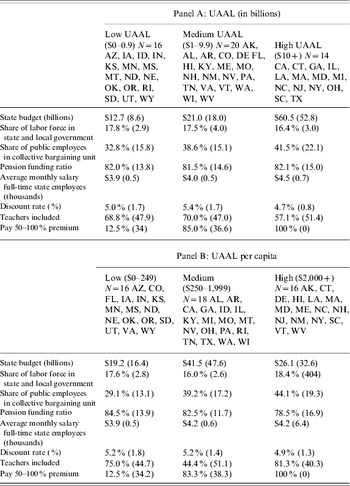
In Table 6, we report results from an exercise where we group states into three categories based on the extent of the UAAL (Panel A) and UAAL per capita (Panel B). We then show how these state-level and plan characteristics are related to the extent of the liabilities that states face. We present the mean and standard deviations for a series of state-level variables for each grouping.
Factors associated with high levels of unfunded actuarially accrued liabilities per capita

Note: Table coefficients are mean (std. dev.)
First, the size of the state may both influence the size of the liability mechanically but may also reflect some economies of scale in provision of health benefits. To examine this relationship, we report the size of the state budget in 2005 from the State and Local Government Sourcebook for each of the liability categories.Footnote 9 The budget is a measure of the overall size of the state government and it is anticipated that this would be positively correlated with RHI liabilities, but would not necessarily influence the cost per capita of these programs. This is indeed the case, where the state budget is nearly five times larger in the high-UAAL versus low-UAAL states but much more similar for the UAAL per capita groupings.
The share of workers in the public sector might also affect plan costs as states with more public sector employees will have higher labor costs compared to similar states with fewer government workers.Footnote 10 In addition, the voting power of this larger government workforce may result in the state providing more generous benefits. However, we see no relationship between our measure of the size of the public sector labor force and the UAAL or UAAL per capita levels. Similarly, a higher degree of unionization among public sector employees could also result in more generous employee benefits.Footnote 11 Our empirical results are consistent with this prediction and show a slightly positive relationship between public sector unionization and both UAAL and UAAL per capita. Note that because of limited power, the only pairwise means that are statistically significantly different are for the low versus medium and low versus high categories of UAAL per capita.
The funding status of the pension plan for state employees could signal that states that prudently fund their pension plans also have taken steps to have low unfunded liabilities associated with their retiree health plans. However, there does not appear to be any systematic variation across the liability groupings in pension funding. Next, we consider the average salary of state employees.Footnote 12 It could be that generous benefits are associated with lower pay or that states that have higher salaries also provide higher retirement benefits. However, there is no strong pattern between our measure of the average monthly salary of state employees and the UAAL or UAAL per capita levels.
Next, we consider how plan characteristics and calculation assumptions are related to both the UAAL and UAAL per capita groupings. The discount rate used in the actuarial calculations has a mechanical effect on liabilities, but it might also reflect the increased incentive of states with high levels of unfunded liabilities to use the higher discount rates that lead to a lower reported liability levels. The discount rate is slightly decreasing in UAAL per capita, but no strong relationship is seen. As discussed above, most states use a discount rate around 4%.
Interestingly, there is no clear pattern of states with high liabilities being more (or less) likely to include teachers in the general state plan. Finally, we consider the GAO (2009) report groupings of the proportion of the insurance premium paid by the state. Figure 1 demonstrated that those states that pay 50–99% and those that pay 100% of the premium have much higher retiree health liabilities relative to states that pay less than 50% of the premium. In Table 6, we consider the fraction of states that pay between 50 and 100% of the premium. Here, we do see a large and striking pattern. For both the high-UAAL and UAAL per capita groups, all states are paying at least 50% of the premium. In contrast, only 12.5% of the lowest-UAAL and lowest UAAL per capita states pay more than half of the premium. This factor is clearly the most robust determinant of the extent of the liabilities. Importantly, this is a policy variable that states have chosen, although little is known about why some states are offering more generous benefits along this dimension than other states.
Although the patterns found in Table 6 are consistent with predictions and clearly indicate a large and important role for the health plan generosity in determining the burden of RHI liabilities, many important questions remain. The considerable variation in plan liabilities across states cannot be explained solely by differences in population, public sector labor force characteristics, or assumptions made in calculating the future liabilities. The choices that state governments make regarding the characteristics of their RHI plan are a key component to understanding why liabilities and costs differ so dramatically across states.
3 Is RHI a liability or a promise?
Given the high levels of liabilities some states face, it is natural to consider whether states must truly fulfill the promise of future health insurance for retirees, or whether they may reduce benefits at some future time. The US GAO (2008) reports that all states have legal protections for their retirement plans that limit the ability of a legislature to substantially alter the generosity of the pension plan for state employees. The majority of states have constitutional provisions that describe how their retirement plans are to be ‘funded, protected, managed, or governed’ (US GAO 2008, p. 60). However, RHI plans are not accorded similar status. Reductions in, or the elimination of, retiree health benefits may be constrained by collective bargaining contracts but, in general, legislatures have more flexibility to reduce and modify retiree health benefit plans for public sector employees. For example, the Ohio 2007 CAFR asserts that ‘unlike pensions, the health care benefits OPERS (Ohio Public Employee Retirement System) provides (with the exception of Medicare B reimbursement) are not a guaranteed benefit ….OPERS continues to make changes to the plan design of the health care benefits …’ (Ohio Public Employees Retirement System 2007, p. 32).
Many states have been amending their health plans for active workers and retirees in response to rising health-care costs. Changes include higher premiums, higher deductibles, higher co-payments, and more years of service to qualify for retiree health plans. The ability to modify retiree health plans provides states with some options to moderate their projected costs and thus reduce the UAAL and ARC presented in these actuarial statements.
4 RHI and pensions
Economists have devoted substantial resources in trying to explain the variation in pension plans across private sector employers. Other studies have examined how changes in the economic and regulatory environment have altered the structure of these retirement plans, and how pension plan characteristics affect work and saving behavior.Footnote 13 In contrast, very little attention has been paid to similar issues concerning RHI plans. Perhaps the lack of research on RHI is due to the rapid decline in the incidence of these plans in the private sector since the establishment of new reporting standards for employers by the Financial Accounting Standards Board in 1989 (FASB, 1989).Footnote 14 However, RHI plans cover virtually all full-time public sector employees and represent a significant component of labor cost to state and local governments. The dearth of research on the effects of RHI may be due to the lack of recognition of the importance of retiree health plans and the true liabilities associated with retiree health plans in the public sector. Until recently, there were very little data on the cost and characteristics of these plans.
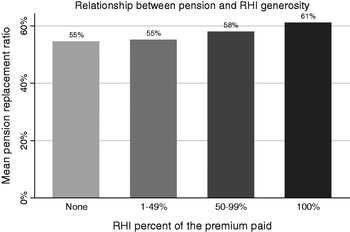
Since both RHI and pensions are deferred compensation and provide benefits in retirement, we might consider both of these plans human resource tools that have the same objectives: attracting, retaining, and retiring quality workers. We know of no study that has considered the joint use of RHI and pension plans to achieve the same HR objectives. As a first attempt to assess the relationship of RHI and pension, we divide states into four groups based on the percent of the premium paid as reported in Table 2. To approximate pension plan generosity, we use the replacement rate for a state employee who retirees at age 60 with 30 years of service in each state. These replacement rates are based on the benefit formula that was in effect in each state in 2006.Footnote 15 The mean pension replacement rate for each group is presented in Figure 2. We see that pension generosity, as approximated by replacement rates, and RHI generosity, as approximated by percent of the premium paid, are positively related. The mean pension replacement rate in the most generous RHI group (61%) is a statistically significant 6 percentage points higher than the mean in the least generous RHI group (55%). The fact that states with more generous pensions also have more generous RHI plans implies that states are not shifting their benefits from one type of delayed compensation to another. It also means that separately investigating the impact of RHI from pensions will be challenging, since the generosity of these plans positively covary.
The relationship between pension replacement rates and RHI percent of the premium paid

Understanding the relationship between RHI and pension plans is of practical importance for a public sector employer's fiscal planning. For example, a more generous RHI plan should make workers on the margin more responsive to the retirement incentives imbedded in pension plans. On the other hand, if employees do not have access to affordable health care in retirement, they may choose to postpone retirement until eligible for Medicare. When public sector employers make choices regarding the structure and generosity of one type of post-retirement benefit, it is essential for them to consider potential repercussions on the effectiveness and take-up rate of other post-retirement benefits offered by the employer.
5 Value to employees
In order to better model the public sector labor market economists need to develop a more detailed understanding of the role of RHI plans as a component of total compensation and how it affects job tenure and retirement decisions. The value of RHI depends on factors such as the employee's age of retirement and the generosity of the plan. Having employer-provided RHI also reduces the need for income compared to workers who expect to purchase health insurance in retirement. The reduction in funds needed to purchase health insurance in retirement might affect lifetime saving, in particular, participation in and contributions to supplemental retirement plans offered by the employer.
However, benefits are not free to workers; instead they are purchased by the employees because they accept lower wages as a quid pro quo for the employer providing the benefits. Benefits are compensation in kind and are hard to trade for other forms of consumption. In other words, it is impossible to accept health insurance, sell it to others, and then use these monies to purchase food and clothing. In addition, the concept of vesting for RHI benefits is less clear and the legal guarantee of future benefits is less secure compared to pension plans. Thus, it may be that the employer offers more benefits than the worker desires. In this case, the reduction in wages associated with the benefit might lower the total value of employment for some workers. Benefits such as pensions and retiree health plans typically have the greatest value to workers who stay for many years and provide much less value to those that remain with the employer for only a few years. Because worker preferences differ, employers can develop and offer compensation packages that appeal to the types of employees they seek to hire. Thus, retirement benefits may help recruit workers, reduce quit rates, and ultimately assist public sector employers in achieving an orderly retirement of its workers.
Given the eligibility requirements for these RHI plans and the value of being able to remain in the state health plan, we should expect public sector employees to be more likely to remain with the employer in order to meet the needed years of service. This effect should be especially strong as the worker approaches the qualifying number of years of service. Once sufficient tenure has been achieved, workers should be more likely to retire. In conjunction with pension plans, the economic incentives imbedded in retiree health plans help to explain lower turnover rates, longer job tenures, and earlier retirements among public sector workers. We know of no studies that tried to estimate the influence of retiree health plans in the public sector on job tenure and retirement decisions. Empirically it is difficult to isolate the effects of RHI separately from those of pensions and other employee benefits. With large data sets one could potentially identify employees’ retirement behavior relative to discrete jumps in the value of plans that do not exactly coincide with other retirement incentives. In addition, given the variation in RHI plan characteristics, such as generosity and eligibility, state-level variation could be fruitfully exploited.
There are numerous studies by economists estimating the impact of employer pensions on job tenure and the timing of retirement, but only a few have examined the role of RHI on retirement decision (e.g., Rogowski and Karoly, Reference Rogowski and Karoly2000; Blau and Gilleskie, Reference Blau and Gilleskie2001). Economists have examined the role of health insurance for active workers on job mobility (e.g., Gruber and Madrian, Reference Gruber and Madrian1997, Reference Gruber, Madrian and McLaughlin2004), but these studies typically do not extend the analysis to potential coverage in retirement. Most of these studies have focused on the general labor force or specific plans of private sector employers.
It is interesting to note that relatively few states have adopted automatic enrollment for supplemental retirement savings accounts and many public employers do not offer to match employee contributions. In contrast, most private sector employers, who do not offer retiree health plans, do offer employer matches and increasingly employers are adopting automatic enrollment in these plans. RHI plans are a valuable benefit and may represent significant cost savings in retirement. As such, workers in the public sector may not require the same level of retirement savings relative to their private sector counterparts. Public sector workers may already be ‘saving’ for retirement in the sense that they are forgoing higher salary now for a future stream of payments in the form of more generous employer-provided benefits in retirement.
A better understanding of the value of RHI would help public employers develop a more comprehensive approach to their retirement policies. For example, should a governmental employer that provides a 100% health insurance subsidy to retirees offer a less generous pension plan or avoid offering supplemental retirement savings plans that include automatic enrollment or an employer match? Do workers covered by RHI save less than comparable workers whose employers do not offer such a plan? Are workers covered by retiree health plans less likely to enroll in supplemental retirement plans and, if they do participate, do they contribute less to these plans? Do employees recognize, understand, and value their RHI benefit? How valuable are RHI plans to different types of workers such as primary versus secondary earners, early versus mid-career workers, or high- versus low-wage workers? How does RHI actually affect turnover rates in the public sector? Does the provision of RHI encourage earlier retirement for public sector workers?
6 Future of public sector RHI
Analysis of the actuarial statements for RHI plans offered by states indicates that some states face substantial future liabilities associated with these programs, that relatively few states have enacted legislation establishing trust funds to help finance these future costs of retiree health plans, and that even fewer are making use of laws that allow funding. These substantial liabilities pose a serious financial problem for many states. These unfunded liabilities will confront policy makers with difficult choices in the future. In 2006, the annual cost to state and local governments for retiree health plans averaged about 2% of employee salaries. If public sector employers continue to pay for these benefits on a pay-as-you-go basis, the cost of RHI is projected to rise to 5% of payroll in 2050 (GAO, 2008). As annual costs rises, the ability to finance RHI programs may cause other priorities to be unmet and the overhang of billion dollar RHI liabilities may influence future bond ratings.
In the near future, states with high unfunded liabilities will need to either increase revenues to meet these costs or they must reduce the benefits they provide to retired workers. There are many options that public employers can adopt to accomplish either of these challenges. Increasing revenues can be achieved by raising any of a variety of taxes or through the sale of public assets. If such financing is used in conjunction with an irrevocable trust, new funds deposited into such a trust can yield returns on investments that can reduce the need for future tax increases.Footnote 16 New revenues to support RHI can also be generated by reducing other government expenditures and transferring these unused funds into the trust for RHI.
Alternatively, states and other public employers can attempt to reduce expenditures on retiree health plans by reducing their generosity or shifting the cost from the employer to workers and retirees through higher premiums, co-payments, and deductibles. Employers can also increase the years of service required for eligibility in these programs, thus reducing the number of eligible participants. States and local governments might also consider the total elimination of retiree health plans, as was seen in the private sector. Another option for states might be to shift from defined benefit-type plans to retirement saving account plans where workers can contribute to a fund that could be used for health care expenses in retirement. However, recall that some state governments may face constitutional and statutory restrictions on eliminating these plans altogether, which may further complicate the strategy of reducing liabilities by restricting the benefits provided.Footnote 17
Finally, states may adopt various methods to address the actual cost of health benefits. Such techniques include more effective delivery of health care to retirees, proper and efficient coordination with Medicare, and the use of health improvement programs such as wellness programs to reduce the utilization of medical care by their retirees. In response to GASB 45 and the financial pressures associated with health insurance promises, states are considering many of these options. Thus, policy changes within states may limit the actual future cost of retiree health plans in the public sector. Along the same lines, national health-care reform could directly affect state RHI plans through reductions in the cost (or cost growth) of health care.
As the various components of the 2010 health bill are implemented, state and local policy makers will try to assess their implications for their health plans for active and retired workers. Will it be cheaper and more acceptable to eliminate retiree health plans and provide incentives for retirees in their 50s to purchase health insurance from the new insurance exchanges? Expansions of Medicare coverage and/or generosity should also impact public sector RHI plans by shifting some costs from states to the federal government. On the other hand, a policy change such as an increase in the age of eligibility for Medicare to match the new Social Security normal retirement ages could negatively affect state and local governments who would then need to cover retirees under their RHI plans for longer time periods.
As one example, in the 2010 health reform law one provision gives individuals who are under age 65 and living in households at 400% or below the federal poverty level eligibility for subsidies to purchase health insurance after 2014.Footnote 18 If the health-care reform does lead to the development of health insurance exchanges or other sources of affordable individual health insurance, this may reduce the pressure on public sector employers as some individuals (although perhaps those with the lowest costs) will opt not to use their employer-provided RHI. How this and other provisions of the health-care reform ultimately affects the RHI liabilities faced by state and local governments remains to be seen.
7 Conclusions
Throughout this analysis of RHI in the public sector, we have examined important economic and policy questions. Unfortunately, the data necessary to answer these questions are not readily available. Relatively few nationally representative data sets contain sufficient number of state and local employees to address these questions and surveys often lack important details of these plans, such as the cost to the retiree of remaining in the plan and the eligibility conditions of continued enrollment in the health insurance plan. One method of assessing the importance of RHI might be to obtain data from individual state systems and compare turnover rates and retirement ages under a system where the employer pays the entire insurance premium for retirees to a system that only provides access to the health plan.
As employers of a relatively large number of workers, state and local governments must develop optimal human resource management policies that enable them to hire, retain, motivate, and ultimately retire high-quality workers. Public sector employers need to maintain a workforce that can produce and deliver the goods and services demanded by their citizens at a cost that taxpayers are willing to pay. Historically, this has been achieved by public employers offering more generous retirement benefits than comparable private sector workers receive. Virtually all full-time state and local employees are covered by both a pension plan and a retiree health plan, whereas coverage rates are much lower in the private sector. Economists have devoted considerable resources toward trying to understand the role of employer pensions with most of these studies focusing on private sector plans. In contrast, economic analysis of retiree health plans is virtually non-existent. New empirical and theoretical research is needed to assist public managers in developing optimal retirement policies and reforming current systems.
It is also important for policy makers, managers, and researchers to consider the joint effects of pension and retiree health plans. From an administrative standpoint, these two important and costly benefits are often overseen by separate governmental units when a coordinated policy is needed. Changes in pension policies that affect turnover rates and retirement decisions will also affect the utilization of RHI. Under pressure from rising costs, public managers and policy makers must be aware of labor market responses to modifications in retirement plans. Additional research is needed to help governmental leaders make the most appropriate choices in designing and modifying their RHI plans going forward.