
Introduction
Rising demands for renewable energy have accelerated the transition toward more sustainable methods of generating electrical power. Looking to address this demand is materials science; polymer electrolyte membrane fuel cells (PEMFCs) provide an alternative source of clean energy through the reduction–oxidation reactions of hydrogen and oxygen gas. Through the following reactions, large amounts of power are generated, leaving the water as the sole byproduct:
 $$\matrix{ {{\rm Hydrogen}\;{\rm oxidation}\;{\rm reaction}\; \lpar {{\rm anode}} \rpar } \cr {{\rm H}_2\to 2{\rm H}^ + + 2{\rm e}^-} \cr}$$
 $$\matrix{ {{\rm Oxygen}\;{\rm reduction}\;{\rm reaction}\; \lpar {{\rm cathode}} \rpar } \cr {{1 \over 2}{\rm O}_2 + 2{\rm H}^ + + 2{\rm e}^-\to 2{\rm H}_2{\rm O}} \cr}$$
 $$\matrix{ {{\rm Net}\;{\rm reaction}} \cr {{\rm H}_2 + {1 \over 2}{\rm O}_2\to {\rm H}_2{\rm O}} \cr}$$
To increase the efficiency of fuel cells, this study applies electrospinning—a fiber fabrication technique employing an electrical current to convert semi-viscous solutions into nanofibers.
In the previous research, electrospun fibers have been used in a variety of contexts, most notably in tissue scaffolding, filtration, and textile manufacturing.[Reference Mirjalili and Zohoori1] This remarkable versatility can be attributed to their distinct physical characteristics; electrospun nanofibers have a high surface area to volume ratio and a continuous length that promotes proton conductivity and reduces nanoparticle agglomerations. Additionally, the many customizable parameters of electrospinning grant users precise control over fiber diameter, porosity, and alignment.[Reference Zhao, Xin, Aiyun and Zhijuan2]
Due to these advantages, recent attention has turned toward electrospinning in the application of a catalyst layer to the electrodes of PEMFCs.[Reference Huang, Zhang, Kotaki and Ramakrishna3] Previous studies have investigated the feasibility of electrospinning pure Nafion, a sulfonated tetrafluoroethylene-based fluoropolymer–copolymer essential to proton conductivity.[Reference Abidat, Morais, Pronier, Guignard, Comparot, Canaff, Nappron, Habrioux, Mamede, Lamonier and Kokoh4,Reference Bajon, Balaji and Guo5] To expand on this development, this study electrospins platinum (Pt)–carbon (C) nanoparticles alongside Nafion and fundamental polymers (FPs) to produce a catalytic solution that increases electrical conduction across the three-dimensional (3D) surface of electrodes in a PEMFC. Our work consists of two phases:
1. assess the viscosity, consistency, and fiber formation of various polymers to determine the most appropriate FP and
2. optimize the ratio of FP: total solute (henceforth referred to as wt%) to produce uniform fibers with minimum agglomeration.
Upon the completion of the two essential phases, preliminary performance testing was conducted to compare the efficacy of electrospun fibers to traditional air-spraying methods.
Literature review
Given the unique physical and molecular properties of nanofibers, electrospinning Nafion has previously been explored. Compared to traditional membranes, electrospun Nafion mats have been shown to exhibit high rates of proton conductivity and gas diffusion, as well as excellent shape-memory properties; thus, it can be hypothesized that their application within the PEMFC will greatly improve its performance in terms of peak power output.[Reference Bajon, Balaji and Guo5,Reference Snyder and Elabd6] As Nafion is unable to polymerize individually, several FPs have been examined as potential additives to electrospinning solutions, including poly(tetrafluoroethylene) (PTFE), poly(ethylene oxide) (PEO), poly(vinyl acetate) (PVA), and PAA, in weight concentrations ranging from 5% to 30%.[Reference Huang, Zhang, Kotaki and Ramakrishna3]
In PEMFCs, electrospun Nafion mats have been explored extensively as a potential replacement to the PEM.[Reference Bajon, Balaji and Guo5,Reference Snyder and Elabd6] Electrospun Nafion–PEO blends displayed a higher proton conductivity and tensile strength, as did an electrospun NTDA-BDSA-r-APPF membrane, which was also found to lower gas permeability and enhance PEM thermal and chemical stability.[Reference Choi, Kyung, Wycisk, Pintauro and Mather7,Reference Tamura and Kawakami8] Ultimately, both proved to be effective alternatives to Nafion membranes without a copolymer attached. However, little research has been performed on electrospun Nafion fibers as a component of the gas diffusion layer and their potential to optimize Pt/C catalyst contact with redox reactants. Preliminary tests utilizing PAA as the FP suggest that a nanofiber additive to the catalyst layer will enhance proton transport as well as catalysis, yet the optimal composition and concentration of PEMFC electrospinning solutions and nanofibers have yet to be determined.[Reference Zhang and Pintauro9]
Materials and methods
FP viability assessment
Expanding upon the previous research, four different FPs were assessed as potential candidates to serve as the FP based on previous applications in similar contexts:
A. Poly(tetrafluoroethylene) (PTFE)[Reference Wang, Richey, Wujcik, Ventura, Mattson and Elabd10]
B. Poly(ethylene oxide) (PEO)[Reference Lee, Choi, Wycisk, Pintauro and Mather11]
C. Poly(vinyl acetate) (PVA)[Reference Ballengee and Pintauro12]
D. Poly(acrylic acid) (PAA)[Reference Chen, Snyder and Elabd13]
Each solution was prepared in a 10 wt% solute concentration, with a solvent composition of isopropanol to deionized (DI) water in a 2:1 ratio, and then electrospun. Scanning electron microscopic (SEM) imaging and laser and optical microscopy were used to characterize FP viability based on solution viscosity, consistency, and fiber formation. PAA was found to be the sole suitable FP, producing fibers with a minimum beading. In addition, PAA was found to be the only base polymer that could produce a solution with the solubility able to be electrospun even when Pt/C is added to it.
Optimization of the fiber structure
Varying ratios of PAA and Nafion (solute) to solvent were then tested to minimize agglomerations within the electrospun fibers. Solutions with concentrations of 5, 10, and 12 wt% were electrospun onto 1 cm2 silicon wafers. Optical, laser–optical, and SEM imaging were employed to analyze and compare the fibers produced, revealing optimal fiber formation from the 12 wt% solution.
Following the addition of Pt/C nanoparticles, the concentration of Pt/C with respect to the additional solute components was varied to optimize PEMFC performance. Solutions with Pt/C to solute concentrations of 27.3% and 33.3% were prepared, with SEM imagery ensuring the continued embedment, rather than a superficial attachment, of Pt/C nanoparticles into the fiber, as explained later in this investigation.
Electrospinning deposition
All electrospinning procedures were conducted inside a Standard Fisher Scientific® fume hood, with a 1 mL syringe stationed on a Scientific Lab Supply® syringe pump 5 cm away from a rotating platform holding microporous carbon electrodes (Supplementary Fig. S1). In order to produce the required electrical field to facilitate fiber formation, a cathode wire was attached to the syringe tip, while an anode wire was attached to the rotating platform. A 12 kV potential difference was applied through a high voltage power box, and the syringe pumping rate was set to 0.5 mL/h.
Electrodes were continuously weighed during electrospinning to achieve a Pt loading of ~0.100 mg/cm2, in accordance with industrial standards. To ensure a uniform, interwoven fiber morphology, electrodes were rotated 90° every 5 min, producing perpendicular fiber layers.
Performance testing of assembled MEA
The experimental Membrane Electrode Assembly (MEA) tested with a B&K Precision software consisted of one electrospun or air-sprayed electrode as the anode and one commercial electrode as the cathode; it was ensured that the two noncommercial electrodes had the same Nafion to Pt/C ratio as each other.
Since membrane conductivity is heavily influenced by water absorption, all membranes were hydrated in DI water for at least 5 min prior to assembly.
An MEA was constructed of glass plates, current collectors, electrodes, and a proton exchange membrane (PEM). Both electrodes were oriented with catalyst ink facing toward the PEM. The nuts and bolts that held the PEMFC together were held flat and tightened 360° clockwise in each trial to ensure equal compression against the membrane. The process of assembly was repeated for each control and experimental trial.
Hydrogen gas flowed through the anode at a regulated flow rate of 78 cm3/min, while open-air was connected to the cathode. Electrical spring clips connected to the B&K Electronic Load software were attached to the current collectors located on the MEA. Each test was allowed to run for 7.5 min, with currents and voltages recorded every 30 s for 15 different currents from 0.00 to 0.70 A at 0.050 A intervals.
Results and discussion
Poly(acrylic acid)
PAA was determined to be the sole viable polymer for electrospinning in combination with Nafion through an examination of the four potential candidates (see the Materials and methods section). In order to establish a baseline, PAA–Nafion was electrospun with a polymer weight of 5%. Laser–optical microscopy imaging was used to analyze the fibers produced.
As shown in Supplementary Fig. S2, the fibers produced were of an unideal structure. Unlike the desired uniform mat of fibers, the 5 wt% PAA–Nafion solution produced fibers that were nonhomogeneous, wispy, and inconsistent. These undesirable characteristics can be attributed to a low solution viscosity, thus prompting the investigation of higher wt% in order to obtain the ideal, interwoven surface morphology.
Optimization of the fiber structure
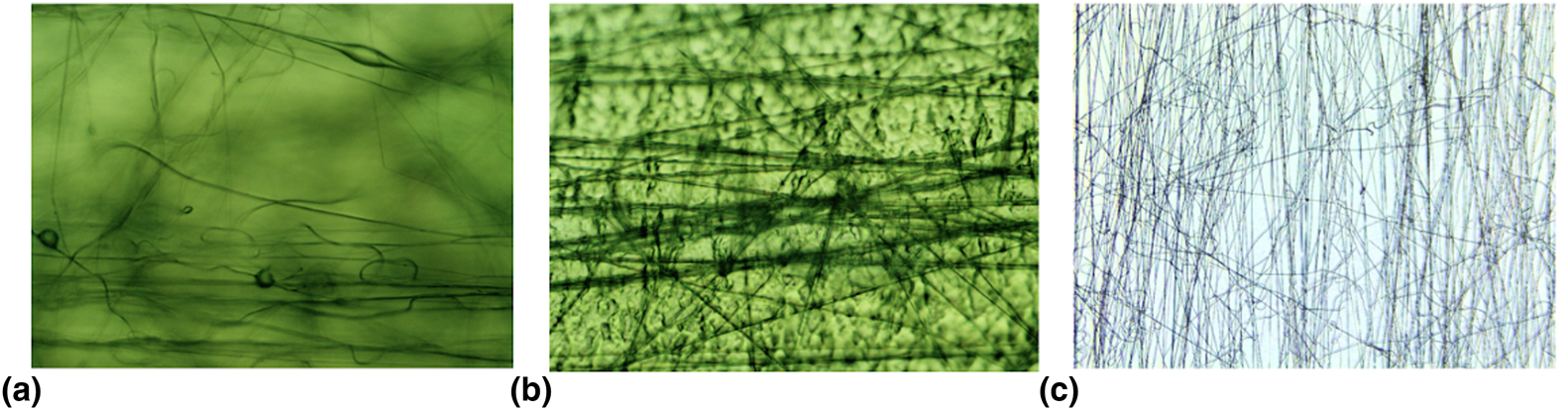
In order to optimize the structure of the fibers produced, solutions with higher solute concentrations were electrospun. Through incremental increases in FP concentrations, it was determined that electrospinning a 10 wt% PAA–Nafion concentration solution produced 3D nanofibers, as seen in Fig. 1(b). However, there were significant areas of bead formation and an inconsistency in fiber diameters, which could cause uneven fiber distribution. Both of these factors were detrimental, as they prevent the process of electrospinning from optimally increasing the surface area contact between the catalyst layer and the PEM.
Optical/laser–optical microscopy of (a) 5 wt%, (b) 10 wt%, and (c) 12 wt% PAA–Nafion solutions.

A 12 wt% Nafion–PAA solution produced the most optimum fibers for the purposes of this study. Not only was electrospinning able to produce fibers of consistent diameters, but few beads were observed in laser–optical microscopy [Fig. 1(c)]. An 18 wt% Nafion–PAA solution was also prepared; however, it was too viscous to electrospin. Therefore, a 12 wt% concentration of Nafion and PAA in a 4:1 ratio was used as the base solution, with Pt/C added to electrospin onto carbon electrodes.
As shown in Supplementary Fig. S3, smooth, thin-woven fibers are produced by a 12 wt% PAA–Nafion solution. Thermal imaging highlights points of intersection across the fibers with a minimal beading. Overall, these surface properties are hypothesized to create a path of least resistance to proton transport.
Scanning electron microscopy
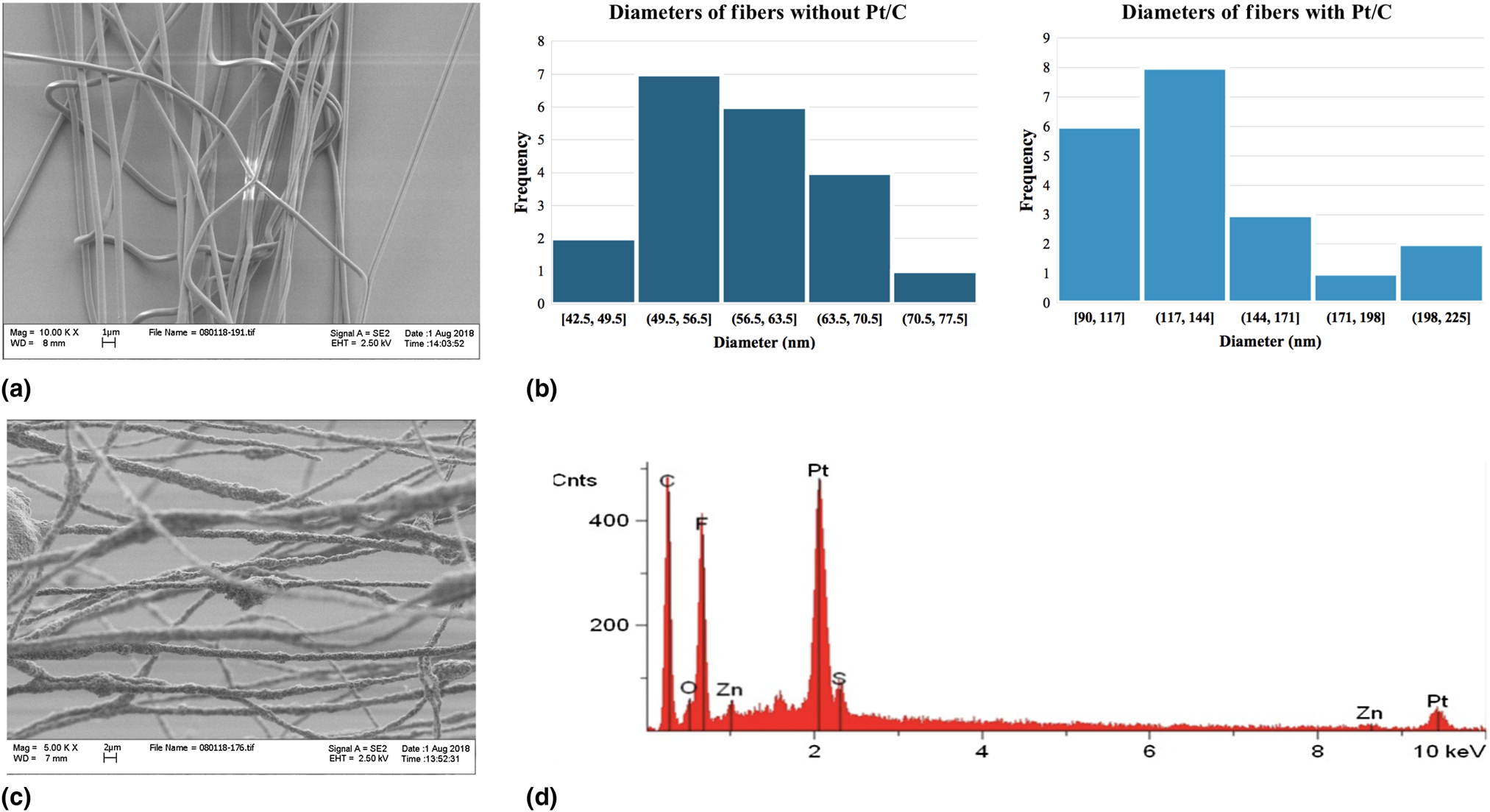
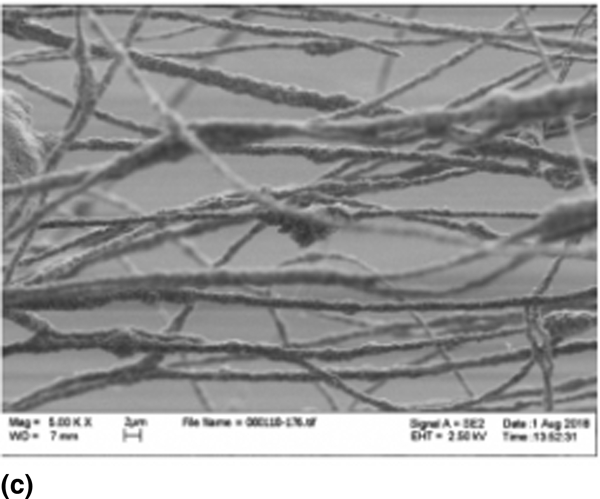
In order to more closely observe the structure of the electrospun nanofibers, as well as their critical interaction with Pt/C nanoparticles, SEM imagery was conducted on the 12 wt% Nafion–PAA fibers, with and without Pt/C in a 27.3 wt% concentration [Fig. 2(a)]. Without Pt/C, electrospun fibers had an average diameter of 63 nm, an ideally thin distance that facilitates fiber interwovenness [Fig. 2(b)]. Fibers containing Pt/C, however, had an average diameter of 140 nm, roughly twice as large, confirming the attachment of a thin layer of Pt/C across the entire surface of the fiber [Fig. 2(b)]. Agglomerations, although present, are minimal, suggesting that incorporating Pt/C nanoparticles into the base solution is an effective means of ensuring even catalyst dispersion [Fig. 2(c)]. Furthermore, the protruding ridges revealed in Fig. 2(c) confirm the encapsulation of the Pt/C nanoparticles within the fibers.
(a) SEM of 12 wt% PAA–Nafion solutions without Pt/C; (b) histogram of diameters of electrospun fibers with and without Pt/C; (c) SEM of 12 wt% PAA–Nafion solutions with Pt/C; and (d) EDS of electrospun Pt/C–PAA–Nafion fibers on a Si wafer.

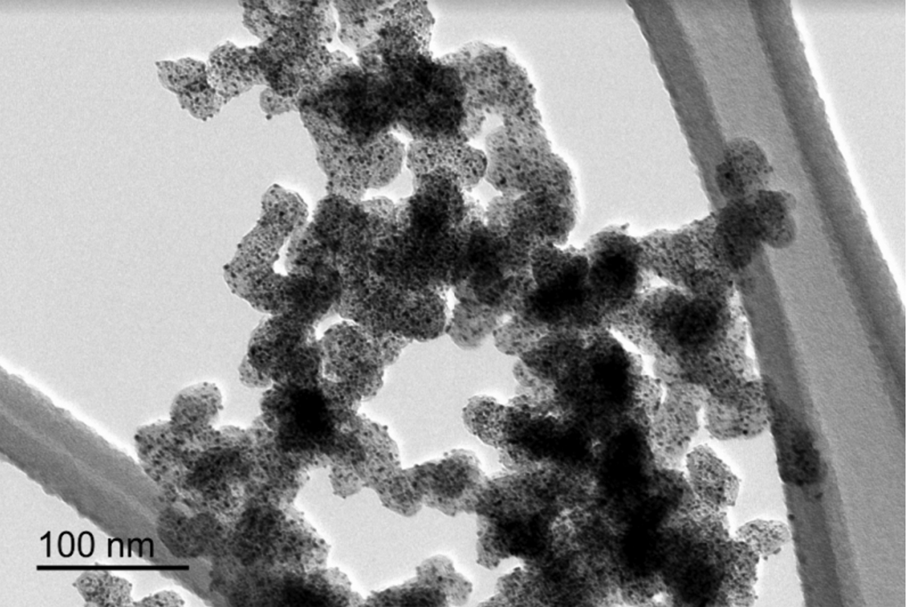
Transmission electron microscopic (TEM) images of air-sprayed ink were also recorded as a means of comparison, as this is the catalyst deposition method most often used in industrial settings (Fig. 3). In contrast to the continuous, interconnected Nafion nanofibers produced via electrospinning, the randomness inherent in air-spraying resulted in a nonuniform dispersion of the Nafion particles, which diminishes proton conductivity. These images suggest that electrospinning is the optimal method of catalyst deposition to ensure maximum availability of Pt “active” sites and therefore catalytic activity.
TEM of air-sprayed Pt/C catalyst ink.

Energy-dispersive spectroscopy
Energy-dispersive spectroscopy (EDS) was performed on a silicon wafer with electrospun fibers to confirm the chemical identity of the catalyst layer. The peaks, displayed in Fig. 2(d), represent elements present on the surface of the Si wafer, as well as on the electrodes. Fluorine, zinc, and silicon correspond to the silicon wafer itself, while carbon, platinum, fluorine, and oxygen correspond to Nafion, PAA, and Pt/C.
Upon analysis, it was determined that the proportionally high intensities of Pt, C, and F are caused by the high frequency of Pt/C and liquid Nafion present. This shows the ability of electrospinning to deposit a high concentration of catalyst even with the addition of PAA as an FP.
Performance testing of assembled MEA
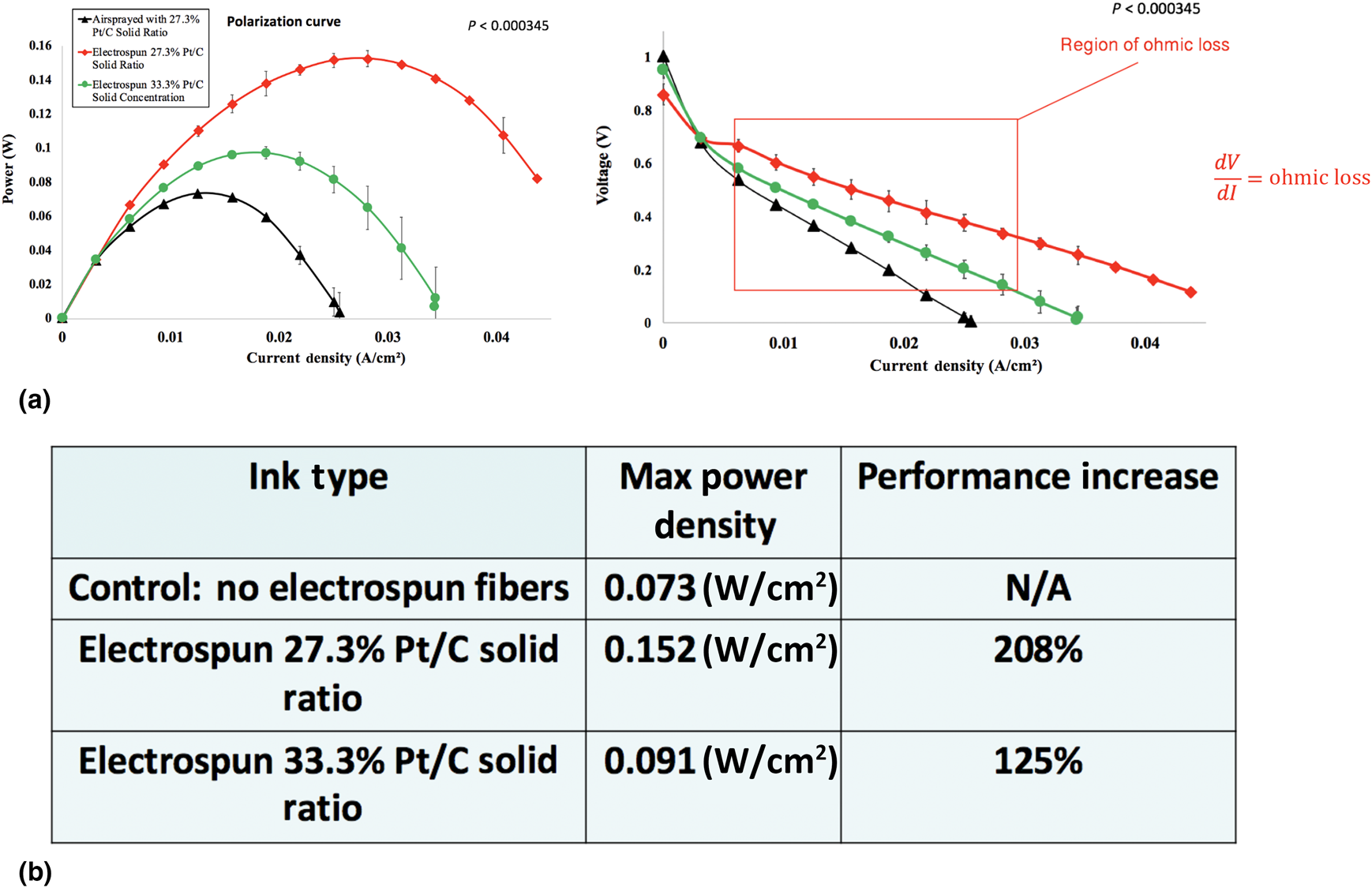
In the PEMFC performance test station, MEAs containing electrospun and air-sprayed electrodes were tested and compared. MEAs containing electrospun electrodes yielded a peak power output of 0.1525 W. Meanwhile, the MEA consisting of air-sprayed electrodes had a peak power of 0.0733 W, confirming the superiority of electrospun MEAs by 208% [Fig. 4(a)].
(a) PI curve of air-sprayed—27.3% Pt/C, electrospun—27.3%, and electrospun—33.3% electrodes. (b) Summary of performance testing data.

Statistical analysis determined a P-value (0.000345) of less than the standard α-level 0.05, confirming that the recorded results are indeed statistically significant. A summary of performance testing results can be found in Fig. 4(b).
This increase in PEMFC performance is most probably due to the increased surface contact between the Pt/C, Nafion membrane, and the carbon electrode enhancing the catalysis of the reduction–oxidation reaction between hydrogen and oxygen gas. While commercial and air-sprayed MEAs have Pt/C infused within the carbon electrode, electrospinning creates 3D layers of polymer nanofibers, thus creating additional surface area coverage and a continuous length to facilitate proton conduction. Furthermore, electrospinning Pt/C significantly lowers the activation energy required for reactions to occur and thus amplifies PEMFC efficiency.
Ohmic loss
To directly attribute these observed performance enhancements to maximized proton conductivity, as predicted, the center portion of Power-Current (PI) graphs were analyzed [Fig. 4(a)], whose displayed losses are known to correspond directly with ohmic loss, as shown in Ref. [Reference Zhang14]. Ohmic loss is a material's intrinsic resistance, which, given the proton-dependent nature of PEMFCs, refers primarily to proton conductivity in fuel cell contexts.
While control samples exhibited an average ohmic loss of −26.37 V cm2/A, the calculated loss for the optimal electrospun MEA was only −14.65 V cm2/A [Fig. 4(a)]. Such a notable 45% decrease in ohmic loss substantiates the hypothesis that electrospun fibers enhance proton conductivity.
Optimization of Pt/C–Nafion/PAA solid ratio
The concentration of Pt/C was also varied to probe the composition of the optimal catalyst solution. Although the hypothesis is that a higher concentration of Pt/C would result in higher power output, it is determined that this was the case when catalysts were electrospun onto the electrodes. In the study, an application of 27.3 wt% solid Pt/C reached 125% the performance of an MEA with 33.3 wt% Pt/C. Thus, it was concluded that an overconcentration of Pt/C, the main catalyst of the PEMFC, can prove to be detrimental to its performance. This establishes the existence of an optimal polymer concentration of Pt/C in the electrospinning process and how a balance between Nafion, PAA, and Pt/C must be reached in order to obtain maximum performance.
Conclusion
The results of our study illustrate the successful enhancement of electrospun fibers for use in PEMFCs through the addition of PAA as the FP.
Through characterization trials and working with four individual FPs, PAA was determined to be the most viable polymer for electrospinning among those investigated due to its favorable solubility in water, isopropanol, and Nafion. Furthermore, a 12 wt% PAA–Nafion solution was found to most dramatically improve PEMFCs performance after electrospinning. As demonstrated by optical/laser–optical microscopy, this specific concentration of polymers created the most uniform distribution of electrospun nanofibers, with a minimal beading, even when combined with Pt/C.
MEAs whose catalyst layers were electrospun with 27.3% Pt/C solute concentration ultimately achieved a 208% increase in a maximum power output compared to traditional air-spraying. This performance enhancement can be attributed to the optimal physical characteristics induced by electrospinning. Consistent, interwoven electrospun fibers maximize the Pt/C surface area to catalyze redox reactions and provide continuous pathways to increase proton conductivity.
Lastly, it was determined that a greater Pt/C concentration within an electrospinning solution does not necessarily correlate to greater PEMFC energy output. From performance tests involving MEAs with 27.3 and 33.3 wt% solid Pt/C, it was not only determined that an overconcentration of Pt/C is detrimental to the catalysis of the redox reaction but also that there exists an optimal concentration of Pt/C within the electrospinning solution that allows for maximum performance.
Supplementary material
The supplementary material for this article can be found at https://doi.org/10.1557/mrc.2019.144.