1. INTRODUCTION
The development of a new car is a long and complex process because of the high number of aspects that have to be considered, and also to the multidisciplinary expertise required. In this scenario it is crucial to enable the exchange of information and knowledge among people involved in the design cycle. In particular, the increasing importance of aesthetic appearance emphasizes the need for studying those components of the product that have a specific meaning directly connected to the styling intent. The results of these studies allow the formalization and consequent sharing of specific information about products from an aesthetic point of view. Capturing and maintaining semantic information embedded in the shapes of products may allow car designers to retrieve documents and existing digital models more easily, both from internal and external repositories, thus making the reuse of knowledge and of design solutions possible. Today, the availability of powerful and flexible knowledge technologies, which are semantic based and context aware, facilitates creation and access to digital repositories; in contrast, currently available knowledge-based systems focus on the functional elements of the design but fail however to manage aesthetic knowledge.
Semantics stored in a digital encoding of a three-dimensional (3-D) model is inherently implicit, and it has to be extracted from shapes by dedicated algorithms. Unfortunately, today's state of the art shape-matching systems (e.g., Osada et al., 2001; Kazhdan et al., 2003; Novotni & Klein, 2003) are not accurate enough to distinguish between objects that have a similar overall shape or have mostly subtle differences, because their target is the retrieval and classification of generic objects from the Web. However, there are dedicated systems, designed for geometrical analysis in very specific domains (e.g., Razdan et al., 2001, 2002), and therefore, the algorithms can rely on domain knowledge to achieve better results. Domain knowledge has been considered to align objects for better analysis and to compare medical images (Krell et al., 1997), bones (Razdan et al., 2002), and archeological artifacts (Razdan et al., 2001). Semantics inferred from certain geometric features of the object were considered in Corney et al. (2002), but without taking into account the context of the objects. Körtgen et al. (2003) consider matching feature points inferred from geometry to establish context alignment. De Luca et al. (2005) formalize primitives and features of ancient architectural styles analyzing architectural treaties, and they have developed a knowledge-based modeling tool that shows stylistic references to the designer. Wielinga et al. (2001) has developed a content-based image retrieval system for images of artefacts, which is based on an the ontology of art styles derived from the Art and Architecture Thesaurus. Szykman et al. (2001) have put forward the importance of using domain knowledge for searching repositories of computer-aided design (CAD) models. Kopena and Regli (2003) have used description logics for the representation of assemblies and for capturing not only geometrical features but also the function and flow of CAD models. Hernádvölgyi et al. (2004) uses domain knowledge for aligning and comparing CAD models of cars, exploiting knowledge about the fixed arrangement of their components in the space. In CAD models, in fact, components are explicitly isolated, and to infer the context, giving an idea about their setting, a correspondence has to be established between differently named but logically equivalent elements. Concerning the formalization of style in the car design context, McCormack et al. (2004) define shape grammars to translate the key elements of Buick vehicles into a repeatable language, which can be used to generate products consistent with the Buick brand. Hsiao and Wang (1998) presented a method for guiding the modification of a rough model of a car according to a specific character. This approach is based mainly on the collection of customers' verbal descriptions, and it relies only on the car proportions such as height and tail length.
The issue of identifying and using overall features related to car characteristics was also faced by Yanagisawa and Fukuda (2004), who defined a system for the communication of customers' appraisal of provided models. Through repeated cycles of shape proposal and score attribution, the system provides a model that best fits customers' preferences. This method takes into consideration the side view of a car and a refined version of the curve property values defined in Podehl (2002). These properties, initially specified within the FIORES-II project (FIORES-II) and then refined in Giannini et al. (2004), are also used in the formalization presented here and they are recalled in Section 4.3 (FIORES-II, http://www.fiores.com).
The objective of our research is the definition of a knowledge management system able to (semi)automatically extract and store shape semantics during the concept modeling phase. The framework enables the reuse of aesthetic information through the retrieval of multimedia content and design solutions used in the past. The main visual elements, which contribute to the car aesthetics, together with their relationships, have been identified and formalized in specific car aesthetics ontology. Our research relies on domain knowledge gathered during several years of cooperation with designers of major European car manufacturers, that is, Pininfarina, BMW, and SAAB. This cooperation has been supplemented by reports of direct discussions, questionnaires, and interviews that have been carried out during the development of joint research projects.
After a short overview of the concept design process given in Section 2, in Section 3 we will describe the framework of the knowledge-based system. Section 4 focuses on the formalization of the car aesthetics, whereas Section 5 gives a brief summary of the geometric reasoning and image processing tools needed to complete the framework. Section 6 concludes the paper with final remarks and future work.
2. THE CONCEPT DESIGN PROCESS
The identification of the basic elements of car aesthetics and the evaluation of their relevance starts by considering the process that leads to their definition.
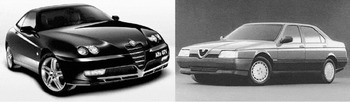
When a new car development starts, the designer receives a briefing; this is a document folder specifying the new product in terms of ergonomics, basic engineering and packaging constraints, performance, target customers, cost, and quality, which is often compared to competitor products. The final product should also conform to general norms and traditions, such as brand books, brand heritage, and general trends. Marketing briefs insist mainly on the so-called target, that is, the target customer category. Most car designers tend to use the target group as a general indication, with rather broad aesthetic relevance. Conversely, the “package” defining measurements and proportions among parts has strong implications on the car's aesthetics; for instance, long overhangs are considered typical of luxury cars, while, on the contrary, wheels located as far as possible at the fore and aft of the vehicle are typical of city cars. In addition, some companies maintain permanent shape characteristics in their products, thus forming a brand identity. Sometimes the brand identity is very general and derives from some proportions; sometimes it is very specific and depends on a particular shape, for example, of the roof line, the glass line, or the front grill. As an example, Alfa Romeo cars have character lines on the hood that converge upon the logo. As clearly visible in Figure 1, these lines are definitely brand lines together with the triangular front grill.

An example of brand identity pattern: the front hood character lines and grill of Alfa Romeo cars (GTV and 164). Photos courtesy of Alfa Romeo and Pininfarina.
At the conceptual stage, sketches, excerpts from newspapers and magazines, pictures, blueprints, 3-D models, and videos are the main sources of inspiration and means of communication of design ideas for designers. Designers conceive a new product by making sketches of some essential curves that are an abstraction of the product model. These curves are not only structural lines, like profiles, but also meaningful lines strongly affecting the product impression; thus, they are usually referred to as character lines. Usually designers concentrate on profiles, or side views, and they use perspective views for an overall impression (Catalano et al., 2002).
In the early design phase changes occur frequently, because the synthesis between the designer's idea and the engineering and ergonomic constraints is not often immediate. When the final sketch is selected, a 3-D model is normally created starting from those 2-D curves used by the designer in the early conceptual phase, which correspond to the profiles and character lines. This is often not an easy task, because some characteristic elements are exaggerated in the sketch to enforce the desired effect. Typically, the selected hand-made sketch is scanned and converted into a digital format, and then used as a framework on which to build up, step by step, different surfaces. The digital model is created by a computer-aided styling (CAS) tool expert, that is, the surfacer, who is usually not a designer but a professional often familiar with physical modeling, for example, clay modeling, because such a skill is valuable for the sketch interpretation and shares similar terminology with designers (Yamada, 1997). During this activity, designers help to perform shape adjustments and they manifest their ideas of how to achieve their aesthetic intent using a set of terms that is different from those used during the briefing.
In FIORES-II, the language used during the early design phase has been deeply analyzed (Poitou, 2002). It emerged that when marketing people and designers communicate they use terminology that very often refers to emotional values (e.g., dynamic, aggressive) and expresses generic objectives, that is, the character the final product will hold. These terms have a contextual value because fashion, trends, agreeability, attractiveness, and other aspects, which are recognizable and coherently understood only within specific cultural and temporal conditions, influence them. As a contrast to this, during the creation and modification of the digital model, designers communicate how to achieve their aesthetic intent using detailed and restricted terms that are called aesthetic properties (APs). In this phase, designers provide instructions on the elements and properties that are to be changed to obtain a certain effect (e.g., making a curve more accelerated or decreasing the tension of a curve) and they tend not to use geometrical language, which is hardly comprehensible for nonmathematicians. Differently from the FIORES-II approach that has focused on the geometrical language, the authors in this paper are trying to formalize part of the “emotional” language and to put it into relation with the geometrical one in a unique framework.
3. SYSTEM ARCHITECTURE
Content retrieval systems for designers should be able to cope with the working practice presented so far, asking queries that are expressed in their specialized terminology, and answering in formats and using jargon that is familiar to them. The system should answer queries in natural language (e.g., “images of front of sports cars”) retrieving texts, images, videos, 3-D models, sketches, and even nondigital material, that is, sketches on paper, in various formats from internal and external repositories and the Web. It should be able to identify and to retrieve single components of complex 3-D models even if these are included in whole models (e.g., a bumper extracted from a 3-D model of a BMW). The front end must ensure simplicity of use and short description of the content resulting from queries. The usability issues just described are often the principal cause of frustration for designers, who end up turning their backs on new technology and applications in their workflow. Semantic information, which is abundant in sketches, 3-D models, and pictures, needs to be captured and annotated through a procedure that reduces human effort to the minimum. Data representations must be created, using automatic and semiautomatic methods, taking the format of the content into account to provide the richest representation for each multimedia format.
The authors propose a retrieval system of shapes described in terms of domain components and by means of shape-related annotations. Meta-data are generated and stored in description files whose structure is based on models that vary according to the type of content. The included description models represent both qualitative and quantitative aspects of the content using the description trees of the MPEG 7 standard (Salembier et al., 2002), which supports descriptions of multimedia content and eases the structuring of information. The choice of a standard language significantly increases the chances of accessing metadata across various applications. According to the content type, we modeled two data representations: one dedicated to the description of 3-D shapes, the other to generic multimedia content (i.e., text-based documents, pictures, and videos; Brunetti et al., 2005; Ucelli et al. 2005).
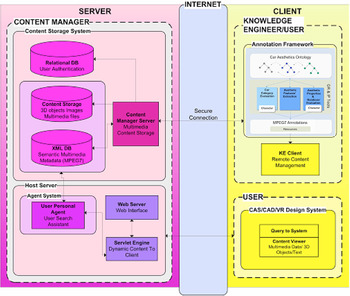
Figure 2 shows the main components of our architecture, which support the complete metadata creation cycle and tools for storing and managing the retrieval of meta-data descriptions.

The framework for annotating and reusing the car aesthetics knowledge. [A color version of this figure can be viewed online at www.journals.cambridge.org]
The Knowledge Engineer (KE) component comprises the following:
- an MPEG 7 annotation framework for the creation of MPEG 7 descriptions. It manages information on the media (file format, dimensions, aspect ratio, resolution, compression for image files, date, time, updates) and is based on the car ontology described here for the shape content aspects.
- a client application (KE Client) that allows the upload, download, and remote management of the content of the content storage system through a secure connection.
The Content Manager (Fig. 2, left) is responsible for the management of the content files and their MPEG 7 descriptions. It consists of the following:
- the Content Storage System, which includes the server side of the KE Client and three databases. The Content Manager Server is the server that processes and answers to the requests of the KE Client using a secure connection. It accesses the users' database for the retrieval of login information and it manages the procedures for the user identification. It is responsible for managing the upload and download of the content files stored in the file system and of the MPEG 7 descriptions stored in the XML database.
- the Host Server, which supports the user in the activities of searching and retrieval. It includes a ServerWeb for the navigation of the portal, a Servlet Engine for the execution of Java code at the server side, and a multiagent system based on the Jade platform (Java agent development framework, 2006), which searches the descriptions stored in the Content Storage System.
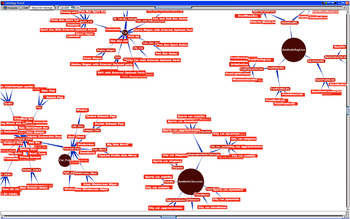
Finally, the User Client is the front end that allows the user to query the multiagent system and to retrieve relevant content. At this stage it is a simple browser that supports the navigation of information retrieved from the Content Storage System, and it comprises specific plug-ins for the visualization of 3-D shapes. The user queries the system by typing one or more keywords. A personal agent searches the MPEG 7 database and it sends the information to the User Client, which visualizes a list of short descriptions of relevant documents with the indication of the type of content (i.e., text, picture, blueprint, brochure, renderings, 3-D models). The annotation framework, as shown in Figure 2, relies extensively on the domain knowledge through the Car Aesthetics Ontology, which provides a formalization, in OWL DL language (Dean et al., 2006), of the various aspects that designers deem to influence the aesthetic evaluation of a vehicle. It takes into account two different levels: one concerning a macroaesthetic classification, including the specification of car categories and related typical components; the other is devoted to elements and relationships relevant to the categorization and aesthetic evaluation. A snapshot of the developed ontology that will be described in the following sections is shown in Figure 3.

A snapshot of the car aesthetics ontology. [A color version of this figure can be viewed online at www.journals.cambridge.org]
The framework is conceived for use in different scenarios. In the first scenario, the annotation is almost entirely manually performed and low-level information about the content of 3-D shapes (e.g., file format, dimensions) are automatically extracted, while the user may directly label the shape visualized with overall concepts of the provided ontology, for example, dynamic city car.
In contrast, the framework includes the possibility of integrating the annotation and retrieval system with the CAS/CAD modeling system of the styling environment; in this scenario, the user can also perform the annotation of components and aesthetic parts during the model creation phase, thus making the retrieval of car appearance easier, and brand identity elements may be directly annotated from design environments. Moreover, coupling the aesthetic conceptualization with suitable Geometric Reasoning (GR) methods working on 3-D models, and Image Processing (IP) tools acting on 2-D documents and images leads to an almost automatic batch annotation of the available resources. In fact, the car aesthetics ontology first supports the computational processes for the car category identification, thus gaining initial hints about the character of the car. In the second scenario, single aesthetic elements and properties are analyzed and the predominant character can be finally assigned. Some initial activities in this perspective are currently carried out for car blueprints (Dao & De Amicis, 2005), which comprises a practical solution to the real difficulty of gathering 3-D models of cars because of a lack for scientists of repositories of car models built by professionals of the automotive industry. In addition, the possibility of combining the manual specification of the category and character together with the automatic identification and evaluation of the aesthetic key elements and relationships represents a means for researchers to collect data and identify new hidden relationships, which may be used for the fine adjusting and enriching of car aesthetics ontology.
In this paper, the focus is the classification and specification of the distinctive aesthetic features of the automotive domain, the extraction of their geometric properties and, finally, the suggestion of a few tools and algorithms that once adapted or implemented will automatically detect these properties, guided by the specific domain knowledge. The next section introduces the concepts and properties of car categories, aesthetic features, and characters that have been taken into account in the formalization of car aesthetics for the annotation framework.
4. FORMALIZATION OF CAR AESTHETICS
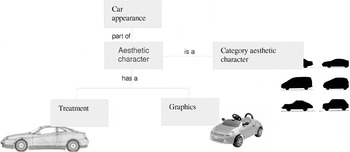
There are some aspects playing a decisive role when we evaluate a car: the first is called graphics, and it includes some details (e.g., spoilers, lights), the materials and the color; the second is the treatment, which is the set of surface properties including character lines that have aesthetic relevance; the last is volume, which relates with proportions and mass distribution.
During the design process first designers develop their ideas defining the volume, then they draw the character lines, and only at the end do they care about the details. The volume identifies the category of the car through the proportions and some special ratios. Then, the car's appearance is altered or emphasized by the treatment, which will define its character more clearly. Finally, graphics completes and harmonizes the overall appearance (Catalano, 2004).
In the conceived Car Aesthetics Ontology the following classes have been defined at the root of the graph, as illustrated in Figure 4.

The car aesthetics ontology (root classes).
In fact, each car has different aesthetic characters, but in general, one or two are predominant. In an attempt to measure the aesthetic character of a car, we could formally say that

that is, an n-uple of different basic aesthetic characters, where each aci has a value measuring the incidence of that character on a specific carx. Because each character depends on the category of the car, the role and the importance played by the elements and their relationships are different according to the type of car considered.
In the next sections, we will consider the following sub set of Aesthetic Characters (ACs):

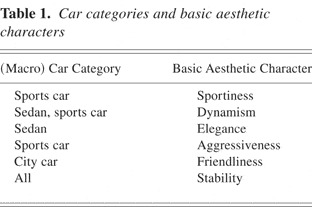
The characters of AC apply differently to the diverse categories of cars. Then, as summed up in Table 1, there are categories that are expected to have some properties. This only means that these categories generally have few predominant basic aesthetic characters:

Car categories and basic aesthetic characters

In the conceptualization discussed deeper in Section 4.3, a concept of measure is implicit, but it is not defined. Analogously, the relationships and implications mentioned cannot be considered always true, but generally true. Our proposal reflects the shared knowledge we have gleaned from designers' experience. Moreover, the overall appearance of a product is also conditioned by subjectivity, culture, fashion, and more importantly, it is not simply the sum of the single characterizing element, but it is a much more complex combination. For these reasons, our goal is to make some tendencies explicit so that they can be used as filters in a framework for retrieving car models from an aesthetic perspective. We have selected the most probable entities concurring to define a style, with the aim of moving toward the direction of the automation of such a process. Because of the intrinsic ambiguity and vagueness of the aesthetic domain, developing a framework for completely automatic annotation is impracticable. Adopting a reasoner that performs inference based on a nonmonotonic logic may be a suitable solution. Nonmonotonic logics were born to handle human reasoning with a formal language, which often takes decisions with incomplete, inconsistent and time-variable information. Different approaches have been proposed for a defeasible inference, such as default and abductive logics, and they are widely adopted in artificial intelligence and database applications. Moreover, a Web rule language put on top of the ontology can enrich the deductive capability, exploiting both the ontology and the rule base knowledge to draw inferences.
Similarly, measurement of APs, thresholds, or ranges of validity will not be quantified in this paper, but only indicated where necessary. The work started in Giannini et al. (2004) needs the analysis of a larger number of car models for the evaluation of the identified properties and relations, and for the validation of the introduced threshold values.
4.1. Car categories
The identification of the type of a car can provide the first indication of its aspect. We identified the main categories following the indications of the standard ISO 3833:1977 on types of road vehicles and the common market categorization. Limiting our study to only passenger cars, the following main categories have been identified: Sedan, Sports car, City car, Station wagon, Space wagon, Sport Utility Vehicle (SUV), All-terrain vehicle, Pick-up, and Limousine.
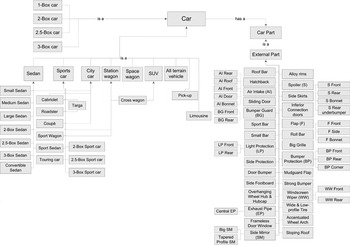
Figure 5 illustrates a part of the car ontology we defined, showing the main categories in terms of individual classes, and their subclasses, with distinctive properties; car parts that belong to specific car types, and concepts related with car volumes (e.g., two-box, three-box car) which are strongly related with car categories, are also included. The root class Car has as properties the generic components that are present in all types of cars (e.g., hood, left_door, right_door_window), which all categories of cars inherit through the is-a relation with the root class. Some classes have multiple parental relations and inherit characteristics from multiple classes, for instance a Targa inherits properties from Cabrilet and Roadster. Higher level concepts such as Family car, which are not shown in Figure 5, are usually more ambiguous and they have been included as individual classes. The main categories, in this example, Sedan and Station wagon are linked to concepts such as Family car through axioms.

The ontology of car categories and specific parts.
Among class properties we took into consideration synonyms to qualify each category with alternative terms. For instance Sedan is the American English term for Saloon. Sports car has as a synonym Sportster. Station wagon has as synonyms Estate car, Estate wagon, Large Estate, Brake, Hatchback, whereas All terrain vehicle has as synonyms Cross-country vehicle, Land Rover, Jeep, and Four-by-four, Four-wheel drive, and All-Wheel Drive. The same applies to the subclasses of each main category (e.g., Coupe, Convertible).
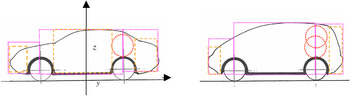
Other class properties are the parameters for distinguishing between car categories: these are dimensional characteristics, dimensions of packaging (length, width, height), which are calculated according to the standard ISO 612:1978 on the definition of dimensions of road vehicles, volumes (i.e., one box, two-box, two-and-half box, three-box car), wheel dimensions, and specific ratios that are used by designers to first characterize the type of car. In particular, designers usually employ the size of the wheels as the unit of measurement of volumes. Wheels are the first entity designers draw, and they build the whole car around them. The length between the wheels (wheelbase) can be measured in terms of the number of wheels contained, and the type of car is given by the ratio between the height of the car and the diameter of the wheel: if the ratio is greater than one, the car is an Estate one; if it is less, the car becomes a Sports one. Moreover, if the diameter of the wheel is emphasized by an opening fillet, named over_wheel_arch, the consequent proportions make the car look compact. The evaluation and comparison of such properties is one of the filters we include to extract the car category from a model not annotated yet.
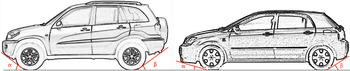
For further specification of domain knowledge, we considered a structure-based approach of cars that takes into account the components of the body and the characteristics of parts that are typical of each category (e.g., sloping roof for Coupe cars or rear spoiler for Sports car). Some other specific dimensional characteristics are included for easing the identification of some categories: for instance, approach and departure angles for All-terrain vehicles and SUV, as shown in Figure 6.

The approach angle (α) and departure angle (β) are characteristic angles of all-wheel drive and SUVs (α, β ≈ 30°); other types have α, β << 30°, and they are not included in the specifications. [A color version of this figure can be viewed online at www.journals.cambridge.org]
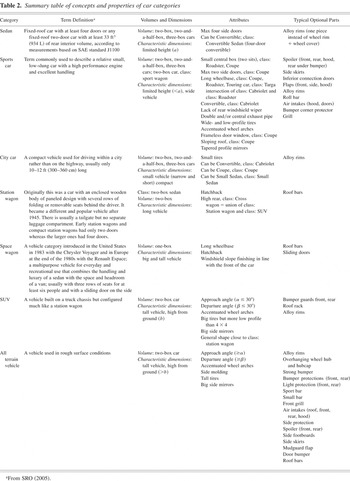
Table 2 summarizes characteristic dimensions, volumes, optional external parts, and attributes for the first seven categories. The optional external parts are the details that belong to the graphics of the car. The identification of all these in 3-D models of cars by means of existing algorithms and geometric reasoning tools represents another filter for labeling parts coming from CAD and virtual reality (VR) files.
Summary table of concepts and properties of car categories

4.2. Treatment
Even if the final result of the design process is the complete and detailed definition of the surfaces constituting the final shape of the product, the character evaluation and modification is performed by concentrating on specific curves of the object, for example, sections and reflection lines, which are normally judged in a planar view (paper or CAD screen). With the term treatment we refer mainly to those curves contributing to express the overall character of a car. They can be either real or virtual curves; in fact, they can be part of the contour but also reflection lines, or more generally lines related to the smoothness of the surface. To formalize some typical qualities of a car, a taxonomy of the key curves that may elicit some emotions and their properties is proposed here. However, single curves are not usually enough to express a character, and it is more common that some properties of specific curves together with special relationships among such curves define the predominant character of a car. The (aesthetic) relationships between curves can be of two types:
- geometric relations between adjacent curves: in this case, the aesthetic effect is given by the type of connection between the two curves (e.g., kind of blending, kind of radius);
- geometric relations between not adjacent curves: in this case, the aesthetic effect is given by the mutual position between them (e.g., parallelism, angle of incidence, symmetry).
Only some geometric relations have aesthetic results, then they are made explicit by the different characters. In the next subsections, first a taxonomy of the aesthetic key lines (akls) will be described, then their APs and relationships will follow.
4.2.1. Aesthetic key line taxonomy
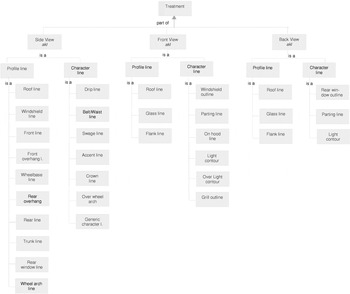
We will group together the aesthetic key lines in accordance with the 2-D views used in practice. For clarity, we will subdivide curves according to two main projection views: the side and the front/back views, which are the most important ones to show the character. Figure 7 shows a taxonomy that distinguishes between profile curves and other character lines.

The treatment ontology.
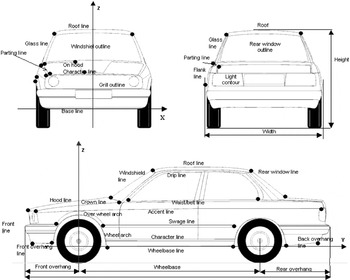
In the profile category, different portions of the contour of the car have been named and put in an adjacency sequence. Among the akls, the roof_line, the windshield_line, and the wheelbase_line in the side view are the most significant. The roof_line and the wheelbase_line are the first curves sketched by the designer, just after the wheels. In fact, they identify the packaging and begin to suggest the style. In contrast, the windshield_line with its slope and length contributes to the definition of the aesthetic and aerodynamic quality of the vehicle, through its influence on the drag coefficient, which is used for the calculation of the aerodynamic drag. In the Character line category all the real and virtual curves affecting the character of a car are included. Among these, the waist_line and the accent_line have particular relevance for the car style. The waist_line is a curve defining the change of the material between the auto body and the glass of the windows. It is often coupled with the accent_line, a virtual line that expresses the reflection of the light on the surface. The accent_line is related to the curvature of the surface in the surroundings of the waist_line. It can be also represented by a sharp line with a strong aesthetic effect. The over_wheel_arch has usually the effect of emphasizing the wheel rim, increasing the impression of compactness or stability of a car. Some peculiar brand lines can elicit the family feeling, making the philosophy of a car company recognizable directly from the shape of the vehicle. The shape of the lights has also a visible influence on the character of the car. Figure 8 shows the different aesthetic key lines using the typical views arrangement of a blueprint.

The aesthetic key lines of the treatment.
4.2.2. APs
The APs of the treatment curves are inextricably related to the geometry, but in a complex way, and they act on the aesthetics of the shape.
The FIORES-II consortium has lain great emphasis on those properties corresponding to terms used by designers for expressing modifications on shapes: in particular, concepts of acceleration, softness/sharpness, tension, convexity/concavity, flatness, and crown have been defined together with their measures. Their definitions are briefly summarized here because they will be used in Section 4.3 for the formalization of the dominant character. More details and examples can be found in Giannini et al. (2004).
Considering the whole curve, the concept of acceleration is related to how much the variation of the tangent to the curve is balanced along it; thus, even if curvature maxima are present but distributed along the curve, this still comes out as not accelerated.
The term softness/sharpness is used to describe properties of transitions between curves or surfaces. In styling, the term radius is generally used to indicate a more rounded transition (a blending) between two curves or surfaces. In general, a small radius is called “sharp,” and a big radius is called “soft.”
When designers increase convexity of a curve (or concavity, in the opposite direction), they are moving toward the enclosing semicircle; thus, the ideal convex curve is the semicircle, or an arc of circle, if the continuity constraints at the end points are compatible. Otherwise, it is the curve presenting the lowest variation in curvature that satisfies the given continuity constraints.
According to the user's axiomatic feeling “Straight lines have either no tension or an infinite one,” tension has been defined as the “internal energy” of a curve subject to continuity constraints at its boundaries, which is required to change its shape according to its boundary continuity constraints, provided that it is not a straight line. This can be geometrically translated into an evolution of curvature along the curve, which means that increasing the tension of the curve leads to a larger part of small curvature.
Flatness is simply related to how much the curve tends toward a straight line. Curves including some inflection points are referred to as wet curves or S-shaped.
Putting on crown means lifting or raising a certain part of the curve in a given direction, without changing the end points and eliminating the inflection points, if any, while creating a convex part.
As anticipated, each AP has been associated with a measure, which has not been reported in this paper. For simplicity, we use the notation:

In short, then,

Regarding the relationships between two curves, valid in a certain view, we can define the following:

where

and
- hasConjunctionWith refers to the kind of blending/radius between two aesthetic curves;
- isParallelTo and isTangentTo specify the parallelism and the tangency, respectively, between two curves;
- isIncidentTo(α) indicates that two curves form an angle of α degrees;
- isSymmetricWrt claims a symmetry of a curve with respect to a straight line;
- follows/precedes is the adjacency relationship between profile lines.
4.3. Aesthetic character
In the following subsections, only the main characterizations of the basic aesthetic characters will be formally expressed through a logic symbolism.
4.3.1. Sportiness
A sports car has to be distinguished from a sportive car. A sports car belongs to a category of car that is unmistakably sportive. Sports cars have typical volume characteristics, as was explained at the beginning of the section, whereas a car might be defined as sportive mainly because of its treatment and graphics. In particular, an alternation of different materials and colors is a constituent of the common graphics, plus the possible presence of typical optional parts such as spoilers.
Regarding the treatment, the accent_line, the over_wheel_arches, the roof_line, the rear_overhang have a fundamental importance. In general, they are evident and possibly sharp, with the roof_line generally tensed, while the accent_line can be sharp. The accent_line can be also tensed, or a wet curve can be preferred while the roof_line counterbalances this softness effect with a more tensed behavior. Therefore, this formula is generally true:

The over_wheel_arch is often emphasized, affecting the volume and the treatment. In fact, a prominent over_wheel_arch gives the impression of increasing the width of the wheel, therefore making the vehicle appear much more compact. The prominence effect can be created either putting the crown in the area around the wheel arch or inserting a sharp over_wheel_arch. It often happens that the accent_line vanishes into the over_wheel_arch:

Another peculiarity is that the rear overhang is short to stress the impression of dynamism:

Clearly, sportiness is associated with dynamism and possibly aggressiveness; thus, the three characters can coexist in a car. An example of car company that has adopted the sportive character as a distinctive brand identity is Alfa Romeo, which emphasizes sportiness in all its models.
4.3.2. Dynamism
The concept of dynamism is strictly related to car aerodynamics. In practice, this character is obtained by giving directionality to a car. This is translated in flat lines in the profile view, that is, straight accent_line, roof_line, and waist_line, which converge to a point in the direction of movement. Together with directionality, the dynamic effect is obtained by changing the sloping angle between profile lines and the wheelbase_line. Considering the linear approximation of the akls involved, the wider the angle with the wheelbase_line, the more dynamic is the effect. In principle, the angle may be widened until the engineering constraints are contradicted. More formally:

where β, γ are threshold values.
Another complementary way to gain dynamism is related to the inclination of the drip_line and the windshield_line. They follow the same directionality as the akls considered above, but the windshield_line is more sloped and the roof_line is often flattened in the back of the car and more crown is put at the windshield, creating a soft effect at the joint:

Dynamism depends on the category of the car. Although a sports car or a sedan may follow the general principles just mentioned, this may not happen for a city car, which is shorter (packaging constraints). For a city car, dynamism is given by tensed lines more than by directionality and flat lines; therefore, (1) becomes:

where the condition on the angle is weaker and may be not valid.
4.3.3. Aggressiveness
Aggressiveness is often associated with the idea of speed; therefore, with dynamism and sportiness. As a consequence, it will be hardly attributed to a city car or a family car, which should elicit stability and feelings of security. In general, aggressiveness tends to be embodied at the front of a car. The akls having most influence on the character are the hood_line, accent_line, and roof_line. In the profile view, the curves belonging to the hood are accelerated in the front part. In the front view light_contours, the grill_outline, and the on_hood_line have a big role. Light contours that are stretched out rather than round give rise to an aggressive feeling. Side character lines, roof_line, hood_line, and accent_line are normally very accelerated curves following the profile behavior.

where

4.3.4. Elegance
Elegance is maybe more subjective than the above-mentioned characters. Some categories of car are better candidates for the evaluation of elegance because of their target customers. This applies to sedans, station wagons, possibly sports cars, but less commonly to city cars because elegance has to convey the impression of luxury. The general principle is to achieve harmony using smooth surfaces and transitions, appropriate material, and color choices. Usually, elegance is the opposite of sportiness, and therefore, it should be achieved by avoiding changes of materials and additional details. As a consequence, there are fewer character lines, the akls are generally tensed, not sharp and not wet. Sharp character lines are not elegant; thus, sportive cars, which often include sharpness, are in general not elegant:

4.3.5. Friendliness
Friendliness is often referred to city cars, and it is generally not coupled with the other aesthetic characters described so far. In terms of proportions, friendliness can be easily associated to “square” packages. Many akls will not be tensed, some are even round; in fact, the use of precise circles can bring to mind a world of fantasy. Among the akls, a friendly character can be assigned to the roof_line together with the over_wheel_arch, the accent_line, or the drip_line. The over_wheel_arch is usually prominent and quite round. In addition, the light contours are often round, or at least soft.

4.3.6. Stability
Stability is naturally associated with all categories of cars, even if for some of them it comes in for greater emphasis, for example, for family cars. The roof_line has the highest weight in the profile view. If it is symmetrical with respect to the axis of the wheelbase line, then a car can be considered stable. In contrast, stability is emphasized by tensed akls, in particular in the roof_line, the accent_line, and the waist_line; therefore:

However, it is the symmetry of the elements with respect to the axis of the wheelbase that amplifies the feeling of stability:

In the front or back view, the position of the wheel with respect to the flank gives an indication of stability: the closer the wheels are to the flank, the more stable the car, and vice versa.
5. ONTOLOGY-DRIVEN AESTHETIC ANNOTATION USING GR AND IP TOOLS
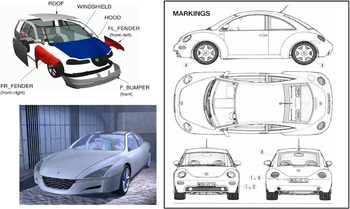
To define tools for the automatic annotation of car aesthetics, it is necessary to understand how these conceptual key entities are defined and how they can be extracted from a product digital model. In this section we will provide indications about the “geometric nature” of the various shape-related elements characterizing car aesthetics, and how they can be identified and evaluated. It is important to consider that different representations may be available, each having different levels of details information, that need to be processed with proper approaches and tools. The range of representations goes from fully detailed 3-D CAD models that are suitable for manufacturing, that is, decomposed according to the constituent parts and including all the shape details to the 3-D representation of the body of the car only, typical of the styling phase, and 2-D simplified blueprints, as shown in Figure 9.

Examples of (a) a component-based 3-D CAD representation, (b) a 3-D CAD model for styling courtesy of Pininfarina, and (c) a simplified blueprint. [A color version of this figure can be viewed online at www.journals.cambridge.org]
Therefore, both geometric reasoning methods for 3-D models, and image processing tools for blueprints or similar representations, are needed.
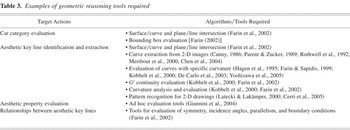
Most of the requisite basic geometric algorithms and methods are already known (see Table 3 for a quick reference). Farin et al. (2002) presents a thorough overview for 3-D shapes, while Marr (1982) is a classical reference for images. Nevertheless, to automate the annotation process, the combination and usage of these methods should be driven by the aesthetic domain knowledge formalized in the ontology,
Examples of geometric reasoning tools required

For instance, the evaluation of the category involves reasoning on the composing volumes of a car (see Section 4.1). This can be obtained in different ways, but it irrevocably involves analysis and comparison of the bounding boxes of single parts of a model with respect to the dimension of the wheel (see Fig. 10).

The decomposition of a car in its composing volumes. [A color version of this figure can be viewed online at www.journals.cambridge.org]
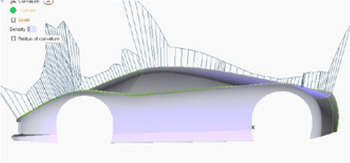
Considering, for example, the akls; it is clear that it is not possible to detect them univocally only with geometric and image processing techniques. In fact, for all the representations, and even more for very detailed 3-D models or blueprints, semantic reasoning is needed to select the akls among a set of candidate curves. Then, the intrinsic characteristics and the symmetry of a car will be utilized to discriminate between the lines. For instance, the roof_line will be searched for as the highest line, conversely to what will be done with the wheel_arches, which are the lowest circular lines (see Fig. 8). As described in Section 4.2, akls may correspond either to real or to virtual lines of the model, which need different methods to be processed. By definition, profile curves are those obtainable through the intersection of the 3-D model with specific planes. The main issue in this case is the segmentation of the entire profile into the constituting character lines. First, curvature extrema should be identified (see Patrikalaliks & Maekawa, 2000). In fact, because of the high degree of smoothness of such models, the conjunction of the different components of a car profile may be recognized from points where continuity decreases, that is G and G0 points in G areas. Second, reasoning on the relative positions of the segments with respect to the coordinate frame helps to distinguish and to annotate the profile curves (see Fig. 11).

A curvature plot of the car profile. [A color version of this figure can be viewed online at www.journals.cambridge.org]
The extraction of curves from images has been extensively dealt with; in Table 3 references to various methods for curve detection are listed.
Subparts of car drawings, for example, grills, light contours, and logos, can be identified comparing them to similar shapes in a database; different methods have been developed in the field, among the others by Latecki and Lakämper (2000) and Cerri et al. (2005).
Virtual character lines are even more strongly related to the surface curvature behavior. In fact, they normally correspond to loci of points with a special value of curvature. In some cases, they belong to the boundary of the skin of the car, as for drip_line and waist_line. In some other cases, they are sharp edges, as it is often the swage_line; thus, points with G continuity must be determined. Finally, they may belong to the widely adopted reflection lines or light lines, as typically happens with the accent_line. In this case, several and experienced methods may be found in literature to calculate them according to the different geometric representations; see, for example, Farin and Sapidis (1989) and Hagen et al. (1995) for continuous surfaces. More recently, the problem has been also addressed for discrete representations (see Kobbelt et al., 2000; De Carlo et al., 2003; Yoshizawa et al., 2005).
Although mutual relationships between the various akls can be generally verified by basic geometric algorithms that evaluate symmetry, incidence angles, parallelism, and boundary conditions, measuring the APs reported in Section 4.2.2 is much more complex. Therefore the achievements of the FIORES-II project, in terms of knowledge, algorithms, and s/w prototypes will be made use of.
6. CONCLUSIONS
The development of a new car usually begins with the evaluation of already existing models. To fully take advantage of the already available resources, car models and data should be adequately annotated making car categories and aesthetic characters explicit. Considering the economical unsustainability of letting CAD experts annotate existing models, it is evident how tools able to (semi)automatically perform this task would provide a great benefit. These tools can only be created if a formalization of what constitutes a style, and of how such elements can be translated and derived from the shape geometric description, is carried through to a logical end.
Starting from the experience of working with car designers that we gained in our previous European projects, in this paper we have focused on the identification of stylistic key elements and their mutual relationships, and on the formalization of specific car categorizations and aesthetics. Finally, we have put forward some hints on how to relate these elements to the shape properties of the geometric representation, showing that the requisite basic methods for shape analysis are available. What is still missing is their adaptation and utilization according to the specific domain knowledge.
Our future activity will be the completion of the car aesthetics ontology and the integration and adaptation of all the tools needed to perform the automatic annotation. The successive step could be the integration with a VR-based styling system (Fiorentino et al., 2002). VR technologies cannot be ignored because they offer designers the possibility to sketch and model more intuitively in 3-D and in real time, thus reducing the need for physical prototyping. Three-dimensional input and output devices together with form-descriptive gestures (to sketch and to manipulate models in 3-D) have the potential to be much more effective than the traditional drawing methods because they allow easy and immersive creation and interaction with 3-D surfaces and their direct manipulation in 3-D (Ucelli et al., 2005). Therefore, including the digital outcome of these technologies in our framework becomes a natural evolution of the modeling activity.
ACKNOWLEDGMENTS
This work is currently being carried out within the scope of the AIM@SHAPE Network of Excellence (AIM@SHAPE), supported by European Commission Contract IST 506766, and the SIMI-Pro project, funded by the Provincia Autonoma di Trento.