Introduction
A growing body of research often indicates that immigrant populations in Western countries enjoy a lower level of mortality in relation to their receiving native-born populations (Wilmoth & Dennis, Reference Wilmoth, Dennis, Robine, Crimmins, Horiuchi and Zeng2006). A variety of explanations have been suggested for this, ranging from possible deficiencies in the data acting to bias downward the death rates of immigrants, to the possibility that foreigners form a selected population for good health and longevity and consequently share reduced mortality rates in relation to the native born (Brahimi, Reference Brahimi1980; Vallin, Reference Vallin1985; Marmot et al., Reference Marmot, Adelstein and Bulusu1983, Reference Marmot, Adelstein and Bulusu1984a, Reference Marmot, Adelstein and Bulusu1984b; Kasl & Berkman, Reference Kasl and Berkman1983; Kestenbaum, Reference Kestenbaum1986; Young, Reference Young1987; Trovato & Clogg, Reference Trovato and Clogg1992; Valkonen et al., Reference Valkonen, Brancker and Reijo1992; Khlat, Reference Khlat1993; Courbage & Khlat, Reference Courbage and Khlat1995; Razum et al., Reference Razum, Zeeb, Akgun and Vilmaz1998; Abraido-Lanza et al., Reference Abraido-Lanza, Dohrenwend, Ng-Mak and Turner1999; Ringback Weitoft et al., Reference Ringback, Weitoft, Gullberg, Hjerns and Rosen1999; Singh & Siahpush, Reference Singh and Siahpush2001; Uitenbroek & Verhoeff, Reference Uitenbroek and Verhoeff2002; Khlat & Darmon, Reference Khlat and Darmon2003; Anson, Reference Anson2004; Jasso et al., Reference Jasso, Massey, Rosenzweig, Smith, Anderson, Bulatao and Cohen2004; Palloni & Eubank, Reference Palloni, Eubank, Anderson, Bulatao and Cohen2004; Singh & Miller, Reference Singh and Miller2004; Eschbach et al., Reference Eschbach, Stimpson, Kuo and Goodwin2007).
In recent years, in a large number of high-income countries (many of which have sizeable immigrant populations), the sex differential in life expectancy has been narrowing (Trovato & Lalu Reference Trovato and Lalu1996a, Reference Trovato and Lalu1996b; Pampel, Reference Pampel2002, Reference Pampel2003; Glei & Horiuchi, Reference Glei and Horiuchi2007). This has resulted from men's larger improvements as compared with women with regard to major causes of death, most notably cancer, heart disease and accidents and violence. For instance, in Canada, between the early 1970s and the early 2000s the gap in life expectancy at birth between females and men reduced by nearly two years (Trovato, Reference Trovato2005). Studies documenting this relatively recent development are all based at the national level. Therefore, it is not known to what extent immigrant populations in these countries have contributed to this phenomenon.
Although there is an extensive demographic literature in the area of sex differences in mortality (e.g. Madigan, Reference Madigan1957; Stolnitz, Reference Stolnitz1957; El-Badry, Reference El-Badry1969; Retherford, Reference Retherford1975; Preston, Reference Preston1976; Verbrugge, Reference Verbrugge1976, Reference Verbrugge1979; Nathanson, Reference Nathanson1984; Luy, Reference Luy2003) systematic analysis of sex differences in life expectancy between immigrants and native-born host populations are virtually absent. The principal aim of this study is to address this void in the literature. The study looks at the case of immigrant and native-born populations in Canada, one of the leading countries of immigration in the world. In 2006, out of a total Canadian population of nearly 32 million, over six million were foreign born. Is the sex differential in life expectancy in the immigrant population equal in magnitude to that of the Canadian-born population, or does it differ? What is the contribution of different causes of death to either increase or decrease the sex differential in expectation of life between 1971 and 2001 in these two populations?
Data and Methods
The data for this investigation were obtained from Statistics Canada (2008a, b) as two separate files: one containing deaths by age, sex, cause of death and nativity (native born, foreign born) for 1970–1972 and 2000–2002; and the other consisting of corresponding population counts based on the Canadian censuses of 1971 and 2001. These population counts served as the denominators for the computation of central age–sex-specific death rates by nativity and cause of death for 1971 and 2001. (Three-year mortality data surrounding the most recent census period of 2006, i.e. deaths for 2005, 2006 and 2007, were not available at the time of this investigation.)
Between 1970 and 1972, there were 466,629 deaths in Canada. By 2000–2003, this number had risen to 661,203. A small percentage of cases had missing information with respect to nativity (i.e. country of birth of deceased for 2% of total deaths in 1970–1972, and 5% of the total in 2000–2002). These cases were allocated pro rata to the observed age–sex–nativity distribution of deaths in 1971 and 2001. A similar procedure had to be adopted in regard to the population counts because a notable discrepancy between the population counts in the custom tabulation received from Statistics Canada and the total population based on the population estimates for Canada published by Statistics Canada was noted (Statistics Canada, 2009). To illustrate, in 2001, the total population of Canada in the custom table was 29,638,265, whereas that based on the Statistics Canada population estimates was 31,021,174. This difference is accounted by the fact that the population counts in the custom tabulation came from the census, which by design excludes individuals in institutions (e.g. elderly persons in hospices), whereas the population estimates encompass the whole population of Canada. Therefore, in order to adjust the population denominators in this study, the discrepancy between these two data sources (population estimates – population counts in custom tabulation) by age, sex and period were allocated pro rata to the age–sex–period–nativity-specific population distributions in the custom tabulation.
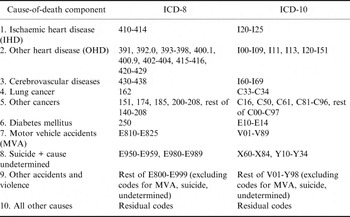
For the two periods under observation, central death rates were computed cross-classified by nativity (native born vs foreign born), age group (0, 1–4, 5–9, …, 85+), sex and ten cause-of-death categories: ischaemic heart disease, other heart disease, cerebrovascular disease, lung cancer, other cancers, diabetes, motor vehicle accidents, suicide, other accidents and violence, and all other causes of death (see Table 1 for the corresponding ICD codes). These death rates served as elemental inputs for a decomposition analysis of sex differences in life expectancy at birth by nativity.
ICD-8 (1971) and ICD-10 (2001) codes for causes of death

Through decomposition it was possible to determine the independent contribution of sex differences in cause-specific mortality to observed sex differences in life expectancy at birth in 1971 and 2001 for immigrant and Canadian-born populations, respectively. The method of decomposition applied here is an adaptation of the procedure developed by Das Gupta (Reference Das Gupta1993) for decomposition of difference in rates, itself based on an earlier formulation by Kitagawa (Reference Kitagawa1955). To illustrate, assume life expectancy at birth e 0, for males is totally determined by two causes of death (extension to more causes would follow the same logic as described below). Define these as A and B, where A is a vector of age-specific death rates from heart disease, and B is a vector of age-specific death rates for ‘all other’ causes of death. The life expectancy at birth for females is completely determined by the same two causes of death, defined as the vectors a and b. Thus,


Two new life expectancies at birth were calculated – F(a,B) and F(A,b) – and then the following four differences considered:




Differences (3) and (4) above can be attributed to difference in heart disease rates between males and females since the ‘other’ cause of death is held constant (as ‘b’ in (3) and as ‘B’ in (4)). The differences (5) and (6) are attributed to the differences in ‘other causes’ of death between males and females. Adding these four life expectancies we get:

From the above it can be seen that the difference in life expectancy between females and males is actually the sum of two components:
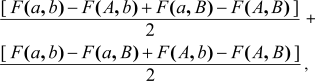
the first component representing the effect of heart disease, and the second, ‘other causes’ of death.
Differences in life expectancy by nativity
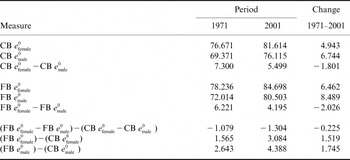
Table 2 displays female and male life expectancies at birth by nativity and the corresponding difference in this measure between females and males in each period. Life expectancies in 1971 were 76.7 and 69.4 years respectively for Canadian-born females and males, and 78.2 and 72.0 years for immigrant females and males. By 2001, both immigrant and native-born populations had experienced important gains in expectation of life. The improvement for the Canadian born was almost 5 years for females and 6.7 years for males. Improvements were more substantial in the foreign-born population: by almost 6.5 years for females and nearly 8.5 years for males.
Sex-specific life expectancies at birth (e 0) and differences by nativity (Canadian-born (CB) and foreign-born (FB) populations), Canada, 1971 and 2001
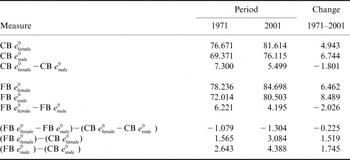
Consistent with these changes the sex differential in life expectancy at birth narrowed by 2.03 years in the immigrant population, and by 1.8 years for the Canadian born. In interpreting these and subsequent results throughout this investigation one must consider the fluidity of the foreign-born population over time and the cross-sectional nature of the data. The composition of the immigrant population is constantly changing. Whereas in the past most migrants to Canada were from Europe and the United States, today the majority of newcomers are from Asia, Africa, South America and the Caribbean (Simmons, Reference Simmons, Halli and Driedger1999; Green & Green, Reference Green and Green1999). Clearly, the immigrant population in 2001 is not totally the same population as in 1971.
The bottom panel of Table 2 includes three different contrasts. The first represents the discrepancy in the magnitude of the sex difference in life expectancy at birth between immigrants (i.e. foreign-born, FB) and the Canadian-born population (CB): (FB  −FB
 )−(CB −CB ).
This contrast confirms that the sex differential is smaller for the immigrants by almost 1.08 years in 1971 and by 1.30 years in 2001. Thus, between 1971 and 2001, the degree of narrowing of the sex gap in life expectancy has been more pronounced in the immigrant population.
The next two contrasts in this table consider differences in life expectancy within a specific-gender category. In both periods, the differential involving men (FB −CB ) exceeds the corresponding female differential, i.e. (FB −CB ). Among males, the immigrant advantage was 2.640 in 1971 and 4.390 in 2001. Among females, the difference also favoured immigrant females but was notably smaller: 1.565 in 1971, and 3.084 in 2001.
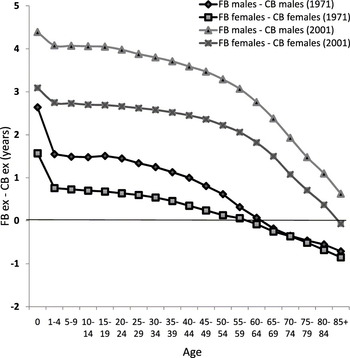
Figure 1 shows age–sex-specific differences in life expectancy between immigrants and the Canadian born in 1971 and 2001. With few exceptions, immigrant male and female expectancies exceed those of their Canadian-born counterparts across virtually all age categories. The age-specific differentials in favour of immigrants are wider in 2001 than in 1971.
Differences in life expectancy by age, sex and nativity, Canada, 1971 and 2001. FB: foreign-born, i.e. immigrant, population; CB: Canadian-born population.

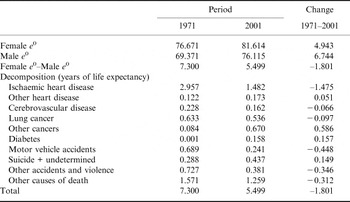
In Table 3, a large portion (about 40%) of the observed difference in life expectancy of 7.3 years between Canadian-born females and males in 1971 is explained by the contribution of higher male mortality from several causes, namely: ischaemic heart disease (2.957), other causes of death (1.571), other accidents and violence (0.727), motor vehicle accidents (0.689), lung cancer (0.633) and suicide (0.288). By 2001, the differential in life expectancy between females and males had dropped to 5.499 years (a reduction of 1.8 years). As shown in the last column of this table, the effect of some cause components declined over time while that of others increased. The influence of ischaemic heart disease fell by 1.475 years (the largest drop) as a function of steeper declines in male death rates from this disease in relation to females (see Appendix for additional details). A similar situation is noted in connection with motor vehicle accidents (–0.448), other accidents and violence (–0.346) and other causes of death (–0.312). These results indicate that even though Canadian-born men and women have both experienced mortality improvements from these causes of death, on balance the improvements have been more pronounced for males, thus resulting in a notable narrowing of the sex gap in expectation of life between Canadian-born females and males (by 2.744 years). On the other hand, the combined contribution of other heart disease, other cancers, diabetes and suicide served to widen the female advantage in life expectancy by almost one year (0.943). And overall, the net effect of these counteracting contributions resulted in a narrowing of the differential by 1.801 years (as already noted in Table 2).

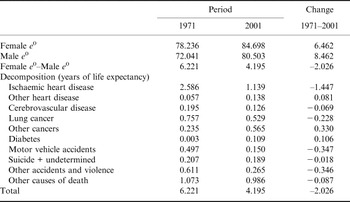
Regarding the foreign born, Table 4 indicates that most of the observed decline of 2.026 years in the female–male difference in expectation of life between 1971 and 2001 can be attributed to the effects of reduced sex differences in death rates from ischaemic heart disease. The effect of this component in 1971 was 2.586, dropping to 1.139 in 2001, thus producing a reduction of the sex differential in life expectancy by 1.447 years. For the remaining cause components the contributions are notably smaller. For instance, change in sex differences in lung cancer mortality accounted for a closing of the difference of 0.228 of a year, while other cancers had the opposite effect to expand the female advantage by 0.330 of a year. A small widening effect is also noted in connection with diabetes (0.106). Change in the contributions of other accidents and violence and of motor vehicle accidents helped narrow the sex differential in life expectancy by an almost equal amount (about 0.35 of a year in each case). Change in sex differences in suicide had a small negative contribution (–0.018).

From the preceding results it has been seen that: (1) migrants of both sexes live longer than native-born Canadians and have a smaller sex differential in mortality, and this is true of both 1971 and 2001; (2) improvements in survival between periods are greater among migrants; (3) the cause-of-death profiles of sex differentials are largely similar among migrants to the one exhibited by native-born Canadians; and (4) the pattern of change in cause contributions is somewhat different for the two populations.
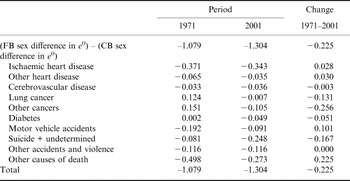
Table 5 represents a further elaboration of this last point. Between 1971 and 2001, the sex differential in life expectancy for the immigrant population got smaller in relation to that of the Canadian born, by 0.225 of a year. This net difference resulted from two sets of opposing influences. On the one hand are the combined effects of other cancers (–0.256), suicide (–0.167), lung cancer (–0.131), diabetes (–0.051) and cerebrovascular disease (–0.003), all of which show that sex differences in mortality from these causes reduced more in the immigrant population over time than in the Canadian born. On the other hand, for the remaining causes, the signs are positive. This indicates that sex differences in mortality reduced less in the immigrant population as compared with the Canadian-born population between 1971 and 2001, even though as of 2001 immigrants maintained a smaller sex differential in these causes of death (ischaemic heart disease, other heart disease, motor vehicle accidents, other causes of death).

Discussion
The topic of sex differences in life expectancy in immigrant populations has received limited systematic attention in the demographic literature. This study undertook an empirical analysis of sex differences in life expectancy among immigrant and Canadian-born populations in 1971 and 2001. During this period Canada as a country experienced a contraction of its sex gap in life expectancy by nearly 2 years (Trovato, Reference Trovato2005). As demonstrated in the present investigation this phenomenon was not confined solely to the Canadian-born population; it also involved the immigrant population. In fact, the foreign-born population experienced a larger decline in the sex differential in life expectancy (2.026 years vs 1.801).
It was also observed that in a relative sense, immigrant men enjoy a larger advantage in survival chances than do immigrant women. Further investigation is needed to explore the underlying factors involved in this differential. Positive health selectivity is a frequently cited explanation for immigrants' mortality advantage over their native-born host populations. The ‘healthy migrant’ thesis posits that healthy individuals self-select themselves for emigration from their populations of origin, and this selective process translates into a more favourable mortality profile for immigrants in their adopted countries (Brahimi, Reference Brahimi1980; Marmot et al., Reference Marmot, Adelstein and Bulusu1984a, Reference Marmot, Adelstein and Bulusub; Abraido-Lanza et al., Reference Abraido-Lanza, Dohrenwend, Ng-Mak and Turner1999; Jasso et al., Reference Jasso, Massey, Rosenzweig, Smith, Anderson, Bulatao and Cohen2004; Palloni & Arias, Reference Palloni and Arias2004; Rubalcava et al., Reference Rubalcava, Teruel, Thomas and Goldman2008). Although this effect is well established, little attention has been devoted to the question of sex differences in health selectivity (see Llacer et al., Reference Llacer, Zunzunegui, del Amo, Mazarrasa and Bolumar2007 for an exception); thus, it remains unclear whether the intensity of health selection among immigrants varies by gender. In an early study based on France, Brahimi (Reference Brahimi1980) introduced the idea that positive health selection should be more intense among men because they are typically more economically active than are women and are therefore more prone to emigrate from their home countries (and when family migration is involved it is usually the male head of household that is the principal decision-maker and the rest of the family follows him to the new country). Based on these assumptions Brahimi hypothesized that the sex differential in mortality among immigrants should be most noticeable in the prime working ages. This proposition has received some empirical support, in that between the ages of 30 and 45, the relative mortality risk of migrant men (immigrant male death rate/native-born male death rate) has been observed to be lower than that of migrant women in relation to native-born women (Brahimi, Reference Brahimi1980; Khlat, Reference Khlat1993). This suggests that even though the selective nature of migration affords male and female migrants an overall mortality advantage in relation to their native-born host population, the intensity of health selectivity may be stronger among male migrants.
A further avenue for future research concerns the smaller sex differential in life expectancy in the immigrant population. As has been seen, this is mainly a function of immigrants' relatively smaller sex difference in mortality from lung cancer, other cancers and suicide. Cancer – especially of the lung – is strongly correlated with tobacco use. According to research in this area sex differences in smoking-related mortality explain between 40 and 75% of the mortality gap between men and women (Retherford, Reference Retherford1975; Waldron, Reference Waldron1986; Peto et al., Reference Peto, Lopez, Boreham and Heath1992, Reference Peto, Lopez, Boreham and Heath1994, Reference Peto, Lopez, Boreham and Thun1996, Reference Peto, Lopez, Boreham, Thun, Heath and Doll2006; Vallin, Reference Vallin, Federici, Oppenheim Mason and Sogner1993, Reference Vallin, Caselli, Vallin and Wunsch2006; Lopez, Reference Lopez, Lopez, Caselli and Valkonen1995; Ezzati et al., Reference Ezzati, Henley, Thun and Lopez2000; Pampel, Reference Pampel2002, Reference Pampel2003; Case & Paxson, Reference Case and Paxson2005; Preston & Wang, Reference Preston and Wang2006; Wang & Preston, Reference Wang and Preston2009). It would be important to examine in greater detail the role of sex differences in smoking-related mortality to sex differences in life expectancy across immigrant and non-immigrant populations in societies where the foreign born represent a substantial portion of the national population. Similarly, further research is needed to explore in greater detail sex differences in suicide mortality in immigrant and non-immigrant populations. The present investigation has shown that sex differences in this type of mortality have narrowed among immigrants but widened over time in the Canadian-born population. Essentially, this means that immigrant men have been closing their gap in this type of mortality with immigrant women, whereas Canadian-born men have been less successful in this respect (see Appendix A). Why this is so remains open to further inquiry.
Ideally, this analysis should be replicated with mortality data classified by immigration cohort (i.e. year of arrival to the host society). Such data would help provide a clearer picture of how immigrant health and mortality probabilities change with increasing duration of residence in the adopted country. The data examined in the present investigation are cross-sectional and therefore devoid of this type of information. Over the course of the study period – i.e. the 30 year interval between 1971 and 2001 – the immigrant population of Canada has undergone important compositional change (e.g. a decline in migrants from Western Europe and an increase from developing countries); therefore, the changes in sex differences in life expectancy observed in this study cannot be assumed to pertain totally to the same immigrant population as in 1971. Notwithstanding this limitation, this study advances in a meaningful way our knowledge of sex differences in mortality and life expectancy in the context of immigrant and host populations in Canada. It is hoped that the study will stimulate further research in this area.
Acknowledgments
The authors are grateful to the Social Sciences and Humanities Research Council of Canada (SSHRC) and the Killam Research Fund at the University of Alberta for their generous support. They also thank the anonymous reviewers for their insightful comments on an earlier version of this paper. It goes without saying that any errors and omissions are the sole responsibility of the authors. A preliminary version of the paper was presented at the 2nd Symposium on Frontiers and Challenges in the Study of Human Longevity held at the Max Planck Institute for Demographic Research, Center on the Economics and Demography of Aging, Rostock, Germany, 13–14th June 2008.
Appendix
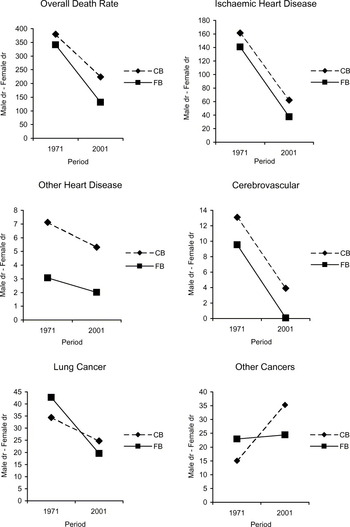
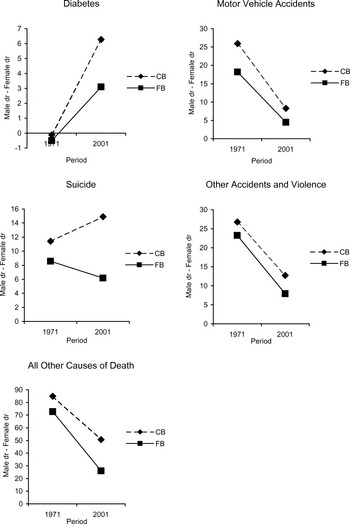
Figure A1 shows the sex differences in cause-specific death rates (male–female) for the Canadian-born (CB) and immigrant (FB) populations in 1971 and 2001 (difference in rates per 100,000).
Sex differences in cause-specific death rates (male–female) for Canadian-born (CB) and immigrant (FB) populations, 1971 and 2001 (difference in rates per 100,000).