INTRODUCTION
This is the third paper in a recent series on the tanaidacean assemblage in the Central Pacific Manganese Nodule Province. The two recent papers centred on the genera Collettea (G.O. Sars, Reference Sars1882), Robustochelia Kudinova-Pasternak, Reference Kudinova-Pasternak1983 and Tumidochelia Knight et al., Reference Knight, Larsen and Heard2003 (Larsen, Reference Larsen2011a) and Stenotanais Bird & Holdich, Reference Bird and Holdich1984 and Typhlotanais G.O. Sars, Reference Sars1882 (Larsen, Reference Larsen2011b). Previous papers of the tanaidacean fauna from this general area have dealt with the genera Agathotanais Hansen, Reference Hansen1913 (Larsen, Reference Larsen1999) and Collettea (G.O. Sars, Reference Sars1882) (Larsen, Reference Larsen2000).
This paper deals with a new genus, but, more importantly, it deals with the identification of dimorphic males and their assignment to females of a given species (see Larsen, Reference Larsen2002). The identification of dimorphic- of even polymorphic- males and assignment to their respective females, have been a long standing problem for tanaid systematics (Larsen & Wilson, Reference Larsen and Wilson2002; Guerrero-Kommritz & Brandt, Reference Guerrero-Kommritz and Brandt2005; Bird & Larsen, Reference Bird and Larsen2009) but some shared species-specific characters might be present and this topic should be investigated further in other taxa.
MATERIALS AND METHODS
Samples were taken during the French/German BIONOD expedition between 28 April and 11 May 2012, from aboard the research vessel ‘ĹAtalante’ using epibenthic sledges. The material was sieved through 0.5 and 0.3 mm mesh. Parts of the material were fixed and stored in 96% alcohol for genetic treatment.
Dissections were made in glycerin using chemically-sharpened tungsten wire needles. Body length was measured from the tip of the cephalothorax to the apex of the pleotelson. The terminology in the descriptions is based on Larsen (Reference Larsen2003), although the minute terminal article of the antennule is here termed ‘terminal cap-like article’ (see Larsen et al., Reference Larsen, Bird and Ota2013). Adjectives such as long and short are used as relative qualifiers in respect of the appendage being described.
Types are deposited in the Muséum National d'Histoire Naturelle Paris (MNHN).
SYSTEMATICS
Order TANAIDACEA Dana, Reference Dana1849
Suborder TANAIDOMORPHA Sieg, Reference Sieg1980
Superfamily PARATANOIDEA Lang, Reference Lang1949
Family COLLETTEIDAE Larsen & Wilson, Reference Larsen and Wilson2002
Cheliasetosatanais gen. nov.
DIAGNOSIS
Female: pereon composed of six free pereonites, pleon composed of five free pleonites with small ventral apophyses and pleotelson. Antennule with five articles of which the terminal article is minute and cap-like. Antenna with six articles. Labrum with distal setae of a robust nature. Mandible incisor and lacinia mobilis well calcified; molar wide with distal denticles but apex tapering and weakly calcified. Labium composed of two lobes with distal setae of a robust nature and with small inner spines. Maxilliped basis fused, with long lateral seta reaching midlenght on palp article 3; endites not fused, with three spiniform and outer and inner simple setae; palp article 3 with row of small outer spines. Cheliped attached via triangular sclerite; propodus with inner row of multiple robust setae; dactylus with inner cluster of setules and seta. Pereopodal propodi all with ventral spines. Pereopods 4–6 dactylus and unguis not fused. Pleopods absent. Uropodal endopod and exopod both composed of two articles.
Male: swimming type. Pereon reduced; pleon enlarged; pleotelson with long (half the total length of pleotelson) apical spiniform process. Antennule with seven article plus terminal cap-like article; article 4–6 with ventrodistal cluster of aesthestascs. Mandibles absent. Maxilliped well developed; endite as in female; palp without spines and with simple setae only. Cheliped setation as in female. Pereopods 1–3 elongated and stick-like. Pleopods biramous. Uropod endopod tri-articulated (first one pseudoarticulated), exopod bi-articulated.
TYPE-SPECIES
Cheliasetosatanais spinimaxillipedus sp. nov.
ETYMOLOGY
Named after the setose propodal cheliped.
GENDER
Masculine.
REMARKS
The male shows several similarities with the male of Siphonolabrum Lang, Reference Lang1972 like the fully developed maxilliped, a heavy cheliped propodal and dactylar setation, and tri-articulated uropodal endopod but lacks the elongated labrum of Siphonolabrum. However, the female of the new genus clearly does not belong to the Anarthruridae Lang, Reference Lang1971 on the basis of the mandibles, maxilliped endite armament, cheliped attachment, and biramous uropods. The male differs also from Siphonolabrum maxilliped endite armament and the bi-articulated uropodal exopod.
The male morphology deserves closer attention. Tanaidacean males are infamous for their different expression of morphology. Firstly there is the ‘female-looking’ type, as found in Agathotanaidae Lang, Reference Lang1971, Tanaellidae Larsen & Wilson, Reference Larsen and Wilson2002, Parafilitanais Kudinova-Pasternak, Reference Kudinova-Pasternak1983, Pseudoanarthrura Larsen, Reference Larsen2005 and Collettea (G.O. Sars, Reference Sars1882), where the male shares the female morphology except a thicker antennule (without multiple aesthestascs) and the presences of pleopods but retains functional mouthparts. Then there is the ‘Tanaoidea-type’, where the male also retains functional mouthparts but differs in the shape of the cephalothorax and chelipeds. Thirdly there are the ‘Leptocheliidae-type’, where the antennules contain multiple articles with bundles of aesthestascs, reduced mouthparts, heavily modified chelipeds but with the pereon/pleon only moderately modified. The fourth type is the typical ‘swimming-male’ found in Leptognathiidae, Paratanaidae Lang, Reference Lang1949, Pseudotanaidae Sieg, Reference Sieg1976, and Typhlotanaidae Sieg, Reference Sieg1986 where the antennules contain multiple bundles of aesthestascs, reduced mouthparts, and all somites heavily modified but with a cheliped which displays only minor modifications. In this study we are faced with a fifth type, represented by the new genus and Siphonolabrum Lang, Reference Lang1971 (Sieg, Reference Sieg1986) which resemble the typical ‘swimming-male’, but with a fully developed maxilliped almost identical to that of the female. Since the new genus and Siphonolabrum clearly do not belong to the same family, the character of this male morphology is already homoplastic.
The identification of dimorphic males and their assignment to females of a given species have generally been considered close to impossible without application of genetic methods (Larsen, Reference Larsen2001; Larsen & Froufe, Reference Larsen, Froufe, Nimis and Vignes-Lebbe2010, Reference Larsen and Froufe2013). This is because the genders were considered to share no species-specific characters (Bird & Larsen, Reference Bird and Larsen2009). However, as stated above, both the male of the new genus and that of Siphonolabrum, share some specific features with those of the female. For example, in the genus described herein, both the maxilliped endite armament, the strange cheliped setation, and to a lesser degree, similarities in the pointed pleotelson. In Siphonolabrum the genders share the enlarged labrum and the maxilliped morphology with the female (Sieg, Reference Sieg1986:144, figure 96). It is entirely possible that some species-specific characters have been overlooked in the male of some of the other tanaid taxa known to harbour di- or polymorphic males (Leptocheliidae, Leptognathidae, Nototanaidae, Paratanaidae, Pseudotanaidae, Typhlotanaidae). It is here recommended that special attention should be taken when dealing with such taxa in the future.
Also of interest is the presence of a single prominent penial cone (albeit with two genital openings) on the male. Usually the single cone is restricted to the suborder Apseudomorpha, but has previously been recorded for a few species of tanaidomorphans (Kakui et al., Reference Kakui, Katoh, Hiruta, Kobayashi and Kajihara2011).
The genus fits with the family diagnosis of Colletteidae and is currently placed herein. However, few will dispute that the diagnosis of Colletteidae is too wide and that the family is not monophyletic. A phylogenetic analysis of the Colletteidae is, however, not within the scope of this study.
Cheliasetosatanais spinimaxillipedus sp. nov.
(Figures 1–4)
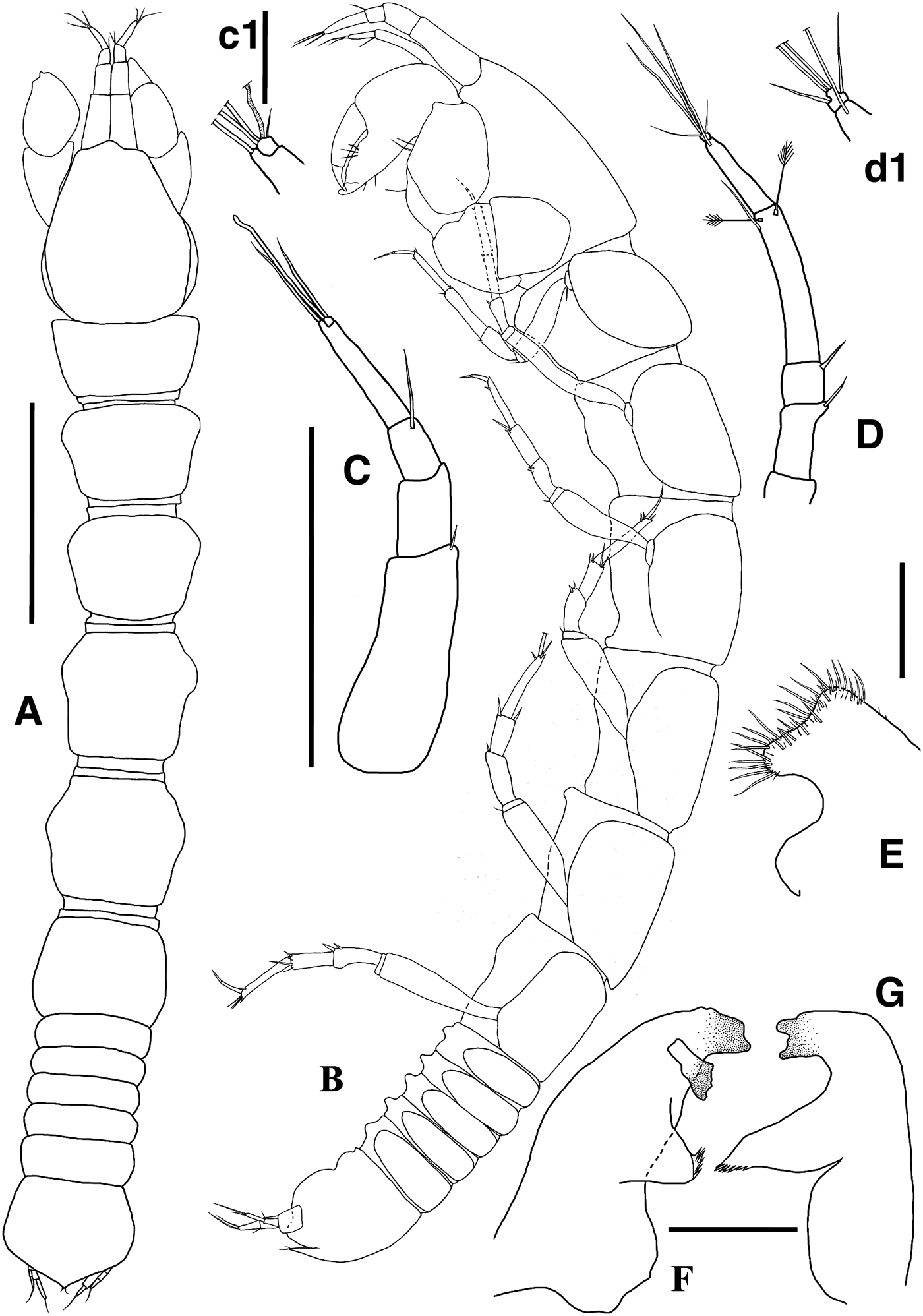
Cheliasetosatanais spinimaxillipedus sp. nov., adult female: (A) holotype habitus dorsal view; (B) holotype habitus lateral view; female paratype: (C) antennule; (C1) same apex; (D) antenna; (D1) same apex; (E) labrum dorsal view; (F) left mandible; (G) right mandible. Scale bars: A, B, 1 mm; C, D, 0.5 mm; E–G, 0.1 mm.

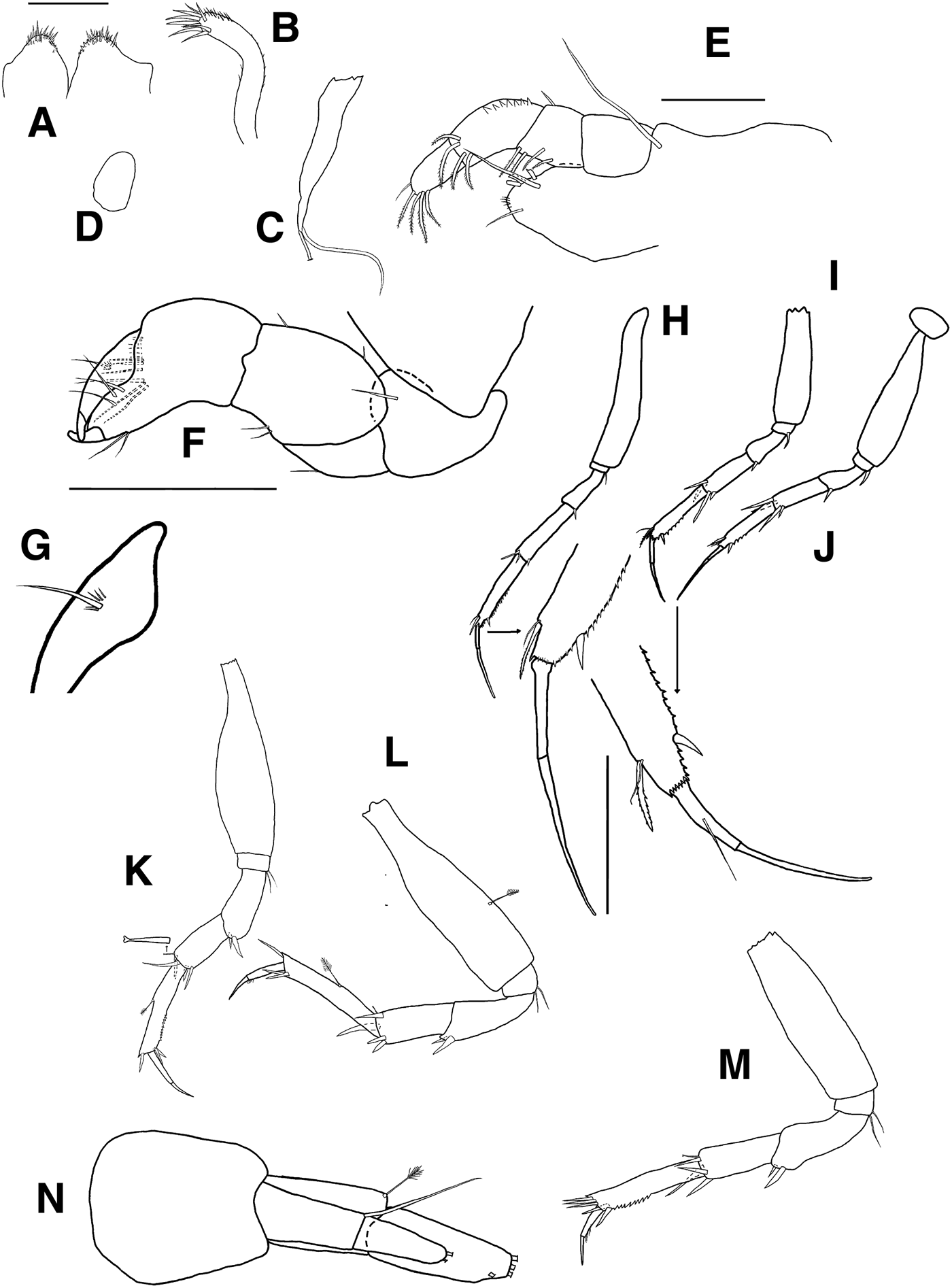
Cheliasetosatanais spinimaxillipedus sp. nov., female paratype: (A) labium; (B) maxillule endite; (C) same palp; (D) maxilla; (E) maxilliped; (F) cheliped, outer view; (G) inner side of cheliped dactylus; (H) pereopod 1; (I) pereopod 2; (J) pereopod 3; (K) pereopod 4; (L) pereopod 5; (M) pereopod 6; (N) uropod. Scale bars: A–E, 0.1 mm; F–N, 0.5 mm.
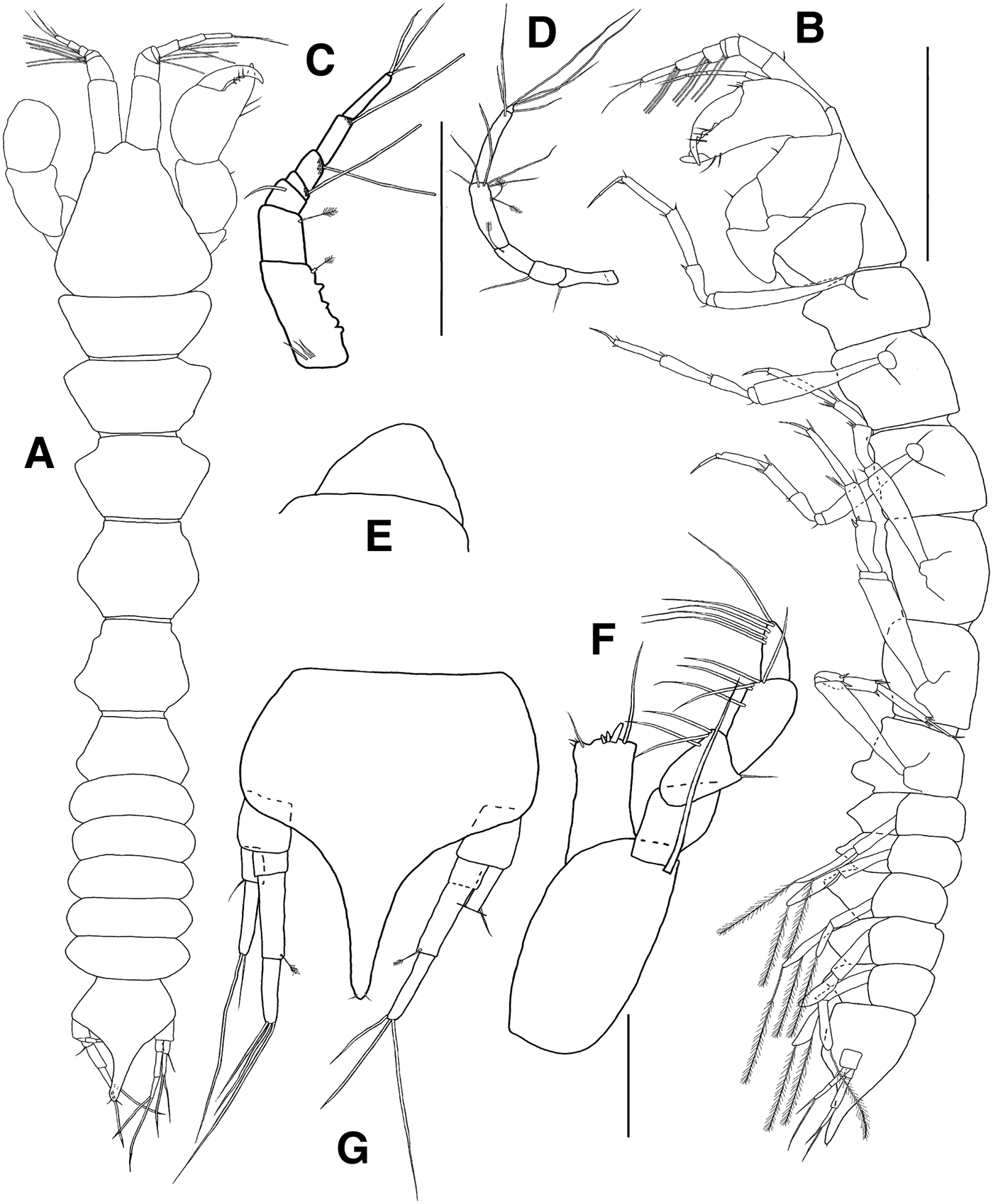
Cheliasetosatanais spinimaxillipedus sp. nov., adult male paratype: (A) dorsal view; (B) same lateral view; (C) antennule; (D) antenna; (E) labrum dorsal view; (F) maxilliped; (G) pleotelson and uropod. Scale bars: A, B, 1 mm; C, D, H, 0.5 mm; E–G, 0.1 mm.
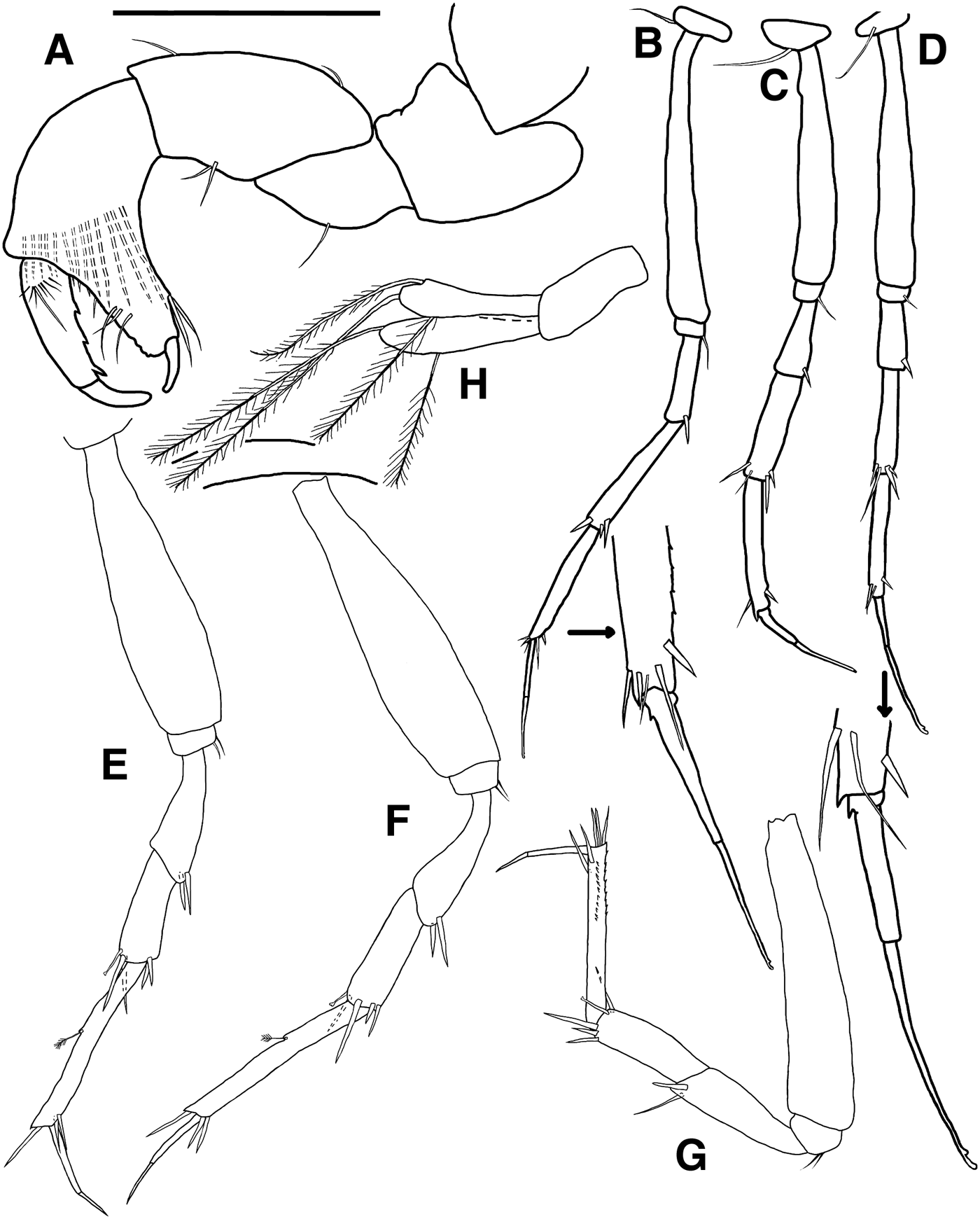
Cheliasetosatanais spinimaxillipedus sp. nov., male paratype: (A) cheliped, outer view; (B) pereopod 1; (C) pereopod 2; (D) pereopod 3; (E) pereopod 4; (F) pereopod 5; (G) pereopod 6; (H) pleopod. Scale bar: A–G, 0.5 mm.
ETYMOLOGY
Named after the spiniform setae on the maxilliped endites of both genders.
TYPE MATERIAL
Holotype: adult female, station BIO12-06EBS, epi (Reg. No. to be added after acceptance), 2 April 2012; coordinates: 11°42.76′N 116°40.35′W; water depth: 4261 m–11°46.22′N 116°41.13′W, water depth: 4259 m.
Paratypes: one female, same locality, dissected (Reg. No. to be added after acceptance). Two non-ovigerous females (one dissected), Two males (one dissected), same location.
DIAGNOSIS
Currently like the generic diagnosis.
DESCRIPTION
Non-ovigerous female, 6.1 mm (Figures 1 and 2). Body (Figure 1A, B): long and slender, 9.5 times as long as wide. Cephalothorax (Figure 1A): as long as first two pereonites combined, eyes and eye-lobes absent. Pereon (Figure 1A, B): pereonites with distinct lateral shield. Pereonites 1–3 widest anteriorly, pereonite 4 and 5 widest at midlenght, pereonites 5 and 6 widest posteriorly. Pereonite 1 shortest. Pereonite 6 marginally longer than pereonite 1 and shorter than 2. Pereonite 5 longest and marginally longer than pereonite 4. Pereonite 2 longer than pereonite 6 and shorter than pereonite 3. Pleon (Figure 1A, B): pleonites of equal length, all pleonites with small apophyses. Pleotelson: longer than three last pleonites combined. Apex pointed.
Antennule (Figure 1C, C1). Shorter than cephalothorax. Article 1 longest but shorter than rest of antennule, with one distal simple seta. Article 2 longer than article 3, apparently naked. Article 3 longer than wide, with one simple distal seta. Article 4 almost as long as article 2 and 3 combined, with two terminal setae of which one is almost as long as article. Article 5 (Figure 1C1), minute and cap-like partly covered by article 4, with one aesthetasc, one short and two long terminal setae almost as long as article 5.
Antenna (Figure 1D, D1) about 0.8 times as long as antennule, composed of six articles. Article 1 short and fused to the cephalothorax, naked. Article 2 elongated and widening dorsodistally, longer than article 3, with robust dorsodistal seta. Article 3 square, with robust dorsodistal seta. Article 4 longest, with one simple and two setulate distal setae. Article 5 longer than article 2, with one long distal seta. Article 6 (Figure 1D1) minute, with abrupt decrease in width midlenght, with two short setae midlenght and two long terminal setae.
Mouthparts (Figures 1E–G and 2A–E): labrum (Figure 1E) with distal setules and setae of a robust nature. Mandibles (Figure 1F, G) well-developed, molars wide but tapering, apex with distal denticles but weakly calcified. Left mandible (Figure 1F) incisor weakly bifurcated, with two small outer denticles, very heavily calcified; lacinia mobilis widening distally, with serrated apex, very heavily calcified. Right mandible (Figure 1G) incisor widely but unevenly bifurcated, very heavily calcified. Labium (Figure 2A) composed of two triangular lobes with distal setules and setae of a robust nature, with small inner spines. Maxillule (Figure 2B, C): endite with nine terminal spiniform setae, shaft with evenly spaced row of setules; palp with two long terminal setae. Maxilla (Figure 2D): ovoid, naked. Maxilliped (Figure 2E): basis fused, with long lateral seta; endites not fused, with a row of setules, three spiniform and outer and inner simple setae. Palp article 1 naked; article 2 with one outer and four inner bipinnate setae; article 3 with four bipinnate inner setae, with row of small outer spines; article 4 with five bipinnate terminal setae. Epignath not recovered.
Cheliped (Figure 2F, G): basis attached to cephalothorax via large sclerite, with dorsodistal seta. Merus triangular, with one ventral seta. Carpus longer than wide, no carpal shield, with two ventral setae and one small dorsal seta in each end. Propodus more than twice as long as wide, with inner vertical row of 12 robust setae increasing in length ventrally. Fixed finger with two ventral and three inner simple setae. Dactylus as long as fixed finger, with inner medial cluster of multiple setules (Figure 2G) and one dorsodistal seta.
Pereopod 1 (Figure 2H): coxa discrete (not illustrated). Basis long (more than 5.5 times longer than wide), naked. Ischium with one simple seta. Merus twice as long as wide, with one spiniform ventrodistal seta. Carpus longer than merus, with three spiniform distal setae. Propodus longer than carpus, with multiple ventral and terminal spines, one serrated robust and one simple dorsodistal setae, and one spiniform ventrodistal seta. Dactylus naked. Unguis sharp, twice as long as dactylus.
Pereopod 2 (Figure 2I): as pereopod 1 except: ischium with one robust seta. Carpus with four spiniform distal setae.
Pereopod 3 (Figure 2J): as pereopod 2 except: dactylus with medial seta.
Pereopod 4 (Figure 2K): coxa incompletely fused to body. Basis wider than pereopods 1–3 (3.3 times longer than wide), naked. Ischium short, with two simple setae. Merus with two unequally long spiniform ventrodistal setae. Carpus shorter than merus, with one bone-shaped and four distal spiniform setae. Propodus longer than merus, with one dorsomedial setulate seta, one spiniform dorsodistal and two spiniform ventrodistal setae, ventral margin with multiple spines. Dactylus naked, longer than unguis.
Pereopod 5 (Figure 2L): as pereopod 4 except: basis with one ventromedial setulate seta. Dactylus with small terminal setules.
Pereopod 6 (Figure 2M): as pereopod 4 except: propodus without dorsomedial setulate seta, with three spiniform dorsodistal and two ventrodistal setae, with multiple ventral and terminal spines. Dactylus with small terminal setules.
Pleopods: absent in female.
Uropods (Figure 2N): biramous. Basal article very wide, almost square. Endopod bi-articulated, article 1 as long as article 2, with one setulate distal seta; article 2 setation broken but with at least one subdistal and three terminal setae. Exopod bi-articulated, combined longer than endopod article 1, with one long distal seta; article 2 shorter than article 1, setation broken but with at least two terminal setae.
Male, 3.8 mm (Figures 3 and 4). Body (Figure 3A, B): 5.3 times as long as wide. Cephalothorax triangular, marginally longer than wide, as long as pereonites 1–2 combined, with small blunt rostrum. Pereonites with indistinct lateral shield. Pereonites 1 to 3 widest anteriorly, pereonite 4 widest at midlength, pereonites 5 and 6 widest posteriorly. Pereonite 1 shorter than pereonite 2. Pereonite 2 shorter than pereonite 3. Pereonite 3 shorter than pereonite 4. Pereonite 4 longer than pereonite 5. Pereonite 5 longer than pereonite 6. Pereonite 6 as long as pereonite 1, with one prominent penial cone having two genital openings. Pleon with large triangular hypospheneans, wider than pleotelson and posterior part of pereon, with clear lateral shield but no setae. Pleotelson (Figure 3G) longer than last three pleonites combined, apex tapering into a long (more than half of total pleotelson length) spiniform projection, with one pair of apical simple setae.
Antennule (Figure 3C): longer than cephalothorax, of eight articles. Article 1 more than twice as long as article 2, with three proximal simple setae and distal setulate seta, ventral margin with denticles. Article 2 more than twice as long as article 3, with one distal setulate seta. Article 3 about half as long as article 2, with one dorso-subdistal seta. Article 4 narrow and band-shaped, with multiple (many more than illustrated) ventrodistal aesthestascs. Article 5 longer than article 3, with multiple ventrodistal aesthestascs. Article 6 as long as article 7, with multiple ventrodistal aesthestascs. Article 7 about as long as article 2, with one long seta (longer than article itself). Article 8 minute and cap-like, with one long and one short simple distal setae.
Antenna (Figure 3D): 0.75 times as long as antennule, of seven articles. Article 1 fused with cephalothorax and partly fused (pseudoarticulated) with article 2. Article 2 longer than article 3, widening distally and with one dorsal simple seta. Article 3 shorter than article 4, with dorsodistal seta. Article 4 half as long as article 6, with dorsodistal setulate seta. Article 5 twice as long as article 3, with five simple distal, and two setulate subdistal setae. Article 6 longer than article 5 with one long simple seta. Article 7 minute, with abrupt decrease in width midlenght, with two subdistal and three long simple distal setae.
Mouthparts (Figure 3E, F): labrum (Figure 3E) prominent, naked. Mandibles absent. Maxillule not recovered and probably absent. Maxilliped (Figure 3F) remarkably well-developed for a non-feeding male; basis with one long lateral seta; endites with three spiniform setae on distal margin and one long outer, one shorter and three tiny setae on inner distal margin. Palp article 1 naked; article 2 with three inner, simple and one outer setae; article 3 with five longer simple inner setae; article 4 with five simple setae. Epignath not recovered.
Cheliped (Figure 4A): not elongated, attached to body via triangular sclerite. Basis widest distally, shorter than carpus, naked. Merus triangular, with one ventral seta. Carpus shorter than propodus including fixed finger, with one dorsoproximal and dorsodistal seta, and two ventromedial setae. Propodus with one seta at dactylus insertion and vertical row of 13 inner distal setae increasing in length ventrally. Fixed finger with small denticles and three simple setae on cutting edge, and two ventral setae. Dactylus as long as fixed finger, with dorsoproximal setae and setules, with three inner minute spines.
Pereopod 1 (Figure 4B) thin and sticky-like. Coxa with seta. Basis slender (l/w ratio 7.5) and naked. Ischium with one simple ventral seta. Merus about 0.8 times as long as carpus, with one robust ventral seta. Carpus longer than propodus, with two long and one short spiniform distal setae. Propodus about 0.4 times as long as basis, ventral margin with small evenly-spaced minute spines, with four distal setae, and one sub-ventrodistal spiniform seta. Dactylus and unguis marginally shorter than propodus, dactylus marginally longer than unguis, with proximal dorsal spine. Unguis with bifurcated apex.
Pereopod 2 (Figure 4C): similar to pereopod 1 except: carpus with additional simple seta, not longer than propodus. Propodus with one dorso-subdistal and one spiniform ventral setae subdistally.
Pereopod 3 (Figure 4D): similar to pereopod 2 except: propodus with two dorso-subdistal setae.
Pereopod 4 and 5 (Figure 4E & 4F): coxa incompletely fused to body. Basis wider than those of pereopods 1–3, naked. Ischium with two simple setae. Merus with two dissimilar spiniform distal setae. Carpus with one ‘bone-shaped’ dorsodistal seta and four spiniform distal setae. Propodus with one dorsomedial setulate, one dorsodistal, and two spiniform ventro-subdistal setae, and small dorsodistal spine. Dactylus and unguis combined shorter than propodus, without ventral spines, unguis less than half as long as dactylus.
Pereopod 6 (Figure 4G): as pereopod 5 except: propodus medial margin with spines, dorsal margin serrated, with three dorsodistal and two ventral spiniform setae and no dorsomedial seta.
Pleopods (Figure 4H) subequal. Basal article as long as endopod, naked. Endopod with one outer and nine plumose inner setae of which the most distal is shorter and have a complex tip. Exopod with 13 plumose inner setae (only flanking setae illustrated).
Uropod (Figure 3G): shorter than pleotelson. Basal article shorter than exopod, naked. Endopod with three articles of which the first is naked, partly fused with, and shorter than half of article 2. Article 2 longer than article 3, with one setulate distal seta. Article 3 as long as exopod article 2, with three apical setae. Exopod with two articles, as long as two first endopod articles combined; article 1 with one distal simple seta; article 2 with one short and one longer than endopod distal setae.
ACKNOWLEDGEMENTS
Thanks are extended to Drs Menot (IFREMER) and Rühlemann (BGR), chief scientists of the BIONOD expedition for inviting the senior author to participate in this cruise and for making the material available for study.
FINANCIAL SUPPORT
K.L. was supported by the European Regional Development Fund (ERDF) through the COMPETE—Operational Competitiveness Program and national funds through FCT—Foundation for Science and Technology, under the project PEst-C/MAR/LA0015/2013. This paper is part of a PhD dissertation (C.L.A.S.) funded by CAPES—Coordenação de Aperfeiçoamento de Pessoal de Nível Superior (Grant number: 5428/10-6).