Introduction
The codling moth, Cydia pomonella (Lepidoptera: Tortricidae) is a major global pest of pome fruit and walnuts (Reyes et al., Reference Reyes, Franck, Charmillot, Ioriatti, Olivares, Pasqualini and Sauphanor2007; Voudouris et al., Reference Voudouris, Sauphanor, Franck, Reyes, Mamuris, Tsitsipis, Vontas and Margaritopoulos2011; Işci and Ay, Reference Işci and Ay2017). Fruit quality is seriously affected by this pest, especially when the larvae bore into the center of fruits to feed on the sarcocarp and seeds, thus leaving frass on the surface and causing fruit abscission (Yang et al., Reference Yang, Zhang, Wang, Dong, Gao and Jia2016). In orchards, C. pomonella infestation rates can reach 80% for apples if pest management strategies are not conducted (Wan et al., Reference Wan, Yin, Tang, Wan, Chen, Wu, Huang, Qian, Rota-Stabelli, Yang, Wang, Wang, Zhang, Guo, Gu, Chen, Xing, Xi, Liu, Lin, Guo, Liu, He, Tian, Jacquin-Joly, Franck, Siegwart, Ometto, Anfora, Blaxter, Meslin, Nguyen, Dalíková, Marec, Olivares, Maugin, Shen, Liu, Guo, Luo, Liu, Fan, Feng, Zhao, Peng, Wang, Liu, Zhan, Liu, Shi, Jiang, Jin, Xian, Lu, Ye, Li, Yang, Xiong, Walters and Li2019). Therefore, this pest poses a great threat to fruit production worldwide and annual crop losses amount to hundreds of billions of dollars and with annual crop damage estimated to be tens of millions of dollars (Knight et al., Reference Knight, Judd, Gilligan, Fuentes-Contreras, Walker, Xu and Fountain2019; Mohammed, Reference Mohammed2019).
The C. pomonella is a major invasive agricultural pest in China that has become an issue of pome fruit export concern (Wang et al., Reference Wang, Hu, Li, Wang and Yang2019). This pest is native to central Asia Minor and was first found in Xinjiang, China in 1957 (Zhang et al., Reference Zhang, Zhou, Wang and Chen1957). But in recent years, it has extended further into Xinjiang, Inner Mongolia, Ningxia, Gansu, Heilongjiang, Jilin, and Liaoning (Yang and Zhang, Reference Yang and Zhang2015; Chen et al., Reference Chen, Chen, Ge, Yang and Wang2020). Field monitoring performed by the National Agricultural Technology Extension Service Center of China in 2020 showed that C. pomonella was now found in Beijing, Hebei, and Tianjin, closing in to the main apple production areas in the Loess Plateau and Bohai Bay, and causing a serious threat to the development of the apple industry in China (Fang et al., Reference Fang, Cai, Ke, Xing, Yang and Wang2018). Considering its great damage and potential threat to agricultural production, C. pomonella has been listed in the 10 pests of the First-Kind of Crop Diseases and Insect Pests List, by the Ministry of Agriculture and Rural Affairs of the People's Republic of China (PRC). Therefore, it has become urgent to develop effective prevention and control strategies for this invasive pest to block or delay its further spread into the main production areas.
C. pomonella in orchards is usually controlled by integrated pest management (IPM) methods, including environmentally compatible strategies including agricultural practices (Reyes et al., Reference Reyes, Franc, Olivares, Margaritopoulos, Knight and Sauphanor2009), pheromone-mediated mating disruption (Witzgall et al., Reference Witzgall, Stelinski, Gut and Thomson2008), attract-kill (Charmillot et al., Reference Charmillot, Hofer and Pasquier2000), and frequent application of insecticides (Soleño et al., Reference Soleño, Parra-Morales, Cichón, Garrido, Guiñazú and Montagna2020). However, these environmentally compatible approaches have the limitations in suppressing a high density of pest population (Ju et al., Reference Ju, Mota-Sanchez, Fuentes-Contreras, Zhang, Wang and Yang2021). In addition, insecticide overuse has inevitably led to the development of C. pomonella resistance to most of the commonly used insecticides in at least 16 countries (Wei et al., Reference Wei, Liu, Hu and Yang2020; Ju et al., Reference Ju, Mota-Sanchez, Fuentes-Contreras, Zhang, Wang and Yang2021). Therefore, the development of alternative and effective strategies remains critical in the management of C. pomonella worldwide (Agasyeva et al., Reference Agasyeva, Ismailov, Nastasiy and Nefedova2021). One alternative strategy that has been successfully used to suppress C. pomonella populations is the sterile insect technique (SIT) (Knipple, Reference Knipple2013; Thistlewood and Judd, Reference Thistlewood and Judd2019). This strategy is environmentally benign, species-specific, and highly compatible with other area-wide IPM methods (Dyck et al., Reference Dyck, Hendrichs and Robinson2007). In general, SIT involves three key components: mass rearing of the target insect species, production of sterile insects, and release of the sterilized insects into the field to mate with wild insects of the opposite sex (Dyck et al., Reference Dyck, Hendrichs and Robinson2007). The first successful SIT program for C. pomonella control was developed in the 1990s under the ongoing OkanaganeKootenay Sterile Insect Release (OK SIR) program in south-central British Columbia, Canada, using Cobalt60 (60Co-γ) (Bloem and Bloem, Reference Bloem, Bloem, AliNiazee and Long1996; OK SIR, 2011). This program was proven to have a good effect on controlling C. pomonella, with the number of orchards without damage increasing from 42% in 1995 to 91% in 1997 (Bloem and Bloem, Reference Bloem and Bloem2000).
Cobalt60 is the earliest and most widely used radioactive source in SIT, with advantages in good penetration performance and dose rate stability (Li et al., Reference Li, Zhao, Chen, Ju, Wei and Yang2021). However, a serious problem has arisen recently for the use of Cobalt60 source in SIT projects as it is becoming almost impossible to acquire radioactive sources for insect sterilization as well as its radioactive pose a safety hazard (Mastrangelo et al., Reference Mastrangelo, Parker, Jessup, Pereira, Orozco-Dávila, Islam, Dammalage and Walder2010). Moreover, the SIT program using Cobalt60 as the radioactive source is also limited by economic constraints (Knipple, Reference Knipple2013). Compared with other control strategies to control codling moth, the area-wide SIT program is the most expensive way, with an estimated global cost at nearly $1120 per ha, and that does not account for the additional costs of supplemental controls such as insecticide, mating disruption, etc. (Thistlewood and Judd, Reference Thistlewood and Judd2019). As a consequence, the exploration of methods to replace Cobalt60 with a less expensive X-ray source is useful to provide a sustainable and effective strategy of area-wide management of codling moth using SIT. In this study, we investigated the radiation biology of a new generation of X-ray irradiator on the codling moth, including determining the optimal age of pupae for irradiation and the optimal irradiation dose, as well as its effects on adult longevity and reproduction-related parameters such as mating competitiveness.
Materials and methods
Insects
A C. pomonella strain has been bred continuously in the laboratory for more than 50 generations without exposure to any ionizing radiation (Hu et al., Reference Hu, Wang, Ju, Chen, Tan, Mota-Sanchez and Yang2020). Larvae were reared on the artificial diet and maintained in a growth chamber (MLR-352H-PC, Panasonic) under the following conditions: temperature 26 ± 1°C, relative humidity 60 ± 5%, photoperiod of 16:8 h (light/dark), as described by Wang et al. (Reference Wang, Hu, Li, Wang and Yang2019). Under the rearing protocol used, the duration of the pupal stage was 9 days, so at the time of irradiation, pupae that were 1, 4, and 7 days before emergence were 8-, 5-, and 2-day-old pupae, respectively. Moths were supplied with a 10% honey solution.
Irradiation
A new X-ray irradiator (JYK-001 type) (fig. 1) independently developed by Hebi Jiaduoke Industry and Trade Co., Ltd, Hebi, China, was used in this study. The size of the irradiator is 600 cm × 250 cm × 250 cm (length × width × height). Mature larvae were collected from the diet, sorted by sex, placed in a plastic container (25 cm × 12 cm × 15 cm) with corrugated paper on the bottom, and allowed to pupate. Different ages of male pupae (2-, 5-, and 8-day-old) were placed in a cylindrical transparent tube (diameter: 2 cm; length: 6 cm) in the irradiation chamber (length: 21 cm; width: 24 cm; height: 16–40 cm) for irradiation by exposure to X-ray radiation at a dose rate of 12.7 Gy min−i (with the error within 0.5 mGy s−G) for 4 h (183 Gy), 8 h (366 Gy), and 12 h (549 Gy), respectively [*One gray (Gy) is the SI unit of 100 rads, equal to an absorbed dose of 1 Joule/kilogram]. The irradiation dose used in this paper is the average dose, and the dose rate was measured using a Radcal Accu-Dose+ digitizer with a 10 × 6–0.6 CT ion chamber. The radiation source was located 16 cm above the samples, and at this irradiation height, the effective irradiation area is 9 cm × 9 cm. The effective thickness of irradiation is less than 30 mm. The voltage of the X ray generator is 180 KV, and the current is 10 mA.
The X-ray irradiator used in this study. The irradiator (JYK-001 type) was independently developed by Hebi Jiaduoke Industry and Trade Co., Ltd, Hebi, China. (Left) Outside view of the X-ray irradiator and (Right) the platform for the manipulation of irradiation.

Effect of radiation on emergence rate
Three groups, each with 10 pupae were used per dose. Non-irradiated insects were used as a control. Both irradiated and non-irradiated samples were packed in a glass container stuffed with cotton and laid flat in plastic containers (25 × 12 × 15 cm) in a growth chamber (MLR-352H-PC, Panasonic) under the conditions described above. The temperature was kept at 6 ± 2°C and 25 ± 1°C during transportation and irradiation, respectively. The time of eclosion and the rates of adult eclosion were recorded.
Effect of radiation on adult moth sterility and adult lifespan
The optimal age of pupae for radiation, as determined above, was used in the following studies. Male pupae from 1 day before emergence (8-day old) were treated with doses of 183 Gy, 366 Gy, and 549 Gy, respectively. Treated samples were reared under the same conditions as described above. After emergence, irradiated males and non-irradiated females were introduced in pairs (sex ratio 1:1) randomly into a waxed-paper oviposition cage (25 × 12 × 15 cm) for oviposition. Moths were supplied with a 10% honey solution on absorbent cotton. Three groups, each with 10 pairs were used per dose, with the non-irradiated insects used as the controls. Survival of male adults was recorded per day.
The mate capsule of dead female adults was dissected under a stereoscope with 1 × objective (TS-63X, Shanghai Shangguang New Optical Technology Co., Ltd., Shanghai, China) to check the spermatophore formation, recording the numbers of matings by counting the number of spermatophores within the spermathecae, and calculating the mating rate. Waxed-paper oviposition cages with eggs were incubated in the growth chamber (MLR-352H-PC, Panasonic) under the same conditions described above to allow for complete egg development and larval eclosion. The eggs per day, the total number of eggs oviposited, and the number of eggs hatched were counted according to Blomefield et al. (Reference Blomefield, Bloem and Carpenter2010).
Effect of radiation on male mating competitiveness
The 2–3 day old, virgin moths were used to assess the mating competitiveness of the irradiated codling moths. Non-irradiated insects were used as a control. Irradiated males (IM), non-irradiated (NM) males, non-irradiated females (NF) were introduced in the ratios of 0:1:1, 1:0:1, and 1:1:1 respectively, into a waxed-paper oviposition cage (25 × 12 × 15 cm) for mating. The total number of eggs oviposited and hatched was counted per group. For each mating combination, 3 replicates each with 10 male pupae from 1 day before emergence was irradiated with 366 Gy. The competitive mating index (C) was calculated according to the method of Fried (Reference Fried1971) using the following formula:


N is the number of NM, S is the number of IM. Ha is the egg hatching rate of NM paired with NF, whereas Hs is the egg hatching rate of IM paired with NF. Ee is the observed and expected value of egg hatching rate of a certain S/N ratio of mixed male moths paired with NF.
Data analysis
The mortality, life span, number of eggs laid (fecundity), and hatched (fertility) were subjected to one-way analysis of variance (ANOVA) using SPSS 19 (IBM Inc., Chicago, IL). Significant differences (P ≤ 0.05) were analyzed by the Duncan test. Results were plotted using the GraphPad Prism 5 (GraphPad Software, CA) software.
Results
Effects of radiation on emergence rate of C. pomonella
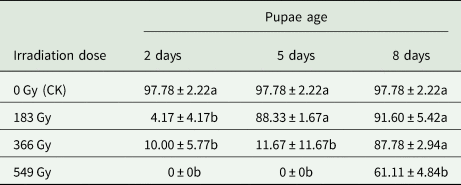
Compared with the control, a varying degrees of decline for the emergence rate of the tested stages of male pupae exposed to different doses of X-ray were observed. The trend is similar for 183 and 366 Gy. There is a more dramatic effect at 2-day-old and 5-day-old pupae. However, at 8-day-old pupae the emergence rate is less than the rest of the treatments (table 1).
Emergence rate of male pupae of C. pomonella irradiated with different irradiation doses of X-Ray

aMale pupae from 7 (2-day old), 4 (5-day-old), and 1 (8-day-old) day before emergence were treated with doses of 0 (CK), 183 Gy, 366 Gy, and 549 Gy, respectively.
bThree replicates, each with 10 males was used in this study. The data in the table are the mean ± standard deviation (SD). Letters behind indicate significant differences analyzed by the one-way analysis of variance (ANOVA) with Duncan's test (P < 0.05).
After being irradiated with 183 and 366 Gy, 2-day-old pupae almost did not eclose. For 5-day-old male pupae, the emergence rate of the 183 Gy irradiated group reached the same level (F 1,3 = 9.04, P = 0.057) as the control. But emergence significantly declined (F 1, 3 = 88.59, P = 0.003) in the 366 Gy irradiated group compared with the control. No significant difference was found in the emergence rate of 8-day-old pupae in the 183 Gy (F 1, 4 = 6.13, P = 0.087) and 366 Gy (F 1, 4 = 5.22, P = 0.105) groups when compared with the control; however, the emergence rate in the 549 Gy irradiated group was lower than that of the control (table 1).
Effects of radiation on adult moth sterility of C. pomonella
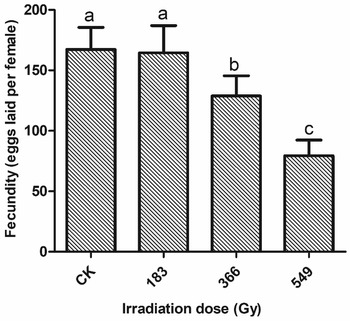
There was no significant difference (F 1, 16 = 0.027, P = 0.87) in the total number of eggs laid per female between 183 Gy treated groups (164.49 ± 12.98) and the control (167.24 ± 10.53). The fecundity of C. pomonella treated with 366 Gy (128.84 ± 9.14) and 549 Gy (79.36 ± 9.21) was significantly lower (366 Gy: F 1, 15 = 7.40, P = 0.016; 549 Gy: F 1, 13 = 34.32, P < 0.001) than those treated with 183 Gy and the control, and the lowest fecundity was observed in the 549 Gy irradiated group (fig. 2).
Effect of different irradiation doses on the fecundity of C. pomonella. 8-days-old males were treated with 0 (CK), 183, 366, and 549 Gy, and the eclosed adults were out-crossed to untreated adults. Three replicates, each with 10 males per dose were coupled with 10 virgin females. The results are shown as the mean ± SD. Error bars represent the standard errors calculated from three replicates. Letters on the error bars indicate significant differences analyzed by the one-way analysis of variance (ANOVA) with Duncan's test (P < 0.05).

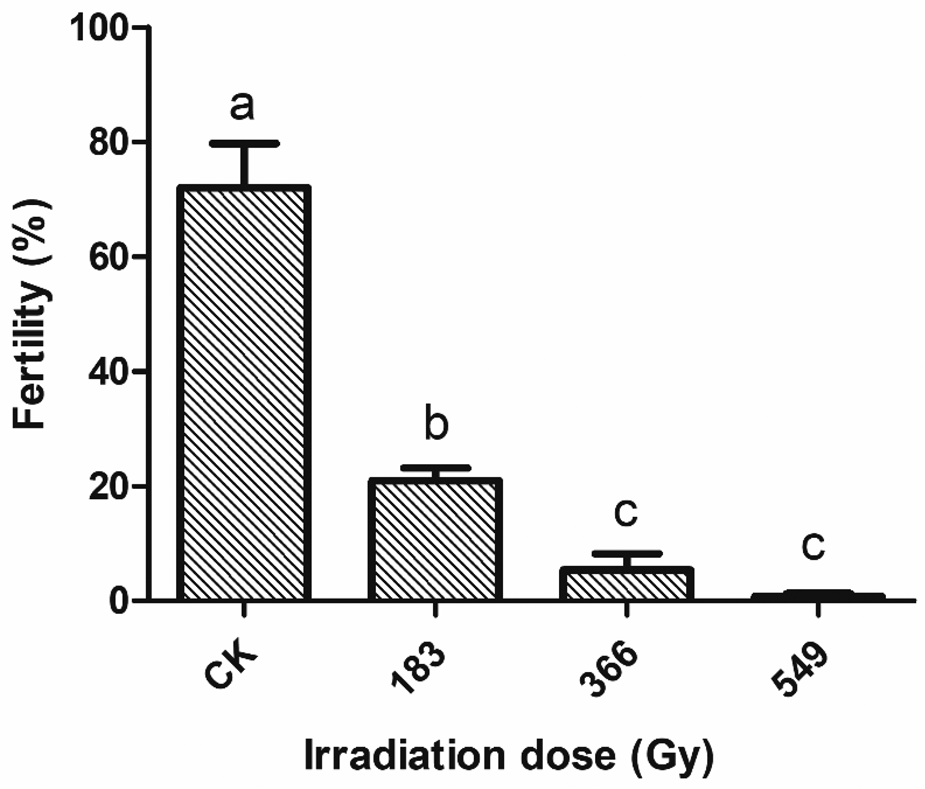
The percentage of eggs that hatched was influenced by the radiation dose. The egg hatching rates of the 183 Gy, 366 Gy, and 549 Gy groups were 20.93 ± 1.30%, 4.37 ± 2.25%, and 0.66 ± 0.42%, respectively. This is significantly lower (183 Gy: F 1, 16 = 123.10, P < 0.001; 366 Gy: F 1, 15 = 172.01, P < 0.001; 549 Gy: F 1, 13 = 168.70, P < 0.001) than that of the control (72.07 ± 4.42%) (fig. 3).
Effect of different irradiation doses on the fertility of C. pomonella. Male pupae from 1 day before emergence (8-day-old) were treated with 0 (CK), 183, 366, and 549 Gy, and the eclosed adults were out-crossed to untreated adults. Three replicates, each with 10 males per dose were coupled with 10 virgin females. The results are shown as the mean ± SD. Error bars represent the standard errors calculated from three replicates. Letters on the error bars indicate significant differences analyzed by the one-way analysis of variance (ANOVA) with Duncan's test (P < 0.05).

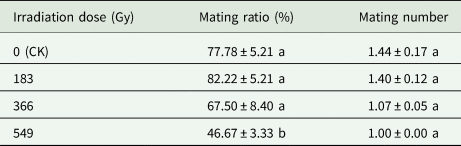
Compared with the control group, the mating rate of the male moths developed from pupae irradiated with 549 Gy significantly decreased (F 1, 13 = 18.20, P < 0.001). There was no significant difference (F 2, 23 = 1.396, P = 0.27) in mating rate between the 183 Gy and 366 Gy irradiated groups when compared with the control. In addition, there was no significant difference (F 3, 28 = 3.47, P = 0.085) in the number of matings between the control group and each of the irradiated groups (table 2).
Effects of different X-Ray irradiation doses on the mating rate and mating frequency of C. pomonella

Three replicates, each with 10 males were coupled with 10 virgin females. The data in the table are the mean ± standard deviation (SD). Letters behind indicate significant differences analyzed by the one-way analysis of variance (ANOVA) with Duncan's test (P < 0.05).
Effects of radiation on the adult lifespan of C. pomonella
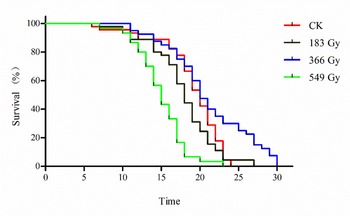
There was no significant difference (F 2, 23 = 2.75, P = 0.085) in the longevity of C. pomonella between adults developed from the pupae irradiated with 183 Gy and 366 Gy, and the control group, with average lifespans of 17.84 ± 0.74 d (mean of triplicates ± SE), 21.05 ± 1.46 d, and 19.02 ± 0.60 d, respectively. The longevity of male moths developed from the pupae irradiated with 549 Gy (14.93 ± 0.63 d) was significantly shorter (F 1, 13 = 2.88, P < 0.001) than that of the controls (fig. 4).
Survival curves of C. pomonella treated with different irradiation doses. Three replicates, each with 10 males per dose were coupled with 10 virgin females. Survival period data for each treatment were recorded and analyzed by ANOVA with Duncan's test (P < 0.05). (For interpretation of the references to color in this figure legend, the reader is referred to the web version of this article).

Effect of radiation on male mating competitiveness
The egg hatching rate of IM: NM: NF at a ratio of 1:0:1 was 10.17 ± 13.02%, significantly lower than the ratio of 0:1:1 (egg hatching rate of 85.98 ± 4.16%; F = 102.17, P = 0.002) and 1:1:1 (egg hatching rate of 84.92 ± 6.31%; F = 0.102, P = 0.77), with an expected value of 48.08% (table 3). The competitive mating index (C) is 0.01, indicating that 366 Gy of irradiation reduces the mating competitiveness of codling moth male moths (table 3).
Effect of X-Ray irradiation (366 Gy) on the mating competitiveness of C. pomonella adults

Irradiated males (IM), non-irradiated (NM) males, non-irradiated females (NF) were introduced in the ratios of 0:1:1, 1:0:1, and 1:1:1, respectively, for mating. Three replicates, each with 0 (at the ratio of 0:1:1) or 10 (at the ratio of 1:0:1 or 1:1:1) IM were assessed. The data in the table are the mean ± standard deviation (SD). Letters behind indicate significant differences analyzed by the one-way analysis of variance (ANOVA) with Duncan's test (P < 0.05).
Discussion
SIT has been effectively implemented in the eradication and control of the codling moth (Bloem and Bloem, Reference Bloem, Bloem, AliNiazee and Long1996; Bloem et al., Reference Bloem, Bloem, Carpenter, Dyck, Hendrichs and Robinson2005; Thistlewood and Judd, Reference Thistlewood and Judd2019). When the SIT program began, the radiation biology of C. pomonella should first be better understood than other relevant aspects such as its biology and ecology (Thistlewood and Judd, Reference Thistlewood and Judd2019). To increase the effectiveness of released males in SIT programs, it is critical to optimize the balance of mating competitiveness and sterility when copulating with wild females (Bakri et al., Reference Bakri, Heather, Hendrichs and Ferris2005a, Reference Bakri, Mehta, Lance, Dyck, Hendrichs and Robinson2005b).
The timing of pupal irradiation affects the quality of the resultant adults (Fezza et al., Reference Fezza, Follett and Shelly2021). In this study, we found that the highest emergence was observed for pupae irradiated at 1 day before emergence at all irradiation doses (183, 366, 549 Gy) using the newly developed X-ray irradiator. The emergence was negatively impacted by irradiating pupae at 5- and 8-days after pupation (corresponding to 4 and 1 days before emergence), at 366 Gy. However, emergence for pupae irradiated 7 days before emergence (2-day-old pupae) was significantly reduced compared to pupae irradiated at 1 and 4 days before emergence and the control. Results suggest that it is acceptable to use pupae from 1 day before emergence for SIT programs without compromising the overall quality of the released moths at 183 Gy. Our results are in line with the findings in Conopomorpha sinensis (Fu et al., Reference Fu, Zhu, Deng, Weng, Hu and Zhang2016), Bactrocera dorsalis (Fezza et al., Reference Fezza, Follett and Shelly2021), and Grapholita molesta (Li et al., Reference Li, Zhao, Chen, Ju, Wei and Yang2021), suggesting that the young pupal stage is more sensitive to radiation. Although mitotic and meiotic cells are the most sensitive to radiation, mitosis has almost stopped in the cells of old pupae (Clements, Reference Clements1992). Therefore, pupae very close to eclosion would have to be irradiated almost instantaneously (Andreasen and Curtis, Reference Andreasen and Curtis2005).
The correct irradiation dose used for sterilization is crucial for SIT programs; irradiation doses that are too low will result in insufficiently sterile insects, while doses too high may generate males with reduced mating competitiveness (Robinson et al., Reference Robinson, Cayol and Hendrichs2002; Guerfali et al., Reference Guerfali, Hamden, Fadhl, Marzouki, Raies and Chevrier2011). In this study, we found that with the increase of irradiation dose, the eggs laid (fecundity) and hatched (fertility) of resultant adults copulating with non-irradiated females decreased significantly. When males were exposed to ≥366 Gy and paired with non-irradiated females, there was low residual fertility varying between 0.66 and 4.37%, which are similar to the results of Blomefield et al. (Reference Blomefield, Bloem and Carpenter2010) for C. pomonella and Bloem et al. (Reference Bloem, Carpenter and Hendrik2003) for Cryptophlebia leucotreta, using 60Co-γ ≥100 Gy and 150 Gy, respectively. A recent report showed that almost 100% sterility was observed using a novel X-ray irradiator at a radiation dose of 91.2 Gy for Ceratitis capitata and 31.7 Gy for Anastrepha fraterculus, which was not significantly different from the radiation dose of 60Co-γ (Mastrangelo et al., Reference Mastrangelo, Parker, Jessup, Pereira, Orozco-Dávila, Islam, Dammalage and Walder2010). Differences in the sterilization doses for reaching 100% sterile between these results may be related to the radiosensitivity of different species, the differences in the irradiation environment and conditions. It should be noticed that it is not necessary to achieve a dose that provides 100% of sterility, but a large proportion of sterile males with a high degree of sterility relative to the wild type is very important (Bakri et al., Reference Bakri, Heather, Hendrichs and Ferris2005a, Reference Bakri, Mehta, Lance, Dyck, Hendrichs and Robinson2005b).
The choice of appropriate radiation dose for Lepidoptera is complicated because they are relatively radiation-resistant compared with other insects (Bloem et al., Reference Bloem, Carpenter and Hendrik2003; Thistlewood and Judd, Reference Thistlewood and Judd2019; Jiang et al., Reference Jiang, He, He, Zhao, Yang, Yang and Wu2022). Therefore, the radiation dose employed had to effect a compromise between the levels of sterility-induced males and their competitiveness in mating with wild moths (Bloem et al., Reference Bloem, Bloem, Carpenter and Calkins1999a, Reference Bloem, Bloem, Carpenter and Calkins1999b; Blomefield et al., Reference Blomefield, Bloem and Carpenter2010). In this study, we found that when irradiated males are mated with untreated females, the degree of sterility in the F1 progenies is higher at 366 Gy than 183 Gy, however, the codling moth SIT program is limited by the reduced competitiveness of irradiated males relative to non-irradiated males (table 3). Our results are congruent with the results reported by Bloem et al. (Reference Bloem, Bloem, Carpenter and Calkins2001, Reference Bloem, Carpenter, Bloem, Tomlin and Taggart2004), which demonstrated that codling moth mating competitiveness was reduced when irradiated by 60Co-γ at a higher dose of 250 Gy compared to 150 Gy. Our findings are also in line with the results reported by other researchers, who found that the use of low radiation doses (100–150 Gy) would achieve the compromise between the levels of sterility of female codling moths and their competitiveness in mating with wild moths (Anisimov, Reference Anisimov1993; Bloem et al., Reference Bloem, Bloem, Carpenter and Calkins1999a, Reference Bloem, Bloem, Carpenter and Calkins1999b), indicating that a reduction of radiation dose could increase the mating competitiveness of sterile moths. We also found that the fertility increased substantially when non-irradiated males were added (84.92 ± 6.31%), suggesting that the fertility defects of sterile males could be rescued in presence of fertile males or wild males. Although males are partially fertile or sub-sterile, the degree of sterility in their F1 progenies is higher than in the parental adults. This phenomenon is known as inherited sterility or F1 sterility (North, Reference North1975; Bloem et al., Reference Bloem, Bloem, Carpenter and Calkins1999a, Reference Bloem, Bloem, Carpenter and Calkins1999b). Therefore, the sterility of F1 progenies after males are irradiated at 183 Gy needs to be explored in more detail. Moreover, we believe that more doses of exposure and a large sample size are required to test before the transition from X-ray to massive field applications in the future.
Based on our findings in this study and the previously published work, an operational dose of <366 Gy of X-ray for future codling moth SIT programs in China is recommended. However, it is very important to perform other studies before field application of X-ray, including mating competitions in field cage, proportion of sterile males vs fertile females (laboratory and field studies), experiments of releasing sterile males at a reduced scale and monitor the percentage of fruit infestation. Currently, we are investigating the mechanisms of loss of mating competitiveness of irradiated codling moths and attempting to improve competitiveness via a series of rearing and acclimation studies, such as using insects that have gone through diapause (Dyck, Reference Dyck2010), or integration of probiotic microorganisms in the diet of larvae, which has been proved to be effective in Aedes albopictus (Chersoni et al., Reference Chersoni, Checcucci, Malfacini, Puggiol, Balestrino, Carrieri, Piunti, Dindo, Mattarelli and Bellini2021).
Acknowledgements
This research was supported by the LiaoNing Revitalization Talents Program (XLYC1907097), the IAEA TC program (CPR5027), and the National Key R&D Program of China (2021YFD1400003). The authors are grateful to John Richard Schrock (Emporia State University, Emporia, KS, USA) for proofreading the manuscript.