Introduction
Traditionally, suicide rates increase with aging in many countries (Shah and De, Reference Shah and De1998). However, exceptions to this observation are emerging. Data from the World Health Organization (WHO) data bank in 1995 revealed that female suicide rates did not increase with age in Mauritius, Colombia, Albania and Finland (Shah and De, Reference Shah and De1998). Suicide rates for both sexes increased with age in Switzerland (Ajdacic-Gross et al., Reference Ajdacic-Gross, Bop, Gostynski, Lauber, Gutzwiller and Rossler2006) and Brazil (Mello-Santos et al., Reference Mello-Santos, Bertolote and Wang2005), but there were smaller peaks in the younger age-bands. Although, the female suicide rate increased with age in China, there was an additional peak in the younger age-bands (Pritchard, Reference Pritchard1996; Yip et al., Reference Yip, Callanan and Yuen2000; Qin and Mortensen, Reference Qin and Mortensen2001). Male suicide rates were the highest in the 25–29 years age-band in Thailand (Lotrakul, Reference Lotrakul2006). In England and Wales the male suicide rate was the highest in the 25–34 years age-band (Needleman et al., Reference Needleman, Mak and Wessely1997; McClure, Reference McClure2000). Suicide rates for Australian, New Zealand and white American males increased with age, but suicide rates for females initially increased with age, peaking at menopause, and declined thereafter (Woodbury et al., Reference Woodbury, Manton and Blazer1988; Skegg and Cox, Reference Skegg and Cox1991; Snowdon and Snowdon, Reference Snowdon and Snowdon1995). Suicide rates among non-white Americans (Seiden, Reference Seiden1981; Woodbury et al., Reference Woodbury, Manton and Blazer1988), Indians (Adityanjee, Reference Adityanjee1986; Bhatia et al., Reference Bhatia, Kahn and Medirrata1987), Jordanians (Daradekh, Reference Daradekh1989), Indian immigrants to the United Kingdom (Raleigh et al., Reference Raleigh, Bulusu and Balarajan1990; Needleman et al., Reference Needleman, Mak and Wessely1997) and some east European countries (Sartorius, Reference Sartorius1995) declined with increasing age.
In developing and developed countries the proportion of the elderly is increasing due to increased life expectancy and falling birth rates (Shah and MacKenzie, in press). Therefore, suicides are likely to be a major public health concern for the elderly in countries with an increase in the suicide rate with increasing age. However, with the emergence of studies from several countries without an increase in the suicides rate with aging, a cross-national study examining the relationship between suicide rates and age was undertaken to ascertain the current world status of this relationship.
Methods
Data collection
Data on suicide rates for males and females in the seven age-bands 16–24 years, 25–34 years, 35–44 years, 45–54 years, 55–64 years, 65–74 years and 75+ years were ascertained from the WHO website (www.3.who.int/whosis/mort/table1.cfm) for all listed countries. Data on suicide rates were only collected where the latest available year was 2000 or more recent. Data on suicide rates were excluded if the suicide rate was zero.
Data analysis
Each of the seven age-bands 16–24 years, 25–34 years, 35–44 years, 45–54 years, 55–64 years, 65–74 years and 75+ years were coded numerically in the ascending order of 1 to 7. Spearman's correlation coefficient (rho) was used to examine the relationship between the seven age-bands and the suicide rates by correlating the ascending order numerical codes for the seven age-bands with the absolute suicide rate for each age-band. These analyses were conducted for both sexes for each country. This method of analysis was used successfully to examine time trends in elderly suicide rates (Hoxey and Shah, Reference Hoxey and Shah2000; Shah et al., Reference Shah, Elanchenny and Collinge2001; Shah, Reference Shah2007). The power of such correlational analysis may be low because it was based on a small number of data points. Therefore, both the strength and the statistical significance of the correlation were considered.
Results
Data on suicide rates were available for 62 countries. The median (range) year for the available data was 2001 (2000–2003). All the statistically significant (at least at 0.05% level) correlations were strong and in the value of rho ranged from 0.76 to 1.
The relationship between suicide rates and age
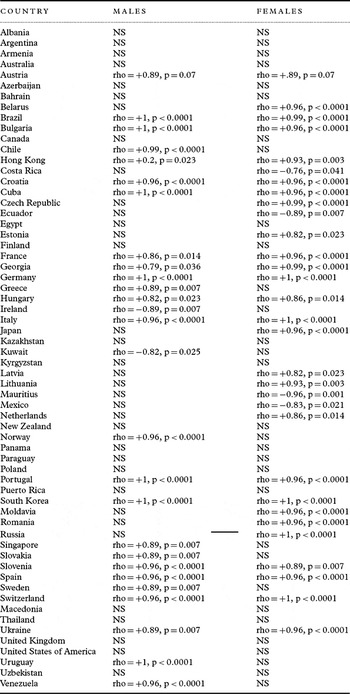
The relationship between suicide rates and age in both sexes in different countries is illustrated in Table 1. A significant increase in suicide rates with increasing age was observed in males in 25 countries (including eight countries where this was the case only for males). A significant increase in suicide rates with increasing age was observed in females in 27 countries (including 10 countries where this was the case only for females). These figures included 17 countries with a significant increase in suicide rates with increasing age in both sexes.
The relationship between suicide rates and age

NS = not significant.
A positive value for rho indicates that the suicide rate increases with increasing age; a negative value for rho indicates that the suicide rate decreases with increasing age
There was no significant increase in suicide rates with increasing age in males in 31 countries (including 10 countries where this was the case only for males). There was no significant increase in suicide rates with increasing age in females in 29 countries (including eight countries where this was the case only for females). These figures included 21 countries without a significant increase in suicide rates with increasing age in both sexes.
Male suicide rates declined with age in two countries (Ireland and Kuwait) while female suicide rates declined in four countries (Costa Rica, Ecuador, Mauritius and Mexico).
Closer examination of countries without an increase in suicide rates with age
Three patterns emerged for countries without a significant increase in suicide rates with increasing age in both sexes. First, the suicide rates in a number of these countries was generally low in all the age-bands in both sexes. Second, the suicide rates in a number of these countries generally peaked in the younger age-bands. Third, these countries clustered into two regions: (1) South and Central America, and (2) Eastern European countries and countries emerging from the former Soviet Union.
Two patterns emerged for countries without a significant increase in suicide rates with increasing age in females only. First, the female suicide rates in these countries were generally low. Second, these countries clustered in South America (Chile, Uruguay and Venezuela).
Two patterns emerged for countries without a significant increase in the suicide rate with increasing age in males only. First, there was a peak with the highest suicide rate in the younger age-bands (generally in the age-bands 25–34 years, 35–44 years and 45–54 years) in these countries. Second, these countries clustered in Eastern Europe and countries emerging from the former Soviet Union (Belarus, Czech Republic, Estonia, Latvia, Lithuania, Moldavia, Romania and Russia).
Discussion
The main findings were: (1) there was a significant increase in suicide rates with increasing age in males in 25 countries and in females in 27 countries, and in both sexes in 17 countries; (2) there was no significant increase in suicide rates with increasing age in males and females in 31 and 29 countries respectively, and in both sexes in 21 countries; (3) suicide rates for all the age-bands were low in both sexes or in females in countries without a significant increase in the suicide rate with increasing age in both sexes or in females only respectively; (4) suicide rates were highest in the younger age-bands in countries without a significant increase in male suicides rates with increasing age; (5) regional clustering was observed for countries without a significant increase in suicide rates with increasing age in both sexes (Central and South American countries, and Eastern European countries and countries emerging from the former Soviet Union), females only (South America) and males only (Eastern European countries).
Some methodological issues need consideration before discussing the findings because they may influence the reliability of the findings. Data on suicide rates in cross-national studies should be viewed with caution because: data were not available for all the countries (Moscicki, Reference Moscicki1995; Wasserman et al., Reference Wasserman, Cheng and Jiang2005); the validity of this data was unclear (Diekstra, Reference Diekstra1989; Wasserman et al., Reference Wasserman, Cheng and Jiang2005); the legal criteria for the proof of suicide varies between countries and different regions within a country (Shah and Ganesvaran, Reference Shah, Ganesvaran, Chiu and Ames1994; Wasserman et al., Reference Wasserman, Cheng and Jiang2005); some countries have poor death registration facilities (Shah and Ganesvaran, Reference Shah, Ganesvaran, Chiu and Ames1994); and cultural and religious factors and the stigma attached to suicide may lead to the under-reporting of suicides (Wasserman et al., Reference Wasserman, Cheng and Jiang2005; Abraham et al., Reference Abraham, Abraham and Jacob2005). However, recent studies have argued that within individual countries there is internal consistency (Sainsbury, Reference Sainsbury1983) and such variation is less important where changes in patterns, rather than the prevalence, of suicide rates are concerned (Pritchard, Reference Pritchard1992).
In countries without an increase in suicide rates with increasing age in both sexes or in females only, suicide rates were generally low for all the age-bands in both sexes or in females respectively. There may be several possible explanations for this.
(1) The suicide rate may be low because of under-reporting due to the methodological issues noted above.
(2) The statistical analysis may not have been sufficiently sensitive to detect a correlation between the suicide rate and increasing age due to low suicide rates.
(3) Low suicide rates indicate that the absolute number of suicides was also low and, therefore, random variation in the number of suicides in one or two age-bands may inadvertently influence the statistical analysis. The last two reasons were noted in a study examining time trends in suicide rates in the very old (Shah et al., Reference Shah, Elanchenny and Collinge2001).
(4) This observed relationship may be genuine. This is supported by similar findings from earlier studies from some of these countries including: absence of an increase in the suicide rate with increasing age in females in Albania and Finland (Shah and De, Reference Shah and De1998); and in New Zealand and Australia, female suicide rates peaked at menopause and decline thereafter (Skegg and Cox, Reference Skegg and Cox1991; Snowdon and Snowdon, Reference Snowdon and Snowdon1995).
In countries without an increase in the suicide rate with increasing age in males, there were peaks with the highest suicide rates in the younger age-bands. This observation is consistent with earlier studies in Thailand (Lotrakul, Reference Lotrakul2006) and the U.K. (McClure, Reference McClure2000). Thus, this finding may also be genuine.
Therefore, the observed regional and cross-national differences in the relationship between suicide rates and age need further consideration because there may be other potential explanations in addition to the methodological issues. Comparison of countries with and without an increase in the suicide rate with increasing age may allow generation of testable etiological hypotheses.
The relationship between aging and suicide may be explained by the vulnerability hypothesis (Lindesay, Reference Lindesay1991). Recognized risk factors for suicide in the elderly include physical illness, bereavement, social isolation, loss of income, loss of status and retirement (Shah and De, Reference Shah and De1998). These factors are prevalent in old age, but only a small number of individuals with these characteristics commit suicide. Therefore, personality traits of inability to form close relationships (Murphy, Reference Murphy1982), a tendency to be helpless and hopeless (Sendbuehler, Reference Sendbuehler1977), an inability to tolerate change and loss of control (Wolff, Reference Wolff1969), and feelings of loneliness, despair and dependency on others (Osgood, Reference Osgood1992) have been proposed as vulnerability factors (Lindesay, Reference Lindesay1991). These vulnerability factors, in the presence of risk factors for suicide, may lead to the development of mental illness and mediate suicide in the elderly. Regional and cross-national differences in the prevalence of these vulnerability factors and the risk factors for suicide may explain the relationship between suicide rates and age, and requires further investigation in cross-national studies.
Differences in the prevalence of mental illness in different age and sex groups may also explain the observed regional and cross-national differences in the relationship between suicide rates and age. This is difficult to evaluate critically due to paucity of prevalence studies of mental illness in different age and sex groups from developing countries, and the vast majority of existing studies are mainly from developed countries.
Differences in genetic factors that predispose different age and sex groups differentially to mental illness or directly to suicidal behavior may also explain the observed regional and cross-national variations in the relationship between suicide rates and age. Suicide rates across all age-bands, for both sexes, could simultaneously be examined in a given country and in migrants from that country to another country. Given that the genetic composition of those in the original country and in migrants from that country would be identical but the environmental factors may be different, the relative contribution of genetic and environmental factors to suicide rates could be examined. A unique study examining suicide rates in elderly migrants to Australia showed that suicide rates were generally higher among migrants to Australia than in their country of origin (Burvill, Reference Burvill1995) suggesting the possibility that environmental factors in the host country may have contributed to suicide rates. Studies examining suicide rates in migrant populations, including those in the U.K. (Needleman et al., Reference Needleman, Mak and Wessely1997) and Sweden (Westman et al., Reference Westman, Sundquist, Johansson, Johansson and Sundquist2006), are emerging.
Differences in life expectancy may also explain the observed regional and cross-national differences in the relationship between suicide rates and age. It is possible that in countries without an increase in the suicide rate with increasing age, people at risk of suicide in old age do not reach the age of increased risk due to early mortality and reduced life expectancy. Moreover, those who do reach old age may be at reduced risk of suicide because they may be able to tolerate additional hardship in old age better owing to exposure to life-long adversity in some countries (Seiden, Reference Seiden1981; Lindesay, Reference Lindesay1991). For example, elderly African-Americans and native Americans (Indians) in the United States have low suicide rates (McIntosh, Reference McIntosh1984; Woodbury et al., Reference Woodbury, Manton and Blazer1988) and this has been attributed to their life-long history of socioeconomic deprivation (McIntosh, Reference McIntosh1984). This hypothesis could be explored further because data on child mortality rates and life expectancy for different countries are available from the WHO.
Cultural factors may also explain the observed regional and cross-national differences in the relationship between suicide rates and age. Among Arabs in Jordan (Daradekh, Reference Daradekh1989), Malays in Singapore (Ko and Kua, Reference Ko and Kua1995), non-white Americans (Seiden, Reference Seiden1981; Blazer et al., Reference Blazer, Bachar and Manton1986), Indians (Adityanjee, Reference Adityanjee1986; Bhatia et al., Reference Bhatia, Kahn and Medirrata1987), Indian immigrants to the United Kingdom (Raleigh et al., Reference Raleigh, Bulusu and Balarajan1990; Needleman et al., Reference Needleman, Mak and Wessely1997) and some east European groups (Sartorius, Reference Sartorius1995) suicide rates declined with increasing age. In the current study, suicide rates did not increase with increasing age in Central and South American countries, Eastern European countries and countries emerging from the former Soviet Union for both sexes, in South American countries for females only and in Eastern European countries for males only. Suicide rates declined with increasing age in males in Kuwait and females in Costa Rica, Ecuador, Mexico and Mauritius. Traditionally, in these societies the elderly are respected, held in high esteem and live in closely knit families offering protection against loneliness and despair which might lead to suicide (Shah and De, Reference Shah and De1998). Family and social integration may be important factors in this context (Rao, Reference Rao1991). This hypothesis has also been used to explain the low suicide rate among the elderly in Thailand (Lotrakul, Reference Lotrakul2006), and increasing suicide rates found in elderly Japanese (Shimuzu, Reference Shimuzu, Hasegawa and Homma1990; Watanabe et al., Reference Watanabe, Hasegawa and Yoshinaga1995), elderly Hong Kong women (Yap, Reference Yap, Williams, Tibbits and Donaghue1963) and the elderly in two ethnic groups in Singapore (Kua and Ko, Reference Kua and Ko1992; Ko and Kua, Reference Ko and Kua1995) who have lost their traditional role in the family. This can be formally evaluated by examining cross-national differences in the following variables: the cultural views and attitudes of young people towards the elderly (Lotrakul, Reference Lotrakul2006); and, the relationship between suicide rates in different age-bands and household size, and the proportion of people in different age-bands living in extended families, in nuclear families and on their own (Shah et al., in press).
Regional and cross-national differences in socioeconomic inequality and deprivation may differentially predispose different age and sex groups to suicide in different countries. Income inequality was associated with increased suicide rates in men over the age of 55 years in developed countries (Cutright and Fernquist, Reference Cutright and Fernquist2000) and in both sexes in the general population in the United States (Kowalski et al., Reference Kowalski, Faupel and Starr1987). Similarly, socioeconomic inequality was associated with increased suicide rates in both sexes, up to the age of 75 years, in Japan (Fukuda et al., Reference Fukuda, Nakamura and Takano2005) and in both sexes in the general population in a study of 10 European countries (Lorant et al., Reference Lorant, Kunst, Huisman, Costa and Mackenbach2005). However, a recent study in England and Wales reported that income inequality correlated better with suicide rates in younger men then in the elderly (Gunnell et al., Reference Gunnell, Middleston, Whitley, Dorling and Frankel2003). Moreover, markers of economic adversity were associated with increased suicide rates in males of all ages in Australia, although the opposite was observed for females (Berk et al., Reference Berk, Dodd and Henry2006). This Australian study also reported that some markers of economic adversity were differentially associated with suicide rates in different age-bands, including higher housing loan interest rates being associated with higher suicide rates in younger people but lower suicide rates in older people (Berk et al., Reference Berk, Dodd and Henry2006). A cross-national study of 60 countries reported a positive correlation between gross national domestic product (GDP) and suicide rates in both sexes in the general population (Zhang, Reference Zhang1998). However, in Thailand economic growth was negatively associated with suicide rates in both sexes in the general population (Lotkarul, Reference Lotrakul2006). Similarly, a decline in elderly suicide rates over time in England and Wales was associated with an increase in GDP (Gunnell et al., Reference Gunnell, Middleston, Whitley, Dorling and Frankel2003). Suicide rates in both sexes in the general population in London (Kennedy et al., Reference Kennedy, Iveson and Hill1999) and England (Rezaeian et al., Reference Rezaeian, Dunn, St Leger and Appleby2005) were higher in areas with high socioeconomic deprivation. In England and Wales, elderly suicide rates in both sexes were also higher in areas with high socioeconomic deprivation (Whitley et al., Reference Whitley, Gunnell, Dorling and Smith1999; Shah et al., Reference Shah, Uren, Baker and Majeed2002). These findings collectively suggest that socioeconomic inequality and deprivation may differentially influence suicide rates in different age and sex groups in different countries. Further cross-national research, using the same methodology and the same markers of socioeconomic inequality and deprivation across countries, is required to clarify the role of socioeconomic inequality and deprivation in suicide. Cross-national data on measures of socioeconomic status (i.e. GDP and income inequality) are available from the WHO and the United Nations (UN), and could be used to explore these hypotheses further.
Although methodological issues may explain regional and cross-national variations in the relationship between suicide rates and age, other potential explanations also require further investigation because they may have major international and national public health policy implications for reducing suicide rates. Moreover, data required to examine some of these speculated explanations are now available from the WHO and the UN.
Conflict of interest
None.