Introduction
Establishment of protected areas remains one of the most important biodiversity conservation strategies on the planet, but there is significant debate over where protected areas should be established, how to fund them and what their goals should be (McNeely Reference McNeely1994, Rodrigues et al. Reference Rodrigues, Andelman, Bakarr, Boitani, Brooks, Cowling and Fishpool2004, Aycrigg et al. Reference Aycrigg, Davidson, Svancara, Gergely, McKerrow and Scott2013, Wyborn & Bixler Reference Wyborn and Bixler2013, Watson et al. Reference Watson, Dudley, Segan and Hockings2014, Coetzee Reference Coetzee2017). Protected area systems commonly comprise aggregated protection efforts of many different government and non-government actors, each having their own goals and constraints. In terms of biodiversity conservation, the aggregation of these efforts determines the overall effectiveness of protected areas.
The status of different components of biodiversity across geographical scales and jurisdictional areas adds to these issues (Abbitt et al. Reference Abbitt, Scott and Wilcove2000, Poiani et al. Reference Poiani, Richter, Anderson and Richter2000, Leppig & White Reference Leppig and White2006, Crain et al. Reference Crain, White and Steinberg2011, Wyborn & Bixler Reference Wyborn and Bixler2013, Santos et al. Reference Santos, Watt and Pincetl2014). Locally rare taxa, peripheral populations and species with transboundary distributions, for example, might elicit attention and/or conservation legislation at local scales or within certain jurisdictional boundaries, but escape consideration at larger scales or in important parts of their range where differing conservation regulations might apply.
Coordinating the conservation planning efforts of the various players involved provides an opportunity to increase potential biodiversity conservation gains (Bode et al. Reference Bode, Probert, Turner, Wilson and Venter2011, Jacobson & Robertson Reference Jacobson and Robertson2012, Scarlett & McKinney Reference Scarlett and McKinney2016). A first step towards such coordination is to understand how areas protected by different organizations and funded in different ways contrast with one another in terms of how well they can protect species. Some contrasts are inevitable given the different constraints governing where various conservation actors can target protection efforts, as well as the differences in their overall goals for protection (Abbitt et al. Reference Abbitt, Scott and Wilcove2000, Crain & White Reference Crain and White2011, TNC 2015).
For example, local communities may seek to protect nearby land to provide local amenity value(s) (e.g., see Ando & Shah Reference Ando and Shah2010, Reference Ando and Shah2016), such as recreation opportunities and clean water provision. In addition to these and other potential local ecosystem services, protected areas may also provide local benefits for species conservation (Crain & White Reference Crain and White2011, Crain et al. Reference Crain, White and Steinberg2011). Locally established protected areas will be geographically constrained in where they can be sited (near the local community in question) however, and may favour some parts of the landscape over others, reflecting their protection goals.
In contrast, other protected areas are established by larger-scale conservation actors such as state and national governments or large-scale non-governmental organizations (NGOs). For example, The Nature Conservancy (TNC), a globally operating conservation organization, has acquired and protected more than 103 million acres of land globally (TNC 2019). Such large-scale actors can potentially show more flexibility over what locations they protect, although they also face many constraints, such as costs and locating willing sellers, and they likely have different conservation objectives (TNC 2001, 2015).
Given that community-supported conservation efforts are developing through various mechanisms in communities worldwide (Hackel Reference Hackel1999, Berkes Reference Berkes2007, Horwich & Lyon Reference Horwich and Lyon2007, Rodríguez-Izquierdo et al. Reference Rodríguez-Izquierdo, Gavin and Macedo-Bravo2010), understanding the potential value of these efforts is critical to local as well as large-scale conservation planning. An interesting example of community-driven conservation is provided by local ballot initiatives in the USA. Local stakeholders often contribute to the conservation of open space areas and biodiversity at smaller scales through synergistic efforts, including the direct democracy process (Banzhaf et al. Reference Banzhaf, Oates and Sanchirico2010, Graves Reference Graves2012, LBI 2017). Unlike a representative democracy, where voters elect representatives who determine policies on their behalf, in a direct democracy voters make decisions on specific policies themselves through ballot initiatives and referenda. A local ballot initiative or referendum is a process by which citizens bypass local government bodies by proposing laws directly (typically through petitions and signature gathering) and voting on them at the polls (Graves Reference Graves2012). Some US states, such as California, combine elements of both representative and direct democracy in their governance. Citizens in these states can vote on – and be involved in proposing – specific initiatives and policies in addition to choosing elected representatives. Indeed, 48 states in the USA have at least one city that allows the use of local-level (city-wide) ballot initiatives (Graves Reference Graves2012). The prevalence of using direct democracy and ballot initiatives to advance open space preservation in the USA does not yet appear to be matched in other countries, but intriguingly, many other countries allow some instrument (initiative, referendum or plebiscite) of modern direct democracy (NDD 2019).
In the USA, ballot initiatives of this type set aside US$76 billion in funding for conservation efforts between 1988 and 2017 (TPL 2017). These opportunities have spurred tremendous growth and investment in protected areas by local communities in parts of the USA that have voted to fund local land protection through taxes on other real estate transactions, sales taxes, income taxes and other means. For example, in the 2016 electoral cycle, voters in Los Angeles County, California, voted by a large margin (84% in favour) to establish a US$35 special tax on developed land parcels within parts of the Hollywood Hills and Santa Monica mountains for 10 years. The US$10 million generated annually by this tax are to be used “to maintain and conserve local open space, wildlife corridors, and parklands; acquire and protect additional lands from development; improve fire prevention including high fire alert patrols and brush clearing; protect water quality in local creeks; and increase park ranger safety patrols” (LBI 2017). Although open spaces protected through local ballots are often geared towards the protection of resources such as water supplies or to provide recreation opportunities, as opposed to habitat protection and biodiversity conservation (PNC 2007, CDOSHC 2013), they may benefit preservation efforts for numerous species and their habitats (Kroetz et al. Reference Kroetz, Sanchirico, Armsworth and Spencer Banzhaf2014, Durán et al. Reference Durán, Inger, Cantú-Salazar and Gaston2016).
Despite the large sums of funding involved, however, little work has been done to evaluate what contribution local ballot initiatives provide to biodiversity protection. The one exception is a study that focused on the county scale, where the potential ancillary benefits of local ballot measures for biodiversity protection were assessed in terms of directing funding and increasing conservation efficiency across the USA (Kroetz et al. Reference Kroetz, Sanchirico, Armsworth and Spencer Banzhaf2014). Counties within the USA having passed open space measures contained more species and more species of concern than counties that had not (Kroetz et al. Reference Kroetz, Sanchirico, Armsworth and Spencer Banzhaf2014).
There is a difference, however, between showing that a county passed a ballot measure and demonstrating that the actual parcels protected by it are located in important places for species preservation and making meaningful contributions to conservation goals. Land parcels protected via local ballots have not been evaluated specifically in relation to species and habitat distributions in order to assess their benefits for biodiversity conservation. Nor did the previous analysis indicate what species groups stood to benefit most. Furthermore, the conservation benefits provided by open spaces protected via local ballots have not been compared to those provided by the holdings of large-scale conservation organizations.
In this paper, we compare how protected areas established by local communities through ballot initiatives and those established by a large-scale conservation actor overlap with distributions of multiple components of biodiversity. Reflecting our focus on protected areas established by local communities, we concentrate specifically on parcels of land protected through local ballot initiatives. We define local ballot initiatives as those passed by municipalities and counties rather than state-wide ballot measures, which are also important for conservation. We use The Nature Conservancy (TNC) as an example of a larger-scale conservation actor that is active in land protection, which feasibly has more flexibility over where and what it protects. Our rationale behind the comparison is that the two actors may operate according to their individual missions in potentially differing areas with diverse geographical and ecological attributes.
Our overall objective is to evaluate and differentiate the benefits to biodiversity in terms of species richness that could be provided by open spaces preserved through local ballot initiatives versus a private institution operating at the scale of the state or broader regional scales. To this end, we first compare the geographical attributes of local ballot-protected areas with areas protected by TNC. We then quantify the potential biodiversity conservation values of local ballot-protected areas based on their overlap with reptile, amphibian, bird and mammal species’ ranges when compared to sites preserved by TNC. We also quantify the overlap of local ballot-protected areas and TNC-protected areas with the distribution of special status elements of natural diversity; namely, rare or threatened species or natural communities ranked G1–3 or S1–3 by the California Natural Diversity Database (CNDDB).
Methods
Identifying protected area types
We focused on protected areas in California, USA. California encompasses the majority of the California Floristic Province, a global biodiversity hotspot (Myers et al. Reference Myers, Mittermeier, Mittermeier, Da Fonseca and Kent2000), and it is at the forefront of open space conservation (Stein et al. Reference Stein, Kutner and Adams2000, CPAD 2015). In terms of local community-driven protection, numerous city- and county-level conservation agencies throughout California have protected open space areas via local ballot initiatives in their respective jurisdictions (MCP 2010, Kroetz et al. Reference Kroetz, Sanchirico, Armsworth and Spencer Banzhaf2014, EBRPD 2017). The large-scale conservation actor that we compared local ballot-protected areas to is TNC, a globally operating land trust (TNC 2017). In the USA, TNC operates semi-autonomous state chapters (Fishburn et al. Reference Fishburn, Boyer, Kareiva, Gaston and Armsworth2013), and here we focus on TNC California, which undertakes conservation activities across the state. While we compared areas protected by local ballot initiatives to those protected by TNC, we recognize that other comparisons could also be made. For example, the federal government has protected large areas in the Sierra Nevada Mountains and the Mojave Basin and Range (Wilson et al. Reference Wilson, Sleeter and Davis2015). In the ‘Discussion’ section, we return to our choice to compare local ballot-protected areas to TNC-protected areas, as well as other choices that could have been made.
To identify open space areas that were preserved (i.e., purchased and/or managed) with funding acquired from the passage of city or county ballot initiatives in California, we reviewed The Trust for Public Land’s LandVote Database and Ballotpedia’s database on local ballot measures (LBI 2017, TPL 2017). We identified successful city- and county-level ballot initiatives dealing with open space preservation across the state (Supplementary Table S1, available online) and consulted the agencies in charge of planning, managing and operating open spaces within the local jurisdictions that received funding from these measures. In doing so, we obtained data on specific properties that were preserved with funds from local ballot initiatives (n = 732), which we mapped with geographical data from local agencies and from the California Protected Areas Database (CPAD 2015). We were unable to obtain data from five counties in which open space ballots were passed and one that had not yet purchased open space with the funds. We used Geographic Information Systems (GIS) data available from TNC (2017) to map the protected areas that they had established (n = 444).
Biodiversity data
To evaluate the benefits for biodiversity conservation provided by the protected areas, we obtained species distribution data from the California Wildlife Habitats Relationships (CWHR) database (Brosi et al. Reference Brosi, Daily, Davis, Scott, Goble and Davis2006, CIWTG 2014a), which includes data on the habitats suitable for 71 species of amphibians, 89 species of reptiles, 368 species of birds and 182 species of mammals within California, equating to c. 70% of the known vertebrates in the state (CIWTG 2014a). Spatial data showing the current geographical extent of each species in California in the CWHR database have been compiled from several sources (e.g., museum records and reserve surveys). Species ranges were mapped at c. 10–km resolution (1:1 000 000 scale). Ecological Subsection-level polygons from the US Forest Service’s Ecological Subregions of California mapping project were used as primary map unit boundaries for delineating habitat types (Miles & Goudy Reference Miles and Goudy1994, CIWTG 2014a, 2014b).
We also used distribution data from the CNDDB to incorporate information on 2622 special status elements of natural diversity (also referred to as species at risk) in our data set (CDFW 2014). Special status elements include plants, animals and natural communities that: (1) are listed under the State and Federal Endangered Species Acts; (2) are considered to be Species of Special Concern (SSC) by the California Department of Fish and Wildlife (CDFW); (3) meet the criteria for listing as described in the California Environmental Quality Act (CEQA) guidelines; (4) are biologically rare, restricted and declining; (5) are peripheral to the major portion of a taxon’s range but are threatened with extirpation in California; (6) are associated with a habitat that is declining in California at a significant rate; or (7) are designated as a special status species by other state, federal or non-government organizations (CDFW 2019). The CNDDB database incorporates spatial data on these elements from various partners and maps them at levels of geographical detail ranging from specific bounded areas of occurrence to non-specific locations within an 8000-m radius (CDFW 2014).
Spatial and statistical analysis
We began by comparing the geographical attributes of local ballot-protected areas with areas protected by TNC. Specifically, we compared the median values of latitude, longitude, parcel size, distance to nearest urban area and number of habitat types using Wilcoxon–Mann–Whitney tests (Neuhäuser Reference Neuhäuser and Lovric2011). Each of these geographical variables has the potential to affect the diversity and distribution of biodiversity in protected areas (Rosenzweig Reference Rosenzweig1995).
To make an initial determination of whether there were differences in the biodiversity conservation benefits provided by the protected areas, we quantified the number of species from different groups (amphibians, reptiles, birds, mammals and special status elements of natural diversity) with ranges overlapping each individual site. While the overlap between large-scale range maps and protected areas provides a coarse measure of conservation value, it is commonly relied upon in gap analyses and related writings (Abellan & Sanchez-Fernandez Reference Abellan and Sanchez-Fernandez2015, Polak et al. Reference Polak, Watson, Bennett, Possingham, Fuller and Carwardine2016, Tantipisanuh et al. Reference Tantipisanuh, Savini, Cutter and Gale2016). Essentially, this measure provides insight into whether protected areas are geographically distributed in such a way that they have the potential to support species while falling short of determining actual occupancy of a specific parcel by a species, something that requires finer-grained data (Alagador et al. Reference Alagador, Martins, Cerdeira, Cabeza and Araujo2011).
In order to explore further the differences between local ballot-protected sites and TNC sites, we sought to control for the potentially confounding geographical variables that can affect the distribution of biodiversity. Accordingly, we built models with a set of covariates to provide insight into whether any differences in the biodiversity conservation value of protected sites are associated with how the site was protected (through the local ballot process or by TNC, our large-scale conservation actor) as opposed to other factors. In order to account for a potential latitudinal gradient in species richness (for examples, see Rosenzweig Reference Rosenzweig1995), we included the latitude of the centroid of each protected parcel. Because the size of a given parcel is likely to influence the number of species that occur there (Rosenzweig Reference Rosenzweig1995, Storch et al. Reference Storch, Keil and Jetz2012, Rybicki & Hanski Reference Rybicki and Hanski2013), we also controlled for parcel area. Furthermore, the proximity of protected areas to urban areas can affect their capacity for maintaining biodiversity due to potentially greater risks of adverse impacts on habitat quality and ecosystem function that can result from abundant visitor pools, fragmentation and nearby disturbance sources (McDonnell et al. Reference McDonnell, Pickett, Groffman, Bohlen, Pouyat, Zipperer and Parmelee1997, Clergeau et al. Reference Clergeau, Savard, Mennechez and Falardeau1998, Germaine & Wakeling Reference Germaine and Wakeling2001, Burton et al. Reference Burton, Samuelson and Pan2005, Ando & Shah Reference Ando and Shah2010). Therefore, we included the shortest distance between the boundaries of urban centres and the boundary of each protected area as an additional covariate. Lastly, we considered the number of different habitat types that occurred on each of the protected areas in the analysis, since habitat heterogeneity can influence the number of different species that occupies a given area (Rosenzweig Reference Rosenzweig1995, Tews et al. Reference Tews, Brose, Grimm, Tielbörger, Wichmann, Schwager and Jeltsch2004, Crain et al. Reference Crain, Sánchez-Cuervo, White and Steinberg2015). Specifically, we included the number of different habitat types that overlap each protected land parcel from the 59 that are included in the CWHR database (CIWTG 2014a).
We used a type of multiple regression model – a simultaneous autoregressive (SAR) model – to examine associations between the estimated coverage of species ranges and protected area type (ballot or not; β1 ≠ 0) while controlling for site geographical factors. We directly controlled for some geographical factors by including geographical covariates in regression models of log species richness on a protected area type for each organismal group. Using a SAR model allowed us to further account for the possibility that the error term in the regression is spatially autocorrelated, as can occur if additional spatial covariates have been left out of the model. We initially checked for collinearity among all of the predictors with Spearman’s correlation analyses, and we found that they are only weakly correlated with one another (all correlation coefficients < 0.47; p < 0.01 for all variables; Taylor Reference Taylor1990, Evans Reference Evans1996, Rafter et al. Reference Rafter, Abell and Braselton2003). Pair plots were also generated to look for separation between local ballot and TNC sites when plotted against the other independent variables. The SAR modelling for each of our dependent variables was conducted using Spatial Analysis in Macroecology software (Rangel et al. Reference Rangel, Diniz-Filho and Bini2010).
Results
Geographical attributes of protected areas
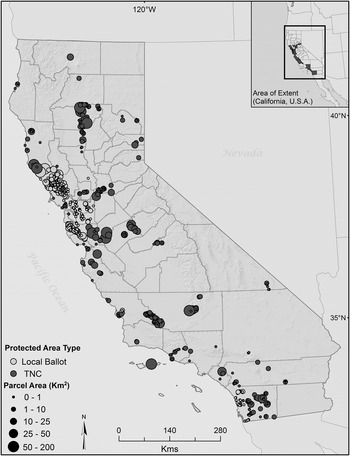
Local ballot and TNC activity varied across California. The 732 parcels of land protected via successfully passed local ballot initiatives were located in 10 counties (Fig. 1), with the majority being in coastal counties with large urban centres (e.g., Oakland, San Jose and San Diego). We compared the areas established through local ballots to 444 parcels that were protected by TNC (Fig. 1) located in 37 counties throughout California. Six counties contained both kinds of protected area, four contained local ballot-protected areas but no TNC-protected areas, 31 contained TNC-protected sites but none protected through local ballots and 17 California counties contained neither.
The distribution of protected open space areas in California (USA) established through local ballot initiatives (light markers) and by a model large-scale conservation organization, The Nature Conservancy (TNC; dark markers). Marker size indicates the overall size of the protected area. Counties that had passed local ballot measures but had not used the funding to protect open spaces by the time of the study or could not provide data on protected areas purchased with the funding are indicated with hash-marked borders. Inset map shows the distribution of all counties in California that have passed local ballot measures related to the preservation of open space areas.

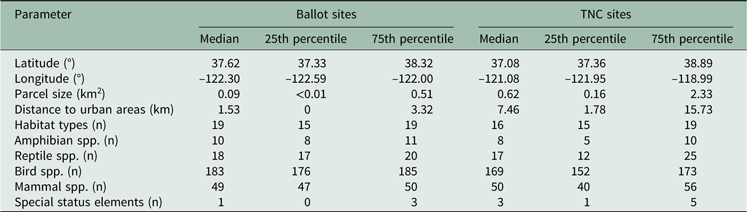
The geographical attributes of local ballot-protected areas and TNC-protected areas were variable and differed between types of protected area (Table 1). The median latitude at which local ballot-protected areas occurred was slightly higher than for TNC-protected areas (Wilcoxon–Mann–Whitney, W = 174806, p = 0.03); median longitude was also slightly greater for local ballot-protected areas (W = 74730, p < 0.001). Median parcel size was smaller for local ballot-protected areas than for TNC-protected areas (W = 89703, p < 0.001), but both were relatively small; the median size of individual parcels was less than 1 km2 for both types. Local ballot-protected parcels tended to be located closer to the nearest urban area than TNC-protected areas (W = 71638, p < 0.001). The median number of habitat types that overlapped with local ballot-protected areas was also greater than the number that overlapped with TNC-protected areas (W = 193355, p < 0.001).
Descriptive statistics for geographical variables and biodiversity attributes for the 732 sites protected by local ballot initiatives and the 444 sites protected by The Nature Conservancy (TNC). Special status elements of natural diversity are all species and communities ranked G1–3 or S1–3 in the California Natural Diversity Database (CNDDB).

Benefits of local ballot-protected areas to biodiversity conservation
Coverage of species ranges by protected areas established through local ballot initiatives or by TNC was variable (Table 1). Our regression models of species richness on protected areas had reasonably good model fit; p-values for all models were less than 0.01 and R 2 estimates were generally above 0.34 (Louviere et al. Reference Louviere, Hensher and Swait2000; Table 2). Individually, after controlling for basic geographical and biophysical differences between the two protected area types (e.g., their size) and residual spatial autocorrelation due to unmeasured spatial variables, the protected areas established by local ballots did a better job of covering the ranges of amphibian, reptile, bird and mammal species than those protected by TNC (Table 2). In contrast, local ballot-protected areas were not as well situated to offer protection to special status elements of natural diversity (Table 2). This may reflect the fact that sites are often protected through the ballot to generate local amenity value (e.g., recreation or agriculture) and not necessarily for protection of rare or sensitive species or habitats.
Results from simultaneous autoregression models of biodiversity richness on characteristics of selected protected areas in California (USA). The coefficients for the five predictor variables used in each analysis are listed. The dependent variables for the species group models (amphibians, reptiles, birds and mammals) are the log number of species in each group whose range overlaps with individual protected areas included in the study. Logged counts of special status elements of natural diversity (all species and communities ranked G1–3 or S1–3 by the California Natural Diversity Database (CNDDB)) that occur on protected areas analysed in the study are used as the dependent variable for the last model.

*p < 0.05, **p < 0.01.
Rho values in each model were 0.844 and all models were significant with p < 0.01.
The covariates we considered were also important for explaining the variation in how protected areas performed at covering species ranges (Table 2). Protected areas at higher latitudes covered fewer species’ ranges for most species groups, including amphibians, reptiles and mammals, regardless of protected area type. Protected areas nearer to urban areas did a better job of offering protection to special status elements of natural diversity, likely because encroachment of urban areas on the historical ranges of these elements has contributed to why they are now of particular conservation interest or concern. Distance to urban areas showed a mixed signal for other groups. Coverage of the ranges of special status elements of natural diversity as well as bird species was also greater for larger protected areas. In addition, protected areas of either type that contained a greater diversity of habitats could offer protection to more species. Interestingly, this did not apply to special status elements of natural diversity, however, suggesting again that particular targeting efforts may be needed to protect rare or endangered species and communities (Crain et al. Reference Crain, Sánchez-Cuervo, White and Steinberg2015).
Discussion
In order to improve the coordination of the range of land protection activities that contribute to conservation goals, how different types of land protection complement each other needs to be understood. Local protection efforts may be motivated by different goals and be bounded by different constraints than those motivating and constraining larger-scale conservation practitioners. Quantifying these differences can help limit redundancies and generate synergies in conservation efforts. Comparing areas protected by local communities through the direct democracy process in California to protected areas established there by TNC enabled us to explore this issue in detail. To our knowledge, the current study presents the first land parcel-level analysis of the potential benefits that local ballot-protected areas provide to biodiversity conservation.
In the USA, local ballot measures are valuable tools for local stakeholders to become involved with community conservation and open space protection in their immediate jurisdictions. Based on the available data, local ballot initiatives led to the protected status of well over 700 land parcels of open space in California alone (Fig. 1), and such ballot initiatives are actively used to protect land in many other states in the USA. Successful ballot measures allow local citizens to take more ownership of open space conservation agendas in their cities and counties, as they are able to be involved in the protection process from the original initiative proposals to the final stages when they directly experience the benefits of the local open spaces that they helped to create (Campbell & Vainio-Mattila Reference Campbell and Vainio-Mattila2003).
We found significant differences between local ballot- and TNC-protected areas in terms of geographical characteristics. Local ballot-protected areas occurred at slightly higher latitudes on average, where as anticipated individual land parcels of either type covered fewer species’ ranges (Rosenzweig Reference Rosenzweig1995). Land parcels protected through local ballots also tended to be smaller than land parcels protected by our large-scale conservation actor, TNC. As would be expected (Rosenzweig Reference Rosenzweig1995, Storch et al. Reference Storch, Keil and Jetz2012, Rybicki & Hanski Reference Rybicki and Hanski2013), larger protected areas had the potential to represent habitats for greater numbers of certain taxa (birds, special status taxa). In many instances, however, local ballot-protected land parcels were located adjacent to open space areas protected by large-scale conservation organizations, including TNC, and they served to increase the overall sizes of these open spaces. This may stem from the fact that TNC has supported local land trusts and ballot initiatives, potentially leading to synergistic approaches to land conservation, a strategy whose specific benefits could be explored in more detail in future research. Other local ballot-protected areas were more isolated, however, and offered unique benefits in terms of their spatial distribution. Several were established in counties where TNC was not active (and vice versa), indicating that both local open space ballot initiatives and TNC efforts can be useful for generating unique benefits for biodiversity conservation in the state. Local ballot-protected areas were also located nearer to urban areas where voters are more likely to pass open space ballot initiatives as a potential correlate of younger age, greater affluence and higher levels of education (Kroetz et al. Reference Kroetz, Sanchirico, Armsworth and Spencer Banzhaf2014), but also where threat of habitat conversion is high. Presumably, costs also play a role in this difference, as more urbanized jurisdictions passing local ballot initiatives may be bounded to higher land prices within their borders, whereas a larger-scale agency such as TNC has the flexibility to secure potentially lower-cost purchase options, assuming that there are available sellers. The combined benefits of local ballot-protected areas and TNC-protected areas are therefore likely to be more effective than either process individually, as other studies of land conservation in California and elsewhere have shown (Santos et al. Reference Santos, Watt and Pincetl2014).
In terms of biodiversity conservation, we found that individual protected areas established through local ballot initiatives are located in a way that gives them the potential to provide habitat for a substantial number of species. More specifically, our regression models indicate that local ballot-protected areas may provide protection to more amphibian, reptile, bird or mammal species, on average, than protected areas established by the large-scale conservation actor, TNC (Table 2). Local ballot measures that establish open space protection do not cover the whole of California, however, and are instead geographically constrained to a subset of counties. Thus, they currently only protect biodiversity in some parts of the state. It is encouraging, then, that despite these geographical restrictions, they are still able to protect important components of many species’ ranges.
At the same time, we found that TNC-protected areas are located in a manner that contains the potential to protect more special status elements of natural diversity than local ballot-protected areas. This could reflect a difference in goals motivating which land parcels receive protection and an increased ability on the part of TNC to target locales where species of particular conservation concern occur. TNC has a mission and resources that prioritize species at risk for their relative irreplaceability, and they are more likely to have an exhaustive data-driven plan for targeted land acquisition than many local authorities. That TNC will pay more to acquire local sites where species of conservation concern are known to occur has been observed elsewhere in the USA (Poiani et al. Reference Poiani, Richter, Anderson and Richter2000, Kim et al. Reference Kim, Cho, Larson and Armsworth2014).
Reflecting our interest in the different geographical constraints on localities that can be protected through local ballot initiatives and by a large-scale actor such as TNC, we focused our analyses on the spatial distribution of protection relative to the distribution of biodiversity using GIS. An important caveat of biodiversity research looking at range protection over broad spatial scales, however, is that range coverage does not necessarily equate to species occupancy on an individual site, particularly at smaller scales. The actual habitat conditions and status of biodiversity on the individual land parcels included in this analysis were not assessed on the ground or reconfirmed by local experts. A systematic assessment of the similarities and differences between the actual habitat conditions in the different protected area types through field surveys and/or detailed, remotely sensed data would offer added insight into the benefits of local ballot-protected areas for biodiversity preservation in California (Gaston et al. Reference Gaston, Charman, Jackson, Armsworth, Bonn, Briers and Callaghan2006, Reference Gaston, Jackson, Cantú-Salazar and Cruz-Piñón2008, Coetzee Reference Coetzee2017), something that we intend to address and report in future work.
A second obvious extension is to push beyond species richness measures and to evaluate whether there are compositional differences within the different taxonomic groups in which species receive protection. Another worthwhile extension includes focusing more on the properties of the protected area network rather than on individual sites in order to quantify, for example, the added conservation benefits provided by local ballot-protected areas in terms of increased connectivity among protected areas in the state. Such studies could focus on potential increases in the overall sizes of protected area conglomerations, decreases in measures of patchiness and proportional representation of biodiversity (Poiani et al. Reference Poiani, Richter, Anderson and Richter2000, Nagendra et al. Reference Nagendra, Lucas, Honrado, Jongman, Tarantino, Adamo and Mairota2012).
Moreover, as there are several other state- and national-level conservation agencies managing protected areas in the state, studies could be repeated to compare local ballot-protected areas to the holdings of these additional components of California’s protected area network. For example, comparisons could be made to federally protected areas in the state that can involve much larger parcels of land but are often located at higher elevations and in desert areas or on other poor-quality soils (Wilson et al. Reference Wilson, Sleeter and Davis2015). As well as comparisons to other conservation actors, another design choice would be to restrict attention to protected areas established in particular time periods when different amounts of information on biodiversity were available and different goals motivated protection strategies (Santos et al. Reference Santos, Watt and Pincetl2014).
A final extension of our work could involve moving beyond landscape studies towards social studies. Such studies could be developed through surveys of public opinions towards biodiversity conservation and understanding of ecosystem services provided by protected lands relative to the proportion of public open space in given areas where local ballot initiatives are – or are not – an option.
Conclusions
Overall, we show that local ballot-protected open space areas offer benefits for biodiversity conservation in California. Local ballot-protected areas provide potential habitats to a large number of amphibian, reptile, bird and mammal species, and local ballot sites may even outperform sites protected by large-scale conservation organizations based on these measures. While larger organizations may outperform local ballot-protected sites in terms of special status elements of natural diversity, the added benefits obtained from local ballot sites are nonetheless important.
Local ballot-protected areas can also provide an empowering means of biodiversity conservation in citizens’ local surroundings, a factor that may allow them to appreciate the benefits of biodiversity conservation more directly. Ballot initiatives of this type are commonly used by communities across the USA to protect land (Kroetz et al. Reference Kroetz, Sanchirico, Armsworth and Spencer Banzhaf2014), and there may be potential opportunities to leverage some instrument of modern direct democracy to advance conservation in other countries (NDD 2019). More generally, though, we focused on local ballot initiatives as an interesting example of local community-driven conservation efforts, something that is common to all countries. For our application, we found community conservation and preservation of open spaces through local ballots to be important contributions and we encourage greater coordination of local community conservation efforts such as this with the efforts of larger-scale conservation organizations.
Supplementary material
To view supplementary material for this article, please visit https://doi.org/10.1017/S0376892919000407
Acknowledgements
We sincerely thank our families and friends for their ongoing support. We also thank colleagues at University of Tennessee-Knoxville, University of California-Davis, Resources for the Future, The Nature Conservancy and The Smithsonian Institution for useful discussions.
Financial support
This work was supported by the National Science Foundation (grant number 1413990) and USDA NIFA AFRI (grant number 2017-67023-26270).
Conflict of interest
None.
Ethical standards
None.