1. INTRODUCTION
On the night of December 14, 2012, a 25 year old woman was drugged and raped in Cologne, Germany (Burger Reference Burger2013). When taken for a medical examination, two hospitals, both run by the Catholic Church, refused to prescribe emergency contraception (Drobinski Reference Drobinski2013b; Diehl and Roth Reference Diehl and Roth2013). It was reported that the doctors feared losing their jobs if they did so, as emergency contraception is not in line with the worldview of their employer (Drobinski Reference Drobinski2013a). The incident provoked harsh public criticism of the Catholic Church. Earlier in the year, there had been an intense media debate about the employment practices of Catholic welfare providers, prompted by the dismissal of a female manager of a Catholic daycare facility after she got divorced and moved in with a new partner (Kamann Reference Kamann2012). The church argued that the marital promise “till death do us part” is an integral component of the Catholic worldview and they were therefore obliged to terminate the manager's contract (Katholische Nachrichten Reference Nachrichten2014). The press subsequently brought to light similar cases where Catholic welfare providers had decided not to employ or to dismiss people due to their sexual orientation, marital status, or because they had the “wrong” religion (Frankfurter Allgemeine Zeitung 2012). Also Protestant welfare providers were criticized for dismissing headscarf wearing Muslims, employees with extra-matrimonial affairs, and amateur porn stars.
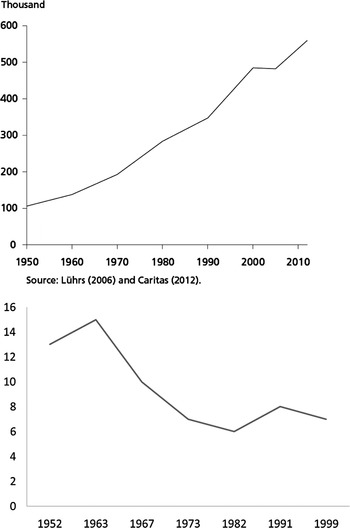
The two largest faith-based welfare organizations, Caritas and Diakonie are an essential part of the German welfare state. Caritas’ annual report records that it had 559,526 employees in Reference Diakonie2012, making it the largest private employer in Germany (Deutscher Caritasverband Reference Deutscher2012). Through the expansion of their welfare services, Caritas and Diakonie together have become Germany's second largest employer in all categories (Deutscher Caritasverband Reference Deutscher2012; Diakonisches Werk der EKD e.V. 2012; Lührs Reference Lührs2006, 36–38). German globally operating corporations such as Thyssen-Krupp (156,856 employees) or BMW (Bayerische Motoren Werke) (110,351 employees) have much less employees. Together, Caritas and Diakonie are responsible for 80% of the welfare work of all, secular and religious, charitable institutions of the German system of care service provision (Wohlfahrtspflege). Judging from the employment statistics of social care workers from the German statistical agency Caritas and Diakonie have together a share between one-fifth and one-fourth of the care market.
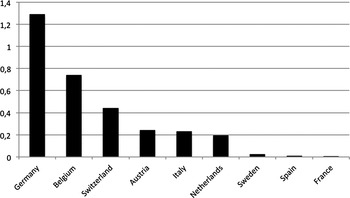
Calculating the share of the overall population employed by faith-based organizations shows us that in Western Europe, Germany stands out (see Figure 1). Not only is the size of Diakonie and Caritas exceptional in international comparisons but also their legal status. Through their connection to the two major churches in Germany, Caritas and Diakonie enjoy the special status of religious employers (Kirchliche Arbeitgeber). This grants them exemptions from parts of federal labor law, most notably, discrimination and equal treatment clauses and the labor representation law (Betriebsverfassungsgesetz and Personalvertretungsrecht §118 Abs. 2 BtrVG §112 BPersVG; Kreß Reference Kreß2014). Hence, it allows Caritas and Diakonie to dismiss employees who do not live their life in accordance with the Christian worldview of their employer. They can also set wages without fearing resistance from the unions. This makes Caritas and Diakonie, in Germany, especially interesting cases to study the consequences of faith-based welfare provision.
Percentage of total population employed by faith-based organizations. Data for Germany year 2013; Austria year 2013; Sweden year 2013; Spain year 2013; France year 2013; Italy year 2009; Belgium year 2002; Switzerland year 2002; Netherlands year 2002. Data from Deutscher Caritasverband Reference Deutscher2012; Caritas Österreich Reference Caritas2013; Diakonisches Werk der EKD e.V. 2012; Diakonie Austria Reference Diakonie2014; Caritas Espanola Reference Caritas2013; Secours Catholique Caritas France 2013; Crisp Reference Crisp2013; Baglio et al. Reference Baglio and Nanni2012; Fix and Fix (Reference Fix and Fix2005).

So far the literature on faith-based welfare has been primarily concerned with contextualizing the expansion of faith-based welfare in Europe. Only a small number of studies have taken a closer look at how the faith in faith-based welfare provision sets it apart from state, market, or other charitable welfare provision. Such research has been mainly carried out by urban geographers, a highly prolific subfield of the social sciences, which unfortunately too often remains out of the focus of mainstream political science and sociology. However, only a limited number of urban geographers have explored the potential impact of the “dark side” of the faith in faith-based welfare, namely their gendered effects when this faith is morally, ideologically, and socially conservative.
This article studies the two largest faith-based providers in Germany, Caritas and Diakonie and asks: What consequences do doctrinal backgrounds have on faith-based welfare provision? In particular, the article offers a special view on the gendered dimension of faith-based welfare in relation to employment law and care provision.
To assess the impact of religious ideas on the employment and care practices of faith-based welfare providers in Germany, the study pairs insights from urban geography with insights from the recent turn to ideas in historical institutionalist literature. It uses a dynamic concept of ideas that does not perceive ideas as fixed entities but acknowledges that they change over time. The article analyzes the impact of religious ideas against the backdrop of a changing society in Germany between 1945 and today. The longitudinal design of the study shows that there was little divergence between the ideas of faith-based welfare providers, their employees, and their clients in the 1950s. In the 1970s, this started to change. Women escaped private patriarchy and unpaid domestic labor and gained independence from the male breadwinner centered family model by taking up paid labor outside of the household. This triggered a crisis of care at home. The subsidiarity mechanism built into the German welfare state led to a replacement of private family care with care provided through faith-based providers. Paradoxically, Caritas and Diakonie grew through the demise of the patriarchic and male breadwinner oriented gender values that the German churches had promoted since the 1950s. However, for the employees of faith-based welfare providers, the emancipation from private patriarchy at home has led to religious patriarchy at the workplace.
Since 80% of their employees are women, faith-based organizations in the German welfare state contribute to a highly gendered occupational regime within which women are exposed to discrimination on the basis of patriarchic religiously inspired ideas of their employers. The article finds that there are significant differences between Catholic and Protestant faith-based providers, reflecting a progressive change in Protestant Church doctrine on gender patriarchy since the 1970s that did not happen in the Catholic Church.
The remainder of the article will open with a section on the relevant literature, the theoretical approach, and the material used. The second section analyses the congruence between the ideas of the churches, their faith-based welfare providers and the public in the 1950s, and how these were embedded in the German welfare state. The third part shows how faith-based welfare provision became more conflictual during the 1970s, following female emancipation and the ensuing clash between ideas of the public and the ideas of the churches. The third part shows how this conflict got reinforced through the family policy reforms of the 2000s. The fourth part concludes.
2. WHAT WE KNOW ABOUT THE FAITH COMPONENT OF FAITH-BASED WELFARE
We know that faith-based welfare providers differ significantly from secular welfare providers in funding and organizational structure (Ebaugh et al. Reference Ebaugh, Pipes, Chafetz and Daniels2003; Ebaugh, Saltzman, and Pipes Reference Ebaugh, Saltzman and Pipes2006). Moreover, it seems that “[a]n organization's founding religion provides an identity reflecting the way the religion views service and this outlook usually stays with the organization” (Bielefeld and Cleveland Reference Bielefeld and Cleveland2013, 11). A survey found that “80 per cent of faith based agencies use religious imagery” (Ebaugh et al. Reference Ebaugh, Pipes, Chafetz and Daniels2003, 411) and Jawad emphasized that faith-based welfare provides, in contrast to the traditional welfare state, not only give material relief but also pays attention to “ethical issues” and “moral and ideational factors” (Jawad Reference Jawad2012, 13).
However, of all 611 scientific publications on faith-based welfare in the United States between 1912 and 2013, only one-seventh addressed the theological distinctiveness of faith-based providers (Bielefeld and Cleveland Reference Bielefeld and Cleveland2013, 4). The literature from political scientists and sociologists about faith-based welfare provision in continental Europe touches even less upon critical questions about the implication of the faith character of faith-based welfare provision (for an exception see the contributions in: Bäckström and Davie Reference Bäckström, Davie, Bäckström, Davie, Edgardh and Pettersson2011). So does, for example, Bode acknowledge that in the German case “religious values have been central” and that there is a “growing distance between the growing German population and the Churches” (Bode Reference Bode2003, 206). However, he does not follow up on this with a critical assessment of the implications for employment and care practices of Caritas and Diakonie.
Research on continental European faith-based welfare providers by political scientists and sociologists is dominated by macro-sociological approaches and has focused primarily on institutions (Minkenberg Reference Minkenberg2003; Schmid Reference Schmid1995; Göcmen Reference Göcmen2011; Zehavi Reference Zehavi2013; Fix and Fix Reference Fix and Fix2005; Hien Reference Hien2014). In particular, it has been found that the state church conflicts of the 19th century determined the degree to which faith-based welfare organizations became incorporated into European welfare states. This historical institutionalist approach looks at the regulation of the relationship between religion and the state. Ideational components of faith-based welfare provision have also not been in the focus of attention in case studies about German faith-based welfare providers (Friedrichs and Klöckner Reference Friedrichs and Klöckner2011). So does, for example, a series of studies sponsored by the trade unions focus on pay and working conditions of faith-based employers without connecting them to doctrinal positions of Caritas and Diakonie, and only criticizing their constitutionally protected status as church based employers (Dahme et al. Reference Dahme, Kühnlein, Stefaniak and Wohlfahrt2012; Kreß Reference Kreß2014; Lührs Reference Lührs2008).
There is, however, literature that is seldom cited by macro-oriented political scientists and sociologists, which does address critical questions about the faith in faith-based welfare provision. Since the mid-2000s urban geographers have explored the phenomenon of faith-based organizations in urban cities in a series of case studies that have led to a vivid conceptual and theoretical debate about the role of faith-based organizations in post secular societies (for a good summary see: Cloke, Beaumont, and Williams Reference Cloke, Beaumont and Williams2013). This debate has created two opposing arguments: on one side stand those who see faith-based welfare organizations as “little platoons” that “willingly or unwillingly” serve neo-liberal interest (Peck and Tickell Reference Peck and Tickell2002; Hackworth Reference Hackworth2009), on the other side stand scholars who point out the potential of liberation theology and other radical or leftist religious movements to oppose, obstruct, or reformulate neo-liberal ideas (Sutherland Reference Sutherland2014; Johnsen Reference Johnsen2014; Cloke, Beaumont, and Williams Reference Cloke, Beaumont and Williams2013). Both approaches have in common that neo-liberalism, manifested in cuts and reconfigurations of the welfare state, have opened spaces for a resurgence of faith-based welfare activities. Both camps acknowledge that the ideas embodied in a faith-based organization are conditioned by contextual factors and specific theologies, and thereby have an impact on the actions of faith-based welfare providers on the ground (Cloke, Thomas, and Williams Reference Cloke, Thomas, Williams, Cloke, Beaumont and Williams2013, 7–9; Hackworth Reference Hackworth2012, 24–26). However, these studies remain largely silent on the potentially gendered dimension of the ideas of faith-based organizations and what they mean for care and employment practices of conservative Christian faith-based organizations in continental Europe and for Germany in particular (for a good summary of the research done on the faith component: Johnsen Reference Johnsen2014; also: Smith and Sosin Reference Smith and Sosin2001; Harris Reference Harris1995; Sider and Unruh Reference Sider and Unruh2004).
The German churches see their major welfare organizations as essential instruments for evangelization. The preamble of the Caritas states that “essential for its actions is the ambition of the Gospel and the belief of the church” and that Caritas “forms its action in accordance with Christian social ethics and the social teachings of the church” (Caritas Deutschland Reference Caritas1997, 5, 15). The code of practice of the Diakonie states that its work is “a living expression of the Protestant Church” (Diakonie Deutschland Reference Diakonie2012).
Since Caritas and Diakonie are part of the two churches, church doctrine and religious ideas serve as a template for their employment practice and care provision. Hence, if we want to know more about the impact of religious ideas on faith-based welfare provision it is essential to look into doctrine and how faith-based organizations embody it.
Religious doctrine is essentially a “system of ideas” (Durkheim Reference Durkheim2008, 62), ideas which are continuously reinterpreted by the churches. In the German Protestant and Catholic Church, doctrine is remodeled and pinned down in special committees, congregations, and synods that adapt faith to a changing environment. Church doctrine changes throughout time and this provides variation to the impact of religious ideas on faith-based welfare practice. The traditional historical institutional approach to faith-based welfare providers in Europe would profit from an incorporation of the ideational turn that the historical institutionalist literature embraced during the past two decades albeit with the add on of a dynamic component (Berman Reference Berman1998; Blyth Reference Blyth2002; Schmidt Reference Schmidt2008; Béland, Carstensen, and Seabrooke Reference Béland, Carstensen and Seabrooke2016). So far ideas in the ideational literature have been used as static independent variables that do the explaining (Blyth Reference Blyth2003; Reference Blyth2016). The ideas of the German Protestant Church on gender patriarchy have profoundly changed since the 1950s. A dynamic approach to ideas allows us to account for the changing nature of religious ideas and their impact on faith-based welfare provision. Such a dynamic approach is also absent in the urban geography literature. Calls for contextualization have been strong, but the attention to idiosyncrasies of individual faith-based organizations is only applied spatially and has not (yet) been studied in its diachronic dimension (Beaumont Reference Beaumont2008, 2030; Beaumont and Dias Reference Beaumont and Dias2008, 389–390; Cloke, Thomas, and Williams Reference Cloke, Thomas, Williams, Cloke, Beaumont and Williams2013, 3–7).
The focus on ideas does not mean to discharge the traditional historical institutionalist approach used in the study of continental European faith-based welfare. The regulation of religion sets the legal frame for their actions. However, we should not only focus on the institutional regulation of church-state relations but also on the relationship between the welfare state and faith-based welfare provision. The institutions of the welfare state can reinforce the effects of the ideational component of faith-based welfare provision, especially if, as van Kersbergen and Manow have shown, the welfare state itself is a product of patriarchic church doctrine (Manow and Van Kersbergen Reference Manow, Van Kersbergen, Van Kersbergen and Manow2009; Van Kersbergen Reference Van Kersbergen1995; Manow Reference Manow2004; Kahl Reference Kahl, Van Kersbergen and Manow2009; Morgan Reference Morgan2002; Hien Reference Hien2012). Hence, we have to account for the iterative relationship between welfare state institutions and ideas of faith-based welfare providers and how both co-evolve (Steinmo Reference Steinmo2010). In the German case, this is especially important because the expansion of care services in the formerly service lean conservative welfare state is to a large extent responsible for the expansion of faith-based welfare providers.
To capture the relationship between ideas and institutions I analyze church documents, the communiqués and preambles of faith-based welfare providers and pair them with an analysis of German welfare state institutions from the 1950s onward. I contrast the co-evolution of ideas of faith-based welfare providers and the institutions of the welfare state with public opinion on patriarchy, male breadwinner centeredness, marriage, divorce, and homosexuality. To identify frictions between public opinion, church doctrines, and employees of faith-based welfare providers, I analyze the legal disputes between faith-based employers and employees at the highest German labor law court.
3. CHURCH DOCTRINE, THE GERMAN WELFARE STATE AND FAITH BASED WELFARE PROVISION
Post war Germany saw a steep resurgence of religiosity after the moral havoc of Nazi dictatorship and holocaust. An allied survey from March 1946 indicates that 65% of all Catholics attended church regularly (Tennstedt and Schulz Reference Tennstedt and Schulz2007, 78). Many Germans thought that the “third Reich originated in the increasing alienation from God” (Bösch Reference Bösch2001, 30). The Christian Democratic Party picked up on this. Their founding manifesto from 1945 states that “[f]rom the chaos of guilt and disgrace, in which the deification of a criminal adventure has thrown us, an order in freedom can only evolve, if we remember the cultural, ethical and moral force of Christianity” (Christlich Demokratische Union 1945b, 1). It became the party to dominate post war welfare reconstruction.
The Christianity of the 1950s came with strong ethical prescriptions for family life, welfare, and the role of women within it. Already Rerum Novarum, the first Catholic social encyclical issued by the Vatican in 1891 had pointed out that “paternal authority can neither be abolished nor be absorbed by the state” (par. 14) and that it is sinful “for mothers on account of the fathers's low wage to be forced to engage in gainful occupations outside of the home to the neglect of their proper care and duties, especially the training of children” (par 71). The second social encyclical Quadragesimo Anno developed in the 1930s the theory of the just wage that should be allocated to the “authority of the father” (par 13) and be sufficient for the whole family. Both papal encyclicals remained the main reference point for German Catholicism till to the second Vatican council.
Besides the gradually less conservative view on wedlock, which is not a sacrament for German Protestants, the German Protestant Church shared in the 1950s most of the Catholic viewpoints on family-patriarchy and gender. Barth and Bonnhöfer, prominent German speaking Protestant theologists of the 1940s and 1950s, were of the view that the “calling of a woman lies in her motherhood” (Karrenberg and Schober Reference Karrenberg and Schober1980, 432).
Traditional family and gender ethics remained the main doctrinal reference point for the German churches and the Christian Democratic Party after WWII. The “Berlin manifesto,” one of the first Christlich Demokratische Union manifestos, states that “men must […] be the head of the family” and that “the state must by its economic and social policy give him the opportunity to nurture his family in honor” (Christlich Demokratische Union 1945a, 4–5). Adolf Würmling, the first Christian Democratic family minister after the war remarked in a parliamentary speech that the church was “his best comrade in arms”(cited in Gerlach Reference Gerlach2010, 179).
During the 1950s the Christian Democratic Party translated these ethical prescriptions into the German welfare state. In 1949 came the first tax break for married couples (Kinderfreibetrag), in 1951 a tax advantage for married couples with children was introduced, and in 1955 a family allowance was granted (Kindergeld). The Adenauer governments reconstructed the German welfare state around a male breadwinner centered model of social protection. Welfare benefits and social security of all family members were tied to the employment status of the husband, not to the family member's status as individuals. A double wage should ensure that the head of the family could cater to all members of the family without them needing to participate in the labor market. Care tasks for children, elderly, and disabled were assigned to women within the household. Care was neither enumerated nor recognized through the social security system.
The 1950s and 1960s saw not only the infusion of familialism and private patriarchy in the West-German welfare system, but also the introduction of the subsidiarity principle. Catholic family doctrine and the experiences of Nazi totalitarianism had assured that the patriarchic social entity of the family was made largely impermeable for state or societal control. This impermeability was reinsured through the subsidiarity principle. Quadragesimo Anno states that
[t]he supreme authority of the State ought, therefore, to let subordinate groups handle matters and concerns of lesser importance, as occasion requires and necessity demands. Therefore, those in power should be sure that the better a graduated order is kept among the various associations, in observance of the principle of “subsidiary function,” (Pius XI Reference XI1931 par. 80).
In other words, the lowest entity in society should always have the responsibility. Only if the lowest entity fails, the next higher entity steps in and helps out.
This is how Diakonie and Caritas got firmly entrenched in the German welfare system. Not the state should step in if the family fails to provide care tasks but intermediary institutions like Caritas and Diakonie.
The onset of German partition reinforced the independent status of the two charitable organizations from state oversight. The consensus in West-Germany was that the churches in East Germany had to be shielded from influence form the communist state (Kreß Reference Kreß2014). The Adenauer government granted Diakonie and Caritas an exemption from federal labor law codification (Betriebsverfassungsgesetz) in 1953.
The familial and subsidiarity oriented welfare system was very much in line with the values of West-German society in the 1950s and 1960s. Caritas and Diakonie enjoyed high acceptance and esteem. The conservative male breadwinner oriented and patriarchal family model was embraced by the religious voters and this paid off electorally. During the 1940s, 71% of all regular church going Catholics and 40% of regular church going Protestants displayed an affinity to the Christian Democratic Party (Meritt and Meritt Reference Meritt and Meritt1970, 81–83). The Christlich Demokratische Union had a constant surplus of female votes (Wiliarty Reference Wiliarty2010).
Also the employees of Caritas and Diakonie did not mind the worldview requirements of their employers, simply because most of their employees were religious personnel. In 1951, still 27,314 deacons worked in care jobs for the Diakonie. Only 6,430 were professional care workers. Also the vast part of the care work of Caritas was done still by religious personnel. In 1950, 60,447 friars and nuns worked for Caritas while 45,611 of the employees were professional lay care providers (Lührs Reference Lührs2006, 37–38). There was not much divergence between the values of the employees of the Caritas and Diakonie and their employers and hence, there were not many disputes over employment practices.
Between 1956 and 1978 only one case went to the highest German labor law court, the Bundesarbeitsgericht. The “painter-decision” (Anstreicherentscheidung) of the Bundesarbeitsgericht (January 31, 1951) struck down the request for reinstatement of a 40 year old painter, employed in a Catholic hospital who was divorced, had an affair with an 18 year old employee of the same hospital, and married her once she got pregnant. The Catholic hospital fired him on the basis of his immoral behavior (“sittenwiedrigen Verhaltens”; Listl Reference Listl1986, 138). The painter argued that his duties at the hospital had nothing to do with spreading the Gospel and that he did not hold any management or representative position within the hospital. The court nevertheless struck down his request and declared that any employee of a religious welfare providing association was bound to a life in accordance with the worldview of his employer (Listl Reference Listl1986, 139). This verdict had repercussions for the handling of similar cases in lower labor courts which were all ruled in favor of Diakonie and Caritas. For the next 22 years, no case made it up to the Bundesarbeitsgericht.
4. THE TRANSITION FROM PRIVATE TO RELIGIOUS PATRIARCHY
Things started to change from the 1960s onward. The share of women in Germany that wanted to be “housewives” had diminished between 1961 and 1973 from 57 to 29% (Rusciano Reference Rusciano1992, 351). Between 1970 and 2013 female labor market participation increased from 46.5 to 72.4%. The male breadwinner model started to erode on the “behavioral level” (Lewis Reference Lewis1997) and with it the private patriarchy of German society.
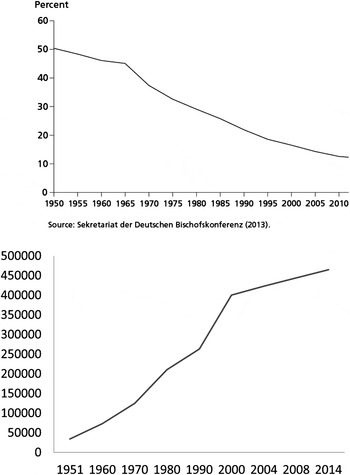
The process of societal liberalization of family values went hand in hand with a decrease in church attendance: In 1950, 50.4% of all Catholics attended Sunday mass on a regular basis. In 1973, the figures had dropped to 35%. Of the Protestants only 7% in West-Germany attended mass on a regular basis (Pollack and Pickel Reference Pollack and Pickel2003, 458).
Whereas the churches were hemorrhaging members and church attendance dropped, ever more people started to work for and receive care from Caritas or Diakonie. In the 1970s and 1980s, faith-based welfare providers saw their strongest expansion. Caritas and Diakonie almost doubled their employees from 245,967 to 451,717. Women escaped private patriarchy and gained economic independence form the male breadwinner through enumerated work outside of the household. This resulted in a shortage of care work at home. The first outcome was a decline of the birthrate that started in the 1970s. The second was the expansion of faith-based welfare provision. The subsidiarity principle institutionalized in the German welfare state allocated care tasks to the five large charitable providers with special status when the family could not care anymore. Since Caritas and Diakonie were the largest, and best connected politically, they got most of the care contracts. Their child, elderly, and disabled care sectors expanded, and with technical progress also the medical sector. The institutional structure of the German welfare state structured around the subsidiarity principle ensured that the breakdown of the former religiously inspired lifestyle of male breadwinner centered private patriarchy of the 1950s and 1960s was compensated through the expansion of the care services of the churches. While the churches profited from this societal change through the expansion of their care services, especially in the Catholic case they were reluctant to give up their traditional ideas on wedlock, family, and patriarchy.
In 1981, Joseph Ratzinger, who later became Pope, argued that “[a]n order in which going to work is necessary for both parents is disorder, it destroys the basis of life […] a family wage is therefore the basic principle of Christian social teaching” (Ratzinger Predigt [May 5, 1981] cited in Liminski Reference Liminski and Rauscher2008, 287). Indeed, the “patriarchic paradigm of marriage and family” and the “subordination of woman to man” remained even after the second Vatican council unbroken for the Catholic Church in Germany. The latest family synod in 2015 confirmed this conservatism after a progressive first draft by Pope Francis did not find the necessary two-third majority among the Bishops (Drobinski Reference Drobinski2015). Marriage in “good as in bad times” (Bischofssynode Reference Bischofssynode2015, 32) stays central. Marriage gets even promoted to the status of a “house church,” an “indispensable subject of evangelization” (Bischofssynode Reference Bischofssynode2015, 7). Re-married couples are explicitly excluded from receiving the sacraments. The Synod sees a great danger in the “civil law, which endangers marriage and family” (Bischofssynode Reference Bischofssynode2015, 19). The document makes bold statements against gender-mainstreaming which “negates the natural differences between man and woman” (Bischofssynode Reference Bischofssynode2015, 10). “‘Gender’-ideology” promises “a society without difference between the sexes and hollows out the anthropological foundation of the family” (Bischofssynode Reference Bischofssynode2015, 10). There was no easing of the hostile stance on homosexual partnership, as the final document of the synod sees “no fundament to make analogies between homosexual partnership and the plan of God for marriage and family” (Bischofssynode Reference Bischofssynode2015, 48).
The German Protestant Church (Evangelische Kirche in Deutschland, abbreviated EKD) took a different route. Departing from the fact that marriage is not a sacrament and divorce has been possible ever since Luther, it relaxed its traditional stance on wedlock. Already in 1969 the Protestant Church had decided after a heated debate that “the remarriage of divorced can not be principally ruled out.” In the 1970s followed a more gender equality friendly doctrinal change. From 1979 onward women could become priests. The Protestant standard textbook for ethical questions, the Evangelisches Soziallexikon stated in the 1980s that that “[t]he anthropological question about a creationist difference in rank of man and woman is negated by the majority of Protestant theologists. Many Catholic theologists are in favor” (Karrenberg and Schober Reference Karrenberg and Schober1980).
The most recent family document of the German Protestant Church marks the peak of the liberal transformation. The German Protestant Church explicitly uses an inclusive family concept where “it should not matter in what form family and partnership is lived” (German Protestant Church 2013, 141). The Protestant Church argues in favor of “the recognition of diverging sexual orientations” (German Protestant Church 2013, 143). It also positions itself positively toward re-marriage (German Protestant Church 2013, 143). Patchwork families are embraced. In order to prevent economic hardship after divorce, the Protestant Church recommends the early and continuous employment of women. This stands in sharp opposition to the Catholic position which sticks to a patriarchic division between genders.
The divergence between public and church opinion on gender patriarchy and family policy led to a steep increase in labor law cases and contestation of alleged discrimination practices at Diakonie and Caritas from 1975 onward. From 1945 to 1975 only one case was decided by the Bundesarbeitsgericht, the highest labor law court in Germany. Between 1975 and 1986 11 cases made it all the way up to federal labor law court (Bundesarbeitsgericht). Two of them were ultimately decided by the constitutional court (Bundesverfassungsgericht) which reinforced the autonomy of the labor law of the churches and their faith-based providers in 1985 (Listl Reference Listl1986). Of the 11 cases eight were about loyalty and value conflicts between employers and employees. In five cases, dismissal was directed against women. The reasons were re-marrying, marrying a divorced man (four cases), and exiting the church (one case). Another case was about a doctor of a catholic hospital who publicly argued in favor of abortion and another one was about a man dismissed due to his homosexuality. The remaining two cases were about collective labor law rights of trade unions within care service deliverers run by faith-based organizations. All cases about loyalty and value conflicts except one were filed by Catholic welfare organizations connected to Caritas. The only case filed by the Protestant Diakonie concerned the dismissal of a homosexual employee. The numbers reflect the conservative patriarchic stance of marriage of the Catholics. The case of the dismissed homosexual is connected to the still uneasy stance of the German Protestant on homosexuality in the 1980s. The 1980 issue of the Evangelische Soziallexikon argues in favor of “therapies” for homosexuals and thinks that with the right approach a “spreading of homosexuality could be curbed through the right behavior of parents and educators” (Karrenberg and Schober Reference Karrenberg and Schober1980, 588).
One reason for the higher conflictuality between employers and employees of faith-based welfare providers in the 1970s and 1980s compared to the 1950s and 1960s was the professionalization of the workforce of Diakonie and Caritas. In 1960, Diakonie employed 47,918 professional care workers backed up by 25,011 deacons and nuns. In 1970, the religious personnel had decreased to 15.7%. At Caritas the professionals increased from 1970 from 137,938 to 251,010 in 1980 while religious personnel decreased to 13% (Lührs Reference Lührs2006, 37–38). In 1990, only 6.5% of all employees of Caritas were religious personnel and at the Diakonie only 2.3%. The opinions of these employees had become more liberal in the same way as the public. The worldview congruence between employer and employee was not given any longer. A survey of 2,600 employees of Caritas and Diakonie between 2006 and 2007 shows that only 11.2% chose their employer on the basis of their own religiosity and only 20.1% said that they had consciously considered the religiosity of their employer when choosing to work for the faith-based organization (Lührs Reference Lührs2008, 52).
German reunification led to a boost in faith-based welfare provision in the early 1990s. West German faith-based organizations could expand their services to the East and take over most of the formerly state run care facilities. German reunification was not only an opportunity to expand the care services further but it was also a challenge. East Germany was both more Protestant and secular then the West. The denominational balance shifted from half Protestant and half Catholic in post war West Germany to one-third Catholic, one-third Protestant, and one-third that do not belong to any of the two churches in post-re-unification Germany. The communist East German state had a gender policy that officially contrasted from the West German male breadwinner model. The employment share of women had been much higher than in the West and the attitudes toward working mothers were much more favorable than in the West (Braun, Scott, and Alwin Reference Braun, Scott and Alwin1994). The sudden care crisis in the East triggered by the collapse of the East German state fueled expansion of faith-based providers. However, East German secularism also undermined their legitimacy. On top, the 1990s saw recalibration and retrenchment of the service sector of the German welfare state. The automatic cost reimbursement principle for the six large publicly acknowledged charitable institutions that provide welfare service on the behalf of the state (Kostendeckungsprinzip) was abolished, a marketization of the care sector started and European integration opened the German care market also to non-German competitors. After a short spike due to reunification, the 1990s therefore saw a levelling out of faith-based welfare expansion. With reference to the loss of many institutional and legal vantage points many commentators saw this as the end of faith-based welfare growth (Lührs Reference Lührs2006; Zehavi Reference Zehavi2013).
5. THE EFFECTS OF FAITH BASED WELFARE PROVISION IN THE 21ST CENTURY
During the 2000s, the liberalization of German public opinion on traditional family values reached unprecedented levels. In 1994, still 68.8% of all women agreed to the statement “a pre-school child will likely suffer if his mother works” in Western Germany. In 2002, only 50.7% thought so (East Germany drop from 30.3 to 27.9%; Besenthal and Lang Reference Besenthal and Lang2004). The change was so drastic that the Christian Democratic Party started to change its ideas on family policy. The Christian Democrats had continuously lost female votes over the past decade. Many women were dissatisfied with the male breadwinner model that the party championed in close collaboration with the churches since the 1950s. Angela Merkel abandoned the male breadwinner model from the party platform and subsequently overhauled federal family policy despite strong resistance form the Catholic Church and the Catholic party members (Wiliarty Reference Wiliarty2010). A parental leave scheme was introduced (12 + 2 month, 67% income replacement) and a guarantee for a childcare place from the age of one upward. This was a radical break with the past. It was the institutional follow up to the abandoning of the male breadwinner model on the behavioral level. Prior to the reform women had to pay for taking up jobs outside of the household, by having no children, since the combination of job and family was impossible. Now they should have both, at least that was the idea behind the new family policy regime (Henninger, Wimbauer, and Dombrowski Reference Henninger, Wimbauer and Dombrowski2008; Fleckenstein Reference Fleckenstein2011).
Traditional religious ideas about patriarchy, marriage and partnership, and family households were now not only gone in large parts of society but also eradicated from the welfare state in which they had so firmly been entrenched (Hien Reference Hien2013). The pertinent question was who would do all the care services that would be needed to make the new family policy regime work? Already in the negotiations of the new legislation Caritas and Diakonie played a crucial role. While the Protestant Church and Diakonie endorsed policy change based on its changed family policy position since the 1970s the Catholics opposed it. Margot Käßmann, who would later become the head of the Protestant Bishops said that she “could not understand the [Catholic] critique at all” (cited in Frankfurter Allgemeine Zeitung 2007). The Catholic Bishop Rheinhard Marx commented that “politics is erring if it wants to make people believe that they can have everything at once: career, high income and children” (Marx Reference Marx2010). However, the prospect of such a vast expansion of childcare was a strong argument to overcome the resistance of the Bishops.
A senior female member of the Christian Democrats, and long-term member of the committee on family affairs, described this situation as follows:
We knew that if we wanted to get this thing through, we had to get to terms with the churches. The Protestants were easy. When von der Leyen sent me instead for the first time to present our new plans to the Catholic Bishops it seemed to me as if I was speaking to a brick wall. The Bishops sat in front of me and unanimously told me that what we wanted to do was witches brew. When I met them the second time and confronted them with the possibility of losing the four billion euros of federal funding for the day-care facilities the situation changed. The hardliners did of course not change their mind but it was enough to get a majority with the moderates in favor of the reform (personal interview German Bundestag, Berlin, February 2, 2011).
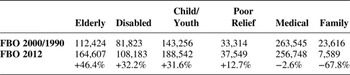
Either the Catholic Church would have to renounce to a huge growth opportunity for their faith-based welfare organizations and the possibility for evangelization in a time when ever less people go to church or they would have to compromise their ideas on family policy (see, Figures 1 and 2). In the end, the Catholic Church tried to do both, expanding their faith-based care services and holding on to their conservative gender ideas. Both, Caritas and Diakonie, grew as a result of the reform (Table 1, Figures 2a and 2b) especially in the childcare sector.
Percentage of Catholics attending Sunday service, 1950–2012 and number of employees Caritas 1951–2014.

Number of employees Caritas Germany, 1950–2012 and Frequent church attendance Protestant Church (Pollack and Pickelt 2003).

Employees of faith-based welfare organizations in Germany

Figures are calculated by the author as full-time employment equivalent, following the template of the German federal statistics authority, one part-time employee equals half a full-time employee. Sources: Data for 2000/1990 based on pairing Diakonie data for 2000 with Caritas data for 1991 due to a lack of data on Caritas for 2000; figures for 2012 are from 2012 for Diakonie and Caritas.
The double-strategy of more market share for Caritas for evangelization and upholding conservative values is difficult to maintain. Conflicts erupt between the largely professionalized staff (in the 2000s Caritas stopped having statistics on its religious personnel as the numbers became negligible) with largely secularized ideas about marriage, divorce, religion, patriarchy and homosexuality and the conservative Catholic ideas of their employers. This creates ever more public blowback.
In 2012, a lesbian educator was dismissed during her parental leave (Mayr Reference Mayr2012). In the same year, Bernadette Knecht a female childcare facility manager in the city of Königswinter was dismissed after she had divorced and moved in with her new partner (Kamann Reference Kamann2012). In 2014, a Muslim nurse wearing a headscarf was dismissed by the Diakonie. In 2015, a lesbian manager of a Catholic youth club had to go because she had married her girlfriend (Die Welt Reference Die2015a). In 2015, an educator of a Protestant disability care facility who acted in amateur porn movies during her spare time got dismissed by the Diakonie (Nassal Reference Nassal2014). In 2010, a social worker of the Catholic Kolpingwerk lost his job in 2010 because he had a profile on a homosexual dating site (Schädler Reference Schädler2010).
These cases are only those that made it into the federal press. Between 2000 and 2015, 39 cases of conflicts between employees and Caritas and Diakonie were discussed in German courts.Footnote 1 In almost all cases, the highest courts defended Cartias and Diakonie's prerogatives on the basis that they were members of the church and therefore enjoyed an especially constitutionally protected status.
Most of the discrimination cases, never make it to court because employees know that their cases would not stand a chance (Gekeler Reference Gekeler2013). Employees who divorce and remarry or marry their homosexual partner often pre-emptively terminate their contracts, like the case of a childcare facility manager in Holzkirchen (Die Welt Reference Die2015a) or do not get the job in the first place like in the case of Tanja Jungerer in Ulm (Kamann Reference Kamann2012). The Spiegel also reported about a hospital bought by the Protestant Diakonie and whose employees, in fear of losing their jobs started a mass-baptism (Müller Reference Müller2013).
Since 80% of faith-based employees are women (Lührs Reference Lührs2006, 27) they are not only negatively impacted because of the conservative church doctrine but also because care is a work-field characterized by precarious working conditions. Feminist welfare analysts have long argued that care jobs are “worse paid, all else equal, then other types of work,” with “continental Europe report[ing] the highest gaps” in wages between men and women (Orloff Reference Orloff2009, 326; see also Kroos and Gottschall Reference Kroos, Gottschall, Emmenegger, Häusermann, Palier and Seeleib-Kaiser2012; Briken et al. Reference Briken, Gottschall, Hils and Kittel2014). Since the 1980s, part time work in faith-based organizations has increased dramatically. While in 1980 only 20% of the employees had part time contracts, the numbers grew to 45% in 2004. In 2008, 72% of Diakonie staff had a part time contract while it was 60.1% in 2012.
The expansion of faith-based welfare contributes stronger to negative implications of “gendered occupational regimes” (Orloff Reference Orloff2009, 327; Estevez-Abe Reference Estevez-Abe2009, 186) than the employment in other care providers because Caritas and Diakonie both set wages independently from federal collective bargaining processes in special bi-partite commissions. They can do this due to their special status as religious employers. While this so-called third way often used to work in favor of the employees it has been increasingly criticized to lead to wage dumping since the liberalization of the care market (Kreß Reference Kreß2014; Lührs Reference Lührs2010). Moreover, in contrast to the female dominated workforce, the wage setting commissions are composed to 80% of men. In the words of Herman Lührs, “540 men decide the working conditions of one million women” (Lührs Reference Lührs2006, 2; 2010). A recent report on the wage bargaining system of Protestant faith-based welfare providers predicts a further “worsening of the negotiated wages of women,” due to the increasing economic rationalization of faith-based welfare organizations triggered by declining church tax revenues (Dahme et al. Reference Dahme, Kühnlein, Stefaniak and Wohlfahrt2012, 89).
Negative press, recruitment problems, pressure from the unions, and a court sentence from the Bundesarbeitsgericht led to a reform process of church labor law in 2013 in both churches. Unions are no longer forbidden to enter Caritas facilities and according to the churches 10 to 15% of the members of the Arbeitsrechtliche Komissionen should be union members in the future. The value commitment was eased but only with regards to married homosexual couples and for re-married. Moreover the value commitments are still in place for professionals that are involved in evangelization (verkündungsnahe Berufe), a stretchable term that involves childcare workers as well as head physicians. For all other groups of employees, homosexuality or remarriage does no longer automatically lead to suspension or elimination, but they remain under rigorous case by case analysis.
The reception of the reform was mixed. Alois Glück, the head of the Catholic lay organizations, said it was a “paradigm shift.” Three Bishops refused to implement the reforms in their constituency and gave in only later (Die Welt Reference Die2015b). Catholic youth organizations criticized that the reform did not go far enough. The piecemeal concessions confirm that the Catholic Church and Caritas tried to have it both ways: expand their care empire because it secures political and social influence and at the same time holding on to traditional values when using their care providers for evangelization efforts. Caritas and Diakonie have not made a transition toward a fully market based enterprise as many of their critics argue, if not they would relax the enforcement their conservative values. These values are becoming increasingly costly in terms of public approval and increasing legal conflicts with their largely secularized employees.
6. CONCLUSION
In the 1970s, ever more women were emancipated from household tasks and family patriarchy. Since the German welfare state was organized through the subsidiarity principle, most of the care tasks that the transition from private patriarchy brought were given to faith-based welfare providers. The special status of faith-based welfare providers as church employers allowed them to express their values in their care practices and demand value loyalty from their employees. Women working for these organizations found themselves under a new patriarchy: now not private but dictated by the religious values of their employers. Hence, the increasing involvement of faith-based welfare providers in the German welfare state since the 1970s has led to the establishment of a large gendered occupational regime where approximately one-fourth of all employees of the social care sector are employed.
This article has used an ideational approach to trace the evolution of religious ideas diachronically from the 1950s until today, revealing a divergence between Protestant and Catholic Church doctrine since the 1970s. Pairing it with a classic historical institutionalist approach has provided a better understanding of the iterative relationship between church doctrine, federal employment law, the transformation of the German welfare state, and changes in public opinion.
The article addressed a major silence in the existing literature on faith-based organizations, namely, the potentially gendered dimension of conservative faith-based welfare providers. Faith-based welfare organizations are in many cities at the forefront in combating poverty and social exclusion and have often promoted progressive ideas, however, there is also a “darker side” of faith-based welfare. This “darker side” comes to the fore when the ideas behind faith-based welfare organizations are ideologically morally and socially conservative, and if the organizations have legally given exemptions from discrimination and labor law. For the future of the study of faith-based welfare organizations, this means that geographical context — theology, ideology, and legal standing of faith-based organizations — matters, and this is something that policymakers should keep in mind when discussing third way style reforms of the welfare state that include the reliance on faith-based welfare organizations.