Introduction
Superimposed images can be found at different rock-art locations around the globe (Baracchini & Monney Reference Baracchini, Monney, David and McNiven2018; Boyd & Cox Reference Boyd and Cox2016; Bwasiri & Smith Reference Bwasiri and Smith2015; Carden & Prates Reference Carden and Prates2015; Clegg Reference Clegg1987; Davis Reference Davis1984; Gunn et al. Reference Gunn, Ogleby, Lee and Whear2010; Hollmann Reference Hollmann2015; Lewis-Williams Reference Lewis-Williams1972; McDonald & Veth Reference McDonald and Veth2013; Monney Reference Monney, Besse, Stahl Gretsch and Curdy.2003; Pilavaki Reference Pilavaki, Mina, Triantaphyllou and Papadatos.2016; Sauvet & Sauvet Reference Sauvet and Sauvet1979; van Tilburg & Lee Reference van Tilburg and Lee1987; Walsh Reference Walsh1994; Welch Reference Welch1990). Superimpositions, also referred to as ‘overlapping’, are employed by rock-art researchers to describe images that are located on top of/under another image. Although both terms have been used interchangeably, there are some subtle differences between them. Overlapping, in its most accepted definition, has been described as the partial covering of an image by a newly created one (Lewis-Williams Reference Lewis-Williams1974, 94), whereas superimposition implies full covering of one image over another in which the original depiction may or may not still be visible (Lewis-Williams Reference Lewis-Williams1974, 94).
An early archaeological interest in their interpretive value has been their potential for understanding succession in rock-art styles, the evolution of different styles through time and the re-use of a locality by the same or different groups over time (Brady & Gunn Reference Brady, Gunn, McDonald and Veth2012; Cardoso & Bettencourt Reference Cardoso and Bettencourt2015; Chippindale & Taçon Reference Chippindale, Taçon, Steinbring, Watchma, Faulstich and Taçon1993; Keyser Reference Keyser1987; Leroi-Gourhan Reference Leroi-Gourhan1967; Loubser Reference Loubser1993; McCarthy Reference McCarthy1964). Despite them being found almost in every continent, theoretical literature on the role superimpositions played/still play is scarce, with most efforts being concentrated on decoding a site's stratigraphic sequence and applying Harris Matrix principles and diagrams to reconstruct different painting events over time (Fredell et al. Reference Fredell, Kristiansen and Criado Boado2010; Gunn Reference Gunn2017; Harper Reference Harper2017; Harris & Gunn Reference Harris, Gunn, David and McNiven2018; Leroi-Gourhan Reference Leroi-Gourhan1967; Pearce Reference Pearce2010; Russell Reference Russell2000; Travers Reference Travers2015) and assess the preservation of rock-art sites (Loubser Reference Loubser1997), respectively. Among those interested in expanding current views on superimpositions, a major focus was placed on exploring artists’ motivations and the governing rules behind this practice (see Kaiser & Keyser Reference Kaiser and Keyser2008; Lewis-Williams Reference Lewis-Williams1974; Reference Lewis-Williams1992; Loubser Reference Loubser1993; Pager Reference Pager1976; Pearce & George Reference Pearce and George2011; Wellmann Reference Wellmann1979).
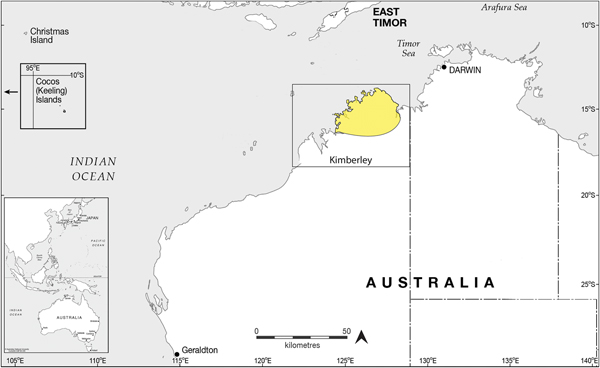
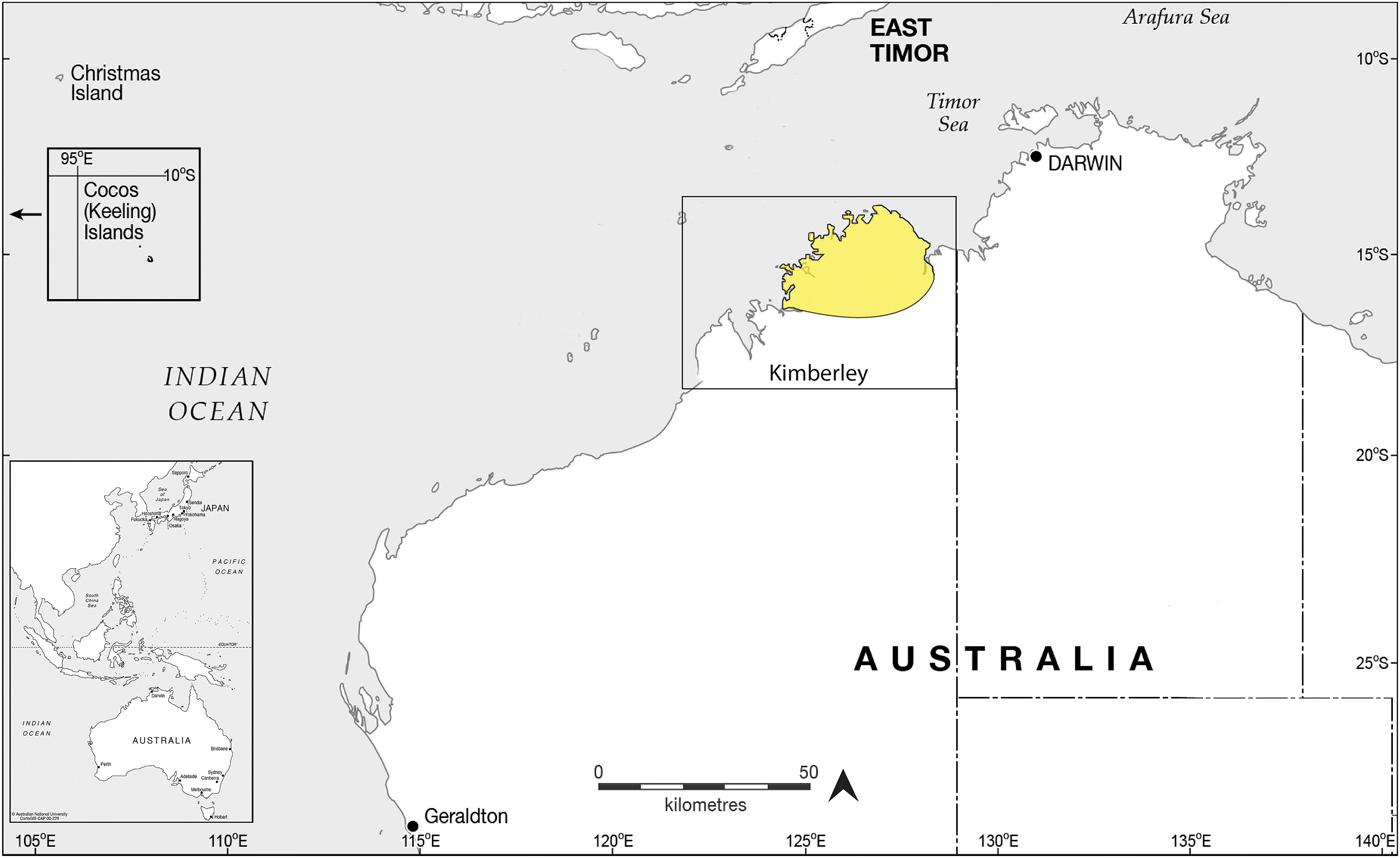
While the interpretation of the social significance of superimpositions has been sporadically addressed by some rock-art researchers (Lewis-Williams Reference Lewis-Williams1974; Reference Lewis-Williams1992; Walsh Reference Walsh2000, for example), their detailed study can still be deemed under-theorized and under-developed, with no clear set of criteria used for classifying and further interpreting their significance in rock art assemblages. The aim of this article is to explore how superimpositions found in the Kimberley Region, Western Australia, have been perceived by different groups over time in order to better understand how human agents engaged with (pre)existing images and incorporated them into new painting practices. So far, the main attempt that has considered the artists’ motivations behind the superimposition of images in the Kimberley focused on notions of cultural dominance as the main explanation for superimpositions (Walsh Reference Walsh2000, 214). To illustrate this perspective, a formal analysis of rock-art images belonging to two stylistic phases from the northwestern Kimberley area—Gwion Gwion and Static Polychrome—was conducted (Fig. 1). Pre-existing records from the northern Kimberley and a rock-art complex recorded by the author from the northeastern Kimberley were used. The following research questions are addressed in this paper: what current views are held on superimpositions? Do researchers interpret this practice as intentional? What is the potential of the study of superimpositions for understanding how past populations mediated with their predecessors? Lastly, what are the implications for future interpretations of Kimberley rock art?
The Kimberley, showing the location of the study area. The Kimberley is geographically limited to the south by the Great Sandy and Tanami deserts, to the east by the range uplands of the Northern Territory and to the west and north by the coastline.
The role of superimpositions in rock-art research
Much of the debate on the motivations behind superimpositions has focused on determining to what extent they are the result of intentional or non-intentional actions. Those who view superimpositions as non-intentional believe that they are the product of the artist's indifference towards previous depictions (Brentjes Reference Brentjes1969; Graziosi Reference Graziosi1960), or to an economical principle: the lack of space on the rock surface (Pager Reference Pager1971; Rosenthal & Goodwin Reference Rosenthal and Goodwin1953). If the proposition is that superimpositions are the product of indifference towards earlier paintings, logically superimpositions should be randomly distributed on rock panels with little to no apparent relation to underlying figures. However, this argument is challenged when Kimberley rock-art corpuses are considered, as well as from other rock-art localities such as South Africa and North America (see below). Furthermore, a similar case emerges when the specific placement of later images within rock-art panels is considered, as it seems to be the rule rather than the exception for paintings to be deliberately placed on top of, and in association with, previous images.
Among researchers who consider the practice as intentional, the most widespread explanation concerns the use of superimposition and overlapping of images to appropriate and enhance the magic or power contained in previous depictions (Capitan Reference Capitan1925; Trezise Reference Trezise1971). In the case of Upper Palaeolithic Europe, it has been proposed that superimpositions are ‘the visible expression of the energies of the particular group who “owned” or “used” the cave’ (Ucko & Rosenfeld Reference Ucko and Rosenfeld1967, 173–4). Another interpretation is that of Levine (Reference Levine1957), who noted that Indigenous Australians employed superimpositions as restitution rituals, in which animals were returned to nature by marking their image at sacred places. Researchers have also been concerned with the study of ‘scenic relations’ (Laming Reference Laming1959) between painting events. Lewis-Williams (Reference Lewis-Williams1974, 101) proposes that for South Africa superimpositions are ‘governed by a set of rules that favoured certain combinations and avoided others’, where certain combinations of motifs were preferred. Following this proposition of superimpositions as a form of syntax, Pearce and George suggest that ‘overpainting (…) has profound implications for our understanding of how images were used by people subsequent to the original painters’ (Pearce & George Reference Pearce and George2011, 173). Like Lewis-Williams, they advocate the proposition that some superimpositions were deliberate, although the reason behind their creation might sometimes be unclear.
Intentional superimpositions: art or vandalism?
Within this dual classification schema—non-intentional versus intentional—some authors found correlations between superimpositions and vandalism. In the late 1930s, Battiss divided superimpositions into (a) casual painting over a faded image, (b) vandalism in which figures are superimposed over preserved images, and (c) intentional superimpositioning (Battiss Reference Battiss1939). According to his classification, superimpositions should be distinguished from vandalism, although no further details as to how he made this distinction are given. Kaiser and Keyser (Reference Kaiser and Keyser2008) also classified superimpositions into different types after noting that some Shield Bearing Warrior engravings at Bear Gulch, North America, were re-used and superimposed by later figures. In another study, Keyser mentions that some panels have been vandalized, but no definitional distinctions between vandalism and superimpositions are given (Keyser Reference Keyser1987, 45).
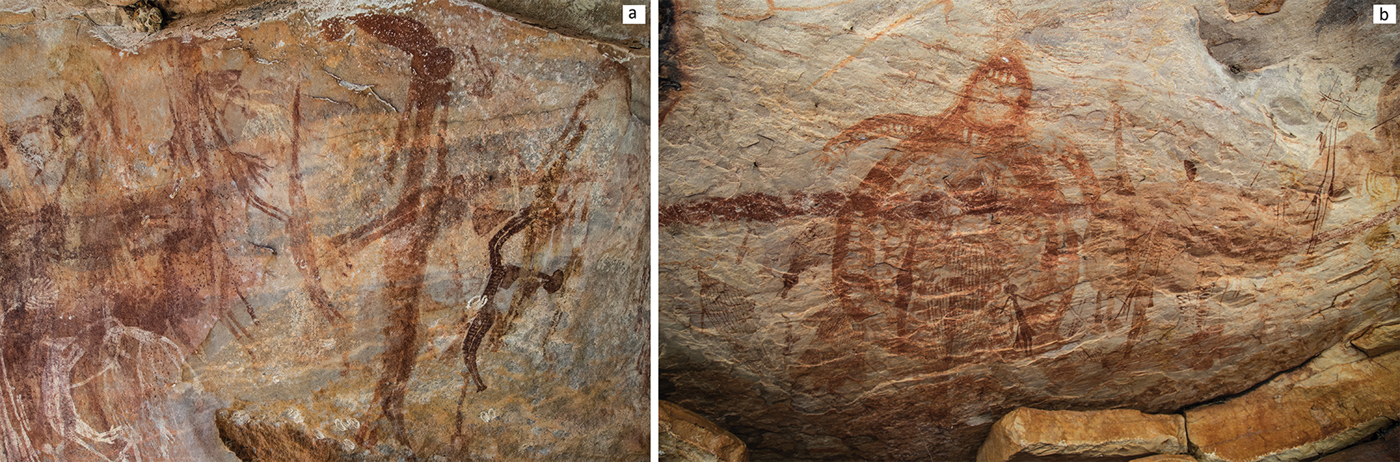
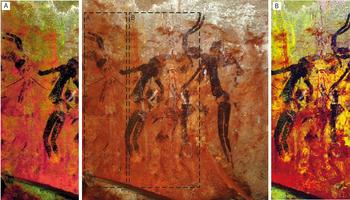
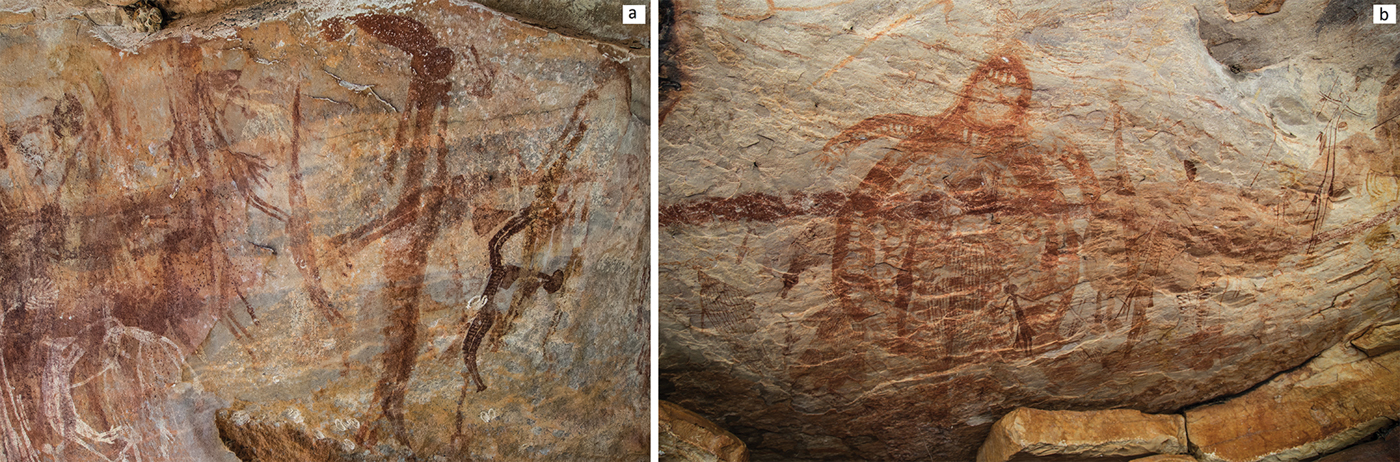
The most clear example of superimpositions being interpreted as vandalism is Walsh's (Reference Walsh2000) analysis of Kimberley rock art. He classifies superimpositions into (a) casual or unintentional, (b) deliberate with positive intentions, and (c) deliberate with negative intentions. In order to assess whether superimpositions could be deemed deliberate or not, he used indicators such as: the locations of new depictions within a rock panel; the alignment of new figures with old figures; the ‘defacement’ of old depictions; and the spatial area that new depictions cover. Accordingly, he states that intra-group superimpositions (i.e. images that cover depictions in the same style) are positive (Fig. 2), whereas inter-group (i.e. the overlapping/superimpositioning of images belonging to different styles) are negative (Walsh Reference Walsh2000, 214). Walsh concludes that approximately 20 per cent of Kimberley rock art is superimposed, but determines that they fall under his ‘deliberate-negative’ classification schema (Walsh Reference Walsh2000, 220), generally intending to destroy existing supernatural power contained in previous depictions, show cultural dominance or subjugation and destroy previous art forms (Walsh Reference Walsh2000, 218).
Two examples of intra-group (a) and inter-group (b) superimpositions as identified by Walsh (Reference Walsh2000).
Despite Walsh's meticulous analysis of Kimberley superimpositions, his interpretations on this practice appear skewed towards considering them as a negative device. He notes: ‘why [do] prehistoric artists frequently seem to wilfully deface earlier masterpieces by superimposing them with their arguably less technologically advanced images?’ (Walsh Reference Walsh2000, 214, my emphasis). Implicit in this statement is the fact that new depictions constitute a ‘degenerated’ form of art in comparison to previous depictions (Redmond Reference Redmond2002, 56), therefore considered as a form of vandalism that destroyed previous and authentic Kimberley art (McNiven & Russell Reference McNiven and Russell1997, 807).
But what are the main differences between superimpositions and vandalism? Why do we tend to consider the contemporary act of placing new images on top of previous ones as vandalism (negative practice), but seem to identify the same phenomenon in past practices as superimpositions (positive practice)? Is the concept of vandalism used by researchers to reify, according to their specific worldviews, the deleterious nature of new depictions covering up and masking what they consider to be artistically superior paintings? Could superimpositions and vandalism be used to refer to paintings made at different time-scales, where the term superimposition is used to refer to older painting events and vandalism to contemporaneous ones?
To unpack the full consequences that referring to Kimberley rock-art repertoire as vandalism conveys, it is worth considering how the term has been used historically within the discipline. Vandalism has been defined as ‘the intentional destruction of cultural property’ (Crichton Merrill Reference Crichton Merrill2011, 60) and has been linked to ‘barbaric acts’ and criminality (Lemkin Reference Lemkin1933) during the Second World War (Crichton Merrill Reference Crichton Merrill2011, 60). Much of the work done to prevent and condemn vandalistic acts has been related to state vandalism and iconoclasm, directed to protect endangered cultural heritage from destructive activities caused during armed conflicts (see The Hague Convention: UNESCO 1954). However, vandalism has recently been described as an activity charged with cultural significance (Crichton Merrill Reference Crichton Merrill2011, 62). In essence, the differences between superimposition and vandalism rely on the latter being a targeted activity with the purpose of destroying cultural heritage, whereas the former intends to transform previous art. Although Walsh has recorded cases in which previous figures have been obliterated, total removal (as opposed to partial coverage, scoring, pecking and battering) is not very common in the Australian artistic repertoire.
As has been argued, labelling this practice as superimposition or vandalism has different connotations on the way we interpret rock art. Walsh's work on the Kimberley has been described as portraying a Eurocentric and colonial understanding of the art (McNiven & Russell Reference McNiven and Russell1997, 807; Reference McNiven and Russell2005) that brought negative attention from social media and the general public about the origins and motivations behind Kimberley art practices. By contrast, it is proposed here that superimpositions were (and still are) a mechanism that allowed past and present inhabitants to (re)create and (re)appropriate the inherited landscape. As such, Jones' (Reference Jones2005) thoughts on ‘material citations’ are of relevance to this interpretation. According to Jones, material citations are both spatial and temporal, since they reference past events (or material activities) as well as events from other areas, where ‘each material act references and gains its meaning from that which has gone before’ (Jones Reference Jones2005, 200). This concept of ‘material citations’ contrasts with what has been denominated as the ‘Tyranny of the Author’ (Barthes Reference Barthes1977). Barthes contends that ‘to give the text an Author is to impose a limit on that text, to furnish it with a final signified, to close the writing (…) When the author has been found, the text is explained’ (Barthes Reference Barthes1977, 147). The attribution of an author to a piece of text generates a readily finished writing not open to other interpretations, in which readers are passive consumers (Bapty & Yates Reference Bapty, Yates, Bapty and Yates1990, 10). If we align these two concepts (i.e. material citations and the ‘Death of the Author’), we can propose that artists were not only producers of art, but also consumers influenced by previous depictions that enhanced the artistic process by creating new meanings and, at the same time, shed light in shared experience. This perspective will be explored in the following sections.
Study area: an overview to northern Kimberley rock-art sequences and chronology
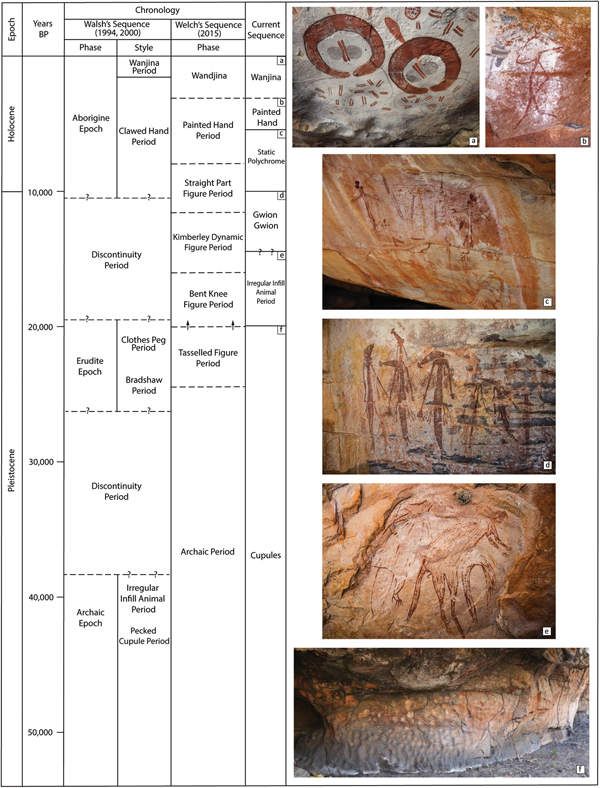
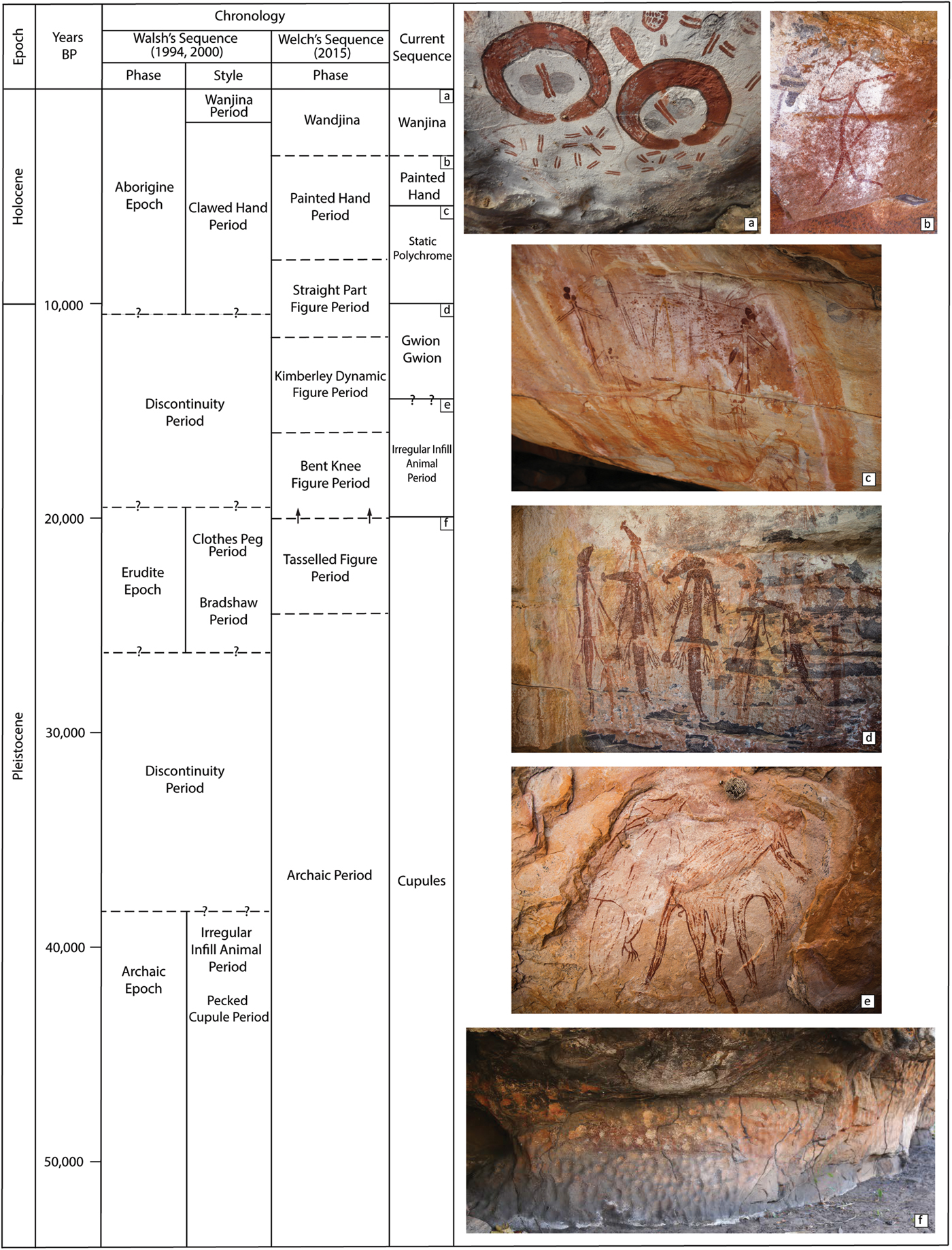
The Kimberley region is located in the northern portion of Western Australia and covers ~423,000 sq. km (Fig. 1). The northern Kimberley rock-art repertoire was acknowledged early on in Australian archaeology and included into Australia-wide stylistic sequences (Maynard Reference Maynard and Ucko1977; Reference Maynard and Mead.1979; McCarthy Reference McCarthy1964; Reference McCarthy1967). The Kimberley rock-art repertoire has been presented as a six-phase stylistic sequence (e.g. Maynard Reference Maynard and Mead.1979; McCarthy Reference McCarthy1967; Walsh Reference Walsh1994; Welch Reference Welch1990) with regional sequences proposed by David Welch (Reference Welch1990; Reference Welch1993a, Reference Welch, Lorblanchet and Bahnb) and Grahame Walsh (Reference Walsh1994; Reference Walsh2000) based on superimpositions and rock-art weathering. Welch's sequence consisted of three major phases: Monochrome Art Period, Bichrome Art Period and Polychrome Art Period (Welch Reference Welch1990, 121): the first period was composed of Bradshaw paintings (hereafter referred to as Gwion), the second by Hooked Stick figures (hereafter Static Polychrome figures) and the third by the Wanjina. On the other hand, Walsh's (Reference Walsh1994) classification was more elaborate, with the art being divided into three Epochs (Archaic, Erudite and Aborigine), each containing a series of groups and sub-groups of paintings (see Figure 3). One of the main differences between both stylistic sequences relies on how these phases or Epochs relate to one another. In his sequence, Welch proposed that each phase was connected to the previous one, whereas Walsh adamantly supported a discontinuity between the different Epochs. This led to a heated debate on the origin of Gwion paintings, with those who supported a foreign provenance (Walsh Reference Walsh1994; Reference Walsh2000) and those who sustained a local origin of this tradition (Barry & White Reference Barry and White2004; McNiven & Russell Reference McNiven and Russell1997; Morwood Reference Morwood1996; Welch Reference Welch, Lorblanchet and Bahn1993b; among others). In this sense, based solely on stylistic attributes (McNiven Reference McNiven2011), it has been argued that the Gwion figures ‘arrived in the Kimberley in a fully developed form’ (Walsh Reference Walsh1994, 41), probably from Indonesia (Hogarth & Dayton Reference Hogarth and Dayton1997, 15), and that these depictions are ‘immensely superior to the ordinary aboriginal level’ (Mathew Reference Mathew1894, 42). As a consequence, some independent researchers and media channels used Walsh's propositions to sustain an abrupt emergence of the Aborigine epoch, not grounded on a deep-time art tradition, leading to the unsupported belief that the art was not made by Indigenous communities from Australia (see Barry & White Reference Barry and White2004; Mathew Reference Mathew1894; McNiven Reference McNiven2011; McNiven & Russell Reference McNiven and Russell1997; Mowaljarlai et al. Reference Mowaljarlai, Vinnicombe, Ward and Chippindale1988, as the most relevant).
Synthesis of Kimberley rock-art style sequences originally proposed by Walsh (Reference Walsh1994; Reference Walsh2000) and Welch (Reference Welch2015), contrasted with the widely accepted sequence proposed by Ouzman et al. (Reference Ouzman, Veth, Myers, Heaney, Kenneally, David and McNiven2018); Veth et al. (Reference Veth, Myers, Heaney and Ouzman2017).
Additional styles to those originally proposed by Welch and Walsh have been presented by O'Connor et al. (Reference O'Connor, Balme and Fyfe2013). The two additional styles of rock art reported from the Southern Kimberley belonged to the Contact period, including black dry pigment; and finely scratched rock art. The authors note that black dry pigment art was often applied to older paintings in order to retouch existing motifs (O'Connor et al. Reference O'Connor, Balme and Fyfe2013, 544), whereas the scratches are often found superimposed over earlier art in an attempt to recreate/imitate it (O'Connor et al. Reference O'Connor, Balme and Fyfe2013, 549).
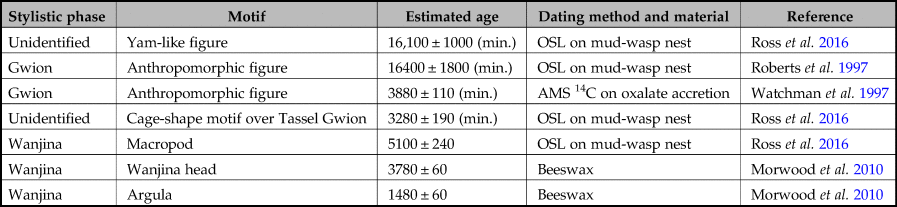
Although direct dating of Kimberley rock art is still nascent, the last decade has seen advances on dating techniques that aim to be potentially applied to corroborate/disprove/modify these style-based sequences, including: Accelerator Mass Spectrometry 14C (AMS), Optically-Stimulated Luminescence (OSL) and Uranium Series (U/Th). The Kimberley rock-art dating can be synthesized as follows: (i) cupules are thought to be part of a colonizing repertoire (Balme et al. Reference Balme, Davidson, McDonald, Stern and Veth2009) from c. 50,000 bp, produced/retouched through time; (ii) the Irregular Infill Animal Period may date from the Late Glacial Maximum from 20,000 to 18,000 bp, based on dating of archaeological evidence of early artistic behaviour and the use of ochres; (iii) Gwion Gwion figures are modelled to have had a span between 14,000 and 10,000 bp (see Table 1); (iv) Static Polychrome figures may have had a span between 10,000 and 6000 bp, as suggested by links between these figures and Hooked Figures from Arnhem Land dated at 9540–9260 bp (David et al. Reference David, Taçon, Delannoy and Geneste2017) and (v) Painted Hand and Wanjinas probably belong to Mid to Late Holocene (Ouzman et al. Reference Ouzman, Veth, Myers, Heaney, Kenneally, David and McNiven2018; Veth et al. Reference Veth, Myers, Heaney and Ouzman2017).
Summary of Kimberley AMS and OSL dates to present.

In accordance with the research questions raised by this study, the aim of this paper is to examine the extent to which groups painting Static Polychrome figures had an awareness of previous Gwion depictions. Therefore, the selection of these two periods was primarily based on shared similarities in body composition and spatial distribution across them. It has been argued that Gwion and Static Polychrome depictions share some characteristics in terms of body composition (see Motta Reference Motta2016; Travers Reference Travers2015; Travers & Ross Reference Travers and Ross2016), such as little interest in sexual detail, head detail and face detail (Travers & Ross Reference Travers and Ross2016, 154) and shared body decorations (Motta Reference Motta2016). In terms of the spatial distribution of these two styles, a correlation between the two periods has been proposed, Gwion paintings being more concentrated in the northwestern and northeastern Kimberley and Static Polychromes extending further to the east (Morwood & Hobbs Reference Morwood, Hobbs and Walsh.2000)
Materials and methods
A series of formal and informed approaches are used to examine the research questions raised in this paper. A formal analysis was conducted on two samples from the Kimberley: (i) a sample based on previously recorded and photographed sites from the northwestern Kimberley and (ii) a sample from northeastern Kimberley obtained during a detailed rock-art recording campaign during July/August 2017. An informed approach is later used in this paper to expand current interpretations of superimpositions by incorporating Indigenous—or emic—perceptions of Kimberley art.
The first sample was based on image banks from previous publications on western Kimberley rock art. A database was developed with information on the geographical location of sites, rock-art styles represented, size of the motifs, pigments used and associated descriptions (Motta Reference Motta2016). The data used here were sourced from high-resolution and scaled plates appearing in Donaldson's (Reference Donaldson2012) three-volume publication of Kimberley art. One of the constraints of relying on this sample for the analysis relates to the skewing towards more detailed and visually impactful examples.
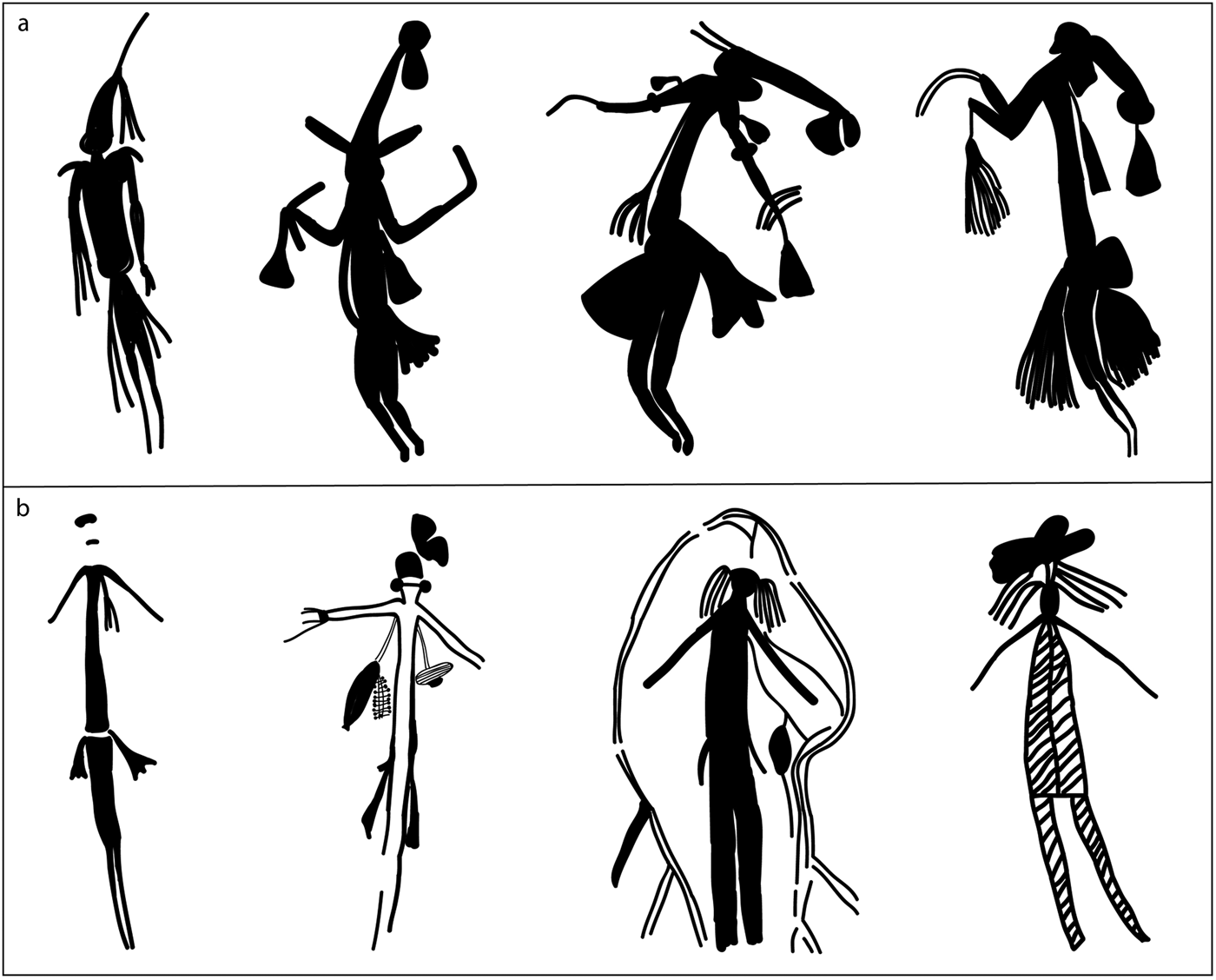
Furthermore, photographs were selected based on the geographical location of the sites and styles portrayed, with Gwion Gwion and Static Polychrome style phases selected as the focus of study (see Figure 4 for Gwion and Static Polychrome variability). A total of 70 images were selected from 67 sites, containing a minimum of 482 anthropomorphic figures (a minimum number was calculated as being detectable with unmodified and D-Stretch enhanced panels) belonging to Gwion and Static Polychrome rock-art styles, of which 403 were superimposed (Table 2).
Variability among Gwion and Static Polychrome Figures. Gwion figures present a wide variability in terms of personal decoration and body composition (a), whereas Static Polychrome figure components are less varied (b).

Superimposition relations per photograph.

The second sample, from northeastern Kimberley, consists of a major site complex recorded by the current author during a 2017 field campaign, as part of the ‘Kimberley Visions: Rock Art Style Provinces of North Australia’ project (ARC LP 150100490). Recording of the site consisted of a detailed photographic record, site plans and site profiles, sketches of the art and the completion of a five-level FileMaker proforma containing information on the art, rock surfaces and site location.
In order to determine if Static Polychrome figures were intentionally placed on top of previous Gwion images, the following criteria are examined:
Criterion 1: Location of figures within a panel. The focus is to identify if other suitable rock surfaces were available at the time of new painting events and if artists placed imagery on top of existing art due to the ‘lack of’ space (Lewis-Williams Reference Lewis-Williams1974, 99; Ucko & Rosenfeld Reference Ucko and Rosenfeld1967, 114; Walsh Reference Walsh2000). The objective is not to determine the percentage of art covering rock-art panels, rather if new depictions were located on top of existing ones when a suitable surface was available.
Criterion 2: Alignment of figures. If new figures lined up with previous ones (Kaiser & Keyser Reference Kaiser and Keyser2008, 44–5; Walsh Reference Walsh2000, 214), the purpose is to examine whether new depictions were positioned as interacting with preceding ones. Alignment considers the placement of new figures in relation to existing ones, and takes into consideration if new motifs were arranged to coincide with existing ones.
Criterion 3: Reuse of existing images. The objective is to determine whether previous depictions were integrated into new compositions (Kaiser & Keyser Reference Kaiser and Keyser2008) by the re-incorporation of older figures into new compositions.
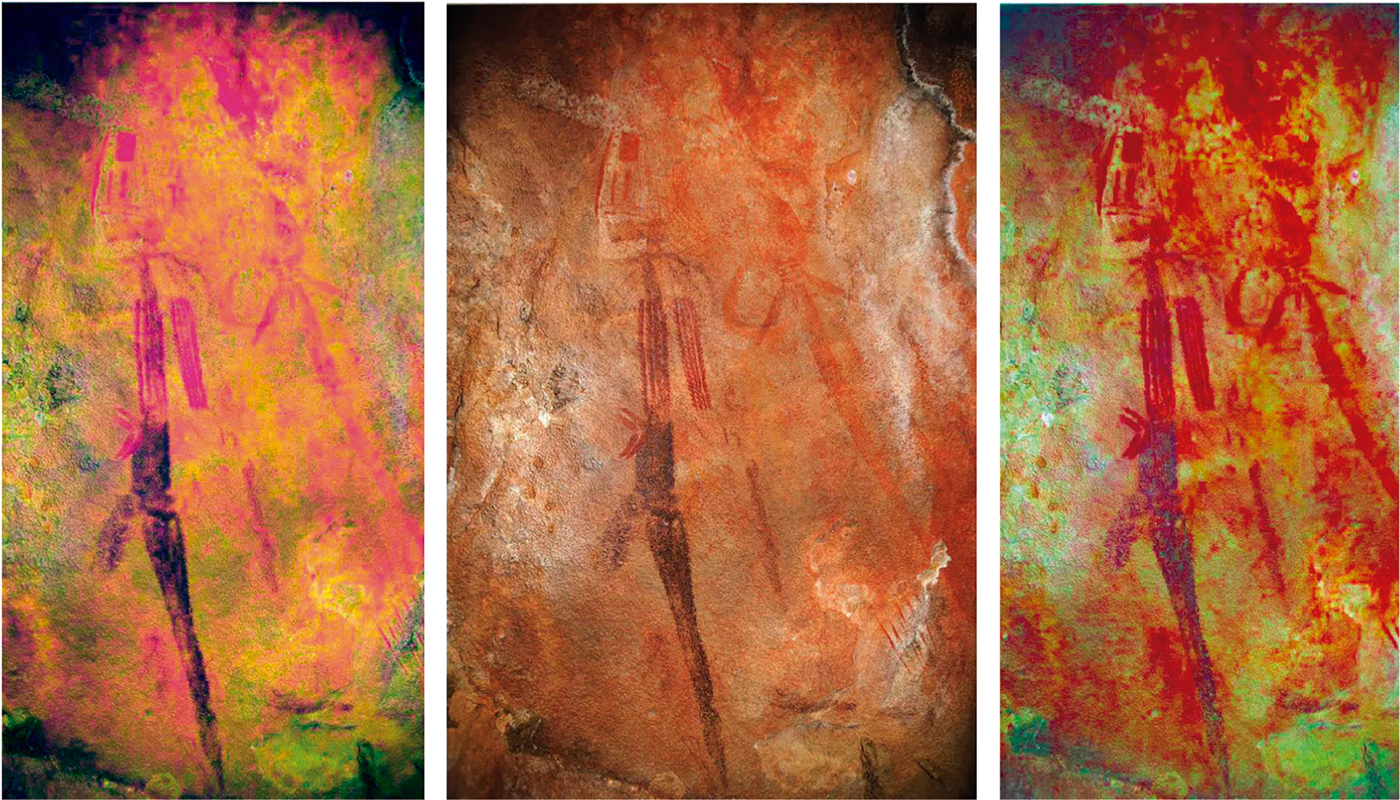
The D-Stretch plug-in from ImageJ software was used as part of the analysis to highlight some motifs. The plugin enhances colour channels in digital images, providing a better visualization of different superimposed figures (Gunn et al. Reference Gunn, Ogleby, Lee and Whear2010; Harman Reference Harman2008). In order to overcome some of the limitations associated with relying on photographs for assessing superimposition sequences, a rock-art site from northeastern Kimberley (recorded by the author on a 2017 field campaign) is used here to demonstrate future applications to other regions.
The character of superimpositions in Kimberley rock art
Northwestern Kimberley
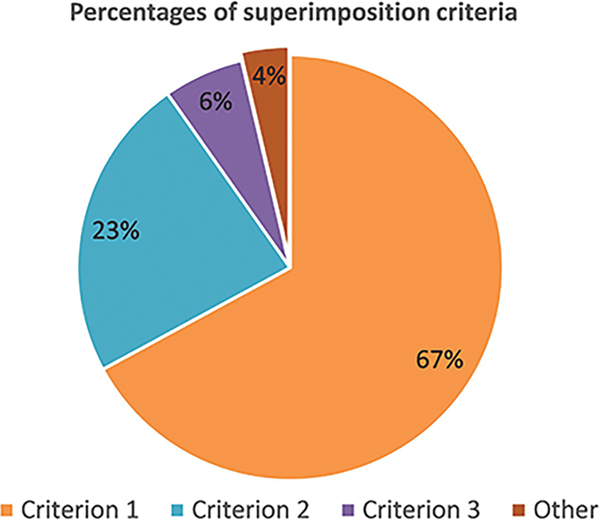
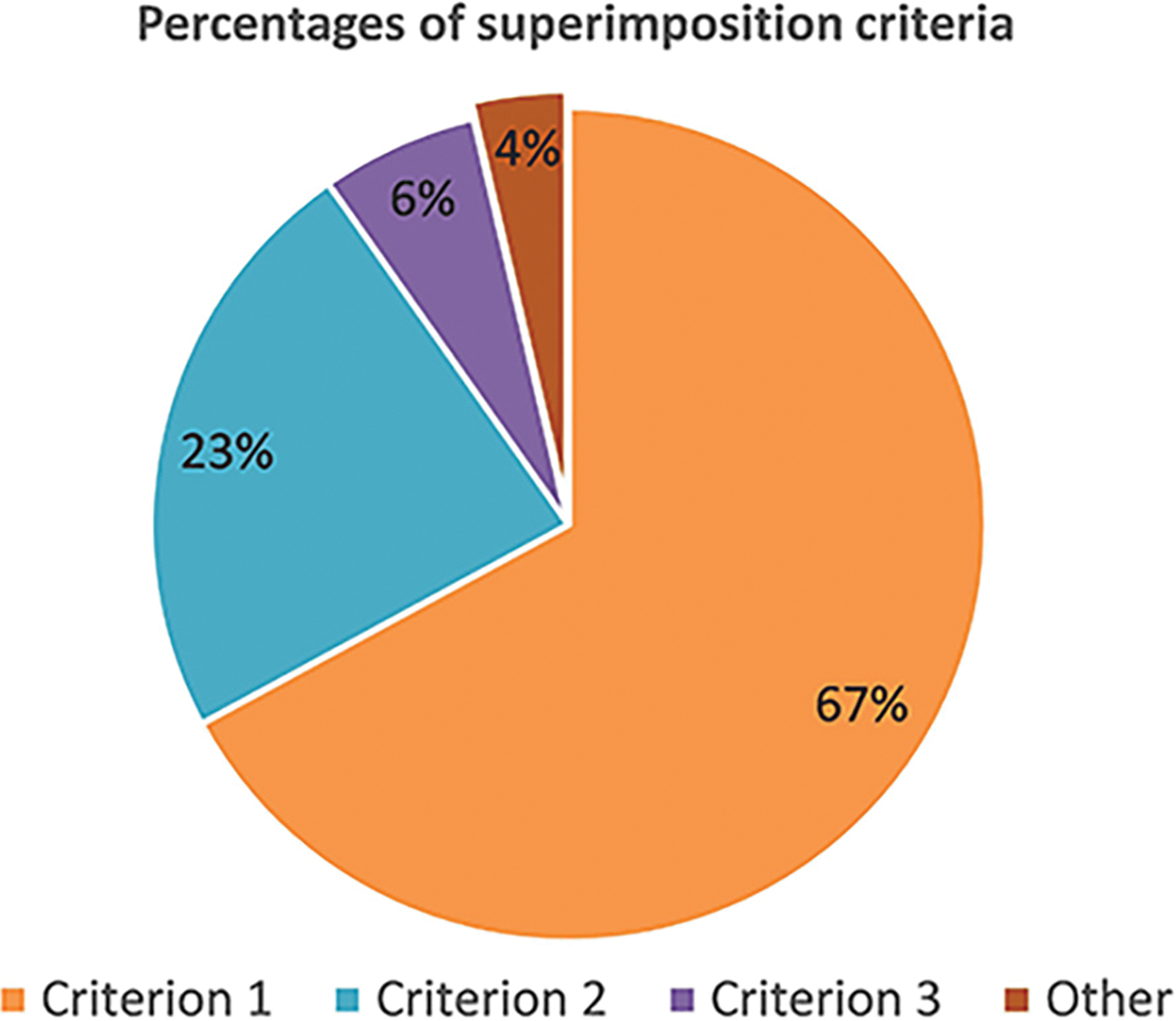
From the total of 482 anthropomorphic figures identified in 70 plates, 83 per cent (n = 403) are superimposed. Of the total of 403 human figures involved in superimpositions, 67 per cent follow criterion 1 (i.e. that new figures were located on top of existing ones in panels where suitable rock surface was available), 23 per cent criterion 2 and 6 per cent criterion 3, with the inevitable conclusion (96 per cent) that the location of new figures within a panel has been carefully selected by artists (Fig. 5). New motifs were placed on top of existing depictions, despite the fact that suitable rock surfaces were still available in most panels. Although the re-use of older art is not abundant among Gwion and Static Polychrome figures (only 6 per cent), the creation of new forms by combining different figures is present uniformly across the sample. In order to illustrate Kimberley superimposition types better, three examples are presented for further illustration.
Chart with percentages of superimposition criteria, calculated on individual anthropomorphic motifs (n= 403). A smaller percentage of the sample could not be attributed to any criterion proposed in this paper.
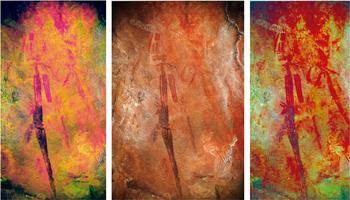
Example 1 – Photograph 19 (Fig. 6)
This scene is composed of three Static Polychrome figures that can be distinguished by colour: the first is mulberry-hued, the second one overlying the first figure is white and the third is painted in pale red. Despite part of the torso being covered by multi-barbed spears, the head and arms of the first figure are still visible, although badly faded. On top of this figure is another Static Polychrome figure, larger in size, finished with a red outline and infilled with a white pigment. The headdress was painted over the previous Static Polychrome figure and appears to be covering the head. It is interesting to note that the new figure is carrying several multi-barbed spears which have been executed on top of the darker Static Polychrome figure and carefully aligned with its body, intentionally serving to cover the previous depiction.
Case Study 1 – Photograph 19: an example of superimposition criteria 1 and 2. Interesting to note is that later SP multi-barb spears were carefully placed on top of a previous Gwion figure, with the spear aligned with a Gwion torso. (Modified from Donaldson Reference Donaldson2012, 128.)
Example 2 – Photograph 32 (Fig. 7)
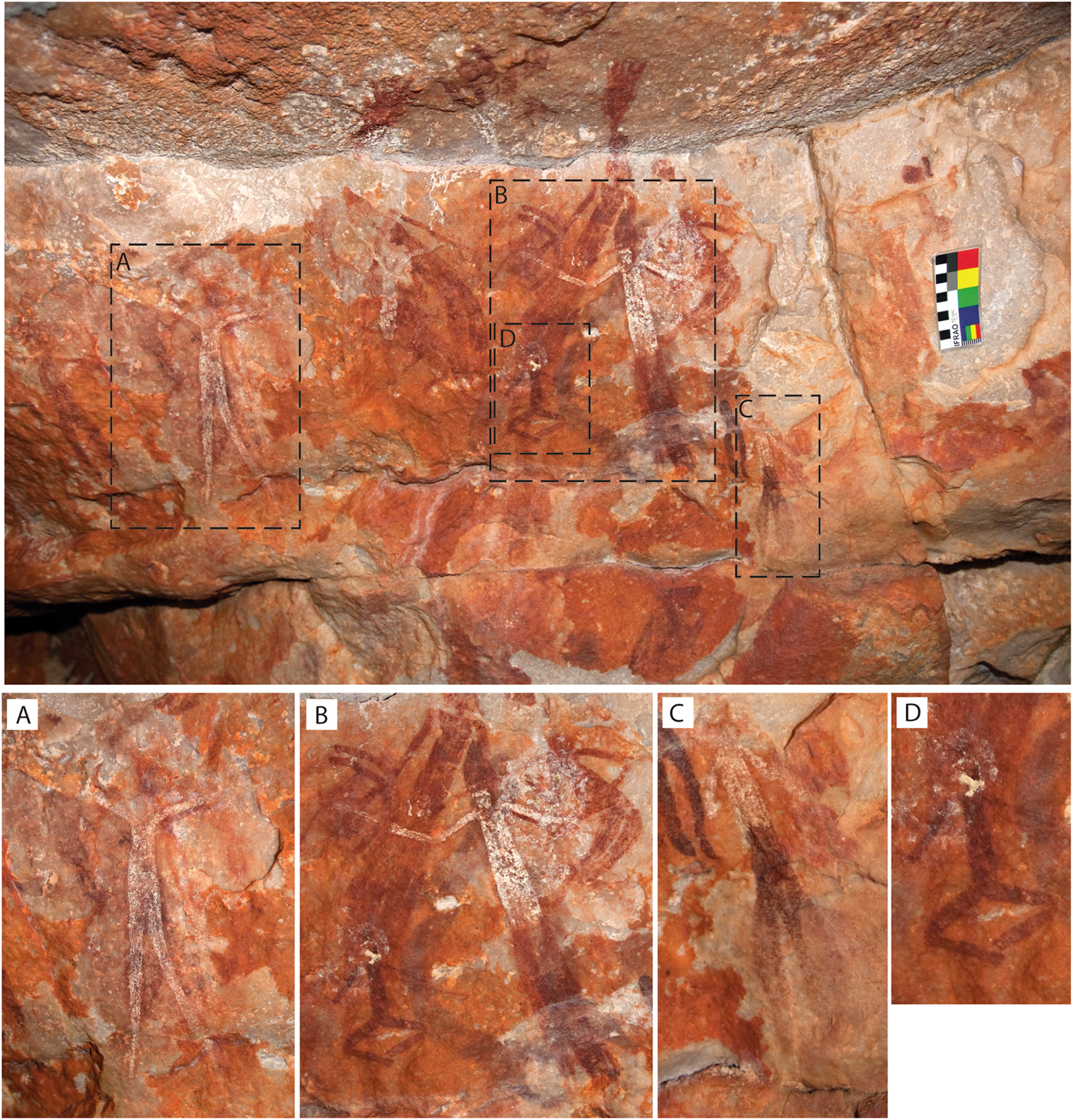
At first sight, this composition is integrated by a complex pattern of superimpositions between Gwion and Static Polychrome figures, with nine Gwion figures located on the right-hand side of the panel and three Static Polychrome figures located across the panel. The panel registers the first and second criteria of superimposition relationships. On the basis of the relationship of figures and their weathering, it is possible to speculate on the sequence of painting events. The first painting episode, or event, comprises a larger Gwion figure to the right holding concentric boomerangs as well as two other figures situated on each side and portrayed in an inclined orientation. The second event comprises the centrally seated figure with crossed legs and two other figures located to the extreme right (highlighted in green), all of which are in darker red colour with no dress decorations. The last event includes the depiction of at least three Static Polychrome figures, painted in white, two of them overlying the larger Gwion composition, with the third figure overlapping an unidentified faded figure (highlighted in black). Of note are two Static Polychrome figures which have re-used the legs of two previous Gwion depictions.
Case Study 2 – Photograph 32: example of criteria 1 and 3 of superimposition relations, with close-ups to the different components. New SP figures were specifically placed on top of older Gwion figures, despite the availability of suitable rock surface in other panels. Additionally, previous elements were reincorporated into new compositions as noted on the detailed photographs. (Modified from Donaldson Reference Donaldson2012, 178.)
Example 3 – Photograph 91 (Fig. 8)
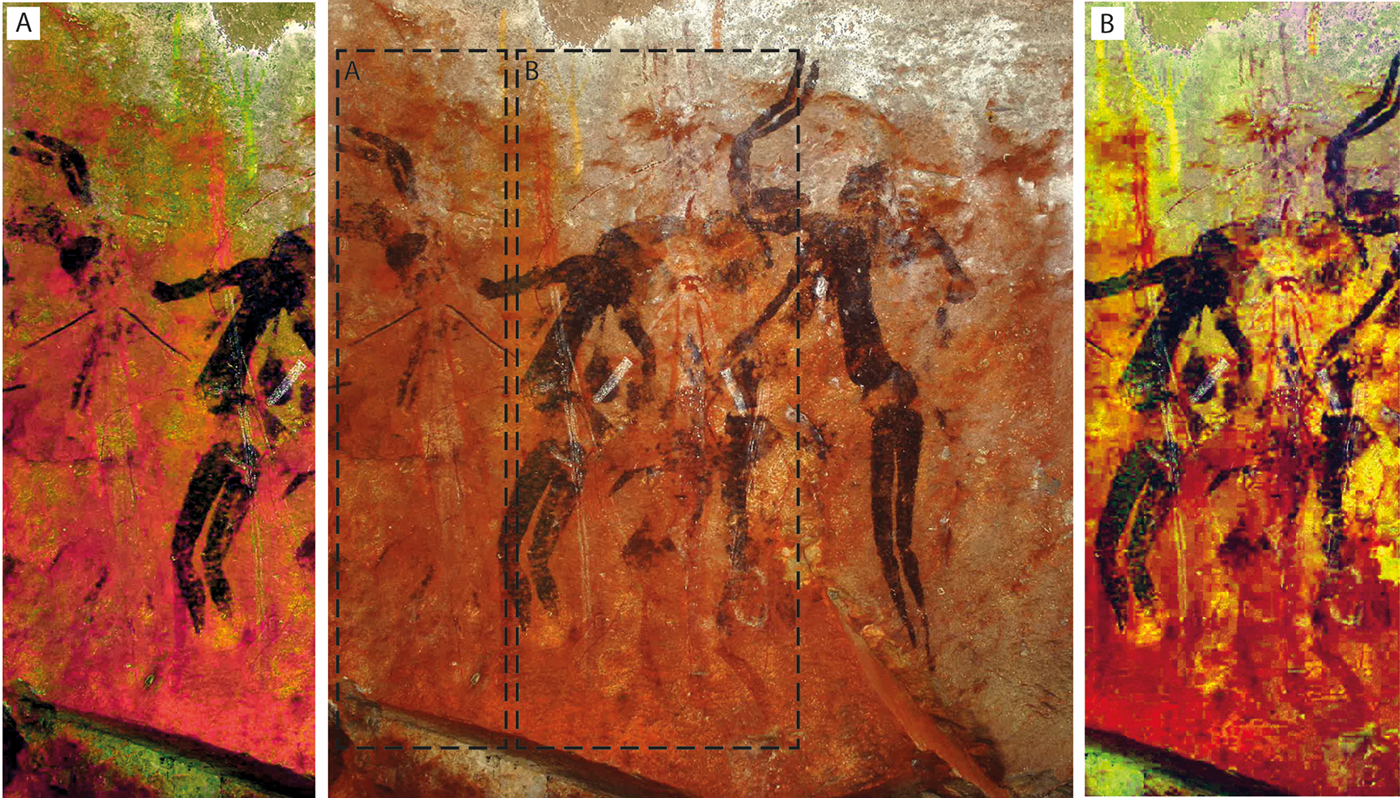
This plate presents criteria 2 and 3 as shown by the intended alignment of new figures and the re-use of existing imagery. In this sense, a Static Polychrome figure (Fig. 8b) has been added over the centre of the Gwion scene. This figure has been depicted in a straight limb posture and plan orientation, contrasting with the Gwion figures depicted in profile view. The additive figure has been carefully placed between two pre-existing Gwion figures. In addition, this figure is carrying two back-to-back long multi-barbed spears at each side of the body, one of them with the barbs facing upwards (on the left-hand side) and the other facing down. Single spears with the barbs facing down have been interpreted as conveying an aggressive stance (Walsh & Morwood Reference Walsh and Morwood1999, 50). However, a closer look at the position of the spear within the scene suggests two alternate scenarios, one in which the Static Polychrome figure is ‘attacking’ the existing Gwion figure based on the interpretation of the spear going ‘through’ the torso, the effect of which is dramatically enhanced through the depiction of an arched back of the earlier figure (located to the left of the Static Polychrome). The other scenario sees the new depiction as simply fortuitously executed over the two figures without any intention to create a new meaning or engagement. Finally, the other Static Polychrome figure (Fig. 8a) has the head outline directly on top of a Gwion arm and headdress; together this creates an intricate new type of headdress with the angular boomerangs now forming part of the headdress detail. This seems like a deliberately hybrid fusion of elements across the two temporally discrete painting episodes.
Case Study 3 – Photograph 91: criteria 2 and 3. Note that younger Static Polychrome figures were placed on top of an earlier Gwion composition, with alignment of some elements (such as the SP headdress and multi-barb spear and a Gwion headdress). (Modified from Donaldson Reference Donaldson2012, 414.)
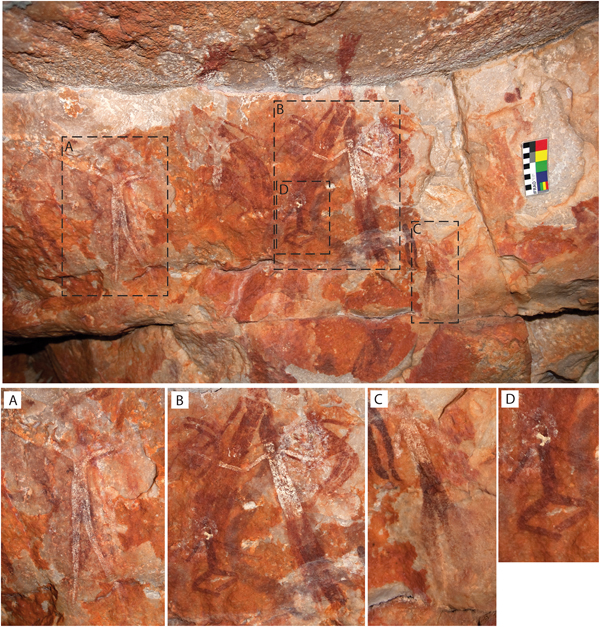
Northeastern Kimberley: Example 4 – KGR188 (Figs. 9 & 10)
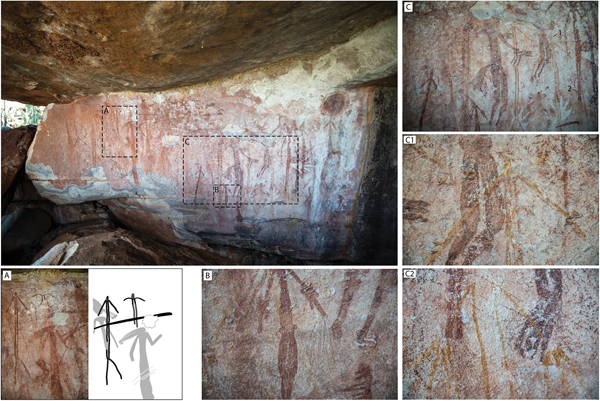
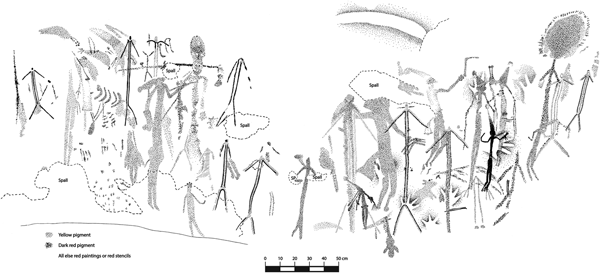
Although the precise location of the site cannot be disclosed, the site is located in proximity to the King George River, on an escarpment facing east. The site complex is composed of two panels, both suitable for rock-art production over their entire surface. Nonetheless, the rock art is concentrated on just one rock panel (facing northeast). At least 34 anthropomorphic figures belonging to Gwion and Static Polychrome style phases were identified, of which 21 are involved in superimposition relationships. The rock panel is covered by human figures, with Static Polychrome figures distributed across the entire panel. Two Static Polychrome figures (Fig. 9a) have been painted exactly on top of two pre-existing Gwion figures. Additionally, two Gwion figures display scratches on their torso and headdress and one Static Polychrome figure has scratch marks on its middle portion. Figure 9b shows the addition of some ochre crayon lines to a Gwion hand that could simulate strings or blood. To the right of the panel (Fig. 9c) there are many Static Polychrome depicted on top of or in between Gwion figures, where scratches and ochre crayon marks are found. It has previously been proposed that scratch figures, at least in southern Kimberley, are part of a post-European colonization tradition (O'Connor et al. Reference O'Connor, Balme and Fyfe2013). It is difficult to determine if the scratch marks found on the Gwion figures and the addition of ochre-crayon lines to one Gwion were done during the Static Polychrome period, or if they were added during a post-European contact episode. Of note is the fact that later Static Polychrome figures found in this panel do not seem to have had their pigments removed or elements added into their compositions.
Case Study 4 – KGR188: superimpositions between Gwion and Static Polychrome figures. (A) and (C) show scratch marks on Gwion depictions, whereas (B) portrays the addition of ochre crayon marks over a Gwion human figure.
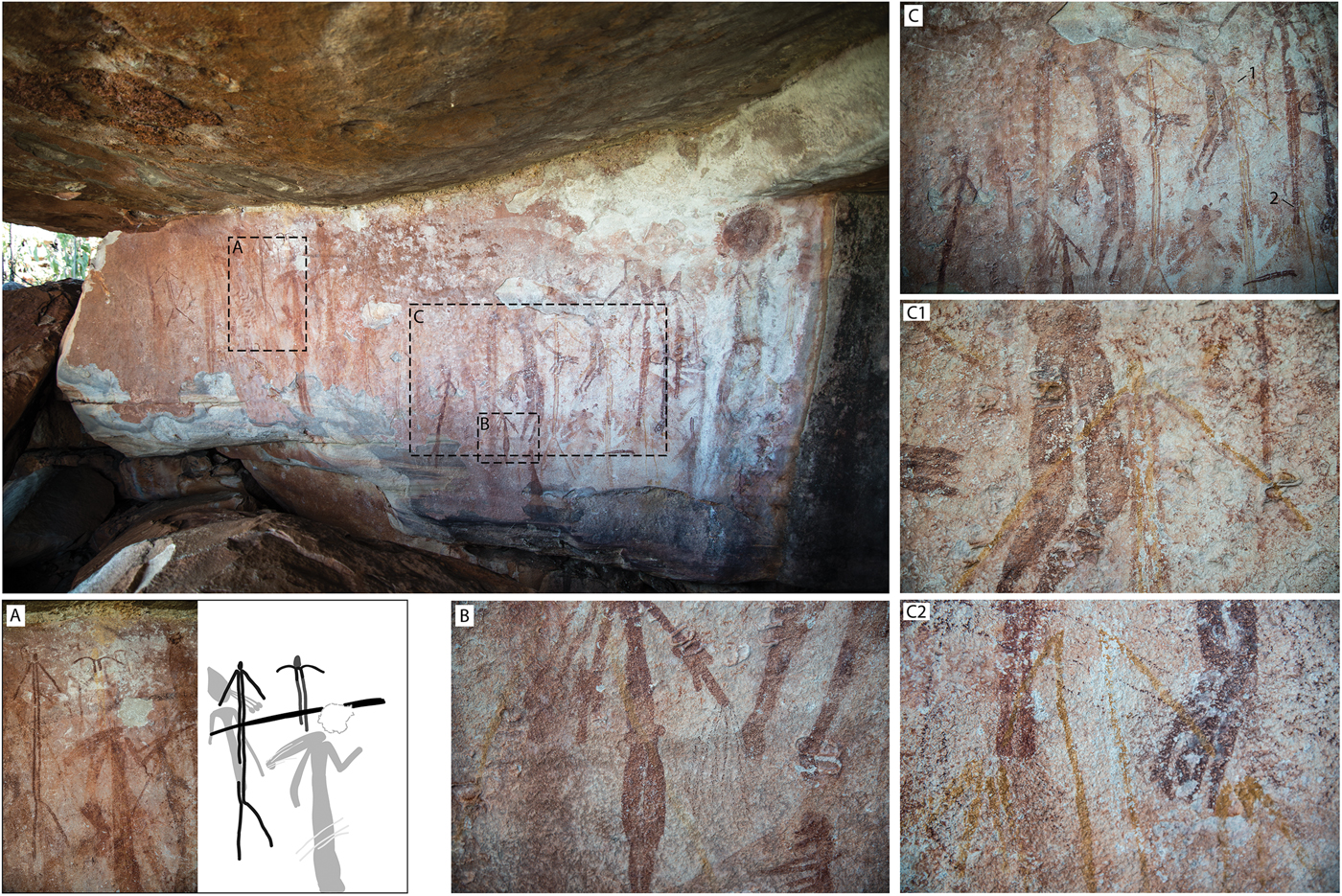
Drawing of KGR188 showing superimposition relations between Gwion and Static Polychrome figures. Spalling events can also be noticed. (Sketch: David Lee.)

Rock-art consumption, the (re)creation of Kimberley art
The present study has established that later Static Polychrome figures were integrated into previous Gwion compositions by: (i) adding figures into previous compositions; (ii) aligning elements of the new depictions into previous ones; and (iii) reconfiguring and re-using previous images and elements to create new arrangements. Superimpositions are theorized here as a reflection of the agency of human groups and how they incorporated previous depictions into new artistic representations. Understood from this perspective, the study of superimpositions has the potential to expand on how descendant groups engaged with and represented past inhabitants at both experiential and ontological levels. It has been proposed that the ‘re-enactment of narrative events from the past’ (Lucas Reference Lucas2005, 84) has the purpose of recollecting the past through the performance of commemorative practices (Connerton Reference Connerton1989, 45). By actively focusing on the role superimpositions played in the past, interpretations can linger instead on the effects past images had on the depictive practices of artists working in the same area in later periods. As such, I propose here that artists were not only producing rock art, but were also consuming and interacting with previous rock-art corpuses and traditions (see also McDonald & Veth Reference McDonald and Veth2013; Motta et al. Reference Motta, Porr, Veth, Horn, Wollentz, Haug and di Maida.in press).
Following one of the research questions raised in this paper—what is the potential of the study of superimpositions for understanding how past populations mediated with their predecessors?—if we consider superimpositions as material citations we can then propose that this practice had the purpose of (re)connecting not only with past populations, but also with the inherited landscape, where artists, instead of being passive consumers or readers, were active players in the (re)creation of Kimberley art. Examples of the relevance that repainting and retouching previous art plays among contemporaneous Indigenous Australians has been extensively recorded in the Kimberley. Repainting practices of Wanjina beings are not only related to the replenishment of resources, but are also a way of reconnecting with ancestors, since each clan is believed to have descended from a Wanjina (Blundell & Woolagoodja Reference Blundell, Woolagoodja, McDonald and Veth.2012, 474; Mowaljarlai et al. Reference Mowaljarlai, Vinnicombe, Ward and Chippindale1988, 692). Some sites testify the long tradition of Wanjina repainting, evidenced in thick layers of paint (Clarke Reference Clarke1978, 59). This practice is intimately linked to the wunan [clan organization system], in which each clan is responsible for the maintenance of their Wanjina. If a clan becomes extinct, another clan of their moiety would ‘inherit’ the repainting responsibility (Blundell Reference Blundell1980, 113). Without intending to make a direct generalization with Pleistocene rock art, we can observe that the repainting of Wanjina plays an important role in clan organization and belief systems, in which the repainting is considered to be intertwined with ancestry that needs to be passed on to future generations.
From the different types of superimpositions found in the northwestern and northeastern Kimberley art assemblages, it can be suggested that Static Polychrome depictions were often intentionally placed on top of Gwion Gwion ones, and indeed were often aligned. Furthermore, superimpositions according to criterion 3 (i.e., that integrate previous depictions with new ones) may have occurred as a way of reconnecting with ancestors and the inherited landscape. From this perspective, the objective is to leave behind negative propositions that ultimately influenced certain researchers to suggest that the contemporary art from the Kimberley Region has no ‘ancestral’ connection to past populations (see Kimberley sequences and chronology section for a further discussion on this topic), and negative connotations of superimpositions that conceives them as vandalization of art instead of intentional practices that connect subjects to their past.
To conclude, I would like to go back to one of the questions raised at the beginning of this article: what are the implications [of the study superimpositions as proposed here] for future interpretations of Kimberley rock art? I have argued that considering the social significance of superimpositions will allow us to re-examine the effects that existing rock-art motifs and compositions have on contemporary practices (Morphy Reference Morphy, McDonald and Veth.2012, 295). This perspective would contribute to leaving behind rigid interpretations of the past in which style equals people and, in contrast, embrace an approach that promotes the cultural continuity of the area portrayed in the re-use and reconfiguration of past depictions as a way of (re)connecting and expanding bodily experience between past and present inhabitants from the area. In other words, alternative explanations of superimpositions should shift from approaches that see them as mechanistic devices to one that conceives them as a potentially generative process which can create new meanings, provide a continuity with past traditions and expand the bodily experience. At present, researchers are starting to incorporate new approaches that consider the long occupational history of the Kimberley and the re-use and modification of its rock art and landscape into their research agendas (e.g. Morphy Reference Morphy, McDonald and Veth.2012; Motta et al. Reference Motta, Porr, Veth, Horn, Wollentz, Haug and di Maida.in press; Porr Reference Porr2018, among others).
Acknowledgements
The data presented in this paper were initially collected during my MSc at University College London and further expanded during my PhD at the University of Western Australia. Data collection in the northeastern Kimberley was funded by the Forrest Research Foundation PhD Scholarship and the ‘Kimberley Visions: Rock Art Style Provinces of North Australia’ project (ARC LP 150100490). I thank and acknowledge the Balanggarra Aboriginal Corporation—especially Ambrose Mungala Chalahimeri and Augustine Unhango—and project partners of the Kimberley Visions team. I am grateful to Jeremy Tanner and Andrew Garrard for supervising my master's thesis at UCL. I thank Peter Veth, Jo McDonald, Sven Ouzman and Bruno Vindrola-Padrós for their insightful observations on an earlier version of this paper; to Mike Donaldson for kindly allowing me to use the photographs contained in his book and Sam Harper for her assistance in obtaining permission to share photographs from the 2017 northeastern Kimberley fieldwork. Lastly, I would like to thank David Lee for inking some sketches from the last field season and for assisting with the recording in the northeastern Kimberley. All illustrations are mine unless otherwise stated.