Introduction
According to many empirical studies, work instability in European societies has been constantly rising over the last three decades.Reference De Grip, Hoevenberg and Williams1–Reference Blossfeld, Mills and Bernardi7 During the last 30 years, Italy has seen a strong increase in the number of non-standard workers who now represent between 12% (see Ref. 8) and 14% (see Ref. 9) of the labour force. In addition, longitudinal research, conducted using Italian demographic cohorts, show that men and women entering the labour market from the 1970s onwards tend to face, much more than earlier generations, the likelihood of being trapped in precarious work trajectories.Reference Schizzerotto10–Reference Barbieri and Scherer13
Supporters of the theory of the fragmentation of inequality suggest that there has been a ‘democratization’ of unemployment and of non-standard, flexible work, producing risk and vulnerability along individual rather than class lines. They argue that the process of individualization might free citizens from group and class ascriptionsReference Dogan14–Reference Pakulski and Waters16 or, in a pessimistic view, that the experience of unemployment tends to concern a widening group of individuals – as Richard SennettReference Sennett17 has famously argued – regardless of the social background.Reference Beck18, Reference Beck and Beck-Gernsheim19 In other words, the risk of becoming poor or unemployed would become generalized, and go beyond the limits set in the past by social classes and level of education. This view does not completely fit with other important studies that suggest greater stability – and even a widening – of class inequalities over the last century.Reference Blossfeld, Mills and Bernardi7, Reference Schizzerotto10, Reference Erikson and Goldthorpe20–Reference Shavit and Müller22
This article aims to highlight that, even if non-standard contracts may affect all social classes, social differences regarding the types of flexibility still persist. Low-educated couples, as well as manual and unskilled or semi-skilled service employees, experience the negative effects of job insecurity more than non-standard workers in higher occupational positions: although temporary contracts are likely to concern both high-middle and low-level jobs, there are wide differences in the capability of workers at different ends of the labour market to compensate for these insecurities. Therefore, higher-earner atypical workers move from job to job or may have many jobs at the same time; they continuously upgrade their skills; they are able to resist downward mobility, relying on capabilities for preventing access to workers from lower positions.23 In contrast, unskilled and semiskilled service employees working in temporary jobs suffer from the worsening of working conditions as a result of deregulation and suffer obstructions if they want to start families.24
At the same time, the arrival of the era of work-portability is touching non-standard workers at the top rather than those at the bottom, as time-flexibility leads to a blurring of the distinction between workplace and home mainly for this group. High-level professionals on temporary contracts and with very flexible time schedules are likely to work around the clock and, consequently, experience a disintegration of the boundaries that divide the realms of work and home.Reference Nippert-Eng25–Reference Muffels28
We hypothesise that there are at least two classes of non-standard workers: a higher, active class affected by continuous connection to work, but rewarded with better salaries and lighter risks and a lower, passive class affected by work instability, but rewarded with a traditional clear distinction between work and family time. To ascertain fully the validity of this proposal, we should look at the entire span of a person’s career. However, since we do not yet know how the work–life trajectories of non-standard workers will end, we have to be satisfied with analysing their occupational status and work–life balance at the current point in time, trying to assemble information about the social differences between low-skilled and high-skilled workers. We will examine whether, within the segment of couples of young adults with temporary jobs, there are already evident disparities rooted in social background. Our data draw upon biographical interviews and descriptive reports of daily life, since in this way we can look at a range of different factors produced by work flexibility and instability.
Furthermore, we will adopt a work–life approach, which means that we take into account not only the labour market, but also the family and the domestic sphere. In this way we can observe differences among non-standard workers more fully. Thus, we are able to understand the implications of social inequalities – even where they have not yet exerted their full effects such as in the transition to adulthood – by observing patterns of family formation, the impact of types of work flexibility, and the role of home and work boundaries definitions in conditions of occupational instability. These crucial factors enable us to study choices and constraints structured by cultural attitudes.Reference Mayer29, Reference Schizzerotto and Lucchini30
Research into couples of non-standard workers
Relying upon two studies carried out in different periods and different cities, the following qualitative analysis draws upon interviews with 84 households of non-standard workers – 35 in Rome, and 49 in Naples – aged from 25 up to 45 years. Spouses and partners were parenting at least one child older than one year and had a temporary job at the time of the research.31 We included partners and spouses who had been working for one year or longer with one or more of the following contracts:32 (a) full and part-time fixed term; (b) self-employment and quasi-self employment on fixed term projects as defined in ‘collaborazioni coordinate e continuative’ or ‘lavoro a progetto’33 and (c) self-employed who are in fact working within a company or directly for an employer.34
The couples who were approached agreed to be interviewed over a period of time, and opened up their house to our frequent visits and observations. Before beginning the in-depth interviewing, we administered a structured questionnaire providing information about work and family life, social origins, educational and professional careers, financial well-being and time management. For the in-depth interviews, both partners were recorded separately at the same time, but in two different locations within the house, with one dedicated interviewer for each spouse. Interviews lasted two hours on average. Both before and after interviews, we interacted with partners, visited every room in their house, and discussed the organisation of their daily life.
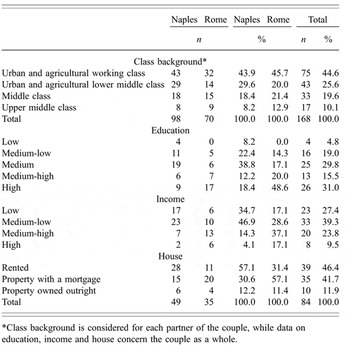
The selected cases of interviewees are not a representative sample of the national or local population of households with both partners in temporary jobs. Gathering such a group would be too difficult, since the occupational status of non-standard workers may change even in a short period of time and official data on the national or provincial distribution of both partners’ occupational status is still lacking. Nonetheless, the social distribution of our selected couples among classes is approximately similar to the national average:35 44.4% of interviewees have a working class background; 25.6% are lower middle class; 19.6% come from the middle class; and 10.1% from the upper middle class. Considering data on the Italian population, our percentages do not differ substantially: 45.5%, 27.6% 16.9% and 10% respectively (see Table 1).36
Class background, education, income and housing status. 168 partners aged 25–45 years old, parenting at least one child and with atypical occupations. Naples and Rome, 2004 and 2005

*Class background is considered for each partner of the couple, while data on education, income and house concern the couple as a whole.
Regarding educational levels, the quota of couples with one or both highly educated partners is slightly above the Italian average. Yet, there is also a large group of medium-low and low educated couples (respectively 4.8 and 19%), mainly from the cases selected in Naples.37 We considered income and housing status as structuring variables: 27.4% of couples of non-standard workers have a monthly net income lower than €1500; almost 40% receive a monthly income that ranges from €1500 up to €2500, whilst the remaining 33% register a monthly income higher than €2500. In any case, the general framework of incomes reveals that many households face problems with their financial budgets due to the fact that both low and medium income families are likely to have an erratic pay pattern over the year. With regard to the houses we visited, almost half of the families interviewed paid rent, while the remainder were property owners, in many cases still on a mortgage. Only 12% owned their homes outright.
Mobile professions versus fluorescent safety-vest jobs
During the process of interviewing and discussing job descriptions and professional profiles, it became clear that the gap between social classes at the beginning of family formation reflects the current occupational stratification. When listening to discussions about the work and life of non-standard employees, a wide disparity emerges between those that have a vocational, qualified, yet higher wage job and those working in un-credentialed or semi-credentialed occupations.
We classified professions in four groups according to prestige, vocational choice, required skills and credentials, responsibility, and the extent to which a job would be considered more or less ‘trendily’ attractive. We assumed that there is a visible group of professions, having real or imagined high remunerability, which exerts a strong appeal on young people who invest money and effort in training, upgrading and entering the right scene to get the job they have always dreamt of. Professions such as copywriter, creative manager, human resources trainer, web content writer or change management expert, researcher, designer, graphic or advertising specialist may be very engaging and gratifying, but when performed under short-term contracts as entry jobs may also be unfairly rewarded and scarcely protected. We included these jobs in the first group of ‘cognitive, creative and expertise professionals’ where one can also find various project, account and retail managers, lawyers and contract experts and a variety of top consultants.
A second ranked group consists of ‘middle employees in the advanced service sector and skilled technicians’ such as diverse engineers, database administrators, law clerks, sales representatives, financial controllers, accountants, internal auditing managers, safety coordinators on site building, hardware and software computer experts.
In third place, we have ‘clerks, sales personnel, rank-and-file personnel and services operators’. It is a category that includes all the jobs based on intellectual work, but not the highest credentials, such as front office and back office clerks, help/desk support and administration clerks, reception operators, secretarial employees, call-centre workers, customer service clerks, client service assistants, primary school teachers, nurses, tour guides, travel agency employees, and airline stewards.
Finally, at the bottom of the ladder, we placed ‘manual, transport and logistic and maintenance and cleaning workers’ who have jobs as surveillance personnel, whorehouse workers, handypersons, carers for the elderly, drivers and couriers, janitors, office cleaners, street cleaners and maintenance workers.
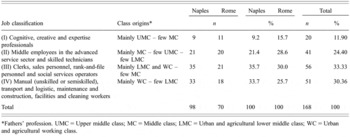
As shown in Table 2, in our research there is an evident relationship between the professional occupation of non-standard employees and their class origins, considered on the basis of the father’s profession: the higher the class origin of temporary workers, the more rewarding and top-rated their current job. This does not come as a surprise: even if the interviewed partners are all non-standard workers, they have very different jobs with prestige and remunerability apparently varying according to their social background. Children of fathers from the working class are mainly unskilled or semi-skilled temporary workers, while their peers from the upper middle class work especially as skilled technicians, experts and professionals in the advanced service sector, or in top-related activities.
Jobs classification and class origins of 168 partners aged 25–45 years old, parenting at least one child and in atypical occupation. Naples and Rome, 2004 and 2005

*Fathers’ profession. UMC = Upper middle class; MC = Middle class; LMC = Urban and agricultural lower middle class; WC = Urban and agricultural working class.
As we know, those who have jobs for which they must be highly qualified also have, precisely for this reason, considerable market value.Reference Erikson and Goldthorpe20 Therefore, an unstable employment position does not automatically detract from a good career path. Couples from the first two professional ranks are competing to reach a well-established economic position and they may also rely on the possibilities offered by parents in terms of financial and networking aid.Reference Millar and Waman38, Reference Devine39
Non-standard workers of affluent origins perform activities based on intellectual skills and expertise, on complex analysis, and on exchanging knowledge. Their activities presuppose high professional creativity, complex abilities in project management, and an acute specialization. In the middle, there are clerks, sales personnel, rank-and-file personnel, and social services operators who appreciate their job because it is not too demanding time-wise, but would like to have a more stable perspective and higher wages than they have as casual and often unprotected workers.
At the opposite end of the job classification spectrum, the old-fashioned distinction between manual and non-manual workers still seems fitting. Men from working class families have manual or semi-manual jobs with hard and physically stressful tasks. The difference from their fathers is that they are not assembly-line blue-collar workers on a nine-to-five schedule in factories. Rather, they have jobs and timetables that vary considerably. They still use their hands to work a wide range of tools, but they wear a modern uniform, which is the new dress code of the urban non-standard working class: yellow or orange fluorescent safety vests indicating that danger, urgency or security are at play. Wives or partners of manual or unskilled temporary workers are employed as call centres operators, client service assistants, cleaning personnel in hospitals, supermarket cashiers, and indoor steward assistants.
Parental support is essential for ensuring that couples can cope with insecurity, but these parents’ professional networks and economic possibilities are much more powerful in the case of the higher social classes.Reference Breen21, Reference Schizzerotto and Lucchini30 When couples of non-standard workers start to establish an independent family, the capability of their parents to ease the transition makes all the difference. It is at this point that the inequality between those with an affluent background and the others, with middle or working class parents, becomes evident. Couples of non-standard workers at the top of the professional ranking can take greater risks, and are equipped with all the energy and skills required; they know that an unprotected, but exciting, unstable job today may turn into in a top-ranking career tomorrow. This explains why couples in qualified professions worry less about unstable employment than those in low professions. After all, for both men and women with careers in progress, the risk of unemployment drops the more highly-qualified they become, as well as according to the social and economic status of their first job.Reference Schizzerotto10
Being on temporary contract is not the real problem … or better I do not care if I am dismissed since I don’t think finding a new job … would be a great problem. As a consultant in a creative advertising company since 3 years I would find another company in a week or two. I just cannot accept the idea that I do not have a paid holiday, I cannot get sick, I do not have an official working schedule … I do not have family allowances … just charge of a project, and that’s it … You work until the end of it … no way out.40
The greater capability of families from the upper and middle classes to support their temporarily employed children in their professional careers plays a key role in protecting them from the uncertainties of the labour market. This is a typical example of the social reproduction of differences through kin and informal networks.Reference Saraceno41 It works remarkably well in the context of the Italian labour market, where family and small enterprises really count in determining the professional opportunities of the youngsters.Reference Schizzerotto10, Reference Millar and Waman38
I started working as a financial specialist in my father’s friend’s small company … where I am still working, even if in a temporary position. It is their policy … you cannot change it, one has to accept their rules. It is not bad anyway, wage is OK, although they have been driving me workaholic.42
I have been studying all my life. I got a degree, a masters, and also further specializations as a copywriter. Entering the media sector is too hard. You have to know the scene, enter in the right circle, make a long training and go to different workplaces, because none give you a chance unless there is someone else who guarantees for you. In my case … well … my uncle did a lot of sponsoring .. at the beginning, I used to be underpaid, while after some years, the job is satisfying, interesting, they pay me better … well, on short-term project contracts, but you know .. today it is the canon.43
I started with my first worth job thanks to a friend of mine … He introduced me in the field of human resource management. I had a very ridiculous contract of three months. But there I learned a lot and then my father-in-law finally helped me in getting this position I currently hold at [an important Italian energy company] where I am assistant director in human resource management. I feel the job is OK. I do not mind being temporary, what it is essential for me is to go on gaining experience.44
The first impact of social class origins on temporary workers is therefore the extent to which their families are able to carry them throughout their education and in the labour market, and to support them during the transition to definitive professional achievement. Partners relying on their parent’s social and economical assets are able to better plan a path for their professional and family life because they do not feel anxious about their unstable working conditions.Reference Salmieri45 Fathers and mothers of highly-qualified temporary workers not only substantially ease their children’s way into the professional arena, they can also support their children while in the stage of family formation, and in their progress along the uncertain path of career achievement. They offer financial support during periods of unemployment; they may have contributed to buying an apartment or may have donated one of their own; they have often shared some of the new family budget costs – such as babysitting, a family car, or overheads for holidays – in order to keep up their children’s standard of living.
Let’s say that they help from time to time. [Could you give some examples?] Oh, yes … to tell the truth the most important help was when they decided that the apartment they bought in the 1980s would be mine once I would get married, and that is what they did. Now, at present, I do not feel comfortable to receive money or financial support from them anymore, because we are independent, but it is obvious that in case of need theirs is the first door to knock on … I have to say that without their help we would not have had a place where to live, at least a place of our own, we would not have been able to settle easily and comfortably, we would not have been able to cover the initial big expenses, etc.46
Couples of non-standard workers who benefit from their parents’ affluent status experience a sort of ‘assisted independence’. However, compared with couples from lower strata, help and support are often less evident, more discrete and only in the case of unexpected needs. The ordinary monthly budget does not completely depend on the parents’ funding, unless a very short period of unemployment or of lack of income may call for a loan. Financial aid is given so that the couple might be able to afford a holiday, pay a second babysitter, buy a deluxe washing machine, or to come up with the money for unexpected medical care.
By contrast, stories from middle and lower classes couples of non-standard workers indicate that if their parents help out, this aid is often of a basic kind: a small flat where the partners lived before getting married; part of the parents’ house the parents converted specifically for the new couple; old and tiny cottages in semi-urban areas, which frequently figure in the early life of a low-skilled couple or continue to form part of their present life.
My parents-in-law have been determinant during our settlement. They contributed as best they could to our fervent wish: to purchase a house. We did not succeed yet, because, you know, prices are getting higher and higher and mortgages are unaffordable for us. My and my husband’s salaries are scarcely sufficient to cover ordinary monthly expenses, so my parents-in-law have to intervene from time to time, at least to pay the apartment rent. It is not easy for them, as they cannot count on a large amount of money, their wages are not high either.47
Couples from lower strata living in rented accommodation have to face a double uncertainty: work instability plus housing anxiety. Plans to purchase a flat have to take into account the risk of unemployment, and have to rely on the ability to manage short-term jobs with efforts to save money. The desire to generate savings that could enable the purchase of a flat in the future has to be balanced with the costs of renting in the present. This means having a tricky time in shaping the new family life: disadvantaged couples find shelter in their family’s home, sometimes living in a ‘teen room,’ or converting a garage for the baby’s needs during the early steps of parenting. Once these couples finally find a house to live in, they are not in the position to purchase it or still have to rely on their parents’ help to be able to pay the rent. It is not by chance that owners of apartments are heavily concentrated among couples from higher professional positions, while of 26 couples at the bottom of the professional rank (fourth position), only three own the apartment they live in. Interviews disclose a scenario of debts, the selling of small family estates, continuous sacrifices, and saving money. Their parents can secure neither economic solidity via financial aid, nor occupational stability via informal networking. The parents’ role is therefore more likely to be a bare minimum support, a basic aid in the face of continuous emergency situations. Emotional bonds tend to substitute for financial transfers: unskilled or semiskilled women on temporary contracts often go to recover from childbirth at their mother’s house, and turn to their mothers when ill or overworked. This close link appears to be crucial for couples facing economic uncertainty and work instability, since those that cannot rely on their parents’ help because of geographical distance dividing families also cite it as something they lack. Not a small number of couples highlighted the lack of this kind of help when it came to the many problems of the organization of day-to-day life, and especially of child rearing. The typical admission from the luckier mothers is: ‘we take advantage of the grandmothers’.
Is flexibility the same for all?
Experiences of ‘work flexibility’ and ‘work instability’ change gradually when moving down from the top-ranked jobs to the less prestigious ones. But before examining this issue, it is crucial to make some observations about both flexibility and instability. Although the concept of work flexibility is increasingly used in a general framework, indicating both the de-regulation of labour market and the variability of contents, tasks, timetables and skills in the workplace, it is necessary to make some clear distinctions here. Literature on the labour market and work organization distinguishes many types of flexibility.Reference Atkinson and Meager48–Reference Wallace51 Here, we focus on contract flexibility, time flexibility, functional flexibility, and place flexibility. If contract flexibility concerns employment relations with a fixed term contract and should designate the high probability of registering more frequent periods of unemployment during the life cycle as a result of an increasing number of temporary jobs, then conversely functional flexibility should designate the possibility of doing various types of tasks, involving different skills. Time flexibility indicates the likeliness of having rotating shifts, working overtime, working around the clock or against deadlines; and place flexibility indicates the extent to which workers are required to change workplace to do their tasks.Reference Hirst and Zeitlin52, Reference Esping-Andersen and Regini53 Not only temporary jobs, but even secure, long-term protected jobs may require being flexible in times, tasks, skills and workplaces.Reference Boyer54–Reference Thompson and Warhurst57 Hence, contract flexibility may be automatically considered a synonym of work instability, but this is not the case for the other three types of flexibility: patterns of time flexibility (part-time, rotating shifts, work-on-call), functional flexibility (variation of tasks and requirements) and place flexibility (changing workplaces) can be attributed to fixed-term contracts as well as secure permanent jobs. The distinction between work instability and types of flexibility is thus crucial if one inquires into the nature and extent of social differences among non-standard workers.Reference Yandle58
Until a wider set of data and records of a complete professional life cycle are available, qualitative research cannot empirically determine the probability and duration of work instability among various non-standard workers. Still, qualitative methods and interviews can at least account for an evident difference regarding the way couples at the top and at the bottom of temporary jobs ranking consider the menace of unemployment. Interviews with cognitive, creative and expertise professionals illustrate that being on a short-term job contract is not the undesirable side of their work position. What may create discontent in higher temporary professionals is rather to be continuously involved in work activities, with no time distinctions. As a matter of fact, among temporary workers in higher positions, job demands are associated with longer work hours and often undefined work schedules.Reference Salmieri45
I like my job … or better, let’s say that I love my job … The salary is quite good, there are also balanced rewards and incentives … and I do not care too much about being temporary, since I guess sooner or later I can get permanent or switch to another company… Every day is a new challenge and I appreciate working along with my co-workers … what is … I do not say wrong … but what is hard to sustain is that we do not have established timetables, you know when you start working, but you do not know when you will finish, or you have to track deadlines, which normally means a huge load of working nights and days, working at home … it’s stressful … if there is a big purchaser to work for, a project to be completed, you forget family, your children, your free time…59
A 33-year old career woman expresses similar feelings about work instability and time flexibility:
The most obvious thing I should say as a woman and as a working mother is that time flexibility is good, but in all honesty, I cannot say it is always the case. You think, ‘Well, I do not have fixed schedules, that’s right, I can arrange myself according to my needs’, but after you discover that there are plenty of collateral effects … you are just working twice as much, because you cannot say no when time is getting tight. Officially I have a limit of 160 hours a month, that means that I am not required to do more if I want to get my minimum wage, but when you are committed, you just do not count the hours you work … for example when bringing work home, I do not register my working hours. [Anyway, are you dissatisfied with being on temp?] Oh, that is not a problem. I mean, I would probably get more legal protection, but I want to keep my job proving that I deserve it, not because they cannot dismiss me.60
Socialisation and cultural loyalty to the imperative of competitiveness may explain in part why higher professionals accept short-term contracts.Reference Hochschild61 However, if those in higher professions show little or no discontent toward the latent instability of their occupation, it is mainly because of the scanty occurrence of unemployment episodes. Comparing the last five years in the occupational lives of higher professionals and manual workers, the latter are four times more likely than the former to have suffered periods of unemployment. In addition, unemployment with manual workers lasts on average three months longer (five against two months). Thus, it is the least educated and least qualified partners, who have the least social and cultural capital,Reference Bourdieu62 that start their working lives in poorly qualified jobs and experience the longest periods of time in unprotected jobs. Indeed, the experience of working conditions that are utterly without legal or contractual security presents a linear association, in a negative way, with social class. Couples that work as clerks, front- and back-office operators, shop assistants and other mainly manual workers, aspire to long-term employment contracts and see it as the definitive rescue from both family budget uncertainty and dependency on parents. Disadvantaged couples – fed up with economic restrictions, hard sacrifices, and precarious conditions in the hope of a stable, protected and secure job – give priority to the instrumental and the vocational side of a job, to get a secure and protected occupation.
Every summer I pray God I can have my job-contract renewed, because it is always a lottery … I work as a temporary teacher at infant schools. In order to get the job I have to wait for vacancies or some permanent teacher who calls for long absence. Well, you know how hard it is to get a permanent contract. It would be my joy. In the meanwhile I have to consider even the risk to be left unemployed for one year that would be a catastrophe … my husband’s salary is inadequate and we already live beyond our means. [Do you like the job you do?] Yes I do … it is a job like many others … I like to be in touch with children, I like to teach them something useful for the rest of their lives, but I would not die for it … I mean … give me a permanent contract, with paid holidays, sick days off, duties and rights and I’ll do whatever job.63
The disadvantages of the various types of non-standard contracts are named with unerring precision: paid holidays, maternity leave, parental leave, sick pay, pension funds, these are the sorts of safeguards and guarantees, the absence of which, or at best the partial presence of which, is lamented by all couples at the bottom of the professional ranks. Understandably, there is a good deal of resentment about this inequity, and not a few low-skilled workers aspire to nothing more than getting out of their non-standard job to enter a more protected, but even lower-paid job in order to enjoy more rights.
That is why I would even take a lower-wage job, providing it is a permanent contract.64
The attitude of a 36-year-old truck driver towards temporary contracts could be extended to many other interviewees in the same position:
I do not like the situation of being continuously under pressure. The fear to lose your job is always with you. You do not work and live in an easy way. My wife and I always fight on where to cut to save money in case of need, if I get fired or when they leave me hanging on for one month before renewing the contract. Hard times come when my wife does not get the pay regularly at the end of the month. They used to do that, invoking all sorts of odd justifications. [Would it be so difficult for both to find another, more secure job?] Well, it is just what we normally do … cause we look around for better jobs, but we cannot move to another town because my wife needs daily help from her mother in order to care for the baby… Besides the fact that to tell the truth her job is not bad. Caring for aged people is something she does not dislike; the hours are not bad … it is just a matter of being treated more fairly, of being paid regularly and hopefully of getting a permanent position.65
If work instability affects temporary workers differently depending on social class, education, and the professional skills they have, functional flexibility is distributed more erratically and seems to be welcomed or not according to subjective points of view. Varying tasks, changing working processes, shifting goals, and skilfully using opportunities, are doubtless both a persistent requirement in, and an appreciated facet of, the specific work organization of higher jobs; whereas going down to lower job positions, functional flexibility seems to be less pervasive. Nonetheless, all temporary workers declare that they appreciate functional flexibility, provided that their companies and enterprises take the necessary measures, and make available enough and useful means to allow for the transition. If not, manual and semi-manual workers, especially female ones, blame small enterprise policies aiming at downsizing the workforce, making the hierarchy of accountability too flat, and requiring workers to perform to demands that change too fast, without allowing for the time required to re-train themselves.
Every day you have to face great challenges in performing a job which would be otherwise very easy to organize. You arrive at work and you find you will not serve food during your timetable because now costumers are invited to serve themselves and you are charged with checking that the food is correctly prepared and displayed on the bar … Oh, that’s good, it is more fun to do that, except that you do not how to do it properly. Managers change work rules and organization from day to day without being on the work floor themselves, without knowing how things really work, without letting you prepare to do your job … no explanation, no reason … it is just you, co-workers and thousands of customers everyday. It is up to you to solve problems as they come up.66
Among clerks, sales operators, rank-and-file personnel and social services workers, functional flexibility is supposed to be less dominant, because of the association with standard and bureaucratic working procedures. Nonetheless, changing patterns of work may produce some forms of discontent when imposed from the top.
I like to deal with changing tasks. I like to choose myself and to prioritize what needs to be done everyday. The problem is when supervisors suddenly ask for doing something we are not supposed to be asked. The result is that I have to work harder in order to complete the workload within the closing time.67
It is on the issue of time flexibility, then, that another clear difference shows between the top and the bottom ranks of temporary workers. In this case, contrary to what we saw before, it is those on the higher professional levels rather than the middle and lower ranks of temporary workers that seem to be discontent. Manual and semi-manual workers, along with clerks and other employers in the middle ranks, even when they work shifts, on average work to a fixed and scheduled timetable that enables them to know in advance when they will start and end their job. On the contrary, cognitive, creative and expertise professionals on temporary contracts usually do not have a fixed timetable, and work times often spills over into family life.
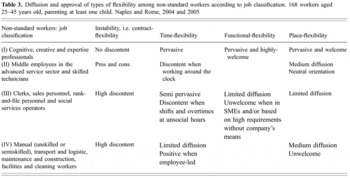
Table 3 offers a schematic representation of the relations between types of non-standard jobs on the one hand, and instability and types of flexibility form on the other.
Diffusion and approval of types of flexibility among non-standard workers according to job classification. 168 workers aged 25–45 years old, parenting at least one child. Naples and Rome, 2004 and 2005

Home and work realms
The third difference between high and low-skilled temporary workers could be seen as a direct outcome of the second: the greater the responsibilities, the autonomy and the salary, the more blurred the boundary between work and not-work, workplace and home, professional commitment and private life. Generally, jobs with higher intellectual content are those that claim the most of people’s time.Reference Moen26, Reference Hochschild68 A warehouse worker, in contrast, feels the weight of his responsibilities only until the warehouse closes, not a minute longer. With an eye to the so-called ‘family-work nexus’Reference Esping-Andersen69 it does not really matter whether time-flexibility is employee- or employer-led.Reference Wallace70 While low-profile non-standard workers tend to shelter their home from the impact of hard and stressful working hours, carefully closing mental doors to work requirements when it is family time, high-skilled workers tend to turn their home into another workplace, as their work can be done everywhere.
We have found it useful to recompose the myriad ways respondents used to describe and juxtapose ‘home’ and ‘work’ as a continuum. The possibilities range from ‘integration’ to ‘segmentation’. Within the ideal-typical position of ‘home’ and ‘work’ as fully integrated, no distinction exists between what belongs to ‘home’ or ‘work,’ and when and where they are engaged. Within this integrated paradigm, we find both women and men from the high professional and ICT flexible jobs. For them, the various realms intertwine and they conceptualize them within the same mental framework. Whether designated by an outsider – the interviewer – as ‘home’ or ‘workplace’, for these extreme integrators almost all space and time is multipurpose: non-standard couples working at home change their residential environments to support their work activities and meet their psychological needs. The continued increase in the usage of personal computers and associated technologies such as wireless and broadband access, exacerbated by the pervasive use of e-mail and instant messaging, has led to a blurring of workplace and non-workplace for many of them. Digital and communication devices – advantaging higher skilled professionals over a semi-skilled and unskilled workforce in the labour market arena – form a double-edged work tool: on the one hand, it allows for work to be done in and with the family; on the other, it makes work performable in any moment and place.
There is no family time … family time consists of some particular event, or when I put my kid to bed and I tell him a story. The difference between work and home is just that when I am at work I’ve got my colleagues physically close to me, while at home I can take a rest, going down to smoke a cigarette, or have a talk with my wife, provided that she is there, or I can have a snack.71
Thanks to digital and mobile technologies, and because their work content is much more information-related, temporary workers in higher professions may work anywhere.
I used to consider my work over, after switching off my mobile phone and laptop … but I still stay mentally connected for a while, because when I am at home I am in the habit of checking my agenda, to plan the next day, or to read a few reports left on my desk. [So aren’t you able to separate family and work clearly?] It is not that I cannot … it is rather that I do not want to … I mean … this way I can share my working hours with my children. It is true, it is not quality time when you are on the laptop and your child is asking for attention, but it is better than no time at all.72
At the other end of the continuum these aspects of social existence are conceived and negotiated with the partners and co-workers as completely segregated worlds. This is the typical approach of the clerks and manual workers we interviewed. Their mental boundary between realms is clear and impregnable, and they resolutely uphold the distinctive character of each sphere. Manual workers on lower incomes and female part-timers back on the labour market after childbirth try to adapt their time schedules to each other. The segmentation approach asks for a rigid separation, enforced above all by the home and workplace remaining physically separate. The wearing of different clothes or otherwise changing one’s appearance can reinforce this.
Manual contingent workers are advantaged in this by the non-portability of their tasks: their work content cannot be moved from the workplace to somewhere else. Thus, they are able to keep workplace and working time firmly separated from family time and place. The gap between the knowledge specialists and the manual workers has implications for their respective use of free time too. The knowledge workers go on thinking about, or even actually continue with, their work after they have left the office, at home, with additional stress in the evenings or at the weekends. This is the price they pay for having an ‘interesting’ job that ‘never lets you get away’. The manual labourers, on the contrary, work very hard physically, but once at home they claim that they: ‘Completely switch off from work’; ‘Left all the strain and worries at work’; ‘Do not exist for anyone, except for my husband and my children’.
Unskilled or semi-skilled temporary workers do not enjoy what the sociological literature on work–life balance use to call ‘positive flexibility’.Reference Boje73, Reference Boje74 As a matter of fact, couples in middle or poorer jobs are rarely able to determine their timetables or shifts; but they can at least rely on being able to ‘switch off’ when they leave the workplace.
Oh, no… It is not me who decides which days I am on schedule. Normally, I am notified one week in advance … therefore I can arrange things and plan with my husband how to cope with my son… And once the schedule is handed to each of us, there is no way to change it … That is bad … from one point of view … because if you need a day off you cannot exchange with colleagues, but at least there is no change during the week all of a sudden. [But can you for example ask to start an hour later, or finish an hour earlier? In case of family need…] Yes, officially you can, but I tend to not ask for it, because otherwise the bosses claim they cannot count on you … I prefer trying to solve family matters by asking my mum to help out.75
I work on Mondays, Wednesdays and Fridays from 6.45 to 11.45 a.m. and the other days from 11.45 to 16.45 p.m. Saturdays and Sundays are off, except for two Sundays and two Saturdays a month. It is a little bit odd to alternate working times each day, but you soon get accustomed to it. [Who decides on the timetable … I mean, can you change it according to your needs?] I do not know why they have these rotating shifts … well, you can ask someone else to exchange shifts, if you have to … or you can ask for a leave a few days in advance, but it is not up to us to chose when we want to work, otherwise everyone would take the second shift … you know, to be at work at 6.30 in the morning is stressful. [Do you take work home, or do you think about things related to work when you are at home?] That is very uncommon. The nice side of my job is that once you leave the hospital, work is over. Working at the emergency front-desk sometimes makes you wonder whether a patient is still suffering … sometimes you may have flashbacks of serious injuries, but you try to keep this apart from your private life … when I am home I just try to relax and enjoy my children.76
Can flexible higher professionals say as much? Not likely. In the case of the creative professions, the level of autonomy is directly proportional to the number of projects in which one is involved, and various consultants highlight the importance of continually keeping up to date, both as to knowledge and the extensive use of computers: in their case, every moment of the day is useful to make progress. Consultants, experts and specialists on temporary contracts tend to arrange their daily priorities according to professional requirements even more than their permanent colleagues do.
I do not consider my job as heavy. I get excited when there is a problem to be solved and I can go on thinking about the possible solution until I find one that sounds suitable. It is also a way for me to prove that I can succeed as well as a permanently employed expert. When the doors close, I go on working at home, if necessary.Reference Perrons, Ward, McDowell, Ray and Fagan27
Temporary workers in high profile jobs admit that the price they pay for their strong work commitment is a frenetic and hectic family life. In order to care for their children they often have to rely on babysitters, childcare centres and kindergartens, or ask for help from parents and other relatives. When one partner has to go on an important business trip, or has a whole day team group meeting, the other partner has to be pressed into service to find a solution for the kids. Clashing work–family needs are an ordinary issue with couples in higher positions.
Every evening we have a fight over who has more reasons to pretend to have to work the laptop instead of doing the housework, playing with the kids, or cooking something to eat. The fact is that each of us has an important job and we both love it and it is very time-demanding, so we both try to work a bit before of after dinner.77, 78
To be able or allowed to work at home is often presented as an opportunity created by recent transformations in the workplace, first and foremost the information technology revolution. Nevertheless, instead of replacing the office with the home, many higher-end workers end up making the latter part of the former, taking over the sitting room, the kitchen or even the bed, with whatever was not completed on the computer at work.Reference Castells79
How couples of non-standard workers demarcate their work and personal lives also leaves traces and signs in the organization of their domestic space. Couples of non-standard high-skilled workers on portable jobs often do not have the classic TV centred living-room. Instead, they have re-shaped it as a working area where computers, printers and monitors share space with sofas, bookshelves, and family pictures. Non-standard occupations of a cognitive kind and new technologies are constantly enhancing the portability of work. Therefore, the classical living room and kitchen are ever more likely to be transformed into professional working areas, with the traditional boundaries that once existed between living and working spaces being constantly erased.
On the contrary, the homes of low-status contingent workers also showcase typical working class home features: a tiny kitchen, a bedroom filled with stuff for the kids – often sleeping in their parents’ room – and a living room that aspires to represent the public space of the family. Dinnertime also means dinner space: the kitchen is a place where the family normally eats together according to ritualistic habits and spatial adjustments.
Class and gender differences in balancing work and care activities
Not only social class, but also gender is a key factor when it comes to dealing with time-flexibility and home–work boundaries. Is the traditional asymmetric gender division of labour affected by the new form of flexibility? And how persistent is the traditional woman carer role among dual flexible worker couples? Might time flexibility lead towards a more balanced work–family relation?
Interview outcomes indicate a shrinking of the male breadwinner template among highly educated couples. Not only do high educational credentials predict an increasing involvement of young fathers in parenting roles, but also chaotic daily work-family overlaps are drawing out men’s new abilities to perform traditional female chores such as cooking, cleaning and child nursing.
At the opposite end of the scale, among couples of manual non-standard workers, home and work boundaries stay fixed and defined and, consequently, the woman as the main carer, even when she works full-time, stands out as the strongest pattern of family organization. In these families, women going on a part-time schedule when returning to work from childbirth have weak support from local childcare services. The new abilities of low-educated men – cooking, shopping, and loading the washing machine – were learnt and practised before and not after the birth of the child, but they do not appear as sufficient to rebalance the gender asymmetries. The issue is not irrelevant in view of the budgetary possibilities or impossibilities of couples at the bottom of the professional ladder, since here domestic chores fully fall to the two partners only, with no babysitters, nor any domestic paid helpers around. Moreover, unskilled and semi-skilled non-standard female workers are often constrained to pass from a full-time low-paid job before having a child to a part-time even lower-paid job after childbirth, or when the child or children is/are growing up. For low-educated women, part-time employment is not just an answer to the need to contribute to the family income and to the desire to share life more fully with their children. It often also results from the type of employment available within the less valued sectors of the economy. Interviews show that jobs such as cashier in a supermarket, secretary, call centre operator, or substitute teacher in a public pre-school are usually offered only on a part-time basis. Resulting from qualitative micro-research, this conclusion corroborates the outcomes of macro-research at the European level:Reference De Grip, Hoevenberg and Williams1 a large share of part-time employment is in low-skill female occupational groups.
When the contract offers fewer safeguards, the combination with motherhood becomes more complicated. If maternity leave occupies too long a period of time, a woman’s chances of finding the same employment as before noticeably diminish. This is what one of our interviewees, a woman employed in a supermarket, stresses:
I worked until the end of the seventh month of my pregnancy; then there were the five months of maternity leave, two before and three after. But, after the third month, I had to go back to work if I didn’t want to drop my contract. The childcare centre would have offered the solution, but there was a problem: they didn’t accept three-month-old babies because they are too young. You needed to go to the council childcare centre and put yourself on the waiting list, but the paradox was that, being a short-term worker, on the list I came only after long-time employees and so my daughter was not eligible to get care.80
In contrast, high-educated women in temporary jobs may suffer from the impossibility of obtaining protected maternity leave, but once they are back on the labour market they profit from their previous professional experience and more easily find a new job.
Couples of workers in higher positions are wont to continually extend their working hours – at home, in the office, commuting – and have greater difficulties in differentiating time for general life and time for working. Nevertheless, they seem better equipped with respect to the problems they face in handling the balance between career and family, first because usually they enjoy intensive organizational support from their families of origin, and secondly because they can count on greater financial margins that allow them to delegate child rearing to childcare providers, both public and private. These flexible couples lead daily lives with solutions in reserve, the so-called ‘plan Bs’: if it is not possible to go and pick up the baby from the childcare centre because of an unexpected meeting at work, they need to have already decided beforehand what to do instead, and whom to call upon to do so. It is also necessary to delegate a lot: to one’s own parents, to friends, or to couples met through the children; or to the babysitter, a figure that is just as flexible as they are when it comes to schedules and availability. In many cases, couples have to adapt their schedules to each other:
She leaves work a bit earlier on the days when the baby is at childcare for half the day, I leave work a bit later on the days when the baby is at childcare until 6 p.m.81
Conclusion: winners and losers?
We cannot talk of a simple polarization emerging between secure employment conditions and lifestyles for some workers and job insecurity for the whole group of non-standard workers. The issue of social class has not disappeared within the general group of non-standard workers, nor is it likely to do so. Although, among young adult Italian couples, there is a growing likelihood that they will share the status of atypical worker, their different social origins, as well as inequalities deriving from both the type of job they hold and the kind of home and work negotiation they enter into, make the disparity too great to be neglected.
To understand the influence that social class exerts on the occupational trajectories of atypical workers, as well as the relationships between such paths and the difficulty of starting and supporting a family, it would be best to carry out research of a retrospective nature through the gathering of longitudinal data on the subjects affected by these phenomena.Reference Crouch82 However, the research presented here, using a qualitative methodology that corresponds to what is sometimes called ‘Expressive Sociology’, through interviews, direct observation and the qualitative analysis of the information gathered, can help elucidate the mechanisms of daily life that form an excellent and revealing mirror of social relationships within and between socio-economic categories more generally. Indeed, the research findings seem to confirm the persistence, if not the strengthening, of the significance of the social class to which one belongs in determining the risks of professional instability and thus of social vulnerability.
The social disparities correlate quite closely with the various stages in the process of family formation and establishment of a professional career. The subjects of our analyses find themselves at a stage in life in which people would normally expect to establish themselves professionally and start a family. Our evidence, then, seems to confirm that inequalities continue to be socially structured even where polarization of financial inequality is less severe. To put it schematically, it is as though, among atypical workers, those at the bottom of the professional ranking are still living in a Fordist society, but without enjoying the concomitant social protection. Those at the top are already living in a Post-Fordist society, but without experiencing the meritocracy we are used to expect from that system. Finally, those in the middle are frightened both by the uncertainties of the latter and by the injustices of the former.
In brief, couples from higher social classes are less affected by unstable employment conditions, and they subscribe to the mainstreaming competitiveness typical of present-day society. Still, they pay a high price in terms of work spilling over into family times. Conversely, couples from lower social origins register not only a greater anxiety about the future of their employment, but also face more difficult conditions of life. The perception of their own socioeconomic position shifts the differences in origin between the couples centre stage: for those of working or lower middle class origins, the conditions under which they live are almost immutable and they can at best advance toward work-stability; for all the others, the present is lived as a long period of transition towards financial conditions that promise to be better. Next, class distinctions are also based on the extent to which couples in different professions conceptualize, negotiate and reconceptualize work and family on a daily basis according to work requirements.
The present research was conducted in two Italian urban areas where labour market dynamics are problematic and casual and informal occupations have deep historical roots. Further investigation at the national and European levels needs to be done in order to arrive at more solid generalizations, and to shed light upon non-standard work in general: a category that cannot be seen as a homogeneous social class.
Luca Salmieri (1972), holds a Degree in Political Science (1990), a DEA in Etude Genre (1993), and a PhD in Gender Identity and Social History (1994). He is Assistant Professor for ‘Sociology and Culture,’ and Reader in ‘Sociology’, at the Faculty of Sociology, Università ‘La Sapienza’, Rome. He is also a temporary lecturer in ‘New forms of division of labour’ at Venice University and a researcher at Florence University where he takes part in the ‘WORKCARE Research Project: Social Quality and the Changing Relationship between Work, Care and Welfare in Europe’ (EU project 2006-028361). Luca Salmieri has recently published a book focusing on employment, flexibility and family formation in Italy: Coppie flessibili (Rome: Il Mulino, 2006).