Disasters increasingly occur over the world and are becoming more challenging for society. Reference ten Have, O’Mathúna, Dranseika and Gordijn1 Investments in disaster risk reduction (DRR) reduce disaster losses and help strengthen economic, social, and environmental capacities. Reference Kawasaki and Rhyner2 Conducting DRR measures can be cost-effective due to saving lives and preventing economic damage, and saving recovery costs. 3
Governments need to use economic evaluation approaches to design their interventions in terms of the main financial sources allocated to DRR. Reference Watson, Caravani and Mitchell4 Accordingly, the study of DRR financing in 5 countries showed that even low-income countries can prioritize DRR measures by managing the allocated financial resources for disaster management in the national budgets. Economic evaluation methods such as cost-effectiveness analysis can help health policy-makers understand the importance of allocating resources to prevention interventions. Reference Kellett, Caravani and Pichon5
Reducing disaster casualties and destructions in the critical infrastructure of the health sector can be considered a crucial measure Reference Maly and Suppasri6 ; however, long-term DRR planning for the health sector has not been considered by public health systems due to financial resource limits. Reference Dar, Buckley and Rokadiya7 The economic evaluation of different phases of disaster management (mitigation, preparedness, response, and recovery) can describe the importance of investments in disaster prevention programs which are cost-effective, especially in disaster-prone regions. Reference Ishiwatari and Surjan8 To our knowledge, a few studies have been conducted to investigate the economic evaluation methods/approaches in the field of health in disasters. Thus, the present study is aimed to identify the studies which applied economic evaluation approaches/methods for evaluating the economic costs of disasters. Accordingly, the knowledge gaps of economic research in the field of disaster health management are recognized.
Methods
This study was conducted through a scoping review approach following the scoping method outlined by Arksey and O’Malley Reference Arksey and O'Malley9 The authors applied for scoping review because the research topic was too broad for the systematic review and has not been comprehensively reviewed so far.
Databases and Search Strategy
The databases of Web of Sciences, PubMed, and Scopus were searched using related keywords which were selected by MeSH terms, similar articles, and documents as well as experts’ suggestions. The main keywords were health, economic evaluation, and disaster management. The authors did not set any time limit. Documents published between 1995 and 2021 were obtained at the end of the search phase.
Inclusion Criteria
English peer-reviewed studies which reported their own experiences on the application of any economic evaluation method/approach in disaster health management; original papers and case studies.
Exclusion Criteria
Technological and man-made disasters as well as biological, economic, social, and political crises; economic evaluation studies which were not conducted in the field of disaster health management; studies which theoretically mentioned the advantages of using economic evaluation methods in disaster health management; letter to editor, commentary, essay, and other letters.
Studies Selection and Charting Data
Resources extracted from the initial search were collected in EndNote-7. At the first stage, articles were screened using the title and abstract. In the next stage, screening of the full texts was independently performed by 2 researchers to select the final articles based on the inclusion and exclusion criteria. Once articles were selected, data extraction was conducted by 2 authors, and data were recorded in a sheet. Data analysis was conducted through a descriptive-analytical method.
Results
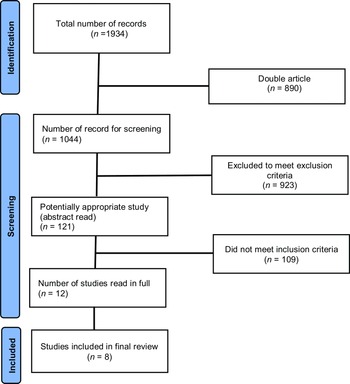
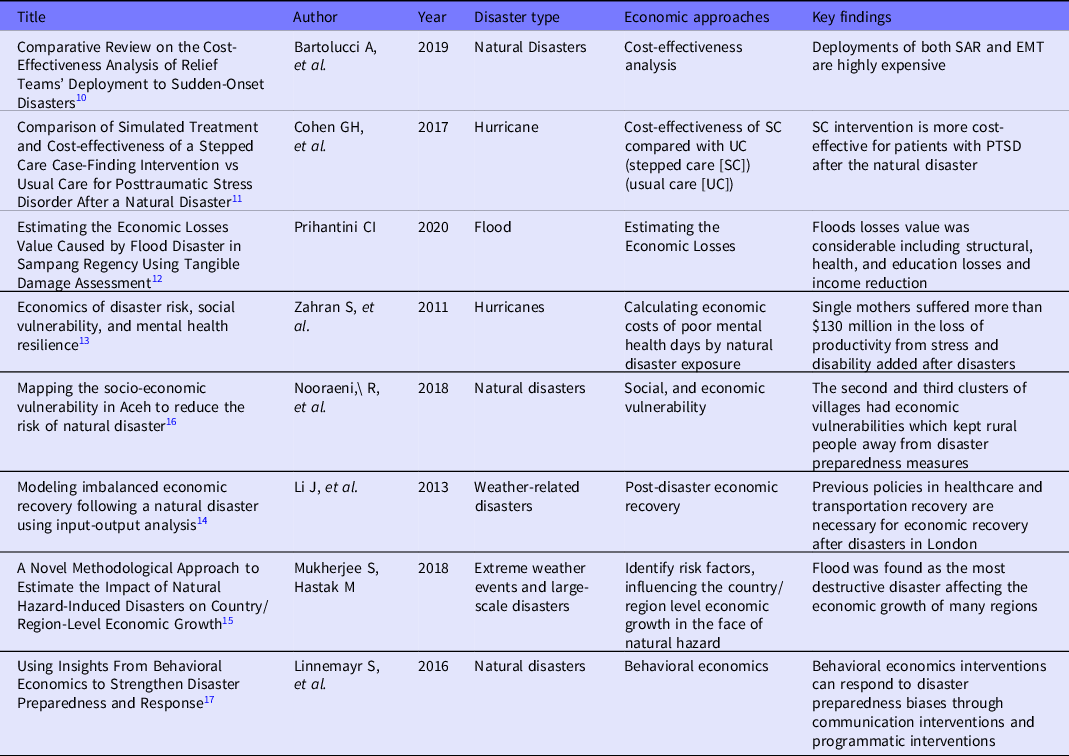
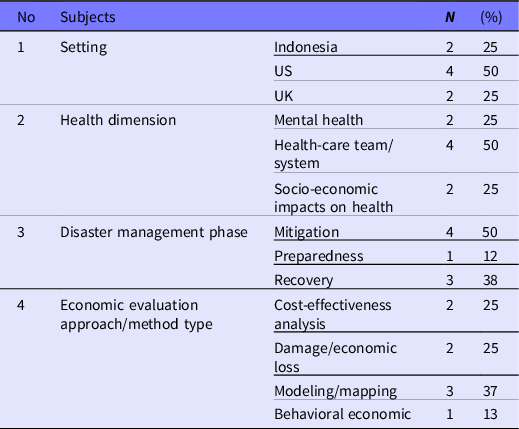
A total of 1934 references were identified through the initial search. After the screening process, 8 articles met the inclusion criteria and were selected for analysis (Figure 1). The final articles were described based on the publication date, setting, disaster type, disaster management phase, health dimensions, and economic approaches (Tables 1 and 2).
Articles screening and selections flowchart.

Characteristics of the final selected articles

Frequency of setting, health dimension, economic evaluation, and disaster management phases

Economic Evaluation Approaches/Methods
The economic evaluation approaches/methods in the context of disasters have been conducted in the forms of cost-effectiveness analysis, damage/economic loss assessments, economic modeling/map, and behavioral economic evaluation.
Cost-effectiveness analysis
A few studies reported the performance of cost-effectiveness analysis in the field of disaster health management. For example, the study comparing cost-effectiveness analysis of emergency medical team (EMT) and search and rescue (SAR) deployment showed that the deployments of both SAR and EMT are highly expensive, and their successes depends on the time they require to be operational. EMTs deployments were determined by the lack of detailed clinical information and assessments of response due to the insufficient reliable data and reports shared by internal agencies. SAR deployments were specified by limited lives served as the result of long-distance travel, response time, and late arrival in affected regions. Reference Bartolucci, Walter and Redmond10 In addition, the study of comparison between a stepped care case-finding intervention (SC) and moderate-strength single-level intervention as the usual care (UC) after Hurricane Sandy found the 10-y incremental cost-effectiveness of each intervention for patients with post-traumatic stress disorder (PTSD). Comparing the incremental cost-effectiveness of SC and UC showed that SC intervention is more cost-effective for patients with PTSD after a natural disaster. Reference Cohen, Tamrakar and Lowe11
Damage/economic loss assessments
The damage or economic loss assessment studies were conducted after disasters. For instance, the economic damage of floods in the Sampang Regency in Indonesia was estimated by Tangible Damage Assessment using Averting Behavior Method. Authors estimated that the flood losses value is Rp 5,881,948,800 which consists of structural and household property losses, health (medical treatment) and education losses, as well as vehicle damage and income reduction. Reference Prihantini12 Furthermore, the relationship between Hurricanes Katrina/Rita exposure and mental health resilience in terms of vulnerability conditions as well as the economic cost of poor mental health days followed by exposure to natural disasters were measured through monthly time series and negative binomial regression. The authors found that the poor mental health count is sensitive to the intensity of hurricanes by a factor of 1.06 for every billion (US $) dollars of destructions added for the exposed people, and by a factor of 1.08 for single mothers. Single mothers suffered more than $130 million in the loss of productivity from added stress and disability after disasters. Reference Zahran, Peek and Snodgrass13
Economic modeling/mapping
The economic modeling or mapping studies have been conducted based on the scenarios which likely occur in the future. For example, the dynamic inequalities route map of the imbalanced economic recovery was provided using the map for the economic scenario of flooding in London in 2020. Accordingly, the economy of London would recover over 70 mo by using a proportional rationing scheme with the assumption of 40% primary loss to service sectors, 50% initial loss to labor, and 10-30% to other sectors loss. The modeling with various labor recovery paths showed that conducting the previous policies in health-care and transportation recovery is necessary for economic recovery after disasters. Reference Li, Crawford-Brown and Syddall14 In a retrospective study, analysis of disaster and economic data between 1970 and 2010 to examine the disasters impacts on economic growth at country/region level was conducted using a random parameter modeling approach. The significant risk factors which vary for countries/regions included disaster intensity based on homelessness and deaths as well as economic properties such as accessibility to trade. Flood was found as the most destructive disaster affecting economic growth of many countries/regions. Reference Mukherjee and Hastak15 In addition, the study of comparing the socio-economic vulnerability conditions of villages in Aceh province, Indonesia, was conducted to map the villages based on their social-economic vulnerabilities. The 6512 villages were grouped into 3 clusters using the Genetic-K Prototype algorithm based on 30 variables of socio-economic vulnerability. The first cluster of villages had the best socio-economic indicators and experienced at least 1 disaster. The second and third clusters included villages with the least telecommunication and information supplies and minimum access to important facilities and areas. This cluster had the characteristics which kept rural people away from disaster preparedness measures. Reference Nooraeni, Yudho and Pramana16
Behavioral economic
Behavioral economic can provide an economics-psychology framework to understand how people behave during the phases of disaster management. For example, the study of behavioral economics in disasters recognized the decision-making biases relevant to disaster preparedness and response. The authors reported that behavioral economics interventions can respond to disaster preparedness biases through 2 types of interventions including communication and programmatic interventions. Communication interventions are low-cost and can be merged into the current efforts. Programmatic interventions need the adoption of programs, policies, and efforts on human resources. Reference Linnemayr, O’Hanlon and Uscher-Pines17
Discussion
This report shows the importance of applying economic evaluation approaches/methods in the context of disaster health management. However, the publication of most studies (between 2016 and 2020) can indicate that economic evaluation is a new concept in the field of health and disasters. Based on our findings, cost-effectiveness analysis, damage or economic loss assessment, modeling, or mapping, as well as behavioral economic analysis have been used as the economic evaluation approaches/methods. Implications of each approach/method are described as follows:
Cost-Effectiveness Analysis
Cost-effectiveness analysis can help decision-makers manage competing priorities and optimize their financial resources allocations to the most cost-effective interventions during predisaster phases. Reference Clarke18 Thus, reducing disaster economic loss can be achieved by the most cost-effective interventions which need to be determined and conducted during prevention and preparedness phases. Interventions which maximize effectiveness for a given cost are considered for disaster management. For instance, the use of technology, education and training are confirmed as cost-effective investments before disasters. Reference Stewart and Bird19
Economic Loss/Damage Assessment
The estimation of economic loss or damage costs in disasters can obviously show the huge destruction of disasters to policy-makers. Reference Prihantini12 According to the economic damage analysis, health officials and managers can understand that the destruction costs could be prevented by predisaster interventions. Thus, such assessments can be used as the basis of preparedness and response planning in disaster-prone regions.
Economic Modeling/Mapping
Economic modeling or mapping can be applied to comparing different interventions as well as anticipating the socio-economic consequences of disasters. Such models can assist governments in policy and decision-making as well as in identifying the investment needs for disaster risk reduction and preparedness. Reference Mukherjee and Hastak15 Prevention and disaster risk strategies can effectively reduce the economic impacts of disasters.
Behavioral Economic
The behavioral economic approach can be effective for decision-making in the fields of disaster preparedness and response. Reference Linnemayr, O’Hanlon and Uscher-Pines17 The importance of behavioral aspects in estimating the economic effects of natural disasters needs to be considered in the field of disaster health management. In other words, the behavioral consequences can be larger and more important than the standard economic effects which are typically measured.
Strengths and Limitations
Describing the applications of economic evaluation approaches/methods in the field of disaster health management can be considered as 1 of the advantages of our study. In addition, we included case studies that conducted economic evaluation approaches/methods in the context of health and disasters. On the other hand, there were several potential limitations in our study. The possibility of missing some related papers and not considering the gray literature at the time of searching databases were the limitations of the review.
Conclusions
Mitigating the economic impacts of disasters is a vital issue for all disaster-prone regions. Each economic evaluation approach/method can illustrate the economic costs of disasters for health-policy makers to explain the investment needs for disaster risk reduction, mitigation, and preparedness. In other words, economic resources can be prioritized and spent for disaster prevention and risk reduction interventions based on the economic evaluation outcome. Planning and conducting the economic evaluation methods can be considered at all phases of disaster management. Using cost-effectiveness analysis for choosing the most cost-effective interventions and applying the economic models for anticipating the effects of disasters are highly suggested. Such approaches can result in establishing disaster risk reduction interventions and preparedness plans in the health system. Further research is needed to identify the advantages and limitations of each economic evaluation method/approach in the field of health in disasters. Such research can be preferably designed as the systematic review and meta-analysis.
Author contributions
Concept and design of the study: S.S. Data Collection F.S.H., S.S., and A.Z. Analysis and interpretation of data: S.S. and F.S.H. Drafting and reviewing the manuscript: S.S., F.S.H., L.M., H.S., S.H., and N.J. All authors reviewed and approved the final manuscript.
Funding
The current review project was funded by the Safety Promotion and Injury Prevention Research Center, Shahid Beheshti University of Medical Sciences, Tehran, Iran