1. Introduction
The large body of empirical research in tropical fringe areas suggests that population growth (migration), infrastructure changes, and insecure property rights for land ownership are the most critical factors associated with forest decline and agricultural expansion worldwide (Wibowo and Byron, Reference Wibowo and Byron1999; Barbier and Burgess, Reference Barbier and Burgess2001a). Bohn and Deacon (Reference Bohn and Deacon2000) find insecure property rights to be a highly significant predictor of deforestation in a cross-country study. Interestingly, though, when more specific features of population growth and insecure property rights are considered, empirical work has been inconclusive. For example, Barbier and Burgess (Reference Barbier and Burgess2001b) report that higher wages tend to reduce deforestation by making other land-use forms profitable. Shively (Reference Shively2002) and Shively and Pagiola (Reference Shively and Pagiola2004) agree, finding that higher wages outside of forest margins tended to slow deforestation in Palawan. Neither of these studies considered costly site protection, paid by land holders, made necessary due to migration and resulting population growth pressure. Site protection was considered by Bohn and Deacon (Reference Bohn and Deacon2000); they find a statistically significant correlation between deforestation and site protection investment in cross-country data. However, Barbier and Burgess (Reference Barbier and Burgess2001b) find instead that site protection is not a statistically significant predictor of deforestation. Aside from these conflicting empirical results, there is a paucity of theoretical work focused on the joint effects of population growth, site protection costs, and insecure property rights. A model incorporating these is clearly needed to place empirical findings in perspective.
Using these conflicting empirical findings as motivation, we develop an analytical land-use framework to examine how migration pressure, insecure property rights, and public and private costly enforcement jointly affect incentives for and the profitability of land uses, and ultimately deforestation, in tropical frontier forest areas. Three land-use classes are considered: agriculture, plantation forestry, and utilization of public native fringe forest areas. Two concepts of deforestation are used, one defined as a change in any type of forest cover, and the other defined as a change in only native forest cover.
Previous literature has focused merely on land use for native forests and agriculture. Our inclusion of plantation forestry reflects new developments in tropical economies and tropical forest landscapes. As the International Tropical Timber Organization (ITTO) in its latest 2005 status report states, planted forests are now playing a much more significant role in the supply of tropical country timber; the area of planted tropical forests has expanded considerably in the past 15–20 years and continues to do so. ITTO further realizes that some tropical countries are becoming increasingly reliant on planted forests for domestic timber supply (ITTO, 2005: 8–9). Planted forests will likely reduce pressure on native forests to satisfy wood demand.
An examination of deforestation under the combination of all important land-use forms as endogenous, along with the inclusion of migration pressure, property rights risks, and site protection investment is the primary contribution of this article. A secondary contribution is to link together several somewhat disparate strands of deforestation literature. We build upon well-known deforestation land-use articles, including Parks et al. (Reference Parks, Barbier and Burgess1998) and Barbier and Burgess (Reference Barbier and Burgess1997), both of whom specify land-use margins between agriculture and plantation forest uses, Parks et al. (Reference Parks, Barbier and Burgess1998), who consider land quality as a von Thunen distance approach (see also Chomitz and Gray, Reference Chomitz and Gray1996), and Barbier and Burgess (Reference Barbier and Burgess1997), who use cost−benefit ratios to define land use between agriculture and forestry. Unlike our study, these papers do not include exploitation of remaining native forests as a land use, nor do they consider insecure property rights.
The second strand of literature related to our work concerns the effects of insecure property rights on deforestation. This literature has considered issues such as risks of land expropriation and illegal logging, as well as the role of migration in enhancing these risks. Expropriation risk in agriculture and forestry has been separately studied in many articles, the most important of which for our purposes are Alston et al. (Reference Alston, Libecap and Mueller2000), Contreras-Hermosilla (Reference Contreras-Hermosilla2000), Blaser and Douglas (Reference Blaser and Douglas2000), and van Kooten et al. (Reference van Kooten, Sedjo, Bulte, Folmer and Tietenberg1999). Alston et al. (Reference Alston, Libecap and Mueller2000) demonstrate that insecure property rights and expropriation risk provide incentives for both migrant settlers and private landowners to accelerate deforestation. They discuss examples where migrants (squatters) are granted legal rights by the government to occupy designated open access land areas (public or private), as long as they convert the land to a ‘beneficial’ use. Land not deemed in a beneficial use is at risk of being expropriated by the government. The only way private landowners can avoid expropriation is to keep the land cleared of forest cover for at least five years. In the Brazilian Amazon, Contreras-Hermosilla (Reference Contreras-Hermosilla2000) provides examples where establishing forest plantations and clearing of forests are responses to this risk. Blaser and Douglas (Reference Blaser and Douglas2000) and Wibowo and Byron (Reference Wibowo and Byron1999) further argue that expropriation of forests will be a critical impediment to future forest management in tropical countries.
Thus, both native forests and the increasing number of forest plantations will come under expropriation pressures as population growth continues in fringe areas, unless private site protection is employed. Hotte (Reference Hotte2005) and Clarke et al. (Reference Clarke, Reed and Shestra1993) examine agricultural land users' costly private enforcement effort such as building fences or obtaining formal title. Hotte (Reference Hotte2005) allows for a case where the landowner may either devote more efforts to protect the property, or purposely overexploit it to reduce returns that could be gathered by illegal activities.
Illegal logging and expropriation risk in planted and native forests have been studied in a forest rotation framework by Mendelsohn (Reference Mendelsohn1994), Barbier and Burgess (Reference Barbier and Burgess2001b), and Zhang (Reference Zhang2001), and in the context of productive forest investments by Bohn and Deacon (Reference Bohn and Deacon2000). Mendelsohn (Reference Mendelsohn1994) was the first to examine a problem where forests are subject to a small constant confiscation risk unless costly effort is employed by the owner. Barbier and Burgess (Reference Barbier and Burgess2001b) extend Mendelsohn's analysis to show that, under a high level of tenure insecurity, it may not be worthwhile to invest in long-term productive uses of land. Zhang (Reference Zhang2001) introduced a known probability of losing plantation forest to expropriation by the government. Bohn and Deacon (Reference Bohn and Deacon2000) show how risk of capital confiscation, through expropriation or illegal logging, reduces investment in forest plantations.
Migration push has been linked to deforestation in several empirical studies (see e.g. Angelson and Kaimowitz, Reference Angelson and Kaimowitz1999; Barbier and Burgess, Reference Barbier and Burgess2001a; Shively, Reference Shively2002; and Shively and Pagiola, Reference Shively and Pagiola2004). In addition to increased expropriation risk, higher population growth in fringe areas certainly increases the possibility that illegal logging occurs. Besides these direct push effects, migration brings more available labor supply and possibly lower wages to frontier areas. This lowers the transaction costs of finding and employing laborers, tending to improve the profitability of crop production and promoting land clearing and deforestation. Barbier and Burgess (Reference Barbier and Burgess2001b) confirm this empirically, finding that higher wages tend to reduce deforestation.
Finally, native forests are open access resources, and this means that illegal logging is a well-known form of exploitation (Clarke et al. Reference Clarke, Reed and Shestra1993; Hyde et al. Reference Hyde, Amacher and Magrath1996; Boscolo and Vincent, Reference Boscolo and Vincent2000; Amacher et al. Reference Amacher, Koskela and Ollikainen2007).Footnote 1 As a landowner, the government can devote resources to monitoring and punishing illegal loggers. In this way the government creates an economic risk to illegal loggers, because their profits are reduced through fines when they are caught. Our paper considers for the first time public enforcement in a land-use context, allowing us to compare public and private costly site enforcement in a way that informs future empirical work in this area.
We can identify four specific novelties of our land-use model developed here. First, by distinguishing specifically between the three forms of insecure property rights, we provide a more thorough analysis of their effects on deforestation. Second, all three relevant land-use forms are endogenous via land allocation decisions. Third, we investigate how important migration push is to these property rights risks and the resulting realization of land uses. Finally, property rights risks in our model are endogenous in the sense that private landowners can reduce these risks through employment of costly enforcement effort.
The rest of the paper proceeds as follows. In section 2 we examine production and land allocation in agriculture, plantation forestry, and illegal logging on public native forests under insecure property rights. In section 3 we analyze determinants of deforestation as they show up through land allocation decisions affected by our three types of risks. In section 4 we offer conclusions and policy implications.
2. Rents and land allocation under insecure property rights
Suppose that land users face three types of risks: expropriation and illegal logging on private and public land, and unapproved harvesting on public lands; all are violations of existing law. Expropriation risk is defined as the possibility that the government takes part of the private land base from agriculture or plantation forestry for its own use or for future migrant settlement. Illegal logging risk in plantation forestry is defined as the possibility that forest rents from private plantation forests are taken by a sudden illegal trespasser who harvests the trees. Finally, we use the notion of illegal logging risk in native fringe forest areas to refer to unapproved harvesting by trespassers in publicly owned native forests within the fringe area.
Native forests typically have dual benefits: they provide non-timber benefits to local and indigenous people, as well as revenue when harvested. Plantation forestry is present in many tropical countries and as noted earlier is increasing in importance.Footnote 2 When one considers abandoned cleared land, plantation forestry provides a potential source of sustainable timber supply, and this could prove useful in sustaining native forest benefits and reducing deforestation.
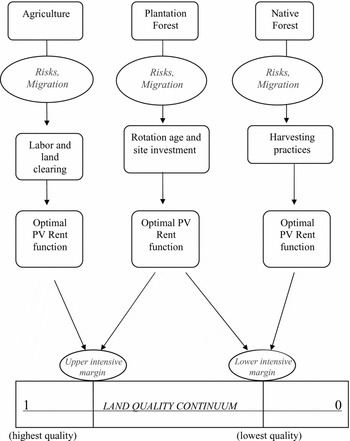
The nature of our model is illustrated in figure 1. The approach is to link migration pressure and insecure property rights ultimately to land use on a land quality continuum; this determines how much land is subject to deforestation through land clearing and illegal harvesting. Migration pressure and insecure property rights affect the profitability of agricultural production, plantation forestry, and the use of native public forests, and this affects input choices and ultimately rents to land uses on the quality continuum. Land is allocated between these land-use forms on the continuum according to their relative profitability in a recursive model following Lichtenberg (Reference Lichtenberg1989).
Private market land allocation

2.1. Basic land-use forms under migration and property right risks
Three existing models in the literature serve as our starting point, but we modify them to specifically reflect insecure property rights and migration pressure. Agricultural production with land conversion is described by a conventional and well-known agricultural input choice model. Plantation forestry is described by a rotation model under risk of loss (Reed, Reference Reed1984), that has been used, albeit in a simpler form, to describe insecure property rights as illegal trespass and logging in plantation forestry by Mendelsohn (Reference Mendelsohn1994) and Barbier and Burgess (Reference Barbier and Burgess2001b). Finally, for illegal logging in native tropical fringe areas, we adapt recent ideas presented in a non-land-use model by Amacher et al. (Reference Amacher, Koskela and Ollikainen2007). In the presence of heterogeneous land qualities, the per parcel present value returns for agriculture, plantation timber production, and illegal logging on native fringe forests are presented in the following three objective functions, respectively
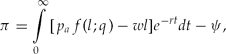


In (1a)–(1c), q is the quality of the land parcel, pa and pf are crop and timber prices net of harvesting costs, r is the interest rate, w is the wage rate, l is agriculture labor, ψ a constant cost of land conversion (such as clearing or burning), c is forest planting and site preparation costs, c(Q) is forest harvesting costs in native forests, and λ is the probability of a catastrophic loss for the forest plantation owner, which is interpreted here as loss from illegal logging (i.e., timber trespass). The agricultural production function is f(l; q), while T is the rotation age (harvest time) chosen for plantation forests and F(T; q) denotes forest yield at harvest time.
The primary way that public native forests are legally sold in a tropical country is through concessions. Thus, Ω in (1c) is harvest revenue received from these types of sales. Because there can be illegal logging in concessions, we introduce the parameters Q, ρ, and τ, to denote, respectively, the volume of timber illegally logged, the probability that illegal logging is detected, and the fine if detected. The introduction of land quality in the present value return functions of (1a)–(1c) follows Hardie and Parks (Reference Hardie and Parks1997), in that we assume that rents are increasing in land quality, that is, fq > 0, Fq > 0 and φqc(Q)<0.Footnote 3
We make two new extensions to these previous models. The first extension is to add migration pressure to the frontier as a factor in all of the return functions in (1a)–(1c). There are two features of migration in our analysis. First, migration affects the cost structure of production within each land use by changing the availability of labor, and, second, migration serves as a ‘push’ factor for deforestation by increasing the likelihood of agricultural production-related land clearing and trespass-related harvesting in plantation forests and native fringe forests. The first feature of migration is introduced into (1a)–(1c) using the following assumptions


Migration reduces the costs of land conversion in (2a) and reduces costs of planting and logging in (2b), all through increasing labor supply. Moreover, l′(n)>0 indicates that migration improves input efficiency in agriculture, because agricultural production in tropical fringe areas is typically hindered by underdeveloped input supplies and credit rationing that are somewhat alleviated by migration.Footnote 4
The second feature of migration is introduced by recognizing that migration increases property rights risks in all land-use forms. Property rights risks exist in the two above-defined forms as a risk of land expropriation and a risk of illegal logging in plantation forests and native forests.Footnote 5 Following Hotte (Reference Hotte2005) and Clarke et al. (Reference Clarke, Reed and Shestra1993), we allow land owners to protect their lands by employing costly private enforcement. Examples include building fences when converting land to agriculture and applying for and obtaining formal title. In forest plantations, site investment includes planting costs, as well as annual monitoring and protection costs, made during each rotation. With this in mind, site investment costs can be written from (1b) and (2b) as c(n) = c(n) + ∫0Tc(n)e −rxdx.
Let α represent the probability that a percent share δ of agricultural or forested land area is expropriated by the government. For the agricultural and plantation forestry use, we then propose the following assumptions


Differentiating (3a) with respect to migration yields: dα/dn = (αn + αθθ′)dn > 0, so that higher migration increases expropriation risk directly through the push factor (first term) and indirectly through labor availability by decreasing land clearing and site investment costs (second term). Due to lower costs, protection effort can be increased while keeping outlays at their previous level. This increased enforcement effect may be a dominant factor during early stages of migration, but eventually the direct effect determines ex post migration risks (Hotte, Reference Hotte2005, also argues this in a different model). This interpretation will have important implications for deforestation in what follows.
Our second new extension of the literature is the inclusion of illegal logging in native forests; this impacts sustainable non-timber benefit production. We assume that public enforcement is exogenously given in native forest areas, and that these areas exhibit two overlapping land uses: non-timber benefit production (B*), and exploitation of forest stocks through illegal logging. Illegal logging decreases non-timber benefits to local people who have no means of safeguarding against it. Depending on the actual tree species composition of a given site, illegal logging in native forests arises in two forms, either by selective logging (also known as ‘high-grading’) of only the most valuable trees (such as mahogany or teak), or through excessive harvesting of timber volume beyond the allowed concessions size. In what follows ω will denote the share of high valued species on a native forest land unit so that 1 − ω is the share of low valued trees. We write a large Pf to refer to the price of the most valuable native trees and a small pf to refer to the price of the least valuable trees.
Given our new features concerning insecure property rights, migration pressure, and high-grading we re-express the per parcel present value return objective functions in (1a)–(1c) using (2a) and (2b) and (3a) and (3b) as follows



where J in (4b) now contains λ=λ(n, c(n)) from (3b). Equations (4a) and (4c) present the new models we will work with in what follows. The optimal choice of agricultural input, rotation age and illegally logged volume defines the indirect net present value rent functions which determine the pattern of land allocation in our model (see figure 1).
Previous literature has already established some results for how input choices depend on parameters. For agricultural labor, rotation age, and illegal logging choices, the literature cited earlier collectively finds the following results:  , and
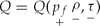 . In proposition 1, we provide new insights concerning the effects of migration and insecure property rights risks on these choices. As figure 1 suggests and as we show below, the new results of proposition 1 will prove crucial in our analysis of land use and ultimately deforestation later in the paper.
Proposition 1. Expropriation and illegal logging risk and production intensities
When insecure property rights exist in the form of land expropriation and illegal logging risks, and landowners are risk-neutral, then:
(a) Agricultural expropriation risk and private enforcement do not affect the optimal choice of inputs, but increased migration increases input intensity.
(b) Plantation forestry expropriation risk has no effect on the optimal rotation age; an increase in migration decreases rotation age, but increased private enforcement increases rotation age.
(c) Public enforcement in native fringe forests through detection and penalties reduces the amount of illegally logged volume but increases high-grading, while migration increases illegally logged volume.
Proof. To prove parts (a) and (b), differentiate (4a)–(4b) to obtain πl=(1−δα(n, ψ))(pafl−w)=0 and  T = (1 - δα)J T = 0, thus both conditions are independent of expropriation risks. Migration effects in parts (a)–(c) are obtained by the means of conventional comparative statics. To prove part (c) of proposition 1, define the expected indirect revenue for illegal logging beyond the concession through ‘pure’ high-grading as V h*=Ω+(1−ρτ)PfωQ−C(ωQ), and expected indirect revenue from harvesting of all trees by V*=Ω+(1−ρτ)(PfωQ*+pf(1−ω)Q*)−C(Q*). Taking the difference yields V*−V h*=pf(1−ω)Q*(1−ρτ)−C(Q*)+C(ωQ)≥(<)0. Thus, the higher ρ and τ are, the smaller is the advantage from harvesting all trees.
Expropriation risk does not affect the optimal intensity of input use in agriculture and forestry (i.e., for crop input and rotation age decisions), because private enforcement activities are independent of input intensities. However, from (4a) and (4b), land values in these uses will clearly be reduced by costly enforcement, through a reduction in the relative profitability of agriculture and plantation forestry. Thus, expropriation risk will clearly lead to land-use change, as we will see later. Also, our finding that a higher penalty and detection probability increase high-grading is interesting. Restricting illegal logging of highly valuable trees clearly requires imposing higher penalties specifically for high-grading.
2.2. Private market land allocation
The goal is to examine how our new features of migration, risks, and related site investments affect land use and deforestation. To do this, we first make an assumption about suitability of agriculture, plantation forestry and native forests on land of various qualities, when land areas devoted to concessions are exogenous. Denote by G the entire set of potentially usable forest land outside of concessions. Within G, land quality differs depending on site factors. All land can be divided into separate parcels having uniform quality. Following Lichtenberg (Reference Lichtenberg1989), we rank land quality by the scalar measure q, with a scale chosen so that minimal land quality is zero and maximal land quality is equal to one, i.e. 0≤q≤1. G(q) is then the cumulative distribution of q, i.e. the set of parcels having at most a quality level of q. Let g(q) be the density function for G(q), i.e. g(q)=G′(q). The bottom of figure 1 describes this continuum of qualities and will be useful in helping to follow the discussion below.
The total amount of forest land is given by

Land area G will be allocated to agriculture and the two forestry uses or will remain idle. The profits for all land-use activities are increasing in land quality, so from (4a)−(4c), πq* > 0, q* > 0, and V*q > 0; this implies any type of production is more profitable on better land qualities. We now make the following assumption concerning relative profitability of land uses needed to ensure unique interior solutions with each use occupying a compact range of quality.
Assumption A: For land qualities and land uses, the following relationships hold



A1 and A2 define the relative profitability of different land uses. From A1, at the best land quality level, agricultural production is most profitable, and plantation forestry production is more profitable than illegal logging. Assumption A2 indicates that the order is reversed, and illegal logging is most profitable on the lowest quality land. Assumptions A1–A2 together with πq* > 0, q* > 0 and V*q > 0 ensure that agriculture performs best when practiced on the highest quality land and native public forests remain on lowest quality land. This allows a partition of our land quality continuum (figure 1) consistent with what has been observed in tropical countries (Parks et al., Reference Parks, Barbier and Burgess1998). Finally, assumption A3 allows the possibility that some land will remain intact as native forests. In this form of land use, non-timber benefits (B*) are produced in a sustainable fashion; we assume B* is exogenous. Illegal logging in native forest areas reduces the possibilities of utilizing non-timber benefits. The margin for native forest use is then defined by the equality between marginal net returns in illegal logging activities and non-timber benefits.
Denote the share of land devoted to agriculture and public native forests by ha and h m+i respectively. The share of land area devoted to plantation forestry is then hf=1−h m+i−ha. The share of land subject to illegal logging, hm, is simply defined by a zero logging profit condition. The market allocation of land in the economy then solves the following problem

It is easy to show that the necessary conditions for interior solutions of ha and hm+i are

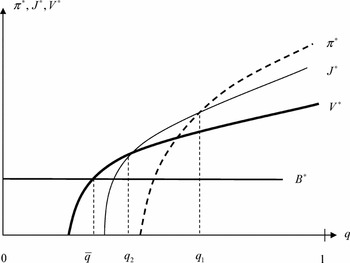
The first condition defines the upper intensive margin of land quality between agriculture and plantation forestry uses, which we denote as q 1. The second condition defines the lower intensive margin between plantation forestry and illegal logging, denoted as q 2. Finally, the zero-profit condition defines the extensive margin between illegal logging and native unexploited land, denoted as q. The amount of land devoted to all land-use forms is determined by the margins defined in (7) and the land quality distribution function (see appendix).
Drawn in figure 2 are land choices, margins between land uses, and present value rent curves as a function of quality. Optimal land use is determined by the intersection of these rent curves and by the zero-profit condition of illegal logging on native forests. The shape of figure 2 reflects assumption A; that is, the rent curve for agricultural production when graphed over land qualities is everywhere steeper than the rent gradient for plantation forestry, and the rent gradient for plantation forestry use is steeper than the rent gradient for illegal logging.
Land allocation as a function of land quality

2.3. Definition of deforestation
Deforestation and reforestation as they are employed in this paper can now be defined in two ways using the idea of margins developed above.
Definition 1.Deforestation takes place whenever overall forest cover decreases due to agricultural and plantation land clearing, or illegal logging.
Definition 1 gives equal emphasis to exploitation of both native and plantation forests, i.e. it simply concerns removal of any forest cover. It also implies an obvious definition of reforestation, namely that reforestation takes place whenever a plantation forest is established on previously cleared land, or when forest cover appears on cleared land due to natural regeneration. This definition has been heavily criticized by environmentalists and NGOs for giving too much emphasis to plantation forests, because it implies that clearing native forests and establishing an equivalent area of forest plantations are perfect substitutes and do not constitute deforestation per se. Of course, it is evident that the biodiversity provided by plantation forests differs critically from that of native forests in terms of all forms of non-timber benefits and ecosystem services. We therefore also apply the following stricter definition of deforestation:
Definition 2.Deforestation takes place when native forest land is cleared either due to agricultural land clearing, plantation forestry, or illegal logging.
Clearly, definition 2 gives only a secondary role to plantation forestry. In fact, whenever even native forest land is cleared for plantations it would amount to deforestation. Also by this definition restoration of deforested land can only take place by natural regeneration or nature-mimicking regeneration that eventually leads to the original native old growth forest containing a large variety of tree species and non-timber benefits.
3. Determinants of deforestation
In this section, we arrive at our main results concerning the scope of deforestation in tropical forest fringe areas using the above two definitions. The key parameters to be examined are those concerning migration pressure, expropriation, and illegal logging risks, and private and public enforcement of property rights. We use La, Lf, Lm and LB to refer to the amount of land allocated to agriculture, plantation forestry, illegal logging, and native forests for non-timber benefit production respectively. The details of derivations are given in the appendix; here we present only the signs of land-use changes.
3.1. Migration pressure, expropriation, and illegal logging risks
We are especially interested in examining how migration-induced agriculture and illegal logging push factors, coupled with insecure property rights, affect deforestation under the two definitions above.
Migration pressure
Migration pressure clearly affects the profitability of all land-use forms, by increasing expropriation and illegal logging risks and by decreasing the costs of illegal logging

As the appendix reveals, migration affects rents through multiple channels associated either with expropriation and illegal logging risks, or with reduced costs due to migration. Risks increase with migration more rapidly than costs decrease. Hence, the effect of migration on rents is plausibly negative. Despite this, the signs of land area change between agriculture and plantation forestry are still ambiguous through the term (πn* − n*), because migration reduces the returns in both activities. Referring to figure 2, the relative shift of both rent curves for plantation forests and agriculture is indeterminate. We make a plausible assumption that (πn* − n*) > 0. This reflects the observation that at the upper intensive margin q 1, increasing migration pressures probably raise expropriation risk more for plantation forestry than for agriculture, because expropriation has been noted as a special risk for forests (Blaser and Douglas, Reference Blaser and Douglas2000: 11), and it also follows from the beneficial use and forest expropriation issues discussed in Alston et al. (Reference Alston, Libecap and Mueller2000) and Armsberg (Reference Armsberg1998). This effect is further reinforced by an increased illegal logging risk for plantation forestry that follows from population growth. At the lower intensive margin q 2, the effect of migration pressure on plantation forestry and illegal logging is clear. Illegal logging benefits from reduced logging costs due to migration, and thus the lower intensive margin shifts to the right in figure 2 in the direction of higher land qualities, while the extensive margin shifts to the left in the direction of lower land qualities that become profitable to exploit. Thus, land area under both plantation forestry and native forests decreases with migration pressure.
One can conclude from (8) that migration promotes deforestation by both definitions 1 and 2 through two channels: by expanding agriculture and increasing illegal logging activity. This is not the entire story though. Recall our discussion of the two opposing effects migration has on expropriation and illegal logging risks. Migration directly increases these risks through a higher population size, but the direct risk effect is offset somewhat because private enforcement becomes less costly due to greater labor availability and decreasing labor costs. From equations (2a) and (2b) above, we employed the assumption that, ultimately, the direct risk effect dominates the private enforcement cost effect as migration pressure increases. However, it is conceivable that, in early stages of migration, the indirect protection cost effect could dominate the risk effect. In this case, referring to figure 2, the ultimate location of the upper and lower intensive margin may change as migration progresses. These results provide theoretical insight into specific empirical findings discussed in a recent survey article by Barbier and Burgess (Reference Barbier and Burgess2001b). Using various model specifications, they find an ambiguous effect of population growth on agricultural land expansion. This ambiguity has also been noted in other empirical deforestation studies (see e.g. Contreras-Hermosilla, Reference Contreras-Hermosilla2000).
Expropriation and illegal logging risks
Expropriation risk reduces present value returns to both agriculture and plantation forestry land uses, while illegal logging risk reduces present value returns for plantation forestry. These rent changes translate into corresponding land-use changes. The effects of expropriation and illegal logging risks on land area are given by


We start our interpretation with expropriation risk in (9a). Referring to the appendix, the effect of a higher expropriation risk on the upper intensive margin q 1 is generally ambiguous and depends on the sign of the term (πα* − α*). However, given that agriculture takes place on better quality lands, it is plausible to assume that the expropriation risk effect has a larger effect on expected returns to agriculture than to plantation forestry (this would also be true if expropriation risk to forest plantations was zero). In this case, expropriation risk shifts the upper intensive margin to the right in figure 2, and less land is devoted to agriculture as plantation forestry expands into higher quality land. Despite this, rents in plantation forestry are reduced, so that illegal logging becomes more profitable on lower quality lands that are devoted to plantation forestry. This serves to move the lower intensive margin, q 2, to the right. The overall effect on land allocated to plantation forestry is ambiguous.
Illegal logging risk in equation (9b) has clearer effects since it reduces the present value rents from forest plantations. In this case, illegal logging in native forests expands as the extensive margin q moves to the left in figure 2. Illegal logging risk would also imply that the upper intensive margin q 1 moves to the left, and the agricultural land use expands to lower quality lands currently in plantation forestry.
When expropriation risk alone is considered, and when it is relatively more important in reducing incentives for agriculture, the total effect on deforestation depends, as evidenced by our discussion of margins above, on the sign of: dL f/dα + dL m/dα. Applying definition 2 then implies there is no change in deforestation, because land in native forests is unchanged, dL B/dα = 0.
This is not the case if illegal logging risk increases. Then, deforestation always occurs based on definition 1. Such a result is evidence of a double mechanism of deforestation and provides new theoretical support for calls in the applied policy literature to implement subsidies and reduce the costs of sustainable forest practices such as reduced impact logging and plantation establishment (Winkler et al., Reference Winkler1997; Barreto et al., Reference Barreto, Amaral, Vidal and Uhl1998). Interestingly, by definition 2 we would conclude that no deforestation takes place because of expropriation risk.
We collect our basic findings in proposition 2.
Proposition 2. The effects of migration and insecure property rights on deforestation
In a tropical forest frontier area subject to migration and insecure property rights, when deforestation is defined as a decrease in overall forest cover, higher migration, expropriation and illegal logging risks increase deforestation by reducing land area devoted to plantation forestry, either by promoting agricultural land use or promoting illegal logging.
Proposition 2 is revealing in many ways to the deforestation debate. It places context on empirical studies showing expropriation and illegal logging risks as important variables explaining deforestation (Barbier and Burgess, Reference Barbier and Burgess2001a, Reference Barbier and Burgess2001b), the recognized increasing importance of forest plantations in tropical countries, and discussions about illegal logging. It also provides specific reasons why the empirical literature suggests that migration pressure may have both increasing and decreasing effects on deforestation (see Angelson and Kaimowitz, Reference Angelson and Kaimowitz1999).
Our land-use model reveals the precise mechanisms by which these parameters affect deforestation. In most cases, insecure property right risks lead to agricultural expansion and increased illegal logging. Both expropriation and illegal logging risks reduce plantation forest establishment and the stock of native public forests. If plantations are a desirable land component, then a double benefit could be obtained by increased enforcement in fringe areas to decrease illegal logging. This increases land allocated to plantation forestry and non-timber benefits production on native forest land.
Proposition 2 also raises a natural question about the transition from native forest to a patchwork of land uses in the presence of migration. As Albers et al. (Reference Albers, Fisher and Hanemann1996) and Hyde et al. (Reference Hyde, Amacher and Magrath1996) note, there is a logical progression of land uses in tropical native forest settings, and in many ways these discussions apply here. Migrants settle and clear land in native forests to begin farming as smallholders when access is made available to vast tropical forests. Other land users begin development of plantations on cleared land if prices and costs make this profitable. Illegal logging in remaining native government-owned forests continues then as pulse harvesting by illegal loggers seeking rents.
3.2. Policies and deforestation: public and private enforcement
As we discussed earlier, many studies show that insecure property rights decrease both agricultural and forest plantation investments. In our land-use model, we can separate the effects of public enforcement by the government from private site investment-based enforcement by the land-owner. The latter has the effect of reducing expropriation risks by serving as a signal of beneficial economic use to the government. The former has the effect of a higher probability of detection and higher penalty rate. Thus, both private and public enforcement can have an important influence on deforestation by our definitions. We now compare these investments.
Private enforcement: land clearing and site investments
The effects of site investment in agriculture and forestry play a dual role of investment and enforcement, and thus they affect land use as follows


The signs for agriculture and plantation forestry in (10a) and (10b) are generally ambiguous (see appendix). As in the case of migration, both risk and cost changes affect rents in agriculture and plantation forestry. Higher site investment costs directly decrease the profitability of plantation forestry, but they also indirectly decrease illegal logging and expropriation risks, which increases profitability. These two countervailing effects clearly open up many interesting interpretations not yet considered in the theoretical literature, despite the empirical debate that has surrounded site protection.
We can trace out two alternative outcomes concerning site investments that depend on the degree to which property rights are insecure. The more secure property rights are, the more likely that the direct cost effect will dominate land-use changes – in other words, higher protection costs for agriculture and forest plantation land uses will decrease the profitability of both land uses, leaving what happens to the upper intensive margin unclear. Land would shift to the use with the lower relative protection costs.
By definition 1, deforestation decreases (increases) when the direct effect of land clearing costs (site investment) dominates. In neither case would we find deforestation according to definition 2.
Public enforcement: detection of and penalty for illegal logging
Public enforcement has definite effects. Both of these instruments work on the lower intensive and extensive land-use margins, and both have qualitatively identical effects (see appendix). Thus, we report them in (11) using a general index k=ρ, τ

A higher probability of detection (or a higher enforced fine) will decrease the profitability of illegal logging activities at both the extensive and lower intensive margins, q and q 2, in figure 2. Plantation forestry then expands to additional lower quality lands and q 2 moves to the left. Illegal logging becomes less profitable at the extensive margin q. The land area under illegal logging unambiguously decreases, implying that larger areas of native forests remain intact for non-timber goods production. Deforestation decreases according to both definitions this time, although high-grading may increase.
We collect our findings in proposition 3.
Proposition 3. Private and public enforcement and deforestation
In a tropical forest frontier area subject to migration and insecure property rights and with deforestation defined as a decrease in overall forest cover, higher public enforcement increases land area devoted to both native and plantation forests by reducing illegal logging, thus decreasing deforestation, but increased private enforcement through site investment and protection measures in agriculture may or may not reduce deforestation depending on the intensity of migration pressure.
Proposition 3 is important for deforestation policy. First, it implies that governments must find ways to enforce restrictions on illegal logging and collect stiff fines for such behavior if the goal is to reduce the area subject to this use, and thus to ultimately reduce deforestation no matter how it is defined. Doing so decreases the profit from illegal logging and reduces deforestation by shifting the extensive margin. Second, reducing migration pressure is needed to make private enforcement successful.
Proposition 3 can also be used to shed light on some puzzles found in empirical work. For example, Bohn and Deacon (Reference Bohn and Deacon2000) obtained a statistically significant effect for site protection investment in their empirical cross-country deforestation equation, while Barbier and Burgess (Reference Barbier and Burgess2001b) found that it was not statistically significant. Our results provide some context for this by showing that the outcome depends on whether the site investment cost effect dominates the risk-reducing effect or not.
3.3. Market forces and deforestation: price of timber and non-timber benefits
Forest markets and deforestation are inexorably linked, and in some cases market development is said to lead to more secure land-use practices. Our model allows us to examine if this is true. We allow both the timber price and value of non-timber products, collected from standing native forests, to increase.
Timber price and the value of non-timber benefits
Consider the effects of increased timber price and increased value of non-timber benefits. Timber price directly affects the profitability of plantation forestry and illegal land-use activities


The timber price effect in (12a) is generally ambiguous and depends on which land-use forms have the highest marginal benefits from a price increase. A higher timber price does not necessarily promote plantation forestry though. While higher timber prices push plantation forestry on to land currently occupied by agriculture, illegal logging also becomes more profitable at the lower intensive and extensive margins. Only if plantation forestry rents increase more than rents to illegal logging will the total amount of land in plantation forest increase.
This aspect has been a point of debate within the empirical literature. Angelson (Reference Angelson1999) and Angelson and Kaimowitz (Reference Angelson and Kaimowitz1999) point out that previous models provide conflicting results concerning the effects of tenure insecurity risk and timber prices, while others have argued that increases in prices will lead to greater incentives to establish sustainable forest plantations (e.g. Barbier et al., Reference Barbier, Bockstael, Burgess and Strand1995). Our model provides context for thinking through both sides of this story.
Equation (12b) describes some possibilities of reducing illegal logging by increasing the value of non-timber benefits in native forests.Footnote 6 The outcome is conditional on how B* affects incentives of illegal loggers. Provided illegal loggers are local people, a higher B* naturally reduces illegal logging, as they derive higher benefits from un-harvested forest. However, if illegal loggers come from outside the fringe area, one cannot reduce illegal logging by increasing B*. Hence, the identification of illegal logger types is vital for policies aiming at reducing illegal logging via increasing the value of non-timber benefits. We obtain either decreased deforestation in terms of both definitions or no change at all when non-timber benefits increase.
We collect the main findings of land use and deforestation in our last proposition.
Proposition 4. Mechanisms of deforestation under insecure property rights
In a tropical forest frontier area subject to migration and insecure property rights, when deforestation is defined as a decrease in overall forest cover, a higher timber price has an ambiguous effect on deforestation, but an increased value of non-timber benefits unambiguously decreases deforestation or leaves it unchanged depending on the incentives of illegal loggers.
Finally, narrowing our analysis to deforestation only as the removal of native forests, the following changes would be necessary to proposition 4: provided that higher migration, expropriation and illegal logging risk effects are strong enough, or plantation forestry is not well-established, native forest land area will shrink as these property risks increase.
4. Conclusions
We considered the importance of migration and insecure property rights to deforestation using a land-use model tailored to tropical frontier forest regions. We defined three forms of insecure property right risks: illegal logging risk on private land, government land expropriation risk, and illegal logging on native public forest land. These risks were linked through three land-use classes: agriculture, plantation forestry, and illegal logging on idle fringe native forest land. Migration was included as a land clearing ‘push’ factor and production cost modifier, reflecting findings in much of the applied literature.
We find that higher migration, expropriation, and illegal logging risks promote deforestation either by increasing agricultural land clearing, or by encouraging illegal logging in native fringe forests. While public enforcement effectively reduces deforestation, the success of private enforcement (site investment and protection measures in agriculture) depends on the intensity of migration. Interestingly, higher timber prices have an ambiguous effect on deforestation, because, besides improving plantation forestry profit, it increases incentives for illegal logging.
Our results have important implications for policies aimed at reducing deforestation. Policies targeting migration pressures are one of the key ways of reducing agricultural land clearing and illegal logging in fringe tropical forest areas. According to our results, the success of private enforcement needs to be weighed when evaluating any migration-based policy. Our introduction of plantation forest as a possible land use raises another important policy issue. We modeled this land use as a rotation problem, but selective harvesting of these forests could have been introduced as well. Plantation forestry as a competing land use with crop production is still in its infancy in many tropical countries, but it can provide a steady and sustainable flow of timber, thereby reducing harvesting pressures on native forests.
Our analysis reveals crucial factors which would help to create a steady plantation forestry land-use class. The key factors are lower illegal logging and expropriation risks jointly present with higher timber price and lower costs of site investment. If these factors were promoted in a way that did not allow plantation forestry to expand and ‘crowd out’ native forest land areas, then conditions for sustainable forest management possibilities and reforestation of areas abandoned by agriculture or grazing can be created.
One final comment concerns public enforcement and ‘high-grading’ of forest stocks. Public enforcement plays a critical role in reducing the destruction of native forests. It can only be successful, however, if detection activities are expanded to adequate levels. One option is to adopt new satellite technology and other monitoring measures in order to improve the efficiency of enforcement across land-use classes, often spread out over several thousand square miles. However, as our model results show, high-grading of native forests will always be difficult to detect, and new satellite technologies help less here than in monitoring a larger scale activity such as illegal clear-cutting. Higher fines are probably the only means a government has to affect high-grading.
Appendix: Comparative statics of land allocation
The land areas in agriculture and the two forestry uses are defined as follows
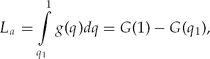
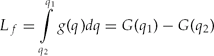
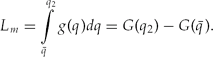
Define a parameter vector θ=[pa, pf, c, r, λ, w, ρ, τ]. By differentiating (A.1a–c) we obtain, for the changes in the land use
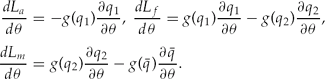
In (A.2) the change of intensive and extensive margins,  , and
 , can be defined by differentiating the land allocation conditions in (7). Differentiating equation (7) with respect to land quality yields D = (πq* −
q), Δ = (
q* - V q*), which both are positive because of our assumption A. The comparative statics is

where

 - \bar c)}\nonumber\\
&&+\, c_n (r + \lambda ) )[ {r(1 - e^{ - (r + \lambda )T} )} ]^{ - 1} = \,?
\end{eqnarray}](https://static.cambridge.org/binary/version/id/urn:cambridge.org:id:binary:20160202032449545-0789:S1355770X0800483X_eqnU6.gif?pub-status=live)

where *pi;α* = −δ ∫0∞ [p af(l) − wl]e −rtdt < 0,
α* = −δJ < 0, and
where π*ψ=−δαψ∫∞0[paf(l)−wl]e −rtdt−1 = ? and

where, V*τ<0 and V*ρ<0.