Scholars are celebrating a “microfoundational moment” in IR theory (Kertzer and Tingley Reference Kertzer and Tingley2018), when “macro is out, and micro is in” (Gerring Reference Gerring2008, 176). During this renaissance, the field has given increasing attention to leaders (Horowitz, Stam, and Ellis Reference Horowitz, Stam and Ellis2015; Saunders Reference Saunders2011) and diplomatic summitry (Wheeler Reference Wheeler2018), as well as to everyday interactions (Bjrkdahl, Hall, and Svensson Reference Bjrkdahl, Hall and Svensson2019) and “micro-moves” (Solomon and Steele Reference Solomon and Steele2017). From psychology to diplomacy, the “first image” seems to be back in fashion. This interest extends beyond published scholarship: at conferences, on social media, and in casual conversation, IR scholars frequently invoke the causal importance of individuals. One recent survey found that, by large margins, scholars emphasize Donald Trump’s temperament, rhetoric, and personal behavior to explain perceived declines in American reputation (Peterson, Powers, and Tierney Reference Peterson, Powers and Tierney2018).Footnote 1 After decades of downplaying the role of individuals and microlevel phenomena generally, the first image appears to be back in a big way.
After decades of downplaying the role of individuals and microlevel phenomena generally, the first image appears to be back in a big way.
Yet, this renaissance is more difficult to identify in raw publication numbers at top journals. The TRIP project (2020), which hand codes every IR article in 12 leading journals, found that only 13.7% of such articles include the role of individuals. This proportion remained approximately the same in every year of the study from 1980 through 2018.Footnote 2 We therefore are presented with a puzzle. Whereas the study of individuals appears to be flourishing in qualitative assessments of the field—as well as in survey data of what scholars understand to be important to international politics—quantitative indicators suggest stasis rather than growth over time. This article reviews two common explanations for why IR scholars might overlook individuals in their work. Using TRIP project data, we suggest that epistemology and methodology, which often are blamed, in fact seem relatively benign. Instead, we tentatively endorse explanations that privilege the rise of grand theory and resultant internecine paradigmatic debate.
Two decades ago, as the “paradigm wars” (or “third great debate”) were raging, an influential International Security article lamented the lack of attention given to leaders (Byman and Pollack Reference Byman and Pollack2001).Footnote 3 A potential explanation, it suggested, was a growing commitment to positivism. On this reasoning, the complexity and diversity of leaders defy broad, scientific generalization and—rather than settle for a more descriptive, less general, and less predictive discipline—scholars instead tackle problems amenable to a scientific (or scientistic) approach. “Political scientists posit that although individuals may matter from time to time, their influence does not lend itself to the generalizations that political scientists seek. Simply put, individuals are too individualistic” (Byman and Pollack Reference Byman and Pollack2001, 108).Footnote 4
A second explanation shifts the blame from positivism and scientific methods to “grand theory” itself (Solomon and Steele Reference Solomon and Steele2017).Footnote 5 Drawing on structural functionalism, Waltz (Reference Waltz1979) reoriented realism away from the study of individuals and human nature to the structure of the system.Footnote 6 Responding to neorealism, the rise of liberalism ostensibly would take individuals seriously again, but it did not reverse this trend.Footnote 7 Moreover, although constructivism reoriented the field back toward agents, the return was somewhat muted as—once again—structural variants tended to overshadow more agentic accountsFootnote 8 (i.e., 20% of constructivist articles study the first image and 73% study the third). On this view, grand theory’s emphasis on structures and states—and the resulting paradigmatic debates about those dynamics—reduced attention to the microfoundations of those same structures (Chakravarty Reference Chakravarty2013; Croft and Vaughan-Williams Reference Croft and Vaughan-Williams2017).
These are testable claims. Surveys of disciplinary trends often are anecdotal and impressionistic. In the remainder of this article, we subject these intuitions to rigorous analysis using publication data. We found relatively little support for the first claim. The second claim has stronger support, with the proviso that path dependence likely figures more prominently in the causal explanation than usually understood.
EMPIRICAL ANALYSIS
We examined these claims using the TRIP journal-article database (TRIP 2020). Research assistants in a three-round process code the paradigm, epistemology, methods, levels of analysis, and issue area (among others) of articles. The database includes all IR articles published between 1980 and 2018 in 12 leading journals, determined by the Garand and Giles (Reference Garand and Giles2003) impact rating.Footnote 9 Our dataset encompasses 7,215 strictly IR articles. It is important to note several limitations of the TRIP dataset: (1) because it codes only a subset of prominent journals, TRIP misses a wide variety of other journals; (2) the data include only those articles published from 1980 through 2018; and (3) the dataset does not include books.Footnote 10 We tested the following three hypotheses implied by the literature discussed previously:
Hypothesis 1: Either epistemology or methodology (or both) will significantly decrease the likelihood of using the first image.
Hypothesis 2: Approaching a topic from a liberal or realist perspective will significantly decrease the likelihood of using the first image.
Hypothesis 3: Studying topics traditionally dominated by liberalism (i.e., international organizations [IOs], international political economy [IPE], and international law) will significantly decrease the probability of using the first image.
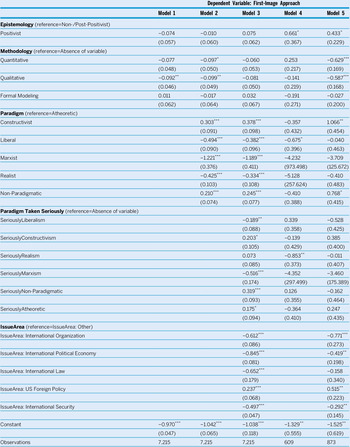
Our dependent variable of interest is a dummy variable coded 1 if an article is coded as using the first image and 0 otherwise. We used a binomial probit model—with an array of binary independent variables with 1 for the presence of that attribute in the article or 0 otherwise—to predict an author’s use of the first image. The initial model reflects conventional wisdom that the neglect of the first image results from epistemological and methodological commitments (table 1). Subsequent models control for an author’s paradigm (model 2) and issue areaFootnote 11 and paradigms taken seriously (model 3). The latter model is our preferred specification. To ensure that the results persist in relevant subsets of the data, we restricted the same analysis to only a single issue area—that is, IOs (model 4)—and to the most recent articles published from 2000 through 2018 (model 5).
Estimate of Probit Regressions for Use of First Image
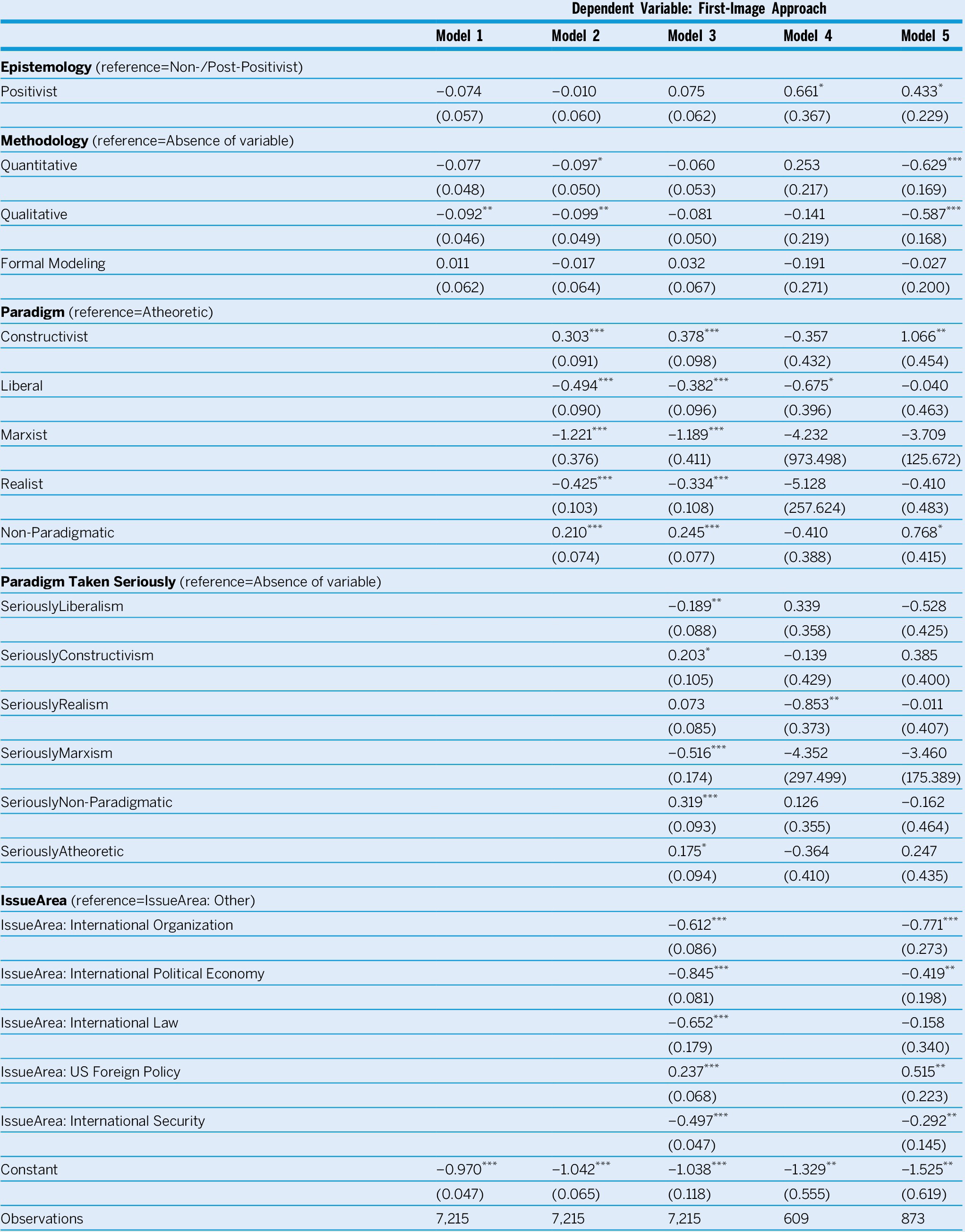
Notes: *p<0.1; **p<0.05; ***p<0.01. Std. errors in parentheses.
The perceived effect of positivism—that it shifts attention away from individuals—seems driven by omitted-variable bias: once we control for theoretical commitments (e.g., liberalism or realism), it does not dissuade an author from using the first image. By contrast, the paradigms have strong and consistent effects across most models: realism, liberalism, and Marxism substantially discourage using the first image; constructivism and non-paradigmatic approaches encourage it. Finally, all of the most frequently studied issues (i.e., international security [IS], IO, IPE, and international law) have strong, negative effects, except US foreign policy.
We found more mixed results for methods. In the long term, quantitative methods do not seem to impede studying individuals, but that may not be true in recent decades. Nonetheless, we can make two statements with confidence: first, qualitative methods are not more conducive to first-image scholarship than quantitative methods; and, second, formal methods have no effect on the likelihood that a scholar studies individuals.
DISCUSSION
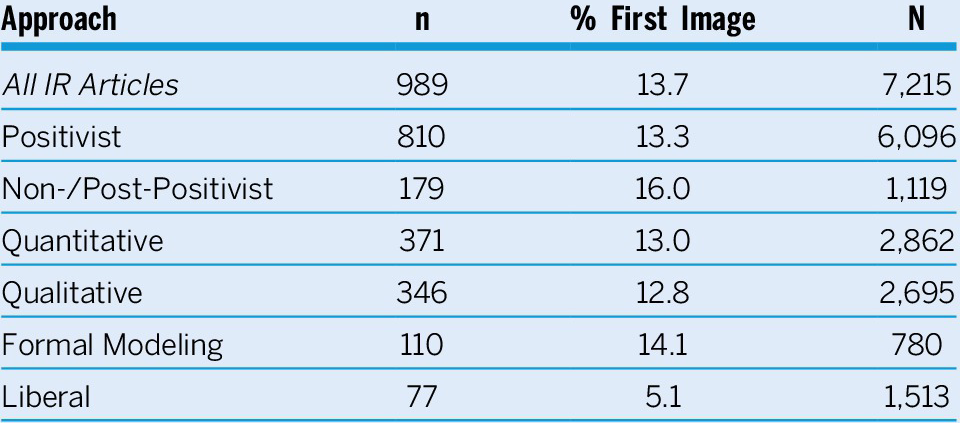
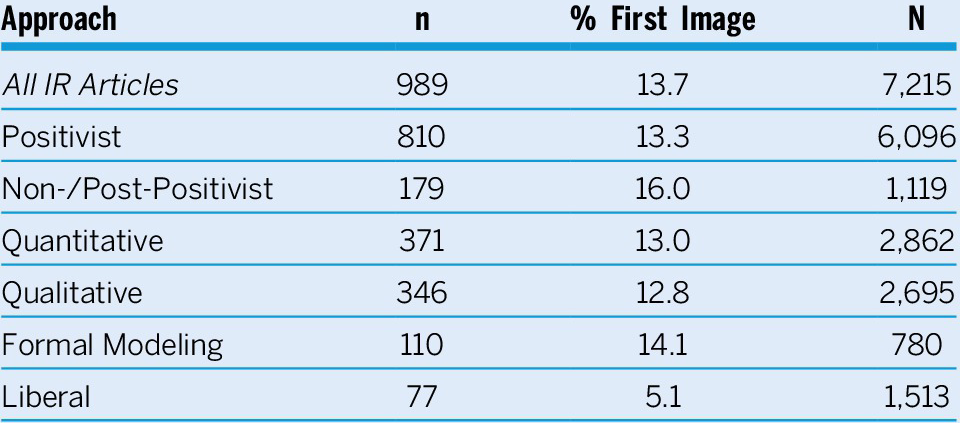
We believe that we can safely exonerate epistemology and, to a slightly lesser extent, methodology; neither causes scholars to downplay the first image. Review of a few descriptive statistics reinforces this point: the proportion of quantitative and formal work studying the first image is approximately the same as that of non-quantitative work; the same is true of positivist versus non-/post-positivist work (table 2).
Use of First Image by Approach, 1980–2018
We believe that we can safely exonerate epistemology and, to a slightly lesser extent, methodology; neither causes scholars to downplay the first image.
From an epistemological standpoint, positivism and the first image are not oil and water. Psychologists and sociologists routinely study individual behavior scientifically, and hypotheses about individuals are as testable as those about states, although the methods may differ significantly. Moreover, whereas positivism’s need for deductively derived hypotheses may push scholars toward rational choice (Popper Reference Popper1985, 361), rationalists themselves stress that rationalism does not favor the third image any more than the first image (Lake and Powell Reference Lake and Powell1999, 34). It is certainly true that individual-level work often focuses on the limitations of applying rational-choice frameworks to individuals. Crucially, however, much of this work still adopts a positivist approach because it studies deviations from rationality at the individual level.
From a methodological standpoint, we hope that as datasets on leaders begin to multiply (Ellis, Horowitz, and Stam Reference Ellis, Horowitz and Stam2015; Goemans, Gleditsch, and Chiozza Reference Goemans, Gleditsch and Chiozza2009), we can dispel the notion that individuals cannot be studied quantitatively. Whereas scholars cannot quantify certain aspects of individuals, they also cannot quantify many aspects of states; the problem seems to be no more severe for first-image variables than others. If anything, Yarhi-Milo (Reference Yarhi-Milo2018) and others have shown that many facts about leaders are easier to acquire than facts about their country. We suggest that our puzzle is explained, at least partially, by the field’s emphasis on grand theory and the resulting paradigmatic wars.
We suggest that our puzzle is explained, at least partially, by the field’s emphasis on grand theory and the resulting paradigmatic wars.
This explanation, however, must answer two questions. First, if grand theories are to blame, then why does the proportion of first-image work remain approximately constant after their decline? Second, why has there not emerged the equivalent of a grand theory, at the micro-level, of the first image?
Turning to the first question, from 1980 to 2004, when the paradigms dominated IR, 15.5% of articles used the first image; from 2015 to 2018, 14.8% did so. The current renaissance improves on the 2005–2014 period (9.9%), but it is approximately the same as the overall proportion for the past 40 years. Although we cannot address this question definitively, our third hypothesis suggests an answer: path-dependent theorizing. Kristensen (Reference Kristensen2018) demonstrated how grand theory continues to structure IR scholarship, including among scholars not working expressly within its traditions. Because different levels of analysis call for different types of theory (Singer Reference Singer1961), studying phenomena with established theoretical tools often is more productive than beginning again. Constructivists who study civil war will have at their disposal different tools—and even vocabulary—than liberals or realists, and these tools will shape the direction of their research. In the previous analysis, we found consistently negative results for scholars who take liberalism seriously, even if they do not identify with the theory. Our findings were similar for scholars working in fields dominated by liberalism, such as IO and IPE.Footnote 12
This quantitative assessment corroborates more qualitative critiques already leveled against the field. For instance, international organizations, in which individual diplomacy occurs daily, would seem to be ready for first-image scholarship; however, these studies remain relatively uncommon (Rathbun Reference Rathbun2014). Instead, scholars use a structural logic that overlooks the interpersonal roots of cooperation (Rathbun Reference Rathbun2011),Footnote 13 even though cooperation in organizations such as the Security Council and G20 arguably depends as much on individual-level dispositions and interactions as on institutional design (Naylor Reference Naylor2018). Similarly, in IPE, the hegemony of liberal theory is well established (Maliniak and Tierney Reference Maliniak and Tierney2009). Many scholars advocate breaking out of its shadow (Keohane Reference Keohane2009) but without great effect. Neoliberalism’s founding texts centered on institutions and interest groups, and subsequent work has continued along these lines despite their recognized limitations.
Nonetheless, we do not argue that the paradigms are “evil,” and neither do we suggest that their (alleged) demise is a net positive for the field. Their internal discipline helps scholars within the tradition to work together and scholars outside of the tradition to identify and use its key contributions. We do agree, however, with Rathbun (Reference Rathbun2019, 305) that the paradigms encourage premature closure: “Using paradigms can help us simplify the world so as to make our jobs more tractable. However, once we lose sight of the fact that we are engaging in simplification, irrational tendencies easily creep in.” Initial simplifying moves, although unavoidable, have path-dependent effects. Those who would study the first image from outside of a paradigm find themselves without a unified body of knowledge on which to build, making it difficult for knowledge to accumulate, whereas those who might work within a paradigm may find themselves corralled by the direction of past research. Perniciously, as IR theory declines, scholars might become less aware of how the old “isms” shape current inquiry and therefore less attentive to “big questions” and creative theorizing.
Turning to the second question, why has a prevailing theory of the individual in world politics not emerged? Jervis (Reference Jervis1976, 28) argued, “[i]t is often impossible to explain crucial decisions and policies without reference to the decision-makers’ beliefs.” Tellingly, two of the main successes in theorizing the first image—political psychology and diplomatic studies—evolved outside of the old paradigms. Psychology imported a coherent research tradition into IR, and it has resisted being subsumed by the isms in much the same way constructivism borrowed from sociological perspectives. Diplomatic studies similarly emerged from non-paradigmatic and eclectic roots: English school, history, and practitioner perspectives combined to provide an interdisciplinary and problematizing foundation. In both cases, a coherent framework for studying individuals developed and contributed to each tradition’s success. At the same time, the disciplines from which first-image IR work has borrowed are eclectic and often cannot agree on core assumptions. “There are very few shared ontological and epistemological assumptions between the ‘behavioral revolution’ and ‘neurobiological revolution,’” observed Kertzer and Tingley (Reference Kertzer and Tingley2018, 332), and this can make “plug-and-play” (i.e., the importing of research traditions from psychology) more challenging than it may appear.
Perhaps, however, first-image work has not produced its own grand theory because it exists in large part to problematize grand theories. Ontological security studies, for example, substitute security of the self for the physical security of a state (Mitzen Reference Mitzen2006). Rather than starting with structure, practice theories uncover how practices, like diplomatic interaction, constitute larger hierarchies (Sending, Pouliot, and Neumann Reference Sending, Pouliot and Neumann2015). The eclecticism of these works suggests that there may never be a prevailing theory of the first image. If so, this may explain why a relatively small proportion of scholarship is punching so far above its weight.
SUPPLEMENTARY MATERIALS
To view supplementary material for this article, please visit http://dx.doi.org/10.1017/S1049096520001699.