Implications
Data required to calculate residual feed intake (RFI, measure of feed efficiency) in swine is expensive to collect and impractical in a production setting. Understanding the main biological factors that contribute to variation in RFI may aid in the development of less expensive selection methods and management practices to increase feed efficiency for both producers and breeding companies. Differences in feed intake and feed efficiency are relatively small during the early grower phase but may be greater later in life. Carcass composition appears to be one of the main biological factors that contributes to differences in RFI at an early age.
Introduction
Residual feed intake (RFI) is a unique measure of feed efficiency that accounts for differences in growth and backfat (BF). RFI is calculated as observed minus expected feed intake for the pig's achieved rate of gain and BF (Koch et al., Reference Koch, Swiger, Chambers and Gregory1963; Luiting, Reference Luiting1990; Kennedy et al., Reference Kennedy, van der Werf and Meuwissen1993). In swine, RFI has been shown to be moderately heritable, with estimates ranging from 0.15 to 0.38 (Nguyen et al., Reference Nguyen, McPhee and Wade2005; Gilbert et al., Reference Gilbert, Bidanel, Gruand, Caritez, Billon, Guillouet, Lagant, Noblet and Sellier2007; Cai et al., Reference Cai, Casey and Dekkers2008; Hoque et al., Reference Hoque, Kadowaki, Shibata, Oikawa and Suzuki2009). To investigate the genetic and biological basis of RFI, a selection experiment for reduced RFI (i.e. improved feed efficiency) in group-housed purebred Yorkshire pigs was undertaken. Selection responses after four generations were evaluated by Cai et al. (Reference Cai, Casey and Dekkers2008) under group pen and ad libitum (Ad) feeding conditions; gilts from the low RFI line consumed substantially less feed (165 g/day), but also had a slightly lower growth rate (33 g/day) and BF (2.0 mm) relative to gilts from the randomly selected control. When adjusting for differences in growth and BF, the difference in RFI was 96 g/day. Bunter et al. (Reference Bunter, Cai, Johnston and Dekkers2010) recently reported IGF-I to be positively genetically correlated with RFI, in this same population. In addition, Cai et al. (Reference Cai, Wu and Dekkers2010) recently showed that, under group housing and Ad feeding, the divergence in feed intake and growth between the low RFI and Control lines mostly occurred during the second half of the growth period, past 50 kg body weight (BW).
The main biological factors that contribute to variation in RFI have been partially quantified in mice (McDonald et al., Reference McDonald, Ramsey, Miner and Nielsen2009), poultry (Luiting, Reference Luiting1990) and beef cattle (Richardson and Herd, Reference Richardson and Herd2004). As reviewed by Herd and Arthur (Reference Herd and Arthur2008), in beef cattle, approximately 73% of the variation in RFI is accounted by factors that include activity, feed intake patterns, behavior, stress, digestibility, protein turnover and tissue metabolism. The importance of these processes for differences in RFI in pigs is only recently starting to be investigated; Barea et al. (Reference Barea, Dubois, Gilbert, Sellier, van Milgen and Noblet2010) showed that pigs selected for low RFI have reduced basal metabolic rate compared with pigs selected for high RFI, using the selection lines described by Gilbert et al. (Reference Gilbert, Bidanel, Gruand, Caritez, Billon, Guillouet, Lagant, Noblet and Sellier2007). Therefore, the objective of this study was to evaluate the fifth generation of the Iowa State University low RFI and Control lines for feed intake, growth performance, body composition and chemical carcass composition under Ad and restricted feed intake. The focus here was on differences during the early grower phase; differences during the later grower phase for these same lines were described by Boddicker et al. (Reference Boddicker, Gabler, Spurlock, Nettleton and Dekkers2011). We hypothesized that during the early–mid growth phase (i) carcass composition and (ii) carcass energy will differ between the Control and low RFI pigs. It is these differences that appear late in this early growth period that may drive the overall reduced feed intake and improved feed efficiency in the line selected for reduced RFI compared with the Control line.
Material and methods
Experimental design
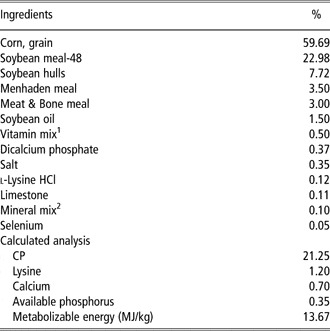
All animal procedures were approved by the Animal Care and Use Committee of Iowa State University. Using a randomized complete block design, 100 Yorkshire barrows (22.6 ± 3.9 kg) from the fifth generation of the Iowa State University RFI lines, 50 from the line selected for reduced RFI (referred to as the Select line in the remainder) and 50 from the randomly selected Control line, were paired based on age and weight, and each pair was randomly assigned to adjacent individual pens. Within each replicate, consisting of four pairs of one Select and one Control pig, littermates were used within each of the two lines, that is, four pigs from one Select litter and four pigs from one Control litter. Pigs were allowed to acclimate for 3 days on Ad feeding and had free access to water at all times. Throughout the experiment, all pigs received the same diet, which was formulated to meet nutrient requirements for pigs of this size (National Research Council (NRC), 1998) over the 6-week test period for each treatment (Table 1). Following the 3-day acclimation period, all pigs were fed Ad for 7 days and average daily feed intake (ADFI) was recorded for each pig (week −1). Thereafter, within each replicate, pairs were randomly allocated to one of four feed intake levels (treatments) to capture differences in growth and maintenance requirements between the lines. The feed intake treatments were: (i) Ad, (ii) 75% of feed intake of the Ad Control pigs (Ad75), (iii) 55% of feed intake of the Ad Control pigs (Ad55) and (iv) a weight stasis (WS) treatment with the goal to maintain static BW to estimate potential differences in maintenance energy requirements. For the Ad75 and Ad55 treatments, pair mates (one from each line) were given identical amounts of feed to evaluate how the two lines utilize a given amount of feed in terms of growth and body composition. In the WS treatment, feed intake was individually adjusted to maintain the initial BW of each pig. The initial feeding level used for the WS treatment was based on estimated energy requirements for maintenance based on 444 BW0.75 kJ of metabolizable energy per day, where BW was the pig's BW on day −1 before treatment. The energy required per day to support each pig's maintenance energy requirements was then calculated following NRC guidelines for swine (NRC, 1998). Pigs on the WS treatment were weighed twice per week and their feed intake was then adjusted based on weight gain or loss relative to their starting BW.
Composition and calculated analysis of the experimental diet

1Vitamin mix donated by DSM Nutritional Products, Inc., Ames, IA 50010, USA and provided the following per kilogram of diet: vitamin A, 4409 IU; vitamin E, 22 IU; vitamin D3, 1102 IU; niacin, 33 mg; D-pantothenic acid, 18 mg; riboflavin, 6.6 mg.
2Mineral mix provided the following per kilogram of diet: Zn, 90 mg as ZnO; Fe2SO4; Cu, 10.5 mg as CuO; Mn, 36 mg as MnO2; I, 1.2 mg as CaI.
The experiment was conducted in five replicates of eight pigs and six replicates of 10 pigs (one pig per line by treatment combination, plus one additional pig per line on the WS treatment for replicates with 10 pigs) and the duration of the test period was 6 weeks. Pigs on any of the three restricted feed intake treatments were provided two equal portioned meals at 0700 and 1700 h each day. Feed allotments for the Ad75 and Ad55 treatments were based on the ADFI in the previous week of the Ad fed Control line pigs within each pig's replicate.
Performance traits
All pigs were weighed at the beginning and end of the pre-treatment week (days −7 and −1 of week −1). Week −1 ADFI was calculated as feed offered minus feed refused during week −1 and used to establish feed allotted to pigs on the Ad75 and Ad55 treatments on day 0. Pre-treatment average daily gain (ADG) was based on BW at days −1 and −7. This was the beginning of the 6-week test period.
All pigs were weighed individually at the start of the treatment period (day 0), and pigs on the Ad, Ad75 and Ad55 treatments were weighed on day 7 of each week until the end of the treatment period (day 42). Pigs on the WS treatment were weighed on days 3 and 7 of each week to adjust feed provided in order to maintain static BW. Weekly ADFI for Ad pigs was calculated as feed offered minus feed refused on day 7 of each week. ADG was calculated for each pig during each week of the treatment period. Feed efficiency was calculated as kilogram of gain per kilogram of feed for each pig. Ultrasonic measurements of 10th rib BF and loin eye area (LEA) were collected on days 0, 14, 28 and 42 of the treatment period. Two 10th rib images were collected by a National Swine Improvement Federation certified technician using an Aloka 500V SSD ultrasound machine fitted with a 3.5 MHz, 12.5 cm, linear-array transducer (Corometrics Medical Systems, Inc., Wallingford, CT, USA).
Upon completion of the performance study, pigs from eight replicates were fasted overnight, weighed, anesthetized via an intravenous injection (0.04 ml/kg BW) of a 1 : 1 : 1 mixture of Telazol-HCl (Fort Dodge Animal Health, Fort Dodge, IA, USA), Xylazine-HCl (Lloyd Laboratories, Shenandoah, IA, USA) and Ketamine-HCl (Fort Dodge Animal Health). After a surgical plane of anesthesia was reached, pigs were euthanized by exsanguination. Immediately thereafter, weight of the viscera, including stomach and intestinal tract, kidneys, lungs, heart and their contents were obtained, and empty BW was recorded. Whole carcass weight was recorded after the head was removed. The carcass was then split medially and the right half was frozen at −20°C for later chemical analyses. Dressing percentage was calculated as empty BW, divided by live weight.
Carcass composition
After each frozen half carcass was sectioned, it was twice passed through a mechanical grinder (Buffalo no. 66BX Enterprise, Westinghouse Electric and Manufacturing Company, USA) and twice through a Hobart 52 grinder (The Hobart Manufacturing Company, Troy, Ohio, USA) with a 5 mm die. The ground carcass was thoroughly mixed and a homogenized sample was collected and stored at −20°C for laboratory analysis. Carcass chemical analysis of moisture, protein, lipid and ash was determined after samples (n = 8 pigs per line per treatment) were thawed and aliquots were freeze-dried and re-ground. Water content was determined in triplicate by drying 8.0 g sub-samples to a constant weight in a Fisher Scientific Isotemp oven at 105°C. Moisture-free sub-samples were placed in a Muffle furnace (Fisher Scientific, USA) for determination of ash. Nitrogen was determined in quadruplicate using the Kjeldahl method in a Fisher Scientific digestion and distillation system (Association of Official Analytical Chemists (AOAC), 1980). CP was calculated by multiplying the nitrogen content by 6.25. Lipid content was determined in duplicate samples of approximately 3.5 g by ether extract, using the goldfish Fat Extraction (Laboratory Construction Company, Missouri, USA) system (AOAC, 1980). Dry matter percentage was calculated as 100% minus the moisture percentage of the carcass. Carcass dry matter, in kilogram, was calculated by multiplying dry matter percentage and carcass weight.
Carcass energy and consumed energy
The gross energy content of the diet and of each carcass was determined in duplicate by adiabatic bomb calorimetry. To calculate carcass energy, total carcass dry matter in kilogram was multiplied by the energy content per kilogram of carcass as determined from bomb calorimetry.
Statistical analysis of performance and composition data
All data were analyzed using the MIXED procedure of SAS (SAS Institute, 2007). All models included replicate and line as fixed factors. Random effects were included for litter and replicate-by-treatment interaction terms. Litter effects were included to account for covariances among littermates and the interaction random effects were included to account for pairing of Control and Select line pigs because there was one Control–Select pair for each combination of replicate and treatment. For traits that were analyzed by treatment, the litter and interaction random effects were removed, as there were no littermates within a treatment and replicate accounts for Control–Select pairs when only a single treatment is considered. However, litter was included as a random effect in the model for the WS treatment because some replicates had two littermates from each line.
Pre-treatment traits of BW at days −7 and −1, ADFI for week −1, and BF and LEA on day 0 were analyzed using the model described above. Starting BW on day −7 was included as an additional covariate for the analyses of week −1 ADFI and ADG to adjust for differences in BW on day −7. Day 0 BW was included as an additional covariate for the analyses of day 0 BF and LEA. Day 0 BW, BF and LEA were also analyzed across treatments, with additional fixed factors of treatment and the interaction of line-by-treatment and random effects of litter and the interaction of replicate-by-treatment, to obtain the starting points in Figure 1a, c and d, respectively.
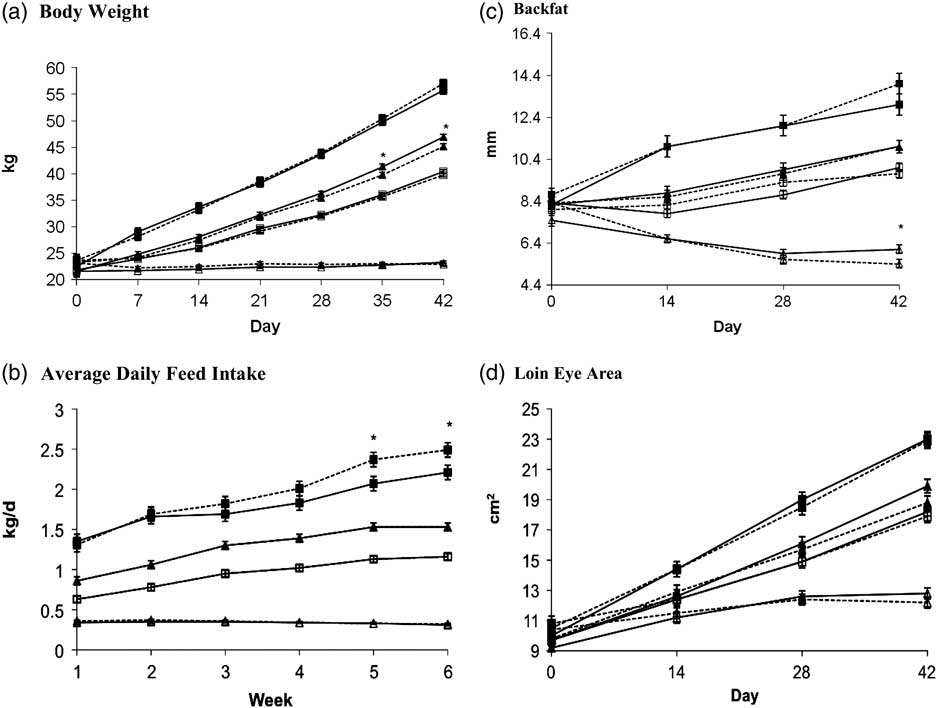
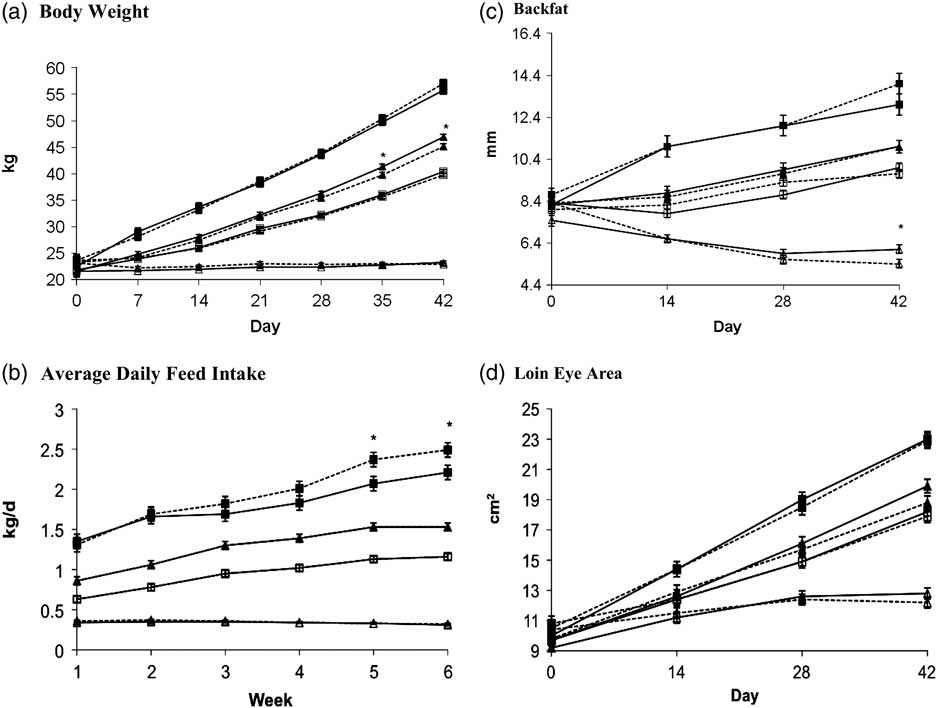
Effects of feed restriction on body weight (a), average daily feed intake (b), backfat (c) and loin eye area (d) of low residual feed intake and control barrows over a period of 42 days starting at 20 kg. Panel (a) represents LSM ± s.e.m. for body weight (BW) every 7 days starting with day 7 (day 0 was used as a covariate). Panel (b) represents LSM ± s.e.m. for weekly average daily feed intake. Panel (c) represents backfat every 2 weeks (LSM ± s.e.m.). Panel (d) represents loin eye area every 2 weeks (LSM ± s.e.m.). n = 11 pigs per line per treatment for the treatments of ad libitum (Ad), 75% of Ad (Ad75) and 55% of Ad (Ad55), and n = 17 per line for the weight stasis (WS) treatment for all analyses. Repeated measures analysis begins with day 14 for panels (c) and (d), as day 0 was used as a covariate for the respective traits along with day 0 BW. ▪ = Ad treatment; ▴ = Ad75 treatment; □ = Ad55 treatment; ▵ = WS treatment; ___ = Select line; ___ = Control line.
The performance traits of ADG and feed efficiency, averaged over the entire treatment period, were analyzed across the three treatments of Ad, Ad75 and Ad55, with additional fixed effects of treatment and the interaction of line and treatment, day 0 BW as a covariate, and random effects of replicate by treatment and litter. These traits were not analyzed for the WS treatment because this treatment was designed to keep BW constant.
To evaluate the cumulative effect of treatments over time, the performance traits of BW, ADFI, BF and LEA while pigs were on treatment were analyzed as repeated measures. These analyses were conducted separately for each treatment because the nature of the treatments resulted in residual variances to be heterogeneous between treatments. In addition, the main focus was on analysis of differences between lines for a given treatment, rather than on differences between treatments. Day 0 BW was included as a covariate to account for differences in starting weight, along with the additional fixed factors of week and the interaction of line and week. For BF and LEA, in addition to day 0 BW, day 0 BF and day 0 LEA were used as covariates, respectively, to adjust for differences in BW, BF and LEA at the start of treatment and allow a fairer comparison of pigs for the traits analyzed. For the trait of BW, the repeated measures analysis included time points from days 7 to 42. Day 0 BW was not included as a time point because it was used as a covariate. Similarly, the traits of BF and LEA only included time points from days 14 to 42 because trait observations at day 0 were included as covariates. A first-order autoregressive, covariance structure was used to model correlations among pig-specific residuals across time.
The carcass traits of carcass weight, viscera weight, dressing percentage and chemical carcass composition were analyzed across treatments, with additional fixed factors of treatment and the interaction of line and treatment, day 0 BW as a covariate, and random effects as previously stated. Slaughter BW was included as an additional covariate for carcass and viscera weight. Owing to the large differences in slaughter BW between treatments, this covariate was fitted as the pig's BW minus the average slaughter BW for that treatment, such that least square means (LSM) were computed for the average BW for each treatment.
For carcass energy, day 0 BW, day 0 BF and day 0 LEA were included as additional covariates to adjust for differences in carcass energy at the start of treatment, such that resulting LSM are estimates of differences in retained carcass energy. This analysis assumes that BW, BF and LEA on day 0 are adequate estimates of carcass energy at the start of test. This assumption was validated by analyzing carcass energy by the same model but with ultrasound BW, BF and LEA at slaughter (day 42) as predictors. This model had an R 2 value of 0.95. Gross energy consumed over the 6-week test period was analyzed separately for each treatment, with day 0 BW as a covariate.
Results
Pre-treatment differences
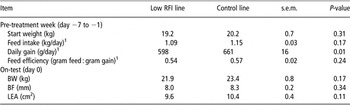
BW and feed intake data for week −1, along with day 0 BF and LEA, are presented in Table 2. There was no significant difference in feed consumption between the two lines during this initial data collection period. However, the Select line pigs weighed significantly less compared with the Control line pigs (23.6 v. 24.1 kg, respectively, P < 0.01, data not shown) and had significantly lower ADG (P < 0.01; Table 2) after adjusting for day −1 BW. There was no significant pre-treatment difference in BF (P > 0.34) and LEA (P > 0.11) between the two lines. Day 0 BW was not adjusted for BW on day −7 and did not differ between the lines (P > 0.17). However, subsequent results were adjusted by including day 0 BW as a covariate in the models. As expected, there were no significant differences (P > 0.96) in BW, BF or LEA between the groups of pigs that were randomly assigned to each treatment (data not shown).
LSM ± s.e.m. for BW and feed intake of pigs from the low RFI and Control lines at the start and end of the week before dietary treatment, and for ultrasonic BF and LEA at the start of treatment (n = 50 pigs per line)

LSM = least square means; RFI = residual feed intake; BF = backfat; LEA = loin eye area.
1Adjusted for start weight (day −7).
Performance and ultrasound traits
LSM for the repeated measures analysis of BW and ADFI over the 6-week treatment period are in Figure 1 (panels (a) and (b)). These data were analyzed separately for each treatment, due to heterogeneous variances across treatments by study design, and adjusted for day 0 BW within treatment. As expected, BW increased as the amount of feed provided increased from treatment WS to Ad. The Ad Select (AdS) pigs tended to consume less feed compared with the Ad Control (AdC) pigs (1.8 v. 2.0 kg/day, P < 0.06), when averaged over the entire 6-week period, with a significant difference in feed intake in weeks 5 (P < 0.02) and 6 (P < 0.03). There was no significant difference in BW between the AdS and AdC pigs for any given week. Feed efficiency (kilogram of gain per kilogram of feed) for the Select and Control lines for the 42-day period were 0.44 and 0.41, respectively. The corresponding values for week 5 were 0.38 and 0.32, and 0.36 and 0.32 for week 6. By study design, the Control and Select line pigs consumed the same amount of feed for the Ad75 and Ad55 treatments (Table 3). The Ad75 Select (S75) line pigs steadily diverged in weight from the Ad75 Control (C75) pigs, with the S75 pigs weighing significantly more than the C75 pigs in weeks 5 (P < 0.02) and 6 (P < 0.01). Conversely, for the Ad55 treatment, there was no significant difference in BW between the Select (S55) and Control (C55) pigs. There was no significant difference in BW between the two lines under the WS treatment during any week. Although the objective of the WS treatment was to keep BW constant, the main effect of week was highly significant (P < 0.01); although the interaction of line-by-week was not significant, the Select WS pigs gained 1.54 ± 0.33 kg from days 7 to 42 (P < 0.01), compared with only 0.67 ± 0.34 kg for the Control line (P < 0.05). Although not significant (P > 0.35), the Select WS pigs consumed 4% less feed over the treatment period compared with the Control WS pigs.
LSM of treatment and line on performance traits of pigs selected for low RFI and a randomly selected Control line over a period of 42 days with a starting weight of 20 kgFootnote 1

LSM = least square means; RFI = residual feed intake; Ad = ad libitum; Ad75 = 75% of Ad; Ad55 = 55% of Ad; WS = weight stasis; BF = backfat; LEA = loin eye area.
a,b,c,d,e,f Means within a row with different superscripts are significantly different at P < 0.05.
1 Values are LSM based on 11 pigs per line per treatment for Ad, Ad75 and Ad55, and 17 pigs per line for the WS treatment.
2 Difference of Control minus Select.
3 Main effect of line.
4 Main effect of treatment.
5 Interaction of line and treatment.
6 Main effect of line from the repeated measures analysis (analyzed separately for each treatment).
7 Analysis included day 0 BW.
8 Analysis included day 0 ultrasonic BF.
9 Analysis included day 0 ultrasonic LEA.
LSM from analyses of ultrasonic measurements of BF and LEA over the treatment period are in Figure 1c and d. These repeated measures were analyzed separately for each treatment and adjusted for day 0 BW, day 0 BF and day 0 LEA, respectively. As expected, both BF and LEA increased with an increase in feed provided by treatment (Figure 1c and d). For the Ad treatment, there was no significant difference in BF (P > 0.19) or LEA (P > 0.49) between the two lines within any 1-week. There was also no significant difference in BF between lines in the Ad75 treatment within any 1-week. For the Ad55 treatment, only the difference in BF on day 28 was significant between the two lines, with the Select pigs having less BF compared with the Control pigs (P < 0.06). There were no significant differences in LEA between the lines when fed at either Ad75 or Ad55.
For the WS treatment, the main effect of week was significant for both BF and LEA (P < 0.01), with a significant line-by-week interaction (P < 0.03) for BF but not significant for LEA (Figure 1c and d). Owing to the severity of feed restriction, both lines lost BF under the WS treatment. Select pigs lost only 0.46 mm in BF from days 14 to 42 (P < 0.02), whereas the Control pigs lost 1.21 mm from days 14 to 42 (P < 0.01, Table 3). Surprisingly, Select pigs had an increase of 1.6 cm2 in LEA from days 14 to 42 (P < 0.01), whereas Control pigs did not have a significant increase in LEA (P > 0.13). On average, Select pigs on the WS treatment had significantly more BF at day 42 than Control pigs (6.1 v. 5.4 mm, respectively, P < 0.02).
Carcass traits
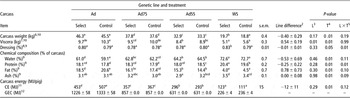
The main effect of treatment was highly significant (P < 0.01) for all carcass traits (Table 4). The main effect of line was significant (P < 0.01) only for weight of viscera, with the Select line having 6% less visceral mass compared with Control pigs when averaged over treatments. On a within-feed treatment basis, differences between lines in viscera mass tended to be lower for the Ad (P < 0.10) and Ad55 treatments (P < 0.10), with no significant differences for the Ad75 (P > 0.16) and WS (P > 0.14) treatments. Although other traits did not show significant line effects across treatments, the two lines were significantly different for several specific trait-by-treatment combinations. Select pigs had significantly lower live weight compared with the Control pigs under the Ad treatment (P < 0.01). Furthermore, under the WS treatment, Select pigs had significantly higher dressing percentage than Control pigs (P < 0.01).
LSM for treatment and line on harvest data and carcass composition of pigs selected for low RFI and a randomly selected Control line over a period of 42 days with a starting weight of 20 kgFootnote 1

LSM = least square means; RFI = residual feed intake; Ad = ad libitum; Ad75 = 75% of Ad; Ad55 = 55% of Ad; WS = weight stasis; CE = carcass energy; GEC = gross energy consumed.
a,b,c,d,e Means within a row with different superscripts are significantly different at P < 0.05.
1 Values are LSM based on eight pigs per line per treatment.
2 Difference of Control minus Select.
3 Main effect of line.
4 Main effect of treatment.
5 Interaction of line by treatment.
6 Carcass equals empty BW, including head and hair.
7 Viscera includes entire intestinal tract with contents, kidney, heart and lungs.
8 Dressing percentage is carcass weight as a percent of slaughter weight.
9 Analysis included day 0 BW as a covariate.
10 Analysis included day 0 BW and adjusted slaughter weight (average slaughter BW within each treatment minus individual pig's slaughter BW) as covariates.
11 CE determined from calorimetry.
12 GEC over the total 6-week test period (analyzed per treatment).
Chemical carcass composition
Percentages of the main chemical components of carcass protein, lipid, ash and water summed up to 100.5% ± 0.16% of the sub-sample weight, which confirms the accuracy of the procedures used (Table 4). The main effect of treatment was significant for all components (P < 0.01). With an increase in feed restriction, protein% and water% increased, whereas fat% decreased. The treatment effect for ash% was driven by the WS treatment, which had the greatest ash%. For all traits, the main effect of line across treatments was not significant (P > 0.28); however, the two lines were significantly different for some specific trait-by-treatment combinations. For protein%, the line-by-treatment interaction was significant (P < 0.01). The Select line had greater protein% compared with the Control within the WS (P < 0.04) treatment, and the Select line tended to have less protein% compared with the Control within the Ad55 treatment (P < 0.10). There was no difference in protein% between the lines within the Ad (P > 0.33) and Ad75 (P > 0.16). The Select line had a significantly lower fat% (P < 0.05) compared with the Control for Ad, with no significant line difference for the other treatments. There were no significant differences between the two lines in ash% within any treatment, except for Ad55, for which the Select line had less ash% compared with the Control line (P < 0.04). AdS had significantly greater water% compared with the Control (P < 0.05), with no significant difference between lines for the other treatments.
Analysis of energy consumed v. retained
The effects of treatment and line on carcass energy are reported in Table 4. The main effect of treatment was highly significant, with an increase in feed restriction resulting in a decrease in carcass energy (P < 0.01). The line effect revealed that there was no significant difference (P > 0.27) in carcass energy between the lines across all treatments. However, a line effect on carcass energy was observed for the Ad treatment (P < 0.02), with Select line pigs having lower carcass energy.
Similar to ADFI, gross energy consumed was analyzed separately for each treatment because of the nature of the treatments imposed and, thus, the main effects of treatment and the interaction of line and treatment were not estimated. Again, in contrast to ADFI (Figure 1b), only eight pigs per treatment and line were evaluated for energy consumed (Table 4). No significant differences were found in energy consumed between the Select and Control lines for the Ad and WS treatments (Table 4). By study design, pigs within the Ad75 and Ad55 treatments consumed the same amount of energy, respective to treatment.
Discussion
This study aimed to evaluate a line selected for reduced RFI against a Control line at a young age for differences in performance and carcass composition. Pigs were from the fifth generation of two lines of Yorkshire pigs, with one line selected for low RFI and a randomly bred control line and selection based on RFI evaluated under group housing and Ad feeding from approximately 45 to 110 kg (Cai et al., Reference Cai, Casey and Dekkers2008). As expected based on results from Cai et al. (Reference Cai, Casey and Dekkers2008), under Ad feeding, the Select line pigs consumed less feed compared with the Control line. But, in contrast to Cai et al. (Reference Cai, Wu and Dekkers2010), who found limited differences in feed intake at an early age, significant differences were apparent before 50 kg BW. Similar to Cai et al. (Reference Cai, Wu and Dekkers2010), rate of gain at this early age was not different from the Control line. This difference in results for feed intake may be attributed to the different environments, as pigs in this study were individually penned, which has been shown to affect performance (de Haer and de Vries, Reference de Haer and de Vries1993).
There was no significant difference in feed efficiency between the lines under the Ad treatment. When feed was restricted to 75% and 55% of Ad, pigs from the Select line had a slightly greater weight gain on the same amount of feed, which resulted in greater feed efficiency of the Select line under the Ad75 treatment and suggests that the Select line has reduced maintenance requirements or is more efficient at tissue deposition. The trait RFI, as defined by Koch et al. (Reference Koch, Swiger, Chambers and Gregory1963), equals observed feed intake minus expected feed intake based on average requirements for maintenance and growth. Therefore, by feeding the two lines identically restricted amounts of feed, pigs with reduced maintenance requirements or increased efficiency of tissue deposition are expected to have greater growth. The WS treatment was designed to assess difference in maintenance requirements between the two lines, although this provides only a crude indicator of maintenance requirement, because of changes in body composition; accurate estimation of maintenance requirements requires use of respiratory chambers (Barea et al., Reference Barea, Dubois, Gilbert, Sellier, van Milgen and Noblet2010), but this was beyond the scope of this study. Although the aim of the WS treatment was to keep BW constant, BW slightly increased for both lines from days 0 to 42. However, Select line pigs had significantly greater increases in BW than Control line pigs, with no significant difference in feed intake. Collectively, these results indicate that selection for reduced RFI results in greater feed efficiency; however, differences were fairly small due to the age and weight of the pigs, consistent with Cai et al. (Reference Cai, Wu and Dekkers2010).
Estimates of genetic correlations between RFI and BF thickness are generally positive in pigs, ranging from 0.07 to 0.77 (Johnson et al., Reference Johnson, Chewning and Nugent1999; Gilbert et al., Reference Gilbert, Bidanel, Gruand, Caritez, Billon, Guillouet, Lagant, Noblet and Sellier2007; Hoque et al., Reference Hoque, Kadowaki, Shibata, Oikawa and Suzuki2009). In market-weight pigs of the Iowa State University RFI selection lines, Bunter et al. (Reference Bunter, Cai, Johnston and Dekkers2010) found a positive genetic correlation between RFI and BF (r = 0.20). Furthermore, a study that looked at BF accretion rates using real-time ultrasound found that the variation in BF depth increased with BW (Moeller and Christian, Reference Moeller and Christian1998), indicating that BF does not differ significantly in young pigs. In this study, BF results were unclear. There was no significant difference in BF between the two lines within treatments, when analyzed using repeated measures, which may be due to the young age of the pigs used. However, contradictory to results from the repeated analysis of BF (Figure 1c), likely due to the different models and assumptions behind the covariate of day 0 BF, under Ad feeding, the Select line had significantly less BF on day 42 (Table 3). Furthermore, there was a significant difference in BF between the two lines under the WS treatment under which the Select line pigs lost less BF (Figure 1c) and had more BF on day 42 compared with the Control pigs (Table 3). This indicates that the Select line prioritizes energy differently to maintain energy stores under severe feed restriction.
Genetic correlations between RFI and LEA in pigs have generally been found to be negative, ranging from −0.18 to −0.60 (Johnson et al., Reference Johnson, Chewning and Nugent1999; Cai et al., Reference Cai, Casey and Dekkers2008; Hoque et al., Reference Hoque, Kadowaki, Shibata, Oikawa and Suzuki2009). Cai et al. (Reference Cai, Casey and Dekkers2008) found that the Select line had greater LEA compared with the Control line. In this study, there was no difference in LEA between the two lines under Ad treatment. These results likely differ to those reported by Cai et al. (Reference Cai, Casey and Dekkers2008) for the same lines because of differences in age of pigs when measurements were taken.
Live weight was not significantly different between the two lines within any of the treatments, except under Ad feeding where Select pigs weighed significantly less than Control pigs. This difference may largely be explained by two factors. First, as shown in Figure 1a, the Control line had a slightly heavier BW, although it was not significant. A second explanation is that only 8 of the 11 replicates were slaughtered, whereas weekly BW was measured for all 11 replicates. Furthermore, there were no significant differences in carcass weight after adjusting for live weight. Given the previous result of no significant differences in slaughter and carcass weight, there was no significant differences in dressing percentage between lines within any treatment, except for the WS treatment for which Select line pigs had a 4% greater dressing percentage. This difference can be attributed to the difference in carcass weight between the two lines. Further research is needed to determine whether selection for low RFI increases dressing percentage. Selection for low RFI resulted in lighter visceral weight, which in the latter part of the growing phase, may ultimately increase dressing percentage and profit for the producer. Viscera, compared with muscle, is energetically expensive to maintain (Noblet et al., Reference Noblet, Karege, Dubois and van Milgen1999). Therefore, lower visceral mass in the Select line may contribute to the difference in feed intake and increased feed efficiency compared with the Control.
A study that divergently selected Yorkshire pigs for low- and high-fat, along with a Duroc line divergently selected for low- and high-fat, found that pigs selected for low-fat had reduced ether extract percentage (fat%) compared with the pigs of the high-fat line at 19.0 kg of BW (Brooks et al., Reference Brooks, Fontenot, Vipperman, Thomas and Graham1964). In this study, under Ad feeding, the Select line had 2.1% less fat compared with the control, but 1.9% more water, which supports our hypothesis that carcass composition between the two lines is different at a young age. Therefore, the Select line makes up in water what it is lacking in fat compared with the control. However, our hypothesis is not supported in the treatments where feed was restricted, as chemical carcass composition did not differ between the lines.
In beef cattle, steer progeny form low RFI parents had less BF and more protein than progeny from high RFI parents (Richardson et al., Reference Richardson, Herd, Oddy, Thompson, Archer and Arthur2001). These differences in steer progeny chemical carcass composition, however, accounted for only 5% of the difference in RFI (Richardson et al., Reference Richardson, Herd, Oddy, Thompson, Archer and Arthur2001). To evaluate the extent to which differences in feed intake could be explained by differences in carcass composition in our study, net energy consumed was estimated to be 56% of gross energy consumed (Oresanya et al., Reference Oresanya, Beaulieu and Patience2008), using the LSM of Table 4. Then, line differences in net energy consumed were compared with estimated line differences in carcass energy retained, using LSM from Table 4. In the Ad treatment, the line difference in net energy consumed was (1333 to 1226) × 0.56 = 60 MJ, whereas the line difference in retained carcass energy was 511 to 459 = 52 MJ. To estimate the extent to which the difference in carcass composition explains the difference in consumed energy, retained carcass energy is divided by net energy consumed. Here, the difference in carcass composition may explain 87% of the difference in consumed energy; given our assumption that net energy intake is 56% of gross energy consumed is correct. For the other treatments, the line difference for retained energy was larger compared with the difference in consumed energy. Overall, it appears that carcass composition does indeed explain a substantial portion of the difference in feed intake. Furthermore, this difference in carcass composition can be attributed largely to the difference in fat content.
Maintenance energy requirements are believed to be associated with RFI. Selection for lower RFI resulted in lower maintenance requirements in beef cattle (Herd and Bishop, Reference Herd and Bishop2000). Barea et al. (Reference Barea, Dubois, Gilbert, Sellier, van Milgen and Noblet2010) showed that pigs selected for low RFI consumed less feed and had lower basal metabolic rates between 20 and 65 kg compared with pigs selected for high RFI. Owing to the study design, this study was unable to accurately estimate efficiency of energy retention or maintenance energy requirements. However, this research provides insight for a more advanced study to look into differences in basal metabolic rates between the Select and Control lines.
In conclusion, selection for low RFI in Yorkshire pigs has reduced feed intake under Ad feeding, with limited effects on growth rates and carcass yield. The differences in feed intake and feed efficiency are relatively small during the early grower phase. However, the trends are such that these differences may be greater after 50 kg, which has been shown by Cai et al. (Reference Cai, Casey and Dekkers2008) and Boddicker et al. (Reference Boddicker, Gabler, Spurlock, Nettleton and Dekkers2011). Finally, carcass composition appears to be one of the main biological factors that contributes to the difference in RFI between the two lines.
Acknowledgments
This project was funded by the National Pork Checkoff and the Iowa Pork Producers Association. Funds for development and maintenance of the selection lines were from the Iowa Agriculture and Home Economics Experiment Station through the Center for Integrated Animal Genomics, Iowa State University, (Project no. 3600) and supported by Hatch Act and State of Iowa Funds. The authors acknowledge technical assistance to this project from the Iowa State University Residual Feed Intake group, specifically Emily Kuntz, Martha Jeffrey, Shayleen Harrison, Abbie Lashbrooke, Anna Gabler and John Newton, and staff at the Lauren Christian Swine Research Center and Bilsland Memorial Farm.