Developing interventions for people with dementia is a common policy objective. In the United Kingdom (UK), policy targets include providing timely diagnosis and intervention (Welsh Assembly Government, 2011) and non-pharmacological help which supports people with dementia in managing worries, fears, distress and practical and financial issues (Department of Health, 2001). Similar objectives have been identified by the United States Department of Health and Human Services (2014). However, the efficacy, optimal targeting, and duration of different types of psychosocial intervention needs to be determined (Princes et al., Reference Prince, Bryce and Ferri2011).
Support groups are a common form of psychosocial intervention and are increasingly being provided for people with dementia, especially for people in the early stages of the illness. For instance, the Alzheimer's café (a form of support group) is now established in many countries and is a regular feature of dementia services in the UK (Capus, Reference *Capus2005). Given the increasing provision of support groups for people with dementia, it is important to explore the evidence base.
Support groups can be based on a range of theoretical models and groups may be led by professionals or lay facilitated. The term support group has been applied to different types of meetings: groups which focus on mutual support and topics suggested by attendees, groups which have combined mutual support and education, self-help, user-led groups and psychotherapy groups (Hedman et al., Reference *Hedman, Hansebo, Ternestedt, Hellström and Norberg2014a). It is therefore difficult to define the specific characteristics a group should have to be categorized as a support group.
A further problem is that support groups for people with dementia may have different characteristics to support groups for people without dementia. Whilst support groups for other chronic conditions, such as cancer, may be led by lay facilitators (Montzeri et al., Reference Montazeri2001), groups for people with dementia may benefit from professional facilitation as people with dementia can experience word finding problems (Bayles, Reference Bayles1982) and this might make it harder for them to initiate discussions without some scaffolding. Similarly, support groups for chronic conditions, such as diabetes may be quite informal (Markowitz and Laffel, Reference Markowitz and Laffel2012) but a more structured group format may help people with dementia manage their memory and language difficulties in meetings. For example, people with dementia have said that adopting routines assists them with their memory (Toms et al., Reference Toms, Quinn, Anderson and Clare2015) and this benefit might extend to a consistent meeting structure. Therefore, providing support groups for people with dementia may involve different considerations.
Several support groups for people with dementia have been studied for their effectiveness, normally defined as an improvement in psychosocial outcomes such as quality of life, mood, social support or self-efficacy. Effectiveness can also be often more broadly defined to encompass participant satisfaction with attending the group and their perception of deriving benefit. There is some evidence that such groups can be effective (Logsdon et al., Reference *Logsdon, McCurry and Teri2007; Reference *Logsdon2010); however, findings have been inconsistent. For instance, Logsdon et al. (Reference *Logsdon2010) found that their support group improved participants’ mood and quality of life ratings, whereas participants attending a group designed by Gaugler et al. (Reference *Gaugler2011) declined in instrumental activities of daily living and there were no other significant differences.
A recent systematic review by Leung et al. (Reference Leung, Orrell and Orgeta2015) concluded that support groups may have psychological benefits for people with dementia and mild cognitive impairment. However, they only focused on outcomes from RCTs and therefore only two papers were included. A narrow focus on trial design eliminates the majority of the available evidence and other study designs may be more informative about how interventions perform in “real life” conditions. For instance, individualized interventions explored in pre-post studies may inform practice and non-randomized control groups that control for time effects provide valuable information (Cohen-Mansfield et al., Reference Cohen-Mansfield, Buckwalter, Beattie, Rose, Neville and Kolanowski2014). Furthermore, one of the included studies was a multi-component intervention, which contained cognitive behavioral therapy (CBT) sessions. There is a reasonable argument for excluding psychotherapy groups from more stringent definitions of support group, as psychotherapy groups have distinctive features because their primary purpose is to provide therapy rather than social support.
Objectives
The current review aimed to explore the effectiveness of support groups for people with dementia by examining outcome research from a range of methodologies. Further objectives were to investigate the characteristics of participants and the content, structure and theoretical basis of the support groups evaluated. An additional aim was to consider whether negative outcomes or adverse events have been reported for support group interventions.
Methods
Three health science databases were searched from inception between February and March 2014: Medline (EBSCO), CINAHL (Cumulative Index to Nursing and Allied Health Literature: EBSCO) and PsycInfo (ProQuest). The key search areas were dementia (example terms: dementia and Alzheimer disease) and support groups (example terms: support group and psychosocial intervention). Search terms were derived from key words in relevant papers and MeSH listings. A further search was conducted in the Current Controlled Trials database using the term “dementia groups.”
A number of secondary searches were conducted in March 2014. A manual check for relevant papers was made in the ALOIS database and “Dementia: The International Journal of Social Research and Practice” was hand searched from inception. An author search was conducted in Medline (ECSBO) for key authors (Rebecca Logsdon and Robyn Yale). Final searches included cross-checking retrievals with those reported by Leung et al. (Reference Leung, Orrell and Orgeta2015) and a citation search in Google Scholar on papers meeting inclusion criteria. The Medline update function was also used to retrieve newly published papers.
Inclusion and exclusion criteria
No date restrictions were applied but papers had to be published in English in a peer-reviewed journal. Participants had to have a diagnosis of dementia and studies were included if they reported outcomes related to a support group. Caregivers could also attend the support group but groups that did not include the person with dementia were excluded, therefore caregiver support groups were not included. How authors defined their group was noted but due to the variable use of the term “support group” (Hedman et al., Reference *Hedman, Hansebo, Ternestedt, Hellström and Norberg2014a) all interventions were critiqued against the definition of a support group developed for the review. For the review, support groups were defined as:
-
• A structured or unstructured group which could be time-limited or open-ended and could be either professionally facilitated, led by a lay facilitator or group members themselves. This criterion takes into account that support groups for people with dementia may have different formats than groups for people without cognitive impairment.
-
• A group which provided opportunities for people with dementia to communicate and socially interact in some way amongst themselves. This could involve exchanging ideas and providing emotional support. Contact could be face-to-face, over the phone or online. This criterion highlights that sharing and discussing concerns and experiences in the group is a defining feature of support groups based on reviews of forms of support group which have received more attention in the literature, such as groups for caregivers of people with dementia (e.g. Parker et al., Reference Parker, Mills and Abbey2008; Hornillos and Crespo, Reference Hornillos and Crespo2012). This criterion also recognizes that technology can be used to facilitate group meetings.
Groups were still defined as support groups if information and/ or psycho-education was provided by professionals as part of the group, and meetings could be part of a multi-component intervention, as long as the support group element was evaluated separately. Groups were excluded, if participants primarily received a specific therapeutic intervention directed either at mental health or cognitive functioning. This excluded group therapies such as CBT, cognitive stimulation and reminiscence. Group therapies were excluded because psychotherapy groups are a heterogeneous form of intervention and many have specific therapeutic aims and proposed mechanisms of action which are not equivalent to support groups. For instance, although in cognitive behavioral therapy (CBT) groups there is an element of group support, therapists argue that the mechanism of change is the therapy's focus on altering a person's thinking and behavior. Each form of therapy group can be reviewed as a separate entity. Overviews of psychological interventions for people with dementia (e.g. Kasl-Godley and Gatz, Reference Kasl-Godley and Gatz2000) have included support groups as a separate category of intervention. This suggests that in the literature it is commonly proposed that support groups form a distinct intervention, which can be distinguished from group therapy.
Review process
Inclusion screening was conducted by GT, and ten percent of the papers retrieved were independently checked by JN. There was 83% agreement on abstract screening and 90% agreement on full text screening. All disagreements were resolved through discussion. Study information was extracted by Author A using a standardized form and the information collated included details of the sample, methodology, intervention and outcomes. Author C checked ten percent of the information extracted and there was 81% agreement: when there was disagreement the original text was re-examined.
Papers were ranked on the level of evidence provided. There are many grading systems (Robey, Reference Robey2004) and this review allocated papers with reference to a system detailed in a recent paper by Arbesman and Lieberman (Reference Arbesman and Lieberman2011). Relevant levels were selected and categories added for post-intervention surveys and qualitative studies:
-
Level 1: Randomized controlled trials.
-
Level 2: Two group non-randomized studies.
-
Level 3: Repeated measure designs.
-
Level 4: Post-intervention survey, rating or questionnaire
-
Qualitative: Qualitative studies.
Papers were also evaluated to determine the quality of reporting. Quantitative papers were rated using the CONSORT checklist (Moher et al., Reference Moher2010). For between group and repeated measure designs this guidance was adapted. Post-intervention surveys and qualitative papers were evaluated using the Critical Appraisal Skills Program tool (CASP, 2013) and each criterion area met was assigned a value of one: higher numbers represent more detailed reporting. Included papers were rated by Author A and ten percent of these papers were checked by Author C: inter-rater agreement was 82% and all disagreements were resolved through discussion.
The heterogeneity of research designs precluded a meta-analysis. A narrative synthesis was appropriate to summarize the breadth of the literature and contributes to the evidence base as the previous review reported on just two papers.
Results
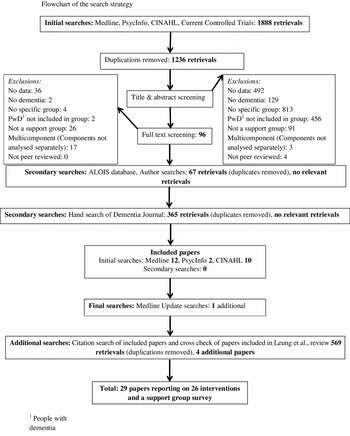
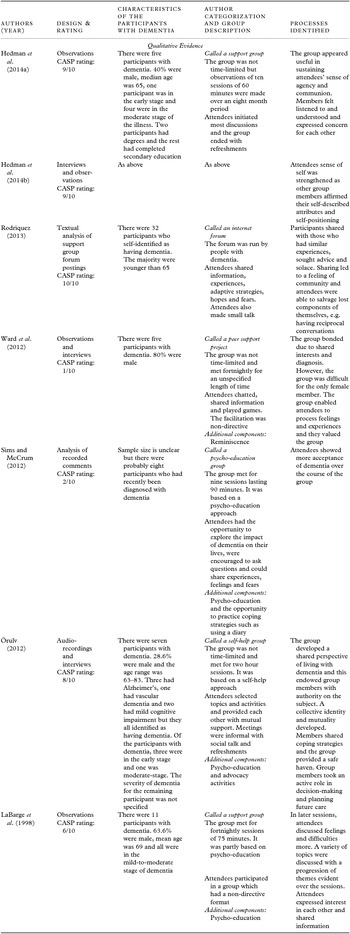
The results of the literature search are detailed in Figure 1: twenty-eight papers (reporting on 26 groups) met inclusion criteria. Seventeen groups were identified as support groups, four as education groups, four as self-help or self-management groups and two groups could not be categorized (see Tables 1, 2 and 3 for further details). All these groups met the review definition of a support group. A further paper was included that reported on a survey of several support groups. Table 1 provides details about the studies evaluating support group outcomes, Table 2 lists the outcome findings from these studies and Table 3 details research exploring the processes, such as reflection or mutual support that occurred within groups.
PRISMA diagram. Flowchart of the search strategy.

Characteristics of papers included in the review that reported on outcomes of support groups for people with dementia

Note: CBT (cognitive behavioral therapy), MMSE (mini-mental state examination), RCT (randomized controlled trial).
Outcomes of support groups for people with dementia

Note: BAI (beck anxiety inventory), BASDEC (brief assessment schedule depression cards), FAM (family assessment measure), GDS (geriatric depression scale), QOL- AD (quality of life- Alzheimer's disease), RAID (rating of anxiety in dementia), RMB-PC (revised memory and behavior problem checklist), SF-36 (Medical outcome study short form 36), VAS (visual analogue scale).
Papers included in the review that reported process evaluations of support groups for people with dementia

Publications spanned 25 years: the first paper reported a time-limited group with psycho-education components (McAfee et al., Reference *McAfee, Ruh, Bell and Martichuski1989), whilst recent publications referred to an open-ended group with no additional components (Hedman et al., Reference *Hedman, Hansebo, Ternestedt, Hellström and Norberg2014a; Reference *Hedman, Hellström, Ternestedt, Hansebo and Norberg2014b). Papers referring to open-ended groups were retrieved from 2005 onwards with increasing numbers published in recent years. The majority of studies were conducted in the west: 11 were American, 13 European, two Canadian and one Australian. One web study recruited an international sample from America, Canada and New Zealand (Clare et al., Reference *Clare, Rowlands and Quin2008) and although the other internet study was based in Columbia, it is unclear where the participants were posting from (Rodriquez, Reference *Rodriquez2013).
The RCTs had at least 25 people with dementia randomized to the intervention group, although three quantitative studies with other methodology had smaller samples (McAfee et al., Reference *McAfee, Ruh, Bell and Martichuski1989; LaBarge and Trtanj, Reference *LaBarge and Trtanj1995; Cheston and Jones, Reference *Cheston and Jones2009). The longest follow-up period for both time-limited and open-ended groups was 24 months (Clare et al., Reference *Clare, Rowlands and Quin2008; Laakkonen et al., Reference *Laakkonen2013). However, Laakkonen et al. have yet to publish their 24 month data and the longest follow-up data actually reported for a time-limited group was six months (Logsdon et al., Reference *Logsdon, McCurry and Teri2007).
Sample characteristics
Most samples comprised clinical populations already in contact with services. An exception was the study by Goldsilver and Gruneir, (Reference *Goldsilver and Gruneir2001) which additionally recruited from the community using flyers and radio adverts. Participants were predominately male and the mean age tended to be above 70 years, although the majority of participants in Rodriquez, (Reference *Rodriquez2013) were younger than 65 years. Ten studies reported on participants’ level of education and 70% of participants had completed secondary education; several (at least 30%) had attended college or obtained degrees. Many studies did not report whether participants experienced other conditions or what these were but two studies reported comorbid depression (Marshall et al., Reference *Marshall, Bucks and Mander2005; Martin et al., Reference *Martin, Turner, Wallace, Stanley, Jesuthasan and Bradbury2013) and one study indicated that participants had a range of health conditions such as cardiac problems, carcinoma, hypertension, cerebral vascular accident, osteoporosis and hearing difficulties (Martin et al., Reference *Martin, Turner, Wallace, Stanley, Jesuthasan and Bradbury2013).
The only specific diagnoses reported were Alzheimer's disease and vascular dementia. In three studies (Goldsilver and Gruneir, Reference *Goldsilver and Gruneir2001; Gaugler et al., Reference *Gaugler2011; Billington et al., Reference *Billington, Carroll, Davis, Healey and Kinderman2013), a few participants may not have received a formal diagnosis and in the study by Örulv (Reference *Örulv2012), two participants had been re-diagnosed as having mild cognitive impairment. Most participants were one-to-ten years post-diagnosis, although two groups (Marshall et al., Reference *Marshall, Bucks and Mander2005; Sims and McCrum, Reference *Sims and McCrum2012) were designed for people who had recently been diagnosed. The majority of participants were in the early stages of dementia: mean Mini-Mental State Examination (MMSE: Folstein et al., Reference Folstein, Folstein and McHugh1975) scores ranged from 19.9 (Laakkonen et al., Reference *Laakkonen2013) to 28.8 (Roberts and Silverio, Reference *Roberts and Silverio2009). However, five groups included participants in the moderate stage (LaBarge and Trtanj, 1995; Roberts and Silverio, Reference *Roberts and Silverio2009; Örulv, Reference *Örulv2012; Laakkonen et al., Reference *Laakkonen2013; Hedman et al., Reference *Hedman, Hansebo, Ternestedt, Hellström and Norberg2014a; Reference *Hedman, Hellström, Ternestedt, Hansebo and Norberg2014b) and two studies included participants in the severe stage of dementia (Capus, Reference *Capus2005; Laakkonen et al., Reference *Laakkonen2013).
Interventions
The majority of groups were time-limited. The modal number of sessions was eight; the shortest group comprised four meetings (Roberts and Silverio, Reference *Roberts and Silverio2009) and the longest 24 sessions (Marshall et al., Reference *Marshall, Bucks and Mander2005). The majority of groups met weekly (12 studies) or fortnightly (five studies). Most group meetings lasted 90 minutes, although the longest session time was 240 minutes and included lunch (Laakkonen et al., Reference *Laakkonen2013).
Most groups had up to ten participants (or five dyads) attending. The exception was the Alzheimer's café which could have up to 35 attendees (Capus, Reference *Capus2005). The majority of groups met in community locations such as church halls. When reported, groups were normally facilitated by professionals, and people with dementia were co-facilitators in only two groups (Martin et al., Reference *Martin, Turner, Wallace, Stanley, Jesuthasan and Bradbury2013; Rodriquez, Reference *Rodriquez2013). However, in the support group evaluated by Örulv (Reference *Örulv2012) group members made decisions collectively. Caregivers had some involvement in over half of the groups, although involvement ranged from being in solely separate sessions to attending all meetings alongside the person with dementia.
Only one open-ended group was described as having a theoretical basis and this followed a self-help model (Örulv, Reference *Örulv2012). Eight time-limited groups provided no theoretical basis. A range of theoretical models informed the development of the remaining time-limited groups including; psycho-education (LaBarge et al., Reference *LaBarge, Dras and Wingbermuehle1998; Sims and McCrum, Reference *Sims and McCrum2012), empowerment (Roberts and Silverio, Reference *Roberts and Silverio2009), learning theories (Laakkonen et al., Reference *Laakkonen2013), Corbin and Strauss's model of illness work (Martin et al., Reference *Martin, Turner, Wallace, Stanley, Jesuthasan and Bradbury2013) and therapy models, such as, counseling practices (LaBarge and Trtanj, Reference *LaBarge and Trtanj1995) and coping effectiveness training (Dobbs et al., Reference *Dobbs, Harper and Wood2009).
In terms of group content, five groups provided just mutual support (Mason et al., Reference *Mason, Clare and Pistrang2005; Snyder et al., Reference *Snyder, Jenkins and Joosten2007; Billington et al., Reference *Billington, Carroll, Davis, Healey and Kinderman2013; Rodriquez, Reference *Rodriquez2013; Hedman et al., Reference *Hedman, Hansebo, Ternestedt, Hellström and Norberg2014a; Reference *Hedman, Hellström, Ternestedt, Hansebo and Norberg2014b). However, Billington et al. (Reference *Billington, Carroll, Davis, Healey and Kinderman2013) utilized a group reading format and the group provided in Mason et al. (Reference *Mason, Clare and Pistrang2005) formed part of a multi-component intervention. All the other support groups contained additional components.
Psycho-education was provided in 63% of the groups. The information tended to be about dementia or related topics, such as different types of memory. Group members were frequently provided with support to develop coping strategies: 30% of groups taught general strategies such as goal-setting and problem-solving, 37% provided cognitive or memory strategies and 48% covered emotional coping techniques. Approaches to help manage practical and daily living tasks were imparted in 44% of groups. In nine instances these were future orientated, such as thinking ahead about driving and finances, and in five instances they focused on health; for instance, lifestyle changes to promote well-being. Managing relationships was covered in 48% of groups: two groups promoted communication skills and six groups encouraged social activities. There were also attempts to enhance participants’ self-esteem and self-efficacy in 44% of groups. For instance, two groups were based on self-help and encouraged advocacy (Clare et al., Reference *Clare, Rowlands and Quin2008; Örulv, Reference *Örulv2012). Finally, a few groups (30%) aimed to sustain behavior change by, for instance, linking participants into other services. When the label authors applied to their group was considered, education and self-help/ self-management groups contained the greatest number of additional components. For instance, 50% of groups labeled as education and 75% of groups identified as self-help/ self-management groups had components to enhance self-esteem or self-efficacy compared to 41% of groups referred to by authors as support groups.
A few support groups probably contained elements of therapy and skills training, but these additional interventions were not of sufficient magnitude to classify these groups as another form of intervention and none of these groups were described by their authors as psychotherapy groups. Three groups incorporated cognitive stimulation or memory training exercises, two included some reminiscence activities, one utilized elements of cognitive behavior therapy (Dobbs et al., Reference *Dobbs, Harper and Wood2009), one probably provided a component of circumscribed family therapy (McAfee et al., Reference *McAfee, Ruh, Bell and Martichuski1989) and one utilized counseling skills in the facilitation techniques (LaBarge and Trtanj, Reference *LaBarge and Trtanj1995).
Outcomes
Acceptability
Group uptake was often unclear, but when reported it ranged from 34.6% (Dow et al., Reference *Dow, Haralambous, Hempton, Hunt and Calleja2011) to 100% (Goldsilver and Gruneir, Reference *Goldsilver and Gruneir2001; Mason et al., Reference *Mason, Clare and Pistrang2005; Sims and McCrum, Reference *Sims and McCrum2012; Kjallman et al., Reference *Kjallman, Hellzen and Norbergh2014). Sixteen studies reported on attrition and this ranged from none (Kjallman et al., Reference *Kjallman, Hellzen and Norbergh2014; Laakkonen et al., Reference *Laakkonen2013) to 25% of the sample (Snyder et al., Reference *Snyder, Quayhagen, Shepherd and Bower1995) but was typically limited. When reported, adherence tended to be good with participants normally attending more than half the sessions offered. However, attendance in Hedman et al. (Reference *Hedman, Hellström, Ternestedt, Hansebo and Norberg2014b) ranged from three to ten sessions (out of ten observed) and some respondents in Rodriquez, (Reference *Rodriquez2013) contributed a single post.
Level one evidence
Four papers reported RCTs, although Laakkonen et al. (Reference *Laakkonen2013) actually reported survey data and Quayhagen et al. (Reference *Quayhagen2000) provided only caregiver outcomes. The latter study found that caregiver morale reduced after attending the support group with their relative and participants expressed concern about the length and timing of sessions. The remaining papers had medium quality ratings (see Table 1) as they provided limited information about randomization. In one group, participants had improved quality of life and mood post-group (Logsdon et al., Reference *Logsdon2010) but the initial study on this group found only evidence of improved quality of life (Logsdon et al., Reference *Logsdon, McCurry and Teri2007).
Level two evidence
Two studies had between-group designs and paper quality ratings were adequate. Cheston and Jones (Reference *Cheston and Jones2009) compared a psycho-education group to a psychotherapy group and found no significant difference in outcome. Similarly, Dobbs et al. (Reference *Dobbs, Harper and Wood2009) compared a standard support group to a driving cessation support group. Participants in the latter group were reported to improve more in terms of quality of life, mood, memory and behavior disturbances if a lenient (p ≤ 0.10) significance level was selected.
Level three evidence
Four studies employed repeated measure designs. McAfee et al. (Reference *McAfee, Ruh, Bell and Martichuski1989) reported limited details about statistical methods, recruitment, follow-up periods and data interpretation but found an increase in dementia knowledge, although there was only a trend for mood improvement. Roberts and Silverio (Reference *Roberts and Silverio2009) did not employ standardized outcome measures and found no change in dementia knowledge or coping. However, there was an increase in the number of people taking regular exercise, enrolling in other programs and engaging in planning for the future. The Get into Reading group afforded only a trend towards reduction in neuropsychiatric symptoms (Billington et al., Reference *Billington, Carroll, Davis, Healey and Kinderman2013). This group was based around the shared reading of a piece of text or poetry but did include discussion as a significant component. Gaugler et al. (Reference *Gaugler2011) similarly reported no significant findings but found that there was a decrease in instrumental activities of daily living post-group. Additionally, Marshall et al. (Reference *Marshall, Bucks and Mander2005) in a predominately qualitative study used a single outcome measure but again found no significant difference in mood post-group.
Level four evidence
These four papers had a weaker methodology. Snyder et al. (Reference *Snyder, Jenkins and Joosten2007) reported on a survey which covered a number of support groups, whilst the other papers contained ratings of specific groups. Support group ratings were positive in all papers with participants recommending the group to others and endorsing improvements in understanding and coping skills. However, some concerns were also raised. For instance, negative feedback was received about session length, group duration and size (Goldsilver and Gruneir, Reference *Goldsilver and Gruneir2001; Zarit et al., Reference *Zarit, Femia, Watson, Rice-Oeschger and Kakos2004). Furthermore, some participants found group interactions problematic (LaBarge and Trtanj, Reference *LaBarge and Trtanj1995; Goldsilver and Gruneir, Reference *Goldsilver and Gruneir2001; Zarit et al., Reference *Zarit, Femia, Watson, Rice-Oeschger and Kakos2004) and participants in one group said the facilitator talked too fast (LaBarge and Trtanj, Reference *LaBarge and Trtanj1995). Other types of paper often contained participant group ratings (Logsdon et al., Reference *Logsdon, McCurry and Teri2007; Dobbs et al., Reference *Dobbs, Harper and Wood2009; Roberts and Silverio, Reference *Roberts and Silverio2009; Gaugler et al., Reference *Gaugler2011; Laakkonen et al., Reference *Laakkonen2013). These ratings were very similar to those reported in the four papers above.
Qualitative studies
Most of these eight papers employed a mixture of observation and interview methods. Four papers had high and four achieved medium quality ratings. There were several consistent themes. Participants talked about support groups being a safe space to share information and express themselves (Marshall et al., Reference *Marshall, Bucks and Mander2005; Mason et al., Reference *Mason, Clare and Pistrang2005; Martin et al., Reference *Martin, Turner, Wallace, Stanley, Jesuthasan and Bradbury2013). They enjoyed meeting with other people experiencing similar situations and liked having the opportunity to interact socially. They described feeling understood and accepted and group members often formed close bonds (Snyder et al., Reference *Snyder, Quayhagen, Shepherd and Bower1995; Marshall et al., Reference *Marshall, Bucks and Mander2005; Mason et al., Reference *Mason, Clare and Pistrang2005; Clare et al., Reference *Clare, Rowlands and Quin2008; Dow et al., Reference *Dow, Haralambous, Hempton, Hunt and Calleja2011; Kjallman et al., Reference *Kjallman, Hellzen and Norbergh2014). Additionally, participants’ sense of self, self-efficacy and esteem could be affirmed (Clare et al., Reference *Clare, Rowlands and Quin2008; Martin et al., Reference *Martin, Turner, Wallace, Stanley, Jesuthasan and Bradbury2013). However, in Clare et al. (Reference *Clare, Rowlands and Quin2008) this affirmation might have come from the advocacy work participants took part in rather than from the group forum. Quantitative papers often collected some open-ended participant feedback and the comments reported mirrored these themes (McAfee et al., Reference *McAfee, Ruh, Bell and Martichuski1989; LaBarge and Trtanj, Reference *LaBarge and Trtanj1995; Zarit et al., Reference *Zarit, Femia, Watson, Rice-Oeschger and Kakos2004; Logsdon et al., Reference *Logsdon, McCurry and Teri2007; Billington et al., Reference *Billington, Carroll, Davis, Healey and Kinderman2013).
A further seven papers considered group processes. Paper quality was more variable (see Table 3) and two papers obtained low ratings (Sims and McCrum, Reference *Sims and McCrum2012; Ward et al., Reference *Ward, Howorth, Wilkinson, Campbell and Keady2012). The themes reported mirror the evaluation papers: participants’ sense of self and self-efficacy could be affirmed (Örulv, Reference *Örulv2012; Rodriquez, Reference *Rodriquez2013; Hedman et al., Reference *Hedman, Hansebo, Ternestedt, Hellström and Norberg2014a; Reference *Hedman, Hellström, Ternestedt, Hansebo and Norberg2014b), participants benefitted from the social interaction and understanding afforded by the group (LaBarge et al., Reference *LaBarge, Dras and Wingbermuehle1998; Ward et al., Reference *Ward, Howorth, Wilkinson, Campbell and Keady2012; Rodriquez, Reference *Rodriquez2013; Hedman et al., Reference *Hedman, Hansebo, Ternestedt, Hellström and Norberg2014a) and groups could form a collective identity (Örulv, Reference *Örulv2012). Additionally, group attendance could improve participants’ acceptance of their dementia (Sims and McCrum, Reference *Sims and McCrum2012) and groups could be a safe place to process experiences and feelings (LaBarge et al., Reference *LaBarge, Dras and Wingbermuehle1998; Örulv, Reference *Örulv2012; Ward et al., Reference *Ward, Howorth, Wilkinson, Campbell and Keady2012).
Some negative findings were also reported. In Capus (Reference *Capus2005), caregivers were unsure if the Alzheimer's café benefitted their relative. In the other study, evaluating the Alzheimer's café (Dow et al., Reference *Dow, Haralambous, Hempton, Hunt and Calleja2011) participants said that they wanted clarification about the role of staff and would welcome more opportunities to provide feedback and suggestions. In smaller support groups, some participants reported it was hard to speak in the group (Marshall et al., Reference *Marshall, Bucks and Mander2005; Mason et al., Reference *Mason, Clare and Pistrang2005) and others were concerned about meeting people with more severe dementia than themselves (Marshall et al., Reference *Marshall, Bucks and Mander2005). One dyad reported feeling disconnected from their support group (Kjallman et al., Reference *Kjallman, Hellzen and Norbergh2014) and a similar phenomenon was reported for a female participant in an otherwise male group (Ward et al., Reference *Ward, Howorth, Wilkinson, Campbell and Keady2012). In some cases, particular activities and topics aroused concern. For instance, in Clare et al. (Reference *Clare, Rowlands and Quin2008) some respondents thought the group forum had difficulty moderating controversial issues like assisted dying.
Discussion
This review investigated the effectiveness of support group interventions for people with dementia. Secondary objectives were to explore participant characteristics, examine the content, structure and theoretical basis of the support groups and consider negative outcomes and feedback.
Evidence of effectiveness
Attrition and adherence data suggest that support groups are acceptable to participants. Groups are rated positively and people are observed to enjoy meeting together and often form close bonds. When participants have provided feedback on groups, although some concerns have been raised on the whole respondents have reported positive experiences and satisfaction. Interestingly, more research on open-ended groups has been published recently, perhaps because of the increasing credibility given to qualitative studies and because of an increasing recognition that people with early stage dementia retain the skills to partake in such groups. In terms of outcomes, however, the evidence is limited.
In investigations of time-limited groups, one study found improved mood (Logsdon et al., Reference *Logsdon2010), one study found increased dementia knowledge (McAfee et al., Reference *McAfee, Ruh, Bell and Martichuski1989) and two studies found enhanced quality of life (Logsdon et al., Reference *Logsdon, McCurry and Teri2007; Reference *Logsdon2010) following participation. Additionally, another group was found to enhance social participation and health regimes (Roberts and Silverio, Reference *Roberts and Silverio2009). This represents evidence of some positive psychosocial outcomes from RCT’s, between-group studies and repeated measure designs. Despite the corroborating evidence from different study designs, the evidence base for time-limited groups is not strong. Only two RCTs (the highest level of evidence included in the review) found evidence for positive outcomes and these trials lacked detailed information about randomization procedures and so had potential methodological limitations. The repeated measure design papers also had variable reporting quality with Roberts and Silverio (Reference *Roberts and Silverio2009) meeting 71% of reporting criterion but McAfee et al. (Reference *McAfee, Ruh, Bell and Martichuski1989) only met 47% of criterion. Evidence for improved mood is particularly limited with three studies reporting no improvement or trends only (McAfee et al., Reference *McAfee, Ruh, Bell and Martichuski1989; Marshall et al., Reference *Marshall, Bucks and Mander2005; Logsdon et al., Reference *Logsdon, McCurry and Teri2007). However, only Marshall et al. (Reference *Marshall, Bucks and Mander2005) identified that some participants had co-morbid depression and baseline scores in the other two studies indicated that participants experienced few symptoms of depression: initial low mood will in part determine whether improved mood is seen post-group. It can be tentatively concluded, however, that as yet there have been no studies which have shown that support groups significantly worsen participant's psychosocial outcomes. From participant feedback, it can also be concluded that most participants are satisfied with receiving a time-limited group. Only participants in the study by Goldsilver and Grunier (Reference *Goldsilver and Gruneir2001) raised group duration as a concern.
There are significant gaps in the evidence base for time-limited groups. There is currently no evidence as to whether benefits are maintained in the medium or longer term and this limits what conclusions can be drawn about how effective these support groups are. Furthermore, one between groups (level two) study which met 55% of reporting criterion suggested that groups focused on specific dementia issues (e.g. driving cessation) may be more beneficial than generic support groups (Dobbs et al., Reference *Dobbs, Harper and Wood2009). The results indicated a trend that depression and quality of life slightly deteriorated in the generic comparison support group. Cheston and Jones (Reference *Cheston and Jones2009) in a level two study meeting 77% of reporting criterion also found a trend that a psycho-education support group was less effective at improving anxiety and depression than a psychotherapy group. These are the only two studies which have compared support groups to an alternative intervention. Limited conclusions can be drawn about how effective support groups are compared to other types of group interventions due to the small number of studies and the absence of randomized allocation.
The evidence base for open-ended groups, including newer forms of contact such as online groups, is even more limited. These groups have only been evaluated via qualitative methods: interviews, observations and feedback ratings suggest that people with dementia derive subjective benefit from groups. Groups were reported to, or observed to, promote self-efficacy, self-esteem and sense of self. Despite the consensus of evidence, many studies providing this evidence used post-group survey's and interviews (level four evidence). Although one of these papers achieved a rating of 7/10 on the CASP tool, the remainder scored below five indicating the papers might have methodological limitations. Additional evidence comes from qualitative studies, all these papers (except Snyder et al., Reference *Snyder, Quayhagen, Shepherd and Bower1995) were rated above five on the CASP but qualitative studies are not often designed to provide generalization of study findings. Therefore, again the strength of the evidence base for open-ended groups is not strong and further research using different methodologies is needed.
The findings from both time-limited and open-ended groups are broadly consistent with previous review conclusions examining psychosocial interventions (Kasl-Godley and Gatz, Reference Kasl-Godley and Gatz2000) and support groups (Leung et al., Reference Leung, Orrell and Orgeta2015) for people with dementia. Psychotherapy for people with dementia can have similar outcomes. For example, psychodynamic interventions were found to increase acceptance and adjustment and there is evidence that reminiscence groups create interpersonal connections (Kasl-Godley and Gatz, Reference Kasl-Godley and Gatz2000). However, in these papers the authors also highlight that more research is needed as the evidence base for these approaches is limited. Similarly, in reviews of caregiver support groups, inconsistent findings have led to the conclusion that further research is needed (Hornillos and Crespo, Reference Hornillos and Crespo2012) despite these groups receiving more research than support groups for people with dementia.
Support group components
The majority of groups reviewed were categorized as support groups by their authors. However four groups were labeled as education groups, four as self-help or self-management groups and two groups could not be categorized. All these groups fitted the study definition of a support group. A similar occurrence has been found in other literatures. For instance, Thompson et al. (Reference Thompson, Spilsbury, Hall, Birks, Barnes and Adamson2007) aimed to classify caregiver interventions by type but found within each category there was a considerable range and assignment could not always be mutually exclusive. This heterogeneity makes it difficult to determine what aspects of support groups are important for improving psychosocial outcomes. However, in the case of open-ended groups, five of the groups reviewed (40%) seemed to contain no additional components and this does suggest that just talking and discussing with other people experiencing similar situations in a supportive environment can be sufficient for people to perceive a group as beneficial. It is very difficult to draw further conclusions. For instance, as fifteen papers did not provide any information about uptake we cannot draw any conclusions on factors that influence uptake, such as group type or severity of dementia.
Over half the support groups reviewed provided psycho-education and a few contained circumscribed elements of therapy which were not sufficient to meet exclusion criteria. Groups categorized by authors as education or self-help or self-management groups tended to have more additional components but a substantial number of groups labeled “support groups” also had such components. This suggests that, in terms of content, it might be hard to distinguish categorically between therapy, support, self-help and education groups. This could be considered a limitation of the current review and an alternative approach would have been to include a broader range of groups and draw comparisons based on the extent of additional components provided. However, this would have replicated the approach of previous overviews (e.g. Kasl-Godley and Gatz, Reference Kasl-Godley and Gatz2000) which have included support groups as one subtype of therapy. One practice implication of this finding is that practitioners need to consider what additional components to include when planning support groups. For instance, providing a support group without elements of psycho-education could be less effective as over half of the studies providing the evidence base for support groups (including the level one papers) contained psycho-education components.
Literature limitations
The generalizability of the review findings are limited. Most studies were conducted in the West and in 63% of the studies reviewed, participants were predominately in the early stages of dementia. Younger people with dementia participated infrequently and co-morbid conditions were rarely reported. When educational level was reported, most participants were well-educated. Caregivers also often had involvement in interventions, suggesting that the people with dementia had, in theory at least, a good support network. Obviously, this limits how generalizable the findings are to other cultures, younger participants and participants who are less well-educated. Future research should explore if support groups might be of most benefit to people who are in the early stages of dementia and who have other sources of support, such as a caregiver.
Most studies were adequately reported, although several papers did not provide attrition or adherence information and this must be a caveat to the conclusion that most participants find support groups to be an acceptable intervention. Additionally, a lack of detail about participant characteristics made comparing studies difficult. For instance, ten studies lacked details about participants’ functioning (McAfee et al., Reference *McAfee, Ruh, Bell and Martichuski1989; LaBarge and Trtanj, Reference *LaBarge and Trtanj1995; Quayhagen et al., Reference *Quayhagen2000; Snyder et al., Reference *Snyder, Jenkins and Joosten2007; Clare et al., Reference *Clare, Rowlands and Quin2008; Dow et al., Reference *Dow, Haralambous, Hempton, Hunt and Calleja2011; Sims and McCrum, Reference *Sims and McCrum2012; Ward et al., Reference *Ward, Howorth, Wilkinson, Campbell and Keady2012; Billington et al., Reference *Billington, Carroll, Davis, Healey and Kinderman2013; Rodriquez, 2013).
Review limitations
The literature search did not access unpublished data or non-English papers. Four studies were included although not all participants had clearly received a diagnosis: 95% of the sample were diagnosed in Gaugler et al. (Reference *Gaugler2011), the majority had dementia in Goldsilver and Gruneir (Reference *Goldsilver and Gruneir2001), a small subset of participants were still undergoing diagnostic assessment in Billington et al. (Reference *Billington, Carroll, Davis, Healey and Kinderman2013) and in the study by Örulv (Reference *Örulv2012) two of the seven participants had been re-diagnosed with mild cognitive impairment, though they were originally diagnosed with dementia and self-identified as having dementia. These studies were judged to meet the inclusion criteria as the whole sample experienced dementia type symptoms and no alternative diagnoses were given (except for mild cognitive impairment). Determining participant diagnosis is likely to become more difficult with the advent of online interventions. In the internet study, by Rodriquez (Reference *Rodriquez2013) participants identified themselves as having dementia but this diagnosis was not verified. Some reviews have circumvented this issue by including papers if there was evidence that participants functioned below normative levels in a specified number of domains (Regan and Varnelli, Reference Regan and Varanelli2013). This approach has merit as excluding the papers discussed above would have resulted in a loss of useful information in the current review.
This review has synthesized evidence from groups labeled as support groups, education groups and self-help or self-management groups. This represents a fairly conservative inclusion criterion as some authors also refer to psychotherapy groups as support groups and all the groups included met the study definition of a support group. However, it is acknowledged that combining the evidence from these three forms of support group may have overlooked differences within each group type. Additionally, one study (Billington et al., 2013) had a different group format, although the group still provided mutual support and discussion. As Thompson et al. (Reference Thompson, Spilsbury, Hall, Birks, Barnes and Adamson2007) concluded, mutually exclusive classifications are not always possible but these inclusions may have reduced the robustness of the synthesis.
To enhance the robustness of the synthesis and reflect variations in the literature, study methodology was evaluated and a level of evidence assigned. This enabled papers to be compared on a pre-determined set of components, but the limitations of adapting rating and ranking systems are acknowledged. In particular, the CASP rating tool was probably too stringent for level four papers (surveys and questionnaires), as these papers were not primarily written from a qualitative perspective. However, neither are they written according to CONSORT guidance and it is unlikely they would have achieved higher ratings on an alternative rating system.
Research recommendations
Further RCTs need to be conducted to explore the effectiveness of support groups for people with dementia. In addition, qualitative methods can contribute by capturing outcomes that are difficult to measure, such as changes in sense of self and acceptance of diagnosis, especially if groups are open-ended. In particular, observations whilst groups are running seem a useful way to capture benefits that may not be recalled at a later date due to memory problems. This method was used in several studies (McAfee et al., Reference *McAfee, Ruh, Bell and Martichuski1989; LaBarge et al., Reference *LaBarge, Dras and Wingbermuehle1998; Marshall et al., Reference *Marshall, Bucks and Mander2005; Mason et al., Reference *Mason, Clare and Pistrang2005; Dow et al., Reference *Dow, Haralambous, Hempton, Hunt and Calleja2011; Ward et al., Reference *Ward, Howorth, Wilkinson, Campbell and Keady2012; Hedman et al., Reference *Hedman, Hansebo, Ternestedt, Hellström and Norberg2014a; Reference *Hedman, Hellström, Ternestedt, Hansebo and Norberg2014b). Other complementary data collection methods also seemed to yield useful information. For instance, in Kjallman et al. (Reference *Kjallman, Hellzen and Norbergh2014) participants kept diaries of their experiences, in LaBarge and Trtanj (Reference *LaBarge and Trtanj1995) group facilitators kept process notes and some studies recorded the comments made during group meetings (Snyder et al., Reference *Snyder, Quayhagen, Shepherd and Bower1995; Sims and McCrum, Reference *Sims and McCrum2012). With the advent of online groups, member postings can also be analyzed (Rodriquez, Reference *Rodriquez2013).
Despite the qualitative evidence that support groups are subjectively experienced as beneficial, service providers are likely to need more evidence about group outcomes, especially in the medium and longer term. This will require longer follow-up periods and ideally studies will employ mixed method designs so that randomized controlled procedures can be employed but qualitative information regarding participants’ experiences are still collected. Non-randomized comparison group studies could also provide further evidence regarding the effectiveness of support groups (Cohen-Mansfield et al., Reference Cohen-Mansfield, Buckwalter, Beattie, Rose, Neville and Kolanowski2014). Further research is needed as it remains unclear how effective support groups are in promoting positive psychosocial outcomes. It is also unclear what elements of support groups are beneficial and future studies should systematically compare different group components.
Conclusions
Support groups for people with dementia could be more accurately labeled as support and information groups based on their content: groups tend to include psycho-education and other therapeutic elements. These groups are an acceptable intervention for people with dementia and subjective benefits are reported. Observation studies endorse these findings as they have typically observed positive group processes occurring. However, study samples are fairly homogenous and this might limit the generalizability of these findings. Evidence for positive outcomes is more limited and further mixed-methods RCT's or non-randomized comparison group studies with longer follow-up periods are needed. On the basis of the current published evidence, it is not possible to determine how effective support groups are in promoting positive psychosocial outcomes.
Conflict of interest declaration
None.
This review was funded by the National Institute for Social Care and Health Research (NISCHR) Health Award 2012, grant number RFS-12-35. The funder had no role in developing the review question, the choice of review design, the literature search, the review analysis or the decision to publish.
Author roles
Gill Toms contributed to the design of the study, the formulation of the research question and search strategy, the conduction of the literature search, the interpretation of the findings and the writing of the manuscript.
Linda Clare contributed to the design of the study, the formulation of the research question, and the writing of the paper.
Julie Nixon contributed to the literature search and the writing of the manuscript.
Catherine Quinn contributed to the design of the study, the formulation of the research question, the interpretation of the findings, and the writing of the manuscript.
Acknowledgments
We wish to thank wider members of our study team who assisted us in thinking about support groups and their components, in particular Daniel Anderson, Susan Davies and Fiona Sanders.