


Introduction
Storm phobia is characterized by an excessive fear of severe weather conditions, such as thunderstorms and tornadoes, and is classified as a specific phobia (natural environment type) in the DSM-5. Storm phobia is often accompanied by anticipatory anxiety, avoidant behaviours and significant distress and/or functional impairment (Nelson et al., Reference Nelson, Vorstenbosch and Antony2014). It has been noted that approximately 2% of the population in the United States and Canada will experience a phobia of storms in their lifetime. This percentage is predicted to increase as a result of climate change (see supplementary material for details).
Many experts agree that exposure to the feared object/situation is both necessary and sufficient for treating individuals with specific phobia. Although in vivo exposure has been found to be the most effective intervention for reducing fear in this population, the inherent limitation of exposing individuals to weather conditions in a controlled manner limits its use in the treatment of storm phobia. Concerns about this inherent limitation may be overcome through the use of virtual reality (VR), which can provide a three-dimensional computer-generated environment that allows individuals to actively participate in a virtual world. VR exposure therapy has been extensively researched in the treatment of other specific phobias, such as acrophobia (i.e. fear of heights) and fear of flying, where it has been found to be as effective as in vivo exposure therapy (Krijn et al., Reference Krijn, Emmelkamp, Olafsson and Biemond2004). However, its use in the treatment of storm phobias has been limited, with only one known paper to date that has described the use of VR exposure in the treatment of storm phobia. A case study by Botella et al. (Reference Botella, Baños, Guerrero, García-Palacios, Quero and Alcañíz2006) demonstrated that the patient was able to confront all her feared scenarios by the end of her VR treatment and that the improvements were maintained at 6-month follow-up. Based on this case study, it seems that VR exposure therapy may be useful for treating individuals with storm phobia. However, an experimental study is needed to provide evidence for the efficacy of VR exposure therapy in treating storm phobia and to justify future research in this area.
The aim of the current study was to examine the efficacy of VR exposure therapy in the treatment of storm fears by comparing a one-session VR exposure treatment with one session of progressive muscle relaxation (PMR) and psychoeducation. Given that PMR is effective for reducing state anxiety, studies have previously used PMR as an active control condition to compare the effectiveness of exposure therapy (e.g. Mühlberger et al., Reference Mühlberger, Herrmann, Wiedemann, Ellgring and Pauli2001). Based on findings from Mühlberger et al. (Reference Mühlberger, Herrmann, Wiedemann, Ellgring and Pauli2001), it was predicted that PMR would be likely to reduce storm-related anxiety temporarily, but to a lesser extent than VR exposure therapy. It was also predicted that there would be a reduction in storm-related anxiety post-treatment for individuals in both conditions, but that this reduction would be greater for those in the VR exposure condition, and that improvements would be maintained at a 30-day follow-up only for those in the VR exposure condition.
Methods
Participants
Participants included 36 adults who scored 25 or higher on the Storm Fear Questionnaire (SFQ; Nelson et al., Reference Nelson, Vorstenbosch and Antony2014). They were randomly assigned to the VR exposure treatment (n = 18, mean age 25.65 years, SD = 7.81) or to the PMR treatment (n = 18, mean age 29.47 years, SD = 10.93). Both groups were 50% female.
Intervention
The VR condition involved a prolonged exposure to a virtual thunderstorm consisting of a series of eight steps of increasing difficulty (see supplementary material for details). This lasted for approximately 1 hour or until the participant's fear had decreased to a mild level (i.e. a fear rating of 25 or less out of 100). The PMR condition involved a session of PMR and focused breathing lasting about 30 minutes. This was followed by psychoeducation about thunderstorms, which entailed reading an article with information about what a thunderstorm is and how it develops.
Measures
The SFQ (15 items, α = .95) was used to measure severity of storm-related fear. Participants’ SFQ scores at pre-screening, post-treatment and follow-up were used as an indicator of treatment outcome. A Behavioural Approach Test (BAT) was used as a behavioural indicator of how long participants could tolerate an anxiety-provoking virtual thunderstorm. The BAT consisted of a series of ten steps of increasing difficulty, starting with a sunny blue sky and progressing to a dark sky with heavy rain, wind, thunder and lightning. Participants saw the thunderstorm on a head-mounted display, and heard the rain, thunder and wind through built-in speakers. They also experienced vibration through their chairs, which were placed on a raised platform fitted with woofers that vibrated to the sound of thunder, lightning and wind. Participants were asked to perform each step for 30 seconds and then verbally report their level of fear at the end of each step. Subjective fear/distress during the pre- and post-treatment BAT was assessed using the Subjective Units of Distress Scale (SUDS; Wolpe and Lazarus, Reference Wolpe and Lazarus1966), which ranges from 0 (reflecting no fear or distress) to 100 (reflecting the worst fear or distress one can imagine). Participants’ mean, peak and final self-reported fear scores during the pre- and post-treatment BAT were used as a subjective indicator of treatment outcome. To examine the extent to which participants believed each treatment was credible, the Credibility/Expectancy Questionnaire (CEQ; Devilly and Borkovec, 2004) was used (6 items, α = .79 to .90).
Procedure
Participants first completed an online version of the SFQ to determine eligibility. They were then invited to visit the laboratory where they provided informed consent. Participants first completed a 5-minute BAT to assess their initial fear. They were then randomly assigned to either VR exposure or PMR and psychoeducation. Immediately post-treatment, participants completed the same 5-minute BAT. They were then asked to complete the CEQ and the SFQ. Participants were contacted 30 days after their initial treatment session and asked to complete the SFQ for a third time.
Statistical analyses
A mixed model analysis of variance was used to assess changes in the outcome measures (i.e. SFQ, BAT and SUDS ratings) between pre-treatment, post-treatment and follow-up in/between each treatment group. An independent-samples t-test was conducted to compare the CEQ in VR exposure and PMR conditions.
Results
Treatment outcome
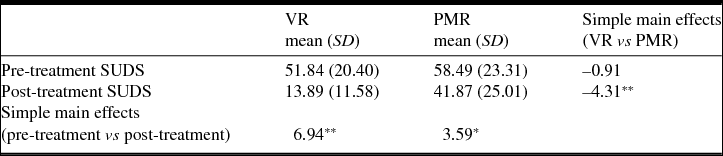
There was no significant difference in CEQ scores between the VR exposure (mean = –0.09, SD = 12.78) and the PMR (mean = –0.82, SD = 12.92) groups, t (34) = 0.17, not significant. There were significant main effects of time [F (1,34) = 57.99, p < .001] and group [F (1,34) = 8.58, p = .006] for mean SUDS ratings, revealing that post-treatment scores were lower than pre-treatment scores in both groups, but the VR group reported lower overall SUDS ratings than the PMR group. A significant treatment group by time interaction was also found for mean reported SUDS ratings, revealing greater reductions in SUDS ratings for the VR group than for PMR group [F (1,34) = 8.86, p = .005]. Post-hoc t-tests revealed that there were no significant group differences in SUDS ratings for the pre-treatment BAT. There were, however, significant group differences for mean SUDS ratings at post-treatment (see Table 1). Cohen's d effect size for mean SUDS ratings was 1.44, indicating a strong effect of VR exposure relative to PMR.
Means, standard deviations and simple main effects for pre-treatment and post-treatment BATs between VR and PMR groups

Significance levels based on t-tests with d.f. = 17. BAT, behavioural approach test; VR, virtual reality; PMR, progressive muscle relaxation; SUDS, subjective units of discomfort scale. *p < .01, **p < .001.
Follow-up
A significant main effect of time was found for the SFQ, revealing a significant difference between pre-treatment and follow-up scores [F (1,32) = 72.28, p < .001]. There was also a significant main effect of group [F (1,32) = 4.12, p = .044, Cohen's d = 0.72]. However, there was no significant time by group interaction for changes on SFQ scores between pre-treatment and post-treatment or pre-treatment and follow-up.
Discussion
The purpose of this study was to examine the efficacy of VR exposure in the treatment of individuals with a fear of storms. A comparison of self-reported fear (SUDS) during pre-treatment and post-treatment BATs between groups revealed that both treatments resulted in reduced self-reported fear. This was expected because exposure therapy has consistently been found to cause attenuation of fear, and progressive muscle relaxation is used in various anxiety interventions to reduce state anxiety symptoms (Conrad and Roth, Reference Conrad and Roth2007). More importantly, there was a significant interaction effect for mean SUDS ratings, indicating that those in the VR exposure group had a greater reduction in self-reported fear than those in the PMR group at post-treatment, and with large effect sizes. These results suggest that although both interventions were effective for reducing fear, these effects were stronger for the VR group, as was hypothesized. Both groups reported similar treatment expectancy and credibility ratings after having been told that their respective treatments had been shown to be effective in the treatment of other disorders. This provides additional support for the efficacy of the VR intervention, as the stronger effects of the VR intervention cannot be accounted for by differences in treatment expectancy.
Analysis of the follow-up data revealed a significant main effect of group with a medium effect size. Although there was no interaction between time and group, both groups appeared to maintain treatment gains at 30-day follow-up. This was expected for those in the VR exposure therapy group due to previous research showing long-term treatment gains following VR exposure therapy (Mühlberger et al., Reference Mühlberger, Herrmann, Wiedemann, Ellgring and Pauli2001). However, this was not expected for those in the PMR group, as PMR is not typically used as a stand-alone treatment for phobias. It could be the case that those in the PMR group took what they learned from the relaxation training and applied it when in anxiety-provoking situations, which might make them feel less anxious when confronted with a thunderstorm. It is also possible that these gains could be explained by non-specific effects of therapy, or by repeated exposure during the BATs. The effects of repeated BATs might also explain why participants in the PMR group reported modest improvements, as they did experience some degree of exposure.
Limitations
The findings from this study should be interpreted with some caution due to the small sample size and the sample being non-clinical. Furthermore, this study did not assess fear and related behaviours during an actual thunderstorm, and the 30-day follow-up period may not have been long enough, as a thunderstorm may not have occurred in that time frame. It is also possible that having been exposed to the virtual thunderstorm environment would have effects on the subsequent BAT.
Future directions
Future studies should focus on replicating the findings of the present study, as this is the first controlled study on the treatment of storm phobia. Future studies should include a longer follow-up period with a third BAT in order to have a behavioural measure of long-term treatment gains. In addition, future studies should include an in vivo behavioural assessment to assess treatment effects during real world thunderstorms.
Supplementary material
To view supplementary material for this article, please visit https://doi.org/10.1017/S1352465817000674




Comments
No Comments have been published for this article.