


Introduction
I want to begin by thanking Professor Wright and Acting Dean Botterell for inviting me for the great honor of delivering the 2025 Coxford Lecture. Given what I shall delicately call ‘recent events’, I recognize that I—as a U.S. citizen on the faculty of a U.S. law school—have little standing to lecture Canadians about the rule of law. Nonetheless, I hope you will indulge what may seem like my presumptuousness in, if not exactly lecturing you, at least delivering a lecture.
I also hope that you will take some solace from the fact that in the course of today’s lecture, I shall be offering a fairly strong critique of a recent important decision of the Supreme Court in my home country and an even stronger critique of the current U.S. administration. I shall frame my remarks in a way that I hope proves relevant to a Canadian audience, but I apologize in advance if any of what I have to say comes across as provincial or—heaven forbid—reflects an ‘America First’ sensibility.
My topic is judicial deference to administrative agencies and its relation to the rule of law. I shall be critiquing the U.S. Supreme Court’s 2024 decision in Loper Bright Enterprises v. Raimondo,Footnote 1 which rejected a longstanding practice under which U.S. courts deferred to reasonable agency determinations of unclear statutes. The prior practice in the U.S. under what was known as the ‘Chevron deference doctrine’Footnote 2 was broadly similar to the Canadian practice under cases like Vavilov,Footnote 3 although I understand that there are important differences between the two legal systems regarding what triggers deference and what exactly deference consists of. Because my aim is to use the majority opinion of U.S. Chief Justice John Roberts in Loper Bright as a foil for a view about the relation of deference to the rule of law more broadly, I shall focus on that decision; but I expect that familiarity with Vavilov and Canadian administrative law principles will make my remarks comprehensible, if not necessarily persuasive.
In Loper Bright, the U.S. Supreme Court rejected the practice of courts deferring to reasonable interpretations of unclear statutory language for two primary reasons. First, the Court concluded that such deference was inconsistent with the express command of the Administrative Procedure Act (APA).Footnote 4 That longstanding federal statute includes a provision stating that a court reviewing agency action “shall decide all relevant questions of law, interpret … statutory provisions, and determine the meaning or applicability of the terms of an agency action.”Footnote 5 This provision, the Supreme Court said in Loper Bright, had been wrongly ignored under the Chevron doctrine.Footnote 6
I shall focus most of my attention on the second reason the Loper Bright Court gave for overruling Chevron: the suggestion by the majorityFootnote 7 and the outright assertion in two concurring opinionsFootnote 8 that when the text of a statute is unclear as applied to some set of facts, the constitutional principle of separation of powers requires that judges—not administrative agencies or anybody else—resolve the uncertainty and, in the words of our Chief Justice John Marshall in Marbury v. Madison, “say what the law is.”Footnote 9
That claim, I shall argue, is mistaken.
To be clear, I do not contend that Marbury itself—or the institution of judicial review—is problematic. Nor do I deny that judges often must exercise judgment to resolve pre-existing legal ambiguity in the course of saying what the law is. Rather, my claim is that deference to the judgment of others is consistent with the law-declaration function; indeed, I shall argue, such deference is often essential to the law-declaration function.
A conventional defense of judicial deference to reasonable agency decisions argues that interpretive deference is permissible because it can be reconciled with the judicial law-declaration function. I agree with that view, which I shall expound in greater detail momentarily. However, I intend to go further. I shall argue that deference to the normative views of other legal actors should not be deemed merely legally permissible, but—absent countervailing considerations—preferred.
I shall take a somewhat winding road to get there, but my end point will be the contention that the very essence of the rule of law is the willingness of actors—including not only primary actors such as natural persons in their daily lives, or firms in their business dealings, but judges in doing their job of deciding cases—to subordinate their own judgment to an external authority.
I shall conclude with a few words about whether, despite what I regard as the persuasive logic of my argument, the current moment is the wrong time to make it—or at least the wrong time to make it in the United States. After all, with a president aggressively asserting executive power more fitting to an authoritarian strongman than an elected public servant, now might seem the right time to defend judicial independence and thus reject deference to the output of executive branch agencies. I shall explain why that worry mostly misunderstands what the current U.S. administration is attempting.
1. The Conventional Defense of Chevron as a Response to Loper Bright
The Loper Bright case divided the U.S. Supreme Court along ideological lines. Six conservative Justices voted to overrule Chevron, while three liberal Justices voted to retain it. The dissenters made a number of powerful arguments. Justice Elena Kagan—for herself and the two other dissenters—invoked legislative intent: When Congress writes statutes that contain gaps or ambiguities, she said, it can be understood to delegate to expert agencies the power to fill the gaps or resolve the ambiguities.Footnote 10 Justice Kagan offered an arresting sample of the sorts of complex technical questions that, under the majority’s holding, now must be decided by generalist judges rather than by agency personnel with relevant subject-matter-specific expertise.Footnote 11 And she chastised the majority for failing to meet the high threshold for departures from stare decisis.Footnote 12
Those are indeed powerful points, but if—as the concurring Justices said and the majority strongly suggested—both the APA and separation of powers require that judges, not agencies, must say what the law is, that is that, no?
Actually, no. There is a conventional defense of Chevron deference that reconciles it with the judicial law-declaration function. I can illustrate it using the facts of the Chevron case itself.
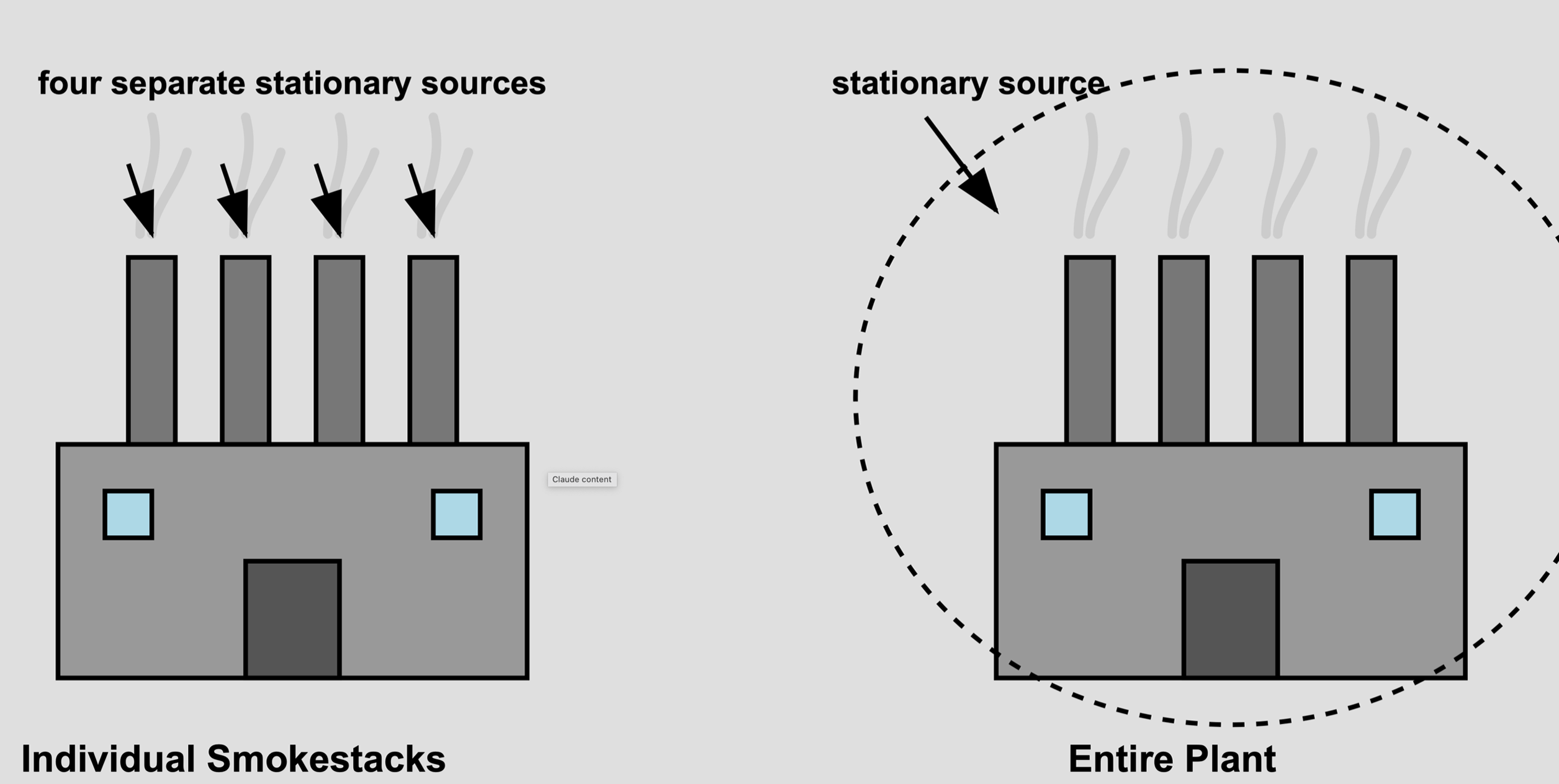
A statute that amended the Clean Air Act sets pollution limits on “stationary sources,” defined within the statutory language to mean “any building, structure, facility, or installation which emits or may emit any air pollutant.”Footnote 13 But what counts as a “facility” or “installation?” The Act does not further define those terms. The Environmental Protection Agency (EPA) during the Jimmy Carter Administration treated each smokestack in an industrial plant as its own stationary source, at least under certain circumstances.Footnote 14 The Ronald Reagan Administration took a more industry-friendly approach. It used a ‘bubble concept’ under which the entire plant could be treated as a single stationary source. Thus, a cleaner-than-average smokestack’s emissions could be used to offset a dirtier-than-average smokestack that, under the stricter Carter Administration standard, would have triggered additional regulatory obligations. Figure 1 illustrates the two approaches.
Illustration of the Carter administration’s (left) and Reagan administration’s (right) differing approaches to defining stationary sources.

Figure 1 Long description
A schematic factory with four smokestacks shown twice. On the left-hand version, four arrows point to the four smokestacks, with the label ‘four separate stationary sources.’ The caption underneath the left-hand vesion says ‘Individual Smokestacks.’ In the right-hand version, a dotted circle surrounds the factory and an arrow points to the whole with the label ‘stationary source.’ The caption underneath the right-hand version reads ‘Entire Plant’.
The Supreme Court in Chevron held that the Reagan administration’s bubble concept was a reasonable interpretation of the unclear statutory term ‘stationary source’, but in so doing, it made clear that the Carter administration’s individual smokestack approach had also been a reasonable interpretation.Footnote 15
The Loper Bright majority stated that although it was overruling the methodological approach of Chevron, it was not disturbing any particular past rulings applying the Chevron doctrine to uphold any particular regulations—at least not yet.Footnote 16 Nonetheless, we can get a sense of what the Court meant in Loper Bright by applying its methodology to the facts of Chevron itself. If faced with those facts in a case of first impression, presumably the Loper Bright Court would have said that its job is not to adjudicate whether the bubble concept is a reasonable understanding of the statutory term ‘stationary source’ but instead, to definitively declare the meaning of the term ‘stationary source’. Under this approach, jurists would use their standard interpretive tools to determine whether ‘stationary source’ means each smokestack counted one by one, the bubble concept, or perhaps something else. However, under the Loper Bright approach, a court could not leave it up to an agency to decide what the statute means and then change its mind when a president with different values took office.
What I am calling the conventional defense of Chevron pushes back against that view, even as it accepts the premise that it is the nearly exclusive province of the judiciary to say what the law is. According to the conventional defense, a court applying Chevron can be understood as saying what the law is by giving a different account of what—or where—the law is. To see how, consider another way of understanding what was happening in Chevron.
Suppose that when Congress wrote “stationary source” in the amended Clean Air Act, it meant to assign to the agency the task of setting pollution standards for what the agency reasonably thought to be a stationary source. Under that interpretation, the judiciary would say what the law is by drawing a boundary around what could reasonably count as a stationary source. The Carter administration’s individual smokestack approach would fall within the acceptable range, as would the Reagan administration’s bubble concept, but some approaches would fall outside of it. For example, the Environmental Protection Agency could not legally claim authority to regulate motor vehicles as stationary sources for the obvious reason that they are mobile, not stationary, sources of pollution and are governed by distinct statutory provisions.Footnote 17 In Figure 2, the court says what the law is by saying where the boundary—the red circle—lies.
The Boundary of the Law
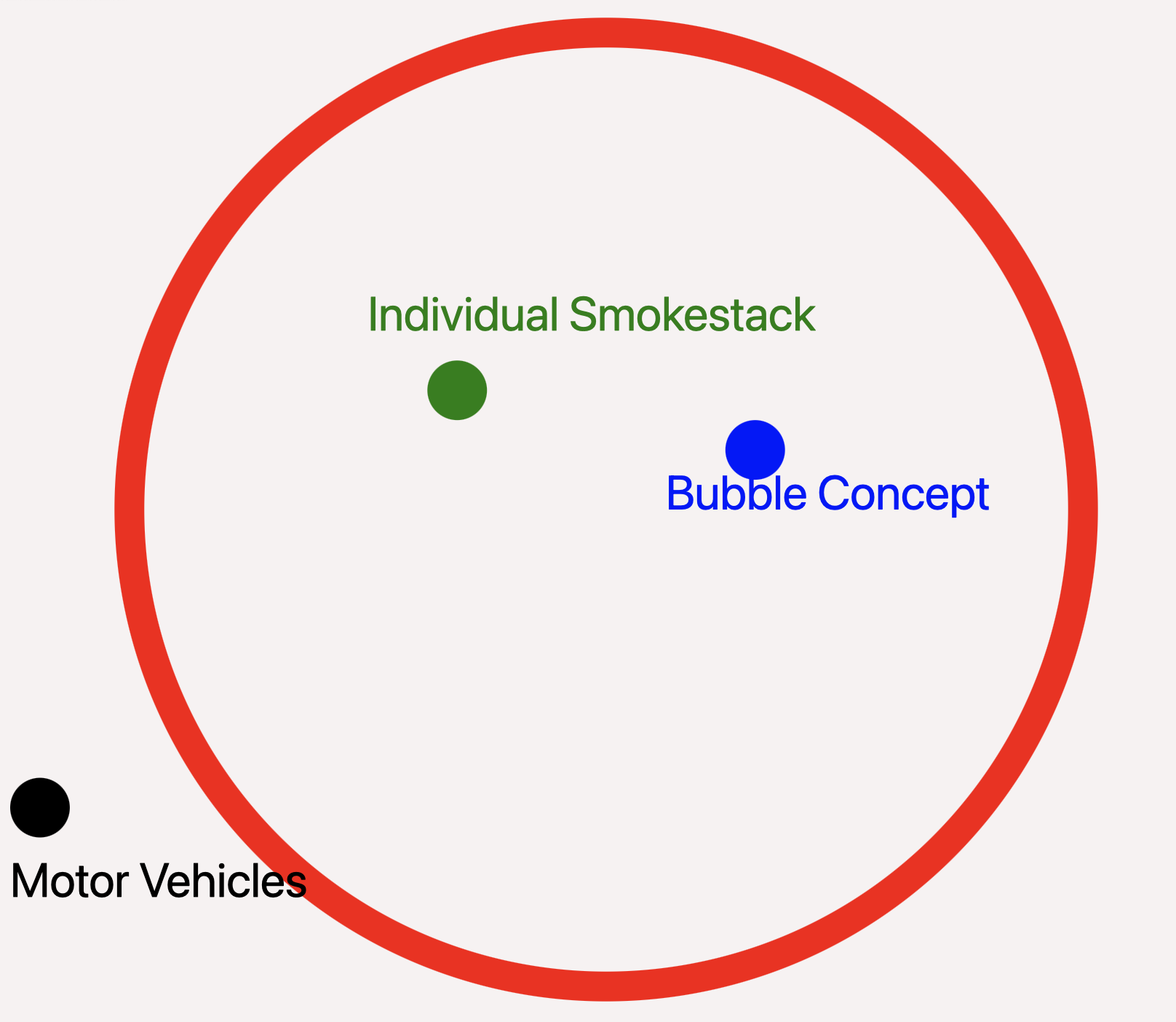
Although I take credit for conceiving of the accompanying nifty graphic, the defense of Chevron I have just offered is not original to me; the fact that I called this defense ‘conventional’ was probably a clue. So far as I am aware, this argument was first offered by Henry Hart more than thirty years before Chevron was decided and in defense of the practice that only later would come to be called the Chevron doctrine.Footnote 18
Not everyone finds the conventional defense persuasive.Footnote 19 Moreover, Hart’s account of the judicial role as setting the bounds of discretion has additional difficulty accounting for a leading post-Chevron case, which instructed that even where a court had previously construed an unclear statutory term to mean A in a case that did not involve any agency, the court was required to defer to a subsequent reasonable agency construction of that term to mean B.Footnote 20
I believe that Hart’s discretion-boundary view can account for even that decision and have explained how in other work.Footnote 21 However, I shall not recapitulate my reasoning here because I want to offer a more radical defense of Chevron deference than Hart did. Suppose we reject the discretion-boundary characterization and accept, instead, that under Chevron some of the role of saying what the law is goes to agencies rather than courts. Even so, I want to say, there is no violation of separation of powers or the rule of law.
Why not? Because deferring to someone else’s view of the law can be consistent with the judicial role. Indeed, as I shall now argue, deferring to the views of others is at the core of the rule of law.
2. The Rule of Law
There are many views about what is and is not essential to the rule of law. Lon Fuller famously identified eight principles he associated with the rule of law, but his exegesis did not resolve the matter once and for all.Footnote 22 On the contrary, ongoing debate over the meaning and content of the rule of law led Jeremy Waldron to suggest that it is an essentially contested concept.Footnote 23 I shall not attempt my own account of everything the rule of law is and is not. Rather, I shall offer one element of what I believe it entails. Although it appears nowhere on Fuller’s list, I want to suggest that a good candidate for one implication of the rule of law is the following proposition:
If one accepts law’s authority, then the law’s commands create prima facie grounds for displacing contrary all-things-considered judgments.
I have stated the proposition conditionally in recognition of the fact that some very prominent legal philosophers have argued that there is not even a prima facie obligation to obey the law.Footnote 24 I do not mean to stake out a definitive position on the contested question in legal philosophy whether there is always a prima facie duty to obey the law, sometimes such an obligation, or never such an obligation. My working hypothesis is that most judges believe—or at least say—that they are obligated to follow the law.
What it means for a judge to follow the law is a bit different from what it means for a primary actor to follow the law. When the law forbids primary actors from stealing, John Doe follows the law by complying with it—that is, by refraining from stealing.
Judge Mary Smith follows the law by applying the law of theft. Even if Judge Smith thinks that defendant Jean Valjean presents a sympathetic case, she will instruct the jury on the elements of theft and any possible defenses—such as necessity—but, absent a good-faith basis for thinking that the law forbidding theft is unconstitutional, she will not simply say that the theft prohibition does not exist or can be ignored. Judge Smith might wish the law were different or contained a more generous set of defenses. She might therefore even bend the law or construe it creatively. But when push comes to shove, she will feel obligated to follow a sufficiently clear law, notwithstanding any contrary druthers she might have as a normative matter.
Despite the controversies I have noted over the existence and extent of a duty to obey the law, I do not regard what I have just said about judges’ obligations to follow the law as controversial. Perhaps there are some adherents of an extreme version of natural law who think that judges are never bound to reach a judgment they think different from how they would resolve the case on an all-things-considered normative basis if there were no applicable law. But if so, they strike me as outliers even among scholars, and even more so among judges themselves.
To be clear, I acknowledge that of course the law is often highly under-determinative with respect to important cases. When that is so, judges will fill in gaps and resolve ambiguities in ways that reflect their own values. Moreover, appellate review—especially in apex courts—has a selection bias for cases in which the pre-existing formal legal materials are under-determinate. I am not a formalist who thinks that judges mechanically apply the law. My point is simply that one can see the commitment to following the law that I am associating with the rule of law in anyone who thinks the law is sufficiently determinate over some range of cases to at least occasionally rule out a contrary all-things-considered judgment.
Indeed, even the most pragmatic legal realists to have sat on the bench recognize the authority of the law. For example, Judge Richard Posner has said that he decides cases by first figuring out what a sensible, all-things-considered resolution of the dispute would be and then looking to see whether the formal materials of the law block that result; if not, he imposes it in the name of the law.Footnote 25 While that is an extreme—some would say cynically—legal realist view for a judge,Footnote 26 note that even Judge Posner allowed that there are resolutions that the law rules out and that, in virtue of his obligation to follow the law, he therefore cannot reach.Footnote 27
The point is probably obvious, but it is worth drawing out: The very essence of the rule of law entails subordinating a judge’s all-things-considered druthers—that is, deferring—to somebody else’s judgment. That somebody else could be the People who ratified a constitutional provision, the legislators who enacted a law, the agency personnel who promulgated a regulation, the judges who handed down the applicable precedent, or some other actor. The judicial duty to say what the law is typically cashes out as a duty to say what law one or more of those other actors has made.
3. Is Interpretive Deference Special?
Hold on. When judges subordinate their all-things-considered judgment to the judgment of the legislature or the People via a constitution, they are recognizing the power of other bodies to make law. They are not deferring to some other actor’s understanding of what the law means. Thus, an objection to my reliance on the rule of law goes, the opinion of Chief Justice Roberts in the Loper Bright case does not say that judges get to disregard the law. It says only that judges get to say what the law—as made by the People in adopting a constitution or the legislature in enacting a statute—means.
Fair enough. However, in actual practice, courts sometimes defer to other actors about not only the existence of law but its meaning. For example, in the United States, when a person incarcerated pursuant to a state court conviction brings a habeas corpus petition in federal court claiming that their conviction resulted from a legal error, the federal court is statutorily barred from granting the writ unless the state court ruling “involved an unreasonable application of[] clearly established Federal law.”Footnote 28 Likewise, under the judge-made doctrine of qualified immunity, U.S. courts even defer to legal interpretations by police officers, school principals, and other non-judicial legal actors sued for civil rights violations. Such a lawbreaker will escape liability unless, at the time of the violation, it was “clearly established” that the defendant’s conduct was unlawful.Footnote 29 In each setting, a judge who thinks that the law means X will defer to another actor’s determination that the law means Y, so long as Y is reasonable (or was reasonable at the time when the other actor made the relevant judgment), even if, by the judge’s lights, Y is an incorrect understanding of the law.
Now it might be objected that in the habeas and qualified immunity settings, the court is not actually deferring to state courts or civil rights defendants. Rather, in each case the court hearing the case decides for itself what the law means, but, to vindicate countervailing principles of federalism, finality, and notice, the court under-enforces that meaning. A holding that a state court erroneously but reasonably misapplied federal law does not establish the meaning of federal law for future cases.Footnote 30 Nor does a holding that a police officer or school principal acted reasonably and thus is entitled to qualified immunity establish the law going forward.Footnote 31 Thus, this objection goes, neither of these examples involves a court deferring to another legal actor about what the law is.
I am not prepared to concede the point, mostly because the effort to distinguish habeas and qualified immunity cases that I have just outlined is closely analogous to the conventional boundary-drawing defense of Chevron deference that I offered above. If a court deciding a habeas or qualified immunity case is not really deferring, then neither is a court that gives Chevron deference really deferring. Defenders of the Loper Bright approach cannot have it both ways. They cannot reject the boundary-maintenance theory of Chevron that renders it consistent with an exclusively judicial power to say what the law is while also asserting a boundary-maintenance theory of habeas and qualified immunity cases in order to maintain that courts never defer with respect to legal meaning.
In any event, even if I were willing to concede the point, habeas and qualified immunity cases are not the only examples of courts deferring regarding meaning. Consider another example. Lower courts routinely accept—we say they are ‘bound by’—legal rulings of higher courts. If the Supreme Court of Canada reverses a judgment of the Court of Appeal for Ontario, the Ontario Justices who ruled the other way are unlikely to be persuaded that they were mistaken, but they nonetheless accept that in any further proceedings in that very case and in future cases, they must accept the legal determination by the Supreme Court. Yet surely no one thinks that practice violates any principle reserving to judges the province and duty to say what the law is. The practice of vertical stare decisis shows that it is possible to say what the law is by accepting someone else’s view of what the law is.
Meanwhile, horizontal stare decisis—the practice by which courts follow their own precedents—has a very similar form to the old Chevron doctrine. Courts occasionally overrule their own precedents, but mere disagreement with a prior precedent is not a sufficient ground for doing so. The old precedent must be very wrong. In the U.S., the official standard is that it must be unsound in principle and unworkable in practice.Footnote 32 That is not very different from saying that courts will follow their past precedents so long as they are not unreasonable interpretations of the law.
Could a clever lawyer find some way to distinguish each of my examples from deference to administrative agencies? In some sense, yes. I acknowledge that each category of cases in which courts subordinate their best judgment of what the law requires to someone else’s view is different in some way or another from deferring to an administrative agency’s construction of a law. In each example—and in others we might consider—there is some distinctive functional justification for a court subordinating its best judgment to the judgment of some other actor. But the variety of ways in which courts defer to other legal actors belies the claim that there is some categorical reason why courts cannot also defer to reasonable agency interpretations of unclear laws—if there is a good functional justification for that kind of deference.
In other words, the question is not whether judicial deference to agencies’ legal views is justified on the same grounds as judicial deference is justified in other settings. The question is whether there is some solid justification for deference in this setting. And the answer to that question is clearly ‘yes’. Agency expertise is one such justification. Political accountability is another. Justice Kagan’s dissent in Loper Bright invoked both justifications.Footnote 33 Meanwhile, the academic literature expounding these (and other) justifications is voluminous.Footnote 34
4. Could Loper Bright Be Used to Resist Authoritarianism?
If I had delivered this lecture in some previous year, I might have ended there. But those recent events to which I alluded when I began this lecture call for consideration of a further factor. One might grant my contentions about the relation between judicial power to say what the law is and deference to administrative agencies, but nonetheless conclude that the Loper Bright decision could prove useful as a brake on the worst excesses of the Trump administration—which, in area after area, has acted in ways that, taken individually, violate the law, and taken collectively, undercut the rule of law.Footnote 35 One might therefore think that now is exactly the wrong time to defend deference to the executive branch of the U.S. government.
I would offer two responses. First, my argument is meant to be mostly analytical rather than normative. Chevron deference was never especially ideological, as the Chevron case itself illustrates. Recall that in Chevron the Supreme Court deferred to a deregulatory environmental policy of the Reagan administration. Deference to administrative agencies will tend to be deregulatory during administrations that prioritize deregulation and pro-regulatory during administrations that prioritize regulation. The fact that I disagree with a great many of the current administration’s substantive policies is thus not a special reason to refrain from criticizing Loper Bright now. Put differently, over the long run, honest application of a policy of deference will not have a substantial ideological skew.
Second, the fundamental problem with the current administration is not that it is adopting reasonable interpretations of the law that disappoint progressives like me who favor different, also reasonable, interpretations of the law. The fundamental problem is that the current administration is largely ignoring the law.
Consider just one illustration of the scope of this lawlessness. In February of 2025, the President signed an executive order called “Keeping Men Out of Women’s Sports.”Footnote 36 It asserts that a federal civil rights statute forbids universities and other institutions that accept federal funds from permitting transgender female athletes from participating in girls’ and women’s sports. It cites two controversial trial court decisions involving challenges to a contrary policy of the Biden administrationFootnote 37 but does not even mention a 2020 Supreme Court decision—authored by one of President Trump’s appointees, Justice Neil Gorsuch—holding that discrimination against transgender women violates a very similarly-worded federal civil rights statute governing employment.Footnote 38 In other words, the executive order asserts that a form of discrimination that the leading Supreme Court opinion appears to forbid is actually required by civil rights law.Footnote 39
Despite its extremely dubious logic, the anti-trans executive order has had substantial real-world consequences. Almost immediately after the order was issued, the governing body for collegiate sports in the United States announced that it would change its rules to limit “competition in women’s sports to student-athletes assigned female at birth only.”Footnote 40 At the same time, the administration opened an investigation into the University of Pennsylvania,Footnote 41 which had previously been the subject of controversy because of the competitive success of a transgender female swimmer who attended the university.Footnote 42 Less than six weeks after opening the investigation, the Trump administration announced that it was withholding $175 million from the University of Pennsylvania for failure to abide by the anti-trans policy, even though the university said that it was by that point complying.Footnote 43
If the University of Pennsylvania were to challenge the administration’s funding cutoff in court, it would have a very strong case—even if the Chevron doctrine were still in operation. In addition to the fact that the anti-trans policy relies on a highly tendentious reading of federal civil rights law, the administration followed none of the procedures mandated by a federal statute before the government may lawfully cut off funding for civil rights violations.Footnote 44 Chevron allowed federal administrative agencies to adopt and apply a range of reasonable interpretations of ambiguous statutes. It never allowed the executive branch simply to ignore the law.
However, the University of Pennsylvania did not challenge the funding cutoff in court. Instead, it entered into a ‘Resolution Agreement’ with the government, capitulating to the Trump administration’s tendentiously transphobic interpretation of civil rights law.Footnote 45 And while some of President Trump’s other high-profile targets—such as Harvard University and a few law firms—filed suit, many others did not.Footnote 46 Why not? The answer is not that they lack confidence that they could win in court. It is that they fear reprisals even if they do win in court.
That seemed to be the reason Columbia University capitulated after the administration withheld over $400 million in funding,Footnote 47 as well as the reason why the law firm of Paul, Weiss struck a deal after it was targeted based on the President’s personal pique.Footnote 48 Brad S. Karp, the Chair of the Paul, Weiss firm, explained in a memorandum that firm lawyers were prepared to sue but ultimately deemed it futile because:
[Even if the firm were] successful in initially enjoining the executive order in litigation, it would not solve the fundamental problem, which was that clients perceived [the] firm as being persona non grata with the administration.… [While litigation] could stop the executive order from taking effect, [it] couldn’t erase it. Clients had told [the firm] that they were not going to be able to stay with [it], even though they wanted to.… It was very likely that [the] firm would not be able to survive a protracted dispute with the administration.Footnote 49
The fear, chill, and intimidation are working—for the Trump administration—under the Loper Bright regime. It is difficult to see how things would be—or even could be—worse if Chevron were still the law.
Conclusion
Despite my defense of judicial deference to administrative agencies, should Loper Bright end up being the difference between a court invalidating and upholding one or more of the terrible policies of the second Trump administration, I shall be grateful. I also do not wish to be misunderstood to say that the U.S. Supreme Court’s rejection of deference to administrative agencies in Loper Bright is in any way equivalent to the Trump administration’s contempt for the law, lawyers, and judges. Loper Bright is rooted in what I regard as a badly mistaken understanding of the rule of law, but it is nonetheless an effort to take the law seriously. By contrast, the second Trump administration simply rejects the rule of law.
Acknowledgements
This essay is a lightly revised and footnoted version of the Coxford Lecture given at Western University’s Faculty of Law on 1 April 2025. I am very grateful to Professor Wade Wright and Acting Dean Andrew Botterell for having honored me with the invitation to deliver it. Thanks are also due to V Carter for excellent research assistance.

 Open access

