1. Introduction: from policy to practice
Science diplomacy has become a strategic instrument of European external action in an era shaped by intersecting sustainability challenges, geopolitical tensions, and rapid technological change. The European Union (EU) increasingly treats international research and innovation cooperation as a means of addressing global public goods, strengthening resilient partnerships, and linking scientific expertise with external action (Council of the European Union, 2026; European Commission, 2021a, 2025a). The adoption of the Council Recommendation on an EU framework for science diplomacy in May 2026 marks an important institutional consolidation of this agenda and explicitly connects science diplomacy with global challenges, international cooperation, academic freedom, and the Union's relations with third countries (Council of the European Union, 2026).
Science diplomacy is commonly described through three orientations: ‘science in diplomacy’, where evidence informs foreign policy; ‘diplomacy for science’, where diplomatic action facilitates scientific cooperation; and ‘science for diplomacy’, where scientific cooperation contributes to international relations (Flink & Schreiterer, Reference Flink and Schreiterer2010; Gluckman et al., Reference Gluckman, Turekian, Grimes and Kishi2017; Royal Society & AAAS, 2010; Ruffini, Reference Ruffini2017). More recent European debate adds a fourth orientation, ‘diplomacy in science’: the use of diplomatic skills and tools in and by science itself (European Commission, 2025a). This extension is particularly relevant to researcher competencies because it recognises that universities, research organisations, and individual scientists increasingly operate in politically sensitive international environments and may need diplomatic capabilities within scientific practice, not only around it.
Despite this policy momentum, a practical gap remains. EU frameworks articulate strategic aims, principles and institutional mechanisms, while scholarship on the science-policy interface highlights communication, trust, knowledge brokerage, and stakeholder engagement (Bednarek et al., Reference Bednarek, Wyborn, Cvitanovic, Meyer, Colvin, Addison, Close, Curran, Farooque, Goldman, Hart, Mannix, McGreavy, Parris, Posner, Robinson, Ryan and Leith2018; Gluckman et al., Reference Gluckman, Bardsley and Kaiser2021; Legrand & Stone, Reference Legrand and Stone2018). Yet explicit competency architectures for researchers that integrate the sustainability and digital dimensions of contemporary science diplomacy remain underdeveloped (Rungius & Flink, Reference Rungius and Flink2020; Van Langenhove, Reference Van Langenhove2017). This matters because the effectiveness of science diplomacy does not follow automatically from scientific excellence: researchers must be able to interpret the policy context, steward and communicate complex evidence, and interact constructively across institutional, disciplinary, and cultural boundaries.
This paper addresses that gap by developing a conceptual model of green and digital competencies for researchers engaging in European science diplomacy. The contribution is fourfold. First, it specifies theoretical mechanisms that connect individual competencies to proximal science-diplomacy outcomes such as policy relevance, evidence credibility, stakeholder alignment, and trust. Second, it distinguishes core, supporting, and context-dependent competencies to make the framework more usable for curriculum design and assessment. Third, it places the model in the Sustainable Development Goal (SDG) framework. Fourth, it clarifies the model's geographical scope and the conditions under which an EU-anchored framework can be adapted to non-EU and Global South contexts.
1.1. Conceptual approach, unit of analysis, and limits
Methodologically, the paper follows a conceptual framework-building approach that synthesises policy documents, established competence frameworks, and scholarship on the science-policy interface (Jabareen, Reference Jabareen2009). The policy anchors are the EU's science diplomacy agenda, GreenComp, DigComp 2.2, the EU AI Act, and related research and digital-policy frameworks. The theoretical synthesis draws primarily on boundary-spanning and knowledge-brokerage scholarship, complemented by competency research in sustainability and at the science-policy interface (Bednarek et al., Reference Bednarek, Wyborn, Cvitanovic, Meyer, Colvin, Addison, Close, Curran, Farooque, Goldman, Hart, Mannix, McGreavy, Parris, Posner, Robinson, Ryan and Leith2018; Dettwiler et al., Reference Dettwiler, Salomon, Piessens-siegrist, Last, Zhang and Hoffmann2026; Gluckman et al., Reference Gluckman, Bardsley and Kaiser2021; Wiek et al., Reference Wiek, Withycombe and Redman2011). The model is therefore an analytical synthesis, not the result of psychometric scale development or causal estimation.
The unit of analysis is the researcher whose work enters, informs, or is conducted within EU-linked or multilateral science-diplomacy processes. This includes researchers based in EU Member States and associated European research organisations, but also researchers from third countries who collaborate in EU-funded programmes, international research infrastructures, diplomatic dialogues, or multilateral processes in which European actors and norms are present. The adjective ‘European’ therefore identifies the policy origin and institutional anchoring of the framework, not a nationality criterion and not a claim that EU competence frameworks are universally applicable.
The UNFCCC COP discussion later in the paper is deliberately illustrative. It combines published scholarship with practice-based reflection to examine whether the proposed competencies are analytically useful in a demanding multilateral setting. No systematic participant-observation protocol, interviews, coding scheme, or case-study dataset was used; accordingly, the COP section is not presented as empirical validation. Future research should test the framework through cross-regional interviews, Delphi exercises, training pilots, and outcome evaluation.
The following sections review the EU science-diplomacy policy landscape and its global context, establish the model's theoretical, and competence foundations, discuss digital and AI governance, present and operationalise the three-layer competency model, apply it illustratively to UNFCCC COP processes, and examine transferability and limitations.
2. EU science diplomacy: policy foundations and global context
Science diplomacy has featured in EU policy documents for more than a decade, initially through strategies for international cooperation in research and innovation and later through a more explicit connection between research, external action and geopolitical resilience (European Commission, 2012, 2021a). The 2025 expert report, A European Framework for Science Diplomacy, developed through a co-creation process involving 130 experts from scientific and diplomatic communities, translated this trajectory into strategic, operational, and enabling recommendations, including a strong emphasis on human capacity development (European Commission, 2025a).
The Council Recommendation of 29 May 2026 now provides the formal EU-level policy reference. It defines science diplomacy as the use of science, scientific evidence, and scientific cooperation to inform and support foreign policy, together with the use of diplomacy to support international scientific cooperation and progress (Council of the European Union, 2026). The Recommendation explicitly safeguards academic freedom and institutional autonomy while encouraging Member States and EU institutions to build capacities, strengthen scientific advice and connect science-diplomacy instruments to programmes and partnerships involving third countries and regions. This policy development reinforces the practical relevance of competencies: capacity building is no longer peripheral to the EU's science-diplomacy agenda but one of its enabling conditions.
The evolving four-part typology also makes individual capabilities more visible. The established categories of science in diplomacy, diplomacy for science, and science for diplomacy locate researchers primarily as advisors, beneficiaries of international cooperation, or contributors to relationship building. The newer category of diplomacy in science foregrounds the diplomatic agency of scientific institutions and researchers themselves (European Commission, 2025a). It captures situations in which scientific collaboration is affected by geopolitical instability, research security concerns, institutional boycotts, contested partnerships, or values-based restrictions. For the present paper, this fourth orientation strengthens the argument that negotiation, cultural awareness, and process management can be legitimate researcher competencies without collapsing the distinction between scientists and professional diplomats.
At the same time, an EU-centred framework requires a critical reflection. A large part of the science-diplomacy literature and many competence frameworks have been developed in Europe and North America. Research on science diplomacy from the Global South shows that countries and institutions pursue distinct objectives, including capacity development, scientific sovereignty, regional cooperation, and greater influence in global knowledge governance (Büyüktanir Karacan & Ruffini, Reference Büyüktanir Karacan and Ruffini2023; Rüland et al., Reference Rüland, Rüffin, Cramer, Ngabonziza, Saxena and Skupien2023). Work on coloniality further warns that apparently universal cooperation models can reproduce asymmetric agenda setting, resource dependence and epistemic hierarchies (Polejack, Reference Polejack2023). An EU-derived competency model should therefore be treated as a reference architecture that requires contextual translation, not as a universal benchmark exported unchanged.
This distinction is compatible with the EU's own contemporary policy orientation. The 2026 Council Recommendation describes science as a global public good and embeds EU science diplomacy in cooperation with third countries, international organisations, and region-specific partnerships (Council of the European Union, 2026). The central analytical question is consequently not whether all researchers should acquire a uniform European skill set, but which competencies are sufficiently general to support responsible boundary-spanning work and which must be adapted to local institutions, power relations, languages, knowledge traditions, and regulatory environments.
3. Theoretical and competence foundations for the twin transition
The model combines two theoretical building blocks with two EU competence frameworks. Boundary-spanning and knowledge-brokerage scholarship explains how researchers can connect scientific and policy communities; competence-in-action scholarship explains what it means for an individual to possess and mobilise a competence. GreenComp and DigComp then provide substantive reference points for sustainability and digital capabilities within the EU's twin-transition agenda.
3.1. Boundary spanning, knowledge brokerage, and competencies-in-action
Boundary-spanning scholarship starts from the observation that scientific and policy communities operate with different incentives, time horizons, languages, and criteria of relevance. Boundary-spanning comprises activities that connect these communities through translation, relationship building, knowledge co-production, mediation, and the design of interfaces through which evidence can become actionable (Bednarek et al., Reference Bednarek, Wyborn, Cvitanovic, Meyer, Colvin, Addison, Close, Curran, Farooque, Goldman, Hart, Mannix, McGreavy, Parris, Posner, Robinson, Ryan and Leith2018; Goodrich et al., Reference Goodrich, Sjostrom, Vaughan, Nichols, Bednarek and Lemos2020). Knowledge brokerage develops this logic further by emphasising the synthesis and translation of evidence, the alignment of information needs and outputs, and the importance of trust, transparency, and integrity in policy advice (Gluckman et al., Reference Gluckman, Bardsley and Kaiser2021). Science diplomacy adds an international and geopolitical layer to these boundary functions.
A competence perspective shifts the focus from activities to the capabilities that enable individuals to perform them. Sustainability-competence literature commonly treats competence as more than an isolated skill: it combines knowledge, skills, attitudes, and judgement that can be mobilised in context to address complex tasks (Wiek et al., Reference Wiek, Withycombe and Redman2011). Recent work at the science-policy interface similarly conceptualises competencies as dynamic and realised in action, highlighting cognitive, relational, reflexive, and spatial-temporal dimensions rather than a checklist of technical abilities (Dettwiler et al., Reference Dettwiler, Salomon, Piessens-siegrist, Last, Zhang and Hoffmann2026). This distinction is important for the present model and motivates the use of ‘competencies’, rather than the broader and sometimes narrower term ‘skills’, in the revised title and framework.
The model uses transformation capacity as an integrative concept, not as a standalone theory of societal transformation. Transformation capacity refers here to the reflexive ability to combine, sequence, and adapt competencies when researchers move across scientific, policy, and diplomatic contexts. It includes recognising value conflicts, revising one's framing when conditions change, selecting appropriate forms of engagement and maintaining scientific integrity under political pressure. The theoretical proposition is therefore mid-range: competencies matter insofar as they enable specific boundary-spanning mechanisms, and those mechanisms can improve proximal conditions for science diplomacy. The paper does not claim that competencies alone cause successful negotiations or sustainability transitions, which also depend on institutions, interests, power, resources, and geopolitical context.
3.2. Green competences: GreenComp
The European Sustainability Competence Framework (GreenComp) was developed as a non-prescriptive reference framework for learning that fosters sustainability competence in formal, non-formal, and informal education (Bianchi et al., Reference Bianchi, Pisiotis and Cabrera Giraldez2022). It defines sustainability competence through four interrelated areas: embodying sustainability values, embracing complexity in sustainability, envisioning sustainable futures, and acting for sustainability. Across these areas, GreenComp emphasises systems thinking, futures literacy, critical reflection on values, and action competence.
For science diplomacy, GreenComp is useful less as a ready-made professional standard than as an orientation for understanding the overall mission. Researchers working on transboundary sustainability issues need to understand socio-ecological interdependencies, uncertainty, multiple temporal and spatial scales, and value conflicts. These capacities support the boundary-spanning mechanisms of contextualisation and issue framing: scientific findings can be situated within wider governance problems without requiring researchers to align their research agendas ex ante with political priorities. This preserves academic freedom while improving the ability to explain why, when and for whom evidence is relevant.
GreenComp also resonates with broader international competence debates. The OECD Learning Compass 2030 highlights transformative competencies such as creating new value, reconciling tensions and taking responsibility (OECD, 2019). These ideas reinforce a conception of sustainability competence as reflexive judgement in complex settings rather than compliance with a predefined sustainability position.
3.3. Digital competences: DigComp 2.2
The Digital Competence Framework for Citizens (DigComp 2.2) provides a common reference for digital competence across five areas: information and data literacy; communication and collaboration; digital content creation; safety; and problem solving (Vuorikari et al., Reference Vuorikari, Kluzer and Punie2022). The 2022 update includes examples involving artificial intelligence and the environmental implications of digital technologies.
In science diplomacy, digital competence must be interpreted at a more advanced and research-specific level than in a general citizen framework. Researchers increasingly work with models, datasets, digital research infrastructures, and AI-supported analytical tools that can become boundary objects in policy and negotiation settings. Competence therefore includes not only tool use but the ability to evaluate data provenance, uncertainty, model assumptions, interoperability and limitations, and to communicate these features to non-technical audiences (Beck & Mahony, Reference Beck and Mahony2018; Vuorikari et al., Reference Vuorikari, Kluzer and Punie2022).
Taken together, GreenComp and DigComp provide complementary anchors for the EU twin transition. Their value for science diplomacy lies in how they can be reinterpreted through boundary-spanning mechanisms: sustainability competence improves contextual and normative judgement, while digital competence improves the stewardship, transparency and communicability of evidence.
4. AI and sustainability governance expectations
Digital transformation and artificial intelligence are increasingly treated in EU policy as enablers of sustainability transitions, but they also generate governance obligations that affect the credibility of scientific evidence (Cath, Reference Cath2022; European Commission, 2021b; European Union, 2024). The Digital Decade agenda emphasises secure, sustainable, inclusive and human-centric digitalisation, making governance awareness part of digital competence rather than an external legal add-on.
The EU AI Act (Regulation (EU) 2024/1689) establishes a risk-based framework for AI systems with obligations relating to transparency, human oversight and fundamental rights, among other requirements (European Union, 2024). The Act does not prescribe a generic competency profile for researchers, and many research activities fall under specific conditions or exclusions. Nevertheless, researchers whose evidence relies on AI-supported systems need sufficient governance literacy to understand when regulatory requirements, data-governance duties, or transparency expectations are relevant. Detailed legal compliance is therefore context-dependent, while the core competence is the ability to recognise governance implications and to explain methodological choices and limitations responsibly.
This distinction is important for avoiding an overly broad competency model. A climate scientist, a social scientist working on digital governance, and a researcher embedded in an EU delegation do not need identical knowledge of the AI Act. What is more generalisable is evidence stewardship: the capacity to assess provenance and quality, document assumptions, communicate uncertainty, protect sensitive information where necessary, and support reproducibility or appropriate openness. Open science and FAIR (Findable, Accessible, Interoperable, Reusable) data principles can strengthen these functions where compatible with security, ethical, and legal constraints (European Commission, 2022; UNESCO, 2021).
In science diplomacy, such competencies can influence trust because digitally generated evidence is often contested not only on scientific grounds but also through questions about transparency, comparability, standards, and governance. Digital and AI capabilities therefore function as a strategic bridge between technical evidence and legitimate international policy use.
5. Proposed competency model: transformation capacity for science diplomacy
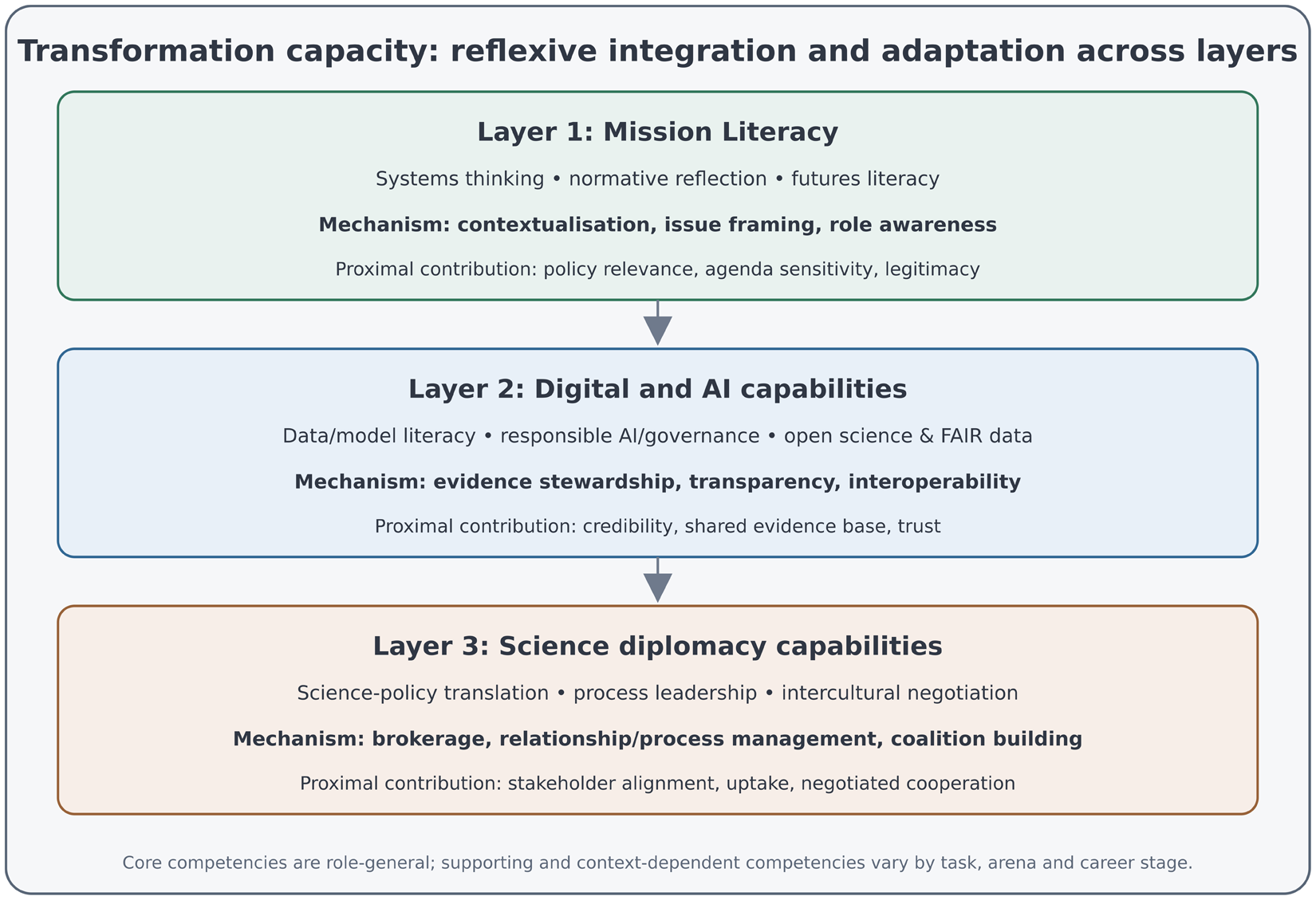
Building on the preceding foundations, the proposed model comprises three interdependent layers: Mission Literacy, Digital and AI Capabilities, and Science Diplomacy Capabilities. Transformation capacity connects the layers by enabling researchers to select, combine, and adapt competencies to the demands of a particular science-diplomacy situation. The model is intentionally role-sensitive: it identifies a core that is broadly relevant to boundary-spanning researchers while allowing supporting and context-dependent competencies to vary by task, arena, and career stage. Figure 1 presents the resulting architecture and proposed pathways.
Figure 1.Revised three-layer competency model and the mechanisms linking competencies to proximal science-diplomacy contributions. The pathways are conceptual and context-dependent; they do not imply deterministic causal effects.
Figure 1 Long description
A top-to-bottom model presents three competency layers connected by downward arrows under the heading ‘Transformation capacity: reflexive integration and adaptation across layers’. Layer 1, Mission Literacy, contains systems thinking, normative reflection, and futures literacy. Its mechanism is contextualisation, issue framing, and role awareness; its contribution is policy relevance, agenda sensitivity, and legitimacy. Layer 2, Digital and AI Capabilities, contains data and model literacy, responsible AI and governance, and open science and FAIR data. Its mechanism is evidence stewardship, transparency, and interoperability; its contribution is credibility, a shared evidence base, and trust. Layer 3, Science Diplomacy Capabilities, contains science-policy translation, process leadership, and intercultural negotiation. Its mechanism is brokerage, relationship, and process management and coalition building; its contribution is stakeholder alignment, uptake and negotiated cooperation. Core competencies are role-general; supporting and context-dependent competencies vary by task, arena, and career stage.
5.1. Mechanisms from competencies to science-diplomacy outcomes
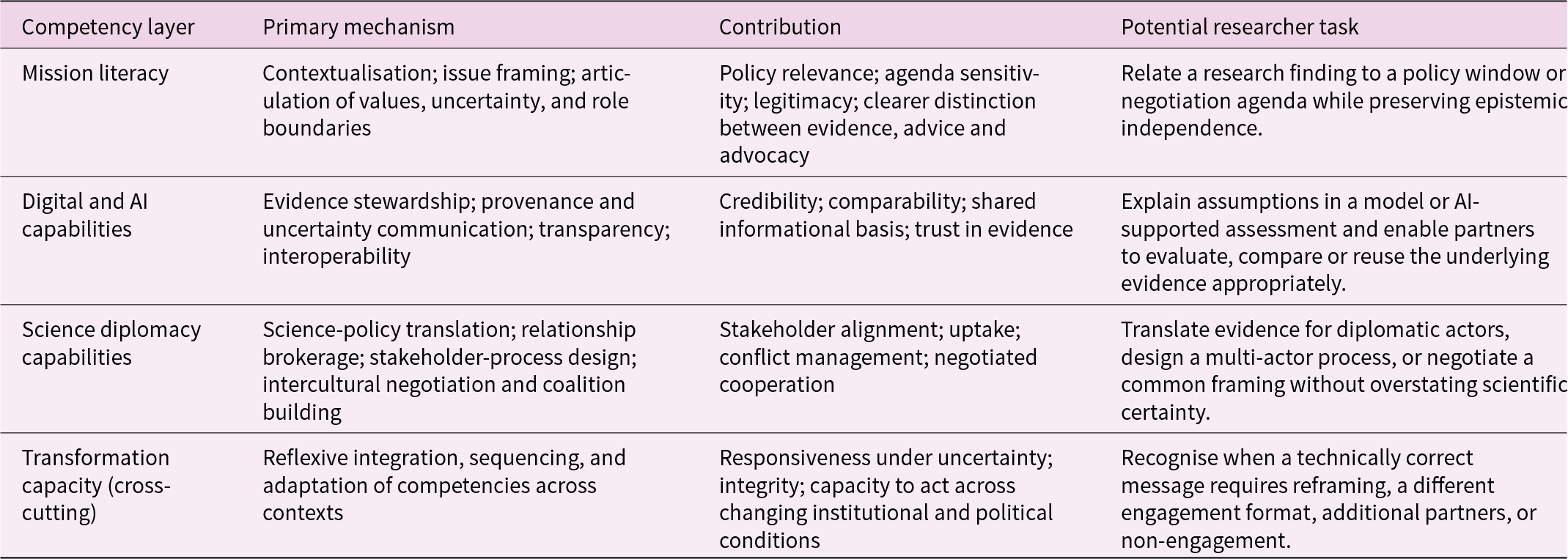
The central conceptual contribution is to make the pathways between competencies and science-diplomacy outcomes explicit. The model does not treat competence as an end in itself. Instead, each layer enables a set of boundary-spanning mechanisms that can improve proximal conditions for effective engagement. Mission Literacy enables contextualisation, issue framing, and reflexive role awareness; Digital and AI Capabilities enable evidence stewardship, transparency, and interoperability; Science Diplomacy Capabilities enable translation, relationship brokerage, process design, and negotiation. Transformation capacity enables researchers to integrate these mechanisms and adjust them when institutional, cultural, or political conditions change. Table 1 summarises the mechanisms, contributions, and illustrative researcher tasks.
Table 1.Competency layers, boundary-spanning mechanisms, and expected contributions

Table 1 Long description
Four rows compare competency layers. Mission Literacy uses contextualisation, issue framing, articulation of values, uncertainty, and role boundaries; it contributes policy relevance, agenda sensitivity, legitimacy, and a clearer distinction between evidence, advice, and advocacy. The illustrative task is relating a finding to a policy window or negotiation agenda while preserving epistemic independence. Digital and AI Capabilities use evidence stewardship, provenance and uncertainty communication, transparency and interoperability; they contribute credibility, comparability, a shared informational basis and trust. The task is explaining assumptions in a model or AI-supported assessment and enabling appropriate evaluation, comparison, or reuse. Science Diplomacy Capabilities use science-policy translation, relationship brokerage, stakeholder-process design, intercultural negotiation, and coalition building; they contribute stakeholder alignment, uptake, conflict management, and negotiated cooperation. The task is translating evidence for diplomatic actors, designing a multi-actor process, or negotiating a common framing without overstating certainty. Transformation capacity is cross-cutting and uses reflexive integration, sequencing and adaptation across contexts; it contributes responsiveness under uncertainty, integrity and capacity to act across changing conditions. The task is recognising when a correct message requires reframing, a different engagement format, additional partners, or non-engagement.
These are plausible conceptual mechanisms rather than empirically estimated effects. A researcher with strong Mission Literacy may still fail to influence an agenda if political incentives are opposed; transparent evidence may not generate trust in a polarised setting; and excellent negotiation skills cannot overcome all structural power asymmetries. The model therefore separates individual capability from system-level outcomes and treats competencies as enabling conditions whose value is mediated by institutions, relationships, and power.
5.2. Layer 1: mission literacy, academic freedom, and reflexive orientation
Mission Literacy refers to a researcher's capacity to understand how independently generated knowledge relates to broader sustainability, innovation, and governance problems. It does not imply orienting research agendas towards predefined policy objectives, nor does it weaken academic freedom. Rather, it enables researchers to identify the institutional and normative context in which their knowledge may be interpreted, contested, or used (European Commission, 2019; Mazzucato, Reference Mazzucato2018).
Its core components are systems thinking, normative and role reflection, and an ability to identify relevant temporal and policy contexts. Futures literacy is a supporting competence that becomes especially important in anticipatory governance, scenario work and long-term sustainability policy. Through these competencies, researchers can distinguish scientific findings from policy preferences, identify where uncertainty or value conflict is politically salient and recognise windows in which evidence can contribute to agenda setting or policy translation. This mechanism can improve relevance and legitimacy precisely because it makes the limits of scientific authority more explicit.
The GreenComp framework reinforces this interpretation by emphasising complexity, values and responsible action (Bianchi et al., Reference Bianchi, Pisiotis and Cabrera Giraldez2022). Applied to science diplomacy, Mission Literacy is therefore best understood as reflexive contextual competence: it helps researchers situate scientific knowledge within sustainability governance without turning scientific work into an instrument of a particular policy mission.
5.3. Layer 2: digital and AI capabilities as evidence stewardship
The second layer treats digital and AI capabilities as competencies for producing, evaluating, documenting, and communicating digital evidence. The core is data and model literacy, including the ability to assess quality, provenance, uncertainty, assumptions, and limitations. Transparency and responsible communication are integral because diplomatic and policy actors must often judge evidence they cannot independently reproduce during time-pressured processes.
Open science and FAIR data practices are supporting competencies because they can improve discoverability, interoperability, and reuse across institutions and jurisdictions (European Commission, 2022; UNESCO, 2021). Their application is not unconditional: legitimate restrictions may arise from research security, personal data, intellectual property, indigenous data governance, or other legal and ethical considerations. Detailed knowledge of the EU AI Act, sectoral regulation, or specific data-space architectures is therefore context-dependent. The broadly transferable competence is governance awareness: recognising which rules and accountability expectations affect the generation and use of evidence.
Through the mechanism of evidence stewardship, this layer can improve science diplomacy in several ways. Better documentation and uncertainty communication strengthen credibility; interoperability can facilitate a shared informational basis across national systems; and transparent explanation of model choices can reduce avoidable disputes about evidence. These effects do not eliminate political disagreement, but they improve the conditions under which disagreement can focus on values, interests and options rather than opaque technical claims.
5.4. Layer 3: science diplomacy capabilities: translation, leadership, and negotiation
The third layer makes explicit the relational and process competencies needed at the science-policy-diplomacy interface. A core competence is science-policy translation: the ability to explain evidence, uncertainty, and options in forms that are intelligible and usable to non-specialist policy and diplomatic actors without overstating certainty or prescribing decisions. This is closely related to knowledge brokerage and boundary spanning (Bednarek et al., Reference Bednarek, Wyborn, Cvitanovic, Meyer, Colvin, Addison, Close, Curran, Farooque, Goldman, Hart, Mannix, McGreavy, Parris, Posner, Robinson, Ryan and Leith2018; Gluckman et al., Reference Gluckman, Bardsley and Kaiser2021).
Intercultural communication and negotiation are also core, as researchers participate directly in international processes. They include recognising different institutional norms, listening across epistemic and political positions, identifying areas of convergence, and managing disagreement. Process leadership and stakeholder design are supporting competencies that become more important when researchers convene networks, lead consortia, advise delegations, or organise multi-actor dialogues. More specialised diplomatic protocol, language proficiency, security procedures, or coalition strategy are context-dependent and should be trained according to role.
These capabilities operate through relational brokerage and process management. They can support stakeholder alignment, improve uptake of evidence and facilitate negotiated cooperation. Sustainable leadership is understood here in a non-hierarchical sense: building trust, maintaining scientific integrity, articulating a shared problem without suppressing legitimate differences and organising processes in which relevant actors can contribute. The addition of ‘diplomacy in science’ to contemporary EU science-diplomacy thinking makes these capabilities particularly salient because scientific institutions themselves may need to navigate diplomatic tensions (European Commission, 2025a).
5.5. Operational hierarchy: core, supporting, and context-dependent competencies
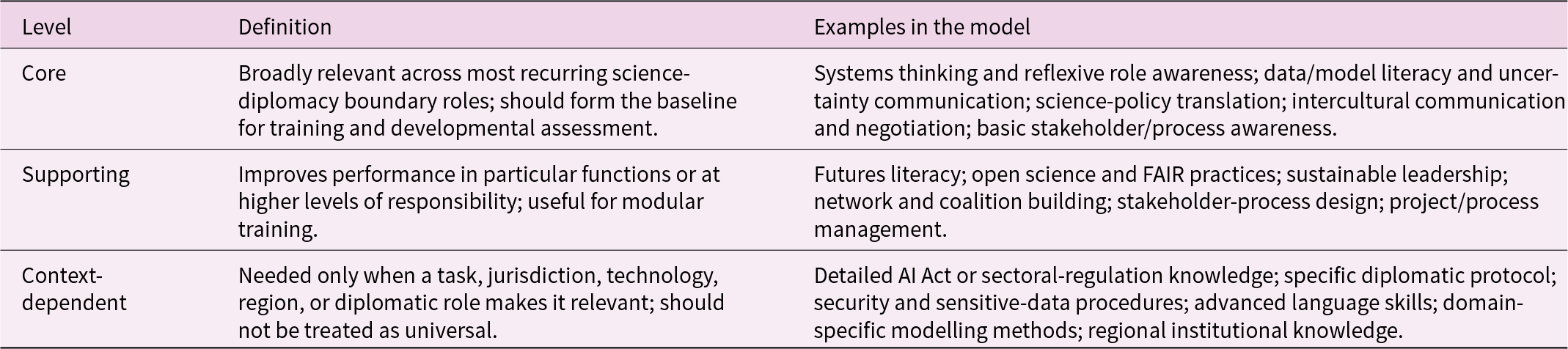
To avoid turning the framework into an unbounded catalogue of desirable attributes, competencies are grouped into three operational levels. ‘Core’ refers to capabilities that are broadly relevant to researchers who repeatedly work across science-policy-diplomacy boundaries. ‘Supporting’ competencies strengthen effectiveness but need not be equally developed for every role. ‘Context-dependent’ competencies are required only in specific regulatory, technical, geographical, or diplomatic settings. The hierarchy concerns expected breadth of relevance, not fixed proficiency: an early-career researcher and a senior delegation adviser may require different levels of the same core competence. Table 2 summarises the resulting hierarchy for training and assessment.
Table 2.Operational hierarchy for training and assessment
Table 2 Long description
Three levels are distinguished. Core competencies are broadly relevant across recurring science-diplomacy boundary roles and should form the training baseline. Examples include systems thinking, reflexive role awareness, data and model literacy, uncertainty communication, science-policy translation, intercultural communication and negotiation, and basic stakeholder and process awareness. Supporting competencies improve performance in particular functions or higher-responsibility roles and suit modular training. Examples include futures literacy, open science and FAIR practices, sustainable leadership, network and coalition building, stakeholder-process design and project or process management. Context-dependent competencies are needed only when a task, jurisdiction, technology, region, or diplomatic role makes them relevant and should not be treated as universal. Examples include detailed AI Act or sectoral-regulation knowledge, specific diplomatic protocol, security and sensitive-data procedures, advanced language skills, domain-specific modelling methods and regional institutional knowledge.
This hierarchy also supports evaluation. Core competencies can be assessed through role-based scenarios, reflective exercises and observed performance rather than simple self-rating. Supporting modules can be selected according to career pathway, while context-dependent requirements can be mapped to a specific programme or assignment. Such an approach is consistent with science-diplomacy curriculum work that combines substantive knowledge with negotiation, communication, leadership and cross-cultural practice (Mauduit & Gual Soler, Reference Mauduit and Gual Soler2020).
5.6. Integration: transformation capacity as the connecting logic
The three layers are analytically distinct but practically interdependent. A researcher engaged in international climate governance may need to interpret a model, explain its assumptions, understand how the result relates to a negotiation agenda and communicate it to actors with different interests and institutional cultures. Effectiveness depends not on possessing the maximum number of competencies, but on mobilising the right combination at the right time.
Transformation capacity describes this integrative and adaptive function. It is reflexive because researchers must assess their role and the consequences of engagement; relational because action occurs across boundaries; and adaptive because the appropriate combination of competencies changes across contexts. In this sense, transformation capacity converts a static competency inventory into a competence-in-action model. It also provides a safeguard against instrumentalisation: a researcher may conclude that the responsible action is to communicate uncertainty more strongly, broaden participation, seek additional expertise, or refrain from taking on a diplomatic role beyond their mandate.
5.7. SDG contributions and implications for capacity building
The model also has a direct conceptual connection to the 2030 Agenda for Sustainable Development. Its contribution should be understood as enabling rather than attributive: researcher competencies do not themselves achieve an SDG, but they can strengthen education, institutions, and partnerships through which implementation occurs (United Nations, 2015). SDG 4, especially Target 4.7, is reflected in the integration of sustainability, global citizenship, and cross-cultural competence into doctoral and professional education. SDG 9.5 is relevant to strengthening research and technological capabilities, with Digital and AI Capabilities supporting responsible innovation and the international circulation of scientific knowledge. SDG 13.3 is especially closely connected to climate-related science diplomacy because it calls for education, awareness, and human and institutional capacity for climate action.
The relational and governance dimensions connect particularly with SDGs 16 and 17. Transparent evidence stewardship and explicit communication of uncertainty can support the principles behind SDG 16.6 on effective, accountable and transparent institutions, while stakeholder-process design and intercultural engagement are consistent with SDG 16.7 on responsive, inclusive and participatory decision-making. SDG 17 provides perhaps the clearest science-diplomacy connection: Target 17.6 concerns international cooperation on science, technology and innovation; Target 17.9 concerns targeted capacity building, including North–South, South–South, and triangular cooperation; and Target 17.16 emphasises multi-stakeholder partnerships that mobilise and share knowledge, expertise and technology (United Nations, 2015).
These connections have practical implications for researcher development. Needs assessments of European science-diplomacy practitioners have identified negotiation, communication and networking among training priorities (Degelsegger-Márquez et al., Reference Degelsegger-Márquez, Flink and Rungius2019), while curriculum research argues for joint learning across scientific and diplomatic domains (Mauduit & Gual Soler, Reference Mauduit and Gual Soler2020). Training programmes can therefore move beyond disciplinary excellence through modular pathways: a core module on mission and role literacy, evidence stewardship and science-policy translation; supporting modules on leadership, foresight, open science and process design; and context-specific modules for legal regimes, regions, or diplomatic settings. Career incentives and mentoring should likewise recognise boundary-spanning work as a legitimate component of research professionalism rather than invisible service activity.
6. Illustrative application to UNFCCC COP processes
UNFCCC Conference of the Parties (COP) processes provide an illustrative setting in which to examine the model because they combine scientific assessment, formal negotiation, geopolitical interests and intense time pressure (Beck & Mahony, Reference Beck and Mahony2018; Oberthür & Groen, Reference Oberthür and Groen2018). This section is not an empirical case study. It uses published literature and practice-based reflection to illustrate how the proposed mechanisms could operate in a multilateral arena; it does not claim that the model has been validated through systematic observation.
Mission Literacy is relevant because climate evidence enters negotiations through politically structured questions about mitigation, adaptation, finance, loss and damage, equity, and implementation. Researchers need to understand where their evidence sits in this architecture, which uncertainties are decision-relevant and where scientific findings intersect with normative claims. The mechanism is contextualisation: the same quantitative result can have very different implications depending on whether it is used in an assessment, a technical dialogue, a national position, or a side event. Reflexive role awareness helps a researcher distinguish explanation from advocacy and can protect legitimacy when evidence is politically contested.
Digital and AI Capabilities become visible wherever models, inventories, scenarios, remote-sensing outputs, or AI-supported assessments are used. Evidence stewardship requires researchers to explain data provenance, baselines, uncertainty, and model assumptions in ways that enable actors from different technical capacities to scrutinise the result. Interoperability and transparent documentation can improve comparability across countries or institutions, while governance awareness becomes important when data access, automated systems, or sensitive information are involved. The proximal contribution is a more credible and contestable shared evidence base, not the elimination of political disagreement.
Science Diplomacy Capabilities matter when researchers translate findings for negotiators, participate in delegations, convene expert dialogues, or broker relationships among scientific and policy communities. COP processes involve coalition dynamics, asymmetries in technical capacity and long-standing differences in responsibility and capability (Oberthür & Groen, Reference Oberthür and Groen2018). Translation, listening, process design and negotiation can help researchers align expectations, clarify disagreement and identify where additional evidence is useful. Transformation capacity becomes the ability to combine these competencies under rapidly changing conditions, including recognising when a message, format, or stakeholder constellation needs to change.
The illustration also reveals the model's limits. Scientific credibility does not neutralise distributive conflict, and individual competencies cannot compensate for structural inequalities in finance, representation, or negotiating power. This is precisely why competence should be treated as one enabling condition within a wider institutional and political ecology of science diplomacy.
7. Transferability beyond the EU and limitations
The framework is deliberately EU-anchored. GreenComp, DigComp, and the AI Act express European policy choices, and the science-diplomacy agenda reflects EU institutions, external-action priorities and research programmes. Presenting these instruments as universal would reproduce the Eurocentrism that Global South scholarship has increasingly challenged (Büyüktanir Karacan & Ruffini, Reference Büyüktanir Karacan and Ruffini2023; Polejack, Reference Polejack2023; Rüland et al., Reference Rüland, Rüffin, Cramer, Ngabonziza, Saxena and Skupien2023). The model's wider value therefore depends on translation rather than transplantation.
Three adaptation principles follow. First, functional equivalence should replace legal or institutional copying: for a non-EU context, the relevant question is which local or regional frameworks perform the same function as GreenComp, DigComp, or EU AI governance. Second, reciprocity and epistemic pluralism should shape Mission Literacy and process design. Researchers must recognise locally defined priorities, knowledge traditions and legitimate forms of expertise rather than assuming that European agendas determine the problem frame. Third, capacity and power asymmetries must be treated as design conditions. Training and partnership models should account for unequal access to digital infrastructure, research funding, negotiation resources and international networks, and should avoid making participation contingent on adopting a one-sided competency standard.
These principles make the framework applicable to researchers from outside the EU when they engage in EU-linked projects or multilateral science diplomacy, while preserving the need for contextual adaptation. They also suggest that future validation should be co-designed across regions. Comparative research could test whether the three layers and proposed mechanisms are recognisable in African Union, ASEAN, CELAC, or other regional science-diplomacy settings, and whether additional competency domains emerge.
The paper has several further limitations. It is conceptual and does not establish causal effect sizes or validated proficiency levels. The boundaries between competencies are porous, and some capabilities may be located in more than one layer. The digital-governance landscape is evolving quickly, so context-dependent regulatory content will require regular updating. Finally, the framework focuses on individual researchers even though science diplomacy is organised through teams, institutions, infrastructures, and networks. Future work should therefore examine organisational capabilities and incentive structures alongside individual development.
8. Conclusion
Strengthening science diplomacy requires more than strategic frameworks and institutional instruments; it also requires attention to the competencies of researchers who operate at the science-policy-diplomacy interface. This paper has developed an EU-anchored three-layer model comprising Mission Literacy, Digital and AI Capabilities, and Science Diplomacy Capabilities, connected through transformation capacity.
The revised theoretical grounding clarifies why these competencies matter. Boundary-spanning and knowledge-brokerage scholarship identifies the mechanisms through which researchers contextualise knowledge, steward, and translate evidence, build relationships and design processes. A competence-in-action perspective explains why these capacities must be mobilised and adapted in context rather than accumulated as a static checklist. The resulting pathways link Mission Literacy to relevance and legitimacy, Digital and AI Capabilities to credibility, interoperability and trust, and Science Diplomacy Capabilities to stakeholder alignment, uptake and cooperation, while recognising that political outcomes remain contingent on institutions, interests, and power.
The framework also clarifies operational use by distinguishing core, supporting, and context-dependent competencies and by connecting capacity building to SDGs 4, 9, 13, 16, and 17. Its EU origin is explicit, but its intended scope is not limited by researcher nationality. Researchers from Europe and partner countries may draw on the model in EU-linked or multilateral settings, provided that transfer beyond Europe is based on contextual adaptation, reciprocity and attention to power asymmetries.
The next research step is empirical validation. Cross-regional interviews, Delphi studies, scenario-based assessment and training pilots could test the proposed hierarchy and mechanisms, identify role-specific proficiency levels and examine whether competency development improves proximal outcomes such as evidence uptake, trust, and stakeholder alignment. Such work would turn the framework from a conceptual reference into an evidence-based instrument for doctoral education, professional development and science-diplomacy capacity building.






 This is an Open Access article, distributed under the terms of the Creative Commons Attribution-NonCommercial licence (http://creativecommons.org/licenses/by-nc/4.0), which permits non-commercial re-use, distribution, and reproduction in any medium, provided the original article is properly cited. The written permission of Cambridge University Press or the rights holder(s) must be obtained prior to any commercial use.
 You have
Access
 Open access
1. Introduction: from policy to practice
Science diplomacy has become a strategic instrument of European external action in an era shaped by intersecting sustainability challenges, geopolitical tensions, and rapid technological change. The European Union (EU) increasingly treats international research and innovation cooperation as a means of addressing global public goods, strengthening resilient partnerships, and linking scientific expertise with external action (Council of the European Union, 2026; European Commission, 2021a, 2025a). The adoption of the Council Recommendation on an EU framework for science diplomacy in May 2026 marks an important institutional consolidation of this agenda and explicitly connects science diplomacy with global challenges, international cooperation, academic freedom, and the Union's relations with third countries (Council of the European Union, 2026).
Science diplomacy is commonly described through three orientations: ‘science in diplomacy’, where evidence informs foreign policy; ‘diplomacy for science’, where diplomatic action facilitates scientific cooperation; and ‘science for diplomacy’, where scientific cooperation contributes to international relations (Flink & Schreiterer, Reference Flink and Schreiterer2010; Gluckman et al., Reference Gluckman, Turekian, Grimes and Kishi2017; Royal Society & AAAS, 2010; Ruffini, Reference Ruffini2017). More recent European debate adds a fourth orientation, ‘diplomacy in science’: the use of diplomatic skills and tools in and by science itself (European Commission, 2025a). This extension is particularly relevant to researcher competencies because it recognises that universities, research organisations, and individual scientists increasingly operate in politically sensitive international environments and may need diplomatic capabilities within scientific practice, not only around it.
Despite this policy momentum, a practical gap remains. EU frameworks articulate strategic aims, principles and institutional mechanisms, while scholarship on the science-policy interface highlights communication, trust, knowledge brokerage, and stakeholder engagement (Bednarek et al., Reference Bednarek, Wyborn, Cvitanovic, Meyer, Colvin, Addison, Close, Curran, Farooque, Goldman, Hart, Mannix, McGreavy, Parris, Posner, Robinson, Ryan and Leith2018; Gluckman et al., Reference Gluckman, Bardsley and Kaiser2021; Legrand & Stone, Reference Legrand and Stone2018). Yet explicit competency architectures for researchers that integrate the sustainability and digital dimensions of contemporary science diplomacy remain underdeveloped (Rungius & Flink, Reference Rungius and Flink2020; Van Langenhove, Reference Van Langenhove2017). This matters because the effectiveness of science diplomacy does not follow automatically from scientific excellence: researchers must be able to interpret the policy context, steward and communicate complex evidence, and interact constructively across institutional, disciplinary, and cultural boundaries.
This paper addresses that gap by developing a conceptual model of green and digital competencies for researchers engaging in European science diplomacy. The contribution is fourfold. First, it specifies theoretical mechanisms that connect individual competencies to proximal science-diplomacy outcomes such as policy relevance, evidence credibility, stakeholder alignment, and trust. Second, it distinguishes core, supporting, and context-dependent competencies to make the framework more usable for curriculum design and assessment. Third, it places the model in the Sustainable Development Goal (SDG) framework. Fourth, it clarifies the model's geographical scope and the conditions under which an EU-anchored framework can be adapted to non-EU and Global South contexts.
1.1. Conceptual approach, unit of analysis, and limits
Methodologically, the paper follows a conceptual framework-building approach that synthesises policy documents, established competence frameworks, and scholarship on the science-policy interface (Jabareen, Reference Jabareen2009). The policy anchors are the EU's science diplomacy agenda, GreenComp, DigComp 2.2, the EU AI Act, and related research and digital-policy frameworks. The theoretical synthesis draws primarily on boundary-spanning and knowledge-brokerage scholarship, complemented by competency research in sustainability and at the science-policy interface (Bednarek et al., Reference Bednarek, Wyborn, Cvitanovic, Meyer, Colvin, Addison, Close, Curran, Farooque, Goldman, Hart, Mannix, McGreavy, Parris, Posner, Robinson, Ryan and Leith2018; Dettwiler et al., Reference Dettwiler, Salomon, Piessens-siegrist, Last, Zhang and Hoffmann2026; Gluckman et al., Reference Gluckman, Bardsley and Kaiser2021; Wiek et al., Reference Wiek, Withycombe and Redman2011). The model is therefore an analytical synthesis, not the result of psychometric scale development or causal estimation.
The unit of analysis is the researcher whose work enters, informs, or is conducted within EU-linked or multilateral science-diplomacy processes. This includes researchers based in EU Member States and associated European research organisations, but also researchers from third countries who collaborate in EU-funded programmes, international research infrastructures, diplomatic dialogues, or multilateral processes in which European actors and norms are present. The adjective ‘European’ therefore identifies the policy origin and institutional anchoring of the framework, not a nationality criterion and not a claim that EU competence frameworks are universally applicable.
The UNFCCC COP discussion later in the paper is deliberately illustrative. It combines published scholarship with practice-based reflection to examine whether the proposed competencies are analytically useful in a demanding multilateral setting. No systematic participant-observation protocol, interviews, coding scheme, or case-study dataset was used; accordingly, the COP section is not presented as empirical validation. Future research should test the framework through cross-regional interviews, Delphi exercises, training pilots, and outcome evaluation.
The following sections review the EU science-diplomacy policy landscape and its global context, establish the model's theoretical, and competence foundations, discuss digital and AI governance, present and operationalise the three-layer competency model, apply it illustratively to UNFCCC COP processes, and examine transferability and limitations.
2. EU science diplomacy: policy foundations and global context
Science diplomacy has featured in EU policy documents for more than a decade, initially through strategies for international cooperation in research and innovation and later through a more explicit connection between research, external action and geopolitical resilience (European Commission, 2012, 2021a). The 2025 expert report, A European Framework for Science Diplomacy, developed through a co-creation process involving 130 experts from scientific and diplomatic communities, translated this trajectory into strategic, operational, and enabling recommendations, including a strong emphasis on human capacity development (European Commission, 2025a).
The Council Recommendation of 29 May 2026 now provides the formal EU-level policy reference. It defines science diplomacy as the use of science, scientific evidence, and scientific cooperation to inform and support foreign policy, together with the use of diplomacy to support international scientific cooperation and progress (Council of the European Union, 2026). The Recommendation explicitly safeguards academic freedom and institutional autonomy while encouraging Member States and EU institutions to build capacities, strengthen scientific advice and connect science-diplomacy instruments to programmes and partnerships involving third countries and regions. This policy development reinforces the practical relevance of competencies: capacity building is no longer peripheral to the EU's science-diplomacy agenda but one of its enabling conditions.
The evolving four-part typology also makes individual capabilities more visible. The established categories of science in diplomacy, diplomacy for science, and science for diplomacy locate researchers primarily as advisors, beneficiaries of international cooperation, or contributors to relationship building. The newer category of diplomacy in science foregrounds the diplomatic agency of scientific institutions and researchers themselves (European Commission, 2025a). It captures situations in which scientific collaboration is affected by geopolitical instability, research security concerns, institutional boycotts, contested partnerships, or values-based restrictions. For the present paper, this fourth orientation strengthens the argument that negotiation, cultural awareness, and process management can be legitimate researcher competencies without collapsing the distinction between scientists and professional diplomats.
At the same time, an EU-centred framework requires a critical reflection. A large part of the science-diplomacy literature and many competence frameworks have been developed in Europe and North America. Research on science diplomacy from the Global South shows that countries and institutions pursue distinct objectives, including capacity development, scientific sovereignty, regional cooperation, and greater influence in global knowledge governance (Büyüktanir Karacan & Ruffini, Reference Büyüktanir Karacan and Ruffini2023; Rüland et al., Reference Rüland, Rüffin, Cramer, Ngabonziza, Saxena and Skupien2023). Work on coloniality further warns that apparently universal cooperation models can reproduce asymmetric agenda setting, resource dependence and epistemic hierarchies (Polejack, Reference Polejack2023). An EU-derived competency model should therefore be treated as a reference architecture that requires contextual translation, not as a universal benchmark exported unchanged.
This distinction is compatible with the EU's own contemporary policy orientation. The 2026 Council Recommendation describes science as a global public good and embeds EU science diplomacy in cooperation with third countries, international organisations, and region-specific partnerships (Council of the European Union, 2026). The central analytical question is consequently not whether all researchers should acquire a uniform European skill set, but which competencies are sufficiently general to support responsible boundary-spanning work and which must be adapted to local institutions, power relations, languages, knowledge traditions, and regulatory environments.
3. Theoretical and competence foundations for the twin transition
The model combines two theoretical building blocks with two EU competence frameworks. Boundary-spanning and knowledge-brokerage scholarship explains how researchers can connect scientific and policy communities; competence-in-action scholarship explains what it means for an individual to possess and mobilise a competence. GreenComp and DigComp then provide substantive reference points for sustainability and digital capabilities within the EU's twin-transition agenda.
3.1. Boundary spanning, knowledge brokerage, and competencies-in-action
Boundary-spanning scholarship starts from the observation that scientific and policy communities operate with different incentives, time horizons, languages, and criteria of relevance. Boundary-spanning comprises activities that connect these communities through translation, relationship building, knowledge co-production, mediation, and the design of interfaces through which evidence can become actionable (Bednarek et al., Reference Bednarek, Wyborn, Cvitanovic, Meyer, Colvin, Addison, Close, Curran, Farooque, Goldman, Hart, Mannix, McGreavy, Parris, Posner, Robinson, Ryan and Leith2018; Goodrich et al., Reference Goodrich, Sjostrom, Vaughan, Nichols, Bednarek and Lemos2020). Knowledge brokerage develops this logic further by emphasising the synthesis and translation of evidence, the alignment of information needs and outputs, and the importance of trust, transparency, and integrity in policy advice (Gluckman et al., Reference Gluckman, Bardsley and Kaiser2021). Science diplomacy adds an international and geopolitical layer to these boundary functions.
A competence perspective shifts the focus from activities to the capabilities that enable individuals to perform them. Sustainability-competence literature commonly treats competence as more than an isolated skill: it combines knowledge, skills, attitudes, and judgement that can be mobilised in context to address complex tasks (Wiek et al., Reference Wiek, Withycombe and Redman2011). Recent work at the science-policy interface similarly conceptualises competencies as dynamic and realised in action, highlighting cognitive, relational, reflexive, and spatial-temporal dimensions rather than a checklist of technical abilities (Dettwiler et al., Reference Dettwiler, Salomon, Piessens-siegrist, Last, Zhang and Hoffmann2026). This distinction is important for the present model and motivates the use of ‘competencies’, rather than the broader and sometimes narrower term ‘skills’, in the revised title and framework.
The model uses transformation capacity as an integrative concept, not as a standalone theory of societal transformation. Transformation capacity refers here to the reflexive ability to combine, sequence, and adapt competencies when researchers move across scientific, policy, and diplomatic contexts. It includes recognising value conflicts, revising one's framing when conditions change, selecting appropriate forms of engagement and maintaining scientific integrity under political pressure. The theoretical proposition is therefore mid-range: competencies matter insofar as they enable specific boundary-spanning mechanisms, and those mechanisms can improve proximal conditions for science diplomacy. The paper does not claim that competencies alone cause successful negotiations or sustainability transitions, which also depend on institutions, interests, power, resources, and geopolitical context.
3.2. Green competences: GreenComp
The European Sustainability Competence Framework (GreenComp) was developed as a non-prescriptive reference framework for learning that fosters sustainability competence in formal, non-formal, and informal education (Bianchi et al., Reference Bianchi, Pisiotis and Cabrera Giraldez2022). It defines sustainability competence through four interrelated areas: embodying sustainability values, embracing complexity in sustainability, envisioning sustainable futures, and acting for sustainability. Across these areas, GreenComp emphasises systems thinking, futures literacy, critical reflection on values, and action competence.
For science diplomacy, GreenComp is useful less as a ready-made professional standard than as an orientation for understanding the overall mission. Researchers working on transboundary sustainability issues need to understand socio-ecological interdependencies, uncertainty, multiple temporal and spatial scales, and value conflicts. These capacities support the boundary-spanning mechanisms of contextualisation and issue framing: scientific findings can be situated within wider governance problems without requiring researchers to align their research agendas ex ante with political priorities. This preserves academic freedom while improving the ability to explain why, when and for whom evidence is relevant.
GreenComp also resonates with broader international competence debates. The OECD Learning Compass 2030 highlights transformative competencies such as creating new value, reconciling tensions and taking responsibility (OECD, 2019). These ideas reinforce a conception of sustainability competence as reflexive judgement in complex settings rather than compliance with a predefined sustainability position.
3.3. Digital competences: DigComp 2.2
The Digital Competence Framework for Citizens (DigComp 2.2) provides a common reference for digital competence across five areas: information and data literacy; communication and collaboration; digital content creation; safety; and problem solving (Vuorikari et al., Reference Vuorikari, Kluzer and Punie2022). The 2022 update includes examples involving artificial intelligence and the environmental implications of digital technologies.
In science diplomacy, digital competence must be interpreted at a more advanced and research-specific level than in a general citizen framework. Researchers increasingly work with models, datasets, digital research infrastructures, and AI-supported analytical tools that can become boundary objects in policy and negotiation settings. Competence therefore includes not only tool use but the ability to evaluate data provenance, uncertainty, model assumptions, interoperability and limitations, and to communicate these features to non-technical audiences (Beck & Mahony, Reference Beck and Mahony2018; Vuorikari et al., Reference Vuorikari, Kluzer and Punie2022).
Taken together, GreenComp and DigComp provide complementary anchors for the EU twin transition. Their value for science diplomacy lies in how they can be reinterpreted through boundary-spanning mechanisms: sustainability competence improves contextual and normative judgement, while digital competence improves the stewardship, transparency and communicability of evidence.
4. AI and sustainability governance expectations
Digital transformation and artificial intelligence are increasingly treated in EU policy as enablers of sustainability transitions, but they also generate governance obligations that affect the credibility of scientific evidence (Cath, Reference Cath2022; European Commission, 2021b; European Union, 2024). The Digital Decade agenda emphasises secure, sustainable, inclusive and human-centric digitalisation, making governance awareness part of digital competence rather than an external legal add-on.
The EU AI Act (Regulation (EU) 2024/1689) establishes a risk-based framework for AI systems with obligations relating to transparency, human oversight and fundamental rights, among other requirements (European Union, 2024). The Act does not prescribe a generic competency profile for researchers, and many research activities fall under specific conditions or exclusions. Nevertheless, researchers whose evidence relies on AI-supported systems need sufficient governance literacy to understand when regulatory requirements, data-governance duties, or transparency expectations are relevant. Detailed legal compliance is therefore context-dependent, while the core competence is the ability to recognise governance implications and to explain methodological choices and limitations responsibly.
This distinction is important for avoiding an overly broad competency model. A climate scientist, a social scientist working on digital governance, and a researcher embedded in an EU delegation do not need identical knowledge of the AI Act. What is more generalisable is evidence stewardship: the capacity to assess provenance and quality, document assumptions, communicate uncertainty, protect sensitive information where necessary, and support reproducibility or appropriate openness. Open science and FAIR (Findable, Accessible, Interoperable, Reusable) data principles can strengthen these functions where compatible with security, ethical, and legal constraints (European Commission, 2022; UNESCO, 2021).
In science diplomacy, such competencies can influence trust because digitally generated evidence is often contested not only on scientific grounds but also through questions about transparency, comparability, standards, and governance. Digital and AI capabilities therefore function as a strategic bridge between technical evidence and legitimate international policy use.
5. Proposed competency model: transformation capacity for science diplomacy
Building on the preceding foundations, the proposed model comprises three interdependent layers: Mission Literacy, Digital and AI Capabilities, and Science Diplomacy Capabilities. Transformation capacity connects the layers by enabling researchers to select, combine, and adapt competencies to the demands of a particular science-diplomacy situation. The model is intentionally role-sensitive: it identifies a core that is broadly relevant to boundary-spanning researchers while allowing supporting and context-dependent competencies to vary by task, arena, and career stage. Figure 1 presents the resulting architecture and proposed pathways.
Revised three-layer competency model and the mechanisms linking competencies to proximal science-diplomacy contributions. The pathways are conceptual and context-dependent; they do not imply deterministic causal effects.
Figure 1 Long description
A top-to-bottom model presents three competency layers connected by downward arrows under the heading ‘Transformation capacity: reflexive integration and adaptation across layers’. Layer 1, Mission Literacy, contains systems thinking, normative reflection, and futures literacy. Its mechanism is contextualisation, issue framing, and role awareness; its contribution is policy relevance, agenda sensitivity, and legitimacy. Layer 2, Digital and AI Capabilities, contains data and model literacy, responsible AI and governance, and open science and FAIR data. Its mechanism is evidence stewardship, transparency, and interoperability; its contribution is credibility, a shared evidence base, and trust. Layer 3, Science Diplomacy Capabilities, contains science-policy translation, process leadership, and intercultural negotiation. Its mechanism is brokerage, relationship, and process management and coalition building; its contribution is stakeholder alignment, uptake and negotiated cooperation. Core competencies are role-general; supporting and context-dependent competencies vary by task, arena, and career stage.
5.1. Mechanisms from competencies to science-diplomacy outcomes
The central conceptual contribution is to make the pathways between competencies and science-diplomacy outcomes explicit. The model does not treat competence as an end in itself. Instead, each layer enables a set of boundary-spanning mechanisms that can improve proximal conditions for effective engagement. Mission Literacy enables contextualisation, issue framing, and reflexive role awareness; Digital and AI Capabilities enable evidence stewardship, transparency, and interoperability; Science Diplomacy Capabilities enable translation, relationship brokerage, process design, and negotiation. Transformation capacity enables researchers to integrate these mechanisms and adjust them when institutional, cultural, or political conditions change. Table 1 summarises the mechanisms, contributions, and illustrative researcher tasks.
Competency layers, boundary-spanning mechanisms, and expected contributions
Table 1 Long description
Four rows compare competency layers. Mission Literacy uses contextualisation, issue framing, articulation of values, uncertainty, and role boundaries; it contributes policy relevance, agenda sensitivity, legitimacy, and a clearer distinction between evidence, advice, and advocacy. The illustrative task is relating a finding to a policy window or negotiation agenda while preserving epistemic independence. Digital and AI Capabilities use evidence stewardship, provenance and uncertainty communication, transparency and interoperability; they contribute credibility, comparability, a shared informational basis and trust. The task is explaining assumptions in a model or AI-supported assessment and enabling appropriate evaluation, comparison, or reuse. Science Diplomacy Capabilities use science-policy translation, relationship brokerage, stakeholder-process design, intercultural negotiation, and coalition building; they contribute stakeholder alignment, uptake, conflict management, and negotiated cooperation. The task is translating evidence for diplomatic actors, designing a multi-actor process, or negotiating a common framing without overstating certainty. Transformation capacity is cross-cutting and uses reflexive integration, sequencing and adaptation across contexts; it contributes responsiveness under uncertainty, integrity and capacity to act across changing conditions. The task is recognising when a correct message requires reframing, a different engagement format, additional partners, or non-engagement.
These are plausible conceptual mechanisms rather than empirically estimated effects. A researcher with strong Mission Literacy may still fail to influence an agenda if political incentives are opposed; transparent evidence may not generate trust in a polarised setting; and excellent negotiation skills cannot overcome all structural power asymmetries. The model therefore separates individual capability from system-level outcomes and treats competencies as enabling conditions whose value is mediated by institutions, relationships, and power.
5.2. Layer 1: mission literacy, academic freedom, and reflexive orientation
Mission Literacy refers to a researcher's capacity to understand how independently generated knowledge relates to broader sustainability, innovation, and governance problems. It does not imply orienting research agendas towards predefined policy objectives, nor does it weaken academic freedom. Rather, it enables researchers to identify the institutional and normative context in which their knowledge may be interpreted, contested, or used (European Commission, 2019; Mazzucato, Reference Mazzucato2018).
Its core components are systems thinking, normative and role reflection, and an ability to identify relevant temporal and policy contexts. Futures literacy is a supporting competence that becomes especially important in anticipatory governance, scenario work and long-term sustainability policy. Through these competencies, researchers can distinguish scientific findings from policy preferences, identify where uncertainty or value conflict is politically salient and recognise windows in which evidence can contribute to agenda setting or policy translation. This mechanism can improve relevance and legitimacy precisely because it makes the limits of scientific authority more explicit.
The GreenComp framework reinforces this interpretation by emphasising complexity, values and responsible action (Bianchi et al., Reference Bianchi, Pisiotis and Cabrera Giraldez2022). Applied to science diplomacy, Mission Literacy is therefore best understood as reflexive contextual competence: it helps researchers situate scientific knowledge within sustainability governance without turning scientific work into an instrument of a particular policy mission.
5.3. Layer 2: digital and AI capabilities as evidence stewardship
The second layer treats digital and AI capabilities as competencies for producing, evaluating, documenting, and communicating digital evidence. The core is data and model literacy, including the ability to assess quality, provenance, uncertainty, assumptions, and limitations. Transparency and responsible communication are integral because diplomatic and policy actors must often judge evidence they cannot independently reproduce during time-pressured processes.
Open science and FAIR data practices are supporting competencies because they can improve discoverability, interoperability, and reuse across institutions and jurisdictions (European Commission, 2022; UNESCO, 2021). Their application is not unconditional: legitimate restrictions may arise from research security, personal data, intellectual property, indigenous data governance, or other legal and ethical considerations. Detailed knowledge of the EU AI Act, sectoral regulation, or specific data-space architectures is therefore context-dependent. The broadly transferable competence is governance awareness: recognising which rules and accountability expectations affect the generation and use of evidence.
Through the mechanism of evidence stewardship, this layer can improve science diplomacy in several ways. Better documentation and uncertainty communication strengthen credibility; interoperability can facilitate a shared informational basis across national systems; and transparent explanation of model choices can reduce avoidable disputes about evidence. These effects do not eliminate political disagreement, but they improve the conditions under which disagreement can focus on values, interests and options rather than opaque technical claims.
5.4. Layer 3: science diplomacy capabilities: translation, leadership, and negotiation
The third layer makes explicit the relational and process competencies needed at the science-policy-diplomacy interface. A core competence is science-policy translation: the ability to explain evidence, uncertainty, and options in forms that are intelligible and usable to non-specialist policy and diplomatic actors without overstating certainty or prescribing decisions. This is closely related to knowledge brokerage and boundary spanning (Bednarek et al., Reference Bednarek, Wyborn, Cvitanovic, Meyer, Colvin, Addison, Close, Curran, Farooque, Goldman, Hart, Mannix, McGreavy, Parris, Posner, Robinson, Ryan and Leith2018; Gluckman et al., Reference Gluckman, Bardsley and Kaiser2021).
Intercultural communication and negotiation are also core, as researchers participate directly in international processes. They include recognising different institutional norms, listening across epistemic and political positions, identifying areas of convergence, and managing disagreement. Process leadership and stakeholder design are supporting competencies that become more important when researchers convene networks, lead consortia, advise delegations, or organise multi-actor dialogues. More specialised diplomatic protocol, language proficiency, security procedures, or coalition strategy are context-dependent and should be trained according to role.
These capabilities operate through relational brokerage and process management. They can support stakeholder alignment, improve uptake of evidence and facilitate negotiated cooperation. Sustainable leadership is understood here in a non-hierarchical sense: building trust, maintaining scientific integrity, articulating a shared problem without suppressing legitimate differences and organising processes in which relevant actors can contribute. The addition of ‘diplomacy in science’ to contemporary EU science-diplomacy thinking makes these capabilities particularly salient because scientific institutions themselves may need to navigate diplomatic tensions (European Commission, 2025a).
5.5. Operational hierarchy: core, supporting, and context-dependent competencies
To avoid turning the framework into an unbounded catalogue of desirable attributes, competencies are grouped into three operational levels. ‘Core’ refers to capabilities that are broadly relevant to researchers who repeatedly work across science-policy-diplomacy boundaries. ‘Supporting’ competencies strengthen effectiveness but need not be equally developed for every role. ‘Context-dependent’ competencies are required only in specific regulatory, technical, geographical, or diplomatic settings. The hierarchy concerns expected breadth of relevance, not fixed proficiency: an early-career researcher and a senior delegation adviser may require different levels of the same core competence. Table 2 summarises the resulting hierarchy for training and assessment.
Operational hierarchy for training and assessment
Table 2 Long description
Three levels are distinguished. Core competencies are broadly relevant across recurring science-diplomacy boundary roles and should form the training baseline. Examples include systems thinking, reflexive role awareness, data and model literacy, uncertainty communication, science-policy translation, intercultural communication and negotiation, and basic stakeholder and process awareness. Supporting competencies improve performance in particular functions or higher-responsibility roles and suit modular training. Examples include futures literacy, open science and FAIR practices, sustainable leadership, network and coalition building, stakeholder-process design and project or process management. Context-dependent competencies are needed only when a task, jurisdiction, technology, region, or diplomatic role makes them relevant and should not be treated as universal. Examples include detailed AI Act or sectoral-regulation knowledge, specific diplomatic protocol, security and sensitive-data procedures, advanced language skills, domain-specific modelling methods and regional institutional knowledge.
This hierarchy also supports evaluation. Core competencies can be assessed through role-based scenarios, reflective exercises and observed performance rather than simple self-rating. Supporting modules can be selected according to career pathway, while context-dependent requirements can be mapped to a specific programme or assignment. Such an approach is consistent with science-diplomacy curriculum work that combines substantive knowledge with negotiation, communication, leadership and cross-cultural practice (Mauduit & Gual Soler, Reference Mauduit and Gual Soler2020).
5.6. Integration: transformation capacity as the connecting logic
The three layers are analytically distinct but practically interdependent. A researcher engaged in international climate governance may need to interpret a model, explain its assumptions, understand how the result relates to a negotiation agenda and communicate it to actors with different interests and institutional cultures. Effectiveness depends not on possessing the maximum number of competencies, but on mobilising the right combination at the right time.
Transformation capacity describes this integrative and adaptive function. It is reflexive because researchers must assess their role and the consequences of engagement; relational because action occurs across boundaries; and adaptive because the appropriate combination of competencies changes across contexts. In this sense, transformation capacity converts a static competency inventory into a competence-in-action model. It also provides a safeguard against instrumentalisation: a researcher may conclude that the responsible action is to communicate uncertainty more strongly, broaden participation, seek additional expertise, or refrain from taking on a diplomatic role beyond their mandate.
5.7. SDG contributions and implications for capacity building
The model also has a direct conceptual connection to the 2030 Agenda for Sustainable Development. Its contribution should be understood as enabling rather than attributive: researcher competencies do not themselves achieve an SDG, but they can strengthen education, institutions, and partnerships through which implementation occurs (United Nations, 2015). SDG 4, especially Target 4.7, is reflected in the integration of sustainability, global citizenship, and cross-cultural competence into doctoral and professional education. SDG 9.5 is relevant to strengthening research and technological capabilities, with Digital and AI Capabilities supporting responsible innovation and the international circulation of scientific knowledge. SDG 13.3 is especially closely connected to climate-related science diplomacy because it calls for education, awareness, and human and institutional capacity for climate action.
The relational and governance dimensions connect particularly with SDGs 16 and 17. Transparent evidence stewardship and explicit communication of uncertainty can support the principles behind SDG 16.6 on effective, accountable and transparent institutions, while stakeholder-process design and intercultural engagement are consistent with SDG 16.7 on responsive, inclusive and participatory decision-making. SDG 17 provides perhaps the clearest science-diplomacy connection: Target 17.6 concerns international cooperation on science, technology and innovation; Target 17.9 concerns targeted capacity building, including North–South, South–South, and triangular cooperation; and Target 17.16 emphasises multi-stakeholder partnerships that mobilise and share knowledge, expertise and technology (United Nations, 2015).
These connections have practical implications for researcher development. Needs assessments of European science-diplomacy practitioners have identified negotiation, communication and networking among training priorities (Degelsegger-Márquez et al., Reference Degelsegger-Márquez, Flink and Rungius2019), while curriculum research argues for joint learning across scientific and diplomatic domains (Mauduit & Gual Soler, Reference Mauduit and Gual Soler2020). Training programmes can therefore move beyond disciplinary excellence through modular pathways: a core module on mission and role literacy, evidence stewardship and science-policy translation; supporting modules on leadership, foresight, open science and process design; and context-specific modules for legal regimes, regions, or diplomatic settings. Career incentives and mentoring should likewise recognise boundary-spanning work as a legitimate component of research professionalism rather than invisible service activity.
6. Illustrative application to UNFCCC COP processes
UNFCCC Conference of the Parties (COP) processes provide an illustrative setting in which to examine the model because they combine scientific assessment, formal negotiation, geopolitical interests and intense time pressure (Beck & Mahony, Reference Beck and Mahony2018; Oberthür & Groen, Reference Oberthür and Groen2018). This section is not an empirical case study. It uses published literature and practice-based reflection to illustrate how the proposed mechanisms could operate in a multilateral arena; it does not claim that the model has been validated through systematic observation.
Mission Literacy is relevant because climate evidence enters negotiations through politically structured questions about mitigation, adaptation, finance, loss and damage, equity, and implementation. Researchers need to understand where their evidence sits in this architecture, which uncertainties are decision-relevant and where scientific findings intersect with normative claims. The mechanism is contextualisation: the same quantitative result can have very different implications depending on whether it is used in an assessment, a technical dialogue, a national position, or a side event. Reflexive role awareness helps a researcher distinguish explanation from advocacy and can protect legitimacy when evidence is politically contested.
Digital and AI Capabilities become visible wherever models, inventories, scenarios, remote-sensing outputs, or AI-supported assessments are used. Evidence stewardship requires researchers to explain data provenance, baselines, uncertainty, and model assumptions in ways that enable actors from different technical capacities to scrutinise the result. Interoperability and transparent documentation can improve comparability across countries or institutions, while governance awareness becomes important when data access, automated systems, or sensitive information are involved. The proximal contribution is a more credible and contestable shared evidence base, not the elimination of political disagreement.
Science Diplomacy Capabilities matter when researchers translate findings for negotiators, participate in delegations, convene expert dialogues, or broker relationships among scientific and policy communities. COP processes involve coalition dynamics, asymmetries in technical capacity and long-standing differences in responsibility and capability (Oberthür & Groen, Reference Oberthür and Groen2018). Translation, listening, process design and negotiation can help researchers align expectations, clarify disagreement and identify where additional evidence is useful. Transformation capacity becomes the ability to combine these competencies under rapidly changing conditions, including recognising when a message, format, or stakeholder constellation needs to change.
The illustration also reveals the model's limits. Scientific credibility does not neutralise distributive conflict, and individual competencies cannot compensate for structural inequalities in finance, representation, or negotiating power. This is precisely why competence should be treated as one enabling condition within a wider institutional and political ecology of science diplomacy.
7. Transferability beyond the EU and limitations
The framework is deliberately EU-anchored. GreenComp, DigComp, and the AI Act express European policy choices, and the science-diplomacy agenda reflects EU institutions, external-action priorities and research programmes. Presenting these instruments as universal would reproduce the Eurocentrism that Global South scholarship has increasingly challenged (Büyüktanir Karacan & Ruffini, Reference Büyüktanir Karacan and Ruffini2023; Polejack, Reference Polejack2023; Rüland et al., Reference Rüland, Rüffin, Cramer, Ngabonziza, Saxena and Skupien2023). The model's wider value therefore depends on translation rather than transplantation.
Three adaptation principles follow. First, functional equivalence should replace legal or institutional copying: for a non-EU context, the relevant question is which local or regional frameworks perform the same function as GreenComp, DigComp, or EU AI governance. Second, reciprocity and epistemic pluralism should shape Mission Literacy and process design. Researchers must recognise locally defined priorities, knowledge traditions and legitimate forms of expertise rather than assuming that European agendas determine the problem frame. Third, capacity and power asymmetries must be treated as design conditions. Training and partnership models should account for unequal access to digital infrastructure, research funding, negotiation resources and international networks, and should avoid making participation contingent on adopting a one-sided competency standard.
These principles make the framework applicable to researchers from outside the EU when they engage in EU-linked projects or multilateral science diplomacy, while preserving the need for contextual adaptation. They also suggest that future validation should be co-designed across regions. Comparative research could test whether the three layers and proposed mechanisms are recognisable in African Union, ASEAN, CELAC, or other regional science-diplomacy settings, and whether additional competency domains emerge.
The paper has several further limitations. It is conceptual and does not establish causal effect sizes or validated proficiency levels. The boundaries between competencies are porous, and some capabilities may be located in more than one layer. The digital-governance landscape is evolving quickly, so context-dependent regulatory content will require regular updating. Finally, the framework focuses on individual researchers even though science diplomacy is organised through teams, institutions, infrastructures, and networks. Future work should therefore examine organisational capabilities and incentive structures alongside individual development.
8. Conclusion
Strengthening science diplomacy requires more than strategic frameworks and institutional instruments; it also requires attention to the competencies of researchers who operate at the science-policy-diplomacy interface. This paper has developed an EU-anchored three-layer model comprising Mission Literacy, Digital and AI Capabilities, and Science Diplomacy Capabilities, connected through transformation capacity.
The revised theoretical grounding clarifies why these competencies matter. Boundary-spanning and knowledge-brokerage scholarship identifies the mechanisms through which researchers contextualise knowledge, steward, and translate evidence, build relationships and design processes. A competence-in-action perspective explains why these capacities must be mobilised and adapted in context rather than accumulated as a static checklist. The resulting pathways link Mission Literacy to relevance and legitimacy, Digital and AI Capabilities to credibility, interoperability and trust, and Science Diplomacy Capabilities to stakeholder alignment, uptake and cooperation, while recognising that political outcomes remain contingent on institutions, interests, and power.
The framework also clarifies operational use by distinguishing core, supporting, and context-dependent competencies and by connecting capacity building to SDGs 4, 9, 13, 16, and 17. Its EU origin is explicit, but its intended scope is not limited by researcher nationality. Researchers from Europe and partner countries may draw on the model in EU-linked or multilateral settings, provided that transfer beyond Europe is based on contextual adaptation, reciprocity and attention to power asymmetries.
The next research step is empirical validation. Cross-regional interviews, Delphi studies, scenario-based assessment and training pilots could test the proposed hierarchy and mechanisms, identify role-specific proficiency levels and examine whether competency development improves proximal outcomes such as evidence uptake, trust, and stakeholder alignment. Such work would turn the framework from a conceptual reference into an evidence-based instrument for doctoral education, professional development and science-diplomacy capacity building.
Acknowledgements
The author thanks the anonymous reviewers and colleagues who provided feedback on earlier versions of the manuscript. Any practice-based reflections on UNFCCC processes are offered solely as illustrative reflections and not as empirical observations. Claude (Anthropic, Claude Sonnet 4.6) was used on 4 April 2026 to assist with manuscript editing, including improving phrasing and checking reference formatting. ChatGPT (OpenAI, GPT-5.6 Sol) was used on 20 August 2026 to assist with language editing, restructuring in response to peer review, and reference-format checking. The author independently researched, wrote, reviewed, verified, and revised all AI-assisted content and takes responsibility for the final text.
Author contributions
The author conceived the conceptual framework, conducted the policy and literature synthesis, and wrote and revised the manuscript.
Data Availability statement
This is a conceptual paper. No datasets were generated or analysed. The UNFCCC discussion is illustrative and is not based on a systematic participant-observation, interview, or case-study dataset. Policy documents and reports cited are publicly available from the sources listed in the references.
Funding statement
This research received no specific grant from any funding agency, commercial, or not-for-profit sectors.
Competing interests
The author declares none.