


1. Introduction
The Jiangnan Orogen occupies a key tectonic position within a collision zone between the Yangtze and Cathaysian blocks, which has resulted in a long-standing debate on the tectonic evolution of the South China Block (SCB), such as the amalgamation time of the Yangtze and Cathaysian blocks and the mechanism of intraplate deformation. Since Hsü et al. (e.g. Reference Hsü, Li, Chen, Wang, Sun and Sengor1990) put forward the hypothesis that this wide orogen of the SCB was induced by Mesozoic continental collision within the SCB, other researchers have queried the existence of the Mesozoic oceanic crust within the SCB and prefer that Mesozoic intraplate deformation resulted from Indosinian and Yanshanian events (e.g. Chen et al. Reference Chen, Foland, Xing, Xu and Zhou1991; Wang et al. Reference Wang, Zhang, Fan and Peng2005; Shu et al. Reference Shu, Faure, Jiang, Yang and Wang2006).
Now, it is widely accepted that the Jiangnan Orogen formed during the Neoproterozoic Sibao (or Jinning) orogeny during the assembly of the Yangtze and Cathaysia blocks marked by the unconformity between the deformed Lower Neoproterozoic Lengjiaxi Group and the Upper Neoproterozoic Banxi Group (e.g. Wang, X. L. et al. Reference Wang, Zhou, Griffin, Wang, Qiu, O'Reilly, Xu, Liu and Zhang2007; Li et al. Reference Li, Li, Li, Lo, Wang, Ye and Yang2009). Z. X. Li et al. (Reference Li, Li, Zhou and Kinny2002, Reference Li, Wartho, Occhipinti, Zhang, Li, Wang and Bao2007, Reference Li, Bogdanova, Collins, Davidson, De Waele, Ernst, Fitzsimons, Fuck, Gladkochub, Jacobs, Karlstrom, Lu, Natapov, Pease, Pisarevsky, Thrane and Vernikovsky2008) suggested that the SCB was located in the interior of the Rodinia supercontinent with a ‘missing-link’ model, and assigned the Jiangnan Orogen to part of the worldwide Grenvillian Orogen (c.1300–1000 Ma; Dewey & Burke, Reference Dewey and Burke1973; McMenamin & McMenamin, Reference McMenamin and McMenamin1990; Hoffman, Reference Hoffman1991) related to the assembly of the Rodinia supercontinent. A failed rift developed after 850 Ma due to a superplume postulated on the basis of the original Neoproterozoic magmatism (Li, Z. X. et al. Reference Li, Li, Kinny and Wang1999, Reference Li, Li, Kinny, Wang, Zhang and Zhou2003). However, whether or not the Grenvillian Orogen exists in the SCB has recently been the subject of vivid debate in the field of Precambrian research. An alternative reconstruction of the palaeocontinents has also been proposed, showing that South China was situated to the northwest or west of Australia based on palaeomagnetic data (Evans et al. Reference Evans, Li, Kirschvink and Wingate2000; Yang et al. Reference Yang, Sun, Yang and Pei2004). This model kept the Jiangnan Orogen away from the Grenvillian Orogen. In addition, the deformed Lengjiaxi Group underwent greenschist-facies metamorphism, which is also distinctly different from the Grenvillian orogenic belt characterized by amphibolite- to granulite-facies metamorphism (e.g. Wasteneys et al. Reference Wasteneys, Clark, Farrar and Langridge1995; Karlstrom et al. Reference Karlstrom, Ahall, Harlan, Williams, Mclelland and Geissman2001). Meanwhile, new detrital zircon U–Pb dating results have been accumulated for the Proterozoic strata and granites (Sibao/Lengjiaxi Group; e.g. Zhou et al. Reference Zhou, Wang, Qiu and Gao2004; Wang, X. L. et al. Reference Wang, Zhou, Qiu, Zhang, Liu and Zhang2006a ,Reference Wang, Zhou, Qiu, Zhang, Liu and Zhang b , Reference Wang, Zhou, Griffin, Wang, Qiu, O'Reilly, Xu, Liu and Zhang2007; Zhao et al. Reference Zhao, Zhou, Yan, Zheng and Li2011), which support that the previously defined Sibao orogeny occurred after c. 830 Ma, much younger than the Grenvillian orogeny. Thus, these scholars argue that the Jiangnan Orogen has no connection with the Grenvillian orogeny.
Many geodynamic models have also been postulated for the mechanism of Mesozoic intraplate deformation of the SCB. Li & Li (Reference Li and Li2007) suggested that the geodynamics of the development of the 1300 km wide intracontinental orogen within the SCB originated from Permian Palaeo-Pacific flat-slab subduction. Other scholars attribute the Late Permian–Triassic deformation and magmatism of the SCB to the collisions between the Indochina Block and the SCB, and between the SCB and the North China Block (e.g. Zhou et al. Reference Zhou, Sun, Shen, Shu and Niu2006; Wang, et al. Reference Wang, Fan, Sun, Liang, Zhang and Peng2007a ,Reference Wang, Fan, Zhao, Ji and Peng b ; Shu et al. Reference Shu, Zhou, Deng, Wang, Jiang, Yu and Zhao2009; Zhang et al. Reference Zhang, Dong, Li, Cui, Shi, Su and Li2012), and Wang et al. (Reference Wang, Zhang, Fan and Peng2005) presented the Mesozoic uplift of the western Jiangnan Orogen as a compressive model of intracontinental oblique convergence. Although the above models are supported by a wealth of geologic relations, palaeomagnetic data and biogeographic information, polyphase intracontinental deformations blur the scope and dynamic sources of the orogeny, confusing which effect and model from the above debate is reasonable for the evolution of the SCB. Meanwhile, significant uncertainties remain over when the Yangtze and Cathaysia blocks assembled together, where the SCB was located in the palaeo-supercontinent, and where the boundary resided between the Yangtze and Cathaysia blocks. Thus, detailed analysis of sources, ages and depositional processes is necessary to solve the above debates.
Zircons have since played a prominent role in the interpretation of the composition and history of modern and ancient sediments due to fact that zircon is highly refractory at the Earth's surface and that it exists in virtually all sedimentary deposits. Hence, zircons provide critical links in understanding the source history of a deposit, sedimentary dispersal systems and tectonic reconstructions. The depositional process of the Jiangnan Orogen is the key to constraining the assembly and subsequent evolution of the Yangtze and Cathaysia blocks. Although the detrital ages published by former researchers (e.g. Wang, X. L. et al. Reference Wang, Zhou, Griffin, Wang, Qiu, O'Reilly, Xu, Liu and Zhang2007; Wang, Y. J. et al. Reference Wang, Zhang, Fan, Zhang, Chen, Cawood and Zhang2010; Wang, L. J. et al. Reference Wang, Yu, Griffin and O'Reilly2012) have revealed the major tectonic events that occurred in the Jiangnan Orogen, this paper selects older basement that detached from the large-scale detachment fault of Hengshan mountain (adjacent to the Cathaysia Block), Hunan province, and Palaeozoic and Mesozoic rocks at the eastern margin of the Yangtze Block to present new detrital U–Pb zircon age data. Based on the comparison of the age spectra of the pre-Cretaceous strata, provenance analysis and depositional processes between the Yangtze and Cathaysia blocks, we propose a new tectonic model and reconstruct the evolutionary history of the SCB.
2. Geological setting
2.a. Basement of the South China Block
The Yangtze and Cathaysian blocks have distinctive crustal ages with Archaean to Proterozoic basement in the Yangtze Block, and Palaeo- to Mesoproterozoic and minor Archaean basement in the Cathaysia Block (Huang et al. Reference Huang, Ren, Jiang, Zhang and Qin1987; Ren, Reference Ren1991; Gao, Lin & Qiu, Reference Gao, Lin and Qiu1999; Chen & Jahn, Reference Chen and Jahn1998; Qiu et al. Reference Qiu, Gao, McNaughton, Groves and Ling2000).
The Kongling complex is the oldest rock and crustal remnant in the SCB, and is located in the northern Yangtze Block. Zircon U–Pb dating revealed that the major tonalite– trondhjemite–granodiorite (TTG) magmatism occurred at 2.95–2.85 Ga and minor magmatism at 3.3–3.2 Ga (Qiu et al. Reference Qiu, Gao, McNaughton, Groves and Ling2000). The Kongling complex was intruded by the 1.85 Ga granite in the north and by the Huangling batholith of Neoproterozoic age to the south. The corresponding Hf model ages are all about 3.5 Ga indicating mantle origins in the Palaeoarchaean. Recently, a Grenvillian ophiolite dated at c. 1100–985 Ma was reported from Mianwan, Huangling area (Peng et al. Reference Peng, Kusky, Jiang, Wang, Wang and Deng2012). These rocks are unconformably overlain by Middle–Upper Neoproterozoic sedimentary strata, including the Liantuo, Nantuo, Doushantuo and Dengying formations, from bottom to top. The detrital zircons from the Liantuo sandstone yield spectrum ages from 3.8 Ga to 750 Ma with 2.95 Ga, 1.95 Ga and 820–750 Ma being three important episodes of crustal reworking in the SCB (Zhang et al. Reference Zhang, Zheng, Wu, Zhao, Gao and Wu2006a ,Reference Zhang, Zheng, Wu, Zhao, Gao and Wu b ).
The second oldest rocks are the Upper Palaeoproterozoic volcanic and sedimentary rocks of the Dahongshan Group, with a tuff of a 1.67 Ga eruptive age in the southwestern Yangtze Block (Fig. 1; Greentree & Li, Reference Greentree and Li2008). Although no direct contact has been observed between the Dahongshan Group and the Lower Neoproterozoic Kunyang Group, it is thought that the Dahongshan Group is the basement of the Kunyang Group (Greentree et al. Reference Greentree, Li, Li and Wu2006). Detrital zircons constrained the maximum depositional age of the Kunyang Group to 1000–960 Ma (Zhang, C. H. et al. Reference Zhang, Gao, Wu, Shi, Yan and Li2007; Sun et al. Reference Sun, Zhou, Gao, Yang, Zhao and Zhao2009; Wang, L. J. et al. Reference Wang, Yu, Griffin and O'Reilly2012). The overlying Sinian sequences have a maximum depositional age of c. 750 Ma (Wang, L. J. et al. Reference Wang, Yu, Griffin and O'Reilly2012), which is consistent with strata around the periphery of the Yangtze Block.
Digital topography map of the South China Block (original data from the International Scientific Data Service Platform; http://datamirror.csdb.cn/admin/datademMain.jsp) showing main terranes, tectonic assemblages, major structures and sampling sites.

Precambrian strata cropping out in the Jiangnan Orogen have been reported by many researchers, and the ages of the magmatic rocks are constrained mainly at c. 850–750 Ma (e.g. Wang, X. L. et al. Reference Wang, Zhou, Griffin, Wang, Qiu, O'Reilly, Xu, Liu and Zhang2007; Zhou, Wang & Qiu, Reference Zhou, Wang and Qiu2009; Zhao et al. Reference Zhao, Zhou, Yan, Zheng and Li2011). Detrital zircon U–Pb data support that the oldest strata (Lengjiaxi Group and Sibao Group, etc.) were deposited at c. 860–800 Ma (Wang, X. L. et al. Reference Wang, Zhou, Griffin, Wang, Qiu, O'Reilly, Xu, Liu and Zhang2007; Gao et al. Reference Gao, Chen, Ding, Liu, Zhang, Zhang, Liu, Pang and Zhang2011).
The Cathaysia Block quite sparsely exposes the Precambrian metamorphic basement rocks and is characterized by outcrops of voluminous Phanerozoic igneous rocks. Archaean U–Pb ages in the Cathaysia Block are primarily recorded in residual zircon cores and detrital zircon grains. In the eastern part of the Cathaysia Block, the Precambrian rocks, which were previously considered as belonging to the Palaeo-Mesoproterozoic and even Neoarchaean, are most abundant (Hu et al. Reference Hu, Xu, Tong and Chen1991; Gan et al. Reference Gan, Li, Sun, Jin and Zhao1995; Zhuang, Huang & Deng, Reference Zhuang, Huang and Deng2000). However, many of them have been considered as Neoproterozoic and even later rocks recently (Li, Li & Li, Reference Li, Li and Li2005; Yu et al. Reference Yu, Zhou, O'Reilly, Zhao, Griffin, Wang, Wang and Chen2005; Wan et al. Reference Wan, Liu, Xu, Zhuang, Song, Shi and Du2007; Li et al. Reference Li, Li, Wartho, Clark, Li, Zhang and Bao2010; Shu et al. Reference Shu, Faure, Yu and Jahn2011). Zircon U–Pb dating results indicate the existence of Palaeoproterozoic S-type granites and high-grade metamorphic rocks in the Cathaysia Block (Yu et al. Reference Yu, O'Reilly, Zhou, Griffin and Wang2012). Yu et al. (Reference Yu, O'Reilly, Zhou, Griffin and Wang2012) separated the Cathaysia Block into the northeastern Wuyishan and southwestern Nanling–Yunkai segments, both of which are characterized by Palaeoproterozoic and minor Archaean components, and by Neoproterozoic, some Neoarchaean and Late Mesoproterozoic components along the E–W boundary, respectively. Zircons from mafic rocks and granites in the Wuyishan area give consistent U–Pb ages of c. 1.85 Ga (Xiang et al. Reference Xiang, Zhang, Zhou, Zhong, Zeng, Liu and Jin2008; Liu et al. Reference Liu, Zhou, Zhang, Zhong, Zeng, Xiang, Jin, Lu and Li2009; Li et al. Reference Li, Sun, Wang, Xing, Zhao, Cai and Zhang2011a ,Reference Li, Sun, Wang, Xing, Zhao, He, He and Zhang b ). In addition, granulite-facies metamorphism at 1.89–1.88 Ga (Yu et al. Reference Yu, O'Reilly, Zhou, Griffin and Wang2012) and amphibolite-facies metamorphism at 1.78 Ga (Li et al. Reference Li, Li, Wartho, Clark, Li, Zhang and Bao2010) indicate that part of the crustal basement in the Wuyishan segment is Middle Palaeoproterozoic in age. Detrital zircon U–Pb dating from a metasedimentary sequence in central Jiangxi province, which was previously considered as representing a Mesoproterozoic sequence, gave a maximum depositional age of c. 820 Ma (Li et al. Reference Li, Sun, Wang, Xing, Zhao, He, He and Zhang2011b ).
2.b. Tectonic events and stratigraphy
It is considered that the Yangtze and Cathaysia blocks amalgamated in the Jiangnan Orogen during either the Grenvillian orogeny (c. 1.1–0.9 Ga, Shui, Reference Shui1987; Chen & Jahn, Reference Chen and Jahn1998; Li, Z. X. et al. Reference Li, Li, Zhou and Kinny2002; Ye et al. Reference Ye, Li, Li, Liu and Li2007) or a Middle Neoproterozoic collision time (c. 0.87–0.82 Ga, Zhao & Cawood, Reference Zhao and Cawood1999; Wang, X. L. et al. Reference Wang, Zhou, Griffin, Wang, Qiu, O'Reilly, Xu, Liu and Zhang2007) termed the Jinning orogeny in Hunan, Fanjingshan orogeny in Guizhou and Sibao orogeny in Guangxi province. This orogenic event is characterized by a regional unconformity, with the undeformed Banxi Group (Danzhou Group in Guangxi province, Banxi or Xiajiang Group in Guizhou province) overlying the deformed Lengjiaxi Group (Sibao Group in Guanxi province, Fanjingshan Group in Guizhou province). The Lengjiaxi Group and its equivalent strata are made up of rocks such as sandstones, mica-schist, gneiss, orthogneiss, phyllitized muddy-sandy flysch and siliceous rocks, and a well-bedded greywacke–slate succession with a thickness of more than 5 km (Yan et al. Reference Yan, Zhou, Song, Wang and Malpas2003; Shu et al. Reference Shu, Faure, Jiang, Yang and Wang2006, Reference Shu, Faure, Wang, Zhou and Song2008b ). The Banxi Group and its equivalent strata are mainly composed of sandstone, slate, conglomerate, pelite and lesser carbonate, spilite and volcaniclastic rocks, which characterize an extensional environment (Wang & Li, Reference Wang and Li2003; Wang, X. L. et al. Reference Wang, Zhou, Griffin, Wang, Qiu, O'Reilly, Xu, Liu and Zhang2007). A widespread rift developed until the end of the Early Palaeozoic, and was ended by the Kwangsian orogeny (or the ‘Chinese Caledonian’ orogeny) dated to around 460–415 Ma (Charvet et al. Reference Charvet, Shu, Shi, Guo and Faure1996; Sun et al. Reference Sun, Zhou, Chen, Li, Zhou, Wang and Shen2005; Shu et al. Reference Shu, Faure, Jiang, Yang and Wang2006; Wang, Y. J. et al. Reference Wang, Zhang, Fan, Zhang, Chen, Cawood and Zhang2010), which is characterized by an angular unconformity of the Upper Devonian sandstone upon a hiatus above Silurian deposits or Ordovician phyllite in the Early Palaeozoic (Wang, X. L. et al. Reference Wang, Zhou, Griffin, Wang, Qiu, O'Reilly, Xu, Liu and Zhang2007). The sedimentary cover of the rift consists mainly of Sinian sandstone and siltstone, Cambrian strata of black shale, sandstone and limestone interbedded with dolostone, thick-bedded Ordovician limestone interlayered with dolostone and argillaceous siltstone, Silurian shale and fine-grained sandstone. The subsequent strata are Devonian sandstones, siltstones, sandy shale and limestone, Carboniferous clastic rocks and limestone, and Permian carbonate-rich rocks (Yan et al. Reference Yan, Zhang, Zhou, Wei, Song and Liu2009). During the Mesozoic, the pre-Mesozoic sequences were overprinted again by the Indosinian orogeny and unconformably overlain by the Lower Mesozoic terrestrial clastic sediments (e.g. Yang et al. Reference Yang, Li, Qu, Lu, Zhou, Zhou, Liu, Liu and Wu1982; Li et al. Reference Li, Li, Li and Wang2006; Wang & Shu, Reference Wang and Shu2001; Wang et al. Reference Wang, Zhang, Fan and Peng2005; Zhou et al. Reference Zhou, Sun, Shen, Shu and Niu2006). The Mesozoic strata are entirely terrestrial facies sequences except for the Lower Triassic rocks, which are thin limestone layers interbedded with marls and shales. Following that was the Yanshanian orogeny in the SCB, associated with widespread magmatism during the Late Jurassic to Early Cretaceous (Shu et al. Reference Shu, Zhou, Deng, Wang, Jiang, Yu and Zhao2009).
2.c. Sampling sites
The Jiangnan Orogen is a NE-trending tectonic zone, and can be divided into a western part and an eastern part. The Jiangshao fault is considered the eastern boundary of the eastern Jiangnan Orogen; however, its southward extension is uncertain (Fig. 1). The whole eastern margin of the Yangtze Block is defined as the Sibao Orogen caused by the assembly of the Yangtze and Cathaysia blocks (Fig. 1; Li, Z. X. et al. Reference Li, Li, Kinny, Wang, Zhang and Zhou2003), including the Jiangnan Orogen. In this work, 15 sandstone samples were selected from the pre-Cretaceous strata across the western Jiangnan Orogen. Sample locations are shown in Figures 1, 2 and Table S1 (online Supplementary Material available at http://journals.cambridge.org/geo). Three samples (F41-1, F42-1 and F43-1) were collected from the Lengjiaxi Group, near the detachment fault of Hengshan mountain, Hunan province, which may represent the boundary between the Yangtze and Cathaysia blocks. The fault detached towards the west, which resulted in the uplift of the Jurassic granite and basement of the Lengjiaxi Group. Four samples were collected from the Banxi Group, which are located near Hengshan (F45-1), Xuefengshan (XF25-1 and XF27-1) of Hunan province and north of Fanjingshan (XF73-1) in Guizhou province, respectively (see location on Figs 1, 2). Xuefengshan and Fanjingshan, characterized by uplift of Precambrian strata, are the surface boundaries of the Jiangnan Orogen. Samples from Sinian (XF18-1), Silurian (XF95-1, XF107-1 and XF207-1), Devonian (XF64-1 and XF65-2) and Jurassic (XF138-1 and Y1) strata were chosen, which will give a series of constraints to the Palaeozoic and Mesozoic orogenic events and provenance of the basement.
Simplified stratigraphy of the South China Block and approximate position of detrital zircon samples reported herein shown with stars (see Table S1 in the online Supplementary Material available at http://journals.cambridge.org/geo and Fig. 1 for the sample details).

3. Analytical methods
Zircons were separated from the crushed rocks using conventional heavy liquid and magnetic techniques and then handpicked under a binocular microscope. In situ isotopic measurements of these samples were carried out at the laser ablation inductively coupled plasma mass spectrometry (LA-ICP-MS) laboratory of the National Research Centre for Geoanalysis, China. The detailed analytical procedure is similar to that described by F. Y. Wu et al. (Reference Wu, Yang, Xie, Yang and Xu2006) and Yuan et al. (Reference Yuan, Gao, Dai, Zong, Günther, Fontaine, Liu and Diwu2008). The U–Pb ages and Concordia plots were processed using ISOPLOT 4.0 (Ludwig, Reference Ludwig2003). For zircons with ages older than 1000 Ma, due to the large amount of radiogenic Pb, the 207Pb–206Pb age is more reliable, whereas for zircons with ages younger than 1000 Ma, due to the low content of radiogenic Pb and the uncertainty of common Pb correction, the 206Pb–238U age is more reliable (Jordan, Reference Jordan1988; Anderson, Reference Anderson2007). The LA-ICP-MS U–Pb isotopic age determinations from the 15 samples analysed in this study are listed in Table S2 (online Supplementary Material available at http://journals.cambridge.org/geo). Analyses that are > 10% discordant (by comparison of 206Pb–238U and 206Pb–207Pb ages) are not considered further. Acceptance of analyses with up to 10% discordance allows the inclusion of most of the age information from each sample, and yields a more complete and accurate description of provenance components. To ensure that grains with a complex history (e.g. inheritance, Pb loss or overgrowths) do not compromise data quality, the time-resolved pattern of 206Pb/238U was monitored closely during acquisition, and any analyses that showed unusual patterns were rejected. In addition, provenance interpretations are based primarily on age clusters that include at least three analyses, as inheritance, Pb loss and/or multi-domain analyses will almost always increase scatter (Gehrels, Reference Gehrels, Busby and Azor2011).
4. Analytical results
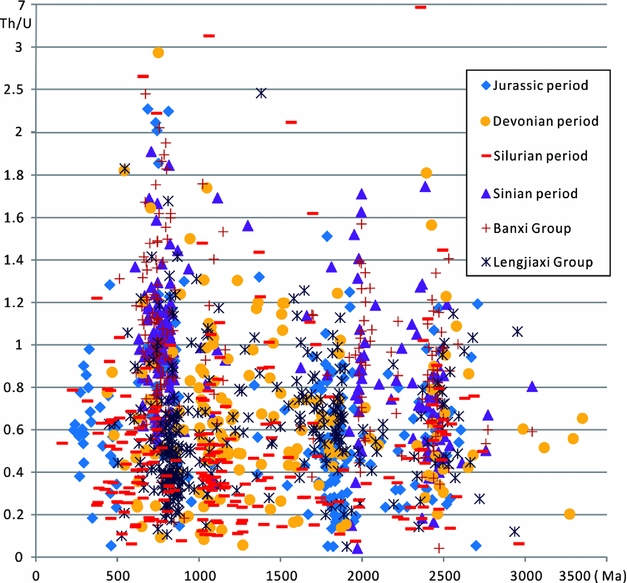
We attempted to collect samples from the main strata exposed around the SCB. The samples are described briefly below and shown on Figure 2, and location information for each sample is presented in Table S1 (online Supplementary Material available at http://journals.cambridge.org/geo). Data are presented in Concordia plots (Fig. 3). Although it is difficult to distinguish the origins of zircons based exclusively on the Th/U ratios, the Th/U ratios offer a broad estimate of the origin of zircons. Many zircons in the present study show oscillatory zoning (Fig. 4), and more than 98% of them have Th/U values greater than 0.1 (Fig. 5), implying an igneous origin (Belousova et al. Reference Belousova, Griffin, O'Reilly and Fisher2002; Corfu et al. Reference Corfu, Hanchar, Hoskin and Kinny2003).
U–Pb Concordia plots for zircons from 15 sandstone samples. (a, b, c) Lengjiaxi Group (F41-1, F42-1 and F43-1); (d) Sinian period (XF18-1); (e, f, g, h) Banxi Group (F45-1, XF25-1, XF27-1 and XF73-1); (i, j, k) Silurian period (XF95-1, XF107-1 and XF207-1); (l, m) Devonian period (XF64-1 and XF65-2); (n, o) Jurassic period (XF138-1 and Y1).

Cathodoluminescence (CL) images of representative zircons from the Lengjiaxi Group, Banxi Group, Sinian, Silurian, Devonian and Jurassic sandstones showing internal structure and morphology. Scale bars are 50 μm.

Age (Ma) versus Th/U ratio for 15 samples of the Neoproterozoic to Jurassic sandstones.
4.a. Neoproterozoic Lengjiaxi Group
Three samples (F41-1, F42-1, F43-1) were taken from the Lengjiaxi Group of Hengshan mountain, Hunan province (Fig. 2). Most of the zircon grains are sub-rounded and a few show a euhedral morphology. Back-scattered electron/cathodoluminescence (BSE/CL) imaging reveals that most zircons have obvious internal structures; a few have oscillatory or planar zoned structures (Fig. 4). A total of 320 detrital zircons have been analysed and most analyses are concordant (Fig. 3a, b, c). Two Palaeoproterozoic populations are present: a small population at 2.6–2.4 Ga and a larger one at 1.9–1.7 Ga (Fig. 6e). The largest population of zircons have ages of 800–900 Ma with maximum depositional ages of 827±11 Ma, 838±8 Ma and 831±11 Ma, respectively.
Age histograms for detrital zircons in the South China Block. (a) The basement of the Cathaysia Block; (b) the Kongling complex of the northern Yangtze Block; (c) the base of the southwestern Yangtze Block; (d) the Fanjingshan Group in Fangjingshan, Guizhou; (e) the Lengjiaxi Group in Hengshan; (f) the Banxi Group in Guizhou; (g) the Banxi Group in Xuefengshan; (h) the Sinian period in Xuefengshan; (i) the Sinian period in the southwestern Yangtze Block; (j) the Cambrian period in the southwestern Yangtze Block; (k) the Silurian period in Guizhou and Sichuan provinces, (l) the Silurian period in Xuefengshan; (m) the Cambrian–Ordovician period in the Cathaysia Block; (n) the Devonian period in Xuefengshan; (o) the Devonian period in the northeastern Yangtze Block; (p) the Devonian period in the western Yangtze Block; (q) the Devonian period in the Cathaysia Block; (r) the Upper Triassic period in the Cathaysia Block; (s) the Upper Triassic period in Xuefengshan; (t) the Middle–Upper Triassic period in Songpan–Ganzi; (u) the Triassic period in the Cathaysia Block; (v) the Upper Triassic – Lower Jurassic period in the northern Yangtze Block; (w) the Jurassic period in Guizhou; (x) the Jurassic period in the southwestern Yangtze Block; (y) the Lower Jurassic period in the Jianghan basin. Data compiled from (a) W. Wang et al. (Reference Wang, Li, Li, Li, Tang, Gao, Zhang and Liu2012); (b) Qiu et al. (Reference Qiu, Gao, McNaughton, Groves and Ling2000); Zhang et al. (Reference Zhang, Zheng, Wu, Zhao, Gao and Wu2006a ); (c) Greentree & Li (Reference Greentree and Li2008); L. J. Wang et al. (Reference Wang, Li, Li, Li, Tang, Gao, Zhang and Liu2012); (d, f) Wang et al. (Reference Wang, Griffin, Yu and O'Reilly2010); (e, g, h, n, w, x) this paper; (i, j) L. J. Wang et al. (Reference Wang, Li, Li, Li, Tang, Gao, Zhang and Liu2012); (k) this paper and Y. J. Wang et al. (Reference Wang, Griffin, Yu and O'Reilly2010); (l, m) Y. J. Wang et al. (Reference Wang, Griffin, Yu and O'Reilly2010); (o, u) Yao et al. (Reference Yao, Shu, Santosh and Li2012); (p) Duan et al. (Reference Duan, Meng, Zhang and Liu2011); (q) Xiang & Shu (Reference Xiang and Shu2010); (r, s, t, v, y) She et al. (Reference She, Ma, Wan, Zhang, Li, Chen, Xu, Li, Ye and Gao2012).

4.b. Neoproterozoic Banxi Group
Samples XF25-1, XF27-1, F45-1 and XF 73-1 are sandstones and siltstones collected from the Banxi Group of Xuefengshan and Hengshan (Fig. 1). The zircon grains are mostly sub-rounded and a few have a euhedral and prismatic shape. These grains are mostly 60–100 μm long and 30–60 μm wide (Fig. 4). A total of 210 detrital zircons have been analysed, which show concordant ages (Fig. 3e, f, g, h). These zircon ages define three major age populations: 700–880 Ma, 1900–2100 Ma and 2400–2600 Ma (Fig. 6g). In the age spectra, the most prominent age peak appears at 780 Ma with maximum depositional ages of 789±15 Ma, 760±10 Ma, 741±6 Ma and 743±11 Ma, respectively.
4.c. Neoproterozoic Sinian strata
Sample XF18-1 is a siltstone collected from the Sinian strata of Xuefengshan. Many zircon grains from the sample are euhedral, elongated and prismatic in shape, whereas most grains are rounded or sub-rounded, being 60–100 μm long and 40–80 μm wide. Most zircon grains have clear igneous oscillatory zoning (Fig. 4). A total of 100 analyses were conducted on the zircon grains. The analyses show a dominant age group of c. 740–890 Ma (Fig. 6h) and a Concordia age with a youngest age of 609±11 Ma (Fig. 3d).
4.d. Silurian period
XF95-1, XF107-1 and XF 207-1 are Silurian siltstones collected from Guizhou province, west of Fanjingshan. Most zircon grains from the samples are rounded, 30–60 μm long and 30–50 μm wide, indicating a long transport distance (Fig. 4). A total of 218 analyses were conducted on these zircon grains. Some zircon grains are discordant due to Pb loss (Fig. 3i, j, k). The analysis plot gives a wide range of U–Pb apparent ages from 400 to 3000 Ma with several groups. The detrital zircon U–Pb ages are mostly clustered at 900–1100 Ma and 470–850 Ma, and the third largest age group is 2.4–2.6 Ga; the 1.7–1.9 Ga age group is also an obvious population (Fig. 6k).
4.e. Devonian period
Samples XF64-1 and XF65-2 are sandstone and siltstone collected from the Devonian of Xuefengshan. Zircon grains from the samples are 40–70 μm in length and 30–50 μm in width. Most zircon grains are rounded and partly fragmented, and a few of them are euhedral, which is suggestive of a variable distance of transport. A total of 312 analyses were conducted on these zircon grains, which show concordant ages (Fig. 3l, m). The results indicate two dominant age groups of c. 800–900 Ma and 900–1100 Ma, and subordinate age peaks at 2.4 Ga, 1.8 Ga, 740 Ma and 440 Ma (Fig. 6n).
4.f. Jurassic period
Samples XF138-1 and Y1 are sandstones collected from western Guizhou and Yunnan provinces, respectively. Most zircon grains are sub-rounded to rounded and partly fragmented, 60–120 μm long and 50–70 μm wide. A total of 200 analyses from two samples were conducted on these grains (Fig. 3n, o). The results show a dominant age group of c. 1700–1900 Ma and subordinate groups of 700–800 Ma, 2400–2600 Ma and 400–600 Ma (Fig. 6w, x).
5. Discussion
5.a. Origin of the basement
The detrital zircon ages indicate that there are three age populations of 2.6–2.4 Ga, 1.9–1.7 Ga and 900–800 Ma in the Jiangnan Orogen (Fig. 6e). The largest age peak is c. 830 Ma, which constrains the age of the basement of the western Jiangnan Orogen and the Sibao orogeny. In order to define the origin of these Proterozoic zircons, the age spectra of the South China zircons are analysed according to the data in this paper and published literature (Fig. 6). The Precambrian crustal materials in the SCB are widely distributed (Zheng, J. P. et al. Reference Zheng, Griffin, O'Reilly, Zhang, Pearson and Pan2006; Zhang et al. Reference Zhang, Zheng, Wu, Zhao, Gao and Wu2006b ; Zhang, Wu & Zheng, Reference Zhang, Wu and Zheng2012), and the main periods of Precambrian crustal growth are c. 2.8–3.0 Ga, 2.5 Ga, 2.2–2.4 Ga, 1.7–1.9 Ga, 0.9–1.1 Ga and 0.8–0.9 Ga in the SCB (Fig. 6). Generally, the Yangtze and Cathaysia blocks exhibit different records of Precambrian tectonothermal events.
According to zircon U–Pb and Lu–Hf isotope data, most of the zircon grains from the Palaeoproterozoic rocks with ages of 2.0–1.7 Ga exhibit negative εHf(t) values in the Yangtze Block (Zhang et al. Reference Zhang, Zheng, Wu, Zhao, Gao and Wu2006a ; Zheng, J. P. et al. Reference Zheng, Griffin, O'Reilly, Zhang, Pearson and Pan2006; Wu et al. Reference Wu, Gao, Gong, Xiang, Jiao, Yang, Liu and Yuan2009; Xiong et al. Reference Xiong, Zheng, Yu, Su, Tang and Zhang2009; Zhang, Wu & Zheng, Reference Zhang, Wu and Zheng2012), indicating that the Middle Palaeoproterozoic event primarily occurred as a reworking of the ancient Archaean lithosphere. On the other hand, there are also positive εHf(t) values reported mainly around the periphery of the Yangtze Block (Wu, Y. B. et al. Reference Wu, Gao, Gong, Xiang, Jiao, Yang, Liu and Yuan2006; Zheng, Y. F. et al. Reference Zheng, Zhao, Wu, Zhang, Liu and Wu2006; Zhao et al. Reference Zhao, Zhou, Li, Sun, Gao, Sun and Yang2010; Wu et al. Reference Wu, Gao, Zhang, Zheng, Liu, Wang, Gong, Zhou and Yuan2012), implying the coexistence of the growth of juvenile crust and the reworking of Archaean crust in the Middle Palaeoproterozoic. In contrast, limited zircon U–Pb and Lu–Hf isotope data from the Palaeoproterozoic crust in the Cathaysia Block (Xiang et al. Reference Xiang, Zhang, Zhou, Zhong, Zeng, Liu and Jin2008; Liu et al. Reference Liu, Zhou, Zhang, Zhong, Zeng, Xiang, Jin, Lu and Li2009; Yu et al. Reference Yu, Wang, Griffin, O'Reilly, Zhang, Li and Shu2009, Reference Yu, O'Reilly, Zhou, Griffin and Wang2012; Li et al. Reference Li, Li, Wartho, Clark, Li, Zhang and Bao2010) suggest similar negative εHf(t) values, implying widespread reworking of Archaean crust in the Middle Palaeoproterozoic.
The Huangling granitic batholith and the enclosed mafic dykes with zircon U–Pb ages of 0.9–0.8 Ga record negative εHf(t) values and Archaean Hf model ages (Zhang, Q. R. et al. Reference Zhang, Li, Feng, Huang and Song2008; Zhang, S. B. et al. Reference Zhang, Zheng, Zhao, Wu, Yuan and Wu2008, Reference Zhang, Zheng, Zhao, Wu, Yuan and Wu2009; Zhang, C. H. et al. Reference Zhang, Fan, Wang and Peng2009), revealing reworking of Archaean crust during this time. Zircon grains from mafic plutons in the same period giving negative εHf(t) values have also been reported from the northwestern margin of the Yangtze Block (Wang, X. C. et al. Reference Wang, Li, Li, Li, Tang, Gao, Zhang and Liu2012; Wang et al. Reference Wang, Zhou, Wan, Kitajima, Wang, Bonamici, Qiu and Sun2013). Most of the Neoproterozoic rocks, both felsic and mafic cropping out in the western Yangtze Block, give positive εHf(t) values (Li, X. H. et al. Reference Li, Li, Zhou, Liu and Kinny2002; Zhou et al. Reference Zhou, Kennedy, Sun, Malpas and Lesher2002; Zheng, Y. F. et al. Reference Zheng, Zhao, Wu, Zhang, Liu and Wu2006, Reference Zheng, Zhang, Zhao, Wu, Li, Li and Wu2007; Xiao et al. Reference Xiao, Zhang, Ni, Xiang and Liu2007; Zhao & Zhou, Reference Zhao and Zhou2008; Zhao et al. Reference Zhao, Zhou, Yan, Yang and Sun2008), indicating the growth of juvenile crust in this period. Igneous rocks occurring on the northeastern margin of the Yangtze Block during Early Neoproterozoic time (1.0–0.88 Ga) all yield positive εHf(t) values (Li et al. Reference Li, Zhou, Zhao, Fanning and Composton1994, Reference Li, Li, Li, Lo, Wang, Ye and Yang2009; Ye et al. Reference Ye, Li, Li, Liu and Li2007; Wang, X. C. et al. Reference Wang, Li, Li, Li, Liu, Yang, Liang and Tu2008; Gao et al. Reference Gao, Klemd, Long, Xiong and Qian2009), with the preferred interpretation being that they derive from reworking of the juvenile crust. Furthermore, the Middle Neoproterozoic magmatic rocks yield positive εHf(t) values (Wu, R. X. et al. Reference Wu, Zheng, Wu, Zhao, Zhang, Liu and Wu2006; Zheng et al. Reference Zheng, Wu, Wu, Zhang, Yuan and Wu2008; Wang, Q. et al. Reference Wang, Wyman, Li, Bao, Zhao, Wang, Jian, Yang and Chen2010; Wang, W. et al. Reference Wang, Liu, Feng, Li, Wu, Wang, Wang and Yang2012; Wang, X. L. et al. Reference Wang, Shu, Xing, Zhou, Tang, Shu, Qi and Hu2012; Zhang, Wu & Zheng, Reference Zhang, Wu and Zheng2012) in the eastern Jiangnan Orogen; however, the magmatic rocks with negative εHf(t) values are mainly recorded in the western Jiangnan region (Li et al. Reference Li, Wang, Zhao and Chen1998; Ge et al. Reference Ge, Li, Li and Zhou2001a ,Reference Ge, Li, Liang, Wang, Li and Zhou b ; Wang et al. Reference Wang, Li, Duan, Liu, Song, Li and Gao2003; Wang et al. Reference Wang, Zhou, Qiu, Zhang, Liu and Zhang2006b ; Zheng et al. Reference Zheng, Zhang, Zhao, Wu, Li, Li and Wu2007; Zhang, S. B. et al. Reference Zhang, Zheng, Zhao, Wu, Yuan and Wu2008; Zhou, Wang & Qiu, Reference Zhou, Wang and Qiu2009; Su et al. Reference Su, Zhang, Dong, Chen, Li and Cui2013). This is interpreted as showing that the crustal nature of this region is transformed from an ancient one in the west to a juvenile one in the east (Zhang & Zheng, Reference Zhang and Zheng2012). The Neoproterozoic magmatic rocks discovered in the Cathaysia Block usually yield positive εHf(t) values too (e.g. Shu et al. Reference Shu, Deng, Yu, Wang and Jiang2008a ,Reference Shu, Faure, Wang, Zhou and Songb, Reference Shu, Faure, Yu and Jahn2011), indicating that they may represent the reworking of juvenile crust.
5.b. Collisional orogen and provenance of basement
Orogens show distinctive distributions of sedimentary facies, deformational styles and metamorphic patterns through crustal thickening, magmatism and metamorphism during one or more tectonothermal events. Orogens can be grouped into three end-member types: collisional, accretionary and intracratonic. Collisional orogens form through collision of continental lithospheric fragments, whereas accretionary orogens form at sites of continuing oceanic plate subduction, and intracratonic orogens lie within a continent (Cawood et al. Reference Cawood, Kröner, Collins, Kusky, Mooney, Windley, Cawood and Kröner2009). Collisional orogenesis reflects the resistance of a buoyant continental nucleus to subduction resulting in significant lithospheric thickening and deformation of both the upper and lower plates (Cawood et al. Reference Cawood, Kröner, Collins, Kusky, Mooney, Windley, Cawood and Kröner2009). Accretionary orogens comprise a range of mafic to silicic igneous rocks and their sedimentary derivatives that develop on oceanic (e.g. West Pacific) or continental (e.g. Andes and Japan) lithospheric substrates. They are represented by island-arc accretion in the early stage, and then arcs accrete to one another and to an active continental margin, being variably deformed and metamorphosed by high-temperature and high-pressure regimes up to granulite and eclogite facies during continuing plate convergence (Cawood et al. Reference Cawood, Kröner, Collins, Kusky, Mooney, Windley, Cawood and Kröner2009). Continental collision and termination of subduction within collisional orogens ultimately stabilizes and cratonizes the orogen, such as the Trans-Hudson orogen (Lucas, Syme & Ashton, Reference Lucas, Syme and Ashton1999). Accretionary orogens, with their subduction plate margins, are seen as the sites of net continental growth, whereas collisional orogens are envisaged as sites of crustal reworking. These orogens can also involve subsidence due to post-collision extension or rifting such as the Bohai Bay Basin of North China (Su et al. Reference Su, Zhu, Lu, Xu, Yang and Zhang2009, Reference Su, Zhu, Wei, Xu, Yang, Wang and Zhang2011). Continental extension leads to ocean opening and failed arms of ocean basins (aulacogens) in intracontinental settings isolated from plate margins. The location of aulacogens adjacent to sites of successful ocean opening means that they are linked to subsequent sites of collisional or accretionary orogens (Hoffman, Burke & Dewey, Reference Hoffman, Burke, Dewey, Dott and Shaver1974); for example, the Oklahoma aulacogen, SE Laurentia, lies marginal to the Appalachian–Ouachita orogeny (Cawood et al. Reference Cawood, Kröner, Collins, Kusky, Mooney, Windley, Cawood and Kröner2009). The weakening subsidence belts are reactivated forming an intracratonic orogenic belt during subsequent compression in response to far-field stresses.
Together, from U–Pb zircon analysis and Lu–Hf isotope data from magmatic rocks, the Middle Palaeoproterozoic and Early–Middle Neoproterozoic are seen to be two important periods of crustal growth and reworking in the SCB. Especially for the Neoproterozoic, there are lasting debates about the tectonic setting and source nature between the Yangtze and Cathaysia blocks, which are interpreted as (1) a part of the Grenvillian Orogen following break-up triggered by a mantle superplume (Li, Zhang & Powell, Reference Li, Zhang and Powell1995; Li, Z. X. et al. Reference Li, Li, Zhou and Kinny2002); (2) ongoing subduction of the oceanic crust with an island-arc origin (Zhou et al. Reference Zhou, Kennedy, Sun, Malpas and Lesher2002; Wang et al. Reference Wang, Zhou, Qiu and Gao2004, Reference Wang, Zhao, Zhou, Liu and Hu2008; Zhao & Zhou, Reference Zhao and Zhou2009); (3) an arc–continent collisional orogeny followed by post-collisional extension and rifting magmatism instead of a superplume (Zheng et al. Reference Zheng, Zhang, Zhao, Wu, Li, Li and Wu2007, Reference Zheng, Wu, Wu, Zhang, Yuan and Wu2008). It is noteworthy that there is no proof of direct assembly between these two blocks, except for in the northeastern Jiangnan Orogen with the Ganwan ophiolite. In this regard, two controversial processes are proposed by the above researchers for the continental accretion of juvenile crust from either arc–continent collision or rifting along the Jiangnan Orogen during the Middle Neoproterozoic. In fact, the widespread sandstone sediments and weak metamorphism of the Lengjiaxi Group in the western Jiangnan Orogen do not fit with the above characteristics of island-arc accretionary orogens. Continental extension led to ocean opening in the eastern Jiangnan Orogen, with an island arc (Shuangxiwu arc, Li et al. Reference Li, Li, Li, Lo, Wang, Ye and Yang2009) and the failed arms of ocean basins (aulacogens) in the western Jiangnan Orogen, where the degree of deformation and metamorphism is generally minimal during subsequent compressional reactivation (Hoffman, Burke & Dewey, Reference Hoffman, Burke, Dewey, Dott and Shaver1974). That is to say, the western Jiangnan Orogen may be an intracontinental orogen.
Geochemical studies suggest that the Dahongshan Group was deposited either in a bimodal intracontinental rift (e.g. Hu et al. Reference Hu, Xu, Tong and Chen1991; Sun, Shen & Liu, Reference Sun, Shen and Liu1991) or on an ocean floor (e.g. Xu, Reference Xu1999) in the southwestern Yangtze Block. Abundant carbonate units are also found in the Dahongshan Group, suggesting deposition in a shallow marine or lagoonal environment (Greentree & Li, Reference Greentree and Li2008). The Kunyang Group consists predominantly of carbonates in the upper part and silicic clastic units in the lower part, with rare volcanic rocks such as tuff and basalt, suggesting an anoxic deep-water to shallow sea and fluctuating fluvial environment (Wang, L. J. et al. Reference Wang, Yu, Griffin and O'Reilly2012).
Compared with ages of detrital zircons from the Precambrian basement, the sedimentary units in the Jiangnan Orogen and Cathaysia, northern Yangtze and southwestern Yangtze blocks have different age populations and sources, respectively (Fig. 6). The samples from the southwestern Yangtze Block mainly contain 2.85–2.7 Ga, 2.45–2.3 Ga, 2.0–1.85 Ga and 1.3–1.0 Ga age populations, whereas the best-represented age populations are 3.0–2.9 Ga in the northern Yangtze Block together with a series of small peak ages of Palaeoproterozoic age. The Mesoproterozoic and Lower Neoproterozoic sediments may have formed in the foreland basin between the Yangtze and Cathaysia blocks (Li, Z. X. et al. Reference Li, Li, Zhou and Kinny2002). The main peak ages concentrate at 0.9–0.8 Ga, with subordinate peaks at 2.2–1.85 Ga and 2.5 Ga in the Jiangnan Orogen, slightly younger than the peak ages in the Cathaysia Block. Detrital zircon ages of the Neoproterozoic succession of the Jiangnan Orogen have only a minor input from sources on both its sides, with abundant Palaeoproterozoic and Archaean peaks. The largest age population of 0.9–0.8 Ga may be related to Neoproterozoic magmatic rocks that crop out in the eastern Jiangnan Orogen (e.g. Li, Reference Li1999; Li, X. H. et al. Reference Li, Li, Zhou, Liu and Kinny2002; Zhou et al. Reference Zhou, Wang, Qiu and Gao2004; Wang et al. Reference Wang, Zhou, Qiu, Zhang, Liu and Zhang2006b ), whereas the basement of the Yangtze and adjacent Cathaysia blocks are the possible source areas of the Palaeoproterozoic detrital rocks of the Jiangnan Orogen. Subduction-related magmatic rocks (1.0–0.9 Ga) have been reported in the eastern part of the Jiangnan Orogen (Ye et al. Reference Ye, Li, Li, Liu and Li2007; Chen et al. Reference Chen, Guo, Dong, Chen, Li, Liang, Li, Yu, Zhao and Xing2009; Li et al. Reference Li, Li, Li, Lo, Wang, Ye and Yang2009) as being of arc–continent origin, whereas, coeval magmatism has not been recorded in the western part of the Jiangnan Orogen (Wang, L. J. et al. Reference Wang, Yu, Griffin and O'Reilly2012) implying a non-arc–continent collisional origin. The Neoproterozoic strata in the Jiangnan Orogen have obvious different age populations compared with those of the southwestern Yangtze Block. The deposition age of the southwestern Yangtze Block is Grenville age (1000–960 Ma), older than that of the Jiangnan Orogen basin (Lengjiaxi Group). That is to say, the source areas of the southwestern Yangtze Block and Jiangnan Orogen may not derive from the same collisional orogeny. The zircons of the Middle Neoproterozoic granite and granodiorite have negative εHf(t) values in the western Jiangnan Orogen, different from those of the eastern Jiangnan Orogen with positive εHf(t) values (Li, X. H. et al. Reference Li, Li, Ge, Zhou, Li, Liu and Wingate2003; Wang, X. L. et al. Reference Wang, Zhou, Qiu, Zhang, Liu and Zhang2006a , Reference Wang, Zhao, Zhou, Liu and Hu2008; Zheng et al. Reference Zheng, Zhang, Zhao, Wu, Li, Li and Wu2007; Zhou, Wang & Qiu, Reference Zhou, Wang and Qiu2009). It means that the western and eastern Jiangnan Orogen have experienced different tectonic processes. The Middle Neoproterozoic rocks in the western Jiangnan Orogen and eastern Jiangnan Orogen deposited directly on ancient crustal basement and ocean floor, respectively. There may be a buried orogen under the western Jiangnan Orogen, which is simultaneous with the collisional orogeny in the southwestern Yangtze Block. The SinoProbe programme has been carried out in China, which provided a high-quality, deep seismic profile across the western Jiangnan Orogen. The profile has been interpreted in detail by S. W. Dong et al. (unpub. data, 2013), which supports the existence of a hidden orogen under the Lengjiaxi Group of the western Jiangnan Orogen.
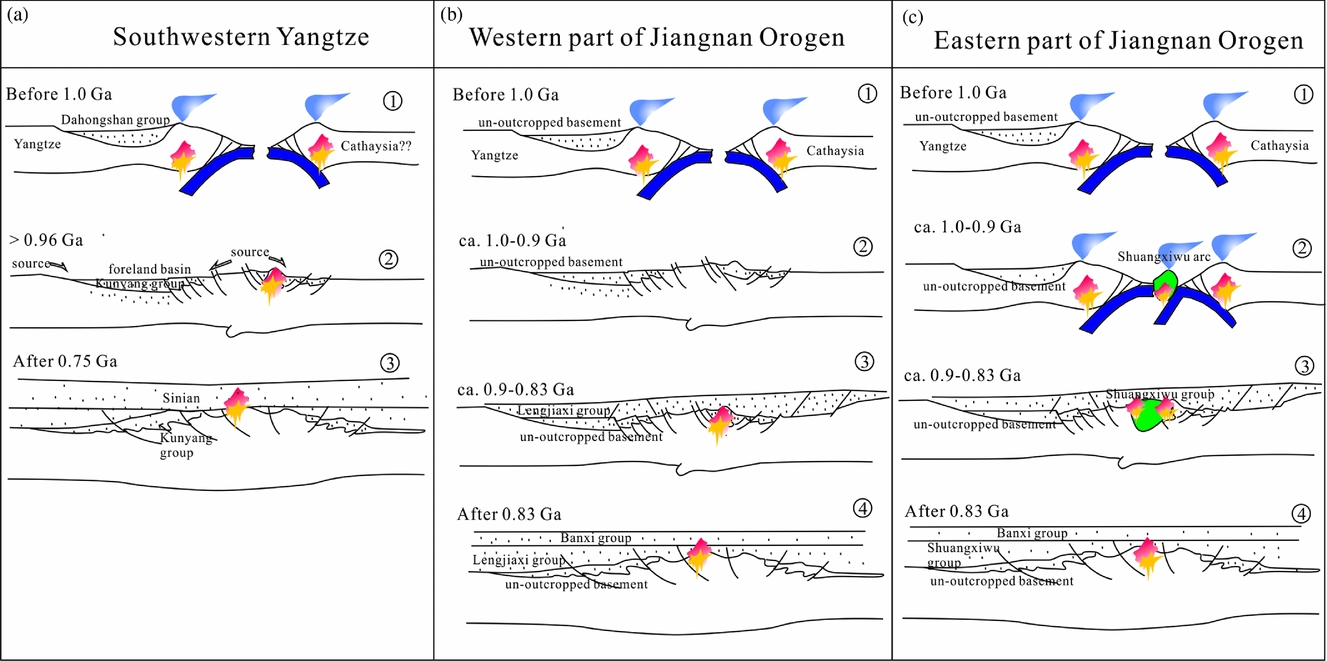
Figure 7 shows the depositional processes across the southwestern Yangtze Block and Jiangnan Orogen based on the ages of detrital zircons and magmatism. The initial collision between the Yangtze and Cathaysia blocks was considered to have occurred in the southwestern Yangtze Block during the Grenvillian; the two then assembled along the Jiangnan Orogen forming the Sibao Orogen (Li, Z. X. et al. Reference Li, Li, Zhou and Kinny2002, Reference Li, Li, Kinny, Wang, Zhang and Zhou2003). Thus, the initial sediments deposited are those of the Dahongshan Group in the southwestern Yangtze before the collision of the Yangtze and Cathaysia blocks (Fig. 7a-1). Subsequently, the Kunyang Group developed in the foreland basin of the collisional zone (Fig. 7a-2), and similar sedimentation may also have occurred under the western Jiangnan Orogen before 0.9 Ga (Fig. 7b-2); meanwhile, the Shuangxiwu arc developed on the eastern margin of the eastern Jiangnan Orogen (Fig. 7c-2). Following that, the widespread deposition of the Middle Neoproterozoic Lengjiaxi Group, Sibao Group and Shuangqiaoshan groups, etc. occurred (Fig. 7b-3, c-3). After that, the Nanhua rift developed, associated with abundant Sinian deposition (Fig. 7a-3, b-4, c-4). The zircon age populations of the Sinian strata are similar to one main peak in the southwestern Yangtze Block and Jiangnan Orogen, indicating that the sedimentary provenances may have begun to converge.
Sketch showing the depositional processes across the southwestern Yangtze Block, and western and eastern parts of the Jiangnan Orogen. (a) Deposition of the Dahongshan Group before 1.0 Ga (1); deposition of the Kunyang Group (2); deposition of the Sinian sediments (3). (b) Deposition on the Yangtze Block before collision (1); deposition of strata (equivalent to the Kunyang Group (2)); deposition of the Lengjiaxi Group (3); deposition of the Banxi Group (4). (c) Deposition on the Yangtze Block before collision (1); development of the Shuangxiwu arc (2); deposition of the Shuangxiwu Group (3); deposition of the Banxi Group (4).
5.c. Provenance of Phanerozoic sedimentary rocks
The Proterozoic tectonics are mostly obscured and covered by Phanerozoic strata, and the Jiangnan Orogen has been previously interpreted as representing a Mesozoic Alps-type collisional orogen (Hsü et al. Reference Hsü, Li, Chen, Wang, Sun and Sengor1990). In fact, the regional structures that are usually the product of intracontinental orogeny occurred during the Middle Palaeozoic Kwangsian and Mesozoic Indosinian and Yanshanian orogenies (Shu et al. Reference Shu, Faure, Jiang, Yang and Wang2006; Wang, Y. J. et al. Reference Wang, Zhang, Fan, Zhang, Chen, Cawood and Zhang2010). The provenances of the Phanerozoic strata were analysed to establish the assembly history and link with subsequent tectonic events of the SCB. The detrital zircon U–Pb data from the Palaeozoic–Mesozoic rocks reported by previous workers have been added to this study (Fig. 1), such as Y. J. Wang, et al. (Reference Wang, Griffin, Yu and O'Reilly2010), Xiang & Shu (Reference Xiang and Shu2010), Yao, Shu & Santosh (Reference Yao, Shu and Santosh2011), Yao et al. (Reference Yao, Shu, Santosh and Li2012), Duan et al. (Reference Duan, Meng, Zhang and Liu2011) and She et al. (Reference She, Ma, Wan, Zhang, Li, Chen, Xu, Li, Ye and Gao2012), etc.
The Kwangsian event is marked by a regional unconformity between the pre-Devonian and post-Lower Devonian strata. Below the unconformity, the detrital zircons of the Cambrian to Silurian samples both in the Cathaysia and Yangtze blocks have similar spectra, implying that they may originate from the same source. The spectra curves contain ages ranging from Archaean to Palaeozoic and a prominent peak in the Late Mesoproterozoic (Grenville age), which is distinctly different from that of the Precambrian strata (Fig. 6). According to the age range of the basement units within the SCB, the Cathaysia Block is the most likely source for the detrital zircons forming the Late Mesoproterozoic age peak. The Palaeoproterozoic detritus fall largely in the range of 2.3 Ga to 2.6 Ga with a peak around 2.5 Ga and lack an Archaean age peak, suggesting they may derive from the Cathaysia Block. Together with the palaeogeography data, a probable sketch map of the provenance for the Palaeozoic strata is presented in Figure 8a. The provenance analysis is consistent with available palaeocurrent data. The Lower Palaeozoic strata have been considered as deep-water deposits in the Cathaysia Block (Xu & Qiao, Reference Xu and Qiao1989; Liu et al. Reference Liu, Hsü, Yao and Wu1994; Xu, Xu & Pan, Reference Xu, Xu and Pan1996; Chen, H. D. et al. Reference Chen, Hou, Xu and Tian2006), whereas Y. J. Wang et al. (Reference Wang, Griffin, Yu and O'Reilly2010) proposed that they formed in a shallow-water environment with a palaeocurrent towards the west and northwest. The samples of Devonian sandstones above the Kwangsian unconformity have varied age curves (Fig. 6). The age spectra in the western Jiangnan Orogen and Cathaysia Block are similar, with peaks at 2.5 Ga, 2.0–1.8 Ga, 1.1–0.9 Ga, 0.8–0.7 Ga and 0.5–0.4 Ga. In addition, the dominant age groups are 1.1–0.9 Ga and 2.5 Ga; thus, we propose that these age grains may have the same source and derive from the Cathaysia Block and the Jiangnan Orogen. Alternatively, the Cambrian–Silurian strata within the SCB could also contain detritus of these ages that could have been recycled into the Devonian sediments, which could then have acted as a source for this material. However, the age populations in the eastern Jiangnan Orogen and western Yangtze Block are different from the above, with minor age peaks in the Palaeoproterozoic and Mesoproterozoic. The zircon grains with the major age group (0.9–0.7 Ga) and synchronous Kwangsian orogenic age (0.5–0.4 Ga) in the eastern Yangtze Block suggest that they may originate from the Jiangnan Orogen and Cathaysia Block too. The detrital zircon ages in the western Yangtze Block are dominated by Early Neoproterozoic ages and do not match well with those in the SCB, being particularly different from those in the western Jiangnan Orogen. Therefore, they are considered to be derived partially from the Jiangnan Orogen, Hannan–Panxi arc of the northern Yangtze Block, and mainly from the exterior of the SCB (Fig. 8a, b; Duan et al. Reference Duan, Meng, Zhang and Liu2011).
Tectonic palaeogeography and sources in China during: (a) the Silurian; (b) the Middle–Late Devonian; (c) the Late Triassic; (d) Jurassic.

The detrital zircon ages of the Upper Triassic sandstones are only slightly distinct between the Cathaysia Block, northern Yangtze Block and the western Jiangnan Orogen, where they have similar age patterns with the main peaks at 2.0–1.7 Ga, 0.5–0.2 Ga and 2.6–2.4 Ga, except for the samples from the Jiangnan Orogen which lack a Mesozoic age group (Fig. 6). The dominant age population of 2.0–1.7 Ga accounts for half of the total (She et al. Reference She, Ma, Wan, Zhang, Li, Chen, Xu, Li, Ye and Gao2012), and are considered as coming from either the North China Craton (Bruguier, Lancelot & Malavieille, Reference Bruguier, Lancelot and Malavieille1997; Li et al. Reference Li, Li and Li2005) or the Yangtze Block including the Dabie Orogen (Grimmer et al. Reference Grimmer, Ratschbacher, Williams, Franz, Gaitzsch, Tichomirowa, Hacker and Zhang2003; Yang, Cawood & Du, Reference Yang, Cawood and Du2010). However, the age groups of Archaean–Early Palaeoproterozoic zircon grains are contradictory to the basement rocks in the North China Block, characterized by a predominant Archaean population in major rivers. In addition, although Palaeoproterozoic rocks and inherited zircons are present in the northern Yangtze Block, the sediment source from the northern Yangtze Block would be dominated by Neoproterozoic grains (She et al. Reference She, Ma, Wan, Zhang, Li, Chen, Xu, Li, Ye and Gao2012). Including the palaeocurrent data, She et al. (Reference She, Ma, Wan, Zhang, Li, Chen, Xu, Li, Ye and Gao2012) proposed that the Cathaysia Block may be the main source of the Triassic–Jurassic sandstones. However, it is hard to explain why the age curve of the western Jiangnan Orogen is different from that in the Cathaysia and Yangtze blocks. It is noteworthy that the Cathaysia Block has not provided Palaeozoic sediment, with the largest age peak at 2.0–1.8 Ga; therefore, we query whether the Cathaysia Block can supply Mesozoic sediment with such an age population. Furthermore, the Songpan–Ganzi Triassic flysch belt is bounded by the Yangtze Block to the east, which has similar detrital zircon age groups to those in the Yangtze and Cathaysia blocks (Fig. 6). It is also hard to get such huge amounts of detritus from the Cathaysia Block over remote distances. In fact, the continental collisions between the Indochina, South China and North China blocks associated with uplift of the overriding plate should provide the main source of Middle–Upper Triassic sediments. The basement of the western Yangtze has an obvious 2.0–1.7 Ga age peak; meanwhile, Lvliang Mountain of the North China Block is also a favourable source material location for the 2.0–1.7 Ga zircons (Bruguier, Lancelot & Malavieille, Reference Bruguier, Lancelot and Malavieille1997), and the occurrence of Caledonian grains in the Triassic is consistent with the source region of Qinling (Xue et al. Reference Xue, Kroner, Reischmann and Lerch1996; Zhang, J. Y. et al. Reference Zhang, Ma, She, Zhang and Zhou2007). As a result, we suggest that the Yangtze and North China blocks probably supplied large volumes of the above sediments (Fig. 8c).
The age spectra of the Jurassic sandstones located in the southwestern, northern and central Yangtze Block are also similar. The ages predominately fall into the group 2.0–1.7 Ga, as that of the Triassic rocks; however, the number of zircon grains with a Neoproterozoic age increase significantly. Variation in the age spectrum from the Triassic to the Jurassic shows that the source region changed with time. It is clear that the Triassic strata might act as a source of the Jurassic materials, whereas the most obvious potential source region of these Neoproterozoic grains is the Xuefengshan region. That is consistent with the direction of the palaeocurrents (She et al. Reference She, Ma, Wan, Zhang, Li, Chen, Xu, Li, Ye and Gao2012). As the tectonic regime transformed from the Indosinian to the Yanshanian, Xuefengshan and Longmenshan uplift supplied the main sources of the Jurassic sediments (Fig. 8d).
5.d. Correlations with an ancient supercontinent
Hoffman (Reference Hoffman1989) proposed that the Laurentia protocraton was formed by the assembly of several microcontinents during 2.0–1.8 Ga. This hypothesis was extended to a global continent (Zhao et al. Reference Zhao, Cawood, Wilde and Sun2002), and then the ‘Columbia’ supercontinent was proposed (Rogers & Santosh, Reference Rogers and Santosh2002). The configuration of the ‘Columbia’ supercontinent is established on the basis of available geological reconstructions of 2.1–1.8 Ga orogens and Archaean cratonic blocks (Zhao et al. Reference Zhao, Sun, Wilde and Li2004). However, where the Columbian orogen was located in the SCB and where the SCB was situated in the Columbia supercontinent is still unclear. It is noted that most Rodinia reconstructions are based on Palaeo- to Mesoproterozoic connections between continental blocks, and most Rodinia fragments contain abundant 2.1–1.8 Ga orogenic evidence (Rogers, Unrug & Sultan, Reference Rogers, Unrug and Sultan1995; Zhao & Cawood, Reference Zhao and Cawood1999). It leads us to consider whether or not the Yangtze and Cathaysia blocks have ever been assembled in the Columbia age.
A Palaeoproterozoic orogeny has been recognized in the northern Yangtze Block, which occurred mainly at 2.04–1.97 Ga associated with high-grade metamorphism (Zhang et al. Reference Zhang, Zheng, Wu, Zhao, Gao and Wu2006b ; Chen, N. S. et al. Reference Xiang and Shu2006; Wu et al. Reference Wu, Zheng, Gao, Jiao and Liu2008; Sun et al. Reference Sun, Chen, Zhao, Wilde, Ye, Guo, Chen and Yuan2008). Based on the available configuration of the Columbia supercontinent (Zhao et al. Reference Zhao, Cawood, Wilde and Sun2002, Reference Zhao, Sun, Wilde and Li2004) and comparison of age populations in the Palaeoproterozoic rocks among the Yangtze and other blocks, the Yangtze, Cathaysia, North China and Australia blocks have an affinity, and the SCB could have been positioned in the western part of the supercontinent, close to Australia (Wang, L. J. et al. Reference Wang, Yu, Griffin and O'Reilly2012). In Australia, the 2.0–1.9 Ga Capricorn Orogen (Myers, Reference Myers1990; Myers, Shaw & Tyler, Reference Myers, Shaw and Tyler1996; Pirajno, Occhipinti & Swager, Reference Pirajno, Occhipinti and Swager1998) is located just next to the Grenville-age orogen and Neoproterozoic Patterson Range Orogen (Fig. 9a), which leads us to postulate that the Columbia-age orogen probably exists near or under the western Jiangnan Orogen. We have discussed the sediment provenance of the Precambrian basement along the southwestern Yangtze Block and Jiangnan Orogen (Fig. 7), where the Yangtze and Cathaysia blocks were set as separate terranes before 1.0 Ga. If the Yangtze and Cathaysia blocks had collided in the Columbia age (Fig. 9b), the above sediment models could also be interpreted logically. If it is true, the southwestern Yangtze Block and the western Jiangnan Orogen would have been intracontinental basins during the Mesoproterozoic, whereas the Sibao orogeny was probably an intracontinental inversion rather than a high-grade metamorphic orogen, and the dispute on the orogenic property, intensity and timing between the Yangtze and Cathaysia blocks will be resolved.
Schematic tectonic map showing distribution of major 2.0–1.8 Ga orogens. (a) Australia Block (modified after Zhao et al. Reference Zhao, Sun, Wilde and Li2004); (b) speculated 2.0–1.8 Ga orogen in the SCB; (c) palaeo-position of the SCB in the Columbia supercontinent (configuration map of the Columbia supercontinent after Zhao et al. Reference Zhao, Cawood, Wilde and Sun2002 and Yu et al. Reference Yu, O'Reilly, Zhou, Griffin and Wang2012).

The Yangtze and Cathaysia blocks have long been considered not to have converged until the Early Neoproterozoic on the basis of an ophiolite in the eastern Jiangnan Orogen (Shu et al. Reference Shu, Zhou, Shi and Yin1994; Ye et al. Reference Ye, Li, Li, Liu and Li2007; Li, W. X. et al. Reference Li, Li, Li and Lou2008; Li et al. Reference Li, Li, Li, Lo, Wang, Ye and Yang2009). In fact, the ophiolite can also be interpreted as ocean floor opened up by the break-up of the Rodinia supercontinent and closed by the subsequent Sibao orogeny in the eastern Jiangnan Orogen. Yu et al. (Reference Yu, O'Reilly, Zhou, Griffin and Wang2012) proposed that the Palaeoproterozoic orogen in the eastern Cathaysia Block was not likely to be linked with that of the northern Yangtze, but with the Lesser Himalaya terrane of NW India. We consider that the Columbia-age magmatism and metamorphism in the northern Yangtze and eastern Cathaysia blocks were two different responses to the orogeny rather than just one continuous orogen. We agree with the position of the Cathaysia Block to the north of the Lesser Himalaya terrane, connecting the Yangtze Block near Australia in the Columbia supercontinent (Fig. 9c).
5.e. Tectonic evolution
The abundances of zircon ages (2.0–1.8 Ga and 1.0–0.8 Ga) suggest that the SCB is closely related to the Columbia and Rodinia supercontinents. Thus, we remodel an alternative tectonic evolution of the SCB as follows (Fig. 10), which is different from all previous models.
Two possible amalgamation histories of the Yangtze and Cathaysia blocks. (a) Assembly during 2.0–1.8 Ga; (b) rifting with an ocean basin and aulacogen at the sites of the eastern Jiangnan and western Jiangnan Orogen, respectively; (c) accretionary orogen in response to the Grenvillian orogeny; (d) rifting during 0.9–0.83 Ga; (d) the Sibao orogeny during 0.83–0.8 Ga; (e) the Nanhua, Kangdian and Bikou–Hannan rift basins after 0.8 Ga.

First, the Yangtze and Cathaysia blocks collided during 2.0–1.8 Ga, which induced granulite-facies metamorphism and extensive magmatism, such as the Quanyishan granite in the northern Yangtze Block (Xiong et al. Reference Xiong, Zheng, Yu, Su, Tang and Zhang2009) and Wuyishan metamorphism in the eastern Cathaysia Block (Yu et al. Reference Yu, Wang, Griffin, O'Reilly, Zhang, Li and Shu2009), etc. (Fig. 10a). This collisional orogen may be a part of the worldwide Columbia-age orogen. Continuing with the geological evolution, the SCB extended with an aulacogen and ocean basin at the sites of the western Jiangnan Orogen and eastern Jiangnan Orogen, respectively at c. 1.1 Ga (Fig. 10b). Subsequently, the SCB is situated to the west of Australia in the Rodinia supercontinent (Hoffman et al. Reference Hoffman1991; Yu et al. Reference Yu, O'Reilly, Wang, Griffin, Zhang, Wang, Jiang and Shu2008), where the Yangtze and Cathaysia blocks assembled with the accretionary Shuangxiwu arc at the site of the eastern Jiangnan Orogen. During that period, some Late Mesoproterozoic – Early Neoproterozoic basins and compression deformation may have developed, such as the Kunyang Group and Tianli gneiss due to the far-field effect of the Grenvillian orogeny (Fig. 10c). During 0.9–0.83 Ga, widespread intracontinental rifting developed due to the break-up of Rodinia, associated with the deposition of the Lengjiaxi, Fanjingshan and Sibao groups, etc (Fig. 10d). Before 0.83 Ga, the western Yangtze Block is marked by an active continental arc on its margin, surrounded by oceanic subduction (Zhou et al. Reference Zhou, Kennedy, Sun, Malpas and Lesher2002; Xiao et al. Reference Xiao, Zhang, Ni, Xiang and Liu2007). Continued southeastward subduction along the western margin of the Yangtze Block during 0.83–0.8 Ga led to rift inversion characterized by greenschist-facies metamorphism and deformation of the Lengjiaxi Group, i.e. the Sibao orogeny (Zhao et al. Reference Zhao, Zhou, Yan, Zheng and Li2011; Fig. 10e). Subsequently, the Nanhua, Kangdian and Bikou–Hannan basins formed in response to the back-arc spreading and subsidence, and were filled with a thick Upper Neoproterozoic sedimentary sequence overlying the deformed Lower Neoproterozoic strata (Zhao et al. Reference Zhao, Zhou, Yan, Zheng and Li2011; Fig. 10f).
Based on palaeomagnetic data and the zircon age groups of the provenance regions, the SCB is considered to have a long connection (750–380 Ma) with Australia (Yang et al. Reference Yang, Sun, Yang and Pei2004) as a part of east Gondwana (Wang, Y. J. et al. Reference Wang, Zhang, Fan, Zhang, Chen, Cawood and Zhang2010). During the Early Palaeozoic, a widespread rift basin developed with deep–shallow-water sediments, whereas the subsequent compression uplifted the basin forming a regional unconformity at 430–400 Ma, which is named the Caledonian orogeny or Kwangsian orogeny in Chinese literature (e.g. Huang et al. Reference Huang, Ren, Jiang, Zhang and Qin1980; Ren, Reference Ren1991; Wang, Y. J. et al. Reference Wang, Fan, Sun, Liang, Zhang and Peng2007a , Reference Wang, Zhang, Fan, Zhang, Chen, Cawood and Zhang2010). Detritus analysis indicates that the Gondwana Continent may have acted as a sediment source to the Cathaysia Block (Wang, Y. J. et al. Reference Wang, Zhang, Fan, Zhang, Chen, Cawood and Zhang2010). The Kwangsian orogeny then resulted in the compression of the Cathaysia Block towards the Yangtze Block, which made the abundant detrital zircons from the Cathaysia Block deposit in the Yangtze Block.
The SCB experienced a two-phase intracontinental orogeny in the Mesozoic. Following the closure of the Palaeo-Tethys Ocean, the continental collisions along the Song Ma–Menglian zone and Qinling–Dabie Orogen between the Indochina, South China and North China blocks occurred during the Middle–Late Triassic (Shu et al. Reference Shu, Faure, Wang, Zhou and Song2008b ). The collisions resulted in uplift of the southwestern Yangtze and North China blocks, which provided the main source for the Middle–Upper Triassic sediments of the SCB. The switch of tectonic regime from a near E–W direction to a near NE–SW direction in the SCB may have occurred after the Middle to Late Jurassic, while the material sourced from the NE-trending Xuefengshan increased greatly, implying that the Palaeo-Tethys regime had changed to a Palaeo-Pacific regime. That is consistent with the palaeostresses: near N–S-direction compression in the Indosinian orogeny and near E–W-direction compression in the Yanshanian orogeny (Zhang et al. Reference Zhang, Dong, Li, Cui, Shi, Su and Li2012).
6. Conclusions
As a supplement to former research, this study provides new data on detrital zircon U–Pb ages from the pre-Cretaceous strata in the Yangtze Block. Combined with the abovementioned discussion, these data support the several major conclusions as follows.
(1) The U–Pb geochronology of 320 detrital zircons in the Lengjiaxi Group of Hengshan mountain, Hunan province, is consistent with the Jiangnan Orogen, characterized by two Palaeoproterozoic populations (2.6–2.4 Ga and 1.9–1.7 Ga) and a Neoproterozoic age group (900–800 Ma) with a peak at ~830 Ma. Detrital ages of 310 grains from the Upper Neoproterozoic strata concentrate around 800–700 Ma, and the most prominent age peak appears at 780 Ma for the Banxi Group.
(2) The detrital zircons from five samples of Palaeozoic rocks in the Yangtze Block have similar age populations to that in the Cathaysia Block. These zircons have a wide range of Mesoproterozoic ages, which are inferred to originate from the Cathaysia Block.
(3) The detrital zircons of Middle–Upper Jurassic sandstones from the southwestern and central Yangtze Block yield similar age spectra with dominant populations at 2.0–1.7 Ga and subordinate groups of 2.6–2.4 Ga, 0.8–0.7 Ga and 0.6–0.4 Ga. The source of the Upper Triassic sediments may derive from the southern Yangtze and North China blocks, while the Jurassic sediments may partly originate from the uplift and erosion of the Jiangnan Orogen due to the subduction of the Palaeo-Pacific towards the SCB.
(4) The depositional age of the Kunyang Group in the southwestern Yangtze Block is older than that of the Lengjiaxi Group and its equivalent sequences in the Jiangnan Orogen, which means they are derived from different tectonic events, respectively. Combined with the discussion on origin and provenance, we infer the existence of a buried orogen under the Jiangnan Orogen. The buried orogen can be applied logically to the assembly process between the Yangtze and Cathaysia blocks, explaining the discrepancy in collisional age and intensity between the Sibao orogeny and Grenvillian orogeny. Large volumes of detrital zircons with ages at 2.0–1.8 Ga suggest that the SCB may have experienced the Columbia-age orogenies; thereby, the inferred orogen under the western Jiangnan Orogen may be a part of the Columbia-age orogen.
Acknowledgements
This study was supported by the SinoProbe – Deep Exploration in China (SinoProbe-08-01), Natural Science Foundation of China (41202154) and China Geological Survey (1212011120184, 1212011220261). We are grateful to the editor Dr Allen and anonymous referees for their helpful and constructive comments on the manuscript. We thank Dr Juan Chen for helpful language revision of the manuscript.



