


On 30 September 1962, John Cage finally arrived in Japan, a country he had longed to visit at least since 1952.Footnote 1 His and David Tudor's month-long performance tour in Japan not only involved a large amount of exchange and collaboration with Japanese musicians but also aroused a considerable wave of reaction and discussion among the Japanese public that the Japanese critic Hidekazu Yoshida called ‘John Cage Shock’. Although the term has been endorsed by critics such as Kuniharu Akiyama for decades, my interviews with Japanese composers between 2016 and 2019 suggest that the widely circulated term ‘Cage Shock’ mischaracterized the Japanese reception of Cage in the 1950s and 1960s. On the one hand, the term misleads us into believing that 1962 was the first time Cage's music was introduced to Japan, eclipsing a decade of cultural exchange between Cage and the Japanese in the 1950s and ignoring Toshi Ichiyanagi's effort to disseminate Cagean experimental music in the early 1960s. On the other hand, the term flattens the multifaceted debates on Cage's performance among the Japanese, some of whom did not consider Cage's music or concepts shocking at all.
Recent studies on Cage's reception in Japan (such as works by Masaaki Ueno and by Yayoi Uno Everett) mostly focus on Cage's Japanese debut and its impact on the Japanese musical scene in the 1960s.Footnote 2 Some scholars, such as William Marotti and Miki Kaneda, however, challenge the unilateral view that ‘Cage influenced Japan’. They argue that the encounters between Cage and Japan were indeed a two-sided exchange, considering that the Japanese avant-garde was already thriving before Cage visited Japan, and that Cage was perhaps more influenced by his encounters with the Japanese avant-garde than they were by him.Footnote 3 This article expands and contributes to this debate by deconstructing the term ‘Cage Shock’. I aim to recover the complexity of the reception of Cage in Japan and consider the reasons why a number of critics adopted the term ‘Cage Shock’ by building on interviews of composers and an analysis of Japanese-language sources. I argue that ‘Cage Shock’ has functioned more as a media buzzword that sensationalizes the story of Cage's impact on Japan than as an objective description of the Japanese reaction to Cage. As such, it has created the perception that Cage's music was completely unfamiliar and new, and therefore impactful on Japanese composers. The term as shorthand has also continuously reinforced the significance of Cage's debut in Japanese music history among later generations.
More broadly, this article locates Cage within a local Japanese history that underscores the geohistorical contemporaneity of avant-garde and experimental practices. I draw upon art historian Reiko Tomii's concept of international contemporaneity, which theorizes how local practices may be linked to global narratives without assuming that the local derives from the global.Footnote 4 Specifically, she suggests that we understand ‘contemporaneity’ in the sense of geohistorical simultaneity:
Geohistorical contemporaneity can be understood as seeing something occurring contemporaneously with something else and living through it with that awareness … Geohistorical contemporaneity can serve as a strategy for decentering, for it is inherently comparative and it enables a view from the periphery, not just the center. As such it brings at least two (and potentially more) locales into discussion and generates a space that is open for multiple viewpoints to operate in, prompting a reexamination of the established narrative.Footnote 5
Building on Tomii's concept, this article considers the parallel development of vanguard practices in Japan and the United States in the 1950s from a non-Western point of view and conceptualizes Japanese avant-garde as neither belated nor derived from Cage. The critical and revised history I sketch out in this article demonstrates how a range of Japanese composers encountered, exchanged, and collaborated with Cage, rather than positioning Cage as an unmediated, lone crusader of experimentalism in the Japanese context or another musical ‘Perry’ coming to open Japan. These relationships in turn belonged to an assemblage of transpacific conversations that constituted Japan-US relations in the second half of the twentieth century.
This article aims to fulfil two related objectives. First, it seeks to recover a lost history of international contemporaneity by examining how Japanese avant-garde artists learned about, processed, and exchanged with Cage in the context of their own interests and practices before and after Cage's Japanese debut. For a number of Japanese composers and artists, Cageian practice was not completely foreign when Cage first visited Japan. Second, it critically explores how and why the term ‘Cage Shock’ arose to represent Cage's Japanese debut and his impact on Japanese composers. I argue that the domination of the ‘Cage Shock’ narrative erased the multifaceted reactions of Japanese musicians to Cage's music and concepts and failed to credit Japanese experimentalisms before and during Cage's trip.
Contacts and Exchanges between Japanese Composers and Cage, 1948–1960
Since the Meiji Restoration, Western music has had a strong presence in Japan. Although there had been an active Western art music scene in Japan that linked with American and European music trends, during the Second World War, information on the compositional activities in Western countries, especially non-allied countries, was blockaded. It was not until 1948 that information about foreign countries became newly available to the Japanese public. During this year, music critic Saburō Sonobe, who was able to access US newspapers through the library provisions of the US Occupation, wrote an article about Cage. This piece, which was a summary of Virgil Thomson's essay in the New York Herald Tribune, described Cage as a new leading composer of the percussion school in American contemporary music.Footnote 6
In Japan, some of the first musicians who became interested in Cage were members of Jikken Kōbō (Experimental Workshop), an avant-garde group that emerged in the post-war period. Founded in 1951 by Akiyama, a leading critic of 1950s Japan, and his young cohorts, including Tōru Takemitsu, this group gained visibility in Japan around the same time that Cage and what would come to be known as the New York School gained notoriety in New York City. Its members came to know Cage's music through their private gatherings, during which they discussed the scores of Western composers such as Olivier Messiaen and information Akiyama found in magazines such as Art and Architecture and Musical America from the United States. The Jikken Kōbō composers recognized that the countercultural force of Cage's music closely paralleled their own anti-establishment stance.Footnote 7 In particular, the aim of some of Cage's works to erase the boundaries of music, sound, art, and life were felt to resonate with the group's cross-disciplinary artistic productions, which aspired ‘to combine the various art forms … and to create a new style of art with social relevance, closely related to everyday life’.Footnote 8 As if finding a fellow traveller on the other side of the Pacific, members of Jikken Kōbō became eager to experience and perform Cage's works in their concert series.
It was this perceived resonance that motivated Akiyama to seek Cage's contact information. Akiyama obtained this information from Isamu Noguchi, the stage designer for the Cage/Cunningham collaborative work The Seasons (1947). Noguchi encouraged Akiyama to write to Cage, vouching for Cage's amiable personality. On 18 April 1952, Akiyama wrote to Cage on behalf of Jikken Kōbō in idiosyncratic English:
All members of our ‘Jikken Kōbō’ have been combined in their opinion and wish that your brilliant works should be played and introduced to [the] public in Tokyo … Its [Jikken Kōbō's] promising artist members all have shown energetic activities, exhibiting their works to be proved not conventional like those [that] can be seen everywhere in this country nowadays … In Japan, to our great regret, old forms, techniques, and only classicism in the sphere of music are in flood; very scarce opportunities are given to us to hear any kind of contemporary music played. We determined, therefore, if it means an adventure to us, to introduce to Japanese audience the works of the composers who can represent and create [a] truly modern sense of humanity today.
It will be greatly appreciated by all of us, if you are kind enough to send us scores of your valuable works for piano and also for chamber music, and [to] give us [the] honor and privilege to use them for our concert, which we hope to be able to hold next July in Tokyo.Footnote 9
Whatever his limitations in English, Akiyama clearly expressed his and Jikken Kōbō's wish to premiere Cage's music in Japan. However, this wish was not fulfilled in 1952 because Cage's reply did not arrive until after the group's July concert. And when Akiyama finally received two of Cage's scores, A Book of Music (1944) and Music of Changes (1952), from the German harpsichordist Eta Harich-Schneider in 1953, he confronted a significant obstacle: ‘No pianist at that time could perform either of these two pieces. Eventually, we just performed Messiaen's pieces, but not Cage's, whose music I had wanted to be performed the most.’Footnote 10
Although Akiyama could not programme Cage's music, Akiyama's initiative continued into a set of correspondence that suggest friendship between him and Cage. Cage wrote about his desire to visit Japan to Akiyama: ‘I have always had the desire to come one day to Japan and perhaps through the Fulbright might manage to do it. In that case I look forward to meeting you.’Footnote 11 Cage reiterated his hope in subsequent letters. For example, in a 1955 letter to Akiyama, he wrote: ‘I cannot tell you how much I look forward to meeting you and being in Japan; it is the country of the whole world whose art and thought has most vitality for me.’Footnote 12 Although Cage's plan to visit Japan was not carried out in the 1950s, his increasing contact with Japanese critics and composers over the course of this decade inspired some Japanese avant-garde leaders, such as Shūzō Takiguchi at Jikken Kōbō and Hidekazu Yoshida at the Twentieth Century Music Laboratory (Nijūseiki ongaku kenkyūjo 二十世紀音楽研究所), to think about the possibility of inviting Cage to Japan.
In the late 1950s, Toshirō Mayuzumi emerged as another key figure in bridging parallel vanguard practices in Japan and the United States. Earlier in this decade, having returned home from studying in Paris, he introduced jazz, serialism, and musique concrète to his compatriots, along with names such as Karlheinz Stockhausen, Pierre Boulez, and Luigi Nono. Mayuzumi's French education, interests in experimental techniques, and attraction to pan-Asianism inspired him to compose with unusual sonorities and instrumental combinations. For example, in Nirvana Symphony (1958), he used two separate pentatonic scales derived from Buddhist temple bells’ overtone series. It was this interest in timbres and acoustics that made him keenly interested in Cage's prepared piano pieces and inspired him to write the first prepared piano piece in Japan (1957). However, Mayuzumi hesitated to adopt aleatoric elements, probably because he did not understand Cage's rationale for composing with aleatoric techniques. After observing the score of Cage's Concert for Piano and Orchestra, Mayuzumi was struggling to verify whether the irrationality he found in Cage's work was total nonsense or a journalist's bluff, and whether this kind of music could truly be an art or not. Eventually, his curiosity drove him to New York to meet Cage in person.
Sometime before Christmas of 1960, Mayuzumi became acquainted with Cage in New York City through Ichiyanagi, who was Cage's student at this time. Knowing that Mayuzumi could not reunite with his family in Japan for Christmas, Cage hosted the visiting Japanese artist in his home in Stony Point, New York, on Christmas Eve.Footnote 13 A piece that Mayuzumi wrote for the magazine Geijutsu shinchō after the trip shows that he was indeed greatly impressed by the American experimentalist. He praised Cage's simple life and proximity to nature, as well as his artistic view that there is no division between art and life.Footnote 14 He also hailed Cage as the most fascinating person among the roughly fifty artists of various ages and genres that he had met during his trip and considered Cage's music as the freshest, richest work that he had heard in the United States.Footnote 15
Compelled by his personal and musical encounters with Cage, and the similar anti-establishment stance between Cage and Japanese avant-gardists, Mayuzumi felt it was imperative for Cage's work to be heard in Japan. He also recognized that Ichiyanagi, who had been studying with Cage and living in New York City since 1957, could become an authority on the music of Cage in Japan and help to bridge the avant-garde scenes between New York and Japan.Footnote 16 Thus, while in New York, Mayuzumi persuaded Ichiyanagi to return to Japan and participate in organizing the Japanese premiere of Cage's and his fellow Americans’ works at the 4th Contemporary Music Festival in Osaka on 25–27 August 1961, under the auspices of the Twentieth Century Music Laboratory.
Connecting Experimentalisms: Toshi Ichiyanagi and Group Ongaku, 1961
Upon returning to Japan from the United States, Ichiyanagi started a busy schedule introducing Cage to the Japanese public.Footnote 17 Through Mayuzumi's connection and organization, Ichiyanagi premiered Cage's Concert for Piano and Orchestra on the first-night concert of the 4th Contemporary Music Festival, which was billed as ‘American Avant-garde Music’. As Ichiyanagi ‘rubbed the piano strings, knocked the keyboard with the elbow, and at the end, went under the piano and knocked the piano with a hammer with uncanny, poker face’,Footnote 18 wrote Yoshiaki Tōno, the ‘concert … ended with continuous laughter and applause’.Footnote 19 Although the premiere of Cage's work was a highlight of the festival, the festival was not centred solely on Cage. The second-night concert, called ‘Japanese Avant-garde’, presented compositions by Takemitsu, Mayuzumi, Makoto Moroi, and others, which drew as much attention as Cage's music did. The heated discussion the second-night concert aroused, such as whether Japanese avant-garde pieces brought more humanistic touching moments than Cage's work, showed that avant-garde practices were already well underway in Japan at that time.
While Ichiyanagi visited Japan as a kind of ambassador of Cageism, his trip ended up being more than a one-way flow of ideas. As he learned during this trip (and as the programming choices of the 4th Contemporary Music Festival showed), experimentalism was already thriving in Japan. In particular, at the Sogetsu Art Centre (SAC), which had become a hub for avant-garde activities in Tokyo since 1958, Ichiyanagi encountered Group Ongaku. Having attended their debut concert on 15 September 1961, he was surprised by this group's aggressiveness in challenging Western art music conventions and by their close resemblance to Cage and the New York School. In a 1963 roundtable discussion, Ichiyanagi recalled: ‘At that time, Cage's scores and recording were not easily accessible in Japan, neither were the foreign composers/artists younger than Cage yet introduced to Japan. Therefore, I was very surprised that there were musicians in Japan who held ideas similar to those American artists.’Footnote 20
Group Ongaku comprised a group of students from the Tokyo University of the Arts and Chiba University who had been practising collective improvisation in practice rooms at the university since November 1958. It included Takehisa Kosugi, Shūkō Mizuno, Yasunao Tone, Mieko Shiomi, Mikio Tojima, Genichi Tsuge, and Yumiko Tanno. Feeling unsatisfied with their academic training in traditional Western music, they reacted against what they considered the bankruptcy of European music by creating sound and noise from customarily unplayable parts of instruments and everyday objects. As Tone told me in our interview, Group Ongaku was aware of contemporary international avant-gardism, such as Pierre Schaeffer's musique concrète, and had heard about Stockhausen and Cage.Footnote 21 At the same time, they were also wary of the Japanese avant-garde's tendency to adopt whatever passed as the new Western European music techniques without thorough processing and reflection. Seeking to avoid superficial imitation of European avant-garde techniques, they decided to adopt an approach which, as far as they knew, was unprecedented: they applied Schaeffer's concept of ‘sonic objects’ to live performance, presenting sound as sound itself (instead of a representation of an idea) in a setting that eschewed egoistic improvisation.
At the Group Ongaku's debut concert ‘Improvisation and Objet Sonore’, Ichiyanagi encountered what this group's members called ‘automatic improvisation’ with sonic objects, such as water, bells, and glasses. The first half of the concert included members’ works with tape and live performance, presented under the title ‘Composition and Musique Concrète’. Among the featured works was Shiomi's Mobile I, II, III (1961). For this piece, she invited the audience's ‘active imagination’ to grasp each sound as an objet and had arranged for several performers to laugh and ring a gong behind the curtains and for Kosugi to play saxophone in the lobby area. She herself wore wooden clogs and walked up and down the stairs outside the hall. By centrifuging the sound events, Shiomi ‘wanted to open everyone's sensibility to the environment’ outside the privileged space of the concert hall.Footnote 22 The second half of the concert showcased a group improvisation (called Metaplasm 9–15) within the framework of musique concrète – a spontaneous performance based on a wide range of electronic and acoustic sounds. The performers treated each sound as a sonic object to be added to a sonic assemblage.
Shortly after the concert, Tone described their debut concert as ‘musique concrète combined with Surrealist automatism’, noting that ‘these improvisations with everyday objects … aimed to pursue a reciprocity between listening experience and improvised musical performance’.Footnote 23 He recounted that in organizing the debut concert, Kosugi and he even had the idea of creating a performance in which pieces would overlap and the beginnings and endings would be blurred – an idea that resembled Cage's 1960s view of music as a process or natural event without a beginning, middle, or end. Though Kosugi and Tone eventually scrapped this idea, they enacted other alternative practices; for example, arranging some pieces to be played in the hallway and the aisles.
Impressed by Group Ongaku, Ichiyanagi visited the group in the green room immediately after the concert to recruit the members for his homecoming solo recital at the SAC in November, which turned out to be the first Cageian happenings in Japan. And as Ichiyanagi collaborated with and became close friends with the young avant-gardists, he introduced them in detail to Cage's indeterminate, chance, and graphic notation scores as well as Fluxus. Tone and Kosugi in particular felt a strong attraction to Cage via Ichiyanagi as they found that Cage shared their interests in incidental sound and simultaneous performative events. It is no coincidence that during Cage's first visit to Japan, Cage felt most drawn to Tone's and Kosugi's works. It was this felt compatibility that led Cage to invite the two Japanese artists to join the Merce Cunningham Dance Company in the 1970s.
Ichiyanagi's well-attended recital at the SAC on 30 November 1961 led the members of Group Ongaku and other aligned artists to enact the defining characteristics of Cage's happenings. Ichiyanagi's IBM – Happening and Musique Concrète, in particular, mediated the concept of Cage's chance operations through avant-gardists such as Yūji Takahashi, Mayuzumi, Takemitsu, Tone, and Kosugi (Figure 1). Ichiyanagi employed an arbitrary set of IBM computer punch cards as scores and asked the performers to prepare two different actions in advance. The performers were instructed to present their preconceived actions according to the number of repetitions and the relative duration (e.g., long or short) designated by the aleatoric number and the black and white rectangles shown on the punch cards. They were also asked to concentrate on their actions without reacting to each other. For this piece, Kosugi used a saw and an electric drill against a wooden board. Tone broke a ceramic bowl first in half, then into quarters, and finally into pieces with a golden hammer. Mayuzumi, borrowing Marcel Duchamp's idea, wrapped up the stage with white paper tape to form a gigantic spider's web on stage, extending down towards the audience and the cameraman.Footnote 24
The premiere of Ichiyanagi's IBM – Happening and Musique Concrète at the SAC, 1961. From left to right, Takemitsu, Shiomi, Mayuzumi, Kosugi, Tone, Mizuno, Ichiyanagi, and Takahashi. Photograph by unknown. Digital Image, The Museum of Modern Art, New York/Scala, Florence.

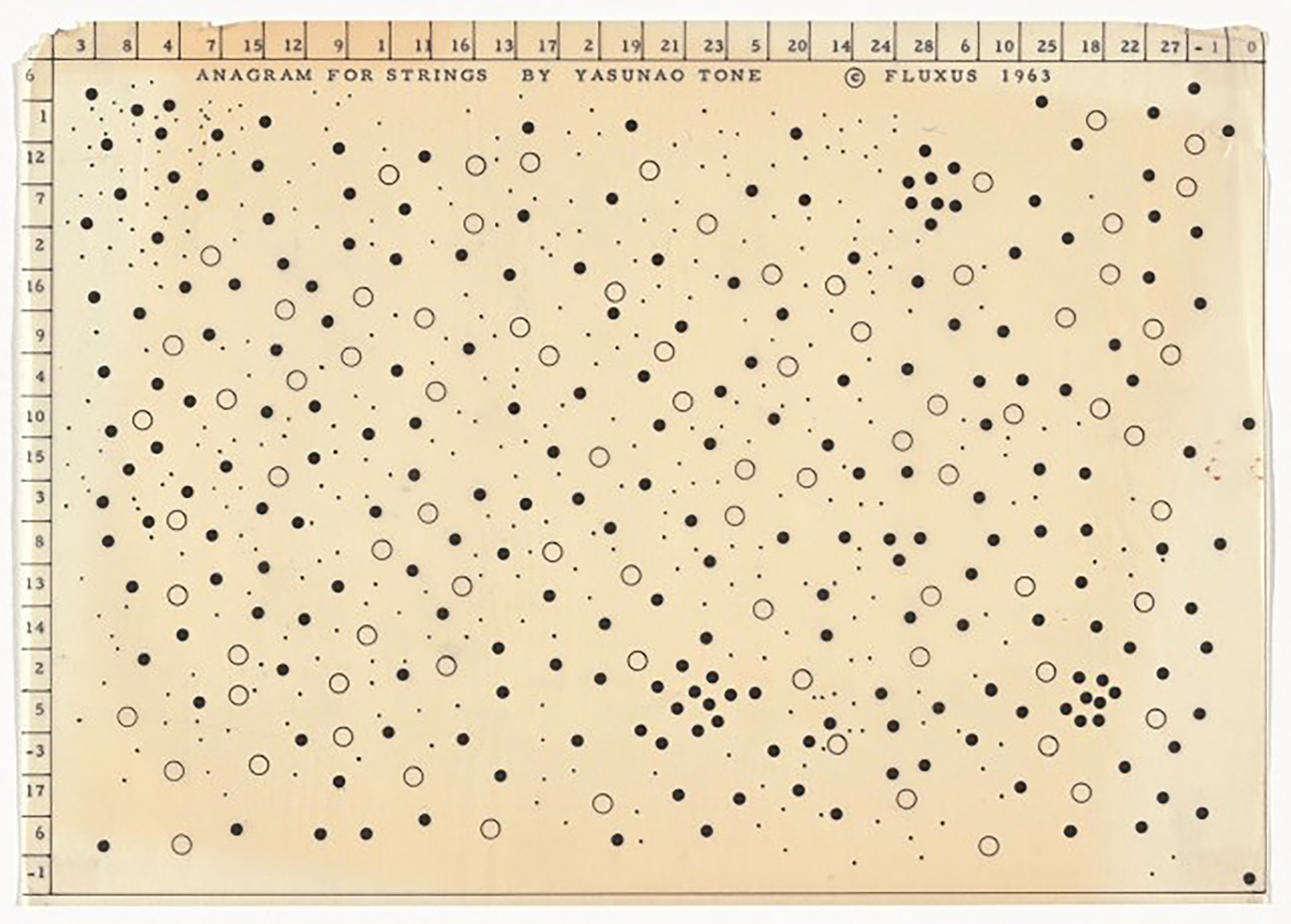
In the months following Ichiyanagi's recital, composers and performers who had become interested in the Cagean avant-garde organized a series of concerts and events at the SAC and the galleries in Tokyo. These initiatives constituted not a kind of ‘Cagean school’ in Japan but flexible applications of related conceptual strands within American experimentalism. For instance, Tone, who learned about the graphic scores of the New York-based composers Earle Brown, Morton Feldman, and Cage from Ichiyanagi, presented his first graphic score Anagram for Strings (1961) in his solo concert in Tokyo in February 1962. Tone applied the technique of graphic notation to realize his previously brainstormed idea of collective glissandi improvisation.Footnote 25 The score of Anagram for Strings asks performers to draw a line that intersects with various circles (Figure 2). On the intersections, they are asked to play different downward glissandos for whatever length of time they choose. For Tone, this score was also a medium for realizing his interest in reconciling surrealism with participatory art.
(Colour online) Score for Tone's Anagram for Strings, 1963. The Gilbert and Lila Silverman Fluxus Collection Gift. The Museum of Modern Art Archives, New York.
Similarly, Yoriaki Matsudaira, who had been composing in the style of European indeterminacy under the influence of Stockhausen, became interested in Cage's experimental and chance music as a result of Ichiyanagi's recital. He attempted Cagean indeterminacy in Co-Action I & II for Cello and Piano (1962), which involved mixing fragments of staff notation, graphic notation, and tablature for cello, playing the internal parts of the piano, and treating the cello as a sound object (e.g., requiring the cellist to hit the body of the cello). He also scripted unconventional relationships among the performers. Co-Action I asks the second player to decide whether to follow the first player's choice of order or not, and the first player to be aware of the other player's choice. Co-Action II, presenting a format close to Cage's happenings, allows all performers to decide the order of the movement independently without taking into account the initial player's choice. In this way, Matsudaira shared Cage's aim to negate the intervention of the composer's wilful expression.
Cage in Japan, 1962
As the previous sections show, a number of Japanese music circles explored Cageian ideas in the context of their own artistic interests. It was not until Cage arrived in Japan, however, that the two-way cultural exchange between Cage and Japan officially began. By visiting Japan in person, Cage revised his image of Japan. Where he had pictured a Zen-like, ancient Eastern country, he found a vibrant, modern society.Footnote 26 Japanese musicians could listen to the sounds they had imagined for Cage's works and see how Cage's radical thought, which the composer claimed derived from Eastern cultures, shaped an artistic practice considered the most avant-garde in Western music circles.
Cage's visit to Japan, accompanied by Tudor, his great music interpreter, was facilitated by Mayuzumi. In 1961, Mayuzumi initiated and oversaw the invitation of Cage as part of his work of internationalizing the SAC.Footnote 27 For Cage, the SAC's offer fulfilled two objectives. The first was his aspiration to secure performances abroad to offset the uncertain opportunities that sometimes attended American experimental composers in the domestic setting. The SAC offered to cover the two artists’ transportation, room and board, and performance expenses, though it promised no performance fees because their concerts were expected to be held on a non-profit basis. The second was Cage's long-term dream of visiting Japan: he had wanted to see the country whose culture had inspired him since the 1950s and to meet his teacher of Zen, D. T. Suzuki. A piece he wrote two weeks before departing for Japan communicated his excitement: ‘The month of October 1962 will be very interesting for David Tudor and for me. Neither one of us has ever been in the Orient before.’Footnote 28
During their six-week stay in Japan, from 30 September to mid-November in 1962, Cage and Tudor gave seven concerts in Tokyo, Kyoto, Osaka, and Sapporo. At their own discretion, the two artists showcased music by New York and non-New York School composers, including Cage, Christian Wolff, Morton Feldman, Karlheinz Stockhausen, Sylvano Bussotti, Iannis Xenakis, Ichiyanagi, and George Brecht. While some pieces had been recently performed, others were premieres, such as Stockhausen's Klavierstück X (1961) and 0′00″ (1962).Footnote 29 These performances involved collaborations with experienced Japanese experimental musicians.
Starting from the first concert at the Tokyo Bunka Kaikan on 9 October, Cage and Tudor, along with the Japanese composer-performers Ichiyanagi, Kenji Kobayashi, Yoko Ono, Mayuzumi, Takahashi, Takemitsu, and others, struck the Japanese audience with their serious outlook in the midst of the eccentric and provocative performances. In Cage's Music Walk (1958), in which ‘the performers may move at any time from one playing position to another’, some performed a conceptual ‘music walk’ by lying below the piano (Tudor) and across the piano strings (Ono), instead of simply walking around (Figure 3).Footnote 30 As Akiyama noted, ‘When the performers walked from one place to the other corner on the stage, the silent time flowed, and the audience's noise got more obvious and became part of the performance.’Footnote 31
Tudor, Cage, Ono, and Mayuzumi performed Cage's Music Walk at the Tokyo Bunka Kaikan on 9 October 1962. Photograph by Matsukaki Kunitoshi. David Tudor Papers. Getty Research Institute, Los Angeles (980039).

At the concert at the SAC on 24 October, Cage dedicated 0′00″ (4′33″ No. 2) (1962) to his friends and hosts Ichiyanagi and Ono, who had accompanied Cage throughout his Japan tour (Figure 4). Cage's performance of 0′00″ consisted of notating the score of the piece he was performing in front of the audience with contact microphones attached to his pen, eyeglasses, and other objects. The resulting score included only one sentence: ‘In a situation provided with maximum amplification (no feedback), perform a disciplined action.’ Kosugi, who was in the audience, vividly remembered the details of the disciplined actions Cage did on stage thirty years later: ‘Cage sat at the desk and wrote with a pen. The contact microphone picked up and amplified sounds from the desk, ashtray, glasses, paper, etc. The audience could hear the sounds of Cage wearing his glasses, taking off his glasses, and putting them on the desk, or smoking his pipe and placing the pipe on the ashtray.’Footnote 32 After finishing his writing, Cage blew on the paper to make the ink dry more quickly, walked towards Ichiyanagi and Ono in the audience, and dedicated the piece to them. Ono then answered Cage with a kiss.
Cage premiered 0′00″ at the SAC on 24 October 1962. Photograph by Yasuhiro Yoshioka.

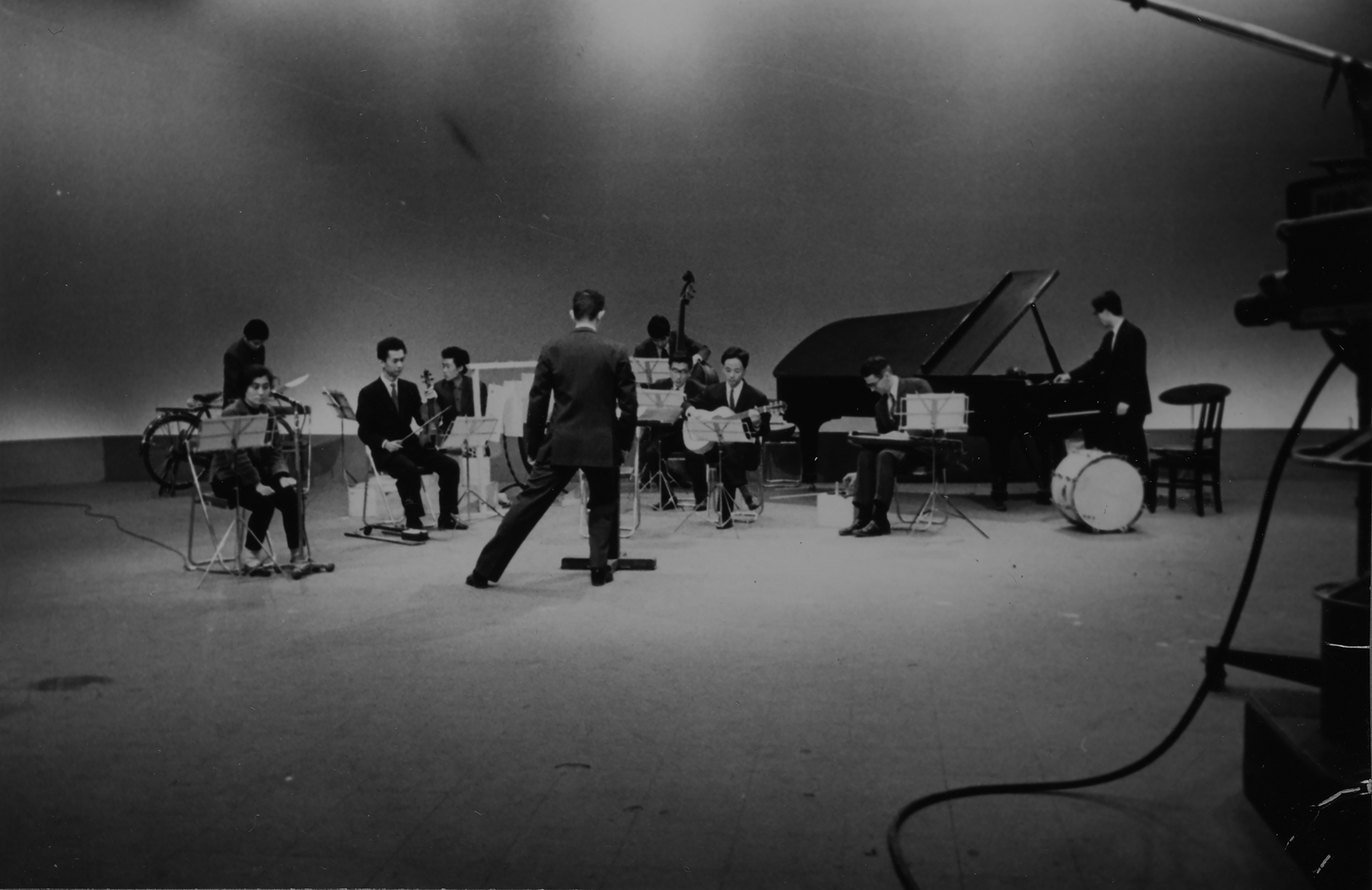
The last concert, on 26 October, took place under the auspices of the Sapporo Contemporary Music Festival and involved the greatest amount of exchange and collaboration between the two Americans and the Japanese artists. Half of the programme consisted of works by Japanese composers. Cage and Tudor were thus able to perform and experience Japanese avant-garde works written in a fashion similar to theirs, including Keijirō Satō's Calligraphy for Piano and Takemitsu's Ring and Corona. In addition, Ichiyanagi's new piece Sapporo, composed as a gesture of welcome to Cage, was a culmination of his reflections on indeterminacy, silence, and graphic notation in combination with his interest in space and group interaction. In Sapporo, the performers – up to fifteen players (and conductor) – may choose any kind of sound-making objects ‘capable of meeting the requirements indicated in the score’.Footnote 33 Sustaining sounds, attack sounds, upward and downward sliding sounds, multiple simultaneous sounds, and long silences are all required.
At the premiere of Ichiyanagi's Sapporo (Figure 5), there were eleven players on the stage playing a mix of objects and instruments (Western and Japanese). Cage was the conductor. Tudor played the Japanese instrument biwa, a short-necked lute. Takahashi, who found a bicycle near the stage, rode the bicycle on the stage while exchanging score with others. Akiyama made sounds with ten wood boxes. Ichiyanagi played piano and drum. Seiji Ozawa kicked a toy car around the stage.Footnote 34 Because the piece requires attention and reaction to others’ performance, the unspoken intimacy that binds the players and links the scattered improvisations created a tension among the performers while accentuating their awareness of the dynamic, textual, and timbral changes.
The premiere of Ichiyanagi's Sapporo at the Sapporo Contemporary Music Festival. From left to right, Yūji Takahashi (bicycle), Ono (voice), Kobayashi (violin), Akiyama (wood boxes), Toshinari Ōhashi (contrabass), Toshio Kuronuma (cello), Harumi Ibe (guitar), Tudor (biwa), Ichiyanagi (piano and drum), and Cage (conductor). Seiji Ozawa, not shown, kicked a toy car around. Photograph by Yasuhiro Yoshioka. David Tudor Papers. Getty Research Institute, Los Angeles (980039).
Creating ‘John Cage Shock’
During his stay in Japan, Cage was surrounded by his cordial hosts at the SAC, experimental musicians, ingenious sound engineers, and knowledgeable artist friends. It was probably this set of ideal conditions that led Cage to conclude that Japan was the first country to acknowledge and understand what he was doing.Footnote 35 However, this positive impression seems to be a misperception if we look at the media portrayal of Cage's Japanese debut.
Within two months of Cage leaving Japan, journals such as Ongaku geijutsu and the SAC Journal and newspaper articles started to sensationalize Cage, in this process making visible the gap between Japanese who declared themselves for or against Cage's approach. A case in point was Ongaku geijutsu's special issue ‘Indeterminate Music, Issues and Opinions’ (1962), which aired first-hand critiques of Cage. A number of dismissive reviews came from Japanese composers who admired Cage's philosophical ideas but who were disappointed by his music. For example, composer Sadao Bekku considered Cage's philosophy to be inconsistent with what he saw as the American experimentalist's uninterrupted attachment to the artifice of the concert stage:
I don't think that Cage had realized his ideal aesthetics. In concert, in front of the audience who bought the tickets, Cage knocked the inside of piano with hammer. How did it relate to life? Eating a rice cookie whenever you want is life. Showing the audience that you eat the rice cookie doesn't relate to life at all. Having a concert with the audience paying for the show itself contradicts Cage's aesthetics.Footnote 36
Other contributors of this special issue cast doubt on Cage's techniques. Composer Shinichi Matsushita pointed out that rolling dice or letting composers choose which notes to perform results in relatively predictable outcomes.Footnote 37
The highlight of this special issue of Ongaku geijutsu was Makoto Moroi's article, where his criticism further sensationalized Cage's visit to Japan. Moroi called Cage a nonsense artist and mourned that Cage had caused the imminent death of music. Listening to the continuous loud noise from the speakers in Cage's Atlas Eclipticalis and Variations II ‘was just like a torture’ to Moroi.Footnote 38 The destructive nature of Cage's works led Moroi to affirm that Cage's music ‘belongs to a different world’ from his own, one that he would never understand.Footnote 39 Moroi's narrative made Cage seem like a very foreign, shocking figure when actually Cageian experimentalism had affinities with contemporaneous Japanese avant-garde.
Sensationalism surrounding Cage, reinforced by those Japanese musicians who were critical of Cage's music, culminated in a roundtable discussion reviewing the Japanese compositional activities in the 1960s, which was featured in the November issue of Ongaku geijutsu in 1969. It gathered Akiyama, Yoshida, Shibata, and Hikaru Hayashi, who all agreed with the narrative that Cage had a significant impact on Japanese compositional circles in the 1960s. It is in this discussion that Yoshida coined the term ‘John Cage Shock’. Replying to Akiyama's comment that ‘Cage had created a new mental state for the Japanese compositional circles’, Yoshida stated, ‘In one word, the 1960s is the decade of “John Cage Shock”.’Footnote 40 Shibata, who had been familiar with the reception of Cage's music in Europe in the 1950s, remarked that Cage aroused an even bigger shock than he had caused in Europe.Footnote 41
The 1969 roundtable was symptomatic of the tendency of Japanese music critics to posit Cage's 1962 visit as one of the originary moments of Japanese experimentalism, a tendency that continued for several decades. For example, in the early 1980s, Akiyama suggested that Cage's 1962 concerts caused a real shock ‘nowhere to be seen in the history of concerts in Japan’ and that they shattered every preconceived notion about music, sound, and silence held by Japanese artists and musicians.Footnote 42 Nihon no sakkyoku 20-seiki (Japanese Compositions in the Twentieth Century), a music history book published in 1999, continued the narrative by describing ‘Cage Shock’ as a sensation: ‘The greatest sensation that the SAC caused is to invite Cage and Tudor to Japan’; ‘The musical trend of pursuing new technique among Japanese composers [in the 1950s] was later subdued by “Cage Shock”, which hit Japan in the 1960s.’Footnote 43
To create a reasonable narrative for the term ‘Cage Shock’, music critics also searched for explanations for what had caused Japanese composers to react drastically to Cage. For example, in 1978, Akiyama noted that after the war, a number of Japanese composers had been following the lead of the European avant-garde, which claimed to pursue a linear progression of musical styles and techniques. He cited Yoshida and Irino, who introduced serialism at the contemporary music festival in Karuizawa in 1957, as examples. When composers such as these encountered Cage's techniques and his aim of dismantling Western art music conventions, their belief in the progress of technique was shaken. As Akiyama wrote, ‘They saw the insanity of anti-music from Cage and thought that Cage declared the end of music … As a result, the chaos of “Cage Shock” was born.’Footnote 44 Composer Shigeaki Saegusa, speaking in 2001, also relied on the historicist framework associated with Western art music (and with the West more broadly) to explain why Japanese composers found Cage to be so shocking. In a piece written in 2001, he hypothesized that ‘Cage Shock’ was caused by a compressed time scale, which he argued contextualized the accommodation of Cagean experimentalism in early 1960s Japan: ‘Ten years of information about Western music from the war to postwar came to Japan in just a few years’, Saegusa said.Footnote 45 In his view, it was such a compressed time scale and the resulting failure of the Japanese composers to digest diverse avant-garde trends that had caused ‘John Cage Shock’ among Japanese composers.
Both Akiyama's and Saegusa's explanations are at least partially valid for those Japanese composers who were single-mindedly following the European avant-garde in the 1950s. Yet, they left out varied Japanese reactions to Cage's Japanese debut and, more broadly, to Cageian experimentalism. As I have demonstrated previously, a number of Japanese composers and artists recognized resonances and affinities between Cage's and their own avant-garde practices, rather than perceiving Cageian practice as completely foreign. The ‘Cage Shock’ narrative has neither offered a reasonable explanation for these other responses nor credited Japanese experimentalisms before and during Cage's trip.
John Cage is Not Shocking
Alternative narratives of Cage's impact on Japanese composers became more visible in the 1990s, when several Japanese publications initiated the Japanese musicological study of Cage and the Japanese avant-garde. One particularly illuminating book was Kagayake 60-nendai: Sōgetsu Āto Sentā no zenkiroku (Shining 60s: The Complete Records of the Sogetsu Art Centre), a comprehensive Japanese work that documented and re-assessed avant-garde events at the SAC from 1958 to 1971.Footnote 46 Here, we find composer Shūkō Mizuno, a member of Group Ongaku, making a striking statement that counters the standard narrative of ‘Cage Shock’. For him, Cage's 1960s performances were not shocking at all: ‘We [Group Ongaku] had already tried out all kinds of [avant-garde] ideas and were thinking about what to do next at that point.’Footnote 47 For Mizuno, it was Cage's experimental music that lagged behind avant-garde trends in Japan at the turn of the 1960s. Rebutting conventional wisdom, he claimed that the so-called ‘Cage Shock’ phenomenon was merely noise made by some journalists and Cage's followers.Footnote 48
Indeed, Mizuno was not alone in interrogating the term ‘Cage Shock’. In my interviews, conducted in Japan from 2016 to 2019, a number of artists who had witnessed Cage's Japanese debut claimed that they felt no shock whatsoever. These include Matsudaira, Yūji Takahashi, Jōji Yuasa, and some members of Group Ongaku, who had already been exposed to Cagean experimental music before Cage's arrival in Japan or had experimental perspectives similar to Cage's before learning about Cage. For example, Matsudaira, who tried both European aleatoric techniques and Cagean indeterminacies before Cage visited Japan, said: ‘I didn't feel shocked or repulsed, unlike many conservative Japanese composers, when seeing Cage's performance. Instead, I was very curious about Cage's music.’Footnote 49 Expanding on Mizuno's ideas, Shiomi clarified that, for Group Ongaku at that time, rather than a shock or a model to adopt, Cage's performance was more a validation from an established composer for what they were doing – their own experimental, multimedia performances.Footnote 50 She recalled, ‘Through Cage's performances, I felt Cage had indirectly told me that I should explore my own way and establish new method and value which had not been established by anyone including Cage himself.’Footnote 51 These views suggest that the term ‘Cage Shock’ has oversimplified the multifaceted reactions of Japanese musicians to Cage's music and concepts, and served to generalize what was the reactions of some conservative composers, followers of the European avant-garde, and the general public.
Some of the composers I interviewed were also concerned that the term ‘Cage Shock’ has distorted the significance of Cage's debut in Japan. Most problematically, the term may well have caused the misunderstanding that Japan had no avant-garde performance before Cage's Japanese debut. Both Tone and Takahashi told me that Cage's concerts in Japan were actually well prepared by experimentalists in Japan. Not only had the activities of Ichiyanagi, Ono, and Group Ongaku at the SAC prepared Japanese audiences to appreciate Cage, there had also been local avant-garde movements that took place prior to the artists’ visit. Takahashi underscored Takemitsu in particular, who was experimenting in the early 1950s with the group Jikken Kōbō.Footnote 52 Takemitsu subsequently applied his interest in environmental noises into his experiments in electronic music, creating works such as Relief Statique (1955) and Vocalism A.I. (1956–60). It is interesting to note that even for Kosugi, who professed being ‘shocked’ by Cage, his surprise was partially due to how Cage's concepts resonated strongly with Group Ongaku's performance of action music in the early 1960s. Kosugi was delighted to recognize the closeness of Cage's musical idea to Ongaku's objective of expanding the concept of music and blurring the distinctions between composition, performance, and reception. These artists, by emphasizing that the Japanese avant-garde was thriving before Cage's 1962 visit to Japan, challenged the implicitly embraced notion that the Japanese avant-garde emerged in response to Cage.
The new criticisms that became apparent in my interviews suggest that ‘Cage Shock’ has functioned more as a media buzzword since the 1960s, rather than objectively reflecting Japanese reception of Cage. In this regard, it is interesting to note Shiomi's remark that the term's wide circulation and acceptance reflect the tendency of the Japanese public to be influenced by mass media's portrayal of foreign figures: ‘When these mass media said Cage is a great person and revolutionary musician, Japanese people accepted it easily.’Footnote 53 Ichiyanagi, the former chief promoter of Cagean music, also acknowledged that the term served to sensationalize Cage's impact and to flatten reception of Cage in Japan. But to Ichiyanagi this sensationalism was a welcome vehicle as he was committed to disseminating Cage's name beyond Japanese artists’ circles. He said: ‘It is true that it [“Cage Shock”] is a media-like term, but it is not a bad term, isn't it? I think there were many ways that people thought about Cage's visit to Japan. Nevertheless, Cage's name has been spread throughout Japan because of the term “Cage Shock”.’Footnote 54 All in all, it is evident that both outsiders and insiders were working in tandem to produce a dramatic and simple historical narrative of another musical ‘Perry’ coming to open Japan.
It should be noted that the term ‘Cage Shock’ has not fallen out of usage. For composers and musicians of later generations, including those I interviewed (Shin'ichirō Ikebe, Kondō, Mayumi Miyata, and Toshio Hosokawa among others), ‘Cage Shock’ continues to affect their understandings of Cage's place in Japanese music history as an originary figure of Japanese experimentalism. Having come of age after the 1960s, they take ‘Cage Shock’ as a serious episode and tend to accept the widespread view that Cage had greatly impacted the Japanese music scene. Even though some of them are aware of the critiques against the term, they feel no right to question the term because they did not experience ‘Cage Shock’ first-hand. For example, composer Motoharu Kawashima, who was born a decade after ‘Cage Shock’, told me: ‘In my generation, we don't know the real situation of “Cage Shock” … We can only read about it as a past event in the history book.’Footnote 55 And ‘Cage Shock’ is still commonly used by the mass media. For example, EM Records in 2012 released three CDs of the original recordings of Cage's 1962 performances in Japan with the title ‘John Cage Shock’, suggesting that it is still the most marketable term to refer to Cage's Japanese debut. Similarly, Ichiyanagi and Saegusa's article in 2001 and critic Keisuke Mihashi's article in 2012 both use ‘John Cage Shock’ in titles as shorthand to refer to the event, attesting to its lasting power within Japanese discourse.Footnote 56
Conclusion
In this article, I examined how Japanese avant-garde artists had engaged in experimental practices and perspectives similar to Cage's and had been exposed to Cagean experimental music before his first landing in Japan. These are histories that are largely left out in accounts of Cage's relationship with Japan. I also critically examined the rise of the term ‘Cage Shock’. I argued that the term has oversimplified the reception of Cage's debut in Japan and created the misconception that Cage's music was completely unfamiliar and new to Japanese composers.
In summary, what are the stakes of using the term ‘Cage Shock’? The term has had the effect of flattening discussions of Cage and Japan by always returning the conversations to the moment of ‘Cage Shock’, a mythologized moment that represents only certain groups of Japanese, particularly those composers who were not previously familiar with Cage. A narrative focusing on ‘how Cage shocked all of Japanese’ fails to reflect the multifaceted interactions of Japanese musicians with Cage and his music over the span of multiple decades. In particular, ‘Cage Shock’ has left out those Japanese avant-garde artists who were contemporaneous with Cage. Their own experimental practices as well as their stories of how they met, collaborated, and developed friendships with Cage can hardly fit into the ‘Cage Shock’ narrative. Also marginalized are the stories of those Japanese composers, musicians, and artists who felt drawn to Cage's music and philosophy even after the waves of ‘Cage Shock’ had dissipated. On this front, it is important to remember that it was those composers who were continuously interested in Cage, such as Takemitsu, Matsudaira, and Takahashi, more than those who were purportedly shocked by Cage, who passed down Cage's music and philosophy in Japan.
More broadly, the rise of the term ‘Cage Shock’ and its effects remind us how the mainstream narrative assumes European/American figures as the originary and central figures of artistic movements, rather than looking at Western and non-Western composers as contemporaneous figures with parallel interests and in artistic exchanges. A critical reflection on ‘Cage Shock’ invites us to interrogate the temporal and geographical assumptions of centre and periphery, assumptions that normalize unequal power relationships in Western-centric music histories. Decentring this and other master narratives requires that we pay attention to the unknown and scattered local histories, which not only grant us a view from the so-called periphery but also allow us to build a global history from a multi-locale perspective and generate a space that is open to multiple viewpoints. This is when the previously lost narratives finally enter history.



