1. Introduction
This survey review examines four books published over the last 20 years or so that aim to provide support and guidance to managers and would-be managers in the field of English language education, and a fifth that was written for managers and principals in mainstream primary and secondary education. ‘Managers’ include directors, principals and directors of studies or heads of department, as well as those with assistant manager or coordinator responsibilities. The review considers the different orientation of the books and their coverage of the broad and complex field of educational management. It then compares the books’ handling of three selected areas: organisational structure, people management and quality management.
Depending on the context, most language education is provided at public sector mainstream schools, at centres providing adult education and lifelong learning, or within the structure of private or public universities. The management of language curricula and courses is usually ‘departmental’ and part of a larger, complex, school or college structure. However, an important feature of language education around the world over the last fifty years is that a whole industry of specialised private sector language schools and colleges has developed, ranging from national and international ‘chains’ and franchises with numerous outlets to programmes offered on university campuses to small family businesses operating in a single location. The managers in these types of institution may well be entrepreneurs who come from a business or commercial background rather than language or education specialists, but in a majority of cases management and coordinator positions are held by former teachers, or indeed teachers who have management duties alongside their teaching timetable.
2. The books under review
Managers in language teaching operations and those taking courses such as the International Diploma in Language Teaching Management (IDLTM) (www.teachers.cambridgeesol.org/ts/teachingqualifications/IDLTM), like managers outside education, naturally refer to the very wide range of books on general management and on specific areas of management, such as marketing, human resources and quality. These are too numerous to mention, and are also quite widely cited in management handbooks for language educators. This review therefore focuses mainly on the books written specifically for managers in language teaching operations. Given the scarcity of works focusing on this area, the first editions of these are for the most part not recent. The purpose of the review is to compare the books that are available at the time of writing to managers and would-be managers in search of support.
White, Hockley, van de Horst Jansen & Laughner's From teacher to manager: Managing language teaching organizations (2008), as the title suggests, focuses on the needs of teachers who are being promoted to, or applying for positions as, managers. Its scope is not dissimilar to that of Management in English language teaching, by White, Martin, Stimson & Hodge (1991) with its broader-sounding title, which remains in print. However, the earlier team of authors took a different approach to the topics covered. Both books have a UK background but aim at an international readership, albeit focusing on providers of courses in English.
In contrast, Christison & Stoller's Handbook for language program administrators (2012) is a collection of papers that, in its first edition, was aimed exclusively at people managing intensive English programmes in the USA, but has now expanded its scope to respond to the international nature of such administration. Quality ESL programs: An administrator's guide by Simons & Connelly (2000), meanwhile, has a narrower focus on ESL programmes in US schools, and is entirely written by the two authors.
Finally, Everard, Morris & Wilson's Effective school management (2004), which is designed for mainstream school managers in the UK, but in the opinion of the reviewer is useful to managers in the language teaching sector worldwide, will be considered because of its overlapping scope.
The review is divided into two main sections. In the first, thumbnail sketches of the books are offered. These provide a brief overview of the target readership and the content and feel of each. In the second part, an attempt is made to compare the books from the point of view of three key topics in education management.
3. Outline of the works under review
The version of Everard et al. (2004) being considered is its fourth edition. Previous editions dating from the 1980s and 1990s were co-written by Everard and Morris, both management specialists with experience inside and outside education. The new co-author, Ian Wilson, contributes as a former mathematics teacher and head teacher. One of their starting points is clear (p. x): ‘It is our contention that those who do not believe that schools can learn from industry base their case on false premises . . . heads and senior staff in schools and colleges can learn to manage better by studying what their counterparts do in successful firms and schools and across national boundaries . . .’.
The book is organised as three main but overlapping sections on ‘managing people’, ‘managing the organisation’ and ‘managing change’, thus underlining the point that divisions within management are artificial and subjective. Each large section is divided into several chapters – eight in the first section, six in the second and four in the third. Each chapter contains ‘personal applications’: these are small thinking or listing tasks, such as ‘draw up a list of effectiveness criteria’ and ‘identify the subsystems in the organisation [of your school]’. Chapters end with discussion topics and suggested further reading. While the book is clearly aimed at head teachers and managers in British schools, there is less reference to national legislative and educational arrangements than might be expected, and most of these are covered by a brief glossary at the end. It would seem easy, therefore, for a manager of a public sector or commercial language teaching operation anywhere to draw on and extrapolate from the considerable wealth of experience, facts and opinions that the book contains.
White et al. (2008) is, as its subtitle (Managing language teaching organizations) suggests, a much more specialised book. It is in some senses a successor to White et al. (1991). The books are aimed at the same audience: ‘teachers making the transition from the role of classroom practitioner to that of manager’ (White et al. (1991: 1). However, the introduction to White et al. (2008) states that developments in the 17 years that elapsed between their respective publication dates make a new approach to the topic necessary: ‘One of the most significant changes [in English language teaching] that have taken place . . . is the reconfiguring . . . of the traditional teacher–student relationship into a service provider–consumer relationship’ (p. 1). It could be argued, of course, that this relationship has always existed in education, especially, but not only, in the private sector, but has not been perceived clearly by either teacher/institution/service provider or student/client/consumer, something the book sets out to rectify.
White et al. (2008) is organised into ten neat chapters spanning key management topics from the point of view of the language teaching organisation (LTO). Subheadings within each chapter appear as a bulleted list at the beginning, rather than with page numbers on the contents page. To illustrate the diversity of LTOs, six examples are provided in the first chapter, and ‘vignettes’ – contextualised situations and real case studies – are a feature of the book, signalled by shaded boxes. Like those in Everard et al. (2004), each chapter contains several ‘tasks’ as well as opportunities for reflection, again signalled by shading. Chapters end with a brief conclusion, followed by a further task or two. Suggested answers to some more detailed tasks are contained in an appendix.
White et al. (1991), on the other hand, has a brief contents page showing the division of the book into three sections: ‘People and organizations’, ‘Marketing’ and ‘Finance’. As in Everard et al. (2004), the first section of White et al. (1991) is the longest, taking up six chapters and more than half the book's pages. The other sections contain three chapters each. The content covered is spelt out in a list of aims at the beginning of each chapter, and is also indicated by useful, if untidy, numbered sub-headings and sub-sub-headings. Each chapter ends with several pages of ‘follow-up activities’, some of which also relate to vignettes or to tables and include role-plays, questionnaires and other practical tasks such as ‘improve the following fire notice’, as well as technical questions such as ‘under what circumstances is it preferable to try to turn a fixed cost into a variable cost?’
The two American books under review reflect the considerable differences between US and UK LTOs, as well as between the two kinds of language education they relate to. Both books focus primarily on ‘ESL programs’ run within other mainstream institutions. Simons & Connelly (2000) is concerned with provision for school-age children in the US (kindergarten to grade 12) who are speakers of English as a second language (ESL). Unlike those discussed above, this book is not aimed primarily at language teachers moving into management roles but instead has a specific contextual focus. According to the blurb on the back cover, ‘This guide was created for central office administrators or building principals who are usually responsible for the development, administration and evaluation of ESL programs. It provides an ecological understanding of educating ESOL [English for speakers of other languages] students, which will facilitate policy decisions and the creation of infrastructure for quality programming’. The authors' priorities are also signalled in their introduction (p. ix): ‘We believe that, while all students in our basic education systems should learn to respect and appreciate diversity, ESOL students must also learn the skills and knowledge they need to succeed and to negotiate differences successfully’, implying that they are not necessarily being enabled to do this, or at least, were not at the time the book was published.
Like Everard et al. (2004) and White et al. (1991), the book is divided into three sections, in this case of roughly equal length and with radically different headings from the UK books: ‘The background issues and questions’, ‘Policy decisions influencing program development’ and (last but not least) ‘Program administration’. This again demonstrates the priorities of the authors, who seek to stimulate fairer, more imaginative and more productive approaches to ESL in the US education context, leading to greater success for students. The chapters do not contain tasks or overt suggestions for reflection, but there are numerous illustrative boxes referring to actual instances, several case studies, and ‘exhibits’, sometimes related to the case studies. Among these, we find, for example, ‘ESL program model differentiation’, ‘a multilevel approach to family involvement’, and ‘competencies required for teachers of language minority students’. The book ends with a collection of 25 practical appendices of lists and forms created by the authors or derived from their experience.
Christison & Stoller (eds.), the other US work, first appeared in 1997. The second edition under review was pending publication at the time of writing, but the publishers kindly made a PDF version available. Although it also focuses mainly on the US context, this is a very different kind of book, not least because it is a collection of 21 chapters written by 21 different individuals or teams of writers. The editors themselves, singly or together, contribute or co-contribute four of these chapters. The fact that it is an edited collection of papers means that the book offers a wide variety of perspectives, approaches and styles, which may be a little disorientating for some readers but may appeal to others.
Christison & Stoller present their compendium in an engaging way (p. viii): ‘this second edition is still the book that we wish someone had given us when we first took on language program administrator responsibilities almost three decades ago . . ..’. In other words, their intended audience is very much the same as that for White et al. (2008) and, indeed, there are frequent references to this work in several of the papers. The focus, however, is specifically on intensive English programmes run on university and college campuses and serving ESL students from the US and abroad. The second edition has sought to broaden the scope of the first to take account of the ‘exponential growth’ in provision within and outside the US and in a variety of different contexts, which are considered in the final section. Adult education programmes, bi-national centres (e.g. Argentine–North American), intensive English programmes in universities, international schools and mainstream state and private schools are considered from the point of view of their respective roles, the student bodies and functions they serve, their main ‘instructional features’, and the main duties of the language programme administrator in each. These papers provide useful context-specific supplements to the rest of the book.
The work is divided into five parts. The title of each considers the language programme administrator from different points of view or in different roles: ‘the basics’; ‘as leader’; ‘as promoter’ (i.e. as advocate for their programme in the wider institution and the community); ‘as manager’; and ‘in different contexts’, including those outside the US arena. As might be expected, over 200 of the 350 or so pages are devoted to the sections on the programme administrator as leader and as manager. These include some interestingly diverse chapters, for example on the programme administrator as ‘catalyst for innovation’ and ‘intercultural navigator’, and a chapter on ‘time management principles’. However, due to its structure, there is much less flow and coherence and cross-referencing in this book as a whole than in the others. On the other hand, users of the book can select chapters according to their needs and interests without worrying about what has come before, much as one might select an article in a journal.
A noticeable difference in the two American books is the sheer volume of references to other authors and their works. Christison & Stoller is the only one of the five to contain a separate index of authors, which alone covers more than five pages. Each chapter has its own list of references, preceded by a brief summarising conclusion. A few also include discussion questions and activities after the conclusion. Simons & Connelly (2000), a relatively slim volume, contains a dozen pages of references (compared to half that in the more voluminous British books). The effect of this depends on the author and reader: it can seem more scholarly and well-researched, in that readers can follow up specific references for themselves, or it may make the text more cumbersome and slow readers down, especially those who are looking for practical guidance based on experience.
4. Overview of topics
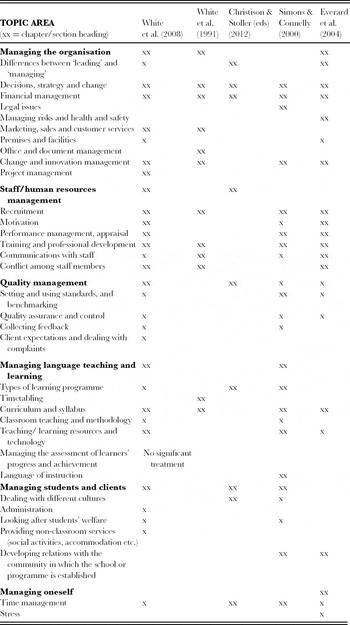
Table 1 presents an overview of the topics covered in the five books. Quite naturally, several of the topics covered are applicable to any kind of management and are viewed by the respective authors through the lens of the educational context they are writing about. In doing so, the authors frequently make reference to works from outside education on general or specific areas of management.
A rough comparison of the topics covered by the books under review

As mentioned above, the divisions in the table are artificial and somewhat misleading: most of management involves various aspects simultaneously. The way the books are divided into sections, chapters and subsections demonstrates the relative importance given to the topic by the authors, and indeed their interpretations of what the topic area means and should include.
5. Comparing the books
What follows is a brief comparison of the handling of some of the key topics across the five books under review.
5.1 Managing the organisation
This is a favourite topic in management and in books on the subject. What is meant by ‘an organisation’? What kind of organisation are we? What kind of organisation do we need and want to be? These are some of the questions that boards of directors or trustees ponder at length, especially when there is a change at top level, a crisis, a merger or a new opportunity. These authors take interestingly different approaches to considering what kind of organisation a school, a language teaching operation, or a language department (‘language program’ in the US books) within a college should be. With its more general scope, Everard et al. (2004) devotes one of its three sections to ‘managing the organization’. However, reflecting the authors' specific view of UK mainstream schools as organisations, the section includes ‘teams’, ‘managing and adapting the curriculum’, ‘managing quality, risk and health and safety’ and ‘managing resources’, all of which are included elsewhere in Table 1. Everard et al. (2004), White et al. (2008) and White et al. (1991) all refer to leading theories and authors in the field. Everard et al. (2004) provides an interesting tabular comparison of five ‘schools of thought on organizations’ (p. 151) ranging from the classical or mechanistic to the behavioural/organic. Meanwhile White et al. (2008) begins by considering typical LTO organigrams, advocating an ‘inverted approach’ (p. 28), in which customer and customer-facing staff are at the broad upper end and directors at the pointed base, before moving on to a very accessible review of key factors influencing organisational design and structure: departmentalisation, span of control, centralisation and specialisation, and their own table of ‘organizational lifecycles’ based on McNamara (Reference McNamara2007). Its predecessor, White et al. (1991), reflecting its vintage, cites Paisey (Reference Paisey1981), Handy (Reference Handy1978) and McGregor (Reference McGregor1960), among others, in its analysis of roles in organisations and theory X and theory Y. The implication in all three books is that managers in schools need to examine their organisations and take more note of thinking that has permeated boards of directors in other types of entity for many years.
Simons & Connelly (2000), with its narrower focus, does not devote space to the issues of organisational structure and culture. However, in Christison & Stoller (2012), a chapter entitled ‘Effective governance’, by a trio of authors from the University of Houston, citing both Weber (Reference Weber, Henderson and Parsons1947) and Likert (Reference Likert1967), explores the topic of mechanistic vs. organic models of organisation. Like Everard et al. (2004) and White et al. (2008), the chapter includes a useful comparative table as well as a discussion of the features of both models in relation to programme administration. The conclusion is that ‘the particular mix in each case depends on (a) administrative setting . . ., (b) enrollment size, and (c) dimensions of the societal culture in which the program operates’ (p. 204). Each of these areas is then discussed. On the issue of societal culture, the authors refer to Hofstede's well-known work on the topic (for example, Hofstede Reference Hofstede2001). The chapter ends with an exploration of typical programme administrator tasks from the point of view of this mix of mechanistic and organic approaches, and four demanding tasks for the reader.
5.2 Staff management
Everard et al. (2004) sets the standard for this area. Indeed, the whole book focuses on it, although only Part I is called ‘Managing People’. This covers practical matters such as ‘managing meetings’, ‘managing conflict’ and ‘recruiting, employing, appraising and dismissing staff’, as well as topics which merit background reference to the work of other writers, such as ‘the manager as a leader’ and ‘motivating people’. However, as mentioned above, Part II, ‘Managing the Organization’, includes sections on team management and quality management as well as others that involve staff management, and Part III, ‘Managing Change’, focuses explicitly on the people management skills as well as the planning and reflective skills required in seeing through positive changes. The novice manager thus has several interconnected opportunities to explore this challenging area of management.
The general background against which the authors aim to approach people management in the school context is summarised eloquently in the introduction (which, unusually, opens with a self-assessment questionnaire about the reader's ‘management principles’): ‘[in schools] tensions will arise between social and economic values, professional autonomy and managerial control, individuality and hierarchy, structural authority and participative decision-making, the head's dual roles of “leading professional” and “chief executive”, the educational good of the many and the self-interest of the few, high principle and pragmatic expediency, and many other dilemmas . . .’ (p. 10). Managers and other staff working in language schools will recognise all of the above. The authors' approach to the practical issues has this kind of thinking very much as a background: it's no good resorting to theoretical models unless they point the way to sensibly flexible practical solutions. An example is a section called ‘recognizing inappropriate behaviour’ in ‘The manager as leader’ (p. 19–20): how can or should top managers deal with the empire-builders or those who shout loudest, or, come to that, those who are quietly competent? People are different, and common-sense approaches are needed to deal with different behaviours effectively but fairly. Similarly, in the section on decision-making, the authors point out that whether one chooses an autocratic, persuasive, consultative or ‘co-determinate’ approach will depend on the type of decision and (especially) the people involved (p. 51–52).
Based firmly in the UK school context, Everard et al. (2004) takes a clearly UK/Anglo-Saxon approach to human resources culture. Chapters like ‘Managing meetings’ contain valuable checklists that may appear rather alien in other educational cultures, where carrying out a process review of a meeting by analysing participation, relationships and disputes within it may be far from the experience or inclination of many managers. Similarly, the chapter on appraisal and performance management of staff, which includes a report on surveys indicating an overwhelmingly positive teacher response to the process, may seem overly optimistic from outside the UK context. Nevertheless, the book contains a multitude of valuable tips and practical guidance in the area of people management, the core of any manager's work.
By contrast, Christison & Stoller (2012), may seem simplistic. In Geddes & Marks’ paper on ‘Personnel matters’ in Section 4, very detailed recommendations on recruiting suitable administrators and instructors for language programmes are followed by a discussion of supervision and performance management. After a lengthy survey of some of the literature, the authors offer practical advice on ‘ongoing feedback and problem solving’. Having pointed out the obvious need for the administrator to identify what the problem is (punctuality, verbal abuse etc.) and what form of sanction might be suitable, they offer second-hand advice: ‘Human resource specialists (Rebore Reference Rebore2007) suggest that administrators (a) guarantee a process that is fair to the employee, (b) consider the employee's reaction to corrective action, (c) ensure that the plan of action fits the severity of the problem, and (d) execute proper follow-up to corrective action’ (p. 233). In contrast to the discussion offered in Everard et al. (2004), this sounds both self-evident and simplistic. On the other hand, the paper also includes checklists that, while they seem focused on administrative steps, could be very useful for newly appointed administrators or those who are left to train themselves.
White et al. (2008), in a tightly packed 28-page chapter, tackle the complex issues of people management in LTOs, which by definition are often seasonal operations that make considerable demands on employees. Given the prominence of scenarios and vignettes in the rest of the book, it is surprising that there are none in this chapter, but there are plentiful opportunities for reflection and tasks, the last of which addresses the thorny issue of managing a staff comprised partly of native speakers (of English) and partly of teachers who ‘typically get on with their teaching, work hard and rarely complain’ (p. 78)! In this chapter there is much less reference to background sources than in Christison & Stoller (2012) but a more thorough overview of topics like appraisal. On the other hand, advice on, for example, the handling of meetings, one of the trickiest aspects of people management in LTOs, is much scarcer and less engaging than in Everard et al. (2004).
White et al. (1991) takes a rather different approach: instead of focusing on human resources management as a general topic, part one includes separate sections on three aspects: ‘staff selection’, reflecting the ever-pressing need to replace language teaching staff who leave for other jobs in other countries, or because of the seasonal nature of the ‘industry’; ‘staff development’; and ‘communication in schools’. The first of these chapters, on staff selection, has a practical orientation similar to that in Christison & Stoller (2012), including a list of recommendations about job descriptions and formats for these, as well as lengthy but useful follow-up activities on the topic, and detailed practical guidance about interviewing, especially the planning and chairing of interviews and questioning techniques.
The second chapter in the series on ‘staff development’ actually focuses primarily on in-service training for newly promoted staff, focusing on the role of ‘assistant principal’, and the importance of a methodical approach to its planning. Not much space is allotted to the professional development of staff in general, although another good follow-up activity points to the usefulness of analysing and using ‘critical incidents’ as a means of deciding on training objectives and opportunities (p. 90). On the other hand, this chapter includes an extensive section on ‘performance review’, generally known as ‘appraisal’ in the other books. It includes an illustrative ‘profiling’ instrument with a ten-point scale that invites managers to rate their teachers against various criteria related to teaching (e.g. ‘teachers maintain suitable class control’ vs. ‘teacher either loses class control or assumes an authoritarian role’ (p. 70)) and to general characteristics (e.g. ‘teacher displays sound judgement and good sense’ vs. ‘teacher lacks sound judgement and good sense, or is erratic in them’ (p. 71)). There are also examples of an appraisal form and a preparatory self-appraisal questionnaire.
Rather surprisingly, as in all these books, very little space is given to observation or other means of actually assessing teachers’ classroom performance or of encouraging teachers to do this themselves. This area and other aspects of teacher welfare and self-development are, however, well covered in two other Cambridge University Press publications, which, due to their narrower scope, are not included in this review (see Bailey Reference Bailey2006 and Randall & Thornton Reference Randall and Thornton2001). The chapter is rounded off with short sections on career advice and ‘discipline’, including dismissal. This topic is also covered ‘with some sadness’ in Everard et al. (2004: 92–98), which includes a task in which readers are invited to ‘role play informing a colleague that she/he will be recommended to the governors for dismissal. Then reverse the roles’ [!] (p. 98).
Simons & Connelly (2000) deals with limited aspects of staff management in chapter 8, ‘Program administration and staff development’. With their narrower focus on school-based ESL provision, the authors' main concern is with helping teachers face the challenges confronting them. Following a rather depressing account of a survey in the 1990s which looked both at the attitudes and competences of ‘subject teachers’ with ESL students in their classes, and also teachers with responsibility for specialised ESL courses, they propose ways of overcoming the skills and competence deficit and dealing with the need for ‘attitude change’ through structured staff development. Two approaches are outlined: support between supervisor and teacher, proposed by Martinez (Reference Martinez1992), using a shared analysis of ‘decision-making points’ (p. 173) to identify gaps in competence; and the ‘study support group’ model (Francis, Hersh & Rowland Reference Francis, Hersch and Rowland1994). This involves getting mixed groups of staff, in this case dealing with ESL students, to meet for an hour each week to discuss key issues relating to ensuring equal opportunities for ‘culturally and linguistically diverse’ students. The authors assert that ‘throughout the country, success in making lasting change in student achievement, group and individual teacher development as leaders and attitudinal change has been brought about by the study support team’ (p. 175). This way of working with staff is not really addressed in the other books here, but unfortunately there is little concrete guidance as to how managers and administrators can encourage such groups and help maintain momentum, an issue that is covered, for example, in Bailey (Reference Bailey2006): ‘skillful supervisors can help [language] teachers themselves identify areas of development . . .[they can] aid in skills development through demonstrations . . . by team teaching, by listening to teachers’ emerging ideas’ (p. 45).
Interestingly, this aspect of providing support for teacher development and the work of study support teams, as opposed to giving training and running meetings, does not really get mentioned in Bailey & Llamas’ own paper in Christison & Stoller (2012), ‘Language program administrators’ knowledge and skills’. The paper revolves round a questionnaire completed by 200 language programme administrators. While conducting staff meetings scores very highly on the importance scale (fifth, behind items that are largely not focused on people management), training teachers is ranked much lower (thirteenth). Providing ongoing individual support and encouraging self-motivated development did not appear in the questionnaire but ‘encouraging and supporting faculty’ and ‘team-building and interpersonal communication’ were both volunteered by respondents as very important additional competences (p. 24). Had these items appeared in the questionnaire, it can be surmised that they would have been rated as very important by a vast majority of respondents, and would then appear in the list of responsibilities proposed by the authors (p. 28) that all programme administrators should be prepared for, regardless of their context.
5.3 Quality management
The ‘market’ for foreign language courses has become considerably more competitive over the past 20 years, and not only in Europe. The stakes are high, particularly for commercially operated private language schools and for colleges and universities that see pre-sessional and in-sessional language programmes for undergraduates and graduates from abroad as a pre-requisite for attracting students from abroad, and an opportunity to supplement their main revenue. In this situation, quality in all areas of the provision has become a key factor, and quality accreditation schemes such as that run by EAQUALS include ‘quality management’ as a main area in their audits (see Heyworth in this issue).
Judging by the way it is handled in the books under review, this topic was not an easy one to offer meaningful guidance on. White et al. (2008) devotes some space to it, wisely anchoring the concept of quality in the area of the customer's ‘buying cycle’ (p. 122ff). The implication is that the more focused providers are on maintaining and developing ‘total quality’, the better customers (including students) will respond as each ‘moment of truth’ in the cycle is reached. If the aim is to achieve loyalty and, if possible, advocacy on the part of the customer so that word of mouth operates effectively to generate new business, considerable effort needs to be invested at all levels in quality monitoring and management. This advice is followed by two useful and practical group tasks looking at the ‘customer journey’ in the school. This theme of the customer's experience and responding to student needs and wishes as the practical way to deliver high quality courses is returned to in the chapter on ‘academic management’. Here the importance of drawing on a credible external point of reference such as the Common European Framework of Reference or CEFR (Council of Europe 2001) in orientating student expectations is highlighted.
The emphasis on the customer's experience and perceptions is made in an even more hard-nosed way in Mercado's paper in the section of Christison & Stoller (2012) focusing on the administrator as ‘guarantor of quality’: ‘institutions that emphasize stakeholder satisfaction can typically count on the following outcomes [of running a high quality programme] (from Kotler Reference Kotler2000):
• Loss of ‘very satisfied’ customers is often limited to 1% or 2%.
• Retention of customers can be five times less expensive than attracting new ones.
• Reduction of desertion by only 5% can increase profits 25% to 85%.’ (p. 119)
This reference to the financial and cost-effectiveness impact of a focus on quality is not new but is certainly not highlighted often enough in the field of training and education. It also sets the tone for the whole paper, which explores the various technical procedures – and quite a few technical terms – used in monitoring quality in key aspects of the language teaching that goes on at the author's own institution in Peru. The point is well made that the different aspects of quality highlighted early on in the customer's journey in marketing and sales all need monitoring carefully, and that techniques and practices exist that can help with this. However, statements like the following about verifying ‘academic quality markers’ through lesson observation seem to over-simplify matters: ‘For example, if teachers are asked to incorporate specific techniques into their lessons to promote oral and written fluency, and the techniques are carried out regularly throughout the students’ learning experiences, eventually students may associate these practices with a systematic institutional effort to promote quality language instruction, especially if the observable behavior is consistent with institutional claims made in program marketing efforts’ (p. 122). For a start, not all students have the same preferred learning style or objectives. Secondly, as anyone who observes teaching regularly will confirm, it is not the technique itself that ensures motivated and successful learning but rather the way in which it is used by individual teachers in the context of a particular class. Nevertheless, the paper is valuable in highlighting the sheer complexity of a whole-hearted approach to quality management, and covers the quality spectrum from internal strategy to external benchmarks of quality through ‘environmental scanning’, as well as percentage goals for student attainment and participation, reference to external standards (in this case the reference is to the ACTFL Oral Proficiency Interview Tester Training Manual (1999) rather than the CEFR), and also to Bloom's Taxonomy (1965) as a means of ‘curricular vetting’ of course books, as well as teacher selection and training.
With its different target readership, Everard et al. (2004) covers quality management in a ‘compendium’ chapter entitled ‘Managing quality, risk, health and safety’. However, as in White et al. (2008), there is a strong endorsement of the customer-centred approach and ‘total quality management’, in particular its corollary that ‘no level of product defect is “acceptable”. . . Carrying the principle over into school management tasks, the message is that we should not simply “do” the timetable, “run” the school sports day . . . but should first think through the various steps . . . who will take them and when they will need to be taken’ (p. 196). In other words, building quality into the process itself is key to a successful result. The authors end the section by noting, as White et al. (2008) do a few years later, the usefulness of a ‘new approach’ to quality in the school context, revolving round ‘the concepts of internal customer/supplier relationships [i.e. relationships between staff with differing but linked responsibilities] and of describing and recording systematically the “processes” within the school’ (p. 198).
While it appears in the title, Simons & Connelly (2000), does not directly address the question of quality management except in terms of ‘program evaluation’ (pp. 176–180), which is more concerned with the process of evaluation than its objectives (‘intended to support and direct decision-making’ [authors' emphasis]) and what can be learnt about the quality of the programme or its administration. The authors imply by their title that, indeed, all the issues and guidance offered in the volume are part and parcel of achieving quality in such ESL programmes in terms of the authors' own concern for greater opportunity and fairer treatment of ESL learners in the US school system.
An issue not adequately addressed in any of these works, in the view of this reviewer, again concerns the motivation and involvement of staff: how can staff at all levels best be encouraged to engage with internal discussion and decisions about quality and standards, customer expectations, quality assurance processes, and continuous and ‘total’ concern for ‘getting things right’ in all areas? EAQUALS’ School self-assessment handbook (2011), which advocates involving staff teams in partial or comprehensive internal review, is an example of a possible approach, but its success is determined by the way in which staff are ‘engaged’ in the task and its aims, and what all stakeholders see as its likely benefits.
6. Conclusion
This survey review has aimed to point out some of the books that managers and prospective managers of LTOs in different contexts may find useful. However, the coverage of relevant topic areas varies considerably according to the authors' respective target audiences, experience and interests, and some are not covered adequately by any of them. For example, it is interesting to note that none of them deals more than ephemerally with the issue of assessment of learners' progress and achievement, or success, or even with diagnostic testing, although this is a key issue in managing language education programmes and language learners.
In general, reference to relevant sections of more than one of these works is recommended rather than dedicated reading of only one of them. The fact that the publication of the earlier editions of three of them date back so far is due to the lack of publications in this area, and does not diminish their potential value. However, this review seems to indicate that more handbooks in this area would be desirable, especially at least one that would focus on the essential competences of school managers and administrators working in language education, and how these competences can be developed.
There have been various limitations in undertaking the review. First, ‘management’ and ‘administration’, especially within education where they commonly span both ‘academic’ responsibilities and non-academic duties, are all-embracing activities. It has not been possible to explore the whole area even in general, let alone in detail; hence the recourse to a sample of some topics of central importance. Secondly, although institutions teaching French, Spanish and German as foreign languages are plentiful both in countries where the languages are spoken and elsewhere, no books came to the reviewer's attention that were specifically on the management of language education on contexts outside the UK and USA, or written specifically for managers of institutions where various different languages are taught. Insufficient time was available to identify any such works through research, which of course does not mean that none exist. Thirdly, the review could not include the numerous articles on aspects of language education management that have been published in all these and other languages, including in English. Thus, with one exception, the works selected for review all have English language teaching (ELT), English for speakers of other languages (ESOL), or English as a second language (ESL) in mind, even if the titles do not always make this clear. On the other hand, depending on context, it is likely that managers working in institutions teaching other languages than English will find plenty in these books that is useful to them.
Richard Rossner is now an independent consultant in the field of education, especially in language education. Having held a number of senior posts in English language teaching, including from 1998 to 2005 that of Chief Executive of the Bell Educational Trust, from 2006 to 2011 he served as Executive Director of EAQUALS (Evaluation and Accreditation of Quality in Language Services). He continues to represent EAQUALS in a number of forums, including the Council of Europe, as a project manager and inspector. His main current interests are the assessment and development of language teacher and manager competences.