Introduction
Persecutory beliefs and hallucinations are characteristic features of psychotic illness; their functional implications are evident in the devastating impact on social functioning and levels of trust in others. Social interactions pose a major challenge to patients. A meta-analysis conducted by our group (Fett et al. Reference Fett, Viechtbauer, Dominguez, Penn, van Os and Krabbendam2011) has linked the poor social functioning evident in psychosis to impaired mentalizing, that is the ability to understand the intentions of others. However, little is known about the nature of the relationship between social functioning, mentalizing and trust in psychosis. Mentalizing is highly relevant for engaging in social interactions but the interactive nature of social encounters is difficult to probe experimentally. Recent developments in neuro-economics have enabled investigations of the complex social interactions by means of interactive paradigms (Harford & Solomon, Reference Harford and Solomon1969; Camerer, Reference Camerer2003; King-Casas et al. Reference King-Casas, Tomlin, Anen, Camerer, Quartz and Montague2005, Reference King-Casas, Sharp, Lomax-Bream, Lohrenz, Fonagy and Montague2008; Sanfey, Reference Sanfey2007).
The classical trust game (Berg et al. Reference Berg, Dickhaut and McCabe1995) is based on the interaction between two players. The first player (the investor) decides how much money to invest out of a certain starting budget. The invested amount gets multiplied and the second player (the trustee) then chooses the amount of money to repay to the investor. Mutually beneficial outcomes are most likely if both players cooperate. However, investing involves a certain risk as the trustee gains the highest payoff by keeping all the money to themselves. Hence, trust is required for the investor to make an investment. Previous research has shown that healthy individuals invest at least some of their money, and that this sign of trust (i.e. making an investment) is strongly reinforced by the reciprocity of the interacting partner (Croson & Buchan, Reference Croson and Buchan1999; Glaeser et al. Reference Glaeser, Laibson, Scheinkman and Soutter2000; Scharleman et al. Reference Scharleman, Eckel, Kacelnik and Wilson2001; Phan et al. Reference Phan, Sripada, Angstadt and McCabe2010). We have demonstrated that patients with psychosis participate in a lower amount of mutually trusting interactions than healthy individuals (Fett et al. Reference Fett, Shergill, Joyce, Riedl, Strobel, Gromann and Krabbendam2012).
Interactive paradigms from the neuro-economics field have been linked to activation in mentalizing regions (Frith & Frith, Reference Frith and Frith2003; Gallagher & Frith, Reference Gallagher and Frith2003) and the brain reward circuit (Rilling et al. Reference Rilling, Gutman, Zeh, Pagnoni, Berns and Kilts2002; Singer et al. Reference Singer, Kiebel, Winston, Dolan and Frith2004; King-Casas et al. Reference King-Casas, Tomlin, Anen, Camerer, Quartz and Montague2005). Benevolent reciprocity (i.e. a higher than expected return) during trust game interactions was associated with significant activation of the caudate nucleus, with a change in the timing of the activation from the repayment to the investment phase indexing the development of trust between interacting persons (King-Casas et al. Reference King-Casas, Tomlin, Anen, Camerer, Quartz and Montague2005). Activation of the medial prefrontal cortex (mPFC) and temporoparietal junction (TPJ) has been interpreted as originating from the mentalizing network, and activation of the insula indicated reward and arousal (van den Bos et al. Reference van den Bos, van Dijk, Westenberg, Rombouts and Crone2009). We have recently shown that patients with psychosis had reduced levels of baseline trust, and reduced activation within the caudate nucleus and the TPJ in response to cooperative repayments (Gromann et al. Reference Gromann, Shergill, Heslenfeld, Fett and Krabbendam2013). Moreover, we found a negative correlation between the attenuated caudate signal and paranoia levels, but no other symptoms. In line with the study by King-Casas et al. (Reference King-Casas, Tomlin, Anen, Camerer, Quartz and Montague2005), this suggests a prominent role of the caudate nucleus in processes related to trust and social reward.
In a typical one-shot trust game, the investment phase involves mentalizing (i.e. trying to predict the trustee's intentions) and the repayment phase involves social reward (or lack thereof, depending on the magnitude of the repayment). By contrast, in a multi-round trust game, the mentalizing and social reward components become intermingled in both phases of the game. In the investment phase, anticipation of a positive repayment by the trustee may lead to activation of brain areas involved in social reward (King-Casas et al. Reference King-Casas, Tomlin, Anen, Camerer, Quartz and Montague2005). Similarly, in the repayment phase, mentalizing activity may occur when subjects start reflecting upon the intentions of the other player, in addition to planning the next optimal investment choice. Thus, in multi-round games, reward and mentalizing-related activation can occur during both the investment and the repayment phases of the trust game.
Previous studies have shown that antipsychotic medication acts upon the brain reward response (Juckel et al. Reference Juckel, Schlagenhauf, Koslowski, Filonov, Wüstenberg, Villringer, Knutson, Kienast, Gallinat, Wrase and Heinz2006; Schlagenhauf et al. Reference Schlagenhauf, Juckel, Koslowski, Kahnt, Knutson, Dembler, Kienast, Gallinat, Wrase and Heinz2008), which constitutes a major limitation of imaging studies using a sample of psychosis patients in that they are limited by potentially confounding effects. Investigating individuals with a familial risk of developing psychosis is a promising solution to this dilemma. Johns & van Os (Reference Johns and van Os2001) have shown that studying mechanisms at a non-clinical level is beneficial because the phenotype expression is more frequent than at a clinical level. Implementing disease-related phenotypes can be best described as an endophenotype approach (Gottesman & Gould, Reference Gottesman and Gould2003; Braff et al. Reference Braff, Freedman, Schork and Gottesman2007). Endophenotypes are associated with explicit neurobiological mechanisms, and allow for the study of explicit hypotheses without dealing with the complexity of the disorder itself. Greenwood et al. (Reference Greenwood, Braff, Light, Cadenhead, Calkins, Dobie, Freedman, Green, Gur, Gur, Mintz, Nuechterlein, Olincy, Radant, Seidman, Siever, Silverman, Stone, Swerdlow, Tsuang, Tsuang, Turetsky and Schork2007) suggested that endophenotypes are essential for understanding the biological basis of psychosis.
Having a first-degree relative with psychosis has been proven to be a risk factor for developing the disorder (Tsuang et al. Reference Tsuang, Stone and Faraone1999; Lichtermann et al. Reference Lichtermann, Karbe and Maier2000; Helenius et al. Reference Helenius, Munk-Jørgensen and Steinhausen2012). Several studies have revealed mentalizing deficits in unaffected relatives of patients with psychosis (Irani et al. Reference Irani, Platek, Panyavin, Calkins, Kohler, Siegel, Schachter, Gur and Gur2006; Baas et al. Reference Baas, van't Wout, Aleman and Kahn2008; Mazza et al. Reference Mazza, Di Michele, Pollice, Casacchia and Roncone2008; Versmissen et al. Reference Versmissen, Janssen, Myin-Germeys, Mengelers, Campo, van Os and Krabbendam2008; Anselmetti et al. Reference Anselmetti, Bechi, Bosia, Quarticelli, Ermoli, Smeraldi and Cavallaro2009). These impairments seem to be more severe in first-degree than in second-degree relatives (Keshavan et al. Reference Keshavan, Kulkarni, Bhojraj, Francis, Diwadkar, Montrose, Seidman and Sweeney2010). Using a multi-round trust game, we found evidence for lower basic trust in first-degree relatives compared to controls (Fett et al. Reference Fett, Shergill, Joyce, Riedl, Strobel, Gromann and Krabbendam2012). Unlike patients, relatives increased their investments when receiving positive information about the trustworthiness of the trustee.
The current study aimed to investigate the underlying neural mechanisms of trust during social interactions in a non-clinical sample with an enhanced psychosis risk to avoid the typical confounders of clinical samples such as hospitalization and medication. Thus, we wanted to determine whether aberrant trusting behaviour constituted an intermediate phenotype of psychosis. Previous studies have supported the suitability of using such an endophenotype approach for studying psychosis (Stefanis et al. Reference Stefanis, Hanssen, Smirnis, Avramopoulos, Evdokimidis, Stefanis, Verdoux and van Os2002; Krabbendam et al. Reference Krabbendam, Myin-Germeys and de Graaf2004, Reference Krabbendam, Myin-Germeys, Hanssen and van Os2005; Simons et al. Reference Simons, Jacobs, Jolles, van Os and Krabbendam2007; Bora & Pantelis, Reference Bora and Pantelis2013; Lavoie et al. Reference Lavoie, Plana, Bédard Lacroix, Godmaire-Duhaime, Jackson and Achim2013). Functional magnetic resonance imaging (fMRI) data were acquired on 50 healthy siblings of patients with psychosis and 33 healthy controls while participating in a multi-round trust game with a pre-programmed cooperative counterpart. Based on previous research (King-Casas et al. Reference King-Casas, Tomlin, Anen, Camerer, Quartz and Montague2005; Fett et al. Reference Fett, Shergill, Joyce, Riedl, Strobel, Gromann and Krabbendam2012; Gromann et al. Reference Gromann, Shergill, Heslenfeld, Fett and Krabbendam2013), we expected to find: (i) lower baseline trust in siblings than in controls; (ii) no group difference between overall trusting behaviour (i.e. mean investments) throughout the trust game, in line with the previous behavioural finding in siblings of intact ability to adapt to the reciprocity of the trustee (Fett et al. Reference Fett, Shergill, Joyce, Riedl, Strobel, Gromann and Krabbendam2012); and (iii) reduced activation of the caudate, TPJ, superior temporal sulcus (STS), insula and mPFC in siblings compared to controls, in line with our previous findings of reduced reward and mentalizing activation in patients during trust game interactions (Gromann et al. Reference Gromann, Shergill, Heslenfeld, Fett and Krabbendam2013).
Method
Subjects
Two groups of subjects were tested for this study: 50 healthy siblings of patients with psychosis and 33 healthy control subjects. The participants (age range 18–60 years) were recruited from the Dutch Genetic Risk and Outcome in Psychosis (GROUP) study (Korver et al. Reference Korver, Quee, Boos, Simons and de Haan2012; www.group-project.nl, see the online Supplementary Material for data on subclinical symptoms experienced by relatives). The main exclusion criteria for the control group were: a personal and family history of any psychiatric or neurological disorders. For the relatives, the main exclusion criteria were: a personal history of psychosis or any psychiatric or neurological disorders, and a family history of any psychiatric disorder other than psychosis. Further exclusion criteria consisted of MRI contraindications such as metal implants, prostheses, pregnancy, history of claustrophobia or epilepsy. The study was approved by the local ethics committee and conducted with strict compliance to ethical standards.
Experimental design
We used a modified version of previously implemented multi-round trust games (King-Casas et al. Reference King-Casas, Tomlin, Anen, Camerer, Quartz and Montague2005, Reference King-Casas, Sharp, Lomax-Bream, Lohrenz, Fonagy and Montague2008). Subjects were scanned while playing a trust game consisting of 20 rounds against a computer. They received the information that they would play with an anonymous human partner in a different location. Subjects played the role of the investor throughout the whole game, and hence always made the first move. Each round started with the same budget consisting of €10. The main task was to decide how much money the subject wanted to share with their anonymous partner. Any whole amount between zero and €10 could be shared. Shared money was tripled and the subject received an amount repaid by the partner.
The computer algorithm was programmed in a probabilistic way, reflecting a cooperative playing style. The amount of the repayments depended on the previous investments of the investor. The repayment of the first round was either 100% or 150% or 200% of the amount invested, each occurring with a probability of 33%. Subsequent repayment of 200% increased in a probabilistic way if the current investment reflected an increase in trust relative to the previous investment, but remained stable in all other situations. Hence, with each increase in trust from the side of the investor, the chance of a repayment of 200% increased by 10%. Only the 200% repayment changed in response to increases in trust, with the 100% and 150% repayments decreasing accordingly.
The game consisted of 20 game rounds and 20 control rounds. The control rounds were included as a baseline condition for the fMRI analysis. The design and duration of each event within the control rounds were identical to those in the game rounds. Participants were told that the control rounds were not related to the investment decisions. Instead of making an investment, subjects saw the numbers from 0 to 10 on the screen, and were instructed to select the number that was marked by a red arrow. Subjects saw the same shapes and colours as in the game rounds but without any numerical information (i.e. investment/repayment values were not revealed). The control rounds were presented in an alternated manner in between the game rounds.
Each game round started with an investment cue of €10 that was shown for 2 s. The following investment period required the subject to move a cursor with their index finger to select a number from 0 to 10 (0–4 s, depending on the button press time). Responses were made with an MRI-compatible two-button box. The invested amount was shown as a histogram and in numbers (2 s), followed by a waiting period with a bar slowly being filled with dots (2–4 s) and a fixation cross (500 ms). The partner's response was displayed on the screen in both graphical and numerical form (3 s), followed by the totals in histograms and numbers (3–5 s, depending on the duration of the previous waiting period). At the end of each round, a fixation cross was shown for 500 ms. In total, one round lasted 18.5 s. At the beginning of a new round, participants always received €10 again. The rounds were independent of each other, thus there were no cumulative totals. The entire game had a duration of 740 s. The timeline for one trust game round is depicted in Supplementary Fig. S1.
Scanning parameters
Imaging data were acquired using a 3.0-T whole-body scanner (Philips Intera, The Netherlands) at the Academic Medical Centre in Amsterdam. A quadrature birdcage head coil was used for radio frequency transmission and reception. Foam padding was placed around the subject's head in the coil to minimize head movement. The functional images were acquired by a T2-weighted echo producing 37 slices of thickness 3.5 mm with no gap, providing complete brain coverage. The functional scans were made in the axial plane [repetition time (TR) = 2.00 s, echo time (TE) = 30 s, field of view (FOV) = 224.0, 129.5, 224.0 mm, voxel size = 3.5 × 3.5 × 3.5 mm]. For anatomical reference, a T1-weighted image (170 slices, isotropic voxels of 1 mm, TR = 9 ms, TE = 3.54 ms, α = 8°, FOV = 256 mm) was acquired in the bicommissural plane, covering the whole brain. For safety reasons, electrocardiograms (ECGs) were monitored to ensure that the participant's pulse remained stable throughout the entire scanning session.
Statistical analyses
SPSS version 19 (SPSS Inc., USA) was used to analyse the demographics and the behavioural data of the participants. The first investment made during the first trial of the game was used as an index for baseline trust, as in our earlier fMRI study (Gromann et al. Reference Gromann, Shergill, Heslenfeld, Fett and Krabbendam2013). As this measure was based upon the investments from the first round, subjects did not have any indication as to how their partner would respond. Hence, a higher first investment indicated higher baseline trust. This analysis was conducted by means of a standard one-way analysis of variance (ANOVA) with group as the independent variable and the first investment as the dependent variable. The average of all investments was calculated as an index for overall trusting behaviour, and analysed by a one-way ANOVA with group as the independent variable and mean investment as the dependent variable.
The imaging data were analysed using Brainvoyager QX, version 2.3 (Brain Innovation, The Netherlands). The functional scans were co-registered to each individual anatomical scan and converted to Talairach space. Preprocessing consisted of slice scan-time correction, three-dimensional (3D) motion correction, temporal high-pass filtering (0.01 Hz), and modest temporal Gaussian smoothing (3 s). Finally, spatial smoothing using a 3D Gaussian kernel [full-width at half-maximum (FWHM) = 6 mm] was performed. The preprocessed functional data were then resampled in standard space, resulting in normalized 4D volume time-course data. For each subject, a protocol was created defining the onsets and offsets of the events. For the investment, two events were defined: real versus control investment with an onset of 0 s from trial onset. The duration depended on the last button press, with a minimum duration of 2 s and a maximum duration of 6 s. For the repayment, real versus control repayments were defined, with the onset ranging between 10.5 and 12.5 s after trial start, depending on the length of time waiting for the partner's response, and a duration of 3 s. Using these protocols, design matrices were computed by convolving each event with a standard haemodynamic response function.
A priori ROIs were defined based on the Tailarach coordinates (TAL) from previous research, identifying robust activation in independent samples. The caudate (TAL 16, 17, 6; Knutson et al. Reference Knutson, Fong, Adams, Varner and Hommer2001) and the insula (TAL –33, 14, –1; Sanfey, Reference Sanfey2007) were used as reward-related regions of interest (ROIs). To tap mentalizing-related activation, the TPJ (TAL 51, –54, 27; Saxe & Kanwisher, Reference Saxe and Kanwisher2003), the STS (TAL 61, –56, 7; Hampton et al. Reference Hampton, Bossaerts and O'Doherty2008) and the mPFC (TAL –3, 64, 20; Hampton et al. Reference Hampton, Bossaerts and O'Doherty2008) were implemented. ROIs were created with a 5-mm sphere centred around the published coordinates. Random-effects general linear model (GLM) analyses were run, based on the individual design matrices and 4D volume time-course data, but restricted to the voxels contained by the ROIs, after correction for serial correlations. These analyses were conducted by means of the VOI GLM module of Brainvoyager. The contrast investment > control round was used for the investment phase and the contrast repayment > control round was specified for the repayment phase. The ROI analyses were conducted using Bonferroni-adjusted α levels of 0.01 for each test (0.05/5).
An exploratory whole-brain, voxel-wise analysis focusing on the investment and repayment phases of the trust game was conducted to determine whether there were group-wise differences in regions outside the a priori defined ROIs. To correct for multiple comparisons, a cluster extent threshold was applied, which was determined by Monte Carlo simulations (Slotnick et al. Reference Slotnick, Moo, Segal and Hart2003). A voxel-wise threshold of p < 0.005 was used to initialize the Monte Carlo simulations. This resulted in a cluster threshold of 5 in Brainvoyager, which corresponds to a corrected threshold of p < 0.05 across the whole brain volume.
Results
Demographics
The control group consisted of 19 men (57.6%) and 14 women (42.4%) with a mean age of 33.4 years (s.d. = 10.17, range 23–55 years). The majority of the sample were right-handed (28 subjects, 84.8%); only five subjects (15.2%) were left-handed. In total, 13 subjects (39.4%) had a university-level education, the remaining 20 subjects (60.6%) had lower educational degrees.
The relatives group consisted of 21 men (42%) and 29 women (58%) with a mean age of 33.9 years (s.d. = 8.74, range 20–59 years). The majority of the sample were right-handed (40 subjects, 80%), nine subjects were left-handed (18%) and one subject did not have a handedness preference (2%). In total, 13 subjects had a university-level education (26%), the remaining 37 subjects had lower educational degrees (74%).
There were no significant differences between siblings and controls in terms of age (F 1,81 = 0.06, p = 0.81), gender (F 1,81 = 1.93, p = 0.17), education (F 1,81 = 0.74, p = 0.39) and handedness (F 1,81 = 0.01, p = 0.93).
Behavioural data
Siblings had a mean investment of €8.1 (s.d. = 1.3) and a first investment of €6.3 (s.d. = 2.5). For the controls, the mean investment was €8 (s.d. = 1.5) and the first investment was €6.2 (s.d. = 2.2). There were no significant differences between siblings and controls in terms of the mean investments (F 1,81 = 0.25, p = 0.62) or the first investment (F 1,81 = 0.04, p = 0.84).
fMRI data
ROI analyses
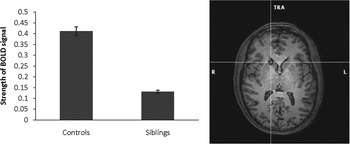
For the right caudate (Fig. 1), there was a significant group effect (t 81 = −2.93, p = 0.0004), with stronger activation in controls than siblings during the investment phase of the trust game.
Percentage blood oxygen level-dependent (BOLD) signal change and location of the right caudate, based on mean β weights. Error bars represent standard errors.

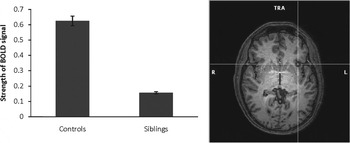
During the repayment phase of the game, there was a significant group effect for the left insula (t 81 = −3.29, p = 0.002), with stronger activation in controls than in siblings (Fig. 2). There were no significant group differences for the right TPJ (t 81 = −2.23, p = 0.03), the right STS (t 81 = −1.99, p = 0.05) and the mPFC (t 81 = −2.17, p = 0.03) for both phases of the game.
Percentage blood oxygen level-dependent (BOLD) signal change and location of the left insula, based on mean β weights. Error bars represent standard errors.

As an index of effect size, the r 2 value or coefficient of determination (i.e. the explained variance within a region) was calculated for the regions with significant group differences. For the caudate, the r 2 value was 0.028, and for the insula 0.032. To ensure that the results were not localized to a few selective voxels within the ROI, we repeated the analysis using a larger 10-mm ROI; there was no change in the results.
Whole-brain analysis
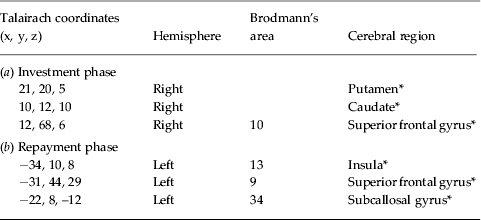
Making investments was associated with stronger activation of the right putamen, right caudate body and right superior frontal gyrus in controls compared to siblings (Table 1 a). Receiving repayments was associated with stronger activation of the left insula, the left superior frontal gyrus and the left subcallosal gyrus in controls compared to siblings (Table 1 b). The within-group results, showing the task effects for each group separately, are presented in Supplementary Tables S1–S4. These main effects of the task show activation in the medial frontal gyrus, anterior and posterior cingulate, superior temporal gyrus and fusiform gyrus.
Brain areas with stronger activation in controls versus siblings during (a) the investment phase and (b) the repayment phase

* Significant at p < 0.05 cluster extent corrected across the whole brain.
Discussion
This study investigated the neural correlates of social reward processing during beneficial social interaction in healthy first-degree relatives of patients with psychosis using a neuro-economic game approach. We found no support for behavioural differences between relatives and controls in terms of initial and mean investments.
The imaging analyses revealed reduced caudate activation in siblings during investments, and reduced insula activation during repayments. The caudate has been linked to greater activation in the generous condition of the trust game in healthy controls (King-Casas et al. Reference King-Casas, Tomlin, Anen, Camerer, Quartz and Montague2005), and might constitute a neural correlate of social reward processing. Our finding of reduced caudate activation in siblings is in line with our previous imaging study showing reduced caudate activation during trust game interactions in patients (Gromann et al. Reference Gromann, Shergill, Heslenfeld, Fett and Krabbendam2013). Just like patients, siblings showed a reduced brain reward response to beneficial social interactions, indicating that this deficit may constitute a potential endophenotype of psychosis.
Prior studies have linked the insular cortex to the processing of positive rewarding stimuli (Chau et al. Reference Chau, Roth and Green2004) and social cognition (Singer et al. Reference Singer, Kiebel, Winston, Dolan and Frith2004; Harbaugh et al. Reference Harbaugh, Mayr and Burghart2007; Tankersley et al. Reference Tankersley, Stowe and Huettel2007), both processes assumed to be impaired in psychosis. Insula activation during the trust game has been associated with reward and arousal (van den Bos et al. Reference van den Bos, van Dijk, Westenberg, Rombouts and Crone2009). Moreover, the anterior insula has been postulated to form part of the brain salience network (Seeley et al. Reference Seeley, Menon, Schatzberg, Keller, Glover, Kenna, Reiss and Greicius2007; Menon & Uddin, Reference Menon and Uddin2010). Combined with our finding of reduced insula activation in siblings, this may suggest that reduced attention to social stimuli could be due to ineffective salience processing in the anterior insula.
Our results from the exploratory whole-brain analysis are in line with these ROI results: controls showed stronger activation than siblings of the caudate during investments and stronger activation of the insula during repayments. Additionally, we found stronger activation of the putamen during investments, the superior frontal gyrus during investments and repayments, and the subcallosal gyrus during repayments. We did not have an explicit hypothesis regarding the subcallosal gyrus, but it has an established role in controlling hedonic tone and is observed to be impaired in depressive illness (Hamani et al. Reference Hamani, Mayberg, Stone, Laxton, Haber and Lozano2011). The putamen has been linked to reward processing (Sanfey, Reference Sanfey2007), and may hence contribute to impaired reward-related activation in response to cooperation. This strengthens the caudate finding from the ROI analyses, suggesting that siblings show a reduced activation of regions of the brain reward circuit in response to beneficial social interactions. Our imaging data are in line with the findings of previous studies showing that reward-related brain activation is linked to engaging in economic exchange games in healthy controls (Rilling et al. Reference Rilling, Gutman, Zeh, Pagnoni, Berns and Kilts2002; Delgado et al. Reference Delgado, Frank and Phelps2005; King-Casas et al. Reference King-Casas, Tomlin, Anen, Camerer, Quartz and Montague2005), and further strengthens the hypothesis that aberrant social reward mechanisms may underlie disturbed social interactions in psychosis (Gromann et al. Reference Gromann, Shergill, Heslenfeld, Fett and Krabbendam2013).
Despite our expectations, we did not find significant group differences in terms of TPJ, STS or mPFC activation. However, considering that the effects in the traditional mentalizing regions just failed to reach significance, they may represent a trend effect in which relatives show intermediate activation of social brain areas, along the lines of behavioural findings on mentalizing where relatives often tend to perform intermediate to controls and patients (Versmissen et al. Reference Versmissen, Janssen, Myin-Germeys, Mengelers, Campo, van Os and Krabbendam2008). The findings indicate that the neural basis for making inferences about the partner's next moves and intentions might work (almost) equally well in siblings as in the control individuals. The fact that neither the whole brain nor the ROI analyses yielded any brain regions with stronger activation in the sibling than in the control group, suggests that siblings do not use compensatory processing strategies. This is also in line with the previous behavioural finding of intact feedback responsiveness in relatives during trust game interactions (Fett et al. Reference Fett, Shergill, Joyce, Riedl, Strobel, Gromann and Krabbendam2012), implying that their ability to respond flexibly may be linked to a more intact mentalizing system. Abnormal mentalizing activation seems to occur in patients during the trust game (Gromann et al. Reference Gromann, Shergill, Heslenfeld, Fett and Krabbendam2013), but not in their healthy relatives. This may suggest that the observed mentalizing deficits during social encounters in patients are related to the illness itself, and may not constitute a potential risk factor for psychosis. By contrast, reduced basic trust was demonstrated in relatives previously (Fett et al. Reference Fett, Shergill, Joyce, Riedl, Strobel, Gromann and Krabbendam2012), reflecting lower levels of reward during trusting behaviour, which can be related to our new finding of reduced neural reward processing. This implies that impaired reward-related activation seems to be present in both patients and healthy siblings, suggesting a potential role as a vulnerability marker for psychosis.
Our finding of no behavioural differences between the groups in terms of mean investments is in line with our hypothesis and our previous behavioural study showing that first-degree relatives were able to adapt their trusting behaviour when receiving feedback on their partner's cooperativeness (Fett et al. Reference Fett, Shergill, Joyce, Riedl, Strobel, Gromann and Krabbendam2012). In general, this finding is also supported by previous studies showing that investment behaviour in healthy individuals is strongly reinforced by the reciprocity of the interacting partner (Croson & Buchan, Reference Croson and Buchan1999; Glaeser et al. Reference Glaeser, Laibson, Scheinkman and Soutter2000; Scharleman et al. Reference Scharleman, Eckel, Kacelnik and Wilson2001; Phan et al. Reference Phan, Sripada, Angstadt and McCabe2010). Surprisingly, we did not find evidence for reduced basic trust in siblings. This is at odds with our previous studies showing lower basic trust in patients (Gromann et al. Reference Gromann, Shergill, Heslenfeld, Fett and Krabbendam2013) and first-degree relatives (Fett et al. Reference Fett, Shergill, Joyce, Riedl, Strobel, Gromann and Krabbendam2012). However, the current study only included one round of initial investment whereas the earlier study was set up with five rounds of initial investment, during which subjects received no information on the partner's repayment, allowing for a more thorough investigation of basic trust. Future fMRI studies should focus on a more elaborate assessment of basic trust by including a condition of subsequent non-feedback rounds, as described in our previous behavioural study (Fett et al. Reference Fett, Shergill, Joyce, Riedl, Strobel, Gromann and Krabbendam2012). Alternatively, there may be differences in characteristics associated with basic trust of the relatives tested in the current study compared to the relatives from our earlier study. Finally, the extent to which the trust game indexes social reward as distinct from generic reward processing is unknown, in addition to whether individual attitudes towards risk taking may have an impact on the behaviour during the trust game interaction. Although several authors have argued that attitudes towards risk influence behaviour in a trust game (Karlan, Reference Karlan2005; Kosfeld et al. Reference Kosfeld, Heinrichs, Zak, Fischbacher and Fehr2005; Fehr, Reference Fehr2009), empirical studies point towards a fundamental distinction between those components. First, it has been shown that risk attitudes did not predict trust decisions (Eckel & Wilson, Reference Eckel and Wilson2004). Second, behaviour in a task not involving trust decisions was unrelated to behaviour in a standard trust game (Houser et al. Reference Houser, Schunk and Winter2010). Our within-group results revealed activation in brain regions that have been implicated as neural substrates of social cognition (Adolphs, Reference Adolphs2009). This supports the notion that our paradigm measures social reward. Moreover, providing social information had an impact on traditional reward learning systems in the striatum (Delgado et al. Reference Delgado, Frank and Phelps2005), indicating a clear distinction between social learning and reward learning. However, data on healthy individuals playing the trust game during hyperscanning have shown a clear shift in the trust signal from the repayment towards the investment phase, in line with traditional reinforcement learning (King-Casas et al. Reference King-Casas, Tomlin, Anen, Camerer, Quartz and Montague2005). Combined with the finding of aberrant reward prediction error in psychosis (Murray et al. Reference Murray, Corlett, Clark, Pessiglione, Blackwell, Honey, Jones, Bullmore, Robbins and Fletcher2008), this suggests a prominent role of neural reward processing in the mechanisms underlying social interactions. The trust game paradigm was not specifically designed for testing mentalizing, but to assess trust in the context of social interactions in an economic exchange game. Decision making in these games is thought to rely on mentalizing abilities of varying complexity; it is important to predict the moves and intentions of the game partner; and also to understand how the game partner perceives and interprets one's own moves. Previous research has supported the notion of a clear social component underlying decision making in trust game paradigms. First, social interactions in the trust game have been linked to perspective taking and the ability to represent the intentions and goals of others (Sripada et al. Reference Sripada, Angstadt, Banks, Nathan, Liberzon and Phan2009; van den Bos et al. Reference van den Bos, Westenberg, Van Dijk and Crone2010; Fett et al. Reference Fett, Shergill, Gromann, Dumontheil, Blakemore, Yakub and Krabbendam2014). Second, research on the neuropeptide oxytocin has revealed a clear distinction between social learning and non-social learning. Specifically, oxytocin had an enhancing effect on social learning, but did not affect learning in a non-social risk game (Baumgartner et al. Reference Baumgartner, Heinrichs, Vonlanthen, Fischbacher and Fehr2008). Our findings with regard to relatives may suggest that impaired social reward processing might constitute a vulnerability factor for social deficits commonly observed in psychosis. However, the design of the study does not allow us to clearly differentiate social from generic reward. Further research is needed to disentangle the relationship between social learning, reward processing and risk sensitivity during social interactions.
Our findings may further be limited by the use of a computer algorithm for the role of the trustee rather than using a real human partner. However, the debriefing check showed that few individuals in either group indicated any doubts on the reality of the other player when assessed using non-directive questions about the perceived fairness of the partner, lending support to the notion that subjects believed in the social interactive nature of the task. However, approximately half the sample in both groups indicated some doubt at some time during the game that they were playing a real person, assessed by a direct question about this. We chose not to exclude these subjects from our sample as there were no systematic differences between the groups in terms of their doubt and, more pragmatically, our within-group results show that both siblings and controls activated well-recognized social brain regions during the investment and repayment phases of the game. This indicates that our subjects were engaging in mentalizing during the trust game interaction. Future studies could focus on trust game fMRI paradigms with real human partners. Moreover, it may be of interest to also study negative social interactions in first-degree relatives of patients with psychosis.
In conclusion, this study provides new evidence for diminished caudate, insula and putamen signals in response to beneficial social interaction in siblings of patients with psychosis. This may indicate that aberrant neural social reward processing reflects, at least in part, vulnerability for psychosis.
Supplementary material
For supplementary material accompanying this paper visit http://dx.doi.org/10.1017/S0033291714000737.
Acknowledgements
S. S. Shergill was funded by a European Research Council Consolidator Award, a Medical Research Centre (MRC) New Investigator Award, and supported by the Mental Health Biomedical Research Centre at South London and Maudsley (SLAM) National Health Service (NHS) Foundation Trust and King's College London. L. Krabbendam was funded by a VICI grant and A.-K. Fett by a VENI grant from the Netherlands Organization for Scientific Research (NWO).
Declaration of Interest
None.