INTRODUCTION
The geographical distribution of the honeycomb worm Sabellaria alveolata (L.) stretches from the Firth of Clyde and Berwick in the North Sea as far as the Moroccan coast (Gruet & Lassus, Reference Gruet and Lassus1983). Intertidal reefs formed by this species have been recorded from a range of Atlantic and Mediterrnanean locations (Williams, Reference Williams1954; Wilson, Reference Wilson1971; Anadón, Reference Anadón1981; Gruet, Reference Gruet1986; Almaça, Reference Almaça1987; Vorberg, Reference Vorberg1995; Porras et al., Reference Porras, Bataller, Murgui and Özhan1996; Sousa Dias & Paula, Reference Sousa Dias and Paula2001). There are limited records also of this species forming reefs subtidally (Molinier & Picard, Reference Molinier and Picard1953; Mettam et al., Reference Mettam, Conneely and White1994; De Grave & Whitaker, Reference De Grave and Whitaker1997).
Based on their life history, Sabellariidae were classified as ‘violent’ forms, by Sveshnikov (Reference Sveshnikov1985), because this family of highly competitive fast colonizers, which are characterized by a long life span, very high fecundity and high dispersal capability (Giangrande, Reference Giangrande1997), uses force to win territory and dominate the community and suppress other species such as Actinia and limpet species (Wilson, Reference Wilson1971). However, the colonies, in their role as habitats, may be of considerable value to certain species of very small animals (Wilson, Reference Wilson1971), with eroded reefs showing high species richness (Porras et al., Reference Porras, Bataller, Murgui and Özhan1996), while sabellariid reefs are also important feeding grounds for many marine species (Kirtley, Reference Kirtley1992). Commito et al. (Reference Commito, Celano, Celico, Como and Johnson2005) described S. alveolata as an important ecosystem engineer. Sabellaria alveolata has been reported to block off coastal estuaries by elevating sand levels in the region of Mont Saint-Michel (Wilson, Reference Wilson1971). Kirtley (Reference Kirtley1992) described reef-building sabellariids as natural ‘surf zone engineers’ and he (Kirtley, Reference Kirtley1968) suggested that a greater knowledge of the long-term effects of them may, for example, be of benefit to engineers designing coastal defences.
Despite their biological and physical effects, other than the classic papers of Wilson (e.g. Reference Wilson1929, Reference Wilson1968a, Reference Wilson1971) in the United Kingdom and research in France (e.g. Fauré-Fremiet, Reference Fauré-Fremiet1921, Reference Fauré-Frémiet1924; Cazaux, Reference Cazaux1964; Bhaud & Gruet, Reference Bhaud, Gruet and Hutchings1984; Gruet & Lassus, Reference Gruet and Lassus1983; Gruet, Reference Gruet1986, Reference Gruet, Caline, Legendre, Le Rhun, L'Homer, Mathieu and Zisinden1988; Dubois et al., Reference Dubois, Commito, Olivier and Retière2006), the biology of this polychaete species has received relatively little attention. Relatively little has been published on the biology or ecology of this species in Irish waters (Williams, Reference Williams1954; Ryland & Nelson-Smith, Reference Ryland and Nelson-Smith1974; De Grave & Whitaker, Reference De Grave and Whitaker1997). This paper describes the reproductive cycle of S. alveolata on an Irish shore and compares it with published accounts for this species in the United Kingdom and France. Reproduction in sabellariids is only sexual, with separate sexes, with sperm and eggs being shed into the sea in mid-summer (Kirtley, Reference Kirtley1968; Wilson, Reference Wilson1969). Previous researchers studying the reproductive cycle of S. alveolata, have either examined the external appearance of the detubed worm (unspent worms are creamy white for males and purplish or rose-violet for females, while spent worms are thin-bodied brownish) (Wilson, Reference Wilson1971; Gruet & Lassus, Reference Gruet and Lassus1983; Wilson, Reference Wilson1968b), or have staged the females only, based on whether the females release their gametes when removed from their tubes in the laboratory, as well as the number and size of oocytes (Gruet & Lassus, Reference Gruet and Lassus1983). In this study the stage of gametogenic development in both males and females was assessed using histology. In order to score the male and female gametes, a scale of gametogenic development was produced for this species.
MATERIALS AND METHODS
Samples were collected monthly from August 2000 to September 2001 from the intertidal area of a semi-exposed shore in County Cork, Ireland. The August 2000 sample came from Garrettstown (51°38′N 8°35′W), while all subsequent samples were collected from Howes Strand (51°38′N 8°38′W). In September 2000 two samples were taken—one each from both Garrettstown and Howes Strand, to ensure that gonad development was the same at both shores.
Samples were taken using a corer (6.5 cm in diameter), with three cores collected on each date except November 2000, when, due to adverse weather conditions, only one core could be obtained. Cores were taken from the centre of a reef and were presumed to possess animals of a similar age. Areas of the reef with a ‘rose-ground pattern of pillow lace’ appearance (Wilson, Reference Wilson1971), indicative of a mixture of young and old tubes, were avoided, although it is known that breeding activity begins in their first year (Gruet & Lassus, Reference Gruet and Lassus1983). On returning to the laboratory, the worms were anaesthetized in seawater containing 0.1% magnesium sulphate for up to three hours. This relaxed the muscles of the body releasing the uncini, ensuring no stretching or deformation of the segments. After extraction from the tube, the calcareous operculum was removed with a sharp blade, before the worm was fixed in 10% seawater–formalin for 24 hours. Each worm was dehydrated, embedded in paraffin and sectioned longitudinally at 7 µm and stained with Harris's haematoxylin and counterstained in eosin. A number of replicate slides were then prepared per worm. The slides were examined microscopically to determine sex and the stage of gametogenesis. Any slides where the full length of the worm could not be seen were discarded. Between 10 (November 2000, when few samples could be collected) and 136 worms were examined each month.
RESULTS
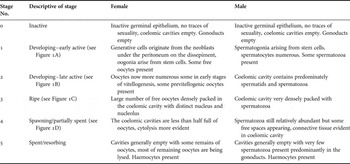
The stage of development was scored (see Table 1) from 0 to 5, based on an adaptation of the scale devised by Cotter et al. (Reference Cotter, O'Riordan and Myers2003) for Pomatoceros lamarckii and P. triqueter.
Description of the stages of gametogenesis of female and male Sabellaria alveolata as seen by histological examination.

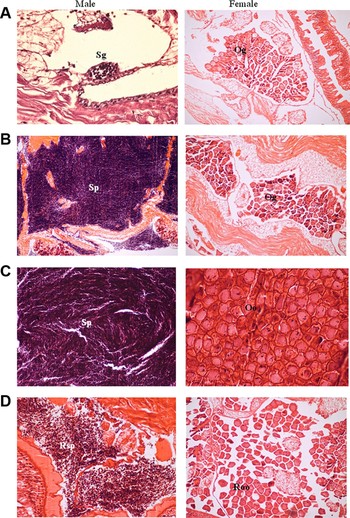
The different stages of gonad development, from stages 0 to 4, in male and female Sabellaria, as seen by histological examination, are shown in Figure 1.
Different stages of gonad development in male and female Sabellaria. (A) Developing–early active; (B) developing–late active; (C) ripe; (D) spawning/partially spent. Og, oogonia; Oo, oocytes; Rsp, residual spermatozoa; Roo, residual oocytes; Sg, spermatogonia; Sp, spermatozoa.

Sex-ratio
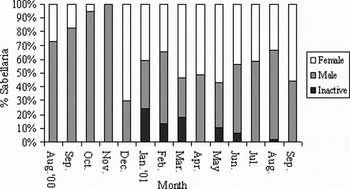
In total 993 worms were examined over the 14 month study period. Individuals whose sex could not be distinguished, based on stage of gametogenesis, as either male or female were classified as inactive (56/993 worms; 5.6%). These were seen in six of the fourteen months studied. The highest proportions occurred from January to March (range: 13–24% of the worms) (see Figure 2).
Percentage of male, female and inactive Sabellaria observed over 14 months from August 2000 to September 2001.

In most months there was an unequal ratio of males:females in the worms that could be sexed, with 100% being male in November, but this was the month when very few samples could be collected. Over the whole sampling period the average percentage of inactive:male:female worms was 5.6%:55.0%:39.4%, with the ratio of active:inactive being 17.7:1. When inactive worms were excluded the ratio of males:females, totalled over the whole period, was 1.4:1. A Chi-square test showed that there was a very highly significant difference in the sex-ratio (χ2 = 25.3, df = 2, P < 0.001)
Male gametogenesis
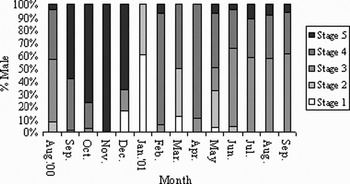
Although not all worms showed the same stage of gametogenic development in a given month, a clear cycle of male gametogenesis was evident from the 14 months studied (see Figure 3), with a distinct peak in the summer (June–September) when the majority of the animals were ripe (Stage 3—coelomic cavity very densely packed with spermatozoa; see Figure 1C).
Stages of gametogenesis observed in male Sabellaria observed over 14 months from August 2000 to September 2001.

At the start of the sampling in August 2000, four of the five stages of gametogenesis were present, with a high proportion (49%) being ripe (Stage 3), followed by spent (40%). In the subsequent two months, only a small percentage (<3%) of the worms were still ripe, with most animals being spent or partially spent, culminating in November with 100% being spent (Stage 5). In subsequent months, the gametes began redeveloping, with all animals either Stage 1 (spermatogonia arising from stem cells, spermatocytes numerous and some spermatozoa present) or Stage 2 (coelomic cavity contains predominately spermatids and spermatozoa) by January 2001. Over the next few months the percentage scored as ripe increased, as did the number partially spent, while other worms had gametes still developing. From June to September over half (range: 57–61%) of the animals were ripe, with most of the rest of the worms being either partially spent or totally spent (see Figure 3).
Female gametogenesis
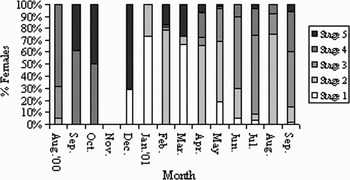
Similar to the male worms, development within the whole population was not synchronous, and as with the males, the females also showed a distinct cycle of gametogenesis, with a clear peak in maturation of the population in the summer (see Figure 4).
Stages of gametogenesis observed in female Sabellaria observed over 14 months from August 2000 to September 2001.

In August 2000, a small number of worms were still developing oocytes (Stage 2: developing to late active), while over 25% were ripe (Stage 3), but the majority (68%) were partially spent (Stage 4). During the next few months only two stages of gametogenesis were seen. In September and October all of the females were either partially spent or spent. There were no samples of females in November, but by December, although the majority of these were spent, 29% were scored as developing–early active. This trend in gametogenic redevelopment continued in the next few months. The peak in the number of females scored as ripe (i.e. when a large number of free oocytes were densely packed in the coloemic cavity) occurred in July (66%). By September 2001, nearly 40% of the females were partially spent/totally spent, but unlike in September of the previous year there were still females with developing gametes as well as ripe ones (see Figure 4).
DISCUSSION AND CONCLUSIONS
As far as we are aware, this is the first published description of a scale of gametogenic development, based on histology, for Sabellaria alveolata, although the appearance of both the male and female gametes during development had been described previously though not using histology (e.g. Dehorne, Reference Dehorne1911; Fauré-Fremiet, Reference Fauré-Fremiet1921, Reference Fauré-Frémiet1924). Dixon (Reference Dixon1981) had outlined the reproductive biology of the serpulid Ficopomatus enigmaticus (Fauvel) (formerly Mercierella enigmatica), using smears, abdomen colour, histology and body size. Similar to our work, he described the histological appearance of the gametes as they developed. However, unlike F. enigmaticus, in which segments producing gametes do not all develop simultaneously, so different stages of development could be found within an individual worm, in S. alveolata the same stage of gametogenesis was present throughout an individual worm. Also, unlike S. alveolata, hermaphrodites, as well as males and females, can be seen in F. enigmaticus (Dixon, Reference Dixon1981).
In the present study, there is a significant difference in the sex-ratio of the honeycomb worms. However, Gruet & Lassus (Reference Gruet and Lassus1983) reported a sex-ratio of 1:1 during their study in north-west France, based on 25 samples (a total of 789 worms) taken between March 1978 and September 1979.
Based on the development of both the male and female gametes, in this south-west Ireland population there appears to be one main spawning period, between June and September. One main spawning period has also been recorded in England, but over a shorter period, i.e. at Duckpool, Cornwall, the breeding (i.e. spawning) season is in mid-July, with most worms being empty of mature genital products by the end of July (Wilson, Reference Wilson1968b, Reference Wilson1969, Reference Wilson1971). Wilson (Reference Wilson1968b) suggested that the advantage of a mass spawning during a finite period would be fully matured eggs capable of producing first-quality larvae. Dixon (Reference Dixon1981) noted that in the United Kingdom for F. enigmaticus, peak spawning activity coincided with the period of high water temperature in August and early September. Seawater temperatures off the south-west coast of Ireland drop to their minimum during February (average ~10°C), while maximum temperatures (~16°C) occur in August (Met. Éireann, www1) so gonad development and spawning in Ireland would correspond well with the time frame over which seawater temperatures are increasing. In Ireland, Simkanin et al. (Reference Simkanin, Power, Myers, McGrath, Southward, Mieszkowska, Leaper and O'Riordan2005) reported no significant change in the intertidal abundance of this species from 1958 to 2003, on the 28 shores compared around the coast. However, Hiscock et al. (Reference Hiscock, Southward, Tittley and Hawkins2004) have suggested that with increasing temperatures this southern species may increase in abundance where it currently occurs and may extend its distribution northwards in the British Isles. The influence of anthropogenic activity is also a factor of significance when considering impacts on reef formations (Holt et al., Reference Holt, Rees, Hawkins and Seed1998; Dubois et al., Reference Dubois, Commito, Olivier and Retière2006) as are severe winters. In contrast to S. alveolata, in south-west England, the subtidal species Sabellaria spinulosa Leukhart spawns between January and March while the sea is still cold, thus up to 5 to 6 months before the intertidal species which spawns at summer temperatures (Wilson, Reference Wilson1970).
Although the main spawning period of S. alveolata is in the summer in south-west England, Wilson (Reference Wilson1969) noted that settlement of larvae has been recorded in most months from September to April. Wilson (Reference Wilson1971) commented that ‘often when the main spawning period is over a few mature or incompletely spent worms, especially males will be noticed, but these are always few in number’. Although in south-west Ireland no ripe oocytes were found in the winter in the present study, by contrast in north-west France (Roches de La Fosse, near the island of Noirmoutier), Gruet & Lassus (Reference Gruet and Lassus1983) recorded oocyte maturity through most of the year, with only a very short period of time (September–October) when only very small oocytes were present and there were two spawning periods, March–April and June/July to September. The peak in oocyte number occurred in May–June, when water temperature and primary production were increasing. Further north at Champeaux, in the Bay of Mont Saint-Michel in north-west France, Gruet (Reference Gruet1986) reported settlement of S. alveolata between March and August, based on the appearance of young worms tubes possibly related to the spring algal bloom, but reproduction also occurs at other times of the year (Wilson, Reference Wilson1968a; Bhaud & Gruet, Reference Bhaud, Gruet and Hutchings1984; Dubois, 2006). Gruet & Lassus (Reference Gruet and Lassus1983) hypothesized that in north-west France S. alveolata may be able to breed in winter because of enough reserves or external food. These authors pointed out that their study site is at the centre of distribution of this species and commented that it would be interesting to see whether further north, where temperature would be the sole factor, only single summer spawning occurs. As seen from the present study, in south-west Ireland, at the most northerly site where its reproduction has been studied so far, this appears to be the case.