Introduction
Maintaining natural characteristics and values of beaches and dunes on coasts subject to human use is difficult because healthy natural coastal systems are dynamic, but many stakeholders desire stability. Most shore protection projects are designed to reduce dynamism by: (1) creating barriers to waves and rising water levels using seawalls and dykes; (2) creating traps for sediment moved by waves and winds using groynes, jetties and sand fences; and (3) stabilizing surfaces using vegetation or resistant materials.
Managers are beginning to re-evaluate the desirability of stabilizing coasts and are examining ways to make landforms more mobile to enhance sand transfers from source areas to nearby eroding areas, reinitiate biological succession to increase species diversity or return developed land to a more natural condition. Actions that have been implemented or suggested for enhancing sand transfers include making groynes more permeable (Rankin et al. Reference Rankin, Bruno and Herrington2004; Wang & Kraus Reference Wang and Kraus2004), instituting sand-bypass systems at controlled inlets (Seabergh & Kraus Reference Seabergh and Kraus2003) and allowing formerly stabilized coastal cliffs to erode (Brampton Reference Brampton and Hooke1998). Reinitiating biological succession includes mowing or controlling grazing (Kooijman Reference Kooijman, Martínez and Psuty2004) or removing vegetation and topsoil to reactivate stabilized dunes (van Boxel et al. Reference van Boxel, Jungerius, Kieffer and Hampele1997; Arens et al. Reference Arens, Slings and de Vries2004). Returning developed land to a more natural state includes many projects to restore coastal marshes and dunes where they were eliminated to accommodate human uses (Finkl & Khalil Reference Finkl and Khalil2005; Kentula & Thayer Reference Kentula and Thayer2005; Teal & Peterson Reference Teal and Peterson2005). These restoration projects often appear to be the target where a lost natural environment has so much value that its replication is considered cost effective or where the existing environment has so little value under present conditions that protection efforts are discontinued.
Although scientists advocate managing coastal landforms as dynamic systems because of their adaptability and species diversity, it is not always easy for managers to consider mobility and change as positive factors (De Raeve Reference De Raeve, van der Meulen, Jungerius and Visser1989; Wanders Reference Wanders, van der Meulen, Jungerius and Visser1989; Doody Reference Doody2001). Compromise solutions are often required to allow some of the natural dynamism that helps to maintain the distinctive sub-environments and exchanges of sediment and biota characteristic of a natural coastal system while providing people some stability (Powell Reference Powell and Barrett1992; Brampton Reference Brampton and Hooke1998; Nordstrom Reference Nordstrom and Dallmeyer2003). The need for compromise places emphasis on controlling and adapting to change rather than preventing it, using a strategy that can be called controlled dynamism. Controls can be placed on the magnitude of change by providing protection against some but not all storm effects or controlling the location of change by protecting some but not all regions.
Controlled dynamism may serve to re-establish geomorphic-biotic interactions previously severed by more rigid management strategies. Examples are needed of locations where changes in policy and practice result in conversion of landforms to more natural, but often less stable systems. This is occurring in the state of Mecklenburg-Vorpommern (Germany), where management policies now identify nature protection as an integral component of projects designed to protect human uses. The approach is facilitated by the lack of intensive development in much of the state and stimulated by several pro-environmental policies of the German federal government, the European Union (EU) and the convention on the protection of the marine environment of the Baltic Sea formulated by the Helsinki Commission (HELCOM), but it is also complicated by the long tradition of using engineering structures to protect human development and the significance of some natural landforms for flood protection and as sources of sediment.
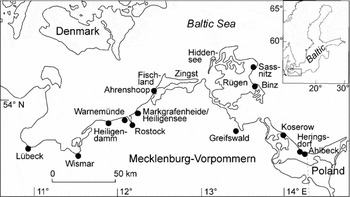
Mecklenburg-Vorpommern's 354-km long outer (Baltic Sea) coast (Fig. 1) consists of bluff segments composed of Pleistocene outwash and till, interspersed with low uplands, spits and accreting forelands composed primarily of Holocene sand and gravel. This outer coast provides shelter to a longer shoreline within the inner bays (boddens). Management problems on the Baltic Sea coast include cliff failure on bluffs and overwash and flooding on low-lying coasts, with progressive erosion a problem on both types of coast. Many low-lying coastal segments owe their existence to sediment supplied alongshore from eroding bluffs, which are less mobile and are believed to act as headlands (hinge points) that help stabilize adjacent shores.
The coast of Mecklenburg-Vorpommern, Germany.

Tidal range is < 0.1 m. Storm floods with still water 1–1.4 m above normal occur 2–5 times per year on the open Baltic Sea coast; heavy flooding, with water levels 1.4–1.7 m above normal occur every 5–20 years. Deep-water wave heights are normally 0.5–1.5 m. Extreme storm waves reach a height of 3–4 m and can attain 5 m. About 70% of the Baltic Sea coast is eroding at an average of 0.34 m yr−1 (MBLU [Ministerium für Bau, Landesentwicklung und Umwelt] 1997). Most of the coast is in a semi-natural state, without buildings but having human-modified landforms and vegetation. About 40% of the Baltic Sea coast is designated as national parks or nature protection areas, and c. 40% of the coast is designated as landscape protection areas, biosphere reserves or nature parks.
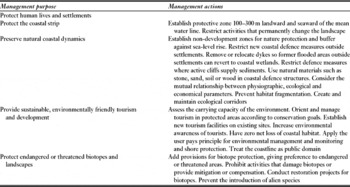
Many recommendations of the EU and HELCOM relevant to beach management (Table 1) are similar to those suggested for programmes in other parts of the world, but the recommendations have been translated into positive action in Mecklenburg-Vorpommern, providing special insight into: (1) removing or relocating dykes; (2) restricting coastal defence measures at active cliffs; (3) using natural materials in defence structures; (4) requiring zero net loss of habitat; and (5) applying the user-pays principle for restoring damaged habitat.
Policy guidelines for coastal management that are applicable to beach and dune environments, derived from HELCOM recommendations (URL http://www.helcom.fi/Recommendations.html) and the European Code of Conduct for Coastal Zones (Council of Europe 1999). The guidelines are not differentiated by the responsible agencies because there is considerable overlap and redundancy between them.

This paper examines planned and existing projects in the state that have the potential for returning artificially stabilized landforms to more dynamic systems through managed realignment of low lying coasts and enhanced sand transfers on high relief (bluff) shorelines. We then add suggestions for making landforms designed as protection structures more natural by creating greater diversity of topography and vegetation and changing the way sediment from artificial nourishment projects is used. Attention is focused on the Baltic Sea coast, where the relatively high wave energies and flooding problems make return to a more dynamic system more risky than in estuaries, where managed shoreline realignment and restoration projects are considered more feasible and are better documented (Hennicke 2000; French Reference French2006; Garbutt et al. Reference Garbutt, Reading, Wolters, Gray and Rothery2006). The analysis is based on evaluation of planning and policy documents, review of the literature on shore protection projects and site visits to field sites conducted in spring 2006.
THE POLICY FRAMEWORK
The principal document guiding shore protection efforts within the state is the General Plan, Coastal and High Water Protection, Mecklenburg-Vorpommern (MBLU no date). A distinguishing characteristic of this plan is the importance of nature protection and landscape care in determining the best protection strategies. Relevant state laws include: (1) Landes-Wassergesetz LWaG 1992 (Water Act) that regulates goals and responsibilities for coastal protection; (2) Landes-Naturschutzgesetz LNatG 2002 (Nature and Landscape Conservation Act) that regulates legitimacy, compensation and substitution of environmental impacts, and defines protected species, biotopes and geotopes and protected areas; (3) Landes-Waldgesetz LWaldG 1993 (Forest Act) that regulates protective forests; (4) Landes-UVP-Gesetz LUVPG 2002 (Environmental Impact Assessment Act) that regulates the assessment of environmental impacts and appropriate compensation, as well as involvement of the public; and (5) Landes-Planungsgesetz LPlG 1998 (Planning Act) that regulates the general regional development, defines areas of main land use and identifies the need for protection. An interesting feature of the German system is that national parks are managed by each state, making it easier to integrate their management with management of adjacent areas.
The need to protect human lives and settlements is an overriding concern, but many state policies which are compatible with international guidelines to preserve natural dynamics, provide for sustainable development and protect biotopes (Table 1) can be accommodated within projects designed to protect people. Projects favourable to environmental protection or enhancement that have been implemented or are planned for the future on the Baltic Coast include: (1) relocating dykes further landward or allowing dykes or protective dunes to erode to expose more land to episodic inundation by the sea; (2) restoring sediment transfers from bluffs to adjacent shore segments; (3) increasing sediment transport rates through groyne fields; (4) abandoning the practice of planting protective forests; and (5) removing exotic vegetation from dunes. Construction costs for environmentally friendly alternatives are often defrayed using funds for compensation or mitigation of environmentally-damaging actions elsewhere (such as construction of marinas), a variant of the user (or polluter) pays principle applied to the objective of zero net loss of coastal habitat (Table 1). Direct monetary evaluation of the biotopes affected is not calculated. The area and its value according to a biotope type catalogue is considered, based on basic ecological, zoological and botanical data, from which the biodiversity, the occurrence of endangered species and the ecological functions are evaluated, yielding a number on an ordinal scale from 0 to 4. A compensation number is then calculated ranging from 0 to 8 (where the biotope value is 4). A correction factor is used to consider the distance from other areas already adversely impacted, ranging from 0.75 to 1.5. The severity of the impact is then determined, ranging from an impact factor of 0.05 (nearly insignificant impact) to 1 (total biotope loss) (Ministerium für Umwelt und Natur 1999). The need for compensation is calculated using the area of the biotope affected multiplied by the compensation number, the correction factor and impact factor.
SHORE PROTECTION METHODS AND PLANNED CHANGES
The earliest documented shore protection efforts were use of sand-trapping fences to build dunes or prevent inundation by blowing sand near Rostock in 1423 (Cordshagen Reference Cordshagen1964). The first groynes were built in 1843 (Lampe Reference Lampe1996), and the first attempts to protect bluffs with rock walls was in 1851 (Cordshagen Reference Cordshagen1964). After 1835, protective forests were planted on the tops of bluffs to stabilize them and protect landward areas from strong winds, blowing sand and migrating dunes. Later, protective forests were planted on low-lying coasts to dampen waves in case dunes were breached during storms.
Many past shore protection projects were implemented just after damaging storms, such as those occurring in 1304, 1320, 1449, 1625, 1694, 1784, 1825, 1864, 1872, 1904, 1913, 1949, 1954, 1995 and 2002 (Geinitz Reference Geinitz1905, Reference Geinitz1914; Krüger Reference Krüger1911; Kohlmetz Reference Kohlmetz1967; Redieck & Schade Reference Redieck and Schade1996; Birr Reference Birr1999; Bärens & Hupfer Reference Bärens and Hupfer1999; Dietrich & Liebsch Reference Dietrich and Liebsch2000). The storm flood of 1872 had the highest documented elevation (2.8 m above mean water level). This storm resulted in several nationally-funded shore protection structures and it provided the design height that is still used for protection structures in the state (MBLU no date). Between World War I and World War II, steel groynes were emplaced and seawalls were commonly built to protect promenades in resorts and on eroding bluffs. Seawall construction continued into German Democratic Republic (GDR) times, when steel groynes were replaced by wood groynes. The first beach nourishment project was conducted in 1968. The first breakwater for erosion protection was emplaced in 1978 (MBLU no date).
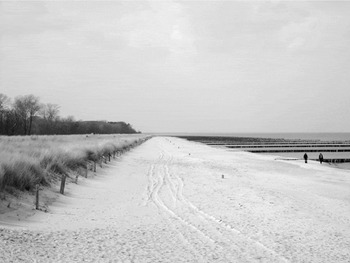
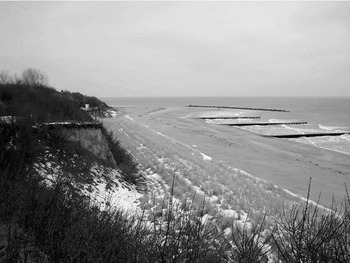
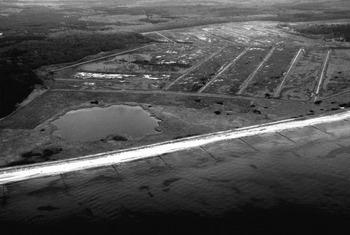
Many locations now reveal several types of protection (Fig. 2), and a cross-shore transect on the low lying coasts may have up to five distinct protection zones including a groyne field, a nourished beach, a protective dune, a protective forest and a dyke. Bluff shores may be protected by seawalls or by breakwaters, groynes, beach fill and even artificial dunes at the base of the bluff (Fig. 3).
The protective foredune and forest just west of Koserow, where the rate of erosion is 0.9 m yr−1.

Ahrenshoop, looking south-west, showing the breakwater, groynes and protective foredune designed to protect the bluff but allow it to function as a hinge point and feeder beach for the adjacent low-lying coast. Note the linear artificial nature of the dune at the base of the bluff.

Beach nourishment
Artificial fill operations are conducted to widen beaches, build dykes and dunes and re-establish sediment budgets at headlands. As of 1994, 44.3 km (12.5%) of the Baltic Sea coast of the state were nourished (MBLU no date). Nourishment operations use sediment from offshore and place it hydraulically on both beach and dune. Projects average 90–150 m3 of sand per metre of coast, with an average expected renourishment frequency of 6–7 years. Sand that is somewhat coarser and more poorly sorted than native sand is sought for emplacement on the beach because of its greater stability.
Dykes
The dyke system includes sea dykes on the open Baltic coast, smaller dykes on the bodden coast, and harbour dykes. Sea dykes extend for 42 km (11.9% of the coast). They are built of sand derived from offshore in the Baltic Sea, with about 0.1–0.2 m of sod placed on the surface and planted with grass. A mixture of seeds is used containing the native plants Festuca rubra ssp. rubra (30%), Festuca rubra ssp. trichophylla (35%), Poa pratensis (25%) and Lolium perenne (10%) (Ausschuss für Küstenschutzwerke 2002). The grass is mowed, and no trees are allowed to grow because their roots would interfere with the structural integrity of the surface. The linear grassy dykes are conspicuous human artefacts in the landscape. The tops of the sea dykes are 3.5–4.5 m above HN (the state standard datum elevation, 0.14 m above mean water level). The slopes on the seaside are generally 1:4. Dykes are not resistant to wave erosion, and consideration of their integrity must be integrated with decisions about maintaining the groynes, dunes and protective forests seaward of them and the bodden dykes landward of them.
Bodden dykes are smaller than sea dykes because they are designed to protect against flooding from the bays, where wave heights and surge levels are lower. Bodden dykes are usually built of locally available peat or clay, and they have to be replaced by higher dykes composed of more resistant and less compactable material. Bodden dykes are being artificially breached in places because of the need to restore lost salt grass meadows, improve conditions for endangered species that use wetlands and increase the degree of protection provided by shorter dykes that replace old dykes (Jeschke Reference Jeschke1983; Holz et al. Reference Holz, Hermann and Müller-Motzfeld1996; Lutz Reference Lutz1996; Abraham Reference Abraham2000; Hennicke Reference Hennicke2000).
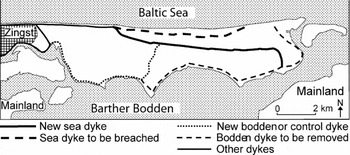
Breaches on the open Baltic Coast have not been made, but are planned. The largest project is planned for completion in 2011 at the national park near Zingst (Fig. 4). There a new dyke will be built in the centre of the spit, followed by cutting of breaches in the dyke on the seaward side and removal of the dyke on the bayside. The existing dyke system protects the surface of the spit that was reclaimed to provide pasture and protect the mainland landward of Barther Bodden from flooding. The planned changes will allow wave overwash from the Baltic Sea to occur over a larger area, diminishing wave energies before reaching the new dyke and creating a mosaic of sand flat, moor, heath and shrub communities on the former pasture. Overwash will occur across more of the spit, but not across its entire width, as was possible during large storms prior to construction of the old dykes. A dyke in the centre of the barrier will still protect the mainland from full storm surges in the Baltic Sea and prevent formation of inlets through the barrier.
Planned dyke relocation at Zingst, Germany.

Removal of the bayside dyke will allow for periodic flooding of the spit from Barther Bodden, where wave heights and surge levels will be lower than on the Baltic side. This will cause the low surface to evolve as salt grass meadow. The area of salt grass in Mecklenburg-Vorpommern decreased from 45 000 ha in the middle of the 19th century to 6600 ha in 1985 (Holz et al. Reference Holz, Hermann and Müller-Motzfeld1996) as a result of dyking. Many of the 172 polders protected by dykes are now below sea level, and the difference in elevation will only increase where dykes remain. Allowing periodic floods in the former polders will deliver fine-grained sediment and may allow the surface to keep up with sea-level rise. The surface will be unavailable for human use during inundations but will provide pasture during the summer when floods normally do not occur.
Dunes
Dunes built for shore protection (Fig. 2) are actually dykes, created using beach fill and shaped by bulldozers. There are two types: flood protection dunes and protective foredunes. Flood protection dunes are the only barrier to flooding along 105 km of the 226 km long low-lying portion of the outer coast (MBLU no date). These dunes are 3.5 m above HN and are 40–45 m wide, built of sand with a flat top and planar sides. They are rebuilt to maintain their volume when they erode and they may be protected on the seaward side by groynes and beach fill. Protective foredunes built seaward of dykes, protective forests (Fig. 2) and cliffs (Fig. 3) are smaller than flood protection dunes because they are not the primary form of protection. They have a top width of 20–25 m and planar sloping sides that give them an engineered appearance similar to flood protection dunes.
Dunes are planted with marram grass (Ammophila arenaria), hybrid marram (Ammocalamagrostis baltica) and sea buckthorn (Hippophae rhamnoides). Elaeagnus angustifolia, E. umbellata and Rosa rugosa were planted in the past, but these species will be removed when dunes are artificially rebuilt. Evolution of the flood protection dune at Heringsdorf (Fig. 5) indicates that these types of dunes may eventually resemble natural dunes in form and function if they are not repeatedly nourished or mechanically reshaped.
The protective foredune and forest at Heringsdorf in March 2006. The original linear appearance of the dune and its contact with the forest has taken on a more natural appearance.

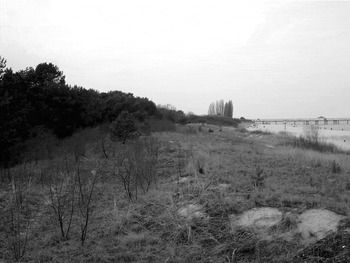
Dunes, like dykes, can be mechanically breached or the dunes can be allowed to erode to the point where they are breached by storm waves. State planners intend to allow the artificially constructed protective dune seaward of the lake Heiligensee (Fig. 6), just north-east of the developed community of Markgrafenheide (Fig. 1), to erode naturally, reducing its protective value and allowing the low upland landward of it to flood and increase the area of wetland habitat. Markgrafenheide would then be susceptible to flooding, so a new ring dyke has already been constructed around it, providing a higher barrier than previously existed. As at Zingst, the total amount of upland protected by the dyke and dune system will be reduced, but the level of protection to the buildings and infrastructure increased. This project can be implemented because it has support from local stakeholders. In contrast, the state was unsuccessful in overcoming resistance to remobilizing the protective dune on Hiddensee (Fig. 1), where nearby residents objected to allowing the flood protection dune in the national park, Vorpommersche Boddenlandschaft, to evolve. The dune was not required to protect developed land. Residents simply preferred the landscape that was familiar to them to one that was unknown and dynamic.
The low-lying coast at Heiligensee, where the protective dune will be allowed to erode, allowing for flooding and an increase in wetland habitat.

Groynes
Groynes are still being replaced in several locations and lengthened where beach fill buries them. They are considered important additions to beach nourishment projects to help retain sand volumes (MBLU no date). Groynes average 50–90 m in length. In 1996, there were 1023 groynes along 77 km (21.8%) of the outer coast, with c. 50% of the groyne fields artificially nourished. Wood pile groynes are preferred. It was found impossible to use only native wood in deeper water, because the native pine (Pinus silvestris) pilings deteriorated as a result of boring by ship bore worms (Teredo navalis) after a mass occurrence in 1993 (Sordyl et al. Reference Sordyl, Bönsch, Gercken, Kreuzberg and Schultze1998). Wood used for groynes must be water resistant, elastic and inexpensive. Other native wood, such as oak, may be water resistant, but it is expensive and does not resist Teredo. The compromise is to use tropical wood certified by the Forest Stewardship Council, based on the environmental and social evaluation of the production process. More than 65 000 pilings of primarily Brazilian acariquana (Minquartia guianensis), abiurana (Pouteria spp.), castanharana (Lecythis spp.), jarana (Lecythis spp.) and mata wood (Eschweilera spp.) were placed on the seaward portion of the groynes and native pines were placed landward of the location of bore worm influence (MBLU no date; Müller & Gercken Reference Müller and Gercken2006). Research into ways of making native pines resistant to Teredo is ongoing and the goal is to return to native pine pilings if a solution is found.
Groynes were allowed to deteriorate in GDR times because money for repair or replacement was lacking. The need to restore natural sediment transfers provides further incentive to allow groynes to deteriorate, and they are not replaced at eroding cliffs where sediment is needed on adjacent beaches, such as on Hiddensee, Ahrenshoop and Streckelsberg at Koserow, and where dunes and dykes are allowed to breach (Heiligensee and east of Zingst). Use of beach fill in combination with groynes makes permeable groynes (Fig. 2) a logical option. Groynes at the ends of groyne fields are designed with greater spacing between pilings to allow more sediment to pass them, reducing the problem of downdrift sediment starvation that is one of the major criticisms of groynes.
Seawalls
Seawalls and armoured dykes exist along 5.5% of the Baltic Sea coast (MBLU no date). Seawalls protect bluffs, but they prevent bluff sediment from entering the longshore transport system (Pilkey & Wright Reference Pilkey and Wright III1988; Kraus & McDougal Reference Kraus and McDougal1996). The need to re-establish natural sediment budgets places increasing attention on altering traditional approaches to armouring coastal bluffs (Brampton Reference Brampton and Hooke1998). It is unlikely that extensive new seawalls will be constructed because of the policy guideline restricting defence measures where active cliffs supply sediment (Table 1) and a state requirement that this lost sediment must be compensated using beach fill. Bluffs not backed by human structures are now allowed to erode, except at hinge points adjacent to lowlands. Formerly protected bluffs now eroding include the northern end of Hiddensee and Fischland. The shore at Ahrenshoop contains a segment that is allowed to erode naturally and a bluff adjacent to it where sediment transport is controlled (Fig. 3).
Seawalls may still be built if there is overwhelming public interest in protecting historic landmarks or buildings and if an existing seawall can be lengthened to accomplish this goal. This occurred at Heiligendamm, the oldest seaside resort, where a 420 m concrete wall was recently built to protect a historical building ensemble.
Breakwaters
There are now 23 breakwaters, varying in length from 50–200 m and representing 1% of the length of the outer coast. They are placed in 2–4 m water depth, 50–200 m from the shoreline (MBLU no date). They are often used with groynes and beach fill and are considered valuable in stabilizing critical hinge points at coastal bluffs (Fig. 3). Breakwaters at these locations are designed to allow enough wave energy to pass them to facilitate transport of sediment to downdrift beaches and to prevent beach accretion from reaching the breakwater, where it would create a barrier to sediment moved alongshore. The sediment bypassing breakwaters is not derived from bluff erosion; beach fill is used to protect the toe of the bluff and provide material for transport downdrift. Bluffs are managed this way at Ahrenshoop (Fig. 3) and Streckelsberg. These bluffs do not have the active cliffs, slumps, debris falls and patchy surfaces with vegetation mosaics that occur on actively eroding high-relief shores.
Protective forests
Protective forests narrower than 100 m (Fig. 2) are no longer perceived by state planners to be effective in reducing the energy of waves breaking on dykes landward of them, and planting has been stopped. The forests are allowed to evolve, but they are protected by groynes, nourished beaches and protective foredunes. They will reflect their artificial origin for many years because of the distinctive linear boundary between them and the protective dunes and dykes on either side.
Forests at seaward edges of bluffs do not evolve naturally because the seaward-most trees are cut down and removed as the bluff erodes. Trees near the edge of the bluff accumulate snow that increases the potential for saturation of the subsurface when the snow melts, thereby contributing to cliff failure (Müller-Motzfeld et al. Reference Müller-Motzfeld, Erdmann and Kornmilch1998). The roots of trees unearth soil when they are undermined by erosion and topple, and they disturb surface vegetation when they slide down the bluff. Fallen trees on the beach are considered unattractive by tourists, providing added incentive to remove them before they fall (Müller-Motzfeld et al. Reference Müller-Motzfeld, Erdmann and Kornmilch1998).
Discussion
Practicality and acceptability of existing and planned projects
Cost has always been a consideration in decisions affecting shore protection in Mecklenburg-Vorpommern (Cordshagen Reference Cordshagen1964), and attempts to save money still drive many projects. Part of the appeal of relocating dykes further landward and allowing groynes to deteriorate is the savings achieved in the cost of protecting a longer coastline. Costs are further defrayed by using funds for compensation or mitigation for actions elsewhere. In the case of dyke relocation, this lower cost alternative can accomplish goals as diverse as creating ecological corridors, adding portions of the coast to the public domain by converting them from farmland to nature areas, adding habitat for endangered species and providing a wider buffer against sea-level rise for developed lands further landward. Mitigating actions can be conducted at any size, with dyke relocation appropriate at large scale and removing exotic species suitable at small scale.
Some changes to shore protection practices in the state will be resisted by stakeholders (Jeschke & Succow Reference Jeschke and Succow2001). Lack of success in convincing residents on Hiddensee of the advantages of dune remobilization underscores the human preference for the status quo as a deterrent to strategies that allow freer interplay of natural processes. This problem of accepting change is noted elsewhere (Leafe et al. Reference Leafe, Pethick and Townend1998; Tunstall & Penning-Rowsell Reference Tunstall and Penning-Rowsell1998). Adaptation to natural change is often identified as an alternative to shore protection structures, but adaptation may also be required with protection structures as they are modified to increase dynamism.
Natural coastal landforms are dynamic, but they are not fragile. They do not have to retain a specific design shape to function as a protection structure, and it is not necessary to maintain a static natural resource inventory to protect natural features. Rapid change is the norm for coastal landforms, in response to both erosion and accretion associated with storm cycles and sea-level changes. Coastal landforms can be considered robust, naturally sustainable and heterogeneous environments where patch dynamics maintain their biodiversity (Doody Reference Doody2001; Heslenfeld et al. Reference Heslenfeld, Jungerius, Klijn, Martínez and Psuty2004; Martínez et al. Reference Martínez, Maun, Psuty, Martínez and Psuty2004). Provision of static protective structures may be critical in some areas, but where structures can be relocated and provide improved protection to the threatened infrastructure, as at Heiligensee or Zingst, return of a portion of the formerly stabilized coast to a natural system is feasible. Like attempts to return dunes to a more dynamic state (Arens et al. Reference Arens, Slings and de Vries2004) or realign shorelines in estuaries (Pethick Reference Pethick2002), the actions at Heiligensee and Zingst are relatively small in scale; they are being applied where there is little remaining threat to human facilities and to achieve environmental goals. These characteristics enhance, but do not ensure, the likelihood of acceptance by stakeholders.
Suggestions for future implementation
Most of the coast of Mecklenburg-Vorpommern, although undeveloped in buildings, appears unnatural because of the engineered design of the dykes and protective dunes. The linear dune and protective forest along the shore west of Koserow (Fig. 2), where only a shorefront road and rail line require protection, appear less natural than the older dune and protective forest in Heringsdorf (Fig. 5) where the shore is intensively developed with houses and support infrastructure. The artificial appearance of the landscape on the low-lying coast west of Koserow (Fig. 2) and at the protected cliffs at Ahrenshoop (Fig. 3) highlights the problem of constructing dunes with shore protection as the overriding design criterion.
The legacy of state control of environmental resources during GDR times and the strong environmentally-oriented legislation passed in the early 1990s created great potential for establishing natural cross-shore gradients of landforms and biota and readily accessible areas for people to experience nature. Natural form and function should be goals where human structures are not in imminent danger, and less attention could be given to designing landforms solely as protection structures. Greater emphasis could be placed on nourishing beaches with the volume of sediment required to allow landforms to evolve into protective features rather than striving for an unnatural initial shape (Campbell et al. Reference Campbell, Benedet and Thompson2005; Nordstrom Reference Nordstrom2005).
The contact between vegetation in the artificial dunes and in the protective forests landward of them remains linear, and there is no initial difference in the height of the dunes alongshore. Patchiness of habitats could be increased by creating an undulating foredune crest, resulting in local differences in drainage and wind speed, and by creating a more crenulated shape on the landward side. Foredune salients in the protective forests would convert the boundary between these two environments from a line to a zone. These actions would enhance both the natural function and image of the dunes. Hippophae rhamnoides planted with Ammophila arenaria provides some initial variety, but its growth is slow and does little to provide the appearance of a natural landform.
Cutting trees on the tops of bluffs and nourishing beaches and dunes seaward of bluffs reduces the likelihood of the slope failures, debris deposits, gullies and bare slopes that form characteristic habitats in naturally eroding bluffs. These practices could be re-examined to evaluate how policy guidelines for creating and maintaining ecological corridors, increasing environmental awareness, and restoring threatened biotopes (Table 1) could be better accommodated. Cliff-top dunes occur naturally on this coast, but dunes at the base of a bluff (Fig. 3) do not, and linear dunes there create an alien appearance and an improper environmental image for tourists. A bluff could remain in a more natural state if the beach were artificially nourished. The base of the bluff would be subject to increased erosion during extreme events, but the rate of erosion would be less than the rate under natural conditions. The optimum solution for maintaining diversity of bluff habitats would be to control the volume of fill to retain the beach/bluff contact without allowing a dune to evolve and without providing so much protection to the base of the bluff that it becomes completely stable.
Conclusions
Realignment of dykes and protective dunes can be accompanied by improved sea defences, albeit at a more landward location. Allowing a coastal bluff to evolve naturally, with some wave attack at the base of the bluff during the largest storms, while nourishing the beach to allow a more predictable level of dynamism, can be a way of controlling coastal hazards in situ. Both actions incorporate traditional shore protection methods, but in new contexts that accommodate greater dynamism of landforms and biota. The location and magnitude of change can be tailored to a more specific area and type of land use, leaving some components of the coastal system free to evolve by more natural processes.
The restoration of natural dynamism that will occur in Mecklenburg-Vorpommern with the implementation of the existing and proposed projects may occur over small areas, but these landscape conversions are needed to document feasibility for implementation in larger projects. Nature enhancement can occur over greater distances alongshore if shore-protection practices are modified to make human-constructed landforms less linear and more interactive. Many dunes and bluffs modified for shore protection are landforms and habitats in name only, and their linear appearance reveals their engineering purpose. Their natural form and function could be enhanced if a portion of the funding for each project could be devoted to creating topographic and vegetative diversity on protective dunes built on low lying coasts, confining use of fill sediment to the beach on high relief shorelines, and allowing some surface failures to occur on bluffs not immediately backed by valuable human structures. These examples of controlled dynamism are not conversions of human-modified landforms to pure nature, but are compromise solutions to retain at least some of the natural functions lost in past attempts to achieve stability.
ACKNOWLEDGEMENTS
This research was supported by the German-American Fulbright Commission. We are grateful to Sonja Leipe, State Agency for Nature and Environment Rostock, for information and insight into shore protection projects in Mecklenburg-Vorpommern.