Surgical outcomes of patients with a functional single ventricle have improved over the past decades. Reference Fontan and Baudet1,Reference Hosein, Clarke and McGuirk2 However, some problems, such as exercise intolerance, remain unsolved. Reference Ohuchi3,Reference Gewillig and Brown4 Patients with Fontan circulation show markedly diminished aerobic exercise capacity as expressed by the peak oxygen uptake, typically ranging 50–60% of the normal value. Furthermore, in patients with Fontan circulation, the peak oxygen uptake has the strongest prognostic value for morbidity and mortality. Reference Ohuchi, Negishi and Noritake5 In such patients, the systemic ventricular preload relies on the passive pulmonary flow from the central venous system due to the absence of a sub-pulmonary ventricle. Hence, the central venous pressure is forced to rise even at rest. This phenomenon may be more pronounced during exercise, especially in patients with poor exercise tolerance. In these patients, the central venous pressure can be accurately estimated by the peripheral venous pressure (mmHg). Reference Milhoan, Levy and Shields6,Reference Masutani, Kurishima and Yana7 Using this theory, Navaratnam et al demonstrated exercise-induced peripheral venous hypertension in patients with Fontan circulation. Furthermore, they found that exercise-induced peripheral venous hypertension was mild in patients with good exercise tolerance. However, they did not investigate the association between peripheral hypertension and peak oxygen uptake. Reference Navaratnam, Fitzsimmons and Grocott8 Thus, we hypothesised that the central venous pressure during exercise inversely correlated with the peak oxygen uptake in patients with Fontan circulation. The aim of the present study was to investigate whether the central venous pressure at peak exercise inversely correlated with the peak oxygen uptake by monitoring the peripheral venous pressure during a cardiopulmonary exercise test.
Materials and method
Patients
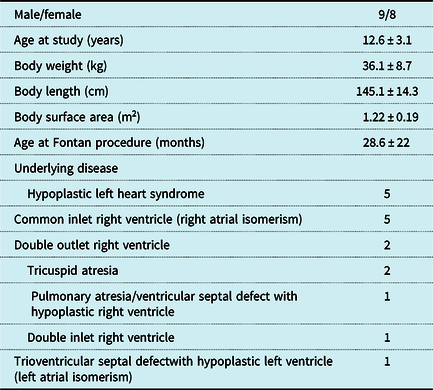
Seventeen patients with Fontan circulation who were routinely followed up in the paediatric cardiology clinic of Kanagawa Children’s Medical Center (Yokohama, Japan) were selected and included in this study. All patients were clinically stable and asymptomatic (NYHA class I). In addition, all patients had undergone bidirectional Glenn anastomoses prior to total cavo-pulmonary anastomoses. In all patients, Fontan operations were performed by connecting the superior and inferior caval veins to the pulmonary arteries using an extracardiac GORE-TEX graft without fenestration. One patient underwent implantation with a pacemaker for sick sinus syndrome, and the mode of the pacemaker was AAIR: 80–140 bpm. The basic rhythm of the other 16 patients was sinus rhythm. We confirmed the absence of pathway obstruction in all patients through angiography. Fourteen and three patients had a systemic right and left ventricle, respectively. The patient characteristics are summarised in Table 1.
Patient demographics

Values are presented as numbers unless indicated otherwise.
Data collection
Peripheral venous pressure
Data were collected during a cardiopulmonary exercise test. A 22-gauge venous cannula was inserted into the peripheral vein in the upper extremity prior to the cardiopulmonary exercise test. The cannula was connected to a venous pressure manometer through a transducer set. The transducer was zeroed to atmospheric pressure at the level of the atrium. At all times during exercise, the transducer was maintained at the atrial level. The resting peripheral venous pressure was measured in a standing position, and this measurement was performed every minute after the initiation of exercise. Recordings were only used when a phasic waveform was observed. We defined the peripheral venous pressure at peak exercise as peak peripheral venous pressure (mmHg).
Exercise protocol and gas exchange measurements
The patients performed a ramp-like progressive exercise test on a treadmill (T2100; GE Healthcare Critikon de Mexico S de RL de CV, Ciudad Juárez, Mexico). The exercise intensity was increased by 0.7 metabolic units every 30 seconds with the completion of the incremental part of the exercise test in approximately 10 minutes. Reference Ohuchi, Nakajima and Kawade9 After a 3-minute rest, the patients performed a 3-minute warm up at a speed of 1.5 km/hour and subsequently exercised with progressively increasing intensity until exhaustion. Heart rate and arrhythmia were monitored by a 12-lead electrocardiogram throughout exercise, and the blood pressure was measured once every 2 minutes during exercise.
Ventilation and gas exchange variables were measured on a breath-by-breath basis. The patients breathed through a mask connected to an aero monitor (AE-310s; Minato Medical Science, Osaka, Japan) for the continuous measurement of inspired and expired volumes and pressures (measured in mmHg). Derived respiratory parameters, including minute ventilation, ventilator equivalents for oxygen and carbon dioxide, and respiratory gas exchange ratio, were computed in real time and displayed with heart rate and oxygen uptake (ml/minute) on a monitor during exercise testing. Oxygen uptake was measured at peak exercise, and the oxygen pulse (ml/beat) was calculated by dividing the oxygen uptake by the heart rate at peak exercise.
We divided the peak oxygen uptake by the body weight (ml/minute/kg) and adopted the obtained value as a parameter representing exercise tolerance. We also divided the peak oxygen pulse by the body surface area (ml/beat/m2) and adopted the obtained value as a parameter representing stroke volume at peak exercise. The heart rate reserve (bpm) was calculated by determining the difference between the heart rate at peak exercise and heart rate at rest; the obtained value was adopted as a parameter representing chronotropic ability.
Cardiac catheterisation and brain natriuretic peptide
We performed cardiac catheterisation in all patients several days after the cardiopulmonary exercise test to evaluate the resting haemodynamics. Through cardiac catheterisation, we measured the central venous pressure, ventricular end-diastolic pressure (mmHg) and cardiac index (l/minute/m2), ventricular ejection fraction (%), pulmonary artery index (mm2/m2), and pulmonary artery resistance (U × m2). The left ventricular and right ventricular end-diastolic and end-systolic volumes (ml) were estimated using the area-length method and Simpson’s rule, respectively; their ejection fractions were calculated as the ratio of stroke volume to end-diastolic volume. We also measured the plasma levels of brain natriuretic peptide (pg/ml) on the same day of the cardiopulmonary exercise test.
Statistical analysis
The statistical analysis was performed using the JMP 13.0 (SAS Institute Inc., Cary, NC, USA) software. Data are expressed as the mean ± standard deviation. Differences in variables were evaluated using a paired t-test. Simple regression analysis was used to evaluate the relationships between continuous variables. P values <0.05 denoted statistically significant differences.
Results
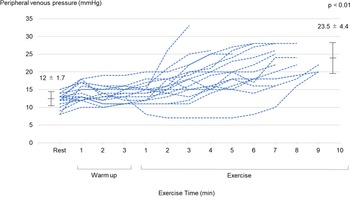
All patients completed the cardiopulmonary exercise test without any complaints. The measurements were successfully performed because we could observe the wave shapes of the peripheral venous pressure of all patients on the monitor during exercise. All but one peripheral venous pressure readings of patients with Fontan circulation increased with the exercise load, and the patterns of this increase varied. One case showed a decrease in peripheral venous pressure during the first 7 minutes of exercise, followed by an increase. All peripheral venous pressure values noted at peak exercise were higher than those measured at rest (23.5 ± 4.2 mmHg vs. 12 ± 2 mmHg, respectively; p < 0.01). The peripheral venous pressure values of all patients are presented over time (Fig 1).
Individual peripheral venous pressure responses during exercise in patients with Fontan circulation. All but one peripheral venous pressure readings of patients with Fontan circulation increased with exercise load and the patterns of this increase varied. The peripheral venous pressure at peak exercise was significantly higher than that measured at rest (23.5 ± 4.2 mmHg vs. 12 ± 2 mmHg, respectively; p < 0.01).

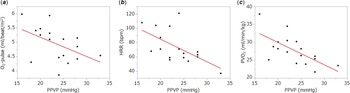
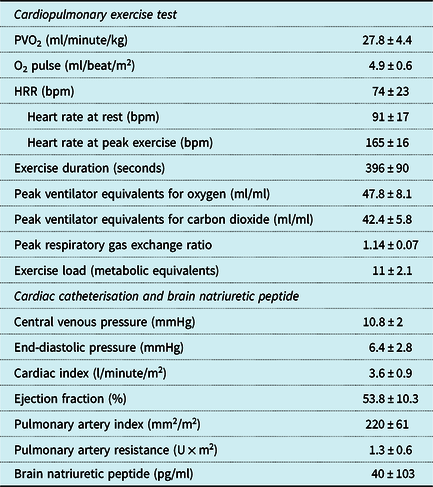
Figure 2 shows the correlations of peripheral venous pressure at peak exercise with the peak oxygen pulse, heart rate reserve, and peak oxygen uptake. The peripheral venous pressure at peak exercise inversely correlated with the peak oxygen pulse, heart rate reserve, and peak oxygen uptake (R = −0.48, p < 0.05; R = −0.6, p < 0.05; R = −0.66, p < 0.01, respectively). Parameters from the cardiopulmonary exercise test, cardiac catheterisation, and blood test are presented in Table 2. None of the resting haemodynamic indices (e.g., central venous pressure, end-diastolic pressure, cardiac index, ejection fraction, pulmonary artery index, pulmonary artery resistance, and brain natriuretic peptide) correlated with peripheral venous pressure at peak exercise or peak oxygen uptake.
Correlation of PPVP with the O2 pulse (a), HRR (b), and PVO2 (c). The PPVP inversely correlated with the O2 pulse, HRR, and PVO2 (R = −0.48, p < 0.05; R = −0.6, p < 0.05; and R = −0.66, p < 0.01, respectively). HRR: heart rate reserve; O2 pulse: peak oxygen pulse; PPVP: peripheral venous pressure at peak exercise; PVO2: peak oxygen uptake.

Parameters from the cardiopulmonary exercise test, cardiac catheterisation, and blood test
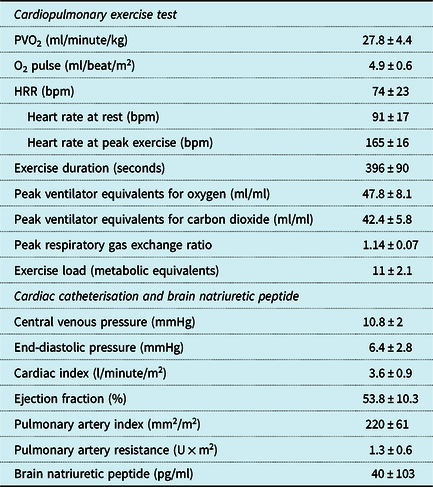
Values are presented as numbers unless indicated otherwise.
All data (except EDPs) were obtained from 17 patients. EDPs were obtained from 16 patients.
Discussion
The present study revealed that exercise-induced peripheral venous hypertension inversely correlates with the peak oxygen pulse, heart rate reserve, and peak oxygen uptake in patients with Fontan circulation.
In normal two-ventricle circulation, exercise results in an up to five-fold increase in cardiac output compared with baseline. In patients with Fontan circulation, the pulmonary blood flow depends on the gradient generated between the central venous pressure and pulmonary capillary wedge pressure, as well as the resistance across the pulmonary vascular bed. Under this physiology, the change in cardiac output with exercise is limited to a two-fold increase compared with baseline. In Fontan circulation, the central venous pressure is forced to rise even at rest. This phenomenon becomes more pronounced during exercise, while cardiac output increases even by two-fold. Reference Goldberg, Avitabile and McBride10 Exercise-induced central venous hypertension indicates ineffective pulmonary flow augmentation during exercise, causing insufficient ventricular filling and stroke volume. This theory explains the inverse correlation between the peripheral venous pressure at peak exercise and peak oxygen pulse – a surrogate of stroke volume. Moreover, it is well established that inadequate ventricular filling attenuates the increase in heart rate. Some studies have shown a correlation of ventricular filling with an increase in heart rate. In a study, Bainbridge observed an immediate augmentation in heart rate following increases in venous pressure and cardiac filling. Reference Bainbridge11 Claessen et al performed a study with exercise cardiac MRI and revealed that abnormal cardiac filling explains the chronotropic limitation in patients with Fontan circulation. Reference Claessen, La Gerche and Van De Bruaene12 Van De Bruaene et al concluded that sildenafil reduced the pulmonary vascular resistance, improved cardiac index at rest and during exercise, and increased the heart rate at rest and during exercise in patients with Fontan circulation. Reference Van De Bruaene, La Gerche and Claessen13 The present results, showing that exercise-induced peripheral venous hypertension correlated with diminished heart rate reserve in patients with Fontan circulation, are consistent with those of previous studies. The peak oxygen pulse (a surrogate for stroke volume) and heart rate reserve (a surrogate for chronotropic function) are considered major elements of exercise capacity, which is measured by the peak oxygen uptake. Reference Goldberg, Avitabile and McBride10 Given that peripheral venous hypertension is inversely correlated with those two elements, it is also inversely correlated with the peak oxygen uptake.
We also measured the resting haemodynamic parameters, including central venous pressure, end-diastolic pressure, cardiac index, ejection fraction, pulmonary artery index, pulmonary artery resistance, and brain natriuretic peptide. However, those parameters did not influence the peripheral venous pressure at peak exercise. Owing to the lack of a sub-pulmonary ventricle, the pulmonary blood flow depends on the gradient generated between the central venous pressure and pulmonary capillary wedge pressure in patients with Fontan circulation. In this study, factors that are likely to affect the peripheral venous pressure at peak exercise (e.g., end-diastolic pressure, pulmonary artery index, and pulmonary artery resistance) did not influence the peripheral venous pressure at peak exercise. It is suggested that these indicators measured at rest are not reflected in the haemodynamics during exercise.
From a different perspective, the present results demonstrate that the peripheral venous pressure is elevated during exercise in patients with Fontan circulation and low peak oxygen uptake. Therefore, the peak oxygen uptake can be a useful index for understanding the status of congestion in the daily life of patients. This is important for patients with Fontan circulation because the majority suffer from congestion of abdominal organs to varying degrees during the postoperative period. Ohuchi et al showed that the peak oxygen uptake in childhood is associated with hepatic fibrotic change and renal dysfunction in patients with Fontan circulation. They also showed the prognostic value of the peak oxygen uptake for morbidity and mortality in these patients. Reference Ohuchi, Negishi and Miike14 Schleiger et al concluded that the incidence and spectrum of Fontan-associated liver disease strongly correlate with exercise capacity. Reference Schleiger, Salzmann and Kramer15 Their findings were supported by our data, indicating that reduced peak oxygen uptake is correlated with venous hypertension. Moreover, our findings showed that the resting haemodynamic parameters did not correlate with the peripheral venous pressure at peak exercise and peak oxygen uptake. Hence, measuring the resting haemodynamic indices may be insufficient for the evaluation of congestion in the daily life of patients with Fontan circulation.
Limitation
One case showed a decrease in peripheral venous pressure during the first 7 minutes of exercise (Fig 1). We cannot completely explain this phenomenon. In patients with Fontan circulation, respiration exerts a beneficial effect on central venous flow. Reference Hsia, Khambadkone, Redington, Migliavacca, Deanfield and de Leval16 Moreover, the breathing rate increases in response to exercise intensity. Reference Wasserman17 In this patient, the augmentation of ventilation may have exerted a greater beneficial effect on central venous pressure compared with that observed in other patients. A similar phenomenon was reported in a previous study. Reference Navaratnam, Fitzsimmons and Grocott8
Conclusion
Exercise-induced peripheral venous hypertension directly correlates with insufficient ventricular filling, which induces insufficient stroke volume augmentation and chronotropic limitation. Consequently, exercise-induced peripheral venous hypertension correlates with exercise intolerance in patients with Fontan circulation. Measurement of the peak oxygen uptake with cardiopulmonary exercise test is useful to understand the status of congestion in the daily life of patients with Fontan circulation.
Acknowledgements
None.
Financial support
This research received no specific grant from any funding agency, commercial, or not-for-profit sectors.
Conflicts of interest
None.
Ethical standards
The study was approved by the institutional ethics committee. Written informed consent was provided by the parents of all patients and several patients who were sufficiently mature to understand the conveyed information.