Hepatocellular carcinoma (HCC) is the third leading cause of cancer death all over the world (Reference Bruix and Sherman1), and more than 50 percent (500 K) of the worldwide HCC occur in China. Conventional treatment for HCC is surgical resection, which offers the best prognosis so far (Reference Bruix and Sherman1). However, the majority patients with HCC are not suitable to this therapy because of poor hepatic function, anatomic location, number and size of the tumors, or comorbidity (Reference Bruix and Sherman1). Radiofrequency ablation (RFA) is an effective treatment alternative especially on early state HCC (Reference Goldberg, Grassi and Cardella2), but is an expensive inpatient procedure in China.
RFA is performed under the guidance of imaging, such as ultrasonography (US), computed tomography (CT) and magnetic resonance imaging (MRI) (Reference Goldberg, Grassi and Cardella2). Ultrasound is currently the most widely used technique due to its low cost, portability, no radiation and real-time multiplanar imaging capacity. However, conventional ultrasonography is inefficient to detect small nodules that are located in the hepatic dome or on the liver surface. Moreover, it is also difficult to determinate the residual viable portion of the HCC after RFA treatment (Reference Hirooka, Iuchi and Kumagi3). As a result, more than 30 percent of patients with small HCC could not benefit from US guided RFA (US-RFA) (Reference Rhim, Lee and Kim4). CT and MRI have superior visualization of the needle/electrode and occult target. However, they cannot be easily integrated in the operating room to allow for real-time imaging, and thus they are not feasible in most clinical settings.
Recently, real-time virtual sonography (RVS), which combines US and CT/MRI, has been introduced (Reference Hirooka, Iuchi and Kumagi3). The RVS navigation system with an electromagnetic (EM) tracking can display the virtual CT/MRI alongside the sonography images, and provide real-time visualization of tracked interventional needles within pre-procedure CT scans (Reference Hirooka, Iuchi and Kumagi3). This technique is especially helpful for the accurate localization and targeting of small HCCs which are poorly visualized on conventional US, and accurate repositioning of an electrode during the multiple overlapping treatments (Reference Kitada, Murakami and Kuzushita5). Some RVS navigation systems are commercially available now and have showed higher treatment efficacies than conventional US-RFA (Reference Hirooka, Iuchi and Kumagi3;Reference Kitada, Murakami and Kuzushita5;Reference Minami, Kudo and Chung6).
RVS has been deployed in a handful of hospitals in China yet its overall clinical and economic value has yet been proven. To examine the affordability and cost-effectiveness of the emerging navigational solution for Chinese HCC patients, we constructed an economic model to preliminarily evaluate the cumulative clinical and financial impact of RVS navigated RFA (RVS-RFA) by simulating the patients’ health-state transitions through their remaining life-years and comparing these outcomes with conventional US-RFA treatment.
METHODS
This study was based on a Markov cohort model for RVS-RFA compared with conventional US-RFA. Drawing from the literature for estimation of model parameters, the model was used to perform cost-effectiveness analyses with deterministic sensitivity analyses and probabilistic sensitivity analyses (second-order Monte Carlo simulation). The model was built in TreeAge Pro™ 2012 (TreeAge Software, Williamstown, MA) and follows a simulated cohort of patients suffering from solitary, small HCC, Child-Pugh class A or B, who are not eligible for surgery. Child-Pugh score is used to assess the severity of liver cirrhosis according to the plasma concentrations of bilirubin and albumin, the degree of ascites, the degree of encephalopathy, and the prothrombin time. Child-Pugh class A indicates a well-compensated disease and Child-Pugh class B indicates a significant functional compromise.
Markov Model
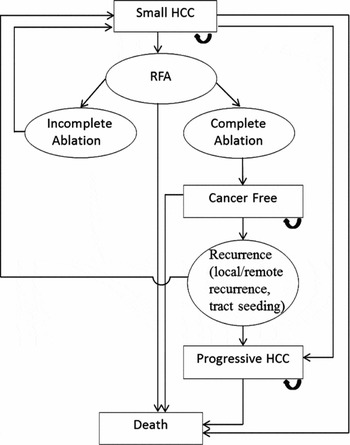
A previous Markov model developed by Cho et al. (Reference Cho, Kim and Kim7) well simulated a randomized controlled trial for the treatment of compensated cirrhotic patients with very early stage HCC undergoing percutaneous RFA therapy. In this study, we adapted the model for the China setting. The model contains four health states: small HCC, cancer free, progressive HCC, and death. Small HCC was defined as the presence of asymptomatic single HCC ≤ 3 cm in the absence of portal vein invasion or extrahepatic disease. All patients with small HCC enter the Markov model and are considered eligible candidates for RFA. These patients undergo RFA treatment; if the tumor is incompletely ablated, they stay in the small HCC state and may receive additional RFA. If the lesion is completely removed, the patients would transit to the cancer-free state. Cancer-free patients may have tumor recurrence including local tumor progression, remote intrahepatic recurrence or needle track seeding. Recurrent HCC can either return patients to the small HCC state, from which state patients may receive RFA retreatment, or move patients to the progressive HCC state. Progressive HCC state was defined as the present of HCC > 3 cm or more than one lesion. Metastatic progression of HCC also belongs to this state. Patients may die from any state, the risk being highest from the progressive HCC state. The cycle length was set to be 1 month. A half-cycle correction was used under the assumption that each transition happens halfway during the cycle. The model cycle was repeated until 99.9 percent of the cohort reached the death state.
The reported probability of repeating RFA in patients after an incomplete ablation is 90 percent to 100 percent (Reference Molinari and Helton8). Hence it is justified to assume that all patients in the small HCC state would undergo repeated RFA, until they exceed a maximum allowable number of treatments and are thereby considered “untreatable.” We assumed that patients could have RFA up to 3 times and that the additional sessions were performed under the same guidance modality. If the tumor was still viable or recurred after the third ablation, the patient would receive no treatment and transit to the state of progressive HCC. To incorporate retreatment in the model, we defined tunnel health states that track the number of prior ablations a patient in the small HCC state has had. Patients in progressive state are assumed not to undergo any further RFA treatment until the patient's death. A portion of patients in this state would undergo liver transplantation as the salvage treatment.
The Markov model structure was the same for cohorts undergoing RVS-RFA and US-RFA while the parameters were different. A schematic diagram of the Markov model was illustrated in Figure 1.
A schematic diagram of the Markov decision model

Data Sources
We searched systematically for reviews and comparative studies of percutaneous RFA with the two guidance modalities in the PubMed, EMBASE, and Science Citation Index from inception to February 2014. The search terms were (radiofrequency OR radio-frequency OR catheter ablation) AND (liver carcinoma* OR liver cancer OR hepatocellular carcinoma* OR liver cell carcinoma*) AND (ultraso*) AND ((fusion) OR (virtual)). A further search was conducted by tracking references in reviews identified. Studies were included if they were published in English or Chinese, included patients with early stage small HCC (Child-Pugh class A or B), and reported complete ablation rate, local recurrence, number of treatment sessions, procedure related complication, and mortality. When comparative controlled studies are scarce, we also considered case series if they added information to the existing evidence base. We excluded cohort studies when the sample size was less than 10 per group. All data were extracted by one author, and cross-checked by the second author. The search strategy and results were summarized in Supplementary Figure 1, which can be viewed online at http://dx.doi.org/10.1017/S0266462314000452, Supplementary Table 1, which can be viewed online at http://dx.doi.org/10.1017/S0266462314000452, and Supplementary Table 2, which can be viewed online at http://dx.doi.org/10.1017/S0266462314000452. Parameters were estimated from the literature where valid data were available and otherwise consisted of our best estimates incorporating expert opinions in China. Four interviews were conducted with physicians from different hospitals in the cities of Beijing, Guangzhou, and Shaoxin.
Parameter Estimation
Treatment Efficacy
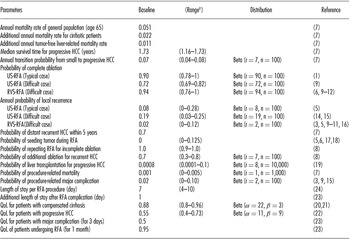
Patients undergoing RFA could be completely ablated (cured) or incompletely (Reference Goldberg, Grassi and Cardella2). Dual-phase spiral CT performed 4 weeks after treatment is used to determine the result of ablation, and the hypervascular enhancement at the arterial or portal phase indicates that a residual viable tumor was present (Reference Goldberg, Grassi and Cardella2). In the conventional sonographic RFA, the complete ablation rate ranged between 65 percent and 100 percent depending on the tumor size and location: 90 percent in small HCC (Reference Bruix and Sherman1), and down to 72 percent when the small lesion was unclear or undetectable on conventional US but clearly visualized in CT or MRI (difficult case) (Reference Minami, Chung and Kudo9). RVS-RFA was reported to have higher complete ablation rates ranging from 90 percent to 100 percent (Reference Minami, Kudo and Chung6;Reference Minami, Chung and Kudo9–Reference Lee, Rhim and Cha12) for treating HCC in such difficult cases, and the mean rate, 94 percent, was used in the baseline. The efficacy of repeated RFA attempts was similar to the results obtained after the first treatment (Reference Livraghi, Goldberg and Lazzaroni13), so we assume it to be the same in the base case.
Fifty to 70 percent of individuals who initially achieve complete ablation develop tumor recurrence during the 5-year follow-up (Reference Zhou, Zhao and Li14). Tumor recurrence includes local tumor recurrence, distant tumor recurrence and recurrence caused by needle track seeding. Local tumor recurrence was defined as the present of enhancement around the ablated place or very close by. Meta analyses showed that the local recurrence rate of small HCC in the percutaneous RFA with conventional US guidance was 19 percent (Reference Zhou, Zhao and Li14;Reference Scaife and Curley15) in difficult case and 8 percent in typical case (Reference Kitada, Murakami and Kuzushita5). Although the data source was limited, the reported local recurrence rate of RVS navigated RFA was far lower, ranging from 0 to 8.3 percent (Reference Hirooka, Iuchi and Kumagi3;Reference Kitada, Murakami and Kuzushita5;Reference Minami, Chung and Kudo9–Reference Nakai, Sato and Sahara11;Reference Zhong, Deng and Li16). Here we used the mean 2 percent as the base-case value of local recurrence rate of RVS-RFA. Distant recurrence was defined as the appearance of new HCC in the untreated liver or extrahepatic regions. The probability of distant intrahepatic recurrent HCC within 5 years was 0.7 (Reference Cho, Kim and Kim7), which was assumed to be similar between the two strategies. Most of studies reported not a single case of needle track seeding after RFA (Reference Kitada, Murakami and Kuzushita5;Reference Minami, Kudo and Chung6), except for two studies that reported incidences of 0.02 percent and 12.5 percent (Reference Llovet, Vilana and Bru17;Reference Mulier, Mulier and Ni18). In patients with tumor recurrence, approximately 70 percent (Reference Molinari and Helton8) may receive additional RFA based on clinicians’ suggestion and patients’ choice. Patients who advance to the progressive state may be candidates for liver transplant, although donor resources are scarce in China. Expert opinion and literature review revealed that approximately 0.08 percent (Reference de Villa and Lo19) of progressive liver cancer patients receive a liver transplant.
The morbidity rates associated with hepatic RFA are generally low: only 2 percent suffered a major treatment-related side effect (Reference Hirooka, Iuchi and Kumagi3;Reference Minami, Chung and Kudo9;Reference Scaife and Curley15). Most literature reported no long-term disability caused by RFA. The mortality rate associated with RFA is 0.1 percent with a range from 0 to 0.5 percent in the published studies (Reference Cho, Kim and Kim7). We assumed procedure-related major morbidity and mortality were independent of the guidance modality used. Table 1 summarizes the efficacy data for US-RFA and RVS-RFA.
Estimated Values of the Variables Used in the Model

Note. Typical case: A mixed case of clearly or unclearly visualized HCC on the conventional US. Difficult case: HCC was difficult to be visualized on the conventional US but could be clearly detected in CT/MRI. QoL = quality of life.
aRange in the sensitivity analyses.
Health Outcomes
The mean age of cohort was assumed to be 65 years. The annual mortality rate of patients was modeled as the sum of the annual mortality in the general population at a given age and the liver-related annual mortality rate in each health state. We assumed that patients with small or cured HCC had survival similar to patients with cirrhosis. The reported 10-year survival rate for cirrhotic patients was 80 percent (Reference Cho, Kim and Kim7). Assuming that half of cirrhotic patients die of cancer (Reference Cho, Kim and Kim7), this suggests a liver-related annual mortality rate of 1.1 percent for patients who have small HCC or who are cancer-free. The median survival time for progressive HCC patients was approximately 1.73 years (Reference Cho, Kim and Kim7); we estimated the excess annual mortality rate using the declining exponential approximation of life expectancy.
Utilities are used to value health-related quality of life (perfect health, 1; death, 0) in calculating quality-adjusted life expectancy. We assumed that quality of life (QoL) without cancer was equivalent to QoL with compensated cirrhosis, which was 0.88 in two studies using time tradeoff method (Reference McLernon, Dillon and Donnan20;Reference Stein, Rosenberg and Wong21); that asymptomatic small HCC did not affect QoL; and that QoL was the same between different strategies. The QoL for patients with progressive HCC was assumed to be 0.55, based on the literature using the health utility index method (Reference Ruggeri, Cicchetti and Gasbarrini22). We assumed patients who receive RFA were subject to a 0.05 decrement in utility for 1 month following the procedure (Reference Gazelle, McMahon and Beinfeld23); patients who experienced procedure-related complications were subject to additional 0.5 decrement (Reference Gazelle, McMahon and Beinfeld23). See Table 1 for the health outcome summary.
Costs
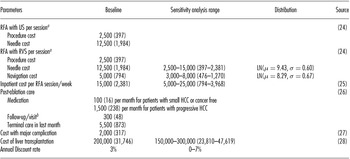
As depicted in Table 2, direct costs were estimated from the modified societal perspective, which includes all direct medical costs from payers including both the state insurance and the patients/their families, and excludes time costs, lost productivity, and other non-medical costs. All costs were calculated in 2012 CNY and reported as CNY and USD with exchange rate of 6.3 CNY to each USD in May, 2012. The Chinese National Medical Service Price Project Standard in 2012 was used to derive cost estimates. The code representing percutaneous RFA treatment costs in the liver was HQA72104, while the code for needle electrode and disposable medical materials was AB0121. Lifetime costs for HCC patients after receiving initial RFA treatment were simulated by the Markov model, which includes costs of the RFA procedure, hospitalization costs, costs of follow-up visits, and medications. The costs of terminal care, costs associated with major complication, and costs of liver transplantation in progressive HCC state were also included, and treated as a toll weighing by the event probability in the model. Total costs were estimated by adding these values together.
Cost Parameter Estimation
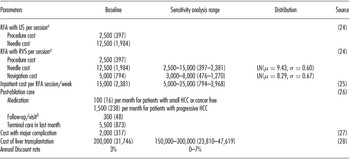
Note. Data are shown as CNY (USD).
a Costs for RFA include technical (hospital) and professional costs.
b Costs per follow-up visit include dual-phase spiral CT, blood tests including liver function tests and serum a-fetoprotein analysis, and chest radiography.
The costs of RFA procedure with conventional US guidance include procedure costs and ablation needle costs (24). We assumed that the RVS navigation system would incur additional cost related to the technology and disposables. RFA was assumed to be an inpatient treatment, which was the typical case in China. The median hospital stay was 7 days (Reference Peng, Lin and Zhang25). Follow-up visits were performed 1 month after treatment and every 3 months for the first 2 years, and thereafter extended to once every 6 months. At each of these follow-up visits, we assumed that a MR or contrast-enhanced CT imaging test, blood tests including liver function tests, and serum α-fetoprotein analysis were performed (Reference Guan, Dong and Wang26).
Other palliative and Chinese traditional medicine is recommended for patients to boost immune systems, depress the virus activities and suppress the growth of the tumor cells. We use conservative estimates of the costs of these daily remedies to be 100 CNY ($16) per month for patients without HCC or with small HCC, and 1,500 CNY ($238) per month for the patients progressive HCC. Once patients have transited to the progressive HCC state, they might choose to receive liver transplantation, which costs around 200,000 CNY ($31,746) in total (Reference Chen, Yao and Chen27). Terminal intensive care costs in the last month before death were assumed to be 5,500 CNY ($873) based on expert's opinions. Additional costs due to lengthened hospital stay or intervention in patients with a major complication were estimated to be 2,000 CNY ($317) (Reference Chen, Yang and Zhu28). For the base-case analysis, costs and quality-adjusted life-years (QALYs) were discounted at a real annual rate of 3 percent. All costs are summarized in Table 2.
Analyses Performed
We verified the model by comparing its outputs for 5-year tumor recurrence (including local and distant tumor recurrence) and 5-year survival to independently published data from the literature. In easier clinical cases, Cho et al. (Reference Cho, Kim and Kim7) reported the complete ablation rate of 0.96 and local recurrence probability of 0.025 with US-RFA, which are similar to the input values of RVS-RFA in our model. In the absence of 5-year survival data with RVS navigation, we used the corresponding data reported by Cho et al. (Reference Cho, Kim and Kim7) as its approximation for model verification. We also compared the average number of ablation attempts over a patient's lifetime.
The base-case analysis was performed by using estimates for costs, treatment effectiveness, and other event probabilities described above. We calculated total costs and QALYs and compared guidance strategies by using incremental cost-effectiveness ratios (ICER). Extensive sensitivity analysis was performed to investigate the effects of changes in model parameters on costs and effectiveness. The following parameters were varied in the deterministic sensitivity analyses over the ranges shown in Table 1 and Table 2: probability of complete ablation, costs of ablation, costs of patient care, tumor recurrence rate, and the discount rate used for costs and QALYs. The ranges of the variables were based, where possible, on confidence intervals in published reports. In probabilistic sensitivity analysis, all model inputs were varied randomly and simultaneously for 10,000 iterations. The model used a lognormal distribution for costs and a beta distribution for probabilities and utilities.
RESULTS
Model Verification
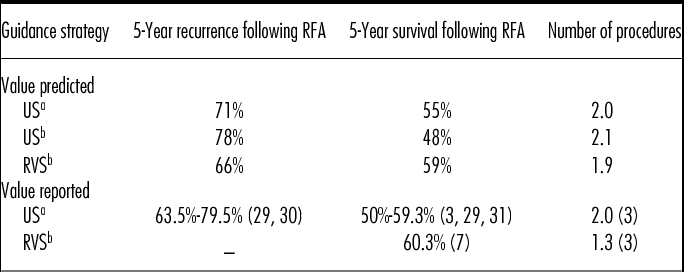
The results of our model verification simulation are reported in Table 3. In the base-case scenario, our model predicts that 71 percent of patients after US-RFA would have tumor recurrence within 5 years, which is consistent with the published literature (63.5–79.5 percent) (Reference Huang, Yan and Cheng29;Reference Hung, Chiou and Hsia30). Predicted 5-year survival following RFA is 55 percent, which falls in the range from 50 percent to 59.3 percent reported in the clinical literature (Reference Hirooka, Iuchi and Kumagi3;Reference Huang, Yan and Cheng29;Reference Vivarelli, Guglielmi and Ruzzenente31). The mean number of procedures performed through patients’ life times was 2, which is consistent with Hirooka et al. (Reference Hirooka, Iuchi and Kumagi3).
Results of Model Verification Simulation

a Typical case, a mixed case of clearly or unclearly visualized HCC on the conventional US.
b Difficult case, HCC was difficult to be visualized on the conventional US but could be clearly detected in CT/MRI.
US, ultrasonography; RVS, real-time virtual sonography.
In specific scenario in which small HCC was unclearly visualized on US imaging but clearly visualized on CT or MRI (difficult case), our model predicts that 78 percent of patients undergo recurrence and 48 percent survive 5 years following the US-RFA, which are consistent with the published data indicating worse health outcomes in these cases. We predicted the 5-year survival following the RVS-RFA to be 59 percent while Cho et al. reported it to be 60.3 percent (Reference Cho, Kim and Kim7).
Base Case Analysis
In the difficult cases, the discounted life expectancies are 4.8 years (5.4 years without discounting) and 6.3 years (7.4 years without discounting) in patients undergoing US-RA and RVS-RFA, respectively. After weighing for the quality of life, RVS-RFA provides an incremental 1.4 QALYs compared with the US strategy (RVS-RFA with 5.1 QALYs; US-RFA with 3.7 QALYs). Total costs for patients with US-RFA are 84,128 CNY ($13,354) while RVS-guided RFA would save 2,467 CNY ($392) through an average patient's lifetime. Hence, RVS-RFA is a dominant strategy for difficult cases in which the costs are lower and the effectiveness is higher than the US-RFA strategy.
Sensitivity Analysis
The results of the one-way sensitivity analysis are shown in Supplementary Table 3, which can be viewed online at http://dx.doi.org/10.1017/S0266462314000452. The RVS navigation strategy remained cost-saving if the complete ablation rate of US-RFA was lower than 0.8, if the complete ablation rate of RVS-RFA was higher than 0.87, if the local recurrence rate of US-RFA was higher than 0.09, if median survival for patients with progressive HCC was more than 0.4 years, if RFA could be performed for a recurrent HCC less than 90 percent of the time, if the cost of RVS navigation was lower than 6,290 CNY ($998), if the cost of RFA disposable needle was higher than 4,310 CNY ($684), or if the cost of hospitalization per procedure was higher than 6,810 CNY ($1,081). The model is most sensitive to the probability of performing RFA for recurrent HCC, the cost of hospitalization, and the cost of disposable needles. Other variables did not alter the cost-saving result for RVS-RFA. Under the assumption that the societally accepted willingness-to-pay (WTP) threshold was benchmarked to per-capita GDP (Reference Eichler, Kong and Gerth32), which was 35,000 CNY ($5,556) in China 2012, RVS-RFA remained cost-effective across all the ranges of variables in our model.
Two-way sensitivity analysis (Supplementary Table 4, which can be viewed online at http://dx.doi.org/10.1017/S0266462314000452) showed that, in the difficult cases, the efficacy of RVS-RFA relative to US-RFA could be cost increasing instead of cost saving in some scenarios as the complete ablation rate varies from 0.76 to 1 and the local recurrence rate varies from 0 to 0.12 in the RVS strategy. If the treatment efficacy was moderately improved with RVS navigation relative to US guidance, for example, with a 0.04 increase in complete ablation rate and a 0.07 decrease in local recurrence rate, the RVS strategy would cost an additional 7,734 CNY ($1,228) while gaining only 0.4 QALY and the ICER would be 18,845 CNY/QALY ($2,991/QALY). At the other extreme, if the treatment efficacy of RVS-RFA was perfect with 100 percent complete ablation and no local tumor recurrence, RVS strategy could save up to 5,508 CNY ($874) while gaining 1.7 QALYs.
Second-Order Monte Carlo Simulation
The cost-effectiveness plane shows that almost all of the 10,000 trials are located to the right of y-axis. More than 71 percent (7,159/10,000) were located on the IV quadrant (Supplementary Figure 2, which can be viewed online at http://dx.doi.org/10.1017/S0266462314000452), which means that RVS-RFA is a dominant strategy. It offers a reduction in costs while the main advantage of RVS-RFA lies in its increased QALYs. The cost-effectiveness acceptability curve shows the near certainty of the dominance of RVS-RFA (Supplementary Figure 3, which can be viewed online at http://dx.doi.org/10.1017/S0266462314000452). As the willingness to pay increases higher than 21,000 CNY ($3,333), the uncertainty about the cost-effectiveness of RVS-RFA decreases to below 1 percent. Particularly, there is 99.8 percent probability that RVS-RFA is more cost-effective compared with conventional US-RFA at the WTP of 35,000 CNY ($5,556) per QALY.
DISCUSSION
Our model has shown that RVS-RFA could save costs while increasing life expectancy or QALYs, for patients with poorly detectable small HCC. The results remain robust and unaffected by variations of most variables, including the complication and mortality rate of the RFA procedure, the costs of complications and terminal care, the cost and probability of liver transplantation, the transition probability from small HCC to progressive HCC, the quality of life, and the mortality rate in each health state. The model is sensitive to the probability that patients undergo RFA for recurrent HCC and the median survival for progressive HCC. For patients diagnosed with tumor recurrence, they either have progressive hepatic dysfunction or multiple tumors making repeating RFA impossible. The probability of repeating RFA for recurrent HCC was reported with a wide range from 30 percent to 80 percent among patients with child-Pugh A or B (Reference Molinari and Helton8). The median survival for progressive HCC was reported higher than 1.16 years (Reference Cho, Kim and Kim7). Therefore, the cost-saving thresholds are far from the values reported in literature, making our results robust.
One-way sensitivity analysis shows that the results are sensitive to efficacy of US-guided treatment, which suggests that the RVS strategy is preferable in difficult clinical cases. Tumors difficult to identify by means of conventional US are characterized in clinical publications (Reference Hirooka, Iuchi and Kumagi3;Reference Kawasoe, Eguchi and Mizuta33): (i) lesion with small size; (ii) location deep within the liver or on the liver surface, beneath the diaphragm, and affected by pulsation of the heart; (iii) residual viable tumor after TACE or RFA; (iv) progression of cirrhosis; (v) recurrent tumor and hepatic metastasis, especially located at a resection stump following hepatocetomy or near the necrotic area produced by previous RFA. In such difficult cases, experienced physicians, conventionally, have to mentally merge the CT image with real-time sonography during the RFA procedure which may result a low treatment efficacy, while RVS-RFA can achieve better efficacy because HCC nodules not visualized on conventional ultrasonography are depicted clearly with RVS. It is noted that in easier cases, US-RFA treatment is sufficient to reach a higher complete ablation rate (>0.8) and lower local recurrence rate (<0.09), parameter values for which the new technology would not be cost-saving.
Our results are sensitive to the costs of navigation, disposable needles, and inpatient care. Because RVS-RFA treatments are generally used for research purpose and not widely applied in clinical therapy, the additional cost of RVS to patients is an unknown parameter. We used 5,000 CNY ($794) as our best estimate incorporating opinions from physicians and technology providers, while varying the range in the threshold analysis to determine the break-even point. Sensitivity analysis shows that the RVS strategy is cost-saving and adds to QALYs if the additional navigation cost is lower than 6,290 CNY ($998). The needle and hospitalization costs varied widely depending on the geographical location of receiving treatment, the brand of the needle and the care intensity. Sensitivity analysis shows that RVS remains cost-saving if the costs in needle or hospitalization are higher than 4,310 CNY ($684) and 6,810 CNY ($1,081), respectively.
Limitations of this study are as follows. First, we simplified our model by assuming that the patients with incomplete ablation or recurrence would undergo RFA treatment no more than three times and under the same guidance. However in reality, patients may switch to different strategies after initial tumor control failure or after attempting RFA more than three times. Second, very few literature reports that RFA could be life threatening or lead to substantial morbidity, and such complications would require creating corresponding utilities to capture such long-term morbidity. However, the assumption that the disability related to RFA procedures is temporary is consistent with most publications, and thus transient costs and utilities were used in our model by weighting them by the probability of complication and incorporating them as tolls. Third, Minami et al. (Reference Minami, Chung and Kudo9) reported an increased efficacy of the repeat treatment for residual HCC while Livraghi et al. (Reference Livraghi, Goldberg and Lazzaroni13) reported a steady efficacy. The discrepancy could be explained in that the treatment efficacy was either higher due to the smaller size of residual HCC or lower because the characteristics of the patient or the specific tumor may be prone to tumor control failure. Without sufficient clinical evidences, we believe it is safe to assume that the efficacy of additional RFA remained the same. Fourth, our analysis is based on direct costs to the healthcare payers and excludes the cost of patients’ time, downstream unrelated disease costs incurred over an increased life span, and indirect costs such as lost productivity. Fifth, it is noted that the Chinese mainland has thirty-two provinces among which the per-capita GDP differs significantly; for example, the per-capita GDP ranged from 8,400 CNY ($1,333) in the Guizhou province to 70,700 CNY ($11,222) in Shanghai in 2009. We assumed the national GDP per capita in 2012 as WTP threshold in our model; however, decisions could be varied when taking the economic development in different regions into consideration. We should also be cautious to generalize the results to advanced HCC treatment, because the parameters in our model were collected from patients with small HCC which may not perfectly reflect clinical reality in advanced disease.
An additional limitation of our study is that no randomized control (RCT) study was identified in the literature review and only four comparative cohort studies were included. We also considered the case series to add more information to our evidence. It has to be recognized that potential biases are possible due to the constraint of evidence and the indirect comparison. Thus it is noted that the uncertainty exists in the results of cost-effectiveness analysis due to such limitations in underlying clinical effectiveness. Further study with RCT in larger number size is required.
In conclusion, RVS-RFA was a dominant strategy which saved patients’ costs and provided better health outcome compared with US-RFA, especially for small HCC poorly defined by the conventional ultrasonography. To our knowledge, it is the first economic evaluation study about fusion navigation technology in RFA treatment. We hope this study will be helpful to assist the decision making given the medical costs and their risks of undetectable HCC. Our study further suggests that certain level of treatment efficacy should be achieved with RVS navigation to make RFA treatment cost-saving from the patient's perspective, which could serve as a benchmark in the development of this emerging technology.
SUPPLEMENTARY MATERIAL
Supplementary Figure 1: http://dx.doi.org/10.1017/S0266462314000452
Supplementary Table 1: http://dx.doi.org/10.1017/S0266462314000452
Supplementary Table 2: http://dx.doi.org/10.1017/S0266462314000452
Supplementary Table 3: http://dx.doi.org/10.1017/S0266462314000452
Supplementary Table 4: http://dx.doi.org/10.1017/S0266462314000452
Supplementary Figure 2: http://dx.doi.org/10.1017/S0266462314000452
Supplementary Figure 3: http://dx.doi.org/10.1017/S0266462314000452
CONTACT INFORMATION
Yizhen Lai, MS, Student of Harvard School of Public Health 677 Huntington Avenue, Boston, MA 02115
Kai Li, M.D, PhD, Doctor of The Third Affiliated Hospital of SunYat-sen University, 600 Tianhe Road, Tianhe District, Guangzhou, Guangdong, P.R. China.
Junbo Li, PhD, Principle Scientist at Philips Research Asia, No.10, Lane 888 Tianlin Road, Min Hang District, Shanghai, P.R.C. 200233
Sheena Xin Liu, MD, PhD, Senior Scientist at Philips Research North America, 345 Scarborough Road, Briarcliff Manor, NY 10510, USA Email: xl2104@gmail.com
CONFLICTS OF INTEREST
The research is sponsored by Philips Research North America.