Holmul, Guatemala, the first lowland Maya site to be excavated stratigraphically, was explored by archaeologist Raymond Merwin of Harvard University from 1909–1911. George C. Vaillant created the first ceramic sequence for the site using Merwin's field notes and by comparing stylistic differences of pottery between rooms in Building B, Group II (Merwin and Vaillant Reference Merwin and Vaillant1932:60–84; Vaillant Reference Vaillant1927:300–316). Based upon the stratigraphic position of pots with particular styles and potential episodes of architectural construction at Holmul, Vaillant proposed a series of five ceramic phases for the site (Vaillant Reference Vaillant1927:300–316). Prior to the publication of his co-authored monograph with Merwin, but after Merwin's initial excavation of Holmul and subsequent death, Vaillant related these ceramic phases and specific styles to pottery from other sites in the Maya area in an effort to create the first interregional ceramic chronology for ancient Maya civilization (Vaillant Reference Vaillant1927).
While Vaillant and Merwin's combined work served as an important building block for initially understanding chronological sequences in Maya archaeology, little direct study of all the original Holmul material from Building B has taken place until the initiation of Boston University Holmul Project investigations in 2000. Notable exceptions are the excellent comparative work performed by Willey and Gifford (Reference Willey, Gifford and Lothrop1961:152–155), Pring (Reference Pring and Hammond1977a, Reference Pring2000:44–56), and Hammond (Reference Hammond1984:1–7) on ceramic vessels found exclusively in Rooms 8 and 9 of Building B. The purpose of their studies was to better understand the pottery in these rooms and its relation to the rise of Classic period civilization. Until the present, however, a reanalysis of the whole vessels from Rooms 1, 2, 3, 4, 7, and 10 from Building B, Group II remained unexamined aside from Merwin and Vaillant's (Merwin and Vaillant Reference Merwin and Vaillant1932; Vaillant Reference Vaillant1927) original assessment.
In this article I present the current ceramic sequence for the Holmul region and re-evaluate the ceramic material of all rooms in Building B Group II in light of new discoveries at sites within the Holmul region and the greater Maya lowlands. The result is a new hypothesis about what social processes are manifested through orange slipped polychrome pottery of the Terminal Preclassic period, which suggests that the vessels associated with deposits in Buidling B, Group II at Homul may represent changes in elite diacritical feasting events of the Terminal Preclassic period. These feasts, and the preparations made for them (including ceramic production) may have simultaneously integrated social groups within a polity while also reinforcing differences between them during two turbulent epochs of Maya political history—namely, the late facet of the Terminal Preclassic period (a.d. 150–250) and the early facet of the Early Classic period (a.d. 250–400).
THE HOLMUL REGION
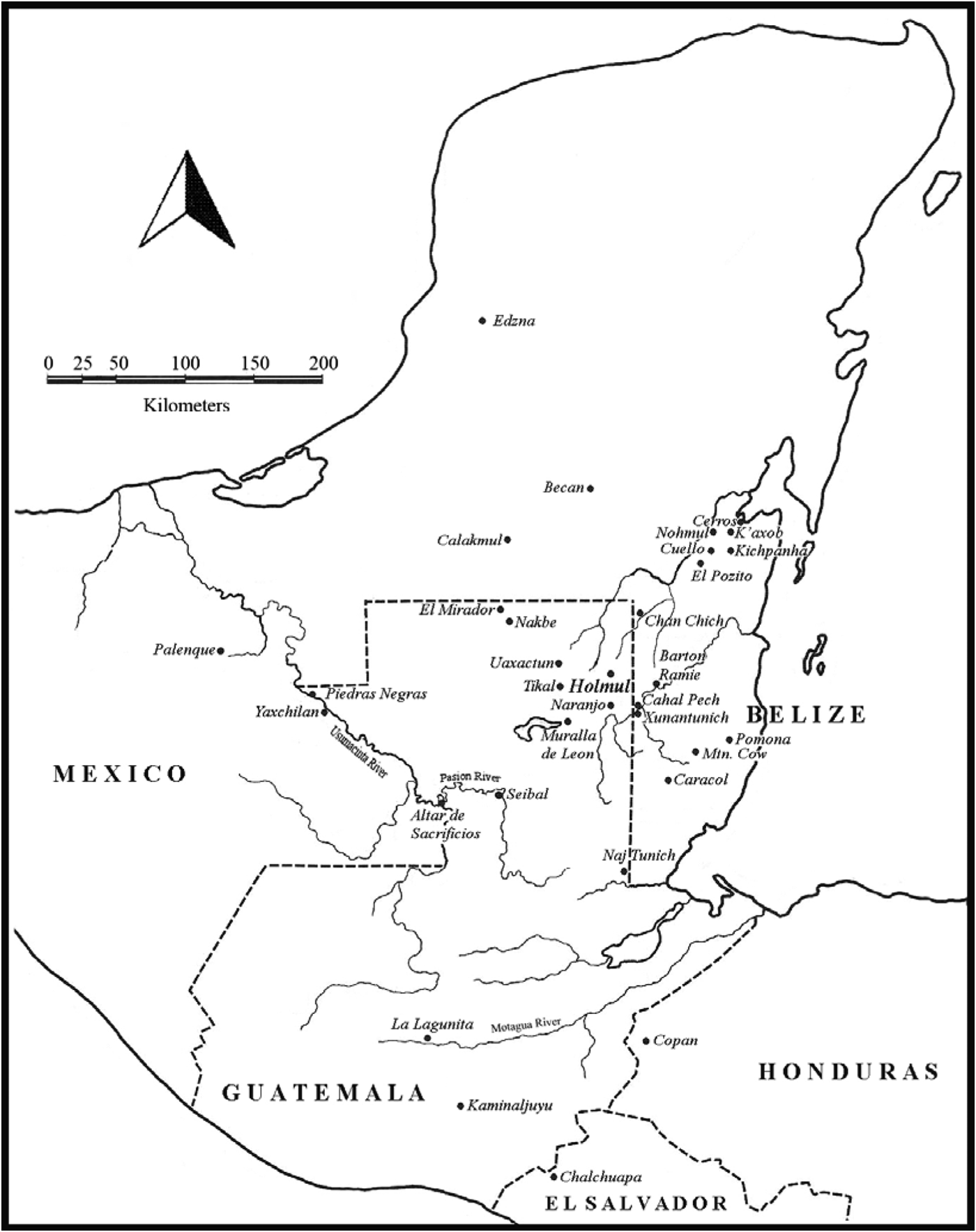
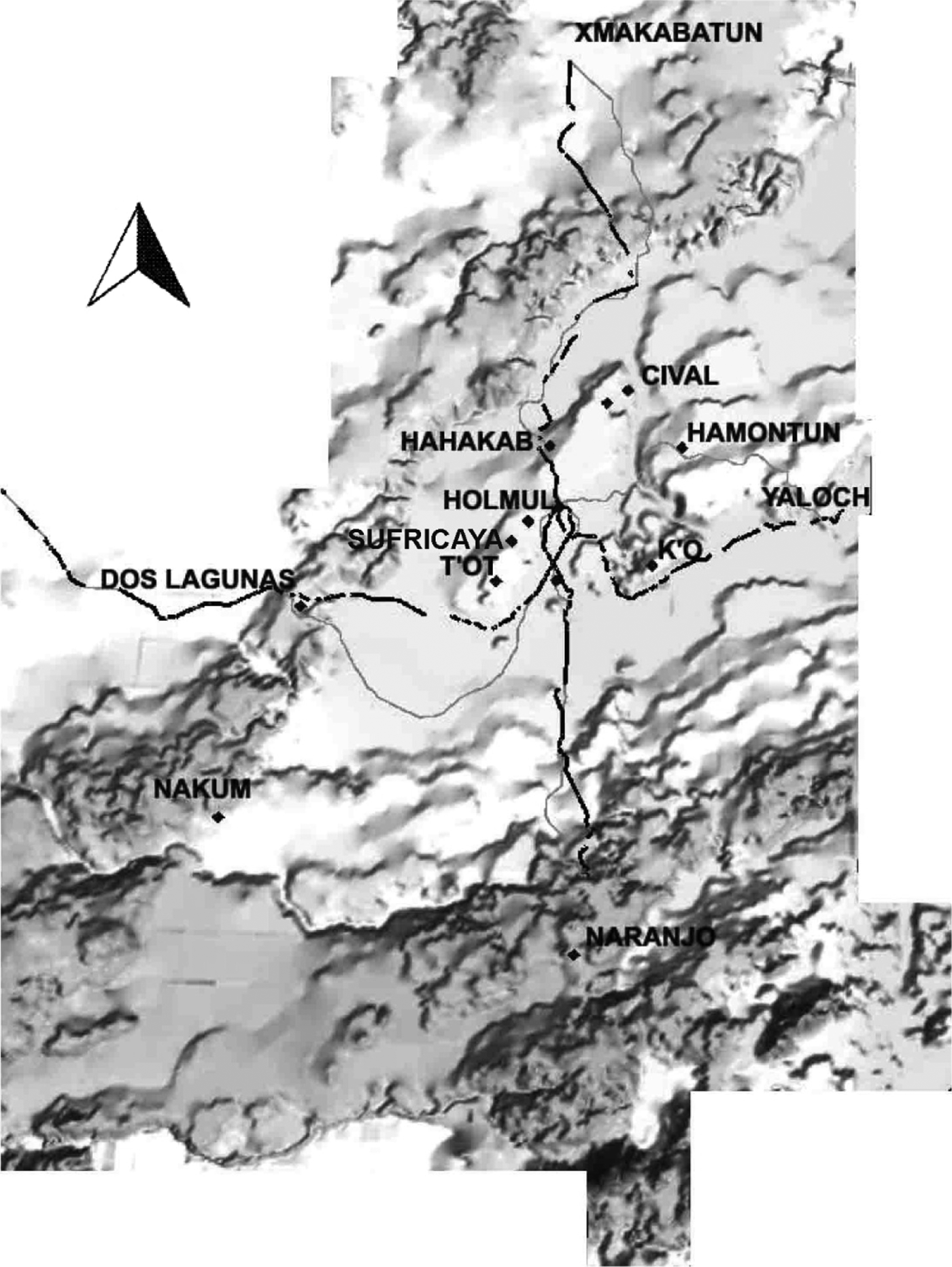
The Holmul region is located in northeastern Guatemala between the central Peten lowlands to the west and the Belize River valley to the east (Figure 1). The region encompasses approximately 10 km2 and contains at least seven identified archaeological sites (Figure 2): Holmul and Cival, two large ceremonial and administrative centers separated by approximately 6 km, and five minor centers—T'ot, K'o, Hahakab, Hamontun, and La Sufricaya—that vary in size by number of temples and plaza groups. Due to the limited number of monuments in the Holmul region, few historical data are available. The earliest inscribed monument in the Holmul region, Stela 2, comes from the site of Cival and has been dated stylistically to the Preclassic period (Estrada-Belli Reference Estrada-Belli2006a; Estrada-Belli et al. Reference Estrada-Belli, Grube, Wolf, Gardella and Guerra-Librero2003). At La Sufricaya, several inscribed monuments and painted murals were found (all from Structure 1) to date to the Early Classic period (Estrada-Belli et al. Reference Estrada-Belli, Tokovinine, Foley, Hurst, Ware, Stuart and Grube2009). These texts link the site of La Sufricaya with the nearby site of Tikal, as well as the “La Entrada” event (a.d. 378) at Tikal that is associated with the use of Teotihuacan-style iconography at several Peten sites.
Map of the location of the Holmul region and other sites mentioned in the text.

Map of sites in the Holmul region. Map by Francisco Estrada-Belli.
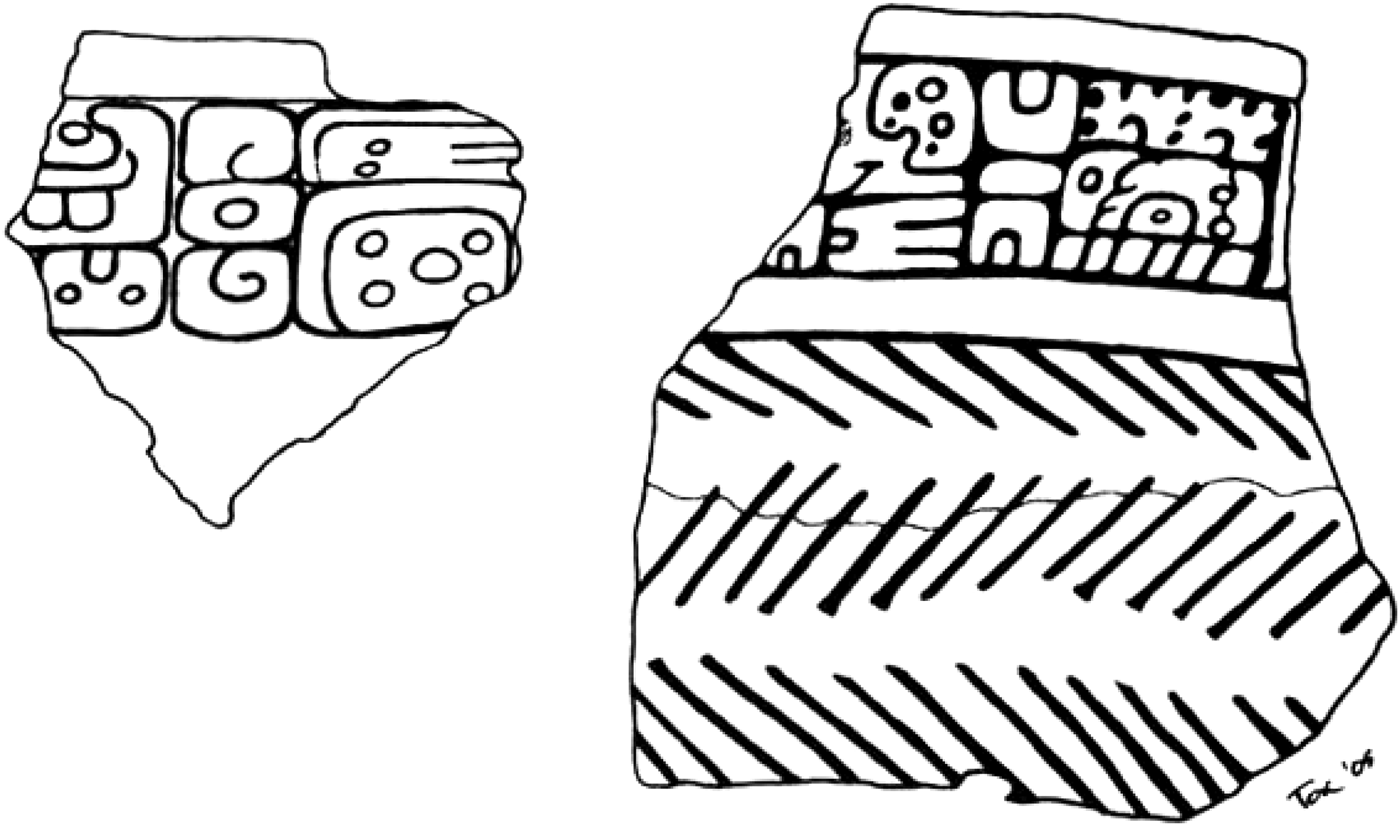
Tokovinine (Reference Tokovinine and Estrada-Belli2006) has pieced together fragments of the Late and Terminal Classic political history of the Holmul region from portable artifacts discovered in Merwin's 1911 excavations, the Holmul Project excavations sponsored by Boston University in 2000 and Vanderbilt University in 2001–2005, and pieces held in various museums and private collections. The record is scarce, but Tokovinine (Reference Tokovinine and Estrada-Belli2006) identifies potential links between the site of Naranjo and Holmul in the Late and Terminal Classic periods. He also identifies the presence of a local title, Chak-Tok-Wayab (Figure 3) (see also Estrada-Belli et al. Reference Estrada-Belli, Tokovinine, Foley, Hurst, Ware, Stuart and Grube2009:Figures 10 and 11), extending back to the Early Classic period at Holmul and forward through time to the Terminal Classic (also see Estrada-Belli et al. Reference Estrada-Belli, Tokovinine, Foley, Hurst, Ware, Stuart and Grube2009). One specific mention of this title was found on a stingray spine associated with the burial of an elite individual in Room 1, Building B, Group II at Holmul. The pottery associated with this burial dates to the K'ahk 2/Tzakol 2 Complex at Holmul (Manik 2 at Tikal) and will be discussed below.
Sherds from the Holmul region displaying the Chak-Tok-Wayab title. Drawing by Alexandre Tokovinine, after Estrada-Belli et al. (Reference Estrada-Belli, Tokovinine, Foley, Hurst, Ware, Stuart and Grube2009:Figure 11).
HOLMUL, ORANGE SLIPPED POTTERY, AND THE TERMINAL PRECLASSIC PERIOD IN THE MAYA LOWLANDS
Studied together the burials and accompanying vessels in Building B, Group II at Holmul, reflect larger sociopolitical processes taking place in the Maya lowlands from the end of the Late Preclassic period to the end of the early facet of the Early Classic period (approximately a.d. 150–400). In order to best understand what these deposits represent, however, a brief discussion of this period is helpful. I prefer using the term Terminal Preclassic period in reference to this time in Maya culture-history and not the more common “Protoclassic” period—a term that invokes a number of outdated and confusing concepts. Some of these concepts include the implicit idea that Maya social complexity began to grow only after a.d. 250 during the Early Classic period; use of the term “Q Complex” when referring to ceramic material of this period; use of the term “Floral Park Horizon” to describe both the chronological and spatial context of ceramic material dating to this period; and, finally, a reliance on diffusion theory to account for the appearance of polychrome ceramics in the Maya lowlands sometime around a.d. 150 (for a more detailed critique of Protoclassic terminology see Brady et al. [1998], Callaghan [2008], and Pring [2000]).
The chronological placement, culture-material correlates, and economic and sociopolitical changes that took place during the Terminal Preclassic period have long been the subject of intense debate in Maya archaeology (Brady et al. Reference Brady, Ball, Bishop, Pring, Hammond and Housley1998; Hammond Reference Hammond1974, Reference Hammond and Adams1977, Reference Hammond1984; Pring Reference Pring and Hammond1977a, Reference Pring1977b, Reference Pring2000; Sharer and Gifford Reference Sharer and Gifford1970; Sheets Reference Sheets, Sheets and Grayson1979a, Reference Sheets1979b; Willey and Gifford Reference Willey, Gifford and Lothrop1961; Willey et al. Reference Willey, Culbert and Adams1967). At the center of much Terminal Preclassic period research is the study of a specific kind of ceramic material, the first orange gloss polychromes. Terminal Preclassic orange gloss pottery exhibits a combination of Preclassic and Classic period ceramic traits along with its own unique characteristics (Smith Reference Smith1955:22). Classic period characteristics include glossy surface finish, red-and-black-on-orange polychrome painting, and some aspects of vessel form including composite bowl shapes. Preclassic characteristics include thick vessel walls and the presence of four supports or “tetrapods.” Traits unique to orange gloss ceramics include fashioning the tetrapod supports into “mammiform” shapes, and vessel forms such as the tetrapod cylinder vase or plate with swollen cylindrical supports.
Brady and colleagues (Reference Brady, Ball, Bishop, Pring, Hammond and Housley1998) address the chronological placement of the Terminal Preclassic period in terms of ceramic evidence, including the introduction of orange gloss pottery. They divide the period into two facets; an early (75 b.c.–a.d. 150) and a late (a.d. 150–400), both based upon significant changes in ceramic modes. In brief, the first facet witnessed the introduction of matte or waxy finish orange-brown ceramic types (for example, Iberia Orange and Ixobel Orange) as well as production and exchange of pottery displaying the Usulutan mode of drip-like decoration (through application of true-resist technology or positive painting). The second facet saw the introduction of glossy-finished orange types (ceramics of the Aguila Orange group) including those with polychrome painted decoration (for example, Ixcanrio Orange Polychrome) as well as continued production and exchange of matte-finished types (ceramics of the Aguacate Orange group).
Sites containing tombs with early phase Terminal Preclassic ceramic material are rare, but include: Tikal Burials 167, 166, and 85, and PD 87 (Coe Reference Coe1965; Culbert Reference Culbert1993; Estrada-Belli Reference Estrada-Belli2010); Jabalí Group Tomb 1 at San Bartolo, Guatemala (Pellecer Reference Pellecer, Laporte, Arroyo and Mejia2006); and possibly Tombs 1, 2, and 3 at Wakna, Guatemala (Hansen Reference Hansen and Houston1998).
Sites that contain notable examples of late facet Terminal Preclassic ceramics include:
• chultunes at Tzimin Kax, Belize (Thompson Reference Thompson1931:284–288);
• chultunes and caches at Topoxte, Guatemala (Hermes Reference Hermes, Laporte and Escobedo1999);
• a tomb at Cahal Cunil, Belize (Thompson Reference Thompson1931:291);
• a burial mound at Nohmul, Belize (Anderson and Cook Reference Anderson and Cook1944:84; Gann and Gann Reference Gann and Gann1939);
• a potential “port mound” at Nohmul, Belize (Pring and Hammond Reference Pring, Hammond and Hammond1985);
• Burials 19, 30, and 31 at Barton Ramie, Belize (Pring Reference Pring2000:106; Willey and Gifford Reference Willey, Gifford and Lothrop1961);
• a chultun at El Mirador, Guatemala (Forsyth Reference Forsyth1989:10; Hansen Reference Hansen1990:88-94; Pring Reference Pring2000:117);
• “ritual contexts” (Lopez Varela Reference Lopez Varela1996:302) and burials at K'axob, Belize (Berry et al. Reference Berry, Varela, Bartlett, Martz, McAnany and McAnany2004);
• contexts of an “elite element of society” (Pring Reference Pring2000:122) at Kichpanha, Belize (Meskill Reference Meskill1992);
• a tomb and cave at La Lagunita, Guatemala (deposit C-48) (Ichon and Arnauld Reference Ichon and Arnauld1985);
• a cave at Naj Tunich, Guatemala (Brady Reference Brady1989);
• Tomb 2 at Chan Chich, Belize (Houk Reference Houk1998, Reference Houk1999);
• in construction fill of a large mound in the epicenter of El Pozito, Belize (Case Reference Case1982);
• in a large midden deposit at Salinas de los Nueve Cerros, Guatemala (Dillon Reference Dillon1977);
• in construction fill of Building B, Group II at Holmul, Guatemala (Callaghan Reference Callaghan2008);
• in construction fill of Structure 1 at La Sufricaya, Guatemala (Callaghan Reference Callaghan2008);
• Tikal burials PNT-21 and PNT-10, both in Structure 5D-86 of the east platform of the E-Group structure at Mundo Perdido (Laporte Reference Laporte and Grube1995; Laporte and Fialko Reference Laporte and Fialko1995)
Maya archaeologists have tested many models aimed at understanding the function and meaning of the second-facet Terminal Preclassic orange gloss ceramics. Because of their combination of Preclassic and Classic period traits, they were once thought to be representative of a transitional cultural phase between the Preclassic and Classic periods (Willey et al. Reference Willey, Culbert and Adams1967). After years of excavations at other Maya sites yielded relatively few examples of Terminal Preclassic orange gloss ceramics (see discussions in Brady et al. Reference Brady, Ball, Bishop, Pring, Hammond and Housley1998; Callaghan Reference Callaghan2008; Pring Reference Pring2000), however, it became clear that the vessels could not be indicative of a pan-lowland phase of cultural development. The presence of these vessels in the Maya lowlands was also thought to be the result of major migrations of populations from southeastern Mesoamerica in the wake of volcanic eruptions (Sharer Reference Sharer1978; Sharer and Gifford Reference Sharer and Gifford1970; Sheets Reference Sheets, Sheets and Grayson1979a, Reference Sheets1979b). But, refined modal analysis and revised dating of the volcanic event proved to falsify these hypotheses (Dull et al. Reference Dull, Southon and Sheets2001; Hammond Reference Hammond1974, Reference Hammond and Adams1977, Reference Hammond1984; Pring Reference Pring and Hammond1977a).
These changing ceramic production patterns are best understood in relation to larger culture-historical processes that took shape in the Terminal Preclassic period. Reese-Taylor and Walker (Reference Reese-Taylor, Walker, Masson and Freidel2002) cite a number of significant culture-historical changes that occurred during this time. These changes included: (1) increased signs of warfare and site abandonment along pre-existing trade routes, (2) a massive reorganization of trade patterns after the collapse of El Mirador, (3) signs of the first royal burials in tombs and plazas of major centers such as Tikal, Caracol, and Holmul, (4) usurpation of the supernatural realm by elites through the construction of ceremonial architecture in the form of mythical places at major site centers and the possibility that elite shamans began taking on roles of deities and sacred ancestors at important ceremonial events, and, most important as concerns this research, and (5) the introduction of a sub-complex of orange-slipped polychrome pottery displaying “tags” of ideology representing re-birth (such as mammiform supports which Reese-Taylor and Walker [2002] relate to representations of breasts from the goddess Ix'chel, as well as peccary imagery) and symbols which eventually become associated with Classic period elites (such as the weave, mat, or pop pattern, as well as early representations of the ahau or Lord glyph).
In light of these emerging culture-historical patterns, scholars are currently applying models derivative of more traditional political economy approaches to understand the introduction of orange gloss ceramics during the late facet of the Terminal Preclassic period. In these models, orange gloss pottery constituted part of a new political economy and served as a form of social currency that materialized political or trade relations (Brady et al. Reference Brady, Ball, Bishop, Pring, Hammond and Housley1998:33; Fields and Reents-Budet Reference Fields and Reents-Budet2005:214–217; Pring Reference Pring2000:42; Reese-Taylor and Walker Reference Reese-Taylor, Walker, Masson and Freidel2002:104-105; Walker et. al Reference Walker, Reese-Taylor, Mathews, Laporte, Arroyo and Mejía2006:665). In this type of model orange slipped pottery would have been considered a type of prestige good with its production and distribution controlled by groups of elites seeking to gain or maintain social status and political authority.
To a certain extent I agree with these models, but would also like to qualify or expand upon them further. I argue that Terminal Preclassic polychrome vessels were social valuables that simultaneously integrated communities while reinforcing political and social hierarchies within them (Callaghan Reference Callaghan2008; Callaghan et al. Reference Callaghan, Estrada-Belli, de Estrada and Aimers2013). My own analysis of paste, form, finishing, and firing modes of these Terminal Preclassic serving vessels and contemporaneous Sierra Red types at Holmul has shown that this early painted pottery was produced by numerous production units often with the same paste recipes and technology as seemingly unrestricted Sierra Red serving vessels (Callaghan Reference Callaghan2008; Callaghan et al. Reference Callaghan, Estrada-Belli, de Estrada and Aimers2013). In these studies paste was examined using a combination of microscopic, petrographic, and chemical composition (instrumental neutron activation analysis [INAA]) methods. The studies revealed overlap of Sierra Red and Ixcanrio Orange Polychrome paste recipes containing sparitic calcite, peloid calcite, and sparitic calcite with grog temper within the same shape-classes (composite bowls and flaring-side bowls). These data do not suggest restricted access to resources or technology at any stage of the production process. When combined with data about the segmented nature of the ceramic production process from ethnographic (Arnold Reference Arnold1985, Reference Arnold1991, Reference Arnold2008; Druc Reference Druc2000; Reina and Hill Reference Reina and Hill1978) and archaeological (Beaudry Reference Beaudry1984; Coggins Reference Coggins1975; Reents-Budet Reference Reents-Budet1994; Rice Reference Rice2009) data it is quite reasonable to assume that the first orange slipped polychromes were produced not by few elite craftspeople, but by many people possibly of different socioeconomic statuses. This would have integrated regional producers into one economic and possibly even social and political unit centered on a Terminal Preclassic polity.
Although production may have been segmented and multiple producers were responsible for the creation of these vessels, I believe some of these producers may not have had access to their final products, specifically some of those responsible for the production of vessels in Building B, Group II at Holmul. As I have suggested elsewhere (Callaghan Reference Callaghan2008; Callaghan et al. Reference Callaghan, Estrada-Belli, de Estrada and Aimers2013) the vessels found in the rooms of Building B, Group II at Holmul were used only by the Terminal Preclassic and early facet Early Classic period elite in what Dietler (Reference Dietler, Wiessner and Schiefenhövel1996:92–99, Reference Dietler, Dietler and Hayden2001:75–88) calls “diacritical feasts.” Diacritical feasts are exclusive gatherings of elites where rich and rare food is served. The function of these feasts was to legitimate social inequalities between exclusive elite participants and those non-elites (and also other elites) that were not in attendance. Unlike “empowering” or “patron-role” feasts (Dietler Reference Dietler, Wiessner and Schiefenhövel1996:92–99, Reference Dietler, Dietler and Hayden2001:75–88), it is not the quantity of food that was important in these feasts, but its quality and the performance or ritual surrounding its serving. Preparation, ceremonious serving, and appreciation of rare foods of exceptional quality serves as a marker of cultural “distinction” and simultaneously demonstrates and boosts one's level of cultural capital (Bourdieu Reference Bourdieu1984).
LeCount (Reference LeCount2001) and others (Foias Reference Foias, Wells and Davis-Salazar2007; Reents-Budet Reference Reents-Budet1994, Reference Reents-Budet, Kerr and Kerr2000, Reference Reents-Budet and McNeil2006) have used ceramic remains and ethnohistoric documents to suggest that Classic period Maya elites practiced exclusive, potentially diacritical, feasting rituals. Painted scenes on Late Classic period polychrome vases support the idea that diacritical feasts may have been practiced by Maya elites. Pictorial scenes on these vessels often portray a king sitting on a throne eating or speaking as he receives visitors (sometimes carrying tribute), and attended by servants or ritual persons such as dwarves or hunchbacks (Reents-Budet Reference Reents-Budet1994, Reference Reents-Budet, Kerr and Kerr2000, Reference Reents-Budet and McNeil2006). These scenes sometimes depict actual historical occasions. It is possible to extend these interpretations back in time to the Terminal Preclassic period when polychrome painting began to appear more frequently in the lowlands.
Because some producers may have been alienated from their final products, and more than likely not granted access to the diacritical feasts in which these vessels were used, the vessels and the feasts they were used in simultaneously contributed to community integration while reinforcing newly forming social and political hierarchies. As I have argued elsewhere (Callaghan Reference Callaghan2008; Callaghan et al. Reference Callaghan, Estrada-Belli, de Estrada and Aimers2013) and will address below, Terminal Preclassic period orange polychrome serving vessels were representations of changes in feasting strategies and material tools of social integration and separation. The polities who took part in the production and consumption of these types of ceramics, and the elites who used and gifted them at diacritical feasts, were able to survive the political turmoil of the Terminal Preclassic period. The vessels in Building B, Group II at Holmul may have been a testament to this community's ability to integrate itself and survive the political and economic events that caused the collapse of other major lowland polities like Cerros, El Mirador, and even Cival in the Holmul region itself.
CURRENT CHRONOLOGY
The current Holmul region chronology is founded upon the analyses of multiple scholars over the course of many years. The sequence is derived from Merwin's original excavations (Merwin and Vaillant Reference Merwin and Vaillant1932:20–41, 50–52), Vaillant's analysis of pottery from Merwin's excavations, as well as his interpretations of Merwin's notes (1927:300–335; Merwin and Vaillant Reference Merwin and Vaillant1932:13–16, 54–84). Ceramic material from Holmul Project excavations sponsored by Boston University in 2000 was examined by Kosakowsky (Reference Kosakowsky2001), who was able to extend Merwin and Vaillant's original sequence both back in time through the Late Middle Preclassic period and forward to the Terminal Classic period. Bernard Hermes analyzed ceramic material from Vanderbilt University Holmul Project excavations in 2001–2004 and was able to identify a potential Early Middle Preclassic component to the sequence. My own analysis of all Holmul Project ceramic material began in 2005, resulting in the creation of a formalized typology.
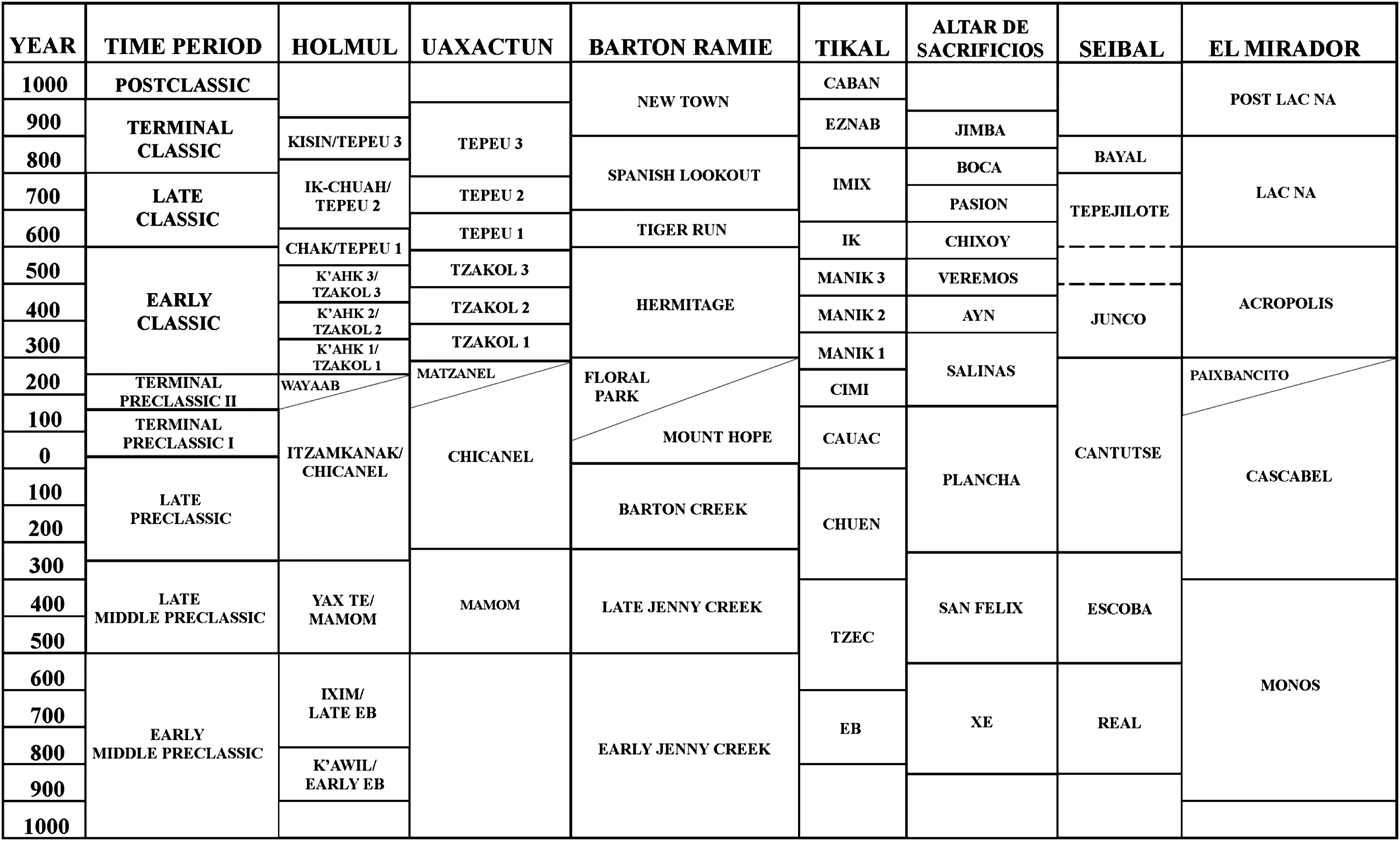
The current Holmul region ceramic chronology is presented in relation to other Maya area sequences in Figure 4. Because the Holmul sequence is newly defined, names of Holmul complexes are paired with Smith's (Reference Smith1955) complex names from Uaxactun and Culbert's (Reference Culbert1993, Reference Culbert and Sabloff2003, Reference Culbert2005) Eb complex at Tikal in the case of Pre-Mamom material for reference. I did not retain Vaillant's original complex names (for example, Holmul I–V) as they only began in the Terminal Preclassic period (Holmul I) and ended in the Late Classic period (Holmul V) and, in some instances, did not represent true breaks or changes in complexes. They also carry with them unfounded implicit assumptions about production quality (for example, superiority or “decadence”). The current ceramic sequence follows the Type-Variety classification system as it was proposed for the Maya lowlands (Gifford Reference Gifford1960, Reference Gifford1976; Smith and GiffordReference Smith and Gifford1966; Smith et al. Reference Smith, Willey and Gifford1960). The Holmul sequence was created by using a combination of absolute and relative dating techniques including: (1) carbon dating of organic material found in association with whole vessels in sealed, well-stratified contexts, (2) ceramic seriation of modes and types of pottery found in Holmul region excavations, and (3) cross-dating ceramic modes and types of Holmul region pottery with pottery found in other Maya sites.
Holmul region ceramic sequence.
Holmul region ceramics manifest specific modes of material common to neighboring regions during certain complexes, specifically the central Peten lowlands and Belize River valley. However, Holmul ceramics also always display their own local technological and stylistic affiliations (for an in-depth discussion of types and modes see Callaghan [2008:232–476]). To briefly summarize, ceramics from the K'awil/Early Eb complex share closest affiliations with nearby Belize River valley ceramic traditions in paste, form, finishing, and decoration. Ixim/Late Eb complex and Yax Te/Mamom material begin to show form modes common to central Peten ceramics of the Mamom ceramic sphere, but still using K'awil/Early Eb paste recipes. Itzamkanak/Chicanel material displays modes firmly established elsewhere for Late Preclassic ceramics in the central Peten and Chicanel sphere in all aspects of production—paste preparation, form, firing, and surface. The Terminal Preclassic Wayaab subcomplex of serving vessels displays modes strongly affiliated with pottery from the same time period and found at sites in the Belize River valley (Floral Park complex), northern Belize, as well as funerary offerings found in central Peten sites. In the K'ahk 1/Tzakol 1 complex, ceramic modes of serving vessels, utilitarian vessels, and imports become strongly anchored in central Peten traditions displayed in characteristics of the Tzakol 1 sphere ceramics. These preferences for central Peten modes continue through the K'ahk 2/Tzakol 2, K'ahk 3/Tzakol 3, Chak/Tepeu 1, and Ik-Chuah/Tepeu 2 complexes. Kisin/Tepeu 3 complex ceramics again share modal similarities with material recovered in excavations from Belize River valley sites such as Xunantunich along with strong continued central Peten influences.
BUILDING B, GROUP II: ARCHITECTURE
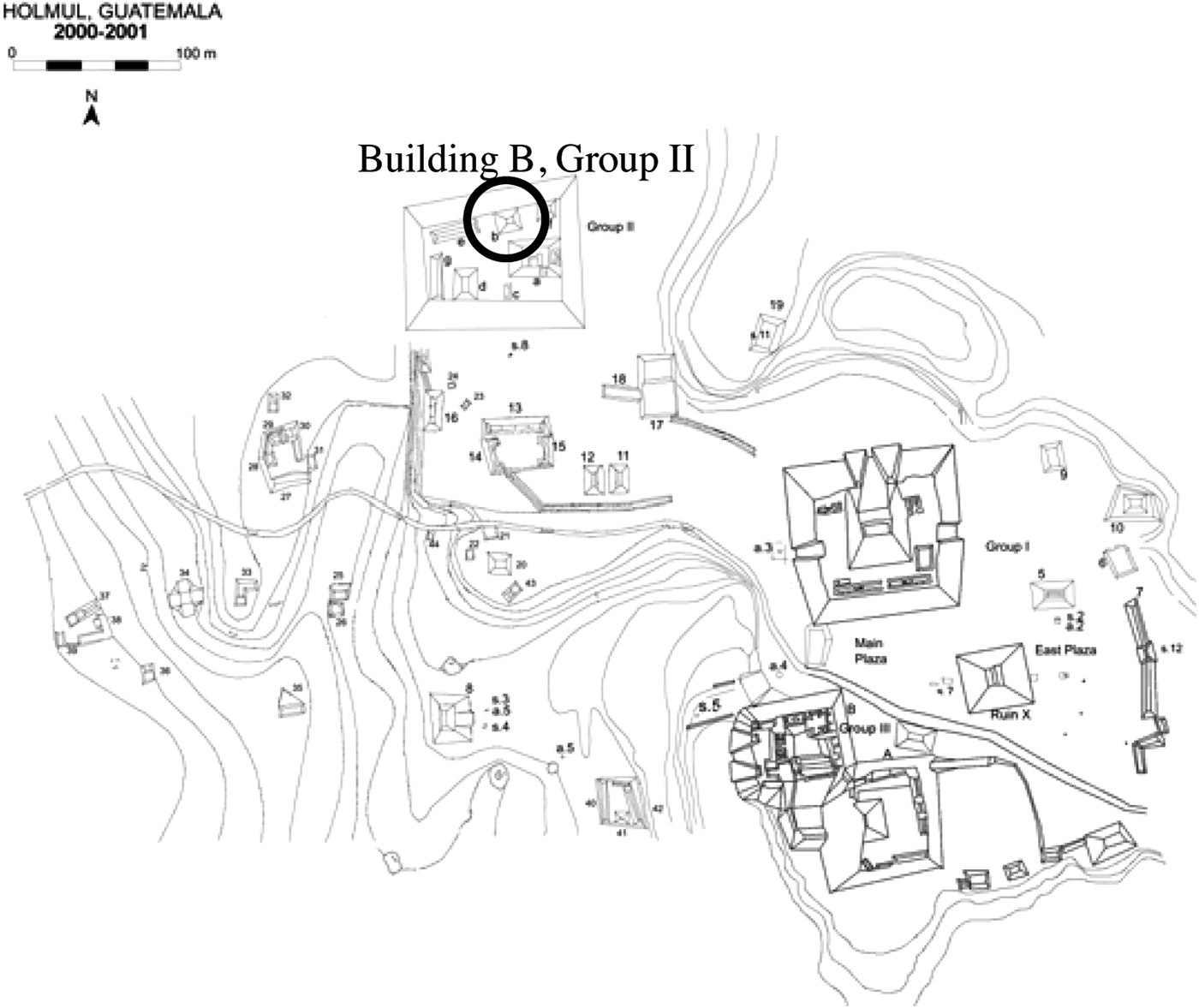
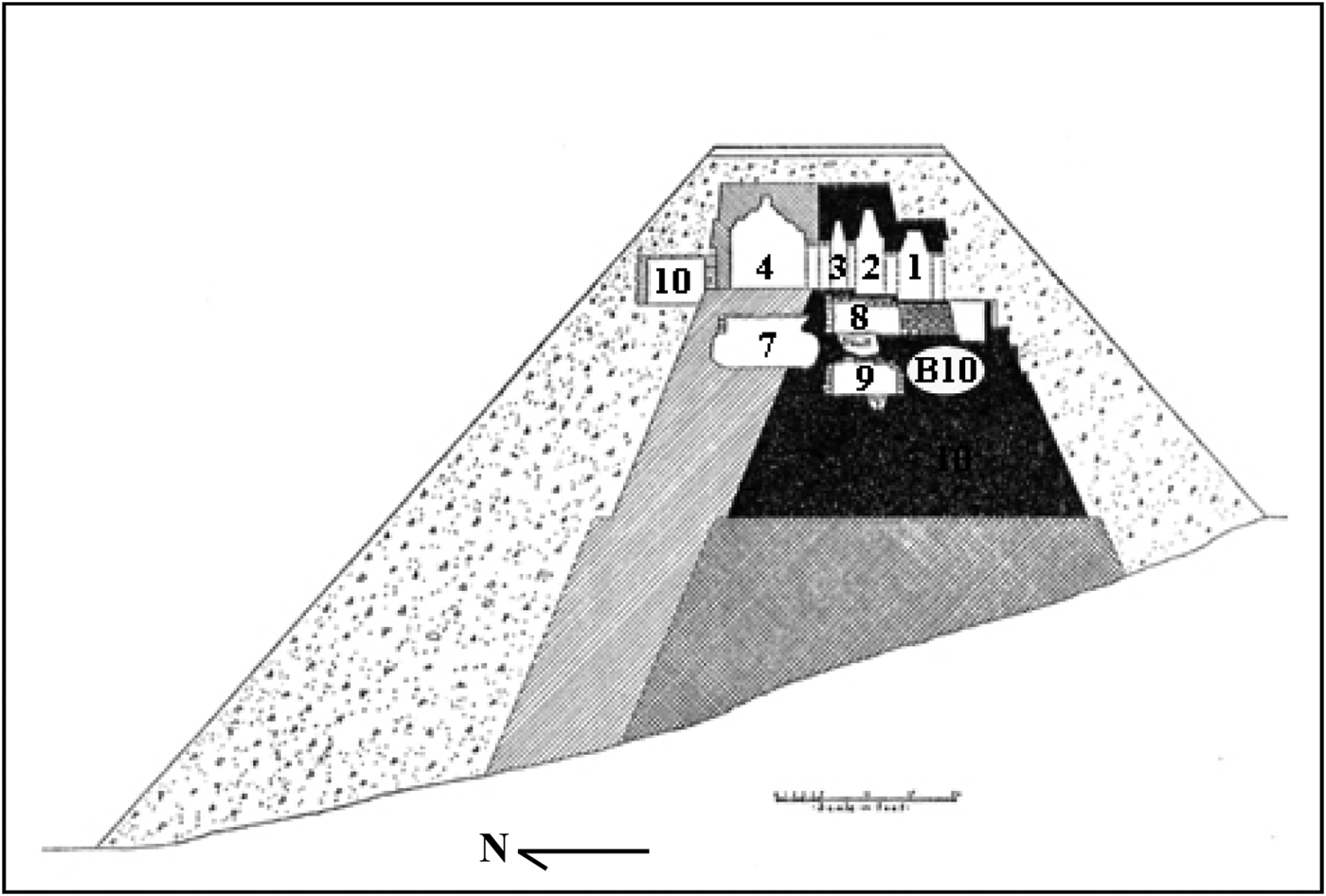
Building B is one of six masonry structures arranged around a patio in Group II of the Holmul site center (Figure 5). The building is oriented north-south and in its present form consists of four formal rooms atop a sub-structure of rubble construction fill containing at least one Late Preclassic platform. Originally believed by Merwin and Vaillant to be the product of only four construction phases (Figure 6), recent excavations of the Building B platform have revealed at least three antecedent phases (Figure 7). Holmul Project excavations directed by Estrada-Belli in 2003–2010 have expanded upon Merwin and Vaillant's original interpretations of the architectural sequence of Building B (Neivens Reference Neivens and Estrada-Belli2005:88–90; Neivens de Estrada Reference Neivens de Estrada and Estrada-Belli2006:22–27).
Map of the Holmul epicenter showing location of Building B, Group II. Map by Francisco Estrada-Belli.
West profile of Building B, Group II, showing rooms excavated in 1909–1911. Holmul Project Burial 10 has been added (“B10”). Modified from Raymond E. Merwin and George C. Vaillant, The Ruins of Holmul, Peabody Museum Memoirs Vol. 3, No. 2. 1904, 1932. Reprinted courtesy of the Peabody Museum of Archaeology and Ethnology, Harvard University.
North profile of Building B, Group II, showing three Late Preclassic construction episodes within the platform. Adapted from Neivens de Estrada (Reference Neivens de Estrada and Estrada-Belli2006:Figure 1).
Over the past four years, Neivens de Estrada has discovered three more building phases predating those proposed by Merwin and Vaillant, creating a total of seven larger construction episodes. The first episode witnesses the construction of a masonry platform decorated with a stucco-plastered façade. Estrada-Belli (Reference Estrada-Belli2010:93–96) argues that the Late Preclassic manifestation of the building may have been used as a site for ancestor veneration. Stucco iconography on the Late Preclassic sub-structure includes an earth-monster or witz with open mouth. A human head with lines on its cheeks, possibly representing wrinkles, emerges out of the mouth of the earth-monster, its hands can be seen grasping the lower edge of the witz mouth as if pulling itself out. Skulls appear to the sides of the witz mouth with emerging head, leading Estrada-Belli (Reference Estrada-Belli2010) to suggest the original sub-structure functioned as a symbolic mountain or place of death. The temple would have been a place of ancestor veneration where earlier inhabitants of Holmul would come to worship potential apotheosized ancestors. The second and third phases of construction served to inter the original Late Preclassic building.
The fourth construction phase consists of a platform on which stand the formal Rooms 1–3, as well as the construction of Rooms 1–3 themselves. Within the platform upon which Rooms 1–3 sit, are two additional “rooms,” but which are better considered formal tombs—namely Room 8 and Room 9. This platform also contains the more recently discovered Burial 10. Rooms 8 and 9 both have an accompanying smaller vault dug through their floors. The entire construction of these first four phases, unknown by Merwin and Vaillant, were subsumed under their first phase of construction (Merwin and Vaillant Reference Merwin and Vaillant1932:40–41). In the fifth phase of construction (second stage according to Merwin and Vaillant), the substructure was expanded north and Room 7 (better stated “Tomb” 7) and Room 4 were constructed. It was also during this time that the exterior walls of the building were covered in plaster complete with stucco ornamentation on the upper register. In the sixth stage of construction (Merwin and Vaillant's third) the upper Rooms 1, 2, 3, and 4 were converted into burial chambers. In at least two separate events osteological material and funerary furniture were placed in these four rooms and the only entrance to the building sealed. In the seventh and final phase (Merwin and Vaillant's fourth) during the K'ahk 3/Tzakol 3 complex (a.d. 450–550) Room 10 (or Tomb 10) was constructed, the entire building covered with rubble fill, and the fill finished with an unornamented plaster façade. There seems to have been no superstructure on this platform.
BUILDING B, GROUP II: CERAMIC INVENTORY
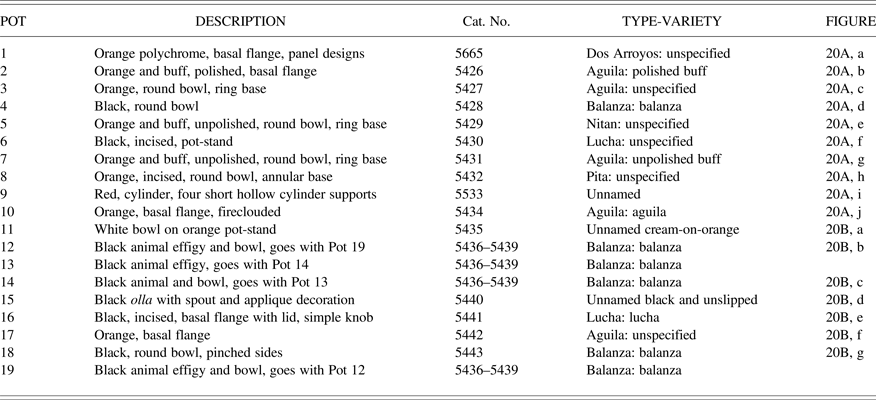
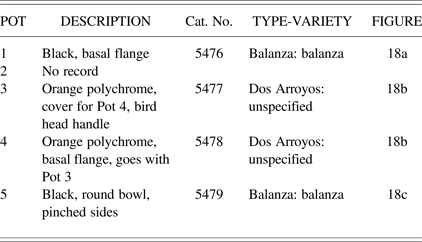
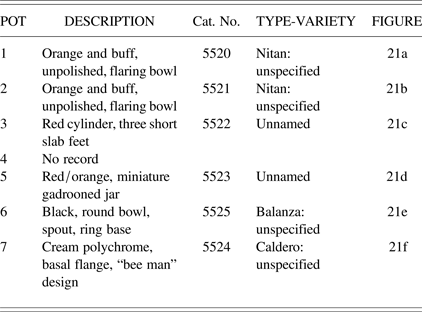
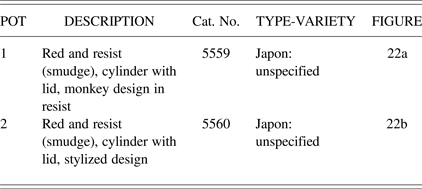
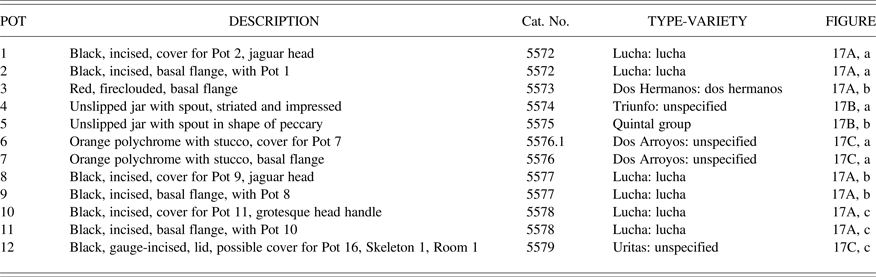
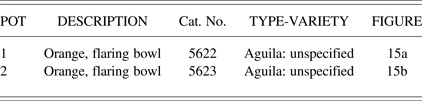
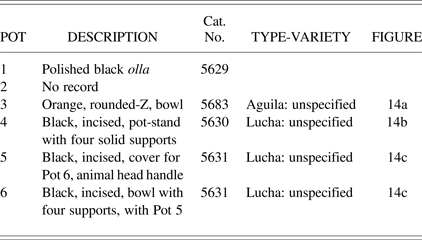
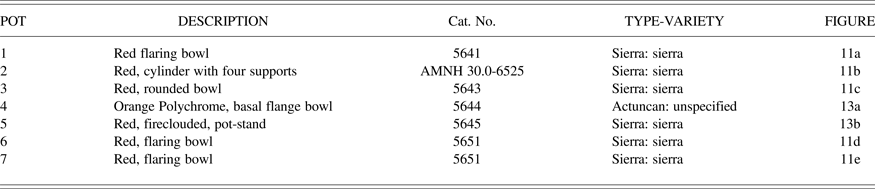
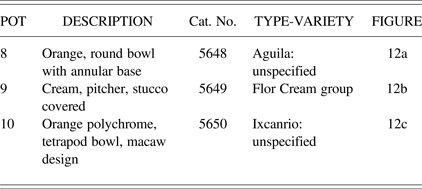
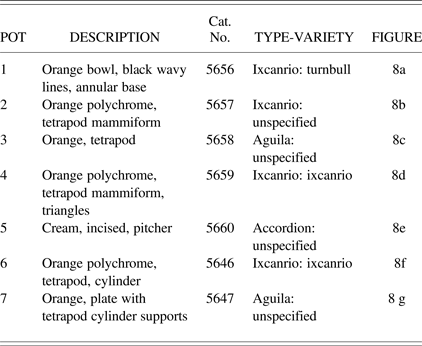
Here I review the pottery of Building B, Group II, beginning with the ceramic material from the rooms and tombs that, based upon Merwin's original excavation data (Merwin and Vaillant Reference Merwin and Vaillant1932:37–39, also see Hammond Reference Hammond1984:4–5) and recent Holmul Project investigations (Neivens Reference Neivens and Estrada-Belli2005), was most likely deposited first. The order of the following discussion is as follows: (1) the newly discovered Burial 10 (Neivens Reference Neivens and Estrada-Belli2005:88–90), (2) Room 9 and its vault, (3) Room 8 and its vault, (4) Room 7, (5) Room 3, (6) Room 2, (7) Room 1, and finally, (8) the problematical Room 10. Rooms 4 and 6 are not part of this discussion because they contained no deposits. In order to provide an accurate description of the context of each room, I present a brief discussion of the architecture and osteological material found in association with the ceramic material. I rely on an unpublished osteological report prepared by Anna Novotny (Reference Novotny2006) of Arizona State Universitywho studied the skeletal remains of Building B, stored at the Peabody Museum at Harvard University, and my discussion of these remains is based on her work. Finally, counts of vessels for each deposition episode are provided and, because of the large sample size, I briefly discuss particularly unique vessels and their relation to other known vessels from the Maya lowlands (for a more complete vessel by vessel discussion see Callaghan [2008:118–165]). Tables 1–12 should aid in this reappraisal of pottery recovered in Merwin's original excavations as they contain the original context for each vessel, the Peabody Museum catalogue number, form, surface finish and decoration, Type-Variety designation, and figure numbers of each vessel as they appear in this article.
Rooms 1 and 2, Skeleton 1
Rooms 1 and 2, Skeleton 5/12
Room 2 West, Skeleton 5/12
Rooms 1 and 2, Skeleton 6
Room 2, Skeleton 10
Room 2, Skeletons 13 and 14
Room 3
Room 7, Skeleton 16
Room 8 Skeletons 17, 18, and 19
Room 8 Vault
Room 9, Skeleton 21
Room 10, Skeleton 22
As an additional note, while all the rooms in Building B were eventually sealed in the seventh and final depositional episode during the beginning of the K'ahk 3/Tzakol 3 ceramic complex, they were intermittently sealed and re-entered many times prior to this in antiquity. Evidence for this can be found in Novotny's conclusion that the osteological remains discovered in the rooms were often incomplete, composed of multiple individuals, and sometimes showed signs of burning. I take this into account in the following analysis, but still rely upon Merwin's original observations and conclusions about the spatial relationship of vessels to groups of bones that he calls “skeletons.” Evidence for re-entry into Building B can also be seen in the fact that rooms often contained vessels of different ceramic complexes (discussed below), as if the building itself served as a type of ossuary containing the partial remains, or osteological relics, of important ancestors as well as heirloom ceramic vessels and other artifacts. All of this points to the continued focus of Building B as a sacred place of ancestor veneration containing inalienable possessions (Callaghan et al. Reference Callaghan, Estrada-Belli, de Estrada and Aimers2013; Kovacevich and Callaghan Reference Kovacevich, Callaghan, Kovacevich and Callaghan2014; Weiner Reference Weiner1992) of bones and artifacts which date back to its original construction in the Late Preclassic period (Estrada-Belli Reference Estrada-Belli2010:93–96).
Holmul Project Burial 10
Burial 10 is located in the Phase 4 substructure of Building B, Group II (see Figure 6). It was discovered in the fill of the substructure platform south of Room 1 and below the floor of Room 8 (Neivens Reference Neivens and Estrada-Belli2005). Burial 10 is the lowest stratigraphically positioned tomb found in the building to date—lower even than Merwin and Vaillant's Room 9. A single body was laid out on a plastered floor according to an east-west axis with the head facing east. The remains were of a young adult, the sex unknown due to the poor preservation of the bones and lack of diagnostic fragments (Novotny Reference Novotny2006:12). Associated with the remains were one Ixcanrio Polychrome: variety unspecified vessel (Figure 8), a tubular jade bead which would have been worn as a pendant, a piece of animal bone, and a thin stucco lining from an unknown perishable object (possibly a gourd or paper/codex). Collagen from a rib fragment associated with Burial 10 was analyzed using accelerator mass spectrometry (AMS) and produced an uncalibrated date of 1840 ± 40 b.p., with a calibrated 1-sigma range of a.d. 120–230 and a 2-sigma range of a.d. 80–250, producing a probable date of deposition of approximately a.d. 150 (Estrada-Belli Reference Estrada-Belli2006b:4). This date falls well within the beginning of what Brady and colleagues (Reference Brady, Ball, Bishop, Pring, Hammond and Housley1998) consider the second half of the Terminal Preclassic period in the Maya lowlands and correlates to the Wayaab sub-complex at Holmul.
Vessel from Holmul Project Burial 10, Building B, Group II. Ixcanrio Orange Polychrome: variety unspecified. Photo by author.
The vessel is a bowl with outcurving walls, direct rim, rounded lip, and concave base with four hollow mammiform supports with air vents, rattles, and nubbin tips. It is slipped a glossy orange and decorated with red and black paint. The main design on the exterior is a frame enclosing a cream or buff background upon which is depicted a repeating mat, or weave, pattern in black fine line execution. Mat, or weave, motifs are separated by crosses of fine red and black lines. While the design is not common to other Wayaab sub-complex vessels found in the tombs of Building B, certain elements of the design are. The cream or buff background panel is also found on Vessel 10 of the Room 8 Burial vault which depicts stylized macaws flying on a cream background panel (Figure 13b). The mat pattern later becomes a symbol of elite or royal power in the Classic period, as it was on a woven palm-frond mat, or petate, that elites and royalty sat when receiving subjects. The weave pattern is found on Terminal Preclassic subcomplex pottery from other sites including Chetumal (Pring Reference Pring2000:98, Figure 63) and K'axob (Berry et al. Reference Berry, Varela, Bartlett, Martz, McAnany and McAnany2004:239). While specific aspects of decoration may differ from the other Wayaab subcomplex vessels found in Room 9 and the Room 8 vault, the Burial 10 vessel does share similarities in form and other decorative techniques. The Burial 10 vessel has a slightly concave base and the tetrapod mammiform supports also have nubbin tips and air vents. Orange slip color is also quite similar to the other vessels falling in the Munsell 2.5 YR 5/8 range. The similarities in the form and decorative modes certainly place it contemporaneous with the Room 9 vessels. This is evidence that Burial 10, and the skeletons in Rooms 8 and 9 were all interred very close in time to one another shortly after a.d. 150.
Room 9 and its Vault (Skeleton 21)
Room 9 is the second lowest stratigraphically positioned tomb in Building B, Group II (see Figure 6). Although at the time of discovery it was the lowest positioned tomb in the building, Merwin believed the skeleton and vessels found in Room 9 were actually deposited after those in Room 8 above it. Merwin's (Reference Merwin and Vaillant1932:39) argument for this ordering of deposition can be seen in his original notes published in the Peabody monograph. His first impression of the architecture in Room 9 is that it was “very crude” when compared to Room 8. It apparently lacked the finished plaster floors and walls of Room 8. This suggested to him that this tomb was perhaps an afterthought in the construction of the substructure of Building B and that Room 8 served as the original and earlier burial chamber. Merwin made this clear where he stated that it was possible for builders to build Room 9 and exit through the Room 8 vault, into Room 8, and eventually through the floor of Room 2. Hammond (Reference Hammond1984:5) also notes this part of Merwin's description and leans toward this explanation of the Building B chronology. The skeletal material associated with Room 9 appears in a vault dug through the floor in the east half of the room. Novotny's (Reference Novotny2006:1–2) analysis of Skeleton 21 reveals that the bones represent the remains of at least one adult male. The skeleton appears to have been found disarticulated and the bones were very badly eroded. Merwin (Merwin and Vaillant Reference Merwin and Vaillant1932:39) noted that while no pots were found directly associated with the burial, approximately “twenty sherds of at least six broken pots” were discovered. Neither Hammond, Pring, nor I were able to locate these sherds in the Peabody Museum collections.
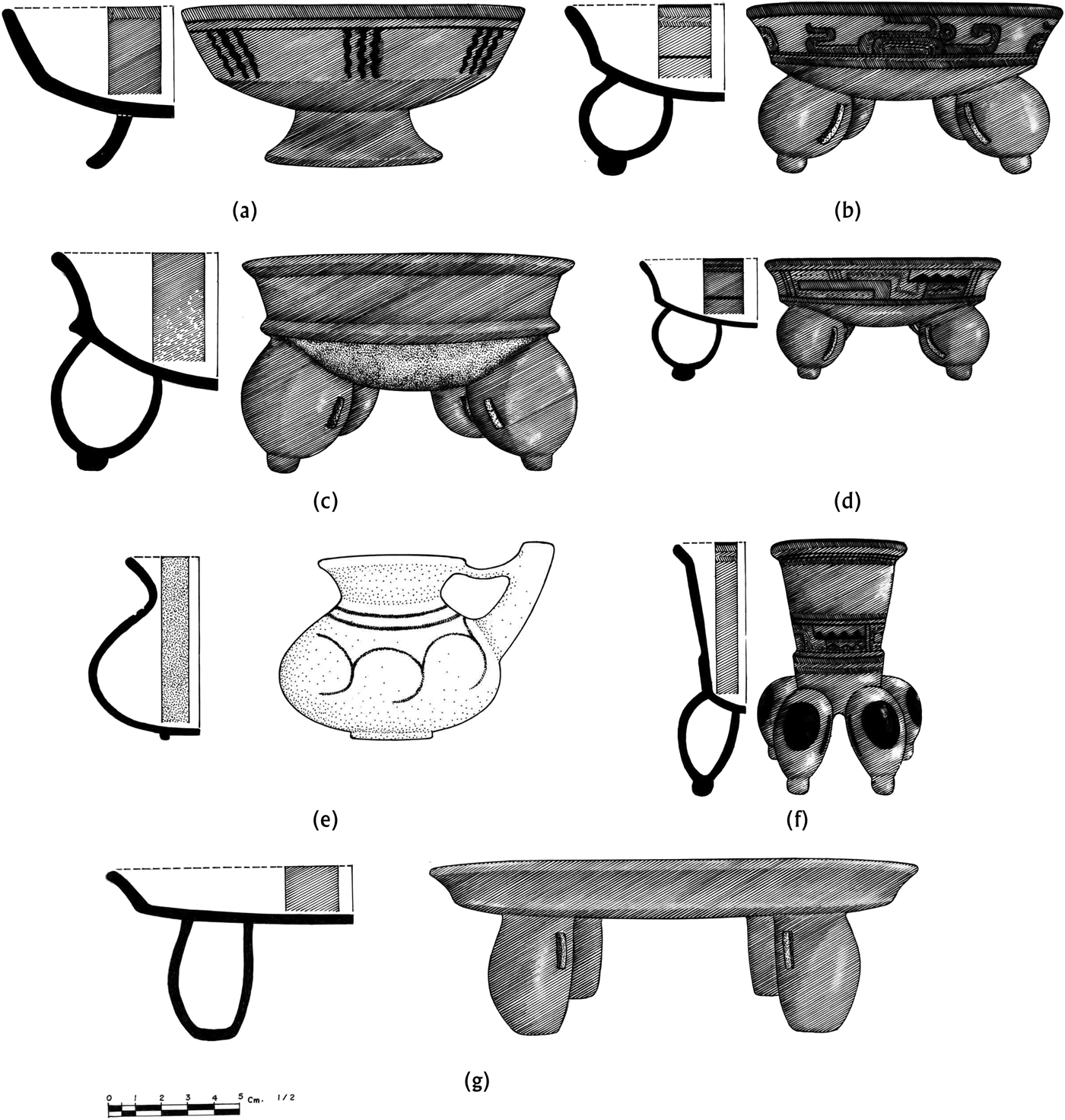
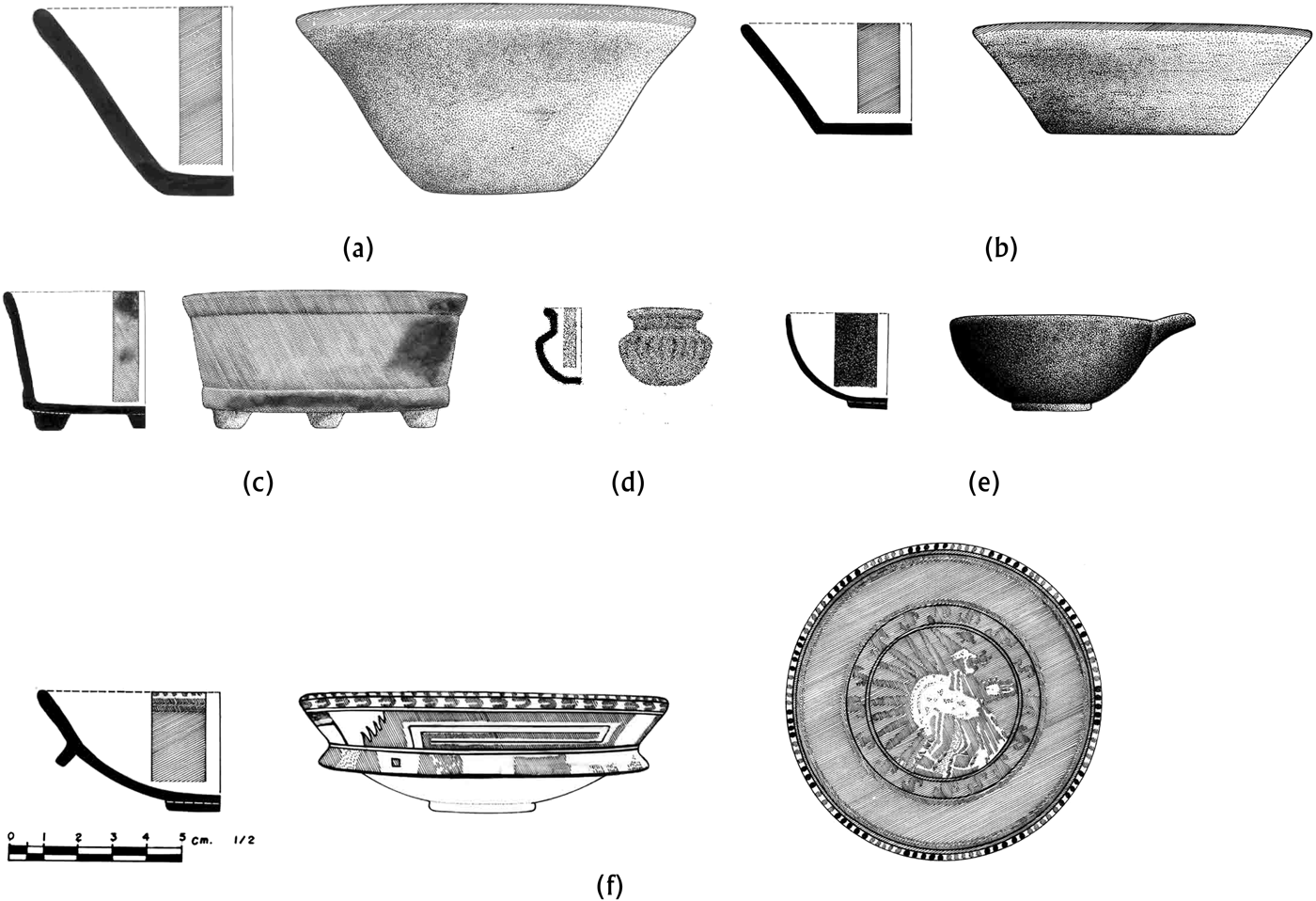
Seven vessels were found in Room 9—Merwin and Vaillant's Vessels 1–7 (Figure 9). Six of the seven vessels belong firmly within the Wayaab subcomplex: these are Vessels 1–4, 6 and 7 (see Figure 10 for location of vessels). Vessel 5 displays form and surface modes more characteristic of Itzamkanak/Chicanel ceramics. After Merwin and Vaillant (Reference Merwin and Vaillant1932; Vaillant Reference Vaillant1927), Smith (Reference Smith1955:22–23) was the first to publish his opinion about the chronological significance of the vessels in Room 9. He correctly pointed to the combination of Late Preclassic form modes and Early Classic decorative modes in the seven vessels. However, he incorrectly classified the Sierra Red ceramics located in the south side of Room 8 as Aguila Orange types. This classification may have added to confusion about Terminal Preclassic ceramic complexes over the past century. Despite this past confusion, what can be concluded at this point is that Sierra Red group ceramics were still being produced at the time of the Terminal Preclassic polychromes—something once suggested by earlier scholars (Laporte Reference Laporte and Grube1995; Lincoln Reference Lincoln, Willey and Mathews1985).
Room 9 vessels: (a) Vessel 1, Ixcanrio: Turnbull; (b) Vessel 2, Ixcanrio: unspecified; (c) Vessel 3, Aguila: unspecified; (d) Vessel 4, Ixcanrio: Ixcanrio; (e) Vessel 5, Accordion: unspecified; (f) Vessel 6, Ixcanrio: Ixcanrio; (g) Vessel 7, Aguila: unspecified. Drawings by Fernando Alvarez, and courtesy of the Holmul Archaeological Project.
Plan of Room 9 deposit showing location of vessels based upon Merwin's original excavation data (Merwin and Vaillant Reference Merwin and Vaillant1932:39).
Room 8 and its Vault
South Side (Skeletons 17, 18, 19)
Room 8 is located directly below the floor of Rooms 1, 2, and 3 in Building B, Group II (Figure 6). The north side of the room appeared to be separated from the south side of the room by a crudely built wall (Merwin and Vaillant Reference Merwin and Vaillant1932:37). The vault in Room 8 was dug into the floor of the northeast corner of the room (Figure 11). Merwin (Merwin and Vaillant Reference Merwin and Vaillant1932:37) speaks of the south side of the room being “sealed up with heavy rocks laid in thick plaster,” creating a spatial and probably even chronological division between the north and south sides of the room. It is only in the sealed south end that human bones were found. He initially identified three groups of bones and assumed they represented the remains of three separate individuals, naming them Skeletons 17, 18, and 19. Novotny's (Reference Novotny2006:2–4) skeletal analysis reveals that none of these groups of burials represented a complete skeleton. Based on the count of specific bones found with each “Skeleton” grouping, she believes Skeletons 17, 18, and 19 may have represented at least two, but possibly as many as six individuals. Overall particular bone fragment counts, however, suggest the lower number of two individuals. All three groups contained bones with evidence of burning or at least coming in contact with fire.
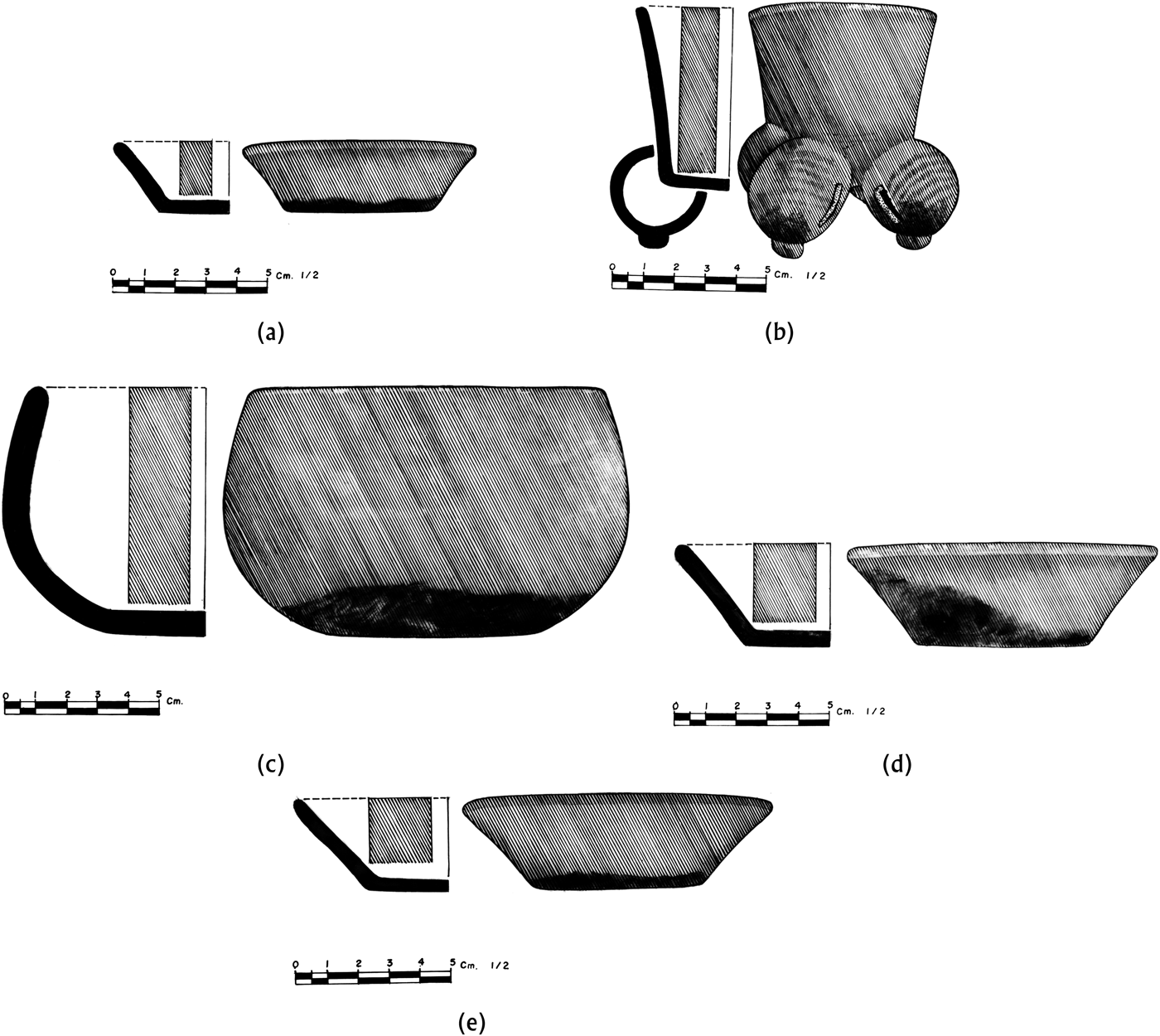
Associated with the bones are five vessels all of the Sierra Red type. These are Merwin and Vaillant's Vessels 1, 2, 3, 6, and 7 of Room 8 (Figure 12). As a group and based on form and slip characteristics, Smith (Reference Smith1955:22) places these vessels firmly within the Tzakol sphere. Like Hammond (Reference Hammond1984:4) and Pring (Reference Pring2000:47), I disagree and based on personal observations (except Vessel 2), believe they belong in the late Chicanel sphere or Itzamkanak/Chicanel complex in the Holmul region. All five vessels display characteristic production modes of the Late Preclassic period in the Maya lowlands. As a note, Vaillant (Merwin and Vaillant Reference Merwin and Vaillant1932:61) placed all five vessels within his Holmul I Burial period. As Hammond suggests (Reference Hammond1984:4) the original contents of Room 8 may have been first placed in the center of the room, but later pushed to the south side and sealed sometime during the Terminal Preclassic period.
Plan of Room 8 and its vault deposit showing approximate location of vessels and skeletal groupings based upon Merwin's original excavation data (Merwin and Vaillant Reference Merwin and Vaillant1932:38).
Room 8, south side vessels: (a) Vessel 1, Sierra: Sierra; (b) Vessel 2, Sierra: Sierra; (c) Vessel 3, Sierra: Sierra; (d) Vessel 6, Sierra: Sierra; (e) Vessel 7, Sierra: Sierra. Drawings by Fernando Alvarez, and courtesy of the Holmul Archaeological Project.
Vault (Skeleton 20)
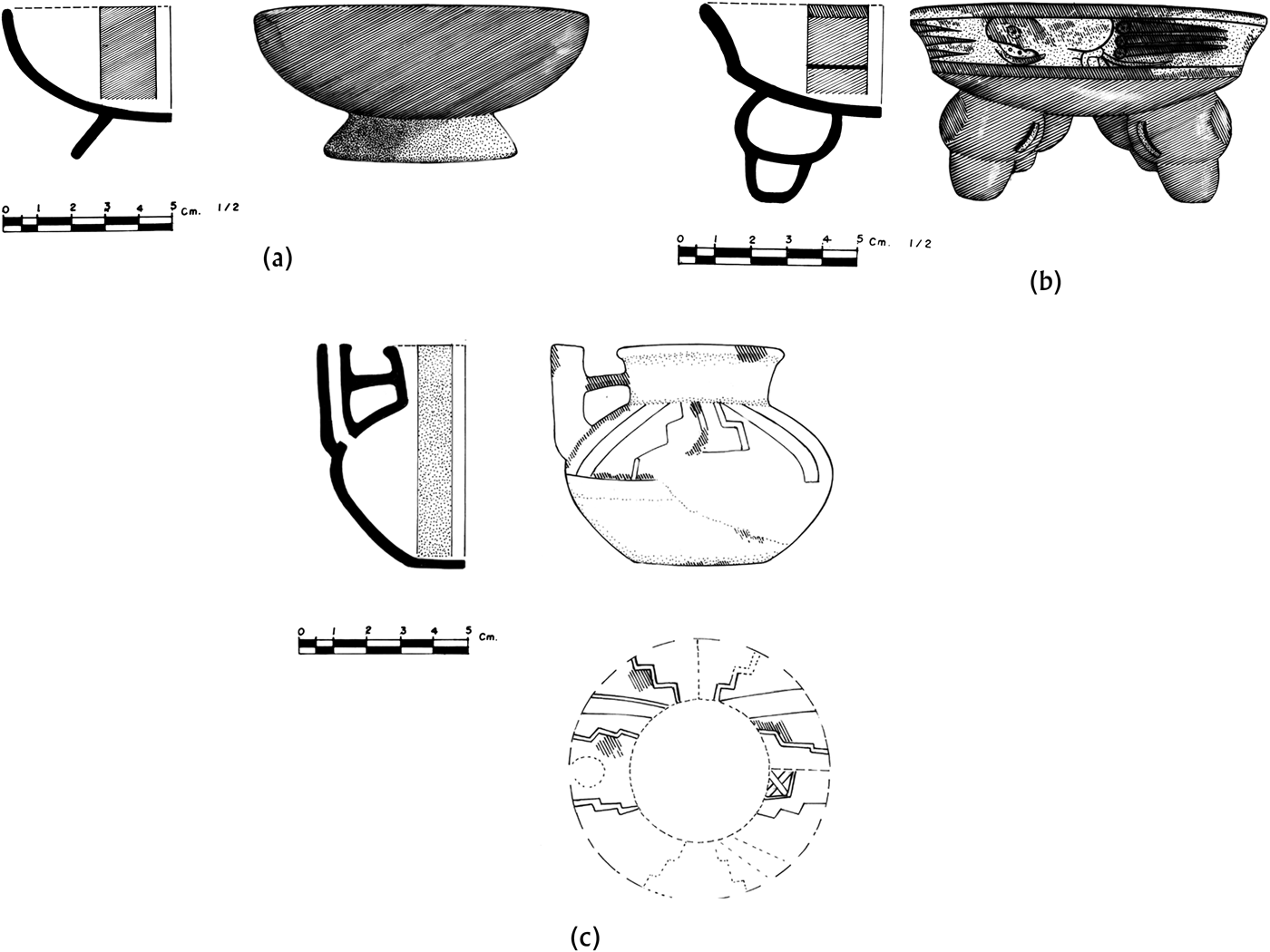
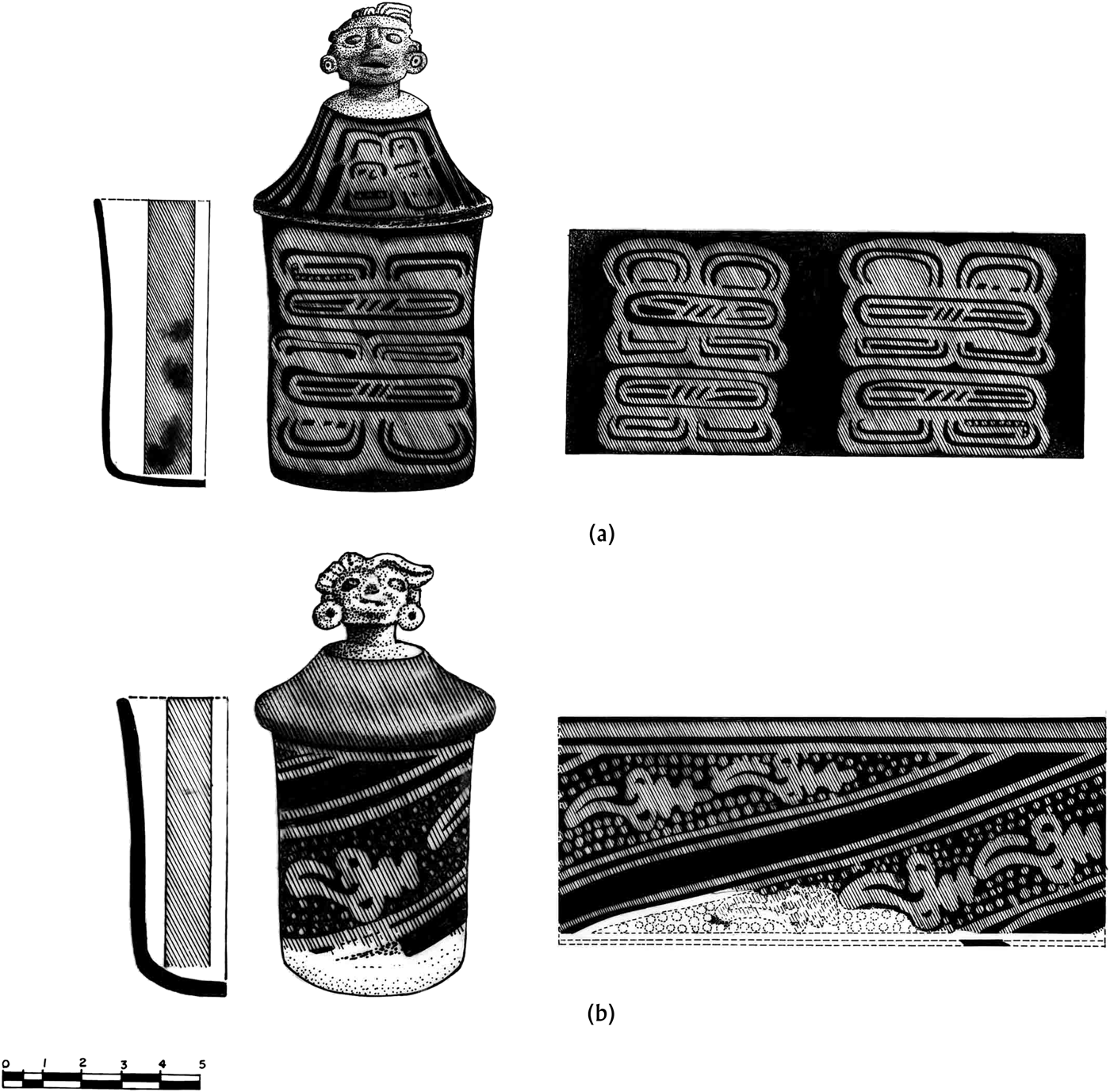
The Room 8 vault was dug into the northeastern quarter of Room 8 (see Figure 11) and contained Merwin and Vaillant's Room 8 Vessels 8–10. The vault also contained the disarticulated remains of one adult (Novotny Reference Novotny2006:4). The sex of the individual could not be determined because the skeleton only contained six bones belonging to the feet, and three teeth. Like Skeletons 17, 18, and 19, bones from Skeleton 20 showed signs of burning. The three whole vessels represent form and decoration modes from the Late Preclassic, Terminal Preclassic, and Early Classic complexes at Holmul. Vaillant placed all vessels within his Holmul I Burial period (Merwin and Vaillant Reference Merwin and Vaillant1932:61).
Aside from the form of Vessel 9 (Flor Cream pitcher decorated with painted stucco), the form and decorative modes of vessels in the Room 8 vault appear to be later than those of the Room 9, Burial 10, and Room 8 south side vessels (Figure 13). Upon closer examination of the decorative modes, even Vessel 9 can be safely placed within the end of the Terminal Preclassic period and beginning of Early Classic period in the Holmul region. Covering pots with painted stucco decoration is an Early Classic mode of decoration in the Holmul region and would imply that the Late Preclassic Flor Cream pitcher may have been an heirloom which was later modified at the start of the Early Classic period and placed in the Room 8 vault along with Vessels 8 and 10.
Room 8 vault vessels: (a) Vessel 8, Aguila: unspecified; (b) Vessel 9, Ixcanrio: unspecified; (c) Vessel 10, Flor group. Drawings by Fernando Alvarez, and courtesy of the Holmul Archaeological Project.
North Side
As mentioned, the north side of Room 8 was separated from the south side by a crude wall (Merwin and Vaillant Reference Merwin and Vaillant1932:37) creating a spatial and chronological division in the room (see Figure 11). The vessels on the south side of the wall all share form and surface modes common among pottery made in the Late Preclassic Sierra Red tradition. The remaining two vessels on the north side of the room share form and decoration modes common to Early Classic ceramics of the K'ahk 1/Tzakol 1 complex (Figure 14). According to Merwin's notes (Merwin and Vaillant Reference Merwin and Vaillant1932:38), these pots were found directly atop the large stones covering the Room 8 vault, making them the last vessels to be placed in Room 8. With the conclusion of the discussion of vessels found in Room 8, the Room 8 vault, Room 9, and Burial 10, we now move forward in time, out of the Terminal Preclassic period and the Wayaab subcomplex, and firmly into the Early Classic period.
Room 8, north side vessels: (a) Vessel 4, Actuncan: unspecified; (b) Vessel 5, Sierra: Sierra. Drawings by Fernando Alvarez, Holmul Archaeological Project.
Room 7 (Skeleton 16)
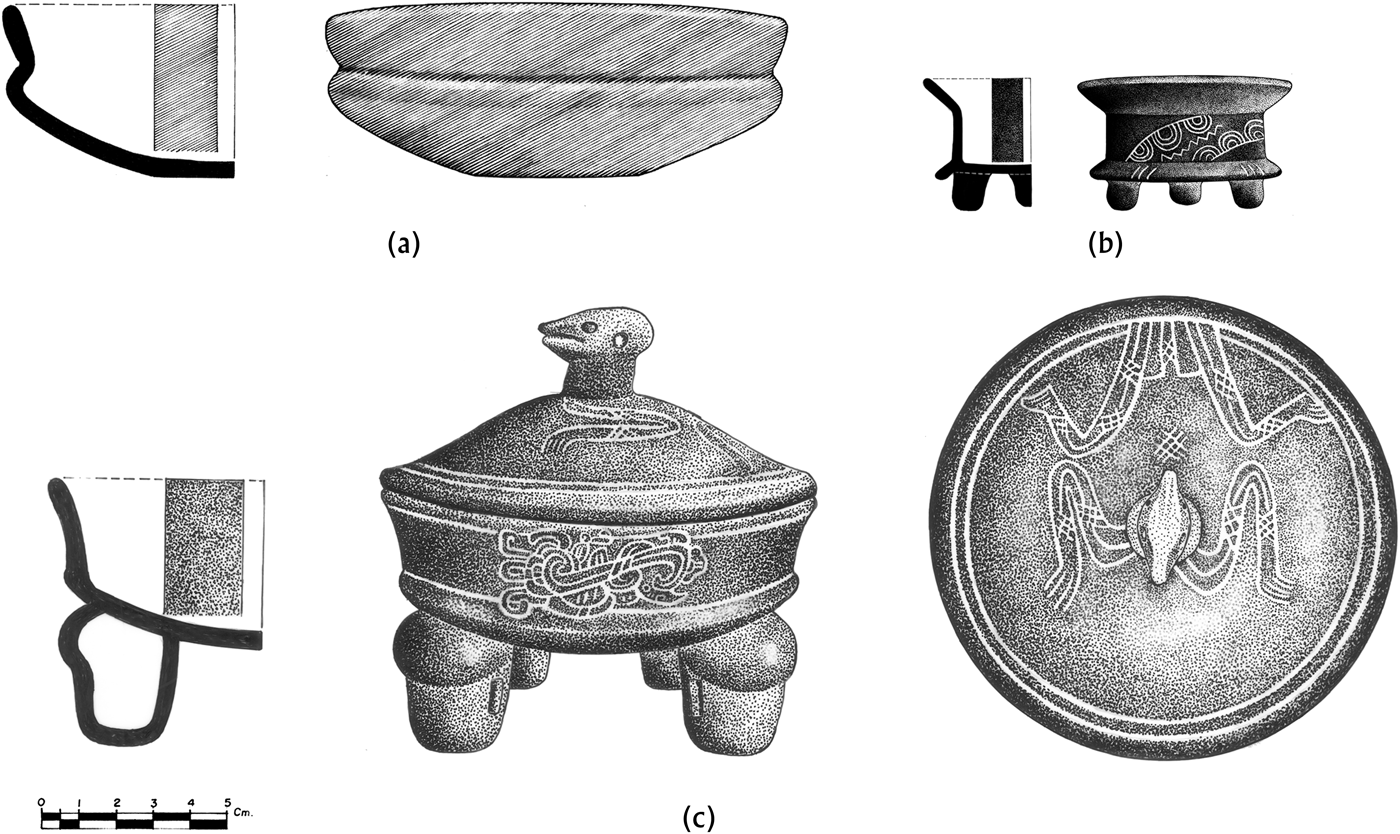
Room 7 is located in the Phase 5 sub-substructure of Building B, Group II (Figure 6). The Phase 5 substructure was added to the north side of Building B and consisted of the expansion of the Phase 4 substructure to the north as well as the addition of Room 4 which could be entered through the main entrance of Building B after passing through Rooms 1, 2, and 3. In other words, during the fifth construction phase Room 4 became the northern most, or back, room in Building B. Room 7 (more appropriately labeled “Tomb” 7) is located below Room 4 in the Phase 5 substructure making it chronologically later than Burial 10, Room 9, and Room 8. Merwin (Merwin and Vaillant Reference Merwin and Vaillant1932:36–37) explained that approximately four inches of construction fill separated the floor of Room 4 from the roof of Room 7. Room 7 contained the remains of what Merwin thought was one individual. Novotny (Reference Novotny2006:18) identifies the bones as belonging to an adult, sex unknown due to poor preservation and lack of diagnostic material. Also found associated with the human remains in the burial chamber were five vessels (only four of which I was able to locate in the Peabody collections) clearly diagnostic of the K'ahk 1–2/Tzakol 1–2 complexes and the first two thirds of the Early Classic period in the Holmul region (Figure 15). Vaillant placed the vessels within his Holmul II Burial period (Merwin and Vaillant Reference Merwin and Vaillant1932:65).
Room 7 vessels: (a) Vessel 3, Aguila: unspecified; (b) Vessel 4, Lucha: unspecified; (c) Vessels 5 (lid) and 6 (bowl), Lucha: unspecified. Drawings by Fernando Alvarez, Holmul Archaeological Project.
Vessels 5 and 6 are worth discussing in more detail here. They are the lid and bowl of the same vessel. The lid (Vessel 5) is a scutate cover with effigy handle. The lid is slipped black and incised with a decoration consisting of two bands around the circumference and the splayed out body of an animal represented by the effigy handle. The bowl (Vessel 6) has flaring walls, a direct rim, rounded lip, a small basal flange with slightly concave base, and four hollow swollen supports. The bowl is slipped black and incised. The main incised design repeats and appears to be either a stylized serpent, or what Smith (Reference Smith1955:73) refers to as a “sky band” element. I classify the vessel as Lucha Incised: variety unspecified. Interesting to note is the relatively mottled appearance of the black slip. The pot dates well within the K'ahk 2/Tzakol 2 complex and the early part of the Early Classic period in the Maya lowlands. Vessels 5 and 6 from Room 7 in Building B, Group II at Holmul are similar to Vessel 8 found in Tomb I, Structure III at Calakmul (Folan et al. Reference Folan, Marcus, Pincemin, Domínguez Carrasco, Fletcher and Lopez1995:322–323; Pincemin Reference Pincemin1994:57–75) which dates to the early fifth century. The vessel also bears resemblance to an unprovenienced black incised vessel with lid and effigy handle in the Dallas Museum of Art holdings portraying the sun god in a canoe paddling through the sky. On this vessel, the supports are fashioned into peccary heads (see Finamore and Houston Reference Finamore and Houston2010:Plate 61). Finally, Merwin and Vaillant's Vessels 5 and 6 also resemble black incised vessels recently discovered in a Tzakol 2 period tomb at the site of El Diablo, Guatemala, observed by the author in 2010.
Room 3 (Skeleton 15)
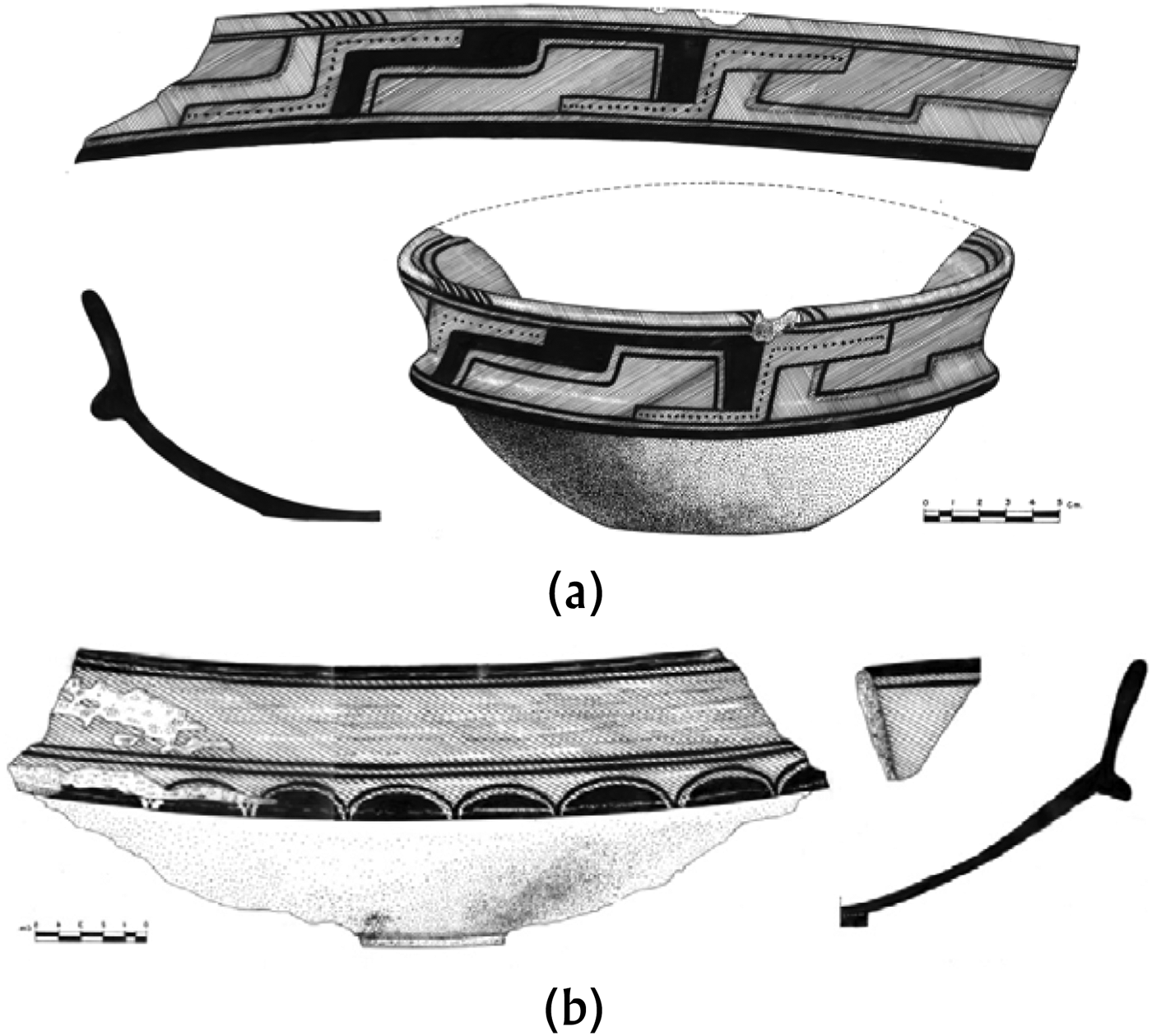
Room 3 is a narrow, east-west oriented, space between Rooms 2 and 4 of the stone superstructure of Building B (Figure 6). It was sealed in Phase 6 of the current architectural sequence (Vallaint's first phase of the second building episode [Merwin and Vaillant Reference Merwin and Vaillant1932:40]) and included the interment of Burial 15 which was found with no offerings. However, Merwin did encounter two whole pots in the fill of Room 3 (Merwin and Vaillant Reference Merwin and Vaillant1932:40). These vessels are likely Peabody catalogue numbers c-5622 and c-5623, both listed as “Pottery Dish Holmul, Ruin B, Room 3, Group II.” The vessels are bowls with flaring walls, direct rims, rounded lips, and flat bases (Figure 16). They belong to the Aguila Orange group and display the characteristic peloid calcite inclusions found in that type of ceramic during the K'ahk 2/Tzakol 2 complex.
Room 3 vessels: (a) Vessel 1, Aguila: unspecified; (b) vessel 2, Aguila: unspecified. Drawings by Fernando Alvarez, Holmul Archaeological Project.
Room 2 (Skeletons 13 and 14)
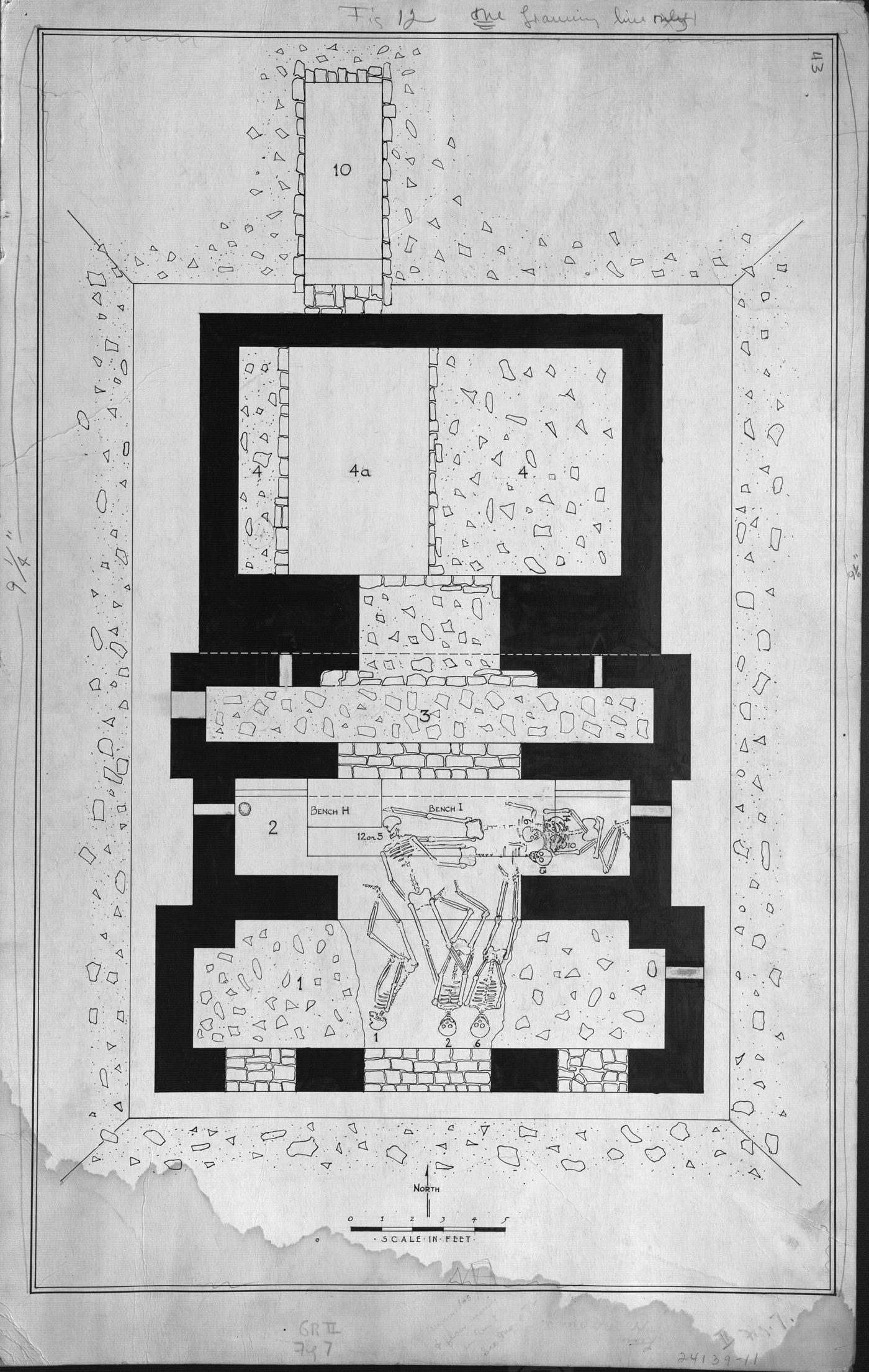
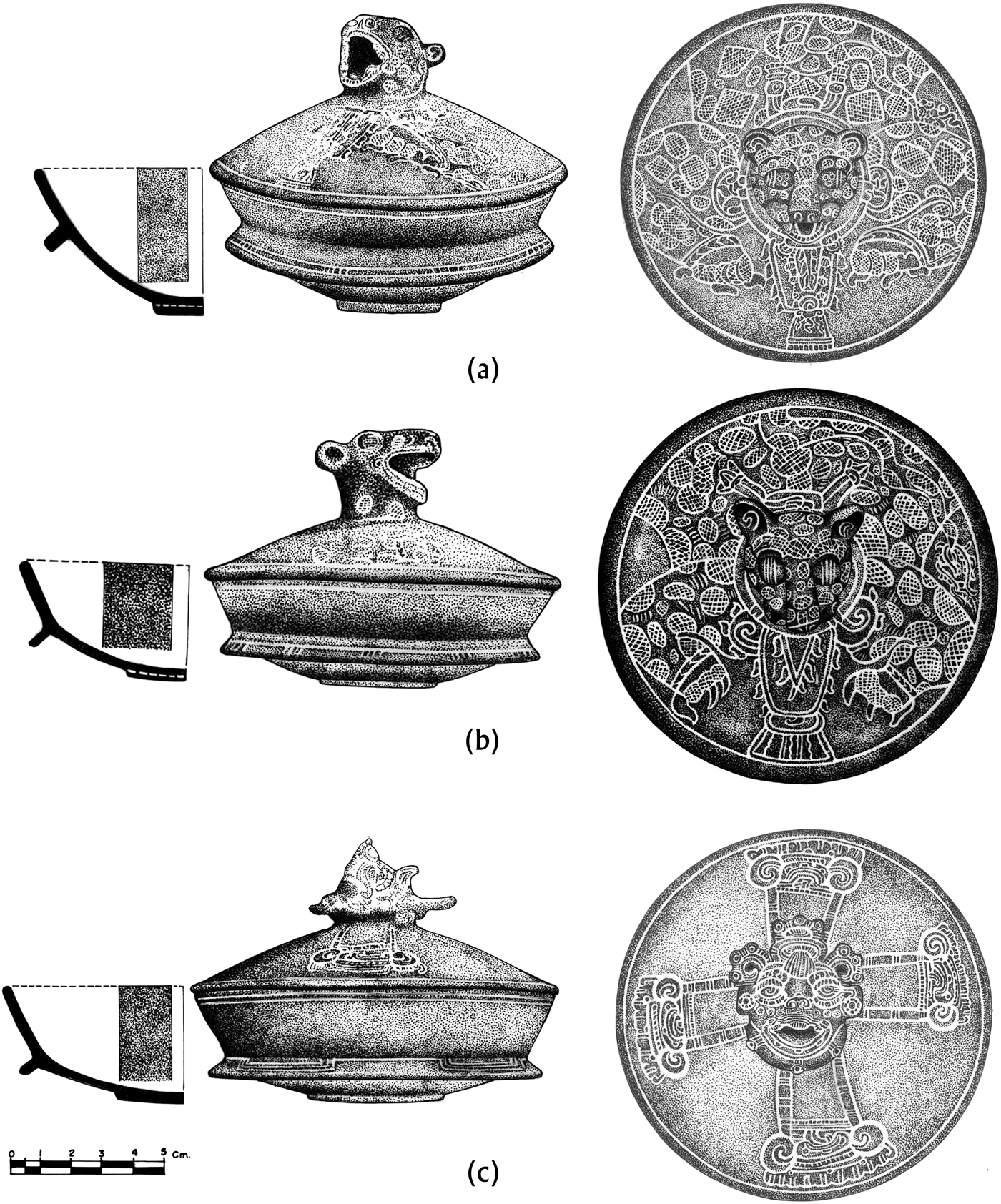
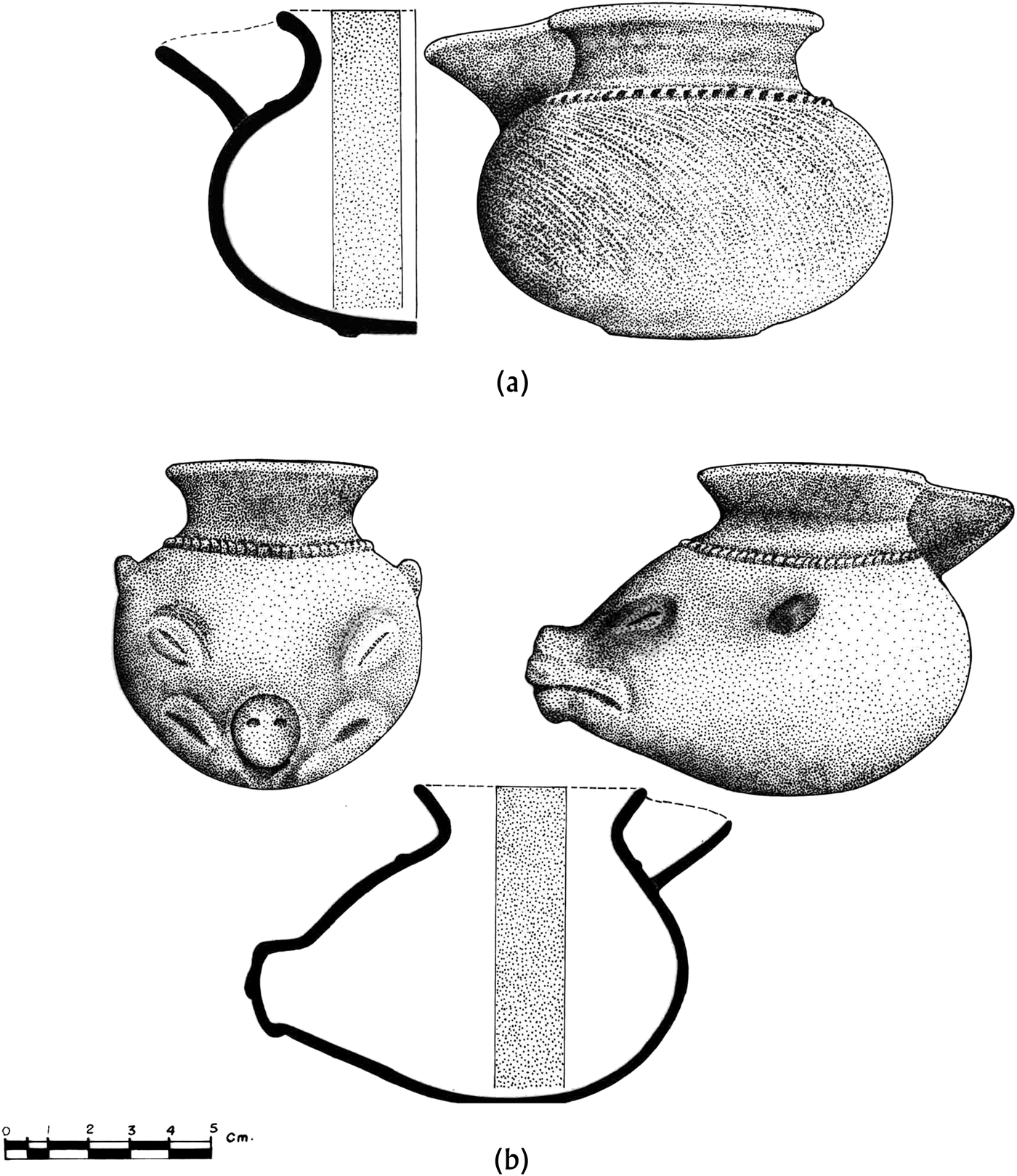
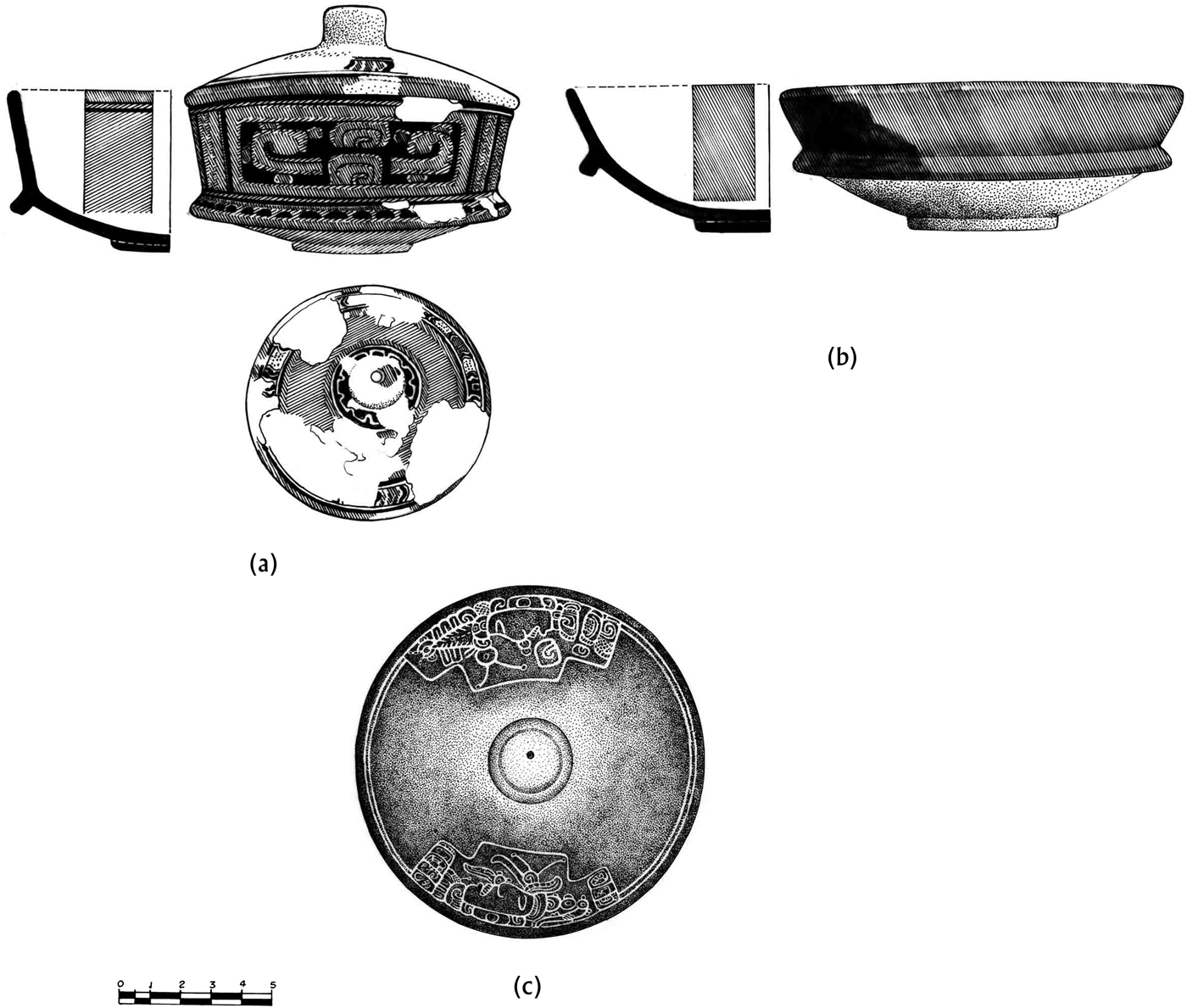
Room 2 is another relatively narrow east-west oriented space between Rooms 1 and 3 in Building B (Figure 6). The entrance to Room 3 to the north was sealed in Phase 6 and two benches, H and I, constructed against this new north wall. Slightly later, Room 2 began to be converted into a burial chamber with the interment of Skeletons 13 and 14. Skeletons 13 and 14 were discovered by Merwin in extended position oriented east-west with heads to the east (Figure 17). They were relatively centered in the room, but extended slightly more into the east side. Because of their position below the remains of Skeletons 9 and 10 above to the east, and Skeleton 5 above to the west, Merwin and Vaillant believed these skeletons were the first of the Room 1 and Room 2 multiple interments to be deposited. Novotny (Reference Novotny2006:10–11) reports that the bones of Skeleton 13 were that of an adult, sex unknown, and the bones of Skeleton 14 an adult, possibly male. Like the rest of the osteological remains in Building B, these “Skeletons” contained bones of more than one individual—most likely indicating that the rooms were entered and remains disturbed on more than one occasion. Grave goods including shell beads and discs, and one piece of jade, were found associated with these individuals (Merwin and Vaillant Reference Merwin and Vaillant1932:34–35). Seven vessels (12 according to the Peabody catalogue numbers which counts lids of the same vessel as separate pots) were found associated with the bodies and piled up in the east side of Room 2 (Merwin and Vaillant Reference Merwin and Vaillant1932:35). The vessels all display form and surface modes consistent with K'ahk 2/Tzakol 2 complex material and indicate possible political links to other powerful sites in the Maya lowlands including Tikal, Uaxcatun, and even Calakmul and Becan in Campeche, Mexico (Figures 18–20). Vaillant (Merwin and Vaillant Reference Merwin and Vaillant1932:66) placed all these vessels within his Holmul III Phase 2 Burial period.
Plan of Rooms 1 and 2, Building B, Group II. Courtesy of the Peabody Museum of Archaeology and Ethnology, Harvard University, 11-6-20/76072.1.30.
Room 2, vessels associated with Skeletons 13 and 14: (a) Vessel 1 (lid) and 2 (bowl), Lucha: unspecified; (b) Vessel 8 (lid) and 9 (bowl), Lucha: unspecified; (c) Vessels 10 (lid) and 11 (bowl), Lucha: unspecified. Drawings by Fernando Alvarez, Holmul Archaeological Project.
Room 2, vessels associated with Skeletons 13 and 14: (a) Vessel 4, Triunfo: unspecified; (b) Vessel 5, Quintal group. Drawings by Fernando Alvarez, and courtesy of Holmul Archaeological Project.
Room 2, vessels associated Skeletons 13 and 14: (a) Vessels 6 (lid) and 7 (bowl), Dos Arroyos: unspecified; (b) Vessel 3, Dos Hermanos: Dos Hermanos; (c) Vessel 12, Urita: unspecified. Drawings by Fernando Alvarez, and courtesy of the Holmul Archaeological Project.
Vessels 1 and 2, 8 and 9, and 10 and 11 are lids and vessels of singular pots (Figure 18). They are all slipped black and incised, and I designate them Lucha Incised: variety unspecified. On these vessels the lids are slipped black and incised with fine lines. The handles for the lids are modeled in the shape of an effigy jaguar or other creature. On two of the vessels, the incision on the lid depicts the body of the animal. The actual vessels are bowls with composite silhouette sides, direct rim, rounded lip, basal flange, and ring base. The bowls are also slipped black and incised with fine lines. Decoration is simple consisting of circumferential bands around the rim, and circumferential bands on the basal flange together with groups of vertical tick marks. The slip is the same mottled brown color like Vessels 6 and 7 in Room 7 as well as other black incised vessels of this complex found in the Holmul region. It would not be surprising if these vessels were locally manufactured. The overall form and decorative modes of these vessels are common in the lowlands from approximately a.d. 250–400. They date to the Tzakol 2 complex at Uaxactun (a.d. 300–400) (Smith Reference Smith1955), Manik 2 complex at Tikal (a.d. 300–378) (Culbert Reference Culbert1993), and Chacsik complex in Becan (a.d. 250–450) (Ball Reference Ball1977). This is the time period before the significant political events of a.d. 378 and the widely documented “entrance” or influence of Mexicanized elite culture and ideology into the Peten lowlands (Stuart Reference Stuart, Carrasco, Jones and Sessions2000).
Vessel 5 (see Figure 19) is unique in that the jar has an almost “shoe-pot” shape, outcurving neck, direct rim, rounded lip, spout, and flat base. It is an effigy pot with the modeled snout and ears of a peccary. A single appliqué fillet with tick impressions encircles the neck at the shoulder-break. The vessel form is reminiscent of Late Preclassic period shoe-pots which are usually found in ritual deposits, often in caves (Brady Reference Brady1989, Reference Brady1992). Relatively course-grained calcite inclusions show through the surface suggesting a carbonate-based paste recipe. The type and variety are difficult to determine owing to the unique form and decoration of the vessel. I place the vessel within the Quintal group for the present time, type and variety unspecified.
Vessels 6 and 7 (see Figure 20) are the lid and vessel of the same pot. Vessel 6 is a scutate lid with cylindrical knob. The vessel appears to be slipped orange with polychrome red and black decoration. The lid, like the rest of the vessel, was then covered in stucco and painted red and green. Vessel 7 is a bowl with composite silhouette walls, direct rim, rounded lip, basal flange, and ring base. The exterior was also decorated in red and black polychrome paint and then covered with red and green painted plaster. Only traces of the plaster still remain. The form and decorative modes place the vessel in the K'ahk 2/Tzakol 2 complex and I classify the pots as Dos Arroyos Polychrome: variety unspecified. Vessels 6 and 7 are contemporaneous with similar vessels from Burial 22 at Tikal (Culbert Reference Culbert1993:Figures 22–24) and Problematical Deposits (PNT 025, 062, 019) in the Mundo Perdido Complex also at Tikal (Laporte and Fialko Reference Laporte and Fialko1995:Figures 29 and 31). Vessel 9 from Calakmul Tomb I, Structure III at Calakmul (Folan et. al. Reference Folan, Marcus, Pincemin, Domínguez Carrasco, Fletcher and Lopez1995:322–323; Pincemin Reference Pincemin1994:57–75) is also similar to Vessels 6 and 7. All of these vessels date to a.d. 300–450 within their respective sites. As noted above, this is the time period before or at the immediate moment (in the case of Burials 10 and 22 at Tikal) of the introduction of highland Mexican political and cultural influence into the Peten lowlands. It is possible that these types of polychromes, as well as the black incised vessels found in association with them, constituted parts of a local Peten lowlands ceramic industry which existed prior to the influence of Mexican ideology (Laporte Reference Laporte and Grube1995; Laporte and Fialko Reference Laporte and Fialko1995).
Shortly after a.d. 378, ceramic form modes begin to change and preference is given to slab foot cylinder tripods, sometimes with lids, and basal flange bowls with lower, more open walls, lacking lids. Decoration still emphasizes polychrome painting, but a new form of black slip gauge-incision is introduced to pottery surfaces as well as the frequent use of appliqué elements in the form of “screwheads,” “feathers,” and other stylized objects. Finally, at least in the Holmul region, paste composition also changes dramatically shifting from carbonate to volcanic ash based recipes in serving vessels. This is supported by microscopic examination and tests with hydrochloric acid. Sherds of serving vessels with no visible carbonate temper but visible ash temper do not react to hydrogen chloride (HCl). It is still possible the same clays were being used, but that all carbonate inclusions were removed in a fine sifting process. Only further chemical analysis on Early Classic serving vessels in comparison to Late and Terminal Preclassic vessels will answer this question.
Vessel 12 (see Figure 20) is a sole scutate lid slipped black and gouge-incised. The handle is not an effigy, but a simple cylindrical knob. Incised design composition also varies from Vessels 1, 8, and 10. Vessel 12 depicts two faces with associated abstract elements staring across the lid at one another. I classify the vessel as Urita Gouged-Incised: variety unspecified. Merwin and Vaillant (Reference Merwin and Vaillant1932:35) believed Vessel 12 is the lid for another black slipped incised pot found in Room 1; specifically, Vessel 16 associated with Skeleton 1. While the lid fits the vessel and the Peabody museum has the two vessels displayed together in the exhibition of Building B, Group II ceramics, there is really no clear evidence to suggest the two pots should be grouped together. Although, considering the multiple interments in Rooms 1 and 2 of Building B, Group II, it certainly is possible that one part of the vessel was moved after initial deposition.
Taken together, the vessels associated with Skeletons 13 and 14 display form and surface modes of the K'ahk 2/Tzakol 2 complex. In comparison to funerary or cache assemblages at other lowland Maya sites (Culbert Reference Culbert1993; Folan et. al. Reference Folan, Marcus, Pincemin, Domínguez Carrasco, Fletcher and Lopez1995; Laporte and Fialko Reference Laporte and Fialko1995), it is safe to assume they were manufactured and deposited anywhere from a.d. 250–400, before the introduction of highland Mexican influence into the Peten lowlands. Compared to the other vessels in Rooms 1 and 2, this date fits well within Merwin and Vaillant's original depositional sequence of skeletons. These pots, and to a lesser extent those associated with Skeleton 5/12 (see below), represent the earliest form and decoration modes for ceramics in Rooms 1 and 2 of Building B, Group II. The presence of these vessels in Building B shows that the elites buried there participated in the greater political and social networks of the Peten lowlands and nearby Campeche Mexico, and possibly enjoyed a relatively high local and interregional socio-economic status.
Rooms 1 and 2 (Skeletons 5 and 12)
Physical placement and ceramic evidence suggest that Skeletons 5 and 12 were the next bodies interred in the Room 1 and 2 mortuary deposit (see Figure 17). Vaillant places the interment of Skeleton 5 in the third phase of his own Holmul III Burial period (Merwin and Vaillant Reference Merwin and Vaillant1932:40–41). Merwin's notes and drawings pertaining to the placement and description of Skeletons 5 and 12 reflect the mixed nature of the actual deposit. From the drawing of Rooms 1 and 2 it appears he discovered the cranium and upper torso of either Skeleton 5 or 12 (or both) in the center of Room 2 placed over the lower limbs of Skeletons 13 and 14. The lower limbs of Skeleton 5 or 12 (or both) stretched into the center of Room 1. Novotny (Reference Novotny2006:11–13) reports that the bones labeled as belonging to the remains of Skeleton 5 did not contain cranial fragments and that multiple examples of the same bones suggest that the osteological grouping labeled “Skeleton 5” represented skeletal fragments from as many as four individuals, all adults, sex unknown. Bones found in boxes labeled “Skeleton 12” did, however, contain cranial remains, but from as many as two individuals, both adults, sex unknown.
The Skeleton 5/12 grouping was associated with a large amount of burial furniture including the most amounts of worked non-ceramic material (such as jade, shell, pyrite, obsidian, and bone) in Building B (Merwin and Vaillant Reference Merwin and Vaillant1932:31–33). Among the most significant finds was a stingray spine carved with legible text. Tokovinine (Reference Tokovinine and Estrada-Belli2006:328–331) reports that the text on the stingray spine included the title Chak-Tok-Wayab which has been found carved or painted on objects belonging to sub-royal or perhaps royal elites associated with sites in the eastern Peten lowlands, and also specifically with royalty associated with the site of Naranjo (Figure 3; also see Estrada-Belli et al. Reference Estrada-Belli, Tokovinine, Foley, Hurst, Ware, Stuart and Grube2009:Figures 10 and 11). The Chak-Tok-Wayab title could signify some kind of high-ranking important political and/or religious office in the Holmul region. This title is found on other examples of material culture associated with prestigious objects or locations in the region at different periods in time: for example, on Mural 7 in an Early Classic phase of Structure 1 at La Sufricaya and carved onto a Terminal Classic piece of pottery found in Group III at Holmul (Tokovinine Reference Tokovinine and Estrada-Belli2006:324–332) (see Figure 3). Tokovinine (Reference Tokovinine and Estrada-Belli2006:329) does not think it improbable that the skeletal remains associated with Skeletal groups 5 and 12 in Building B, Group II at Holmul belonged to the holder of the title Chak-Tok-Wayab in this phase of the Early Classic period at Holmul.
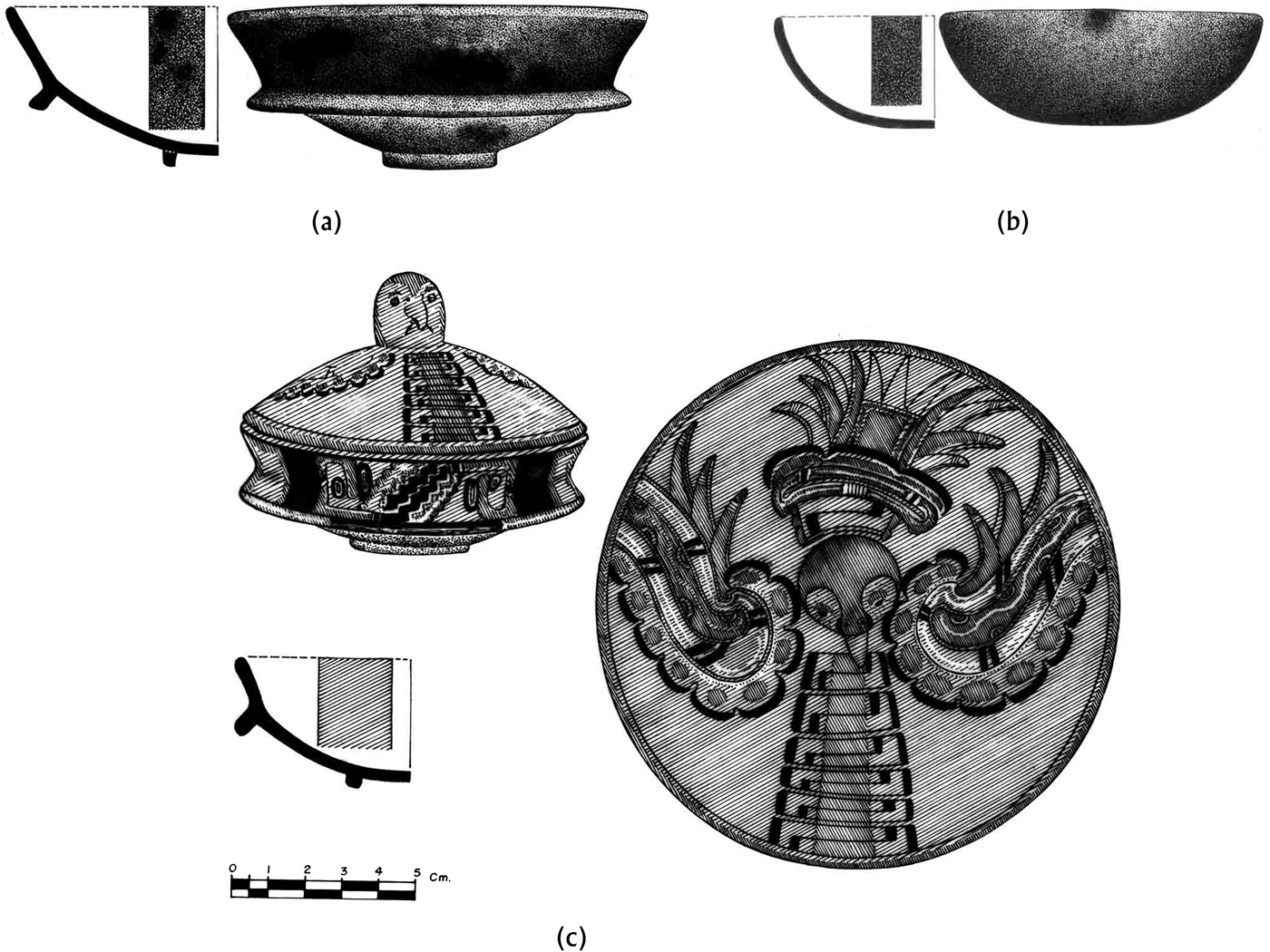
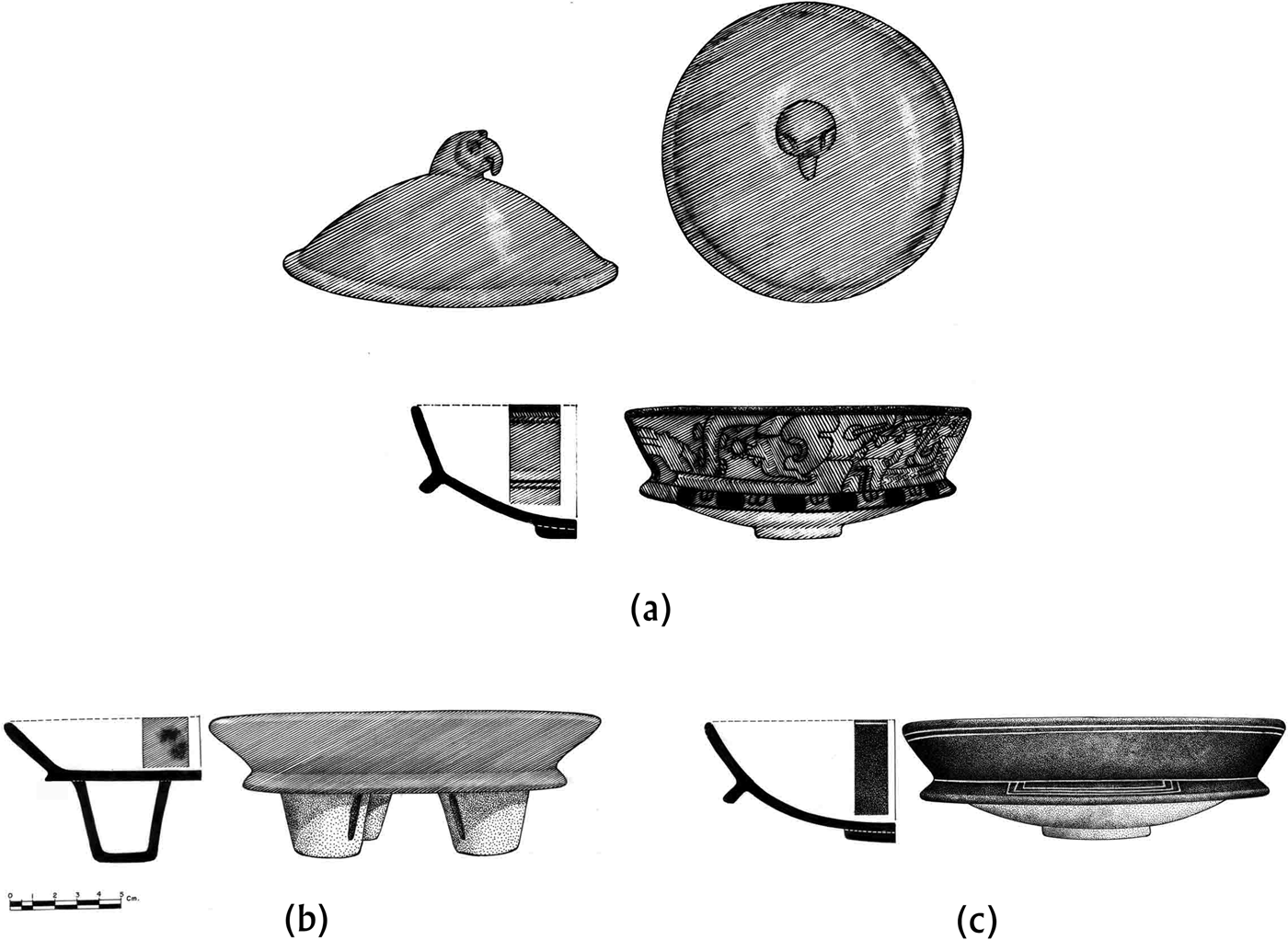
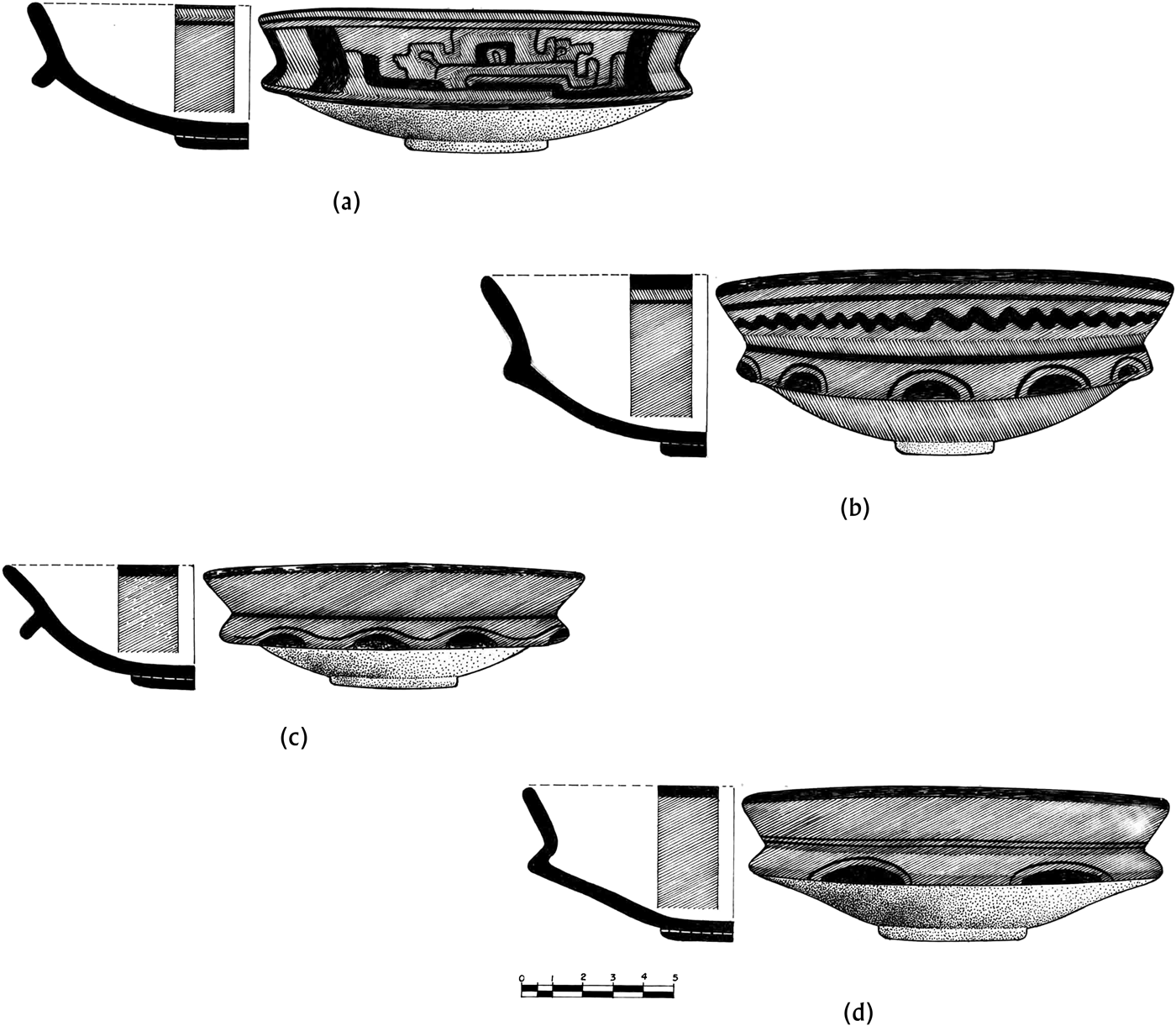
Merwin associated two groups of ceramic material with Skeleton 5/12. Vessels 1 through 5 were discovered in the north center of Room 1 and possibly placed around the pelvic area of Skeleton 5/12 (Figure 21). Vessels A through C were discovered in the northwest corner of Room 2 (Figure 22). Both groups of material share similar form and decorative modes placing them in the K'ahk 2/Tzakol 2 complex. Vaillant (Merwin and Vaillant Reference Merwin and Vaillant1932:68) placed all these vessels within his Holmul III Phase 3 Burial period.
Room 2, vessels associated with Skeleton 5/12: (a) Vessel 1, Balanza: Balanza; (b) Vessels 3 (lid) and 4 (bowl), Dos Arroyos: unspecified; (c) vessel 5, Balanza: Balanza. Drawings by Fernando Alvarez, and courtesy of the Holmul Archaeological Project.
Room 2, vessels associated with Skeleton 5/12: (a) Vessel A, Dos Arroyos: unspecified; (b) Vessel B, Aguila: unspecified; (c) Vessel C, Lucha: Lucha. Drawings by Fernando Alvarez, and courtesy of the Holmul Archaeological Project.
Vessels 3 and 4 (see Figure 21) are worth discussing in more detail. They are actually the lid and bowl of the same vessel. Vessel 3 is a scutate cover with bird effigy handle. The decoration appears to consist of a cream or buff underslip and a light coat of orange slip, upon which is painted the breast design, wings, and tail feathers of the bird-head handle in red and black. Vessel 4 is a bowl with composite silhouette walls, direct rim, rounded lip, basal flange, and ring base. The bowl is decorated with the same cream underslip, orange slip, and red and black polychrome paint. The main design frame consists of two sets of repeating designs. One of the designs is a simple rectangular panel showing the cream underslip and orange overslip. The second design consists of another panel containing a step design surrounded by undulating or squiggly lines. The design is framed by a scroll pattern, still within the larger panel. I classify Vessels 3 and 4 as Dos Arroyos Orange Polychrome: variety unspecified. The form and decoration of the vessels are very similar to others dating to the Tzakol 2 Sphere and found in Uaxactun (Smith Reference Smith1955:Figure 29), the Three Rivers region in Belize (Sullivan Reference Sullivan, Masson and Freidel2002:Figure 7.8), Burial 22 at Tikal (Culbert Reference Culbert1993:Figures 15 and 16), and deposits within Mundo Perdido also in Tikal (Laporte and Fialko Reference Laporte and Fialko1995:Figures 29, 33, 35). The form and decorative modes place this vessel, like those associated with Skeletons 5, 13, and 14 within the Tzakol 2 or Manik 2 ceramic spheres.
Pot A (see Figure 22), the first labeled vessel discovered in the northwest corner of Room 2, is a bowl with scutate lid. Like vessels 3 and 4, it displays bird imagery. The lid handle takes the form of a modeled bird, possibly a parrot or macaw effigy. The entire exterior of the lid is slipped orange with a black band on the lip. The bowl has composite silhouette walls, a direct rim, rounded lip, basal flange, and ring base. The bowl was first decorated with a cream underslip and then slipped orange. The main design is painted red and black polychrome and consists of two repeating themes. The first of the two themes is a simple framed rectangular panel. The second is an outstretched individual lying on its stomach with hands stretched in front and legs crouched behind. Inside the bowl is an eroded red and black design, possibly representing a coiled serpent. I classify the vessel as Dos Arroyos Orange Polychrome: variety unspecified.
Pot B (see Figure 22) is a bowl with composite silhouette walls, direct rim, rounded lip, Z-angle basal break, and four large hollow cylindrical supports with slash vents. The bowl is slipped orange on the exterior and interior. The interior walls display some black fire-clouding. The vessel form is extremely rare for the K'ahk 2/Tzakol 2 complex, but does not belong in any earlier complex—specifically the Wayaab subcomplex. The supports are not mammiform, the base is not concave, and the slip resembles color and application more in keeping with K'ahk 2/Tzakol 2 complex techniques. I classify the vessel as Aguila Orange: variety unspecified.
To conclude, the ceramic material associated with the remains of Skeleton 5/12 display K'ahk 2/Tzakol 2 complex form and decorative modes, but do not represent the same ceramic traditions as the vessels found with Skeletons 13 and 14. More specifically, the vessels associated with Skeletons 5 and 12 contain the traditional Early Classic Tzakol 2 sphere polychromes, but lack much of the incised black ware associated with Skeletons 13 and 14. This could represent a change or difference in social and political relations as they were materialized through the presence of pottery in funeral deposits or perhaps even a factor of chronology, the Skeleton 13 and 14 materials being slightly earlier than that associated with Skeleton 5/12. The high quality of many of the vessels supports the notion that the individual(s) associated with this pottery certainly may have been an important political figure in the Holmul region at the time of his/her death and deserving of the Chak-Tok-Wayab title engraved onto the piece of bone found associated with the osteological remains.
Room 1 (Skeleton 1)
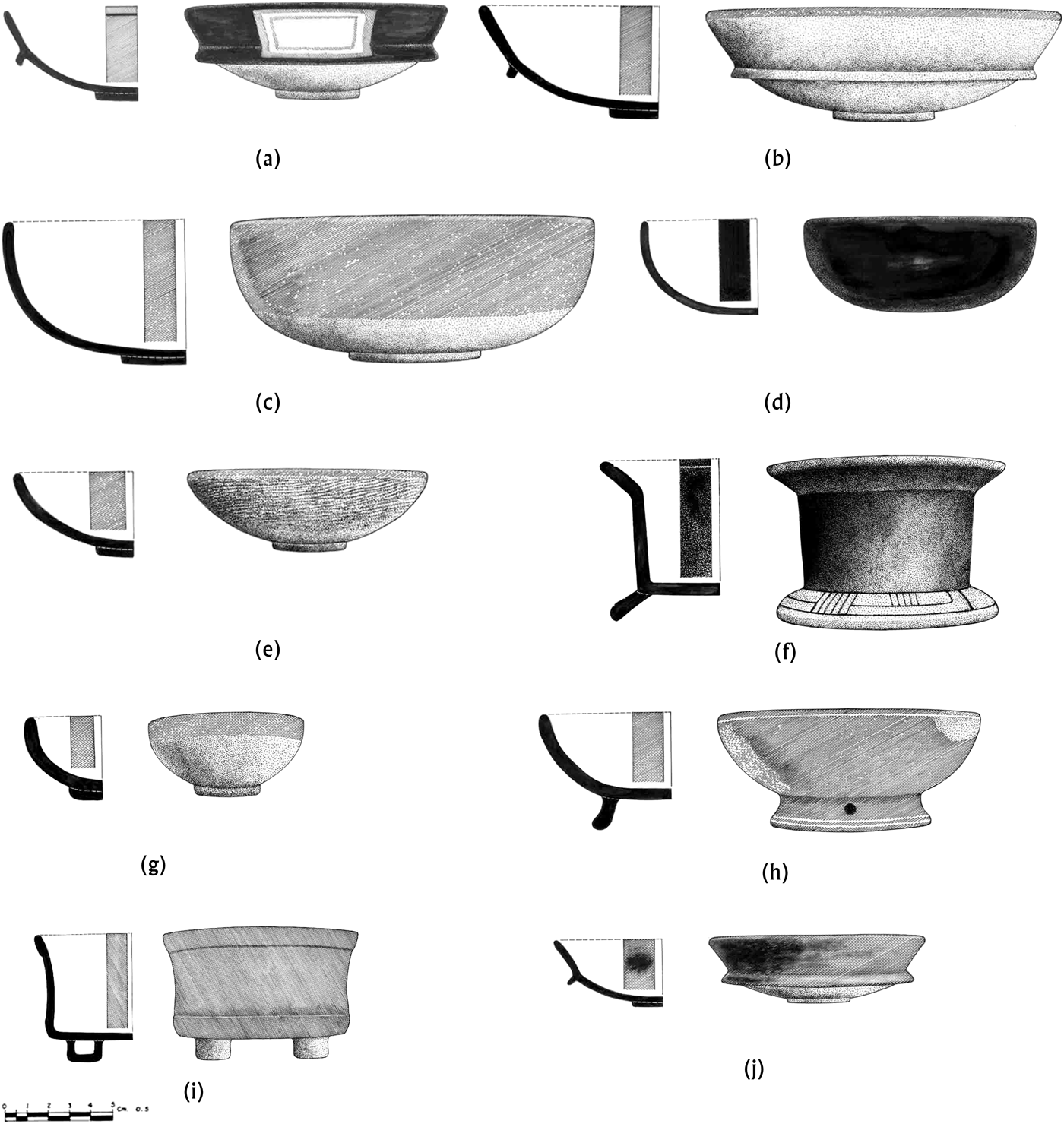
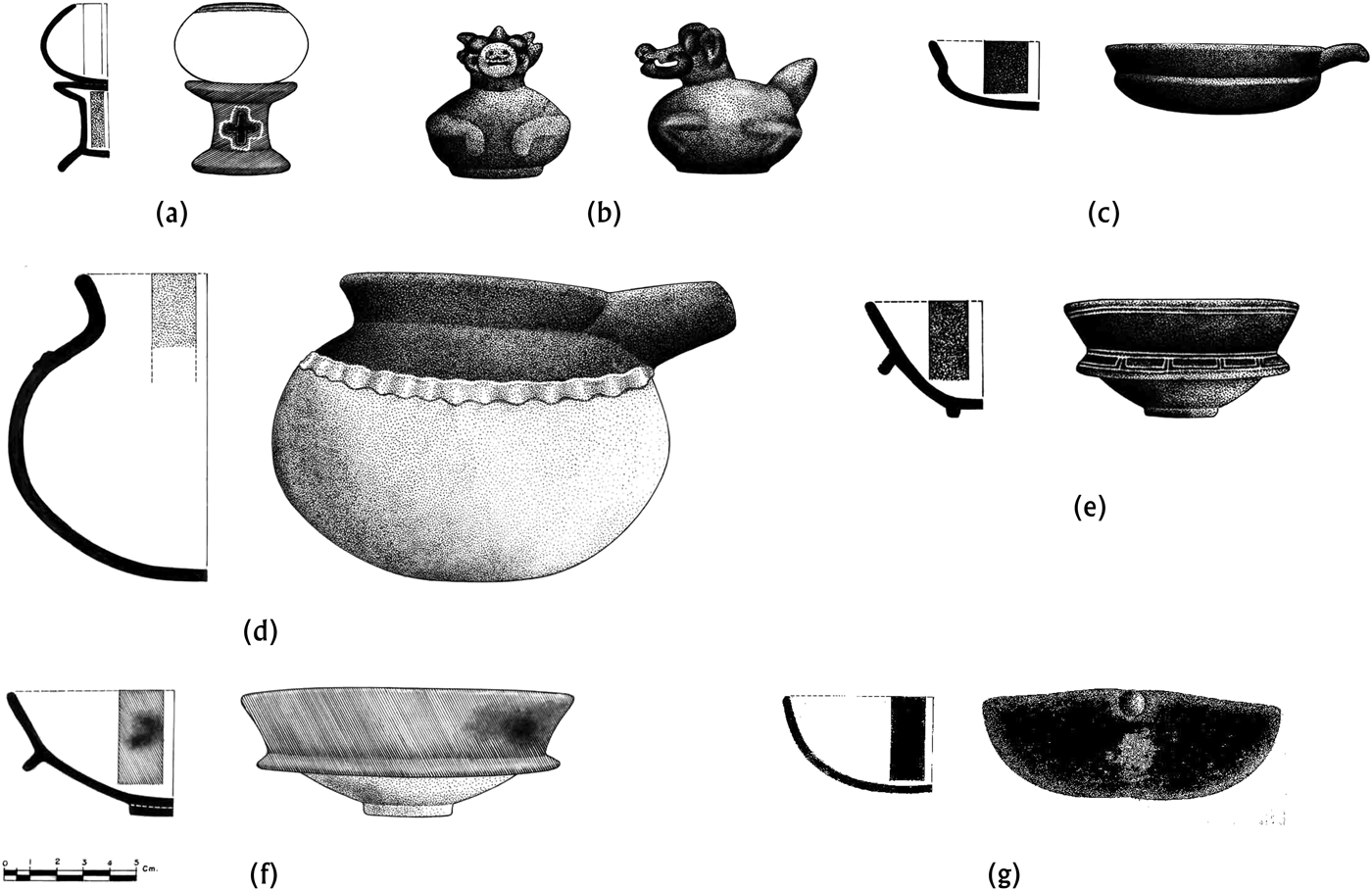
Vaillant places the interment of Skeleton 1 in the fourth phase of his own Holmul III Burial Period (Merwin and Vaillant Reference Merwin and Vaillant1932:40–41). It is impossible to tell from Merwin's notes and drawings which one of the Skeletons (1, 2, or 6) was interred after Skeleton 5. They both believed that the interment of Skeletons 1, 2, and 6 all occurred shortly after the interment of Skeleton 5, and possibly even all at once (Merwin and Vaillant Reference Merwin and Vaillant1932:29, 40–41). From Merwin's drawing (see Figure 17) it appears Skeleton 1 was discovered with head to the north in Room 1, the body relatively extended to the south with parts of the lower limbs stretching into Room 2. Novotny's analysis reveals that the osteological remains catalogued as belonging to the group of bones labeled “Skeleton 1” actually contains the remains of at least two individuals, both adults, sex unknown. Skeleton 1 was associated with the largest amount of ceramic vessels dating to the late K'ahk 2/Tzakol 2 and possibly even early K'ahk 3/Tzakol 3 complexes (Figures 23 and 24). Most interesting about the collective vessels associated with Skeleton 1 is a general lack of fine polychrome or black incised serving vessels—such as that associated with Skeletons 13, 14, and 5/12. This could be an indication of lower status or, perhaps as Merwin and Vaillant suggest, later placement in the Holmul region chronology. Because we do not have a greater representative sample of monochrome serving vessels associated with the K'ahk 2/Tzakol 2 complex, however, it is hard to support this argument strongly. As will be discussed below, the similarities between the form and decorative modes of the monochrome serving vessels associated with Skeleton 1 and those associated with later K'ahk 3/Tzakol 3 deposits at the site of La Sufricaya are apparent.
Room 1, vessels associated with Skeleton 1: (a) Vessel 1, Dos Arroyos: unspecified; (b) Vessel 2, Aguila: Polished Buff; (c) Vessel 3, Aguila: unspecified; (d) Vessel 4, Balanza: Balanza; (e) Vessel 5, Nitan: unspecified; (f) Vessel 6, Lucha: unspecified; (g) Vessel 7, Aguila: Unpolished Buff; (h) Vessel 8, Pita: unspecified; (i) Vessel 9, unnamed red; (j) Vessel 10, Aguila: Aguila. Drawings by Fernando Alvarez, and courtesy of the Holmul Archaeological Project.
Room 1, vessels associated with Skeleton 1: (a) Vessel 11, unnamed cream and orange; (b) Vessel 12, Balanza: Balanza; (c) Vessel 14, Balanza: Balanza; (d) Vessel 15, unnamed black on unslipped; (e) Vessel 16, Lucha: Lucha; (f) Vessel 17, Aguila: Aguila; (g) Vessel 18, Balanza: Balanza. Drawings by Fernando Alvarez, and courtesy of the Holmul Archaeological Project.
Vessel 9 (see Figure 23) is worth discussing in more detail. It is a cylinder with vertical walls, slightly everted rim, rounded lip, flat base, and four hollow cylindrical supports. The vessel also has two chamfers on the exterior; one near the base and one at the rim. The entire vessel, except the base and supports, is slipped red. The form and surface modes are extremely rare. The only other vessel in the Holmul region that comes close to displaying these modes is Vessel 3 associated with Skeleton 6 in Room 1. The cylindrical form and short supports are common to ceramics of the Tzakol 3 or Manik 3 spheres found elsewhere in the lowlands (Culbert Reference Culbert1993:Figures 19, 20; Smith 1995:52) and are part of the suite of Mexican-influenced material culture that was introduced to the Peten lowlands after a.d. 378. Vessel 9, however, does not display the usual or common form and decorative traits of Tzakol 3 sphere ceramics. It has four supports that are cylindrical and hollow, not three solid slab supports (see also Smith Reference Smith1955:Figure 22i, w, and k'). The short squat cylinder form is chamfered on the exterior and has an everted rim, unlike the vertical-walled cylinders with direct rim common to Tzakol 3 sphere ceramics in the lowlands. In summary, Vessel 9 may represent a local imitation of Tzakol 3 sphere modes. I place Vessel 9 in the early K'ahk 3/Tzakol complex, but leave the type and variety unspecified.
Vessel 11 (see Figure 24) is a bowl with markedly incurved walls, direct rim, rounded lip, and round base that is fastened upon a pot stand with cylindrical body, everted rim and base, and rounded lip. The bowl is fashioned from a buff or cream paste and slipped a brownish cream. Two bands of red paint encircle the restricted orifice at the rim. The pot stand is slipped orange and contains four repeating cross designs framed by fine, but crude, post-slip incision on its body. The entire vessel composition is extremely rare for the Holmul region, but the pot-stand mode is common to Early Classic period ceramic complexes in general. The vessel may have been produced during the K'ahk 2/Tzakol 2 or even K'ahk 1/Tzakol 1 complexes. Other vessels like it have been found at the site of Nohmul (Hammond Reference Hammond1984:11; Pring Reference Pring2000:77–78) that date to the early Early Classic or even Terminal Preclassic periods. Although the type and variety are left unspecified for now, I believe the vessel may have been an import into the Holmul region.
Merwin reported that Vessel 12 and Vessel 19 are a set and were found together placed roughly over the pelvic area of Skeleton 1 (Merwin and Vaillant Reference Merwin and Vaillant1932:30–31). Vessels 13 and 14 were also a set of similar pots found in the same area of the Skeleton in Room 1. The catalogue numbers were somewhat confused at the Peabody and one vessel from each set was on display at the time of my visit, possibly Vessels 13 and 19. Vessel 12 (see Figure 24) was available in the storage collection and is a modeled animal effigy. Merwin described it as a “cover” and reported it being found within a spouted bowl. The vessel is hollow and slipped black on the exterior with many rootlet marks. Vessel 19, or the spouted bowl that Vessel 12 was supposedly found within, was paired with Vessel 13 or 14 (the other animal effigy) in the display case of the Peabody museum. Finally, the remaining spouted black bowl (again, either Vessel 13 or 14 with Peabody catalogue number c5436) is currently located in the storage facilities of the American Museum of Natural History in New York. All the vessels are Balanza Black: variety unspecified. Similar animal effigies have been found in Burial A22 at Uaxactun (Smith Reference Smith1955:Figure 5) where Smith dates them to the Tzakol 3 complex. Sullivan (Reference Sullivan, Masson and Freidel2002:204–210) also reports a similar vessel found at the site of Dos Hombres in the Three Rivers region, Belize, and places it within the Early Classic period, but does not assign it a specific subphase or ceramic complex. She suggests the animal represents a coatimundi effigy. Vessels of similar form were also found in Burials 10 and 22 (Culbert Reference Culbert1993:Figures 18b, 26b) and the Burial PNT-062 in the Mundo Perdido Complex (Laporte and Fialko Reference Laporte and Fialko1995:Figure 30), all at Tikal.
To complete the discussion of ceramics associated with Skeleton 1, while the vessels seem to suggest a mixture of both K'ahk 2/Tzakol 2 and K'ahk 3/Tzakol 3 complex material, it is difficult to draw any firm conclusions. Firm chronological conclusions cannot be supported because most of the vessels associated with Skeleton 1 are monochrome serving vessels. Because we do not currently have an adequate representative sample of K'ahk 2/Tzakol 2 complex monochrome serving ware it is difficult to know if these possible K'ahk 3/Tzakol 3 vessels were actually contemporaneous with K'ahk 2/Tzakol 2 highly decorated fine ware (such as the polychrome and black material associated with Skeletons 5/12, 13, and 14). The presence of sherds from similar vessels found in K'ahk 3/Tzakol 3 complex deposits in Structure 1 at La Sufricaya do lend credence to the argument that these monochrome vessels may be slightly later than the material associated with Skeletons 5/12, 13, and 14. Some vessels, however, such as Vessels 8 and 15, are so similar to K'ahk 2/Tzakol 2 complex pottery found elsewhere in Building B that they must have been produced during that time. Also, as discussed above, strong typological comparisons to pottery from other sites with well established sequences support this idea. However, until more reliable K'ahk 2/Tzakol 2 contexts containing both decorated and monochrome serving vessels (as well as utilitarian vessels) are discovered, I cannot make any irrefutable statements about the chronological or sociopolitical significance of the vessels associated with Skeleton 1 in Room of Building B, Group II.
Room 1 (Skeleton 6)
Skeletons 2 and 6 were also part of Vaillant's fourth phase of his Holmul III Burial Period (Merwin and Vaillant Reference Merwin and Vaillant1932:40–41) (see Figure 17). No ceramic material was associated with Skeleton 2, so it is not discussed here. Merwin reported that Skeleton 6 was interred in an extended position with head to the north in Room 1 and lower limbs extending into Room 2. Novotny's analysis reveals that while Skeleton 6 may not have been complete, it did represent the remains of only one individual, juvenile, sex unknown. The skeletal material was associated with seven vessels (Figure 25). Like Skeleton 1, the vessels share form and decorative modes with both K'ahk 2/Tzakol 2 and K'ahk 3/Tzakol 3 complex material.
Room 1, vessels associated with Skeleton 6: (a) Vessel 1, Nitan: unspecified; (b) Vessel 2, Nitan: unspecified; (c) Vessel 3, unnamed red; (d) Vessel 5, unnamed red; (e) Vessel 6, Blanaza: unspecified; (f) Vessel 7, Caldero: unspecified. Drawings by Fernando Alvarez, and courtesy of the Holmul Archaeological Project.
Vessel 3 (see Figure 25) is worth noting in that it is a cylinder with vertical walls, slightly everted rim, rounded lip, and flat base with three solid slab supports. The exterior vessel walls display two chamfers: one appears at the base and the other below the rim. The vessel is slipped red and heavily fire-clouded with rootlet marks on both the interior and exterior. Aside from the three slab feet, the vessel is almost identical to Vessel 9 associated with Skeleton 1. Like Vessel 9, the form suggests a modified version of Tzakol 3 sphere modes.
Vessel 7 (see Figure 25) is a bowl with composite silhouette walls, direct rim, rounded lip, basal flange, and ring base. The interior of the bowl is slipped orange with a cream underslip and bands of red and black paint encircling the rim. On the base of the interior is the depiction of a human figure painted in red wearing a costume. Vaillant called the figure a “man with bee's body” (Merwin and Vaillant Reference Merwin and Vaillant1932:69). The exterior only displays the cream underslip upon which is painted a repeating design in red and black paint. The main design is a step and angular scroll which repeats twice in red and twice in black. The rim of the exterior is encircled by a band of red chevrons. The interior design on the bowl is similar to bowls found in the Three Rivers region, Belize (Sullivan Reference Sullivan, Masson and Freidel2002:Figure 7.4) and Uaxactun (Smith Reference Smith1955:Figure 76b, Number 5). Smith dates his vessel to the Tzakol 2 complex. It is possible Vessel 7 dates to the same period and is part of the K'ahk 2/Tzakol 2 complex. I classify the vessel as Caldero Buff Polychrome: variety unspecified.
In conclusion, the vessels collectively associated with Skeleton 6 suggest the body was interred between the end of the K'ahk 2/Tzakol 2 complex and beginning of K'ahk 3/Tzakol 3. Like the pots associated with Skeleton 1, these vessels display form and surface modes consistent with both K'ahk 2–3/Tzakol 2–3 complexes and also suggest maintained contact between elites at Holmul and other important lowland centers at this time.
Room 2 (Skeleton 10)
Merwin and Vaillant believe Skeleton 10 was the last group of osteological remains to be interred before the superstructure of Building B, Group II was sealed. Skeleton 10 is located in the east side of Room 2 (see Figure 17). Merwin's drawing depicts the body as being interred in a flexed position with head to the west above the remains of Skeletons 13 and 14. Novotny once again identifies the remains of at least two individuals, adults, sex unknown in the catalogued grouping of bones labeled “Skeleton 10.” It is possible that the remains of Skeleton 10 are mixed with the remains of Skeleton 9 that was supposedly interred, without funerary furniture, at the same time as Skeleton 5 in the third phase of Vaillant's Holmul III Burial Period. Only two ceramic vessels were found associated with Skeleton 10 (Figure 26). The vessels were formed and decorated in the same style and suggest an interment date in the late K'ahk 2/Tzakol 2 or early K'ahk 3/Tzakol 3 complex.
Room 2, vessels associated with Skeleton 10: (a) Vessel 1, Japon Resist: unspecified; (b) Vessel 2, Japon Resist: unspecified. Drawings by Fernando Alvarez, and courtesy of the Holmul Archaeological Project.
Vessel 1 (see Figure 26) is a narrow cylinder with vertical walls, direct rim, rounded lip, flat base and accompanying lid. The lid is trapezoidal in shape and has a modeled human head complete with headdress and ear flares for a handle. The exterior of the lid and vessel displays an orange-red underslip. Potters used a black smudging technique to create designs in the red slip possibly using some sort of resist technique. Vaillant calls the main design on the lid of the vessel a “monkey pattern” (Merwin and Vaillant Reference Merwin and Vaillant1932:69). The design on the vessel exterior is much more abstract and almost looks like pseudo-glyphs. I classify the vessel as Japon Resist: variety unspecified.
Vessel 2 (see Figure 26) is also a narrow cylinder with vertical walls, direct rim, rounded lip, flat base and accompanying lid. The lid is trapezoidal in shape and has a modeled human head complete with headdress and ear flares for a handle. The exterior of the lid and vessel displays an orange-red underslip. Potters used the same smudging technique as seen on Vessel 1. No design appears on the lid. The main design on the cylinder is an abstract pattern surrounded by rows of dots and framed by two sets of diagonal lines. I also classify Vessel 2 as Japon Resist: variety unspecified.
Japon Resist is very rare in the Maya lowlands, but is reported by Culbert (Reference Culbert1993:Figures 21a and 27a, Number 1) in Burials 10 and 22 at Tikal as well as Uaxactun (Smith Reference Smith1955:Figure 1 k). Smith places Japon Resist within Tzakol 3, but because it was discovered in association with other Manik 2 vessels at Tikal, it is possible this type could represent another style that bridges the Tzakol 2–3 (or Manik 2–3) complexes. Regardless of the specific period, Vessels 1 and 2 associated with Skeleton 10 fit within the overall chronology of Rooms 1 and 2 possibly anchoring it to the beginning of the K'ahk 3/Tzakol 3 complex.
After this last deposition episode, the superstructure containing Rooms 1–4 in Building B, Group II was sealed and the entire building covered in construction fill in order to create a large plastered platform. The last of the rooms to be discussed in Building B, Group II, lies buried within this fill and outside the superstructure of the original structure.
Room 10 (Skeleton 22)
Room 10 is located in the construction fill of the last building phase of Building B, Group II (see Figure 6). The room was constructed against the exterior north wall of Room 4. A number of skeletal remains were found in the room along with four vessels (Figures 27 and 28), but we are currently unable to locate this group of osteological materials and, as a result, have nothing to report with regard to the human remains. Three vessels, however, were located in the Peabody Museum and one was located in the American Museum of Natural History in New York. Vaillant (Merwin and Vaillant Reference Merwin and Vaillant1932:71–72) placed all these vessels within his Holmul IV Burial period.
Plan of Room 10, Building B, Group II, showing approximate locations of vessels based upon Merwin's original excavation data (Merwin and Vaillant Reference Merwin and Vaillant1932:40, and courtesy of the Holmul Archaeological Project.
Room 10 vessels: (a) Vessel 1, Caldero: unspecified; (b) Vessel 2, unspecified orange polychrome; (c) Vessel 3, Boleto: unspecified; (d) Vessel 4, Boleto: unspecified. Drawings by Fernando Alvarez, and courtesy of the Holmul Archaeological Project.
Vessels 1 through 4 of Room 10 are problematic because they display form and surface modes of the earlier K'ahk 1/Tzakol 1 complex, but they are found in a construction layer which obviously dates to the latter half of the Early Classic period. Based on quality of surface design, Vaillant placed these vessels within his Holmul IV Burial Period and believes the vessels represent a kind of decadent transitional period between the fall of the “Old Empire” (Early Classic) elites at Holmul and the rise of the “New Empire” (Late Classic) (Merwin and Vaillant Reference Merwin and Vaillant1932:72; Vaillant Reference Vaillant1927:300–334). He compares similarities in form between the vessels found in Room 10 and those from Rooms 1 and 2, assuming that because Room 10 is located in the succeeding architectural phase that covers Rooms 1–4 that the vessels in Room 10 must have been produced after the vessels in Rooms 1–4. More than once he comments on the “degeneracy” and lack of sophistication of the designs on the vessel surfaces. While Vaillant correctly assumed that Vessels 1–4 in Room 10 may not have been part of the same ceramic production traditions as those vessels discovered in Rooms 1 and 2, he may have incorrectly assumed that all the vessels in Room 10 must have been produced later than those in Rooms 1 and 2.
Vessel 1 (see Figure 28) is a bowl with composite silhouette walls, direct rim, rounded lip, basal flange, and ring base. The interior is slipped orange with a cream underlsip. Red and black bands of paint run the circumference of the rim. The exterior displays the cream underslip upon which is painted a repeating abstract motif in red and black. The motif appears three times and is separated each time by three thick vertical bands of black, red, and black paint. I classify the bowl as Caldero Buff Polychrome: variety unspecified and believe the vessel was produced within the K'ahk 2–3/Tzakol 2–3 ceramic complexes.
Vessel 2 (see Figure 28) is a bowl with composite silhouette sides, direct rim, rounded lip, Z-angle basal break, and ring base. The interior is slipped orange with one red band running the circumference of the rim. The exterior is slipped orange and painted in red and black. The main design is simple and consists of horizontal bands of red and black paint framing one single squiggly black line. The form and decorative treatment both suggest a production date that is possibly earlier than the K'ahk 3/Tzakol 3 complex, perhaps within K'ahk 1/Tzakol 1 or at least K'ahk 2/Tzakol 2. The Z-angle basal break without basal flange is rarely seen in the Holmul region after the K'ahk 1/Tzakol 1 complex. Furthermore, the crude painting style and simple design is more reminiscent of earlier attempts at polychrome painting than later ones. Smith (Reference Smith1955:Figure 26a) places the “squiggly” line main design at least as early as the K'ahk 2/Tzakol 2 complex. The Z-angle basal break is decorated by enclosed black semicircles. This motif is seen on Boleto Black-on-Orange vessels found at Hamontun in association with an excellent example of a firm K'ahk 1/Tzakol 1 complex marker, Actuncan Orange Polychrome (Figure 29). The entire design scheme is also reminiscent of what Adams (Reference Adams1971:Figure 21d, Numbers 1–5) classifies as Ixcanrio Orange Polychrome at Altar de Sacrificios. Because of this chronological and stylistic confusion, the type name and complex remain unassigned for the time being.
Vessels from Hamontun: (a) Actuncan: unspecified; (b) Boleto: unspecified. Drawings by Fernando Alvarez, and courtesy of the Holmul Archaeological Project.
Vessel 3 (see Figure 28) is a bowl with composite silhouette walls, direct rim, rounded lip, basal flange, and ring base. The interior is slipped orange as well as the exterior. The main design on the exterior consists of simple horizontal black bands on the rim and framing the basal flange. The basal flange is further decorated by enclosed black semi-circles. This type is Boleto Black-on-Orange and is a firm K'ahk 1/Tzakol 1 complex diagnostic marker.
Vessel 4 (see Figure 28) is a bowl with composite silhouette sides, direct rim, rounded lip, Z-angle basal break, and ring base. The interior and exterior are slipped orange. The main design on the exterior is very similar to Vessel 3 described above except that the enclosed black semi-circles appear on the Z-angle as opposed to the basal flange. Like Vessel 3, the black painting is crude and the overall polishing appearing more like a heavy burnish than a true polish. Vessel 4 bears striking resemblance to vessels of the Gavilan Black-on-Orange types found at Altar de Sacrificios (Adams Reference Adams1971:Figures 21a–21c). Although crude, the polish and shade of orange slip on Vessel 4 still warrants its inclusion in the Aguila Ceramic group as opposed to Aguacate and I classify this vessel as Boleto Black-on-Orange: variety unspecified, again possibly within the K'ahk 1/Tzakol 1 complex.
In conclusion, the form and decorative modes of the vessels in Room 10 do not seem to correspond with the placement of the room in the larger Building B architectural sequence. Vessels 2–4 could be heirlooms from the K'ahk 1–2/Tzakol 1–2 complexes that were saved and placed in Room 10 just before the building was covered. One could also argue the quality of decoration on these vessels does not represent the early stages of black-on-orange and polychrome painting, but a cruder painting style meant for a different level of consumption during a later period—the individual associated with these vessels having access to only this type of pottery. However, due to the lack of Boleto types found in K'ahk 3/Tzakol 3contexts and the similarity of Vessel 2 with Ixcanrio vessels from Barton Ramie, I prefer the former hypothesis for the time being.
Regardless of the discordance between the funerary furniture in Room 10 and its place in the architectural sequence, we do know that the building was filled sometime during the late K'ahk 2/Tzakol 2 or early K'ahk 3/Tzakol 3 complexes. At the Peabody are two flaring-walled bowls with direct rims, rounded lips, and flat bases belonging to the Aguila Group, both of which were found by Merwin in the construction fill covering the superstructure of Building B as well as Room 10. The vessels are not listed in Merwin and Vaillant's monograph or Vaillant's dissertation, but they do have Peabody catalogue numbers and original tags that read "Pot 3 Roof, Bldg. B Group II" and "Pot 4 Roof, Bldg. B Group II". The vessels are in the form and decorative tradition of K'ahk 2/Tzakol 2 ceramics and support the assumption that the original Building B was sealed sometime at the end of the K'ahk 2/Tzakol 2 and beginning of K'ahk 3/Tzakol 3 complexes. Building B, Group II, does not contain any material dating to Vaillant's original Holmul V Complex, or the Late Classic period.
FEASTING AND TERMINAL PRECLASSIC POLYCHROME POTTERY
The production of the first orange polychrome vessels and their ceremonial caching in Building B during the Terminal Preclassic and early facet Early Classic periods at Holmul may have been an attempt by local elites to integrate themselves into an emerging political economy through the use of diacritical feasting while simultaneously separating themselves from lower status groups within the site of Holmul itself. Dietler (Reference Dietler, Wiessner and Schiefenhövel1996:92–99, Reference Dietler, Dietler and Hayden2001:75–88) creates a useful typology of feasts based upon the socioeconomic status of the individuals who may have had attended them, and the purpose(s) these feasts may have served their hosts and participants. Empowering feasts are held by individuals or groups in an effort to gain prestige or social standing. These types of feasts are usually inclusive (open to groups of varying socioeconomic status) and conducted on a great scale. Large quantities of commonly used foods are consumed during these feasts. Reciprocal feasts are often expected and most participants have the ability to host a feast and gain prestige in return. While these feasts are definitely competitive affairs, Dietler (Reference Dietler, Dietler and Hayden2001:75–82) does acknowledge that although gaining prestige is the motivating factor, this does not preclude the feast from taking on many other meanings or functions to its participants. The key here is that these types of feasts are inclusive occasions where great quantities of commonly consumed foods are served to all participants with an expectation that the favor will eventually be returned. These types of feasts may occur on days of family celebration such as marriages and births as well as days of mourning such as deaths. Patron-role feasts are different from empowering feasts in that they invoke, “the formalized use of commensal hospitality to symbolically reiterate and legitimize institutionalized relations of asymmetrical social power” (Dietler Reference Dietler, Dietler and Hayden2001:82–83). Like empowering feasts, patron-role feasts are also inclusive affairs where large amounts of commonly consumed food are supplied. The difference here is that there is no expectation, or even possibility, of reciprocation on the part of any participant. These feasts are essentially meant to maintain the status quo and to legitimate the existing social structure where groups have unequal access to material resources and cultural knowledge.
Diacritical feasts differ from empowering and patron-role feasts in that they are primarily exclusive to elites. Furthermore, the function of these feasts is not to legitimate social inequalities between host and participant, but essentially to legitimate social inequalities between exclusive elite participants and those non-elites (and even other elites) that are not in attendance.
It is not the quantity of commonly consumed foods that is important in these feasts, but the quality of the food and the performance or ritual surrounding its serving. Preparing, ceremoniously serving, and appreciating rare foods of exceptional quality serves as a marker of cultural “distinction” and simultaneously demonstrates and boosts one's level of cultural capital (Bourdieu Reference Bourdieu1984). Diacritical feasts are certainly competitive affairs. Not only between members of the same elevated social class, but those of the lower classes as well. Dietler (Reference Dietler, Dietler and Hayden2001:86) notes that diacritical feasting fosters emulation by groups desiring to gain social standing through acquiring tastes appreciated by the elite.
Emulation can be accomplished through use of the same foods, preparation styles, or even performance. The only way for elites to stop emulation is through the application of sumptuary laws that either prohibit specified groups from consuming certain foods or are applied in conjunction with actual restrictions in the distribution of certain foods. In the absence of sumptuary laws, elite tastes or performance surrounding diacritical feasting is required to change in an effort to counteract the process of imitation by non-elites who can eventually gain access to distinctive foods and emulate performances related to their serving. It is this requirement of change in feasting style (specifically serving and performance surrounding the feast) that I argue accounts for the initial production of orange polychrome pottery of the Terminal Preclassic period and subsequent changes in vessel form and surface style thereafter. In this model, elite feasting would span back into the Late Preclassic period, where monochrome red, black, and cream serving vessels may have been used in diacritical feasts. Polychrome painted pottery would have represented a major innovation in competitive feasting during the Terminal Preclassic period. Changes in vessel form and decoration during the proceeding early facet of the Early Classic period would represent yet another change in diacritical feasting—perhaps the foods being consumed or ceremony involved in serving.
Increased diacritical feasting may have arisen out of response, and subsequently contributed, to the tumultuous political climate of the Terminal Preclassic period. Archaeological evidence shows that the Terminal Preclassic period was a time of great political turmoil. Correlates of political unrest include signs of warfare such as earthworks, moats, or palisade walls encircling ceremonial site cores at the sites of Becan (Webster Reference Webster1976), El Mirador (Hansen Reference Hansen1990), El Tintal (Hansen et. al. Reference Hansen, Balcárcel, Suyuc, Mejía, Hernández, Valle, Guenter, Novak, Laporte, Arroyo and Mejía2006), Muralla de Leon (Rice and Rice Reference Rice and Rice1981), and Cival (Estrada-Belli Reference Estrada-Belli2006b, Reference Estrada-Belli2010) all dating from a.d. 1–250. The geopolitical landscape was also becoming increasingly regionalized during the close of the Terminal Preclassic period as evidenced in potential tombs of the first local kings at the sites of Tikal (Coe Reference Coe1990; Laporte and Fialko Reference Laporte and Fialko1995), Caracol (Chase and Chase Reference Chase, Chase and Grube1999), Nohmul (Hammond Reference Hammond1984) and Holmul (Merwin and Vaillant Reference Merwin and Vaillant1932). The last and most significant correlate of potential political unrest was the collapse and abandonment of Late Preclassic period centers such as the massive ceremonial and administrative capitals of El Mirador (Hansen Reference Hansen and Grube2001) and Cival (Estrada-Belli Reference Estrada-Belli2006b, Reference Estrada-Belli2010), and the smaller trade city of Cerros (Freidel Reference Freidel, Stark and Voorhies1978). Diacritical feasting may have become an exclusive means for rising elites at sites positioned along traditional routes of trade and communication, to come together and reconstitute their position in the social structure, form new networks of alliance, and thereby survive the events that caused many sites to collapse at the close of the Late Preclassic period. The sequential deposits and vessels associated with them in Burial 10, Room 9, and Room 8 of Building B, Group II at Holmul are a testament to this community's ability to integrate itself and survive the political and economic events that caused the collapse of other major lowland polities like Cerros, El Mirador, and even Cival in the Holmul region itself.
Like the Terminal Preclassic period, the early facet Early Classic period (a.d. 250–400) remains shadowy and little understood in Maya archaeology at this time. With the discovery of a number of important tombs in the past 20 years, however, a picture of the Early Classic is beginning to emerge where economic and political importance are focused around the site of Tikal. The time spanning the early facet Early Classic was the period before ceramic influence (whether “homology” or “identity” [see Ball Reference Ball and Miller1983]) from central Mexico and Teotihuacan. We can see excellent examples of Tzakol 2 Sphere ceramics notably in the tombs of Tikal in the east platform of the E-Group in the Mundo Perdido complex (PNT-19, 24, 25, 26, 62, and 63) (Laporte and Fialko Reference Laporte and Fialko1995), Rio Azul (Adams Reference Adams1999), and Calakmul (Folan et al. Reference Folan, Marcus, Pincemin, Domínguez Carrasco, Fletcher and Lopez1995; Pincemin Reference Pincemin1994). The vessels in Rooms 1 and 2 of Building B date stylistically to this period and reflect participation in the larger political, and perhaps trade and ritual, networks taking shape in the early facet Early Classic period centered on Tikal. Potential evidence to support this idea is the stingray spine in Room 1 which names at least one individual, possibly Skeleton 5, Chak-Tok-Wayab or a royal title holder, indicating the elites at Holmul had an important role to play in this network before a.d. 400. While we know the “Entrada” event of a.d. 378 had an impact on nearby La Sufricaya (see Estrada-Belli Reference Estrada-Belli2010:134–139; Estrada-Belli et al. Reference Estrada-Belli, Tokovinine, Foley, Hurst, Ware, Stuart and Grube2009), as evidenced by its inscriptions, it may have also been felt slightly at Holmul, as per the inclusion of some Tzakol 3 sphere or Manik 3a complex ceramics associated with Skeletons 1 and 10 in Room 1 of Building B. Among these vessels were included two cylinder vases with supports and two Japon Resist vases with modeled effigy handles. The designs on these latter vessels bear resemblance to Japon Resist vases found in Burials 10 and 22 in the North Acropolis at Tikal (Culbert Reference Culbert1993). The surface characteristics and forms of these vessels suggest they were not produced by the same artisans who made similar styled vessels found in other lowland tombs such as Tikal. Like the Terminal Preclassic orange polychromes before them, these vessels are more than likely the product of multiple production units. They were also undoubtedly used as important serving vessels in diacritical feasts of the early facet Early Classic period that were gifted between elites. Their forms and decoration once again changed from those of the Terminal Preclassic, as cooking recipes, food presentation, and ritual surrounding presentation changed over the course of time—such is the nature of the diacritical feast.
CONCLUSIONS
Building B, Group II at Holmul, Guatemala, is important for understanding key political, ritual, and economic developments in the greater Maya lowlands between the Late Preclassic and Early Classic periods. From combined excavations and interpretations of Merwin and Vaillant in the early 1900s to the work of Estrada-Belli (Reference Estrada-Belli2006b, Reference Estrada-Belli2010) and Neivens de Estrada (2004) today we now know the building was the site of continuous ancestor veneration from as early as 300 b.c. to as late as a.d. 400. The Late Preclassic substructure with its stucco façade iconography depicting a possible ancestor emerging from the mouth of a witz monster marks an early manifestation of this building's use as a sacred place. Subsequent building and remodeling of the structure along with internment of individuals in tombs and eventually rooms of later building episodes shows us the continued importance of Building B as a sacred shrine for ancestors through the Early Classic period. Noted earlier, the building could be considered a piece of inalienable wealth of the Holmul community, housing sacred osteological relics and ceramic offerings (for a discussion of architecture as inalienable wealth see McAnany [Reference McAnany2010:148–152]). It is important to note again that the building was re-entered and re-sealed a number of times in antiquity by community members of Holmul possibly in efforts to add more individuals and material to the rooms, to take something out, or to perform rituals on what had been placed there in the past. This makes constructing a chronological sequence of deposition episodes difficult, but it adds to our overall understanding of how the ancient Maya treated their dead and interacted with architecture from a previous age.
While the vessels in Rooms 8 and 9 have been studied previously in relation to culture-historical processes of the Terminal Preclassic period, the current objective is to re-present them within a re-evaluation of vessels from the rest of the building, as well as to offer a nuanced understanding of their function and meaning. While I argue that they were the manifestation of a new form of political economy, my own previous research has shown that not all the production technologies associated with these vessels may have been restricted to the elite sector of society (Callaghan Reference Callaghan2008; Callaghan et al. Reference Callaghan, Estrada-Belli, de Estrada and Aimers2013). Paste and surface finish technologies were often identical to Late Preclassic ceramics of the Sierra Red group, while form and painting technologies were markedly different. Furthermore, due to the varying quality of painting and forming observed in these vessels throughout the lowlands they may have been made by multiple producers of potentially differing s statuses for multiple demand crowds. Therefore, these vessels are best seen as social valuables and the product of a segmented production process, with distribution potentially controlled by elites mostly through gifting at diacritical feasting events during the Terminal Preclassic period. Unlike the vessels from Rooms 8 and 9, none of the vessels from Rooms 1, 2, 3, 4, and 7 have been integrated into recent reconstructions of culture-historical processes of the Early Classic period. The vessels from these tombs now show us that Holmul elites may have played a role in important political events of the early facet Early Classic period. They point to potential political and even economic relationships between Holmul and other powerful Early Classic centers including Tikal, Rio Azul, Calakmul, and even Becan, during the Tzakol 2 ceramic sphere in the Maya lowlands. While most of the vessels associated with the Early Classic tombs in Building B appear locally produced, they still represent stylistic affiliation with vessels from the other lowland sites mentioned above, possibly indicating political and economic relationships. Unfortunately, the true nature and strength of these relationships are yet to be determined.
In conclusion, this article is designed to contribute to a better understanding of the socioeconomic processes that took place in the Holmul region during the Terminal Preclassic period and behaviors manifested by the production and consumption of the first orange polychrome pottery in the lowlands. But I also wanted to create an easily accessible research resource for ceramic data from an incredibly important archaeological context—Building B, Group II, at Holmul. The only other resource available to scholars that contains this information all in one place is Merwin and Vaillant's original publication. Unfortunately, as the years go by this wonderful resource grows older and rarer, making it more difficult to access. In this article it was my aim to help preserve Merwin and Vaillant's original work, as well as integrate their groundbreaking research into more recent datasets and reconstructions of culture-historical processes in the Maya lowlands. The result is a more comprehensive single resource detailing the pottery and burials of Building B, Group II, at Holmul, Guatemala, for present and future generations of Maya scholars.
RESUMEN
Holmul, en Guatemala, fue excavado por el arqueólogo Raymond Merwin de la Universidad de Harvard entre 1909 y 1911, y es considerado como el primer sitio de las tierras bajas mayas en ser excavado estratigráficamente. Fueron la cerámica en el Edificio B, Grupo II, y las notas de campo de Merwin, las que permitieron a George C. Vaillant construir una secuencia de cerámica original para el sitio de Holmul (Merwin y Vaillant Reference Merwin and Vaillant1932). Sobre la base de la posición estratigráfica de vasijas con estilos particulares y potenciales episodios constructivos en Holmul, Vaillant propone una serie de cinco fases de cerámica para el sitio. Posteriormente, Vaillant relacionó estas fases de cerámica y estilos específicos a la cerámica de otros sitios en el área maya, en un esfuerzo para crear el primer modelo de cerámica interregional con valor cronológico para la antigua civilización maya (Vaillant Reference Vaillant1927). Si bien el trabajo combinado de Merwin y Vaillant sirvió como un elemento importante para el entendimiento inicial de las secuencias cronológicas en la arqueología maya, hubo un escaso estudio directo de todo el material original de Holmul Edificio B hasta el inicio de las investigaciones de la Universidad de Boston en el año 2000. Una notable excepción es el excelente trabajo comparativo de cerámica exclusiva de las salas 8 y 9 del Edificio B, realizado por Willey y Gifford (Reference Willey, Gifford and Lothrop1961), Pring (Reference Pring and Hammond1977a, Reference Pring2000) y Hammond (Reference Hammond1984). El objetivo de estos estudios fue entender de un modo más concreto la relación entre la cerámica de estos cuartos y el surgimiento de la civilización del período clásico. Sin embargo, hasta el presente no ha habido un nuevo análisis de las vasijas completas de Cuartos 1, 2, 3, 4, 7 y 10 del Edificio B, Grupo II, fuera de la evaluación inicial realizada por Merwin y Vaillant (Merwin y Vaillant Reference Merwin and Vaillant1932; Vaillant Reference Vaillant1927). En este artículo presento la secuencia actual de cerámica para la región de Holmul, reevaluando el material cerámico de todas las habitaciones en el Edificio B del Grupo II a la luz de nuevos descubrimientos en los sitios dentro de la región de Holmul y las tierras bajas mayas. El resultado de este estudio conlleva a una mejor comprensión de los posibles cambios en la organización sociopolítica y las relaciones entre los centros de las tierras bajas durante dos importantes, pero todavía poco conocidas, épocas de la prehistoria maya: la fase tardía del preclásico terminal (150–250 d.C.) y la fase temprana del período clásico temprano (250–400 d.C.). Es en estos periodos en que se fechan los entierros y cerámica en el Edificio B.
ACKNOWLEDGMENTS
I would like to thank Francisco Estrada-Belli for giving me the extraordinary opportunity to work on the Holmul ceramic material and for his advice and support during all facets of the ceramic classification process. I would also like to thank Susan H. Haskell, Curatorial Associate for Special Projects at the Peabody Museum of Archaeology and Ethnology at Harvard University, for facilitating my research at the Peabody Museum. My visit to the Museum collections in November 2006 was invaluable to the current research and I greatly appreciate Ms. Haskell's help in the endeavor. A number of scholars greatly aided me during the initial phases of the Holmul ceramic analysis. Many of this help came in the form of informal conversations and emails about the material and I would to thank these scholars for helping me formulate my methodology and informing my interpretations. These scholars include James Brady, David Cheetham, John Clark, the late Pat Culbert, Donald Forsyth, Richard Hansen, Laura Kosakowsky, Lisa LeCount, Marion Poponoe de Hatch, Dorie Reents-Budet, and Debra Walker. I extend a special thanks to Anna Novotny for providing her osteological report of the Building B skeletal material and for allowing me to use it here. Funding for this research was provided in part by a National Science Foundation Dissertation Enhancement Grant (#0707244) and a Vanderbilt University College of Arts and Sciences Graduate Dissertation Enhancement Grant. Finally, many special thanks to artist Fernando Alvarez whose beautiful and accurate vessel drawings appear in this article.