The “Stele of the Vultures” of King EannatumFootnote 1 is often considered one of the first examples of a monument of war, commemorating the victory of the city of Lagash over its rival Umma for the control of the water source of the canal on the border of the two southern Mesopotamian cities. The long inscription carved on the monument describes the reason for the war and the development of the phases of the battle, with the final triumph of Eannatum and his army. In fact, the Stele of the Vultures is not only the most significant figurative example of the representation of a battle on a monumental scale (preceding the steles of the Akkadian Kings Sargon and Naram-Sin),Footnote 2 but also accounts for the strategy of an open field battle, which occurred along the canal with the two armies confronting one another.Footnote 3
Many studies have been conducted on the reconstruction and interpretation of the “Stele of the Vultures”, explaining the iconography and style within the context of Sumerian art of the Early Dynastic Period and the political value of this ancient example of historical narrative, combining both visual and textual data.Footnote 4 Concerning itself specifically with an iconographical detail, the present study focuses on the representation of the choral mass of soldiers behind King Eannatum in the first and second register of the stele. The comparison between the scenes of the first and second register might clarify the way in which the soldiers of the army of Lagash were arranged when preparing for the battle. Sumerian sculptors show the complexity of the arrangement of the soldiers on the battlefield, giving depth and perspective to the linear and juxtaposed sequence of figures.
It seems reductive and inexact (although it is often reiterated) to label Sumerian art (or Near Eastern visual and figurative works more generally) as schematic and symbolic, seeking to diminish the originality of these works by arguing that they simply repeat and simplify the reality of what they aim to represent. Ancient Sumerian artists had different solutions and systems that we need to decode and (re)interpret correctly if we wish to fully grasp the meaning of the image; otherwise we run the risk of passing superficial judgement based more on our preconceptions of what ancient Sumerian images do not have, and less on the qualities they can signify and communicate. The often-abused attribute “symbolic” when speaking of ancient Sumerian art is not only elusive and too generic (sometimes confused with the meaning of allegory that has different nuances and implications), but also reduces the possibility of comprehending the meaning of some images that are not at all symbolic, but rather are purely realistic and concrete.
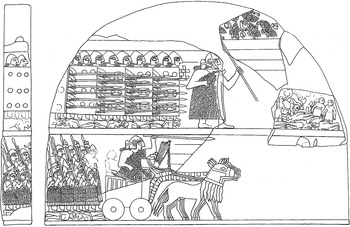
As far as the analysis of the group of soldiers represented in the first register of the “Stele of the Vultures” (Fig. 1) is concerned, it is necessary to go through a process of deconstruction of the image. Indeed this is a process that has already been undertaken by the Sumerian artists, who reached a synthesis in the representation of the mass of soldiers by seeing their arrangement through a double viewpoint, combining two perspectives in one image.
Drawing of detail of the first and second registers (front and side) of the “Stele of the Vultures” (from Seidl Reference Seidl2007: fig. 3b).

Sumerian artists employed a combination of different points of view in order to show what should in reality have been hidden (i.e. that an observer in a single spot could not in fact see). According to this principle, we can borrow the definition of aspective art given by E. Brunner-Traut for Egyptian art.Footnote 5 If perspective gives a personal, situated viewpoint from which the scene, the object or the person is seen, aspective art does not take a personal perspective but rather depicts the space, object or person as it really appears or, I would add, as the artists expect the viewers to see it. This is a perspective of expectation, and artists represent objects, human bodies, and space by giving all possible information concerning their formal characteristics. Since information becomes the fundamental aspect of the image, Sumerian artists apply multiple perspectives in order to represent that information more completely. This creates a “distorted” perspective by showing what, in a correct application of perspective (at least according to the examples known from classical art and art from the Renaissance onwards) should be invisible and overlapping. The representation of the group of soldiers in the first register of the “Stele of the Vultures” follows this principle, resulting in a synthetic image of the whole arrangement whose details can reveal the depth and order of the ranks of the troop, according to linear horizontal and linear vertical positions. If we take the two visual solutions individually, our perception of the composition of the whole array is partial, while the consideration of both perspectives enables us to perceive the overall complexity of the scene. Nevertheless some details are still unclear, and might in fact reflect the desire of the Sumerian sculptors to represent everything (all men, weapons and positions) in one comprehensive picture.
If we begin with the combined result of the Sumerian sculptors, what do we see? The first register (including the left side of the stele, Fig. 1)Footnote 6 shows a row of eleven soldiers (eleven heads and eleven pairs of feet below the shields). From behind the shields that cover the entire bodies of the soldiers protrude six pairs of hands holding long spears, repeated four times. Since the bodies of the soldiers are completely hidden behind the shields, it is impossible to say whether they are wearing a simple wool skirt (as shown in the second register) or have special armour for the battle.Footnote 7 They can be clearly seen to wear helmets, perhaps of metal if the thickness of the lower edge is considered.Footnote 8 We can see that the soldiers hold long spears with both hands,Footnote 9 and they are also presumably equipped with an axe, as indicated by the axes projecting from behind the first shield at the head of the row of eleven men and by the group of soldiers in the second register of the stele, who hold spears in their right hands and axes in their left.
This detail of the axe might be included in the category of unsolvable questions, resulting from the forced combination made by the Sumerian sculptors who wished to give the most complete and real picture of the manifold skills of the soldiers of Lagash in fighting with different weapons in different contexts at the same time. In reality, if soldiers held the long heavy spears with both hands, how could they also grasp the axes? And, as a consequence, how would it be possible for them to carry large shields in front of themselves? This problem of managing several weapons (spear, axe and shield) at the same time was solved by some scholars by introducing the category of shield-bearers, who were thus charged with the duty of carrying the shields to protect the phalanx of infantrymen.Footnote 10 Recently, Ingo Schrakamp suggested a different interpretation, denying the possibility that the Sumerian term ama ÉRIN(-ak), “Mother of the Troop”, might identify the category of shield-bearers (an interpretation that was mainly based on a reading of the document Nik. 1, 281 and derived from the visual evidence of the first register of Eannatum's stele).Footnote 11
Despite the incongruent interpretation of the cuneiform sources, either supporting or denying the existence of a devoted corps of shield-bearing soldiers within the army of Lagash, it is evident that large shields are represented covering the entire body of the soldiers and that these might have been carried by soldiers other than those holding the spears. The Sumerian sculptors clearly indicate that the long spears are held by the soldiers with both hands;Footnote 12 thus, necessarily, a different man might have carried the shield, although we must not consequently think of a fixed array combining one “shield-bearer” and a fellow holding the spear (as, for example, in the typical formation of the later Assyrian army where a pair of soldiers—an archer and a shield-bearer—fought behind the high siege-shield during attacks on fortified settlements). The difficulty, or perhaps mistake, lies in forcing either written or visual evidence (sometimes both): if cuneiform sources do not provide evidence of the existence of a dedicated category of shield-bearers (according to Schrakamp's interpretation), it remains true that the register of Eannatum's stele implies the presence (at least on that occasion) of men charged with the carrying of shields since their fellows needed to hold the heavy, long spears with both hands. According to the image produced by the Sumerian artists, who must have purposely created this solution based on their convention of synthetically combining different aspects and features of the army in one picture, the existence of shield-bearers is a logical deduction. We should not think of shield-bearers as a separate corps of the infantry, rather as an attitude of infantrymen, who were equally employed as spearmen, shield-bearers, or otherwise. In the end, the solution might lie in avoiding any specific and detailed definition and translation of professions and tasks derived from our experience and knowledge of other situations that we then simply transfer to the Mesopotamian world.
If information on how the shields are carried by soldiers is unclear and still a matter of debate, then the exact use of the shields is also not evident: shields cover the bodies of the soldiers, but from the depiction alone it is not possible to gauge whether shields were used to protect the front of the array or whether they were also placed along the sides and the rear of the phalanx, thus creating a protected block of soldiers moving simultaneously. Most plausibly, shields protect the front row of soldiers who face the enemy first: advancing as an ordered block, soldiers in the back rows can move safely and strike the enemy with the log spears protruding from the front shields. Indeed, this hypothetical scheme reflects the moment of the march of the army while reaching the battlefield, just before the real confrontation of the enemy or, at least, in its beginning. Later, soldiers fight at close quarters, in kinds of duels with both the spear and the axe, a more convenient and efficacious close-range weapon.Footnote 13 In fact, looking at the image of the stele, the soldiers of Lagash advance, protected by the shields, over the naked corpses of the enemies, in a synthetic picture that combines preliminary phases (the march in lock step) and the results of the battle (with the dead enemy overwhelmed and overcome by the soldiers of Eannatum).
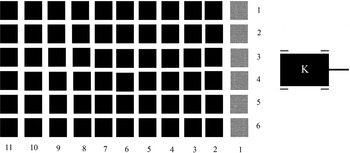
The combined solution of the Sumerian sculptors permits the possibility of reading the composition of the arrangement of the soldiers on the battlefield (Fig. 2). The whole group is thus made of eleven rows (the eleven heads over the shields), with each row formed of six soldiers armed with spears (the six pairs of hands coming out from the shields). The combination of the two representations gives twice as much information: on the length of the phalanx (eleven rows, one behind the other), on the one hand, and the extension in depth of each row (six soldiers, the one next to the other), on the other. The arrangement of the soldiers in rows of six elements is in fact confirmed by the representation in the second register of the stele where twelve soldiers, equipped with spear and axe, are represented in two rows of six men, one behind the other.Footnote 14 By observing both registers, one can reconstruct the reality of the arrangement of the soldiers and understand the solutions of the Sumerian sculptors in representing such a reality with an apparent horizontal linearity that in fact discloses a deeper overlapping rendered through the vertical linearity of the pairs of hands, one above the other.
Reconstruction of the arrangement of the troop of soldiers behind Eannatum (K) in his chariot, as seen from above.

As far as military efficiency is concerned, this tactical solution creates a compact troop of soldiers that is not too large in extension (the rear is not too far from the frontline, avoiding the risk of breaking the solidity) and the width of six soldiers per row guarantees good protection of the front row thanks to the high rectangular shields, with almost one shield to one soldier, at least according to the image, in which five shields can be seen.
If we look at the second register, we can count twelve soldiers. On the contrary, relying on the first register, it would be natural to assume that the soldiers numbered eleven (basing the result on the most effective representation of the eleven heads); however, the synthesis of the image might in fact be solved in the representation of a total of sixty-six soldiers (eleven rows × six soldiers each, Fig. 2). Again, this is a deduction made from the solution of the double “perspective” given by the Sumerian sculptors. In fact, although eleven heads are clearly represented, we do not see eleven lines of pairs of hands; the surface of the shield in horizontal perspective was not big enough to fit the whole representation in vertical perspective, and the synthesis of the image is strengthened by additional selections of details with the obliteration of some aspects and features.
If we conclude that the first register of the stele represents a group of sixty-six soldiers, how are they organised and equipped? Even if the idea of the presence of shield-bearers is not supported by cuneiform sources, it does appear that there are soldiers on the stele who are charged with the duty of carrying and moving shields while the army advances. Following this hypothesis, the first soldier on the right, at the head of the row of eleven men, is in fact equipped with an axe (as are the soldiers in the second register of the stele). Since he holds the axe with one hand, he can easily carry and move a shield with the other. The following soldiers (the remaining ten heads) would thus symbolically represent the spearmen in the ranks behind, who hold their weapons with both hands while their comrades in the front row protect them.
According to this reconstruction, the Sumerian artists make selective choices to show the composition and arrangement of the soldiers of the troop: the eleven heads would represent the first soldier of each row and, from right to left, we first meet the soldier equipped with shield and axe and then the soldiers with the spear. The details of the weapons (shields, axe and spear) give the effective composition of the troops with the characterisation of the category of soldiers employed, although this must not lead to categorising the soldiers represented with definitions such as spearmen and shield-bearers—or at least we should not pretend that these definitions correspond to precise Sumerian words as has been suggested for the case of the shield-bearers. In fact, the first register makes no special differentiation between soldiers with spears and soldiers with shields: next to the shield-bearers there are spear-bearers without any specific reference to existing specialised (separate) corps in the armies of the Early Dynastic period, but simply representing the weapons commonly used in warfare in third millennium Mesopotamia, as recorded in the texts of Lagash.
With regard to the number of soldiers as has been reconstructed by the analysis of the image, is sixty-six a casual total? Perhaps the total number would have been determined by the physical space the Sumerian sculptors could fill with representations of soldiers. However, comparison with the second register reveals the existence of rows made up of six soldiers probably as a tactical arrangement and, therefore, the correspondence between the two registers does not appear to be accidental. In fact, I would suggest instead that the total, beyond the restriction caused by the space of the register, might find comparison with the numbers of soldiers enlisted in the texts of Lagash dated to the period of the reign of Urukagina.Footnote 15 Texts from the archive of the city temple of the goddess Bau list the number of people that constitutes the “qualified troop”, forming the main nucleus of the army of Lagash.Footnote 16 This is based on the terminology used by the scribes, the distinction between select troops and the rest of the contingent and the presence of two recurrent categories of men, texts DP 136, Nik. 1, 3 and DP 135 enlist 100, 184 and 167 men respectively. Within this total, which refers to both the select troops and others purposely enlisted for war, the men from the temple of Bau are clearly indicated: text DP 136, for example, counts seventy-one people of the temple of Bau, a total that is indeed not far from the reconstructed number of sixty-six soldiers on the “Stele of the Vultures”.Footnote 17 Although speculative, it might also be argued that the total of sixty-six soldiers and the division of the army into rows of six men might depend on the use of the sexagesimal system by the Sumerians. If one assumes that the army was made of teams of sixty soldiers, it is interesting to notice that administrative texts (such as Nik. 1, 281) register the delivery of sixty double axes and sixty simple axes next to the thirty-five spears and fourteen shields,Footnote 18 suggesting that each soldier had at least an axe with the addition of either the spear or the shield (in fact this is also the equipment of the soldiers on Eannatum's stele). Moreover, the organization of the army in teams of sixty soldiers might be inferred from another document: the inscriptions of Enmetena and Urukagina relate that Urlumma, King of Umma, left sixty teams of donkeys (i.e. sixty carts) on the bank of the canal when he withdrew.Footnote 19 Each cart could carry two soldiers (at least according to the representation of the Standard of Ur) for a total of 120 soldiers (twice sixty): following the previous idea, the army of Umma reached the battlefield (the canal) by chariot, divided into two teams of sixty soldiers each.
It is true that there is not a perfect coincidence of numbers between the written documents and the stele (also due to the chronology—Urukagina's texts are later than the “Stele of the Vultures”). Notwithstanding this discrepancy, textual data concerning the enrolment of soldiers in Early Dynastic Lagash show that the image of the “Stele of the Vultures” is built upon a realistic idea of the arrangement of the troops on the battlefield.
The image of the “Stele of the Vultures” has often been regarded as a generic and symbolic representation of the military forces of Lagash, with the final visual effect of pointing out the figure of the King (on the so-called historical/human face of the monument) and the effigy of the god Ningirsu (on the divine side of the stele). On the contrary, the analysis of the double system of representing the troops in the first register reveals that the Sumerian artists did not simply create a generic and abstract synthesis with the selection of a few elements labelled generically as “symbolic”. Rather, the Sumerian sculptors went beyond what they actually saw, representing what should not be visible to the viewer, and combining two visual axes: one giving the extension of the length of the arrangement; the other giving the depth of the group of soldiers. According to this analysis, the “Stele of the Vultures” is not simply a generic and symbolic monument showing the battle and victory of Eannatum over his rival Umma: rather, its depiction of soldiers is the result of perspective choices without any symbolic purpose. It is not an allusive image, but rather a concrete representation of the army of Lagash in all its component parts, showing the number of the troops and the place each soldier occupies within the space. If symbolic aspects are to be acknowledged, the eleven heads symbolically represent one row of the army, while the six pairs of hands symbolically refer to the size of each row. However, these “symbols” are the results of an abstraction whose combination, as exactly as a mathematical calculation, gives the reality of the number of soldiers behind Eannatum.
It is necessary to look at Sumerian art—indeed ancient Near Eastern art—without resorting to the generic definitions that are commonly used not to explain the nature of ancient art, but simply to define and categorise ancient Near Eastern artefacts. It is nonetheless true that the limits of interpretation and the reading of the figurative data must not be exceeded; similarly, the interpretation of textual data must not be forced—as in the case of the very limited evidence for or against the existence of a profession we see for the shield-bearers. By taking into consideration the rules and norms of Sumerian art, the present study suggests that the image of the “Stele of the Vultures” is the result of a construction in which the symbols used (or more accurately the selection of details and elements) stand for the heterogeneity of the military composition without questioning whether the soldiers represented could be labelled as spearmen or shield-bearers. These definitions derive from conventions of interpretation that belong to us, and we should be aware that they cannot always perfectly correspond to what ancient people sought to express and represent.