Academic and policy debates about whether China's rise poses a threat or an opportunity for Taiwan and cross-Strait relationsFootnote 1 have settled into two perspectives: a realist assumptionFootnote 2 that Beijing (unintentionally or otherwise) will continue to upset the balance of power and is thus a threat to Taiwan's interests; and a liberal approachFootnote 3 that believes institutions and the benefits of increasing economic interdependence are leading to greater gains for all concerned. Disagreement results from opposing assumptions about Beijing's intentions as its power continues to grow.Footnote 4
Such competing approaches provide fairly clear perspectives but risk being ultimately deterministic in their analyses and policy recommendations. Many accounts exist of the recent largely economic agreements between the People's Republic of China (PRC) and Republic of China (ROC), but these treatments continue to leave out an important part of the story. Respective studies explain how, but not why, critical decisions for such negotiations have been made.Footnote 5 Missing from this debate, most importantly, is a more nuanced consideration of how Taiwan and its policy elites view themselves and their position in cross-Strait relations. In other words, the future of Taiwan's cross-Strait policy may not derive from a military balance-of-power consideration, or how increasing economic interactions develop; instead, whether Taiwan's policy preferences move towards closer cooperation or conflict depends largely on its policy elites' perception of the evolving security situation in the region. As will become apparent, it is essential to recognize that Taiwan's decision makers' views are deeply affected by, and interact with, factors and institutions on and beyond the island.
This article offers a model of political processes based on concepts from the field of strategic studies – the staying power of the status quo and order of movement – as one possible means towards an explanation for Taiwan's position on cross-Strait negotiations, the increasing stability across the Taiwan Strait, and why political parties in Taiwan are converging towards the centre and striving for moderation, as opposed to increasing polarization, when it comes to managing relations with Beijing.Footnote 6 The objective is to help elevate and extend debate on cross-Strait relations beyond the outlooks based on realist versus liberal assumptions. This will require a shift towards the application of two interrelated ideas: a preference for the status quo and a resulting reluctance to take the initiative.
First, bias towards the status quo will emerge as a major factor in accounting for stability in a situation that seems ripe for change. This is the idea underlying the analysis to come. A preference for the status quo can come about and be reinforced through mechanisms that will be introduced and elaborated more systematically at a later point in the context of cross-Strait relations. One key element in a preference for the status quo is loss aversion, that is, a reluctance to take risks because the potential damage is more salient than gain. Uncertainty factors into a general preference to stay with what is known rather than take risks which might seriously harm one's position.
Second, and closely related to the preceding argument about the status quo, is a resulting anticipated effect on moving order. A common preference for reacting rather than initiating – referred to as “second-mover advantage” – reinforces the staying power of the status quo in a wide range of situations. A basic reason for an aversion to moving first is that, all other things being equal, errors of commission tend to be punished more than omission. This is because an explicit action is observable, while the failure to act offers more options for rationalizing bad results and shifting blame.
Before moving on to the plan of work, it is necessary to consider the notion that “everyone observing cross-Strait relations already knows that the status quo is firming up and that a second-mover advantage exists.” If this is indeed the case, the current project might be seen as redundant. The existence of such a consensus in the field could be disputed directly, but a better counter-argument is available through the concept of consilience. This idea, traced back to William Whewell, refers to the degree of confidence that is gained when multiple, independent methods confirm the same point.Footnote 7 In the Sino-Taiwanese context, it could be asserted that experts in the field lean towards something like the “Aquamarine” concept put forward in the present study regarding the evolution of Taipei as a political entity. Even if so, the quest for consilience remains worthwhile because a survey of the literature does not reveal an interview-intensive approach among recent studies. Thus, it will be valuable in building confidence about the explanatory power of the two central concepts in this article – preference for the status quo and second-mover advantage – to compare the academic literature with what can be learned from interviews.
Guided by the interconnected concepts of the staying power of the status quo and second-mover advantage, this study will unfold in five additional stages. The first stage will focus on key concepts that guide the analysis: status quo preference and second-mover advantage. The second stage presents the primary source of evidence for this study, namely, a series of elite interviews in Taiwan from December 2011 and June 2012. Once the status quo and moving order are identified in the Sino-Taiwanese context, the interview material is used in the third stage to assess the utility of the key concepts in accounting for Taipei's position on cross-Strait relations. Research on cross-Strait relations is vast, so the fourth stage – a quest for consilience – concentrates on how the results obtained here relate to recent work that focuses on strategic interaction in East Asia. The fifth and final stage conveys conclusions, along with future directions for research.
Key Concepts: Staying Power of the Status Quo and Order of Moves
A key consideration in accounting for at least some ongoing situations that would seem ripe for change is status quo bias. “Once made,” as William Samuelson and Richard Zeckhauser observe, “policies frequently persist and become codified implicitly or explicitly in the form of decision-making rules of thumb, company policy, standard operating procedures and the like.”Footnote 8 A significant literature, nested primarily in the discipline of economics, presents theory and evidence in favour of the staying power of the status quo.Footnote 9 Three mechanisms are identified in the authoritative treatment of status quo bias from Samuelson and Zeckhauser.Footnote 10 The effect may be seen as the consequence of: rational decision making in the presence of transaction costs and/or uncertainty; cognitive misperceptions; and psychological commitment stemming from misperceived sunk costs, regret avoidance, or a drive for consistency. Each of these mechanisms is considered in turn.Footnote 11
Status quo bias can be consistent with rational choice under various conditions.Footnote 12 Consider, for instance, transaction costs. Why are there so many languages when adoption of just one would be so much more efficient? Even aside from cultural arguments against such change, significant transaction costs would be anticipated during the process of learning a common language.
Important also is the role of uncertainty in reinforcing the status quo; for example, many families return to the same vacation spot each year simply out of inertia. Moreover, a new choice may present the opportunity to obtain a better outcome, but it also entails some degree of uncertainty. What if the result is something inferior and even unacceptable? Evidence in favour of uncertainty as a causal mechanism regarding status quo bias appears in a model of public reaction to reform. A formal model from Fernandez and Rodrik reveals that uncertainty regarding those who would lose or gain from a new policy “can prevent even an efficiency-enhancing reform from being adopted.”Footnote 13 Kahneman, Knetsch and Thaler review empirical evidence and conclude that loss aversion constitutes a key element of decision making.Footnote 14
Uncertainty, in fact, tends to be a more sustained and important trait than people generally acknowledge. One can point to how quickly China became an economic superpower; just a few decades earlier such a rapid rise would have seemed inconceivable. Note also the discovery of significant deposits of geocarbons under the Taiwan Strait as another, more recent trigger for uncertainty. Collectively speaking, even unlikely scenarios, such as a war between China and Japan over territorial disputes, a sharp economic slowdown and rising social unrest in the PRC, or intensely visible anti-Beijing dissent in Hong Kong, might yield at least one occurring in reality. Given that huge earthquake-like events occasionally do happen, it is not irrational for decision making to reflect some degree of bias towards the status quo out of concerns about setting in motion possibly major and irreversible events that entail danger as well as opportunity.
Cognitive misperceptions also can play a role in reinforcing the status quo. People tend towards risk aversion and therefore place an exaggerated value on their current situation. Perhaps this idea is most simply communicated through a pervasive aphorism: “look before you leap.” Consider in particular the greater salience of loss over gain, even if there is some degree of opportunity present that could be pursued through a shift in policy. Gains from trade may be eschewed because dimensions that entail loss are experienced with greater intensity than those that produce gain. Thus the existence of multiple dimensions in the status quo means that some elements may serve as anchors on any movement because there is so little willingness to incur risk in those specific areas.Footnote 15
Another mechanism favouring the status quo is psychological commitment. Once resources, material or ideational, are invested, such placement can take on a dynamic of its own. This may be regarded as an “endowment effect.”Footnote 16 For example, many historians see the longstanding commitment of US leaders to the Vietnam War as a classic example of this mechanism in operation. Long after objective indicators pointed towards the rationality of withdrawal, Washington persisted in fighting. Kahneman, Knetsch and Thaler sum up a decade of research, moreover, as strongly in favour of significant impact from the endowment effect.Footnote 17
All other things being equal, the staying power of the status quo should be greater as the preceding factors become more pronounced. An important by-product concerns moving order. For some situations of strategic interaction it can be advantageous, and even decisive, to move in a particular order. In the archaic practice of duelling, it would provide quite an edge to shoot first if permitted to do so. The opposite is true of the children's game of paper, rock and scissors. In that context, it would be decisive to the outcome if one could see the opponent's choice and then respond with the perfect option.
Strategic interactions in the real world of politics may be expected to tilt one way or the other – that is, towards an advantage from initiation or reaction – with plenty of room for variation in different settings. When the status quo is especially appealing, a disadvantage is more likely to accrue from moving first. In other words, proposing a departure from the status quo naturally includes political “baggage.” Under such conditions, it is expected that policy will converge towards high stability.Footnote 18
Interviews in Taiwan, December 2011 and June 2012
The authors took turns visiting Taiwan to carry out research interviews. One of the authors spent the second week of December 2011 in Taipei. Given the proximity of this visit to the presidential election of 14 January 2012, political issues held an even greater importance than usual among both the public and elites. While this might have the disadvantage of evoking more emotional responses than otherwise would be expected, the overall impact of the timing would seem to be positive in the sense that all of those interviewed had a strong interest in sharing their thoughts.Footnote 19 Following the January presidential elections, the other author spent two weeks in June 2012 in Taipei to conduct follow-up research interviews.
During the December 2011 research visit, 12 meetings took place with a total of 20 interviewees, and no more than three present per session. During the June 2012 visit, discussions were held with 15 interviewees in both official meetings and semi-official conversations on the sidelines of a conference in Taipei. Those interviewed properly can be described as “elite.” They work in government, academe, foundations, media and research institutes. Some have occupied previous roles that span categories, such as academics who previously served in government. Upon advice from those with greater experience in Taiwan, the authors did not raise the possibility of taping sessions. Instead, the material in the next section from the interviews reflects detailed notes taken during discussions that lasted on average between one and two hours.Footnote 20
Sampling is a natural question regarding interview material. What about the problem of selection? The collection of elite interviews here is conventional in that it came about through what is known as the “snowball/chain referral” approach.Footnote 21 The main axis of conflict in Taiwan continues to be Green versus Blue, and the interviews are distributed evenly that way, so concerns about ideological bias should be at a minimum. In terms of format, the present study relies on semi-structured interviews, which are recommended for highly knowledgeable interview subjects.Footnote 22
One other observation, regarding possibly biased responses, seems in order. The interviewers did not “coach” respondents by introducing terminology from strategic studies. In a few cases, interviewees spontaneously introduced such language because of their prior academic training. In these instances, the interviewers obviously then felt free to engage the interviewee directly in a discussion that included references to strategic studies.
Telling the Story of Strategic InteractionFootnote 23
What do status quo bias and second-mover advantage mean in the Sino-Taiwanese context? Once properly identified, these concepts can help to address some of the most important questions that remain largely unanswered in recent analyses of cross-Strait relations. While cooperation on economic issues has provided for greater regional stability, the broader, and perhaps more substantive issues of security, sovereignty, political space and international status for Taiwan remain largely unresolved. In other words, despite increasing economic ties across the Taiwan Strait, a degree of strategic rivalry and competition remains in place. So, too, does a significant US presence as a protector of Taiwan.
Missing from the ongoing debate between liberals and realists are two essential components in need of attention from a theory-driven interview approach: 1) a more nuanced understanding of how Taiwan and its policy elites view themselves and their position in cross-Strait relations, and 2) recognition that the views of Taiwan's decision makers are deeply affected by, and interact with, factors and institutions from both domestic politics and external parties. These points make it all the more important to understand how, why and when domestic politics and external factors shape Taiwan's cross-Strait policies and negotiations. Thus, the key concepts, the staying power of the status quo and order of moves, will be applied towards that end. These concepts, which combine to guide interpretation of the interview material, are considered in turn within the cross-Strait context.
The staying power of the status quo has already been identified as important in cross-Strait relations. Hoo Tiang Boon, for example, sees a mutual interest in “maintaining the status quo” for the Kuomintang (KMT) and Chinese Communist Party (CCP), despite their many differences and historical animosity.Footnote 24 This position is associated with the US as well: it “neither supports Taiwanese independence, nor does it appear keen to endorse a unification outcome.”Footnote 25 As discussed earlier, recent opinion polls from Taiwan continue to point in the same direction, with the majority remaining in favour of the status quo. Opinion polls from 1994 through 2011 show an average of just under 8 per cent for the unification and independence options combined. Footnote 26
What does the status quo mean in practice in cross-Strait relations? The status quo is defined in terms of a situation within which movement is possible and even expected within certain boundaries. An empirical treatment of this issue, which allows for multiple visions and even controversies, is available from Philip Hsu.Footnote 27 After a review of various positions, the following conditional assessment is offered vis-à-vis the view from the Taiwanese public:
…the preference over status quo as an alternative other than unification or independence can be reasonably comprehended as leaving intact the de facto separation between the two governments in Taipei and Beijing of which each proclaims to be a representative of a sovereign country, without solving their difference in Beijing's denial of Taipei's sovereignty claim and without bilateral military confrontation that could be attempted to solve it.Footnote 28
It should be re-emphasized here that the status quo does not amount to stasis. In fact, Taiwan's cross-Strait policy has shifted and evolved quite a bit since the 1990s. Time marches on, leaders from different political parties come and go, issues rise and fall in significance, but all of this takes place within firewalls and the confines of the 1992 Consensus that exclude and reject both immediate independence and reunification, the extreme ends of the policy and ideological spectrum in Taiwan.
This movement cannot be quantified precisely within the discipline from which the idea of status quo bias emerged, namely, economics. Economists produce diagrams that show positions with precise numbers. It is understood that such precision cannot be achieved as readily for the positions of the PRC and ROC regarding cross-Strait relations.Footnote 29 Instead, the “quantification” here is one that says change occurs within degrees rather than in kind. Thus, the status quo incorporates change that does not transform it into a qualitatively new state corresponding to either reunification or independence.
All of this amounts to leaving the matter of Taiwanese sovereignty in abeyance. Any proposal to alter what effectively is a non-policy contains great risk of rejection because an attempt to change any one aspect could open a Pandora's Box of issues and bring the adversaries to the brink of war or even beyond. The status quo can persist even in the presence of obvious change as it is defined in terms of a situation within which movement is possible and even expected within certain boundaries. An apt comparison here would be to think of how balls bounce around in a sphere, lottery-style, without breaking through the surface. Metaphorically speaking, the surface of the cross-Strait “sphere” seems to be getting more solid with time.
What, then, does it mean to say that a middle ground exists between unification and independence? Interviewees frequently focused on the 1992 Consensus as a point of departure for assessing where things are now. The communiqué from US President Richard Nixon to the PRC in 1972 provides the context for assessing the later accord: the US and the PRC would “agree to disagree” on Taiwan. Fast-forward to 1992 and the unofficial agreement between Taipei and Beijing looks similar to its predecessor, that is, a sense is conveyed that is best to leave things alone and eschew confrontation. The 1992 Consensus represents a “concept” that could provide the foundation for building a relationship as opposed to a formal treaty. It is important to acknowledge that agreement on the 1992 Consensus ends once specifics are mentioned. Pan Blue and Pan Green interpretations clash directly, but both sides understand the growing pragmatism of the electorate and its acceptance of the Consensus.
From a KMT point of view, the 1992 Consensus is the “basis of trust” for Taiwan and the PRC. For Beijing, the agreement is “irreplaceable;” it affirms “political trust” regarding “one China that we both espouse and believe.” Given the KMT's disposition towards a reconciliation with the PRC, possibly leading to re-unification over the long term, it is well-disposed towards the 1992 Consensus.
For the DPP, by contrast, the 1992 Consensus represents an agreement between parties – namely, the CCP and the KMT – and lacks democratic standing. For such reasons, in a presidential debate from 2012, presidential candidate Tsai Ing-wen 蔡英文 said that a legal basis for the 1992 Consensus does not exist. A true consensus, as advocated by the DPP during the election campaign, would need to be built through an evolving democratic process.
Given this level of disagreement between its principal political parties, it might seem puzzling that the 1992 Consensus remains quite popular in Taiwan. No furrowing of the brow is needed, however, as the 1992 Consensus is generally taken to mean: “No one knows.” Its vagueness enables all to see in it what they prefer. The candidates from the January 2012 presidential election fit perfectly as examples here. For Ma Ying-jeou 馬英九, the 1992 Consensus represented a KMT agreement with the PRC, whereas for Tsai it referred to a referendum or democratic means of identifying consensus.
When describing the status quo, one interviewee said that it enjoyed “the beauty of vagueness.” Another phrase encountered – “confusion represents safety” – brings in the positive view of the status quo vis-à-vis security. Others have adopted the notion that the status quo provides for strategic ambiguity, laying the foundation and basis for political confidence and security-building mechanisms in the future.Footnote 30 The 1992 Consensus potentially could allow for mutual non-denial between the political authorities and establishments on both sides of the Taiwan Strait. This status quo point is attractive because room exists for decision making by the next generation without a commitment to unification or independence.
Interestingly, the argument among the interviewees converges on the point that, regardless of which party is in charge, the logic behind the 1992 Consensus remains the preferred default option. Put simply, the status quo is identified with peace and stability. In 2000, for example, President Chen Shui-bian's 陳水扁 inauguration speech alluded to the spirit of the 1992 Consensus when he said, “The people on the two sides of the Taiwan Strait share the same ancestral, cultural, and historical background … we believe that the leaders on both sides possess enough wisdom and creativity to jointly deal with the question of a future ‘one China’.” Even though the DPP administration subsequently changed course and sought to take steps that would formalize Taiwan's legal status and international standing, it failed to gain traction or approval from the plurality of the Taiwan electorate. Here again, the status quo – and in effect the 1992 Consensus – is preferred by 70 to 80 per cent of Taiwanese, as major polls consistently demonstrate, and only a massive change of some kind would seem likely to alter those basic numbers. Something close to the magnitude of full democratization on the mainland, for instance, would be needed to shake up the desire among Taiwanese to avoid choosing between independence and unification. Consider the problems with each of these options in turn.
Independence is not feasible because of one additional key factor: US opposition. The US set up the status quo, which reflects its national interest. The US remains an important exogenous factor in maintaining peace and stability in the Taiwan Strait, in spite of concerns expressed by some scholars that (a) Washington's reassurance about focusing on Asia is fleeting and temporary, and (b) further cutbacks in the Pentagon's budget undermine its credibility to be a security guarantor in the long run. Nonetheless, the US pivot and rebalancing in Asia remain a strategic priority for the Obama administration. The growing presence of senior US officials visiting the region and the increasing number of joint military exercises all point to the staying power of the US in the Asia-Pacific. Ensuring a degree of balance and stability, according to a former senior advisor to Ma, will thus remain a top concern and priority for the US. This includes providing defensive arms and weaponry to Taipei and deterring the PRC from using military force or other coercive measures that might alter the status quo. Likewise, for Washington, a declaration of independence by Taipei would represent enormous destabilization.
To reinforce that point, only about 10 per cent of the Taiwanese public supports independence. Even those who are members of Pan Green, generally speaking, would not see independence as a priority in the foreseeable future. If Tsai had won the election, according to several observers, she would have learned from the setbacks experienced by Chen during his administration and taken a prudent approach. Chen's approach, widely perceived as ideological, alienated the public and Tsai lived through that experience. Thus, a Tsai administration, had it occurred, would have featured an “incremental” approach towards policy regarding the mainland. During the election campaign, for instance, there were times when she referred to the “Republic of China” rather than “Taiwan.”Footnote 31 Her cross-Strait policy platform was largely based on the position that domestic consensus must first be solicited through democratic means to strengthen and consolidate Taiwan's position and negotiation strategy vis-à-vis the PRC.
As some scholars and policy elites observed, Tsai's proposal was “not completely objectionable” to the Pan Blue camp. In fact, this notion of a “Taiwan consensus first” was previously broached by former National Security Council advisor, Su Chi 蘇起. Since public opinion consistently indicates that the status quo is the preferred option and policy position, the democratic process (for example, debates in the Legislative Yuan and a referendum) could provide a stronger and clearer mandate for the government to negotiate with the mainland under the principle and spirit of the 1992 Consensus. The 1992 Consensus would no longer be seen as a secretive, opaque deal struck by track two-level negotiators between the KMT and the CCP. As one scholar put it, “the 1992 consensus would now have the legal backing and reflect the pragmatism and plurality of the Taiwan electorate's views regarding the future of cross-Strait relations.”
Even though Tsai did not win the presidency, this new pragmatism has set an irreversible trend for the Pan Green camp. The DPP, having learned its lesson the hard way with two successive losses in presidential elections, is reportedly considering greater flexibility in its policy towards Beijing, one that would encourage party leaders to engage in exchanges and interfaces with PRC officials and policy elites. The DPP, under its new party chairperson, Su Tseng-chang 蘇貞昌, made its first move in this innovative direction by reopening its mainland affairs office in order to carry out future policy research and cross-Strait engagements. More recently in October 2012, a DPP party elder and former premier, Frank Hsieh 謝長廷, made a landmark visit to Xiamen and Beijing, to signal the future prospects for change and flexibility in DPP's platform as well as for greater mutual understanding and reconciliation between the two sides of the Taiwan Strait.
Support for the Pan Blue coalition, in the same way, cannot be equated with adoption of the alternative polar point of unification: “Political trust is the key – the Taiwanese people do not trust the CCP because it is not a democracy.” Recent developments, notably the financial crisis, have made the public even more cautious than ever, which makes a significant move towards unification just as unlikely as independence. Ma, in his second term, will experience pressure to maintain the status quo (i.e. “stay put”). The emphasis will continue to be on normalizing and deepening economic exchanges, as well as on cultural, tourism and educational interfaces between both sides of the Taiwan Strait. While the general direction of Ma's second term will continue to be largely pro-engagement with Beijing, policy elites, including close advisors to Ma, opined that he will maintain a cautious approach towards any political and diplomatic reconciliation or breakthrough with the PRC that seemed rushed. Ma, however, will push for negotiations on more practical and feasible issues, including Taiwan's participation in international institutions that have a functional focus, such as the United Nations Framework Convention on Climate Change and the International Civil Aviation Organization.
Consider also the attractiveness of the status quo for the Taiwanese people with regard to quality of life. Taiwan has elections, a high standard of living, public services supported by taxation, military forces and passports. In other words, Taiwan is independent, except for recognition. The lack of official status as a state, moreover, has no impact on a daily basis. Taiwan, for instance, will host the World University Games in 2017, and the PRC did not stand in the way of that initiative. This situation can be summed up, perhaps, as “independence without independence.” When it comes to managing relations with Beijing, both parties have converged towards the centre and strived for moderation.
Among Taiwanese, support for the status quo reflects expanding pragmatism in the collective mind on the island. As an anecdote, one interviewee (an academic) reported that, when asked, students expressed a preference for becoming the 51st state of the US over joining the PRC. These same students also liked the idea of joining the UN as the “Republic of China” and even found some appeal in belonging to a “United States of China.” An ability to consider a wide range of future options for Taiwan, over and above unification versus independence, also explains why the status quo does so well when compared to those two polar opposites. Other policy elites have discussed the prospects of a confederation or a political arrangement similar to the European Union (EU). The EU model, where gradual political integration started with humble beginnings from a customs union to a free trade region and a common market, remains an attractive option for some.
Many Taiwanese are moving away from an “either, or” mindset when it comes to their future. This is consistent with how linkages have developed with the PRC. The network of connections for business executives, scientists, religious groups and exchange students, among others, continues to build. Memoranda of understanding also are increasingly common and this “social fabric” is not controlled, or controllable, by any particular government. An “interdependent influence” – arguably the best security mechanism – now is exerted through any number of elite connections. All of this promotes continuity and stability more than anything else.
Consider, as well, the way in which Taipei and Beijing reached 16 agreements in a range of sectors, including agriculture, tourism and investments. Cross-Strait dialogue is defined increasingly in such functional terms: negotiations at the sectoral level that consist of a bureaucratic process. While the respective governments sponsor meetings to enhance cooperation, the sectoral meetings do not even reach the level of track two diplomacy. None of this, moreover, seems to induce cognitive dissonance regarding Taiwanese identity and politics. Extremism is alien to the culture even among those who seek change; in the words of one observer in the run-up to the 2011 election, “Tsai is no Hugo Chavez.” Thus, the incremental and rather bureaucratic process of change fits in with the Taiwanese political system, which tends to discourage extremism.
One interview subject, well-acquainted with game theory, described the status quo as a “Nash equilibrium.” The Nash concept, fundamental to the analysis of outcomes under conditions of strategic interaction, focuses on whether players have an incentive to move unilaterally away from a particular location. For the players in cross-Strait relations, at levels of state and society, the status quo represents a Nash equilibrium. No one wishes to depart from the current position without assurance that other changes would take place at the same time. For example, only the most intense advocates of independence for Taiwan would want to issue such a declaration without ironclad support from the US. Along the same lines, unification advocates would be unlikely to go ahead without a range of guarantees from the PRC about what this would mean in practice. For all parties concerned, the status quo is not intolerable and unilateral pursuit of policy change would be associated with the likelihood of marginal gains obtained at the risk of devastating losses.
This conclusion leads naturally into the subject of moving order, which now will be addressed in the cross-Strait context. If the preceding analysis is correct, evidence should exist of a first-mover disadvantage.Footnote 32 With regard to cross-Strait relations, the situation points to a desire among participants to avoid leading the way in any effort perceived to change the status quo. This observation applies most directly to statements by Taiwan's president and opposition about independence versus unification. In Taiwan's highly charged domestic political context, proposing an innovation in either the direction of independence or unification seems likely to result in collateral damage to whoever might try to activate this issue. It is seen that the public is highly averse to risk regarding cross-Strait relations. For example, when President Ma proposed a peace agreement with China in the run-up to the 2012 presidential elections, his rating dropped significantly in the polls. This reaction confirms enduring public anxiety about any departure from the status quo that moves significantly in the direction of unification. A similar dynamic is likely to operate for the Pan Green camp; any attempt to shift the dialogue towards independence is likely to prove damaging to electoral prospects.Footnote 33 In 2008, when voters were asked to support a series of referenda posed by both the DPP and KMT regarding the island's participation in the United Nations, the proposals were rejected owing to a low voter turnout. The perceived public interest in such a politically charged issue area remains low, which indicates a preference for being politically realistic and pragmatic and reflects distaste for uncertainty.
Perception of second-mover advantage is precisely what emerges from the interviews. It is very “costly” not to maintain the status quo and a boomerang effect can be expected from “suggesting anything too extreme.” No PRC leader wants to be the one who “loses Taiwan.” From Taipei's point of view, nothing is gained by “pushing Beijing's buttons.” Along the same lines, “running too quickly or a lack of transparency in cross-Strait relations” is likely to annoy the US and Japan. It therefore becomes reasonable to anticipate reactive approaches on the part of both of these participants in the cross-Strait relations game. Ma is likely to “stay put” and the financial crisis also makes all parties even “more cautious.” For instance, Ma lost considerable ground when he put forward the idea of a peace accord. This went against an effective “red line” from the 1992 Consensus, namely, a prohibition against referenda. Further evidence of this effect is the extraordinary effort on the part of the DPP to keep the question of a peace accord through a referendum procedure on the political agenda. Once Ma had moved first, the DPP had every advantage in moving second.
Consider also the conduct of the PRC during the election campaign of 2011–12. Beijing said nothing in public because of the risk associated with taking the initiative: statements in favour of Ma could be expected to create problems for their (likely) preferred candidate. Instead, Beijing stayed quiet and engaged in low profile signalling. In southern Taiwan, for instance, they signed a contract with fish farmers. Astute observers took this to mean, “we will keep this up if Ma wins.”
Even the counter-factual case of a Tsai victory, had it occurred, is seen as being subject to second-mover advantage. “Old wine in new bottles” would be the expected result. Tsai would not depart significantly from the status quo. Pursuit of independence could stimulate nationalism on the mainland and produce an angry reaction on the part of both state and society. While the 1992 Consensus might be re-packaged and possibly sold as the “2012 Consensus,” the contents would not be much different than before. This is because the basic orientation of the government against unification, independence and use of force will remain compelling, no matter who holds power in Taipei, for the foreseeable future.
Strategic Interaction in East Asia: The Quest for Consilience
Interview material supports the vision of status quo bias and second-mover advantage as basic traits of the contemporary Sino-Taiwanese relationship. However, is there consilience between elite interviews and recent academic literature? According to one observer, disposition towards the status quo in Taiwan is subject to generational effects. Those coming into positions of power now are “less emotional and ideological” and “more comfortable with the status quo.”Footnote 34 This shift can be traced to the absence, among younger cohorts, of the collective memory that had driven KMT policy for decades. Current leaders, and an increasing proportion of their supporters, did not live through the traumatic events on the mainland that caused the KMT to establish its outpost on Taiwan over 60 years ago. Thus, the degree of pragmatism evident in Taiwanese views of the PRC – consistent with a status quo-oriented disposition that is conducive to incremental change – continues to rise with time.
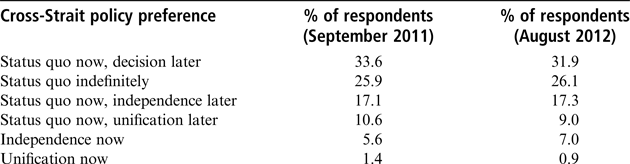
Attitudes among the general public towards Taiwan's future also reflect this pragmatic and moderating trend. It is interesting to note that in data from the last decade the shift is towards independence and unification as conditional preferences.Footnote 35 More support will exist for unification, for instance, if the person expressing an opinion believes that the mainland and Taiwan are becoming compatible in their values. The same is true for independence as a function of a greater belief in the possibility of peaceful change in that direction. These contingencies are based on what is assumed to be likely behaviour on the part of the PRC and US, which can be difficult to foresee. Moreover, in a new scale for preference that takes contingency into account, Hsieh and Niou discover that the status quo is the trend at 38.7 per cent, while Benson and Niou record a value of 53.1 per cent for the status quo in data compiled right after a swing towards sympathy for independence.Footnote 36 “The status quo will, in all likelihood,” observe Hsieh and Niou in the middle of the last decade, “remain the median voter position for all Taiwanese voters.”Footnote 37Table 1 reinforces this argument.
Public Opinion on Cross-Strait Relations

Source: Adapted from the Mainland Affairs Council Public Opinion on Cross-Strait Relations in ROC (September 2011 and August 2012), available at: http://www.mac.gov.tw/np.asp?ctNode=5895&mp=3.
According to official polls conducted by the Mainland Affairs Council in August 2012, nearly 58 per cent of the respondents favoured maintaining the status quo either indefinitely or with some sort of decision deferred to a later date indefinitely. Those who favoured an immediate declaration of independence or immediate unification with the PRC were in the minority (7 per cent and 0.9 per cent, respectively). The latest study measuring changes and trends in the political attitudes of Taiwanese voters, conducted by the Election Study Center at the National Chengchi University, found that the percentage of the population supporting the status quo indefinitely has seen a three-fold increase, from nearly 10 per cent in 1994 to 30 per cent in 2012. Irrespective of party affiliation or national identity, moderation and pragmatism seem to be on the rise among Taiwanese voters in recent years.
A few additional casual observations, along those lines, reinforce the idea of more normal relations across the Strait as the reality. Students attend university back and forth across the Strait. Business, trade and economic links continue to expand. Economic and social integration spill over into each other.Footnote 38 Previously unthinkable connections, such as the use of CCTV footage by a Pan Green-oriented television station, are becoming the norm. The signs of change within boundaries that define a status quo that eschews both unification and independence are clear to see. Moreover, it is difficult to find evidence of movement away from a centre position towards either of the extremes. One study even labels the Ma administration as “pro-status quo.”Footnote 39
For many on the island, the situation at hand seems better than the salient alternatives of immediate unification and independence: “Even if the Taiwanese are reluctant, for practical reasons, to support de jure independence, they have a strong preference for the de facto independence Taiwan currently enjoys, so unification will not be accomplished easily.”Footnote 40 So it follows that the staying power of the status quo can be expected to be a significant factor in shaping cross-Strait relations. A key underlying factor may be the established trend towards perception of a Taiwanese as opposed to a Chinese identity among those on the island.Footnote 41
From Beijing's point of view, this might be seen as consistent with the short-term achievement of further, but limited, integration with Taipei. While this shift falls qualitatively short of unification, the type of changes involved also make independence far less probable.
From the standpoint of Taipei, further political, economic and cultural interactions are permissible as long as they are profitable, practical and stay within boundaries that are understood to exclude unification, a mirror-image of the 1992 Consensus.Footnote 42 Taiwan's decision makers are learning to craft cross-Strait policies within the scope and parameters of this understanding of the status quo that continues to receive the broadest support and acceptance among the general public. It is true that a tremendous amount of change has taken place in Taiwan's cross-Strait policy since the 1980s, and every presidency since the mid-1990s has sought to carve out its defining cross-Strait policy breakthrough by altering the pre-existing policies. However, as will be discussed below, leaders are punished at the ballot box for proposing policies that venture beyond the general public's comfort zone. The status quo can thus persist in light of ongoing change, with the degree of change narrowing and extremist policies that pander either to the “deep Blue/immediate unification” or “deep Green/immediate de jure declaration of independence” constituencies diminishing over time.Footnote 43
With strategic interaction underway simultaneously for Taipei, Beijing and Washington, quite a few complications arise. Intuition points towards the probability that efforts to effect change, regardless of direction, will face quite a challenge from the status quo.Footnote 44 The straightforward explanation is that, to reach agreement, the major actors must obtain minimal satisfaction from a deal in terms of both perceived national interests and respective domestic constituencies. This relative stability of the ambiguous situation regarding independence – functional autonomy for Taiwan without any formal de jure declaration of a legal existence separate from the PRC – suggests a disadvantage to moving first in the issue area. The reason is that efforts to change the status quo will induce concern and even fear among a wide range of constituencies who want to avoid any risk of escalation. Thus, taken together, it is expected that the staying power of the status quo and first-mover disadvantage will produce, paradoxically, a great deal of stability in practice for a situation that would seem quite volatile in theory.
After a review of extensive elite interviews in Taiwan, consilience is at hand. The interviews are in line, collectively speaking, with the key concepts put forward here and recent academic literature produced from various disciplinary points of view. The importance of a preference for the status quo and second-mover advantage are confirmed with respect to understanding the direction of cross-Strait relations from Taipei's point of view.
Cross-Strait Relations and Beyond
Based on elite interviews that find consilience with ongoing research, the trend line towards entrenchment of the status quo is clear to see in cross-Strait relations. The status quo is a deepening equilibrium point for Taiwan, in large part because of the staying power of the status quo and order of movement. Rather than a deepening hue of Blue or Green, Taiwan's political spectrum is converging and shifting towards Aquamarine.Footnote 45
The Taiwanese, on average, embrace neither independence nor reunification. Instead, the status quo – de facto independence coupled with a de jure lack of recognized statehood – shows great staying power. The basic reason for this increasingly solid preference in Taiwan can be traced primarily to one of the causal mechanisms described by Samuelson and Zeckhauser: rational decision making under conditions of uncertainty. Both reunification and independence entail very difficult calculations regarding transaction costs. Would reunifying with the PRC possibly lead to the end of democracy in Taiwan? What about the danger posed by Beijing's threats about use of force if Taipei declared independence? Not only is uncertainty high in each instance, but the potential transaction costs are enormous.
This basic result contains a twist of irony. The literature from economics, cited earlier in this study, tends to frown upon status quo bias. From a policy standpoint, however, the Taiwan Strait is a case where entrenchment of the status quo would seem like the only policy that minimizes the risk of war while simultaneously allowing for a desirable way of life on the part of the people concerned. Put differently, while some mechanisms associated with status quo bias clearly are pernicious – we refer here to misperceptions and endowment effects – in very explosive situations it may be optimal for decision making to move down the pathway towards stabilization. Contemporary cross-Strait relations would seem to be one setting within which a convergence towards the status quo is desirable because no better outcome is feasible across the board. Therefore the truth of the story for Taiwan in cross-Strait relations lies between the extremes of liberalism and realism. Neither friend nor enemy, the PRC instead represents a reality acknowledged by the ROC. The result is an increasingly stable situation that resembles neither mounting confrontation nor positive integration.
Future research could follow at least three directions. Further depth into the Taiwanese case, along with breadth obtained from examining other important instances of strategic interaction and adoption of different methods, emerge as priorities.
One approach regarding Taiwan would be to extend the present results by focusing on interview material not covered here. For example, the political economy of cooperation and conflict in the Taiwan Strait is covered by any number of questions listed in the Appendix. The detailed answers obtained from interviewees on matters such as the high-profile Economic Cooperation Framework Agreement (ECFA) from 2010 create an interesting agenda vis-à-vis the role of economic issues in shaping cross-Strait relations.
Another direction for further research would be comparative in nature. Cross-Strait relations, as assessed in this study, suggest the explanatory capacity of the staying power of the status quo and second-mover advantage under conditions of long-term conflict. Does the narrative identified here, which focuses on a convergence towards the status quo and second-mover advantage, possess more application in other, at least somewhat comparable settings? The situation between Israel and the Palestinians may be a relevant case study. Broad agreement exists on the nature of a solution, if one ever does get implemented. The agreement would have two states and marginal exchanges of territory. A financial settlement would compensate Palestinians for foregoing the right of return to the territory now known as Israel. Some kind of compromise would be worked out on Jerusalem as well. Yet, the antagonists never reach an end point to their conflict. The framework developed here might be applied productively to explain the persistence of a stalemate vis-à-vis Israel and the Palestinians, among other cases.
Yet another option for the future would be a more formal or quantitative approach in terms of methods, thus adding further to consilience. At least three types of approach could be considered here from the standpoint of research methods. One would be to build on aggregate data analysis already in place.Footnote 46 Another approach would be formal, with a multi-player game-theoretic model that includes the PRC and ROC, but also perhaps the US and China as players. A mathematical forecasting model, such as that of Bueno de Mesquita, could be applied as well to assess the direction of cross-Strait relations.Footnote 47
Finally, consider the title of this study. Coalitions labelled Green and Blue, which favour independence and reunification, respectively, have been at odds over the direction of Taiwan for a long time. Analysis based on the concepts of the staying power of the status quo and second-mover advantage suggests that Taiwan will end up neither green nor blue. Instead, Aquamarine – a blending of the Blue and Green positions into a status quo of de facto sovereignty – seems likely, metaphorically speaking, to end up as the lasting colour of Taiwan. Given the history of conflict across the Strait, it is fair to say that much worse things could have happened.
Appendix
Research Interview Questions
1. What are some of the most important domestic interests – business, labour, legislators, public opinion – in helping to shape and determine cross-Strait relations? How influential are these domestic interests? Any concrete examples?
2. In negotiating with the authorities in Beijing, how has Taipei been able to ensure that its proposals – both threats and promises for cooperation – are credible? Have there been attempts by the current Ma/KMT government to ratify these proposals by key domestic constituencies? Why or why not?
3. Does Taiwan's unique system of political governance – a hybrid of parliamentary and presidential system – as well as its social structure and political culture provide considerable leeway in setting security and foreign policy? Why or why not?
4. Would cross-Strait economic and security policy be seen as constituency-driven or constituency-constrained?
5. What are some of the mainstream views and attitudes of the domestic Taiwan audiences that are relevant to recent cross-Strait security and economic arrangements with the mainland?
6. What is the general public mood on cross-Strait relations? Is there a perceived sense of a strong and enduring desire for a peace dividend? And/or anxiety about the polarizing domestic politics in Taiwan and a need to get its own house in order, for example, and forge a more cohesive consensus among the Taiwan electorate about its political status in the international community?
7. What does this pattern of attitudes mean for Taiwanese public support for the relationship/partnership with China?
8. There seems to be an emerging and diverging trend in cross-Strait relations, one in which there is increasing economic integration and interdependence, while political stagnation/fragmentation remains persistent. Looking ahead, how might a Ma KMT or a Tsai DPP government strike deals with Beijing without upsetting the domestic games in the process?
9. Some might describe the Economic Cooperation Framework Agreement (ECFA) signed between Beijing and Taipei as a “win-win” and confidence-building deal. Is there a perception within Taiwan that the gains from this cross-Strait economic cooperation are widespread but diffuse, for example lowering of transactions costs and more affordable goods for Taiwan consumers and businesses, and that the costs are concentrated on a particular social sector, for example small and medium enterprises, the manufacturing sector, labour unions, and the agricultural sector, which is the main economic lifeline for central and southern Taiwan? Have the disadvantaged domestic constituents complicated the cross-Strait negotiation process? How have their concerns been addressed and assuaged by the government/negotiating authorities balancing and integrating domestic and cross-Strait concerns?
10. Does Taiwan's political culture place more emphasis on consensualism or on strong leadership? [The former would mean that domestic constraints will continue to make it more challenging to ratify promises/deals with the mainland, and likewise more difficult to ratify threats. Emphasis on strong leadership in the presidency, however, means that it would be easier to deliver on promises as well as threats.]