Who controls foreign aid and how it is used? Academic disputes rage over what foreign aid allows politicians in recipient countries to do. For some scholars, aid enables political elites to buy votes, build militaries for repression, and enrich themselves through corruption.Footnote 1 Aid may thus undermine citizens' ability to hold political elites accountable for how public revenues are spent.Footnote 2 In this view, foreign assistance is often captured by powerful political elites in recipient countries, thus benefiting politicians and hurting citizens.
Others argue that foreign aid can bypass corrupt political leaders and target the delivery of needed public goods directly to recipients even as it promotes civil society actors that can demand better governance.Footnote 3 Additionally, aid can enable government capacity building and contribute to the development of better-functioning institutions and thus push politicians to reduce corruption and mismanagement.Footnote 4 Understanding the incentives of recipient governments to use aid for their own political purposes, donors can target aid toward specific projects, impose conditions, and limit the fungibility of aid revenues.Footnote 5 By this accounting, foreign donors have considerable influence over the distribution of foreign assistance, thus bypassing elites and benefiting the masses.
There is a great deal at stake in this debate. As much as $7.1 trillion in development assistance has flowed from developed to developing countries since 1945,Footnote 6 representing a meaningful share of intergovernmental financial exchanges. However, if aid—by propping up despots and enabling corruption—does more harm than good, as some scholars have claimed, donor governments should reconsider their aid practices and reduce their commitments. If, on the other hand, aid brings more benefits than costs, then continuing or perhaps even increasing foreign assistance would be advisable. Our study suggests that how aid is delivered also matters: conditionality, bypass, and monitoring may make a difference. Past aid scholarship has appeared to significantly influence major policy decisions at the World Bank in its move to randomized evaluationFootnote 7 and for the US government in its creation of the Millennium Challenge Corporation,Footnote 8 among other examples. The current scholarly debate thus involves more than academic stakes.
We consider two important elements that have been overlooked to date. First, we focus attention on the perceptions of and preferences for aid of both political elites and citizens in recipient countries through parallel survey experiments with behavioral outcomes on nearly two-thirds of the Ugandan National Parliament and a nationally representative sample of Ugandan citizens. Ugandan elites and citizens experience the effects of aid projects continually because of aid's important role in the Ugandan economy. Examining the attitudes and behaviors of political elites—in this case members of parliament—is important given their policy-making powers and status in governing coalitions.Footnote 9
Studying the opinions of ordinary citizens in semi-democratic, developing countries is also important for four key reasons. First, seeking to prolong their rule and concerned that public protests or mobilization may threaten their tenure, many autocratic leaders—including Uganda's President Yoweri Museveni in the country under study here—pay close attention to public opinion in pursuing policies, be they domestic or foreign.Footnote 10 Second, citizens may hold information about the effects of policy on outcomes they value, so public opinion can reveal insights about the world that are otherwise unavailable. Third, even if citizens are misinformed, they predicate actions on their beliefs, so understanding public beliefs can illuminate political behavior. Fourth and finally, scholars have long decried the “broken feedback loop” in which aid decision makers in donor countries are disconnected from the ultimate beneficiaries of their bequests,Footnote 11 so asking recipient publics about their perceptions of aid takes a step toward repairing the faulty feedback system.
As we discuss, different theories about the impact of aid depend on and make assumptions about elites' and citizens' attitudes, beliefs, and behavior. Examining these varying assumptions against evidence might yield a clearer picture about the role of aid. It should help us to understand under what conditions different theories of aid and its effects are more likely to operate. Hence, perceptions and preferences—especially as revealed by behavioral outcomes—matter in their own right.
To address the second overlooked element in prior studies, we propose a meaningful baseline against which to compare aid: government projects, which provide the most relevant alternative for providing public goods. Most theories of aid depend on expectations about domestic elites, arguing that they play a significant role in shaping how foreign aid and government programs affect developing countries. Yet, to our knowledge, no direct, systematic evidence exists that employs politicians as respondents reflecting on aid and similar government programs. Studies comparing recipient citizens' support for foreign- and government-sponsored development projects are likewise rare. Probing elite and mass perceptions about foreign and government assistance may therefore contribute significantly to understanding aid.
The expectations that guided us focus on the belief that donors have significant control over the aid they provide. Uncovering direct evidence for this belief is difficult given the complex set of actors and procedures in the long policy-making chain connecting donor allocation decisions to outcomes in recipient countries. Thus, we designed a study that might indirectly provide evidence for or against this belief by probing the attitudes and behaviors toward aid projects exhibited by both elites and common citizens in a recipient country. It is possible that donors have significant influence over aid and can channel and condition it with a meaningful degree of independence from recipient government manipulation. This is not to claim that donors completely determine the disposition of aid, but merely that they can channel and monitor it so that it aligns more closely with citizen interests in the provision of public goods compared to government programs. This suggests very different expectations for elite and citizen perceptions of and actions toward foreign assistance. It also implies that citizens and elites most attuned to the likelihood of politicians' capturing public resources should especially differ in their dispositions toward aid. If this view is correct, elites should be unable to capture aid easily, so they therefore should less strongly support foreign aid and instead prefer government programs, which they can appropriate more readily. Citizens, on the other hand, benefit more fully from foreign assistance than government programs, so they should evince stronger support for foreign aid relative to elite-dominated government programs. And those citizens who perceive the greatest amount of corruption and clientelism should prefer aid the most.
This belief that donors control aid contrasts with an alternative conceptualization that recipient elites largely capture foreign assistance. This belief assumes that aid is highly fungible and can be used by recipient politicians as they will. Thus, political leaders should more strongly prefer aid because they can capture it like other nontax revenues and use it for their own purposes.Footnote 12 Citizens, on the other hand, should not support foreign assistance because elites are capturing the aid, causing similar patterns as in countries with substantial nontax revenues such as oil.Footnote 13 And those perceiving the most corruption and clientelism in government should be most opposed to aid.
To uncover evidence reflecting on these alternatives, we designed two parallel experiments and executed them in 2012 in Uganda. The experiments contrast members of parliament (MPs) and citizen support for development projects in treatment conditions attributed to foreign donors compared to identical projects in a control condition in which no donor was explicitly mentioned and that most sampled Ugandans took to be the domestic government.Footnote 14
In line with the expectations that donors have significant control over aid, we find that members of parliament are significantly more likely to support projects in the control condition rather than treatment projects identifying foreign donors. However, citizens are significantly more likely to support foreign donors, precisely the opposite of the elites. Effect sizes are generally modest and approach a ceiling, but the differences are significant statistically and robust across a variety of specifications.
We evaluate possible subgroup effects and the results suggest that both elites and citizens believe that donors have substantial control over aid and thus subjects behave accordingly. MPs who perceive greater government corruption are especially likely to prefer government projects over foreign aid, whereas citizens perceiving government corruption are significantly more likely to support the aid projects. We consider many alternative mechanisms, including that members of parliament simply see government funds as more effective, and provide evidence that this is not the case. In addition to corruption and effectiveness, we also consider other mechanisms that might underlie these differences: partisanship, ethnicity, nationalism, incumbency, and a foreign reputation effect. In general, the subgroup results provide null or inconsistent evidence for these possible alternative mechanisms. Taken together, our results suggest that—at least in the minds of those with direct experience—aid may be less susceptible to political capture than government resources.
Theory
Sensing a diminishing utility in continuing macro-level debates over aid allocation and effectiveness, scholars have turned to examining the specific micro-level political economies of aid in donor and recipient countries though notably with a conspicuous absence of data on political elites around which micro-level theories are built.Footnote 15 We frame two positions in this debate that represent opposite views of the relationship between donors and recipients. These are endpoints in the otherwise continuous bargaining relationship that exists between these two sets of actors.
One prominent set of beliefs argues that elites capture aid. This approach posits that donors provide foreign aid in exchange for policy concessions from the recipient government. When donors care most about the foreign policy behavior of recipient countries, for example, their alliance behavior or trading relations, then the recipient government has enormous bargaining power. Donors then must give aid without much concern for its use by the recipient. Donors must provide highly fungible aid such that the recipient political leaders who must implement these policy concessions will benefit. Aid thus becomes a source of fungible government revenue, like other nontax revenues including oil—and with potentially similar negative effects on the economy and polity, as in the well-known resource curse.Footnote 16 By this accounting, donors provide aid in minimally invasive ways and benefit from recipient policy concessions.Footnote 17 This approach emphasizing donor self-interest is not without foundation; some research and conventional wisdom note that donors give aid for political over humanitarian reasons and therefore relinquish much control over aid delivery.Footnote 18
For recipient leaders, fungible aid is a boon because they can capture the money and benefit directly; for recipient citizens, it is a bane because, as a result of elite capture, they fail to receive public goods and therefore suffer as a result. Prominent studies have held that external sources of money, such as natural resources and aid, enable politicians to entrench themselves rather than be held accountable.Footnote 19 By this logic, political elites in the donor and recipient countries are the major beneficiaries of aid because aid increases their political longevity,Footnote 20 whereas citizens in poor recipient countries are the biggest losers since mass publics are forced to accept policy concessions they oppose and endure more corruption from their own leaders.Footnote 21 This approach suggests that the public and political leaders in recipient countries may have very different attitudes toward aid. Leaders should like fungible aid since they can direct it as they want, and publics, at least the majority of them, should be less enthusiastic since they benefit little.
Against this argument we contrast the approach that holds that donors exert influence over the aid they provide. This viewpoint attributes more bargaining power and different interests to donors and it is consistent with the fact that most aid is targeted for specific projects, has conditions attached to it, and often bypasses governments. This argument builds on multiple strands of prior work pointing to the possibility that donors are conscious of the potential for aid to be mismanaged and therefore direct, oversee, and channel the aid in ways that are more likely to bypass corrupt politicians and therefore to produce public goods in recipient countries. Donors understand many of the challenges they face in developing countries and try to act strategically to advance their goals. By this accounting, donors do more than seek policy concessions and they thus pursue aims beyond those implied by aid as an intergovernmental “bribe.”Footnote 22 We concede that donors almost certainly give aid strategically at times for political ends.Footnote 23 However, many studies of aid allocation find that aid goes disproportionately to poorer and needier countries, which suggests that significant amounts of aid target poverty relief.Footnote 24
Donors may be more interested in promoting domestic public goods, such as democracy and development, which may entail large domestic policy changes by the recipient government. These goals may be much closer as well to the preferences of many citizens. To achieve their development aims, donors try to limit fungibility and target, commit, disburse, and monitor aid in ways that do not benefit leaders, but rather pursue broader goals including providing public goods. Thus some citizens, especially those perceiving the government to be corrupt and clientelist, may be supportive of conditionality because it promotes their preferred goals for the aid money. Donors can exert control in part by committing aid to specific projects, attaching conditions to the use of aid, employing elaborate procurement rules, and instituting strong accounting and reporting requirements for recipients.Footnote 25 Such rules make elite capture more difficult. In contrast to an approach emphasizing donor allocation of relatively unrestricted fungible aid, this line of reasoning sees donors actively using aid to provide public goods for recipients by targeting aid for particular projects, attaching conditions to aid, providing both nonfungible and fungible aid, altering channels of delivery, and even withholding (or threatening to withhold) aid in response to recipient leader decisions. In fact, at a broad level, Bermeo shows that donors' goals have changed since the end of the Cold War and that they are now more focused on development and democracy promotion. She demonstrates that donors pursue “strategic development” in purposefully allocating different types of aid to different types of countries, often targeting improvements in government capacity rather than providing narrow benefits to specific leaders.Footnote 26
Even if aid fails to strengthen institutions or build capacity directly, donors may find alternative means to provide aid while avoiding capture by incumbent politicians. Dietrich shows that donors strategically decide how much aid to give directly to governments and how much to bypass them depending on corruption levels and institutional capacity.Footnote 27 This “bypass aid” can support opposition parties, watchdog media, and civil society organizations that might effectively demand more accountability and that, evidence suggests, ultimately strengthens democracy.Footnote 28
In strategically targeting and delivering aid, donors provide less fungible aid.Footnote 29 Indeed, donors appear to systematically emphasize less manipulable sectors when targeting aid to more corrupt governments.Footnote 30 Thus, donors seem able to restrict aid in ways that stymie recipient politicians' self-serving designs.
Foreign aid—especially if it is monitored, has conditions attached to it, or is less fungible—may thus provide more public goods since politicians are less able to divert it to themselves and their allies.Footnote 31 Aid may not be, in fact, similar to other nontax revenues such as oil. If donors exercise substantial control over aid, then it follows that we should expect leaders and citizens to view aid differently. In contrast to citizens who may prefer foreign aid, leaders who do not benefit as much personally may support aid less enthusiastically.
Extant studies address the problem from multiple methodological perspectives, but the debate remains unresolved. While our experimental approach cannot resolve the dispute, focused experiments using elites and citizens may contribute to this debate by providing evidence about who supports foreign aid or government funding for development projects, and their reasons for doing so. We readily acknowledge that our experiments do not and cannot provide direct evidence of donor control or elite capture. Rather, they are designed to provide important indirect evidence by revealing the attitudes and behaviors of different classes of subjects—elites and citizens—toward aid, the conditions under which they support foreign assistance, and thus their beliefs about whether or not donors exert some control over the aid or elites capture it. While this cannot definitively settle the dispute, it does advance the evidence base using a method with high internal validity.
If aid is captured, donors do not exercise control over aid, and recipient elites can use aid as they please, then politicians should prefer foreign aid over government-funded programs. Leaders will thus be freer to use the aid for their own purposes compared to tax revenues for which they must answer to the public.Footnote 32 If, on the other hand, foreign donors exercise more control over aid funds by possessing the capacity to audit, constrain, and punish politicians who try to use aid for their own political ends, then we expect a different result: elites should prefer government programs to foreign aid projects. Political leaders should be keen to use available resources to maintain their privileged position and should therefore prefer the funding source with fewer constraints.Footnote 33
Citizens' preferences should move in the opposite direction. If donors exercise sufficient control over aid such that it reaches the citizens in greater volume and efficacy, then citizens should prefer foreign assistance over government spending. This finding should be especially likely for those who perceive the government to be very clientelist or corrupt. If, on the other hand, donors cannot impose control and aid is seen as reinforcing the problems characterizing all nontax revenues, then citizens should more strongly support government spending over aid.
Along most major byways in Uganda, as in many developing countries, signs tying projects to foreign or domestic donors crowd the roadside and therefore would make the connection of aid to outcomes possible. Of course, citizens' perceptions may be mistaken about the effects of aid, and we are open to interpreting our data in this light. Nevertheless, even if citizens are wrong about aid, their perceptions matter in their own right. Voters have attitudes and beliefs first and then take actions or not based on those priors. Politicians likely have a better grasp of the effects of different sources of revenue on their political careers. Members of parliament often influence how aid is distributed in recipient countries. Combining studies of the two subject pools and comparing their attitudes and behaviors toward the same experimental conditions therefore should usefully illuminate our understanding of who controls aid.
The Ugandan Context
Context matters for the beliefs we are examining. In geo-strategically important developing countries and in ones that are democratic and well governed, prior research suggests that donors should be less influential in and less worried about the recipient's use of funds. Channeling aid and monitoring and bypassing the government should be less possible and/or necessary. Uganda, like many sub-Saharan countries, does not fit this description. Uganda currently has a semi-authoritarian regime in which the government of Yoweri Museveni's National Resistance Movement (NRM) has retained power for thirty years.Footnote 34 In 2006, Uganda began holding multiparty elections but they have not been fully free and fair.Footnote 35 Scholars describe the party's ruling methods as relying heavily on patronage and clientelism to retain its control.Footnote 36 As one recent study points out, “in Uganda, the ruling NRM has established patronage networks throughout the country through the use of local government. The civil service is another such network of patronage, and perhaps the most important is the military. These clientelist networks, while consolidating key sources of support, at the same time undermine governance and erode the viability of institutions and leadership.”Footnote 37 In 2012 when the study was fielded, Uganda ranked on the higher end of corruption scales, scoring in the seventy-fourth percentile (130th out of 176) on Transparency International's Corruption Perceptions Index.Footnote 38
Uganda also receives substantial amounts of foreign development assistance. Like most poor developing countries, it depends on two major sources of revenues: taxes and fees collected by the government and foreign aid. Since the 1990s, aid including off-budget sources has equaled approximately 70 percent of government expenditures. Moreover, aid encompassed about 15 percent of total GDP for much of that period, though the share has declined lately. Our survey confirmed that citizens had general awareness of foreign aid. More than two thirds of subjects knew that more than 30 percent of the Ugandan budget comes from foreign aid; and the majority of subjects were aware of foreign aid flowing to their local areas.
Uganda is typical of African countries in terms of its democratization processes, current level of democratization, and executive dominance.Footnote 39 The Ugandan parliament has competitive elections and, while it is weaker than the executive, it is more than a rubber stamp and is a venue for important and lively debates.Footnote 40 Indeed the reading of the budget each year, which includes discussion of aid, is one of the most controversial and important matters for every MP. As the literature on parliaments in authoritarian systems has pointed out, these legislatures often are designed to impose constraints on the executive.Footnote 41 In these contexts then, donors are more likely to be active and concerned about their aid dollars and often unwilling to let recipient governments control the funds.
Research Design
To investigate competing beliefs about donor control versus aid capture, we conducted two different survey experiments in the field as well as two follow-up surveys. First, we carried out an experiment on a convenience sample of 276 of the 375 members of the tenth Ugandan Parliament (the sitting legislature) and seventy-eight former MPs from the eighth Parliament (total current and former MPs surveyed is 354). Although we sampled MPs by convenience, the distribution is very similar to the actual parliament at that time, which we discuss later.Footnote 42 Second, we conducted a nationally representative experiment on nearly 3,600 citizens in 42 of Uganda's 112 districts. We used a clustered random sample for the citizen survey to ensure regional and political representativeness. Both experiments were similar, but not identical, and were performed between June and October 2012 by local Ugandan enumerators. In September 2012 we conducted a smaller representative, follow-up survey of 460 citizen respondents, and then in the summer of 2015 a follow-up series of interviews with twenty-eight MPs. To maximize the number of responses in the 2012 MP survey, we attempted to conduct a census of all current MPs and achieved a 72 percent response rate in the main survey. While key aspects of the experimental instruments were kept identical for each group to facilitate comparisons, the citizen survey was lengthier.
The samples of respondents reflect the underlying populations well, and assignment to treatment conditions is not predicted by available observables.Footnote 43 Key variables, such as education, gender, age, party, religion, and region, were not significantly related to whether citizens were assigned to a given experimental condition. For the MP survey, Appendix Table A1 presents descriptive statistics from our sample and from Parliament as a whole for gender, party, region and MP type, which generally matches the ninth Parliament as a whole. The distribution of MPs by region is largely representative, though it slightly oversamples those from the central region and undersamples those from the northern region. Finally, assignment to treatment conditions among MPs is not significantly related to party, gender, MP type, or region, so there is good covariate balance across experimental conditions.
We chose to conduct our experiment on MPs as opposed to other government officials for a number of reasons. First, parliament is where the budget and the acquisition of aid (both budget support and project aid) is discussed and decided. Second, MPs very clearly had experience with aid both in parliamentary debates and in managing aid funds (53 percent of our MP interviewees said they had personally managed aid funds). Moreover, MPs value such projects in their districts; a majority of them in interviews said that they received praise and appreciation from citizens for such projects. Third, Uganda's parliamentary system fuses the executive and legislative branches, and thus we are able to also survey cabinet ministers who play an important role in decision making.Footnote 44 In fact, the experiment includes forty-nine government ministers (this includes deputy ministers), twenty-two shadow cabinet members (the opposition's cabinet), and both government and opposition chief whips.
Interventions
The experimental manipulation presented each subject with a randomly assigned project description and a randomly assigned funder for that project. This between-subjects design is important for eliciting comparisons between government and foreign donor projects where direct comparisons might be too sensitive. Because of the sensitivity of the comparison, while we explicitly stated foreign donors in the treatment conditions, we used a control condition in which no donor was named to represent government-funded projects. In poor developing countries like Uganda, public goods projects like those we focused on have two major sources of funding: government revenues from taxes/fees and foreign aid. Hence the control condition could only be interpreted as one of these two sources. To the extent that individuals thought it was foreign aid, this made finding treatment effects for our experiment more difficult. But we felt this choice was critical since it enabled us to avoid social desirability bias related to naming a semi-autocratic government to its citizens and its own members of parliament and asking about support of that government's projects.Footnote 45 Our concern about social desirability bias was most acute for the MPs: we felt we could not ask the public and MPs different questions and then credibly compare responses later. We also conducted follow-up manipulation checks, which showed that most subjects interpreted the control as the government. Moreover, if all subjects had interpreted the control as the government the results would have been even stronger. We provide an extended discussion and proof of this in the robustness section and in the appendix.
We randomly assigned the manipulation for actual pipeline projects, thus avoiding active deception. The projects were co-financed by the World Bank and the African Development Bank and thus sponsored and managed by member-country governments, which allowed us to manipulate the name of the donor presented to subjects. We also randomly assigned the type of project: an infrastructure project (electricity) and an education project. To generalize more fully, we randomly assigned six different donors, including the four major multilateral and bilateral donors in Uganda and two additional multilateral and bilateral donors characterized generically. To increase the number of observations, we presented MPs with and asked them to express their support in various ways for both the electricity and education projects individually (and in random order) but only one donor. Citizens received only one of the two possible projects.
To achieve greater generalizability, we used two different project types and six different foreign donor types. The four specific donors named—the World Bank, the African Development Bank, the United States, and China—are the most active in Uganda and accounted for 54 percent of total aid disbursements. We also chose the electricity and education projects because they represent the types of projects that can be given selectively to constituencies that support politicians. For the mass survey, we randomly assigned the donor and the project type. Neither project type in the mass survey was significantly preferred over the other in the between-subjects design, which may reflect the fact that both types of projects are desperately sought after in Uganda. Because there were no significant differences between project types and among foreign donors, we focus on the difference between all aid donors and the control condition, which most subjects took to be the government.
Our framing question read, “The Electricity Sector Development Project will improve the reliability of and increase access to electricity. One major aspect of the project is to extend electricity to those who do not yet have access to it. The project may require your community to provide funding for maintenance in the future. [This project will be funded by the {RANDOMLY ASSIGNED FUNDER}.] How much would you support this project?” The text for the education project is in the appendix.
We included the sentence about future expenses (“may require your community to provide funding”) to increase the respondents' sense that this project might cost them in the medium and long term to support it. Given that aid may be perceived as “free money” whereas government programs may imply increased taxes, we were concerned that offering a project without any noted costs might lead all subjects to support it. A skeptic might worry that the added cost condition is not sufficient to overcome a bias toward “free” resources, which is a reasonable concern that we took measures to address, as detailed in the robustness section.
Alternatively, in the MP experiment, the funding organizations we randomly assigned were the World Bank, the Government of the United States, a generic multilateral institution (“an international organization funded by many countries”), a generic bilateral agency (“a single foreign country”), and No Donor, in which we omitted the sentence indicating which agency was funding the project and served as the control condition. In the mass experiment, we also included the African Development Bank and the Government of China because the larger subject pool enabled greater statistical power to probe the effects of additional treatment conditions.Footnote 46 These four donors represent the majority of aid projects in Uganda, and the inclusion of the generic bilateral and multilateral donors allows us to effectively tap preferences generally toward any foreign aid donor that might come to subjects' minds.
In the control condition, we assumed recipients would associate this with domestic government spending. We mentioned nothing about foreign aid in this version of the survey. We did the same for the MPs to avoid social desirability bias because we feared that government MPs might feel they should claim to support projects by the government no matter what they believed. But this design choice actually works in favor of the null hypothesis of no difference between treatment and control and therefore our results understate the full extent of treatment effects, as shown in the robustness section.
Our intervention focuses on one type of aid: project aid. Project aid is much more infungible and channeled than budget support. It is the most common type, it constitutes the overwhelming monetary share, and it is the most visible to citizens and thus would maximize our ability to obtain informed preferences regarding aid. According to the AidData information base, between 2000 and 2012 Uganda received 157 budget support grants and loans summing to $3.2 billion. Over the same period, the country was host to 16,019 aid projects summing to $24.5 billion in total aid. This suggests that budget-support aid in Uganda constitutes 1 percent of the count, but 13 percent of total Ugandan aid. This is roughly on par with the rest of sub-Saharan Africa, which received 3,811 budget support grants and loans for $57.5 billion in relation to 352,839 projects that totaled $615 billion. Budget support in the region thus made up 1 percent of the count but 9 percent of the money.Footnote 47 All donors to Uganda give project aid, while only some give budget support. We thus chose to use projects in our experiment so that we could explore attitudes toward all types of donors.Footnote 48
Outcomes
To measure the outcome of support or opposition for the foreign- or domestic-funded projects, we asked all respondents to first express their level of support, then to report to us their willingness to convey their support to a higher authority (party leader for MPs, and local council official for citizens), sign a petition voicing their support, and actually sign the petition.Footnote 49
MPs were asked to express their willingness to coordinate with peers in support of (or in opposition to) the project, tell constituents about the project, rally locals in support of (or in opposition to) the project, and sign a letter to the president in support of or opposition to the projects. Citizens, but not elites, were also asked if they were willing to send a text message (SMS) and to actually send the SMS in support (or not) of the project.
Because the MPs were presented with both projects, we have two observations for each, except the petition to the president. Each MP was asked to sign a single petition that reported their level of support for both projects to the president, thus we have one observation for each MP on this outcome. This design choice was made to reduce the burden on the MPs and to lessen redundancy of sending two nearly identical letters to the president. Donors were independently assigned to MPs such that MPs could receive the same or different donors across the two conditions. These various measures of support present the respondents with varying levels of cost (attitudinal vs. behavioral responses) and are used as the key outcome variables to gauge support for projects across treatment arms.
Results
Do people hold beliefs consistent with a view that donors exert control or that aid is captured? We ask whether MPs and citizens are more supportive of government programs or foreign aid projects and compare their responses. We also consider possible mechanisms that could explain the overall trends in preferences. The donor-control argument suggests that perceptions of government corruption and clientelism should be most telling.
Differences Across Groups
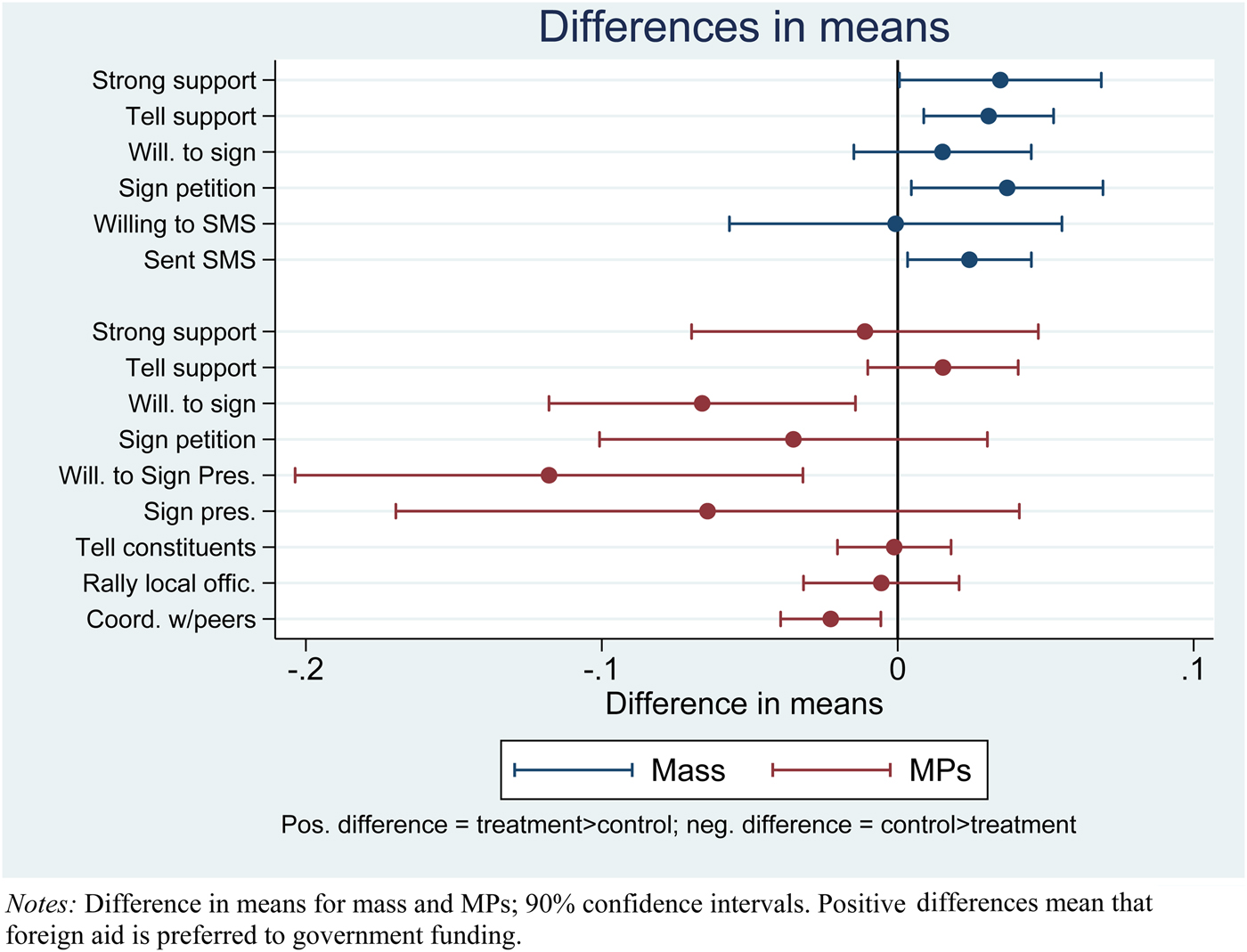
Figure 1 reports the results from difference-in-means tests comparing levels of support under all of the aid treatment conditions compared to the control condition for MPs and citizens. Appendix Table A3 presents the numerical results.Footnote 50 Panel A reports outcomes that were measured for all respondents (plus the SMS and Presidential Letter outcomes for citizens and MPs, respectively), and Panel B reports outcomes for those only measured for MPs. These overall results show that with only one exception, MPs are consistently more supportive of government projects than foreign aid. This difference in support is significant in three of the nine outcomes, and treatment effects range from less than one to twelve percentage points.Footnote 51
Difference-in-means tests comparing MPs and masses

Table A3 also shows that citizens consistently prefer aid over government projects; this difference in support is significant in five of the six outcomes, including the behavioral outcomes. The treatment effects range from two to four percentage points, which are modest but nonetheless significant statistically. These smaller substantive differences may result from strong ceiling effects given that the projects are extremely popular and therefore clustered near the upper bound of 100 percent support.
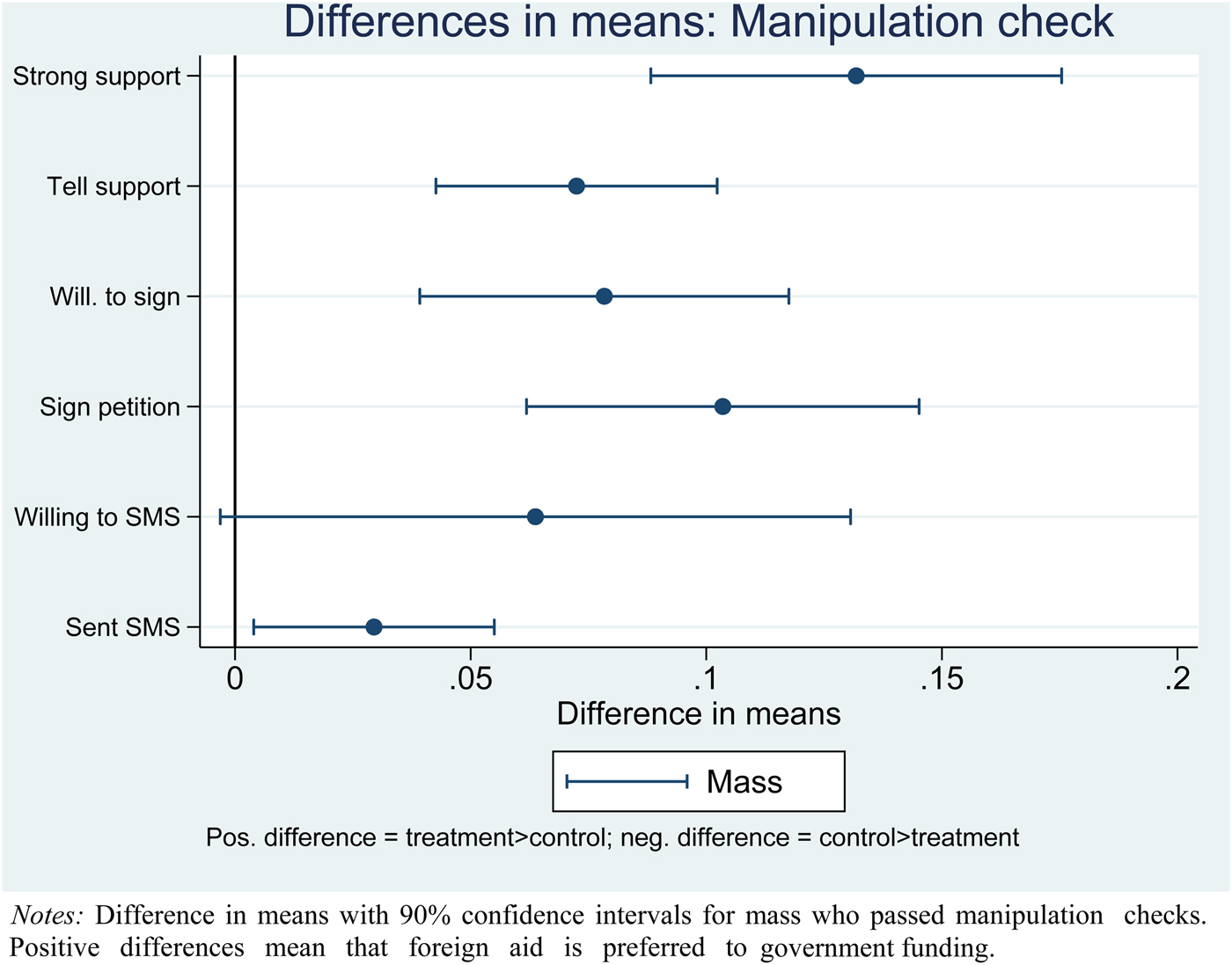
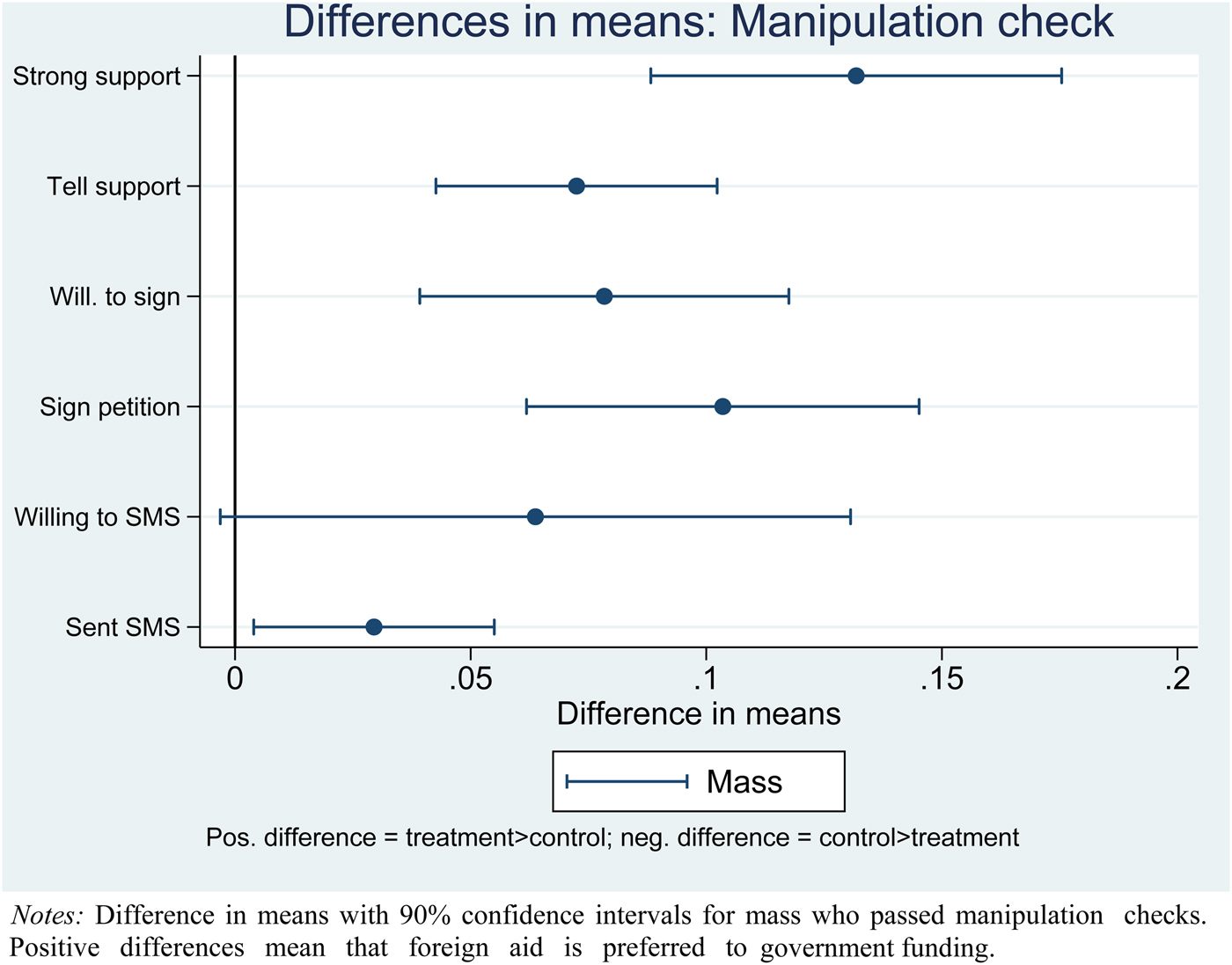
When we consider only those who passed our manipulation checks, our results are even stronger, as Figure 2 shows. These are the citizens who understood the experiment. We did not do manipulation checks on the MPs out of sensitivity to their positions. For those who passed the manipulation checks, all but one of the treatment effects range from seven to fifteen percentage points. Because dropping subjects who did not pass the manipulation checks affects the representativeness of the sample,Footnote 52 we calculated the complier average causal effects (CACE). To calculate CACE,Footnote 53 we use a two-stage least-squares model. Because we have information from the manipulation check that helps us understand better what people perceived when they received the control or treatment, we can use that check as a measure of compliance. We use assignment to treatment as an instrument to predict compliance (perceptions in the manipulation check), which in turn predicts level of support for aid versus government assistance.Footnote 54 The results are reported in the lower portion of Table A4 and are qualitatively the same as those in the baseline intent-to-treat model. We use the full sample for the rest of the discussion, but all our results hold for the group that passed the manipulation checks as well.
Difference-in-means tests masses passing manipulation
Why Do These Differences Appear?
These findings seem to be consistent with a view that donors have substantial control over aid. So we next ask what mechanism might account for these differences. To provide a plausible explanation, a subgroup mechanism needs to differ substantively between the citizens and MPs, to explain the differences between the treatment and control within each subgroup, and most of all to account for the differences between treatment and control across the elites and masses. The logic of donor control implies that perceptions of government corruption and clientelism ought to be most associated with and magnify the effects we observed earlier. We also explore numerous other possibilities—foreign reputation, partisanship, ethnicity, nationalism, government incumbency bias, parliamentary leadership, MP socio-demographics, MP perceptions of government effectiveness—and report on them in detail in the appendix.Footnote 55 None of these additional mechanisms received consistent or strong support, in contrast to perceptions of corruption and clientelism, which did find substantial support. For the perceptions of clientelism and corruption mechanism we report results here but first we rule out a number of other alternative mechanisms.
Ruling Out Some Possible Mechanisms
Multiple alternative mechanisms reported in the appendix are worth discussing here. First, the differences may arise as a result of MP demographics. It is possible that the results we observe are driven by the fact that MPs are different in terms of class, wealth, education, and status. Simply by being elite, one could develop a different perspective on development funding. To address this concern, we split the mass sample into two demographic categories—high and low—and conducted the same analysis on the subgroups. The high types are those who are demographically similar to MPs (i.e., pay taxes, are highly educated, urban, and well informed), and we find no significant differences in preferences across these two subsamples of citizens.Footnote 56 It is thus unlikely that demographic factors are driving our results.
Another alternative story about MPs could be that backbenchers differ from leaders. Leaders in parliament could prefer aid over government funds because they are the ones who can capture foreign aid, regardless of donor control. We test whether parliamentary leaders have significantly different preferences for government and/or donor funds than the rank and file. Appendix Figures A11 and A12 show that while backbenchers do not have a clear preference for one form of funds over another, MPs in the leadership are more willing to sign both the donor and president petitions in support of the government control condition, and thus they have stronger preferences for government, not aid funds. In his article, Good shows that one reason MP backbenchers may have less strong preferences regarding fund type is that they have a harder time getting access to government funds than MP leaders do.Footnote 57 Thus, it does not appear to be the case that parliamentary leaders support aid because they can capture it.
Another alternative is that MPs who support government funding over aid funding might do so as a result of positive views of government funding's effectiveness in comparison with aid funding. It could be that MPs differ from the public in that they generally find the government to be more effective. Our survey and experiment provide no support for this claim. MPs on average do not, in fact, hold the view that government-funded projects are superior. From the survey we find that only 16 percent of MPs reported that government funds, compared to aid funds, are more likely to go to the most needy, are more effective and less wasteful, are better at meeting the needs of constituents, and that government funds are more transparent. We find that 67 percent of MPs have a more positive view of government on at least one of these outcomes, while 84 percent have a more positive view of aid donors on at least one measure. When asked who they think would be the most effective in carrying out the electricity or education project, only 23 percent of MPs named the Ugandan government. Moreover, roughly 80 percent of MPs thought foreign aid had a positive effect on the government and their constituents. Finally, MPs trust foreign donors more than even the masses do.Footnote 58 Therefore, MPs actually tend to have less confidence in the efficacy of government-funded projects compared to foreign aid, even though they tend to more readily support government programs.
It may be, however, that MPs who believe the government does a better job of managing projects are the ones who support the government most and thus are driving the results. To explore this idea, we examine the subgroup effects of those MPs who think the government is better at enacting public goods projects compared to those who think foreign donors are better. We tested this possibility and find no evidence in support of this alternative. (See Appendix Figure A15 and Tables A7–A10.)
We also consider whether partisanship could be driving the observed effects. The subgroup analysis contingent on party support (NRM vs non-NRM) shows that opposition-party supporters in the citizenry are significantly more likely to endorse and act in favor of aid projects than the government condition. But while this is true for citizens, among MPs it is the opposition-party members who most strongly support projects in the government condition, against the expectations that governing-party NRM MPs would most strongly support projects assumed to come from government. This evidence works against the argument that party affiliation is the key conditioning factor.
Mechanisms Implied by Donor Control Theory
The donor-control argument implies that MPs should have a weaker preference for funds that donors can control, but a stronger preference for funds that are not as easily controlled by external actors. We first compared MPs and masses on whether they believe that the conditions donors impose on aid help or hurt Uganda and find that the public sees conditions as helping the country, but MPs see them as hurting, thus suggesting that MPs may not see foreign aid as easy to capture.Footnote 59 We unpacked this through qualitative interviews with twenty-eight MPs in which we asked them with whom they would prefer to implement the education or electricity project (where the funder was not specified). Fifty-nine percent said they would prefer to work with the government to implement the project. Of these MPs, many directly referenced the lack of conditionality and greater control over government projects. One MP said in an interview on 27 July 2015 that s/he would rather work with the government on implementing the project because “one would be sure of the project and there could be no conditionalities.” An overwhelming majority of these MPs who preferred that the government implement the project said aid is more constrained (fourteen of sixteen; 88 percent) and that aid has more rules and regulations (fifteen of sixteen; 94 percent). Thus, the MPs who prefer government funding of a project are also overwhelmingly the same MPs who say aid projects have too many conditions and are too constrained. These views support the idea that donors have significant control over aid.
A second, more direct way to consider implications that donors control aid is to examine perceptions of clientelism and corruption, which may shape support for foreign assistance versus domestic programs. Evidence in favor of the corruption and clientelism mechanism would indicate that citizens who believe that the government is corrupt and clientelist would prefer foreign aid projects because donors can exercise more control and enable effective aid delivery. MPs should have the opposite preference. When politicians see corruption in government it may be a boon to them personally or electorally, and hence they may prefer government projects because they provide an easier way to avoid donor control and instead access money for their own interests.
In the original survey, we asked both MPs and citizens whether government funds are most likely “to benefit government officials and their political allies” or “help those most in need” to capture aspects of both clientelism and corruption (using money to help friends and themselves). Both are intimately linked concepts in Africa because corruption largely sustains clientelism.Footnote 60 We see a very large difference between the public and MPs in their perceptions of corruption and clientelism: 75 percent of the public believes that current government leaders take government money to benefit themselves and their friends rather than everyone in the country, while only 35 percent of the MPs agree with this statement. We therefore use this question to divide the sample into those who see government funds as more susceptible to capture and abuse and those who do not.
Although the corruption question may be vulnerable to social desirability bias, further analysis mitigates the concern. If some MPs are more susceptible to social desirability pressures, then we should expect a strong positive correlation between low perceptions of corruption and other questions reflecting socially desirable responses, such as reporting more visits to the MP's constituency, perceiving a good economy, and claiming better attendance at plenary sessions of parliament. However, answers to these questions are never strongly and positively correlated with low corruption perceptions. There is a weak negative correlation (Pearson's r) between low corruption reports and claiming more days spent in the MP's constituency each month (r = −0.12; p = 0.00). There is a weak positive correlation between low corruption reports and maintaining that the national economy is in at least a “good” condition (r = 0.10; p = 0.01). Finally there is a weak negative correlation between low corruption reports and declaring higher rates of attendance at plenary sessions of parliament (r = −0.07; p = 0.30). There seems to be no consistent social desirability bias.
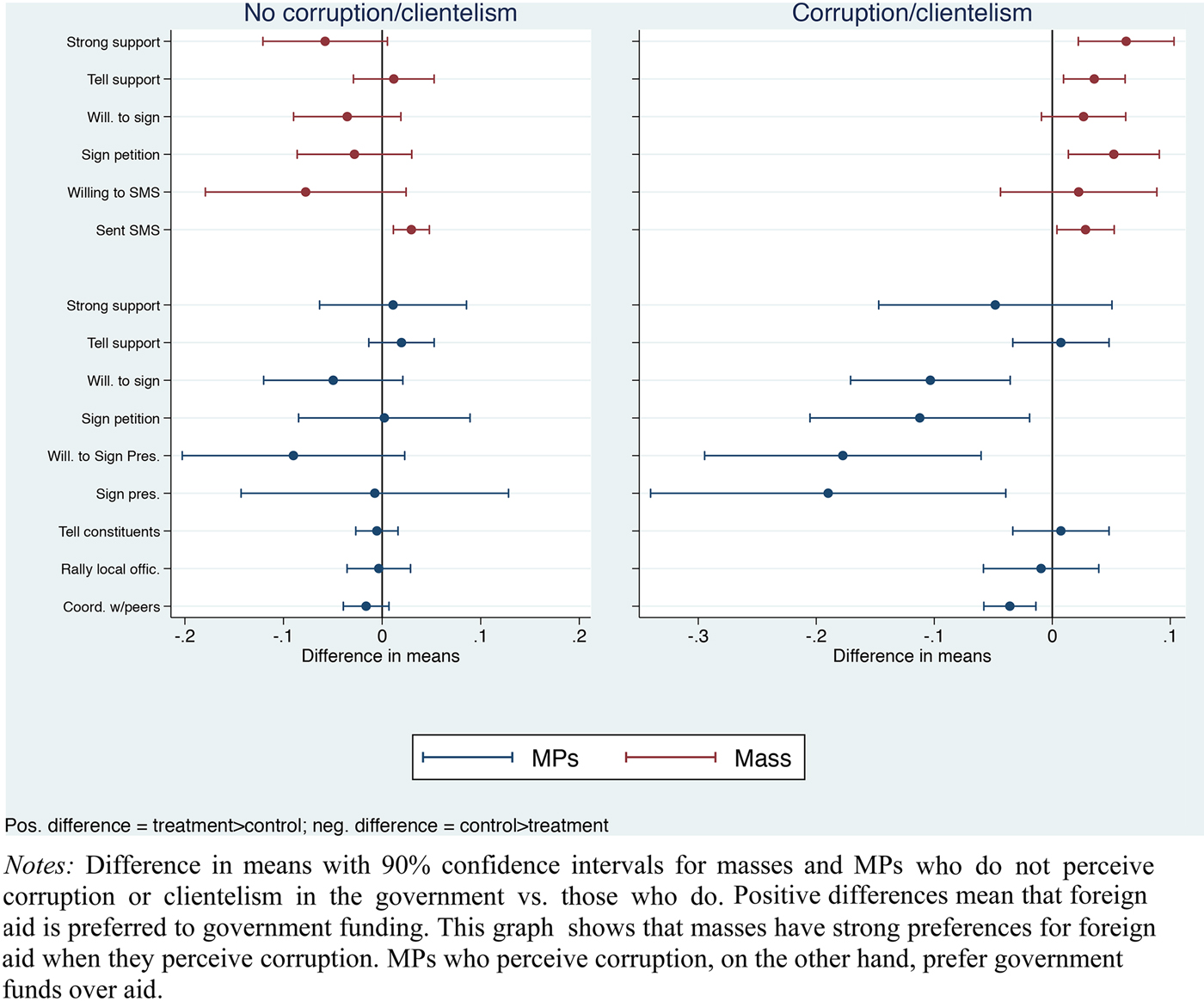
The analysis for MPs shows that those who believe government funds are more likely to be used for corruption and clientelism are significantly more likely to prefer government-funded projects.Footnote 61 For five of the nine outcomes, MPs who see government funds as more corrupt and clientelist are significantly more likely to prefer government funds. These effects are strongly significant for the behavioral outcomes. The treatment effects range from 4 to 19 percent, the latter of which appear to be substantial effect sizes. When we limit the analysis to one observation per MP, the results are similarly strong. In four of the nine conditions, including the petition-to-the-president outcome, the results are substantively and statistically strong (Figure 3).
Difference in means for corruption/clientelism mechanism

Conversely, the difference in support for aid and government projects is not statistically significant for MPs who do not perceive significant corruption and clientelism.Footnote 62 This suggests that the MPs who see few avenues for corruption and clientelism express no preference for government-funded projects over aid. One plausible interpretation of these results suggests that if the MP cannot capture some of the funding, then s/he does not manifest a clear preference toward such projects.
The results in Figure 3 and Appendix Table A6 report the difference-in-means tests and support the claim that citizen support for aid is also conditional on their perceptions of corruption and clientelism, but in the opposite direction. Citizens who believe that government funds are used for corruption and clientelism are significantly more likely to support aid over government projects for three of the six outcomes (four of the six at the 0.1 level). Among subjects who do not perceive the corrupt use of government funds, there are no significant differences. See also Appendix Tables A15–A16. These results are even stronger if we use only those who passed our manipulation checks. The analysis in Figure A18 of the appendix shows that for all but one outcome, the results are substantively and statistically strong for those passing the manipulation check. To provide context we further considered who among the masses and MPs perceives corruption. We estimated models that use various attributes of citizens and MPs to predict perceptions of corruption in Appendix Tables A13 and A14 and discuss those results there.
We do not find differences among donors for either the public or MPs. Other studies have speculated that multilateral aid donors might differ from bilateral ones.Footnote 63 We examined two bilateral aid donors (the United States and China) and two multilateral ones (World Bank and African Development Bank) plus a generic multilateral and bilateral aid prompt. We found no consistent and significant differences among the public or MPs in their views of these donors, as we show briefly in Table A11 in the appendix. Both sets of donors try to maintain control over aid, often in distinct ways: USAID through independent contracting and the World Bank through stringent procurement and accounting rules. Knowledge does not appear to mediate this result. MPs who are aware of aid also showed little knowledge of the purported differences among donors, and this casts doubt on the existence of such differences; second, the public was very knowledgeable about politics in general, making it harder to dismiss their lack of knowledge about aid.
In sum, this analysis provides support for the argument that citizens support aid over government programs conditional on their perceptions of corruption and clientelism. Further, we find that citizens do consider corruption a bad thing: people who perceive there to be more corruption are significantly less likely to trust parliament, their MPs, and the president (effects are significant at the 0.01 levels).
These analyses offer some evidence that political elites, including the parliamentary leadership, may believe that government funds are more susceptible to clientelism and corruption and therefore prefer such funding. Ordinary citizens who perceive corruption and clientelism in government behave in ways that suggest they see aid-funded projects as a more preferred mechanism than government action to obtain the public goods that they so desperately want. These findings are consistent with the belief that donors exercise significant control over aid.
Robustness
There are two important issues in our experimental design. The cost condition addresses the difference between “tax-based” government projects and foreign-funded aid projects even though this characterization is not accurate in the context of the study. Second, the control condition does not explicitly name the government as the funder but is nevertheless interpreted as the government.
Taxed Government Projects Versus Free Aid Projects: A False Dichotomy
A first design objection might be that the public prefers aid because it is viewed as free, whereas government projects require citizens to pay taxes. We do not believe this is the factor driving our results for several reasons. First, we added the cost statement to both the treatment and control conditions so that individuals are aware that any project may require local funds.
Second, we undertook a follow-up study in September 2012 in which we recruited an additional 460 subjects and randomly assigned half to receive the cost statement in association with one of the two randomly assigned project descriptions. The cost statement had no significant treatment effect on subjects' support. This may be either because the cost statement was too weak to produce treatment effects or because subjects were indifferent to costs for projects they feel they desperately need. While the cost statement may be weak, multiple reasons lead us to believe that citizens are relatively indifferent to costs for public goods.
First, subjects likely do not see government projects as costly to themselves any more than foreign aid is costly. The vast majority of Ugandans—86 percent in our nationally representative subject pool—fall below the earnings threshold for paying income tax, which is roughly $600 per year. As Martin as well as Fjeldstad and Therkildsen note, Ugandan tax rates have been reduced recently. Most Ugandans also do not pay indirect taxes.Footnote 64 Eighty percent of Ugandans live in rural areas and more than 90 percent of our subjects reported earning less than two dollars per day in income. Most are not part of the formal economy and hence do not pay indirect taxes like the VAT.Footnote 65 Using self-reported income data, we considered whether those making enough to pay taxes responded differently than those who did not. If taxes are important, then we should observe differences between the two groups. As reported in Appendix Figures A16 and A17, however, we do not observe any significant differences in most cases.
The Government Control Condition
A second design objection might be that the government was not named explicitly in the control condition. We were concerned about social desirability in responses if we labeled the control as the government. This is not a trivial concern as the Afrobarometer data show (see footnote 46). For the citizens, we worried that they might fear government reactions and so always rank the government projects first. For the MPs, we feared social desirability bias in which they always said they preferred the government projects since they were part of the government.
To assess what citizens perceived when they viewed the control condition, as well as what the implications of this are, we conducted a follow-up mass survey in September 2012, and found that the majority of subjects did interpret the control condition as the government (52 and 51 percent for the education and electricity projects, respectively). More than one-third of subjects in the follow-up study, however, attributed the control condition to a foreign donor. Our follow-up interviews with MPs in 2015 suggest similar proportions. While a more direct comparison may have been preferable, attribution of the control projects to foreign donors works in favor of the null hypothesis of no treatment effects.
The concern is that the control condition represented a combination of people who believe it implied either the government or a foreign aid donor; that is, support for the control is equal to some average of support for foreign aid projects combined with support for government projects. Because we know two of these three values—the outcome in the control condition overall and the outcome in the foreign aid condition, we can calculate the third: the level of support that subjects would provide had they been given the government control condition explicitly.
First, we know the average value that citizen and MP respondents gave in support of the projects if they were assigned a foreign donor. In the two surveys we asked about support for the projects using six different aid donors for the masses and four for the MPs, assigning each subject a donor at random. Our data show that across all these foreign donors, the mass respondents did not differentiate significantly between them, but on average they supported the projects that were labeled as foreign-funded at a higher level than the control group did when the donor was not named. We have similar evidence for the MPs, except the MPs supported all the aid projects on average less than the control condition. This implies that we can calculate an average value of support among the mass public and MPs for projects led by any foreign donor.
Second, on average the control group's level of support for the projects was lower than the average for all the foreign-donor treatment groups for the mass experiment. For the MPs, the control group's support was higher than for all the foreign aid projects. Third, our post-survey data show that 51 or 52 percent, depending on the random assignment of electricity or education project, respectively, believe that the control was a government project and most of the remaining believed it was a foreign donor. So the actual value of support for the control group for those who thought it was the government can be deduced from this information. In the mass experiment it must necessarily be lower than for the group that was given the foreign aid conditions, while in the MP experiment it must be higher.
We can use these three pieces of information to calculate the mean and standard errors of the mass respondents who attributed the control condition to the government. We can obtain only an estimate for the MPs since we did not ask them who they thought was funder in the control condition, but this still implies what the control group who attributed it to the government would have scored. We know that the mean of the control group is made up of the respondents who thought that the control was a foreign donor and those who thought the control was the government:
 $$\widehat{{Control}} = \; \alpha {^\ast}\widehat{{Gov}} + \left( {1 - \alpha} \right){^\ast}\widehat{{Foreign}}$$
where
 $\widehat{{Control}}$
and
 $\widehat{{Foreign}}$
are the average levels of support for the development projects under the control and treatment conditions, respectively. These values are known from the data and α is the percentage identifying the control as the government. Rearranging to solve for
 $\widehat{{Gov}}$
we derive:
 $$\widehat{{Gov}} = \displaystyle{{\widehat{{Control}} - \left( {1 - \alpha} \right){^\ast}\widehat{{Foreign}}} \over \alpha} $$
Calculating the standard error to create the confidence intervals is a little more difficult—we describe the procedure in the appendix. Using these calculated means and standard deviations, we can compare those receiving the foreign treatment to the control condition to the portion of control respondents who thought the condition was the government. Appendix Figure A19 demonstrates the relative differences for the strong support condition among the masses. For all other outcome conditions for citizens and MPs, this relative ordering holds so we do not display them here. As the figure shows, the difference between those receiving the explicit foreign condition and those thinking the control represented the government is much larger than between the explicitly foreign condition and the undifferentiated control. The direction of the effect is opposite in the MP case. Thus, the design choice we made works against our hypotheses and therefore provides a very conservative test; had we named the government explicitly in the control condition, we would have observed much larger differences and our results would be even stronger.
In 2015 we conducted a small follow-up study on MPs we had surveyed before. In these interviews we told them about one of our two projects but not the name of the funding organization; that is, we gave them the control condition from our prior study. Then we asked them who they think funded this—close to 40 percent said the Uganda government in part (eleven of twenty-eight). This of course means that some MPs, like some citizens, perceived the control condition as sponsored by foreign donors. Again, this would have led to an understatement of the difference between treatment and control in the MP experiment.
Another concern may be that MPs may merely have a preference for unspecified over specified funding. We note in response that two of the foreign donor conditions were deliberately generic in that they attributed the projects to either an unspecified multilateral or bilateral donor. As we show in the Appendix Table A11, MPs did not significantly prefer these generic conditions to conditions in which the World Bank or the United States were named, which leads us to discount the possibility that MPs prefer projects with unspecified donors. Rather, it appears more likely that their attribution of the control projects to the government prompted the treatment effects.
Conclusion
Who controls aid? Our experiment suggests that elites and the public both perceive that donors exert substantial influence over foreign assistance. We provide what is, to our knowledge, the first experimental study to compare aid preferences and actions for members of parliament and a nationally representative sample of ordinary citizens in a prominent developing country. Citizens preferred aid over government programs consistently, especially in the behavioral outcomes. This was particularly so among the respondents who perceived problems with government corruption and clientelism, thus providing evidence consistent with the argument that aid can help overcome governance problems. In contrast, members of parliament consistently preferred government programs over aid and especially for those MPs perceiving corruption and clientelism.
The study brings together two complementary literatures. The large literature on clientelism and corruption in developing countries shows that governments have the desire and will to use their funds to promote their own political purposes first and foremost. Staying in office is critical and using government projects to build support is one way to do this. Uganda's government is no exception. However, aid scholars often assess foreign assistance without any direct comparison to the most realistic alternative, which is government funding. Our study examines the beliefs and actions of both elites and citizens by comparing their support for these two different sources of development finance.
The study provides evidence that both elites and citizens in Uganda believe that donors have significant control over aid and little encouragement for the notion that elites largely capture foreign assistance. The provision of aid involves a bargaining relationship between donors and recipient governments; the balance of power between them depends on the situation. The end of the Cold War and the experiences of donors with corrupt and autocratic governments seem to have lent impetus to much greater efforts at donor control, as many studies show.Footnote 66 Our study also finds that public and elite perceptions reflect this greater sense of donor control. The idea that aid is highly fungible and that recipient governments can do as they please with it finds little support in the results. On nearly every measure elites prefer the control condition implying government funding to the treatment conditions naming foreign donors, sometimes significantly so. These results largely strengthen when examining MPs who strongly perceive government corruption. Citizens move in the opposite direction: they significantly prefer foreign aid across several attitudinal and behavioral measures to projects implying government sponsorship, and this is especially so for citizens perceiving meaningful levels of corruption.
Neither elites nor citizens are indifferent when it comes to aid versus government-funded projects. Elites and citizens have distinct preferences. Citizens are more willing to support aid by taking behavioral actions imposing personal costs through signing a petition and sending an SMS. They also on average view aid as less politicized than government programs and trust foreign donor institutions more than domestic ones. They also see conditionality as often helping the country, not hurting it.Footnote 67 This provides support for the belief that donors can exert some control over foreign assistance, which argues that aid donors strategically control their aid through channeling, monitoring, and bypassing.
Again suggesting beliefs consistent with donor control, political elites proved less enthusiastic about aid than government-funded projects. MPs likely face fewer constraints over how they utilize domestic government resources. High levels of corruption and clientelism exist in developing countries even in the absence of foreign aid. And domestic resources may be even easier for governments to divert to these purposes since there are often no strong accountability mechanisms in poor developing countries. MPs on average had high levels of trust in foreign aid institutions, and many thought they were more effective at providing and more successful at concluding development projects. But they also thought aid was too constrained by conditionality, rules, and regulations and hence more costly to deal with than government funds.
Our comparison of citizens and elites helps to resolve a novel puzzle about divergent preferences for development assistance. Martin, for instance, hypothesizes that elites and masses have different preferences about development projects, with the public favoring public goods more than elites.Footnote 68 Our results support this supposition, suggesting that aid recipients should not be treated as a unitary group. Furthermore, our study pursues distinct observable implications of the argument that donors have significant control over aid, namely, that citizens perceiving greater corruption and clientelism should prefer stronger foreign donors who can deliver aid, whereas elites should prefer the opposite. Our findings support other research that shows aid revenue should not produce a political curse because it is less fungible, more conditional, and less constant than other nontax revenues, making it difficult for recipient governments to use aid to fund either repression or appeasement.Footnote 69 The study thus finds evidence in favor of donor control and little support for aid capture.
These conclusions have more than academic implications. More than in most issue areas, policy-makers at multilateral and bilateral aid agencies have developed close ties to scholars studying foreign aid. In several recent instances, aid policy-makers have adjusted policies toward conclusions drawn from academic literatures. Yet prominent studies have proposed that aid fosters corruption and autocracy and therefore imply that aid should be reduced or even abandoned. The results of this study, by contrast, suggest that donors are aware of the risks and try to manage aid to benefit publics and bypass political capture. Indeed, both citizens and elites in Uganda see these efforts as effective. Our study suggests that donors should do more to condition and monitor aid, not less, to foster development. As seen from the ground level, foreign assistance can promote rather than hinder development under certain conditions.
Supplementary Material
Supplementary material for this article is available at https://doi.org/10.1017/S0020818317000273.