In dairy sheep, high SCC levels have been shown to be mainly the consequence of an inflammatory process due to the presence of an intramammary infection (IMI) (Gonzalo et al. Reference Gonzalo, Ariznabarreta, Carriedo and San Primitivo2002; Berthelot et al. Reference Berthelot, Lagriffoul, Concordet, Barillet and Bergonier2006; Paape et al. Reference Paape, Wiggans, Bannerman, Thomas, Sanders, Contreras, Moroni and Miller2007), as well as non-pathological conditions due to physiological or environmental factors (Raynal-Ljutovac et al. Reference Raynal-Ljutovac, Pirisi, De Cremoux and Gonzalo2007; Arias et al. Reference Arias, Oliete, Ramón, Arias, Gallego, Montoro, Gonzalo and Pérez-Guzmán2012). The variation factors of SCC in bulk tank milk have been studied in dairy ewes flocks and BTSCC has been considered as a useful tool for monitoring udder health in dairy ewe flocks and as a basis for milk payment schemes (Gonzalo et al. Reference Gonzalo, Carriedo, Blanco, Beneitez, Juarez, De La Fuente and San Primitivo2005, Reference Gonzalo, Carriedo, Beneitez, Juarez, De La Fuente and San Primitivo2006, Reference Gonzalo, Carriedo, García-Jimeno, Pérez-Bilbao and De la Fuente2010).
Previous studies have shown that an increase in ovine SCC is related to important milk yield losses and changes in the composition of milk (Gonzalo et al. Reference Gonzalo, Ariznabarreta, Carriedo and San Primitivo2002; Leitner et al. Reference Leitner, Chaffer, Caraso, Ezra, Kababea, Winkler, Glickman and Saran2003; Martí-De Olives et al. Reference Martí-De Olives, Díaz, Molina and Peris2013), higher milk proteolysis activity (Bianchi et al. Reference Bianchi, Bolla, Budelli, Caroli, Casoli, Pauselli and Duranti2004; Leitner et al. Reference Leitner, Chaffer, Shamay, Shapiro, Merin, Ezra, Saran and Silanikove2004; Martí-De Olives et al. Reference Martí-De Olives, Le Roux, Rubert-Alemán, Peris and Molina2011), and lower quality of dairy products (Raynal-Ljutovac et al. Reference Raynal-Ljutovac, Pirisi, De Cremoux and Gonzalo2007; Leitner et al. Reference Leitner, Silanikove and Merin2008). Regarding changes in protein fraction, high SCC is generally accompanied by an increase in the concentration of proteins from blood because of the higher permeability of the blood–milk barrier during an IMI (Bianchi et al. Reference Bianchi, Bolla, Budelli, Caroli, Casoli, Pauselli and Duranti2004; Martí-De Olives et al. Reference Martí-De Olives, Díaz, Molina and Peris2013).
Plasmin (PL) appears to be the major enzyme involved in sheep milk proteolytic phenomena associated with udder inflammation (Bianchi et al. Reference Bianchi, Bolla, Budelli, Caroli, Casoli, Pauselli and Duranti2004; Leitner et al. Reference Leitner, Chaffer, Shamay, Shapiro, Merin, Ezra, Saran and Silanikove2004). According to Silanikove et al. (Reference Silanikove, Merin and Leitner2006), β-CN is the preferred substrate for PL and its hydrolysis results in the production of γ-caseins and proteoses-peptones (p-p). Previous research has shown that the higher ovine milk proteolysis activity due to IMI involves a greater content of p-p and higher percentage of γ-caseins, as well as a decrease in β-casein percentage and consequently a higher proteolysis index (PI), defined as the relative proportion of γ-CN to (α + β + κ)-CN (Bianchi et al. Reference Bianchi, Bolla, Budelli, Caroli, Casoli, Pauselli and Duranti2004). According to Martí-De Olives et al. (Reference Martí-De Olives, Le Roux, Rubert-Alemán, Peris and Molina2011), this effect of IMI on proteolysis is reflected in a close relationship between individual SCC and the amount of p-p and a group of casein hydrolysis products analogous to bovine γ-caseins. As the cheese-making quality of milk depends, among other factors, on the concentration of intact casein (Bianchi et al. Reference Bianchi, Bolla, Budelli, Caroli, Casoli, Pauselli and Duranti2004; Leitner et al. Reference Leitner, Chaffer, Shamay, Shapiro, Merin, Ezra, Saran and Silanikove2004; Albenzio et al. Reference Albenzio, Santillo, Caroprese, d'Angelo, Marino and Sevi2009), high proteolysis activity by plasmin and other endogenous proteolytic enzymes from somatic cells, such as elastase and cathepsin D, impairs coagulation properties of milk, that is, a longer rennet coagulation time and weak coagulum (Albenzio et al. Reference Albenzio, Caroprese, Marino, Santillo, Taibi and Sevi2004, Reference Albenzio, Santillo, Caroprese, d'Angelo, Marino and Sevi2009). In general, the poor coagulation properties lead to increased curd yield loss (Leitner et al. Reference Leitner, Chaffer, Shamay, Shapiro, Merin, Ezra, Saran and Silanikove2004, Reference Leitner, Silanikove and Merin2008).
Bulk tank parameters have been the target of different legal limits or payment-by-quality schemes proposed by different regions, with obvious repercussion on milk marketing (Directive 94/71/EEC; European Union, 1994). However, BTSCC values in ewe milk used for dairy products sold in the European Union has yet to be regulated. Three categories have been proposed relating to the BTSCC in ovine: good (BTSCC < 500 000), average (BTSCC between 500 000 and 10 00 000) and bad (BTSCC > 10 00 000) (Ariznabarreta, Reference Ariznabarreta1999). On the other hand, Sevi et al. (Reference Sevi, Albenzio, Taibi, Dantone, Massa and Annicchiarico1999) suggested a threshold of 700 000 cells/ml for bulk ewe milk of high microbial quality and renneting ability. Research is still needed to study ewe milk quality parameters in relation to SCC at bulk tank level, especially in terms of proteolytic activity and cheese-making ability. BTSCC thresholds would be useful to differentiate ewe milk on the basis of its overall quality.
To determine the extent to which impairment of milk quality due to IMI affects bulk tank milk and to contribute to the research of BTSCC thresholds based on overall milk quality, the aim of this study was to assess the effect of different levels of BTSCC on (i) composition, (ii) p-p content and CN fractions as indicating parameters for proteolysis, and (iii) pH and coagulating properties of milk. Correlations were also determined in order to establish the relationship between protein fractions, proteolysis indices and coagulation properties of milk at bulk tank level.
Materials and methods
Experimental design
A total of 97 milk samples from bulk tank milk from different flocks (one sample per flock) of Manchega breed ewes were taken over a 5 weeks period. Flocks were located in Castilla La Mancha (Spain), and delivered their milk to the Forlasa S.A. cheese company. Herds were kept under similar husbandry systems, each one usually being divided into two groups of animals, with lambing periods distributed throughout the year. Thus, ewes in different lactation stages were always present in the flocks. The herds were selected on the basis of their bacteriological quality (<200 000 cfu/ml) and the milk SCC was recorded over the last 3 months by the quality control laboratory of raw materials and finished products of the Forlasa S.A. cheese company, choosing those that showed BTSCC within the limits of each of the following four classes: BTSCC < 500 (<500 000 cells/ml), BTSCC 500–1000 (500 000–10 00 000 cells/ml), BTSCC 1000–1500 (10 00 000–15 00 000 cells/ml) and BTSCC > 1500 (>15 00 000 cells/ml). The BTSCC classes were made up according to previous studies (Pirisi et al. Reference Pirisi, Gaspard, Piredda, Jaubert, Ledda, Barillet and Zervas1999; Gonzalo et al. Reference Gonzalo, Tardáguila, Ariznabarreta, Romeo, Montoro, Pérez-Guzmán and Marco2000), reporting significant differences in milk quality, technological properties and health conditions of flocks among them.
Sampling and analysis
Sampling of 500 ml of bulk tank milk from selected farms was performed immediately prior to collection of the milk by the Forlasa S.A. cheese company, following the sampling procedure of the International Dairy Federation (ISO-IDF, 2008). Milk samples were kept at 4 °C until analysis. From each sample two aliquots were taken and carefully analysed within 24 h of sampling; one of them was sent to the laboratories of the Institute for Animal Science and Technology of the Polytechnic University of Valencia, where the SCC and the chemicals analysis of milk were carried out; and the other one was sent to the Analysis Service of the Regional Breeding Centre (CERSYRA, Valdepeñas, Ciudad Real, Spain) where pH and rheological properties were determined. SCC was determined for each milk sample with a Fossomatic 90 (A/S N Foss Electric, Hillerød, Denmark) according to the International Dairy Federation (IDF, Reference Schällibaum1995). Milk samples for SCC determination were preserved with bronopol (0·1%). Milk composition (fat, protein, true protein, casein, whey protein, lactose, and total solids) was determined by midrange infrared spectroscopy using a MilkoScan FT120 (Foss Electric, Hillerød, Denmark), previously calibrated and periodically checked for the ewe milk components. Protein equivalents were calculated from nitrogen data using the factor 6·38.
Isoelectric CN for assessing the relative content of each casein fraction was obtained from skimmed milk after centrifugation at 3000 g for 15 min by the addition of acetate buffer according to the procedure of Rowland (Reference Rowland1938). The purified caseins were re-dissolved by addition of 4 ml of distilled water and 1 ml of 1 M-NaOH, pH 7·0, and were extended on a Petri plate. The re-dissolved caseins were frozen and freeze-dried for analysis by chromatography. Relative content of each casein fraction was determined by Fast Protein Liquid Chromatography analysis on a Mono Q HR 5/5 anion-exchange column (Pharmacia ltd., Milton Keynes, UK) according to the procedure of Papoff et al. (Reference Papoff, Law, Dalgleish and Campus1993) for ewe milk. Using this method, α, β, κ and a group of casein hydrolysis products analogous to bovine γ-caseins (hereafter γ-caseins) can be separated. The p-p fraction was extracted using the fractionating scheme recommended by Rowland (Reference Rowland1938), as modified by Andrews (Reference Andrews1979). The factor used for converting the N content into protein content was 6·54 (Ribadeau-Dumas & Grapin, Reference Ribadeau-Dumas and Grappin1989). The pH was measured on all samples at 20 °C by a pH-meter (Crison microPH 2001, Spain). Milk renneting characteristics [rennet coagulation time (RCT), min, time to curd firmness of 20 mm (k 20), min, and curd firmness 30 min after enzyme addition (a 30), mm] were measured using a Formagraph (Foss Electric, Hillerød, Denmark) according to the method of McMahon & Brown (Reference McMahon and Brown1982).
Statistical analysis
Statistical analyses were performed using SAS software (SAS Institute, 2011). The influence of the BTSCC level was analysed with the GLM procedure on milk composition parameters, pH, coagulating properties, p-p fraction, α-, β-, κ- and γ-CN, and the PI. The statistical analysis was performed according to the following model:
 $$Y_i = {\rm \mu} + {\rm BTSCC}_i + e_i $$
Where μ is the overall mean; BTSCC is the fixed effect of BTSCC category (i = 1–4) and e is the residual effect.
Linear simple correlations were performed among protein components, proteolysis parameters and coagulation properties of bulk tank milk, using the Corr procedure of SAS.
Results and discussion
Ewe milk is mainly destined for cheese manufacturing and changes in milk quality affect the suitability of milk for processing. It is well known that high SCC in individual and half-udder ewe milk as a consequence of IMI is associated with poor milk quality. However, little is known about the consequences that SCC level has on composition, proteolysis indices and coagulation behaviour of bulk tank milk.
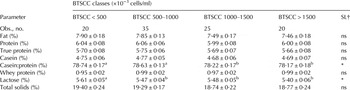
The main milk components for the four BTSCC classes are reported in Table 1. Lactose content was the highest in the BTSCC < 500 class and declined significantly when BTSCC exceeded 500 000 cells/ml. The casein : protein ratio decreased as BTSCC increased, being significantly lower (P < 0·05) in BTSCC 1000–1500 and BTSCC > 1500 categories than in the other categories. In accordance with these results, it has been reported that lactose content and the casein : protein ratio in individual and half-udder ewe milk show significant differences due to IMI, while fat and casein contents remain relatively unchanged (Burriel, Reference Burriel1997; Bianchi et al. Reference Bianchi, Bolla, Budelli, Caroli, Casoli, Pauselli and Duranti2004; Martí-De Olives et al. Reference Martí-De Olives, Díaz, Molina and Peris2013). Milk lactose content decreases with IMI in part because of the reduced synthesis capacity of damaged tissue. In this respect, Auldist (Reference Auldist, Roginski, Fuquay and Fox2003) suggest that lactose content can be considered an indicator of the epithelial cells capacity of synthesis being involved in the osmoregulation in milk. The casein concentration in milk frequently does not decrease as a result of IMI due to the reduction in milk volume. However, it has been confirmed that the casein : protein ratio, which is independent of milk volume, decreases as a result of infection. The lower casein : protein ratio found in this study in milk samples with more than 10 00 000 cells/ml was likely the result of an influx of serum proteins into the milk through the ruptured mammary epithelia and the breakdown of intact casein by endogenous enzymes, and these proteins are not directly relevant to cheese processing. Accordingly, Auldist et al. (Reference Auldist, Coats, Sutherlands, Mayes, McDowell and Rogers1996) and Klei et al. (Reference Klei, Yun, Sapru, Lynch, Barbano, Sears and Galton1998) report that casein : protein ratio is the parameter related to protein fraction of milk that best explains the cheese yield and protein recovery variations due to SCC.
Means (±se) of pH and milk components as affected by the BTSCC class

a,bMeans within a row with different superscripts differ
† Significance level: ***P < 0·001; *P < 0·05; ns not significant
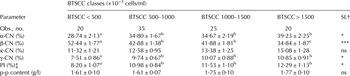
Table 2 summarises the casein fractions and other milk proteolysis parameters as affected by the BTSCC classes. A significant effect of BTSCC (P < 0·05) on α-CN was observed, being lower in milk samples with fewer than 500 000 cells/ml compared with those milk samples with higher SCC. β-CN displayed a decrease about 18% passing from BTSCC < 500 class to BTSCC 500–1000 class and about 19% passing from BTSCC 500–1000 class to BTSCC > 1500 class (P < 0·001). At the same time, the γ-CN increased about 30–44% when the BTSCC surpassed 500 000 cells/ml (P < 0·05). In the case of κ-CN, no significant differences were observed among BTSCC categories. As a consequence of these casein fraction modifications, the PI increased with SCC about 34–50% (P < 0·05) from the BTSCC < 500 class to the BTSCC > 1500 class. Concerning the p-p content, it had an increasing trend with BTSCC, but the effect was not statistically significant.
Means (±se) of the milk proteolysis parameters as affected by the BTSCC class

a,b,cMeans within a row with different superscripts differ
† Significance level: ***P < 0·001; *P < 0·05; ns not significant
‡ Proteolysis Index, calculated as the ratio of γ-CN to (α + β + κ)-CN
These results highlight the existence of higher proteolytic activity in milk when BTSCC exceeds 500 000 cells/ml. The phenomenon could be partly due to the increased plasmin activity in high SCC milk samples, since this activity is controlled by a complex enzymatic system in which one of the plasminogen activators is associated with somatic cells (Albenzio et al. Reference Albenzio, Caroprese, Marino, Santillo, Taibi and Sevi2004, Reference Albenzio, Caroprese, Santillo, Marino, Muscio and Sevi2005, Reference Albenzio, Santillo, Caroprese, Schena, Russo and Sevi2011; Bianchi et al. Reference Bianchi, Bolla, Budelli, Caroli, Casoli, Pauselli and Duranti2004). It is known that β-CN is the primary cleavage substrate of plasmin, producing different γ-CN and proteoses peptones. Furthermore, other enzymes such as elastase and cathepsin, which come from the lysosomes of somatic cells, also act on β-CN, releasing γ-CN and proteoses-peptones (Pinto et al. Reference Pinto, Caira, Nicolai, Mauriello, Cuollo, Pirisi, Piredda, Chianese and Addeo2013). Thus the relative proportion of γ-CN to (α + β + κ)-CN and the p-p fraction are both considered as valid estimation predictors of endogenous proteolysis in individual and half-udder milk with elevated SCC (Le Roux et al. Reference Le Roux, Colin and Laurent1995; Martí-De Olives et al. Reference Martí-De Olives, Le Roux, Rubert-Alemán, Peris and Molina2011). The absence of significant changes in p-p content as affected by BTSCC in the present study may be due to a lower range of variation of the analysed parameters in bulk tank milk samples than in individual or half-udder milk samples.
The above mentioned enzymes are therefore of significance for milk processing quality through proteolytic disruption of intact casein, since the hydrolysis of caseins reduces the stability of micelles during milk storage leading to the diminution of coagulation properties of milk (Storry et al. Reference Storry, Grandison, Millard, Owen and Ford1983). Otherwise, the findings of this study indicated that the increased proteolysis in high SCC milk decreased the ovine β-caseins, but did not diminish α- or κ-caseins, which is in agreement with the results showed in individual and half-udder milk (Bianchi et al. Reference Bianchi, Bolla, Budelli, Caroli, Casoli, Pauselli and Duranti2004; Martí-de Olives et al. Reference Martí-De Olives, Le Roux, Rubert-Alemán, Peris and Molina2011) and bulk tank milk (Revilla et al. Reference Revilla, Rodríguez-Nogales and Vivar-Quintana2009). These data are supported by Pinto et al. (Reference Pinto, Caira, Nicolai, Mauriello, Cuollo, Pirisi, Piredda, Chianese and Addeo2013), who reported that β-CN is more susceptible than αs2-CN, αs1-CN and κ-CN to degradation in high SCC milk in the order β- > αs2- > αs1- >> κ-CN.
The pH and renneting parameters in milk samples grouped according to SCC levels are reported in Table 3. The highest pH value was found for the category BTSCC > 1500, being significantly different (P < 0·001) from BTSCC 500–1000 class. Samples belonging to BTSCC > 1500 category showed an increase of 30–40% (P < 0·001) in the RCT and of 40% in the k 20 compared to BTSCC categories with fewer than 10 00 000 cells/ml. However, the effect on a 30 was not statistically significant, even though the trend was decreasing with increasing BTSCC. Several authors report an increase in pH with SCC (Pirisi et al. Reference Pirisi, Piredda, Podda, Pintus and Rubino1996, Reference Pirisi, Gaspard, Piredda, Jaubert, Ledda, Barillet and Zervas1999; Albenzio et al. Reference Albenzio, Caroprese, Marino, Santillo, Taibi and Sevi2004, Reference Albenzio, Caroprese, Santillo, Marino, Muscio and Sevi2005, Reference Albenzio, Santillo, Caroprese, Schena, Russo and Sevi2011; Bianchi et al. Reference Bianchi, Bolla, Budelli, Caroli, Casoli, Pauselli and Duranti2004). Otherwise, RCT and k 20 of sheep milk are reported to be significantly increased with high SCC, while a30 is not significantly modified (Duranti & Casoli, Reference Duranti and Casoli1991; Pirisi et al. Reference Pirisi, Piredda, Podda, Pintus and Rubino1996; Pellegrini et al. Reference Pellegrini, Florent, Rivemale and Barillet1997; Bianchi et al. Reference Bianchi, Bolla, Budelli, Caroli, Casoli, Pauselli and Duranti2004; Revilla et al. Reference Revilla, Rodríguez-Nogales and Vivar-Quintana2009). In bulk tank milk the changes are noted from 10 00 000 cells/ml (Pirisi et al. Reference Pirisi, Gaspard, Piredda, Jaubert, Ledda, Barillet and Zervas1999; Albenzio et al. Reference Albenzio, Caroprese, Marino, Santillo, Taibi and Sevi2004).
Means (±se) of the milk coagulation properties as affected by the BTSCC class

a,b,cMeans within a row with different superscripts differ
† Significance level: ***P < 0·001; ns not significant
‡ Rennet coagulation time
§ Time to curd firmness of 20 mm
¶ Curd firmness 30 min after enzyme addition
The negative effect of increased SCC on the coagulation properties of milk is actually a consequence of the impairment of physical and chemical characteristics due to decreased udder health status. It has been demonstrated that the changes in milk composition associated with a high bulk milk cell count can affect the quality of cheese (Auldist et al. Reference Auldist, Coats, Sutherlands, Mayes, McDowell and Rogers1996). The most important factors in curd structure formation are casein content, pH and calcium content of the milk. At low pH, calcium is progressively dissociated from the casein micelle, and neutralises the negative charges of the casein, favouring extensive aggregation and fusion between the micelles which tend to form a casein network in which the other components of coagulum are entrapped (Park, Reference Park2007). Thus, casein is the critical component in milk that forms the primary structure of cheese curd. In this study, depressed ratio of casein : protein with increased proteolysis in high BTSCC milk enhanced the extension of the RCT and k 20 because there are more serum proteins without processing value and the stability of casein micelles are reduced as a result of its hydrolysis. Those changes in turn led to poor syneresis, lower cheese yield, increased moisture content and lower fat and protein content in cheese (Albenzio et al. Reference Albenzio, Caroprese, Santillo, Marino, Muscio and Sevi2005; Revilla et al. Reference Revilla, Rodríguez-Nogales and Vivar-Quintana2007).
In accordance with the displayed results, in the present research the pH was positively correlated with RCT (r = 0·51; P < 0·05) and k 20 (r = 0·45; P < 0·05), whereas it was not significantly correlated with a 30. In the literature, the most affected by the pH parameters are the RCT and the k 20, which become worse as pH increases, while a 30 is not correlated with pH (Duranti & Casoli, Reference Duranti and Casoli1991; Delacroix-Buchet et al. Reference Delacroix-Buchet, Barillet and Lagriffoul1994; Pellegrini et al. Reference Pellegrini, Florent, Rivemale and Barillet1997). These findings highlight the importance of pH on the coagulation behaviour of milk, probably due to an increase in the viscosity of milk (Park, Reference Park2007).
With respect to the protein fraction, casein : protein ratio and β-CN were significantly correlated with RCT (r = −0·29 and r = −0·25 respectively; P < 0·05) and k 20 (r = −0·29 and r = −0·30 respectively; P < 0·05), but not with a 30. This is in accordance with the known importance of the casein : protein ratio in the technological suitability of ewe milk. The negative correlations found between β-caseins and both RCT and k 20 confirm that coagulation time is primarily related to the β-CN (Storry et al. Reference Storry, Grandison, Millard, Owen and Ford1983).
Conclusions
A negative effect of elevated SCC on some milk components, casein hydrolysis and milk ability to make cheese has been revealed in bulk tank milk with high SCC. This finding demonstrated that the impairment of milk quality as affected by IMI may be extended to the bulk tank milk of herds with poor udder health status. Reduction of casein : protein ratio and hydrolysis of β-CN in γ-CN, together with an increase in pH, were likely responsible for the increased RCT and k 20. Although the increase in proteolysis began in 500 000 cells/ml, the effect of BTSCC on rheological behaviour was noted from 10 00 000–15 00 000 cells/ml.
The Regional Government of Valencia (‘Generalitat Valenciana’) participated in funding this paper through a research fellowship in whose context this work was carried out. The authors would like to thank the Regional Centre of Animal Selection and Reproduction (Valdepeñas, Ciudad Real) and the Forlasa S.A. cheese company (Villarrobledo, Ciudad Real) for their invaluable help and collaboration in the experiment.