INTRODUCTION
State religions remain a prominent feature on the landscape of international politics, but scholarly research into their dynamics and effects has been limited. This article aims to address this deficiency by examining the extent to which state religions impact upon political and religious freedom. This is achieved through a comparative analysis based on datasets drawn from Freedom House, the Association of Religious Data Archives, and research conducted by Barro and McCleary (Reference Barro and McCleary2005). Within the methodological limits imposed by these datasets, the analysis shows that countries with state religions have substantially lower levels of freedom across a variety of indicators, including civil liberties, political rights, and religious persecution. A supplementary series of comparisons, drawing on data from the United Nations Development Programme and World Values Surveys, indicates that these diminished levels of freedom cannot easily be accounted for by explanations based on rates of human development, religious diversity, or levels of religiosity. This suggests a key role for the institutional mechanics of state religions themselves.
THE STATE OF AFFAIRS
The boundary between the secular and the religious forms one of the principal sites of contestation in the modern world. With the public role of religion having enjoyed something of resurgence since the latter decades of the twentieth century (Casanova Reference Casanova1994), a variety of social, cultural, and political tensions have become increasingly evident around the extent of religious influence. This can be seen across a broad range of issues, including freedom of speech, gender and sexual rights, multiculturalism and advances in medical and scientific technologies. Debates around the normative merits, as well as the actual dynamics and scope of secularization, also continue (Norris and Inglehart Reference Norris and Inglehart2004), as do definitional disputes over the precise meaning of terms such as the “religious” and the “secular” themselves (for discussions see Fitzgerald (Reference Fitzgerald1997); Hallward (Reference Hallward2008); Philpott (Reference Philpott2009)).
The border between the religious and the secular is both porous and open to dispute. Embodying complex and deep-seated power relations, the divide between the two spheres is intrinsically political; being constructed, maintained, shaped and reproduced by a range of social, cultural, and governmental forces. The role of the latter, in particular, puts relations between religion and the state at the center of debates about the role of faith in public life. These relations have assumed a variety of forms across numerous national and historical contexts. Denoting a continuum rather than a fixed, binary proposition, the relationship between religion and the state encompasses an array of possible configurations, varying from mutual antagonism and hostility, to cautious toleration, secular neutrality or accommodation, and, toward the latter end of the scale, closer and more cooperative links involving growing degrees of political assistance, endorsement, and support (Gorski Reference Gorski2000; Fox Reference Fox2006). The closest and most direct forms of this relationship involve an officially sanctioned state religion. But this too assumes a diversity of forms. Structures of governance, for example, include theocratic republics (e.g., Iran), theocratic monarchies (e.g., Saudi Arabia), liberal democratic constitutional monarchies (e.g., Denmark and United Kingdom), authoritarian republics (e.g., pre-revolutionary Egypt), military juntas (e.g., Mauritania), and democratic republics (e.g., Greece and Israel). State religions also vary across a range of country types, from rich (e.g., Saudi Arabia) to poor (e.g., Bangladesh), from large (e.g., Egypt) to small (e.g., Malta), and from the socially diverse (e.g., United Kingdom) to the more culturally homogenous (e.g., Israel).Footnote 1
Although state religions have been a central feature of international politics since the rise of the territorially bound state itself, scholarly research into the dynamics and the impact of state religion has been distinctly limited (for notable exceptions see Barro and McCleary (Reference Barro and McCleary2005) and Brathwaite and Bramsen (Reference Brathwaite and Bramsen2011)). The purpose of this study is to address this lacuna by analyzing the connection between state religion and levels of political and religious freedom. Although state religions do not comprise a homogeneous category, as Brathwaite and Bramsen (Reference Brathwaite and Bramsen2011) point out there are good conceptual reasons to suspect that their effects on freedom may well be negative. Indeed, by definition, the whole purpose of a state religion is to extend financial, political and legal support and privileges for one particular religion over others, a rationale that invariably includes basing key aspects of national identity and political legitimacy on a sectarian basis. The consequences of these arrangements can reverberate in numerous ways: creating differentiated notions of citizenship, fostering intolerance toward other forms of religious belief (or non-belief), promoting the closer involvement of religious authorities in political affairs, and leading to the imposition of restrictive and repressive behavioral practices. In this fashion, state religions can generate social divisions and tensions around religious issues, undermine ideals of civic equality and individual freedoms, and corrode democratic processes and mechanisms of accountability. These points are explored further in the following sections.
METHODOLOGY
The study was conducted using a comparative analysis based on the best available international datasets. First, independent country rankings were taken from the 2011 index compiled by Freedom House.Footnote 2 This classifies countries (from a total index of 194 units) according to levels of freedom based on a quantitative assessment of “political rights” and “civil liberties.” Here, political rights refer to the extent to which people are able to participate freely in the political process, including the right to vote, compete for office, and elect representatives who can exert a significant influence on public policy and be held to account. Civil liberties refer to freedoms of expression and belief, associational and organizational rights, the rule of law and personal autonomy free from state interference. On this basis, countries are classified according to one of three rankings: “free,” “partly free,” or “not free.”Footnote 3
The Freedom House country list was cross-referenced with two indices of countries with a state religion. The first of these was produced by Barro and McCleary (Reference Barro and McCleary2005). The second was compiled from individual country reports drawn from the Association of Religious Data Archives (ARDA).Footnote 4 In addition, the latter resource also provided a series of measurements relating to levels of religious freedom within individual countries: namely, “government regulation of religion,” “government favoritism toward religion,” “social regulation of religion,” and “religious persecution.” These represent composite measures (mean averages) based on a qualitative analysis of country reports published by the U.S. State Department (typically from 2003, 2005, and 2008). The first of these measurements, government regulation of religion, is based on a series of factors, including the extent to which a particular government interferes with an individual's right to worship, levels of protection for freedom of religion, the extent to which missionaries are allowed to operate freely within a country, and the extent of any limitations imposed on proselytizing, public preaching, or conversion activities. The second measurement, government favoritism toward religion, refers to the balance of government funding to religious organizations. This includes the degree to which government favors any particular religion, and the extent to which religion is subsidized, for example, through the provision of funds for religious education, buildings, or salaries. The third metric of freedom provided by ARDA, social regulation of religion, relates to societal views on other religions within a country. This includes attitudes toward conversions and proselytizing, the degree to which established religions attempt to prevent the growth of new religions, and the assertiveness of religious social movements. The final variable, religious persecution, reflects the numbers of people who have been either physically abused or displaced because of their religious adherence.
Examining the relationship between state religion and freedom in this way is far from problem free. For one, a lack of internationally comprehensive, up-to-date and reliable statistics imposes inherent limitations on research design as well as on the robustness of any subsequent findings. Problems pertain, for instance, to the gathering of sufficient and objective data, to the comparability of datasets, and to an absence of definitional and conceptual clarity around key terms — not least “state religion” itself (Hallward Reference Hallward2008; Hsu et al. Reference Hsu, Reynolds, Hackett and Gibson2008). These issues are reflected in the Freedom House, Barro and McCleary (hereafter B&M), and ARDA datasets. Disparities in the different time periods covered by the respective indices are one obvious difficulty. While the most up-to-date information in the B&M index related to state religions in the year 2000, the coverage from ARDA extended to the end of the decade. To complicate matters further, the measurements of freedom drawn from Freedom House referred to the year 2010, while the variables from ARDA were based on samples taken at numerous points throughout the course of the decade.
Problems in the geographical coverage of the indices, as well as in their use of “state religion” as an analytical variable were evident too. The United States, for example, was not included in the study due to a lack of national-level data in the ARDA index, and issues around classification meant that a number of countries invariably fell on what many would consider to be the wrong side of the definitional fence. Numerous countries possess institutional arrangements that do not qualify as a state religion but nonetheless harbor strong links between religion and the state (e.g., Ireland or Belarus), other countries maintain a state religion but are largely secular in socio-cultural terms (e.g., United Kingdom and Denmark), while other countries in possession of an official state religion during the period covered by the indices have since taken the decision to adopt more secular arrangements (e.g., Norway and Nepal).
Although some of these individual difficulties are reduced by the large number of countries in the samples (186 for B&M and 192 for ARDA),Footnote 5 a more serious issue concerned the divergent number of countries that each index classed as possessing a state religion. For B&M the total figure was 75. For ARDA, the figure was 48. Although it is not entirely clear why this discrepancy should have emerged given that the criteria for establishing a state religion are not well specified, a key reason appears to center on state religions in Roman Catholic countries, on which the differences between the two indices are largest (see Table 3).
These issues highlight the need for caution, both in the analysis and interpretation of the research findings. With these caveats in mind, the following sections examine the results of the analysis in more detail. The full set of data drawn from the Freedom House, B&M and ARDA indices, is contained in Appendix 1.
THE DISTRIBUTION OF STATE RELIGIONS
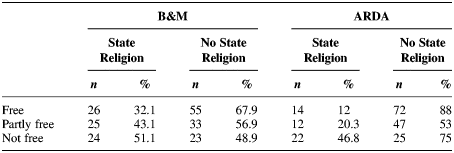
The B&M index contained a total of 186 countries. Of these, 75 (around 40%) were classified as having a state religion. The index constructed using data from ARDA contained a total of 192 countries, of which 48 (25%) were considered to possess a state religion. Breaking this down into the sub-categories used by Freedom House, the B&M list contained a total of 81 “free” countries, 58 “partly free” countries, and 47 “not free” countries. The ARDA index contained 86 “free” countries, 59 that were “partly free,” and 47 that were rated as “not free.” However, while these figures are similar, the distribution of state religions between these categories varied substantially across the two datasets. The overall figures for the “not free” category were virtually identical (24 state religions for B&M and 22 for ARDA), but the number of state religions in the “free” and “partly free” categories were markedly different. The B&M index contained 26 state religions for the “free” category and 25 for the “partly free” category, but the figures from ARDA were far lower, at 14 and 12, respectively. Figures for the distribution of countries and state religions within the Freedom House categories are shown in Table 1.
Distribution of countries with and without state religions
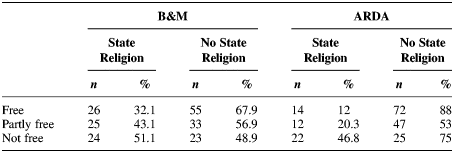
These figures highlight a clear trend in the distribution of state religions between the Freedom House categories; namely, one that is disproportionately skewed toward the less free classifications. According to the B&M index, more than half (51.1%) of all not free countries possessed a state religion, compared to less than a third (32.1%) of “free” countries. A more divergent pattern was evident from the ARDA index, where almost half (46.8%) of all not free countries possessed a state religion, compared to just 12% of those countries classed as free. Put simply, the lower a country was rated on the freedom scale, the greater was the likelihood that it would have a state religion.
The distributional pattern across the entire sample of countries was also more pronounced in the ARDA dataset. According to figures from the B&M index, the overall spread was relatively even, with 34.7% of all state religions (n = 26) being located in the “free” category, 33.3% (n = 25) being found in the “partly free” group, and 32% (n = 24) belonging to the “not free” category. The respective figures from ARDA, at 29.2%, 25%, and 45.8% were more highly concentrated in the not free category. Importantly, both indices also diverged significantly from the distributional pattern that would have been expected had state religions been spread uniformly throughout the sample (in other words, if the presence or absence of a state religion had no connection to the Freedom House classifications). Holding to the respective proportions of free, partly free, and not free countries, a uniform distribution for the B&M index (with 1 state religion for every 2.48 countries) would have produced 32.7 free, 23.4 partly free, and 18.6 not free countries with a state religion. A uniform distribution for the ARDA index (at 1 state religion for every 4 countries) would have produced 21.5 free, 14.7 partly free, and 11.7 not free countries with a state religion. The actual distributions, however, were markedly different. For the B&M index, the figures were 26 free, 25 partly free, and 24 not free. For ARDA, the respective figures were 14, 12, and 22. Compared to a completely uniform distribution, then, the B&M and ARDA indices, respectively, contain notably fewer countries with state religions in the free category, and notably more in the not free class of countries.
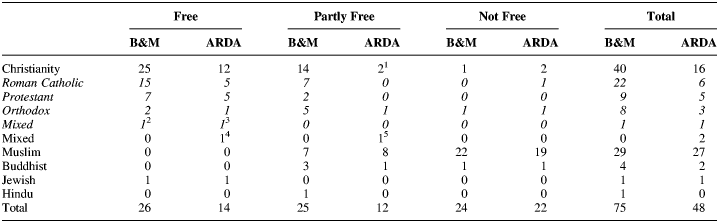
A similarly uneven distribution is found in relation to specific forms of state religion. According to the B&M index, all but one of the 26 free countries with a state religion (and more than half of partly free countries) were classed as being “Christian” (Roman Catholic, Protestant, or Orthodox). In contrast, all but two of the 24 not free countries with a state religion, and none of the respective free countries, were categorized as Islamic. This pattern was repeated in the ARDA index. Here, all but two of the free countries with a state religion (12 out of 14) was Christian, while all but three of the not free countries with a state religion (19 out of 22), and just one of the 14 free countries with a state religion (and with this also being listed as mixed) was classed as Islamic.Footnote 6 The distribution of state religions by their specific form is set out in Table 2.
Distribution of specific state religions*
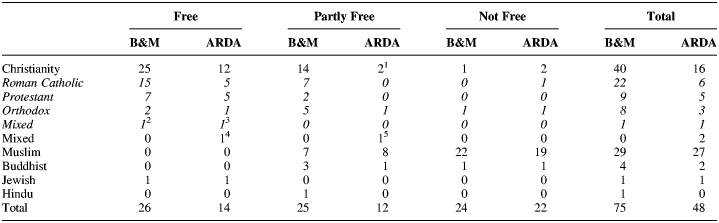
* Figures in italics show the breakdown for Christian state religions, and are not counted in the overall totals on the bottom row.
1 Zambia is simply classed as ‘Christian', with no breakdown according to Protestant, Roman Catholic or Orthodox.
2 The B&M index classifies Finland as Protestant and Orthodox.
3 Finland is classed as Protestant and Orthodox.
4 Indonesia is classed as Muslim, Protestant and Roman Catholic.
5 The ARDA index classes Togo as Muslim, Protestant and Roman Catholic.
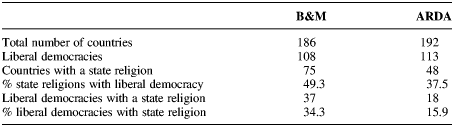
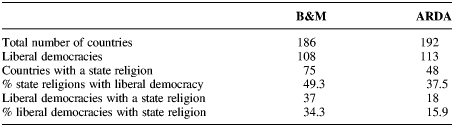
Another interesting dimension in the distributional analysis concerns countries defined by Freedom House as being liberal democracies. Not surprisingly, for both indices, all of those countries that were classed as free, and none of those classed as non-free, were considered to be liberal democracies, regardless of whether or not they possessed a state religion. In the partly free category, the B&M index contained 27 liberal democracies from a total of 58 countries (46.6%). The ARDA index recorded 26 from 59 (44.1%). In all, this gave a total of 108 liberal democracies for the B&M index (58.1% of the entire sample), and 113 for ARDA (58.9% of the sample). The breakdown by state religion is as follows: For the B&M index, 37 out of the 75 countries with a state religion (49.3%) were considered to be liberal democratic; amounting to around a third (34.3%) of all liberal democracies. The corresponding figures from ARDA were 18 liberal democracies from 48 countries with a state religion (37.5%), amounting to 15.9% of all liberal democracies. These figures are set out in Table 3.
Liberal democracies and state religion
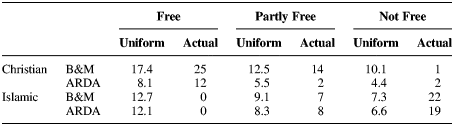
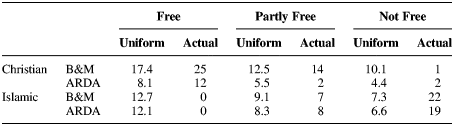
Disaggregating these findings in terms of specific forms of state religion is also revealing. Here, the 37 liberal democratic countries with a state religion contained in the B&M index consist of 34 Christian countries, 2 Muslim, and 1 Jewish. For the ARDA index, the 18 liberal democracies with a state religion are divided into 13 Christian, 3 Muslim, 1 Jewish, and 1 mixed.Footnote 7 Comparing these findings to a hypothetically uniform distribution is illustrative too. For the B&M index, a completely uniform distribution of Islamic state religions across the sample (keeping the proportions of free, partly free, and not free countries intact), at 1 for every 6.4 countries (29 out of a total of 186), would have produced 12.7 free, 9.1 partly free, and 7.3 not free. The respective figures for the ARDA index, with 1 Islamic state religion for every 7.1 countries in the sample (27 out of 192), are 12.1 free, 8.3 partly free and 6.6 not free. For Christian state religions, a uniform distribution for the B&M index (1 for every 4.65 countries) would be 17.4 free, 12.5 partly free, and 10.1 not free. A uniform distribution for the ARDA index (with 1 for every 10.7 countries) would be 8.1 free, 5.5 partly free, and 4.4 not free.
Along with liberal democracies, the actual distribution of specific state religions is also unevenly spread. Compared to what would be expected from a completely uniform distribution, there are substantially more countries with a Christian state religion in the free category (43.7% more for B&M and 48.1% more for ARDA), and significantly less within the not free category (the respective figures here being 90.1% and 54.5%). The differences for countries with Islam as their state religion are even more pronounced. While percentages for the free category cannot be expressed given that no Islamic countries were listed here at all, the B&M and ARDA figures for the not free category show there to be 201.4% and 187.9% more countries here with Islam as a state religion than would be expected under a uniform distribution. The uniform and actual distributions of state religions are shown in Table 4.
Uniform and actual distributions of Christian and Islamic state religions
STATE RELIGIONS AND FREEDOM
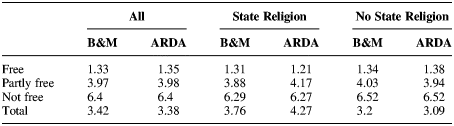
The Freedom House classifications of free, partly free, and not free countries are based on quantitative measurements of political rights and civil liberties. These are ranked from 1 = high to 7 = low, and can be read as a broad barometer of general levels of freedom within a country. Unlike the results concerning the distribution of state religions, analysis of the B&M and ARDA indices in this instance show no clear pattern within each of the free, partly free, and not free categories; with no substantial differences between countries on the basis of whether or not they possess a state religion.Footnote 8 Taking each index as a whole, on the other hand, produces a rather different result. Here, examining the mean average for each dataset reveals that countries with a state religion have substantially lower than average levels of political rights and civil liberties.
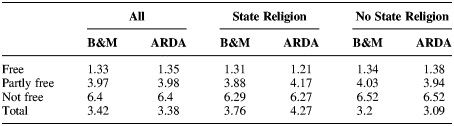
Combining the analysis of these figures with the use of an unpaired t-test allows the results to be explored in more detail. This shows, according to the B&M index, that figures for political rights in countries with a state religion are 9.9% higher (meaning, due to the high/low ranking system, that they have fewer rights) than the mean average for all countries taken together: at 3.76 compared to 3.42. The corresponding figure for ARDA is 26.3% higher (again, signaling fewer rights), at 4.27 compared to 3.38. Although the first of these differences is not statistically significant (p = 0.2744), the latter is significant to p = 0.0137. In contrast, while measures of political rights for countries without a state religion are 6.4% lower than the average according to the B&M index, and 8.6% lower according to ARDA (indicating a higher level of political rights), neither of these figures are statistically significant (with p values of p = 0.4008 and p = 0.2132).
Alongside comparisons to the mean average, direct comparisons between countries with and without state religions reveal a similar pattern. According to the B&M index countries possessing a state religion have a level of political rights that is 17.5% worse than that for countries without a state religion (a score of 3.76 compared to 3.2), while the corresponding figure for ARDA is 27.6% (4.27 compared to 3.09). Although the former of these figures is not statistically significant (at p = 0.0942), the latter records a value of p = 0.0011. These figures are shown in Table 5.
Measures of political rights (mean averages)
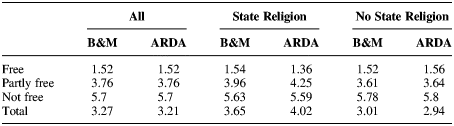
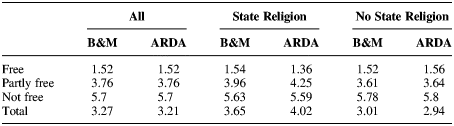
The statistics for civil liberties are similarly consistent. According to the B&M index, countries with a state religion have 11.6% lower levels of civil liberties than the overall average for the whole sample (a score of 3.65 compared to 3.27), while ARDA puts the figure at 25.2% (a ranking of 4.02 compared to 3.21). For countries without a state religion, on the other hand, civil liberties are recorded as being 8% and 8.4% better than the mean average according to the B&M and ARDA indices, respectively. Once again, however, only the second of these findings has statistical significance (the respective p values for the differences from the overall mean being 0.1395, 0.0094, 0.2514, and 0.1874). In contrast, directly comparing countries with and without a state religion produces more decisive and statistically significant results. Here, the B&M index shows that countries with a state religion have 21.3% worse civil liberties than countries without a state religion (3.65 compared to 3.01, at p = 0.0227), with the ARDA index producing an even stronger figure of 36.7% (a score of 4.02 compared to 2.94, at p = 0.0006). These figures are shown in Table 6.
Measures of civil liberties (mean averages)
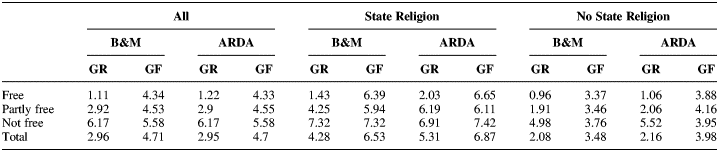
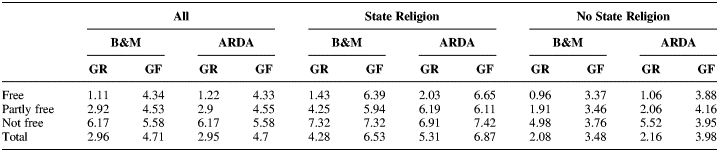
In addition to these findings on political rights and civil liberties, analysis of the ARDA measurements for government regulation and government favoritism toward religion reveal a more pronounced divergence. Here, in each of the free, partly free, and not free categories, as well as in the figures for the overall sample, countries with a state religion have substantially higher scores for (and hence, in this case, greater levels of) government regulation and favoritism than countries with no state religion. According to the B&M index, countries with a state religion have 44.6% higher levels of government regulation of religion than the overall average (a score of 4.28 compared to 2.96), and 38.6% higher levels of government favoritism toward religion (with scores of 6.53 and 4.71). Both of these figures are statistically significant, with p values of 0.0026 and <0.0001. The figures for the ARDA index record an 80% higher level of government regulation (with scores of 5.31 and 2.95), and 46.2% higher government favoritism (6.87 compared to 4.7). Both differentials also yield statistically significant p values of <0.0001.
The results of a direct comparison between countries with and without state religions are also striking. The B&M index shows that countries with a state religion have 105.7% greater levels of government regulation (at 4.28 and 2.08), and 87.6% higher levels of government favoritism (6.53 and 3.48), than countries without a state religion (both at p < 0.0001). For the ARDA index, the figures reveal 145.8% higher levels of government regulation (5.31 compared to 2.16) and 72.6% higher rates of favoritism (with scores of 6.87 and 3.98). Both of these differentials are also statistically significant at p <0.0001. These figures are shown in Table 7.
Measures of government regulation (GR) and government favoritism (GF) (mean averages)
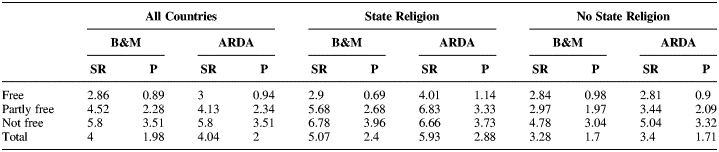
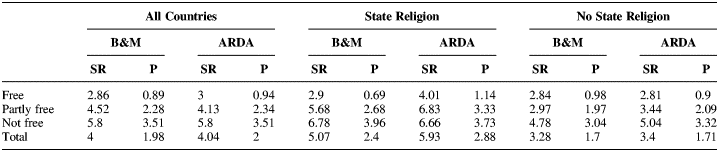
A similar pattern is observed in the ARDA measures for social regulation of religion and levels of religious persecution. At the level of each individual freedom metric, although there is no real difference for free countries in respect of social regulation, countries possessing a state religion in the partly free and not free categories have notably higher scores than countries without a state religion. This finding is repeated in relation to the averages for the entire sample. For the B&M index, countries with a state religion have 26.8% higher levels of social regulation than the overall mean (a score of 5.07 compared to 4.0: at p = 0.0117), with the ARDA index putting the figure at 46.8% (a score of 5.93 compared to 4.04: at p <0.0001). This finding is also reproduced when directly comparing all countries with and without a state religion. The B&M index here records that countries with a state religion have 54.6% greater levels of social regulation than countries with no state religion (5.07 compared to 3.28), while ARDA puts the figure at 74.4% (5.93 compared to 3.4). Both measures are statistically significant at p < 0.0001.
The situation is broadly the same for levels of religious persecution. Although there is no real pattern for free countries, the partly free and not free categories show that countries with a state religion have higher levels of persecution than those without, and with this finding also extending to the total sample overall. Compared to the levels of divergence for social regulation, however, the variance for religious persecution is not as strong, and many of the differentials are relatively small. Directly comparing countries with and without state religions, though, gives a more decisive result. The B&M index here records that countries with a state religion have 41.2% higher levels of religious persecution, with a rating of 2.4 compared to 1.7 (although the p value only equates to p = 0.0626), while ARDA puts the figure at 68.4%, with 2.88 compared to 1.71 (p = 0.0048). These findings are set out in Table 8.
Measures of social regulation of religion (SR) and religious persecution (P) (mean averages)
CAUSE AND EFFECT
A comparative analysis of the B&M and ARDA indices reveals a number of interesting findings about the relationship between state religion and freedom. The distribution of state religions, both in general as well as in their specific forms, tends to be disproportionately skewed toward less free countries, and a similar picture is found for the distribution of liberal democracies. Countries with a state religion also have notably lower levels of political rights and civil liberties (although statistical significance is not as strong in respect of the former), both in relation to the average for all countries as well as in direct comparison to countries with no state religion. This is accompanied by more extensive government regulation and favoritism toward religion, along with higher social regulation of religion and greater levels of religious persecution.
These findings raise an obvious question: why do countries with a state religion have lower levels of freedom than countries with no state religion? Scholarly discussions about the interrelationship between the secular and the religious typically highlight three related factors that might potentially serve as explanatory candidates: levels of human development, levels of religious diversity, and levels of religiosity. Here, a number of potential transmission mechanisms are available. Countries with low levels of human development, for instance, may lack the requisite institutional or civic resources needed to sustain effective democratic governance, while countries with high levels of religiosity and/or high levels of religious homogeneity may be subject to pressures (or opportunities) for the close involvement of religious authorities in the political sphere, at the expense of democratic processes, accountability and individual rights.
The first of these factors was assessed using the 2011 Human Development Index (HDI), constructed by the United Nations Development Programme. This was based on a range of variables (including life expectancy at birth, mean and expected years of schooling, and Gross National Income per capita),Footnote 9 and classified countries as having either “very high,” “high,” “medium,” or “low” levels of human development. These rankings were translated into a quantitative measure by coding them with values from 1–4 (very high to low), respectively.
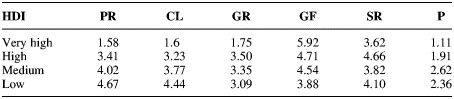
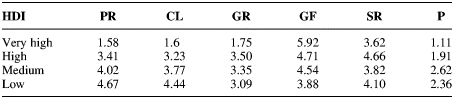
Mapping these figures onto the B&M and ARDA indices showed a clear link between human development and freedom, but possible connections to state religion were more uncertain. In terms of the former, there was no obvious correlation between levels of human development and government regulation, government favoritism, or the social regulation of religion, but levels of political rights, civil liberties and (less clearly) religious persecution all improved as human development levels increased. These trends can be seen in Table 9.
Freedom measures by HDI ranking
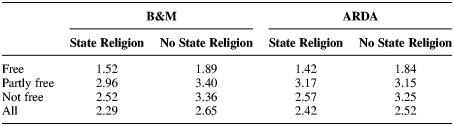
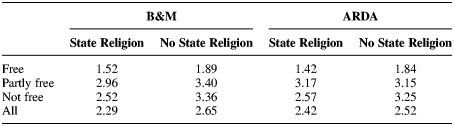
Links between human development and state religion, on the other hand, were less obvious. First of all, countries with a state religion possessed substantially better human development ratings within each of the free, partly free, and not free categories than their counterparts with no state religion, but, unlike the individual freedom metrics, the relationship was not a linear one. The respective averages for the B&M index were 19.6%, 12.9%, and 25% lower for countries with a state religion (indicating higher levels of development on the 1–4 coding scale). The figures for the ARDA index were 22.8%, −0.6%, and 20.9% lower. The overall differences for the B&M and ARDA indices were also unclear. Countries with a state religion in the B&M index possessed an overall average human development rating of 2.29 compared to an average of 2.65 for countries with no state religion, a difference of 15.7%, but the respective figures for ARDA was 2.42 and 2.52, a difference of just 4.1%.
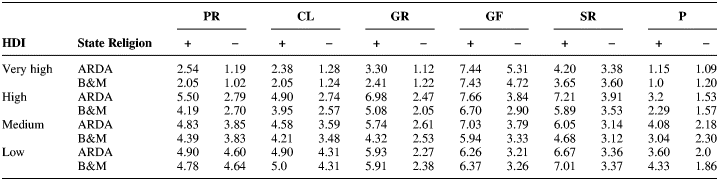
Moreover, alongside this, the negative correlation between state religion and freedom was also reasserted. Examining the figures in terms of the individual freedom metrics showed that countries with a state religion fared substantially worse on almost every count, and in every single human development category. The only exceptions were in the “very high” development ranking, where there was no real difference between countries with and without state religions in terms of social regulation and persecution. These details are set out in Tables 10 and 11.
Average human development levels by freedom category
Freedom metrics by human development category and state religion

The remaining candidates for explaining the relationship between state religion and freedom, religious diversity and religiosity, were assessed using data from the fifth wave of the World Values Surveys (WVS), conducted from 2005 to 2008. While this provided detailed and comprehensive data on a range of key issues, use of the WVS was far from unproblematic. For one, the number of countries examined by the WVS (i.e., 57) was far less than the numbers contained in the B&M and ARDA indices, and several countries in the WVS sample were not present in either dataset. The WVS sample also contained a relatively small number of countries with a state religion. Cross-referencing this with the B&M index produced a total of 17 countries (12 Christian and 5 Muslim), while the figure for ARDA was just 11 (4 Christian and 7 Muslim). The extent to which any generalizations can be drawn from the analysis of this data (especially the sample from ARDA) is duly limited.
The religious diversity of countries examined by the WVS was graded according to the number of denominations in each country that contained at least 2.5% of the population. While this method is clearly unable to capture levels of religious diversity in fine detail (which would require consideration of even smaller denominations), it nonetheless established a useful benchmark for highlighting any potential links between diversity and freedom.
The subsequent examination, however, showed no obvious connection. Of the most diverse countries in the WVS sample (those with at least four denominations at the 2.5% boundary), 10 were free, 2 were partly free, and 2 were not free. Of the least diverse countries, 9 were free, 5 were partly free, and 1 was not free. The overall averages for the individual freedom categories were also similar. Free countries contained an average of 2.8 denominations at the 2.5% level, while partly and not free countries contained 2.8 and 3.0, respectively. Assessing diversity according to the presence or absence of a state religion produced no clear link either. According to the ARDA index, countries without a state religion had an average of 2.8 denominations, while countries with a state religion had an average of 2.5. In contrast, the figures for the B&M index were slightly wider, at 3.1 and 2.2. This indicates that countries with a state religion may have lower levels of religious diversity, but the evidence remains too inconclusive for any causal inferences to be drawn.
The third variable to be considered, religiosity, was measured against a variety of factors covered by WVS. The first of these was the regularity of attendance at a place of worship. The key finding here was that there was no obvious difference in attendance levels between countries with and without a state religion. According to the B&M sample, 41.3% of respondents in countries with a state religion attended at least once a month, compared to 44.5% in countries without a state religion. The figures for the ARDA index were 48.6% and 42.2%. Similarly, for the B&M index the proportion attending once a year, less frequently or not at all, was 41% in countries with a state religion, and 40.5% in countries without. The figures for the ARDA index were 39% and 41%.
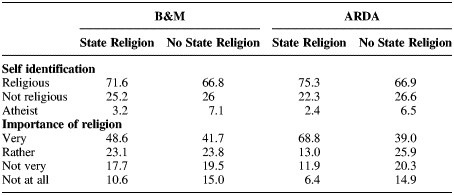
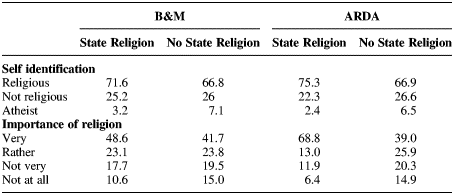
Other measures of religiosity, however, produced more divergent results. Among these: respondents from countries with a state religion were more likely to consider themselves to be a religious person, to regard religion as being “very important” (and, conversely, less likely to view it as “not at all important”), and more likely to view churches as providing answers to social and, especially, moral problems. These findings are displayed in Tables 12 and 13.
Self identification and the importance of religion %
Church provides solutions for moral and social problems (%)

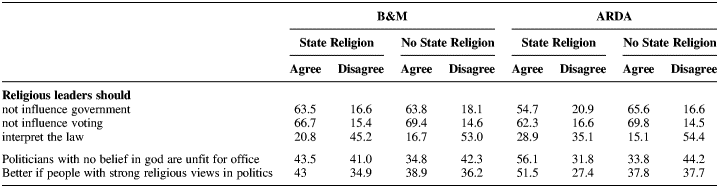
These findings also highlight the possibility of a link between religiosity and state religion, although, again, the picture remains unclear. Furthermore, analysis also indicates that any connection that may exist has mixed results in terms of its effects on attitudes toward the relationship between religion and politics. A large majority of respondents, both in countries with and without state religions, and across both B&M and ARDA indices, were opposed to the idea that religious leaders should directly influence government or voting behavior, and did not consider it to be essential for a democracy to have religious authorities interpret the law.
At the same time, however, despite eschewing direct political influence, respondents in countries with a state religion did appear to favor more indirect forms of religious influence. Clear differences, for example, were evident on the questions as to whether politicians who did not believe in god were unfit for office, and on whether it would be better if people with strong religious views were involved in politics. In both cases, and particularly the former, countries with a state religion were notably more receptive to such ideas. This tendency toward indirect as opposed to direct forms of involvement raises something of a paradox, given that state religions are themselves predicated on a close relationship to the political realm, even if they do not necessarily involve overt interference in political affairs. One possible explanation for this might be a concern to avoid the kind of fractious and unpalatable consequences that can result from the direct and overt involvement of religious authorities in political matters, not least since such behavior raises the possibility that political figures may seek to interfere in religious affairs, but more detailed research on these issues is required. The results of these WVS responses are shown in Table 14.
Views on political issues*
* Figures represent the average numbers of respondents who dis/agreed or strongly dis/agreed. Responses on interpreting the law were ranked on a 10-point scale for the degree to which this was considered essential for democracy. The measures agree/disagree here represent the average number of responses in positions 1–3 and 8–10, respectively.
On the basis of the figures analyzed here, then, neither human development, religious diversity, nor religiosity would appear to have a clear link to state religion. Although the possibility of a link can be observed in various instances, the evidence remains uncertain and any correlations in respect of religiosity would seem, in any case, to favor more indirect rather than direct forms of political influence. As such, it seems unlikely that countries with a state religion could be said to possess any particularly unique socio-cultural qualities that might be invoked to account for the diminished levels of freedom observed previously. This points toward a greater causal role for the institutional dynamics of state religion itself.
CONCLUSION
The boundary between the religious and the secular is intrinsically political. An important, though overlooked, aspect of this is the issue of state religion. This article has sought to address the lack of research in this area by examining the relationship between state religion and freedom. A number of methodological difficulties deriving from the nature of the datasets used mean that the results of the study must be treated with caution. A more detailed and fine-grained analysis, using more comprehensive datasets and more sophisticated statistical methods than those deployed here, would help to address some of these problems.
With these caveats in mind, the study makes a number of key findings. State religions are shown to be disproportionately clustered in less free categories of countries, and a similar pattern is observed in respect of liberal democracies. Analysis also shows that countries with a state religion have significantly higher levels of government regulation and favoritism toward religion, greater levels of social regulation of religion, and substantially lower levels of freedom in terms of political rights, civil liberties, and religious persecution. Consideration of human development, religious diversity, and religiosity as potential causal factors reveals various links to freedom, but no obvious connections to state religion.
These findings suggest that the lower levels of freedom found in countries with state religions may have less to do with their particular socio-cultural conditions, and more to do with the institutional mechanics of state religions themselves. Given that the entire point and purpose of a state religion is to support the promotion of one particular religious perspective over other world-views, and given that this objective invariably involves the provision of various financial, legal and political privileges, it is not hard to see how these dynamics can lead to the curtailing of political and religious freedoms. By linking national identity to notions of religious belonging, by basing the authority and legitimacy of the state on sectarian criteria, by promoting a greater role for religious authority within the political realm, and by maintaining variegated levels of citizenship, the mechanics of state religion can work in such a manner as to foster inequality, division and intolerance, corrode individual rights and equalities, sustain restrictive practices and undermine processes of democratic accountability. This is not, of course, to suggest that countries without state religions are immune from such problems, nor that they might promote greater levels of freedom by default. History, indeed, has shown this not to be the case. Nevertheless, as this study has indicated, the negative correlation between state religion and freedom supports the view that it is a secular state, free from the institutional imperative to uphold any particular set of beliefs, that offers the best guarantee for human rights and freedoms.
APPENDIX 1.
Note: The entries for the heading “state religion” are as follows: N (None), C (Catholic), P (Protestant), O (Orthodox), M (Muslim), J (Jewish), B (Buddhist), H (Hindu). The column headings on the right are: PR (political rights), CL (civil liberties), GR (government regulation of religion), GF (government favouritism towards religion), SR (social regulation of religion), and P (persecution).