Control of invasive herb species is often frustrated by regeneration of seedlings from the soil seedbank (Radosevich et al. Reference Radosevich, Holt and Ghersa2007). Although aboveground stems may have been removed (often with considerable effort), regeneration from the seedbank potentially replaces them quite rapidly, defeating the purpose of the control program. By replacing aboveground stems, seeds in the soil can have a disproportionate effect on invasive species’ population growth rate. Life-stage modeling suggests that population growth is strongly controlled by soil seed longevity in annual and biennial herbs, whereas seedling survival has a lesser effect (Davis Reference Davis2006). Management efforts need to be calibrated to individual species’ seasonal patterns of dormancy to minimize opportunities for germination and reproduction and to maximize natural mortality in the soil. This strategy is widely applied in agricultural systems (e.g., Schutte et al. Reference Schutte, Tomasek, Davis, Andersson, Benoit, Cirujeda, Dekker, Forcella, Gonzalez-Andujar, Graziani, Murdoch, Neve, Rasmussen, Sera, Salonen, Tei, Tørresen and Urbano2014), but the dormancy status and soil longevity of common forest invaders is largely unknown, making comprehensive management impossible.
A seedbank potentially stabilizes an invasive plant population by buffering variation in survival and reproduction of aboveground plants, thereby facilitating occupation of a site (“the buffering hypothesis”; Rees Reference Rees1993). Notwithstanding their apparent vigor, invasive species often show considerable variation in population growth rates among sites and years (e.g., Koop and Horvitz Reference Koop and Horvitz2005), with the possibility of extinction in unfavorable years. A seedbank may be viewed as a bet-hedging strategy in which extinction of vegetative plants in a particular year is compensated by emergence of seedlings from the seedbank in other, more benign years (Venable Reference Venable2007).
A seedbank will arise when physiological seed longevity is paired with narrow germination requirements or internally controlled dormancy in which at least a portion of viable seeds cannot germinate at any particular moment (Thompson and Grime Reference Thompson and Grime1979). Herbaceous species may cycle through different dormancy states between seasons, with the fraction of seeds able to germinate changing on a scale of weeks or months (Baskin and Baskin Reference Baskin and Baskin1985; Honek et al. Reference Honek, Martinkova and Jarosik1999; Sarukhán Reference Sarukhán1974). Seasonally dependent fractional germination potentially allows a species to colonize an unpredictable environment despite frequent periods unsuitable for recruitment (Emery et al. Reference Emery, Flory, Clay, Robb and Winters2013; Rees Reference Rees1993). Dormancy status may change in response to environmental cues such as moisture, temperature, or photoperiod (e.g., Honek et al. Reference Honek, Martinkova and Jarosik1999; Wainwright and Cleland Reference Wainwright and Cleland2013), suggesting that both season and site character influence germinability of invasive species.
Although seed germination has often been described in invasive species, and the physiology of germination cues has been explored in some depth, the dormancy condition of ungerminated seeds is a separate question which deserves attention. A review of the literature shows that seasonal change in dormancy status has only rarely been documented in invasive populations (see Krinke et al. Reference Krinke, Moravcova, Pysek, Jarosik, Pergl and Perglova2005; Liu and Pemberton Reference Liu and Pemberton2008; Moracova et al. Reference Moracova, Pysek, Pergl, Perglova and Jarosik2006). We are not aware of any studies that report changes over time in the dormancy condition of invasive species. In crop species and arable weeds, seasonal changes in dormancy status have been widely documented (Baskin and Baskin Reference Baskin and Baskin1985), but invaders of natural communities are not necessarily comparable to crops or weeds and, hence, need to be investigated separately.
Deciduous forests of the eastern United States are currently experiencing invasion by many nonnative plant species presenting significant challenges to land managers. Japanese stiltgrass and garlic mustard are annual and biennial herb species, respectively, showing rapid growth and high fecundity, but limited natural seed dispersal (Miller and Matlack Reference Miller and Matlack2010; Rauschert et al. Reference Rauschert, Mortensen, Bjornstad, Nord and Peskin2010). With dispersal aided by humans, they have been particularly successful in colonizing moist, partially shaded sites across the deciduous forest region (Fryer Reference Fryer2011). To explore the possibility that changes in dormancy over time contribute to invasion behavior, we examined dormancy and longevity by experimentally burying seeds in forest sites and recovering them at intervals. If seed dormancy promotes site occupation by buffering environmental variation (Rees Reference Rees1993), we expected both species to show long-term survival in the soil, with a small fraction of viable seeds able to germinate at any particular moment. Conversely, short longevity in the soil or a high proportion germinating would suggest that maintenance of a seedbank is unimportant in site occupation. Examination of two species does not allow an unequivocal statement on the role of dormancy in biological invasions; our objective is simply to document seed longevity and seasonal variation in dormancy condition in two well-known examples and suggest implications for management.
Japanese stiltgrass is an annual C4 grass from southeast Asia (hereafter “stiltgrass”). In eastern North America it invades moist-mesic deciduous forest, often appearing on stream terraces, floodplains, and roadsides (Gibson et al. Reference Gibson, Spyreas and Benedict2002; Miller and Matlack Reference Miller and Matlack2010). Colonization and population expansion are associated with canopy openness and soil disturbance (Glasgow and Matlack Reference Glasgow and Matlack2007). Stiltgrass can exist at light levels as low as 1% of full sunlight by using sunflecks (Horton and Neufeld Reference Horton and Neufeld1998), but fecundity declines below ca. 10% of full sun and biomass below ca. 20% (Claridge and Franklin Reference Claridge and Franklin2002; Huebner Reference Huebner2011). As a summer annual, stiltgrass necessarily overwinters in the seedbank. Seeds are produced in a state of innate dormancy (sensu Harper Reference Harper1957), requiring cold stratification for up to 90 d before germination can occur (Judge Reference Judge2005). Longevity of up to 4 yr in the soil has been inferred by observing germination in the field (Barden Reference Barden1987). Seedlings emerge in late spring in the study area, and seed is set in late September. Seeds appear to move short distances by rainwash (Marshall and Buckley Reference Marshall and Buckley2008; Miller and Matlack Reference Miller and Matlack2010). Occasional long-distance dispersal probably reflects human movement of soil containing seeds (Christen and Matlack Reference Christen and Matlack2009; Rauschert et al. Reference Rauschert, Mortensen, Bjornstad, Nord and Peskin2010).
Garlic mustard is a biennial herb from Europe first documented in North America in 1868 (Nuzzo Reference Nuzzo2000). Garlic mustard is currently widely distributed in the eastern United States and southern Canada, including the forest and roadside populations throughout our study area. The species is most abundant in mesic deciduous forests with partial sun, but populations can be found in a wide range of habitats, including floodplains, xeric ridgetops, and railroad ballast (Byers and Quinn Reference Byers and Quinn1998; Nuzzo Reference Nuzzo2000). Garlic mustard germinates in late winter, allowing seedlings to take advantage of a relatively warm period before the canopy leafs out. Juvenile plants overwinter as basal rosettes that bolt and flower in early spring of the second year, setting seed and senescing by midsummer. The species is believed to be dispersed by humans based on a positive relationship between disturbance and population distribution (Gavier-Pizarro et al. Reference Gavier-Pizarro, Radeloff, Stewart, Huebner and Keuler2010) and may also be transported in the fur of animals (Nuzzo Reference Nuzzo2000). Seeds are in a condition of innate dormancy when dispersed, requiring 50 to 105 d of cold and moist stratification in an organic medium to become germinable (Baskin and Baskin Reference Baskin and Baskin1985; Lhotska Reference Lhotska1975). Garlic mustard has been known to lie dormant in the soil for at least 10 yr (Nuzzo Reference Nuzzo2000).
Materials and Methods
Seed dormancy was examined in 10 oak- and hickory-dominated forest stands (Quercus- and Carya-dominated, respectively) in the Low Hills section of the Allegheny Plateau in southeast Ohio (Braun Reference Braun2001). The dominant landform is a network of low ridges and narrow valleys with much fine-scale heterogeneity in slope and aspect. Slope aspect shows a clear contrast in aboveground vegetation reflecting microsite variation in moisture, litter accumulation, temperature, and day length (Olivero and Hix Reference Olivero and Hix1998). North-facing slopes typically have substantially higher diversity of herbaceous species, especially in the Ranunculaceae and Apiaceae, whereas south-facing slopes have relatively few species, often including the Poaceae and Rosaceae (MA Holmes, personal communication).
All study sites (39.00–39.35°N, 82.00–82.40°W) were situated on gentle-moderate slopes in mature second-growth stands with a closed canopy and a moderate litter layer. Soils were well-drained organic-rich sandy and silt loams typical of long-established forest in the region (Lucht et al. Reference Lucht, Anderson, Brown and Martin1985). Obvious environmental variation (e.g., microtopography, canopy openness, tree proximity) was minimized to remove background gradients and focus on seasonal and slope variation. All sites were separated by at least a kilometer to avoid possible autocorrelation of environmental variables and ensure statistical independence.
Seed longevity and dormancy condition were examined by burying seeds in 10 by 10 cm nylon fabric bags and recovering them at intervals following the method of Sarukhán (Reference Sarukhán1974). The method interprets a series of samples as snapshots of a single sample changing through time. Change in dormancy status was measured as the difference in seed viability and germination fraction between samples recovered at successive dates.
Stiltgrass and garlic mustard seeds were collected in three and four wild populations, respectively, near our lab in Athens County, OH. Air-dried seeds were stored at ambient temperature in the laboratory (16 to 20 C) for 1 to 2 wk before burial. Within each species, all seeds were well mixed to remove potential interpopulation variability, and 100 apparently healthy seeds were counted into each bag. Bag fabric had a 0.1-mm mesh, allowing water and gas exchange but excluding seed predators. Seed bags were deployed to the forested study sites in July (garlic mustard) and mid-December (stiltgrass) 2010, at their respective times of natural seed dispersal. Bags were placed on the mineral soil surface under the litter and duff layers to mimic natural seed deposition. At each site, all bags were arranged within a 1 by 1 m plot to aid in relocation and minimize within-site variation. Thus, there were 24 bags (2 species×12 bags) in each plot at most dates.
Factors creating the strong separation of vegetation on north- and south-facing slopes might also be expected to influence dormancy condition (Honek et al. Reference Honek, Martinkova and Jarosik1999; Wainwright and Cleland Reference Wainwright and Cleland2013). To provide a coarse-grained test for environmental control of dormancy, burial sites were located on both north- and south-facing slopes using slope as a proxy for a suite of underlying environmental variables. Individual sites were treated as replicates in the analysis. Bags were recovered at 2-mo intervals for 24 mo. The complete design included 2 species by 5 replicate sites by 2 slope aspects by 12 recovery dates for a total of 240 bags, with 100 seeds in each bag.
Recovered seeds were tested for germinability on moist filter paper in the laboratory. Seeds were tested on a lab bench at ambient temperature (18 to 21 C) under fluorescent lighting (ca. 12/12 h photocycle) for 2 wk, after which germination had ceased in all samples. Although lab-bench germination is clearly an artificial situation, it provides a useful first assessment of dormancy appropriate to weedy, generalist species (Honek et al. 1999; Krinke et al. 2005).
Seeds that did not germinate were tested for viability by visually observing the embryo for firmness and a yellow or green color. Although a tetrazolium test is the preferred method of assessing viability (Huebner Reference Huebner2011), such tests were not used here because seeds screened for germinability had already imbibed water and did not readily absorb the tetrazolium solution. The visual and tetrazolium methods agreed strongly (99% to 100 % agreement) in trials using unimbibed seeds of each species, so visual examination was considered acceptable.
Empty seed coats (i.e., coats detached from embryos) offered an indirect indication of germination in the soil. All empty seed coats were counted in the recovered seed bags.
The total number of surviving seeds (those that germinated in the lab plus those alive but not germinating) plotted across recovery dates can be interpreted as a survivorship curve. However, because sampling was destructive and each sampling date represents a separate group of seeds, we do not know the fate of individual seeds. Uncertainty about dates of mortality leads to intractable problems of right censoring (Crawley Reference Crawley2007), so conventional survival analysis could not be used. Instead, we compared total number of surviving seeds using a generalized linear model set up as an analysis of covariance (ANCOVA; package ‘glm’), in which sites were treated as replicates, aspect and species appeared as categorical variables, and recovery date (number of months in the soil) was a covariate. Recovery date was log transformed to improve normality. Full models were constructed to include main effects and interactions, and nonsignificant terms were progressively removed. The best model was chosen as having no nonsignificant terms and the lowest value of the Akaike information criterion. A similar analysis was applied to germination fraction, described as the proportion of all surviving seeds that germinated at each recovery date; an arcsin square-root transformation was applied as appropriate to proportional data. All procedures were conducted in the R statistical environment (R Core Team 2013).
Results and Discussion
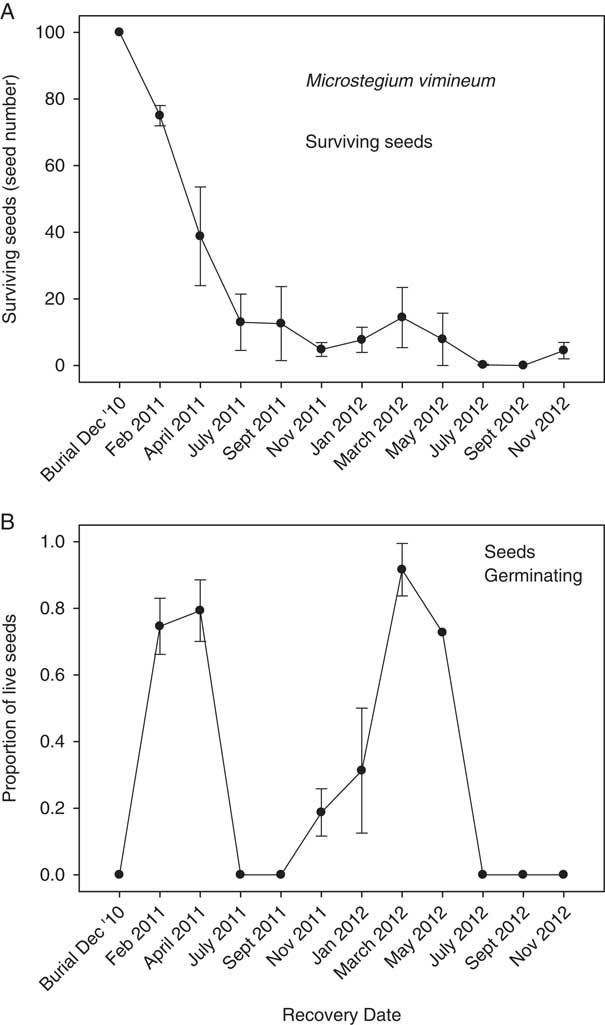
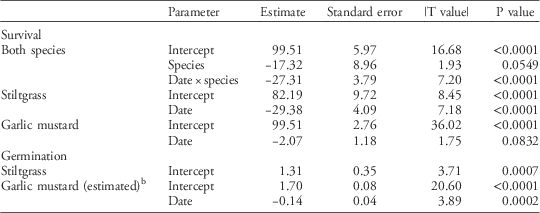
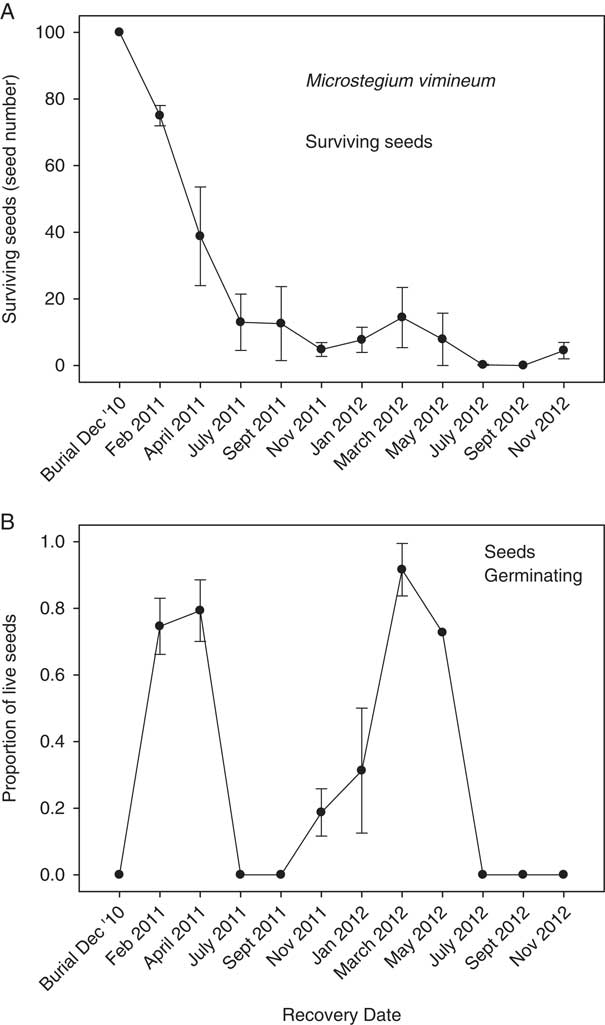
In both species, the number of living seeds recovered declined with time in the soil. Variation within sample dates was relatively minor (Figures 1A and 1B), presumably reflecting stochastic variation in the soil microenvironment. The best model for seed viability showed a significant species by date interaction, and the species term was significant at a slightly relaxed significance level (Table 1). Residuals were tested for normality and homogeneity of variance among sample dates; assumptions were met in all cases. Because the species by date interaction violates the assumption of homogeneity of slopes, the species were reconsidered separately. Survival of stiltgrass declined rapidly with time, with only 0% to 6 % of seeds remaining alive in fall 2012 after 2 yr in the soil (Figure 2A). Note that this curve does not show mortality of a single cohort, so a monotonic decline should not be expected. The best model included a decline in numbers with log recovery date (Table 1). Mean values of survival were marginally higher on south-facing slopes, but the aspect effect was not significant (P>0.05).
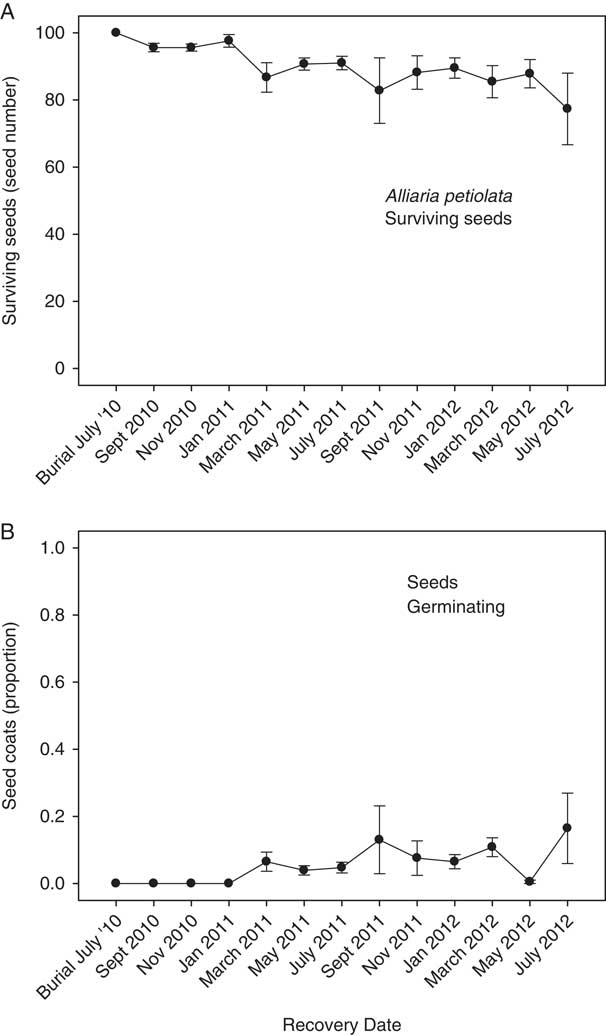
Longevity and dormancy condition of garlic mustard seeds at 10 forest sites in southeastern Ohio: (A) surviving seeds and (B) germinating seeds. The germinating fraction is estimated as the number of empty seed coats expressed as a proportion of total live seeds at each date. Points show mean values; whiskers indicate one standard error. Data from north- and south-facing sites are combined to maximize sample size. Seedlings typically emerge in early spring.

Longevity and dormancy condition of stiltgrass seeds at 10 forest sites in southeastern Ohio: (A) surviving seeds and (B) germinating seeds. The germinating fraction is expressed as a proportion of total live seeds at each date. Data from north- and south-facing sites are combined to maximize sample size. Points show mean values; whiskers indicate one standard error. Seedlings typically emerge in late spring to early summer.
Survival and germination proportion of seeds in the soil; model parameters generated by generalized linear analysis.Footnote a

a Nonsignificant parameters (P>0.10) are not shown.
b Garlic mustard germination is estimated from presence of seed coats, not direct observation of germination.
Viability of garlic mustard declined more gradually than stiltgrass, with 82% and 88% of seeds surviving after 2 yr (Figure 1A). ANCOVA showed only a weak relationship between garlic mustard seed survival and date (Table 1) and no relation to aspect (P>0.05).
The proportion of lab-germinating seeds varied seasonally for stiltgrass, with high germination corresponding to periods of natural seedling emergence in early to mid-spring (Figure 2B). The mean proportion of lab-germinating seed in stiltgrass varied from a high of 86% and 89% germinating in March 2012 and April 2011, respectively, to 0% germinating in the period from July to September (both years).
No seeds of garlic mustard germinated in the lab despite the apparent viability of embryos. Empty seed coats were encountered in bags (Figure 1B), however, indicating that garlic mustard seeds had germinated in the field. Evidently, germination requirements were met in a natural forest community, although it was not possible to assign a date of germination. The high survival rate (Figure 1A) and small seed coat number (Figure 1B) imply that the proportion of seeds germinating was consistently low, with no clear seasonal variation. No detached seed coats were observed in stiltgrass bags at any date, so germination of buried seeds was probably minor.
Because no lab germination data were available for garlic mustard, germination was analyzed separately for the two species. ANCOVA did not produce a significant model for stiltgrass, consistent with the observation that germinability was episodic rather than continuously varying. If abundance of garlic mustard seed coats is interpreted as an estimate of field germination, garlic mustard germinated a small but increasing proportion of seeds after the first winter (1% to 11%), and the log-transformed date term explained seed coat number (Table 1). The aspect term did not explain germination fraction in either of the species (P>0.05).
The two invasive species differed strongly in buried seed longevity. In stiltgrass all seeds had died after only 14 to 22 mo, demonstrating that residence in the soil entails a substantial risk of mortality. Stiltgrass longevity varied between replicates, but all of our directly observed values were less than indirect estimates based on germination from the seedbank in other studies (Barden Reference Barden1987; Judge et al. Reference Judge, Neal and Schear2008). In standardized laboratory trials (Huebner Reference Huebner2011), vernalized stiltgrass seeds showed variation in viability between source populations (4% to 55% viable after 9 mo) suggesting that seed longevity has an inherited ecotypic or maternal basis. In our trials, which used a homogeneous seed mix, modest variation between burial sites may reflect a degree of environmental control, although it could not be interpreted in terms of slope aspect. The functional significance of such variation is questionable, however, because even relatively short longevity is clearly adequate for population persistence in the field. The value of a short-lived seedbank in surviving environmental variability is illustrated by reestablishment of stiltgrass after weak seed-production years at sites in southern Illinois and eastern Tennessee (Gibson et al. Reference Gibson, Spyreas and Benedict2002; Webster et al. Reference Webster, Rock, Froese and Jenkins2008). In both studies failure of reproduction was linked to a single late-season drought, implying that longevity in the soil as short as 18 mo is sufficient for persistence of populations.
In contrast to stiltgrass, a large proportion of garlic mustard seeds survived to the end of the burial trials. The slow rate of mortality suggests population persistence for a decade or longer without restocking the seedbank. This estimate is based on extrapolation from a 2-yr observation period and should not be considered a precise figure, but survival is clearly much longer than estimates based on germination in garlic mustard populations with known reproductive histories (Baskin and Baskin Reference Baskin and Baskin1992; Nuzzo Reference Nuzzo2000). Extended dormancy would allow seedlings to avoid competition from rosettes established the year before (Pardini et al. Reference Pardini, Teller and Knight2008), suggesting an advantage to remaining dormant through at least two germination seasons (i.e., >30 mo). Greater longevity would allow garlic mustard to survive variation in environmental quality on a scale of several years, although it is not clear whether such variation actually occurs in the study area.
Fractional Germination
Both species germinated only a fraction of viable seeds, potentially allowing establishment of seedlings in favorable years while hedging against seedling failure in unsuitable years (Pake and Venable Reference Pake and Venable1996), but they differed in the proportion of germinating seeds. The optimal germination fraction is a balance between the risk of remaining dormant (i.e., mortality in the soil) and the risk of mortality as a seedling (Rees Reference Rees1993). In stiltgrass, high proportions of seeds germinated at some sample dates (86% to 89% of viable seeds), consistent with the severe soil mortality observed here. Because few seeds are held in long-term reserve, populations appear to be vulnerable to extinction in low-quality years. However, extinction risk would be mitigated in communities that show little year-to-year variation in environmental quality. In such communities, a high germinable fraction would confer an advantage by allowing opportunistic use of favorable periods on a scale of days or weeks (Wainwright and Cleland Reference Wainwright and Cleland2013).
The large germinating fraction of stiltgrass is a transient condition, with seeds becoming capable of germination in the winter and spring, including the brief season appropriate for seedling establishment (late spring). Return of ungerminated seeds to an induced dormancy state in early summer allows stiltgrass to avoid unsuccessful autumn germination and survive a second winter. A short, narrowly defined window of physiological readiness is consistent with opportunistic, weather-dependent germination in a region where weather is unpredictable on a scale of months (Densmore Reference Densmore1979).
Garlic mustard did not germinate in our lab trials. The proportion germinating following stratification varies considerably between published studies (24% to 98%; Baskin and Baskin Reference Baskin and Baskin1992; Lhotska Reference Lhotska1975; Pardini et al. Reference Pardini, Teller and Knight2008) probably reflecting differences in test conditions. Garlic mustard germination has been shown to vary in response to temperature alternation and presence of an organic-rich soil substrate (Baskin and Baskin Reference Baskin and Baskin1992; Raghu and Post Reference Raghu and Post2008). It is likely that the lack of lab germination in our trials reflects the absence of germination cues (e.g., use of an unsuitable substrate) rather than an induced inability to germinate. If germination is inferred indirectly from mortality date and the presence of seed coats, the germination fraction does not appear to be sensitive to seasonal variation, potentially allowing it to establish at any time of year if germination requirements are met. The low proportion germinating in the field, and the variation observed in the other studies discussed above, suggests that germination requirements are narrow and specific, unlike stiltgrass.
Dormancy and Life History
It is clear that invasion of temperate deciduous forest by nonnative herb species can be accomplished through at least two distinct dormancy strategies. A shared requirement for cold stratification allows garlic mustard and stiltgrass to avoid germination in the temperate zone winter (Judge Reference Judge2005; Lhotska Reference Lhotska1975). In other seasons, however, individualistic patterns of longevity and germination suggest that dormancy state should be considered in the context of the respective species’ very different life histories (Sarukhán Reference Sarukhán1974). Stiltgrass’s short longevity in the soil is typical of the small number of invasive species that have been examined in natural communities. Most invasive species show either transient (<1 yr) or short-term persistent (<4 yr) dormancy in the soil (Krinke et al. Reference Krinke, Moravcova, Pysek, Jarosik, Pergl and Perglova2005; Liu and Pemberton Reference Liu and Pemberton2008; Van Clef and Stiles Reference Van Clef and Stiles2001). However, garlic mustard longevity greatly exceeded these examples. Neither garlic mustard nor stiltgrass conforms to the familiar pattern of extended seed dormancy, shade intolerance, and effective dispersal that is commonly invoked to explain the success of agricultural weeds (Baskin and Baskin Reference Baskin and Baskin1985; Pysek and Richardson Reference Pysek and Richardson2007).
Seed dormancy in these two species should probably be compared with native forest herb species rather than agricultural weeds. Dormancy and longevity in stiltgrass are similar to the native white snakeroot [Ageratina altissima (L.) King & H. E. Robins.] (Redwood et al. Reference Redwood, Matlack and Huebner2016), a short-lived perennial that takes advantage of forest gaps. The possibility of remaining dormant to a third growing season provides both stiltgrass and snakeroot with a modest hedge against environmental uncertainty (Emery et al. Reference Emery, Flory, Clay, Robb and Winters2013; Gibson et al. Reference Gibson, Spyreas and Benedict2002). Perhaps more important to population persistence, both species show a combination of reliable vegetative survival and a high proportion of reproductive individuals. A similar example is provided by dune fescue [Vulpia fasciculata (Forssk.) Fritsch], an annual grass growing in dune habitats in western Europe (Watkinson and Harper Reference Watkinson and Harper1978). Dune fescue has low fecundity, no obvious dispersal, and only a summer-transient seedbank, yet populations persist due to low seedling mortality and reliable reproduction.
Garlic mustard appears to share the niche of spring-oriented perennial species such as mayapple (Podophyllum peltatum L.), which germinates in late March following a mandatory cold period and persists after canopy closure to fruit in midsummer (Niederhauser and Matlack Reference Niederhauser and Matlack2015). Like most perennial forest herbs (Hyatt and Casper Reference Hyatt and Casper2000), garlic mustard does not appear to have induced dormancy after the initial cold period (Baskin and Baskin Reference Baskin and Baskin1992; Lhotska Reference Lhotska1975; Pardini et al. Reference Pardini, Teller and Knight2008). Instead, germination appears to be opportunistic, controlled by environmental cues independently of season. In our trials this combination resulted in a persistent seedbank, although high germination fractions reported elsewhere (Anderson et al. Reference Anderson, Dhillon and Kelley1996; Raghu and Post Reference Raghu and Post2008) suggest that seedbanks are not formed in every case.
It is also possible that dormancy confers benefits unrelated to the timing of germination. For example, dormancy may facilitate invasion by making seeds available for dispersal by processes that move soil, such as water runoff or road maintenance (Miller and Matlack Reference Miller and Matlack2010; Radosevich et al. Reference Radosevich, Holt and Ghersa2007; Rauschert et al. Reference Rauschert, Mortensen, Bjornstad, Nord and Peskin2010). Thus, dormancy should be considered an aspect of spatial dispersal as well as a means of surviving temporal heterogeneity.
Management Strategies
In both species the annual period of environmentally enforced dormancy (i.e., the potential period of germination; Harper Reference Harper1957) is much longer than the actual season of seedling recruitment observed at these sites (MER, personal observation; and see Fryer Reference Fryer2011; Nuzzo Reference Nuzzo2000). Presumably seedling emergence is controlled by unknown, but fairly specific, environmental cues. The long periods of potential germination suggest that both species can easily change their annual patterns of recruitment in response to environmental variation, for example, climate change. Considering the observed rates of climate change, managers should anticipate extended germination schedules. Our observations suggest that stiltgrass germination can be expected as early as February. Independence of season implies that garlic mustard is capable of germinating year-round if conditions are suitable.
In short-lived species such as stiltgrass and garlic mustard, it may be possible to eradicate a population simply by preventing reproduction. If addition to the soil seedbank can be prevented, mortality in the soil will progressively reduce the dormant seed reserve while aboveground plants senesce naturally. Costly and time-consuming removal of vegetative plants may not be necessary (Matlack and Schaub Reference Matlack and Schaub2011). Results presented here demonstrate that stiltgrass can persist in the soil for at least 2 yr, requiring suppression of reproduction for 3 yr (seed longevity plus one vegetative life cycle). Populations should be monitored for an additional 1 to 2 yr to ensure complete exhaustion of the seedbank. In garlic mustard the slow rate of mortality observed here suggests that seeds can persist for an extended period in the soil, requiring long-term monitoring of infested sites. A precise estimate is not possible on the basis of our 2-yr observation, but survival of more than10 yr is not inconsistent with the data.
In both species, management efforts must prevent the passive dispersal of dormant seeds with bulk movement of soil, for example, by limiting soil and gravel movement in natural areas and controlling rainwater runoff through existing populations. Seeds can also arrive from nearby populations, so management should be synchronized among populations, treating the group as a metapopulation rather than isolated units.
Acknowledgments
We are grateful to the landowners, public and private, who granted access to the study sites. Marion Holmes assisted with the fieldwork. Carol and Jerry Baskin provided advice in early stages of the project. Two anonymous reviewers made helpful comments on the article. This work was supported under Joint Venture Agreement 10-JV-11242303-014 from the U.S. Forest Service.