INTRODUCTION
The occurrence of the great white shark, Carcharodon carcharias (Linnaeus, 1758), in several parts of the western and central Mediterranean Sea has been well documented by several authors (e.g. De Maddalena, Reference De Maddalena2000, Adriatic Sea; Barrull & Mate, Reference Barrull and Mate2001, Catalonian Sea; Soldo & Jardas, Reference Soldo and Jardas2002, in the eastern Adriatic Sea; Morey et al., Reference Morey, Martínez, Massutí and Moranta2003, off the Balearic Islands; Soldo & Dulčić, Reference Soldo and Dulčić2005, eastern Adriatic Sea; Maliet et al., Reference Maliet, Reynaud and Capapé2013, off Corsica Island). In a recent work based on sequencing the mitochondrial control region of four great white sharks caught in different parts of the Mediterranean Sea, Gubili et al. (Reference Gubili, Bilgin, Kalkan, Karhan, Jones, Sims, Kabasakal, Martin and Noble2010) suggested that Mediterranean great whites showed little genetic differentiation from Indo-Pacific lineages, but strong separation from geographically closer Atlantic/western Indian Ocean haplotypes.
Although the first writings on the occurrence of the great white shark in Turkey's waters dates back to the mid-16th Century (Bellonii, Reference Bellonii1553), its presence in the mentioned area has always been subject to debate. In his monumental work, Petri Bellonii reported on the capture of a great white shark in waters off İzmir, a city on the Aegean seaboard of Turkey, with a short description of the specimen. Based on recordings of several neonates, juveniles and adults from the north-eastern Aegean Sea since 1991, contemporary presence of C. carcharias in Turkey's waters is validated without doubt (Kabasakal & Kabasakal, Reference Kabasakal and Kabasakal2004; Kabasakal, Reference Kabasakal2008; Kabasakal & Gedikoğlu, Reference Kabasakal and Gedikoğlu2008; Kabasakal et al., Reference Kabasakal, Yarmaz and Gedikoğlu2009); however, it is still questionable whether the great white shark is a resident or a transient species in the seas of Turkey.
This paper is a critical review of existing literature and presents new records of the great white shark in Turkey's waters, as well as providing an updated insight on the status of C. carcharias in the mentioned region.
MATERIALS AND METHODS
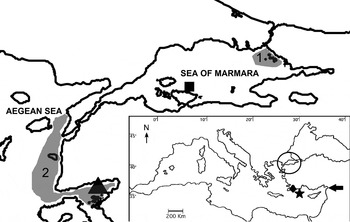
Data of the present study were obtained from the following sources: (i) new records collected through field research; (ii) information obtained through interviews with fishermen and marine biology experts; and (iii) a review of the available data from scientific literature, daily newspapers and internet sources. Samples such as teeth, jaws, tissue samples, photographs, etc, were also obtained and preserved in the archives of the Ichthyological Research Society (IRS). Total lentgh (TL) of fresh samples were measured; TL is the horizontal line from tip of snout to tip of the upper lobe of caudal fin, where the caudal fin depressed to body axis (Serena, Reference Serena2005). The study area is shown on the map in Figure 1.
Locations of historical and contemporary records of Carcharodon carcharias in Aegean and Marmara Seas. Shaded area (1) corresponds to approximate locality of historical marmaric records, and (2) contemporary Aegean records, of C. carcharias in Turkey's waters. (Δ) denotes the location where neonates of C. carcharias caught. (*) corresponds to approximate location where an adult great white shark sighted near a tuna farm cage. ( ) denotes the location of İskenderun Bay record of the great white shark (specimen no 13 in Table 1); (
 ) denotes the location of last marmaric record of the great white shark. (∇) denotes the location of sighting of specimen No. 46 in Table 1.

RESULTS
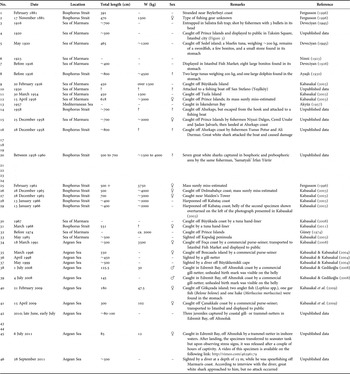
Based on historical accounts, contemporary records and unpublished data of C. carcharias, 46 great white sharks were either recorded or sighted in Turkey's waters during a period from February 1881 to 28 September 2011 (Table 1 with relevant references therein) (Ninni, Reference Ninni1923; Deveciyan, Reference Deveciyan1926, Reference Deveciyan1945; Ayaşlı, Reference Ayaşlı1930; Akyüz, Reference Akyüz1957; Güney, Reference Güney1974; Fergusson, Reference Fergusson, Klimley and Ainley1996; Kabasakal, Reference Kabasakal2003, Reference Kabasakal2008, Reference Kabasakal2011; Kabasakal & Kabasakal, Reference Kabasakal and Kabasakal2004; Kabasakal & Gedikoğlu, Reference Kabasakal and Gedikoğlu2008; Kabasakal et al., Reference Kabasakal, Yarmaz and Gedikoğlu2009). Most of the available historical records of the great white shark in Turkey's waters were recorded in the Sea of Marmara and the Bosphorus Strait (N = 32; Table 1), and only 1 individual was recorded in İskenderun Bay in 1950's (Akyüz, Reference Akyüz1957). Contemporary records of C. carcharias in Turkey's waters were recorded in the Aegean Sea, of which 12 of them were recorded in northern and central parts of the sea, and 1 specimen was recorded in the south-eastern part. Date and locality of capture, TL and weight, sex, summarized fishing data and reference of each individual are presented in Table 1. Total lengths of the recorded great white sharks ranged from 85 cm TL to ~800 cm TL, and mass ranged between 12 kg to ~4500 kg (Table 1).
Historical and contemporary records of Carcharodon carcharias from Turkey's waters between 1881 and 2011.

In relation to historical records of C. carcharias in marmaric and bosphoric waters, most of the specimens (N = 28) have been caught mainly by tuna hand-liners; 1 individual (sp No. 3; Table 1) entrapped in a coastal fish trap and 2 individuals (sp Nos. 28 and 29; Table 1) harpooned near the coast, and 1 specimen (sp No. 33; Table 1) was sighted by a fisherman off the Kapıdağ Peninsula (southern Sea of Marmara).
Three non-fatal shark attacks on boats of tuna hand-liners were also recorded (sp Nos. 10, 14 and 16; Table 1) in the Bosphorus Strait, between 1930 and 1958. All of the attacks were provoked events during the struggle of the hooked great white sharks attempting to escape. Although no fatalities occurred, one of the fishing boats was seriously damaged and sank upon return (İrfan Yürür, personal communication).
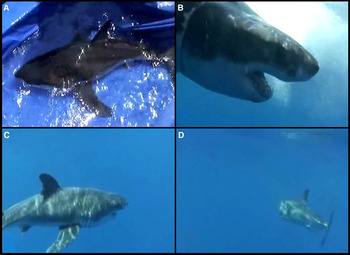
Between 18 March 1991 and 28 September 2011, 13 individual C. carcharias were sighted or caught by commercial fisherman off Turkey's coast of the North Aegean Sea (Figure 1; Table 1). Aegean records of C. carcharias include neonates, juveniles and adults, of which their total lengths ranged from 80 to 550 cm, and mass varied between 12 and 3500 kg. Two of the specimens (sp Nos. 36 and 37; Table 1) were sighted by a commercial gill-netter and a diver, respectively. Three great white sharks (sp Nos. 34, 35 and 41; Table 1) caught by commercial purse-seiners and the remaining 7 individual C. carcharias, 6 of which were neonates, were entangled in coastal stationary nets (gill or trammel nets). Unhealed birth marks were visible in 6 neonates (sp Nos. 38, 39, 42, 43, 44 and 45; Table 1). Last of the neonate great white sharks (sp No. 45; Table 1) was transferred to a 25 ton seawater aquarium by the fishermen. Unfortunately, all attempts to keep the neonate alive were unsuccessful and upon the individual exhibiting signs of distress, it was released after a couple of hours captivity (Figure 2).
Release of the neonate (sp No. 45 in Table 1) of Carcharodon carcharias in Edremit Bay. All images are captured from the video footage by Cenk Balkan. Neonate was first kept in a seawater tank (A), upon release it was stayed in almost motionless posture for a few minutes (B, C), and than swam away (D).

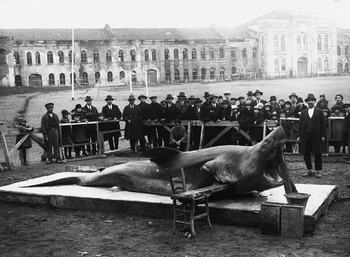
Great white shark caught off Prince Islands, northern Sea of Marmara in the 1920s.

Stomach content records of several individuals revealed remains of bluefin tuna (Thunnus thynnus), swordfish (Xiphias gladius), bonito (Sarda sarda) and unidentified dolphin in adult great whites, as well as angler fish (Lophius spp.), gar fish (Belone belone) and hake (Merluccius merluccius) in one of the Aegean Sea juveniles (sp No. 40; Table 1).
DISCUSSION AND CONCLUSIONS
With the additional 16 records of great white sharks (11 historical and 5 contemporary records), the number of C. carcharias recorded from the seas of Turkey between 1881 and 2011, increased to 46 individuals (Table 1). The present results show that, although the great white shark has disappeared from the Sea of Marmara and Bosphorus Strait, it still occurs off the Aegean coast of Turkey, with low numbers of records. Moreover, all of the new observations (9 individuals) came from field surveys since 2008, emphasizing the importance of systematic data collection.
In a recent inventory study, De Maddalena & Heim (Reference De Maddalena and Heim2012) gave details of 596 records of C. carcharias from the entire Mediterranean Sea and adjacent waters. Historical and contemporary occurrences of C. carcharias off Turkey's Mediterranean coast have been mentioned by several authors (Akyüz, Reference Akyüz1957; Geldiay, Reference Geldiay1969; Quero, Reference Quéro, Whitehead, Bauchot, Hureau, Nielsen and Tortonese1984; Akşıray, Reference Akşıray1987, Fischer et al., Reference Fischer, Bauchot and Schneider1987; Mater & Meriç, Reference Mater, Meriç, Kence and Bilgin1996; Serena, Reference Serena2005; Golani et al., Reference Golani, Öztürk and Başusta2006); however, with the exception of the İskenderun Bay specimen, recorded by Akyüz (Reference Akyüz1957), none of the remaining authors provided information on where the examined specimens were caught or stored for further inspection. Available historical and contemporary records (4 individuals) of C. carcharias from eastern Mediterranean waters can be summarized as follows: in 1934, a female of 425 cm TL caught off Agamy beach (Alexandria, Egypt) (Norman & Fraser, 1937, in Fergusson, Reference Fergusson, Klimley and Ainley1996); and a juvenile (TL 200 cm) caught of Akko coast (Israel) (Ben-Tuvia, Reference Ben-Tuvia1971). In 1993, a female of >500 cm TL was sighted by divers off Paphos (Cyprus) (Fergusson, Reference Fergusson, Klimley and Ainley1996), and Greek swordfish and tuna long-liners caught a great white shark in eastern Mediterranean waters between 1998 and 2001 (Megalofonou et al., Reference Megalofonou, Damalas and Yannopoulos2005). Carcharodon carcharias was also recorded off Alexadroupolis, Kavala and Thassos (north-western Aegean Sea, Greek coast) (Konsuloff & Drenski, Reference Konsuloff and Drensky1943), and off Thermaikos Gulf (north-western Aegean Sea, Greek coast) (Economidis & Bauchot, Reference Economidis and Bauchot1976), both references cited in Papakonstantinou (Reference Papakonstantinou1988). Combining the above data with the results of the present study, the rarity of occurrences of C. carcharias in eastern Mediterranean waters is obvious, with 51 specimens recorded to date from the region, which constitutes 8.5% of total records from the entire Mediterranean reported by De Maddalena & Heim (Reference De Maddalena and Heim2012). North Aegean Sea neoates and the Marmaris specimen (sp. No 46 in Table 1; south-eastern Aegean Sea) are the most recent records of the great white shark from the eastern Mediterranean, as well.
The non-fatal bosphoric great white shark attacks on fishing boats, that occurred in 1930 (1 case) and 1958 (2 cases), should be considered as provoked attack events, which resulted from the struggle between fishermen and the hooked individuals. A clear correlation between the occurrence of the great white shark and the bluefin tuna fishery or migrations of bluefin tuna in Mediterranean waters, is emphasized by several authors (Fergusson, Reference Fergusson, Klimley and Ainley1996; De Maddalena, Reference De Maddalena2000; Barrull & Mate, Reference Barrull and Mate2001; Soldo & Jardas, Reference Soldo and Jardas2002; Morey et al., Reference Morey, Martínez, Massutí and Moranta2003). According to De Maddalena (Reference De Maddalena2000) and Soldo & Jardas (Reference Soldo and Jardas2002), occurrence of the great white shark in coastal waters of the eastern Adriatic was in relation to the high abundance of tuna in these waters during the 19th Century and the first half of the 20th Century. The same authors also stated that, the start of intensive fishing of tuna, especially during the 1970s, in open waters of the Adriatic, resulted in the disappearance of tuna in coastal waters of the eastern Adriatic. Studies on historical and contemporary occurrence of C. carcharias in the Catalonian Sea (Barrull & Mate, Reference Barrull and Mate2001) and around the Balearic Islands (Morey et al., Reference Morey, Martínez, Massutí and Moranta2003), revealed a similar correlation between the seasonal occurrence of the great white shark in western Mediterranean waters and the migration of bluefin tuna heading towards the mentioned region.
Based on the historical accounts of the great white shark in the Sea of Marmara and Bosphorus Strait (Ninni, Reference Ninni1923; Deveciyan, Reference Deveciyan1926; Ayaşlı, Reference Ayaşlı1930; Güney, Reference Güney1974; Üner, Reference Üner1984; Akşıray, Reference Akşıray1987; Kabasakal, Reference Kabasakal2003, Reference Kabasakal2008, Reference Kabasakal2011), the coexistence of C. carcharias and the bluefin tuna in marmaric and bosphoric waters, especially in the first half of 20th Century, emphasized a similar interaction, a vital link between the hunter and prey. In 1958, the highest number of the great white sharks were recorded in the Sea of Marmara and Bosphorus Strait (Table 1). During an interview with one of the surviving tuna hand-liners, who was active between the 1930s and 1990s in the Sea of Marmara, the fisherman stated that due to the discard of hundreds of tons of surplus bluefin tunas and bonitos in coastal waters, in the winter of 1958, large sharks, especially great whites occurred in the Bosphorus Strait for an unusually longer time than in previous years (İrfan Yürür, personal communication). This event is also proved by a report from a daily newspaper, published on 28 December 1958. (Both sources of evidence, voice record of the fisherman and the newspaper page are available on request.) The last record of C. carcharias in the Sea of Marmara (May 1985, sp No. 33; Table 1), coincides almost exactly with the collapse of the tuna fishery in the mentioned region in 1987 (Karakulak & Oray, Reference Karakulak and Oray1994). Since the late 1980s, neither the great white shark nor the bluefin tuna have occurred in the Sea of Marmara or the Bosphorus Strait.
Due to intensification of tuna fishery and the resulting decline or extinction of tuna stocks, C. carcharias is now apparently extinct from marmaric and bosphoric waters; however, recent studies show that several lamniform sharks such as bigeye thresher shark, Alopias superciliosus (Lowe, 1839), common thresher shark, A. vulpinus (Bonnaterre, 1788), and porbeagle, Lamna nasus (Bonnaterre, 1788) which still occur in the Sea of Marmara (Kabasakal, Reference Kabasakal2002, Reference Kabasakal2007; Kabasakal et al., Reference Kabasakal, Dalyan and Yurtsever2011), can penetrate into the aforementioned region in pursuit the schools of prey fish, such as bonito (Sarda sarda), another favourable prey of the great white shark. Furthermore, small odontocetes are also an accessible, perhaps primary prey group, at least to adult great white sharks in the Mediterranean, first, as free swimming prey and second, as a source for scavenging (Fergusson, Reference Fergusson, Klimley and Ainley1996). Altuğ et al. (Reference Altuğ, Aktan, Oral, Topaloğlu, Dede, Keskin, İşinibilir and Çardak2011) suggested that Delphinus delphis and Stenella coeruleoalba are distributed around Saroz Bay and Gökçeada during the year, where there are contemporary Aegean records of C. carcharias (see shaded area No. 2 in Figure 1). Furthermore, local populations of Tursiops truncatus inhabiting the Bosphorus and Dardanelles Straits, Sea of Marmara, and in waters of Gökçeada and Bozcaada islands, and Saroz Bay were also suggested by Altuğ et al. (Reference Altuğ, Aktan, Oral, Topaloğlu, Dede, Keskin, İşinibilir and Çardak2011). Local populations of dolphins in the northern Aegean Sea off Turkey's coast may be an inducing factor for the seasonal occurrence of C. carcharias in the area. According to Altuğ et al. (Reference Altuğ, Aktan, Oral, Topaloğlu, Dede, Keskin, İşinibilir and Çardak2011), the observation frequency for Delphinus delphis species which follow the pelagic fish, was high in the Turkish Straits System (TSS), Bosphorus and Dardanelles Straits, and Sea of Marmara. The same authors also supposed that dolphin presence in the TSS during the spring and autumn seasons, were related to the pelagic fish migration. Seasonal presence of dolphin populations in marmaric waters, as well as seasonal migrations of small odontocetes in pursuit of prey fish, between the Black and Aegean Seas, could create another clue for pursuance by the great white shark. Therefore, a monitoring programme is required to answer the following question: ‘Does the distributional range of C. carcharias, in pursuit of dolphins or pelagic fish schools, still extend to the Sea of Marmara and beyond?’.
Until 2008, the central Mediterranean Sea was supposed to be the only nursery ground of C. carcharias. Based on the spatiotemporal distribution of juvenile great white sharks <185 cm TL, Fergusson (Reference Fergusson, Klimley and Ainley1996) suggested that nurseries of C. carcharias existed in Sicilian and Tunisian neritic waters. A latter report of a pregnant female off the Tunisian coast (Saidi et al., Reference Saïdi, Bradaï, Bouaïn, Guélorget and Capapé2005) is in agreement with Fergusson's (Reference Fergusson, Klimley and Ainley1996) opinion considering the central Mediterranean Sea as a nursery site for the great white shark. Capture of 6 neonate great white sharks between 2008 and 2011, in the same period of the year (from late June to early July), in the waters of Edremit Bay (northern Aegean Sea, Turkey; Figure 1) suggests the possibility of another breeding ground in the region.
A small female juvenile of 142 cm TL, captured off Mazara del Vallo on 11 August 1983, was considered to be the smallest free-living great white shark from the Mediterranean Sea (Fergusson, Reference Fergusson, Klimley and Ainley1996), until the capture of a neonate (125.5 cm TL) in the waters of Edremit Bay on 1 July 2008 (Kabasakal & Gedikoğlu, Reference Kabasakal and Gedikoğlu2008). Therefore, specimen No. 45 (85 cm TL) of the present study is possibly the smallest neonate white shark from Mediterranean waters to date.
The growing tuna farm industry offers a new possibility for encounters between humans and great white sharks off Turkey's coast. Turkey's tuna farmers harvest juvenile tuna from several localities in the open waters of the eastern Mediterranean and transport them to main farm cages located off the central Aegean and Mediterranean coasts of Turkey. Several unconfirmed records of great white sharks were reported by the crews of towing boats; however, solid evidence is needed to describe the interactions between the great white sharks and Turkey's tuna farm industry. In at least one case, which occurred during the summer of 2009 off the Kaş Peninsula (south-western Turkey), a diver, who entered a towing cage for a routine check of the condition of tunas and net, observed a great white shark which was attempting to tear the net (★ on the map in Figure 1) (Hakan Kabasakal, unpublished data). Galaz & De Maddalena (Reference Galaz and De Maddalena2004) reported on a great white shark (~500 cm TL) trapped in a tuna cage off Libya, on 12 June 2002, which remained in the cage for two days. Since tuna is in high demand, and sold for high prices, in most cases fishermen first attempted to release the entrapped great white sharks, as well as other sharks to prevent predation on caged tuna; however, killing the shark would always be a last minute choice. Therefore, the vulnerable status of C. carcharias in the Mediterranean necessitates monitoring of the interactions between the great white sharks and the tuna farm industry, not only to take appropriate action to release the entrapped sharks in tuna cages, but also to fill the gaps in our knowledge about the occurrence and movements of great white sharks off Turkey's coast. Release of the Edremit Bay neonate (sp No. 45; Table 1), is therefore a remarkable change in the mindset of Turkey's fishermen and may be considered as the begining of a promising era for the survival of C. carcharias off Turkey's coast, as well as the entire Mediterranean.
ACKNOWLEDGMENTS
I am grateful to marine mammals experts Dr Ayhan Dede and Dr Arda Tonay (İstanbul University, Faculty of Fisheries) for their valuable comments on migrations of marine mammals in Turkey's waters and sharing their data. Mr İrfan Yürür, last of the legendary tuna hand-liners of Bosphorus Strait, shared his amazing adventures with bosphoric great white sharks. Also, I am grateful to Mr Ayhan Şentürk (aquaculturist) and Mr Halil Ataç (fisherman) for their help in collecting data and providing neonate great white sharks for inspection. Mr Cenk Balkan (diver) generously shared his underwater video footage of releasing the neonate great white shark (sp No. 45) for archival purpose and image capturing. Mr Mark Taylor, an Istanbul based SCUBA instructor and underwater photographer, kindly revised the English of the manuscript. I am also grateful to two anonymous referees for their valuable comments to improve the content of the paper. Very special thanks go to my wife (Özgür) and son (Derin) for their endless love and support.