Healthcare-associated infections (HAIs) pose a major burden on the US healthcare system. HAIs are a substantial source of morbidity and mortality, and they are considered one of the most common sources of preventable harm in the inpatient setting. Reference Magill, Edwards and Bamberg1–Reference Zimlichman, Henderson and Tamir6 In 2015, 3.2% of patients, or roughly 1 in every 31 hospitalized adults, had at least 1 HAI on any given day in the United States, which corresponds to almost 700,000 infections a year. Reference Magill, O’Leary and Janelle2 Urinary tract infection (UTI) is one of the most common types of HAI, accounting for almost 15% of all HAIs and one-third of HAIs outside of intensive care units. Reference Magill, Edwards and Bamberg1–Reference Klevens, Edwards and Richards3 Although mortality and cost of UTIs may be lower than other HAIs (2% and $589, respectively), the estimated overall burden is substantial because they are so common (13,000 deaths and $340 million per year). Reference Klevens, Edwards and Richards3,Reference Tambyah, Knasinski and Maki7
Historically, the vast majority of healthcare-associated UTIs have been considered catheter associated (ie, CA-UTIs). Reference Klevens, Edwards and Richards3,Reference Richards, Edwards, Culver and Gaynes8,Reference Calfee and Farr9 However, there is increasing appreciation that non–device-associated UTIs (ND-UTIs) account for a substantial fraction and sometimes the majority of hospital-onset UTIs. Rates of CA-UTIs have dramatically decreased over the past decade, but the rate of ND-UTIs has remained stagnant. Reference Magill, O’Leary and Janelle2,Reference Weber, Sickbert-Bennett, Gould, Brown, Huslage and Rutala10–Reference DiBiase, Weber, Sickbert-Bennett, Anderson and Rutala12 Despite the increasing importance of ND-UTIs in the acute-care setting, research on the incidence, risk factors, and optimal prevention strategies for these infections is scarce. Thus, the purposes of this study were (1) to update current estimates of ND-UTI rates and their frequency relative to CA-UTI, (2) to assess temporal trends, and (3) to identify potential risk factors for ND-UTIs.
Methods
Data sources and study population
The electronic medical record (EMR) for adults (≥18 years old) admitted to the University of North Carolina (UNC) Hospitals between January 1, 2013, and December 31, 2017, were obtained from the Carolina Data Warehouse for Health (CDW-H), a central repository for clinical and administrative data from the UNC Healthcare System. Prisoners were excluded from this analysis. Patients were able to have multiple hospitalizations during the study period. HAIs were identified through the UNC Hospitals’ Infection Prevention database, which included both device-associated and non–device-associated HAIs captured through comprehensive, hospital-wide active surveillance in accordance with the Centers for Disease Control and Prevention (CDC) case definitions and methodology. Reference Weber, Sickbert-Bennett, Brown and Rutala11,Reference Kanamori, Weber and DiBiase13 The CDC definition of UTI (device and non–device associated) require the patient has at least 1 sign or symptom (eg, fever, suprapubic tenderness, urinary frequency, and/or urinary urgency) and a urine culture with a bacterium of either ≥103 CFU/mL (2013–2014 definition) or ≥105 CFU/mL (2015–2017 definition). All diagnoses were reviewed and validated by 2 independent reviewers. The 2 databases were then deterministically linked using admission date, medical record numbers, and full name. This study was approved by the UNC Institutional Review Board.
Incidence of ND-UTIs
Quarterly incidence rates, per 10,000 hospitalization days, between 2013 and 2017 were calculated, and Poisson regression was used to estimate potential changes in ND-UTI rates over time. The proportion of UTIs that were non–device related each year were also calculated. Cochran-Armitage trend tests (2-sided) were used to test the null hypothesis that the proportion of ND-UTIs did not change between 2013 and 2017. To be consistent with CDC rate calculations, all patients (irrespective of length of stay) were included.
Risk factors for ND-UTIs
Potential risk factors of interest included patient sex, age, comorbidities, immunosuppression, BMI, trauma admission, being on an intensive care unit (ICU), Modified Early Warning Score (MEWS), Morse Fall Scale (MFS), urinary retention, inpatient medications (eg, anesthesia, antibiotics, anticholinergics, benzodiazepines, and opioids), total parenteral nutrition (TPN), urinary catheterization, suprapubic catheterization, nephrostomy tube, and having undergone a urologic procedure. Details on how each risk factor was measured are included in the Supplemental Appendix. For this analysis, only hospitalizations between 2015 and 2017 (ie, after Epic was implemented) were included. Additionally, patients with a length of stay (LOS) <2 days were excluded because they are not at-risk for HAIs according to CDC definitions.
ICU stay, urinary retention, inpatient medications, TPN, device use, and urologic procedures were treated as time-varying exposures, with the patient being considered as exposed for the remainder of the hospitalization. For example, once a patient received antibiotics on day 4, they were considered to have been exposed from day 4 until discharge and were classified as unexposed on days 1–3. Multivariable Cox proportional hazards regression was used to simultaneously estimate the association between each potential risk factor and the incidence of ND-UTIs. Correlation between repeat hospitalizations of the same patients were taken into account by utilizing robust sandwich covariance matrix estimates, and CA-UTI and inpatient mortality were treated as competing risks. Reference Lee, Wei, Amato, Leurgans, Klein and Goel14,Reference Fine and Gray15
Due to missing values of BMI (n = 15,146, 17%), MEWS (n=18,761, 21%), MFS (n=8,571, 10%), and location/discharge disposition (n = 8,482, 10%), inverse probability of missing weights (IPMWs) were calculated. Reference Seaman and White16 Weights were estimated using multivariable logistic regression, which modeled the probability of being a complete case. Details on estimating IPMW can also be found in the Supplemental Appendix online. Because 99% of hospitalizations from January to March 2015 were missing MEWSs (28% of all the missing data), all hospitalizations in this period were excluded from multivariable analysis.
Our statistical analysis strategy is consistent with the American Statistical Association’s statements on P values. Reference Wasserstein and Lazar17,Reference Wasserstein, Schirm and Lazar18 All statistical computations were performed using SAS version 9.4 software (SAS Institute, Cary, NC).
Results
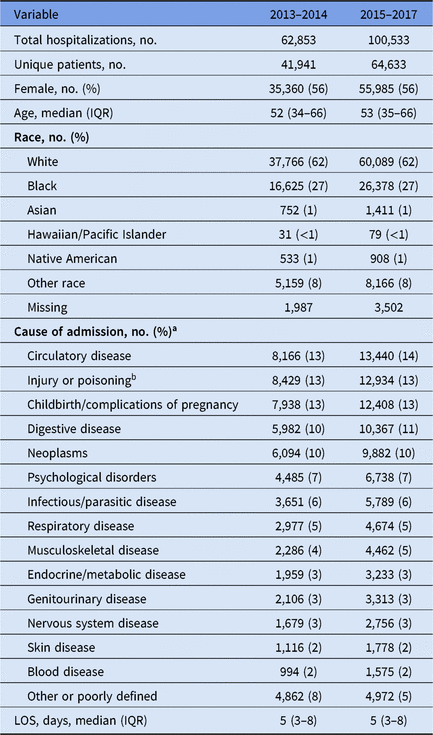
From 2013 to 2017 there were 163,386 hospitalizations (97,485 unique patients); there were 1,273 UTIs (715 ND-UTI, 558 CA-UTI) during 1,234 unique hospitalizations at UNC Hospitals. Of the 1,273 UTIs, 1,268 (99.6%) were successfully linked to a hospitalization record. Also, 142,836 hospitalizations (87%) were >2 days (median 5 days; interquartile range [IQR], 3–8 days). Patient demographics and causes of admission are described in Table 1.
Hospitalization Characteristics

Note. IQR, interquartile range; LOS, length of stay.
a Classified using primary diagnosis on each hospitalization; 2,341 hospitalizations (1%) were unable to be linked to their diagnosis codes
b A subset of these codes were used to identify trauma admissions
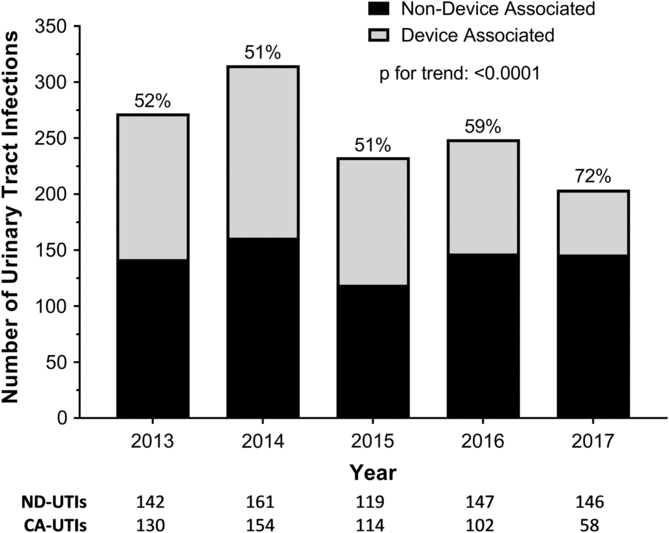
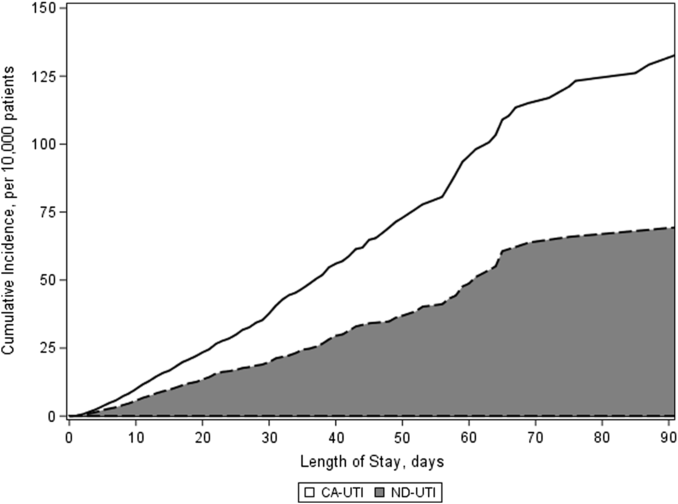
The median time to first UTI was 8 days for both ND-UTIs (IQR, 4–15) and CA-UTIs (IQR, 4–18). Between 2013 and 2017, the rate of ND-UTIs decreased slightly but overall remained stable, with 6.14 ND-UTIs per 10,000 hospitalization days in 2013 and 5.57 ND-UTIs per 10,000 hospitalization days in 2017 (P = .15). However, the proportion of UTIs that were non–device related increased from 52% to 72% during this period (P < .0001) (Fig. 1). From 2015 to 2017, 49 ND-UTIs (15%) occurred in an ICU, 229 (70%) occurred on a floor, 46 (14%) occurred on a stepdown unit, and 67 could not be classified due to missing location data. In comparison, 137 CA-UTIs (55%) occurred in an ICU, 81 (32%) occurred on the floor, 33 (13%) occurred on a stepdown unit, and 18 could not be classified. The 30-day and 60-day cumulative incidences of ND-UTI were 19.9 and 48.7 infections per 10,000 patients, respectively (Fig. 2).
Proportion of urinary tract infections (UTIs) that are device and non–device associated, stratified by year.

Stacked cumulative incidences of non–device associated urinary tract infections (ND-UTIs, gray) and catheter-associated urinary tract infections (CA-UTIs, white).

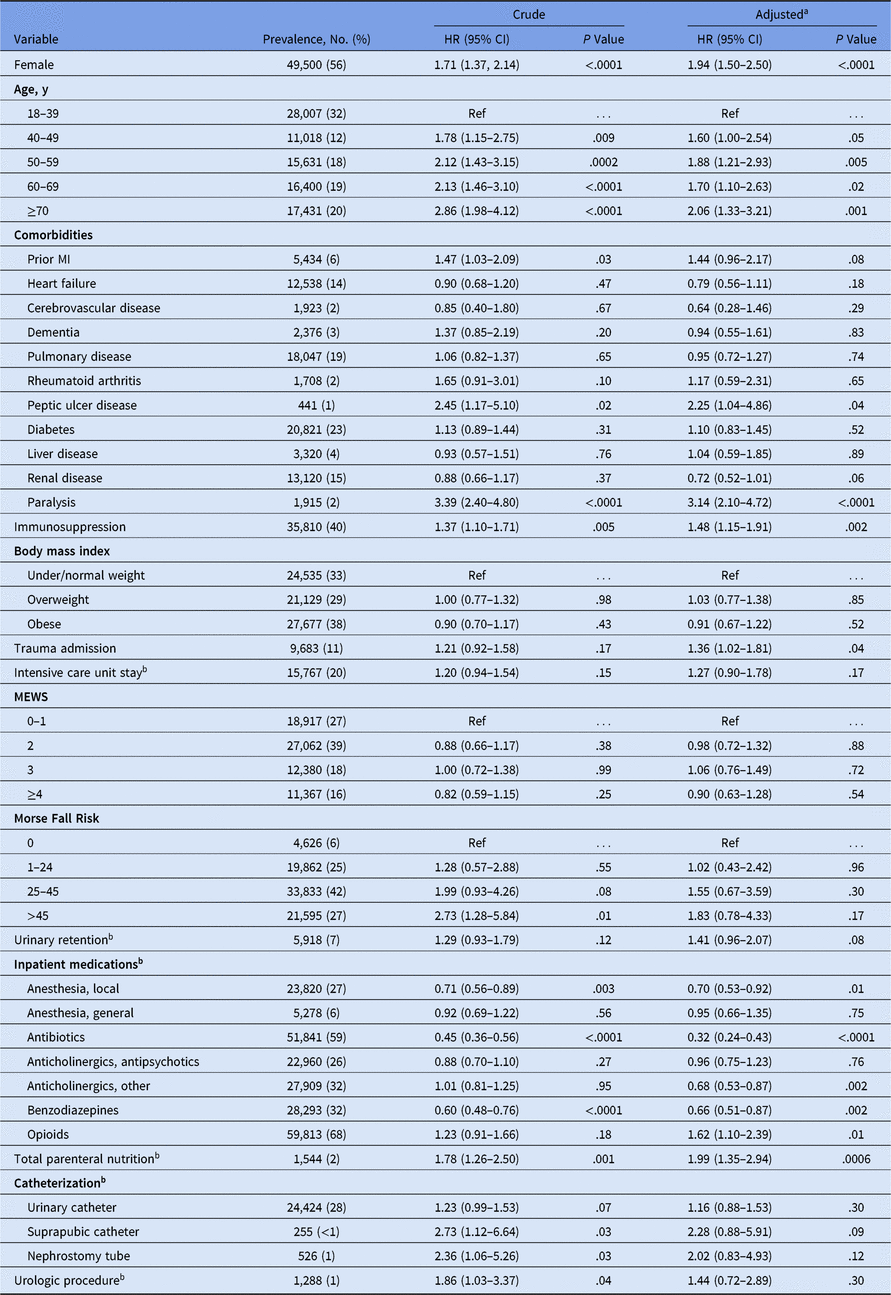
Overall, 88,487 hospitalizations between 2015 and 2017 with a LOS >2 days were included in the risk factor analysis. Median IPMW was 1.07 (IQR, 1.03–1.24; range, 1.00–21.38). Only 27 hospitalizations had a weight >10. After adjustment, female sex (hazard ratio [HR], 1.94; 95% confidence interval [CI], 1.50–2.50) and increasing age were associated with increased incidence of ND-UTIs, with patients ≥70 years old, compared to those 18–25 years old, having the highest risk (HR, 2.06; 95% CI, 1.33–3.21) (Table 2). Moreover, the effect of female sex appeared to be relatively consistent across age (P = .57). Patients diagnosed with peptic ulcer disease (HR, 2.25; 95% CI, 1.04–4.86), patients who were immunosuppressed (HR, 1.48; 95% CI, 1.15–1.91), and patients admitted for trauma (HR, 1.36; 95% CI, 1.02–1.81) were also at increased risk for ND-UTIs. BMI and MEWS did not appear to have any impact.
Risk Factor Prevalence and Hazard Ratios for ND-UTIs Among Adults Hospitalized for >2 Days Between 2015 and 2017

Note. ND-UTI, non–device-associated urinary tract infection; HR, hazard ratio; MI, myocardial infarction; MEWS, modified early warning score.
a Adjusted for all risk factors included in table above; correlation between repeat hospitalizations of the same patients were taken into account using a robust sandwich covariance matrix and inpatient mortality was treated as a competing risk using the Fine and Gray model; inverse-probability of missingness weights were used to account for missing data
b Treated as a time-varying exposure; patients were considered exposed for the remainder of the hospitalization
During the hospitalization, being given TPN (HR, 1.99; 95% CI, 1.35–2.94) and opioids (HR, 1.62; 95% CI, 1.10–2.32) were associated with increased patient risk of ND-UTI (Table 2). In the crude analyses, urinary retention, suprapubic catheterization, and nephrostomy tubes were associated with increased risk of infection, but after adjustment for possible confounders, confidence intervals were wide and effects were no longer statistically significant for urinary retention (HR, 1.41; 95% CI, 0.96–2.07), suprapubic catheterization (HR, 2.28; 95% CI, 0.88–5.91) and nephrostomy tubes (HR, 2.02; 95% CI, 0.83–4.93). Local anesthesia (HR, 0.70; 95% CI, 0.53–0.92), antibiotics (HR, 0.32; 95% CI, 0.24–0.43), nonantipsychotic anticholinergics (HR, 0.68; 95% CI, 0.53–0.87), and benzodiazepines (HR, 0.66; 95% CI, 0.51–0.87) were associated with reduced risk of infection.
Discussion
Between 2013 and 2017, the incidence of ND-UTIs remained consistent, and 72% of UTIs are now non–device associated. Females, older adults, peptic ulcer disease, paralysis, immunosuppression, opioid use, TPN, and trauma patients were all at greater risk of ND-UTI. Urinary retention, suprapubic catheters, and nephrostomy tubes also appeared to increase patient risk. To the best of our knowledge, this is the first robust and in-depth analysis of ND-UTI risk factors and the most recent assessment of ND-UTI incidence.
Over the past decade, the rate of ND-UTIs has remained relatively consistent, but the relative burden of ND-UTIs has increased. For example, from 2006 to 2009, 28% of all UTIs at UNC Hospitals were ND-UTIs and the rate of ND-UTIs was 6.4 infections per 10,000 non–device days, Reference Weber, Sickbert-Bennett, Gould, Brown, Huslage and Rutala10 but by 2012 this rate rose to almost 50%. Reference DiBiase, Weber, Sickbert-Bennett, Anderson and Rutala12 As of 2017, the rate of ND-UTI was 5.57 ND-UTIs per 10,000 hospitalization days and 3 of every 4 UTIs were non–device associated. This shift toward non-device infections is likely due to implementation of evidence-based guidelines to prevent CA-UTI; these guidelines target catheter placement, maintenance, and removal and thus have a limited impact on preventing ND-UTIs. Reference Gould, Umscheid, Agarwal, Kuntz and Pegues19,Reference Hooton, Bradley and Cardenas20 Our results suggest that current targeted surveillance practices directed at catheterized patients alone are no longer sufficient to capture the majority of UTIs in an acute-care setting.
Patient demographics and comorbidities, specifically female sex, older age, peptic ulcer disease, paralysis, and immunosuppression, were associated with increased ND-UTI incidence. Female sex, older age, paraplegia, and immunosuppression have also been shown to increase the risk for CA-UTIs, indicating that certain subsets of patients may be at higher risk for all UTIs. Reference Foxman21–Reference Garibaldi, Burke, Dickman and Smith23 However, a recent study of CA-UTIs found that after accounting for comorbidities and other severity measures, age was no longer a predictor of infection, which likely means that age is a proxy for illness severity or frailty, and not an independent risk factor itself. Reference Garibaldi, Burke, Dickman and Smith23 To the best of our knowledge, peptic ulcer disease has not been reported to be a risk factor for UTIs (or CA-UTIs), but treatments such as ranitidine may cause drug-induced urinary retention, particularly in new users, females, and those ≥60 years old. Reference Verhamme, Sturkenboom, Stricker and Bosch24,25 However, peptic ulcer disease was associated with ND-UTI incidence even after adjusting for urinary retention, indicating that other factors may also be at play.
Inpatient medication use was also associated with ND-UTI incidence. Patients receiving antibiotics, local anesthetics, anticholinergics, and benzodiazepines were at reduced risk for infection, and patients receiving TPN and opioids were at increased risk. Opioids have also been found to cause drug-induced urinary retention, Reference Verhamme, Sturkenboom, Stricker and Bosch24 although opioid use may also be a proxy for acute pain and limited mobility (especially after surgery), which may increase risk for UTIs, particularly in older adults. Reference Rogers, Fries, Kaufman, Mody, McMahon and Saint26 Several studies have also found that TPN was associated with increased fungal infections, including UTIs, in hospitalized patients (although fungal infections were not included in our UTI definition). Reference Muskett, Shahin, Eyres, Harvey, Rowan and Harrison27,Reference Yang, Chen, Hsu, Wang, Chen and Fung28 Interestingly, we found that antibiotic use was associated with reduced incidence of ND-UTIs, even though antibiotic prophylaxis has not been found to reduce risk of CA-UTIs. Reference Gould, Umscheid, Agarwal, Kuntz and Pegues19 Although local anesthetics, anticholinergics, and benzodiazepines are also known to cause urinary retention, anesthetics and benzodiazepines were associated with reduced risk of ND-UTIs, even in unadjusted analyses. Patients receiving these medications may represent an overall healthier patient population.
Finally, both suprapubic catheters and nephrostomy tubes were associated with increased incidence of ND-UTIs, but estimates were imprecise. A recent Cochrane review (2015) found little or no difference in symptomatic UTI risk between short-term suprapubic versus indwelling catheters, but patients with suprapubic catheters were catheterized for longer durations, which could explain the higher cumulative infection risk in this population. Reference Kidd, Stewart, Kassis, Hom and Omar29 Currently, neither suprapubic catheters nor nephrostomy tubes are included in the CDC CA-UTI definition, and the CDC has no recommendations for preventing UTIs in these populations, although they do call for further research on the topic. Reference Gould, Umscheid, Agarwal, Kuntz and Pegues19
This study has several limitations. First, we were unable to assess causality, and the risk factors we identified may only be indicators for the true underlying mechanisms. Second, this was a retrospective, single-center study, and our results may not be generalizable to other hospitals, particularly if the patient population is different. We also did not account for duration, dose, or underlying indications for medication use. Future studies should assess whether longer exposures or higher doses of opioids and other medications are associated with higher risk for ND-UTI. Additionally, The International Classification of Disease, Ninth Revision, Clinical Modifications (ICD-9-CM) and ICD-10-CM codes were used to identify most comorbidities. Using these codes likely underestimates the prevalence of comorbidities, although we expect this misclassification to be nondifferential and, if anything, to bias results toward the null. Similarly, ND-UTIs and CA-UTIs were captured using CDC definitions, which require laboratory confirmation. Patients treated for suspected UTIs but not cultured may have been missed. These definitions also changed in 2015; although the changes reduce the rates of diagnosed UTIs, we expected that the change would affect both ND-UTIs and CA-UTIs, and the trends we observed in ND-UTIs were consistent with 2006–2012 trends. Reference Weber, Sickbert-Bennett, Gould, Brown, Huslage and Rutala10,Reference DiBiase, Weber, Sickbert-Bennett, Anderson and Rutala12 We also only included postdefinitional change data in our risk factor analysis. Likewise, urinary retention was captured using suggestive medications; thus, patients managed without medications may also have been missed. We were also unable to assess intermittent catheterization in our analysis, which may also have increased a patient’s risk for ND-UTIs and was not included in the CDC CA-UTI definition. Reference Gould, Umscheid, Agarwal, Kuntz and Pegues19,Reference Kidd, Stewart, Kassis, Hom and Omar29 Finally, although we had a large sample size, the incidence of ND-UTI and prevalence of some risk factors were low, resulting in low levels of precision of the estimators, as indicated by the widths of the observed confidence intervals.
In conclusion, between 2013 and 2017, the incidence rate of ND-UTIs remained relatively stable, although non-device infections now represent the majority of diagnosed UTIs in our acute-care hospital. Current targeted surveillance practices for catheter-associated UTIs should be reconsidered in light of this changing landscape. Female gender, older age, peptic ulcer disease, paralysis, immunosuppression, trauma admissions, TPN, and opioids were all identified as potential risk factors for ND-UTI. Urinary retention, suprapubic catheters, and nephrostomy tubes may also increase patient risk. Future research should attempt to replicate these findings and to explore the impact of prevention strategies that target these risk factors.
Acknowledgments
The authors would like to thank Adam M. Lee at the NC TraCS Institute for his help querying and obtaining EMR data. The content is solely the responsibility of the authors and does not necessarily represent the official views of the National Institutes of Health.
Financial support
This work was supported by the National Center for Advancing Translational Sciences, National Institutes of Health (grant no. UL1TR002489).
Conflicts of interest
All authors report no conflicts of interest relevant to this article.
supplementary material
To view supplementary material for this article, please visit https://doi.org/10.1017/ice.2019.241