Typically classified as a high-income developing country (1;2), Kuwait is a small country of around 4 million inhabitants located in the Arabian Gulf. As of 2018, it had a gross domestic product (GDP) of $141.68 billion, whereas its gross national income per capita was $83,390 (2). Although total health expenditure per capita was $2,320 in 2014 (equivalent to 3 percent of the GDP), Kuwait boasts one of the most up-to-date healthcare infrastructures in the Middle East (3). Most of the healthcare services are provided by the public sector, whereas the health system is organized into three levels of care: primary, secondary, and tertiary (4). Primary health care comprises a network of around 92 polyclinics, with at least one clinic in every residential district (4;5). Moreover, the country has six general hospitals and several specialized hospitals and clinics providing secondary and tertiary care (4). The Kuwaiti Ministry of Health (MOH) is responsible for operating, regulating, and financing the majority of services provided, as well as for the purchasing of medical equipment and pharmaceuticals throughout the country (5). The workforce in Kuwait is mostly made up of expatriates. The government offers Kuwaiti citizens healthcare services free of charge (4). In the past, this was also the case for expatriates; however, this changed in October 2017, as new regulations increased the compulsory health insurance fees along with additional co-payments. These new regulations were attributed to costly medical drugs and modern technology (6;7).
Health technology assessment (HTA) aims to create evidence-based decision-making and helps setting healthcare priorities. It integrates available inputs to enable the decision-makers to formulate their judgments (Reference Chalkidou, Marten and Cutler8). It is the active channel between decision-making and research. Developing countries face unique challenges in creating functional HTA units or building necessary HTA capacity (Reference El-Jardali, Lavis, Ataya and Jamal9–11), including inefficient data exchange between stakeholders (Reference Pawson12), and poor collaboration between researchers and policy makers (Reference Oliver, Innvar, Lorenc, Woodman and Thomas13). Many policy makers in developing countries may resist HTA and disregard using the evidence in the decision-making process (Reference El-Jardali, Lavis, Ataya and Jamal9). They might not understand the short- and long-term benefits of HTA, to the point that some of them view it as an unneeded luxurious activity (Reference Ghassemi and Dehnavieh14). Moreover, political factors seem to be serious determinants of HTA implementation (Reference Bijlmakers, Mueller, Kahveci, Chen and van der Wilt15–Reference Luz, Santatiwongchai, Pattanaphesaj and Teerawattananon17). Politically sensitive findings and political interests of decision-makers could strongly affect the health policy-making process. In addition, corruption and lack of political will can prevent the incorporation of evidence in this process (Reference El-Jardali, Lavis, Ataya and Jamal9;Reference Bijlmakers, Mueller, Kahveci, Chen and van der Wilt15;Reference Doherty, Wilkinson, Edoka and Hofman16).
A World Health Organization (WHO) report identified lack of funding as a global barrier to HTA activities and plans (11). Shortage in financial resources affects HTA in developing countries at two levels: first, at the process of building HTA capacity and production of evidence; second, at the implementation of published HTA reports (Reference El-Jardali, Lavis, Ataya and Jamal9;11;Reference Babigumira, Jenny, Bartlein, Stergachis and Garrison18;Reference Mohtasham, Majdzadeh and Jamshidi19). External resources from donors and international organizations appear to be of great value for developing countries. However, these resources may lead to unintended negative consequences on building HTA capacities (Reference Mills20), mainly because funders usually focus on a particular disease area and sometimes ignore country priorities, which are not in line with their own interests (Reference Liverani, Hawkins and Parkhurst21).
There are few trained HTA experts in developing countries. Their contribution to the HTA establishment seems to remain minimal, mainly due to the limited HTA institutionalization and as a result of being hired by pharmaceutical companies (Reference Bijlmakers, Mueller, Kahveci, Chen and van der Wilt15;Reference Luz, Santatiwongchai, Pattanaphesaj and Teerawattananon17). Furthermore, HTA capacity building in developing countries is focused on individuals' capacity rather than organizational capacity, which encourages creating field champions who, at times, monopolize the field (Reference Doherty, Wilkinson, Edoka and Hofman16). In addition, availability of data needed in different stages of the HTA process remains a key challenge in developing countries. In these countries, weak patient databases, poor routine data, and non-existent costing data have been shown to lead to scarce, low quality, and hardly accessible data (Reference Oliver, Innvar, Lorenc, Woodman and Thomas13;Reference Pitt, Vassall and Teerawattananon22). Furthermore, high turnover of staff at managerial levels, coupled with lack of institutional capacity and the individualized nature of decision-making, can negatively affect the implementation of HTA (Reference Mohtasham, Majdzadeh and Jamshidi19;Reference Löblová23).
Limited research currently exists on potential barriers and facilitators to implementing HTA in Kuwait. Yet, the “dual” nature of the country (i.e., classified as a high-income, but developing economy) could give rise to unique challenges (or opportunities) regarding the establishment of a legitimate HTA process. This study sought to provide a comprehensive picture of the local context, by exploring Kuwaiti stakeholders' perspectives on the topic.
Methods
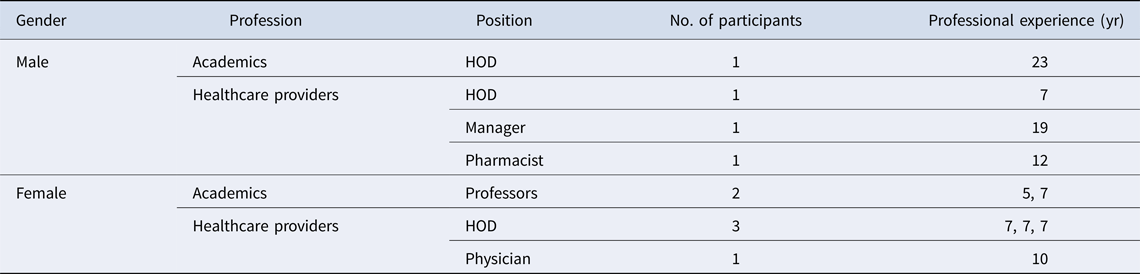
A qualitative study was conducted to gain an in-depth understanding of perceived barriers and facilitators to implementing HTA in Kuwait. The study protocol was approved by the University of Glasgow (College of Medical, Veterinary and Life Sciences), the University of Kuwait (Health Sciences Centre), and the Kuwaiti MOH. Between October and November 2018, a total of ten semi-structured, face-to-face interviews were conducted with individuals having considerable expertise in HTA, or some level of participation in the decision-making process. In particular, three academics were recruited from the University of Kuwait who had substantial experience in teaching HTA and/or related fields, and seven healthcare providers working at various departments of the Kuwaiti MOH (i.e., planning department, primary healthcare technical support department, Central Medical Stores [CMS], inspection and control, and healthcare centers). Table 1 presents further details on participants' characteristics. Other potential participants, namely one from the pharmaceutical services department and three Heads of Departments (HOD) in MOH hospitals, apologized for not being able to take part due to their busy schedule.
Participants' characteristics

HOD, Head of Department.
All interviews were conducted by the first author (BD), nine were in Arabic and one in English. Interviews were held at a mutually convenient time and location (usually at participants' offices) and lasted, on average, 1 hour. Prior to each interview, the researcher shared details about how data would be collected, analyzed, and used, and asked participants to provide written informed consent. With participants' permission, all interviews were audio-recorded and transcribed in full verbatim. Collected data were analyzed thematically, drawing on Braun and Clarke's approach (Reference Braun and Clarke24) that involves moving back and forth throughout the following phases: (i) familiarization with the data; (ii) generating initial codes; (iii) searching for themes; (iv) reviewing themes; and (v) defining and naming themes. Data analysis was conducted by the first author (BD), with ongoing review and reflexive discussions with the second author (EG). The reporting of the study was based on the consolidated criteria for reporting qualitative research (COREQ) (Reference Tong, Sainsbury and Craig25).
Results
Six main themes were identified from the analysis of the interview data, which are described in detail below: (i) knowledge of HTA; (ii) health system readiness to adopt HTA; (iii) decision-making in the Kuwaiti healthcare system; (iv) projects and initiatives; (v) research in Kuwait; and (vi) suggestions to build HTA capacity in Kuwait.
Knowledge of HTA
Most participants believed that the level of awareness of HTA in Kuwait is minimal to non-existent. Limited awareness was thought to be present along the whole hierarchy starting from the high-level management: “Most of them have never heard of the term HTA before, and even those who have heard of it think it's only for devices” (HOD for 7 years, male). Lack of awareness was not only about HTA; it extended to basics such as costing, disease burden, value of money, and financing.
Health System Readiness to Adopt HTA
Capacity and Resources
The lack of institutional and human capacity in Kuwait was a recurrent theme across the interviews. Participants talked about the absence of HTA experts, along with the lack of training programs to prepare stakeholders to understand and implement HTA recommendations and activities. On the other hand, the availability of financial resources was seen as advantageous in building HTA capacity in Kuwait: “We have the resources needed, I mean, we have money… But no one is trained in HTA” (Professor for 7 years, female).
Data Quality and Accessibility
Participants commented on the poor quality of data in Kuwait, which they attributed to three main reasons:
(1) The lack of training for healthcare providers to use the health information system or document properly:
“We don't actually train our doctors to write proper diagnosis…They have never been trained on how to document properly” (Professor for 23 years, male).
(2) The absence of governmental interest in updating the health information system, which currently does not meet the needed level of development:
“Still, if you see it now… it is primitive” (Physician for 10 years, female).
(3) Shortage in staff; which leads to work overload and giving up documentation. Participants believed that the data needed for HTA activities, namely costing data and outcome data, does not exist in Kuwait:
“If you asked what is the monthly budget for Ward 14, for example, their answer will be: what does that mean?!!” (Professor for 7 years, female).
Participants also described the health information system as fragmented and mentioned that it is possible to find many MOH healthcare facilities using different systems for documentation. They attributed this problem to the improper management and follow-up at the level of MOH. Furthermore, the MOH does not have a national plan with clearly set milestones for the health information system and electronic health records. Currently, each healthcare facility has its own plan and works independently: “When you go to <name of hospital>, the electronic health record system is superb. But when you go to <name of different hospital>, you bang your head on the wall, there is chaos everywhere!” (Professor for seven years, female).
Connectivity between different health information systems was also considered absent. Participants said that each facility has its own data that cannot be accessed by other facilities. As such, there is no proper follow-up of patients, whereas data retrieval at the national level is problematic.
Furthermore, participants talked about a non-existent culture of data sharing in Kuwait and attributed this to three main reasons: (a) reluctance to take accountability for the poor quality of the shared data; (b) fear that the shared data could disclose some critical issues about the facility (e.g., misuse or corruption); and (c) monopolizing data to gain power. As a participant put it: “They have the information but they don't share it, because they believe that knowledge is power” (Physician for 10 years, female).
Decision-making in the Kuwaiti Health System
According to the participants, health decisions in the Kuwaiti MOH are not informed by the necessary data and evidence. Decision-making process was described as complicated, with ad-hoc decisions addressing emergencies in the Kuwaiti healthcare system. Participants believed that policy makers base their decisions mainly on their personal experience, cost, and availability of resources, relevant decisions in other countries, and their own gut feeling.
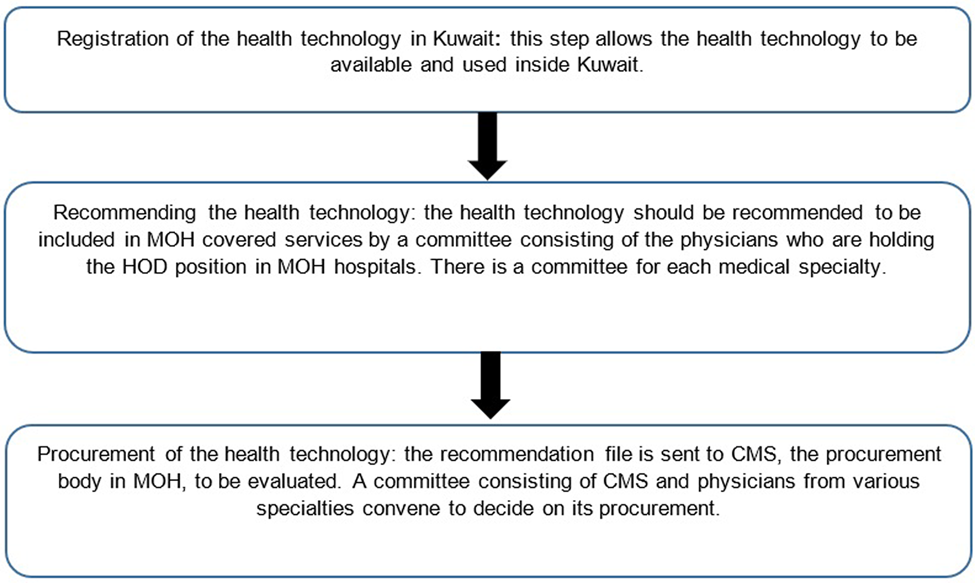
A schematic representation of the process of including a health technology in the MOH coverage plan, as described by the participants, is illustrated in Figure 1. Participants stated that the most important step is the second step, that is, to secure the recommendation of the health technology from the HOD committee. Three main factors were reported to influence the committee members' decisions; first, their clinical experience; second, the clinical evidence they came across; and third, the influence of the manufacturing companies. According to the participants, many manufacturing companies often approach physicians to gain their support; they tend to sponsor committee members to attend scientific events and conferences, arrange for workshops and invite them as speakers, or they might even provide them with personal gifts: “Each manufacturing company secured the loyalty of doctors who have big influence in the MOH” (Physician for 10 years, female).
Process of including new health technology in the Kuwaiti MOH. MOH, Ministry of Health; HOD, Head of Department; CMS, Central Medical Stores.

The possibility of rejecting a health technology after this step is very low. Participants believed that the attention of the entities evaluating the recommendation file will be focused solely on the cost. Yet, cost is rarely a limiting criterion here for two reasons: first, due to the absence of cost-consciousness among decision-makers; and second, because even in the case of resource shortages there are always ways to get more resources from the government: “I think the assumption is that the government will give them whatever they ask for” (Professor for 23 years, male).
Many participants also discussed how patients may exert influence over the health policy and coverage decisions. If a patient's request for a certain health technology was denied by the MOH, the patient might use different channels to obtain that request. Patients can exert pressure on the MOH by pleading to newspapers, asking politicians for help by using their power and relations, or complaining through social media, which was considered to be both highly influential and widespread in Kuwait: “To be honest, ministers could be changed because of a tweet on Twitter” (HOD for 7 years, female). Participants stated that Kuwaiti patients want to receive whatever services they demand, and do not easily accept that some health technologies will not be covered by the MOH in a high-income country such as Kuwait.
Research in Kuwait
Participants agreed that researchers in Kuwait hold huge responsibility in building HTA. They may contribute to building capacity by providing the knowledge, training, consultations, and building HTA infrastructure. Yet, based on participants' accounts, researchers in Kuwait may face several obstacles. For instance, even after obtaining ethical approvals from the MOH, they have difficulty in using the MOH settings in their research. Decision-makers' involvement in research would facilitate processes and get the necessary support. Currently, there is no systematic communication between researchers and policy makers in the Kuwaiti MOH. What is more, participants believed that some decision-makers in Kuwait usually go to academics to support their already made decisions. They disregard the research if its results are not in line with their decisions. Some participants viewed that this relationship depends on the personal connections and whether personal benefits could be gained or not. “I believe that their relationship could be opportunistic” (HOD for 7 years, male).
Projects and Initiatives in Kuwait
Minister Turnover and Ministry Strategy
Participants pointed out that the turnover of health ministers was very high in Kuwait. This resulted in stopping many projects aiming to develop the Kuwaiti healthcare system. When the minister changes, ongoing projects are put on hold whereas the new minister changes all the undersecretaries and administrations. Two connected factors influence these projects. First, there are no well-defined long-term plans with clear milestones for the MOH to follow. Second, each minister comes with different vision and priorities. Therefore, there are different plans for each minister. If any project is not in line with the new vision and priorities it will stop regardless of the level of its progress.
Projects and Kuwait Context
Many participants mentioned that projects and initiatives in the MOH do not consider the healthcare system conditions. MOH should pay more attention to the prerequisites for development programs. MOH in several projects added new tasks to current healthcare staff who were already overloaded, without considering if they are skillful to perform these tasks. Others pointed out that some projects are not suitable for the current infrastructure of the Kuwaiti health system. A typical example was the Canadian accreditation project, which is an ongoing project in the Kuwaiti MOH: “They want to apply the vision of Canada here, but we are not as developed as Canada … they are just covering the gaps with patches” (Physician for 10 years, female).
Suggestions to Build HTA Capacity in Kuwait
In order to successfully build HTA in Kuwait, participants suggested the inclusion of all stakeholders in HTA projects at different steps. They also proposed that the Ministry of Trading should set regulations to control the channels that industries use to communicate with the healthcare providers. To counteract the resistance and to promote for HTA demand; participants recommended spreading the awareness along the whole MOH hierarchy about HTA and its benefits. In addition, learning from the experience of neighboring countries, if any, was seen as a good way for moving forward: “This is important because you will not reinvent the wheel, so you save time, you save cost, you will eh… adopt their success stories and avoid their failures” (HOD for 7 years, male). In addition, several participants suggested establishing a separate entity in the MOH to lead the HTA project in Kuwait. This entity should be equipped with experienced and skilled personnel. Further, it should be invulnerable to any political power; this can be attained by connecting this entity directly to the minister and enforcing the implementation of its recommendations in decision-making process by law.
Discussion
Financial constraints are commonly reported as a major barrier to introducing HTA in developing countries (Reference El-Jardali, Lavis, Ataya and Jamal9;11;Reference Babigumira, Jenny, Bartlein, Stergachis and Garrison18). Yet, this does not appear to be the case for Kuwait, which currently holds the ninth spot on the global GDP per capita ranking (2). Results of this study, however, suggest that the abundance of financial resources in the country might be a double-edged sword; although it clearly has the potential to facilitate the development of HTA capacity, it also seems to hinder recognizing the need for it. In particular, participants in this study argued that the country's wealth encouraged decision-makers to make non-evidence-based choices, while paying inadequate attention to the huge waste in the healthcare sector. What is more, it had created a culture of entitlement, whereby patients believed that the country should provide them with any health technology.
Issues of data availability, quality, and sharing were commonly reported by participants, which seems to be the case in many developing countries (Reference Oliver, Innvar, Lorenc, Woodman and Thomas13;Reference Pitt, Vassall and Teerawattananon22). Data problems in Kuwait are a consequence of gaps in the healthcare system, which should be resolved to obtain quality data suitable for HTA activities. To overcome this barrier, the Kuwaiti MOH needs to reform healthcare governance at the country level. Proper supervision can minimize disparities in the progress across MOH facilities to fulfill national-level plans. The use of appropriate incentives will empower approvals and decisions from MOH, this will promote data sharing and eradicates disconnected management. Furthermore, better management will allow healthcare providers to have the time and skills needed to document different kinds of data, which will improve data availability and quality.
In line with the existing literature (Reference Ghassemi and Dehnavieh14), participating stakeholders reported a limited awareness of HTA across all the Kuwaiti MOH hierarchy, including high-level management. The weak relationship between researchers and policy makers found in this study has also been reported in studies coming from other developing countries (Reference Pawson12). The results of this study suggest that decision-makers in Kuwait might encourage this by being indifferent to research findings unless these support their agendas and already made decisions. Furthermore, the high turnover of health ministers in Kuwait appeared to constitute a major barrier not only for HTA, but for all projects requiring long-term planning and implementation. This seems to be the case in both developing and developed countries (Reference Mohtasham, Majdzadeh and Jamshidi19;Reference Liverani, Hawkins and Parkhurst21;Reference Löblová23).
Based on the interviews, decision-making in Kuwait seems to be based merely on clinical opinion, which is in turn influenced by political factors and vested interests. Process and deliberations for any decision are not disclosed to the public. Among the most pronounced influencers in Kuwait are industries; they have powerful impact on the physicians involved in decision-making. Relationship between both parties is neither regulated nor monitored. This instigates a need to supervise this interaction and formalize all kinds of communication with decision-makers.
Introducing HTA is a disruptive policy change; therefore, political support seems to be a prerequisite for any future initiatives in the country. To move forward, participants believed that political support could be gained by raising the level of policy makers' awareness and commitment to HTA projects. Building a clear strategy for the MOH to follow, regardless of who is filling the position of the Minister, would prevent the instability of higher management from stopping development projects, including HTA. Based on participants' accounts, it is essential to establish an HTA office and prepare a long-term plan that respects the healthcare system's shortcomings. This office should be independent, yet closely connected to the health minister and undersecretaries to gain political invulnerability. Incorporating the recommendations of this office in decision-making and explaining these decisions should be enforced by the law. HTA infrastructure in Kuwait is still premature and considerable efforts should be spent to equip the healthcare system with necessary prerequisites.
To the best of the authors' knowledge, this is the first study to shed light on stakeholders' perspectives of main challenges to building HTA in Kuwait. This work has several limitations; most importantly, resource constraints did not allow us to aim for a larger sample size, although it also had to rely on a convenience sampling strategy, which may not allow for drawing generalizable conclusions. In addition, invited members of the committee of HOD declined to take part in the study due to their busy schedules. Given their key position in the decision-making process, it is likely that additional aspects might have been revealed. Nonetheless, this qualitative study offers a much needed snapshot of current challenges in Kuwait. The results could be used to inform relevant initiatives in the country, also it could prove valuable for other countries sharing similar characteristics with Kuwait.
Acknowledgments
The authors are grateful to the study participants who generously gave their time to share their views. This research received no specific grant from any funding agency, commercial, or not-for-profit sectors.
Conflict of interest
The authors have no conflict of interest to declare.