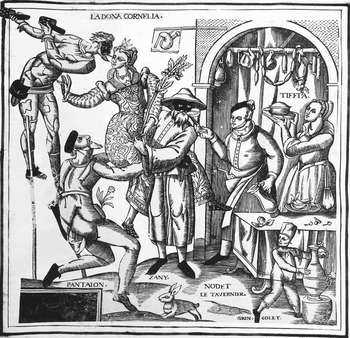
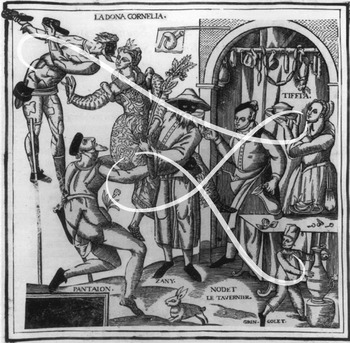
One of the things that strikes one most forcibly in surviving images of early commedia dell'arte is its enigmatic physicality, the manner in which its actors everywhere adopt postures and make gestures that seem not merely emphatic and exaggerated but almost hieroglyphic, full of some additional implication, laden with a figural and emblematic resonance that we sense but no longer see. In general terms, this quality is easily understood, as the body clearly served in commedia as a complex and polyvalent instrument of expression. Its gestures and movements were, as in all theatre, indexically linked to dramatic action, and they also served, as in much masked drama, as surrogates for the facial expression of affect, in that the movements and aspects of the whole body were enlisted to articulate the motions and mien of a veiled face and to overcome or play upon the sensation of estranged speech produced by the half-mask's bifurcation of the visage.Footnote 1 Moreover, in a manner less familiar but illustrated well in Fig. 1, these movements and aspects also functioned as expressions in their own right, not articulating the affect or expression attendant upon immediate speech or situation or delineating the lines of external action but signaling the many impulses and various appetites of the world, the varied aspects of all persons and of the body itself, and invoking at times as their implicatory context human nature, common character, and identity rather than situation, attitude, or emotion.
Harlequin, Pantalon, La Dona Cornelia, Zany, Nodet le Tavernier, Tissia, and Gringolet. From the Recueil Fossard. © Nationalmuseum, Stockholm. (Same as Fig. A31.)

This broad and variable system of physical acting, it now seems clear, was intimately linked to commedia's equally polyvalent use of speech. Language in commedia ranged in a dialectical interplay with its action over straight dialogue, rhetorical play, and macaronic babble, and its formation and structure was in many ways densely bound up with those verbal modes. Yet commedia was international almost from its beginnings, especially in the first period of its expansion and formal consolidation, as Italian troupes encountered growing audiences who were increasingly unfamiliar with their spoken language and unable to follow the matter and meaning of verbal discourse, track its dizzying enlistment of rhetorical figures and conventional sayings, note its wordplay and lyric dissonance, or appreciate the complicated interplay and insinuation of Italian civic commedia's multiple dialects. As a result, the physical language of the form evidently moved to the fore as a privileged, even primary representational mode. As Charles Sorel observed of performance at this time, the comedians “represent many things through action,” so that “even those who do not understand their language cannot fail to understand the subject of the piece.”Footnote 2
What remains unclear, however, is just how this language really worked. We know some of the rudimentary elements and many of the specific elements of commedia's physical method: the gestures and poses that actors typically used have been identified, and scholars are beginning to understand more clearly the lazzi, or little bits and routines, that most strongly characterized its physical play.Footnote 3 That the techniques of this physical language were formally understood and practiced in accordance with a coherent set of conventional rules is unquestionable: scholarship has recognized early commedia's appropriation of classical vocabularies of manual rhetoric as well as its incorporation of an already formalized popular theatrical art of facial expression and its enlistment of popular idioms of gesture that carry their own formal logic.Footnote 4 Yet we still know very little of how all these physical elements worked together and were combined, how they helped define roles, how they were organized and determined in practice, the assumptions and the conventions that would have rendered them so legible (in combination and in flow) to those who watched, the dramatic implications and social resonance they carried, or the vision of the world they produced and conveyed.
The interest of these questions lies in part in what they might tell us of commedia's relation to other theatrical and social practices, for it seems evident that commedia's enigmatic physicality seemed by no means as mysterious to its original audiences as it appears to us and that its conventions and idioms must therefore have had some common currency with the performance of theatre elsewhere and with the performative theatricality of everyday life. However, their most immediate value may lie in what they can tell us of commedia's improvisational method, that “necessary guide” or “disegno interno,” as Paul Castagno has described it, that “substituted for the absence of a dramatic text (disegno esterno)” in much commedia performance.Footnote 5 Not all commedia performance was unscripted, of course, but as scholars have long recognized, it was that method of improvisational performance—the virtuoso ability to stitch together an unscripted tale on the fly, building action and incident from a skeletal template or a familiar premise or a rumor in the air—that marked the formal novelty of the commedia dell'arte, defined its particular character, and constituted the basis of its influence and reputation. For many, it is as an improvisational method that commedia best studied and understood.Footnote 6 Yet, with the exception of a number of recent works that have interrogated the role of literature and text in the improvisational practices of early commedia, critical understanding of that method remains extraordinarily limited, and the role physical techniques played in it, while now widely recognized as integral and important, remains largely unexplored.Footnote 7 That this is so is due in part to the nature of the historical record: surviving texts offer a great deal of information about commedia's institutional practices, its development of roles and repertory, and its diverse stock of conventional plots, dialogues, and speeches, but for many reasons, they contain comparatively little about its improvisational methods and even less about its physical techniques. However, it is also due to an apparent bias within commedia scholarship, which has tended (following the bulk of archival evidence) to privilege such textual records over what is now a considerable, well-articulated body of pictorial evidence and to focus, commensurately, on early commedia's improvisational use of verbal and literary rather than physical and gestural elements.Footnote 8
The implications of these questions extend well beyond the study of commedia itself. As is well known, the commedia dell'arte had a profound impact upon early modern theatre and exercised a lasting influence on the development of theatre and drama in modernity. From it would emerge some of the most innovative and radical theatre of modern times, and in the history of its appropriation and reappropriation in subsequent centuries one can recognize what is in some sense an alternative, often anti-Aristotelian genealogy of modern theatre—a “minor” genealogy that looks very different from the trajectories traced out by the realist tradition and its focus on interiorized character and action. In France, commedia sets a strong line that runs through the barbed political comedy of Molière, the subversive play of the fêtes galantes, and the scabrous farces of the pre-Revolutionary fairs to the incendiary works of Beaumarchais, de Musset, and Apollinaire and in refracted form those of Jarry, Artaud, and Genet. In England, it frames a history that runs through Commonwealth fairground puppetry and John Rich's explosively popular harlequinades to Fielding's and Hogarth's politically charged stages, the popular pantomime traditions of nineteenth-century spectacular theatre, and the sensational melodramatic stage. In Lessing and in Büchner we find it shadowing Germany's radical tradition as well, and in Meyerhold's work commedia becomes imbricated in the theatrical aesthetics of Soviet modernism. In short, the influence of commedia is powerfully evident in many of what now appear to be the most interesting developments in modern theatre, and it informs, often in intimate ways, some of the most radical and significant engagements of the modern theatre with political and mass modernity. To lack a clear understanding of commedia is to lack a clear sense of these changes and of the larger trajectory they describe, and to lack a clear understanding of commedia's physical methods and techniques, of its use and understanding of the body, is to lack a clear sense of the radical history of the theatrical body in modern culture.
This article seeks to contribute to our understanding of that history and to provide some better basis for understanding the “minor” genealogy of modern theatre it helps to define, and in the conclusion I offer some observations to that end. My primary aim here, however, is more limited and is oriented toward the more primary need to offer a tentative introduction to the physical techniques of early commedia—to outline their basic logic and structure, to suggest something of the role they played in commedia's improvisational method, and to provide some sense of the vision of the world (and the understanding of the body's relationship to it) that this physical aesthetic articulated and implied.
I do so, it should be said, in a very limited way: by examining just one iconographic source—a celebrated series of woodcuts of early commedia dell'arte performance, one of which is the image reproduced above, contained in a miscellany known as the Recueil Fossard. To generalists such delimitation may seem severe; to specialists, it will come as no surprise, as this Fossard series was recognized from the moment of its discovery in the mid-1920s as a uniquely valuable piece of evidence in early commedia's relatively sparse iconographic record. As no adequate reproduction of it has ever been published and as the series deserves much wider recognition and study, I have appended a set of its primary images (see Appendix).Footnote 9
In the number, scale, generic range, and magnificence of its scenes, the Fossard series is an exceptional iconographic artifact: in all, it contains nearly three dozen large, highly detailed, meticulously composed images, including not only an extended group of spectacular portraits but also two dozen remarkable vignettes of some kind of theatrical performance as well as a small number of fascinating emblematic and figural compositions.Footnote 10 Although its artist or artists remain unknown, evidence suggests that it was probably produced in Paris sometime in the mid-1580s, perhaps as an album commemorating the appearance of a group of commedia performers at the court of Henri III. To date, scholarly interest in the series has focused on its potential documentary value: in it one finds not only the earliest depiction of Harlequin as a character on the commedia stage (and one apparently produced coincidentally with the origination of the role), but also what appears to be the earliest detailed record of an extended dramatic performance—that is, of some sort of play—on that stage.Footnote 11 Moreover, the series offers rare—and in some instances unique—portraits of a number of the most celebrated players of the early commedia stage, several of whom originated seminal renderings of what would become commedia's most prominent roles.Footnote 12 However, efforts to identify a plausible occasion on which these several performers might have appeared together on the same stage, to determine the order and matter of the play or plays it appears to represent, or to establish even the identity of the actor who might have played this originary Harlequin have all been unsuccessful, and recent scholarship has begun to suggest that efforts to interpret the series as the documentary record of an actual performance may be misguided.Footnote 13 As Castagno and M. A. Katritzky have pointed out, the images of the series are composed throughout in a manner that suggests not documentary particularity but formal typification and stylization, with figures that are distorted into the elongated proportions and occasionally impossible poses typical of mannerist aesthetics, settings and costumes that appear at times to be allegorical and idealized, and scenes that appear less to articulate any plausible single narrative than to illustrate a varied collection of exemplary moments, situations, and motifs.Footnote 14
What such characteristics imply, as Alba Ceccarelli Pellegrino has recently suggested, is that the series as a whole appears to have been designed not simply (or even primarily) as a documentary record or album but as a formal composition and a functional tool for play: its scenes, she insightfully notes, seem together to constitute a kind of virtual theatre, a functional “theatrical machine” that would have “the same effect on the reader-spectator as many theatrical presentations” and enable an amateur enthusiast to construct any number of different performances and plays, both imaginary and real.Footnote 15 Put slightly differently, the Fossard series seems to be not (or not only) a record of commedia performance but a practical and methodological kit, a toy, or a game with which to play at playing and thus to learn how to play well. It is, put slightly differently, a set of images that seems to have been designed to convey an understanding of commedia's techniques and method, and although it has not yet been studied in detail from this vantage, the manner in which it does so—once its functional design becomes evident—is not hard to discern. Like a traditional comic parade of dramatis personae, its character portraits introduce the reader to primary roles; like a set of repertorial templates, its vignettes offer models of improvisational play; and like a set of reference guides or printed rules of play, its formal tableaux and decorative emblems delineate central features of commedia's aesthetic structure and internal design. For the sake of convenience, I will follow that generic order, offering first some treatment of the general manner in which each pictorial genre relates to what we know of commedia performance and then providing a brief description of what the Recueil Fossard's particular images tell us of commedia's physical techniques and their relation to its improvisational method.
Figure and Role: Portrait Images
Character portraits constitute the most common and fundamental genre of the Fossard series and of commedia iconography. That this is so is unsurprising, for commedia was a theatre dominated by character rather than story and by role rather than script. As is well known, characters in the commedia dell'arte were “fixed”; that is, they acted and existed within a fictive temporality rather like that of Bakhtin's “romance time,” in which even the extended passage of events would bring neither development nor age, in which memory would halt at the bounds of local action.Footnote 16 While it is obvious that they were nothing like the individuated historical subjects of the sort found in Shakespeare, they also were not “stock” characters of the sort represented by the conventionalized social personalities of melodrama and realist drama or direct social caricatures of the sort produced by casual farce or topical satire. Instead, they were typological figures, complex, artificially constructed “personages” that were understood as synecdochal figures for various constellated or “nested” attributes of social identity, personal attitude, physical sense, desire, and appetite.Footnote 17 They were in this way closer in status to Jonson's later but more familiar (though much less iconic) characters of the “humours,” socioallegorical constructs in which social type, characteristic appetite, and customary forms of desire were melded in a complex, layered constellation of aspects. Pantalone, for example, represented or could represent a retired Venetian merchant; a greedy and lustful old man; a lean, aging body wracked at once (and in complementary fashion) with jealous, retentive anxiety and immoderate, flagrant sexual need; and/or a figure of all that we associate with age, avariciousness, and impotent lust.
Such strict figurality might seem to suggest a fairly static representation of character in action, but in fact it involved and made possible a great deal of variation and play, for there were many aspects to any given role. Which of these would command the character's action and words was determined, most immediately, as in a comedy of puppets, by the other character or characters with which the role was put into play. That dialectical system was grounded, as surviving texts make abundantly clear, in an extended dialogical structure of role pairs, in which each aspect of one character corresponded (and responded) to a complementary and symmetrically opposed aspect of another.Footnote 18 To offer two very basic but fundamental examples, Pantalone's interactions with the zanni, his greedily hungry servant, tended inevitably, if through infinite variations, to bring out the master's characteristically grasping avarice, whereas his encounters with an innamorata, the ever-elusive object of his desire, would foreground instead (and with equally inexorable variation) the old man's customarily impotent lust.
Though they have not yet been much studied from this perspective, illustrated commedia portraits—at least until the eighteenth century—are correspondingly formal and indexical, tending, like the actors in their construction of roles, to present not glimpses of intimate personality or even individualized actorly personae but influential or celebrated formal presentations of a role's distinguishing appearance and action—articulations, through a skilled actor's gestures, postures, attitudes, apparatus, and remarks, of paradigmatic aspects of figural character. Put differently, such portraits appear to have been designed not merely or even primarily to memorialize an actor, a character, or a moment in some particular play so much as to record some notable or exemplary formal rendering of a specific role or—even more characteristically—of a specific role pair.
One of the remarkable but as-yet-unrecognized qualities that distinguishes the Recueil Fossard portraits is that they are evidently designed, though they number only five in all (A25–A29), to offer something like a complete formal set of these pairs. That is, they lay out—with impressive economy and unrivaled comprehension—the primary aspects of and the basic relations between all of the early commedia dell'arte's central types of role.Footnote 19 The first two portraits show us the two pairs of core characters that together define the possible configurations of the master–servant relationship: Francatrippa and Harlequin (versions of a zanni, or servants; Fig. A25) and Pantalon and Messerre DotourFootnote 20 (versions of Pantalone and the Dottore, archetypes of the first and second vecchi, or masters; Fig. A26). These pairs serve in formal terms to delineate different modalities of that most fundamental axis: that is, they show in respective order the two alternative variants of the servant and master types and thus delineate individually roles that are parallel rather than opposed. The first double portrait (Fig. A25) sets the first zanni's more assertive, low, and knowing role, filled with grotesque language and underhanded violence, against the second zanni's more graceful, naive part, in which macaronic language and lithe contortion serve the same disruptive functions. The second double portrait (Fig. A26) differentiates Pantalone's closed, greedy role, in which the ridiculous vaunting of courtly rhetoric serves as the failed instrument of the master's potency and power, from the doctor's open, capacious part, in which the pedantic declamation of scholarly language continually tumbles into the burlesque.Footnote 21 The three other portraits show us, by contrast, a number of fundamental countervalent types—which is to say, pairs of different role types that would meet often in play. First we are shown the two most basic of these interactive pairs: that of the innamorata (here, “La Donna Isabella”) and the vecchio (here, “Pantalon Inamorato”) (Fig. A27) and that of the vecchio (here, “Segnor Pantalon”) and the zanni (here, “Zany Corneto”) (Fig. A28)—the double pairing that articulates Pantalone's basic duality. These together define what seems to have been a central triangular constellation of early commedia's formal role relations, a kind of pivot of possible action that was anchored in Pantalone's competing aspects of impotent lover and incompetent master.
The fifth portrait (Fig. A29), however, suggests that this central triangle is only the base geometry of a more extended structure of similarly symmetrical relations: it depicts Francisquina, a figure of the servetta or soubrette, and Il Signor Horacio (Segnor in Figs A10, A13), an exemplary innamorato—a crucial pair who here provide a neat chiastic inversion and complementary lower love-pairing to the innamorata–vecchio configuration of Isabella and Pantalon in Fig. A27 (with the fecund, lusty servetta as the reversed figure of her chaste mistress and the potent, youthful, slumming innamorato as that of the impotent, status-seeking old man). Thus, these two pairs together imply a doubled, high–low configuration of amorous relations in commedia. Appropriately, that doubled configuration is rendered more explicitly and fully in two of the series' closing vignettes (Figs. A23, A24), a pair of concluding tableaux that adopt the portrait genre's static, axially balanced pictorial form and serve similarly to offer exemplary, role-defining compositions. Fig. A23 sets the low lovers of Fig. A29 against the two zanni, where the innamorati function instead as a higher pair of scheming underplot figures and thus suggest, with the even lower zanni, a similar high-low doubling, within the underplot, of lower comic types. As one should expect, all four figures are here slightly more base in appearance and specific identity than in their first depictions, as they occupy and together define commedia's lower register of roles: Francatrippa is replaced by a mere “Zany,” drunken and violent, and the rhetorically adept Horacio becomes the more lyrically amorous and more common “Il Segnor Léandro.” Similarly, Francisquina appears now in the dress of a servant, and Harlequin's graceful bend has been drawn taut like a bow as he brandishes a zanni's low blade. Fig. A24, in complementary fashion, offers a glimpse of the higher register of roles. Like Fig. A27, it depicts that register's central pairing of the innamorata (here, “La donna Cornelia”) and the vecchio, but here that pairing is softened and refined, taking the form not of a raw (and rejected) expression of lust but a restrained (and graciously accepted) invitation to dance. Again as one should expect, the figures are here slightly more elevated in appearance and specific identity than in their earlier depictions: Pantalon assumes more dignified position and proprietary aspect of “Il Segnor,” and Cornelia, far from adopting Isabella's alarmed posture of rebuke, stands in easy repose. Between the two, offering an axial link to Fig. A23's lower constellation, appears “Il Segnor Léandro,” who has traded the bravo's sword of a lower-plot lover for the lute of a courtly accompanist to love.Footnote 22
The portrait images of the series and their associated tableaux thus offer a uniquely systematic introduction to commedia's dialectical system of role pairs and a significant addition to a critical understanding of that system's extended structure. However, their value is by no means limited to their illustration of that foundational aspect of commedia's method. The most striking thing about these images (and certainly the primary source of their value in this analysis) is that they also provide a full delineation—and to my knowledge a unique one—of what appear to be the basic principles of early commedia's elaborate language of physical acting. A detailed treatment of that language, even as it is articulated in this series, would be impossible here.Footnote 23 However, obtaining a basic introduction to it is not particularly difficult, for the Recueil Fossard images articulate with some precision and often hilarious effect what seem to have been two fundamental rules of commedia's physical grammar: handedness and (for lack of a better term) posture.
Every gesture in the portrait images—indeed, every gesture in the Fossard series as a whole, no matter how incidental—seems to be inflected by handedness: that is, before anything else, and aside from its specific denotative meaning, whether a gesture is made by the right hand or the left seems to have implied not only its probable effective force but also its moral and ethical valence. More specifically, these images suggest that in performance the right hand, both individually and in terms of stage position, carried a clear connotation of power, agency, potency, and rectitude: it was properly the correct, dexterous “upper” hand, both in the sense of enabling dominance and in the sense of its use as the expressive member of the higher senses and their associated impulses and expression. Everywhere in the Fossard series, a gesture carried out with the right hand—good or bad, skillful or clumsy—is right: if vigorous and adept, it rules the scene. Throughout the series, the most successful efforts to employ the right hand well are those of the innamorati, both male and female, for they were the most elevated of commedia's characters and the most closely associated with the efficacious use of the classical precepts of rhetorical address (see, e.g., Figs A10 and A12). However, the most interesting right-hand player is undoubtedly Pantalon, for whom the right hand never quite rises to the proper level (e.g., Figs A17 and A20) or goes missing when it does (Fig. A8). Instead, its most characteristic position—if not raised in outrage or command—is on or near one of his elaborate codpieces (Figs A24 and A27), an unambiguous sign of his impotent lust and a sly commentary on the links between the operations of Pantalon's needy desire and his tendency to engage in self-inflating pride.Footnote 24
The left hand, conversely, seems to have been that of loss or weakness, inefficacy, impotence, and error: it was properly the “under” hand, both in the sense of enabling scheming and deception, and in the sense of its use as the expressive member of the lower senses and their associated impulses and expression. Throughout the Fossard series, it is the zanni, as one would expect, who are masters of the left-handed gesture, to the degree that it comes to seem their natural and definitive hand of action. For example, in the images discussed above, it is in Francatrippa's left hand that he holds his threatening wooden sword, the sign of his corrective power of violence (Fig. A25); it is in Zany Corneto's left hand that he holds his bowl, the sign of his dominating construction of desire (Fig. A28); and it is in Zany's left hand that he holds the bottle (fiasco), the raised (and now empty) source of his questionable martial ardor and inevitably that which impedes its success (Fig. A23). Pantalon, by amusing contrast, seems always to keep that hand behind—most typically, as we see in Figs A24 and A30, clamped to his buttocks in what seems a gestural sign of his retentive avarice and its association with the left-handed actions of his hungry, scatalogically inclined servant.
Harlequin, interestingly enough, is remarkable not least in his pronounced ambidexterity. In this quality he articulates what seems to have been a general attribute (that clever naïveté) of the second zanni, a role type that (as Perrucci noted, in a phrase that seems unappreciated in its significance) is “mannered so that he does not know his right from his left.”Footnote 25 However, the Harlequin of the Fossard series takes the ambidexterity of his type to an extreme: as the first portrait image suggests (Fig. A25, but see also Fig. A10), it seems precisely to be Harlequin's forward thrust of both hands—the left (and lower) holding out the zanni's wooden blade (the sign of low play) and the right (and upper) holding out the hat of a master (the sign of elevated play)—that distinguishes him as a novel type of clown, provides his character with its exceptional mobility, and distinguishes him as a uniquely powerful role. This status-shifting ambidexterity is pronounced throughout the Fossard series, reaching its most extreme expression in the literal limb reversal (elbows forward yet palms inward) that marks Harlequin's mock adoption of courtly and heroic status (Fig. A12). Appropriately, blade and cap are reversed again in the four-figure image of lower role types (Fig. A23), where Harlequin's aspect bends toward his roots as a servant.
As the portrait (and other) images suggest, posture, in general terms, appears to recapitulate this implicatory logic on the vertical plane: elevated pose, a forward stance, and an unbowed back (see, e.g., Figs A12 and A29) conform to rectitude, force, propriety, and mastery, whereas lowered pose, a rearward stance, and a bowed back (e.g., Figs A16 and A28) convey scheming, weakness, impropriety, and servitude. However, posture also seems to include the body's disposition vis-à-vis the audience: open positions (e.g., Figs A7 and A21) suggest revealed character, simplicity, or truth, whereas closed or turned-away positions (e.g., Figs A9 and A20) establish distance, deception, or falseness. Finally, wide stances (e.g., Figs A8 and A27) suggest weakness, possession by forceful humors and passions, a closeness to the ground, and a yielding to impulse, whereas unusually tight stances (such as the one we find Léandro adopting in Fig. A23, where he holds the highest status) suggest commanding strength, self-possession, and control of (or detachment from) natural bodily desire.
The use of posture seems thus to have been much more nuanced than it might at first appear, for roles in the Fossard series tend to combine these various elements in subtly complex and ironic fashion. One can, for example, note incremental variations in the elevation, balance, and openness of the innamorati that correspond neatly to both their relative status and their relative integrity (or lack thereof). Moreover, posture is typically combined here with handedness as well, adding additional implication. To offer one fairly simple example, in the first portrait (Fig. A25), Francatrippa adopts a determinedly forward stance, immediately suggesting his aggressive demeanor, but it is his (low) left foot that leads, reinforcing the comically awkward carnal thrust of his blade, while his right lingers behind and points back to suggest his probable flight. Why this is so—why his aspect leads so closely to the nature of his actions—is easy to see, for he bends with servility and stands, as zanni almost always do, wide open, his character (here inflamed by anger) unthinking, laid out for all to see.
The portrait images of the Recueil Fossard thus provide a full introduction to what were probably the basic principles of commedia's physical techniques and their use in the delineation of roles and role pairs. However, they do not reveal much at all about the relation of those techniques to commedia's improvisational method, for the logic of pairing was only the simplest of commedia's configurations of character, and it informed but certainly did not define the negotiation of action in performance. Instead, as one can see at a glance in another genre of the series, the dramatic vignettes, the situational logic of commedia's improvised action was characteristically determined by triangulations, three-character arrays in which a base pair is set against a troubling solitaire, who draws out conflicting and contestatory demands on the paired roles, thus forcing the “turn” in a character's aspect that defines commedia's episodic humor. Similarly, the principles of handedness and stance, while they define the grammar of commedia's physical technique, tell us little of its syntax, or of how it contributed in sequence to that structure of play. To understand these dynamic elements of commedia's method, it is necessary to turn our attention to those dramatic vignettes and their relation to commedia's particular style of theatrical performance.
The Body in Action: Dramatic Vignettes
As is well known, just as the early commedia dell'arte invoked and employed a specific and rather unfamiliar concept of character, it also employed and invoked a specific and rather unfamiliar concept of theatrical performance. First, despite an evident reliance upon literary models for material, early commedia remained dependent less upon full and fixed dramatic scripts than on a fluid repertory of conventional plots (scenarios) that were recorded in textual form (if they were recorded at all) by skeletal, referential descriptions of action and episode, the whole negotiated and filled in with assorted memorized dialogues and set speeches, songs, dances, and bits of comic business and acrobatic display (lazzi) that were, for the most part, transmitted orally and learned in practice. Commedia troupes typically offered a larger scenario interspersed with assorted interludes and routines in one performance, but the whole would not necessarily cohere into a larger, sequential narrative or unified action, and a central narrative would not itself serve as the primary source of interest and amusement.Footnote 26 Instead, like variety theatre, commedia was an “open” theatrical form: it relied for pleasurable effect upon what it could do with its material, how it could use an extemporaneous premise to produce pleasing combinations of the company's limited, overlapping repertory of personae, situations, and routines.Footnote 27
Scenarios themselves were designed to fit such imperatives. They came in many genres, but they tended most strongly toward the loose structures of romance and love intrigue, forms in which the company's capacity for combinatory invention could be most widely exercised. Like fables or parables, these dramatic tales had an ambivalent relation to any specific context. As suggested by their earlier term, soggetto or “theme,” scenarios used plots as thematic conceits to trace actions understood as exemplary and quotidian, as patterns of experience widely applicable to everyday life rather than particular outlines of historical events. In consequence, like commedia's roles, scenarios reflected the logic of typification rather than that of individuation, and their improvisational construction produced a dramatic world that was in consequence radically episodic, a world in which reality—even within a sustained dramatic narrative—could find itself lapsing into dream, lyric, and song, or discarded momentarily in favor of direct comic address. In consequence, commedia's specific scenes tended to be organized within a repertory as exemplary presentations of certain types of situation rather than as presentations of singular events within a particular narrative. These episodes were not freely interchangeable, for commedia's improvised negotiation of plot followed clear paths of introduction, complication, reversal, and denouement, and most episodes adhere to a specific formal position. However, substitution and variation of scenes that shared structural functions was, like substitution and variation of stock speeches and gags, to be expected of an able ensemble.
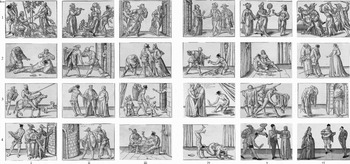
Such radically typological logic defines the aesthetic focus of the Recueil Fossard's vignette illustrations (Fig. 2). In them, as Pellegrino has noted, the reader-spectator is offered not simply records of some indeterminate performance but also “model” scenes or schematic renderings of favored kinds of bit, play, or “trick” in a formal repertory of possible situations.Footnote 28 Like the delineations of roles in the series, these particular models appear to have exercised considerable influence. Among them, one finds, for example, recognizable invocations of what would become definitive narrative moments in Don Quixote (Fig. 2, 3i [cf. Fig. A13]) and Cyrano de Bergerac (Fig. 2, 4ii [cf. Fig. A20]), figurations, respectively, of the quest of the mock hero and the romance of the lyric clown.Footnote 29 Moreover, the dramatic vignettes, like the portraits, appear to constitute a nearly complete and comprehensive formal set, presenting a full range of situations, including lazzi, musical interludes, and moments of dramatic explication, complication, confrontation, and resolution. As a group they thus provide an unusually valuable guide to the characteristic tenor and formal organization of commedia's episodic dramaturgy. As the series suggests, such episodes tended strongly toward farcical renderings of common legitimate narrative and symbolic motifs. In addition to mockeries of epic and romance, for example, one finds parodic versions of biblical narrative (a mock pièta; Fig. 2, 2i [cf. Fig. A7]) and of legitimate social comedy (a mock marriage; Fig. 2, 3ii [cf. Fig. A14]).
Composite of Recueil Fossard vignettes, arranged in four horizontal acts of six scenes. © Nationalmuseum, Stockholm.

The series also suggests that the organization of commedia's scenes, like the construction of its roles, was shaped and defined by a formalized set of physical conventions. First, as one would expect from their figurality (and as Pellegrino points out), the dramatic vignettes of the series articulate what was evidently a coherent and self-consciously pictorial dramaturgy. More specifically, like the scenes of melodrama, those of commedia appear to have been organized theatrically so as to enable the performers to realize emblematic visual tableaux—static moments, held for effect, in which the figural significance of a particular episode could be recognized and read (even by “those who do not understand their language”) in the disposition and attitudes of its figures. In part, such tableau compositions seem to function in the same manner as the portraits in the series, setting up a dialectical juxtaposition or constellation of roles in whose related gestures and postures one may discern the essential character of a scene and the basic relations among its figures. Unlike the portraits, however, the vignettes are imbued with action and expressive of the temporality of situation, and as such they are more diverse and variable. Some are active, surging forward in suggestive anticipation, or flying about in uncontrolled play; others are conclusive and still, or tensely frozen, or deliciously, slowly indulgent in a moment of stolen repose. As such they may seem contingent: however, when laid out as a whole—in what are evidently four discrete acts, each composed of six individual scenes—the series' dramatic vignettes appear as well to reveal a formal language of physical acting tied to the development of plot, a sort of syntax of gesture and posture through which the narrative motion, function, and implication of particular kinds of scene could be rendered visibly, even if their verbal matter remained unintelligible.
Specifically, one finds that in all of the opening scenes (those situated leftmost, in column i) the players adopt an unmistakable left-to-right inclination and form situational compositions defined by an inaugural lean in from the left—a lean realized most often by left-handed gestures. Such a pronounced visual bias does more than imply a simple left-to-right inauguration of action: in Harlequin's sneaking, left-handed theft of Act I, in the suggestively interlocking gestures of the zanni and Harlequin in Act II, in the farcical presentation of Harlequin as a left-handed hero and Horacio as his left-handed herald in Act III, even in Harlequin's leaning Act IV introduction to song, one finds a characteristic syntactic combination that conveys, even without recourse to words, the presentation of subversive action or ironic commentary as a wry introduction to deluded heroic or romantic endeavor.
In the second scenes, those of complication, we find, equally invariably, that the players adopt instead a strong right-to-left inclination, a retrograde orientation, and form situational compositions defined not by a lean in from the left but by a rising, countering motion from the lower right—a motion characteristically realized not by catalyzing gestures of the hand but by reactive stances of the feet. In Harlequin's surging, foot-forward dance of Act I, in the two retrograde quest parades of Pantalon and his zanni in Acts II and IV, in the eloquent physical array of Act III's wedding scene,Footnote 30 these scenes delineate a physical syntax of complicating action, a pattern that finds its point most often here in the responsive, if impotent, right-handed actions of the vecchio, the archetype of the blocking figure, and, as we've seen, the “pivot” role around which commedia's comic action turns.
The third, fourth, and fifth scenes of these acts tend to operate as sets, articulating together the rolling, chiastic inversion of roles and reversal of power that forms the central motion of comic plot. The tumbling shapes of these intermediary episodes vary more in form, as they delineate inversions and reversals of different situational types and describe the most rapidly changing and uncontrolled phase of the action, but they exhibit nonetheless a shared physical dynamic of cyclical revolution and reversal. As we would expect, the majority of third scenes (those of Acts I, II, and III) and particularly those of pursuit and claim (in Acts I and II) are marked by a renewed pressure from the left against a weakened right as unruly protagonists push forward against the fleeing, yielding, retreating opposition. Of all the scenic structures, those of these third scenes, as they delineate the acceleration and rising tension of the plot, are most imbued with an anticipatory temporality, repeatedly illustrating moments of impending rather than realized significance (the moment of chase, of deceptive conquest, of piteous confrontation), and they accordingly throw their weight forward and to the right of the stage.
In most of the fourth scenes (Acts I, III, and IV), those of deception, discovery, and challenge, we find the figures composed so as to illustrate the central, chiastic tumble of comic reversal and recognition—the overcoming of order's resistance by disorder and with it the left–right reversal of positions that conveys the now inverted relations of protagonists and antagonists. These are central, medial scenes, and in them we find a poised left-to-right balance and a pronounced intermixture of right-handed and left-handed gesture and stance that suggests their formal resonance with portrait images and evinces the importance of such revelatory moments—when characters break through restraint to reveal an alternative aspect of their nature—in the full articulation of a role. Harlequin, for example, becomes in two of these scenes (those of Acts II and III) a reactive figure, occupying the lower right in a pair of strong postures that are emblematic of his ambiguous status as a master of both the low, violent play of a zanni and the ardent supplications of a courtier. In fact, the specific attitude that we see him adopt in Act II would become an archetypal figuration of the role, as the pose wryly captures both the essence of the Harlequin's capabilities within commedia's world and the performer's graceful abasement before his courtly patrons.
In most of the fifth scenes (Acts II, III, and IV), those of renewed and rectifying amorous or martial pursuit, one finds, as we might by now expect, a strong rising motion from left to right, the lift up and out of the central chiastic roll that counterbalances the tumble downward and into it as the plot regains momentum and balance and moves toward its end. Typically, we find here figures engaged in roused, corrective effort, and the action is marked everywhere by the gestures of upturned, rising right arms—gestures notably “under”-handed and hence not dominating, but driven by and expressive of an assertion of rightfulness and of proper correction, expression, and claim. Finally, the sixth scenes, those of comic denouement, set weakened, reactive lefts against grounding, concluding rights, marking a momentary restoration of balance and order, an unsteady pause of conflict, and a leaning tilt, of varying strength and emphasis, back toward the left. In these scenes the figures are in a certain sense put in their “proper” social place, with the right now firmly occupied by figures of corrective justice, romantic grace, strength, and authority and the left by weaker figures of misguided lust, farcical mock heroism, blindness, and acquiescence, a restoration that both concludes the extended, rolling pendulum swing of the act as a whole and sets the stage for its resumption and repetition.
Recognition of this long, rolling pattern is in itself arresting, for it suggests a powerful, close connection between physical choreography and comic action, one that pulls commedia's improvisational physical methods several steps closer to dance and renders more apparent by far its resonance with and reliance on mime. However, it also makes evident a deep, almost visceral structural correspondence between commedia's physical techniques of gesture and posture and its construction of improvised comic drama, a correspondence that implies a gymnastic as well as a verbal understanding, in practice and in reception, of commedia's dramatic design, or disegno interno. More than offering a systematic treatment of “model” scenes, the dramatic vignettes of the Fossard series articulate a formal dramatic order that finds embodied expression through a coherent set of physical dramaturgical conventions that are themselves grounded on and articulated by the figurative physicality of commedia's roles and thus on the figural conception of the body as an instrument of representation. It is in this deeply fundamental structural sense, I think, and not simply in its dramatic focus on fixed characters, that commedia might best be understood as a theatre dominated by characters rather than stories and by roles rather than scripts, for roles defined figures that in turn structured possibilities for improvised action. Put more simply, commedia's action, both local and extended, did not find expression in the body so much as spring from it as the natural expression of its mien and motion.
Profane Illumination: The Recueil Fossard's Closing Tableau
Taken together, the role portraits and dramatic vignettes of the Fossard series thus suggest a good deal about the physical art of commedia, its relation to roles and to action, and its fundamental part in the form's method and internal design. However, they are on their own unsatisfying in the end, for there is little among those images that offers a sense of the significance of the whole, the larger import and implications of such a language of performance, or its meaning as more than the formal apparatus of diversionary play. Comedy, after all, was (as Molière would later point out) not simply a form of play but a religion of sorts, a ritual that carried more profound and illuminating import, and we should expect of commedia that its method was more than an arbitrary technique. To gain some sense of the specific ritual carried out by commedia in action, it is necessary to take a closer look at one final image, a peculiar scene best known as Image XXXVIII (see Fig. 1; in series as Fig. A31). The largest and most elaborate of the series as a whole, the scene is composed not as a portrait or a vignette but as an independent tableau, different in kind and in appearance from all others in the series. Formally, it appears to be a pendant, a separate, individually conceived scene that concludes the virtual theatre it closes, re-presenting that theatre's action in the refracted form of a different register, complementing, commenting upon, and clarifying the import and the implications of the now-complete show, and condensing its actions into a single, definitive tableau. Arranged as a sort of wheeling, cosmographic emblem, the scene thus functions a sort of “key” image, offering a synthetic map or guide to commedia's constellated roles and patterns of action and articulating, in the process, the underlying structure and vision that govern the whole. One imagines, after working with the series for a while, that this image might be set to one side, as a reference to keep close at hand.
On the left, we are offered a wheeling constellation of figures and gestures that lays out, in an elaborate, four-part role portrait, the primary formal attributes of and the complementary formal relations between an arlecchino, a vecchio, an innamorata (here La Dona Cornelia), and a zanni, the four definitive roles of this series and the most ubiquitous in early commedia's ensemble structure. In the uppermost corner stands Harlequin, commedia's new catalyst of action, an inverted clown as mock hero, teetering on stilts, exercising the uncertain powers of assumed courtly grace. Counterbalanced by a pair of heavy black shoes (the symbols, in this series, of commedia's itinerant and farcical craft), he bows to Cornelia, bending to her ear to woo her with his speech, which we know to have been a macaronic mixure of high and low, a polyglot compound of songs, impressions (contraffare), and mock Horatian odes. In keeping with such heterogeneous address, his gesture is characteristically ambidextrous, and his posture plays the same way, combining the left-handed, subversive play of the servile clown and the dexterous, right-handed capabilities of the rhetorical courtier. His wooing is effective, for Cornelia's love is aroused, enflamed on her dress, and she leans in and lifts her ear to his mouth, gazing off into the middle distance. As an innamorata, however, she remains poised, raising her right hand almost reflexively in a provocatively close but gracefully interposed gesture of noli me tangere,Footnote 31 a classical figure of physical rhetoric and a cognate sign of the propriety and skill of the innamorata's verbal rhetoric (a more elegant intermixture of cantarina and Petrarchan octaves). Yet, if Cornelia's right-facing upper body takes the form of of a courtly innamorata, skilled in proper rhetorical gesture and word, her figure is twisted at the waist and turned below to its left, where her lower body takes instead the form of the farcical servetta, legs open and wrapped around about the waist of the zanni, held in the arms of both master and servant, her lap filled with the servant's pinching left hand and her own, here cradling a large phallic stem or branch, a thyrsus of sorts signifying her earthy fecundity rather than her courtly love. For his part, the zanni adopts an open if narrowly stolid and unaroused stance, shows only his active left hand (the exemplary figure of his role's low scheming), and stands directly beneath the tavern's bagpipe insignia, a symbol of gluttony and a figural image of the stomach's irrepressible voicing of the appetites and demands of the lower body.Footnote 32 Suitably, the zanni is distracted by such appetites, his nose (that ambiguously phallic organ of both higher sense and lower desire) drawing him away from his manifest scheming to the cup of wine held outstretched by the taverner, Nodet. Below him, pursuing, raising, and supporting Cornelia, stands Pantalon, characteristically striving with a too-low and obstructed right hand, his weight falling back (especially as Cornelia leans over) on his poorly planted left leg and the false “property” of the stage on which it rests. The vecchio's gaze, as we would expect, is raised in jealous dismay to the amorous exchange underway above, distracting him, as ever, from his servant's underhanded scheming and hungry consumption.
At one level, this constellated portrait thus offers something the portraits do not: a synthetic key to the complementary disposition of aspects through which commedia's fundamental roles were related, combining the primary axial portraits of the series in a magnificent, wheeling depiction of the structure and the structural dynamic of the role system as a whole. It shows us, in other words, the circling, infinitely extendable dynamic that links the unsteady amorous pursuits of the interloping clown to the scheming machinations of the hedonist servant and the inevitably imperfect interventions of the vecchio, the whole a cycle wheeling around and through the variable female roles that centered commedia's dramatic action. However, this cosmographic emblem also ties that dynamic to dramatic form, for it is evident that the four figures recapitulate as a series the rolling sequence of postures that define commedia's scenic structure and delineate its tumbling trajectory. Harlequin leans in from the left to start the sequence (scene i), Cornelia blocks (scene ii) and then turns in chiastic inversion (scenes iii and iv), her torso (and role) twisting from various postures of classical elevation to earthy postures of grotesque fecundity and frank carnality. With the action inverted, the sequence rolls back to its counterbalancing right and to the figure of Pantalon, whose uplifted gaze and romantic arousal, charmingly signified by his codpiece's bloom, reassert proper claim and rightful action (scene v) and whose tenuously weight-balancing posture, like those of commedia's concluding sixth scenes, brings the sequence to an unsteady close and sets it in order for another tumbling cycle. This four-figure wheel is thus a sort of double constellation, delineating in one circular, clockwise configuration not only the primary structure of relations between commedia's most fundamental roles but also the correspondence between those relations and commedia's fundamental structure of dramatic action. What this correspondence suggests (or what it confirms, as the series as a whole suggests as much already) is that commedia's different roles may be understood as figures associated not simply with nested identities, attributions, and desires but also with certain kinds of action, certain shapes of event and experience, certain moments in the motions of quotidian life. Certainly other versions of such an emblem could be constructed, but in a basic sense each company must have spun much the same gyre.
However, this wheeling form, impressive as it is, is only half of the scene; and if the gyre links the formal construction of roles to that of dramatic action, the scene as a whole, I have come to conclude, links the movements of that gyre to those of the world. Put differently, the tableau as a whole appears to put commedia in context, revealing the grounding of its method and techniques in the grotesque vision of life and tying its dynamic to that specific understanding of experience and change. Most obviously, we see here a performance spilling off of the stage and into the tavern, a dissolution of the fourth wall prompted by and negotiated at several different levels by the central figure of the zanni, whose nose draws us from the world of the stage and its figural characters into that of the tavern and, presumably, the social world. However, that offstage world is absurdly rich, stuffed with sausage and wine and tobacco and full-bodied figures of its own. As Tissia's rich pie and full skirt, the jug of wine held at the ready, the waiting table, and Nodet's pipe (already lit in his apron) all suggest, society here is not real but ideal. Like the figures it faces, this tavern is not actual but figural, a groaning-board fantasy of realized desire—a version, in short, of the carnivalesque world of abondonce, the land of Cockaigne, that immanent world of appetite appeased that signifies in the grotesque imagination (as in much of the zanni literature of the period) both the true nature of society and the appetites and outlook of the body.Footnote 33 That world offers—like the gyre but without its doubled, internal sense of theatrical presentation—a synecdochal figure for an organic structure of action, an idealized vision of motions of the world in which all desire is open and active, all destructive want now productive, generative of matter and indeed of nature itself. Hence the symbolic ascendancy of the stomach in this realm, the proliferation of sausages, signs for both the gut and its meals, and of natural signs and objects of production, fecundity, and birth.
In metatheatrical terms, we are situated here not within or after the preceding comic performance but behind it or beyond it—as if looking at its action left-handed, from within this grotesque vision, so that the world itself conforms to commedia's imaginary, customarily deluded, fantastic, naive view of its features. It is rather like a scene taken from Quixote's mind, or, more enigmatically if also more accurately, from the dream of one of commedia's clowns, the buffoni who first shaped its improvisational play. Where the vignettes depict a dramatic world of barren impotence, lack, urgent need, failed deceptions, and bitter revenge, this shows us a visionary world of fertile bounty, excess, and production, of poised imposture and the sweet satisfaction of desire. As Duchartre rightly noted, among all of the images in the series, this one especially appears to reveal commedia's exaltation of life and all earthly joys.Footnote 34 The four comic figures may define once again (and now synthetically) commedia's central, axial roles, but here we are shown their actions and relations in triumphant, surreal detail, their modes now fully externalized, complementary, productive, and materialized in symbolic natural form: Pantalon's codpiece, the sign of his impotent desire, here sprouts a blossom, and a full head of grain emanates from Cornelia's groin, the sign of her creative force and the object of the contestatory desires of the male roles. Her dress, a piece of costume that typically appears in the vignettes as a plain sign of either modest virtue or exposed shame, is here richly embroidered with flowers and vines that give outward expression to her active desire and love. It is at the center of this image, appropriately enough, that we find the figure of Zany, who here, as in contemporary lazzi texts, appears as the Manichaean engine of bounty, “the ur-Eater of the world.”Footnote 35 As in commedia performance, he functions here as both an axial joint (the street, the schemer, the go-between)Footnote 36 and (crucially) as a central agent and focal point of exchange and circulation, of social intercourse and carnal pleasure—functions emblematically signified by the central constellation of the zanni's shadowed purse and dagger (the resources of his greedy pursuits, on his left hip), the cup of wine held to his lips, the smoking pipe in Nodet's apron, and Cornelia's well-shaped leg, a joint of sexual pleasure graphically separated from her body as yet another item of carnal desire to be bought, conned, or stolen. Thus we find here a scene that is not merely formal but philosophical, one that links commedia's figural roles and their structural functions to a complex, grotesque conception of the world as a roiling balletic puppet play of interconnecting and overlapping kinds and forms of appetite and desire.
Yet such a reading is still incomplete, for what it does not explain is how that fundamental connection to the grotesque informs and finds expression in action: how it guides and conditions the larger motion and progress of commedia's improvised drama as well as the local negotiation of its comic play. Put differently, it is helpful to be shown commedia's figural grounding in the grotesque vision of life, but how does that vision inform and find articulation in its internal design? How is it performed, not merely rendered in symbolic form?
To answer that question, it is useful to recall that this scene is itself a representation of performance: that is, it is composed not merely as a figural emblem or an allegorical scene but as a realized theatrical tableau or a staged moment achieved in real time through a combined series of actions and then “held” for spectacular effect, visual scrutiny, and contemplation of the whole. Looked at in this way, as the momentary product of a dynamic combination of movements into position, assumptions of posture, and articulations of gesture and expression, the scene takes on an unexpected temporal dimension: its parts, which appear synchronic in a figural reading, begin to resolve into sequence, and the whole composition takes on a new structural order—an order governed not by the spatial juxtaposition of figural elements but by the physical logic of the scene's gymnastic realization in action and by the dynamic process of scrutiny and contemplation that this realizing action locates, inflects, and sets in motion. It is, finally, in that order—visible, appropriately enough, only to those who imagine the scene as performance—that this key image articulates the profound connections between the grotesque imagination and commedia's improvisational design.
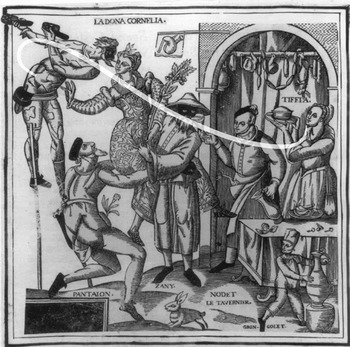
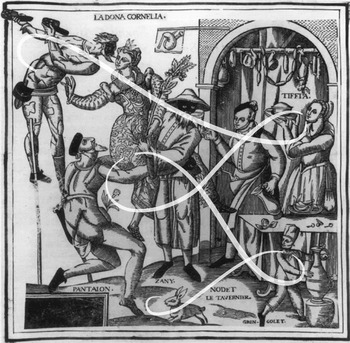
As Castagno has noted, and as the actors' physical disposition suggests, the scene's gymnastic realization follows a fairly clear sequential logic, beginning with the elevation of La Dona Cornelia on Pantalon's thigh, the rise of her turning gaze to that of Harlequin above, and the extension of her hand toward his torso. That motion pulls, aims, and inflects our gaze, lifting our eyes, with and by the lifting of Cornelia's hand and eyes, to the bending figure of Harlequin at the tableau's leftmost and uppermost point and to his counterbalancing, swaying extension of the ornamented shoes. With that appropriately inaugural lean in from the left the tableau is realized, and active scrutiny of the scene's visual play begins. Its first gestural focal point, the ambidextrous extension and slow bobbing sway of the shoes, begins the process, holding and then rolling the attention, turning it rightward and forward to slide downward over the shoulder through Harlequin's attentive masked gaze and sly whispers to Cornelia; across her face, neck, and arm to the Zany with his nose at the cup; from that cup through the arm, figure, and face of Nodet to the pie and the arm and the upturned and turning face and figure of Tissia. Tissia's own framing look, directed back up along the sloping vignettes over which our attention has just traveled, ends the tableau's first “line” of reading (Fig. 3) and invites the reader-spectator to pause and assess the movement that has been completed—a long, sliding curve that follows, with neat precision, the hierarchy of the higher senses (sight, sound, smell, and taste) and the slide of desires and behaviors through the states they define: ambition, greed, seduction, distraction, scheming, tricking, and tempting.Footnote 37
First Movement: The Higher Senses. © Nationalmuseum, Stockholm.

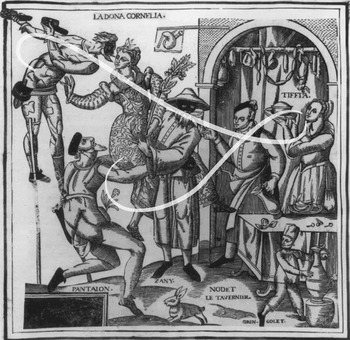
As those desires are quelled in the drowsy satiety of appetite and bounty, the scene's visual flow turns and rolls, dropping and swinging back to the left along a topography slightly closer and certainly more base, its constellated negotiations defined now not by gazes and heads but by bellies and groins in a slow slide through the demands and impulses of the lower senses. The gustatory pleasures of Tissia's pie fall by degrees to the carnal pleasures of smoke (Nodet's pipe) and of sex (the Zany between Tissia's legs) and thence to the aestheticized lust of Pantalon's flower, where the scene's second line is, like the first, held up, slowed, and reversed, though now in the curving, load-bearing aged figure and upturned, reversing gaze of the vecchio. Like the retrospective gaze of Tissia, that of Pantalon ends this second line of reading (Fig. 4), a cyclical tumble through the lower humors to those actions and states in which such energies are dissipated and contained—not satiety and indulgence but ambition and responsibility, not the dulling pleasures of the belly but the disciplinary avarice of work and, as Pantalon's reactive lean upon the “false” property (of the stage) suggests, the stabilizing force of property and propriety of all kinds, real or assumed.
Second Movement: The Lower Senses. © Nationalmuseum, Stockholm.

However, also like Tissia's figure, that of Pantalon marks a pause rather than a conclusion to the scene's visual flow, slowing it to roll back again in another descending, approaching swing, this one along a still lower topography, one both corporeal and natural, topographical, elemental (Fig. 5). Like another bend in the stream (with even a flower in the dell), Pantalon's curving frame turns our eye around again, carrying us down along his taut thigh to the Zany's skirts and across the declension of the ground shadows to the foregrounded diminutive figure of Gringolet, framed in the shadow and the skirts of the table, his dwarfish, ambiguously childlike body embracing—in suitably elemental fashion—a large water jug situated, with evident repose, upon a heavy wooden stump. Humors become something else here, as the appetites of the lower bodily senses are replaced by more fundamental forces of procreation, first in the tableau's realizing gesture, the raising of Cornelia (which now appears as an oddly resonant refiguration of Dionysus' birth from the thigh of Zeus) and then, in more primordial terms, in the infantile Gringolet's close pairing with the matriarchal ewer and with life-giving nature—though a nature here in chopped form already and quite obviously domesticated, diminutive in its scale, and limited in its resource and vitality.
Third Movement: Procreative Forces. © Nationalmuseum, Stockholm.

Gringolet's gaze, the only look we meet in this third line, once again ends and redirects a line of descent, his upward glance implying that review of the symbolic terrain our eye has just descended and his figure redirecting our gaze downward along another path (Fig. 6), this one falling along the bend of his awkward right leg to the tableau's lowest plane and immediate foreground, where a seemingly inconsequential rabbit gazes, at ground's-eye view, upon the poised shoe of Pantalon. And here, rather than encountering yet another reversing gaze—and another swing across the scene—we are stopped short, our eye repelled by the solid black mass of the stage, to focus a second time upon the scene of the rabbit and the shoe. This last gaze is, then, nonhuman, but it is no less a position of reflection, for in the rabbit's feral stare one may recognize the fundamental condition that produces all of the impulses, humors, appetites, needs, and weaknesses arrayed so arrogantly above: that of a jumpy, helpless animal, unconscious with fear, blind with appetite, ravenous in hunger, fecund in reproduction, utterly reliant upon the doubtful bounty of the land. Appropriately, the rabbit is situated directly beneath the sign of the Zany, the human crux of the emblem, and those of the iconic bagpipe and thyrsus, figures of the lower body raised on high.
Fourth Movement: Animal Existence. © Nationalmuseum, Stockholm.

If the scene's emblematic import suggests commedia's sociological and sensory structures, the skeleton and limbs of that collective theatrical body, this long, traversing descent initiated by the temporality of performance is meant to show us, I think, the characteristic motion of that body, a rolling dramatic cycle of profane enlightenment that informs and catalyzes commedia's dramatic action at all levels and scales—a process in which the appeals of elevation are continually, if incrementally, tumbling into the bestial and base. In its rolling pattern of descent and blindness, commedia in this way recapitulates modes of theatrical enlightenment that extend back to Greek mystery cults, in which illumination, or epopoteia (literally, “eye-opening”) follows upon mystos, the reduction and confinement of the gaze to the lowest level of experience and perception. Yet it is important not to think of such reduction as an endpoint, either in this scene or in the more abstract experience of profane enlightenment that commedia enlists. For if the rabbit's gaze appears to conclude this scene's imaginary realization, it also cannily gestures toward a repetition of the whole; for we also realize, after a moment perhaps, that this lowest, least-human emblem refigures at the tableau's nadir that gaze upon Harlequin's uplifted shoes with which the process of scrutiny began—a gaze that marked the scene's apogee of aesthetic, social, and sensory desire. And with that reflective insight, that moment of profane illumination, we glance upward once more, following Pantalon's lifting figure back up to the dangling footwear above, reinaugurating and repeating the cycle.
Conclusion: The Crisis of the Body and the End of Commedia
As this specific pattern of enlightenment suggests, commedia was not a drama concerned with great social change but a theatre of the recurrent, the quotidian, and the everyday. Its processes of continual renegotiation, its balanced, tumbling imbalance differentiate commedia's rhythms of change and action from both the resolving moments of bourgeois drama and the disruptive topsy-turvydom of Bakhtinian carnival, those later dramatic structures—almost a dialectical pair—wrought from the splitting alienation of modernity's separation of “high” and “low” modes of representation. In the Bakhtinian carnivalesque, the elevation of the rule of the low is inversive, a transgressive moment dominated by the “Lord of Misrule,” an outburst contained in ritual. In commedia, however, that elevation was a local, swaying element of the everyday, a ubiquitous and fundamental element of the circulation and activity of social life. Commedia in this sense dramatized something less akin to the disruptive energies of Mardi Gras than to those of Leopold Bloom's passing fancy for a tasty kidney, its scene and action not those of the festival but, as here, those of the tavern and the street, of the everyday rather than the extraordinary.
In this sense, commedia can be understood as having offered, like melodrama, a reassuringly stable vision of social logic and legible identity amid the anonymity and heterogeneity of the city. However, unlike melodrama, commedia unmasked and even mocked the rule of moral judgment: its governing impulses were not vices and virtues but, as the Joycean simile is meant to suggest and as Fig. A31 makes evident, appetites, desires, temptations, and ambitions—things that arise from the body, not from the mind. The local structure of dramatic action and of interaction in commedia derived its range, reference, and logic—its body and texture, in a sense—from this embodied conception of identity. Its improvised scenes, those episodic enactments of quotidian relations, are not exactly vignettes in the modern sense—brief glimpses or sketches of the ephemeral movements of life. They are instead moments that retained a more fundamental, almost emblematic significance as brief anatomical sketches of the basic mechanisms—the steady orbits, as it were—of human behavior as it ranged over and roiled through the social and the individual body.Footnote 38 The conflicts they rehearsed occurred time and again, continually, simultaneously, jostling in an ever-changing, always-the-same flow of passions and “humors,” appetites and hungers. As a form, commedia in this fundamental sense denied even history its claim to elevation, laughing it, as it were, into the stomach of the now.
Yet perhaps because commedia invites us—with its figural characters, its synchronic frames of action, its allegorical impact and antihistorical impetus—to forget historical context, we tend as well to overlook the extreme historicity of commedia itself, for the invitation to a quotidian world offered in the theatre of the Recueil Fossard was not itself quotidian, even if it was evidently intertwined with a strong classical tradition. Such transcience is suggested even within the woodcuts of the Fossard series, for its grand emblematic tableau, as Marianne Hallar has noted, was itself originally conjoined to two other images—the double portrait of Francatrip[p]a and Capitan Cocodrillo that came to serve as the centerpiece of the montage that forms the other formally anomalous plate of the series (Fig. A30) and a portrait of Sibilot, perhaps Henri III's court buffoon Subilot, announcing the show with a blast of his horn (Fig. A32). Putting the three pieces together situates that tableau at the end of a small parade, presenting it with a larger and apparently historical, profoundly contingent frame and foregrounding the moment of Harlequin's appearance as much as the formal accomplishment his role.Footnote 39
Recognition of such formal change and flux reminds us that what we tend even today to speak of as the “traditional commedia dell'arte” (as if the form enjoyed a long-term, stable existence) developed quite rapidly in the 1570s and was superseded by the comédie italienne, a “new form,” as Virginia Scott puts it, “of Italian conventions and French taste” by early in the next century.Footnote 40 The shift was more than simply a matter of taste. In its first years, as Italian players formed into companies composed of actors from the several cosmopolitan centers of Italy, the infelicities of dialectical incomprehension and the manner in which the players' use of regional Italian dialect had mapped commedia's action as a decentered geography made possible the multivalent incorporation of the spoken word into commedia's decentered, jostling system of sensation and apprehension. In early modern France, however, this trend was reversed. As commedia companies became institutionalized within court culture, performance gradually began to incorporate and then to adopt the language of its audience, and in consequence the spoken word emerged as a new and privileged sign of meaning and template for performance. One consequence of this shift was that Italian performers who could not speak French were rapidly excised from the drama. However, the imposition of French tied the action of commedia directly to the social life of its audience, rendering its figural commentary suddenly more topical and its types more local, more realistic, and less clearly situated in figural time. In such a context, the polyvalent signification of commedia's embodied aesthetic shifted toward a more aestheticized, more purely gymnastic form of performative virtuosity, and the signifying properties and formal conventions of its physical language of performance faded.
This reduction in the signifying power of commedia's theatrical bodies was by no means an isolated phenomenon. Scholars of the grotesque, building upon Bakhtin's work, have traced the decline of that aesthetic in much greater detail, showing its loss of power and meaning in neoclassical culture, while scholarly research on the history of the body has situated that decline within a larger, more general crisis of the epistemological status and function of the body—a crisis characterized specifically, Kenneth Burke first pointed out in the 1940s, by a collapse of the body's synecdochal meaning—of its capacity, that is, “to represent or mirror a social, religious, or cosmic whole.”Footnote 41 This crisis was not immediate, but it was fairly rapid, and its impact upon the artistic imagination followed a fairly clear path of development. In both artistic representation and in everyday life, in high and low culture, conventional systems of meaning attached to the body since antiquity and powerfully developed in Renaissance humanism and neoplatonic philosophy became distended and fractured, as the corporeal truths they asserted were gradually disjoined and detached from bodily experience, growing increasingly out of sync with new patterns of sensation and new forms and structures of subjective and social self-consciousness. In France, as the work of Éric Méchoulan and Véronique Adam suggests, this detachment appears to have been experienced as a growing sense of the body's figural opacity that stemmed from a failing ability to perceive the force of that synecdochal relation. In late sixteenth-century lyric poetry, this shift prompted a pressurized desire to evoke the body's fading emblematic resonance through the force of ordered language.Footnote 42 In England (and more generally in Protestant cultures), this detachment appears instead to have been experienced as (and was certainly articulated as) a growing sense of the body's ineluctable fragmentation—a feeling prompted by failing ability to reconcile its diverse parts that prompted, in turn, pressurized desires to interrogate the limits and possibilities of such instability.Footnote 43
More generally, however, efforts to articulate this crisis were also articulations of loss. In Montaigne's Essais, in Hamlet's inscrutable, flawed theatre of images, in the anxiously elaborated nature of Tudor and Fontainebleau aesthetics, and in the aestheticized self-scrutiny of sonnet lyricism, the emblem of the body appears as an artifact, its figure fractured, its facets and limbs suggestive but no longer reliable or wholly legible signs of meaning.Footnote 44 In Rabelais and Cervantes, as in the anamorphic memento mori of Holbein and Callot's mannerist festivals and nightmares and in the commedia dell'arte as well, the artistic imagination turned its attention from the fading sign of the classical corpus to the twisting, grotesque structure of the baroque body, its forms and aspects distending and swelling to excess with accumulated history—indeed, with the accumulated gloss and violence of anachronistic symbolism—before shattering (or rotting) into the fragmentary, disembodied allegories of baroque Trauerspiel, its pieces broken and scattered, as Walter Benjamin recognized, like the signs of Dürer's Melancholia.Footnote 45
While the impact of this imaginative crisis, this overburdening, distortion, fragmentation and loss of the body's signifying power, is evident throughout the arts, its impact was probably most profoundly felt—as one might expect—in the theatre, that artistic mode in which the body itself served as the primary instrument and vehicle, not just a privileged emblem, of representational meaning.Footnote 46 In a general sense, but one supported now by ample scholarship, the virtually simultaneous development of Elizabethan drama and the commedia dell'arte—a double birth of extraordinary (and extraordinarily short-lived) theatrical phenomena at the close of the sixteenth century—may be recognized as a neatly dialectical pair of responses to this crisis of the body at its moment of greatest intensity: the former shifting its attention to interiority and to the construction of the self in the mind, narration, and history; the latter, as I have tried to show, reasserting the body's exoteric figurality, its grotesque, quotidian, silent claim to determine meaning.
Each of these reactions gives rise to a distinct theatrical and dramatic tradition, but we are more familiar with the first, for it was in a sense on the side of the future. From it, of course, emerged subjective realism, the primary mimetic mode of modern dramatic performance. Unsurprisingly, histories of acting and of the body in performance have tended to focus on that interiorizing reaction, to the degree that one might describe the history of early modern acting as a history of the actor's internalization of character, of Proteus' shape-changing shift into a subject, of the relocation of the wellsprings of passion from the heart to the mind, of the rationalist effort to evoke internal feeling and emotion.Footnote 47 That history fits well with much of the subsequent history of the theatre, and it has made possible a good deal of recent scholarship on acting in later periods.
Much less attention, however, has been devoted to the former externalizing reaction—that exemplified by the commedia dell'arte—despite growing awareness of its enormous influence on modern theatre and particularly on modern drama's radical tradition. That this is so is also unsurprising, for that reaction, like the tradition to which it would give rise, was in many ways extraliterary or even antiliterary, relying rather on the ephemeral poetry of the body in the world, and both poorly suited and resistant to textual organization and record. What traces of it do remain are instead often pictorial rather than textual and primarily rather than secondarily visual, both in their construction of formal meaning and in their articulation of formal history. Understanding that reaction certainly necessitates a stronger appreciation of the role of visual culture in the history of dramatic performance, but it also suggests something of the potential (and the potential implications) of such a reorientation.
Appendix:
The Recueil Fossard Woodcuts
The Recueil Fossard was discovered by Agne Beijer, director of the Drottningholm Theatre Museum, in the early 1920s. It is named, in secondhand fashion, for François Fossard, a musician of the court of Louis XIV who maintained an archive of materials related to the history of performance and spectacle and whose name appears on the miscellany's title page. In 1928, Beijer and Pierre-Louis Duchartre published a facsimile edition of forty-six of the album's eighty-five prints, including, though not in coherent order, the series of woodcuts reproduced here. Although many of these woodcuts are reproduced elsewhere and some appear in almost any major study of the commedia dell'arte, the entire series has never been published in an easily available form adequate for critical study. (I have not reproduced here the title pages of the series, as these appear to be later additions.) The Recueil Fossard is housed at the National Museum of Fine Arts in Stockholm (Nationalmuseum), which absorbed the Drottningholm.
Alba Ceccarelli Pellegrino suggests that the author of the verse captions that accompany many of the series' images could have been François Béroalde de Verville;Footnote 48 however, the artist (or artists) who designed and executed the images remains unknown. For more on the provenance and attribution of the Fossard miscellany as well as the long history of efforts to understand their probable order, sense, and reference, see especially the work of M. A. Katritzky, the leading authority on these images, and of Delia Gambelli.Footnote 49
Harlequin verrier, Agnan, and La Nimphe. From the Recueil Fossard. © Nationalmuseum, Stockholm.

Agnan, La Laictiere, and Harlequin. From the Recueil Fossard. © Nationalmuseum, Stockholm.
La bonne mere Guillemette, Agnan Magister, and Peronne. From the Recueil Fossard. © Nationalmuseum, Stockholm.
Peronne, Julien le débauché, and Mathieu Bouclon. From the Recueil Fossard. © Nationalmuseum, Stockholm.
Agnan, Mathieu Bouclon Philosophe, and Julien déguisé en femme. From the Recueil Fossard. © Nationalmuseum, Stockholm.
Julien déguisé, Agnan, La bonne mere Guillemette, and Mathieu Bouclon. From the Recueil Fossard. © Nationalmuseum, Stockholm.
Fr[a]ncatripa, Harlequin Inamorato, and Licetta. From the Recueil Fossard. © Nationalmuseum, Stockholm.
Il Segnor Pantalon, Zany, and Francisquina. From the Recueil Fossard. © Nationalmuseum, Stockholm.
Il Capitan Cocodrillo, Harlequin d[é]guisé, and La Donna Lucia. From the Recueil Fossard. © Nationalmuseum, Stockholm.
Il Segnor Horacio, Harlequin, and Il Segnor Dotour. From the Recueil Fossard. © Nationalmuseum, Stockholm.
Pantalon, Harlequin, and Francisquina. From the Recueil Fossard. © Nationalmuseum, Stockholm.
Zany Corneto, Harlequin, and La Dona Lucretia. From the Recueil Fossard. © Nationalmuseum, Stockholm.
Il Segnor Horacio and Harlequin. From the Recueil Fossard. © Nationalmuseum, Stockholm.
Harlequin, Segnor Pantalon, and Francisquina. From the Recueil Fossard. © Nationalmuseum, Stockholm.
Harlequin and Messere Pantalon. From the Recueil Fossard. © Nationalmuseum, Stockholm.
Francisquina, Pantalon, and Harlequin. From the Recueil Fossard. © Nationalmuseum, Stockholm.
Segnor Dotour, Il Segnor L[é]andro, and Pantalon. From the Recueil Fossard. © Nationalmuseum, Stockholm.
Il Segnor Pantalon and Zany Corneto. From the Recueil Fossard. © Nationalmuseum, Stockholm.
Harlequin, Zany Corneto, and Il Segnor Pantalon. From the Recueil Fossard. © Nationalmuseum, Stockholm.
La Donna Lucia, Il Segnor Pantalon, and Zany. From the Recueil Fossard. © Nationalmuseum, Stockholm.
Philipin, Harlequin, and Il Segnor Pantalon. From the Recueil Fossard. © Nationalmuseum, Stockholm.
Harlequin and Zany Cornetto. From the Recueil Fossard. © Nationalmuseum, Stockholm.
Zany, Harlequin, Il Segnor Léandro, and Francisquina. From the Recueil Fossard. © Nationalmuseum, Stockholm.
La Donna Cornelia, Il Segnor Léandro, and Pantalon. From the Recueil Fossard. © Nationalmuseum, Stockholm.
Francatrippa and Harlequin. From the Recueil Fossard. © Nationalmuseum, Stockholm.
Pantalon and Messerre Dottore. From the Recueil Fossard. © Nationalmuseum, Stockholm.
La Donna Isabella and Pantalon Inamorato. From the Recueil Fossard. © Nationalmuseum, Stockholm.
Segnor Pantalon and Zany Corneto. From the Recueil Fossard. © Nationalmuseum, Stockholm.
Francisquina and Il Signor Horacio. From the Recueil Fossard. © Nationalmuseum, Stockholm.
Zany Cornetto, Pantalon di Besongnosi, Francatrip[p]a, Capitan Cocodrillo, Doctor Gratian, and La Dona Isabella. From the Recueil Fossard. © Nationalmuseum, Stockholm.
Harlequin, Pantalon, La Dona Cornelia, Zany, Nodet le Tavernier, Tissia, and Gringolet. From the Recueil Fossard. © Nationalmuseum, Stockholm.
Recumbent figure, Subilot, and Stephanel Bottarga. From the Recueil Fossard. © Nationalmuseum, Stockholm.