Introduction
The unique properties of organic conducting polymers were first discovered by Heeger, Shirakawa, and MacDiarmid back in the 1970s. This discovery was the genesis of an enormous amount of work in the area of organic electronics and was finally honored with the Nobel Prize in Chemistry in 2000.[Reference Heeger1] Conjugated semiconducting polymers offer broad applications in the field of molecular electronics. Perhaps the most attractive research area in polymers nowadays is the development of novel semiconducting polymers for organic photovoltaics (OPVs), organic light emitting diodes (OLEDs), organic thin film transistors (OTFTs), sensors, etc.[Reference Carle, Helgesen, Madsen, Bundgaard and Krebs2] Their properties modulation via precise control of the molecular structure has populated a vast number of publications, patents, and further technological breakthroughs in the past 2–3 decades. Conjugated polymers and oligomers offer the unique capability of tuning the final semiconducting materials’ properties via a correct choice of the chemical structure and the synthetic methodology, the variation of conjugation length, and the substitution pattern of side groups. Besides their inherent function of charge carrier generation and transport and their nanomorphology based on π–π-stacking interactions, the alteration of their exact chemical structure, and the introduction of side or main chain functionalities, meaning moieties that can lead to further reactions and/or interactions, greatly expand their properties and potentiality.
Net, unsubstituted conjugated polymers such as poly(p-phenylene), poly(p-phenylene vinylene), etc., suffer from low to negligible solubilities due to extended π-stacking prohibiting thus, their processing from solution to thin films. In the vast number of cases, the semiconducting macromolecular chains are decorated with alkyl, alkoxyl, branched, or even dendritic side units which serve a dual scope: to impose solubility and processability to the final semiconductor as well as to enhance nanophase ordering and crystallization in the thin film which are essential for charge transport in most of the organic electronic devices.
On the other hand, and since their discovery back in the early 1990s, fullerenes and carbon nanotubes (CNTs) have attracted scientific interest as promising materials for novel applications. The realization of their electronic properties opened new possibilities for technological applications such as in organic electronics. Almost 20 years after the realization of the bulk heterojunction photovoltaics (BHJ PVs), based on the combination of polymeric conjugated electron donors and fullerene derivatives as electron acceptors, the efficiency of these systems has exceeded 10% boosting their perspective for commercialization. Certain figures of BHJ PVs such as reduced cost, mechanical flexibility, impact resistance, optical transparency, large area coverage, and printability are their most prominent advantages over the competing silicon-based PV technologies. The active layer of a typical organic PV cell is composed of a polymeric semiconductor, as the electron donor, blended with a fullerene derivative, as the electron acceptor. The known semiconducting conjugated polymers poly(1,4-phenylene-vinylene)s (PPVs) and poly(3-hexylthiophene) (P3HT) were initially used as the electron donors, that after light absorption generate excitons which dissociate to provide electrons to a neighboring electron-accepting phase. Efficient matching of the energy levels of the electron donor and the electron acceptor, the maximum light absorption and the required morphology of a stable, nanophase-separated system with bicontinuous structures are the crucial parameters that determine the final PV efficiency. Open questions in the OPVs technology still are the design and scaling up of more efficient electron donors, the development of appropriate organic electron acceptors, and the correct matching of the favorable electron donor and electron acceptor into the desired nanoscaled morphology of a bicontinuous interpenetrating network.
The synthesis of new materials aiming to improve the energy efficiency of PV devices is a primary research area of focus of the scientific community. Attempts to this direction are either to find even better polymeric electron donors, or perhaps more efficient electron acceptors, or to improve the performance of the overall system with methodologies that will drastically contribute to the optimization of device's performance, reaching values higher than 10%.[Reference He, Zhong, Su, Xu, Wu and Cao3, Reference Boudreault, Najari and Leclerc4]
Besides recent enhancements in device performance mainly due to the development of a large number of more effective polymeric electron donors there is still space and demand for efficiency improvement. This can be achieved through the control and stabilization of the active layers morphology through the use of copolymers with electron donor and electron acceptor units and hybrid materials modified with carbon nanostructures. These new hybrid materials are expected to have improved properties, controlled energy levels and to contribute to the better mixing of the photoactive electron donor and acceptor materials improving thus, the morphology and hence the efficiency of the PV device.
The electron donor in a PV device is the responsible material for the absorption of solar light. The maximum of the electromagnetic radiation of the visible spectrum is near IR and thus the maximum of the electron donors’ absorption should be located in that region. However, most polymers absorb only a small part of the incoming light. Based on the emission spectrum of the sun, it is calculated that the band gap of the optimal polymeric donor should be approximately 1.5 eV. Essential characteristics of the electron donor are also good hole mobility and the capacity to create in combination with the electron acceptor a stable film on the device which will lead to the appropriate morphology.
Herein, we will emphasize on semiconducting polymers being substituted by functional groups (e.g., hydroxyl, carboxylic acid or ester, halogen, azide, etc.) aiming thereafter to further modify, copolymerize or create hybrids with carbon nanostructures.
Functional semiconducting polymers
Organic semiconductors have attracted much attention, due to their versatility, promise for larger scale, lower cost, and easier production of electronic devices as compared with their inorganic counterparts. A potential advantage of utilizing conjugated polymers in such applications is the ability to tune the properties of the polymer at the molecular level. Tuning is typically accomplished through synthetic modification, which permits the incorporation of additional functionalities. The ability to modify these properties is of the utmost importance for the efficient application of these materials. Soluble, stable systems are required for their processing, and the desirable properties of these polymers are dependent on the extent of conjugation. Increased conjugation lowers the band gap and results in an enhancement of the thermal population of the conduction band, thus increasing the number of intrinsic charge carriers.
The most widely employed methods for the synthesis of the conjugated polymers for optoelectronic devices are (cross-)coupling reactions mediating Pd or Ni catalysts. As such Suzuki, Stille, Heck, Kumada coupling and more recently direct-arylation reactions are commonly employed and can tolerate various heteroatoms and substitution patterns of the involved monomers.
The need for heteoatoms incorporated in polymer semiconductors was early recognized since they can alter and effectively change the band gap of the polymer increasing the absorption wavelengths as needed in solar cell electron donors or lowering the highest occupied molecular orbital (HOMO) or lowest unoccupied molecular orbital (LUMO) levels resulting in p- or n- semiconductors. Nitrogen and oxygen atoms are electron withdrawing leading to better electron transporting properties. Poly(benzimidazobenzophenanthroline) is an excellent example of a potential electron acceptor containing nitrogen heterocycle or otherwise an n-type conjugated ladder polymer that has an ionization energy (HOMO level) of 5.9 eV, an electron affinity (LUMO level) of 4.0 eV, excellent thermal stability in air and exceptionally high field-effect electron mobility.[Reference Hong, Kertesz, Lee and Kim5–Reference Alam and Jenekhe7]
As part of the heteroatom containing semiconducting polymers family, the polythiophenes case are probably the most studied materials as polymeric electron donors, considered the benchmark polymers in most organic electronic applications. Every respectable novel material developed and tested “must” be compared and prove itself versus P3HT. This is nowadays the reference polymer electron donor especially when it comes to polymer solar cells. In general, polythiophenes are stable materials applicable in almost all environmentally friendly energy-producing devices and machines.[Reference Jeffries-EL, McCullough, Skotheim and Reynolds8, Reference Perepichka and Perepichka9] In particular, poly(3-substituted thiophene)s are one of the most studied polymer groups for (semi)conductor/optical applications, thanks to the well-understood synthetic methods for high molecular weight and regioregular polymers and their good solubility and processability.[Reference McCullough10] Of course, the grignard metathesis (GRIM)[Reference Loewe, Ewbank, Liu, Zhai and McCullough11] or Ni-catalyzed chain-growth polymerization[Reference Miyakoshi, Yokoyama and Yokozawa12] or Kumada catalyst-transfer polycondensation[Reference Beryozkina, Senkovskyy, Kaul and Kiriy13–Reference Kiriy, Senkovskyy and Sommer15] has been widely employed since it can produce P3ATs of high regioregularity and molecular weight that moreover carry “living” bromine chain ends[Reference Liu and McCullough16] which can be further modified either in situ or ex situ the polymerization reaction. Moreover, regioregular head-to-tail rr-P3HT can be electrophilically substituted at the four-position of the thiophene ring. Introduction of side bromine groups is especially useful for further reaction through typical Suzuki, Stille, and Heck coupling conditions leading to poly(thiophene)s possessing aryl, vinyl, alkynyl, etc. side-chain groups.[Reference Li, Vamvounis, Yu and Holdcroft17, Reference Stefan, Bhatt, Sista and Magurudeniya18]
In several cases, the preparation of a multi-macroinitiator P3HT which possesses the desired light absorption and electron-donating function was demonstrated and thereafter the development of a second segment via polymerization of the proper vinylic monomer was performed. The post-functionalized P3ATs retain their optical properties if the functionalization degree remains low (typically up to 10%).[Reference Economopoulos, Chochos, Gregoriou, Kallitsis, Barrau and Hadziioannou19–Reference Topham, Parnell and Hiorns24]
As will be explained in the below section of hybrid semiconducting polymer–fullerene systems, several P3HT copolymers have been used to develop hybrids acting as compatibilizers of the active P3HT:PCBM layer. Additionally the crosslinking concept could lead to the stabilization of the active layer's morphology.[Reference Wantz, Derue, Dautel, Rivaton, Hudhomme and Dagron-Lartigau25] Below a few representative examples of crosslinking the electron donors in OPVs and OTFTs are given, which also apply to the case of side group functionalities inserted into P3HT.
Bromine-functionalized regioregular poly(3-hexylthiophene) (P3HT-Br) copolymers (Scheme 1) were prepared by copolymerization of 2-bromo-3-(6-bromohexyl) thiophene and 2-bromo-3-hexylthiophene by the McCullough method.[Reference Liu and McCullough16] The P3HT-Br copolymers were cross-linked, via a radical mechanism initiated by the photochemical cleavage of the C–Br bonds under ultraviolet (UV) irradiation at 254 nm and were used as electron donors in both BHJ and bilayer-type PV devices that proved to be thermally more stable when compared with devices based on non-crosslinked plain P3HT.[Reference Kim, Miyamoto, Ma and Frechet26]
P3HT-Br copolymers prepared by the McCullough method.[Reference Liu and McCullough16]

Using once again the above-described side bromine bearing copolymers Kim et al. replaced the bromine with azide units at the end of the alkyl chains of P3HT. The P3HT–azide copolymers (Scheme 2) were used in OTFT devices after crosslinking upon exposure to UV light. Moreover, the P3HT–azide polymers formed fullerene-attached diblock copolymers. Therefore the P3HT–azide copolymers were employed as in situ compatibilizers in P3HT/PCBM BHJs, affording efficient and also thermally stable OPVs with suppressed macrophase separation as seen in Fig. 1.[Reference Kim, Han, Cho, Kang, Cho, Lee, Fréchet, Oh and Kim27]
Azide side-functionalized rr-P3HT copolymers.[Reference Kim, Han, Cho, Kang, Cho, Lee, Fréchet, Oh and Kim27]
Optical microscopy images of the P3HT/PCBM films containing 0%, 10%, or 15% P3HT-azide10 copolymer after annealing at 150 °C for 24 h. Scale bar =100 μm. Adapted with permission from Ref. Reference Kim, Han, Cho, Kang, Cho, Lee, Fréchet, Oh and Kim27, copyright (2012) American Chemical Society.
Anthracene end-capped P3HT has also been prepared and studied in respect to the stabilization of its blend with PCBM after UV treatment of the blends that promotes a [2 + 2] cycloaddition of the anthracene moieties with the fullerene species.[Reference Khiev, Derue, Ayenew, Medlej, Brown, Rubatat, Hiorns and Wantz28]
As already mentioned the “living” bromine end chain groups of P3AT can be in situ or ex situ transformed to functional moieties affording end functionalized P3ATs.[Reference Jeffries-El, Sauve and McCullough29]
A vast number of P3HT-containing block copolymers have been reported employing end functionalized macromolecules where the end functionality can initiate the polymerization of different monomers or can react with α, ω, or α-functionalized polymeric chains.[Reference Yassara, Miozzoa, Girondaa and Horowitz30] For example, Urien et al. synthesized a series of P3HT-containing di- and triblock copolymers from alkyne end-functionalized P3HT and azide end-functionalized polystyrenes.[Reference Urien, Erothu, Cloutet, Hiorns, Vignau and Cramail31] Segalman and co-workers reported block copolymers prepared from an ethynyl-terminated P3HT that was reacted under “click” chemistry conditions with a polyacrylate polymerized from an azido-functionalized initiator and that moreover carried side electron accepting perylene bisimide moieties.[Reference Tao, McCulloch, Kim and Segalman32] McCullough and co-workers reported a P3HT-block-poly(acrylic acid) (P3HT-b-PAA) copolymer that showed a solvatochromic behavior in a variety of polar and non-polar solvents.[Reference Craley, Zhang, Kowalewski, McCullough and Stefan33] Hadziioannou and co-workers reported on the post-functionalization of P3HT affording ω-thiol-, ω-carboxylic acid, ω-acrylate-, and ω-methacrylate-terminated P3HT from which graft copolymers with polyisoprene, poly(vinyl alcohol), or poly(butyl acrylate) coils were synthesized following the “grafting onto” or the “grafting through” methods.[Reference Mougnier, Brochon, Cloutet, Fleury, Cramail and Hadziioannou34] In addition, Bielawski and co-workers reported an in situ synthesis of ethynyl end functionalized P3HT of high purity that facilitated access to P3HT-b-PAA which self-assembled into hierarchical structures (Scheme 3).[Reference Li, Ono, Wu and Bielawski35]
Synthesis of P3HT-b-PAA.[Reference Li, Ono, Wu and Bielawski35]
Ethynyl end-functionalized P3HT has been most recently used for the preparation of P3HT-block-poly-(neopentyl p-styrenesulfonate) copolymes via its click chemistry with azide end-functional protected polystyrene sulfonate blocks.[Reference Erothu, Kolomanska, Johnston, Schumann, Deribew, Toolan, Gregori, Dagron-Lartigau, Portale, Bras, Arnold, Distler, Hiorns, Mokarian-Tabari, Collins, Howse and Topham36]
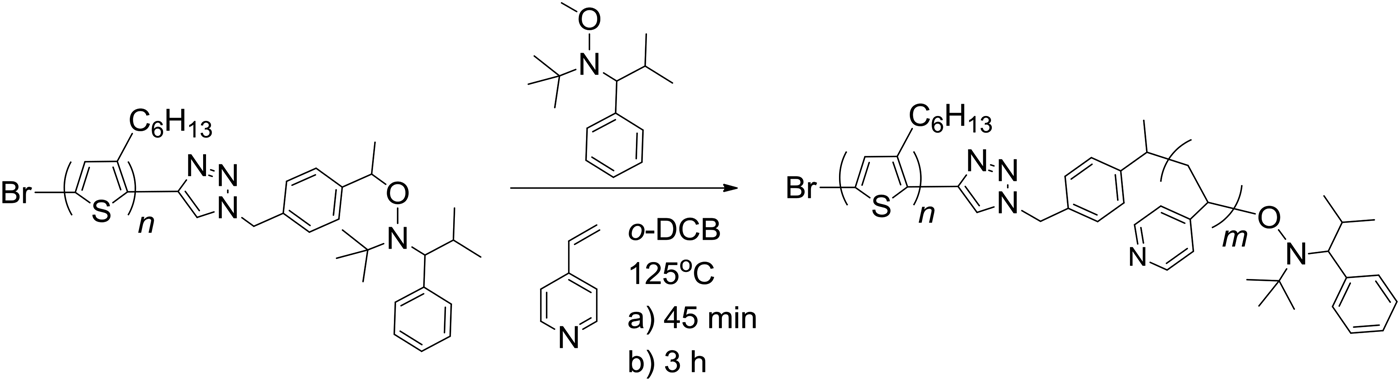
Combination of click chemistry and nitroxide-mediated radical polymerization (NMRP) was used by Lohwasser et al. for the incorporation of P3HTs segments into amphiphilic block copolymers at which the alkyne-terminated P3HT performed a copper-catalyzed azide–alkyne click reaction, forming a macroinitiator for NMRP that polymerized 4-vinylpyridine (4VP) (Scheme 4)[Reference Lohwasser and Thelakkat37]
Incorporation of P3HT in combined NMRP with click chemistry.[Reference Lohwasser and Thelakkat37]
Allyl end-functional P3HT was also modified to hydroxyl end-functional P3HT that performed Steglich esterification with poly(ethylene oxide) (PEO) chains bearing end carboxylic acid units, leading to P3HT-block-PEO copolymers.[Reference Erothu, Sohdi, Kumar, Sutherland, Dagron-Lartigau, Allal, Hiorns and Topham38]
Macromonomer ω-end vinyl P3ATs can be prepared either via a Suzuki coupling of the bromine end-group with styryl-boronic acid or directly in the polymerization medium by adding a vinyl magnesium halide as soon as the polymerization has come to its end (Scheme 5).
Synthesis of ω-end vinyl P3ATs (a) with a post-polymerization Suzuki coupling reaction, (b) via in situ introduction of the double bonds at the end of the GRIM polymerization.[Reference Jeffries-El, Sauvé and McCullough39]
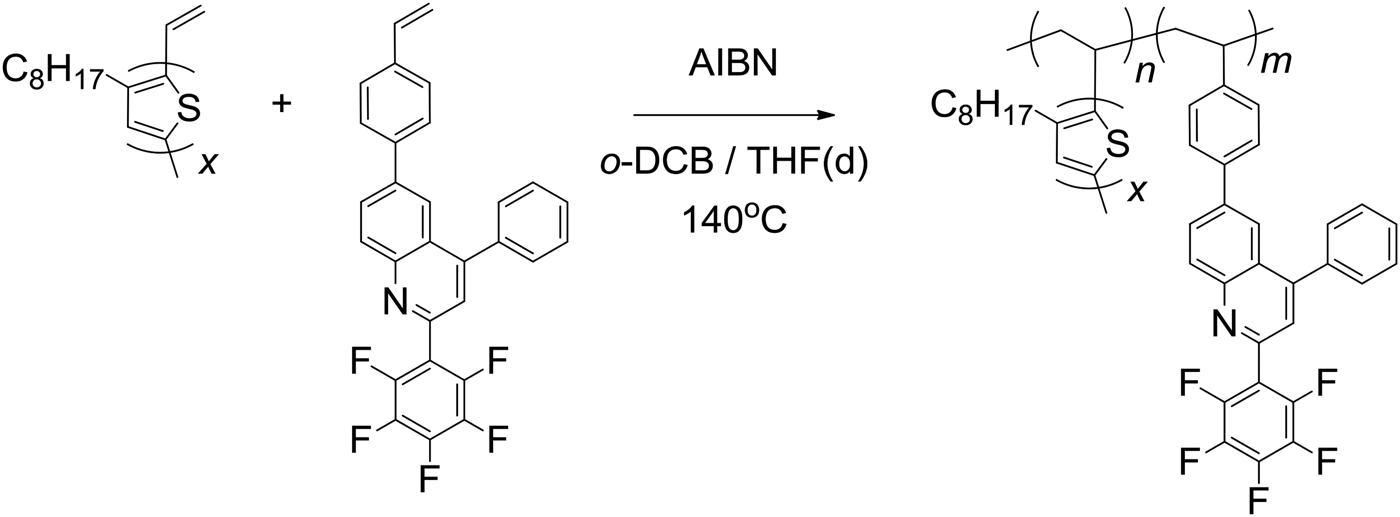
Such 2-vinyl terminated regioregular poly(3-octylthiophene)[Reference Jeffries-El, Sauvé and McCullough39] can be used thereafter as macromonomers in copolymerization with other semiconducting or not comonomers. An example of copolymers containing vinyl-P3HT blocks that are prepared via free radical polymerization (FRP) are given in Scheme 6, in which a potential electron-accepting comonomer, vinylphenyl perfluorophenyl-phenylquinoline has been employed.[Reference Kakogianni, Kourkouli, Andreopoulou and Kallitsis40] The perfluorophenyl group was specifically selected in this case as an electron withdrawing group with the potential to lower even more the LUMO level of the quinoline electron acceptor. However, and most importantly, these perfluorophenyl-quinoline containing copolymers were used for the development of hybrid materials comprising fullerene species as will be described in more detail in the below hybrids’ section.
Preparation of P3HT random copolymers via FRP.[Reference Kakogianni, Kourkouli, Andreopoulou and Kallitsis40]
Fluorine-substituted oligomeric or polymeric semiconductors have been developed in many cases trying to make use of the electron-withdrawing fluorinated aromatic rings.[Reference Chen and Cao41, Reference Cheng, Yang and Hsu42] Highly fluorinated systems such as perfluoroarenethiophenes, exhibit unique molecular-packing and charge-transport characteristics in comparison with the corresponding fluorine-free analogs[Reference Yoon, Kim, Facchetti and Marks43] Incorporating the fluorinated units serves to lower both the LUMO and HOMO energies of the materials and also facilitates planarization. Lowering of the HOMO energy level to below −4.9 eV, the level at which electrochemical reactions with wet oxygen can occur, is desirable for improving the ambient stability of polythiophenes.[Reference Crouch, Skabara, Lohr, McDouall, Heeney, McCulloch, Sparrowe, Shkunov, Coles, Horton and Hursthouse44]
The case of the PTB7 electron donor (Scheme 7) is a characteristic study in which the presence of the fluorine atom leads to a lower HOMO level, thus enhancing the V oc parameter. This polymer exhibits an absorption ranging from 550 nm and up to 750 nm and its blend with PC71BM afforded polymer solar cells with an initial energy conversion efficiency of 7.40%.[Reference Liang, Xu, Xia, Tsai, Wu, Li, Ray and Yu45] The fluorine effect is also demonstrated in a recently reported alternating copolymer with thiophene–tetrafluorophenyl–thiophene and furan-flanked diketopyrrolopyrrole moieties (PDPPF–TFPT) that exhibits a balanced ambipolar behavior as required for applications in organic thin-film transistors (Scheme 7).[Reference Sonar, Chang, Shi, Wu and Li46]
Examples of semiconducting polymers bearing fluorine substituents.[Reference Liang, Xu, Xia, Tsai, Wu, Li, Ray and Yu45, Reference Sonar, Chang, Shi, Wu and Li46]
In an orthogonal synthetic approach a series of AB-alternating, side-chain-functionalized poly(thiophene) analogs were designed aiming to selectively localize at the interface between regioregular poly(3-hexylthiophene) (rr-P3HT) and PCnBM (n = 61, 71) in BHJ solar cells. The side chains of every other repeat unit in those polythiophenes (Scheme 8) contained various terminal aromatic moieties and were prepared via GRIM polymerization of dithiophenes carrying the side-chain functionality in one of the thiophene rings as shown in Scheme 8.[Reference Lobez, Andrew, Buloviand and Swager47] Pentafluorophenoxy-containing polymer was the most effective side-chain-functionalized additive and yielded a 28% increase in PCE when incorporated into a 75 nm thick rr-P3HT/PC61BM BHJ at a 0.25 wt% loading. Moreover, devices with 220 nm thick BHJs containing 0.25 wt% that perfluorophenyl-functionalized rr-P3HT displayed PCE values of up to 5.3% which was a 30% PCE increase over a control device lacking the additive. In fact, when the perfluorophenyl-alternating rr-P3HT was compared with analogs but random regioregular, homopolymeric or random regiorandom structures it was found that only the AB-alternating regioregular polymer lead to increased charge-carrier lifetimes versus a reference cell.
AB-alternating, side-chain-functionalized poly(thiophene)s prepared from a dithiophene functionalized monomer.[Reference Lobez, Andrew, Buloviand and Swager47]
Recently, perfluorophenyl ω-end functionalized P3HT was prepared by the in situ addition of perfluorophenyl magnesium bromine as end-capper of the “living” bromine chain ends (Scheme 9).
Introduction of the end perfluorophenyl group.[Reference Giannopoulos, Nikolakopoulou, Andreopoulou, Sygellou, Kallitsis and Lianos48]
A novel functionalization-sensitization route for the decoration of TiO2 nanoparticles (NPs) and or nanoparticulate TiO2 thin films with polymeric dyes was then demonstrated via the creation of stable and non-hydrolysable Ti–O–C carbon bonds.[Reference Giannopoulos, Nikolakopoulou, Andreopoulou, Sygellou, Kallitsis and Lianos48] These were realized via an etherification analog reaction of perfluorophenyl-functionalized organic light-absorbing dyes with the hydroxyl groups located onto the TiO2 surface. The initial experiments and the proof of concept were performed using simple monomeric perfluorophenyl-functionalized quinolines. Thereafter the methodology was extended to the perfluorophenyl-functionalized rr-P3HT as can be seen in Scheme 10.
Modification of TiO2 surface with perfluorophenyl-functionalized rr-P3HT.[Reference Giannopoulos, Nikolakopoulou, Andreopoulou, Sygellou, Kallitsis and Lianos48]
A photoluminescence (PL) quenching was detected for the hybrid rr-P3HT-5F-TiO2 NPs after excitation at the absorption maximum of rr-P3HT. This was attributed to the covalent attachment of the rr-P3HT-5F moieties onto the TiO2 NPs allowing the efficient electronic interactions between the two species. rr-P3HT-5F-sensitized TiO2 photoanodes were also prepared under analogs conditions at which the stability of the created Ti–O–C bonds was prominent even after extensive washing with organic and aqueous media. The rr-P3HT-5F-sensitized TiO2 photoanodes were tested and found functional in dye-sensitized solar cells (DSSCs) and in photoelectrochemical cells for water splitting under alkaline conditions. The same methodology is applicable also for low-band gap alternating electron donors carrying perfluorophenyl moieties at their chain ends.[Reference Giannopoulos, Anastasopoulos, Andreopoulou and Kallitsis49]
Another multi-practical functionality is the amino moiety. For instance, an amino-end-functional polythiophene was employed as CdSe nanocrystals (NCs) dispersant and thus, affording nanocomposites with favorable morphology for use in P3HT/CdSe hybrid solar cells. Stille coupling reaction of P3HT carrying a bromine end-group with an organotin thiophene compound bearing a cyano group afforded polymer (a), which was transformed into (b) after reduction with LiAlH4 (Scheme 11).[Reference Liu, Tanaka, Sivula, Alivisatos and Frechet50]
Synthesis of P3HT with amino-end functionality.[Reference Liu, Tanaka, Sivula, Alivisatos and Frechet50]
Since hybrid NPs comprised of inorganic semiconductor quantum dots (QDs) and organic semiconductor-conjugated polymers have nowadays gained considerable interest, other semiconductors besides poly(thiophene)s, have also been employed after their functionalization for QDs’ dispersion.[Reference Rath and Trimme51, Reference Freitas, Gonçalves and Nogueiras52] Thus, side amino-functionalized polyfluorenes onto CdSe/ZnS QDs by replacing the initial pyridine ligands used in the QDs synthesis with the polyfluorene derivatives have been reported.[Reference Guo, Zhao, Pei, Zhou, Gibson, Brug, Lam and Mao53] Moreover, functionalized ligands during the QD synthesis can be used to subsequently polymerize from- or attach to- a pre-synthesized polymer to the QD surface (“grafting from” or “grafting to” approaches). Emrick et al. reported the “grafting from” route where a bromine functionalized ligand was used during QD synthesis and then oligo(p-phenylene-vinylene) tri- and tetramers were built onto the CdSe QDs.[Reference Skaff, Sill and Emrick54] In another report, hybrid particles composed of an inorganic semiconductor NC with a shell of organic semiconductor ligands were prepared directly by high-temperature synthesis. Functionalized fluorenes with amine or phosphonic acid end-groups for binding to the inorganic interface were synthesized by Suzuki–Miyaura coupling polymerization using novel three-coordinated Pd(II) complexes as initiators (Scheme 12).[Reference de Roo, Haase, Keller, Hinz, Schmid, Seletskiy, Cölfen, Leitenstorfer and Mecking55]
Fuctionalized polyfluorenes PF-C6H4-NH2 and PF-C6H4-P(O)(OH)2.[Reference de Roo, Haase, Keller, Hinz, Schmid, Seletskiy, Cölfen, Leitenstorfer and Mecking55]
In an analog approach toward functionalized P3HTs, phosphonic ester, pyridine, protected thiol, and protected phenol end-groups functionalized air-stable Ni initiators were employed. These functional groups were used to synthesize hybrid materials consisting of different NPs anchored with P3HT, such as metal oxides (e.g., superparamagnetic Fe3O4) decorated using the phosphonic ester, CdSe/ZnS QDs combined with the pyridine, whereas noble-metals- (Au-) based NPs interacted with the thiol and phenol groups.[Reference Monnaie, Brullot, Verbiest, De Winter, Gerbaux, Smeets and Koeckelberghs56] A recent comprehensive review on the attachment of semiconducting species onto inorganic substrates can provide more detailed information onto this inorganic-conjugated polymer hybrids formation.[Reference Bousqueta, Awada, Hiorns, Dagron-Lartigau and Billona57]
A discrete block copolymer of side-functionalized P3HT has been presented which is synthesized by sequential addition of the net alkyl-thiophene and the bromine-functionalized alkyl-thiophene monomer at various ratios, via the GRIM polymerization (Scheme 13). The bromine groups were then transformed to thiol-functionalities and the block copolymers were studied in respect to electronic interactions with non-toxic bismuth sulfide (Bi2S3) NCs showing an efficient charge transfer between the P3HT-SH and the Bi2S3 NCs. Improved PV performance was obtained from the P3HT-SH/Bi2S3 NCs cells versus the plain P3HT/Bi2S3 NCs ones.[Reference Martinez, Higuchi, MacLachlan, Stavrinadis, Miller, Diedenhofen, Bernechea, Sweetnam, Nelson, Haque, Tajimaef and Konstantatos58]
Preparation of block copolymer of side functionalized P3HT via the GRIM polymerization.[Reference Martinez, Higuchi, MacLachlan, Stavrinadis, Miller, Diedenhofen, Bernechea, Sweetnam, Nelson, Haque, Tajimaef and Konstantatos58]
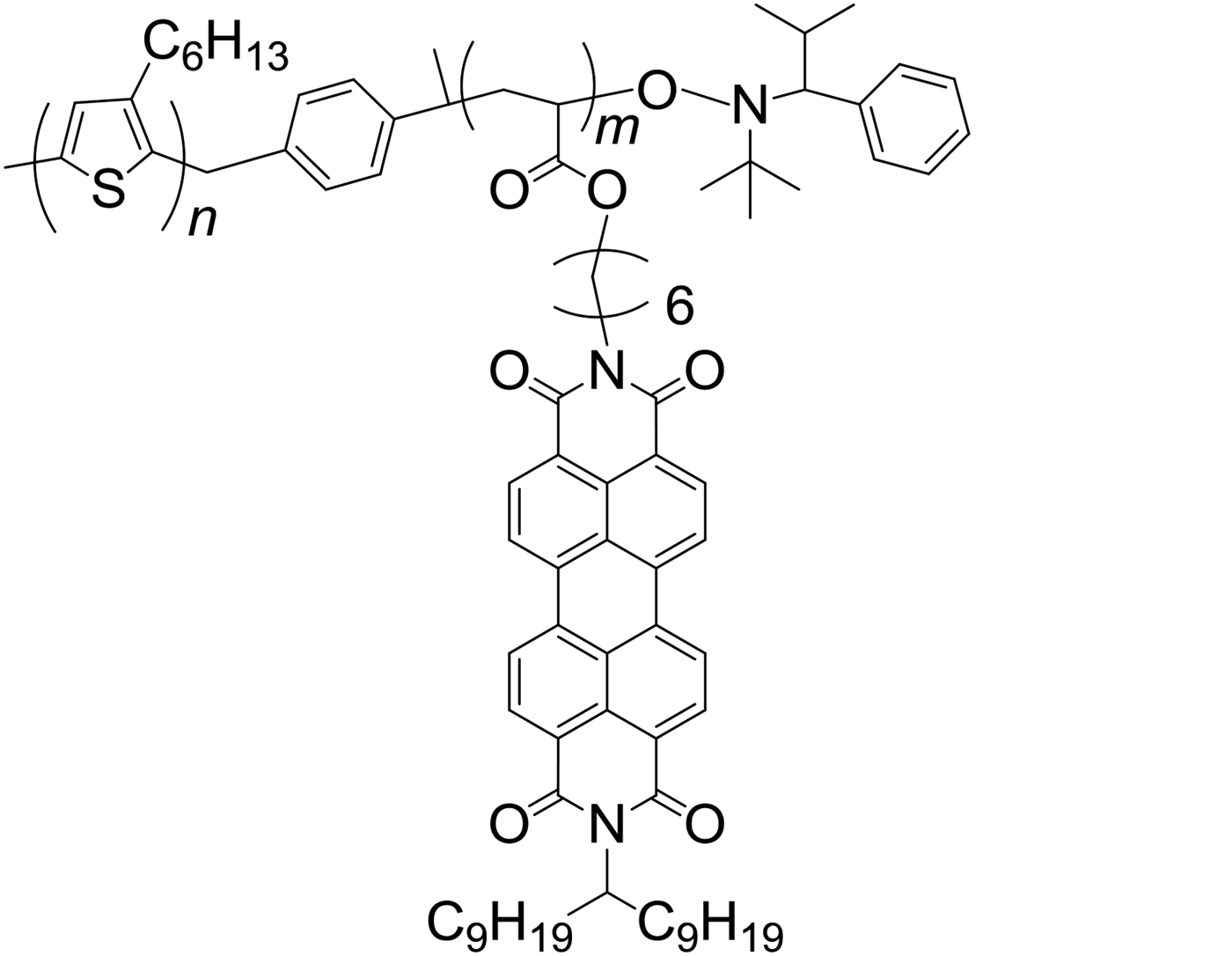
The most widely used non-fullerene acceptor is perylene bisdiimide (PDI), due to its relatively high electron affinity, good electron mobility, and strong absorption of visible light. In most representative cases, PDI containing donor–acceptor copolymers have been prepared employing initiator functionalized P3HT rods. The Thelakkat group after initial reports on a triphenylamine–PDI coil–coil block copolymer[Reference Lindner and Thelakkat59–Reference Sommer, Lindner and Thelakkat61] extended their approach to polythiophene block copolymers bearing PDI coil blocks (Scheme 14).[Reference Sommer, Lang and Thelakkat62] Analogs block copolymers were also reported by other groups[Reference Tao, McCulloch, Kim and Segalman32, Reference Zhang, Cirpan, Russell and Emrick63, Reference Rajaram, Armstrong, Kim and Frechet64] consisting of a hole-transporting block of P3HT and an electron-transporting block of PDI-pendant polyacrylates.
P3HT-block-poly(perylene bisimide acrylate) donor–acceptor copolymer.[Reference Sommer, Lang and Thelakkat62]
Hybrid nanostructures of functional semiconducting polymers with carbon nanostructures
As above mentioned, the great advancements for the preparation of new more efficient electron donors based on their optimum chemical structure design mainly using electron-donating and electron-accepting building blocks along the main chain in order to modulate the electronic properties and the effective band gap, resulted in significant efficiency increase. Furthermore, the development of new fullerene derivatives also contributed to the efficiency increase even for systems that seemed to have leveled off like in the P3HT:ICBA case. However, the rational design and control of the morphology of these systems proved to be trickier and up to now empirical methods like annealing seem more efficient than a knowledge-gained approach based on the deeper understanding of the exact parameters that correlate the morphological behavior of such systems.
To this end the design and preparation of hybrid structures can significantly contribute both from the modulation of energy levels and also by controlling the morphology of the active layer. Thus, electron donor–fullerene hybrid structures and electron donor–CNT hybrids have been created. The different synthetic methodologies used, resulted in hybrids with various connection chemistries between the semiconducting species and the carbon nanostructures. This was initially necessary to prove the synthetic feasibility and the influence of the hybrids on the active layer morphology control and stabilization. Thereafter more controlled ways of chemical connection in the sense of direct attachment of the semiconducting species to the carbon nanostructure became available.
Semiconducting polymer/CNTs hybrids
CNTs have been used as the transport medium in BHJ solar cells and as mobility enhancers within TFTs. CNTs, particularly semiconducting single-wall carbon nanotubes (SWCNTs) have attracted great scientific interests owing to their extraordinary charge carrier mobility and their nanometer dimensions that enable charge transport along the nanotubes long axis with reduced charge recombination when applied into OPVs.
The preparation of semiconducting polymer/CNT hybrid materials refers to the attachment of the semiconductor by one or more connecting sites onto the CNTs surface. There are of course several studies at which the non-covalent interaction and un-bundling of CNTs with a semiconducting polymer is described, but these do not constitute the development of hybrid materials.
The two major pathways for the decoration of CNTs with polymeric materials are the “grafting from” or “grafting to” routes. Meaning either polymerizing the desired monomer from initiating sites previously created onto the surface of CNTs or attaching a pre-developed polymeric entity carrying the appropriate functional group onto CNTs. “Grafting to”[Reference Mansky, Liu, Huang, Russell and Hawker65] or “grafting from”[Reference Zhao and Brittain66] techniques have also been used for the conventional polymer modification of nanotubes. In order to prevent the disruption of p-conjugation, various modifications[Reference Campidelli, Sooambar, Diz, Ehli, Guldi and Prato67, Reference Cioffi, Campidelli, Sooambar, Marcaccio, Marcolongo, Meneghetti, Paolucci, Paolucci, Ehli, Rahman, Sgobba, Guldi and Prato68] that allow weak functionalization of the SWNTs, resulting in the lowest possible distortion of their electronic properties, can be used.[Reference Babel and Jenekhe6Reference Perepichka and Perepichka9, Reference Tasis, Tagmatarchis, Bianco and Prato70]
In cases that the targeted application of the modified SWCNTs is their use as optoelectronic materials, attachment of semiconducting units is of utmost importance trying to increase the processability and applicability of nanotubes within the active layers of OPVs or as current collecting electrodes. Recent advances on the enrichment of the semiconducting character in SWCNTs expand the perspective for the use of such materials in PV applications. In these cases, the control over the electronic properties in the semiconducting SWCNTs is combined with the solubility improvement by simply using semiconducting organic species as covalent SWCNTs modifiers.
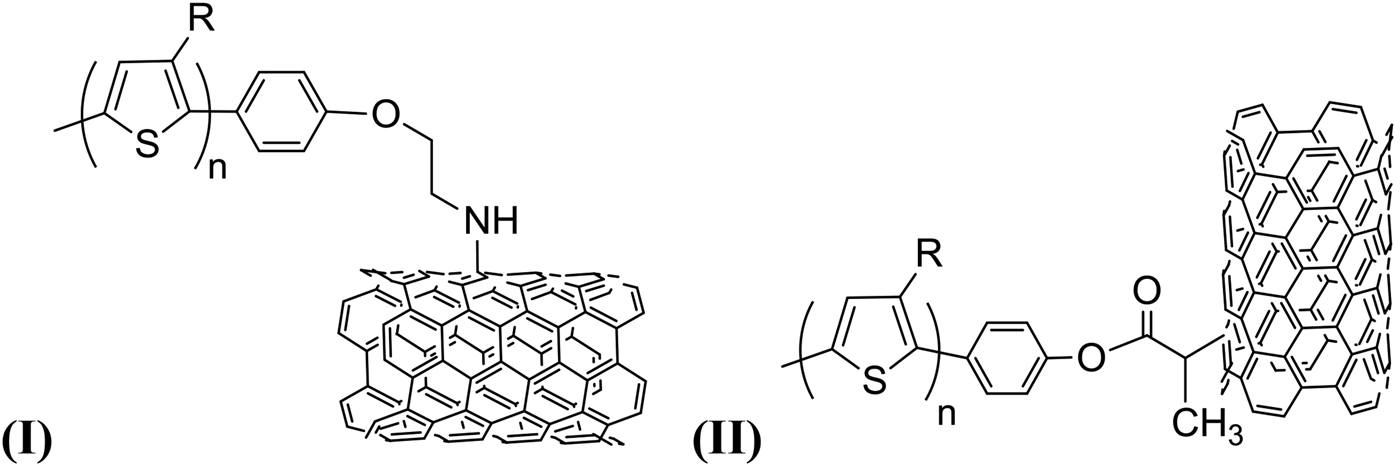
As an example Stefopoulos et al.[Reference Stefopoulos, Chochos, Prato, Pistolis, Papagelis, Petraki, Kennou and Kallitsis71] presented hybrid materials consisting of the electron-donating rr-P3OT covalently attached to SWCNTs using either hydroxyl decorated SWCNTs and hydroxyl ω-end functionalized rr-P3OT under a Mitsunobu-type etherification reaction (hybrid I, Scheme 15) or 2-chloropropionyl phenyl ester ω-end functionalized rr-P3OT and net SWCNTs under atom-transfer radical addition (ATRA) conditions (hybrid II, Scheme 15). The reported hybrids presented dispersability and processability in common organic solvents, and at the same time combination of both counterparts’ properties. Interestingly PL quenching of the rr-P3OT was observed for the hybrid materials in their solid thin-film state, providing proof of the energy transfer from the polymeric semiconductor to the CNT (Fig. 2).
Hybrid materials of SWCNTs with hydroxyl ω-end functionalized rr-P3OT (I) and 2-chloropropionyl phenyl ester ω-end functionalized rr-P3OT (II).[Reference Stefopoulos, Chochos, Prato, Pistolis, Papagelis, Petraki, Kennou and Kallitsis71]
UV–vis (a) and PL (b) spectra of rr-P3OT and of the rr-P3OT–SWCNTs hybrids (I) and (II) shown in Scheme 15, in the thin-film state. Reproduced from Ref. Reference Stefopoulos, Chochos, Prato, Pistolis, Papagelis, Petraki, Kennou and Kallitsis71 by permission of John Wiley and Sons 2008.
Electron-accepting poly(vinylphenyl-phenylquinoline) was employed for the functionalization of SWCNTs via the “grafting from” technique.[Reference Chochos, Stefopoulos, Campidelli, Prato, Gregoriou and Kallitsis72] Polymerization of the vinylphenyl-phenylquinoline monomer onto properly modified SWCNTs using atom-transfer radical polymerization (ATRP) conditions resulted in efficient grafting of the optically active oligomeric chains onto the nanotubes.
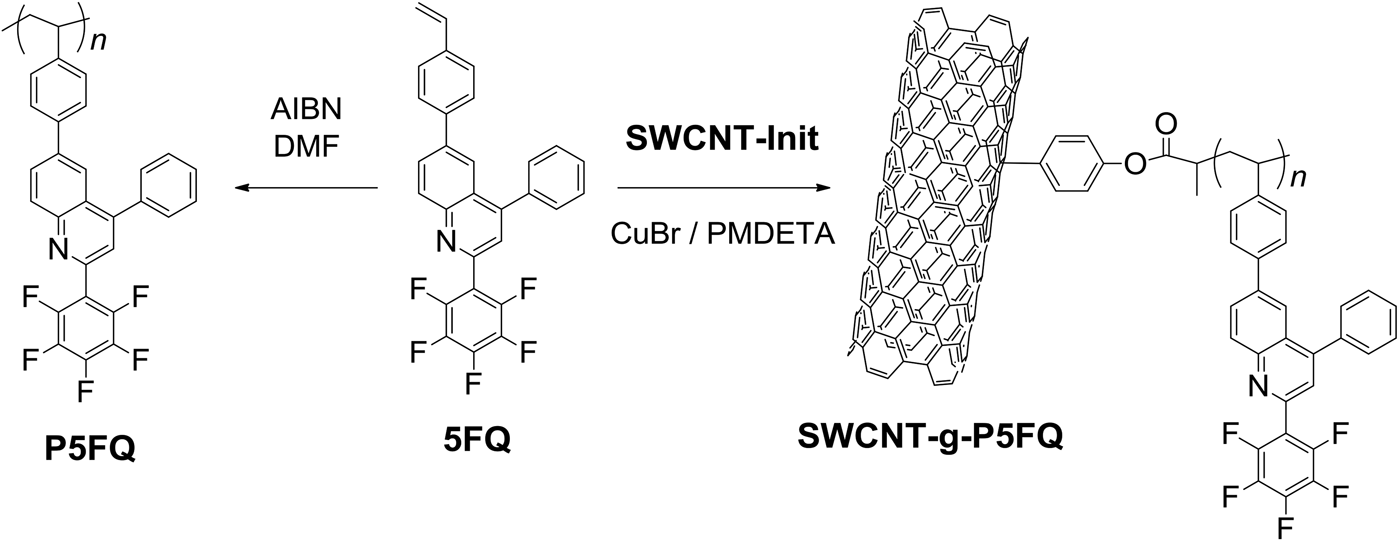
In a continuation of the semiconducting polymer modification of SWCNTs, our group used poly(vinylphenyl perfluorophenyl-phenylquinoline) (P5FQ) for the preparation of the hybrid SWCNTs-graft-P5FQ (Scheme 16).[Reference Stefopoulos, Kourkouli, Economopoulos, Ravani, Andreopoulou, Papagelis, Siokou and Kallitsis73] The “grafting from” method was employed also in that case were ATRP initiating sites were created onto the SWCNTs surface that were used for polymerizing the vinyl perfluorophenyl-quinoline monomer.
Preparation of P5FQ and its anchoring onto SWCNTs.[Reference Stefopoulos, Kourkouli, Economopoulos, Ravani, Andreopoulou, Papagelis, Siokou and Kallitsis73]
As a step further, our group developed even more hybrid materials by functionalizing SWCNTs with different semiconducting vinyl quinoline monomers bearing electron-accepting groups or a ruthenium–quinoline complex. From the band diagrams of the pristine and modified nanotubes it is evident that the strongest charge transfer occurred in the case of the metal complex derivative in agreement with the results of the Raman studies, while the same complex had the highest LUMO energy. The attachment of the quinoline molecules in the SWCNTs body led to hybrid materials with HOMO positions in between the HOMO positions of the net components (Fig. 3).[Reference Kourkouli, Siokou, Stefopoulos, Ravani, Plocke, Müller, Maultzsch, Thomsen, Papagelis and Kallitsis74]
Schematic diagram of the pristine SWCNTs and the hybrid materials energy bands measured by UPS and energy gaps calculated from the UV–vis–NIR spectra and the corresponding LUMO positions. Adapted with permission from Ref. Reference Kourkouli, Siokou, Stefopoulos, Ravani, Plocke, Müller, Maultzsch, Thomsen, Papagelis and Kallitsis74, copyright (2013) American Chemical Society.
Semiconducting polymer/fullerene hybrids
As already described a well-investigated approach toward controlling the morphology at the nanometer and stabilizing the nanophase separation of conjugated polymer–fullerene BHJ solar cells over the long-term is the incorporation in the active layer of diblock copolymers acting as compatibilizers that bear distinct blocks of the electron donor and of the electron-accepting fullerene. Such diblock copolymers act as compatibilizers similarly to the typical immiscible or partially miscible polymer blends compatibilization. The interfacial tension between the polymer donor and fullerene acceptor phases is reduced and their aggregation over larger domains is also suppressed.
In the first attempts functionalized PPVs and P3ATs were used as the donor blocks and the fullerene species were covalently attached on flexible polymeric blocks. The first donor–acceptor block copolymer with good electronic properties was synthesized by the group of Hadziioannou,[Reference de Boer, Stalmach, van Hutten, Melzer, Krasnikov and Hadziioannou75] using a PPV electron donor block as macroinitiator for the nitroxide mediated radical polymerization (NMRP) of styrene and chlorostyrene. Then the synthesized block copolymer was modified with fullerenes via atom transfer radical addition (ATRA).
This structure was modified several times in the years to follow, in order to improve the synthetic route.[Reference van der Veen, de Boer, Stalmach, van de Wetering and Hadziioannou76, Reference Barrau, Heiser, Richard, Brochon, Ngov, van de Wetering, Hadziioannou, Anokhin and Ivanov77] It was found that the electron mobility of the hybrid materials was increased due to the incorporation of the C60 units, but still remained below the electron mobility of net PCBM. Also even though C60 was immobilized onto the coil copolymeric block, crystallinity problems were still observed. Nevertheless, the fact that the hybrid copolymer gave better performance than the polymers themselves in blend, reinforced the idea of using conjugated rod–coil hybrid block copolymers in PV devices.
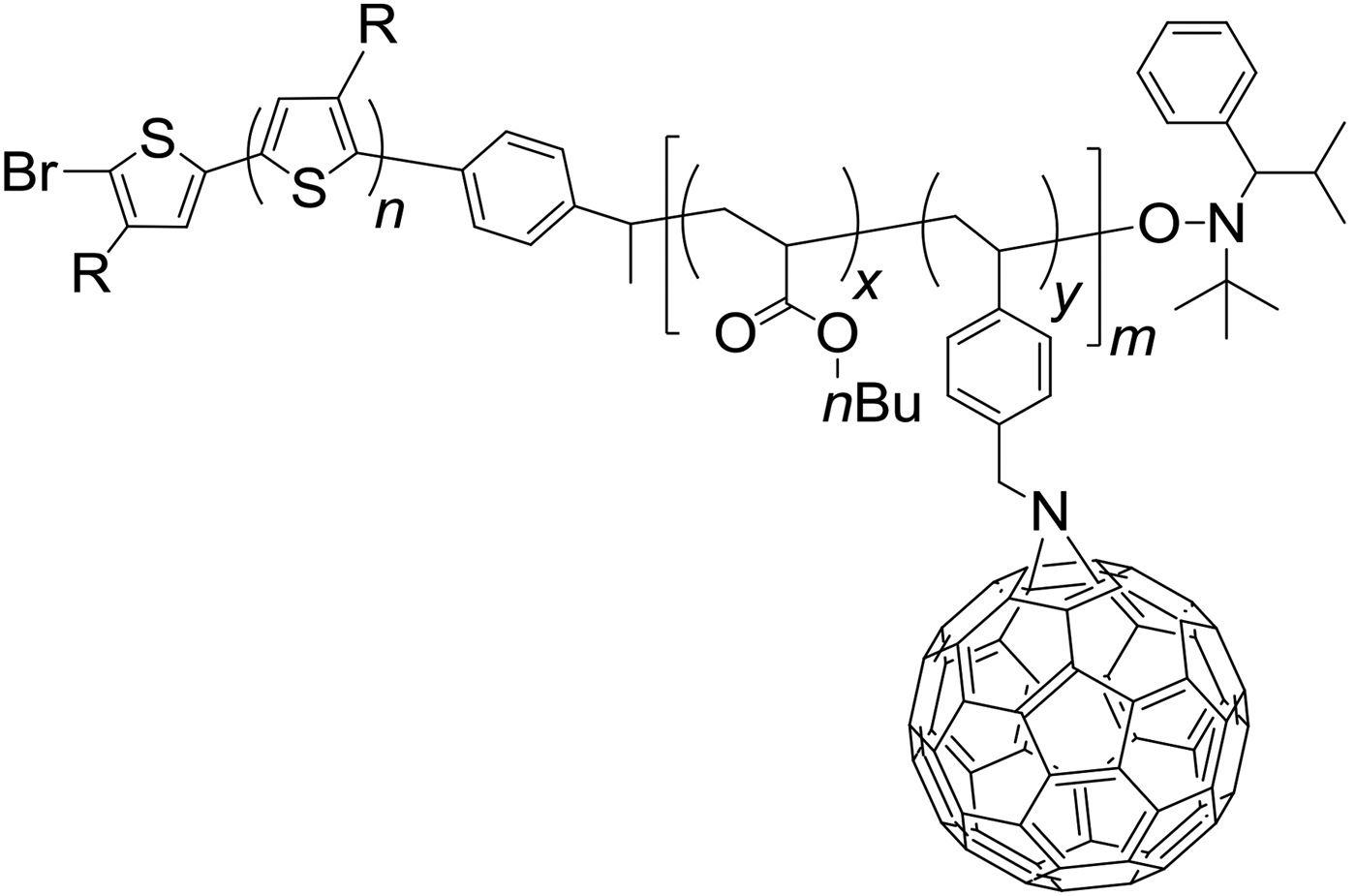
Thereafter most research groups,[Reference Sivula, Ball, Watanabe and Frechet78–Reference Hiorns, Iratçabal, Bégué, Khoukh, De Bettignies, Leroy, Firon, Sentein, Martinez, Preud'homme and Dagron-Lartigau82] synthesized similar hybrid copolymers using poly(3-alkylthiophene), as the semiconducting rod block Scheme 17. In most cases, the morphology of the active layer was significantly improved when employing the hybrid materials; however, the device performance remained unaltered.
A hybrid copolymer consisting of a poly(3-alkylthiophene) block and of flexible n-butyl acrlylate and styrene-C60 coils.[Reference Richard, Brochon, Leclerc, Eckhardt, Heiser and Hadziioannou79]
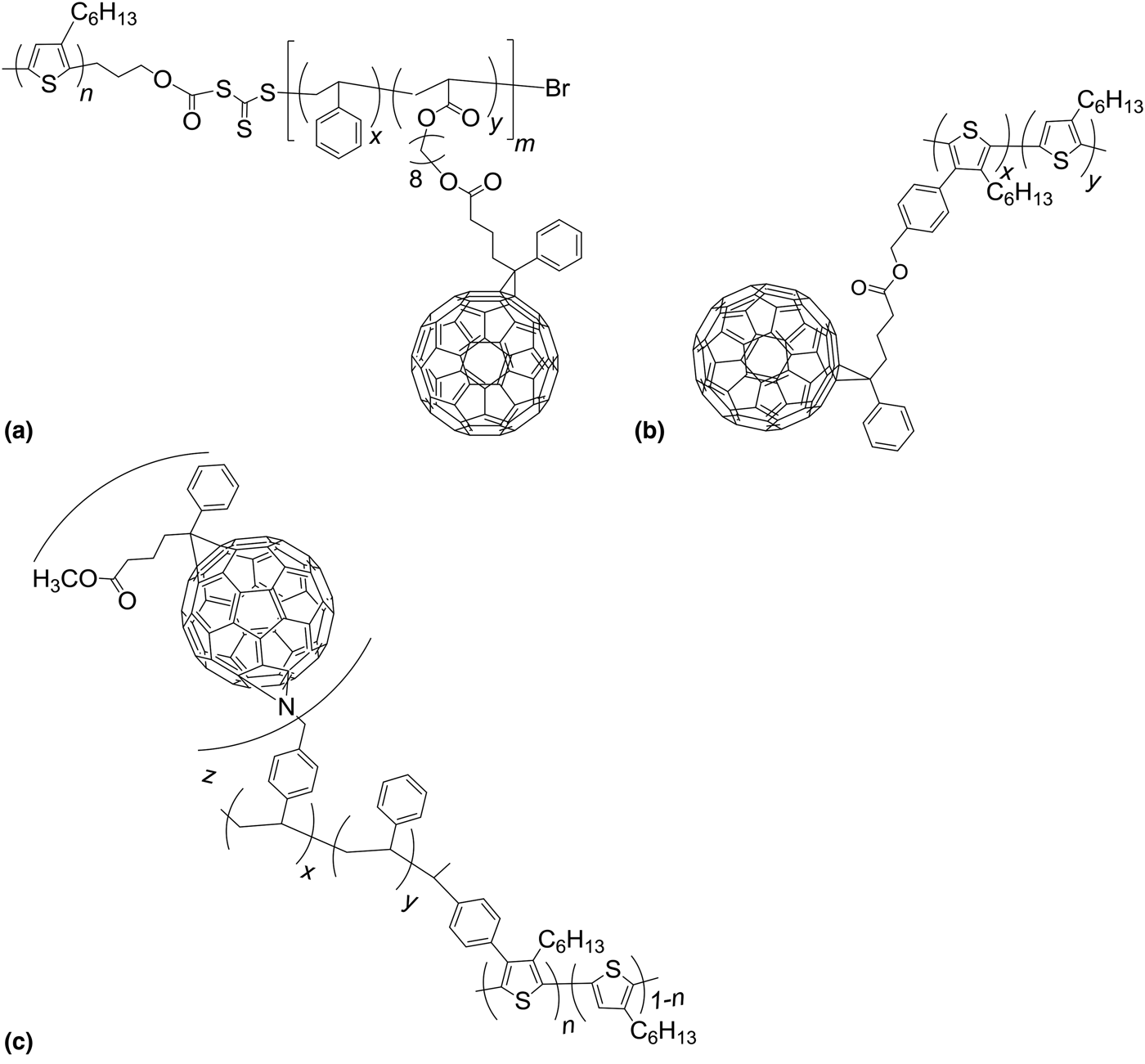
In order to improve the morphology as well as to increase the performance of the device some research groups focused on the development of hybrid copolymers bearing immobilized units of PCBM,[Reference Lee, Jung, Emrick, Russell and Jo83–Reference Chen, Li, Wang, Qu, Zhao, Xie and Yang88] instead of C60. Scheme 18 shows some representative hybrid copolymeric structures prepared by creating initiators at the end group of poly(thiophene)s, or by modifying the side chains of the polythiophene ring in the 4 position. When the well-defined rod–coil block copolymer of Scheme 18(a) was used as “surfactant” of the P3HT:PCBM blend, the control of the interface morphology of the donor–acceptor phase domains within the composite resulted in an improvement of the efficiency with respect to the analogous solar cell fabricated without the “surfactant”.[Reference Yang, Lee, Heeger and Wudl86]
Poly(thiophene) hybrid copolymers carrying PC60BM units [(a)[Reference Yang, Lee, Heeger and Wudl86], (b)[Reference Chen, Li, Wang, Qu, Zhao, Xie and Yang88], (c)[Reference Gholamkhass, Peckham and Holdcroft84]].
Another interesting approach was the synthesis of polythiophene-b-[poly(4-vinylpyridine) (P4VP)]copolymers, since P4VP is known to associate non-covalently with PCBM,[Reference Sary, Richard, Brochon, Leclerc, Lévêque, Audinot, Berson, Heiser, Hadziioannou and Mezzenga89, Reference Renaud, Mougnier, Pavlopoulou, Brochon, Fleury, Deribew, Portale, Cloutet, Chambon, Vignau and Hadziioannou90] based on the fact that each molecule of PCBM can form non-covalent bonds with up to six molecules of 4VP.[Reference Laiho, Ras, Valkama, Ruokolainen, Österbacka and Ikkala91] In the case where the copolymer was used as the donor and complexating agent in blends with PCBM, only moderate yields in PV devices were obtained.[Reference Sary, Richard, Brochon, Leclerc, Lévêque, Audinot, Berson, Heiser, Hadziioannou and Mezzenga89] On the other hand, when a P3HT-b-P4VP copolymer was incorporated as a compatibilizer in P3HT:PCBM blends, in low fraction volumes, high-efficient solar cells were obtained without necessitating any additional thermal or solvent annealing of the active layer.[Reference Renaud, Mougnier, Pavlopoulou, Brochon, Fleury, Deribew, Portale, Cloutet, Chambon, Vignau and Hadziioannou90]
However, the above-described cases of diblock copolymers compatibilizer having P3HT rod and flexible coils at which the fullerenes are attached require multi-staged post-polymerization reactions constituting their practicality quite limited. Furthermore, the large volumes of the insulating coil blocks cause reduce charge carrier transport in the BHJ devices.
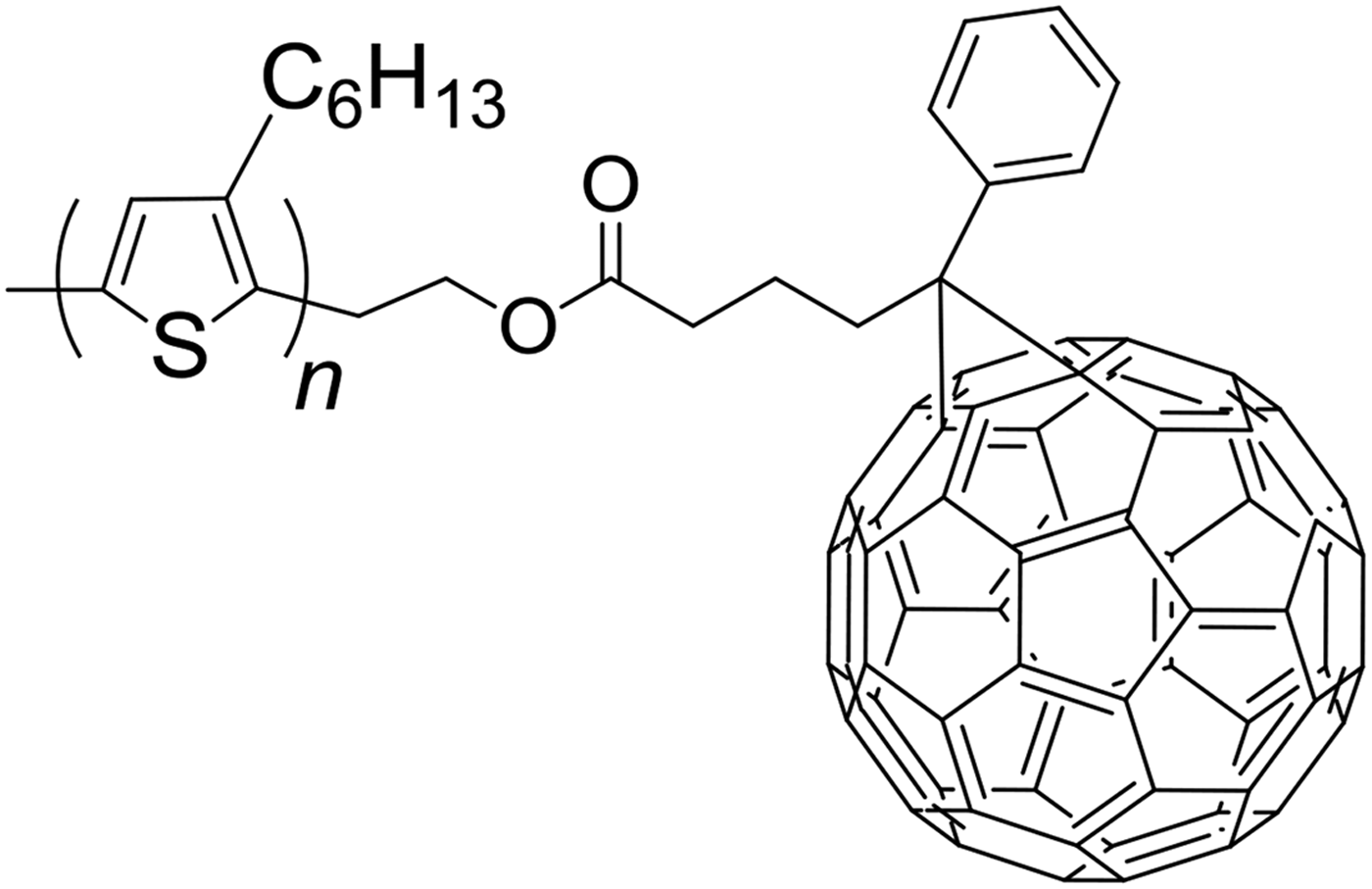
As a possible solution to the complexity and practicality of hybrid polythiophene compatibilizers, a more simple C60-end-capped poly(3-hexylthiophene) (P3HT-C60) (Scheme 19) was reported.[Reference Lee, Jung, Emrick, Russell and Jo83, Reference Wang, Heeger and Wudl92]
C60-end-capped poly(3-hexyl thiophene).[Reference Lee, Jung, Emrick, Russell and Jo83, Reference Wang, Heeger and Wudl92]
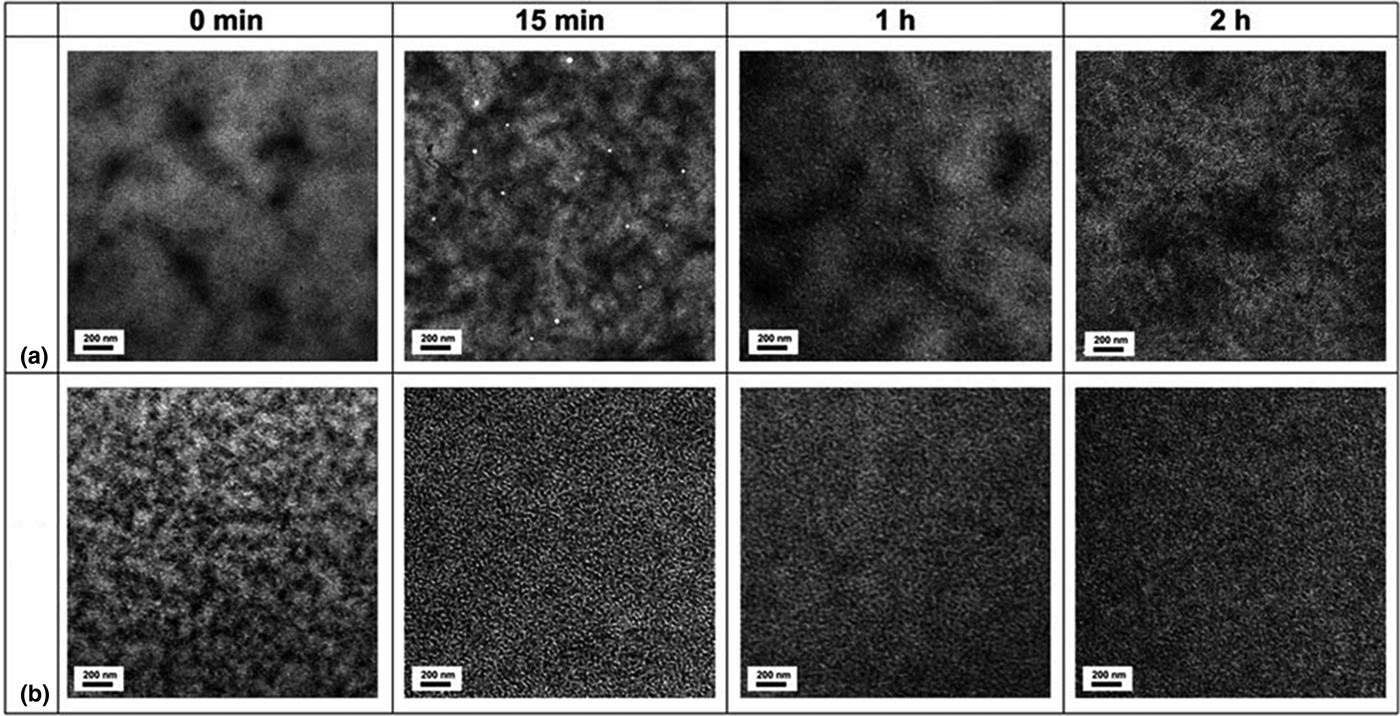
When this end-capped polymer was used as a compatibilizer for P3HT/PCBM blends the bicontinuous and nanometre-scale film morphology was preserved even after prolonged annealing times, and as a result, the P3HT/PCBM/P3HT-C60 BHJ solar cells exhibited the excellent long-term thermal stability of device performance Fig. 4.[Reference Lee, Jung, Emrick, Russell and Jo83] Self-assembly of the P3HT-C60 end-capped polymer resulted in nanostructures with well-defined donor–acceptor interfaces depending on the solvent employed as schematically shown in Fig. 5.[Reference Wang, Heeger and Wudl92–Reference Wang and Wudl94]
TEM images of (a) the standard P3HT/PCBM and (b) P3HT/PCBM/P3HT-C60 composite film with the addition of 2.5 wt% P3HT-C60 as a function of annealing time at 150 °C. Reproduced Ref. Reference Lee, Jung, Emrick, Russell and Jo83 with permission of The Royal Society of Chemistry.
Schematic representations of spherical (a) and fibrillar (b) nanostructures formed by P3HT-C60 of Scheme 19 where n = 30. (c) A scanning electron microscope (SEM) image of THF-cast film of P3HT-C60 shows spherical aggregates with varying sizes. (d) A photocurrent image collected at 0 V from o-DCB-cast film of P3HT-C60 showed well-resolved fibrillar structures with high contrast versus the background signal. Reproduced Ref. Reference Wang and Wudl94 with permission of The Royal Society of Chemistry.
Non-conjugated connecting bridges were employed in the above cases for the attachment of the organic part onto the carbon nanostructure. On the other hand, if a conjugated bridge is inserted in-between the semiconductor and the carbon nanostructure through a “direct” attachment the electronic interactions of the two counterparts should be enhanced leading to unique integrated properties for the final hybrids.
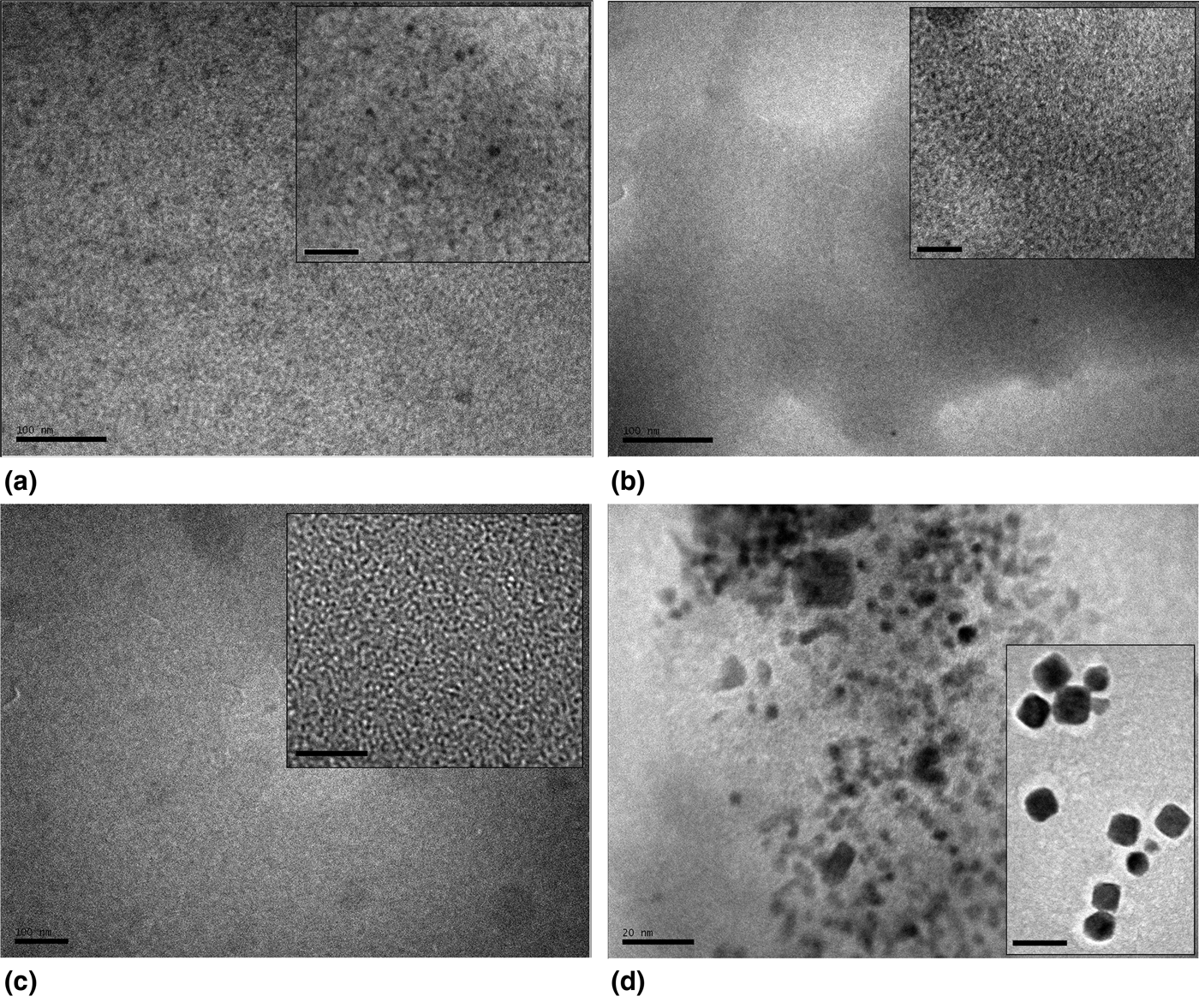
The perfluorophenyl functionality allows such a direct attachment through the transformation of one of the fluorine atoms to a stable azide and subsequent [3 + 2]-cycloaddition onto the fullerene's surface. 1,6-Azo bridged carbon nanostructure–organic semiconducting hybrids are created via this route.[Reference Yan, Cai and Keana95–Reference Liu and Yan99] This direct coupling of fullerenes onto semiconducting copolymers bearing electron-accepting poly(vinylphenyl perfluorophenyl-quinoline) blocks and electron-donating regioregular poly(3-alkyl thiophene) blocks was reported by Kakogianni et al. (Scheme 20).[Reference Kakogianni, Kourkouli, Andreopoulou and Kallitsis40] As can be seen in Fig. 6(b) films of P3OT-(P5FQ-N-PCBM) prepared using o-DCB presented smaller nanophase segregated domains, than those from THF [Fig. 6(a)] owing to the enhanced solubility of the polymeric and of the fullerene moieties.
Modified fullerenes with semiconducting copolymers bearing electron-accepting poly(vinylphenyl perfluorophenyl-quinoline) and electron-donating regioregular poly(3-alkyl thiophene) blocks.[Reference Kakogianni, Kourkouli, Andreopoulou and Kallitsis40]
TEM images of unstained P3OT-(P5FQ-N-PCBM) (from Scheme 20) (a) using THF and (b) using o-DCB; (c) of P3OT–PF5FQ using o-DCB (scale bar 100 nm). The insets in (a) –(c) show higher magnifications with the scale bar corresponding to 20 nm; (d) shows the TEM image of a P3OT-P5FQ/PCBM blend and of the net PCBM (inset, 20 nm scale bar) both using o-DCB. Reproduced Ref. Reference Kakogianni, Kourkouli, Andreopoulou and Kallitsis40 with permission of The Royal Society of Chemistry.
Polythiophene with pendant cyclopentadienyl groups was synthesized by employing GRIM polymerization and post-polymerization modifications and was finally conjugated to fullerenes (C60, PCBM, ICBA) via a Diels–Alder reaction (Scheme 21). The covalent P3HT–fullerenes hybrids formed smoother aggregation-free films with fine lamellae compared with the respective P3HT/fullerenes physical blends.[Reference Yameen, Puerckhauer, Ludwig, Ahmed, Altintas, Fruk, Colsmann and Barner-Kowollik100]
Polythiophenes with cyclopentadienyl pendant groups and covalent hybrids with different fullerenes, fabricated via Diels–Alder ligation under ambient conditions.[Reference Yameen, Puerckhauer, Ludwig, Ahmed, Altintas, Fruk, Colsmann and Barner-Kowollik100]
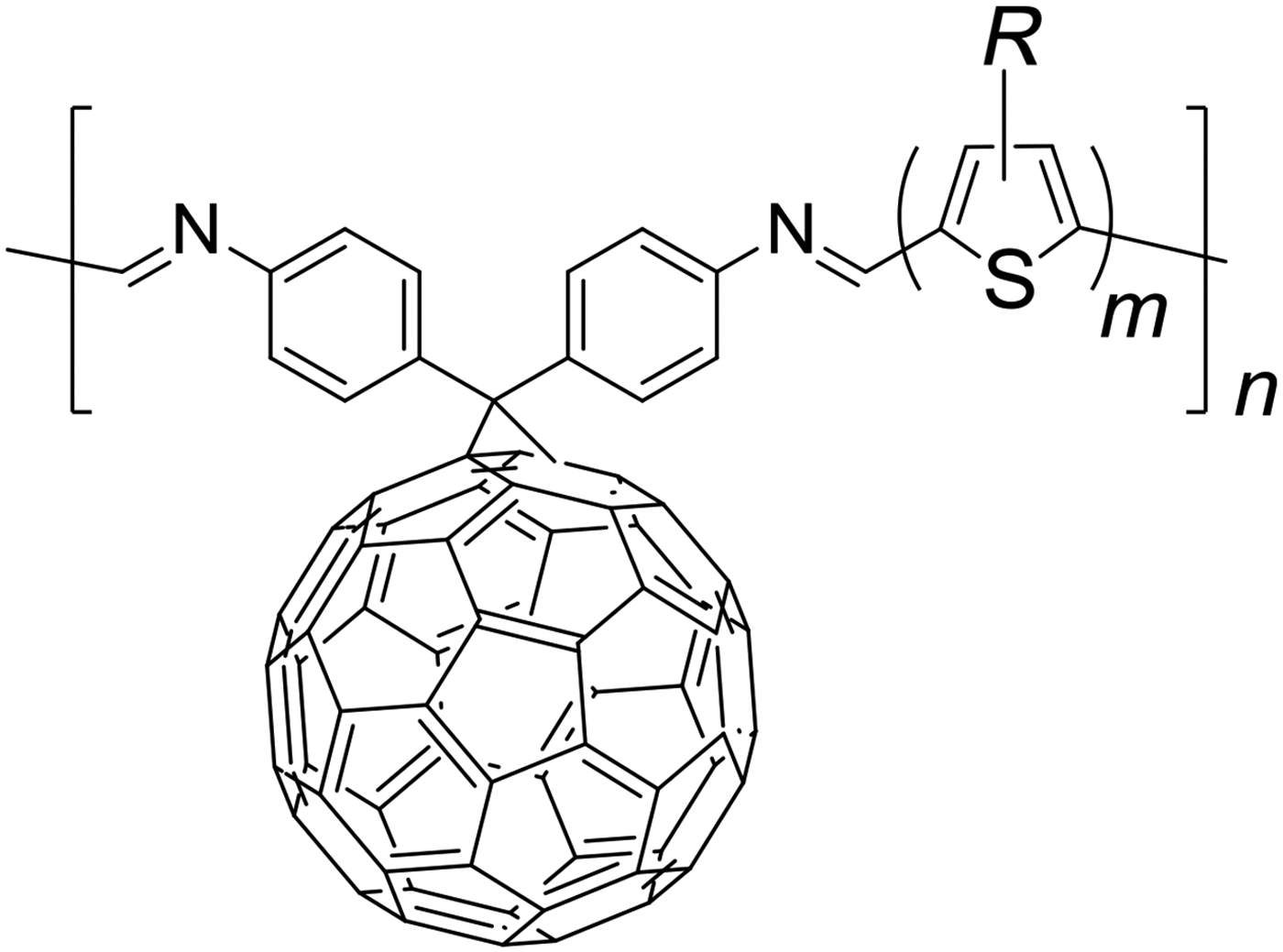
In a different approach the synthesis of hybrid polythiophene–C60 copolymers was accomplished by the copolymerization of a fullerene comonomer and difunctional P3HT rods as the second comonomer. Interesting highly linear donor–acceptor wire-like structures were obtained under specific substrates and casting, annealing conditions.[Reference Hiorns, Cloutet, Ibarboure, Khoukh, Bejbouji, Vignau and Cramail101] In a more defined manner and only quite recently a novel approach has been reported for the preparation of alternating polythiophene–fullerene hybrids at which the fullerene moiety is introduced as a comonomer during the polymerization reaction. Oligothiophene/fullerene alternating copolymers were prepared via condensation of dialdehyde functionalized oligothiophene segments of 15–30 r.u. and aromatic diamines carrying the fullerene unit (Scheme 22).[Reference Perrin, Legros and Mercier102]
Fullerene alternating copolymer prepared from dialdehyde oligothiophenes.[Reference Perrin, Legros and Mercier102]
Future prospects in applications of functional semiconducting polymers and hybrid organic materials with carbon nanostructures or inorganics
The advantages of organic conjugated semiconducting polymers such as versatile structural design, optoelectronic properties determined by the exact chemical structure, lightweight, mechanical strength, and flexibility have made possible enormous technological breakthroughs in the field of organic electronics. Nevertheless, for the realization of competitive technologies with broad commercialization potential requires well-defined materials and devices with “on-demand” properties, stability, and long-lasting operation under all environmental conditions and every day mistreatments. In general, strong limitations are the lack of accurate predictions over the active layer's morphology and properties and therefore the device's efficiency and stability through the design of new semiconductors. Through the various ways to manipulate the polymers’ characteristics in terms of chemical structure, nanophase ordering, miscibility with complementary materials (polymeric, carbon-based nanostructures, and inorganics) and optoelectronic properties it is expected that eventually all shortcomings will come to a “happy-ending”. Obviously this can be achieved only through interdisciplinary work in material synthesis, morphology control, and device design and fabrication.
As seen from the above sections, polymer chemists have come up with many, different polymer structures bearing functionalities that can modulate the optoelectronic properties and lead to controlled or even, in some cases, stabilized morphologies. Semiconducting polymers carrying functional units offer endless possibilities for the combination of moieties with different properties and with defined architectures leading to self-organized structures with domains in the nanometer scale.
The availability of the various synthetic methodologies for the functionalization of polymeric semiconducting units together with the realization of the potentiality of the carbon-based hybrid nanostructures also paved the way for the development of semiconducting carbon nanostructure hybrids of various architectures. This recent trend in the combination of functional polymers with carbon-based nanostructures such as fullerene derivatives and CNTs extend the applicability of semiconducting polymers and copolymers toward multifunctional polymeric hybrid materials. For example, semiconducting polymer-modified carbon nanostructures show great promise for optoelectronic applications and especially for OPVs due to their dual functionalities, both of the semiconducting species and of the fullerene or CNTs derivatives. Different synthetic approaches have been followed using a variety of chemistries for the covalent attachment of the functionalized semiconducting species onto carbon nanostructures. Recent advancements on the direct coupling of the functionalized semiconductors onto the carbon nanostructures open new ways for the synthetic consideration of these hybrid materials and enable their exploitation in a wide range of applications. The direct connection of the two moieties and the hybrids eventual distribution to the donor–acceptor interface, provide the means for better nanophase and interface stabilization and control of the nanodomains dimensions. These hybrids resemble the block copolymers characteristics and can eventually influence, control, and finally stabilize the morphology of blends constituting the net components.
By a chemically straightforward synthesis with the ability to prepare materials at any requested amount, a prerequisite to the realistic use of hybrid materials has been eventually fulfilled. The existence of functionalized semiconducting species with different functional groups also opens the way of their attachment to other nanomaterials such as inorganic semiconductors providing thus potential materials for DSSCs.
Acknowledgments
This research has been co-financed by the European Social Fund (ESF) and Greek National Resources through the “ARISTEIA” Action of the “Operational Programme Education and Lifelong Learning” project “Design and Development of New Electron Acceptor Polymeric and Hybrid Materials and their Application in Organic Photovoltaics—DENEA 2780”.