In spite of tremendous progress, mastitis remains the most economically significant bacterial disease of dairy cattle, and continued advances in mastitis control are necessary to ensure sustainability of dairy farming worldwide (Ruegg, Reference Ruegg2017). As the European Union plans to reduce the sale of antimicrobials for livestock by 50% by 2030, new methods for earlier mastitis detection, more reliable prevention, and more effective treatments need to be explored. Previous studies found milkability traits with negative implications for udder health, including a long duration of incline phase, a long decrease phase and too high a milk flow (Grindal et al., Reference Grindal, Walton and Hillerton1991; Mijić et al., Reference Mijić, Knežević and Domaćinović2004; Tančin et al., Reference Tančin, Ipema and Hogewerf2007). Moreover, mastitis by itself negatively affects milk production (Koeck et al., Reference Koeck, Loker, Miglior, Kelton, Jamrozik and Schenkel2014) and milkability (Tančin et al., Reference Tančin, Ipema and Hogewerf2007). Milk production and milk flow characteristics are used not only in the monitoring of udder health, but also in the development of milking machines and in setting parameters for their use (Tančin et al., Reference Tančin, Ipema, Hogewerf and Mačuhová2006). Adapting milking machines and milking procedures to the physiological requirements of the cow could enhance milking efficiency and protect udder health (Sandrucci et al., Reference Sandrucci, Tamburini, Bava and Zucali2007).
The aim of this study was to explore the extent of milkability changes caused by the incidence of clinical mastitis, and to monitor the development of these changes in a timeline from 2 weeks before to 4 weeks after the diagnosis of clinical mastitis. Our second objective was to investigate if milkability of cows shortly before mastitis diagnosis was significantly different compared to healthy cows, and therefore to determine if monitoring these parameters could be useful for early detection of clinical mastitis.
Material and methods
The study was carried out in accordance with Czech legislation for the protection of the animals against abuse (no. 246/1992) and with directive 2010/63/EU on the protection of animals used for scientific purposes.
Experimental design
The study was conducted on a Holstein dairy farm in the Central Bohemian Region of the Czech Republic. Housing conditions and milking settings are specified in the online Supplementary File. All cows that calved on the farm from November until the end of February participated in the experiment (n = 127). Milkability parameters during the first 120 d in milk (DIM) were monitored for all cows in the experiment. A veterinarian diagnosed 27 cows with clinical mastitis during the observed period. Healthy cows were used as a control group, and to provide a reference for the monitored parameters in non-infected cows. The period around mastitis diagnosis was divided into six weeks and marked as follows: 2PreMas – 8 to 14 d before mastitis diagnosis; 1PreMas – 1 to 7 d before mastitis diagnosis; 0PostMas – 0 to 6 d after mastitis diagnosis; 1PostMas – 7 to 13 d after mastitis diagnosis; 2PostMas – 14 to 20 d after mastitis diagnosis; 3PostMas – 21 to 27 d after mastitis diagnosis.
Data collection
Data for milk yield per milking (MY; kg), average milk flow (AMF; kg/min), milking time (min), the occurrence of bimodal milk flows and partial milk flows within the first two minutes of milking (during following schedule: 0–15 s; 15–30 s; 30–60 s; 60–120 s; kg/min) were collected from in-line real-time milk analysers (Afilab with software Afifarm 4.1; Afimilk; Afikim; Israel) for each milking.
Statistical analysis
The GLM procedure in SAS 9.3 (SAS Institute Inc., Cary, NC, 2011) was used to evaluate the differences in milkability parameters during the period around clinical mastitis diagnosis, and to compare them with the control group. The model equation consisted of the fixed effect of the time of milking (morning; evening), the fixed effect of parity, the fixed effect of the period around mastitis incidence, linear regression on DIM, and regression on the date of milking. Detailed descriptions can be found in the Supplementary file. The Tukey−Kramer method was used to evaluate differences of least-square means. Significance levels P < 0.05 and P < 0.01 were used to evaluate the differences between groups. The model equation was significant for all monitored parameters (online Supplementary Table S1).
Results and discussion
In our study, 21.3% of monitored cows were diagnosed with clinical mastitis within the first 120DIM. This percentage might seem high, although it is similar to the average incidence rate on Holstein dairy farms, as we discuss further in the online Supplementary File.
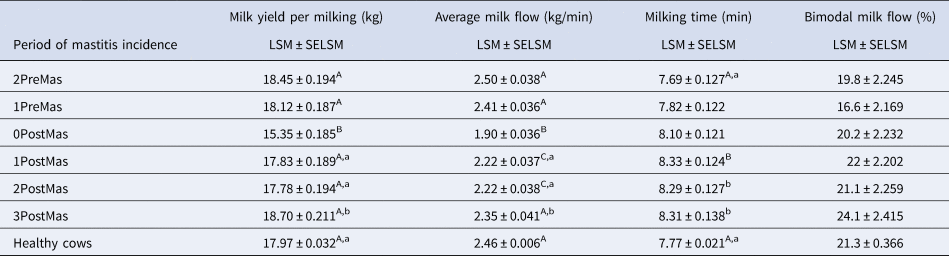
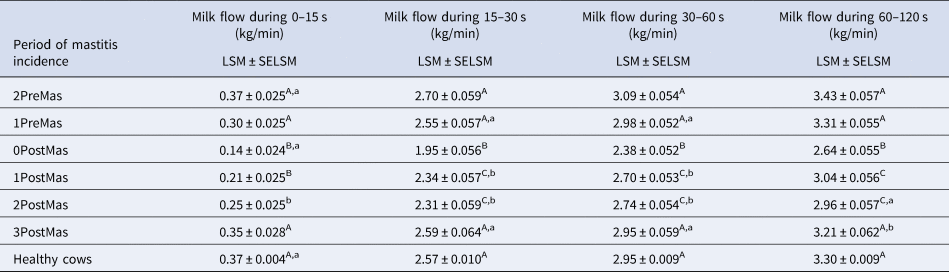
As was stated in the study of Tančin et al. (Reference Tančin, Ipema and Hogewerf2007), it is important to know if there are milk flow characteristics that could be used for earlier identification of health problems or if specific milk flow characteristics are risk factors for mastitis. In our study, we did not observe any significant differences in MY, AMF, milking time, the occurrence of bimodal milk flows or partial milk flows between the cows during 2PreMas and the healthy cows (Tables 1 and 2). The subsequent period (1PreMas) also did not show any statistical difference in comparison with healthy cows, but we observed a downward trend approaching the day of mastitis diagnosis. This might have been caused by a few days overlap between mastitis incidence and diagnosis. Milkability was significantly affected during the clinical mastitis (0PostMas). However, these changes occurred too late to be effectively used for early detection compared to changes in milk conductivity and somatic cell count (SCC), which become noticeable in the very early stages of the clinical disease. Moreover, it is possible that these milkability changes were only secondary, and only occurred because of prior changes in milk yield and milk composition.
Development of milk yield and selected milkability parameters in period around mastitis incidence, with the healthy cows as a control group

Different letters in columns mean statistical significance A-B-C… P < 0.01; a-b-c… P < 0.05. 2PreMas – 8 to 14 d before mastitis diagnosis; 1PreMas – 1 to 7 d before mastitis diagnosis; 0PostMas – 0 to 6 d after mastitis diagnosis; 1PostMas – 7 to 13 d after mastitis diagnosis; 2PostMas – 14 to 20 d after mastitis diagnosis; 3PostMas – 21 to 27 d after mastitis diagnosis; LSM, least squares means; SELSM, standard error of least-squares means.
Development of partial milk flows during the first two minutes of milking in period around mastitis incidence, with the healthy cows as a control group

Different letters in columns means statistical significance A-B-C… P < 0.01; a-b-c… P < 0.05. 2PreMas – 8 to 14 d before mastitis diagnosis; 1PreMas – 1 to 7 d before mastitis diagnosis; 0PostMas – 0 to 6 d after mastitis diagnosis; 1PostMas – 7 to 13 d after mastitis diagnosis; 2PostMas – 14 to 20 d after mastitis diagnosis; 3PostMas – 21 to 27 d after mastitis diagnosis; LSM, least-squares means; SELSM, standard error of least-squares means.
Hagnestam et al. (Reference Hagnestam, Emanuelson and Berglund2007) observed a non-significant decrease in MY 2−4 weeks before diagnosis and a significant decrease in the week proceeding diagnosis. On the other hand, the results of our study showed that MY significantly dropped only during 0PostMas (−2.77 kg per milking compared to 1PreMas; P < 0.01; Table 1). These contrary results might be related to earlier detection of mastitis in our study, where we used farm software equipped with ‘in-line’ milk analysers, while Hagnestam et al. (Reference Hagnestam, Emanuelson and Berglund2007) detected mastitis visually from the first streaks of milk and inflamed udder. Corresponding to our results, Koeck et al. (Reference Koeck, Loker, Miglior, Kelton, Jamrozik and Schenkel2014) reported reduced MY during the occurrence of clinical mastitis. Studies of Hagnestam et al. (Reference Hagnestam, Emanuelson and Berglund2007) and Koeck et al. (Reference Koeck, Loker, Miglior, Kelton, Jamrozik and Schenkel2014) also observed that MY during lactation was negatively affected after clinical mastitis. In our study, MY was affected only during the clinical disease (0PostMas) and quickly increased one week later (1PostMas) to the production level of the pre-mastitis period. Moreover, MY significantly increased during 3PostMas in comparison with the previous two weeks. In addition, MY during 3PostMas was significantly higher compared to the healthy cows and non-significantly exceeded pre-mastitis values. A reason for higher MY in the month after the occurrence of mastitis might be partly due to the traditional intensive genetic selection for milk production traits and the antagonism between milk production and mastitis resistance (there is detailed discussion in the online Supplementary File).
Fast milking cows with high milk flows are at higher risk of mastitis incidence (Grindal et al., Reference Grindal, Walton and Hillerton1991), which was not observed in our study, as AMF during 2PreMas and 1PreMas was similar to AMF of healthy cows. However, AMF dropped during 0PostMas (−0.51 kg/min compared to 1PreMas; P < 0.01; Table 1) and was significantly affected by mastitis even three weeks after the diagnosis. Reduced milk flow rate for infected quarters was also pointed out in the studies of Tančin et al. (Reference Tančin, Ipema and Hogewerf2007), and Tančin and Uhrinčať (Reference Tančin and Uhrinčať2014). An explanation for this non-linear relationship might be that fast milking cows are more susceptible to mastitis, but when one quarter within the udder is infected, the peak milk flow rate for that quarter is significantly decreased (Tančin and Uhrinčať, Reference Tančin and Uhrinčať2014). At last, AMF became similar to the healthy cows in 3PostMas, but it did not reach pre-mastitis values, although the differences were not significant.
Pre-mastitis milking time was similar to the healthy cows, and we did not observe any significant changes during 0PostMas. Milking time became significantly longer during 1PostMas ( + 0.62 min compared to 2PreMas; P < 0.01; Table 1), because MY increased in 1PostMas but AMF was still significantly decreased by mastitis. Tančin et al. (Reference Tančin, Ipema and Hogewerf2007) demonstrated a longer decline phase for infected quarters, which could prolong overall milking. In our study, longer milking was most likely associated with overmilking of fast milking uninfected quarters, while the flowmeter waits until the milk flow from the infected quarter drops below the threshold for the automatic detachment system. The threshold for milk flow in our study was set to 0.5 kg/min, which could leave too much milk in the infected quarters in this specific situation. Leaving a small amount of milk in the udder after milking does not increase SCC or mastitis incidence (Clarke et al., Reference Clarke, Cuthbertson, Greenall, Hannah, Jongman and Shoesmith2004). However, as was shown in the study of Gašparík et al. (Reference Gašparík, Ducháček, Stádník and Nováková2018), decreasing the threshold value on a farm with high bulk SCC significantly reduced SCC within a month after milking setting optimization. Prolonged milking time observed during 1PostMas stayed at the same level during 2PostMas and 3PostMas. Therefore, milking time did not return to pre-mastitis values and was significantly increased even a month after mastitis diagnosis ( + 0.62 min from 2PreMas to 3PostMas; P < 0.05). Extended machine-on time could further damage uninfected quarters on susceptible cows (further discussion in online Supplementary File).
The occurrence of bimodal milk flows was not affected by mastitis. The occurrence ranged from 16.6% during 1PreMas to 24.1% during 3PostMas (Table 1), which was lower compared to the study of Sandrucci et al. (Reference Sandrucci, Tamburini, Bava and Zucali2007) with 35.8%. The lower occurrence was probably caused by the combined form of pre-milking stimulation used in our study. Partial milk flows had similar development to each other and to AMF as well. All partial milk flows significantly dropped during 0PostMas compared to the pre-mastitis period (P < 0.01), which showed that milk flow during the incline and plateau phases of milking was significantly slower due to mastitis. Corresponding results were reported by Mijić et al. (Reference Mijić, Knežević and Domaćinović2004), who demonstrated that the cows with a short incline phase had the least SCC in milk. Partial milk flows significantly increased in 1PostMas, stayed on the same level during 2PostMas, and increased to the pre-mastitis and healthy cows' values during 3PostMas (Table 2).
Negative effects of mastitis on milkability could be explained by the underlying physiological mechanisms of udder infection. Increased SCC could slow down milking by affecting the free flow of milk through milk ducts from the alveoli to the cistern as was suggested by Tančin et al. (Reference Tančin, Ipema and Hogewerf2007). The presence of one or more quarters with high SCC within the udder would reduce MY and consequently peak flow rate (Tančin et al., Reference Tančin, Ipema and Hogewerf2007). In agreement, our results showed that MY and AMF significantly decreased during 0PostMas when SCC was at the highest. Furthermore, mastitis can cause an increase in SCC long after the clinical symptoms have been cured (Koeck et al., Reference Koeck, Loker, Miglior, Kelton, Jamrozik and Schenkel2014), which might be the reason for significantly longer milking time of cows recovering from clinical mastitis. Another possibility is that milking of infected teats was more painful. Mastitis can be a very painful disease, which causes hormones of the hypothalamic−pituitary−adrenal axis to be elevated (de Boyer des Roches et al., Reference de Boyer des Roches, Faure, Lussert, Herry, Rainard, Durand and Foucras2017), resulting in incomplete milking and slower milk flow. Reducing the pain during milking could improve mastitis treatment.
Nowadays, milking setup for Holstein cattle requires high pulsation rate, wider pulsation ratio, high milk flow threshold for automatic detachment, and moderate vacuum level to achieve the fastest milking without damaging teat structures (Gašparík et al., Reference Gašparík, Ducháček, Stádník and Nováková2018). However, balanced milk flow and gentle milking could be beneficial for infected and recovering animals. This could be achieved by narrowing the pulsation ratio and decreasing the vacuum level.
In conclusion, the results of this study showed that milkability changes caused by the incidence of clinical mastitis are significant, long lasting, and should not be ignored. The ability to adjust milking settings for cows diagnosed with mastitis, or cows that are recovering from mastitis, could become a useful tool for improving mastitis treatment in the future.
Supplementary material
The supplementary material for this article can be found at https://doi.org/10.1017/S002202992200005X
Acknowledgements
This work was supported by the Ministry of Education, Youth and Sports of the Czech Republic (‘S’ grant) and by the National Agency for Agricultural Research of the Czech Republic (grant no. QK21010123).