INTRODUCTION
Most cancer patients experience a number of distressing physical and psychosocial symptoms during the course of their illness, and these symptoms significantly affect their day-to-day activities and quality of life (Bruera et al., Reference Bruera, Neumann and Brenneis2000). The integration of palliative care interventions early in the cancer treatment process has been widely advocated (National Consensus Project, 2004; Ferris et al., Reference Ferris, Bruera and Cherny2009; Levy et al., Reference Levy, Back and Benedetti2009) Early referral to palliative care can facilitate the timely diagnosis and treatment of symptoms, provide longitudinal psychosocial support to patients and their families, and aid in a gradual transitioning to end-of-life care (Bruera & Hui Reference Bruera and Hui2010b; Hui et al., Reference Hui, Parsons and Nguyen2010). In this simultaneous care model, patients need not choose between cancer-directed treatments and palliative care.
Palliative medicine is a recognized specialty in many countries, and a growing base of evidence shows it improves patients' quality of care (Higginson et al., Reference Higginson, Finlay and Goodwin2002, Reference Higginson, Finlay and Goodwin2003). Over the years, the number of palliative care programs in cancer centers, academic hospitals, and community hospitals in the United States has dramatically increased (Billings & Pantilat Reference Billings and Pantilat2001; Hui et al., Reference Hui, Elsayem and De la Cruz2010a). One expectation of hospital-based palliative care programs is that they can help integrate palliative interventions earlier in the disease process. However, despite increased availability and evidence of efficacy, patients continue to be referred to these programs in low numbers and late in the disease trajectory (Cheng et al., Reference Cheng, Willey and Palmer2005; Osta et al., Reference Osta, Palmer and Paraskevopoulos2008; Hui et al., Reference Hui, Elsayem and De la Cruz2010a). Efforts to expand palliative care programs can be stymied when referrals are nonexistent or are too late in the disease trajectory to be effective (Meier, Reference Meier, Meier and Hughes2010).
A major barrier limiting referrals to palliative care programs may be the misconception about palliative care services held by oncologists, patients, and their families. Palliative care is often considered synonymous with hospice care, or end-of-life care, and referral to the program is considered appropriate only after patients have exhausted all cancer treatment options (Enguidanos et al., Reference Enguidanos, Housen and Goldstein2009; Fadul et al., Reference Fadul, Elsayem and Palmer2009; Finlay & Casarett, Reference Finlay and Casarett2009). Given that almost all cancer patients seen by the palliative care team are referred by oncologists, oncologists play a critical role in determining the need for and timing of referral. Oncologists' understanding of palliative care programs and their ability to effectively communicate information about palliative care services to their patients is of paramount importance to the development of successful palliative care infrastructures in institutions across the country.
Several studies have suggested that the term “palliative care” may be a deterrent to early referrals and that the term “supportive care” may present hospital-based palliative care programs in a more favorable light (Morstad Boldt et al., Reference Morstad Boldt, Yusuf and Himelstein2006; Fadul et al., Reference Fadul, Elsayem and Palmer2009). In order to facilitate early referrals, we changed the name of our outpatient and inpatient consultation program from “Palliative Care” to “Supportive Care” in November 2007.
The goal of this study was to examine medical oncologists' perceptions of the supportive care service at M.D. Anderson Cancer Center and to determine whether changing the name “palliative care” to “supportive care” influenced communication with patients and their families about palliative care and the referral process.
METHOD
The study was conducted at The University of Texas M.D. Anderson Cancer Center, a comprehensive cancer center in Houston, Texas. The institutional review board approved the study.
Participants
We invited medical oncologists from eight different oncology departments in the Division of Cancer Medicine to participate in the study. The departments were chosen according to the number of referrals to supportive care services, from the highest (Thoracic/Head & Neck Care Center, Gastrointestinal Care Center, and Investigational Cancer Therapeutics), middle (Genitourinary Care Center, Gynecologic Oncology Center), and lowest (Breast Center, Sarcoma Care Center, and Melanoma Care Center)(Elsayem et al., Reference Elsayem, Swint and Fisch2004). Eighty oncologists were contacted via e-mail and asked about their willingness to participate in the study.
Procedure
Informed consent was obtained from all participants prior to the study interview. Oncologists were asked to provide information pertaining to their demographics (age, sex, race) and their clinical practice (number of years in practice, percentage of patients with advanced cancer, proportion of patients who had died in the last year, and proportion of their patients that they referred to the supportive care program). This was followed by a semi-directed interview. The interview questions were geared toward eliciting open-ended responses to acquire specific information about oncologists' perceptions and understanding of supportive care services, to determine how their understanding influenced the communication between them and their patients during the referral process, and to determine to what extent changing the name of the service from “palliative care” to “supportive care” affected oncologists'/patients' understanding of palliative/supportive care. The specific questions used during the interview are available on request from the first author.
All interviews were conducted over a 1-month period (February 2011). All interviews were audio-recorded and then fully transcribed. The name and personal information of participants were removed from transcripts, and participants were assigned a code number. All audio files were kept in a secure location.
Data Analysis
We used a grounded theory approach in the analysis of the qualitative transcripts and applied a thematic analysis to the data to extrapolate results. Grounded theory is a popular qualitative research technique that allows theory to emerge inductively from data (Chesebro & Borisoff Reference Chesebro and Borisoff2007). The first step is an open coding, consisting of multiple reviews of the transcripts to identify and categorize data (Lindlof & Taylor Reference Lindlof and Taylor2002). The first two authors (S.B., W.R.) performed this first step independently. The second step in grounded theory is to divide the interview into “units of meaning” to highlight, in a third step, the underlying meaning of what the participant wanted to express. This open coding (analysis of each interview independently) was then complemented by an axial coding, to connect all the interviews. This comparison of the interviews aimed to identify the common and differing elements among participants' responses. During this last step, all elements were categorized into major themes and subthemes. These results were independently reviewed and then compared and synthesized by the two first authors (S.B., W.R.).
Sample Size Determination
In qualitative research, sample size is determined when none of the analysts recognize new or unique themes. This is known as data saturation. In our study, data saturation was reached after the coding of 15 transcripts. We therefore stopped further recruitment after two interviews with no new information.
Presenting Results
Exemplar statements made by participants are presented in italics to support our conclusions. Minimal editing was done to preserve authenticity. We used ellipses (…) where irrelevant information was deleted from a quote. When necessary to clarify, we added information to participant's words in square brackets.
RESULTS
Demographics of Study Participants
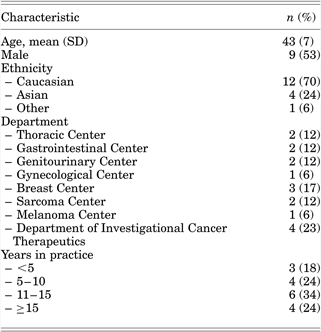
We interviewed 17 medical oncologists from eight oncology departments. The median length for an interview was 7 minutes and 27 seconds (range, 3:31 to 20:16 minutes). Participant characteristics are summarized in Table 1. Sixteen (94%) oncologists stated that 50–75% of their patients had advanced cancer. Additionally, 12 (71%) oncologists reported that 50–75% of their patients had died within the past year. All of the oncologists stated that they were familiar with the supportive care service.
Oncologist's characteristics (N = 17)

SD, standard deviation.
Fourteen (82%) participants reported that they referred >50% of their patients to the palliative/supportive care service, whereas three (18%) claimed that they referred <25% of their patients.
Oncologists' Understanding of the Function and Benefits of the Supportive Care Program
Oncologists' primary understanding of supportive care services focused on two specific elements of palliative care: symptom control and end-of-life care. They also cited caregiver/family counseling and support, improving patients' ability to tolerate cancer therapies, and counseling for children of cancer patients as additional supportive care services.
Symptom Control
All of the oncologists interviewed cited symptom control or symptomatic relief as a primary function of supportive care. Specifically, oncologists described the service as assisting patients with common and coexisting symptoms such as pain, nausea, vomiting, and weight loss; oncologists also included an emphasis on the service's attention to psychosocial issues such as depression. Several of the oncologists explained that whereas they manage patients' symptoms, the supportive care team has greater expertise in symptom control.
I think that it's nice to know that there are people who are more skilled than I am and who are interested in very complicated situations, complicated symptoms that are difficult to manage.
I think supportive care is more comprehensive. I have patients, who have pain, and sometimes I send them to pain service, but it's related to cancer pain. But pain services, all they would end up doing is titrating up their medication without looking at the other issue related to the pain itself. (…) The emotional feeling of being on 10 pain medications, being constipated, or being not able to eat, being depressed, that's part of the pain sometimes. (…) I think supportive care addresses issues that are encompassing of their symptoms, not just the one symptom. They look at the whole person.
Transitioning Patients to End-of-Life Care
The majority of oncologists expressed an appreciation for the supportive care team's assistance with the communication process involved in transitioning patients to end-of-life care.
The fact that we can actually explain to patients that it's not that we're going to stop taking care of them, but that we're shifting the focus of our care to intensive management of symptoms and quality of life, I find is a very positive thing to be able to offer our patients.
(…) and also the transition to hospice care, especially patients who are not accepting it, who have difficulty accepting it, and it takes a longer time to deal with it. So to have people who can help with this is very important. A lot of our time is spent on treating the cancer, so when we don't have treatment, it's very difficult.
Providing Informal Caregiver Support
All of the oncologists agreed that the supportive care team provides psychosocial support to the patients' caregivers. Oncologists perceived that caregivers benefited in two specific ways: 1) reduced caregiver anxiety, and 2) assistance with communication about disease and end of life. The oncologists perceived that the reduction of caregiver distress was directly associated with the benefits of patient symptom relief. One oncologist explained:
(…) for the family members, they often are very relieved to see that the symptoms, which are in many ways the most distressing thing for the family members to see the patients go through, the emphasis on controlling those symptoms and improving those symptoms can bring a lot of relief to the family as opposed to simply aggressive treatments for the cancer which may not address symptoms patients are experiencing.
Oncologists also perceived that the supportive care team played a key role in the communication process among patients, caregivers, and physicians. One oncologist stated: “I think that it helps them [caregivers] to accept the inevitable and ease the transition. Maybe even grieving eventually.”
Another elaborated on that point: “When patients are ready to die, they're ready to die, but sometimes the families urge them to take on therapy that they don't necessarily need.”
Helping Children of Cancer Patients
Some oncologists specifically cited the role the supportive care service plays for patients who have young children. These oncologists described how members of the supportive care team assist with the psychosocial concerns of patients who are struggling to communicate with their young children about their disease. “I have a lot of patients, unfortunately, who have young children. And how do you talk to your kids about death and dying and cancer? And they [supportive care] help with that.”
Decreasing Oncologist Workload Burden
The majority of oncologists perceived involvement of the supportive care team as an important time-saving application. These oncologists admitted they simply do not have time to manage the complex issues their patients often experience. “(…) because I'm allotted 15 minutes while I'm trying to treat them for their metastatic cancer, it really does not give me appropriate time to deal with a lot of the issues.”
Additional Benefits
Oncologists cited their ability to increase or extend chemotherapy treatments as another practical application for the involvement of supportive care. “I have patients whose symptoms are better controlled and then I can sometimes give them more chemotherapy. They tolerate their chemotherapy better.”
Several oncologists stated that supportive care might actually help in prolonging a patient's life. They referred to a recent study in which researchers found longer survival rates in lung cancer patients with early palliative care intervention. (Temel et al., Reference Temel, Greer and Muzikansky2010) One explained: “I thought the lung cancer study was great. Overall survival, I mean if that was a drug, people would be going crazy. Some pharmaceutical company would be going crazy.”
Communicating to Patients about Referral to the Supportive/Palliative Care Program
“The Earlier the Better”
The majority of oncologists understand that early referral to supportive care maximizes benefits for patients, caregivers, and the oncologists themselves. Many of these oncologists underlined the importance of forming a relationship with a new team and allowing better continuity of care when cancer treatment is no longer appropriate. “I refer the patient actually even earlier than when they need supportive help, not at the end of their course when they cannot get any more therapy because, at that point, they have no time to form a relationship with the supportive care physician…”
However, a few oncologists admitted that their current practice does not always follow this rule. One stated: “.. in reality we tend to do it towards the end of that journey [patient's journey through metastatic cancer] (…) we tend to use the service as a transition to a non-therapeutically active end-of-life phase. Perhaps we should refer earlier, but we don't.”
Triggers and Barriers to Referral
When oncologists were asked to identify the factors that help them determine whether to provide a referral, the majority cited the presence of refractory symptoms or obviously distressful symptoms as a point for referral. “As a medical oncologist, many times I tend to discount… pain control we don't discount as much, but some of the nausea, vomiting, weight loss, psychosocial issues, etc, etc. and they sort of give those much more higher priority.”
Several oncologists cited end of life, presence of recurrent or metastatic disease, or exhaustion from cancer treatment as a trigger for referral. “So I'm one of those who have not, who still treats the supportive care service as the palliative care service, and I look for end-of-life type stuff.”
One oncologist who self-reported a high level of referrals described his hesitation to provide referrals toward the end of the disease trajectory:
One area that is tough for me, and I think is tough for other people, is you know symptoms increase at the end, but often you're not quite at the hospice stage, and sometimes they increase and I feel like I'm able to control them, but then it kind of gets tougher and there's just too many things going on.
Furthermore, several oncologists acknowledged that the moment to stop chemotherapy and initiate a more palliative approach to care is not a clear-cut point in time. “The area where I could conceive of more utilization would be in this kind of symptom management with ongoing transition to, or maybe going to hospice down the road. I think we need to be more consistent in working out what the boundaries are a little bit.”
Even though most oncologists stated that early referrals to supportive care are preferable, several oncologists revealed that the communication involved with the referral process is often challenging. These oncologists explained how referral to the program may potentially lead to conflicts regarding goals of care and disruption in the balance of power between physicians. “There are some physician ownership issues, which in some ways is a good thing. If you want to take good care of somebody, it's your duty; you want to take the responsibility to do that in its totality. You don't want someone kind of potentially changing what you're doing.”
Managing Patient- or Caregiver-Initiated Referral
Although oncologists are responsible for referring patients to supportive care, there were a few oncologists who stated that it was not uncommon for patients or caregivers to broach the topic first. One oncologist described what may be a trend: “I feel like people are much more savvy now about palliative care and it may be from reading on the Web or just from networking with other patients, but people know a lot more about palliative care and supportive care now than I feel like they used to, even 2 years ago.”
Oncologists explained that patients who initiate conversations about supportive care referral are usually seeking greater symptom control or assistance with end-of-life transitions. However, the majority of oncologists stated that it was rare for patients or caregivers to ask them for a referral to supportive or palliative care. One oncologist stated that the reason for them not bringing it up first might not be that they are unaware of the service, but rather that they want to convey a positive outlook regarding their illness. “(… ) most patients come here wanting to fight and they don't want to tell you that they want supportive care or that they are weak. They all try to be peppy and happy, and that they can do everything and be strong.”
Impact of Name Change (from “Palliative Care” to “Supportive Care”) on Communication
None of the oncologists stated that the name change had an impact on their referral patterns to the supportive care program. However, the majority of them supported the name change, as it helped them in their communication about the referral, as they perceived their patients were more receptive of “supportive care” than they were of “palliative care.”
“A name is a name for me. It doesn't make a difference. It helps the patient though, to tell them I am referring them to supportive care. Some patients take it easier than if I tell them I am referring them to palliative care. They think it is hospice (…) so the patient may have a different intake, but that doesn't change my practice pattern.
A few oncologists stated that the name change did not affect their communication with patients regarding referrals because they were already using the term “supportive care” to describe the palliative care program. “I've never called them the palliative care service. I've always called them the supportive care service.”
One oncologist who had reported a referral pattern of <25% stated that the name change would not affect referrals as that oncologist still identifies supportive care as a service synonymous with hospice or end-of-life care, regardless of the name change.
There were some oncologists who were not in favor of the name change to supportive care; two preferred the name “symptom control,” and the others favored keeping the name “palliative care,” and stated:
Supportive care seems like we are not going to palliate, that we are just going to support them. So to be able to palliate them psychologically, physically, symptom wise, it seems that we are achieving something. (…) So I feel that supportive is a little bit too passive, whereas palliative it seems that we are doing a little bit more than supportive.
DISCUSSION
One of the primary goals of simultaneous care is to eliminate the need for cancer patients to choose between disease-directed treatments and palliative care. As oncologists play a critical role in determining the need for and timing of referral, their understanding of palliative care programs, and their ability to effectively communicate information about the service to their patients, is crucial. We aimed to examine medical oncologists' perceptions of the supportive care program at M.D. Anderson Cancer Center, and to determine whether changing the name of the service from “palliative care” to “supportive care” influenced communication regarding referrals.
This study reveals that oncologists' understanding of the supportive care program primarily corresponded with the principles of palliative care, and was consistent with the simultaneous care model (Loscalzo Reference Loscalzo2008; Meier Reference Meier, Meier and Hughes2010). Oncologists' cited symptom control, transitioning to end-of-life care, caregiver/family support, and improving patients' ability to tolerate cancer therapies as some of the benefits of the program. The majority also stated that referrals should occur early, with some insisting that the onset of advanced disease was not a necessary prerequisite for referral. However, despite these positive perceptions of the service, oncologists appeared to be hesitant in initiating referrals unless there were “sentinel” events, such as the cessation of cancer treatments, or the presence of refractory symptoms, which is also consistent within the literature (Johnson et al., Reference Johnson, Girgis and Paul2008) Oncologists in our study acknowledged several communication challenges that they faced, such as referral conversations with patients, as well as with the supportive care team following the referral, which may explain some of the delay in enacting referrals earlier in the disease trajectory.
Physicians are known to favor communication regarding medical or technical issues over quality-of-life assessments or psychosocial issues (Detmar et al., Reference Detmar, Muller and Wever2001) Assessment of palliative care needs requires physicians to go beyond their comfort zone, encouraging patients to express all their concerns, fears, and expectations for care. There are also inherent challenges to delivering accurate prognostic information to patients (Finlay & Casarett Reference Finlay and Casarett2009). Discussions about poor prognoses—often referred to as “bad news” conversations—are difficult to deliver because they are upsetting to the patient and family (Escalante et al., Reference Escalante, Martin and Elting1997). Some oncologists' hesitate to discuss the possibility of death with their patients because they may perceive it as a failure on their part to “cure” the illness or they may not want to take away hope from the patient (Ahmedzai et al., Reference Ahmedzai, Costa and Blengini2004) Reluctance to openly discuss anything beyond the narrow confines of the disease may result in missed opportunities for appropriate goal setting and care planning (Finlay & Casarett Reference Finlay and Casarett2009). Even after the name change, oncologists in our study perceived challenges with patient referrals.
Rather than suddenly passing the baton of care to a new team when cancer- directed therapies are no longer feasible, oncologists in our study acknowledged the importance for patients to form a relationship with the supportive care team earlier on, thereby allowing better continuity of care. However, inclusion of another team in a patient's care plan requires a great deal of coordination and interaction. Interviewed oncologists cited concerns about potential disagreements between the two care teams regarding goals of care, and disruption in the balance of power between physicians. Our results suggest that there is a need for improving communication between oncology and palliative medicine professionals if we truly want to offer patients access to simultaneous care. It is essential that both teams make efforts to avoid confrontation, and work on strategies for collaborative decision making (Glare et al., Reference Glare, Auret and Aggarwal2003) Palliative medicine specialists should reassure referring oncologists that the team will work in an integrated fashion, and will not attempt to disqualify their care plans, but will rather enhance them by focusing on aspects not addressed so far (Bruera Reference Bruera2004). Later, as the clinical situation emerges, the supportive care team may need to become increasingly involved in the direct management of complex scenarios. “Palliphobia” can be greatly exacerbated when a palliative care team tries too hard, too fast, to make changes in patient care, without discussion with the referring provider (Bruera Reference Bruera2004).
Although interviewed oncologists perceived that the name change did not impact their own referral pattern, a recent quantitative study conducted at M.D. Anderson Cancer Center revealed an overall increase in referrals since “palliative care” became “supportive care,” by ~40%, and by 1.5 months earlier in the illness trajectory (Dalal et al., Reference Dalal, Palla and Hui2011) One possible explanation is that the physicians' recollection of referrals may be tied to particularly meaningful patients for whom their pattern may not have changed, rather that their overall recognition of their results. This effect is called the confirmation bias (i.e., cognitive bias whereby one tends to notice information that confirms one's existing beliefs, while ignoring anything that contradicts those beliefs) (Onwuegbuzie & Leech Reference Onwuegbuzie and Leech2007). Our results, if confirmed, suggest that the physicians' recollection of referral patient may not be a reliable outcome, and that independent confirmation of referral patterns needs to be measured. However, oncologists overall favored the name change, as they perceived patients would be more receptive to “supportive care” than to “palliative care.” This needs to be confirmed by conducting interviews with oncology patients and their families, which would also allow for understanding their views of the problems they face and the barriers they encounter when such a referral is made.
CONCLUSION
In summary, we found that oncologists understood the primary functions and benefits of the supportive care program, and perceived the service in helping them ease their workload. Although early referrals to the service are preferable, oncologists identified communication challenges involving the referral process with patients/families, and with the supportive care team. Furthermore, although renaming “palliative care” may be an effective approach to improving perceptions of the service—particularly for patients, as this research suggests—more research is needed to determine whether renaming the service is the best way to approach the issue. Future research should expand on the simultaneous care model by contributing to the construction of an infrastructure that guides physicians through each phase of simultaneous care. Physicians would benefit from continued research and curriculum development concerning communication skills, including how to communicate with colleagues to facilitate concurrent care. Medical oncologist training should include systematic rotation in the palliative care department, and role-playing prognostic discussions and palliative care referrals with patients. Overall, as oncologists provide earlier and more frequent palliative/supportive care referrals, patients will have a better quality of life.
Limitations
The main limitation of this study is the recruitment process. Although oncologists were broadly and randomly selected during initial recruitment, those with greater propensity for referrals to and utilization of palliative/supportive care services at M.D. Anderson were more likely to participate. Therefore, a more favorable interpretation of the program may be reflected in this study's findings compared with the overall view of all oncologists at the institution. Furthermore, data consisted of oncologists' self-reports of their perceptions and practices. Although eliciting oncologists' responses from their point of view was essential to this study, the reliability of self-report data is always questionable, because it is dependent upon the participants' subjective perspectives. Further research to confirm our findings is warranted.