Introduction
Lameness is a painful and debilitating condition that is recognised as one of the most important welfare problems for dairy cattle. It also contributes to the overall cost of production on dairy farms with several direct and indirect costs (Green et al., Reference Green, Hedges, Schukken, Blowey and Packington2002). Esslemont and Kossaibati (2001) estimated a direct cost of up to £112 per average lameness case in the UK including labour, treatment and cost of discarded milk. This cost increases up to £193 following the consideration of indirect costs such as reduced milk yield (Green et al., Reference Green, Hedges, Schukken, Blowey and Packington2002), longer calving interval (Esslemont and Kossaibati, 2001), increased risk of culling (Booth et al., Reference Booth, Warnich, Gröhn, Maison, Guard and Janssen2004) and the overall lower survival rate (Booth et al., Reference Booth, Warnich, Gröhn, Maison, Guard and Janssen2004). In addition, there are animal welfare costs that are difficult to quantify, such as the pain suffered by a lame cow (Logue et al., Reference Logue, Offer and Kempson1993).
Hoof disorders are the main contributor to lameness in dairy cattle (Logue et al., Reference Logue, Offer and Kempson1993). Also, correlations between some hoof disorders and locomotion are strong (van der Waaij et al., Reference van der Waaij, Holzhauer, Ellen, Kamphuis and de Jong2005), albeit with large s.e. Such correlations indicate that the presence and increased severity of hoof disorders are highly related to the deterioration in the locomotion ability of the cow (van der Waaij et al., Reference van der Waaij, Holzhauer, Ellen, Kamphuis and de Jong2005). Factors affecting hoof disorders and locomotion can be generalised into environment and genotype of dairy cow, although genotype by environment interactions also exist (Boelling and Pollott, Reference Boelling and Pollott1998; Fatehi et al., Reference Fatehi, Stella, Shannon and Boettcher2003). Significant genetic variation is reported for traits associated with hoof health (Politiek et al., Reference Politiek, Distl, Fjeldaas, Heeres, McDaniel, Nielsen, Peterse, Reurink and Strandberg1986; Emanuelson, Reference Emanuelson1998; van der Waaij et al., Reference van der Waaij, Holzhauer, Ellen, Kamphuis and de Jong2005), implying that genetic selection for improved hoof health is feasible. Genetic studies suggest that selection solely on milk production will increase the genetic predisposition to inferior hoof health and lameness (Uribe et al., Reference Uribe, Kennedy, Martin and Kelton1995; Emanuelson, Reference Emanuelson1998; Rauw et al., Reference Rauw, Kanis, Noordhuizen-Stassen and Grommers1998); however, in direct contrast others (Berry et al., Reference Berry, Buckley, Dillon, Evans and Veerkamp2004; Van Dorp et al., Reference Van Dorp, Boettcher and Shaeffer2004) have reported favourable genetic correlations between milk yield and locomotion.
Nutrition and feeding management are important risk factors for hoof disorders and clinical lameness, in particular those associated with laminitis (Nocek, Reference Nocek1997; Amstel and Shearer, Reference Amstel and Shearer2006). Abrupt changes in diets (e.g. dry cow to lactation cow diets) as well as diets high in water-soluble carbohydrates, low in effective fibre or a combination of both are known triggers of laminitis, sole ulcers, white line disease and heel erosion (Nocek, Reference Nocek1997; Cook et al., Reference Cook, Nordlund and Oetzel2004).
The objective of this study was to quantify the effects of three genetic groups of Holstein–Friesian cows, selected on a total merit index, and managed in two contrasting grass-based systems of milk production on locomotion score, clinical lameness and hoof disorders. The possible existence of genetic group by management system interaction was also investigated. The results from this study will be useful in determining if selection using the Irish total merit index for dairy cattle has any negative repercussions for traits associated with cow locomotion and hoof health while also evaluating contrasting pasture-based feed systems.
Material and methods
This study was carried out at Curtins Farm, Teagasc, Moorepark Dairy Production Research Centre, Fermoy, Co., Cork in the south of Ireland (50°07′N, 8°16′W, 46 m above sea level) from 1 December 2005 to 11 December 2006. For the purpose of this trial, a total of 126 spring-calving Holstein–Friesian cows of three genetic groups (42 cows per group) were randomly allocated to one of two grass-based feed systems in a 3 × 2 factorial arrangement (21 cows per treatment group).
Animals
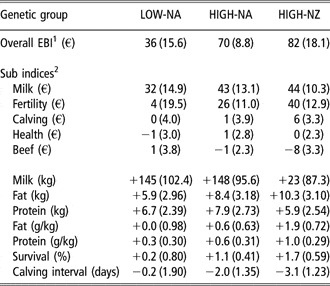
Cows of three genetic groups (mean calving date of 23 February 2006; range 12 January to 29 April 2006) were compared based on the ‘Economic Breeding Index’ (EBI). The EBI (Berry et al., 2007) is the Irish selection index derived to identify animals whose progeny are genetically superior for profitability within Irish dairy herds (Veerkamp et al., Reference Veerkamp, Dillon, Kelly, Cromie and Groen2002). The EBI is expressed in euros per lactation and ranks animals on the expected profitability per lactation of their progeny and includes traits such as milk production, fertility and survival, calving performance, beef performance and health. The three genetic groups were Irish national average genetic potential of North American ancestry (LOW-NA), North American high genetic potential (HIGH-NA) and New Zealand high genetic potential (HIGH-NZ).
To generate the LOW-NA genetic group, a sub-sample of the lowest 25% of cows, ranked on EBI, from within the Moorepark herd were selected, representing progeny of 12 sires of North American Holstein–Friesian ancestry. The LOW-NA groups were selected to represent the characteristics of the average genetic potential dairy cow on Irish dairy farms at the time of the study. The HIGH-NA genetic group was generated as a sub-sample of the highest 25% of animals of North American ancestry on EBI from within the Moorepark herd, representing progeny of 14 sires of North American Holstein–Friesian ancestry. The HIGH-NZ animals originated as embryos were imported in 1998 from New Zealand and implanted into 13-month-old heifers at Moorepark. These embryos were generated by mating high genetic merit New Zealand Holstein–Friesian cows (expressed in the New Zealand genetic evaluation system, Breeding Worth) with high genetic merit New Zealand Holstein–Friesian sires. The resulting herd has been perpetuated by mating the New Zealand females to sires of New Zealand origin, representing progeny of 13 sires. The average percentage North American Holstein genes in the LOW-NA, HIGH-NA and HIGH-NZ groups were 81%, 92% and 12.5%, respectively. The mean pedigree index (from the February 2006 international evaluations of the INTERBULL Animal Center, Uppsala, Sweden for milk production traits and the February 2006 domestic genetic evaluation for other traits) for each genetic group across a range of traits is summarised in Table 1. The parity structure of each genetic group in the present study was the same with 25%, 25% and 50% of first, second and third or greater parity animals, respectively.
The mean pedigree index (EBI) for the three genetic groups of Holstein–Friesian cows studied based on their predicted transmitting abilities (and s.d.) for milk production, survival and calving interval

All predicted differences were obtained from the February 2006 international evaluations of the INTERBULL Animal Centre (Uppsala, Sweden) using the multi-trait across-country evaluation (MACE).
1EBI = Economic Breeding Index.
2Subindices are derived from the economic values of individual traits: milk (−€0.084/kg) fat (€1.55/kg), protein (€5.27/kg), survival (€10.80/%), calving interval (−€7.17/day), health (−€55.48/unit logSCC and €1.13/standardised locomotion score), beef (€2.94).
Feeding systems
Pluriparous animals were blocked (two animals per block) based on calving date, bodyweight and previous lactation milk production within genetic group and then randomly allocated to one of two grass-based feeding systems. Pre-experimental milk production (i.e. milk yield in the first 4 weeks of lactation) and calving date were used to block primiparous animals and they were subsequently randomly assigned to feeding system. A separate farmlet was allocated for each feed system. Therefore, each feeding system was applied immediately post partum to all pluriparous cows and after 4 weeks of pre-experimental milk production for primiparous animals. The feed systems compared were (1) a high grass allowance and low-concentrate input system typical of spring-calving herds in Ireland (control) and (2) a higher concentrate, high stocking rate feeding system. The low-concentrate feed system had an overall stocking rate of 2.6 cows/ha, and a concentrate input of 743 kg over the total lactation with the remainder of the diet coming from grazed grass. Animals on the high-concentrate feed system were stocked at 2.8 cows/ha and had a concentrate input of 1.474 kg of concentrates over the total lactation. The fertiliser input (nitrogen) on both systems was 260 kg/ha (from early January to late September). The ingredient composition of the concentrate (kg/t as fed) for both systems was as follows: 250 kg barley, 260 kg corn gluten, 350 kg beet pulp, 110 kg soybean meal and 30 kg minerals plus vitamins.
During the housing period, animals were grouped according to calving date and fed grass silage ad libitum with animals consuming approximately 1.0 t DM per cow during the dry period. All animals were turned out to grass as they calved during the day from 23 January and during day and night from 21 March to 4 December 2006. All calved animals were offered a grass silage ad libitum over night from 23 January to 21 March. All animals regardless of feed systems grazed to a similar post-grazing surface sward height (5.5 cm).
Animal measurements
This study was part of a larger study that investigated the productivity, health and welfare of the three genetic groups. For the purposes of the current study, three aspects of cow health and welfare are described as follows: locomotion score, clinical lameness and hoof disorders.
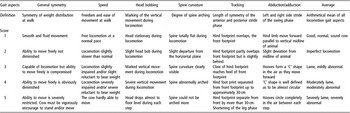
Locomotion score was assessed every second week throughout the year by one trained observer. Cows were assessed using a locomotion score system modified from O’Callaghan et al. (Reference O’Callaghan, Cripps, Downham and Murray2003). In brief, cows were observed walking on a level concrete surface after the morning milking and scored on six different aspects of gait. Definitions of the gait aspects are summarised in Table 2. Each individual aspect received a score from one to five; one representing normal and five representing severely abnormal.
Definition of locomotion score gait aspects. Locomotion score adapted from O’Callaghan et al. (Reference O’Callaghan, Cripps, Downham and Murray2003)

Clinical lameness was based on the farm manager’s assessment that the cow was sufficiently lame that she had to be restrained for inspection and treatment. The cow was either correctively trimmed, a claw block applied and/or drugs administered. Cow number, date, diagnosis and treatment were recorded. Data were available for all cows from the beginning of the study until drying off or until an animal was removed from the study.
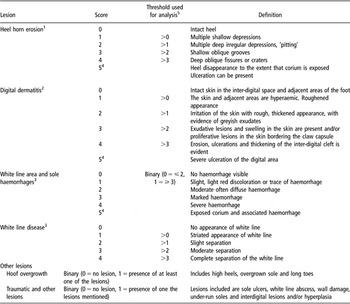
The four hooves of all cows were preventively trimmed 50 days prior to the mean expected calving date. Following calving, hoof disorders were recorded on both claws of each hind foot by the same trained observer at 35 (s.d. = 4) and 230 (s.d. = 26) days post-calving. A sliver of horn (approximately 1 mm) was pared from the whole area of the weight-bearing surface to expose fresh horn. The presence and severity of hoof disorders in each claw were classified into five groups: (1) heel erosion; (2) digital dermatitis; (3) sole haemorrhages; (4) white line disease and (5) hoof conformation, traumatic and infectious disorders (Table 3). For the sole haemorrhage scoring, a compartmentalised recording methodology of two areas per claw (i.e. white line area and sole area) using a modification of the six zones from Greenough and Vermunt (Reference Greenough and Vermunt1991) was used. In brief, white line area corresponds to zones one to three, while sole area corresponds to zones four to six used by Greenough and Vermunt (Reference Greenough and Vermunt1991). The scoring system used to indicate the severity of the lesions is explained in Table 3.
Hoof lesion scores for heel erosion, digital dermatitis, sole haemorrhage and white line disease

1Score adapted from Smilie et al. (Reference Smilie, Hoblet, Eastridge, Weiss, Schnitkey and Moeschberger1999).
2Score adapted from Winckler and Willen (Reference Winckler and Willen2001).
3Score adapted from Greenough and Vermunt (Reference Greenough and Vermunt1991).
4Score of 5 at the different lesions types had a small representation in the data, therefore was grouped with category four in the analysis.
5The data on the present column indicate the thresholds and arrangement of data used for statistical analysis.
Data editing and statistical analysis
Locomotion score
Locomotion score data between calving and dry off or removal of the study were retained for analysis. Analysis of locomotion score data was undertaken for each of the six gait aspects individually as well as for the mean locomotion score calculated as the arithmetic mean of the six gait aspects. The hazard of a cow reaching a threshold of three (i.e. poor locomotion) at day t post-calving, given that it had not reached the threshold by time t−1, was modelled using Cox’s regression survival analysis in PROC TPHREG (SAS, 2006). Additional analyses were undertaken using a threshold of four. Cows that did not reach the threshold under investigation were included as censored for the days post-calving corresponding to the day of dry off or removal of the study. Class variables considered for inclusion in the model were genetic group, feed system and parity; the covariate included was calving day of the year. Only factors significantly (P < 0.05) affecting the dependent variable, based on the Wald test-statistic, were retained in the model, with the exception of genetic group and feed system, which were forced into the model. Two-way interactions between genetic group and feed system, between genetic group and parity and between feed system and parity were also tested for significance in the model.
Hazard ratios were calculated as the exponent of the model solutions. The hazard ratio is an estimation of relative risk of the event (i.e. poor locomotion) occurring in the exposed group v. the reference group or class. In all instances the LOW-NA, low-concentrate feed system and a combination of LOW-NA × low concentrate were the reference class for the genetic group, feed system and genetic group by feed system interaction, respectively. Therefore, a hazard ratio of one indicates that the hazard of poor locomotion is equal in both groups. However, a hazard ratio greater than one indicates a greater risk of poor locomotion compared with the reference class. Because feed system was not imposed on first parity animals until 4 weeks after calving, two sets of analyses were carried out. Both analyses included the same class variables: genetic group, feed system and parity. In the first set of analysis, all parities were included (1 to 6) and the estimates of genetic group and parity quantified. For the second set of analysis, only animals with a parity ⩾ 2 were included and the estimates for feed system quantified.
Clinical lameness
Only the first case of clinical lameness within cow, between calving and dry off or removal from study was retained for analysis. Both survival analysis and logistic regression were undertaken to quantify the effect of genetic group, feed system and two-way interactions on clinical lameness. For survival analysis, the methodology applied was identical to that described above for locomotion score. In the logistic regression analyses, days post-calving were divided into three periods: 0 to 50 post-calving, 0 to 100 post-calving and 0 to 200 days post-calving. The logit of the probability of clinical lameness within each time period was modelled by logistic regression using PROC GENMOD (SAS, 2006) utilising a logit link function and a binomial distribution. Fixed effects tested for inclusion in all analyses were identical to those previously described for the analysis of locomotion score.
Hoof disorders
Two types of disorders were identified: those scored on an ordinal scale (i.e. digital dermatitis, heel erosion and white line disease) and those scored as a binary trait (i.e. other lesions as described in Table 3). Sole and white line haemorrhages were recorded on an ordinal scale; however, due to the low frequency of data points in high severity classes, the data were rearranged into a binary trait (Table 3). In summary, a binary variable was generated for both areas, irrespective of whether a haemorrhage of ⩾3 was observed or not. For all analyses, hoof measurements at 35 and 230 days post-calving were analysed separately. Preliminary analyses were done for ordinal traits to investigate whether the odds of a positive outcome differed at each threshold of severity. The preliminary analyses revealed a lack of proportionality; hence, separate binary variables were defined using different cut-off thresholds for the different hoof disorders with an ordinal scale. The different threshold used for each hoof disorder is stated in Table 3.
All data were analysed using generalised estimates equations (GEE) in PROC GENMOD (SAS, 2006) utilising a logit link function and a binomial distribution; cow was included as a repeated effect with an exchangeable correlation structure assumed among claw and hoof records within cow. Fixed effects considered for inclusion in the model were genetic group, feed system, parity, lesion location (claw: lateral or medial, hoof: left of right) and calving date of the year; when appropriate, two-way interactions were tested for significance. Significance was declared at P < 0.05 based on the GEE score statistic. For some traits, animals in parities four to six had a prevalence of zero, posing problems associated with quasi-complete separation of the data. In such instances, parities four to six were merged with parity three animals and defined as parity three and greater.
Results
Locomotion score
Across the entire data set 56%, 56%, 50%, 60%, 75%, 75% and 35% of cows reached a general threshold of ⩾3 for the locomotion gait aspects of general symmetry, speed, head bobbing, spine curvature, tracking, abduction/adduction and average, respectively; 24%, 22%, 17%, 25%, 34%, 32% and 14% cows reached a threshold of ⩾4. The number of days post-calving for 25% of the animals to reach a threshold of ⩾3 for general symmetry, speed, head bobbing, spine curvature, tracking, abduction/adduction and average was 140, 46, 84, 34, 21, 45 and 122, respectively.
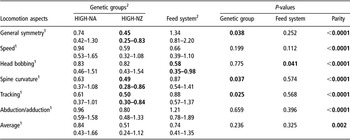
The effects of genetic group, feed system and parity on the range of locomotion gait aspects were similar irrespective of whether a threshold of three or four was used; therefore only results using a threshold of three are presented in Table 4. No genetic group by feed system interactions were observed for any locomotion gait aspect. Across the different gait aspects, the high EBI genetic groups had a lower hazard of reaching a threshold of three at day t of lactation given they had not reached that threshold by day t−1, albeit most were not significantly different from the LOW-NA group. The lowest hazards in the high EBI genetic groups were observed for general symmetry, spine curvature and tracking with the HIGH-NZ cows at less risk (P < 0.05) than the LOW-NA cows. The HIGH-NZ was not different (P > 0.05) from the LOW-NA cows. Feed system did not affect any of the aspects of locomotion (P > 0.05) with the exception of head bobbing (P < 0.05) where animals on the high-feed system had lower hazards of having increased head bobbing. Higher parity cows had a higher hazard (P < 0.001) of reaching thresholds of three or four for all aspects of locomotion. For example, sixth parity animals compared with first parity animals had 21.42 (95% CI: 7.444 to 61.658), 26.40 (95% CI: 9.260 to 75.238) and 9.12 (95% CI: 4.079 to 20.381) greater hazard of having poor general symmetry, spine curvature and tracking, respectively.
Effect of genetic group of Holstein–Friesian, feed system (low v. high concentrate) and parity on the hazard of showing locomotion ability with a score of three or greater

HIGH-NA = high EBI genetic merit of North American ancestry; HIGH-NZ = high EBI genetic merit of New Zealand ancestry.
1Expressed as hazard ratios and 95% confidence intervals.
2LOW-NA and low concentrate used as reference categories.
Bold values indicate significance (P < 0.05).
Clinical lameness
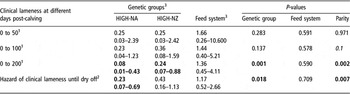
A total of 26 out of 126 cows (21%) were clinically lame at least once while 10 of these 26 cows were clinically lame more than once. Incidence of clinical lameness in the first 50, 100 and 200 days post-calving was 5%, 10% and 18%, respectively.
Genetic group and feed system effects on clinical lameness are summarised in Table 5. No interactions were observed between genetic group and feed system (P > 0.05). Both high EBI genetic groups (i.e. HIGH-NA and HIGH-NZ) had lower odds (P < 0.001) of clinical lameness in the first 200 days post-calving compared with the LOW-NA group (Table 5). The effect was also reflected in the hazard of getting clinically lame throughout lactation; where the HIGH-NA group had a lower hazard (P < 0.05) of becoming lame than the LOW-NA cows. Feed system had no effect (P > 0.05) on clinical lameness throughout lactation. The odds of a cow becoming clinically lame increased with parity where sixth parity animals had a 30.83 (95% CI: 4.401 to 215.980, P < 0.001) greater odds of becoming clinically lame compared with first parity animals.
Effect of genetic group of Holstein–Friesian, feed system (low v. high concentrate) and parity on clinical lameness

HIGH-NA = high EBI genetic merit of North American ancestry; HIGH-NZ = high EBI genetic merit of New Zealand ancestry.
1Expressed as odd ratios and 95% confidence intervals.
2Expressed as hazard ratios and 95% confidence intervals.
3LOW-NA and low concentrate used as reference categories.
Bold values indicate significance (P < 0.05).
Italic values indicate tendency (P ⩽ 0.1 or P = 0.05).
Hoof disorders
Results show that time of inspection had an effect on the prevalence of hoof disorders. Compared with 35 days post-calving, at 230 days post-calving, there was a reduction (P < 0.05) in the prevalence of cows affected (i.e. ⩾3 score) with digital dermatitis (33% to 19%), heel horn erosion (41% to 25%), haemorrhages on the white line area (9% to 3%) and traumatic and other lesions (23% to 13%). Conversely, there was an increase (P < 0.05) in the prevalence of cows affected by white line disease (23% to 40%) and hoof overgrowth (52% to 65%) with days post-calving. However, there were no changes in the prevalence (10%) of cows with haemorrhage severity of ⩾3 in the sole area across inspections (P > 0.05).
Location of disorders in the claw (i.e. lateral or medial claw) and hoof (i.e. left or right hoof) had no significant impact on any of the odds of any of the hoof disorders investigated. Furthermore, location had no interaction (P > 0.05) with genetic group, feed systems or parity.
There were no interactions (P > 0.05) between genetic group and feed system for any hoof disorder investigated, except for heel horn erosion. The interaction (P < 0.05) was observed for threshold ⩾2 of heel horn erosion at 35 days post-calving between genetic group and feed system. Genetic group differences due the interaction with the feed system are reported further below in the text. However, the main effect of genetic group on heel horn erosion without interaction is reported in Figure 2.
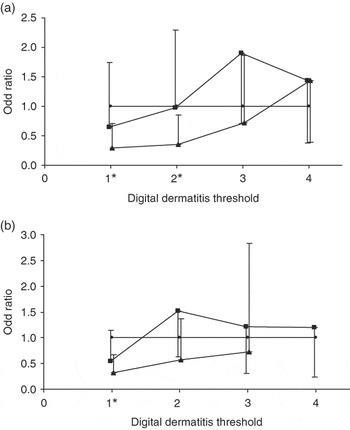
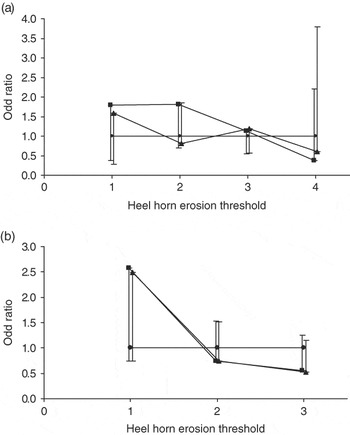
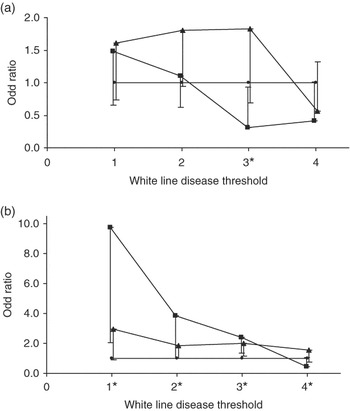
Although not always significantly different, the effect of genetic group on digital dermatitis, heel horn erosion and white line disease differed depending on the threshold chosen with the trend being relatively consistent either at 35 days or 230 days post-calving. The effect of genetic group on digital dermatitis, heel horn erosion and white line disease are illustrated in Figures 1–3, respectively, for different thresholds used.
Odds ratios for different thresholds of digital dermatitis at (a) 35 days post-calving and (b) 230 days for the (—▪—) HIGH-NA, (—▴—) HIGH-NZ and (—●—) LOW-NA; LOW-NA cows were the reference category. Relevant portion of the 95% CI are represented in the vertical s.e. bars. No cow in the HIGH-NZ had a digital dermatitis ⩾4 at 230 days post-calving and therefore this effect is not shown. *Indicates a significant (P < 0.05) genetic groups effect. Significance lies among the genetic group which relevant portion of 95% CI is above or below but not crossing the line representing the LOW-NA genetic group.

Odds ratios for different thresholds of heel horn erosion at (a) 35 days and (b) 230 days post-calving for the (—▪—) HIGH-NA, (—▴—) HIGH-NZ and (—●—) LOW-NA; LOW-NA cows were the reference category. Relevant portion of the 95% CI are represented in the vertical s.e. bars.

Odds ratios for different thresholds of white line disease at (a) 35d days post-calving and (b) 230 days post-calving for the (—▪—) HIGH-NA, (—▴—) HIGH-NZ and (—●—) LOW-NA; LOW-NA cows were the reference category. Relevant portion of the 95% CI is represented in the vertical s.e. bars. *Indicates a significant (P < 0.05) genetic groups effect. Significance lies among the genetic group which relevant portion of 95% CI is above or below but not crossing the line representing the LOW-NA genetic group.

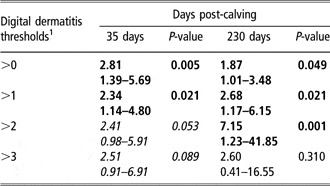
Feed system had no significant effect on white line disease or heel horn erosion, but it significantly affected digital dermatitis. The effect of feed system on digital dermatitis is summarised in Table 6.
Effect of feed system (low v. high concentrate) on different thresholds of digital dermatitis at two different times of inspection post-calving

1Expressed as odds ratios and 95% confidence intervals. Low-concentrate feed system used as reference category.
Bold values indicate significance (P < 0.05).
Italic values indicate tendency (P ⩽ 0.1 or P = 0.05).
For digital dermatitis (Figure 1), there were no differences (P > 0.05) between the HIGH-NA and LOW-NA animals for any of the thresholds chosen. However, the odds of digital dermatitis with a score ⩾1 was lower (P < 0.05) for HIGH-NZ animals compared with the LOW-NA animals. Furthermore, at 230 days post-calving, no HIGH-NZ cow had a digital dermatitis score of ⩾4. Animals in the high-concentrate feed system had a greater odds of having digital dermatitis with scores ⩽3 at both time periods (Table 6). Pluriparous cows had higher odds (P < 0.01) of digital dermatitis across the different thresholds than primiparous ones. Relative to primiparous animals, the odds of a digital dermatitis score ⩾3 at 35 days post-calving were 13.92 (95% CI: 4.523 to 42.852), 3.99 (95% CI: 1.077 to 14.759), 5.32 (95% CI: 1.317 to 21.537), 2.03 (95% CI: 0.471 to 8.799) and 2.61 (95% CI: 0.617 to 11.062) for second, third, fourth, fifth and sixth parity animals, respectively. Similar trends were observed at 230 days post-calving.
Genetic group did not significantly affect the odds of heel horn erosion at any of the thresholds investigated at either stage of lactation (Figure 2). Similarly, the feed system had no effect on heel horn erosion at any threshold or stage of lactation. However, as previously mentioned, an interaction between genetic group and feed system was evident for heel horn erosion with a score ⩾2 at 35 days post-calving (P < 0.001). This manifested itself as follows: HIGH-NZ cows on the high-concentrate feed system had greater odds (3.57, 95% CI 1.231 to 10.375) of heel horn erosion compared with HIGH-NZ cows on the low-concentrate feed system (0.57, 95% CI 1.712 to 0.163). Similar differences were observed in the LOW-NA cows, where animals on the high-concentrate feed system had higher odds (1.46, 95% CI 4.365 to 0.488) than LOW-NA cows on the low-concentrate feed system (reference group). However, the opposite trend was observed in HIGH-NA cows; HIGH-NA cows on the low-concentrate feed system had greater odds for this threshold (2.81, 95% CI 0.933 to 8.445) compared with animals on the high-concentrate feed system (0.67, 95% CI 0.246 to 1.811). Parity had an effect (P < 0.05) on heel horn erosion at both inspections across all thresholds analysed. Greater parity animals had greater odds of heel erosion than first parity animals. For instance, sixth parity animals had greater odds (7.02, 95% CI: 2.327 to 21.189) of heel horn erosion ⩾2 at 35 days post-calving than first parity animals. Similar results were found at 230 days post-calving.
Genetic group affected the odds of white line disease (Figure 3a) at 35 days post-calving (P < 0.05) for score ⩾3, where HIGH-NA cows had lower odds of presenting such severity of heel erosion than LOW-NA cows; HIGH-NZ cows did not differ at any threshold from LOW-NA cows. Moreover, genetic group affected (P < 0.05) the odds of white line disease at almost all the thresholds at 230 days post-calving (Figure 3b). The odds of white line disease was greater (P < 0.05) for the HIGH-NA compared with the LOW-NA cows at the low severity thresholds (i.e. score ⩽3), but the trend between these genetic groups was reversed at higher severity thresholds (i.e. score ⩾4). HIGH-NZ cows differed from the LOW-NA cows at a threshold = 3, where HIGH-NZ cows had greater odds of white line disease. However, for the rest of the thresholds no differences were found, showing an even distribution of severity cases at 230 days post-calving (P > 0.05) for the High-NZ cows compared with LOW-NA cows. Feed system did not affect the odds of white line disease at either stage post-calving (P > 0.05). Pluriparous cows had greater odds of white line disease than primiparae at both inspections. For example sixth parity cows at 35 days post-calving had greater odds (21.88, 95% CI: 2.953 to 162.277) of white line disease ⩾3 than first parity animals.
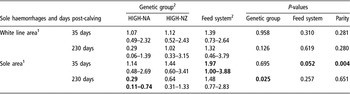
Genetic group had a significant effect on haemorrhages in the sole area at 230 days post-calving, where HIGH-NA cows had lower odds of presenting haemorrhages than LOW-NA. For other time periods analysed, neither genetic group nor feed system affected the odds of haemorrhages in the white line area or in the inner sole area and no genetic group by feed system interactions were observed (Table 7). Parity had an effect on haemorrhages only at 35 days post-calving for the inner sole haemorrhages (P > 0.05). Pluriparous cows had a higher odd (7.13, 95% CI: 1.834 to 27.702) of haemorrhages than primiparae.
Effect of genetic group of Holstein–Friesian, feed system (low v. high concentrate) and parity on sole haemorrhages using a severity threshold ⩾3 at two times of inspection post-calving

1Expressed as odds ratios and 95% confidence intervals.
2LOW-NA and low concentrate used as reference categories.
Bold values indicate significance (P < 0.05).
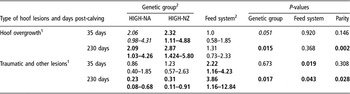
Results for other lesions recorded in the hoof are summarised in Table 8. No significant differences were found among the genetic groups at 35 days post-calving. However, both high EBI groups (HIGH-NZ and HIGH-NA) had higher odds (P < 0.05) of presenting hoof overgrowth characteristics than LOW-NA cows at 230 days post-calving (Table 8). Moreover, high EBI groups had lower odds (P < 0.05) of presenting traumatic lesions at 230 days post-calving. Cows on the high-concentrate feed system had higher odds (P > 0.05) of presenting traumatic and other lesions compared with cows on the low-concentrate feed system at both inspections. No interactions were found among main effects. In terms of parity, pluriparous cows had higher odds (P < 0.02) for presenting any of the listed lesions in comparison to primiparous animals at 230 days post-calving. For example, sixth parity cows had higher odds (13.62, 95% CI: 2.224 to 83.454) of presenting traumatic and other lesions compared with first parity cows.
Effect of genetic group of Holstein–Friesian, feed system (low v. high concentrate) and parity on other hoof disorders at different times of inspection post-calving

1Expressed as odds ratios and 95% confidence intervals.
2LOW-NA and low concentrate used as reference categories.
Bold values indicate significance (P < 0.05).
Italic values indicate tendency (P ⩽ 0.1 or P = 0.05).
Discussion
Pasture-based systems reduce the risk and severity of lameness by providing a yielding standing surface when grazing, reducing contact with infectious pathogens and providing comfortable laying areas (Bergsten, Reference Bergsten2001). Nevertheless, excessive walking distances, poorly constructed or badly maintained roads combined with badly drained soils and poor herding skills have a detrimental effect on cows’ hooves under grass-based systems (Chesterton et al., Reference Chesterton, Pfeiffer, Morris and Tanner1989; Logue et al., Reference Logue, Offer and Kempson1993).
However, to date most studies investigating the effects of genetics or nutritional management on hoof health were predominantly on cows fed indoors with few studies undertaken on cows on a diet predominantly based on grazed grass as operated in Ireland (Arkins Reference Arkins1981; Harris et al., Reference Harris, Hibburt, Anderson, Younis, Fitspatrick, Dunn, Parson and McBeath1988; Logue et al., Reference Logue, Offer and Kempson1993). Furthermore, information on lameness and hoof lesions are not routinely recorded in Irish dairy herds. Therefore, the motivation for this study was to quantify whether selection on the total merit index for dairy cattle in Ireland, the EBI, has any deleterious consequences for dairy cow hoof health and also to quantify whether the effect differed between contrasting pasture-based feeding systems. Although the size of the study is relatively small (126 animals) and extends over a relatively short period of time (1 year), it nonetheless provides data, from a well-controlled experiment, on the potential associations between genetic group and hoof health as well as between two contrasting grass-based management systems and hoof health.
The incidence of clinical lameness in the present study is similar to other reports on pasture-based systems of milk production (10% to 28%; Arkins, Reference Arkins1981; Tranter and Morris, Reference Tranter and Morris1991) as well as other production systems (2% to 59%; Clarkson et al., Reference Clarkson, Downham, Faull, Hughes, Manson, Merritt, Murray, Russell, Sutherst and Ward1996; Hirst et al., Reference Hirst, Murray, Ward and French2002). The high incidence of white line disease (22% of the cows) observed in this study has also been reported previously for pasture-based systems (Arkins, Reference Arkins1981; Tranter and Morris, Reference Tranter and Morris1991; Logue et al., Reference Logue, Offer and Kempson1993).
The prevalence of lameness in most studies is based on the subjective decision of the farm manager and therefore may underestimate the true frequency of lameness (Logue et al., Reference Logue, Offer and Kempson1993). To overcome this, it is suggested that a range of functional measures and parameters such as locomotion scoring and hoof disorders be included for a true estimation of lameness in addition to farm records (Booth et al., Reference Booth, Warnich, Gröhn, Maison, Guard and Janssen2004; Amstel and Shearer, Reference Amstel and Shearer2006). The ability to detect a lame cow is proportional to the extent of the changes in locomotion ability due to pain and the observer being able to detect those changes (O’Callaghan et al., Reference O’Callaghan, Cripps, Downham and Murray2003). The consistency between clinical lameness incidence and various aspects of locomotive ability using other functional measurements (locomotion score and hoof disorders) evident in this study supports the use of a variety of measures to derive more accurate estimates of hoof health. Such measures, while lower in heritability than claw morphology (Politiek et al., Reference Politiek, Distl, Fjeldaas, Heeres, McDaniel, Nielsen, Peterse, Reurink and Strandberg1986; Van Dorp et al., Reference Van Dorp, Boettcher and Shaeffer2004), are associated with milk production, health and survival of a cow (Green et al., Reference Green, Hedges, Schukken, Blowey and Packington2002; Van Dorp et al., Reference Van Dorp, Boettcher and Shaeffer2004).
Effect of genetic group
Significant differences between Holstein–Friesian genetic groups were observed across a range of hoof health variables, although the significance of genetic group effects among hoof disorders varied. Indeed, this study tested a large number of parameters for significance and some of the significant findings might have occurred by chance. Also, some results were somewhat contradictory (hoof growth) to the overall trend or were difficult to interpret (white line disease). Such variability can be explained by non-genetic influences (Bergsten, Reference Bergsten2001), the extent of genetic variance for the different disorders and the lack of strong correlations between the different disorders (van der Waaij et al., Reference van der Waaij, Holzhauer, Ellen, Kamphuis and de Jong2005). For example, van der Waaij et al. (Reference van der Waaij, Holzhauer, Ellen, Kamphuis and de Jong2005), in a study of Dutch dairy herds, reported the largest heritability estimate (0.01) for digital dermatitis, the same hoof disorder that presented a significant difference in odds ratios between genetic groups in the present study.
In summary, we can state that higher EBI groups (HIGH-NA or HIGH-NZ) had equal or improved locomotion ability, less-severe hoof disorders and less clinical lameness than animals of lower genetic potential (LOW-NA). The differences between genetic groups were generally constant across feed systems. The reported interaction for heel erosion might be considered an artefact of multiple testing since the existence of an interaction between genetic group and feed system was tested for all variables analysed. Genetic contributions to locomotion ability were reported previously (for review, see Boelling and Pollott, Reference Boelling and Pollott1998) with significant heritability estimates for locomotion (Van Dorp et al., Reference Van Dorp, Boettcher and Shaeffer2004) and hoof conformation (Politiek et al., Reference Politiek, Distl, Fjeldaas, Heeres, McDaniel, Nielsen, Peterse, Reurink and Strandberg1986; Rogers, 1996). Boelling et al. (Reference Boelling, Madsen and Jensen2001) observed significant inherent breed differences in hoof measurements, horn characteristics and claw disease frequencies between Danish Red, Danish Friesian and Danish Jersey breeds, while Jones et al. (Reference Jones, Hansen and Chester-Jones1994) found that the health costs associated with lameness were about 50% greater for a genetic line of cows selected for high milk yield than for cows from a control line.
Genetic variation within breeds in hoof lesions and hoof shape were reported and reviewed by Politiek et al. (Reference Politiek, Distl, Fjeldaas, Heeres, McDaniel, Nielsen, Peterse, Reurink and Strandberg1986). These studies reported sufficient heritabilities and additive genetic variation for claw morphology (e.g. claw angularity) and therefore recommended the inclusion of such traits in breeding indexes, while stipulating that morphological measures are limited (e.g. hoof growth) since they vary greatly due to environmental circumstances and measurement criteria (Politiek et al., Reference Politiek, Distl, Fjeldaas, Heeres, McDaniel, Nielsen, Peterse, Reurink and Strandberg1986). Thus, the present study emphasises the use of these functional measures (e.g. locomotion score) to investigate differences within breeds and as tools for the further development of balanced breeding indexes. Spine curvature and tracking were aspects of locomotion where significant genetic group differences were found; and such differences were in agreement with clinical lameness differences in the genetic groups. The literature states that the expression of clinical lameness due to increased incidence of traumatic and other lesions such as sole ulcers is better characterised in changes in the spine curvature and tracking of the cows’ locomotion (Sprencher et al., Reference Sprencher, Hostetler and Kaneene1997).
Exclusive genetic selection for milk production within the Holstein–Friesian breed is widely associated with a variety of deleterious consequences for animal health and survival (Jones et al., Reference Jones, Hansen and Chester-Jones1994; Rauw et al., Reference Rauw, Kanis, Noordhuizen-Stassen and Grommers1998; Booth et al., Reference Booth, Warnich, Gröhn, Maison, Guard and Janssen2004). The EBI index places emphasis on improved survival, fertility as well as health, with increased milk solids production. Reduced survival of a cow has a direct relationship with high incidence of lameness (Green et al., Reference Green, Hedges, Schukken, Blowey and Packington2002; Booth et al., Reference Booth, Warnich, Gröhn, Maison, Guard and Janssen2004). Therefore, increased genetic merit for survival, fertility and health is expected to have a favourable effect on the likelihood of lameness. The results of this study support this hypothesis, as the locomotion score of the HIGH-NA and HIGH-NZ groups was not compromised despite their genetic superiority for production traits such as increased fat and protein (Table 1). Hence, the differences among the genetic groups are in agreement with the predicted genetic potentials for survival for the three genetic groups.
Further explanation of the differences in the different gait aspects of locomotion score between the EBI groups may relate to body condition score (BCS) changes early in lactation. McCarthy et al. (Reference McCarthy, Berry, Dillon, Rath and Horan2007) studied the BCS curve of three genetic groups of the Holstein–Friesian cattle and reported that New Zealand Holstein–Friesian cows, of similar ancestry to the HIGH-NZ group, suffered less BCS loss in the early lactation compared with the other two groups. A high BCS loss immediately post partum has deleterious consequences for hoof health, resulting in hoof disorders such as sole ulcers (Lischer et al., Reference Lischer, Ossent, Räber and Geyer2002; Mülling and Lischer, 2002). Differences in the BCS loss among the genetic groups of the present study are speculated. Thus, the BCS loss being less for higher EBI groups reduced the risk of traumatic hoofs disorders, compared with LOW-NA cows as observed in Table 8.
Effect of feed system
Nutrition strategy and management affect hoof health, especially laminitis prevalence and severity (Nocek, Reference Nocek1997; Westwood et al., Reference Westwood, Bramley and Lean2003; Cook et al., Reference Cook, Nordlund and Oetzel2004). The feed systems applied in this study were divergent management strategies within pasture-based milk production systems with grazed pasture as the basal diet. The feed system strategies differed in concentrate input and stocking rate. The low-concentrate feed system is the basic management strategy of Irish pasture-based dairy systems. By contrast, a high-concentrate system combined with a higher stocking rate results in increased milk production per cow and per hectare while maintaining high levels of grass utilisation within an Irish pasture-based system. In general, hoof health was not deleteriously affected by increased concentrate supplementation, and no meaningful interactions were observed between feed system and genetic group. The prevalence in digital dermatitis and one of the gait aspects of locomotion (head bobbing) differed between feed systems, but was not reflected in a greater risk of clinical lameness. The higher incidence of digital dermatitis observed with the high-concentrate feeding is consistent with Somers et al. (Reference Somers, Schouten, Frankena, Noordhuizen-Stassen and Metz2005) where high concentrate intake in early lactation increased the risk of digital dermatitis. Additionally, the high-concentrate system in the current experiment was managed at a higher overall stocking density, which, under wetter grazing conditions, could result in increased pathogen transmission between infected and healthy hooves, thus spreading the digital dermatitis and increasing prevalence of digital dermatitis in the high-concentrate feed system. While other studies observed increased laminitis incidence with high-concentrate diets (Logue et al., Reference Logue, Offer and Kempson1993; Westwood et al., Reference Westwood, Bramley and Lean2003), the levels of concentrate supplementation in both feeding systems in the current analysis were modest and therefore the lack of major effects of feed system on other hoof disorders or influence on locomotion score is unsurprising.
Effect of parity and stage of lactation
The increased risk of poor hoof health observed in older animals is in agreement with the literature (Amstel and Shearer, Reference Amstel and Shearer2006). Mülling and Lischer (2002) suggested that the risk of lameness is exacerbated in older animals due to detrimental morphological and physiological changes to the hoof suspensory apparatus. However, observed effects might plateau with time, partly because cows adjust to these changes and partly because inferior hoof health affects the probability of culling (i.e. predisposed cows are culled at young age; Margerison, Reference Margerison2004). Still, older animals are always at greater risk of having poor hoof health and lameness, compared with first parity animals due a cumulative chance effect (Hirst et al., Reference Hirst, Murray, Ward and French2002; Booth et al., Reference Booth, Warnich, Gröhn, Maison, Guard and Janssen2004).
Descriptive results of the study showed an increased prevalence and severity of hoof disorders at first inspection (i.e. 35 days post-calving) compared with the second inspection (i.e. 230 days post-calving). The effect is a reflection of the stage of lactation (early v. late lactation) of the cow and seasonality (spring v. autumn). Such phenomena have been previously described in the literature (Clarkson et al., Reference Clarkson, Downham, Faull, Hughes, Manson, Merritt, Murray, Russell, Sutherst and Ward1996; Hirst et al., Reference Hirst, Murray, Ward and French2002). In Ireland, early spring coincides with the wet ground conditions for pasture-fed cows, which increases the risk of hoof disorders and lameness problems in the herd (Arkins, Reference Arkins1981). Furthermore, in early lactation cows mobilise BCS. The early-lactation BCS loss includes fat loss in the digital cushion of the hoof, thereby depleting its shock absorbing capacity and resulting in increasing wear of the horn and deformities of the inner and outer structures resulting in hoof lesions such as sole ulcers (Lischer et al., Reference Lischer, Ossent, Räber and Geyer2002; Mülling and Lischer, 2002). Differences in the BCS loss in early lactation had been related to genetic effects (McCarthy et al., Reference McCarthy, Berry, Dillon, Rath and Horan2007). Thus, it is desirable to disentangle seasonality from stage of lactation, especially early in lactation, to obtain a better understanding of these effects.
Conclusions
This study is novel in reporting differences among Holstein–Friesian genetic groups under controlled pasture-based feeding strategies. At the same time, it provides insight into the potential usage of functional measures as tools for lameness evaluation and inclusion of such estimations in breeding indexes. Genetic group defined by EBI influences the risk of presenting a poor locomotion score, getting clinical lameness and presenting different hoof disorders of dairy cattle. Results suggest that genetic improvement using the EBI will positively impact hoof health of the cow regardless of the feed system of the animal. In general, cows maintained on a high-concentrate feed system did not differ in the risk of poor hoof health or lameness. Although the study was conducted over 12 months, which may be considered short term, the results nonetheless indicate the possibility of reducing the risk of lameness-related problems through balanced breeding objective such as the EBI.
Acknowledgements
We thank the staff of Curtins farm for their co-operation, care and management of the cows and their assistance during the course of the study. We gratefully acknowledge the useful discussions with Dr Christer Bergsten at the outset of this project.