One of the most frequently cited recent arguments about European state development involves the effect of constitutional checks and balances on economic performance. In areas where political institutions placed constraints on rulers, scholars have argued that property rights were more secure, which helped stimulate investment, innovation, and growth. Authors have suggested that checks and balances also facilitated long-term borrowing by governments, since creditors found it less likely that constrained rulers would default on loans. Easier access to loans at low interest rates gave some states an advantage in international competition. The contrasting cases of Great Britain and France provide a popular illustration of the argument linking borrower credibility to constitutional regime, as does the example of the Netherlands. In this article I use data on a broad sample of European states over a long time period to investigate the political conditions that gave governments easier access to credit at low interest rates. I test the proposition that institutional constraints facilitated access to credit. I also consider two alternative hypotheses regarding access to credit: a city-state/merchant power hypothesis, and another hypothesis involving an interaction effect between city-states and constitutional constraints.
The idea of a link between constitutional checks and balances, access to credit, and economic performance in early modern Europe has generated a lively debate in recent years. North and Weingast argued that the constitutional changes of the Glorious Revolution allowed the British crown after 1688 to gain increased access to credit at low interest rates, and Schultz and Weingast have extended this argument to a comparison with ancien régime France.1
See North and Weingast 1989; and Schultz and Weingast 2003. For more on this subject, see also Hoffman and Norberg 1994; North and Thomas 1973; Stasavage 2007, 2003; Tracy 1985, 1994; Velde and Weir 1992; and Weingast 1997. Summerhill 2004 has considered these issues for non-European states.
Sussman and Yafeh 2006.
Acemoglu, Johnson, and Robinson 2005.
Clark 1996. Likewise, Hoffman, Postel-Vinay, and Rosenthal 2000 show that private financial markets in France developed rapidly during the late eighteenth century despite the weakness of representative institutions.
My second testable proposition, the city-state/merchant power hypothesis, provides a different prediction from the constitutional hypothesis about the foundations of credible commitment. The core idea behind this hypothesis is that in city-states, merchants would be much more likely to be dominant within the political elite when compared with larger territorial states where they would be outnumbered by landowners within the elite. As a result, while the political power of merchants is not something that can be directly measured, particularly in a cross-country setting, the existence of an independent city-state may serve as a good proxy for merchant power. Given that merchants were also the primary source of credit for sovereign borrowing at this time, one should expect to observe that city-states found it easier to gain access to credit at low interest rates when compared with larger territorial states. When merchants controlled a city-state's decision-making institutions directly, they could ensure that decisions were taken to prioritize servicing debt rather than opting for opportunistic defaults. In other cases merchants could impose significant political and economic costs if the ruler of a city-state defaulted. There is abundant historical evidence suggesting that merchants were more politically powerful in city-states than in larger territorial entities. The political role of merchants in city-states has been emphasized by a number of historians.6
This would include Pirenne 1910 and 1925; Brady 1991; Lopez 1976; Pezzolo 2004 and 2003; and Lane 1973.
Greif 2006.
In addition to the constitutional and city-state/merchant power hypotheses, I also consider a third hypothesis that involves an interaction effect between state type (city-state or territorial state) and constitutional regime. According to this third hypothesis, borrower credibility depended on the simultaneous presence of a city-state and a constitutional regime placing constraints on rulers. There are two reasons one might expect this interaction effect to exist. The first involves the relationship between a city-state and princely overlords in its region. If princes were subject to a constitutional regime limiting their prerogatives, then one should expect it to be even more likely that merchants within a city-state would exert real influence, and that it would be more difficult for princes to extract finances from a city without the consent of its political elite. The second reason involves the constitutional regime of a city-state itself. If the presence of representative institutions made it more likely that state policies responded to majority opinion within the political elite, then it seems natural to predict that merchants would be more likely to be predominant in city-states with representative institutions as opposed to city-states without such institutions. One would not expect the establishment of representative institutions to have a similar impact in larger states where merchants made up a small fraction of the political elite.
I proceed by elaborating the alternative theoretical arguments in the next section. This involves first drawing on a model of interaction between a borrower and a lender developed by Ghosh, Mookherjee, and Ray that can be used to suggest why any political factors that influence the interest rate at which a state borrows should also influence the extent to which the supply of credit to this state is rationed.9
Ghosh, Mookherjee, and Ray 2000.
In the subsequent sections I draw on several different data sources to test my three hypotheses. The second section begins by briefly presenting historical evidence on five specific cases involving constitutions, merchant power, and public borrowing—Italian city-states (Venice, Genoa, and Florence), German city-states, France, the Netherlands, and Great Britain. This historical evidence is useful for considering the plausibility of the different hypotheses, before turning to quantitative evidence. I show that there is ample historical support for the idea that merchants had significant political influence in city-states and that this helped allow city-states to borrow at low interest rates. The evidence on the effect of constitutional checks and balances is more mixed. While increased constitutional constraints on rulers in Great Britain and the Netherlands appear to have been associated with improved access to credit, in Florence, Genoa, and France one observes instances where significant constitutional change had no apparent effect on borrowing credibility.
The third section turns to the quantitative assessment of my three hypotheses. Epstein has compiled an interesting database of nominal interest rates on long-term sovereign borrowing for twenty-seven European states over the period 1274 to 1785, based on information contained in a range of secondary sources.10
Epstein 2000.
Using the above data, in the fourth section I estimate the political determinants of borrowing costs, controlling for the return on capital in private markets and the rate of urbanization. I also attempt to control for the extent of barriers to entry in the sovereign lending market, which should have an effect on interest rates for sovereign loans. Based on ordinary least squares (OLS) regressions, I find evidence that city-states paid lower interest rates on their debt. This is consistent with the idea that merchants were more likely to hold political power in city-states when compared with larger states. There is less indication that constitutional checks and balances were associated with lower borrowing costs. I do, however, find some evidence of an interaction effect between state type and constitutional regime. The city-states that paid the lowest interest rates on their debt were those that had republican institutions and those that were in regions where princely overlords were constitutionally constrained.
In the fifth section I extend the investigation by estimating a sample selection model where I consider what determined whether a state was active in the debt market, and given that a state borrowed, what determined the interest rate on its debt. If the political conditions that produce lower interest rates also make it less likely that a state is rationed out of the debt market, then ignoring sample selection could lead one to underestimate the magnitude of these political effects. Investigating whether a state borrowed is also an interesting issue in its own right that allows a further test of the observable implications of my main hypotheses. One should expect any political factor that lowers default risk to be associated with a greater likelihood of borrowing. The empirical results of this section can be summarized as follows. When one considers the city-state and constitutional hypotheses, but with no interaction effect, one observes that city-states were more likely to be able to borrow, and at lower interest rates than other states. There is less evidence of an overall effect of constitutional regime. However, when one allows for interaction effects between state type and constitutional regime, one observes some evidence that ability to borrow, and at low interest rates, depended on the simultaneous presence of a city-state and constitutional constraints on rulers.
The sixth section reports the results of a final empirical test using instrumental variables to deal with the potential endogeneity of city-state development. The simple observation of a correlation between city-states and low interest rates does not necessarily imply a causal effect running from the former to the latter. For example, it may be that certain historical conditions, such as the medieval revival of trade that occurred beginning in the tenth century, led simultaneously both to the emergence of city-states and to a greater accumulation of capital (implying lower interest rates) in certain areas. This effect should be controlled for in my OLS regressions by the inclusion of an estimate of the return on private capital and by including urbanization as a proxy for the level of economic development, but these variables are inevitably imperfect proxies. In this section I suggest that one can use a specific historical accident, involving a ninth-century division of the Carolingian empire, to construct an instrumental variable that predicts future city-state development and that should logically have had no direct effect on the interest rates at which sovereign states borrowed several centuries later. As a part of the Treaty of Verdun in 843, the Carolingian empire that covered much of Western Europe was divided into three separate territories roughly following longitudinal strips: West Francia, East Francia, and a middle territory of Lotharingia. Subsequently, central control in Lotharingia collapsed to a much greater degree than in the other two. This collapse of central authority undoubtedly favored the subsequent development of numerous city-states in this north-south band stretching from the Netherlands to Northern Italy. It seems clear that the process whereby certain cities and regions were “selected” into this middle territory of Lotharingia depended heavily on idiosyncratic, accidental factors operating at the time of the division, and the same can be said for the factors explaining the subsequent collapse of central control in Lotharingia. This makes a dummy indicator for states subsequently located in the former territory of Lotharingia an ideal instrument for city-state development. In the sixth section, using this and two other instruments for city-state development, I show that my conclusions regarding city-states, merchant power, and sovereign borrowing remain robust.
Hypotheses About Government Borrowing
I begin by developing my three core hypotheses about government borrowing involving constitutional checks and balances, city-states as a proxy for merchant power, and the possibility of an interaction effect between these two factors. Before doing this, however, I first present a theoretical framework that demonstrates why one might expect these political factors to influence both access to credit and interest rates.
The Politics of Credit Rationing
The empirical tests in this article consider the possibility that certain political conditions are associated with lower interest rates on loans, in addition to asking whether political conditions determine whether the quantity of credit available to some borrowers is limited (credit is rationed).11
Weingast 1997; Robinson 1998; and Schultz and Weingast 2003 have emphasized that political institutions may influence whether a sovereign is rationed.
Ghosh, Mookherjee, and Ray 2000.
It is commonly argued that in the case of sovereign debt, repayment depends on reputational constraints that limit incentives for governments to voluntarily default. In this game in each period a lender can extend a loan contract to the sovereign specifying the size of the loan L and an interest rate i. The opportunity cost for the lender is determined by r, which is the return on capital in the private capital market. The sovereign produces output according to the production function F(L) and has a discount factor for future consumption of δ. For European states during the period considered here, the most important “productive” activity involved military conflict. If the sovereign repays the loan, he pays L(1 + i), but he also has the option of defaulting in which case he has utility from an outside option equal to v in each subsequent period. As discussed below, the parameter v might be influenced by a number of different political and economic factors.13
The specification of this exogenous parameter for the utility a sovereign receives after defaulting is similar to the strategy adopted in Robinson 1998; Weingast 1997; and Schultz and Weingast 2003.

In the absence of any other constraints, the sovereign would prefer to choose a loan quantity that maximizes the difference between production and the cost of repayment.

An equilibrium solution to the above game will not necessarily be determined exclusively by the two above conditions because of the possibility of voluntary default. I follow Ghosh, Mookherjee, and Ray by identifying whether there can exist a stationary subgame perfect equilibrium of this repeated game where the lender follows a trigger strategy of offering the same loan contract (L,i) in every period unless the sovereign defaults in which case the lender refuses to grant further loans on any terms.14
Ghosh, Mookherjee, and Ray 2000. The focus on stationary equilibria simplifies the analysis but rules out plausible dynamics such as the possibility that a lender might initially test a borrower with a small loan at a relatively high interest rate in order to form firmer beliefs about the future probability of default. Dynamics such as this have recently been considered in the political economy of sovereign debt markets by Tomz forthcoming. It should also be acknowledged that the complete information model presented here should probably be seen as a tractable shorthand for a more realistic model where the borrower can voluntarily default, but where there is uncertainty about an intrinsic ability of the borrower to repay, creating a potential problem of adverse selection. If we augmented the current model by specifying that with some probability the borrower is of a type that will always default irrespective of the circumstances, then this would create incentives for borrowers to repay in order to convey a signal about their type. Tomz has emphasized the greater plausibility of incomplete information models of reputation for sovereign debt markets.

The left side of the above inequality gives the present value for the sovereign of using the loan for production, choosing not to repay, and then receiving no further loans. The right side represents the present value from producing, repaying the loan, and then repeating the same process in each period. The no-default constraint shows that a larger loan allows the borrower to produce more units of output, but it may also increase the likelihood of default, because high repayments make default a relatively more attractive option.15
This idea is central to the prediction of credit rationing in the reputational model of sovereign debt first developed by Eaton and Gersovitz 1981.
Under the above conditions, if the loan contract given by intersection of the isoprofit condition (1) and the sovereign's maximization problem (2) does not satisfy the no-default constraint, then credit will be rationed. When there is rationing, the equilibrium loan contract will be determined by a pair (L*,i*) that gives the sovereign the minimal incentive necessary to repay and that also satisfies the lender's isoprofit condition.16
As I am reproducing an existing theoretical model to motivate my empirical specification, I do not present a full derivation of this result. See Ghosh, Mookherjee, and Ray 2000.


What conclusions can one derive from the above model for empirical analysis? The most important is that when the value of v, the sovereign's outside option from default, is high, credit rationing is more likely to occur; and when there is rationing, an increase in v will trigger a reduction in equilibrium loan size. Given the isoprofit condition, this also implies that an increase in v will result in a higher equilibrium interest rate. As a result, for any political factors, such as constitutions or merchant power, that are hypothesized to determine v, one should investigate whether they are correlated both with interest rates and with access to credit. While strictly speaking this model gives predictions of the amount that sovereigns are able to borrow and not whether they are able to borrow, in practice the data I consider provide information about interest rates, and whether one observes a loan or not, but they do not record the size of the loan. It nonetheless seems very likely that the binary indicator for whether one observes that a sovereign borrowed in a given year will be a good proxy for the ability of the sovereign to borrow in significant quantities.
In addition to providing comparative statics about the value of r, the above discussion also identifies a number of other factors that should be included as controls in any empirical analysis of borrowing by European states. First, high barriers to entry in the sovereign lending market (a high value of z) will be associated with a higher interest rate for a specified loan size (given the isoprofit condition). High barriers to entry will also be associated with a greater likelihood of rationing; and if there is rationing, an increase in costs of entry will result in a smaller equilibrium loan size. In lending markets there can be important informational costs of entry. Existing lenders are likely to have better information about a sovereign borrower than are new entrants to the lending market. Below I suggest that barriers to entry can be proxied in part by whether a state's neighbors have already entered the debt market.
Second, the above discussion also suggests including an estimate of the opportunity cost of capital in any empirical estimation of the determinants of the interest rate for sovereign loans. This will be critical for testing my city-state merchant power hypothesis, as I need to be able to distinguish between the strictly economic effect whereby one might expect a city-state to be a state where capital is abundant and thus where r is low, as opposed to the political effect I am proposing whereby merchant political power is greater in city-states and therefore v is lower.
Finally, while dealing with this issue in full is beyond the scope of this article, one should also consider to what extent changes in production possibilities for different European states over time, a change in F(), may have influenced access to credit and prevailing interest rates. One possibility I discuss below is that the military revolution of the sixteenth and seventeenth centuries may have privileged larger territorial states over city-states by increasing returns to scale in military operations.17
Constitutional Checks and Balances
I next examine the reasons why the parameter v might plausibly depend on a country's constitutional regime. In cases where rulers share power with a representative assembly that has an important decision-making role, then default may be less likely to occur than in cases where there are weak constitutional constraints on a ruler's authority. There are several different mechanisms through which this effect might operate. Take the case of an independent sovereign who alone decides whether to default on debt, but there is a representative assembly that has some control over taxation. If the sovereign defaults, then the representative assembly can punish the sovereign by withholding future taxes.18
This argument is made by Robinson 1998.
Weingast 1997.
When considering medieval and early modern European experience, there is ample variation in the strength of representative institutions that can be used to examine the constitutional hypothesis. As noted by authors such as Graves, while the experience of English parliamentarianism is well known, most states in medieval Europe actually had some type of representative assembly.20
Graves 2001.
City-States and Merchant Power
My second hypothesis focuses on state type and in particular the way in which this may have influenced the balance of power between large landowners and owners of financial capital within a society, with direct implications for the parameter v in the formal framework above. If one accepts that in medieval and early modern Europe, merchants were the primary sources of credit for sovereign borrowing, and merchants were more likely to form a sizeable fraction of the political elite in city-states, as opposed to larger territorial states, then one can predict that city-states should have, on average, found it easier to gain access to credit and at lower interest rates when compared with territorial states. In terms of the formal framework presented above, v would have been lower in merchant-controlled city-states for several reasons. If they directly controlled a city-state's policymaking institutions, then merchants could use their political influence to ensure that sufficient taxes were levied to service existing debt. In cases where merchants did not rule directly but nonetheless exerted substantial influence, rulers who defaulted may have found it more likely that they would be replaced, again implying a lower value of v.
The literature on state development in Europe has emphasized that city-states were often politically dominated by merchant groups. Merchants either had substantial influence in state politics, or in many cases they actually directly ruled a city. This applies whether one refers to city-states in what is today Belgium and the Netherlands, to Italian city-states such as Florence, Venice, or Genoa, or to city-states in Germany.22
For city-states in Belgium and the Netherlands, see Pirenne 1910. For Italian city-states, see Waley 1989; Lane 1973; Pezzolo 2004 and 2003; and Lopez, 1976. For city-states in Germany, see Fryde and Fryde, 1963; and Fryde, 1964.
I emphasize the de facto aspect here, because the entire adult population in city-states was, of course, not given the opportunity to consent to such arrangements.
Hoffman and Norberg 1994.
A final further point involving the merchant power argument is that this is a prediction about the effect of city-states on borrowing, not about economic performance more generally, or the viability of the city-state model in a changing international context. As a result, my merchant power hypothesis is perfectly consistent with the observation that city-states ruled by merchants tended to establish market regulations with high barriers to entry (Epstein 2000) and that the small size of city-states and/or the interests of their elite groups would ultimately inhibit them in competition with larger states (Tilly 1990; and Lachmann 2003).
Interaction Effects
One logical alternative to the above two hypotheses is to suggest that borrowing credibility depended on the simultaneous presence of a city-state form of organization and constitutional checks and balances. There are two reasons why one might expect this interaction effect to have existed. First, it may be that merchants were more likely to hold political power in city-states, but they were particularly likely to wield significant power in city-states that were governed by representative assemblies, as opposed to city-states with a monarchical form of organization. This would be true to the extent that representative institutions made it more likely that a state's policies responded to majority opinion of its political elite, and that merchants made up the majority of members of the elite in cities. A second reason involves the constitutional regime in the broader region within which a city-state is situated. If the constitutional regime places limitations on the extent to which a princely overlord can extract finances from a city without the consent of the city's political elite, then this would also reduce the risk that a city would be unable to service its debts because of such external impositions. As a result, cities in such regions should be more credible borrowers than cities in regions where princely overlords are not constitutionally constrained.
Evidence from Individual Country Cases
Before proceeding with the quantitative tests that are the principal focus of this article, I briefly review evidence from five historical cases: (1) the Italian city-states of Florence, Genoa, and Venice, (2) German city-states, (3) France, (4) the Netherlands, and (5) Great Britain. The evidence from these examples supports the idea that merchants often held power in city-states and that this was associated with greater access to credit at low interest rates. Several cases suggest the significance of constitutional arrangements in contributing to borrower credibility, but there are also instances where constitutional arrangements shifted significantly without an apparent effect on borrower credibility.
Florence, Genoa, and Venice
These are three prototypical examples of independent city-states that established a reputation for sophistication in long-term government borrowing and for servicing of public debt. Along with several Flemish cities, Florence, Genoa, and Venice appear to have been the first European states to develop a system for issuing long-term debt backed by specific future revenues. It has long been observed that merchants had an important position in the establishment and subsequent governance of these three city republics.26
The particularities of how debt was managed differed in each case; in Genoa it was delegated to the Casa di San Giorgio, while in Florence and Venice it was directly controlled by representative assemblies. In all three cases, though, the emphasis was on long-term debts purchased primarily by citizens and serviced with stable revenue flows. These loans also often involved an element of compulsion for significant wealth holders, although this did not imply that wealthy citizens expected to earn no profit from these arrangements. In addition, there was a secondary market through which individuals could sell these assets.27See Pezzolo 2005, for a concise overview of debt financing in Florence, Genoa, and Venice.
Pezzolo 2003 cites evidence suggesting that in 1427 a full 22 percent of Florentine households held debt, while by 1500 this was true of 14 percent of Genoese households.
All three city-states referred to here were characterized, particularly before 1500, by constitutional regimes that placed restraints on rulers. This was true both with regard to internal institutions for republican governance, as well as with regard to princely overlords. This would seem to support the constitutional hypothesis. However, it should also be noted that shifts in constitutional regime that began in the second half of the fifteenth century do not appear to have had a significant impact on ability to borrow. In Florence, even though the formal institutions of the republic were preserved, after 1434 the city came under the domination of the Medici family. Despite this major constitutional shift, there is little indication that the Florentine government under the Medici found it more difficult to borrow than did Florence during the republican period.29
This conclusion is based on the evidence for nominal interest rates as well as market yields on Florentine debt presented in Pezzolo 2005.
Brady 1991 makes an argument that the merchants who controlled government in Genoa actually benefited from outside control by the Hapsburgs, because it consolidated their position against domestic opponents.
German City-States
The city-states of Northern Italy were by no means the only medieval and early modern examples of self-governing cities that issued their own long-term debt. In addition to cities in Flanders, there are also historical records from a number of German city-states that were self-governing in financial matters.31
One could add to this the case of several Swiss cities that issued their own debt. See Gilomen 2003.
Fryde and Fryde 1963.
Mainz and Nuremberg were able to borrow at nominal rates of 4 percent and 4.5 percent during the early fifteenth century. This is only slightly higher than the average nominal interest rate of 3.6 percent on Florentine public debt during this period (based on the data in Epstein 2000).
France
The French monarchy has been used as a prototypical case of a government that lacked credibility as a borrower, and there is much evidence to support this conclusion. Despite the models provided by Italian city-states and by a number of cities within France that issued their own annuities, the French monarchy did not take steps to establish a long-term debt until the sixteenth century. Once the French monarchy established a more regular system for issuing long-term debt, it was able to borrow at lower interest rates than during the preceding period, but these rates remained high relative to those at which the Italian and Germany city-states borrowed. The French monarchy's lack of credibility as a borrower has often been linked to the fact that French monarchs were not subject to significant constitutional constraints. Representative assemblies at the national level in France were weak, and it is well known that the Estates-General was not convened at all between 1614 and 1789. What is less often recognized is that during an earlier period, in the fourteenth and fifteenth centuries, the Estates-General had a significant amount of influence over royal policy, and monarchs frequently felt the need to call the Estates to justify tax increases.35
The existence of an earlier period of strong representative institutions in France presents a potential challenge to those who argue that the French monarchy's lack of credibility as a borrower stemmed above all from its constitutional position. Given that the Estates-General had more political influence in the fourteenth century than in the sixteenth century, if the constitutional hypothesis is accurate, why did France not establish a long-term debt during this earlier period? In fact, financial innovation took place in France just as the monarchy was escaping from constraints posed by representative institutions.The Dutch Republic
Even before the establishment of the Dutch republic in the late sixteenth century, the Netherlands had a lengthy experience with long-term public borrowing. A number of cities in the Netherlands had issued their own debt during the medieval period, and as one of the most heavily urbanized regions in Europe, there was an abundance of capital that could be made available for such borrowing. During the sixteenth century the Netherlands was initially controlled by the Hapsburg monarchy, which used the Netherlands as an important source of finance for military campaigns. Rather than raise loans directly, the Hapsburgs chose to raise funds indirectly by having Dutch cities issue their own long-term debt, guaranteed by future revenues raised by these same cities. As a result, the Hapsburgs were initially able to borrow at a 6.25 percent rate of interest, and at this time there was also a dramatic increase in the availability of credit.36
In 1572, the northern areas of the Netherlands revolted against Hapsburg control, and as a result the Estates of Holland now maintained its procedures for borrowing while using the proceeds to finance its military operations. By the middle of the seventeenth century, the independent Dutch republic was able to borrow at nominal interest rates as low as 4 percent.37t'Hart 1999.
Tracy 1985, 216.
Great Britain
Great Britain after the Glorious Revolution of 1688 remains the paradigmatic case of a constitutional change that is commonly said to have resulted in greatly improved access to public credit. While the British crown contracted loans backed by customs revenues as early as the thirteenth century, unlike continental monarchies in France or Spain, Britain did not actually establish a regular system of long-term borrowing until after the Glorious Revolution of 1688. A likely reason for this lag involved Britain's relative disengagement from major continental wars during the seventeenth century, but it also seems plausible that financial operators may have rationed credit to the Crown. North and Weingast have argued that the institutional changes of the Glorious Revolution allowed the British Crown after 1688 to borrow unprecedented sums at significantly lower interest rates than had prevailed before the Revolution.40
North and Weingast 1989.
Summary
This section has briefly examined the plausibility of the alternative arguments involving city-states, merchant power, and constitutional checks and balances. In the five cases considered above, I have noted that long-term sovereign borrowing developed particularly early in city-states, and not just in Northern Italy, and a number of city-states were able to borrow fairly continuously at low rates of interest. There is abundant historical evidence that merchants played a prominent role in these political communities. In fact, in a number of cases, cities were ruled by individuals who themselves invested in public debt. There is evidence from several cases that constitutional checks and balances may have been significant for borrower credibility. The cases here also raise important questions about constitutional considerations. In several instances where a state underwent a shift in its constitutional regime, one does not observe a significant change in access to credit. The next section describes the evidence that will be used to conduct quantitative tests of my different hypotheses.
Data on Sovereign Borrowing and Political Institutions
With any study investigating the politics of government borrowing during a 500-year time span there are inevitable questions regarding how to accurately measure both costs of borrowing and political institutions. This section deals with these issues in detail. I first discuss the data on interest rates for sovereign loans. I then describe how I divide states between city-states and larger territorial entities, while also presenting the four variables used to measure constitutional checks and balances.
Interest Rates for Sovereign Loans
The ideal data source for government costs of borrowing would involve information from secondary markets to calculate yields on long-term government debt at different points in time. With a few exceptions, this type of data is not available for the vast majority of states for the period considered in this study. What is available is a fairly extensive data set of nominal interest rates on long-term government debt collected by Epstein.42
Epstein 2000.
The important data set collected by Tomz (forthcoming) covers states from the eighteenth century onwards.
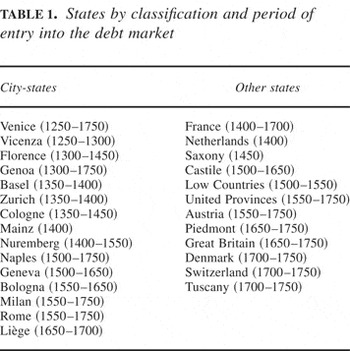
In order to facilitate estimation of the determinants of government borrowing costs, I have used the interest rates reported by Epstein to construct a small time-series cross-section data set composed of twenty-seven states over eleven fifty-year time periods running from 1250 to 1750. The names of the different states are listed in Table 1. The data set contains ninety-four observations, meaning there is a large number of missing observations. In some cases missing observations are explained by the fact that states did not exist as independent entities during the period in question. In other instances the absence of data is no doubt explained by random factors. Finally, while the interest rate data used were not collected by Epstein with the specific intention of identifying the earliest date at which a state borrowed, there also appears to be a clear pattern of selection whereby certain states did not enter the debt market until significantly later than others. A brief glance at Table 1 suggests that city-states, on average, began long-term borrowing earlier than did larger territorial entities. This is consistent with the historical evidence presented in the previous section. There are some clear cases where the first appearance of a state in this data set does not correspond to the date at which it began long-term borrowing—the city of Liège, for example, began borrowing long before 1650. Nonetheless, the overall order of appearance for states here is consistent with existing historical accounts of the development of sovereign borrowing.
States by classification and period of entry into the debt market

Political Institutions
The hypotheses laid out in the first section above raise two measurement issues regarding political institutions. First, one needs to distinguish between city-states and larger entities. Second, one needs to distinguish environments where political institutions placed constraints on executives from environments where rulers were relatively unconstrained.
The first of these issues is the more straightforward. Few would contest the fact that Florence during the fifteenth century was a city-state while France was not. Cases such as the Duchy of Milan may be more debatable, but there are few such examples in the database. In order to produce an objective indicator of whether an entity is a city-state, I have used the following simple coding rule: the dummy variable city is equal to 1 if the name of the country is the same as the name of its capital.44
One should also note that while some city-states, such as Venice, at times actually controlled large amounts of territory, in these cases citizenship rights generally remained restricted to inhabitants of the core city itself, so in terms of governance these states remained different from territorial entities.
I use four different measures to proxy for the presence of constitutional checks and balances. Each of these four variables is defined so that higher values correspond to lower levels of constitutional restraints on rulers. I adopt this coding scheme in order to make interpretation of the interaction effects in my regressions more transparent.45
This follows a suggestion by Braumoeller 2004.
The first of the four constitutional measures, unfree is a binary indicator produced by DeLong and Shleifer.46
DeLong and Shleifer 1993.
I also use a second indicator of constitutional constraints, a variable named coercion that is based on Tilly's distinction between coercion and capital.48
Tilly 1990.
DeLong and Shleifer 1993.
The third constitutional indicator I use is a measure produced by Acemoglu, Johnson, and Robinson of protection for capital.50
Acemoglu, Johnson, and Robinson 2002.
Though the original coding scheme for this variable was based on a 7-point scale, for the variable named protect in this article I have used a 3-point scale with 0 representing the highest level of constitutional protection for capital and 2 the lowest. I adopted this coding scheme because in the sample considered here almost all observations fell into three categories of the original Acemoglu, Johnson, and Robinson 2005 variable.
The final constitutional variable I use is a dummy variable, monarchy, which equals 1 for states that are monarchies and 0 for states that are republics. The coding for this variable is based on that provided by Epstein.52
Epstein 2000.
The proportion of city-state observations that were at least nominally republics is not as large (thirty-nine out of fifty-seven).
Estimating Determinants of the Cost of Borrowing
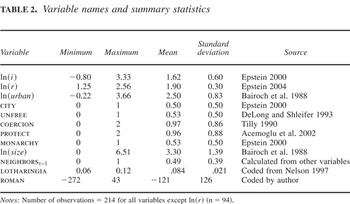
This section presents OLS estimates of the determinants of interest rates on sovereign loans, based on equation (6) below. In equation (6), iit represents the nominal interest rate on public debt for state i at time t. The OLS regression also includes the dummy variable city, for city-states, as well as a constitutional variable const. As described above, I use four alternatives for measuring constitutional constraints. Table 2 provides a list of summary statistics for all variables.

Variable names and summary statistics

Following the theoretical discussion in Section 2, I include an estimate of the rate of return on private capital r as a control variable. While I do not have country-by-country data available, Epstein has produced an estimate of the average return on capital in private markets broken down into fifty-year periods, and which distinguishes between a number of European regions. I use this measure in the regressions reported in Table 3. This measure shows a clear, although not constant, decline in the return on capital in Europe beginning in the thirteenth century.54
Epstein 2004. I would like to thank Stephan Epstein for kindly providing this data. This measure of the average return on private capital is highly correlated with the observed trend in long-term private interest rates reported by Homer and Sylla 1996.
The urbanization data was constructed by Bairoch, Batou, and Chèvre 1988.
OLS estimates of borrowing costs

The theoretical framework presented above suggests that interest rates for sovereign loans will also be higher the greater the barriers to entry into the sovereign loan market. While direct measures of these barriers to entry are not available, the data I use here do provide a potential proxy. If a state's nearest neighbors are established as borrowers, then it seems likely that it should be relatively easier for new lenders to enter the market. The variable neighbors represents the fraction of a state's three nearest neighbors that have already entered the loan market.
A final issue for control variables concerns the fact that I am estimating determinants of nominal interest rates here, and as a result one should ideally control for the effect of expected inflation on these rates. This would not be an issue if there was no measurement error in the estimate of r, and this variable thus perfectly controlled for differences in expected inflation between countries and over time, but this seems unlikely to be the case. Otherwise, differences in expected levels of inflation might explain cross-country variation in interest rates for sovereign debt. These differences might also explain variation in interest rates over time, in particular since it is known that the price revolution of the sixteenth century was a period of rapid increase in price levels when compared with either the preceding or subsequent centuries. In order to attempt to deal with this issue, I estimated average inflation levels for each state in the data set for each century from 1250 to 1750.56
To do so I used available data on wheat prices in four European markets: Bruges, Cologne, Tuscany, and France, in addition to a price index available for England. I based the estimated average inflation rate for a city-state or territorial state on the change in price levels of the nearest of these five markets or, in the case of those more distant states, on the average price change in the five markets. The series for Bruges was compiled by A. E. Verhulst. Wheat prices in Tuscany were compiled by Paolo Malanima from several historical sources and are available at the International Institute of Social History (IISG), Prices and Wages Archive, at 〈http://www.iisg.nl/hpw/〉, accessed 20 March 2007. Grain prices for Paris and Cologne were collected by Poynder 1999 and are also available at the IISG archive. The London price index for consumables was collected by W. M. Ormrod and is available at the European State Finance Database, at 〈http://www.le.ac.uk/hi/bon/ESFDB/frameset.html〉, accessed 20 March 2007.
Aside from measurement error, which is certainly present, there is at least one obvious reason for this result. While data for all five markets show high inflation in the sixteenth century, this was a century where the average interest rate on sovereign loans actually declined significantly. Neal 1990, 3–4, suggests that this drop in interest rates during the midst of a general rise in prices can best be explained by financial innovations that led to increased efficiency in financial markets.
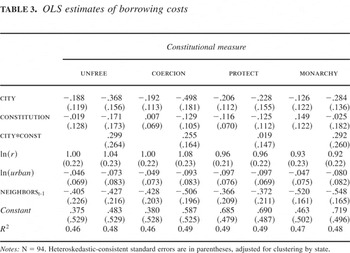
Table 3 reports the OLS estimation results. In order to take account of the fact that errors for multiple observations from the same state are not likely to be independently distributed, these and all subsequent estimates in this article use standard errors adjusted for clustering by state. For each constitutional variable I first consider a restricted specification that does not include the city*const interaction term, followed by a specification that does include the interaction effect. In the specifications without the interaction term the dummy variable city is negative in all four cases but not generally statistically significant at conventional levels (for example, p = .126 in the first regression).58
This result with regard to city-states is not driven exclusively by the influence of Italian city-states such as Florence, Venice, and Genoa. When one substitutes two separate dummy variables into equation (OLS), one for Italian city-states and one for non-Italian city-states, one observes that the coefficient on the variable for non-Italian city-states is the more negative of the two.
The next specifications in Table 3 include the interaction term city*const. One can observe that this variable has a positive and sizeable coefficient in three of the four regressions, though the coefficients are not statistically significant. It is worth remembering that all four constitutional variables are defined such that a value of 0 corresponds to the highest level of constitutional constraints. This value is empirically relevant, because between 37 percent and 47 percent of observations take a value of 0 for each of the four constitutional variables. In these interaction specifications the coefficient on the variable city now captures the difference between city-states and territorial states when constitutional constraints are at their maximum, implying that city*const = 0. As can be seen, in all four regressions the coefficient on city is now more negative, and in three of the four cases it is statistically significant. In substantive terms the estimated difference between interest rates for city-states and territorial states is roughly two percentage points when constitutional constraints are at their maximum. This result is consistent with the third hypothesis suggesting that the simultaneous presence of a city-state form of organization and of constitutional checks and balances will have a large impact on borrowing credibility.
In sum, the OLS estimates in Table 3 provide some support for the idea that city-states were able to borrow at lower rates of interest than other states, and this is consistent with the idea that merchants were more likely to be politically dominant in city-states when compared with larger territorial states. The Table 3 results provide relatively little support for an unconditional version of the constitutional hypothesis, namely the idea that across different types of states one should observe a statistically significant difference in borrowing costs between rulers subject to constitutional constraints and those not subject to such constraints. Finally, the Table 3 results also provide initial support in favor of a third hypothesis that the simultaneous presence of a city-state form and of constitutional checks and balances had a particularly large effect on borrowing costs.
Sample Selection Involving the Decision to Lend
One of the potential weaknesses with the regression results presented in the previous section is that they do not take account of the possibility of sample selection bias—it may be that factors that determine the interest rate on government debt also determine whether one can observe a recorded interest rate for a state in a given period.59
Eichengreen and Mody 2004 have recently estimated a model of borrowing behavior that controls for sample selection bias of this type.
Heckman 1979.
Given the theoretical framework, it is not an obvious task to identify a variable that could be included in the selection equation but plausibly excluded from the interest rate equation. Any variable that affects the equilibrium loan size L* will also affect the equilibrium interest rate i*. One possibility, however, is to consider if, irrespective of whether a certain state actually borrowed in a certain year, there might be certain factors that made it more likely that the loan would have been reported by chroniclers and that historians would have subsequently collected data from these initial reports. Larger states (in terms of population) and territorial states for which capital cities were larger metropolitan centers may have been more likely to have attracted the attention of historians. So, if the French monarchy borrowed funds it may have been more likely to attract the subsequent attention of historians than if a small Swiss or German city-state contracted a loan.61
In addition, once we control for the state's level of economic development by including the urbanization rate and the estimated return on private capital, it is difficult to suggest why the simple fact of having a larger capital city should produce lower interest rates on sovereign debt. This is further supported by the fact that if we estimate the OLS equations from Table 3 while including capital city size as an additional variable, its coefficient is generally not statistically significant, and it is positive. This would run contrary to the prediction that capital city size might be a further proxy for the level of economic development and should therefore be negatively correlated with interest rates.
Bairoch, Batou, and Chèvre 1988.
I also make one further assumption when estimating the selection equation. For the reasons already presented, the process determining whether a given observation is missing is likely to vary depending on whether a state has already issued long-term debt at a prior date. If a state has already entered the market, then an observation may be missing for essentially random reasons. So, for example, there is probably no significant political or economic explanation why one can observe an interest observation for Genoa in 1600 and 1700, but not in 1650, with this particular data set. In contrast, if a state began borrowing in 1600 and there is no interest rate data for several centuries before 1600, then it seems much more plausible that the pattern of missing data is explained by credit rationing. In what follows, I include in the selection model all observations where an interest rate is recorded, and all observations at dates prior to the first recorded interest rate for a given state, time t*. This implies that the process driving sample selection for all t > t* where iit is not observed is assumed to be ignorable without having to be conditional on further information.
The full specification for the selection model is presented in equations (7) and (8) below. The interest rate equation remains identical to that in the OLS estimates from the previous section (excepting the inclusion of the additional selection parameter

). The selection equation includes the same set of variables, in addition to capital city size.


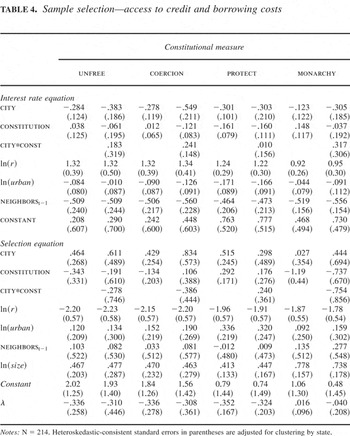
Table 4 provides maximum likelihood estimates of the selection model. As before, for each constitutional variable I consider first a restricted specification that does not include the interaction term city*const. I then report a full specification that does include the interaction term. Beginning with the restricted specifications that do not include the interaction term, the estimates of the interest rate equation suggest that city-states paid consistently lower rates of interest on their loans. The city dummy variable is statistically significant in three of the four specifications without the interaction term. The size of the coefficient on the city dummy variable is similar across the specifications. Based on these estimates, there also continues to be relatively little evidence for the unconditional version of the constitutional hypothesis that would lead one to expect positive and statistically significant coefficients on the four constitutional variables. The one partial exception here is the monarchy dummy.
Sample selection—access to credit and borrowing costs

In the Table 4 estimates, the selection equations are also of direct interest because they provide a further test of the different political hypotheses about government borrowing. In three out of four cases the coefficient on city is positive and statistically significant, implying that one is more likely to observe an interest rate for a city-state than for other types of states, meaning city-states are more likely to have borrowed. In contrast, apart from the monarchy dummy variable, there is less evidence that constitutional constraints were associated with a greater likelihood of access to credit.
Looking at the Table 4 regressions that include the interaction term city*const, one can see that the city dummy variable has a negative sign in the interest rate equations and it is statistically significant at least at the 10 percent level in all but one case. As with the OLS estimates, one can also observe that the coefficient on the city dummy is more negative in the full specification where the city dummy captures the estimated effect of this variable when constitutional constraints are at their maximum. This is consistent with my third hypothesis, though it should be noted that the interaction terms city*const are again not statistically significant.
In all but one case in Table 4, the estimate of the selection parameter

is negative. This is what one would expect based on the theoretical framework in Section 2. It implies that any unobserved factor that increases credit rationing will be associated with an increase in the equilibrium interest rate. Though the coefficient on

has the expected sign, it is generally not statistically significant, implying that one cannot reject the hypothesis that the selection and interest rate equations are actually independent.
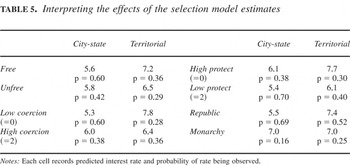
In order to give the reader a sense of the substantive magnitude of the differences between city-states and territorial states, with and without checks and balances, Table 5 presents a series of predicted values based on the Table 4 regressions that include the interaction term city*const. Each box shows the predicted probability of an interest rate being observed for different levels of the city and constitutional variables, taking into account the interaction term and setting other variables at their sample means. The table also shows the predicted interest rate, conditional on there being an interest rate observed, again setting all other variables at their sample means. As the table shows, when using the constitutional variables unfree, coercion, and monarchy, there is an effect whereby city-states in areas where rulers are constitutionally constrained are more likely to be able to gain access to credit, and at lower interest rates than are other types of states.
Interpreting the effects of the selection model estimates

Overall, the results of the selection model provide strong support for the idea that there was a significant difference between city-states and other states in medieval and early modern Europe in terms of ability to borrow at low interest rates. It is consistent with the idea that the distinctiveness of city-states stemmed from the fact that they were frequently politically dominated by merchants. When one expands the specification to allow an interaction effect between state type (city-state or territorial) and constitutional regime, one can also see some evidence that the most credible borrowers appear to have been city-states where rulers were constitutionally constrained.
Controlling for the Endogeneity of City-State Development
The empirical tests have so far considered whether my conclusions regarding city-states are robust to controls and to sample selection bias, but they have not considered a third possibility. Rather than reflecting an underlying causal relationship, it may be that the results are driven by unobserved factors that led simultaneously both to the development of city-states in certain areas and to easier sovereign access to credit at low interest rates. So, for example, it may be that independent city-states emerged in areas where trade grew particularly rapidly in the early medieval period, and presence of abundant merchant capital from trade should have also produced lower interest rates.63
The literature on medieval city development beginning with Pirenne 1925 has emphasized the role of the growth of trade in their development. This phenomenon has also been emphasized by Spruyt 1994.
When attempting to find a suitable instrument for an endogenous regressor, one strategy is to focus on historical accidents. Banerjee and Iyer have demonstrated how historical accidents involving the timing of British colonization in Indian regions led to the adoption of different systems of land tenure, and so timing of colonization can serve as a useful instrument.64
Banerjee and Iyer 2005.
See Posner 2004, for an interesting recent example.
In the year 843, as part of the Treaty of Verdun, the Carolingian empire that covered much of Western Europe was divided into three separate territories: (1) West Francia that gradually evolved into France; (2) East Francia that gradually evolved into Germany; and (3) Lotharingia that covered a central portion of territory running from the present-day Netherlands to Northern Italy but which never evolved into a single state. While central authority receded throughout the Carolingian empire in the years after 843, quite arguably it collapsed most dramatically in Lotharingia. This territory derived its name from its ruler, Lothar, who nominally retained the imperial title.66
Technically the region referred to as Franca Media comprised both Lotharingia and the Kingdom of Italy, but I will follow the usage of referring to the entire region under the control of Lothar as Lotharingia.
First, historians, at least since Geoffrey Barraclough, have emphasized that even if the settlement at Verdun in 843 had clear long-lasting effects, as it helped lead to the development of France and Germany, the treaty had little to do with the prior emergence of homogeneous ethnic groups or national sentiments in any of the three territories; the division was instead largely dictated by dynastic considerations involving the desire to establish three relatively equally sized territories, each of which had similar economic resources.67
The division did not correspond to either preexisting linguistic or ethnic boundaries. The division was also influenced by temporary military factors involving which of the three brothers who negotiated the Treaty of Verdun had military control of a territory, and which local baron was allied with each of the three brothers that negotiated the division.68See Nelson 1997; and Fried 1995, for an in-depth account of Carolingian politics during this period, highlighting the chaotic nature of dynastic politics.
Second, it is difficult to argue that the subsequent collapse of the central territory of Lotharingia and the lesser degree of fragmentation that occurred in West Francia and East Francia was somehow predetermined. It appears instead that idiosyncratic dynastic events played an important role. Airlie makes a convincing argument that one important element helping to lead to the collapse of Lotharingia was the bitter divorce dispute of King Lothar II who ruled from 855 to 869.69
Airlie 1998.
See Sharma 2005, for a consideration of the role of the institution of primogeniture in establishing political stability in early modern Europe.
In sum, while the settlement at Verdun in 843 has had generally recognized effects on the future path of European state development, the fact that some cities found themselves selected into a region where central control eventually collapsed to a greater degree than elsewhere seems to have occurred in large part as the result of historical accidents. Beyond the accidental features of the settlement at Verdun, it is also important to emphasize that this division occurred well before the emergence of city-states in Europe and well before the resurgence in trade after the year 1000 that authors such as Pirenne have emphasized as being crucial for city-state development.71
Pirenne 1925.
In addition to the lotharingia variable, I also use one further variable as an instrument for city-state development. The variable roman represents the date at which a specific region was integrated into the Roman empire, with earlier integration implying a longer duration of Roman presence, and thus potentially greater influence of Roman heritage. There are a number of ways in which Roman heritage may have influenced the development of city-states. Pirenne argued that in Northern Italy and in Provence, members of the elite retained a Roman tradition of living in cities, rather than moving to rural areas as was the case in a number of other European regions.72
Ibid.
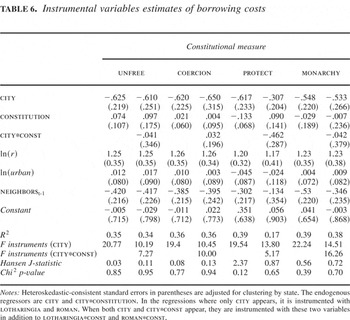
Table 6 reports the results of the instrumental variables estimates. The regression results are quite consistent across the different constitutional variables. In all but one case, one can observe a large and statistically significant difference between the estimated interest rate for city-states and territorial states. In addition, the coefficient on the city variable is now more negative than in the OLS estimates, and it does not differ sizably between the regressions that include the city*const interaction term and those that do not. Taking the first regression using the constitutional variable unfree as an example, the estimated interest rate differential between a city-state and a territorial state is 3.2 percentage points. This evidence goes against the conclusions from the OLS estimates that city-states where rulers were constitutionally constrained were likely to be able to borrow at lower interest rates than were city-states in areas with unconstrained rulers. The instrumental variables estimates are similar to the previous results in suggesting that there was not a significant interest rate differential according to constitutional regime. As with the previous results one also continues to observe a coefficient on ln(r) that is consistent with a one-for-one effect of a change in the private return to capital (taking into account the confidence interval). The coefficient on the neighbors variable, designed to proxy for barriers to entry in the sovereign lending market, also remains negative and statistically significant in all cases.
Instrumental variables estimates of borrowing costs

The final four rows in Table 6 report the results of several tests regarding the excluded instruments. The F-statistics correspond to a test that the coefficient on the excluded instruments is jointly 0 in the first-stage regression for the endogenous variable city and in the first-stage regression for the endogenous variable city*const. In all cases these lead to a clear rejection of the null. The next two lines report the results of a test of overidentifying restrictions that can help establish whether the instruments can be legitimately excluded from the interest rate equation. In all but one case, the Hansen J-statistic and corresponding Chi2 p-value suggest that the null hypothesis that the instruments are uncorrelated with the error term in the interest rate equation cannot be rejected. The result of the overidentification test for the remaining equation using the constitutional variable protect is more questionable. Together these tests provide strong evidence for the validity of the instruments.
In addition to the possibility of “self-selection” whereby certain country-level factors might lead simultaneously to the development of a city-state and to lower interest rates on sovereign debt, there is also a final endogeneity issue one might consider with my results. This involves the “military revolution” of the sixteenth and seventeenth centuries and the potential effect of this change on both state institutions and financial markets in Europe. The military revolution is generally recognized to have involved a sizeable increase in the number infantry fielded by major European powers.73
Downing 1992 presents figures showing that between the 1550s and the 1630s, Spanish and French military strength doubled, with similar increases for other powers.
Parker 1988. See Hoffman 2005 for an interesting recent investigation of technological change and its effects on firearms prices in Europe before the Industrial Revolution.
This would follow Tilly 1990 in particular.
Downing 1992.
Conclusions
In this article I have considered three alternative hypotheses about the politics of sovereign borrowing in Europe over a long historical period. First, access to credit at low interest rates may have depended above all on the creation of constitutional limitations on rulers. This is the type of explanation emphasized by numerous recent papers on institutions and commitment. Alternatively, it may have been that the difference between constitutionally constrained and unconstrained rulers was less salient than was the difference between city-states and larger territorial states, because state type was critical for determining whether merchants were politically dominant. Finally, borrower credibility may have depended on the simultaneous presence of both a city-state and constitutional restraints on rulers. My empirical results provide relatively weak support for the unconditional form of the constitutional hypothesis and strong support for the second hypothesis involving city-states and merchant power. The results also provide some support for the third hypothesis involving interaction effects. City-states were more likely than larger states to be able to borrow, and at low rates of interest, but city-states with republican institutions and city-states in regions where princely overlords faced institutional constraints on their authority appear to have been even more credible as borrowers than were city-states elsewhere. These findings have important implications for the study of the determinants of government credibility. They also suggest that it would be useful to extend the inquiry of this article by further developing the key hypotheses, by collecting data that can test these hypotheses more accurately, and by making efforts to take account of the endogeneity of both city-state development and constitutional development.