Lyndon Johnson’s domestic policies dramatically influenced American politics and governance. Medicare and Medicaid have become two of the nation’s most significant and consequential health-care programs. Head Start and the Elementary and Secondary Education Act have helped millions of low-income and minority children access educational opportunities. The Civil Rights and Voting Rights Acts of 1964 and 1965 dismantled systems of Jim Crow segregation and bestowed new rights upon African Americans and other minority groups. Scholars across disciplines generally agree that many of Johnson’s domestic initiatives produced positive outcomes over the long term.Footnote 1 But one aspect of LBJ’s political and policymaking legacy remains mired in confusion and disagreement: the Community Action Program (CAP), the cornerstone of the Economic Opportunity Act (EOA).
Launched in 1964, the CAP attacked poverty at the local level. The policy’s most consequential and controversial component required low-income citizens’ “maximum feasible participation” in the fight against poverty. Citizens were to establish new community action agencies (CAAs) to design and administer programming. To foster local innovation, the federal government bypassed state and local governments and disbursed funds directly to new CAAs. Flexibility and experimentation were critical components of the program’s design and implementation.
Given the program’s innovative structure, it is unsurprising that the CAP generated widespread criticism. Opponents charged that CAAs fomented racial unrest, embezzled federal funds, and filled the coffers of local political machines. In 1969, David Stolloff wrote, “From the beginning of the Community Action Program, it was clear to any alert politician that ‘community action’ and ‘citizen participation’ imply direct confrontation with established systems of political power and social control.”Footnote 2 Saul Alinsky blasted it as “political pornography,” arguing that political elites were using it to buy off opposition forces.Footnote 3 Republican leadership in the House of Representatives referred to the poverty program as “a churning Disneyland of administrative chaos.” Former Vice President Richard Nixon argued that Johnson’s “war on poverty has been first in promises, first in politics, first in press releases—and last in performance.”Footnote 4 Early scholarly assessments, most notably Daniel Patrick Moynihan’s Maximum Feasible Misunderstanding, suggested that policymakers relied too heavily upon untested scholarly theories when they drafted the legislation, which resulted in administrative incompetence.Footnote 5
However, new research taking a bottom-up approach presents an alternative view and suggests that the CAP generated positive economic and political outcomes. This work highlights activists’ local struggles and shows that the War on Poverty facilitated participation in diverse contexts across the country and helped develop a cadre of minority political leaders, which contributed to the rising influence of civil rights organizations on social policy in the 1960s and 1970s.Footnote 6 Noel Cazenave, Susan Ashmore, and Nancy Naples argue that the CAP’s emphasis on citizen involvement ushered in a new era of participatory democracy. Annelise Orleck and Lisa Gayle Hazirjian’s recent edited volume on the grassroots War on Poverty thoroughly documents how local activists seized the political moment to challenge existing systems of economic, racial, and political inequality. These scholars situate the CAP in the long historical struggle by marginalized communities including women, African Americans, and other racial and ethnic minorities for civil rights and equal opportunity in the polity.Footnote 7
Additionally, David Torstensson’s research on the rural War on Poverty sheds light on the overlooked ways that antipoverty efforts facilitated institutional development in some of the country’s most geographically isolated areas.Footnote 8 In the field of economics, Martha Bailey and Nicolas Duquette’s rigorous analysis of Office of Economic Opportunity (OEO) funding shows that the Johnson administration was dedicated to fighting poverty and racial inequality. They note:
Rather than including and empowering state and local politicians and community leaders in the allocation process as in the New Deal, OEO funds were used to circumvent and challenge these interests. OEO funds flowed to poor and nonwhite areas, which empowered new constituencies of poor and African Americans. . . . Unlike New Deal funding, OEO grants did not flow to (or away from) areas with powerful congresspersons or meaningfully reward swing voters that helped Democrats win the most liberal Congress since the New Deal. . . . The OEO’s focus on fighting poverty and racial discrimination—over politics as usual—is consistent with this humanitarian vision.Footnote 9
Economists and economic historians have produced detailed analyses of initiatives that began under CAP but then spun off into successful and enduring independent programs, such as Head Start, Legal Services, and community health centers.Footnote 10 Taken together, these studies bring new evidence to bear on the CAP’s long-term effects.
Despite advancements in our understanding of the CAP’s legacy and impact, scholars still lack a synthetic description that brings together the extant scholarship in a coherent manner to highlight the program’s experimental impulse and heterogenous implementation. This article analyzes the CAP’s history and implementation until 1967, when Congress passed a sweeping amendment to the program. I argue that the CAP is best understood as a bold attempt at administrative experimentation and reform. By delegating authority over the War on Poverty to local communities, the CAP ensured that circumstances on the ground—not direction from above—would guide antipoverty efforts. Matthew Crenson and Francis Rourke considered the OEO and CAP to be “the leading edge of administrative change—a far-reaching experiment in citizen participation and government by remote control.”Footnote 11 Breaking from typical approaches to public administration, each CAA was to coordinate from the bottom up and be “tailored to the distinctive circumstances of its own locality.”Footnote 12
The historical record shows that policymakers outlined multiple visions of community action and that CAAs adopted a range of implementation strategies in the program’s early days. This project presents the first step toward a more nuanced understanding of how CAA implementation varied across the country. In doing so, it provides a more balanced and comprehensive reassessment of the CAP’s early history. The article proceeds as follows. In the first section, I describe three distinct visions of community action advanced by policymakers: coordination, collaboration, and mobilization. Three brief case studies illustrate how communities drew upon these visions when they carried out the CAP’s goals. The second section provides a more systematic assessment of how local communities implemented the CAP.
Drawing upon an original dataset of ninety-eight CAAs from the across the country, I show that while CAAs adopted each of these strategies, only a small number employed the mobilization approach, despite its predominance in both critical analyses and the academic scholarship on CAP. I then analyze the effects of the 1967 Green Amendment, which effectively curtailed the program’s experimental impulse, and offer concluding remarks and suggestions for future research.
Designing the Poverty Program: Multiple Visions of Community Action
Prior research suggests that Johnson and key policymakers overlooked contradictions within the EOA because they were eager to pass legislation ahead of the 1964 elections.Footnote 13 The CAP’s failure, according to critics, stemmed from policymakers’ inability to foresee how the law’s vague language and mission would cause confusion upon implementation. Contrary to this view, I argue that policymakers envisioned a program that would be adaptable to local context and that communities recognized this and designed their programs accordingly. This section sketches out three distinct visions of community action and shows how communities drew upon these models when they fought the War on Poverty.
Community Action as Coordination
LBJ formed the Task Force on the War Against Poverty in February of 1964, although he had been working on the poverty program with the Council of Economic Advisers (CEA), led by Walter Heller, and the Bureau of the Budget (BOB) the previous two months.Footnote 14 Sargent Shriver chaired the task force, which included academic economists and individuals from federal agencies including the Departments of Justice, Agriculture, Labor, and Health, Education, and Welfare.Footnote 15 Task force members believed that a federal antipoverty program should coordinate and reorganize existing resources. They argued that poverty was a complex issue, which required a multifaceted solution. “The scope of the poverty problem is broader than is commonly recognized, and its nature is more varied. . . . The causes and sources of poverty are strongly interdependent, and so are the programs required to deal with them.”Footnote 16
The CEA suggested that existing institutions needed to be reorganized and better coordinated to combat poverty. A CEA memo outlined the features of a new “Coordinated Community Action Program,” stating, “We believe that the key element in any realistic attack on poverty would be a proposal which is aimed at specific local areas of poverty; relies on well-organized local initiative, action, and self-help under Federally-approved plans and with Federal support; establishes action programs to evaluate and coordinate existing Federal, State, local and private programs and to test and demonstrate new ones.”Footnote 17 The CEA wanted to ensure that “community resources are focussed in a coordinated manner.”Footnote 18 The program should “provide a coordinated and flexible approach to the development of the rationale on poverty and to the development of a program which takes into account the varieties of poverty.” Heller viewed existing efforts as “diffuse in their impact.” Community action should be “designed to develop techniques for giving focus, consistency, and continuity into all the programs which bear on a given individual or group living in poverty.”Footnote 19 Policymakers argued that a federal program was necessary to better coordinate disparate and disorganized local services.
A February BOB memo clarified the coordination approach. The new program would “initiate in local communities a coordinated ‘package’ or ‘packages’ of existing and newly authorized activities directed against poverty in an extensive way. . . . This approach will make it possible to accomplish major objectives which require bringing together several different programs and sources of funds in a way in which no existing agency could provide.”Footnote 20 New CAAs were to cooperate and coordinate with existing institutions—local governments, service organizations, and business and civic groups—to reorient and streamline service delivery. The BOB felt that a federal program would allow localities to borrow successful ideas from one another and diffuse effective strategies for poverty relief. The goal was “not only to help the community immediately concerned, but also to help all communities having similar problems by obtaining valuable information about the causes and remedies of poverty and about the adequacy of existing Federal, State, and local efforts, and by developing, in a careful and planned approach, promising new ideas for attacking poverty, and for bringing together the Federal, State, and local governments in a common effort.”Footnote 21 Community action would create a network of social provision, with multiple institutions working cooperatively to address poverty. Since poverty resulted from interdependent forces, its eradication would require a coordinated attack from several fronts.
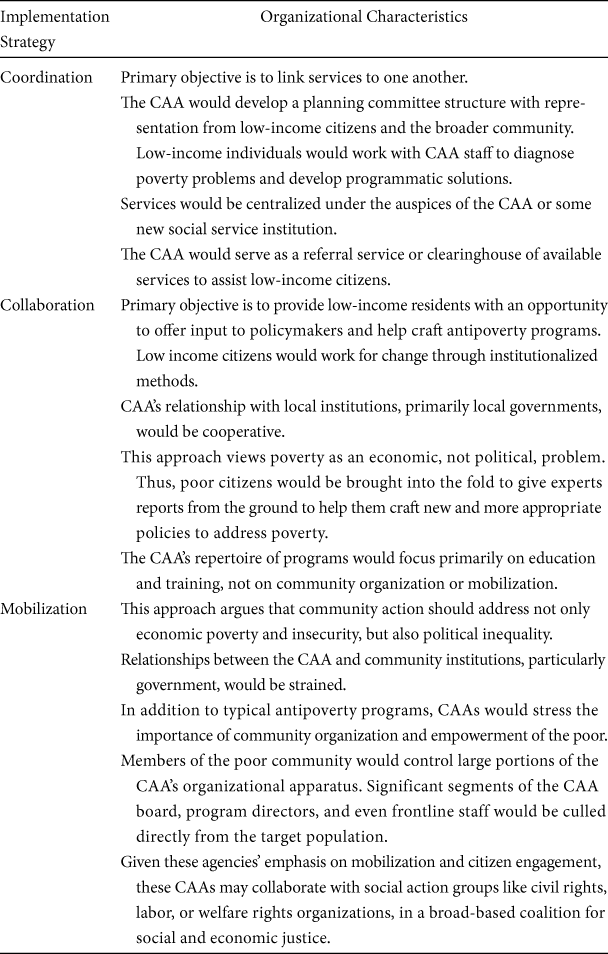
CAAs adopting the coordination approach would identify gaps in the provision of services and help reorganize social provision. Poor individuals would play an important role on CAA boards and work with local institutions to develop concise diagnoses of poverty problems and sketch out potential solutions for social service organizations. The focus was to be on planning, organization, and management. According to this approach, CAAs would not need to dramatically change or alter existing institutions, but rather to link disparate services to one another and synchronize resources available for poor citizens.
Community Action as Collaboration
Others involved in the CAP’s design envisioned a program that allowed local governments to use insight and knowledge from low-income residents to craft new antipoverty programs and bring new voices into the political process. Although LBJ was not intimately involved in drafting the EOA—he delegated significant authority to the task force—his experiences with the New Deal, particularly the National Youth Administration (NYA) informed this vision of community action. The NYA granted state administrators extensive control, and Johnson’s idea of community action similarly gave significant authority to state and local political elites.Footnote 22 As LBJ recalled in his memoirs, community action “was based on one of the oldest ideas of our democracy, as old as the New England town meeting—self-determination at the local level.”Footnote 23
Low-income citizens, with support from Washington, would propose new ideas and voice their concerns to policymakers who possessed the political experience and bureaucratic knowledge to turn ideas into programmatic outcomes. Norbert Schlei, a lawyer from the Kennedy administration who was involved with the task force in 1964, recognized the benefits of citizen knowledge, but understood the necessity for administrative acumen: “I thought the administration of many of these programs required great intelligence and the ability to harmonize a lot of very complex things to administer the efforts of a lot of people and resources. I felt that, whereas maybe a bunch of poor people would have a better insight into where they hurt, they would never be able to successfully administer a large, complex program.”Footnote 24 Poor citizens would give policymakers reports from the ground to help them craft new and more appropriate programs. This approach would provide the poor with new training, education, and employment opportunities to “allow the poor to engineer their own paths to affluence.”Footnote 25 Schlei viewed collaboration between the poor and local governments as imperative. He recalled, “I ultimately . . . came to accept the view that you really were never going to do anything effective and lasting unless you involved and brought along with you the local governments . . . they would keep undoing it or uprooting unless they were brought in.”Footnote 26 In many ways, the collaboration approach sought to incorporate low-income citizens into the political process through institutionalized means.
A group of community organization professionals advocated a similar approach. In 1965, the National Association for Community Development (NACD), an umbrella group of CAAs and antipoverty workers, prepared and distributed a memo to the CAP office in Washington. The paper argued that CAAs worked best when they collaborated with local governments. The NACD contended that CAAs were not the appropriate vehicles to launch direct protest efforts to challenge or overthrow local political establishments. The memo noted, “There is no point in promoting unachievable methods. Protest and direct political action fall within this category. They are certainly needed in all communities, but it is not realistic to expect a community action agency to be the vehicle through which they are achieved.”Footnote 27 The NACD argued that CAAs should use institutionalized methods to work with the local political establishment, not mobilize against it.Footnote 28
Even in cases where the relationship between low-income citizens and local government was somewhat contentious or strained, nearly every CAA worked to some extent with local officials. Although the CAP’s funding structure bypassed state and local governments, setting the stage for conflicts over the boundaries of federalism,Footnote 29 local governments nonetheless played an important role in the CAP’s administration. Both scholarly analysis and criticism from the political left eventually viewed this close collaboration between local governments and the CAP as a form of cooptation, but the historical evidence shows that it was a central tenet of the program from the outset.
The Mobilization Model of Community Action
In March 1964, Shriver established the Urban Areas Task Force to plan the CAP’s implementation. Some members of this task force developed and specified the idea of “maximum feasible participation” as a means of poverty relief. Jack Conway, Richard Boone, Sanford Kravitz, and Frederick O’R. Hayes became involved during this period, and they brought new ideas about community organization and empowerment into the process.Footnote 30 These individuals recognized that local governments could be important allies in the War on Poverty.
Hayes noted that the three met with several mayors and governors prior to the program’s enactment to work on program planning and organization.Footnote 31 Conway often referred to the CAP as a “three-legged stool” that would join public officials, private agencies, and low-income citizens together to address poverty.Footnote 32 However, this approach recognized the limits of the coordination and collaboration models. Conway and Hayes understood that in some areas, political and economic institutions were entirely unresponsive to the needs of low-income citizens. In those places, the poor needed to dramatically restructure and democratize local institutions to escape poverty. CAAs would allow them to do so.
Conway, a former union organizer who understood the importance of indigenous control and engagement,Footnote 33 wrote that “a vital feature of every community action program is the involvement of the poor themselves—the residents of the areas and the members of the groups to be served—in planning, policymaking, and operation of the program.”Footnote 34 Participation was to be “meaningful” and “effective” and achieved through “democratic approaches and techniques such as group forums and discussions, nominations, and balloting.”Footnote 35 CAAs should provide a venue for low-income citizens to harness their civic power and push back against unresponsive institutions when necessary.
Fred Hayes contended that the poor had become suspicious and resentful of middle-class domination, and “this situation cannot be corrected without extensive participation of the poor in the process of program development and administration.”Footnote 36 Hayes outlined an approach that encouraged the poor to take part in the political and decision-making processes of local CAAs.
He envisioned that “individual projects or parts of the program may be carried out by organizations on which the poor are strongly represented,” or that “neighborhood programs and individual projects can be administered by, under the policy direction of, or with the advice of indigenous neighborhood organizations which represent the poor and on which the poor are represented.”Footnote 37 Hayes viewed the CAP as a means by which the poor could build the skills necessary to design, lobby for, and implement public programs and become active participants in the political process. John Baker, assistant secretary at the Department of Agriculture and task force member, recognized some of the benefits of this approach. “Maximum feasible participation,” he argued, “meant starting with the most downtrodden. It meant that women ought to have an equal say-so with men. It meant that poor black folks ought to have equal say-so with upwardly mobile, upper-middle-class [people]. . . . At the community level, everybody that perceived themselves to have a unique concern or contribution should be geared into the decision-making mechanism.”Footnote 38 According to this view, community action would do more than synchronize existing services or provide low-income citizens with a seat at the political table; CAAs instead would dramatically democratize local power structures.
Proponents of the mobilization approach argued that the program should address not only economic poverty, but also political inequality. To restructure economic and political relations, the poor needed to develop their own base of support that would allow them to express their discontent and challenge unresponsive local elites. This approach viewed “conflict between groups as the main battleground” in a war against poverty.Footnote 39 Data presented below shows that although relatively few communities adopted this approach, it nonetheless had an outsized influence on the CAP’s development.Footnote 40
To give a better sense of how these models were implemented, it is useful to provide some heuristic examples of CAAs that adopted each approach. My objective here is not to develop a theory that explains the determinants of CAAs’ implementation approaches, but rather to provide a more accurate historical description of how local communities drew upon these different visions as they tackled poverty. The brief histories that follow are what Andrew Bennett and Alexander George refer to as “configurative idiographic” case studies. They provide good descriptions of each implementation strategy, but do not directly cumulate in a generalizable theory of how localities carried out the CAP’s diverse antipoverty objectives.Footnote 41
Coordination in the Arkansas River Valley
The disorganization of social welfare services led ARVAC, which served eight counties in west-central Arkansas along the banks of the Arkansas River, to adopt the coordination approach. The agency was primarily concerned with the “failure of social institutions to provide the services in sufficient quantity and quality to respond to the needs of the poor.”Footnote 42 ARVAC wanted to bring the entire community’s resources together in a synchronized attack on poverty: “The ARVAC staff states that a new philosophy is emerging which is that they are getting away from the individual aspect of service to new directions in a group type situation. This has involved ARVAC in more of a coordinating role as well as a role to mobilize other resources.”Footnote 43 ARVAC’s primary objective was to build up and streamline social welfare institutions with insights from the local community to better serve the needs of the region’s poor residents.
ARVAC’s leadership recognized that residents would be skeptical of “outsiders” and were unlikely to accept help from federal antipoverty workers. To break down barriers between the CAA and residents, Jo Ann Braddy, a local schoolteacher, launched a pilot project to hire low-income residents—primarily women—as caseworkers. Dora Couch, one of ARVAC’s caseworkers, helped several members of one family locate critical services. She helped Frances Whitworth enroll in adult education classes, where she soon earned her G.E.D. Whitworth then signed up for an OEO-funded practical-nurse training program. With Couch’s help, Whitworth’s two sons were both accepted into the Job Corps. Couch also taught one of Whitworth’s daughters to sew during her weekly in-home visits. The CAA thus served as an effective clearinghouse and referral service for existing and new antipoverty programs. Braddy’s pilot program eventually became an integral component of ARVAC’s approach to attack poverty.Footnote 44
ARVAC established “planning process and coordination procedures which link[ed] services to one another.”Footnote 45 The CAA built a network of program advisory committees that included representatives from the poor community. They identified specific problems and developed targeted programs to address them. By drawing upon low-income citizens’ knowledge of poverty, ARVAC increased political and economic leaders’ recognition of poverty’s causes and consequences. The agency developed effective lines of communication among a wide range of community institutions to improve programming and services.Footnote 46
ARVAC operated harmoniously with the community. Public officials were said to participate actively in board discussions alongside poor residents. The CAA’s relations with its affiliate counties were said to be excellent. Agency staff learned valuable skills through its participation in the organization’s administrative structure. The poor were clearly viewed as equals by government officials in the region, and the various factions focused their efforts on programmatic details rather than politics.Footnote 47
Community action generated racial hostility in some communities, particularly when CAAs challenged entrenched structures of inequality and segregation. But this was not the case at ARVAC, even when the agency integrated its programming. As one report pointed out, the agency “integrated its staff and programs, in an area with a strong segregation tradition, without major hostility.”Footnote 48 It is unclear from the existing records specifically how the agency successfully navigated the politics of race in the region, but the available evidence indicates that the agency did not generate intense discord.
ARVAC’s programming and its approach to institution-building are prime examples of the coordination approach developed by policymakers in Johnson’s CEA and BOB. The goal of coordinating agencies was to organize, streamline, and deliver services. ARVAC eschewed mobilization in favor of this service-oriented approach.Footnote 49
Collaboration in Philadelphia
The collaboration model sought to provide low-income citizens with an opportunity to use institutionalized modes of engagement to gain a seat at the political table. In Philadelphia, the War on Poverty intersected with ongoing debates about racial inequality and community control. The city’s first attempt to establish a CAA was unsuccessful, as mayor James Tate failed to provide a mechanism for adequate resident participation. With assistance from Sam Evans, an adviser on poverty and racial issues, the city proposed creating a series of neighborhood-based poverty councils that would elect representatives to the Human Services Committee.Footnote 50 The revised proposal would establish a new Philadelphia Antipoverty Action Commission (PAAC) that would subsume the duties of several existing poverty and economic development committees and become the primary antipoverty agency. Charles Bowser, an attorney who had worked with the NAACP, would serve as PAAC’s executive director. The plan would create Community Action Councils (CACs) to choose delegates to the PAAC. Community activists charged that the new CACs did not provide sufficient opportunities for citizen involvement, so Tate doubled the number of CACs and allowed the poor to select their own representatives in special poverty elections.Footnote 51 Eligible candidates had to be adults living in Philadelphia with incomes below the $3,000 federal poverty line.Footnote 52 This represented a bold innovation, as no other city in the country provided low-income citizens with an opportunity to select their own representatives in a direct electoral process.Footnote 53
While the CAC elections in 1965, 1966, and 1967 generated dismal participation rates—turnout was only 2.6, 5.4, and 3.5 percent of eligible voters, respectively—they did help low- income residents, particularly African Americans and women, develop political and civic skills.Footnote 54 In the first CAC elections, women made up 61 percent of the candidate and were elected to 73 percent of the seats on the CACs. While men dominated the chairperson positions on the CACS, two-thirds of the representatives elected to the PAAC board, which provided the greatest opportunity to influence local politics, were women.Footnote 55
Despite the low rates of participation, OEO was enthusiastic about the city’s model, and in 1965 disbursed nearly $6 million of funding to support new initiatives, including a Board of Education sponsored preschool program and Leon Sullivan’s Opportunities Industrialization Centers (OIC), an innovative employment program. OIC became one of the most successful and transformative employment programs in Philadelphia. In his analysis of postwar economic development in Philadelphia, Guian McKee argues:
What Leon Sullivan and his associates accomplished was the construction of an effective and viable form of community-based local employment policy—a job-oriented, community-based response to the problems of poverty, discrimination, and deindustrialization in post-war Philadelphia that reshaped old strands of structural, job-oriented liberalism and adapted it for the needs and politics of the 1960s and 1970s. . . . Few other War on Poverty programs, and none in Philadelphia, accomplished so much.Footnote 56
However, community action’s accomplishments in Philadelphia were limited by the city’s traditional political structure and deeply entrenched patronage system.
Tate, Evans, and Bowser retained tight control over PAAC and used it to secure political support. Rather than acquiesce to the CACs, who proposed new programs, the majority of OEO funds went to traditional social service programs. The agency did not fully restructure the city’s social welfare system, though it did improve relations among different agencies and produce tangible results.Footnote 57 The city’s machine-oriented political system moderated the activism of social movement groups, who often cooperated with city officials to secure patronage positions.Footnote 58
Low-income Philadelphians were not entirely content with the city’s incremental and service-based approach to poverty relief. Some members of the black community urged a boycott of the 1966 poverty elections and white liberal groups such as Americans for Democratic Action and the Maximum Participation Movement pushed a slate of reform candidates in that year’s poverty elections to give low-income citizens a greater voice. But these efforts could not dislodge the patronage network that Tate, Evans, and Bowser had secured. Greenstone and Peterson contend that the city’s conservative, reform-oriented nature precluded a “participatory political settlement.”Footnote 59 Tensions in Philadelphia never erupted into the type of widespread social protest or urban uprisings that would plague cities like Los Angeles, Detroit, and Newark.
The way community action unfolded in Philadelphia suggests that the collaboration strategy could provide poor individuals with valuable skills. Despite such gains, the agency could not fully dismantle extant structures of inequality and economic immobility. Judged against the high bar that the War on Poverty’s rhetoric set, Philadelphia’s program was largely considered a failure. It generated only incremental improvements in the city’s social welfare infrastructure through limited education and employment programs. Poor residents’ participation in the agency’s administration, while innovative, was deemed insufficient when political elites co-opted the program and used it a vehicle to deliver political favors. But the collaboration approach to community action did not envision a dramatic restructuring of local economic or political institutions. Instead, this model sought to help low-income citizens develop their civic skills and become more familiar with the political process, in the hopes of bringing marginalized communities into the pluralist fray. Judged against this bar, the program generated positive results. Specific PAAC programs, such as OIC and the agency’s preschool provided critical services. In addition, Philadelphia’s experience with community action provided women and African Americans with valuable political experience, and many of these citizens would later go on to participate in various levels of city politics.Footnote 60
Mobilization in Newark
CAP brought latent social tensions to the fore in some communities. Reflecting upon the small number of locales where CAP ignited tension, OEO Director Sargent Shriver noted:
Now, you could go to another place where the culture and political atmosphere was poisoned; and when you brought community action in there, the whole town exploded. . . . I used to say that community action was like a doctor coming and putting a thermometer in your mouth to find out what your temperature is, and the temperature comes out 110 degrees, and then you curse the doctor. That’s what happened in a lot of communities: the community leaders cursed us for revealing how lousy the community situation was; it was terrible. It wasn’t our fault. Our activity brought it into the open.Footnote 61
Jill Quadagno, noting the distinct approach that Newark, New Jersey’s CAA, United Community Corporation (UCC), adopted, wrote, “In a few cities community action went beyond increasing the political participation of the poor to incorporating [a] more radical vision of social change. One such city was Newark, New Jersey.”Footnote 62
Newark elected Hugh Addonizio as mayor in 1962. Following his election, he proclaimed that city hall was open to Newark’s black residents. However, his offer only extended to those willing to abstain from direct action in exchange for patronage positions. While he integrated the police department, the bulk of the city’s political establishment—the City Council and the Board of Education—had only two black members.Footnote 63 As low-income citizens sought more from government than petty patronage, they became increasingly frustrated with Addonizio’s administration. As one OEO evaluation noted, the mayor’s administration had “lost sight of the growing needs of the lower income residents in the ghettos.”Footnote 64
The relationship between UCC and Newark’s political establishment was perhaps the most hostile in the nation.Footnote 65 Addonizio hoped to use the program to “buy off all political insurgency.”Footnote 66 The agency would not use funds to solve problems, but instead “to get people to shut up about them.”Footnote 67 The city’s poor community, in conjunction with civil rights groups, viewed Newark’s patronage system as an obstruction to economic and racial equality and believed that UCC should democratize and reform the city’s political structure. UCC engaged in “an all-out attempt to force institutions to change their current practices.”Footnote 68 The CAP’s call for “maximum feasible participation” served as a rallying cry for anxious and energetic reformers. Recent work by Kevin Mumford, Julia Rabig, and Mark Krasovic thoroughly documents the clashes between Newark’s low-income citizens and members of the political establishment. Cyril Tyson, who led Harlem Youth Opportunities Unlimited (HARYOU), Harlem’s experiment in community action, came to Newark in 1964 to lead UCC. Tyson developed an area board structure that would elect members to the agency’s board, craft programs, and provide citizens with a venue to develop their political capabilities. Unlike the CACs in Philadelphia, which increasingly came under the control of the political establishment, Tyson ensured that UCC’s area boards were autonomous and controlled by residents.Footnote 69 The boards launched marginalized citizens, particularly black women, into political and social activism. These individuals understood neighborhood needs and helped secure funding for education and recreation programs.Footnote 70
With support from Tyson, Newark’s poor residents took up the CAP’s call for “maximum feasible participation,” only to confront a recalcitrant and antagonistic political establishment.
Newark’s urban core was crumbling and the city’s antipoverty programs were underfunded and disorganized. A summer camp for low-income youth received inadequate equipment and funded field trips that were so disorganized and resource-starved that “no refreshments or food was furnished and usually the youths returned from the trips hungry, disappointed, and at times in tears.”Footnote 71 In what seems like an attempt to force poor black residents out of Newark, the city tried to use Model Cities funds to demolish 150 acres of low-income housing to build a medical and dental college. This was directly antagonistic to the program’s goal, which provided federal assistance to improve physical environments, increase the housing supply for poor residents, and establish social and educational services.Footnote 72 The mayor’s decision pushed the city’s poor residents further toward mobilization and demonstration.
Addonizio, along with some members of Newark’s city council, particularly Lee Bernstein from the Weequahic neighborhood, depicted community action as a disjointed mess of frustrated poor residents. Using coded racial language, “they encouraged white constituents to equate area boards with slums, slums with the influx of black residents into formerly white neighborhoods, and all of it with plummeting housing values.”Footnote 73 City hall’s resistance to black progress led residents to become more involved in radical forms of activism, particularly black nationalism. A constellation of factors, including Newark’s location between two major cities with large black nationalist movements and its reputation for volatility, spurred the development of the city’s radical activist groups.Footnote 74 Such groups aimed to organize a black governing coalition to control the city’s political machinery without interference from white political elites. Students for a Democratic Society (SDS) forged a coalition with the city’s civil rights groups. In response to the city’s attempt to raze poor neighborhoods, a coalition of social-action groups seized control of UCC.Footnote 75
Tension in the city reached a boiling point and protests erupted on July 12, 1967, when police arrested John Smith, a black cab driver for a traffic violation.Footnote 76 Residents in a nearby housing project witnessed police drag Smith into the local police station. Fellow taxi drivers began broadcasting that Smith had been arrested and was being beaten by police. Quadagno notes that a UCC board meeting was interrupted by a phone call alerting UCC members of the situation. CAA leaders immediately headed to the police station as Smith was taken from the precinct to a nearby hospital.Footnote 77
Within an hour of the incident, a crowd of 150 had descended upon the precinct. Local civil rights leaders urged citizens to remain calm and orderly, and began organizing a march toward city hall. Nonetheless, disorder erupted when a rock was hurled from the crowd and a young man threw a fire bomb.Footnote 78 Within minutes, a full-scale riot had broken out. Over the next five days, Newark experienced looting, arson, and murder. By the time the chaos ended, twenty-five people had died and the city experienced over $10 million in damages.Footnote 79 Police charged that UCC used sound trucks to agitate protestors and printed and distributed flyers that promoted protest activities and increased tensions. Official evaluations suggest that UCC’s role in the protests was unclear, but OEO nonetheless charged that the CAA’s central planning and administrative activities were disorganized or nonexistent. OEO then placed UCC under direct supervision.Footnote 80
In the aftermath of the unrest, the Governor’s Select Commission on Civil Disorder highlighted UCC’s positive role in the city’s antipoverty infrastructure. The report noted that the agency provided a stabilizing force in the city and its affiliated programs employed approximately one thousand people and provided job training for nearly one-third of the city’s unemployed residents.Footnote 81 Residents felt that UCC, despite its somewhat limited programmatic results, nonetheless hastened a dramatic shift in the city’s political and economic structures.Footnote 82
Community Action on the Ground: The First Three Years of the War on Poverty
The previous section showed that communities drew upon the different models of community action to attack entrenched poverty and inequality. This section analyzes the CAP’s implementation more systematically to show how the program spurred innovation across the country. The different models of community action provided communities with a range of potential implementation strategies and the CAP’s grant-making process echoed the program’s experimental nature. As Donald Baker, OEO’s general counsel recalled, “As a practical matter, Sarge and Conway and many others in the Congress were pressing the program to get the money out and to go, go, go, and make the grants and make the contracts.”Footnote 83 Administering the first CAP grants “was sort of a wild operation.”Footnote 84 Many communities put together applications before the EOA passed, and Baker noted that “we used those original applications as a means of learning, little laboratory experiments in which we could study and decide what our policies were going to be.”Footnote 85 The process thus represented an innovative back-and-forth conversation between local communities and the federal government, as conditions on the ground influenced OEO guidelines.
CAP administrators used this knowledge to guide future programming. Ted Berry, mayor of Cincinnati, was appointed as CAP’s assistant director in 1965. He recognized that the program’s administrative flexibility provided federal policymakers with insights about which initiatives would be successful in a nationwide War on Poverty. CAAs launched several programs, including education, job training and counseling, health care and rehabilitation, housing and home management, consumer information education, and legal assistance. CAP then used CAAs’ testing of various programs to identify “areas of service which later developed into national emphasis programs.”Footnote 86
The CAP’s innovative design also directly confronted extant systems of political and racial injustice. Unlike the New Deal, political considerations played a relatively small role in funding the War on Poverty.Footnote 87 Instead, OEO thus hoped to use CAP funding to fight poverty, not to help build LBJ’s political coalition, which created conflict between the administration and local governments in some places. The Johnson administration understood that initiatives like the Civil Rights Act and the War on Poverty that challenged existing structures of economic and racial inequality were likely to cause conflict. By emphasizing the localized nature of poverty and inequality, the CAP highlighted the fact that “the first step toward the conquest of poverty was to transfer authority from local bureaucratic institutions to their low-income clients, and citizenship participation was to be the chief mechanism for achieving this political shift.”Footnote 88
The program’s funding structure allowed the administration to directly challenge racial injustice. The EOA apportioned funding so that states with more poor residents received higher levels of funding and Shriver had significant authority over how funds were disbursed within states. Shriver could “work around de facto exclusion of the poor from designing programs to address their own poverty and de jure racial segregation that restricted the political participation of African Americans.”Footnote 89 This led to intense conflicts in some locales, particularly in the segregated South. For example, Louisiana governor John McKeithen “tried to stack the state-level OEO office with political cronies and white supremacists.”Footnote 90 Shriver withheld funding and held firm despite McKeithen’s appeals to Congress, Vice President Humphrey, and LBJ. Only when McKeithen selected a new slate of appointees did OEO begin disbursing funds to Louisiana.Footnote 91 The CAP thus represented one of the most direct attacks on entrenched forms of inequality in postwar policy history.
As the three brief case studies above demonstrate, local innovation and the program’s unique design led communities to carry out the program in myriad ways. To develop a more systematic understanding the CAP’s heterogenous implementation, I constructed a dataset of CAAs for the period 1964 to 1967 (see Appendix). Drawing on official reports, independent evaluations, and scholarly research over the course of CAP’s history, this is the most comprehensive dataset of CAA implementation strategies from this period to date and presents the first synthesis of the extant research on the CAP. CAAs were only included in the dataset if the analysis included enough information to make an accurate assessment of the agency’s implementation strategy. The ninety-eight CAAs in the dataset represent every agency that I could identify in both primary archival records and secondary sources.
The most significant source of evidence on CAA implementation strategies is Daniel Yankelovich’s 1968–69 study of the CAP. In 1967, following passage of the Green Amendment, Congress authorized Yankelovich, a respected public opinion scholar to conduct an independent study of its effects. Yankelovich’s team studied fifty-three CAAs in thirty-seven states from every geographic region, including large, urban cities, suburban communities, and remote rural locations. The research included more than six thousand personal interviews with community leaders in the public and private sectors, state officials, CAA staff, and low-income citizens.Footnote 92 Yankelovich’s report included community profiles that provide a narrative summary of each CAA’s history and its relations with the local community. While these community profiles are brief, they nonetheless provide useful systematic and independent evidence about the CAP’s implementation.
The dataset also draws upon official OEO analyses of local initiative grants conducted in 1967–68, when OEO surveyed forty-three CAAs. The report describes CAAs’ interactions with the community, including political officials and social welfare agents.Footnote 93 While this is a useful source of data, it does have some limitations. Some of these agency histories are very brief and focus solely on one specific local initiative program, and thus do not provide sufficient information about the CAA’s broader implementation scheme to be included in the dataset.
The dataset also utilizes the extensive secondary literature on the CAP. This project thus brings together the extensive body of scholarship on CAP, from initial evaluations to more recent reassessments of the program’s impact. Agencies that have received considerable attention appear alongside those about which we know relatively little. While my review of the secondary scholarship is extensive, it is possible that I overlooked some analyses or studies. Since I only included agencies about which there exists considerable information about implementation, the case selection criteria unfortunately exclude many rigorous and impressive quantitative and large-N analyses of CAAs, as they include little or no information about the agencies that were studied.Footnote 94 This dataset represents the first synthesis of the fifty-plus years of scholarship on CAP during a pivotal moment in the program’s history.
Potential Biases and Shortcomings of Dataset
While this is, to my knowledge, the most comprehensive compilation of CAA implementation approaches from this period, there are still shortcomings that should be addressed. First, the nearly one hundred CAAs in this dataset represent less than 10 percent of all CAAs in existence at the time. It is thus possible that the conclusions drawn from such a small sample are not wholly representative.
Second, although the largest source of data is the Yankelovich study, which sampled CAAs in a systematic and representative manner, many studies did not choose CAAs randomly or intend to produce a representative picture of the universe of CAAs, which introduces the potential for bias in the data. For example, OEO’s local initiative study may have chosen agencies that it knew were successful. However, the CAAs included in OEO’s reports did sometimes cause conflict, which would suggest that these reports paint a realistic picture of how CAAs implemented their programs during this period. Conversely, as noted above, much of the early secondary literature was highly critical of the CAP, and given the focus in the secondary literature—both old and new—on high-profile mobilizing agencies, it is possible that the dataset over represents this model of implementation.
Despite these shortcomings, this dataset represents the most complete picture of the CAP’s implementation to date, and should be of wide interest to scholars of the War on Poverty. Subsequent research could augment this data with demographic, political, and economic information to generate additional insights about the determinants of implementation strategies. My hope is that this dataset will be open to expansion and revision by scholars interested in the CAP and the broader War on Poverty to produce systematic and rigorous analyses of the program’s history.
Coding CAA Implementation Strategies
Drawing on the multiple visions of community action, I identified a series of organizational characteristics for each implementation strategy, which are described in Table 1. I reviewed the available data to determine how closely each CAA’s operations matched the characteristics of each strategy, and coded each agency accordingly. The categorization scheme outlined above represents a set of ideal types. Unsurprisingly, when individual agencies carried out the War on Poverty’s broad objectives, they often borrowed strategies and tactics from each model of community action. Thus, many agencies appear in the dataset as hybrid agencies that do not fit neatly into one category.
CAA Organizational Characteristics by Implementation Strategy

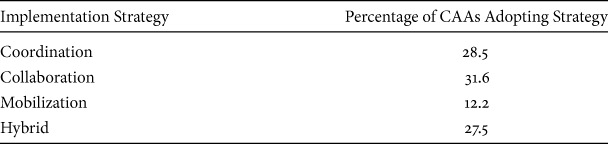
Echoing the CAP’s call for experimentation, communities attacked entrenched poverty in diverse ways depending upon local conditions and circumstances. Table 2 shows the percentage of CAAs that adopted each of the implementation approaches, as well as agencies that borrowed from multiple strategies.
Percentage of CAAs Adopting Each Implementation Strategy

The data shows that implementation strategies varied widely, even within states. Shriver’s authority over how funds were distributed within states allowed CAAs in the same state to adopt different implementation tactics to match local circumstances. This buttresses Bailey and Duquette’s quantitative analysis by highlighting that conditions on the ground, not political considerations, influenced how administrators waged the War on Poverty.Footnote 95 Most CAAs adopted either the coordination, collaboration, or a hybrid approach, but no single approach constitutes a majority, which highlights the program’s flexible and experimental nature. Perhaps the most significant finding is the relatively low frequency of mobilizing CAAs, at just over 12 percent of the sample. This frequency does seem high for any American social program, as it is difficult to think of a comparable program that disbursed federal funds in support of political or social mobilization. However, given the focus in the scholarship on high profile, dramatic, and sometimes volatile agencies, the data suggests that such CAAs were a significant minority of all agencies, which points to an important bias in the extant literature on the CAP. A more comprehensive analysis of the CAP needs to pay closer attention to more typical organizations who utilized less confrontational approaches. Given their predominance across the institutional landscape, we must give such agencies more attention to more systematically map the contours of the War on Poverty.Footnote 96 Even though there were relatively few mobilization-oriented CAAs, critics nonetheless took advantage of the few areas where disorder did occur in the summer of 1967, which led to dramatic changes in the CAP’s administrative structure.
1967: Disorder, the Green Amendment, and the Curtailment of the CAP’s Experimental Ethos
Unrest like that which occurred in Newark broke out in twenty-seven cities in the summer of 1967, resulting in more than six thousand arrests and hundreds of millions of dollars in property damage. Critics of the War on Poverty argued that CAAs fueled disorder, even though official reports showed that antipoverty programming helped quell rioting in many cities.Footnote 97 Opponents of Johnson’s Great Society viewed the disorder as an opportunity to contain LBJ’s progressivism, particularly the CAP.
Led by Representative Edith Green (D-Ore.), Congress amended the CAP in the fall of 1967 to limit the program’s call for citizen mobilization as a means of addressing poverty. Green argued that the EOA effectively created new governmental structures in opposition to democratically elected political institutions. She stated, “As I see it, the Congress clearly intended to attack this economic problem, but it did not intend to legislate a revolution in American politics by establishing another structure of government at the various levels of political action in the United States.”Footnote 98 The Green Amendment codified the CAP’s “maximum feasible participation” requirement by mandating that CAAs adopt a tripartite board structure, with representatives of the poor making up one-third the board, while the additional two-thirds would be filled by public officials and representatives of business, labor, civic, or charitable groups. The amendment allowed states to designate either a state or local government body or a public or nonprofit agency as the CAA.
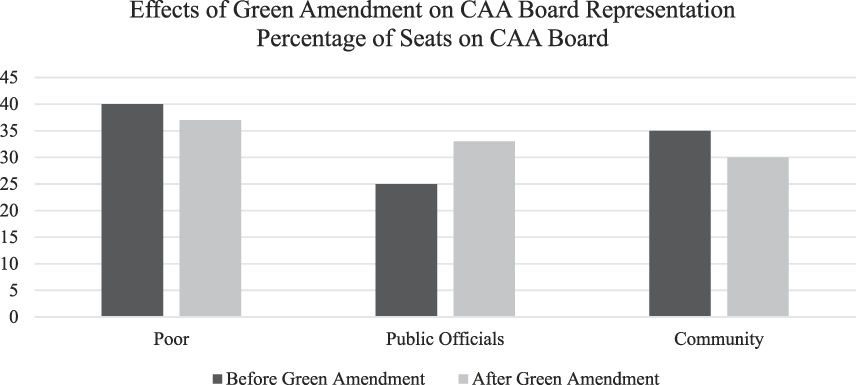
A detailed analysis of board compositions before and after the amendment shows that it did curtail low-income citizens’ voice on CAA boards.Footnote 99 Drawing upon data on fifty-three CAA boards from Yankelovich’s CAP study, Figures 1 and 2 describe these changes.
Average Number of Seats on CAA Boards Before and After Green Amendment of 1967.
Source: Yankelovich, Inc., Study of the Effects, Volume III.

Percentage of Seats on CAA Boards Before and After Green Amendment of 1967.
Source: Yankelovich, Inc., Study of the Effects, Volume III.

The poor’s representation, both in terms of the average number of seats and their proportion on CAA boards declined following the passage of the Green Amendment. Prior to 1967, the average CAA board consisted of just under fifteen representatives of the poor community, roughly eight from the public sector, and just over thirteen representatives from business, civic, and other groups. After 1967, the number of poor and community representatives dropped to thirteen and just over ten, respectively, while the public sector increased to just over eleven. The poor’s proportional power decreased as well, as they made up nearly 40 percent of the board prior to the amendment, and only 37 percent after. This data was gathered shortly after the Green Amendment passed; the poor’s proportion would decline even further in subsequent years to comply with the amendment’s mandates. Public officials saw their proportional representation on CAA boards increase from 25 percent to 33 percent after 1967. Public officials were the clearest beneficiaries of the Green Amendment.
Despite these changes, the widespread takeover of CAAs by state and local governments that critics of the amendment feared did not materialize, largely because most CAAs already operated with strong support from their communities, as the collaboration and coordination models would suggest. As William Phillips, OEO’s assistant director of congressional relations noted: “The only community action programs we really remember are the ones involved in controversy. We don’t think much at all about the hundreds and hundreds of programs [about which] there was never a peep of financial scandal, or never a peep of controversy or conflict between the people who participated in the programs and the local community. Many, many of them had 100 percent support from the local governments.”Footnote 100 Eight months after the amendment’s passage, most communities chose to continue the existing CAA without change. In 1969, there were 972 CAAs; 952 of those CAAs exhibited no change because of the Green Amendment.Footnote 101 This suggests that the vast majority of communities supported their CAAs.
The amendment nonetheless curtailed the CAP’s experimental ethos. The decision to change a CAA from a public to a private agency did not occur at random. Yankelovich found that “virtually all the changes in designation were concentrated in the group of CAAs where conflict between the poor and city hall became an overt political issue.”Footnote 102 Although only a few cities exercised greater control over CAAs after the Green Amendment, the sheer fact that city hall could take over a CAA had a chilling effect on agencies, who increasingly avoided programs focused on civic engagement in order maintain relationships with stakeholders. Backlash toward the CAP and Johnson’s broader domestic social programs during the Nixon and Reagan presidencies and cuts in funding since the 1970s led CAAs to avoid experimentation in favor of “safe” programs such as utility assistance, tax preparation, asset management, and health services.Footnote 103 While these programs are critically important for low-income individuals, much of the innovation and experimentation that characterized the CAP’s early years has faded away over time as agencies have come under increased regulatory scrutiny and funding has become more precarious.
Conclusion: The War on Poverty’s Experiment in Public Administration
The evidence presented above shows that CAP was not the radical, disorganized, unruly program its opponents labeled it as. Policymakers envisioned different models of community action that CAAs could adopt depending upon local circumstances and situations, and communities implemented the CAP in myriad ways. The majority of CAAs worked closely with local governments and other community institutions to develop, streamline, and improve the social welfare infrastructure in low-income areas. Subsequent research should aim to improve our understanding of the determinants of the various implementation approaches outlined above to develop a more comprehensive theory of how the CAP played out on the ground across the country.
The CAP’s experiment in public administration led to several changes in the governance of American social policy. The program’s participatory ethos encouraged citizen activists in the 1960s and 70s to demand greater citizen control over federal policies.Footnote 104 The broader strategy of coordinating programs from the bottom up also persisted. As Crenson and Rourke point out, many social programs of the late-1960s and 1970s, such as Model Cities and Richard Nixon’s revenue sharing programs echoed the CAP’s call to delegate more authority from Washington to the state and local levels.Footnote 105 In addition, Kent Germany and Andrew Morris argue that in creating more than one thousand new antipoverty agencies, the CAP and the broader War on Poverty effectively blurred the lines between public and private social provision and hastened the development of the emergent nonprofit sector.Footnote 106
While CAAs have undergone numerous administrative changes since their establishment in the mid-1960s, nearly one thousand still operate today across 96 percent of the nation’s counties. Despite efforts by Republican presidents Richard Nixon and Ronald Reagan to end community action, the program persists today as the Community Services Block Grant program. While the CAP originally called for low-income citizens’ “maximum feasible participation” in program design and implementation, such opportunities for direct citizen involvement are now far more routinized and bureaucratic. However, CAAs still provide crucially important services in low-income communities into the twenty-first century.Footnote 107 A more systematic assessment shows that the program directly attacked entrenched poverty and provided low-income individuals with new opportunities to participate in economic, political, and social relations, which generated long-term positive benefits. The CAP has thus proven to be a resilient and important aspect of Lyndon Johnson’s political and policymaking legacy.
Appendix. Classification of CAA Implementation Strategies, 1964–1967

Sources to the Appendix: The following sources were used to construct the dataset: Community Action Program, Office of Program Policy, Policy and Evaluation Division, “Local Initiative and Community Action,” February 1969, Record Group 381, Records of the Office of Economic Opportunity/Community Services Administration, Program Subject Files: 1967–72, Box 21, Folder: Participation of the Poor, National Archives and Records Administration, College Park, Md.; Local Initiative: A “New Fix,” Record Group 381, Records of the Office of Economic Opportunity/Community Services Administration, Program Subject Files: 1967–72, Box 3, Folder: CAP–Local Initiative (“New Fix”), National Archives and Records Administration, College Park; Yankelovich, Study of the Effects, Volume III; Greenstone and, Race and Authority; Hallman, “The Community Action Program”; Cazenave, Impossible Democracy; Shostak, “Promoting Participation of the Poor”; Ralph M. Kramer and Clare Denton, “Organization of a Community Action Program: A Comparative Case Study,” Social Work (Oct., 1967): 68–80; Torstensson, “Beyond the City,” Paul E. Peterson, “Forms of Representation: Participation of the Poor in the Community Action Program,” American Political Science Review 64, no. 2 (June 1970): 491–507; Harold Wolman, “Organization Theory and Community Action Agencies,” Public Administration Review 32, no. 1 (January–February 1972): 33–42; Naples, Grassroots Warriors; Quadagno, The Color of Welfare, Rhonda Y. Williams, “To Challenge the Status Quo by Any Means: Community Action and Representational Politics in 1960s Baltimore,” in The War on Poverty, ed. Orleck and Hazirjian; Marc S. Rodriguez, “Defining the Space of Participation in a Northern City: Tejanos and the War on Poverty in Milwaukee,” in The War on Poverty, ed. Orleck and Hazirjian; Kenneth B. Clark and Jeannette Hopkins, A Relevant War Against Poverty: A Study of Community Action Programs and Observable Social Change (New York, 1969); Ashmore, Carry It On; Susan Youngblood Ashmore, “Going Back to Selma: Organizing for Change in Dallas County after the March to Montgomery,” in The War on Poverty, ed. Orleck and Hazirjian; Brian Keough, “Politics as Usual or Political Change: The War on Poverty’s Community Action Program in Albany, New York, 1959–1967,” Afro-Americans in New York Life and History 36, no. 2 (2012): 37–65; Blumenthal, “The Bureaucracy”; Rabig, The Fixers; Krasovic, The Newark Frontier; Mumford, Newark; Mckee, The Problem of Jobs; Countryman, Up South; Germany, New Orleans after the Promises; Ralph M. Kramer, Participation of the Poor: Comparative Community Case Studies in the War on Poverty (Englewood Cliffs, N.J., 1969); Paul E. Peterson, “Forms of Representation: Participation of the Poor in the Community Action Program,” American Political Science Review 64, no. 2 (June 1970): 491–507; Fremont James Lyden and Jerry V. Thomas, “Citizen Participation in Policy-Making: A Study of a Community Action Program,” Social Science Quarterly 50, no. 3 (December 1969): 631–42; Cahn and Passett, eds., Citizen Participation: Effecting Community Change (New York, 1971); Sumati N. Dubey, “Community Action Programs and Citizen Participation: Issues and Confusions,” Social Work 15, no. 1 (January 1970): 76–84; John H. Strange, “Citizen Participation in Community Action and Model Cities Programs,” Public Administration Review 32 (October 1972): 655–69.