1. Introduction
An extensive deposit of agate occurs on Pedro González Island in the Pearl Island archipelago of the Gulf of Panama (Figs 1, 2). Archaeological studies showed that the agate was exploited to make abundant stone tools between 6200 and 5600 cal BP, which were found at an accumulation of cultural debris at Don Bernardo Beach on the northeastern coast of Pedro González Island (Fig. 3). This represents the oldest Preceramic human settlement yet identified in the Pearl Island archipelago, where there is clear evidence for exploitation of dolphins and other marine and terrestrial fauna using the agate tools (Cooke et al. Reference Cooke, Wake, Martínez-Polanco, Jiménez-Acosta, Bustamante, Holst, Lara-Kraudy, Martín and Redwood2016; Martin et al. Reference Martín, Cooke, Bustamante, Holst, Lara and Redwood2016; Pearson et al. Reference Pearson, Martín, Castro, Acosta and Cooke2021). Several environmental and societal reasons could account for the existence of this settlement, but it is likely that local agate resources contributed to developing and sustaining local human activities. Some preliminary observations suggest that the agate occurs in giant amygdales in ‘basalt’ lavas (Cooke et al. Reference Cooke, Wake, Martínez-Polanco, Jiménez-Acosta, Bustamante, Holst, Lara-Kraudy, Martín and Redwood2016), but the geological context and origin of the agate remain to be investigated in detail. Giant amygdales are very rare in the geological record and are generally associated with subaerial lavas (e.g. Self et al. Reference Self, Thordarson, Keszthelyi, Mahoney and Coffin1997, Reference Self, Keszthelyi and Thordarson1998; Shipboard Scientific Party, Reference Coffin, Frey and Wallace2000; Thordarson, Reference Thordarson2000; Barreto et al. Reference Barreto, de Lima and Goldberg2017), making their occurrence on Pedro González Island a valuable opportunity to better understand their possible modes of formation. In addition, little geological information exists in eastern Panama due to logistical limitations and tropical vegetation in the most remote parts of the country. This means that new data from Pedro González Island can help fill a large observation gap, providing novel constraints on the geological evolution of the eastern part of the Panama volcanic arc that is considered by many authors to be associated with the emergence of the Isthmus of Panama (e.g. Coates et al. Reference Coates, Collins, Aubry and Berggren2004; Farris et al. Reference Farris, Jaramillo, Bayona, Restrepo-Moreno, Montes, Cardona, Mora, Speakman, Glascock and Valencia2011; Montes et al. Reference Montes, Cardona, Jaramillo, Pardo, Silva, Valencia, Ayala, Pérez-Angel, Rodriguez-Parra, Ramirez and Niño2015; Buchs et al. Reference Buchs, Irving, Coombs, Miranda, Wang, Coronado, Arrocha, Lacerda, Goff, Almengor, Portugal, Franceschi, Chichaco and Redwood2019 b).
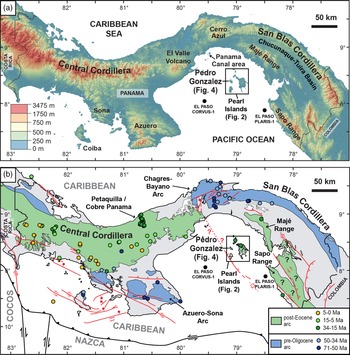
Regional geological setting of the Pearl Islands and Pedro González Island showing the location of the El Paso Corvus-1 and El Paso Plaris-1 drill holes (modified from Buchs et al. Reference Buchs, Coombs, Irving, Wang, Koppers, Miranda, Coronado, Tapia and Pitchford2019 a).

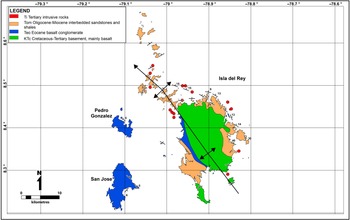
Geologic compilation map of the Pearl Islands Archipelago (adapted from Mann & Kolarsky, Reference Mann, Kolarsky and Mann1995).

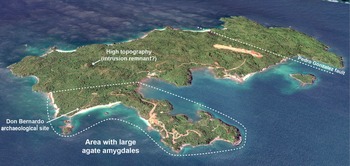
Satellite view towards the SW of Pedro González Island, showing the area containing large agate amygdales (image captured in 2013, source: Google Earth).

This study provides the first detailed lithological descriptions and geochemical analyses of Oligo-Miocene volcano-sedimentary sequences in the Pearl Island archipelago, and presents new constraints on the nature and origin of unusually large (up to 40 cm in diameter) amygdales and less abundant geodes (hereafter collectively called amygdales) that locally occur in submarine lavas. Our results suggest that the formation of the giant amygdales resulted from sediment–lava (peperitic) interaction and subsequent hydrothermal activity. As discussed below, only two other possibly similar occurrences could be found in previous studies worldwide. In addition, geochemical results show the occurrence of unusually tholeiitic supra-subduction igneous rocks, which we propose to be a lateral analogue of early Miocene volcanic deposits of the Panama Canal area and provides the first possible record of magmatic cessation in eastern Panama. New constraints on the origin of the volcano-sedimentary deposits of Pedro González Island are consistent with previous regional studies that suggest that the Panama volcanic arc was an island arc, and not yet fully emergent in the early Miocene.
2. Geological setting
The Pearl Island archipelago and Pedro González Island are part of the East Panama Deformed Belt in the fore-arc of the Panama volcanic arc (Fig. 1), where a complex system of NW–SE-trending, locally active, faults and thrusts define several basement highs and basins filled by Eocene to Holocene sedimentary deposits (Mann & Kolarsky, Reference Mann, Kolarsky and Mann1995; Derksen et al. Reference Derksen, Coon and Shannon2003). The Pearl Islands correspond to a N–S-trending basement high, which is interpreted, based on 2D seismic profiles in the Gulf of Panama, as a hanging-wall anticline associated with an east-dipping reverse fault zone (Mann & Kolarsky, Reference Mann, Kolarsky and Mann1995). This basement high separates tilted basins in the east and west of the gulf, which are locally filled by km-thick sedimentary sequences. From a regional volcanic perspective, the studied area occurs in the fore-arc of the latest Cretaceous to Eocene (c. 66 to 39 Ma) Chagres–Bayano Arc that extends along the San Blas Cordillera (Wegner et al. Reference Wegner, Wörner, Harmon and Jicha2011; Montes et al. Reference Montes, Bayona, Cardona, Buchs, Silva, Morón, Hoyos, Ramírez, Jaramillo and Valencia2012a) (Fig. 1). In contrast to western Panama where post-Eocene (still ongoing) volcanic activity has formed a high Central Cordillera (Wegner et al. Reference Wegner, Wörner, Harmon and Jicha2011), only limited post-Eocene volcanic activity has been documented in eastern Panama. Supra-subduction magmatism occurred in the Majé Range and Canal area during the Oligocene to early Miocene (Farris et al. Reference Farris, Jaramillo, Bayona, Restrepo-Moreno, Montes, Cardona, Mora, Speakman, Glascock and Valencia2011, Reference Farris, Cardona, Montes, Foster and Jaramillo2017; Rooney et al. Reference Rooney, Franceschi and Hall2011; Whattam et al. Reference Whattam, Montes, McFadden, Cardona, Ramirez and Valencia2012; Buchs et al. Reference Buchs, Coombs, Irving, Wang, Koppers, Miranda, Coronado, Tapia and Pitchford2019 a, b). However, younger volcanism has not been documented yet in eastern Panama. Magmatic cessation occurred c. 16 Ma ago in the Canal area, which could also correspond to the end of volcanism in eastern Panama (Buchs et al. Reference Buchs, Coombs, Irving, Wang, Koppers, Miranda, Coronado, Tapia and Pitchford2019 a). As further discussed below, only two samples of igneous rocks have been analysed and dated in the Pearl Island archipelago (Lissinna, Reference Lissinna2005), which suggest the occurrence of early Miocene (c. 22 to 18 Ma) arc volcanism in the studied area. However, the exact nature and extent of this volcanism, as well as its relationship with regional magmatic activity, remain very poorly constrained.
Although the regional tectono-stratigraphic context of the Pearl Island archipelago seems reasonably well constrained, very limited information exists on the geology and palaeoenvironmental evolution of the Pearl Islands. To date, the only published stratigraphic study of the archipelago is from Mann & Kolarsky (Reference Mann, Kolarsky and Mann1995); it provides a geological synthesis and interpretation based on data from (1) unpublished reports from the Dirección General de Hidrocarburos of Panama, (2) 1600 km of 2D seismic surveys by Mobil Exploration and Production Services Company collected between 1969 and 1972, and (3) two offshore well logs of the El Paso Corvus-1 (2926 m deep) and El Paso Plaris-1 (2867 m deep) wells drilled by El Paso Natural Gas in 1974 (Fig. 2; Quirós Ponce, Reference Quirós Ponce and Quirós Ponce1975). According to Mann & Kolarsky (Reference Mann, Kolarsky and Mann1995), microfossils from marine sedimentary sequences along the eastern coast of Isla del Rey (the largest island in the archipelago) indicate a late Miocene–Pliocene age and a middle neritic or deeper environment of deposition. In sedimentary sequences of the southern part of Isla del Rey, larger benthic foraminifera indicate an Oligocene age and a very shallow inner neritic environment of deposition. These sequences are thought to correlate to basin fill sediments drilled at El Paso Corvus-1 and El Paso Plaris-1 holes located to the southwest and southeast in the Gulf of Panama (Mann & Kolarsky, Reference Mann, Kolarsky and Mann1995) (Fig. 1). In addition, correlation between these two drilling sites and interpretation of seismic profiles in the Gulf of Panama suggests that the geology of the area is composed of a Cretaceous to Palaeogene (?) igneous basement overlain by middle Eocene conglomerate (of unspecified lithological composition) (Mann & Kolarsky, Reference Mann, Kolarsky and Mann1995). The basement sequence is, in turn, overlain above an angular unconformity by a sequence of Oligocene to Miocene marine sedimentary deposits. Overlying Plio-Pleistocene marine sediments are separated from the Oligo-Miocene sequences by another angular unconformity. The geological compilation map of the Pearl Islands presented in Mann & Kolarsky (Reference Mann, Kolarsky and Mann1995) and reproduced in Figure 2 follows this general stratigraphic subdivision, with local occurrences of small Cenozoic igneous intrusions (Fig. 3). Geochemical and geochronological data of a basaltic andesite and dacite from Isla del Rey and Bajo Bayonera islands indicate supra-subduction geochemical affinities with 21.9 ± 0.7 Ma and 18.4 ± 0.3 Ma (early Miocene) crystallization ages determined by Ar–Ar dating (Lissinna, Reference Lissinna2005). However, the field context is not specified for these samples, and our personal geological observations at the reported sampling sites did not allow us to identify the provenance of these samples.
The stratigraphy of the Pearl Island archipelago summarized above and in Figure 2 is in broad agreement with other field and biostratigraphic constraints from sedimentary sequences exposed further east in Panama (Coates et al. Reference Coates, Collins, Aubry and Berggren2004; Barat et al. Reference Barat, Mercier de Lépinay, Sosson, Müller, Baumgartner and Baumgartner-Mora2014). Notably, it was suggested that the former stratigraphy of the Pearl Islands (Mann & Kolarsky, Reference Mann, Kolarsky and Mann1995) can be correlated with the San Blas Complex, Darien and Clarita Formations of the Chucunaque–Tuira Basin in the Darien Province of eastern Panama (Coates et al. Reference Coates, Collins, Aubry and Berggren2004; Barat et al. Reference Barat, Mercier de Lépinay, Sosson, Müller, Baumgartner and Baumgartner-Mora2014). However, it is important to note that there remain considerable gaps in our understanding of the geology and volcanic history of the Pearl Islands and eastern Panama. Although Pedro González Island has been interpreted to include an Eocene basal conglomerate (Mann & Kolarsky, Reference Mann, Kolarsky and Mann1995), to our knowledge no direct constraints exist on the geology of the island. In addition, early Miocene ages of crystallization of the two igneous samples with arc geochemical affinities by Lissinna (Reference Lissinna2005) are not consistent with the interpretation of a Cretaceous to Palaeogene (?) igneous basement in the area (Mann & Kolarsky, Reference Mann, Kolarsky and Mann1995). However, the geochemistry of these samples has not yet been compared with that of the Cretaceous to recent volcanic fronts of Panama, and no geochemical data exist for Pedro González Island. In fact, it remains unclear based on published geological information whether the archipelago is exclusively composed of volcanic arc products or also includes accreted oceanic islands and autochthonous oceanic plateau sequences similar to those exposed elsewhere in the Panamanian fore-arc (e.g. Buchs et al. Reference Buchs, Baumgartner, Baumgartner-Mora, Flores and Bandini2011). This study helps address some of these issues with new detailed field observations and a comparison of new geochemical data from igneous rocks of Pedro González Island with other well-dated volcanic units of Panama.
3. Methods
3.a. Field observations and sampling
Mapping of Pedro González Island was carried out iteratively during three field campaigns between 2009 and 2016. Because the island has a low topography and is covered by tropical forest, lithological observations and sampling were focused on coastal exposures at low tide from a boat or along beaches, where possible. A full coverage of coastal exposures was achieved.
3. b. Geochemical analyses and compilation of regional geochemical data
Whole rock samples weighing c. 250–500 g were prepared and analysed at the School of Earth and Ocean Sciences at Cardiff University. The weathered edges were first removed by hammering and sawing. Samples were then crushed using a steel-jaw crusher. An aliquot of c. 80 ml of the crushed fraction was subsequently milled to <125 µm in an agate planetary ball mill. Approximately 2–3 g of this sample powder was heated to 900 °C for 2 hours in a furnace to remove any volatile substances and determine loss-on-ignition (LOI) values. Samples were prepared for inductively coupled plasma (ICP) analysis using the lithium metaborate fusion method. In this procedure, 0.1 ± 0.001 g of each ignited sample was mixed with 0.6 ± 0.001 g of flux (50:50 lithium borate:sodium borate) in a platinum crucible and three to four drops of lithium iodide wetting agent were added. The mixture was fused using a Claisse Fluxy automated fusion machine. The resulting borate glass was then dissolved in a 50 ml solution of 20 ml of 10 % HNO3 and 30 ml of 18.2 Ω deionized water obtained using a Milli-Q purification system. After the mixture had fully dissolved, 1 ml of 100 ppm Rb spike was added to the solution, which was then made up to 100 ml with 18.2 Ω deionized water. Approximately 20 ml of each solution was run on a Jobin Yvon Horiba Ultima 2 inductively coupled plasma optical emission spectrometer (ICP-OES) to obtain major element and some trace element abundances. An aliquot of 1 ml of each solution was added to 1 ml of In and Tl and 8 ml of 2 % HNO3 and run on a Thermo Elemental X7 series inductively coupled plasma mass spectrometer (ICP-MS) to obtain trace element abundances. The accuracy of the data was assessed using International Standard Reference Materials (ISRM) JB1a, JG1a and JA2 analysed alongside the samples. Major and trace element analyses of these reference materials fell within 5–10 % of reference values for the majority of elements analysed, with r 2 values of >0.995 for all elements in both ICP-OES and ICP-MS analyses. Complete analyses, including values for the ISRM, are provided in Supplementary Table S1 (the Supplementary Material is available online at https://doi.org/10.1017/S0016756821001229).
Regional datasets used for comparison with new geochemical results include igneous samples from: (1) the pre-Oligocene Chagres–Bayano Arc (n = 95, Wegner et al. Reference Wegner, Wörner, Harmon and Jicha2011); (2) the post-Eocene Cordilleran Arc (n = 116, Wegner et al. Reference Wegner, Wörner, Harmon and Jicha2011), grouped here with the Early Miocene Majé Range (n = 17, Whattam et al. Reference Whattam, Montes, McFadden, Cardona, Ramirez and Valencia2012) and the Oligocene Cerro Patacon and Bas Obispo Formations in the Canal area (n = 22, Rooney et al. Reference Rooney, Franceschi and Hall2011; Farris et al. Reference Farris, Cardona, Montes, Foster and Jaramillo2017; Buchs et al. Reference Buchs, Coombs, Irving, Wang, Koppers, Miranda, Coronado, Tapia and Pitchford2019 a, b); (3) early Miocene Las Cascadas and Pedro Miguel Formations from the Canal area (n = 68, Farris et al. Reference Farris, Cardona, Montes, Foster and Jaramillo2017; Buchs et al. Reference Buchs, Coombs, Irving, Wang, Koppers, Miranda, Coronado, Tapia and Pitchford2019 a, b); and (4) Isla del Rey and Bajo Bayonera islands in the Pearl Islands (n = 2, Lissinna, Reference Lissinna2005). We did not include samples from Baker et al. (Reference Baker, Hollings, Thompson, Thompson and Burge2016) from Cobre Panama, which are affected by alteration in a highly mineralized area. Samples with unrealistic Nb/Ta values of >28 (Wegner et al. Reference Wegner, Wörner, Harmon and Jicha2011) were not plotted in trace element diagrams using Nb. Unless specified otherwise, we did not plot samples with LOI > 4 wt % in diagrams using elements that are mobile during low-temperature alteration and weathering (e.g. total-alkali silica (TAS) and alkalis–FeO*–MgO (AFM) diagrams). All major element contents were recalculated on an anhydrous basis before plotting. A high content of calcite in our sample DB16-104 is indicated by CaO = 16.20 wt % and LOI = 8.34 wt %. This sample was therefore not used in major element diagrams.
4. Results
4.a. Geological map and lithostratigraphy
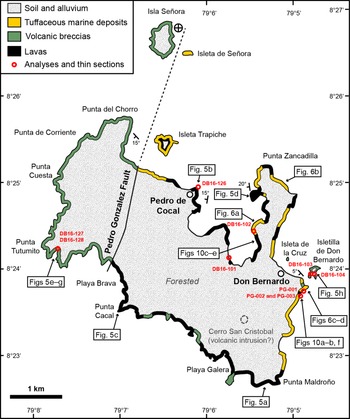
The geology of the studied island can be subdivided into three main lithostratigraphic units: (1) lavas, (2) volcanic breccias and (3) tuffaceous marine deposits (Figs 4–6). The bedding of layered units does not follow a preferential orientation, but the dip is generally <20°. Faults are common along coastal exposures. Their significance is difficult to assess due to limited exposures and a lack of good stratigraphic markers at the scale of the island, but their frequency clearly impedes construction of a detailed/measured lithostratigraphic column in the study area. In addition, a main N–S-trending fault cross-cuts the island, which we introduce here as the ‘Pedro González Fault’. This fault is associated with a lower topography and marks the contact between contrasted lithological assemblages in the western and eastern sides of the island. The strike of the fault is parallel to the orientation of many coastal segments around the island (Figs 3, 4). This and the location of the island suggest that the Pedro González Fault could belong to the N–S-trending reverse fault system believed to be associated with the Pearl Islands anticline (Mann & Kolarsky, Reference Mann, Kolarsky and Mann1995). However, this hypothesis could not be verified because the fault plane is preferentially weathered and was not found in field exposures.

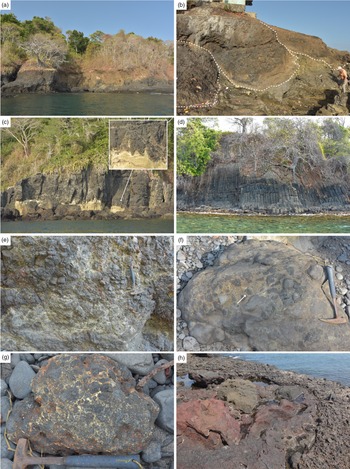
Examples of andesitic lavas and primary andesitic breccias exposed along the coast of Pedro González Island (location of the pictures is shown in Fig. 4). (a) Lavas interbedded with tuffaceous marine deposits (exposure height is c. 7 m). Lava on the left has columnar joints curving close to the margin of the flow, whereas the lava on the right is massive with breccias at its top. (b) Lava lobes impinging upon tuffaceous deposits. (c) Massive to brecciated lava with evidence of soft deformation of tuffaceous deposits at its base. Brecciation occurs close to the margin of the flow on both sides of the picture. (d) Thick lava with large near-vertical columnar jointing (exposure height is c. 8 m). (e) Monomictic breccia with elongated lava fragments. This lithology is chiefly layered at the metre scale and forms most of the volcaniclastic deposits west of the Pedro González fault. (f) Block of monomictic breccia with chilled amoeboid clasts (arrow). (g) Block of monomictic breccia with amoeboid clasts and a palagonized glassy or tuffaceous matrix. (h) Lobate lava intruding andesite breccias.

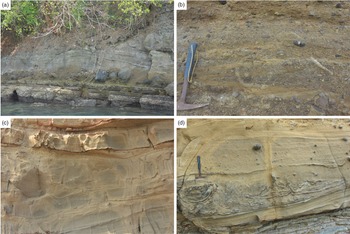
Examples of tuffaceous marine deposits exposed along the coast of Pedro González Island (location of the pictures is shown in Fig. 4). (a) Tuffaceous deposits with cross- to parallel-layered, fine to coarse tuffs and tuffaceous (matrix-supported) debris-flow deposits containing andesite granules to boulders. Some of the larger clasts in the debris flow deposits are well-rounded. (b) Lenses of polymictic andesitic breccia interbedded with tuffaceous deposits. Note burrows that occur as cm-wide tubes cross-cutting the bedding. (c) Cross-bedded marine tuffaceous deposits with whiter pumiceous beds. (d) Fluid escape structures in tuffaceous deposits.

The western side of the island is predominantly composed of volcanic breccias (Fig. 4). As shown by geochemical results presented below, these breccias and other igneous rocks of Pedro González Island have basaltic andesite to andesite compositions; these will be informally referred to as ‘andesitic’ hereafter. The breccias are monomictic and grain-supported, with poorly sorted and generally angular to amoeboid clasts (Fig. 5e–g). Some of the clasts have a chilled/quenched glassy margin that can be locally palagonized (Fig. 5f, g). The breccias are commonly cross-cut by andesitic dykes that form <5 % of the unit. The igneous rocks of this unit are generally devoid of vesicles and amygdales. Although no pillow lavas were observed, the lithostratigraphic, compositional and textural characteristics of the breccias indicate that they represent primary volcanic products emplaced in a subaqueous environment.
The eastern side of the island that hosts the Don Bernardo archaeological site includes a distinct sequence composed of andesitic lavas interbedded with tuffaceous marine deposits and minor volcanic breccias (Fig. 4). Andesite dykes and small igneous intrusions form a very minor fraction (<5 %). A topographic high in the interior of the island could be the erosional remnant of a larger intermediate/felsic intrusion (Fig. 3). The lavas vary greatly in thickness and morphology, from relatively thin (<2 m thick) lobate (Fig. 5b) to thick (∼8 m thick) massive or columnar-jointed lavas (Fig. 5c, d). However, no pillow lavas were observed. Auto-brecciation of some of the lavas locally occurs, apparently leading to the formation of monomictic volcanic breccias similar to those observed in the western side of the island (Fig. 5a, h). Load structures and/or brecciation of the lavas are commonly observed at the contact with tuffaceous deposits (Fig. 5a, c). Lavas also locally protrude into underlying tuffaceous deposits (Fig. 5b). These lithofacies provide clear evidence for interaction of submarine lava flows with soft (water-rich) marine sediments, which locally led to peperitic brecciation (e.g. Skilling et al. Reference Skilling, White and McPhie2002).
Tuffaceous marine deposits form c. 50 % of the lithologies mapped on the eastern side of the island (Fig. 4). These deposits have a distinctive light brown colour with a rare calcareous component. Alteration of finer volcanic (tuffaceous) components is extensive in this lithology. The sequences are generally sandy and well-bedded, with frequent cross-laminae and cross-bedding, and occasional Thalassinoides(?) burrows (Fig. 6). The tuffaceous component of this lithology is best illustrated in the field by occasional pumice-rich layers, which can form discrete 1 to 30 cm thick intervals/lenses in the otherwise generally finer deposits (Fig. 6c). These lithofacies are interpreted as (1) relatively pure, undisturbed volcanic fallout tuffs, and (2) a mixture of fallout tuffs with minor pelagic sediments, which were partly to totally homogenized by burrowing and reworking by bottom currents. In addition, some of the thicker beds of the tuffaceous marine deposits can form tabular beds and lenticular bodies (e.g. Fig. 6a), which commonly lack internal structure and include an abundance of granules to boulders of petrographically diverse andesite (Fig. 6a, b, d). The igneous clasts are poorly sorted and very angular to well rounded. These clast-rich matrix- to grain-supported tuffaceous lithologies are interpreted to have formed from debris flows and grain flows with local slumps. Turbidites do not occur in the sequence. Fast sedimentation rates of the tuffaceous deposits can be inferred based on the common occurrence of fluid escape structures (Fig. 6d), and the lack of intervals of finer-grained fossiliferous (calcareous, clayey or siliceous) lithologies from a background pelagic sedimentation.
4.b. Whole-rock petrography and geochemistry
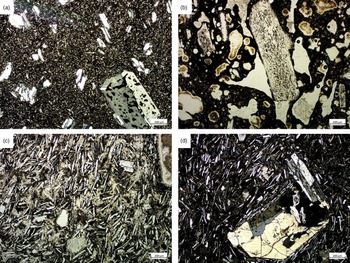
Nine samples of igneous rocks were selected for whole-rock analysis, including three lavas with minor to no vesicles, one lava host to giant amygdales, two dykes cross-cutting tuffaceous deposits and primary volcanic breccias, and three clasts from primary volcaniclastic deposits (Supplementary Table S1 (the Supplementary Material available online at https://doi.org/10.1017/S0016756821001229); the sample locations are shown in Fig. 4). Field constraints indicate that all samples are representative of local magmatic activity. Microscope observations show that the samples are poorly porphyritic, with feldspar and/or clinopyroxene phenocrysts, and display amygdales only in a few rare occurrences (Fig. 7). A variable, albeit generally minor, degree of alteration is shown by LOI that ranges between 1.3 and 8.3 wt %. Thin-sections show that glass and plagioclase microlites are commonly replaced by clays and opaque minerals (presumably Fe oxides and hydroxides). Larger plagioclase phenocrysts commonly have a sieve texture that attests to magma mixing and/or disaggregation of crystal mush in the magma plumbing system. However, despite evidence for minor alteration and magma mixing and/or mineral accumulation, the composition of the samples is overall very consistent and supports the occurrence of a single, cogenetic magmatic suite on Pedro González Island (Figs 8, 9).
Photomicrographs of volcanic rock textures (sample locations are shown in Fig. 4). (a) Fine-grained, columnar-jointed basalt with plagioclase phenocrysts and microcrystals of plagioclase in a very fine-grained matrix (DB16-101, xp). (b) Clast in breccia of vesicular basalt with plagioclase phenocrysts. Small vesicles are lined with an acicular brown mineral, possibly a zeolite (DB16-104, ppl). (c) Amygdaloidal lava with plagioclase microphenocrysts in a matrix with abundant plagioclase laths with a trachytic texture (PG-002, ppl). (d) Amygdaloidal lava with a large phenocryst of plagioclase and clinopyroxene in a matrix with abundant plagioclase laths with a trachytic texture (PG-002, xp). Abbreviations: ppl – plane polarized light; xp – crossed polars.

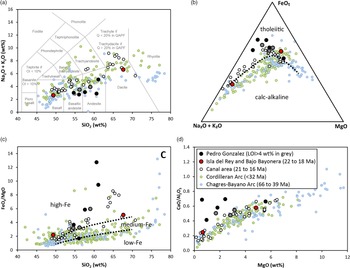
Major-element diagrams showing igneous rocks from Pedro González Island (lavas, clast and dykes, location shown in Fig. 4) and regional volcanic arc units. Sources and handling of the data are detailed in the Methods. SiO2 vs FeO*/MgO diagram is after Arculus (Reference Arculus2003).

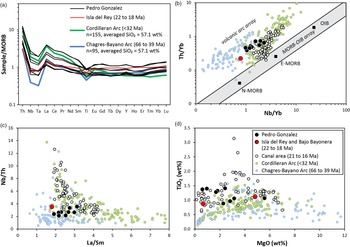
Trace element diagrams showing igneous rocks from Pedro González Island (lavas, clast and dykes, location shown in Fig. 4) and regional volcanic arc units. Sources and handling of the data are detailed in the Methods. MORB (mid-ocean ridge basalt) normalization values in (a) are from Gale et al. (Reference Gale, Dalton, Langmuir, Su and Shilling2013). Nb/Yb vs Th/Yb diagram is after Pearce (Reference Pearce2008).

The studied igneous rocks are basaltic andesite to andesite (Fig. 8a) that plot in the tholeiitic field of the AFM diagram (Fig. 8b). This clearly contrasts with the bulk of the Panama volcanic arc that has calc-alkaline affinities. The sample hosting giant amygdales is an andesite (SiO2 = 60.6 wt %, LOI = 3.6 wt %) without any distinctive geochemical features. Consistent with their AFM tholeiitic affinities, the Pedro González igneous rocks have particularly high FeO*/MgO and CaO/Al2O3 values at a given SiO2 content (Fig. 8c, d). These features are commonly associated with delayed Fe-oxides and earlier feldspar crystallization in anhydrous melts (e.g. Arculus, Reference Arculus2003; Schmidt & Jagoutz, Reference Schmidt and Jagoutz2017), hence supporting lower water contents in the magmas of Pedro González relative to the bulk of the Panama volcanic arc. When compared to other igneous rocks of the Panama volcanic arc, the Pedro González samples are more akin (but not identical) to tholeiitic basalts to dacites of the Panama Canal area (early Miocene Las Cascadas and Pedro Miguel Formations, e.g. Buchs et al. Reference Buchs, Coombs, Irving, Wang, Koppers, Miranda, Coronado, Tapia and Pitchford2019 a) (Fig. 8). Normalized patterns of immobile trace elements are very consistent within Pedro González samples and document supra-subduction magmatic affinities with a gradual increase in the most incompatible elements punctuated by a typical Nb–Ta negative anomaly (Fig. 9a). These trace element patterns are broadly similar to the average composition of the post-Eocene Panama volcanic arc (see Methods for the full list of references) and a sample of early Miocene dacite from Isla del Rey in the Pearl Island archipelago (Lissinna, Reference Lissinna2005). Geochemical similarity to the post-Eocene Panama volcanic arc is also supported by Nb/Yb vs Th/Yb and La/Sm vs Nb/Th diagrams (Fig. 9b, c). In addition, these diagrams show that Pedro González samples are compositionally distinct from the Isla del Rey dacite of Lissinna (Reference Lissinna2005). Importantly, MgO vs TiO2 trends show that about half of the analysed Pedro González igneous rocks have a much higher TiO2 content at a given MgO than the bulk of the post-Eocene volcanic arc, including early Miocene samples from the Pearl Island archipelago (Lissinna, Reference Lissinna2005) and Majé Range (Whattam et al. Reference Whattam, Montes, McFadden, Cardona, Ramirez and Valencia2012) (Fig. 9d). High TiO2 contents have only previously been observed in tholeiitic series of the Panama Canal area (c. 21 to 16 Ma) that are associated with magmatic cessation in central Panama (Buchs et al. Reference Buchs, Coombs, Irving, Wang, Koppers, Miranda, Coronado, Tapia and Pitchford2019 a).
4.c. Agate deposit
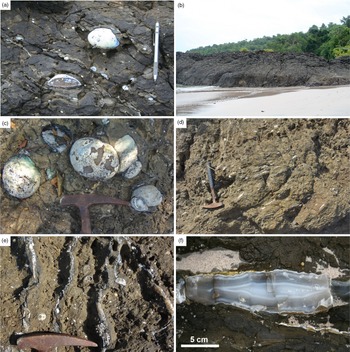
Agate occurs in unusually large amygdales, and fewer geodes, of up to 20–40 cm diameter, as well as small amygdales (0.1–1.0 cm) in a bimodal distribution, and in veins in vesicular andesitic lavas over a zone of c. 2.9 km N–S by up to 1.3 km wide, with an area of c. 3.0 km2, on the Punta Zancadilla peninsula and around Don Bernardo and Mague beaches on the northeastern part of Pedro González Island (Figs 3, 4, 10). The amygdales only occur in a few andesitic lavas interbedded with tuffaceous sediments, which clearly indicate that unusual, favourable lithostratigraphic conditions were required for their formation. Some of the large amygdales are found in laterally continuous, planar lavas which often have columnar jointing, with more abundant and larger amygdales in the upper parts (Fig. 10a, b, f). The other large amygdales occur in the front of shorter, lobate lavas which form arcuate or ring structures several metres across (Fig. 10c–e).
Examples of large agate amygdales and veins (location of the pictures is shown in Fig. 4). (a) Spherical to oblong, bimodal small and large amygdales in a massive tabular lava interbedded with marine tuffaceous deposits (lava shown in (b)). (b) Massive tabular lava with concentration of larger amygdales at the top (approximate height of the outcrop is 4 m). (c) Coalescence of large amygdales in a lobate lava. (d) Elongated amygdales in a lobate lava with the maximal length of the agates parallel to the flow. (e) Irregular agate veins in a lobate lava with large amygdales. (f) Thicker agate veins in massive tabular lava (b) showing concentric banding.

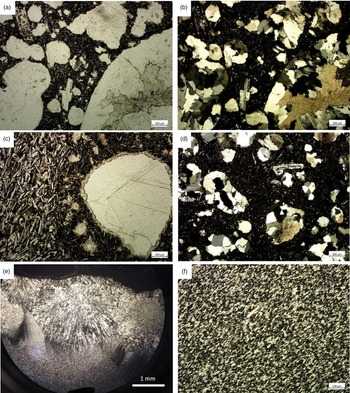
Agate (and rarely quartz) occurs in the amygdales and in irregular veins and vein breccias up to 20 cm wide that cross-cut both the lavas and amygdales (Figs10e, f, 11). The small amygdales may have a wall contact layer of an acicular brown mineral, possibly a zeolite, infilled with agate, quartz and late calcite (Fig. 11a, b, d), and some small amygdales have a thin wall-contact layer of agate or quartz that is coated by an unidentified botryoidal mineral and infilled by coarse calcite (Fig. 11c). The vein structures have an associated narrow halo of weak intermediate argillic alteration and bleaching to clays, probably smectite, which makes the basalt softer and more readily eroded. Agate veins were seen in tuffaceous sediments adjacent to one flow, but are generally absent in sedimentary rocks that are interbedded with the lavas. The colour of the agate is medium grey to white, and some have weak concentric colour banding and textural banding, particularly in veins. A thin-section cut across a large agate amygdale shows it to be zoned from chalcedony with a fibrous radial texture in spherules on the edge (Fig. 11e), to microgranular chalcedony laths <50 um long in the middle (Fig. 11f). Open centres occur in some amygdales, which are thus termed geodes, and some veins, and may be lined with very small to rarely coarse quartz crystals. The hard agate nodules are resistant to weathering and are abundant in the soils over the lavas, and in gravel beaches, although in the latter they are often broken and the agate whitened by reaction with seawater. However, the agate in these deposits is very hard and could easily be extracted and processed to create sharp tools.
Amygdale photomicrographs (sample locations are shown in Fig. 4). (a, b) Vesicular basalt clast in breccia with small amygdales with infill of quartz with calcite in the centre (DB16-104, ppl (a), xp (b)). (c) Amygdaloidal lava with small amygdale with a wall-contact layer of low-birefringence mineral (quartz or zeolite?) that is coated by an unidentified brown botryoidal mineral and filled with coarse calcite (PG-002, ppl). (d) Small amygdales with infill of quartz and minor calcite in vesicular basalt clast in breccia (DB16-104, xp). (e) Chalcedony with fibrous radial texture in spherules on the edge of a giant agate amygdale, with microfibrous textured chalcedony in the middle (PG-003, xp). (f) Chalcedony with microfibrous texture in a giant agate amygdale (PG-003, xp). Abbreviations: ppl – plane polarized light; xp – crossed polars.

The size of the agate-filled amygdales, commonly up to 20 cm in diameter and occasionally up to 40 cm, is highly unusual. The height is much less than the diameter. Small amygdales (0.1–1.0 cm) occur together with large ones to give a bimodal size distribution. The amygdales have a flat base with a domed top, although some can be very flat, are circular to less commonly oval in plan, and are usually aligned in the basalt in flow textures (Fig. 10). There is clear evidence for bubble coalescence at all observed localities (Fig. 10c).
5. Discussion
5.a. Geology of Pedro González Island and palaeogeographic implications
The geology of Pedro González Island was previously considered to be a basal conglomerate of mid-Eocene age (Mann & Kolarsky, Reference Mann, Kolarsky and Mann1995; Fig. 2). Middle Eocene conglomerates and shallow-marine limestones rich in larger benthic foraminifera are commonly exposed in the Panamanian fore-arc, where they usually underlie km-thick turbiditic to hemipelagic volcaniclastic/tuffaceous sedimentary sequences (e.g. Kolarsky et al. Reference Kolarsky, Mann, Monechi, Meyerhoff, Pessagno and Mann1995; Krawinkel et al. Reference Krawinkel, Wozazek, Krawinkel and Hellmann1999; Buchs et al. Reference Buchs, Baumgartner, Baumgartner-Mora, Flores and Bandini2011; Montes et al. Reference Montes, Cardona, McFadden, Morón, Silva, Restrepo-Moreno, Ramírez, Hoyos, Wilson, Farris, Bayona, Jaramillo, Valencia, Bryan and Flores2012 b; Barat et al. Reference Barat, Mercier de Lépinay, Sosson, Müller, Baumgartner and Baumgartner-Mora2014). These basal conglomerates and shallow marine limestones likely mark a tectonically induced regional subsidence of the outer margin (Buchs et al. Reference Buchs, Baumgartner, Baumgartner-Mora, Flores and Bandini2011). In contrast, geological observations at Pedro González Island indicate the occurrence of a complex assemblage of primary volcanic andesitic breccias, andesitic lavas, tuffaceous marine deposits and minor andesitic dykes. This lithological assemblage clearly supports a deeper marine environment with active volcanic activity, unlike shallow marine environments recorded by regional middle Eocene conglomerates exposed elsewhere in the Panamanian fore-arc. In addition, our regional geologic reconnaissance in the Pearl Islands suggests that Pedro González lithostratigraphy is similar to that of sedimentary sequences and igneous rocks dated between the Oligocene and early Miocene on Isla del Rey (Mann & Kolarsky, Reference Mann, Kolarsky and Mann1995; Lissinna, Reference Lissinna2005). In contrast to the information on the existing geological map (Fig. 2), we have not yet found exposures of pre-Oligocene igneous basement overlain by shallow-marine limestones and conglomerates in the Pearl Islands. In addition, new geochemical results indicate that igneous rocks on Pedro González Island are compositionally similar to the post-Eocene volcanic arc, and most particularly to the early Miocene tholeiitic sequences of the Canal area that are associated with magmatic cessation in central Panama c. 16 Ma ago (Buchs et al. Reference Buchs, Coombs, Irving, Wang, Koppers, Miranda, Coronado, Tapia and Pitchford2019 a; Figs 8, 9). As indicated by the AFM diagram and FeO*/MgO and CaO/Al2O3 ratios (Fig. 8), the analysed igneous rocks have the most extreme tholeiitic character found to date in Panama. This is consistent with the hypothesis that a decrease of hydrous slab component accompanied magmatic cessation regionally (Farris et al. Reference Farris, Jaramillo, Bayona, Restrepo-Moreno, Montes, Cardona, Mora, Speakman, Glascock and Valencia2011; Buchs et al. Reference Buchs, Coombs, Irving, Wang, Koppers, Miranda, Coronado, Tapia and Pitchford2019 a). Therefore, the unusual composition of Pedro González igneous suite suggests emplacement during or shortly before magmatic cessation, which is constrained to c. 16 Ma based on previous data from the Canal area (Buchs et al. Reference Buchs, Coombs, Irving, Wang, Koppers, Miranda, Coronado, Tapia and Pitchford2019 a). This age of emplacement is also broadly consistent with previous geochronological constraints from igneous rocks in the Pearl Island archipelago (Lissinna, Reference Lissinna2005), although caution is required in this comparison considering observed geochemical differences with Pedro González Island (Fig. 9) These age constraints are additionally in agreement with biostratigraphic data from the El Paso Plaris-1 drill hole (Fig. 1), which we consulted at the National Secretariat of Energy of Panama in 2016, and indicates the occurrence of early Miocene planktonic foraminifera in the lowermost part of the hole at a depth of 2776 m (i.e. Globigerina dissimilis and Globigerina binaiensis). We conclude therefore, based on these observations, that the volcano-sedimentary deposits on Pedro González Island must represent a new formation of Oligo-Miocene age (between 34 and 16 Ma), most probably c. 21–16 Ma based on regional geochemical and geochronological constraints and the model of magmatic cessation in central Panama (Buchs et al. Reference Buchs, Coombs, Irving, Wang, Koppers, Miranda, Coronado, Tapia and Pitchford2019 a). The newly defined Pedro González Formation is expected to be stratigraphically above Eocene units imaged in seismic profiles in the Gulf of Panama (Mann & Kolarsky, Reference Mann, Kolarsky and Mann1995; Derksen et al. Reference Derksen, Coon and Shannon2003; Barat et al. Reference Barat, Mercier de Lépinay, Sosson, Müller, Baumgartner and Baumgartner-Mora2014). It could be mapped and recognized in seismic profiles regionally, with a lithostratigraphic subdivision similar to that shown on our geological map (Fig. 4).
The volcano-sedimentary sequences of Pedro González Island provide a novel insight into palaeoenvironments in southeastern Panama during the Oligo-Miocene. Recent stratigraphic studies from the Panama Canal area, c. 100 km to the NW of the Pearl Islands (Fig. 1), document at least two marine transgression events between the Oligocene and early Miocene, which are correlated with: (1) neritic to bathyal sedimentation in the Eocene to Oligocene Gatuncillo, Caimito, Bohio and Bas Obiso Formations, and (2) the early Miocene Culebra Formation (Kirby et al. Reference Kirby, Jones and MacFadden2008; Montes et al. Reference Montes, Cardona, McFadden, Morón, Silva, Restrepo-Moreno, Ramírez, Hoyos, Wilson, Farris, Bayona, Jaramillo, Valencia, Bryan and Flores2012 b; Buchs et al. Reference Buchs, Irving, Coombs, Miranda, Wang, Coronado, Arrocha, Lacerda, Goff, Almengor, Portugal, Franceschi, Chichaco and Redwood2019 b). During this time interval, the canal area was a terrestrial to subaqueous coastal environment host to several volcanic centres and a monogenetic volcanic field (Retallack & Kirby, Reference Retallack and Kirby2007; MacFadden et al. Reference MacFadden, Bloch, Evans, Foster, Morgan, Rincon and Wood2014; Farris et al. Reference Farris, Cardona, Montes, Foster and Jaramillo2017; Buchs et al. Reference Buchs, Irving, Coombs, Miranda, Wang, Coronado, Arrocha, Lacerda, Goff, Almengor, Portugal, Franceschi, Chichaco and Redwood2019 b). In contrast, the study of fore-arc basins in eastern Panama indicates that Oligo-Miocene sedimentation occurred in neritic to bathyal environments, with so far no evidence for subaerial sedimentation or extensive volcanism (Coates et al. Reference Coates, Collins, Aubry and Berggren2004; Barat et al. Reference Barat, Mercier de Lépinay, Sosson, Müller, Baumgartner and Baumgartner-Mora2014). Magmatic activity in the eastern Panamanian fore-arc during the early Miocene is, however, suggested by local reports of andesitic volcanism with c. 20 Ma U–Pb ages in the Majé Range (Whattam et al. Reference Whattam, Montes, McFadden, Cardona, Ramirez and Valencia2012), and a 21.7 ± 0.3 Ma Ar–Ar age in the Sapo Range (Lissinna, Reference Lissinna2005), respectively 50 km to the NE and SE of the Pearl Islands (Fig. 1). The occurrence of lavas, dykes and primary volcanic breccias at Pedro González Island (this study) and two samples of igneous rocks from Isla del Rey and Bajo Bayonera (Lissinna, Reference Lissinna2005) suggest that volcanic activity also occurred in the Pearl Islands area during the Oligo-Miocene. In addition, the observations of abundant tuffaceous deposits with cm-sized pumices and well-rounded boulders of basalt/andesite in the volcano-sedimentary deposits is clear evidence for the occurrence of active volcanic islands in or close to the Pearl Islands in this period. Thus, the studied sequences most likely formed on the slopes of an active island arc volcano. Although the depth of deposition is not precisely known, the absence of hummocky and swaley cross-stratification suggests an environment below the wave base (i.e. below c. 150 m). Importantly, new observations from Pedro González Island suggest the existence of an uncharted Oligo-Miocene volcanic front with ancient islands in the Gulf of Panama, which might have extended across the eastern Panamanian fore-arc from the Canal area to the Sapo Range, but of which the exact spatial extent and duration of magmatic activity remain to be investigated.
5.b. Origin of large agate-filled amygdales
5.b.1. Formation of giant vesicles
The large size of the Pedro González agate amygdales is highly unusual and was important in making them suitable for tool manufacture at the Don Bernardo archaeological site (Cooke et al. Reference Cooke, Wake, Martínez-Polanco, Jiménez-Acosta, Bustamante, Holst, Lara-Kraudy, Martín and Redwood2016; Martin et al. Reference Martín, Cooke, Bustamante, Holst, Lara and Redwood2016; Pearson et al. Reference Pearson, Martín, Castro, Acosta and Cooke2021). Although very limited information exists on vesicle formation in submarine lavas, the most common explanation for the formation of giant vesicles in subaerial basic lava flows is coalescence of rising gas bubbles, which can lead to the accumulation of larger, dome-shaped vesicles at the top of the lava (e.g. Self et al. Reference Self, Thordarson, Keszthelyi, Mahoney and Coffin1997, Reference Self, Keszthelyi and Thordarson1998; Thordarson, Reference Thordarson2000; Barreto et al. Reference Barreto, de Lima and Goldberg2017). These characteristics are very similar to those of giant amygdales observed in Pedro González submarine lavas (Fig. 10), which suggest that coalescence of rising vesicles played a key role in their formation. In addition, it is well documented that lava inflation and magma degassing during crystallization can control the size and distribution of vesicles in subaerial lavas (e.g. Self et al. Reference Self, Thordarson, Keszthelyi, Walker, Hon, Murphy, Long and Finnemore1996; Cashman & Kauahikaua, Reference Cashman and Kauahikaua1997). Although inflation could have occurred to create the morphology of some of the thicker lavas at Pedro González Island, giant amygdales were also found in thinner lobate lavas, therefore suggesting that lava inflation was not a primary cause for the coalescence of giant vesicles in the study area. In addition, most of the lavas and igneous clasts in the study area do not contain vesicles, although our geochemical results indicate that they belong to a cogenetic magmatic suite. This suggests that the source of the volatiles to form giant amygdales was spatially restricted and non-magmatic. A simple hypothesis to account for these observations is that bubble-forming water/steam was provided from the tuffaceous sediments that underlie the lavas with giant amygdales. The release of water/steam from water-rich sediments at the contact with lavas or igneous intrusions is a common process in shallow subaqueous environments and subvolcanic settings where magma interacts with unconsolidated (water-rich) sediments/tuffs such as those observed on Pedro González Island (e.g. Skilling et al. Reference Skilling, White and McPhie2002). A magma–sediment interaction leading to the formation of giant amygdales is also in agreement with dewatering structures observed in some tuffaceous sediments interbedded with the lavas (Fig. 6d), and the peperitic textures seen at the base of some lavas overlying the sediments (Fig. 5c). Efficient transfer of sediment fluids into the lava could also explain why giant vesicles could form in relatively deep marine conditions (most likely below the wave base), considering that hydrostatic pressure generally tends to suppress vesiculation in the deep sea. In this scenario, vesiculation could also have been facilitated by the formation of a non-porous rigid (quenched) crust on top of the submarine flows, which could have facilitated fluid saturation in the crystallizing magma in the interior of the lava flow. In addition, volatile escape might also have been limited by high viscosity of the andesitic lavas. In any case, the local occurrence of large lenticular amygdales parallel to the flow direction (Fig. 10d) indicates that giant vesicles formed before the lava interior had stopped flowing. In contrast to the formation of agates in basic volcanic rocks in vesicular cavities, the formation of giant agates in acidic volcanic rocks occurs in cavities of spheroidal crystallization or megaspherulites (high-temperature crystallization domains) in which so-called lithophysae (thunder eggs) form in sizes of several cm to dm, and in extreme cases >4 m in diameter (Götze et al. Reference Götze, Möckel and Pan2020; Breitkreuz et al. Reference Breitkreuz, Götze and Weißmantel2021). The limited degree of alteration of the studied igneous rocks (Table S1 (Supplementary Material available online at https://doi.org/10.1017/S0016756821001229); Fig. 7) as well as the coalescent shape of some of the giant amygdales (Fig. 10c) are strong evidence that the amygdales cannot simply result from post-volcanic hydrothermal opening and filling of cavities as notably suggested for some subaerial lavas of the Parana large igneous province (e.g. Hartmann & Duarte, Reference Hartmann and Duarte2020).
Although the formation of giant vesicles in submarine lavas is expected to be rare, another example of sediment–lava interaction associated with large vesicles is reported from Ocean Drilling Program (ODP) Site 1139 on the Kerguelen Plateau, in a sequence of lavas emplaced in a shallow-marine (neritic) environment (Shipboard Scientific Party, Reference Coffin, Frey and Wallace2000). At this locality, a massive lava with vesicles up to 6 cm in size intrudes a clayey sediment, with a texture typical of lobate peperites. Although the origin of these vesicles remains unclear (Shipboard Scientific Party, Reference Coffin, Frey and Wallace2000), it is interesting to note that other lavas at Site 1139 do not have large vesicles, therefore suggesting that sediment dewatering was essential in the formation of larger vesicles.
To our knowledge, the wet-sediment–lava interaction for the formation of amygdales was first proposed by Butler & Burbank (Reference Butler and Burbank1929) for the subaerial flood basalts of the Meso-Proterozoic (1185–1085 Ma) Keweenaw Series of the Midcontinental Rift System of the USA, a large igneous province exposed in the Lake Superior region, where the amygdales contain important deposits of native copper and, accordingly, are well studied (Nicholson et al., Reference Nicholson, Cannon and Schulz1992; Ernst & Jowitt, Reference Ernst and Jowitt2013). There it was observed that the basal amygdaloidal zones in basaltic lava flows are ‘more strongly developed above sedimentary beds than above other flows [which] suggests that the gas that filled the cavities may have been in part derived from the underlying material and also that the sedimentary beds contained more water than the flows. Such water was converted to steam and absorbed by the overflowing lava and was thus a factor in the formation of the basal amygdaloid’ (Butler & Burbank, Reference Butler and Burbank1929).
5.b.2. Mineralization of the amygdales
Agate is a distinctly banded, fibrous variety of chalcedony, which is fibrous microcrystalline silica. Agate is made of layers of length-fast chalcedony, sometimes with layers of quartzine (length-slow chalcedony) fibres, and may be intergrown with moganite (a low-temperature silica polymorph), α-quartz, opal-A, opal-CT and cristobalite (Michel-Lévy & Munier-Chalmas, Reference Michel-Lévy and Munier-Chalmas1892; Flörke et al. Reference Flörke, Flörke and Giese1984, Reference Flörke, Graetsch, Martin, Röller and Wirth1991; Heaney & Post, Reference Heaney and Post1992; Cady et al. Reference Cady, Wenk and Sintubin1998; Hopkinson et al. Reference Hopkinson, Roberts, Herrington and Wilkinson1999; Götze et al. Reference Götze, Möckel and Pan2020; Moxon & Palyanova, Reference Moxon and Palyanova2020). Agate generally occurs in vesicles in lavas with wall-lining banding which grows from the exterior to the interior perpendicular to the fibres. The mineralogy becomes progressively dehydrated towards the centre where quartz or amethyst may occur, or voids. The banding is due to changes in translucency as a result of changes in crystallite sizes, trace element and hydroxyl concentrations (Cady et al. Reference Cady, Wenk and Sintubin1998). Agate contains a significant amount of water between 0.5 and 3.0 wt % as OH in Si–OH silanol groups (Götze et al. Reference Götze, Möckel and Pan2020). Agate is unusual in ageing over time. It precipitates from silicic acid (H4SiO4) as discrete particles (silica sols) which grow to form a gel and precipitate as amorphous silica; this changes with time to cristobalite then to fibres of chalcedony, quartzine and moganite (agate), and eventually to quartz by release of water, accompanied by an increase in crystallinity and grain-size (Götze et al. Reference Götze, Möckel and Pan2020; Moxon & Palyanova, Reference Moxon and Palyanova2020). The temperature of formation of agate has been determined by various studies using oxygen and hydrogen isotopes (Fallick et al. Reference Fallick, Jocelyn, Donnelly, Guy and Behan1985; Harris, Reference Harris1989; Saunders, Reference Saunders1990), Al concentrations and fluid inclusions to be between 20 and 230 °C (Götze et al. Reference Götze, Möckel and Pan2020), while Moxon & Palyanova (Reference Moxon and Palyanova2020) concluded that the temperature of the fluid was <200 °C and most likely <100 °C. Agate is formed by self-organizational crystallization, as distinct from periodically changing external causes, from a fluid that is partly polymerized (Heaney, Reference Heaney1993) to strongly polymerized gel (Wang & Merino, Reference Wang and Merino1990; Harder, Reference Harder1993) or colloid (Saunders, Reference Saunders1990). Because of the general conditions of formation of agate, it is clear that agate deposition on Pedro González Island took place at low temperature, after cooling of the andesite. Agate was precipitated in the open spaces of vesicles, fractures and faults to form amygdales, veins and vein breccias. The veins are commonly accompanied by intermediate argillic (probably smectite) wall rock alteration that forms at low temperature from a weakly acid hydrothermal fluid (Simmons et al. Reference Simmons, White, John, Hedenquist, Thompson, Goldfarb and Richards2005). The presence of late-stage calcite in the small amygdales indicates that the hydrothermal fluid also contained minor amounts of CO2 and Ca. The veins and vein breccias indicate that the lavas were subjected to brittle fracturing and faulting and imply that agate formation may be significantly younger than volcanism, in other words epigenetic, and may be related to uplift and faulting. The well-defined, focused zone of agate deposition is interpreted to represent a zone of upflow of a hydrothermal fluid which may have been related to a younger intrusion at depth (Simmons et al. Reference Simmons, White, John, Hedenquist, Thompson, Goldfarb and Richards2005). Near-surface deposition is indicated by the low temperature of agate formation, but the environment is not constrained since agate/chalcedony deposition can take place in both submarine (Hopkinson et al. Reference Hopkinson, Roberts, Herrington and Wilkinson1998, Reference Hopkinson, Roberts, Herrington and Wilkinson1999; Franklin et al. Reference Franklin, Gibson, Jonasson, Galley, Hedenquist, Thompson, Goldfarb and Richards2005) and subaerial (Simmons et al. Reference Simmons, White, John, Hedenquist, Thompson, Goldfarb and Richards2005; Hartmann et al. Reference Hartmann, da Cunha Duarte, Massonne, Michelin, Rosenstengel, Bergmann, Theye, Pertille, Arena, Duarte, Pinto, Barboza, Rosa and Wildner2012) settings.
5.c. Exploitation of the agate amygdales
The 6000-year-old shell midden archaeological site with abundant agate tools at Don Bernardo Beach occurs near the southern end of the agate zone (Fig. 3). The large size and predominance of solid agate amygdales and veins, rather than agate geodes with a void, made the agate suitable for tool manufacture, in addition to the inherent properties of hardness and conchoidal fracture (Pearson et al. Reference Pearson, Martín, Castro, Acosta and Cooke2021). The availability of raw material for tool making was undoubtedly an important factor in the location of the human settlement, and indeed it may well have been the reason for the settlement. Agate raw material could have been gathered in any of three ways: (1) by quarrying and breaking agate amygdales and veins from outcrops of andesitic lavas, although the rock is hard and this would not have been very easy and risked breakage; (2) gathering agate pebbles in the soil that have weathered out of the andesitic lavas; or (3) gathering agate pebbles from the gravel beaches. It is considered most likely that agate pebbles were collected from the soil, given that it is hard to break them from fresh andesitic lavas, and that the beach pebbles are altered to an opaque white colour from seawater interaction which may have made them unsuitable for working.
The Pedro González agate is a geological curiosity that is likely to have limited analogues in the world. It is therefore interesting to note that the amygdaloidal basalts of the Keweenaw Series at Lake Superior, Michigan, already mentioned above (Butler & Burbank, Reference Butler and Burbank1929; Wilson & Dyl, Reference Wilson and Dyl1992), provide another example of the ancient exploitation of mineralized vesicles. Here the vesicles are locally filled with native copper, while others contain agate, and form the important mineral district of Michigan Copper Country that produced more than 5 million tonnes of copper and 500 tonnes of silver. These deposits were mined for native copper in amygdales and veins by Archaic Native Americans from 8500 to 3580 cal BP in the period known as the Old Copper Complex, one of the oldest known metalworking societies in the world (Pompeani et al., Reference Pompeani, Steinman, Abbott, Pompeani, Reardon, DePasqual and Mueller2021). Copper production was from thousands of small pits, and hammering stones and copper tools have been found. The copper was used to make tools which are found widely distributed in North America.
6. Conclusions
Geological mapping, field observations and whole-rock geochemical analysis on Pedro González Island document a submarine volcano–sedimentary sequence with distinctive lithological and geochemical characteristics that reveal the occurrence of a new ‘Pedro González Formation’ in the Pearl Island archipelago. This unit is composed of lavas, dykes, volcanic breccias and tuffaceous sediments that demonstrate the occurrence of active volcanic islands in the Pearl Islands in the Oligo-Miocene. Although the age of emplacement of the studied sequence has not been directly constrained, igneous rocks from Pedro González have unique tholeiitic geochemical affinities that suggest emplacement during magmatic cessation in eastern Panama in the early Miocene (c. 21–16 Ma). Our results suggest the existence of an uncharted Oligo-Miocene volcanic front with ancient islands in the Gulf of Panama, which might have extended across the eastern Panamanian fore-arc from the Canal area to the Sapo Range, but of which the exact extent and age remain to be investigated.
Agate deposits on the island are closely associated with unusually large amygdales in the submarine basaltic andesites/andesites. We suggest that these deposits formed as a result of peperitic processes from subaqueous lava–sediment interaction, whereby water released from unconsolidated tuffaceous deposits at the base of lava flows rose through the lavas, coalesced, and accumulated below the chilled lava tops. The agate deposits, hosted by submarine andesitic lavas, indicate the low-temperature, shallow expression of a submarine or subaerial, epigenetic hydrothermal system. The presence of abundant agate deposits, the large amygdale size and their solid fill were important factors in the siting of the remote, insular 6000-year-old quarry-workshop and settlement, and in fact, may have been its raison d’être.
Supplementary material
To view supplementary material for this article, please visit https://doi.org/10.1017/S0016756821001229
Acknowledgements
Thanks are due to Richard Cooke, Senior Archaeologist, Smithsonian Tropical Research Institute, Panama City, Panama, for inviting the first author to visit the project in 2009; Juan Guillermo Martin, Professor of Archaeology, Universidad del Norte, Barranquilla, Colombia, and leader of the Playa Don Bernardo rescue archaeology programme in 2015–16, for the invitation to participate in the project and for organizing the site visits; Georges A. Pearson, archaeologist, Panama, who accompanied the first author on the 2015 visit; and Grupo Eleta S.A., Panama for permitting the visits and providing transport to the island, with board and lodging, and especially for the help of their staff J. J. Amado (2009), Ignacio Solis, Irene Sathl, Angel Mendieta (logistics) and Julio Miranda (camp manager) in 2015–16; and finally to our excellent pangero, Angel Jiménez from Pedro de Cocal village on Pedro González Island, who transported us around the island by boat to carry out geological mapping (2016). We thank David Muñoz and the staff at the Secretaria Nacional de Energía in Panama for providing access to unpublished drilling reports in the Gulf of Panama. Paul Hands is thanked for making the thin-sections and Alastair Hodgetts for taking the photomicrographs. The comments of Léo Afraneo Hartmann and an anonymous reviewer are appreciated and helped improve the article. Field work was partly supported by grant #GEFNE137-15 of the National Geographic Society.
Declaration of competing interest
The authors declare no competing interests.