




Introduction
In 2025, Slovenian society was witness to various aspects of political actors’ preparations for the upcoming spring 2026 elections. The centre-left governmentFootnote 1 was attempting to finish certain (announced) reforms and provide different kinds of benefits for active and retired employees. Opposition parties, in contrast, stepped up their control function by more frequently relying on parliamentary control mechanisms and successfully challenging two adopted laws – by supporting certain citizens’ initiatives which called for legislative referendums on such laws, and with their activities in the associated campaigns. All of this helped the opposition bring several issues into the spotlight, as well as to mobilise its supporters.
For the majority of 2025, just between 17 and 23% of voters viewed the government’s work as (very) positive, with a modest increase to 26% (November) and 27.5% (December) by the end of the year (Delo 2025). This small, but steady rise came after the government announced it would take decisive steps following the killing of Aleš Šutar (locally known person who came to pick up his son in a nightclub) in the city of Novo Mesto amid years of mounting tensions involving Roma communities in south-east Slovenia. The government also provided a few additional employee benefits, generally those in the public sector who for the first time were given a winter bonus, which also applied to pensioners (Delo 2025). The government was also more active in presenting the reforms it made to the public.
Election report
In 2025, no election was held, although two legislative referendums were organised.
Referendums
In 2025, both parliamentary parties and voters voiced many ideas about holding consultative or legislative referendums. One of these was a proposal to hold a consultative referendum on any increase in defence spending, as raised by MPs from the governmental The Left party. The National Assembly in 2025 supported holding a referendum on defence spending, yet after 2 weeks it voted to cancel the previously approved referendum on the issue. The issue of defence spending exposed tensions within the ruling coalition, particularly after Prime Minister Golob made a commitment at a NATO summit to eventually raise defence and defence-related spending. The biggest governmental party, the Freedom Movement, had first threatened to respond with a referendum on NATO membership itself. However, the proposed referendum question – whether Slovenia should raise defence spending to 3% of GDP by 2030 – was criticised by constitutional experts as vague and potentially misleading (see Slovenia Times 2025a). This was similar to developments in 2024, when a consultative referendum on expanding the Krško nuclear power plant was first called but, then, later abandoned (see Krašovec Reference Krašovec2025). For different reasons (mostly due to a lack of voter or MP support, but also due to withdrawal of the initiative by its initiator), only two legislative referendums were held, with both being demanded by at least 40,000 voters and backed by opposition (centre-)right parties.Footnote 2 While the governmental parties won on the four consultative referendums in 2024, at the two legislative referendums in 2025 it was the opposition parties that celebrated victory.
In May 2025, a referendum on the Law on a Pension Supplement for Exceptional Achievements in the Field of Arts was conducted. Organisers of the referendum campaign encompassed all of the parliamentary parties, and a few non-parliamentary ones. The Law had changed the conditions and terms under which award-winning artists could claim an allowance to be added to their pensions, thereby altering the still applicable law from 1974 (A. S. et al. 2025). The opposition Slovenian Democratic Party (SDS), for example, argued that the law provided an income guarantee to a particular cultural elite, whereas the opposition New Slovenia (NSi), among others, declared that the old-age and disability pensions must be taken care of before talks can start on the mentioned allowances (Slovenia Times 2025b).
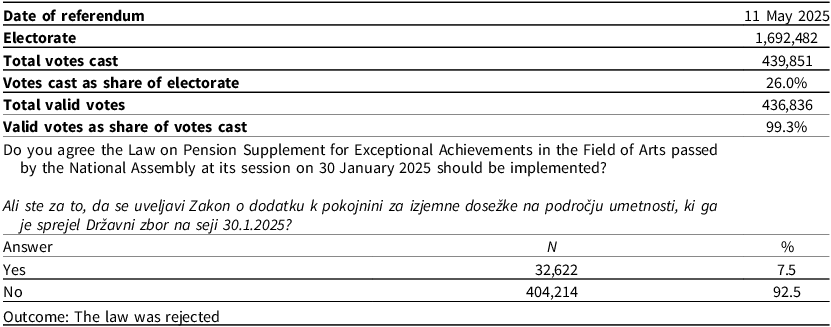
In Slovenia, a law that is subjected to a legislative referendum is rejected if it is voted against by the majority of voters who cast valid ballots, and on the condition that at least one-fifth of all eligible voters voted against it. In anticipation of an adverse outcome, two governmental parties, the Freedom Movement (GS) and The Left party, made a strategic decision and called on voters to abstain from voting. Given the highly specific nature of the proposed legislation, a low turnout was expected in these circumstances. Nonetheless, eventually over one-fifth of all eligible voters voted against the law, which surprised the parties in government (Table 1).
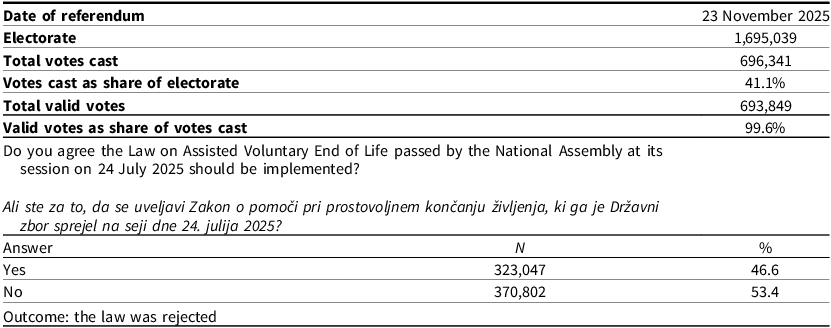
In November, a referendum on the Law on Assisted Voluntary End of Life was held. The Law would allow terminally ill, mentally competent adults who experience unbearable suffering the right to end their lives with medical assistance. It had been drafted according to a proposal that received majority support at a consultative referendum on the topic in 2024. In contrast to the 2024 consultative referendum, when 54.9% of voters who cast a vote favoured adopting such a law, in 2025, after the Law had been first passed by parliament, 53.4% of voters voted against it at a legislative referendum (Table 2). Formally, there were 33 different referendum campaign organisers, including both parliamentary parties and some non-parliamentary ones. This time, governmental parties were much more active (in the Yes camp) than at the referendum on the Law on a Pension Supplement for Exceptional Achievements in the Field of Arts. Both sides of the campaign strongly featured civil society organisations; in the Yes camp the most active was Silver Thread – Association for Dignified Ageing, while in the No camp different organisations represented by Aleš Primc, a prominent conservative activist who also initiated the referendum, were the most active (Slovenia Times 2025c). Although not registered as a campaign organiser in the No camp, the Catholic Church also played an active role, as did the Medical Chamber of Slovenia. Representatives of Silver Thread challenged the result of the referendum and demanded that another vote be held, first at the State Electoral Commission (which dismissed the complaint) and later at the Supreme Court (Al. Ma. 2025a). At the time of writing, the latter has yet to decide the matter.
Cabinet report
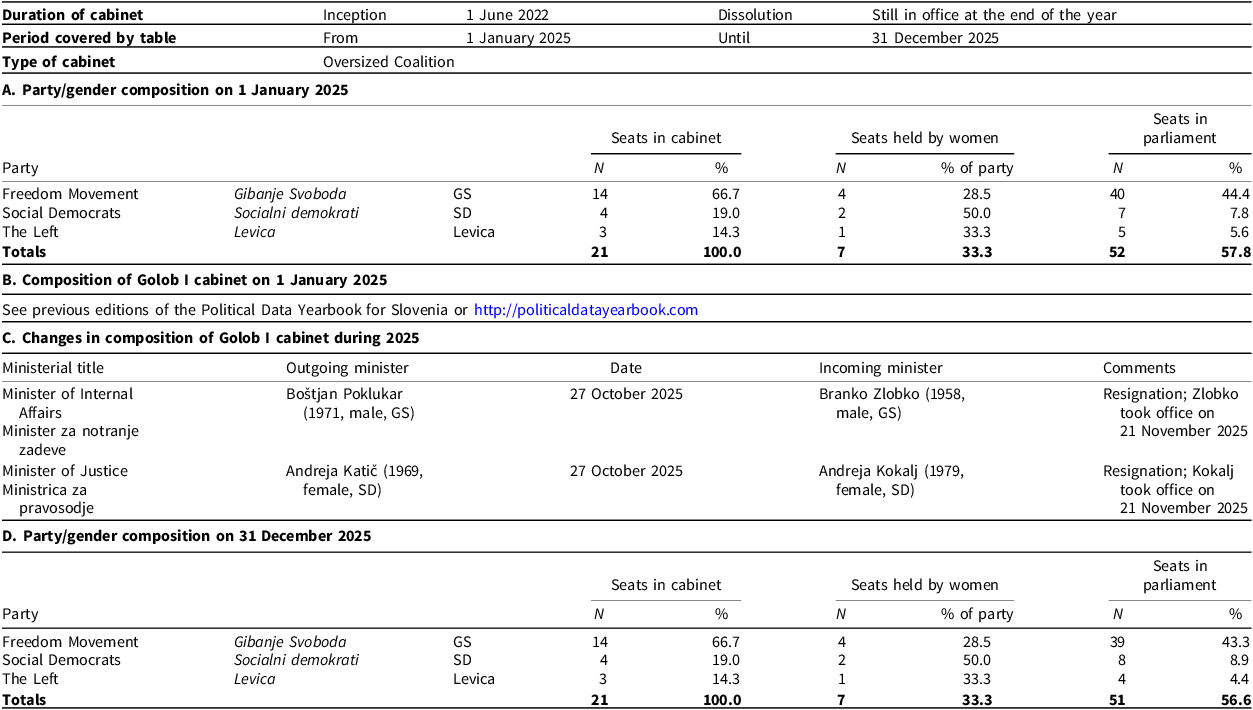
In 2025, the government faced intense scrutiny from the opposition parties SDS and NSi. Both parties initiated four interpellations against ministers and an additional one against the government as a whole, while another interpellation filed at the end of 2024 was discussed at the beginning of 2025. Especially ministers from The Left came under opposition fire, with all three of them facing interpellations. Minister of Internal Affairs Boštjan Poklukar (GS) and his work were placed under scrutiny twice that year. He, along with his ministerial colleagues from The Left, remained in their positions after the interpellations. However, Minister Poklukar resigned, together with Minister of Justice Andeja Katič (SD), at the end of October (Table 3), assuming their political (objective) responsibility following the ‘Šutar’s case’. The resignations were triggered by an incident in late 2025, when a man died in hospital in the city of Novo Mesto after having been assaulted by a member of the local Roma community. This event triggered huge public protests. The unrest took place against the backdrop of a long-standing policy debate: for years, multiple mayors had also been calling for greater security in certain areas of Slovenia along with social policy reforms targeting the Roma population in particular (T. L. Š. et al. 2025).
Parliament report
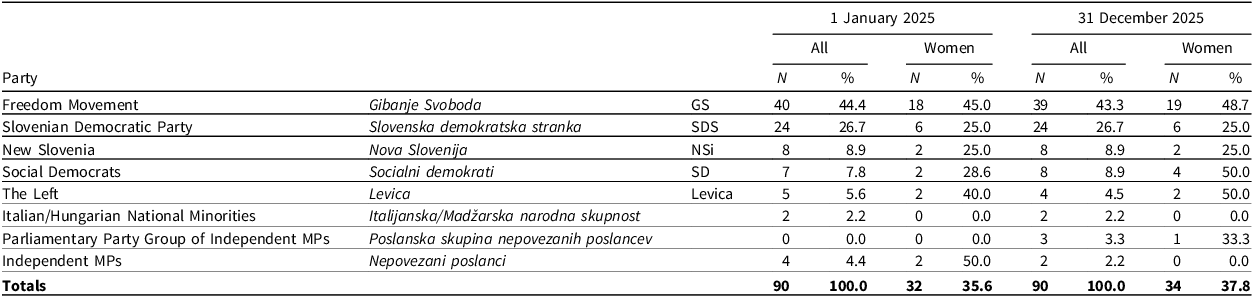
Even though there were no major changes in the composition of the National Assembly (Table 4), a few small ones were observed in some parliamentary party groups (PPGs). In February 2025, two former long-term members of the SDS PPG (see Krašovec Reference Krašovec2025), together with an MP who just days earlier had left the GS PPG, established a parliamentary group of non-affiliated members of the Assembly (three MPs are needed to establish a parliamentary group in the Assembly). Another change in the GS PPG occurred following the appointment of MP Branko Zlobko as Minister of Internal Affairs (Mateja Zupan Josipovič replaced Zlobko in the Assembly).
Mojca Šetinc Pašek, who left GS and became an independent MP in 2024, joined the SD PPG in September. SD PPG leader Jani Prednik resigned as the MP when his ex-partner reported him for psychological and physical violence (Janja Rednjak replaced Prednik in the SD PPG).
In March, Miha Kordiš, a radical-left-leaning member of The Left PPG, was expelled from the party for serious breaches of the party statute and supposedly disruptive actions (24ur 2025a). In April, Kordiš left the party’s PPG and in November established the new party ‘We, Socialists!, in which he intended to run at the spring 2026 parliamentary elections.
Political party report
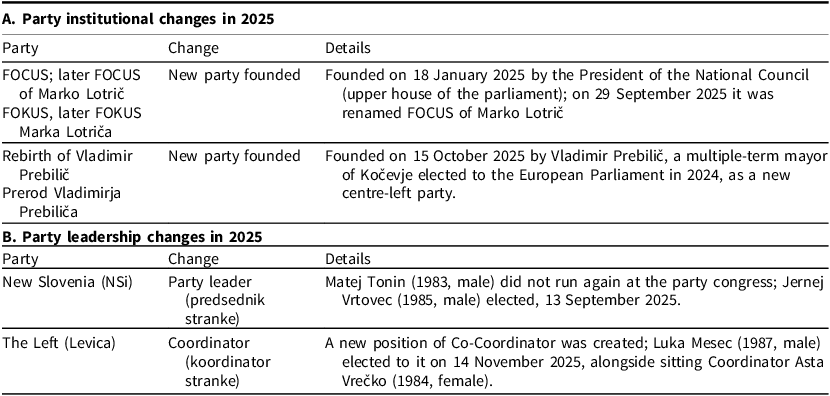
Two parliamentary parties saw a change in their leadership (Table 5). NSi party leader Matej Tonin was elected to the European Parliament in June 2024, with serious questions related to his position as leader of the party being raised since. For some time, a central point of contention within NSi had been his declaration that NSi would not enter any future government led by SDS leader Janez Janša (Slovenia Times 2025d). Janez Janša is the ‘Marmite’ of Slovenian politics: either loved or loathed by voters. Supporters noted his strong leadership, competent government, and carrying through on promises, while critics highlighted the corruption scandals, democratic backsliding under his rule, and friendship and support for illiberal politicians and politics (Haughton et al. Reference Haughton2024). Ideologically, the NSi is very close to the SDS, yet it is also true that by participating in SDS-led governments, the NSi has lost considerable electoral support. In any event, new party leader Jernej Vrtovec clearly supported the idea of potential future co-operation with Janša.
Luka Mesec, who is the most prominent figure in The Left, withdrew from the position of party coordinator in 2023 after the party congress elected a more radical left-oriented composition of the party council (see Krašovec Reference Krašovec2024). Nevertheless, in anticipation of the spring 2026 elections, the statute of The Left was amended to introduce a position of Co-coordinator of the party. In November, Mesec was elected to this position.
Rumours began in 2024 that Vladimir Prebilič, a multiple-term mayor of the small town Kočevje, who gained national prominence during the 2022 presidential elections and in 2024 was elected to the European Parliament, was planning to establish a new centre-left party. In October 2025, this indeed happened – a new party called Rebirth of Vladimir Prebilič (Prerod Vladimirja Prebiliča) was formed in an attempt to continue the decade or so long tradition of electorally successful centre-left new parties (Fink-Hafner Reference Fink-Hafner2024; Haughton et al. Reference Haughton2024). At the beginning of 2025, a party FOCUS (FOKUS) was founded by the President of the National Council (the Council is indirectly elected upper house of the parliament) Marko Lotrič. The party’s main electoral base was supposed to be craftsmen, entrepreneurs, and those who work in the economy, from which Lotrič also comes.
Institutional change report
In 2025, no progress was recorded concerning the constitutional amendment aimed at implementing preferential voting at National Assembly elections, even though 70.9% of voters had voted in favour at a 2024 consultative referendum.
In December, the right to use cash was codified in the Constitution (the new article reads: Everyone has the right to use cash in banking transactions and other forms of legal transactions in accordance with the law). The change to the Constitution had been proposed by at least 30,000 voters in 2023. The proposal built on the assumption that the use of cash as a legal means of payment in Slovenia could be in jeopardy in the future, either by being severely restricted or completely abolished, while the Eurosystem cash strategy stresses that cash contributes importantly to the freedom of choice between different payment methods and is indispensable for the financial inclusion of all groups in society. Support for this change was shown by all PPGs.
Issues in national politics
Several salient issues attracted public and political attention in Slovenia in 2025. Early on in its term in 2022, the centre-left government led by Robert Golob announced many reforms (see Krašovec Reference Krašovec2023, Reference Krašovec2024). The administration succeeded in finalising several policy initiatives, including reforming the public sector wage system and the pension system, accelerating the construction of non-profit housing, introducing a few reforms designed to safeguard the sustainability of the public healthcare system, and also preparing the Long-Term Care Law for implementation. Both of the latter two reforms were heavily criticised by the opposition; the healthcare system reform also drew criticism from the Medical Chamber of Slovenia and several other doctor associations, while the Law on the Long-Term Care faced many implementation problems, together with reluctance from employers’ organisations due to the increased tax burden on them. Business representatives voiced similar concerns regarding the introduction of the mandatory winter bonus (Slovenia Times 2025e) and the announced increase in the minimum wage due to come into force in 2026. These developments aroused the ire of many employers’ organisations, as such measures, had not been negotiated within the tripartite Economic and Social Council and were argued to carry a heavier burden and lead to an unpredictable business environment. (Centre-)right opposition parties, also discontented with such policies, will probably seek to exploit the dissatisfaction of these actors at the next election.
In October, controversy involving a fatality unfolded in the city of Novo Mesto. Years of mounting tensions with Roma communities in the country’s south-east came to a head with the October killing of Aleš Šutar, an individual who went to collect his son from a nightclub and became involved in a fatal altercation with a Roma man, triggering mass protests. In response to the situation, the government quickly put together the ‘Šutar Law’ (the Law on Emergency Measures to Ensure Public Safety), an extensive omnibus law that broadens police powers (in ‘security risk’ areas) and clamps down on access to social benefits (Slovenia Times 2025f). The legislation is largely reactive and aimed at reassuring the public. Opposition parties generally supported the law, but accused the government of responding too late and only after the fatal incident. However, the non-governmental organisation Legal Network for the Protection of Democracy warned that parts of the Šutar law, adopted as an urgent response to an (alleged) perceived rise in public security threats and violent incidents related to the Roma community in Slovenia, were at risk of being unconstitutional. The Network described the Law as having been adopted through an emergency legislative procedure and containing broad and intrusive provisions that seriously undermine constitutional guarantees, human rights standards, and the rule of law.
Several disagreements between Prime Minister Golob and President of the Republic Nataša Pirc Musar became evident, preventing decisions from being made about a number of important appointments in the economic and political system (L. M. et al. 2025). In many cases, the President of the Republic holds the right to nominate candidates for positions, with the candidates then being appointed by the National Assembly. Disagreements between the two leaders meant that some institutions were without a leader for a long time. This includes the Bank of Slovenia, which has not had a governor since the start of 2025, and the Ombudsman. On the other hand, a new President of the Commission for the Prevention of Corruption also had to be appointed; a public tender was issued for this, yet the president (who alone appoints the President of the Commission) decided not to appoint any candidate and requested that a new tender be arranged (Al. Ma 2025b).
A number of high-profile cases in 2025 were related to officeholders and their alleged corrupt(-risk) activities, or activities that allegedly constitute a breach of integrity. Already in 2023, the Commission for the Prevention of Corruption commenced an investigation against Prime Minister Golob as part of the ‘Bobnar case’ and a possible breach of the integrity rules (see Krašovec Reference Krašovec2023). While the case was still being investigated in 2025, the Commission opened another inquiry to establish whether the Prime Minister had breached integrity law when he and his life companion spent weekend breaks at the Croatian holiday home of a businessman and fellow party member who the government had appointed to a collective body that manages two hospitals (24ur 2025b). In 2025, Mayor of Ljubljana Zoran Janković was, as already in the past several times, the subject of legal scrutiny and the prosecution called for a court-led investigation against him on charges of corruption. The case focused on his alleged participation in a kickback scheme in exchange for steering building permit procedures in Ljubljana. On the other hand, SDS leader Janša was acquitted in the so-called Trenta case, albeit the verdict was not yet final and the prosecution announced it would appeal (see Krašovec Reference Krašovec2025; Slovenia Times 2025g). These developments should be analysed against the backdrop of 2025 Eurobarometer data on perceptions of corruption, which reveal that up to 85% of Slovenian respondents believe that corruption is widespread in the country (EU average: 69%) (European Commission 2025a). The same percentage agreed that corruption exists in the nation’s public institutions. Among Europeans, Slovenian respondents accounted for the biggest share (59%) of those believing that the giving and taking of bribes and abuse of power for personal gain is widespread, especially among politicians at different levels (European Commission 2025a).
While the economic hard data in 2025 were quite favourable for Slovenia, the Fiscal Council – an autonomous state authority supervising the management of fiscal policy – highlighted significant risks. Despite assessing certain aspects of the fiscal and economic situation as very good in the past, it warned that ‘the state budget deficit, excluding intervention measures, increased significantly from EUR 0.2 billion in 2024 to EUR 1.7 billion in 2025. According to the current budget documents, the deficit is expected to further increase in 2026–2027. The high year-end budget deficit was mainly due to economic policy measures (winter bonus and winter allowance, additional financing of health insurance budget) and was, unlike in the previous years, not due to extraordinary circumstances… The high current expenditure growth poses a risk in terms of fiscal sustainability, since it is difficult to bring it down once the rights have been established’ (Fiscal Council 2026). In 2025, the Council cautioned that fiscal stability could be jeopardised if conditions in Slovenia’s broader environment deteriorate. Some warnings of potential risks were also issued by the European Commission by stating that ‘Slovenia faces medium fiscal sustainability risks in both the medium and the long term’ in its 2025 Country Report (European Commission 2025b). The parliamentary opposition warned several times about the government’s fiscal policy and described it as unsustainable.
Developments in the international arena impacted Slovenian politics in 2025 to some extent. A cleavage between governmental and opposition parties on the Gaza situation is worthy of mention, with the former being more supportive of Gaza (Palestine). On the other hand, in the case of the war in Ukraine all major parties still fundamentally agreed to support Ukraine despite different views appearing during the year on how to resolve the war.
Results of the referendum on the Law on Pension Supplement for Exceptional Achievements in the Field of Arts in Slovenia in 2025

Table 1. Long description
The table presents the results of a referendum held on 11 May 2025 regarding the implementation of the Law on Pension Supplement for Exceptional Achievements in the Field of Arts. The table has 10 rows and 3 columns. Row 1: Date of referendum, 11 May 2025. Row 2: Electorate, 1,692,482. Row 3: Total votes cast, 439,851. Row 4: Votes cast as share of electorate, 26.0 percent. Row 5: Total valid votes, 436,836. Row 6: Valid votes as share of votes cast, 99.3 percent. Row 7: Question asked in the referendum, Do you agree the Law on Pension Supplement for Exceptional Achievements in the Field of Arts passed by the National Assembly at its session on 30 January 2025 should be implemented? Ali ste za to, da se uveljavi Zakon o dodatku k pokojnini za izjemne doseke na podroju umetnosti, kiga je sprejel Dravni zbor na seji 30.1.2025?. Row 8: Answer, Yes, 32,622, 7.5 percent. Row 9: Answer, No, 404,214, 92.5 percent. Row 10: Outcome, The law was rejected. The table also includes sources: Dravna volilna komisija (2025); Uradni list Republike Slovenije (2025), Issue 38.
Results of the referendum on the Law on Assisted Voluntary End of Life in Slovenia in 2025

Table 2. Long description
A table summarizing the results of a referendum on the Law on Assisted Voluntary End of Life in Slovenia held on 23 November 2025. The table has 10 rows and 2 columns. Row 1: Date of referendum, 23 November 2025. Row 2: Electorate, 1,695,039. Row 3: Total votes cast, 696,341. Row 4: Votes cast as share of electorate, 41.1 percent. Row 5: Total valid votes, 693,849. Row 6: Valid votes as share of votes cast, 99.6 percent. Row 7: Question asked in the referendum. Row 8: Answer Yes, 323,047 votes, 46.6 percent. Row 9: Answer No, 370,802 votes, 53.4 percent. Row 10: Outcome, the law was rejected. The table includes data on the number of votes cast, the share of the electorate that voted, and the results of the referendum question.
Cabinet composition of Golob I in Slovenia in 2025

Table 3. Long description
The table provides detailed information on the cabinet composition of Golob I in Slovenia for 2025. It includes data on the duration of the cabinet, party/gender composition on January 1, 2025, changes in composition during 2025, and party/gender composition on December 31, 2025. The table is divided into several sections: A, B, C, and D. Section A lists the party/gender composition on January 1, 2025, with columns for seats in cabinet, seats held by women, and seats in parliament. Section B briefly mentions the composition of the Golob I cabinet on January 1, 2025. Section C details changes in the cabinet composition during 2025, including the outgoing and incoming ministers, dates, and comments. Section D lists the party/gender composition on December 31, 2025, with similar columns as Section A. The table includes specific data points for the Freedom Movement, Social Democrats, and The Left parties.
Party and gender composition of the lower house of the Parliament (Državni zbor) in Slovenia in 2025

Table 4. Long description
The table presents the party and gender composition of the lower house of the Parliament in Slovenia on January 1, 2025, and December 31, 2025. It includes data for various political parties and groups, detailing the number and percentage of members for all and women. The table has 9 rows and 8 columns. The columns are labeled as follows: Party, 1 January 2025 All N, 1 January 2025 All %, 1 January 2025 Women N, 1 January 2025 Women %, 31 December 2025 All N, 31 December 2025 All %, 31 December 2025 Women N, 31 December 2025 Women %. The rows list different political parties and groups. Row 1: Freedom Movement, Gibanje Svoboda, GS, 40, 44.4, 18, 45.0, 39, 43.3, 19, 48.7. Row 2: Slovenian Democratic Party, Slovenska demokratska stranka, SDS, 24, 26.7, 6, 25.0, 24, 26.7, 6, 25.0. Row 3: New Slovenia, Nova Slovenija, NSi, 8, 8.9, 2, 25.0, 8, 8.9, 2, 25.0. Row 4: Social Democrats, Socialni demokrati, SD, 7, 7.8, 2, 28.6, 8, 8.9, 4, 50.0. Row 5: The Left, Levica, Levica, 5, 5.6, 2, 40.0, 4, 4.5, 2, 50.0. Row 6: Italian/Hungarian National Minorities, Italijanska/Madarska narodna skupnost, 2, 2.2, 0, 0.0, 2, 2.2, 0, 0.0. Row 7: Parliamentary Party Group of Independent MPs, Poslanska skupina nepovezanih poslancev, 0, 0.0, 0, 0.0, 3, 3.3, 1, 33.3. Row 8: Independent MPs, Nepovezani poslanci, 4, 4.4, 2, 50.0, 2, 2.2, 0, 0.0. Row 9: Totals, 90, 100.0, 32, 35.6, 90, 100.0, 34, 37.8.
Source: Državni zbor Republike Slovenije (2026).
Changes in political parties in Slovenia in 2025

Table 5. Long description
The table is divided into two sections: A and B. Section A details party institutional changes in 2025, and Section B details party leadership changes in 2025. Section A has three rows and three columns. The columns are labeled Party, Change, and Details. Row 1: FOCUS; later FOCUS of Marko Lotri, New party founded, Founded on 18 January 2025 by the President of the National Council (upper house of the parliament); on 29 September 2025 it was renamed FOCUS of Marko Lotri. Row 2: FOKUS, later FOKUS Marka Lotri, New party founded, Founded on 18 January 2025 by the President of the National Council (upper house of the parliament); on 29 September 2025 it was renamed FOCUS of Marko Lotri. Row 3: Rebirth of Vladimir Prebili, New party founded, Founded on 15 October 2025 by Vladimir Prebili, a multiple-term mayor of Kocevje elected to the European Parliament in 2024, as a new centre-left party. Section B has three rows and three columns. The columns are labeled Party, Change, and Details. Row 1: New Slovenia (NSi), Party leader (predsednik stranke), Matej Tonin (1983, male) did not run again at the party congress; Jernej Vrtovec (1985, male) elected, 13 September 2025. Row 2: The Left (Levica), Coordinator (koordinator stranke), A new position of Co-Coordinator was created; Luka Mesec (1987, male) elected to it on 14 November 2025, alongside sitting Coordinator Asta Vrecko (1984, female).
Data availability statement
The data for this article can be found at the PDY Interactive website: http://politicaldatayearbook.com
Acknowledgements
The author acknowledges the financial support received from the Slovenian Research and Innovation Agency – ARIS (Research Core Funding Programme No. P5-0136).
Competing interests
The author declares none.

 Open access

