Significant outcomes
-
∙ The RCT confirmed improvement in the speed index of attention cognitive domain after YT in individuals with schizophrenia.
-
∙ Sustained benefits of brief supervised YT and PE were present for accuracy indices of face memory, abstraction and mental flexibility, and attention; and speed indices of face memory, attention, emotion and spatial memory in the trial participants.
-
∙ Both interventions enhanced memory and attention over a 6 month’s follow-up period.
Limitations
-
∙ A double-blind trial was not feasible, though the single-blind design and the computerised cognitive assessment reduced observer bias.
-
∙ As the study was restricted to clinically stable outpatients and a substantial number of potential participants did not conform to inclusion criteria, further studies to test generalisability are needed.
-
∙ Compliance past the training period was not assessed rigorously.
-
∙ Patients staying far away from the treatment facility could not be included in the study.
Introduction
Impaired cognition is a hallmark of schizophrenia (SZ) (Reference Green and Harvey1,Reference Meier, Caspi and Reichenberg2), with widespread impairments in cognitive domains predating the onset of psychosis (Reference Green and Harvey1,Reference Meier, Caspi and Reichenberg2). Cognitive dysfunction is correlated with functional outcome, and has economic and social ramifications (Reference Abouzaid, Jutkowitz, Foley, Pizzi, Kim and Bates3,Reference Willis, Svensson, Lothgren, Eriksson, Berntsson and Persson4). It increases stigma, adding to illness burden (Reference Millier, Schmidt and Angermeyer5). Current pharmacologic treatments produce improvement in psychotic symptoms, but do not improve cognitive impairments substantially (Reference Kopelowicz and Liberman6,Reference Dunlop and Brandon7). Consequently, non-pharmacologic behavioural treatments are being designed and tested (Reference Green and Harvey1). Many of the current novel cognitive enhancement therapies (CET) comprise intensive, systematic individual training combined with medications (Reference Wykes, Huddy, Cellard, Mcgurk and Czobor8). As yoga includes mindfulness training and physical exercise, it can also be considered a CET (Reference Wykes, Huddy, Cellard, Mcgurk and Czobor8). Systematic studies indicate that the practice of yoga can improve spatial memory (Reference Garfinkel, Schumacher, Husain, Levy and Reshetar9), attention and recall (Reference Nangia and Malhotra10), reduce reaction times and increase accuracy in executive function tasks in a variety of settings (Reference Gothe, Pontifex, Hillman and Mcauley11). Yoga can also improve strategic planning (Reference Tran, Holly, Lashbrook and Amsterdam12), concentration and emotional function in non-psychiatric populations (Reference Berger and Owen13,Reference Pilkington, Kirkwood, Rampes and Richardson14). Yoga training is feasible for individuals with psychotic disorders (Reference Bhatia, Agarwal and Shah15). Some randomised controlled trials (RCTs) of yoga indicated improvements in psychopathology and social cognition in SZ (Reference Vancampfort, Vansteelandt and Scheewe16–Reference Jayaram, Varambally and Behere19), although the benefits were variable (Reference Balasubramaniam, Telles and Doraiswamy17,Reference Cramer, Lauche, Klose, Langhorst and Dobos18,Reference Broderick, Knowles, Chadwick and Vancampfort20). Like yoga, physical exercise is thought to benefit cognitive functions in persons with or without psychiatric disorders (Reference Dishman, Berthoud and Booth21–Reference Knochel, Oertel-Knochel and O’Dwyer26). The benefits of physical exercise for the former have been documented in large studies, as well as meta-analyses (Reference Ten Have, De Graaf and Monshouwer27,Reference Gorczynski and Faulkner28). Specific benefits of aerobic exercise for neurocognitive deficits among people with SZ are being described (Reference Kimhy, Vakhrusheva and Bartels29).
In an open treatment study, we evaluated accuracy and speed indices for eight cognitive domains in relation to adjunctive yoga training for patients with SZ and other disorders (Reference Bhatia, Agarwal and Shah15). We found significant improvement with regard to measures of cognition, after 21 days of adjunctive yoga training, in contrast to treatment as usual (TAU) (Reference Bhatia, Agarwal and Shah15). We selected attention as the primary outcome of interest and designed a randomised controlled trial (RCT) to test our hypothesis (Reference Bhatia, Mazumdar and Mishra30). As physical exercise is a component of yoga and can improve cognitive functions (Reference Malchow, Reich-Erkelenz and Oertel-Knochel25), it was unclear whether the observed beneficial effects of yoga were attributable to physical exercise training that was included in the yoga training. Therefore, we included adjunctive physical exercise training as well as TAU for comparators, along with adjunctive yoga training.
Methods
Study design
A single-blind RCT was implemented to investigate the effects of three interventions, namely TAU, supervised yoga training added to TAU (YT) and supervised physical exercise training added to TAU (PE). Based on our open trial, we chose speed index of attention domain as the primary outcome measure, and included speed and accuracy indices for other cognitive domains as secondary outcome measures (Reference Bhatia, Agarwal and Shah15). Equal numbers of participants were allocated to the three groups.
Hypotheses to test the primary and secondary objectives
Primary hypothesis
YT improves speed index of attention domain among patients with SZ.
Secondary hypotheses
Brief supervised YT improves both speed and accuracy indices of the following cognitive domains: abstraction and mental flexibility, face memory, spatial memory, spatial ability, working memory, sensorimotor, emotion among patients with SZ.
Study site
Department of Psychiatry, Post Graduate Institute of Medical Education and Research, Dr. Ram Manohar Lohia Hospital (RMLH), Delhi, India. RMLH is a large teaching general hospital funded by the Government of India that provides primary/tertiary care to patients from Delhi and surrounding areas free of charge. The majority belong to lower or middle socio-economic classes.
Participants and inclusion/exclusion criteria
Patients above 18 years of age who attended RMLH Psychiatry outpatient clinics from December 2010 to January 2014 were included. Clinically stable outpatients with a clinical diagnosis of SZ (DSM IV) residing in Delhi and willing to participate were referred by their psychiatrists to the RCT research team for assessment, including consensus diagnoses based on DSM IV criteria (Reference Bhatia, Mazumdar and Mishra30). We did not include patients with over 6 month’s history of substance abuse, or patients having any neurological or medical disorder that could deteriorate following yoga/physical exercise or that could confound a diagnosis of SZ. Persons who practiced yoga before enrolment were also excluded.
Assessments and outcome measures
Following written informed consent, a consensus diagnosis was established using DSM IV criteria, based on the Diagnostic Interview for Genetic Studies (DIGS), a semi-structured interview, and available information from medical records and informants (Reference Bhatia, Mazumdar and Mishra30). Cognitive functions were assessed with the University of Pennsylvania Computerized Neurocognitive Battery (Penn CNB) (Reference Gur, Ragland and Moberg31), a validated assessment tool that quantitatively estimates accuracy and speed of performance in cognitive domains known to be impaired in SZ. The Penn CNB incorporates computer-based assessment to minimise observer bias. The cognitive domains included here were accuracy and speed indices for (1) abstraction and mental flexibility; (2) attention; (3) face memory; (4) spatial memory; (5) spatial processing; (6) working memory; (7) sensorimotor dexterity; and (8) emotion processing (Reference Gur, Ragland and Moberg31). Z scores for the cognitive domains were standardised using data from a separate group of Indian control participants (Reference Bhatia, Agarwal and Shah15,Reference GUR, Richard and Hughett32). At study entry, information about additional clinical, physical and social variables was also obtained (Reference Bhatia, Mazumdar and Mishra30). All evaluations, apart from the diagnostic workup and the demographic data were repeated at 21 days (end of training), 3 months and 6 months post-training. Standardised Z scores at all time points are presented in Supplementary Table 1.
Randomisation
Following informed consent and assessment for eligibility, the principal study investigator (T.B.) randomised participants to the YT, PE or TAU in blocks of 12, using an online randomisation program (http://www.randomization.com). Two block randomised lists were prepared in advance to enable age stratified randomisation: 18–30 years or older than 30 years. The age range was based on the mean age of SZ participants enrolled in our prior research studies (Reference Thomas, Bhatia and Gauba33,Reference Bhatia, Garg, Pogue-Geile, Nimgaonkar and Deshpande34). The randomisation lists were stored in a password-protected computer by TB, who did not collect outcome measures, administer any interventions or treat the participants.
Blinding
All recruiters and raters (who administered the cognitive evaluations) were blinded to participants’ intervention group status throughout the study. The outpatient intervention and appointment schedules for all patients were determined by the patients’ psychiatrists, who also remained blinded to the adjunctive intervention groups. The YT and PE instructors, who managed the research evaluation schedule for each participant, were not blinded. Due to the nature of the intervention, the participants could not be blinded to their intervention group assignment, but they were asked not to reveal their assignment to the raters or their therapists.
Intervention
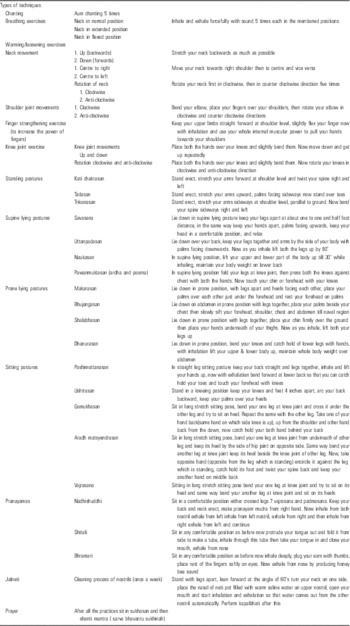
Clinical intervention as usual continued for all study participants. The manualised interventions – YT or PE training – were provided by qualified instructors to groups of participants in 1-h sessions every day for 21 consecutive days, with the exception of Sundays and public holidays (Reference Bhatia, Mazumdar and Mishra30). YT comprised postures, breathing and weekly nasal cleansing as detailed (Reference Bhatia, Mazumdar and Mishra30,Reference Duraiswamy, Thirthalli, Nagendra and Gangadhar35) (see Supplementary Materials). The trainees were supervised during all training sessions, and participated willingly and regularly. PE included brisk walks, followed by jogging and directed aerobic exercises. The protocol of physical exercise was adopted from a published paper, that is, Duraiswamy et al. (Reference Duraiswamy, Thirthalli, Nagendra and Gangadhar35) and it is part of their Supplementary Material (Reference Duraiswamy, Thirthalli, Nagendra and Gangadhar35). Both YT and PE training were imparted in groups as far as possible to reduce cost. The number of participants trained at any time was one to five. One YT instructor and one PE instructor were imparting training separately. Blood pressure and heart rates were monitored. The participants were advised to continue TAU, YT or PE past the training period.
Monitoring compliance post-training
After 21 days of supervised training, the participants were provided with a yoga training booklet along with compliance charts and were instructed to continue practicing at home and keeping records. However, there was no further directed training. The compliance charts had a grid showing dates on the left and questions regarding times, duration and monitoring of yoga in the title row. Whenever the participant practiced yoga or exercise, s/he made a tick mark in the box in front of the date. The compliance charts were to be maintained by participants and their relatives. Compliance records were collected at 3 and 6 months follow-up. Those who failed to return the charts were considered conservatively as non-compliant.
Data and safety monitoring
The study was approved by the Institutional Ethics Committee at PGIMER-RMLH, and the Institutional Review Board, University of Pittsburgh. All participants were screened for any injury or condition that might interfere with YT/PE. All data were stored in password-protected computers and special password-protected databases. A Data Safety Monitoring Board of external experts was constituted and the progress of the project was monitored annually for the first 3 years and bi-annually for the following 2 years. The study was registered with the National Institute of Health registry, registration number NCT01879709. There was no provision for registering yoga/PE intervention trials in India at the time the trial began.
Sample size
Based on our prior study, we estimated that a sample of 234 participants had 85% power to detect changes in cognitive domains with small effect size (0.15) at α=0.05 (Reference Bhatia, Agarwal and Shah15). We enrolled 340 participants to compensate for attrition.
Data analysis
Data were entered manually, double checked and all inconsistencies were rectified in consultation with research staff. Data were also scrutinised to identify out of range values that were examined and discrepancies corrected from source files. Cognitive function data recorded in the Penn CNB do not require manual data entry and were stored at the CNB database at the University of Pennsylvania; these data were retrieved twice to eliminate downloading errors. Distributions of variables were examined for normality and no transformations were needed.
The hypothesis testing was performed in two stages. The first set of comparisons consisted of ‘between-group’ comparisons, that is, changes in each cognitive domain were compared between the three intervention groups. The second set consisted of ‘within-group’ comparisons, that is, changes in each cognitive domain over time were investigated within each intervention group.
Between-group comparisons
With four time points, baseline (pre-training), 21 days (end of training), 3 and 6 months (post-training), we used a mixed model repeated measures analytical method to test our primary and secondary hypotheses. The model included group (YT, PE, TAU), time (baseline, 21 days, 3 months, and 6 months), time×group interaction, gender, age and head of household (HOH) occupation (a proxy for socio-economic status taken from the DIGS). We used SAS® software PROC MIXED (36). All hypotheses were tested using the ESTIMATE statement in PROC MIXED. Adjustments for multiple comparisons for the secondary hypotheses were performed using the Hochberg procedure (Reference Blakesley, Mazumdar and Dew37). The primary hypothesis was not adjusted for multiple comparisons as it involved a single measure, namely ‘Speed index of attention domain’. Effect size estimates comprised of standardised regression coefficients of the contrast-specific dummy group variables from linear regressions estimated at each assessment point. The dependent variables were the changes of follow-up scores from the baseline scores. Age, gender and HOH occupation were used as covariates.
Within-group comparisons
For the three intervention groups (YT, PE, TAU), effect sizes for the changes in cognitive domains at different assessment points in relation to baseline values were calculated by Cohen’s d, adjusted for the covariates age, gender and HOH occupation. Changes from baseline were also examined from mixed model analysis.
Results
Study data
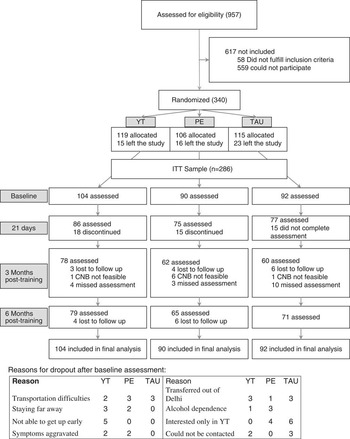
Out of 957 patients referred by RMLH psychiatrists, 340 were eligible based on detailed evaluations, inclusion criteria and consent to randomisation (Fig. 1). In total, 54 individuals withdrew from the study for personal reasons without any baseline assessments (YT 15, PE 16, TAU 23). The reasons for withdrawal included (i) relatives not available to come along as participants were unable to come alone (YT 3, PE 4, TAU 5); (ii) symptoms worsened (YT 4, PE 4, TAU 3); (iii) interested only in yoga; dropped out on finding they were not assigned to YT(PE 2; TAU 8); (iv) lost contact after randomisation. Thus, the intention-to-treat (ITT) sample consisted of 286 participants.
Study flow chart. CNB, Computerized Neurocognitive Battery; ITT, intention-to-treat; PE, supervised physical exercise training with TAU; TAU, treatment as usual; YT, supervised yoga training with TAU.

The reasons for dropout (n=48) in the YT and PE groups included transportation difficulties (YT 2; PE 3; TAU 3), staying far away (YT 3; PE 2); not able to get up early (YT 5); symptoms aggravated (YT 2; PE 2); and being transferred out of Delhi (YT 3; PE 1; TAU 3). One YT and three PE participants were found to be dependent on alcohol following randomisation and were excluded from the study. Four PE participants later told that they were not interested in PE. Six participants in the TAU dropped out as they preferred YT. The other participants could not be contacted further. Participants were asked in an open format whether they had any problem during training and at follow-up points, none were reported.
Baseline characteristics
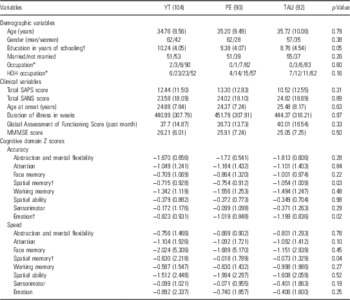
The baseline demographic, clinical and cognitive features are provided in Table 1. The sample included clinically stable individuals. We measured Scale for Assessment of Positive Symptoms (SAPS) and Scale for Assessment of Negative Symptoms (SANS) scores for last 1 month at inclusion. The mean SAPS score was 12.08 (12.32). The mean SANS score was 24.14 (18.26). The participants were not symptomatic during training.
Baseline demographic, clinical and cognitive characteristics of the intention-to-treat sample

HOH, head of the household; MMMSE, Modified Mini Mental State Examination from Diagnostic Interview for Genetic Studies (DIGS); PE, supervised physical exercise training with TAU; SANS, Scale for Assessment of Negative Symptoms; SAPS, Scale for Assessment of Positive Symptoms; TAU, treatment as usual; YT, supervised yoga training with TAU.
Continuous variables listed as mean (SD). Performance estimates for cognitive domains are listed as the mean (SD) of standardised Z scores as described in Methods section.
* Occupations were considered under the following four categories, derived from the DIGS: managerial and professional specialty occupations; technical, sales and administrative support occupations; service occupations (household, protective); and all other occupations (farming, forestry, fishing, mechanic, construction, transportation, labourers, armed services, homemaker, student, unemployed, retired).
† No significant difference after adjustment for multiple comparisons.
There were no statistically significant differences among participants in the three groups in the ITT sample following Bonferroni corrections for demographic, clinical as well as cognitive variables. There were no significant differences between those who completed the 21-day assessment (N=238) and those who discontinued after baseline assessment or did not complete the 21-day assessment (N=48) with regard to demographic, clinical and cognitive variables (Supplementary Table 2).
Missing values
We assumed all intermittently missing data, that is, individuals who missed a visit but came back for the next visit as ‘missing at random’ (MAR). Reasons for study dropouts, as detailed earlier and also given in Fig. 1, were personal, not related to earlier observations or covariates. Hence, dropouts were also considered as MAR.
Medications, substance abuse
The participants in the YT, PE and TAU groups did not differ significantly with regard to type of antipsychotic medication. The number of participants for whom the prescribed doses or types of antipsychotic drugs were changed during the training period or during follow-up did not vary between the intervention groups (data available with authors). There were no significant differences among three groups with regard to smoking status (Supplementary Table 3). The groups did not include any individuals who reported abusing alcohol or illicit substances during or 6 months before the study. Therefore, medications, smoking status or substance abuse were not used as covariates for subsequent analyses.
Between-group comparisons
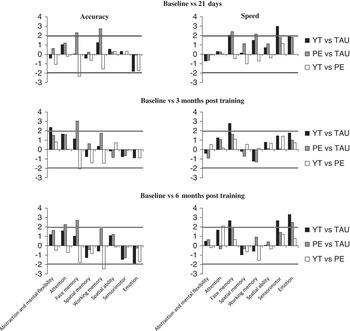
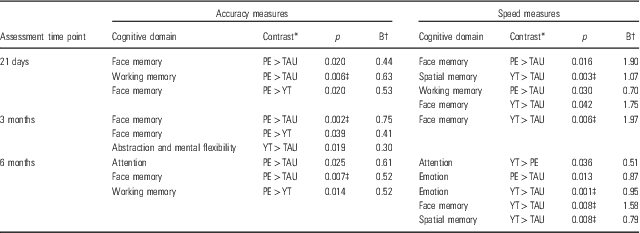
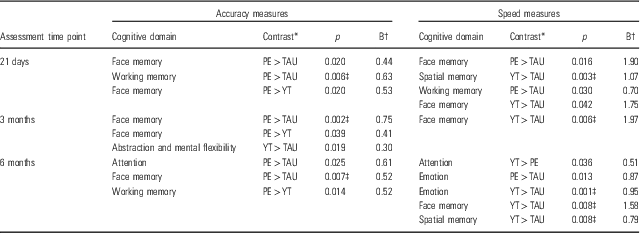
Comparisons of changes calculated from contrasts in cognitive domain scores from baseline between pairs of intervention groups are given in Fig. 2. The horizontal line at 1.96 mark shows statistically significant and non-significant contrasts. The statistically significant contrasts are given in Table 2 and are discussed below. The table includes contrast-specific uncorrected p-values and effect sizes. Contrasts that retained significance after correction for multiple hypothesis testing were marked in the table with a suffix and a footnote. Supplementary Table 4 provides a full list of all contrasts estimates, standard errors and uncorrected significance levels (p-values).
Comparisons of changes in cognitive domain scores from baseline between pairs of intervention groups. The X axis shows individual cognitive domains, with accuracy measures on the left and speed measures on the right. The Y axis shows t-values while comparing pairs of treatment groups. The statistical significance level is indicated by a horizontal line at 1.96. PE, supervised physical exercise training with TAU; TAU, treatment as usual; YT, supervised yoga training with TAU.

Statistically significant contrastsFootnote * between baseline and post-training assessments
PE, supervised physical exercise training with TAU; TAU, treatment as usual; YT, supervised yoga training with TAU.
* Contrasts were calculated from mixed model analysis with group (YT, PE, TAU), time (baseline, 21 days, 3 months and 6 months), time×group interaction, gender, age and head of the household (HOH) occupation. The p-values represent contrast significance levels.
† Standardised regression coefficients of the contrast-specific dummy group variables from linear regressions were used as measures of effect sizes. The dependent variables were the changes of follow-up scores from the baseline scores and age, gender and HOH occupation as covariates.
‡ Significant following Hochberg adjustment.
Test of the primary hypothesis
The speed index in the attention domain in the YT group showed greater improvement than the PE group at only 6-month follow-up (p<0.036, effect size 0.51) (Table 2).
Tests of the secondary hypotheses
The significant results using uncorrected p-values (at p=0.05) for contrasts comprising the secondary hypotheses are summarised below when the intervention groups were compared for the improvements from the baseline with different assessment time points (21 days, 3 months and 6 months) for the eight cognition domains (Table 2).
For the speed index, the YT group performed significantly better than the TAU group for spatial memory (21 days, 6 months), face memory (21 days, 3 months and 6 months) and emotion (6 months). The PE group was significantly better than the TAU group with regard to face memory (21 days), working memory (21 days) and emotion (6 months). For the accuracy index, the PE group performed significantly better than TAU in several domains: face memory over the follow-up period (21 days, 3 months and 6 months), working memory (21 days) and attention (6 months). Improvements in the PE group were significantly greater than the YT group for face memory (21 days and at 3 months) and for working memory (6 months). The YT group improved significantly more than TAU for abstraction and mental flexibility at 3-month follow-up. Eight contrasts retained significance following Hochberg adjustments (Reference Blakesley, Mazumdar and Dew37) for multiple comparisons for the seven correlated cognitive domains analysed in the secondary hypotheses (marked with a suffix in Table 2) and are detailed below.
Speed index
YT was better than TAU for spatial memory at 21 days and 6 months, YT was better than TAU for face memory at 3 months and 6 months, and YT was better than TAU for emotion at 6 months.
Accuracy index
PE was better than TAU for working memory at 21 days, PE was better than TAU for face memory at both 3 and 6 months.
In summary, our results showed that both interventions enhanced memory and attention over the follow-up, more so for the speed index.
Within-group changes over time
The accuracy index in the attention domain improved over the follow-up period in both YT and PE groups. For several other cognitive domains for both speed and accuracy indices, improvements were observed with YT and PE at all follow-up time points. Results from our mixed model analyses are in conformity with these findings (data not shown).
Clinical variables
We analysed SANS, SAPS and Global Assessment of Functioning (GAF) scores at every time point. We did not find any significant changes from baseline.
Compliance analysis
Compliance charts, filled by the patients and their relatives were returned by 75 (87%) YT and 59 (79%) PE participants at the 3-month assessment points and 75 (87%) YT and 64 (85%) PE participants at the 6-month assessment points. Compliance charts were unavailable from 27 participants at the 3-month assessment (YT 11; PE 16) and from 22 participants at the 6-month assessment (YT 11; PE 11). In YT group, 57% and 51% were compliant at 3 and 6 months, respectively, whereas in PE group 49% and 41% are compliant. There were no significant differences between the YT and PE groups with regard to the proportions of non-available data at both assessment time points. The compliance between the YT and PE groups was compared using the proportion of individuals who reported continuing the supplementations and those who did not report continuation for 3 months and 6 months post-training. No significant differences between the two groups were found in both periods considered. Compliance numbers are given in Supplementary Table 5.
Discussion
The trainees were supervised during all training sessions, and participated willingly and regularly. YT participants told the yoga instructor that yoga has made them more active. The relatives repeatedly enquired about any new programmes of YT after completion of the project also. So, we believe that YT and PE were well accepted by the participants. Compliance in both groups was satisfactory and no adverse effects were encountered in the study. The improvement in the speed index of attention domain with adjunctive YT supports the primary hypothesis generated from our earlier open, pilot trial (Reference Bhatia, Agarwal and Shah15,Reference Bhatia, Mazumdar and Mishra30). Consistent with our earlier study, YT improved other cognitive functions too. In agreement with earlier studies among individuals with or without SZ (Reference Gorczynski and Faulkner28,Reference Forbes, Thiessen, Blake, Forbes and Forbes38–Reference Strassnig, Signorile and Potiaumpai43) persons who received PE training also showed significant improvement in several cognitive domains (including attention), although the pattern of improvement was different from the YT group. Similar to our study, Lin et al. (Reference Lin, Chan and Lee44) reported that yoga and aerobic exercise improved working memory in early psychosis patients, with yoga having a larger effect on verbal acquisition and attention than aerobic exercise. We used wider inclusion criteria – clinically stable outpatient with a clinical diagnosis of SZ. In contrast to the effects of YT and PE, cognitive functions did not change noticeably for the TAU group, discounting the possibility that the cognitive improvement with YT or PE was due solely to practice effects. The YT and PE benefits, while modest, are similar to encouraging results from other CETs that do not utilise physical exercise (Reference Wykes, Huddy, Cellard, Mcgurk and Czobor8). The improvements with YT or PE might not be remarkable among healthy individuals, but they should be underscored for patients with SZ, among whom compliance can vary and among whom cognitive impairment is refractory to medications and worsens long-term prognosis (Reference Arango and Amador45,Reference Arango, Bartko, Gold and Buchanan46).
In general, the cognitive domains that improved at the 21-day assessment showed continued improvement at the 3- and 6-month assessment points, supporting the notion of a sustained effect from the relatively brief interventions. Some domains, like abstraction and mental flexibility in the YT group and spatial memory in the PE group, showed statistically significant improvement only at the 6-month assessment, suggesting incremental improvement. The improvement in cognitive functions at the 6-month assessment with YT and PE is remarkable, as it was sustained during the unsupervised, post-training period, when compliance could be irregular. The sustained benefits of YT and PE have important therapeutic implications that justify the intensive supervised training.
There are several explanatory pathways for the improvement with YT and PE. Social stimulation, such as gathering in clubhouses can improve social and cognitive function (Reference Cowell, Pollio, North, Stewart, Mccabe and Anderson47), but it is unlikely to be the sole explanation, as the patterns of improvement differed in the YT and PE groups. Moreover, they were sustained beyond the training period. Some improvement with YT could be due to the physical exercise components of YT, but the pattern of changes differed between the YT and PE groups. Moreover, our YT protocol also included ‘pranayama’, a breathing technique that includes relaxation and meditation. Whether the pranayama itself or its combination with the physical exercises also contributed to the YT improvement is uncertain. We favour a combination of effects consistent with the holistic approach of the yoga philosophy, which promotes self-awareness, acceptance and the ability to be present in the moment.
The biological pathways that might mediate the beneficial effects are uncertain. Yoga elevates oxytocin levels, which can improve emotion recognition (Reference Jayaram, Varambally and Behere19). YT also reduces cortisol levels and thus may have an indirect neuro protective action (Reference Rao, Varambally and Gangadhar48). A more substantial literature is available to explain the beneficial effects of PE, which improves stress coping mechanisms, multi-tasking abilities, information processing efficiency, as well as cardiovascular and metabolic health (Reference Dishman, Berthoud and Booth21,Reference Stein, Collins, Daniels, Noakes and Zigmond22,Reference Knochel, Oertel-Knochel and O’Dwyer26,Reference Ten Have, De Graaf and Monshouwer27,Reference Vancampfort, De Hert and Knapen49–Reference Duman52). PE is also reported to improve brain perfusion along with memory tasks (Reference Massin42) and could enhance neuronal plasticity (Reference Cotman and Berchtold39–Reference Pereira, Rifas-Shiman, Kleinman, Rich-Edwards, Peterson and Gillman41). In mice, exercise can stimulate adult hippocampal neurogenesis resulting in improvement in learning and memory (Reference Van Praag, Shubert, Zhao and Gage53). To sum up, it is likely that several complementary mechanisms enable the beneficial effects.
Some limitations of the study should be noted. A double-blind trial was not feasible, though the single-blind design and the computerised cognitive assessment reduced observer bias. As the study was restricted to clinically stable outpatients and a substantial number of potential participants did not conform to inclusion criteria, further studies to test generalisability are needed. Face recognition test in the Penn CNB has western faces and empirical data regarding their use in Indian context is not available. Though lack of engagement or lack of sustained motivation could be a limiting factor for individuals with SZ (and engagement and motivation are required for the practice of yoga or physical exercise), the improvement available with either YT or PE provides greater choice. Finally, compliance past the training period was not assessed rigorously. The trajectory observed with some cognitive functions could arguably be improved if compliance was monitored more rigorously after the training period. We attempted to minimise bias by blinding, randomisation and concealment of allocation as suggested by Broderick et al. (Reference Broderick, Knowles, Chadwick and Vancampfort20).
There are several avenues for future investigations. The sustained effects of YT and PE at the 6-month assessment points are intriguing and need to be explored further. In addition, modification of the YT and PE training modules, or combined YT and PE could provide further benefits. Alternatively, YT and PE could be evaluated in conjunction with other CETs. Wykes et al. (Reference Wykes, Huddy, Cellard, Mcgurk and Czobor8) suggested that CETs should be combined strategically with planned psychiatric rehabilitation, an avenue that was not explored here. Whether YT or PE can benefit patients with unstable clinical status should also be explored. It may be necessary to adapt the PE and YT regimes for such individuals; for example, with alternate day training.
In conclusion, our RCT confirmed the improvement in the cognitive domain of attention noted with YT in individuals with SZ in our pilot trial. The trial also indicated sustained benefits of brief supervised YT and PE for several cognitive domains in the same individuals. Understanding the mechanism of the beneficial effects of these interventions may help individualise therapies.
Acknowledgement
The authors wish to thank the members of our dedicated study team for their efforts: N.N. Mishra (PhD), Gyan Deepak Shah (MSc), Hemant Pande (MA, Yoga), Sreelatha S. Narayanan (MA), Deepak Malik (MPhil), Nupur Kumari (MPhil), Manoj Nandal (BPed, Physical Education) (Department of Psychiatry, PGIMER-Dr. RML Hospital, New Delhi, India). The authors also thank Dr. R.P. Beniwal (MD), Dr. Rahul Saha (MD), Dr. Shiv Prasad (MD), Dr. Shrikant Sharma (MD), Dr. Satnam Goyal (MD), Dr. Kiran Jakhar (MD), Dr. Mona Chowdhary (MD) and all other clinicians at the Department of Psychiatry, PGIMER-Dr. RML Hospital for referring the patients to the study. The authors thank our study consultants Dr. Rajesh Nagpal (MD) (Manobal Klinik, New Delhi, India) and Dr. S. N. Pande (PhD) (Indira Gandhi Technological and Medical Sciences University, Ziro, Arunachal Pradesh, India). The authors would like to thank DSMB members Dr. W. Selvamurthy, Prof. R. Ganguli, Dr. V. Srieenivas, Dr. J. Brar, Dr. A. Balsavar. The authors gratefully thank Sue Clifton (ME) (University of Pittsburgh Medical Center, WPIC, Pittsburgh, USA) for her editorial assistance. The authors are deeply grateful to our participants and families for their sincere participation.
Financial Support
The work was supported by the Fogarty International Center, the NIH Office of the Director Office of Behavioral and Social Science Research and the National Center for Chinese and Alternative Medicine, of NIH (R01TW008289) to T.B.; and Tri National Training Program in Psychiatric Genetics (TW008302) to V.L.N. and S.N.D.; and NIH funded grant A Neurobehavioral Family Study of Schizophrenia to V.L.N. (MH63480-06A). The content is solely the responsibility of the authors and does not necessarily represent the official views of NIH. Fogarty International Center, NIH had no role in the design and conduct of the study; collection, management, analysis and interpretation of the data; preparation, review or approval of the manuscript; and decision to submit the manuscript for publication.
Supplementary Material
To view supplementary material for this article, please visit http://dx.doi.org/10.1017/neu.2016.42
Appendix 1
Yoga Protocol